New plans to keep the waters flowing Water scarcity is an increasingly pressing issue across south-western Europe, and with climate change intensifying, a new approach to managing resources is required. As leader of the TARGET project, Amélie Bresson is part of a team of researchers developing management plans to integrate water from non-conventional sources. The countries of south-western Europe
Water scarcity
face growing challenges in maintaining drinking water supplies to their populations, with human-induced pressures placing great strain on existing freshwater resources. Regions across France, Spain and Portugal have experienced disruptions to drinking water supplies over recent years, and the problem is set to grow more acute in future, as climate change intensifies. “The frequency of supply disruptions is increasing, and the problem is likely to become increasingly severe in the coming years,” acknowledges Amélie Bresson, Head of Quantitative Management of Water Resources at EPIDOR, the public authority of the Dordogne river basin, in France. The scale of the challenge requires effective collaboration, so now EPIDOR and nine other partners from across France, Spain and Portugal have come together in the TARGET project, investigating how nonconventional water can be integrated into management plans, and so alleviate scarcity concerns. “In the project we are looking in particular at treated wastewater, while we also consider runoff water from roofs and industrial processing,” outlines Bresson.
This reflects a general recognition that a new approach to water management is needed if the resilience of supplies is to be maintained, with droughts and heatwaves across Spain and Portugal in particular having led to marked shortages in recent years. New management plans will be developed for several pilot regions in south-western Europe, including the Dordogne river basin, an area of around
conventional resources. “The olive crop in few regions of Andalucia is irrigated entirely with non-conventional waters, for example,” continues Bresson. “We’re looking at how we can use these waters efficiently and preserve freshwater supplies for drinking.” The management plans must also have the consent of local people, those who will be affected by new ways of using nonconventional water, so their attitudes
“We’re looking at how we can use non-conventional waters efficiently. The olive crop in few regions of Andalucia is irrigated entirely with non-conventional waters for example.” 24,000 km2. “It’s a very large territory, with maybe five urban areas, while the rest of the area is very rural. The main part of demand is for drinking water, but there is increasing demand from the agricultural sector as farmers consider switching to different types of crops,” outlines Bresson. Further pilot work is ongoing in the Spanish city of Granollers, which has been promoting the use of regenerated water for over 25 years, while other areas are also making use of non-
and opinions also need to be taken into account. While many people are fully aware of the need for action, having experienced droughts and shortages, they may still be wary of using treated wastewater – or regenerated water – an issue that Professor Lucia Poggio is addressing as part of her role in the project. “I’m investigating people’s risk perceptions about wastewater, and the social acceptability of using it, among both lay people and experts. I aim to understand
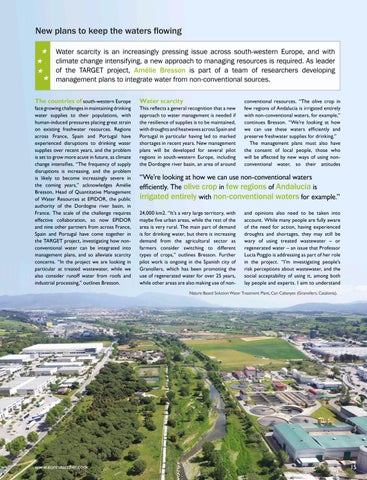
Nature Based Solution Water Treatment Plant, Can Cabanyes (Granollers, Catalonia).
www.euresearcher.com
15
the barriers to using regenerated water,” she explains. Interviews have been conducted with experts in each of the three countries, now Professor Poggio plans to gauge the views of lay people, building on the responses of experts. “We’re going to ask questions of 450 people in each country, to investigate the main barriers to using treated wastewater,” she continues. “We’re also going to look at the gaps between expert views and the opinions of lay people.” An example could be the gap between public perceptions of how clean water needs to be for a particular application, and the actual guidance from the relevant authorities. There are almost always some impurities present in water, and quality thresholds vary according to the nature of the intended application. “People may be ready to accept the use of treated wastewater for cleaning the streets for example, but they might be more concerned about it being used to irrigate agricultural fields, and even more so about using it as drinking water,” explains Professor Poggio. There is typically a gap between experts and lay people in this respect, says Professor Poggio. “Lay people tend to focus more on what they can feel or see, while experts focus on using their expertise and analysing the water,” she outlines. “Lay people may also have some false beliefs about safe water use. They may not be aware that
Obtaining reclaimed water following the NBS process at Can Cabanyes, 25 March 2025.
it’s actually more dangerous to heat water in a microwave than it is to use regenerated water for example.”
Treated wastewater As part of her work in the project Poggio is now probing these attitudes and investigating public perceptions about the risks of using treated wastewater across three different applications, namely urban, recreational and agricultural use. The fieldwork is currently ongoing, and Professor Poggio anticipates it will reveal some significant variations across Spain, Portugal and France. “I expect that the risk perceptions
associated with these three uses will be very different across the three countries,” she says. Initial findings suggest that populations in the French regions covered by the project are ready to consider new ways of re-using water, while at the same time they are often also very environmentally aware. “They may have looked into different ways of obtaining water, like collecting rainwater, while in many cases they are very aware of their own use and take steps to reduce their consumption,” says Professor Poggio. “By contrast Spanish and Portuguese people are typically less concerned about environmental issues.”
The project team is currently collecting data, which will then be subjected to rigorous analysis, and Professor Poggio will present the findings at a number of conferences across Europe. Several research papers are in development, which Professor Poggio hopes will stimulate wider interest and debate. “Our research is generating a lot of interest in the environmental psychology field,” she says. This research holds wider relevance in terms of helping regional and city authorities across the three countries deal with water scarcity issues, taking into account public perceptions and the nature of local demand. “The main goal in the project was to produce a method for integrating non-conventional waters and to provide methodological advice to deal with water scarcity,” says Bresson. “Some of our partners are looking at economic considerations around this, while we also have some more technical work in the project, about using nature-based solutions in wastewater treatment for example.” This research has been focused on the pilot regions, yet water scarcity affects many other countries beyond Portugal, France and Spain, and with the issue growing ever more prominent Professor Poggio says there is a lot of interest in the project’s
Th e
TARGET
Territorial Strategy for watEr Scarcity
Project Objectives
The TARGET project has identified a need and an opportunity for cooperation to integrate unconventional waters into local water management. The objective is to develop a method for formulating territorial strategies for sustainable water management and the prevention of water scarcity.
Project Funding
ERDF assistance: 1.414.335,53 euros Eligible cost: 1.885.780,71 euros Second meeting of the project (Granollers, 2025).
work. Existing freshwater resources are under intense pressure, in large part due to over-extraction, underlining the urgency of managing them effectively. “We’re promoting the water management plans for local decision-makers, including city authorities and rural municipalities,” continues Bresson. The long-term aim is to match water quality with the needs of the intended application, so protecting freshwater resources for the future, and some regions are already well advanced in this respect. “Our Portuguese partners have done a foresight study, considering the integration of unconventional waters, looking ahead to 2030 and even 2050,” says Bresson.
TARGET Project
The TARGET project is not only about conducting practical research, but also communication and knowledge sharing. Professor Poggio and her colleagues are collaborating closely with other initiatives working in complementary areas, aiming to heighten awareness of water scarcity and promote new management solutions.
Kick off meeting of the project (Seville, July 2024).
Project Partners
• Etablissement Public Interdépartemental de la Dordogne (EPIDOR) • ECOFILAE • Universidad Complutense de Madrid, Facultad de Psicología, Departamento de Psicología Social, del Trabajo y Diferencial • Agencia de Medio Ambiente y Agua de Andalucía - Centro Experimental de Nuevas Tecnologías del Agua • Ayuntamiento de Granollers • Universidad Politécnica de Cataluña, Escuela Técnica Superior de Ingeniería de Caminos, Canales y Puertos de Barcelona, Departamento de Ingeniería Civil y Ambiental • Communauté d’agglomération Le Grand Périgueux • Universidade NOVA de Lisboa, Faculdade de Ciências e Tecnologia, Departamento de Ciências e Engenharia do Ambiente • Centre d’Etudes et d’Expertise sur les Risques, l’Environnement la Mobilité et l’Aménagement, Direction Territoriale Sud Ouest, Département Territoires • Município do Barreiro, Departamento de Águas, Higiene Urbana e Atividades Reguladas, Divisão de Águas e Saneamento
Contact Details
Associate Professor Lucía Poggio Lagares Ph.D Faculty of Psychology Universidad Complutense Madrid 28223 - POZUELO DE ALARCÓN (MADRID) T: +34 91 394 2820 E: luciapoggio@psi.ucm.es : https://www.facebook.com/profile. php?id=61560857292916 : https://www.linkedin.com/company/ target-interreg-sudoe : https://www.youtube.com/@ TARGETInterregSudoe W: https://interreg-sudoe.eu/en/proyectointerreg/target/
Amélie Bresson As part of this work, the project team recently participated in a side event at the Euro-Mediterranean Conference on water reuse, where researchers presented some of their findings. This provided a valuable opportunity for researchers to share their insights and participate in discussions and debate with other professionals working in the water management field. The project’s agenda also encompasses knowledge-sharing at the local level, and three basin stakeholders’ workshops have been held so far to publicise the project’s work. These events provided an opportunity to highlight some of the ways in which water can be managed more effectively and efficiently, and alleviate scarcity concerns. This includes gathering water running off roofs in the three pilot regions, with some 723 roofs covering a total area of around 5,000 m2 . This forms part of a wider strategy to use existing water resources more efficiently and effectively, so limiting the need to import supplies or invest in expensive, energy-hungry desalination plants.
16
EU Research
www.euresearcher.com
Lucía Poggio
Amélie Bresson is a highly skilled professional in the field of water resource management, currently serving as the Head of Quantitative Management of Water Resources. As an agricultural engineer specialised in hydrology, Amélie has dedicated her career to advancing sustainable practices in water management Lucía Poggio is an associate professor at Complutense University of Madrid (UCM) with a PhD in environmental Psychology. She integrates the Environmental Psychology research area, within the Social Psychology Department. Her main research interests are risk perception, climate change, as well as housing and social stereotypes.
17