Smarter River Sediment Management Sediment quietly shapes the health of Europe’s rivers, influencing biodiversity, water quality and navigation, yet it rarely attracts public attention. We spoke to Mihaela Timofti, Oriane Georges and Anja Stipankov Ivanovic about how the SUNDANSE project, coordinated by Dunarea de Jos University of Galati, Romania, is developing innovative tools to help safeguard the Danube-Black Sea system. The Danube is Europe’s second longest river, flowing through Germany, Austria, Slovakia, Hungary, Croatia, Serbia, Bulgaria, Romania, Moldova and Ukraine before emptying into the Black Sea. It provides drinking water for millions of people, supports agriculture and hydropower, sustains rich ecosystems and serves as a vital transport corridor linking Central Europe with the Black Sea. Yet beneath its surface lies a challenge that often goes unnoticed: sediment. Sediment - the sand, silt and organic material naturally carried by rivers - plays an essential role in maintaining healthy aquatic ecosystems. However, when too much accumulates in one place or is washed away from another, it can disrupt habitats, transport pollutants and create major obstacles for inland navigation. These issues are becoming increasingly important across the Danube Basin. While some stretches experience severe erosion, others suffer from excessive sediment buildup, requiring frequent and costly dredging to keep shipping routes open. Managing this delicate balance forms the focus of the EU-funded SUNDANSE project, which is developing innovative tools and practical solutions to support more sustainable sediment management across the DanubeBlack Sea system.
More than mud Although sediment is often overlooked, it influences almost every aspect of river health. “The Danube supports biodiversity, drinking water supplies, agriculture, energy production, and inland navigation,” explains Dr Mihaela Timofti, environmental chemist and one of the members of the Project Management Office of the SUNDANSE project. “Some parts of the river are affected by excessive sedimentation, while others experience excessive erosion.” Sediment also acts as a carrier for contaminants. Polluted sediments can transport toxic substances downstream, affecting ecosystems far from their original source. At the same time, excessive sediment accumulation reduces water depth in busy navigation channels, making dredging both necessary and expensive.
36
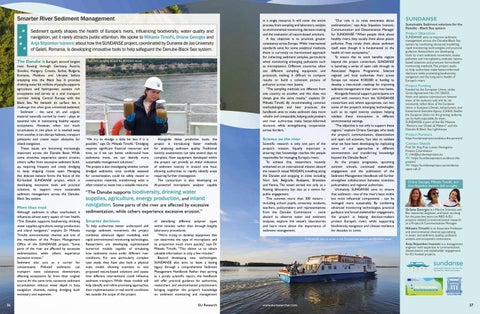
Sediment sampling aboard the REXDAN vessel.
“We try to dredge a little bit less if it is possible,” says Dr. Mihaela Timofti. “Dredging requires significant financial resources and time, so if we can better understand how sediments move, we can identify more sustainable management solutions.” The project is also investigating whether certain dredged sediments, once carefully assessed for contamination, could be safely reused as construction materials, transforming what is often treated as waste into a valuable resource.
Alongside these predictive tools, the project is introducing faster methods for analysing sediment quality. Traditional toxicity assessments can take several days to complete. New equipment developed within the project can provide an initial indication of sediment toxicity in around one hour, allowing authorities to rapidly identify areas requiring further investigation. The consortium is also developing an AI-powered microplastic analyser capable
“The Danube supports biodiversity, drinking water supplies, agriculture, energy production, and inland navigation. Some parts of the river are affected by excessive sedimentation, while others experience excessive erosion.” Smarter decisions To help authorities better understand and manage sediment movement, the project combines advanced digital modelling with rapid environmental monitoring technologies. Researchers are developing sophisticated numerical models capable of simulating how sediments move under different river conditions. For one particularly complex case study, they have also built a physical scale model, allowing scientists to test proposed nature-based solutions and assess how different interventions could influence sediment transport. While these models will help identify and refine promising approaches, their implementation in real-world conditions lies outside the scope of the project.
of identifying different polymer types within minutes rather than through lengthy laboratory procedures. “We’re trying to develop equipment that can determine the type of microplastic and its proportion much more quickly,” says Dr Mihaela Timofti. “This allows us to obtain valuable information in only a few minutes.” Beyond developing new technologies, SUNDANSE also aims to leave a lasting legacy through a comprehensive Sediment Management Handbook. Rather than serving as a purely scientific report, the handbook will offer practical guidance for authorities, researchers and environmental practitioners, bringing together the project’s knowledge on sediment monitoring and management
EU Research
in a single resource. It will cover the entire process, from sampling and laboratory analysis to environmental monitoring, decision-making and the evaluation of nature-based solutions. A key objective is to promote greater consistency across Europe. While international standards exist for some analytical methods, there is currently no harmonised approach for collecting sediment samples, particularly when monitoring emerging pollutants such as microplastics. Different countries often use different sampling equipment and protocols, making it difficult to compare results or build a coherent picture of pollution across river basins. “The sampling methods are different from one country to another, and this does not always give the same results,” explains Dr Mihaela Timofti. By recommending common methodologies and best practices, the handbook aims to make sediment data more reliable and comparable, helping policymakers and river authorities make better-informed decisions while strengthening cooperation across borders.
Science on the river Scientific research is only one part of the project’s mission. Equally important is ensuring that knowledge reaches the people responsible for managing Europe’s rivers. To achieve this, researchers recently embarked on an international mission aboard the research vessel REXDAN, travelling along the Danube and stopping in cities including Novi Sad, Belgrade, Budapest, Bratislava and Vienna. The vessel served not only as a floating laboratory but also as a centre for public engagement. This summer, more than 300 visitors including school pupils, university students, teachers, policymakers and representatives from the Danube Commission - came aboard to observe water and sediment analyses, explore the vessel’s laboratories and learn more about the importance of sediment management.
“Our role is to raise awareness about sedimentation,” says Anja Stipankov Ivanovic, Communication and Dissemination Manager for SUNDANSE. “When people think about healthy rivers, they usually think about plastic pollution. They rarely think about sediment itself, even though it is fundamental to the health of river ecosystems.” To ensure that its work benefits regions beyond the project consortium, SUNDANSE is launching a series of open calls through its Associated Regions Programme. Selected regional and local authorities from across Europe can receive €100,000 in funding to develop a nine-month roadmap for improving sediment management in their own river basins. Alongside financial support, participants are paired with mentors from the SUNDANSE consortium and, where appropriate, can test some of the project’s emerging technologies, such as its rapid toxicity analyser, helping validate these innovations in different environmental settings. “The objective is not only to support these regions,” explains Oriane Georges, who leads the project’s communication, dissemination and open call activities, “but also to validate what we have been developing by replicating some of our approaches in different environments and transferring knowledge beyond the Danube Basin.” As the project progresses, upcoming summer schools, continued stakeholder engagement and the publication of the Sediment Management Handbook will further strengthen collaboration between scientists, policymakers and regional authorities. Ultimately, SUNDANSE aims to ensure that sediment - one of the river’s least visible but most influential components - can be managed more sustainably. By combining advanced monitoring technologies, practical guidance and broad stakeholder engagement, the project is helping decision-makers protect Europe’s rivers while supporting biodiversity, navigation and climate resilience for decades to come.
SUNDANSE team in action in the Danube river aboard the REXDAN vessel.
SUNDANSE Sustainable Sediment solutions for the Danube - Black Sea system
Project Objectives
SUNDANSE aims to improve sediment management across the Danube-Black Sea system by combining advanced modelling, rapid monitoring technologies and practical guidance. Researchers are developing tools to track sediment movement, assess pollution and microplastics, evaluate naturebased solutions and promote harmonised monitoring methods. The project seeks to help authorities make better-informed decisions while protecting biodiversity, navigation and the long-term health of Europe’s rivers.
Project Funding
Funded by the European Union. under Grant Agreement No. 101156533. Views and opinions expressed are however those of the author(s) only and do not necessarily reflect those of the European Union or European Climate, Infrastructure, and Environment Executive Agency (CINEA) Neither the European Union nor the granting authority can be held responsible for them. SUNDANSE is part of the EU Mission “Restore our Ocean & Waters” and the Danube & Black Sea Lighthouse.
Project Partners
https://sundanseproject.eu/about-the-partners/
Contact Details
Prof. Dr. Eng. Puiu Lucian Georgescu Project Coordinator E: info@sundanseproject.eu W: https://sundanseproject.eu/about-theproject/ W: https://sundanseproject.eu/sundanseopen-call-2/
Oriane Georges, Mihaela Timofti, and Anja Stipankov Ivanovic (left to right)
Oriane Georges is a Marine Scientist and Bio-industries Engineer, and been working for the past few years on R&D & EU projects related to environmental research as a Project & Communication Manager. Mihaela Timofti is an Associate Professor and environmental chemist specialising in water and sediment quality, pollutant analysis and ecosystem restoration. Anja Stipankov Ivanovic is a management engineer with expertise in communication, dissemination and stakeholder engagement for EU-funded projects.
www.euresearcher.com
37