Understanding dynamical systems
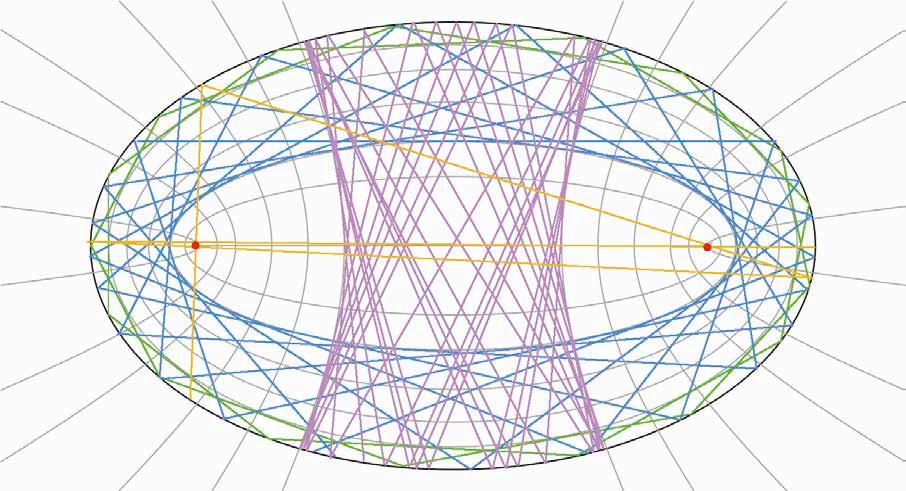
Mathematical billiards provides a playground for researchers to investigate dynamical systems and to look at how they evolve in time. Professor Vadim Kaloshin and his colleagues in the SPERIG project are tackling the Birkhoff conjecture, an open question in the mathematical billiards field, which could open up new insights into the behaviour of dynamical systems.
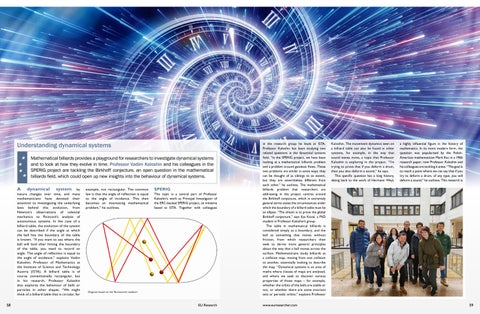
A dynamical system by nature changes over time, and many mathematicians have devoted their attention to investigating the underlying laws behind this evolution, from Newton’s observations of celestial mechanics to Poincaré’s analysis of autonomous systems. In the case of a billiard table, the evolution of the system can be described if the angle at which the ball hits the boundary of the table is known. “If you want to see where the ball will land after hitting the boundary of the table, you need to record an angle. The angle of reflection is equal to the angle of incidence,” explains Vadim Kaloshin, Professor of Mathematics at the Institute of Science and Technology Austria (ISTA). A billiard table is of course conventionally rectangular, but in his research, Professor Kaloshin also explores the behaviour of balls or particles in other shapes. “We might think of a billiard table that is circular, for
example, not rectangular. The common law is that the angle of reflection is equal to the angle of incidence. This then becomes an interesting mathematical problem,” he outlines.
SPERIG
This topic is a central part of Professor Kaloshin’s work as Principal Investigator of the ERC-backed SPERIG project, an initiative based at ISTA. Together with colleagues
in the research group he leads at ISTA, Professor Kaloshin has been studying two related questions in the dynamical systems field. “In the SPERIG project, we have been looking at a mathematical billiards problem and a problem around geodesic flows. These two problems are similar in some ways; they can be thought of as siblings to an extent, but they are nevertheless different from each other,” he outlines. The mathematical billiards problem that researchers are addressing in the project centres around the Birkhoff conjecture, which in extremely general terms states the circumstances under which the boundary of a billiard table must be an ellipse. “The dream is to prove the global Birkhoff conjecture,” says Ilya Koval, a PhD student in Professor Kaloshin’s group. The table in mathematical billiards is considered simply as a boundary, and the ball as something that moves without friction, from which researchers then seek to derive more general principles about the way that a ball moves across the surface. Mathematicians study billiards as a collision map, moving from one collision to another, essentially looking to describe the map. “Dynamical systems is an area of maths where classes of maps are analysed, and where we seek to discover various properties of those maps – for example, whether the orbits of the balls are stable or not, or whether there are some invariant sets or periodic orbits,” explains Professor
Kaloshin. The movement dynamics seen on a billiard table can also be found in other systems, for example, in the way that sound waves move, a topic that Professor Kaloshin is exploring in the project. “I’m trying to prove that if you deform a drum, then you also deform a sound,” he says. This specific question has a long history, dating back to the work of Hermann Weyl,
a highly influential figure in the history of mathematics. In its more modern form, the question was popularised by the PolishAmerican mathematician Mark Kac in a 1966 research paper; now Professor Kaloshin and his colleagues are tackling it anew. “The goal is to reach a point where we can say that if you try to deform a drum, of any type, you will deform a sound,” he outlines. This research is
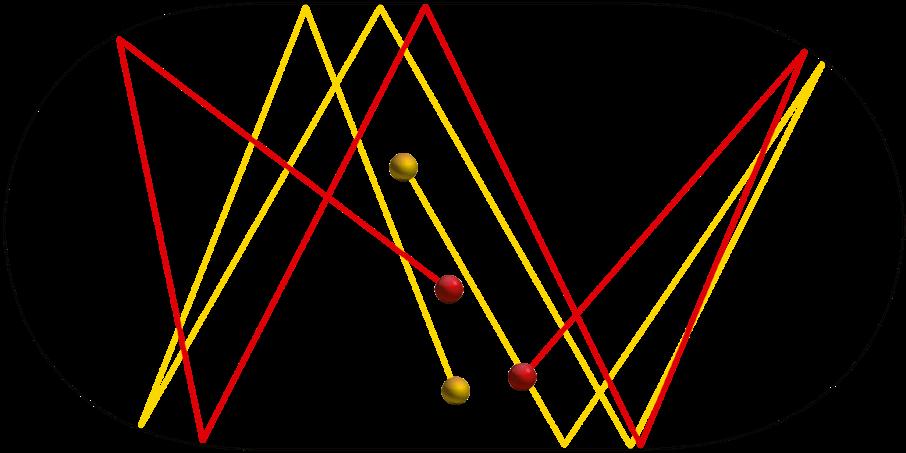
Diagram based on the ‘Bunimovich stadium’.
largely theoretical in nature, with researchers seeking to devise a strategy where they can justify the above statement through strict logical arguments that lead inexorably to a
clear and precise conclusion. “We want to build a chain of logical conclusions, where the next logical conclusion follows on very precisely from the previous one,” continues
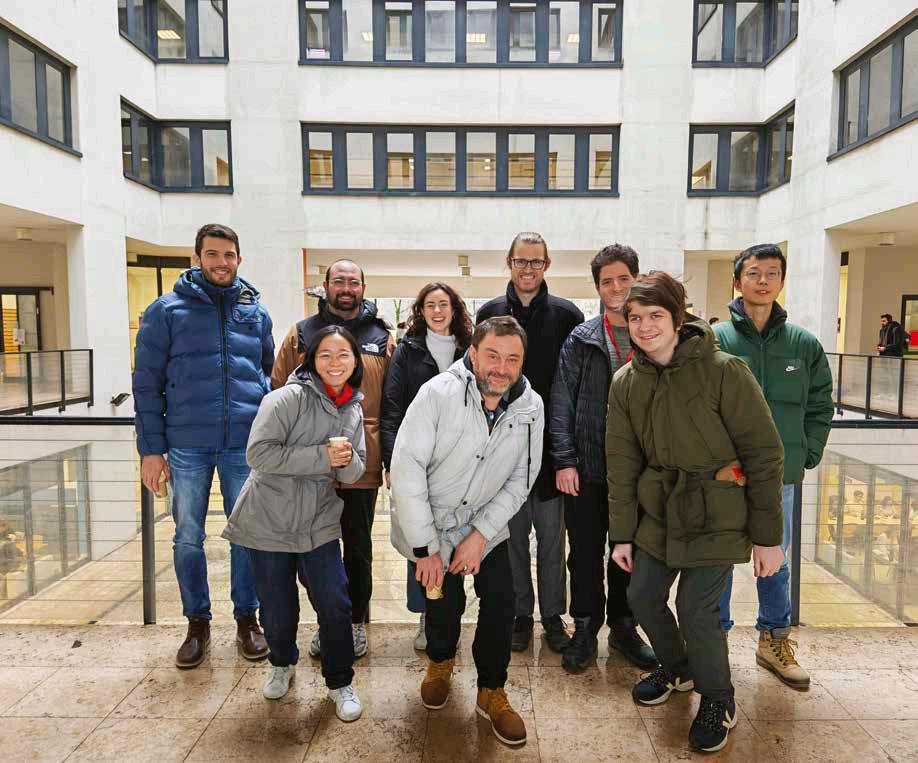
The SPERIG Team
The first group of team members has been motivated in their research by a version of the aforementioned question popularized by M. Kac: “Can you deform a drum without deforming a sound?” A more technical term is a wide open question of spectral rigidity.
Kostya Drach a former member of our team, is currently based in Barcelona. Motivated by fundamental open problems concerning unmarked spectral rigidity for Anosov geodesic flows, he made a deep and original contribution in joint work with me by establishing local smooth conjugacy for nearby sparse Lyapunov isospectral expanding circle maps. This achievement required the development of a novel iterative approximation technique, which we termed the Lifshits–Whitney method. The work combines substantial technical innovation with significant conceptual advances and opens new avenues for the study of rigidity phenomena in smooth dynamical systems.
Corentin Fierobe , a former member of our team who is currently based in Rome, has made significant contributions to the study of length spectral rigidity. Motivated by several open problems in the field, he developed a new and original method in joint work with Alfonso Sorrentino and me. Using this approach, we proved length spectral rigidity for nearly elliptic domains.
Mathieu Helfter, a current member of our team, has been investigating fundamental questions in action spectral rigidity. He developed a powerful framework for studying KAM spectral rigidity and used it to establish generic trigonometric action spectral rigidity for standard maps, which exhibit many similarities to convex billiard systems.
Professor Kaloshin. “The creative aspect of the project is about establishing a logical path leading to the conclusion that you cannot deform a drum without deforming a sound.”
Ilya Koval is a current member of the team whose contributions have been truly exceptional. His research accomplishments include a proof of the Birkhoff Conjecture for nearly elliptic domains that are integrable in a neighborhood of the boundary. In his seminal work on Gevrey divergence, he introduced the Taylor recurrence operator and established a generic divergence result for coordinate transformations to analytic Birkhoff normal form in convex billiards. This represents a significant advance on a classical problem in dynamical systems with origins in the foundational work of Poincaré and Siegel. In addition, his highly innovative joint research with Amir Vig, described below, further demonstrates the depth and breadth of his contributions to the field.
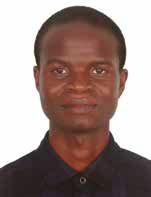
Edmond Koundjinan is a former team member, currently in Toronto. In a joint work with Ke Zhang and I, he proved the Birkhoff Conjecture for nearly centrally symmetric domains combining two seemingly disconnected methods of Bialy-Mironov and Kaloshin-Sorrentino.
Yunzhe Li is a current member of the team. In his PhD thesis, he constructed highly nontrivial examples of analytic deformations of the standard map that preserve a countable subset of the action variables as well as the Lyapunov spectrum. These results provide a significant contribution to the study of dynamical systems, exhibiting delicate structural preservation under nontrivial analytic perturbations. Starting in the fall, he will be in Toronto.
Daniel Tsodikovich , a current member of our team, has contributed to the development of a new method for proving integrable rigidity for the classical Toda lattice
in joint work with Illya Koval and me. His collaboration with Corentin Fierobe also constitutes a significant contribution to this research direction.
Amir Vig is a former team member, currently in Toronto. Jointly with Illya Koval, he constructed a rich collection of convex domains close to ellipses for the singular support of the Laplace spectrum and the length spectrum differ, which is another deep contribution. This question was open for several decades.
The second major direction of the group research is meanders and instabilities in the solar system. Meanders are invariant sets having complicated geometry.
Yi Pan , a former member of our team and currently based in Pisa, worked jointly with Illya Koval and me on the construction of meanders for a generic analytic, isoenergetically degenerate, nearly integrable Hamiltonian system with two degrees of freedom. The scope and length of this work are such that it may ultimately be developed into a book, rather than a standard research paper.
Alessandra Nardi is a current member of our team. In joint work with Illya Koval and me, she is developing methods for constructing meanders associated with so-called Rossby waves.
Miguel Garrido is a current member of our team. In collaboration with Vaughn Otto, Massimiliano Guzzo, and me, he is working on mechanisms for the capture of asteroids from the asteroid belt into the moons of Mars.
The methodology that researchers are using here is largely based on ideas from dynamical systems and functional analysis, but Professor Kaloshin is also drawing from other fields in his work, including classical mechanics and elliptic functions. While he has made significant progress over the course of the project, Professor Kaloshin says the Birkhoff conjecture remains an open problem, and he is committed to probing it further in the future. “My work in this area will continue beyond SPERIG. In my group, we continue to develop new ideas and train the next generation in mathematics research,” he explains. This work is currently ongoing, with Professor Kaloshin and his research group
bumps, but you could also imagine a geodesic that goes around a certain obstacle. Not all of them must experience linear bumps,” he says. The group has also been studying another dynamical system called the Bunimovich stadium, a representation of a soccer or athletics stadium. “The boundary of the stadium is formed of a rectangle, and two semi-circles at either end,” says Professor Kaloshin.
The behaviour of particles reflecting off the boundary of a Bunimovich stadium has been shown to be chaotic, leading to chaotic geodesic flows, another area of interest to Professor Kaloshin and his colleagues in the project. The
“If you want to see where the ball will land after hitting the boundary of a billiard table, you need to record an angle. The angle of reflection is equal to the angle of incidence. In other words, reflection is elastic.”
sharing ideas, developing new tools, and writing papers, in pursuit of the long-term goal of proving the Birkhoff conjecture. “My research group is comprised of eight people. We hold regular seminars and interact and share ideas,” he outlines.
Geodesic flows
A second major problem that Professor Kaloshin and his colleagues are tackling in the project centres around geodesic flows, which can be thought of as essentially a curve representing the shortest path between two points on a surface. As part of his work on the SPERIG project, Professor Kaloshin has been looking at geodesic flows over some highly complex surfaces, including Riemannian manifolds, bumpy spheres, and bumpy tori. “We are studying these kinds of objects and the geodesics on them. In some circumstances, some geodesics must accept
initial conditions, the direction in which a particle initially travels within the stadium, is a key consideration in this respect. “If you change the angle at which you shoot a particle, it leads to a dramatic change shortly afterwards. After the particle has reflected off the boundary, say ten times, the overall picture looks dramatically different,” explains Professor Kaloshin. The Bunimovich stadium is a beautiful example of a chaotic billiard, and it is of fundamental interest to Professor Kaloshin, whose research is motivated primarily by intellectual curiosity rather than any potential for commercial applications. “I’m much more a pure mathematician than a physicist. My main goal in research is to try to answer classical questions, such as the Birkhoff conjecture, and to develop analytic tools to solve them,” he continues.
SPERIG
Spectral rigidity and integrability for billiards and geodesic flows
Project Objectives
The team behind the SPERIG project are working on two related but nevertheless distinct questions in the dynamical systems field, namely a mathematical billiards problem and a problem around geodesic flows. This research is primarily motivated by intellectual curiosity, with Professor Kaloshin and his colleagues exploring fundamental questions and developing new analytic tools.
Project Funding
This project has received funding from the European Union’s Horizon 2020 research and innovation programme under grant agreement Nº 885707
Team Members
• Vadim Kaloshin • Kostya Drach • Corentin Fierobe • Mathieu Helfter • Illya Koval • Edmond Koundjinan • Yunzhe Li • Daniel Tsodikovich • Amir Vig • Yi Pan • Alessandra Nardi • Miguel Garrido
Contact Details
Project Coordinator, Vadim Kaloshin
Institute of Science and Technology Austria (ISTA) – Library
Am Campus 1 3400 Klosterneuburg
T: +43 2243 9000 2195 E: Vadim.Kaloshin@ist.ac.at W: https://vadimkaloshin.com/
Vadim Kaloshin is Professor of Mathematics at the Institute of Science and Technology Austria (ISTA). He gained
PhD from Princeton University, and worked at several universities in the US before taking up his current role in 2021
Vadim Kaloshin