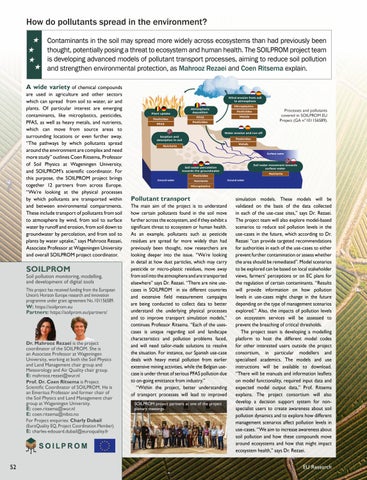
How do pollutants spread in the environment? Contaminants in the soil may spread more widely across ecosystems than had previously been thought, potentially posing a threat to ecosystem and human health. The SOILPROM project team is developing advanced models of pollutant transport processes, aiming to reduce soil pollution and strengthen environmental protection, as Mahrooz Rezaei and Coen Ritsema explain. A wide variety of chemical compounds are used in agriculture and other sectors which can spread from soil to water, air and plants. Of particular interest are emerging contaminants, like microplastics, pesticides, PFAS, as well as heavy metals, and nutrients, which can move from source areas to surrounding locations or even further away. “The pathways by which pollutants spread around the environment are complex and need more study” outlines Coen Ritsema, Professor of Soil Physics at Wageningen University, and SOILPROM’s scientific coordinator. For this purpose, the SOILPROM project brings together 12 partners from across Europe. “We’re looking at the physical processes by which pollutants are transported within and between environmental compartments. These include transport of pollutants from soil to atmosphere by wind, from soil to surface water by runoff and erosion, from soil down to groundwater by percolation, and from soil to plants by water uptake,” says Mahrooz Rezaei, Associate Professor at Wageningen University and overall SOILPROM project coordinator.
SOILPROM
Soil pollution monitoring, modelling, and development of digital tools This project has received funding from the European Union’s Horizon Europe research and innovation programme under grant agreement No. 101156589. W: https://soilprom.eu Partners: https://soilprom.eu/partners/
Dr. Mahrooz Rezaei is the project coordinator of the SOILPROM. She is an Associate Professor at Wageningen University, working at both the Soil Physics and Land Management chair group and Meteorology and Air Quality chair group. E: mahrooz.rezaei@wur.nl Prof. Dr. Coen Ritsema is Project Scientific Coordinator of SOILPROM. He is an Emeritus Professor and former chair of the Soil Physics and Land Management chair group at Wageningen University. E: coen.ritsema@wur.nl E: coen.ritsema@nibio.no For Project enquiries: Charly Dubail (EuroQuality EQ, Project Coordination Member). E: charles-edouard.dubail@euroquality.fr
52
Processes and pollutants covered in SOILPROM EU Project (GA n°101156589).
Pollutant transport The main aim of the project is to understand how certain pollutants found in the soil move further across the ecosystem, and if they exhibit a significant threat to ecosystem or human health. As an example, pollutants such as pesticide residues are spread far more widely than had previously been thought, now researchers are looking deeper into the issue. “We’re looking in detail at how dust particles, which may carry pesticide or micro-plastic residues, move away from soil into the atmosphere and are transported elsewhere” says Dr. Rezaei. “There are nine usecases in SOILPROM in six different countries and extensive field measurement campaigns are being conducted to collect data to better understand the underlying physical processes and to improve transport simulation models,” continues Professor Ritsema. “Each of the usescases is unique regarding soil and landscape characteristics and pollution problems faced, and will need tailor-made solutions to resolve the situation. For instance, our Spanish use-case deals with heavy metal pollution from earlier extensive mining activities, while the Belgian usecase is under threat of serious PFAS pollution due to on-going emittance from industry.” “Within the project, better understanding of transport processes will lead to improved SOILPROM project partners at one of the project plenary meetings
simulation models. These models will be validated on the basis of the data collected in each of the use-case sites,” says Dr. Rezaei. The project team will also explore model-based scenarios to reduce soil pollution levels in the use-cases in the future, which according to Dr. Rezaei “can provide targeted recommendations for authorities in each of the use-cases to either prevent further contamination or assess whether the area should be remediated”. Model scenarios to be explored can be based on local stakeholder views, farmers’ perceptions or on EC plans for the regulation of certain contaminants. “Results will provide information on how pollution levels in use-cases might change in the future depending on the type of management scenarios explored.” Also, the impacts of pollution levels on ecosystem services will be assessed to prevent the breaching of critical thresholds. The project team is developing a modelling platform to host the different model codes for other interested users outside the project consortium, in particular modellers and specialised academics. The models and use instructions will be available to download. “There will be manuals and information leaflets on model functionality, required input data and expected model output data,” Prof. Ritsema explains. The project consortium will also develop a decision support system for nonspecialist users to create awareness about soil pollution dynamics and to explore how different management scenarios affect pollution levels in use-cases. “We aim to increase awareness about soil pollution and how these compounds move around ecosystems and how that might impact ecosystem health,” says Dr. Rezaei.
EU Research