Tracking the ghosts of the seas
Storm petrels are extremely sensitive to environmental change, yet relatively little is known about their behaviour at sea. We spoke to Dr Raül Ramos Garcia about how the SEAGHOSTS project team is using biologging data to build a fuller picture of the spatial distribution and trophic ecology of these tiny seabirds. The storm petrel is an extremely difficult bird to detect and monitor, due to both its size and its somewhat secretive behaviour. These seabirds are very elusive and difficult to see from boats, while historically their small size meant it was also very difficult to monitor them using technological means. “Normally birds can carry devices that represent between 2-3 percent of their own weight. Storm petrels are extremely small, weighing up to 20 grams, so historically they have not been able to carry a logger or other type of tracking device,” explains Raül Ramos Garcia, an Associate Professor in the Faculty of Biology at the University of Barcelona and researcher at the Institute of Biodiversity Research (IRBio) of the same University. The technology has since moved on, and it is now possible to tag storm petrels, from which researchers now hope to learn more about these seabirds. “The weight of these loggers is now below half a gram, representing a small proportion of the weight of storm petrels, so now we can deploy them on these birds,” outlines Dr Ramos. This opens up new opportunities to monitor and track these birds, work which holds wider importance as an indication of how the oceans are changing and its impact on marine life. Storm petrels are widely considered to be a reliable bioindicator, acting as a window into the overall health of marine ecosystems, as they sit somewhere in the middle of the trophic chain. The majority
www.euresearcher.com
of storm petrel species feed on plankton that they pick up from the sea surface, often during the night, and are extremely sensitive to environmental change.
SEAGHOSTS As part of his role as Principal Investigator and Coordinator of the SEAGHOSTS project, an initiative funded by the Biodiversa+ partnership, Dr Ramos is now working to build a fuller picture of the spatial distribution and trophic ecology of storm petrels. Like the majority of seabirds, storm petrels lay their eggs and incubate them on land, but otherwise they spend the rest of their time at sea, about
which there is a large gap in knowledge. This is a gap that Dr Ramos and his colleagues in the project team are working to fill, focusing on two main aims. “Firstly, we want to understand the movement patterns of these birds. This includes their short-term movements, but also their year-round movements, such as migratory patterns,” he says. “Secondly we want to link these movements, both the shortterm and long-term movements, to certain anthropogenic impacts.” This includes not only climate change but also the presence of wind farms and aquaculture facilities in the oceans, physical infrastructures that aren’t part of the
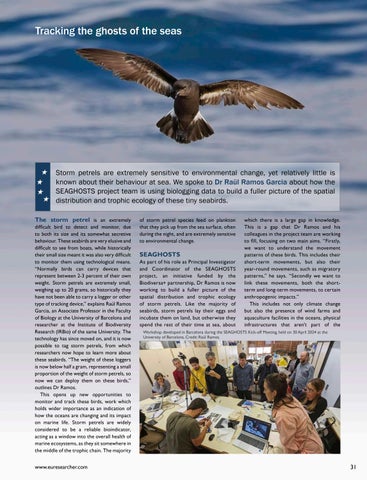
Workshop developed in Barcelona during the SEAGHOSTS Kick-off Meeting, held on 30 April 2024 at the University of Barcelona. Credit: Raül Ramos.
31
natural environment. While some humanbuilt infrastructures may be having an adverse impact on food resources, others may be making new sources available for storm petrels, and evidence shows that the birds themselves are typically quite adaptable. “For instance, new aquaculture infrastructures have been developed in some parts of the oceans, and they can provide some sources of food that weren’t there naturally. These birds can change their behaviour,” he says. The project team is using biologging data to gain deeper insights into how storm petrels adapt to change and deal with emerging challenges. The focus here is on six species within two families, namely hydrobatidae (European or northern storm petrels) and oceanitidae (southern storm petrels). “We’re looking at the European storm petrel for example, which is part of the hydrobatidae family and is found in both Mediterranean and Atlantic waters,” says Dr Ramos. These birds are philopatric, meaning that they migrate annually, before returning to the same colonies to breed. “They can live for 20-30 years, and they always look to return to the same partner, year on year. The birds disperse during the winter, to often very distant locations in the North Atlantic or the Canary current.”
Researchers are using two different types of tags, with one deployed on each bird, to gather more information about storm petrels and the threats they face at sea. One is GPS tags, that Dr Ramos says provide very fine-scale, high-resolution data. “The coordinates are very precise, we probably receive one precise position every half an hour. We get very specific data about the position of the birds at sea, but only close to the breeding grounds. The battery runs out very fast, so we can only deploy these tags
Conservation efforts The idea of the project is to identify hotspots at sea, where storm petrels come together in large numbers, including birds from different populations and even different species. The aim is to understand what it is about these particular areas that attracts storm petrels, which can then feed into conservation and management efforts. “We hope to identify spatial areas important for storm petrels that can then be useful for managers, who can include this data in a wider perspective. This
“We want to understand the movement patterns of storm petrels. This includes their short-term movements, but also their year-round movements, such as migratory patterns.” during the breeding season,” he outlines. A second type of tag provides information on the migratory behaviour of storm petrels. “We use geolocators, that basically record the light intensity for an entire year, from which we can infer their approximate location day by day. This data comes with a fairly large margin of error, but it’s still good enough to study the migratory patterns of these birds, and to look at their behaviour outside the breeding season.”
0.45g light-level geolocator used to track the first annual migrations of the smallest storm petrels. Credit: Raül Ramos.
could mean merging this data with spatial data from other species,” says Dr Ramos. This will contribute to the goal of assessing biodiversity in the oceans, generating data which can then underpin efforts to conserve and maintain it. “The data we provide to managers and other stakeholders can be integrated with other sources of information, to build biodiversity maps and protect key areas of the oceans.
First deployments of light-level geolocators in 2019 on European storm petrels at the colony of Benidorm Island, Spain. Credit: Raül Ramos.
This work is very much in progress, with data currently being collected by the project’s 17 partners, across Europe and North America. This wide geographical spread means the project team is able to bring together data on many different sampling sites, from the Mediterranean right up to the North-East Atlantic. “The project partners have been developing field campaigns, so deploying these logging devices that we received funding for,” outlines Dr Ramos. With the project team having now gathered large volumes of data, the next step is now to develop models, from which researchers hope to glean fresh insights into storm petrels. “We’re going to plot all this data, considering the different environmental variables of these hotspots, and investigate what it is about these areas that attracts storm petrels. We also want to look at the importance of these areas to other sealife, considering also data on other species.” The primary focus in the project however is storm petrels, and on understanding the threats they face, with a view to conserving populations. Many colonies are highly threatened, due to the presence of both invasive predators as well
SEAGHOSTS
The global spatial ecology and conservation of the world’s smallest and elusive seabirds, the storm petrel (Hydrobatidae & Oceanitidae), across the Mediterranean and the North East Atlantic Ocean
Project Objectives
European Storm Petrel (Hydrobates pelagicus) photographed in the colony of Benidorm Island, Spain. Credit: Raül Ramos.
as native predators like yellow-legged gulls, both of which need to be considered in terms of protecting storm petrels. “Often it’s the invasive predators that are seen as the biggest problem, as they haven’t historically been found in these remote locations where storm petrels normally breed, but human activities have also led to an increase in the population of yellow-legged gulls. Conservation efforts need to consider both native and invasive predators,” says Dr Ramos. The project is also making an important contribution in this respect by providing detailed information on the demography of these birds. This work could continue beyond the conclusion of SEAGHOSTS, with Dr Ramos keen to build on the progress that has been made so far. The project partners all hold deep expertise on seabirds, and Dr Ramos hopes their collaboration can be extended further, beyond the conclusion of the SEAGHOSTS project in 2027. “The partners are in regular contact, and we benefit greatly from working together,” he stresses.
White-faced Storm Petrel (Pelagodroma marina) photographed in the colony of Selvagem Grande, Portugal. Credit: Raül Ramos.
0.9 g GPS logger attached to the tail of a Bandrumped storm petrel in the colony of Montaña Clara, Canary Islands, Spain. Credit: Raül Ramos.
Detail of the light-level geolocator deployment on the tarsus of a European storm petrel at the colony of Benidorm Island, Spain. Credit: Raül Ramos.
32
EU Research
SEAGHOSTS investigates the spatial ecology, migration, trophic ecology, and conservation of storm petrels across the Mediterranean and the Northeast Atlantic. By combining advanced tracking technologies, genetic analyses, and ecological approaches, the project aims to identify threats, define Conservation Units, and improve conservation strategies for some of the world’s least-known seabirds.
Project Funding
This research was funded by Biodiversa+, the European Biodiversity Partnership under the 2022-2023 BiodivMon joint call for research proposals, co-funded by the European Commission (GA N°101052342) and Fundación Biodiversidad as funding organisations. Co-funded by the European Union. Views and opinions expressed are however those of the author(s) only and do not necessarily reflect those of the European Union or Fundación Biodiversidad. Neither the European Union nor the granting authority can be held responsible for them.
Project Partners
• The project includes up to 17 partners from 12 different countries. Please see website below for full details
Contact Details
Project Coordinator, Dr Raül Ramos Seabird Ecology Lab Biodiversity Research Institute (IRBio) Department of Evolutionary Biology, Ecology and Environmental Sciences Faculty of Biology, University of Barcelona T: +34 93 402 1449 E: ramos@ub.edu W: https://www.biodiversa.eu/2024/04/15/ seaghosts/
Dr Raül Ramos Dr Raül Ramos is a researcher at the Faculty of Biology, University of Barcelona, and a member of the Biodiversity Research Institute (IRBio). His research focuses on seabird ecology, marine spatial ecology, migration, and the conservation of marine biodiversity through international collaborative projects. Please see website above for full details.
Key partners and participants at the SEAGHOSTS Kick-off Meeting, held on 30 April 2024 at the University of Barcelona. Credit: Raül Ramos.
www.euresearcher.com
33