Machine learning methods to profit society Machine learning algorithms are increasingly being used to support decision-making across a variety of sectors, so their development should be guided not just by technology companies, but the views and interests of stakeholders. In the ERC-backed SAML project researchers are developing a more collaborative approach to designing ML algorithms, as Professor Isabel Valera explains. The
emergence of ever-more sophisticated machine learning algorithms is central to the growth of the Artificial Intelligence industry, enabling the development of tools capable of adapting and responding to changing circumstances. These machine learning (ML) technologies are being applied to support decision-making across society, for example in recruitment and the financial sector, so their development must be guided not just by the technology sector’s desire for profit but also the views and interests of stakeholders.“It’s important to ask the people affected by new technologies what they expect from a system. What do they see as the potential benefits? What are the risks?” stresses Isabel Valera, Professor of Machine Learning at the University of Saarland in Germany. These issues are central to Professor Valera’s work as Principal Investigator of the SAML project, in which she is developing a new, more collaborative approach to training ML algorithms. “We’re looking to enhance transparency in the development of ML algorithms. We are investigating what different stakeholders view as acceptable trade-offs under a particular context,” she outlines. Machine learning algorithms This research is focused on the way in which historical data is used to train an algorithm, which then will have a strong influence on how that algorithm eventually operates and the decisions that are reached. As
72
part of her work in the project, Professor Valera is examining publicly available, empirical data about past decisions. “For example, we’re looking at historical data from banks, investigating which kinds of loans they granted to which applicants and under which conditions. We’re also interested in company hiring decisions, where people’s CVs have been processed in such a way that they can be summarised in a tabular form,” she says. It has been argued that some of the algorithms used in making these kinds of decisions are
conceptions of justice, so Professor Valera is not aiming to please everybody, but rather to develop a transparent methodology. “We want to enhance transparency on the functionality of the algorithm. This means highlighting the implications in terms of the benefits and risks that it’s going to have for different groups of the population,” she explains. Machine learning algorithms can play an important role in clinical trials for example, yet many people want to maintain the security of their own data, and algorithms must be applied in a way that is consistent with wider societal values. “We
“We’re looking to enhance transparency in the development of ML algorithms. We are investigating what different stakeholders view as acceptable trade-offs under a particular context.” inherently biased against certain social and demographic groups, undermining public trust in them. Including a wider range of perspectives in development and training could help address this issue and boost public confidence. “We’re following a multistakeholder approach in the SAML project, drawing on ideas from a variety of different fields, including economics and distributive justice,” continues Professor Valera. The aim here is to heighten awareness of the performance-fairness trade-offs that are involved in optimising an algorithm.We all have different perceptions of what a ‘fair’ outcome is, according to the economic frameworks that we are familiar with and our own personal
want to look at the functionality of these algorithms and highlight the extent to which they are aligned with societal values,” says Professor Valera. “We aim to achieve a greater degree of control over the values reflected in an algorithm, while making the resulting tradeoffs transparent so that different stakeholders can assess the benefits and risks together and make an informed decision about which tradeoffs are acceptable for deployment in practice.” Researchers are ultimately working to develop a methodology of training algorithms, new ways of optimising them on the basis of wider engagement from stakeholders, including technology users, owners and regulators. This will help boost public trust
EU Research
in machine learning algorithms which, as essential components of AI technologies, are increasingly integral to our daily lives. “ML algorithms are being applied across society for a wide variety of different purposes. A prominent example is their use in Large Language Models (LLMs),” outlines Professor Valera. The growth of the AI industry is causing unease in some quarters, who fear its long-term social and ethical implications; a new, more broad-based method of training algorithms could help allay these concerns. “In the project I’m developing a methodology designed to be as general as possible. Essentially we are developing new ways of optimising these algorithms,” continues Professor Valera. “We aim to help navigate different trade-offs and adopt different functionalities during the deployment of an ML algorithm, with the same underlying foundations.”
Serving society This contributes to the wider goal of boosting public trust in ML algorithms and ensuring that they serve the interests of society as a whole, not just the technology companies that develop them. This is of course a fast-
moving area, and digital technology has moved on significantly even in the relatively short time since the project began, says Professor Valera. “Several things have changed over the last few years, with rapid growth in the number of LLMs, and takeovers of some social media companies,” she explains. The project initially had quite a broad scope, but over time it has become more tightly focused, and Professor Valera expects it to narrow further over the remainder of the funding term. “We are narrowing things down, and over the remaining 18 months we have a clear plan for a set of concrete use cases where multiple stakeholders have different objectives and may be affected differently by the same algorithmic decision,” she says. “These are precisely the settings where making the tradeoffs transparent, and enabling stakeholders to assess them jointly, could be particularly important.” “A number of papers have been written so far, outlining the project’s findings, for example on the trade-offs between performance and fairness.There will be others beyond classical applications of machine learning, exploring generative AI and a broader range of societal desiderata beyond fairness.”
SAML Society-Aware Machine Learning
Project Objectives
Artificial intelligence (AI) is an increasingly important tool across many sensitive areas, including recruitment and finance, leading to intense debate about whether existing systems are fair or biased. To build public trust, and to ensure that new technologies meet standards, there is a clear need for technology designers to engage all relevant stakeholders in machine learning development. This is where the EU-funded SAML project steps in. The aim is to develop a completely new methodological approach for the development of machine learning algorithms, which ultimately contribute to the aim of ensuring they are accepted by society as a whole.
Project Funding
This project is funded by an ERC Starting Grant Grant agreement ID: 101040177.
Contact Details
Project Coordinator, Isabel Valera Prof. Dr. Isabel Valera Department of Computer Science Saarland Informatics Campus Bldg. E1 1, R. 225 66123 Saarbrücken, Germany T: + 49(0) 681 302 70171 E: ivalera@cs.uni-saarland.de W: https://machinelearning.uni-saarland.de/ society-aware-ml/
Professor Isabel Valera
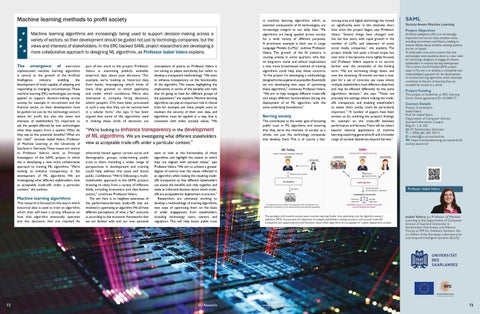
The paradigm shift towards society-aware machine learning. Rather than optimising only the algorithm owner’s objective, SAML incorporates the objectives of multiple stakeholders, making economic and societal trade-offs transparent and supporting informed decisions about which algorithms are acceptable for a given deployment context.
www.euresearcher.com
Isabel Valera is a Professor of Machine Learning at the Department of Computer Science of Saarland University in Saarbrücken (Germany), and Adjunct Faculty at MPI for Software Systems. She is a fellow of the European Laboratory for Learning and Intelligent Systems (ELLIS).
73