Seeking freedom of non-religion What happens when people are persecuted not for their religion, but for their lack of it? Through the EU ROSA (Religion and Its Others in South Asia and the World: Communities, Debates, Freedoms) project, Dr Ben Laws and colleagues investigated the experiences of non-religious asylum seekers in Europe, revealing how asylum systems often struggle to recognise claims based on non-belief. For many people across the world, religion provides a source of identity, belonging and community. Yet for others, the decision to reject, question or move away from religion can come at a significant personal cost. In several countries, individuals who identify as atheists, humanists, rationalists or freethinkers face discrimination, social exclusion, threats and, in some cases, violence. While international human rights frameworks recognise the right to freedom of thought, conscience and religion, including the right not to hold religious beliefs, the realities experienced by non-religious individuals often tell a different story. These realities formed the basis of the ROSA project, an interdisciplinary initiative examining violence against non-religious people in South Asia and the many ways in which such persecution shapes people’s lives. The project explored this issue through four complementary case studies. While three focused on the experiences of non-religious individuals within South Asian societies, Dr Ben Laws, a qualitative researcher and Assistant Professor at the University of Cambridge, examined what happens after people flee persecution. His research followed the experiences of nonreligious asylum seekers as they attempted to build new lives in Europe, exploring how the effects of discrimination can continue long after individuals leave their countries of origin. “The project was interested in the ripples and aftershocks of violence,” explains Laws. “What happens when people leave their country because of threats linked to their non-belief? How are those experiences understood when they arrive somewhere that is supposedly safer?”
Asia where much of the ROSA research was focused, non-belief is often treated as a deviation from accepted social norms. Individuals who reject religious traditions may face accusations of betraying their communities, abandoning cultural values or aligning themselves with foreign influences. In recent years, several prominent secular activists, writers and bloggers have been attacked or killed, highlighting the risks associated with openly expressing nonreligious views. Against this backdrop, some individuals seek asylum abroad.Yet arriving in Europe does not necessarily mean that their difficulties end.
A system struggling to understand Laws conducted ethnographic research with asylum seekers, support organisations and professionals involved in asylum procedures across Sweden, Norway and the Netherlands. His findings suggest that non-religious applicants often occupy an uncomfortable blind spot within asylum systems. Many asylum officers are familiar with claims involving religious conversion. Applicants who have converted to Christianity, for example, can often present evidence through church attendance records, letters from religious leaders, certificates from
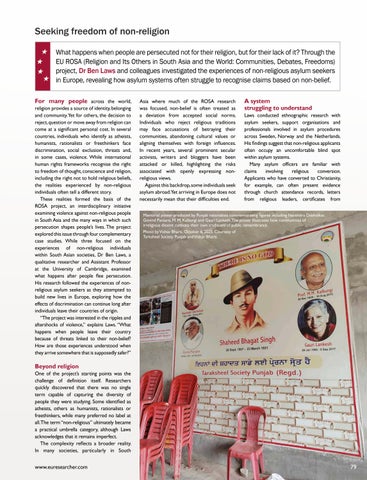
Memorial poster produced by Punjab rationalists commemorating figures including Narendra Dabholkar, Govind Pansare, M. M. Kalburgi and Gauri Lankesh. The poster illustrates how communities of irreligious dissent cultivate their own traditions of public remembrance. Photo by Vishav Bharti, October 6, 2025. Courtesy of Tarksheel Society Punjab and Vishav Bharti.
Beyond religion One of the project’s starting points was the challenge of definition itself. Researchers quickly discovered that there was no single term capable of capturing the diversity of people they were studying. Some identified as atheists, others as humanists, rationalists or freethinkers, while many preferred no label at all.The term “non-religious” ultimately became a practical umbrella category, although Laws acknowledges that it remains imperfect. The complexity reflects a broader reality. In many societies, particularly in South
www.euresearcher.com
79
pieces of evidence during asylum interviews. In certain cases, individuals engaged in highly visible and controversial acts because they believed this would strengthen their applications. The phenomenon reveals a troubling paradox. Systems designed to assess danger may inadvertently encourage behaviours that increase exposure to danger. As standards rise, applicants can feel pressure to become more visible, more outspoken and more provocative in order to prove that they genuinely face persecution. Yet these same actions can expose them to online harassment, threats from transnational communities and even physical danger.What begins as an attempt to satisfy administrative requirements may ultimately increase vulnerability.
Cover of Dissentiments: Non-religion,Violence and the Politics of Visibility in South Asia (Cambridge University Press), featuring Unsilenced (2015) by Gurpreet Singh. Painted in the wake of the murder of the rationalist scholar M. M. Kalburgi, the work embodies the book’s concern with the vulnerabilities and enduring commitments of irreligious dissenters across South Asia.
educational programmes or testimony from faith communities. These forms of evidence fit comfortably within existing administrative frameworks. Non-belief, however, does not lend itself to the same kind of documentation. “How do you prove the absence of belief?” asks Laws.“Many people have spent years hiding their views because disclosure could place them at risk. They often arrive with very little evidence precisely because staying safe required them to leave no trace.” As a result, non-religious claims are frequently assessed through frameworks originally developed for religious conversion cases. Laws found that applicants were often treated as if they had converted to another belief system, even when they had simply rejected religion altogether. This can lead to misunderstandings about motivation, identity and risk.
The burden of credibility A major theme emerging from the research concerns credibility. Across Europe, asylum systems have become increasingly focused on evidentiary standards. Following the migration pressures experienced during the mid-2010s, many countries introduced stricter procedures, temporary protection measures and higher thresholds for demonstrating risk. For non-religious asylum seekers, these developments have had unintended consequences. Laws found that some applicants felt compelled to generate evidence to demonstrate the sincerity of their non-belief. Social media posts criticising religion, blogs discussing atheism and participation in public campaigns sometimes became important
80
that could continue to place him at risk long after the asylum process had ended. These cases reveal how persecution can transcend national borders. Digital communication, transnational networks and close-knit diaspora communities mean that social pressures often travel with individuals. Physical relocation may reduce some immediate threats, but fear, uncertainty and social exclusion can persist in new environments. Laws also highlights the emotional burden of the asylum process. Applicants must repeatedly justify deeply personal aspects of their identity, often to decision-makers unfamiliar with nonreligious worldviews. Many found themselves caught between the need to remain safe and the need to make their non-belief visible and credible.
“How do you prove the absence of belief?” asks Laws, “Many people have spent years hiding their views because disclosure could place them at risk. They often arrive with very little evidence precisely because staying safe required them to leave no trace.” Life after arrival
Creating change
The research also challenges assumptions that relocation automatically resolves the problems experienced by non-religious individuals. One case involved a Pakistani woman who arrived in the Netherlands believing that she would finally be able to express her views freely. Instead, she encountered what Laws describes as a form of “double silencing”. While she had left behind a social environment in which expressing non-religious views could be dangerous, she found herself living alongside other Muslim women from similar cultural backgrounds and remained cautious about openly discussing her beliefs. When she later experienced harassment linked to her online activities, the advice she received from the police was not to speak out more freely, but to delete her social media content. Rather than feeling protected, she felt that she was once again being encouraged to remain silent. Another example highlights the unintended consequences of asylum procedures themselves. Laws described the case of a nonreligious asylum seeker in Sweden whose application required him to demonstrate the risks he would face if he returned to his country of origin. Over time, the claimant became increasingly active online, publicly criticising religion and eventually participating in highly visible acts, including the burning of the Quran. While these actions strengthened the evidence supporting his asylum claim, they also made it impossible for him to maintain a low profile. Public letters, videos and social media content created a permanent digital record
Despite these challenges, the research points towards opportunities for improvement. For example, Norway has introduced specific guidance for assessing atheist asylum claims, marking an important step towards recognising the distinct experiences of non-religious applicants. Through accessible publications, collaboration with NGOs and engagement with organisations working directly with refugees, the project seeks to bridge the gap between academic research
and professional practice. By documenting the lived experiences of non-religious asylum seekers and highlighting the challenges they face within existing asylum procedures, the research provides valuable evidence to inform policy discussions, professional training and future guidance. In doing so, it promotes a more nuanced understanding of how non-religious claims are assessed in practice and how asylum systems can better respond to this often-overlooked group. The project’s findings are brought together in 2026, in an open-access volume, Dissentiments: Non-religion, Violence and the Politics of Visibility in South Asia, which synthesises the insights generated across the ROSA project through extensive ethnographic research conducted in Bangladesh, Pakistan, India and Europe. Bringing together the expertise of the project’s researchers, the book moves beyond individual case studies to examine how violence against non-religious people is intertwined with religion, nationalism and political authority. It also explores the complex politics of visibility, showing how speaking out can become both an act of resistance and a source of vulnerability, forcing many individuals to navigate the difficult balance between remaining silent and making their views publicly known. Ultimately, ROSA demonstrates that non-belief is not simply an abstract philosophical position or the absence of religion. For many individuals, it is a deeply personal aspect of identity that shapes their relationships, opportunities and, in some cases, their safety. By documenting these lived experiences and examining how they are understood within asylum systems, the project provides valuable evidence that can support more
ROSA A closer look at asylum claims based on religious freedom
Project Objectives
ROSA investigates violence targeting people labelled as non-religious in South Asia and its global repercussions. Drawing on long-term ethnographic research, the project examines how irreligious minorities experience persecution and seek recognition, showing how attention to freedom of non-religion reshapes our understanding of religious violence.
Project Funding
ROSA was made possible through the support of the European Research Council (ERC) under the European Union’s Horizon 2020 research and innovation programme (grant agreement no. 817959).
Contact Details
Portrait of the murdered rationalist Narendra Dabholkar by the Punjab artist Kewal Krishan. The pen piercing a gun symbolises the movement’s conviction that critical inquiry and public debate are more powerful than violence. Photo by Vishav Bharti, October 6, 2025. Courtesy of Kewal Krishan and Vishav Bharti.
informed assessment practices and contribute to ongoing discussions among policymakers, practitioners and organisations working with refugees. More broadly, the research highlights how the consequences of violence and discrimination extend well beyond the communities in which they originate, influencing people’s lives, migration journeys and experiences of protection across borders. By bringing these often-overlooked stories to light, ROSA encourages a deeper understanding of the interconnected nature of persecution, identity and belonging in an increasingly globalised world.
Project Coordinator, Professor Jacob Copeman Institute of Studies and Development of Galicia (IDEGA) University of Santiago de Compostela ANTE Territorial Analysis E: jacob.copeman@usc.es W: https://jacobcopeman.academia.edu/ research • Dissentiments: Non-religion,Violence, and the Politics of Visibility in South Asia (Cambridge University Press, 2026). By Copeman, Blom, Laws, Quack & Schulz. • Asylum and Nonreligion: Emotions, Evidencemaking and Credibility (Palgrave. 2024). By Laws • Cultivating Secularity: Politics, Embodiment and Criticism of Religion in Bangladesh (NYU Press, 2026). By Schulz. • Global Sceptical Publics: From Non-Religious Print Media to Digital Atheism (UCL Press, 2022). Edited by Copeman & Schulz. • An Anthropology of Non-Religion? (Special Issue of Religion & Society, 2023). Edited by Schulz & Binder.
Jacob Copeman
Ben Laws
Jacob Copeman is Oportunius Research Professor at the University of Santiago de Compostela. A socio-cultural anthropologist, his research explores religion, non-religion, media and South Asia, supported by multiple European Research Council grants. Ben Laws is currently Assistant Research Professor in the Department of Psychiatry at the University of Cambridge.
Pen and blood. Commemorative magazine cover with photos of murdered rationalists Dabholkar, Kalburgi and Pansare. The recurring image of the pen evokes writing as a practice of dissent and remembrance, suggesting that ideas continue to circulate even after attempts to silence their authors.
A rationalist bookstall in Punjab during fieldwork for the ROSA project. Printed literature remains central to the movement’s efforts to foster public debate and cultivate cultures of rationalist inquiry.
Photograph by Jacob Copeman of the front cover of Tarksheel magazine. Courtesy of Tarksheel Society Punjab.
Photo by Vishav Bharti, June 6, 2024. Courtesy of Vishav Bharti.
EU Research
www.euresearcher.com
81