Revealing the Hidden Half of Crops Root systems make up around half of most plants, yet remain hidden from view within the soil. We spoke to Assistant Professor Saoirse Tracy, coordinator of RootEd, an EU-funded MSCA doctoral network phenotyping plant roots to reveal how they explore soil and how crop breeding might incorporate this knowledge into its programmes. Root systems account for roughly half of most plants and perform the functions on which everything above ground depends, drawing water and nutrients from the soil and anchoring the plant so that it remains upright. Yet roots remain among the least understood components of crop biology. Soil is opaque, and until recently, root systems could be examined only by excavating and washing them, a procedure that destroys the very architecture under investigation. Crop breeding has consequently concentrated on the visible half of the plant, the flowers, ears, and grain, while the root system has been neglected and, in many cases, inadvertently diminished. This omission has grown more consequential as growing conditions become less predictable and as many chemical interventions once available to European farmers are withdrawn. These concerns lie at the heart of RootEd, an MSCA Network funded under the Horizon Europe programme. Coordinated at University College Dublin (UCD) by Assistant Professor Saoirse Tracy, it unites nine partner organisations across Europe, spanning universities, research institutes, and industry, and trains ten doctoral researchers in the plant and soil sciences.When the grant was awarded, reviewers observed that it would be the first doctoral network devoted specifically to roots. The consortium was assembled to span disciplines rather than concentrate expertise within any one of them, combining biology, chemistry, and physics. Its work is organised across three strands. The first concerns the physical constraints that govern how roots explore soil.The second addresses the biology of the rhizosphere, the zone of soil influenced by roots and their associated microorganisms. The third examines the plasticity of roots in a changing chemical environment. The rationale follows from decades of breeding directed almost entirely at what could be seen above ground. “Most of the crop breeding has been done on the top half of the plant, the part we can see, where the flowers are, the wheat, the ears. The roots have been forgotten about, and if anything, we have bred out the roots and made the root system smaller and less able to handle these climate shocks. If we can get an understanding
56
achieve high-throughput phenotyping, the ability to analyse massive amounts of plant traits at incredible speeds,” she explains. Renaud Bulpa has pursued a comparable aim in three dimensions, developing a deeplearning segmentation pipeline to increase the throughput of X-ray CT scan analysis while investigating how tomato roots respond to soil compaction. Once published, he hopes it will help standardise three-dimensional root segmentation and broaden the technique’s applications in plant phenotyping.
Results Below Ground Although many of the network’s findings are still emerging, its first published output concerns the carbon held in agricultural soils. Working across nine paired land-use trials spanning a wide range of soil textures in Germany, Abebaw Misganaw Ambaw and colleagues found that grassland soils stored more organic carbon than the adjacent cropland at every site. Topsoil carbon rose almost linearly with years under grassland, showing no sign of saturation. The gains were smallest in coarse, low-input soils with limited capacity to stabilise carbon, indicating that carbon inputs and stabilisation capacity together constrain accrual. The authors conclude that converting cropland to grassland can raise soil carbon in temperate
The Hydra-Maize platform in the greenhouse. Credit : Erfan Nouri, UCLouvain Control boxes (left). Credit : TianJiao Wei, UCLouvain
RootEd RootEd Doctoral Network
Project Objectives
RootEd investigates how plant roots interact with their environment from physiological and phenotypic perspectives, using noninvasive imaging and deep learning to accelerate analysis. The network trains ten doctoral researchers in plant and soil sciences, supporting sustainable agriculture and contributing to the European Green Deal and a Soil Deal for Europe.
Project Funding Main image: Rear view of a three-plant HydraMaize rhizotron, with maize inbred line Mo17 three days after sowing. Credit : Erfan Nouri, UCLouvain Inset image: Rear view of a single-plant HydraMaize rhizotron. Credit : Erfan Nouri, UCLouvain
A Network Across Borders The doctoral network is not merely a funding mechanism but a structural feature of the research. Marie Sklodowska-Curie Actions require candidates to relocate to take up their positions, so that most RootEd researchers, drawn largely from outside Europe, are new to the country in which they work.The scheme also provides for candidates’ family circumstances and pays a wage well above that offered in many national systems, provisions Dr.Tracy regards as unusually progressive and a strong argument for continued investment in programmes that draw the best researchers into European science.
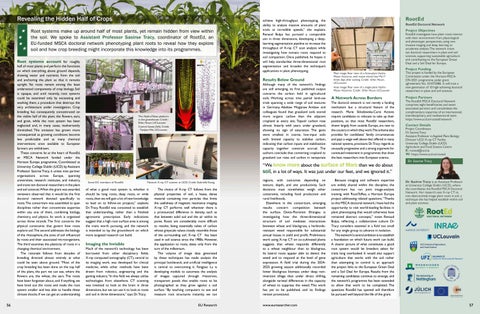
“We know more about the surface of Mars than we do about soil, in a lot of ways. It was just under our feet, and we ignored it.” Some DC members of RootEd.
Nantom X-ray CT scanner at UCD. Credit Gabrielle Young.
of what a good root system is, whether it should be long roots, deep roots, or wide roots, then we will gain a lot of new knowledge to lead on to follow-on projects,” explains Dr. Tracy. RootEd was conceived to establish that understanding, rather than a finished agronomic prescription. Early indications suggest that a high root surface area is among the traits worth pursuing, and the network is intended to lay the groundwork on which more targeted research can build.
Imaging the Invisible Much of the network’s technology has been borrowed from other disciplinary fields. X-ray computed tomography (CT), central to its imaging work, was developed for clinical medicine, while other methods have been drawn from robotics, engineering and the gaming industry. “In this field we always utilise technologies from elsewhere. CT scanning was invented to look at the brain in three dimensions, but we can use it to look at roots and soil in three dimensions,” says Dr. Tracy.
The choice of X-ray CT follows from the physical properties of soil, a heavy, dense material containing iron particles that limits the usefulness of magnetic resonance imaging. X-ray CT performs well wherever there is a pronounced difference in density, such as that between solid soil and the air within its pores. Roots are considerably more difficult to resolve, being essentially tubes of carbon whose greyscale values closely resemble those of the surrounding soil. X-ray CT has been used in soil science since the 1980s. However, the application to roots, dates only from the turn of the millennium. The volume of image data generated by these techniques has made analysis the principal bottleneck, and artificial intelligence is central to overcoming it. Fengjiao Lu is developing models to automate the analysis of images captured through rhizotrons, transparent panels that enable roots to be photographed as they grow against a soil surface. “By teaching computers to see and measure root structures instantly, we can
EU Research
regions, with outcomes depending on texture, depth, and site productivity. Such decisions must nonetheless weigh other constraints, including food production and rural livelihoods. Elsewhere in the consortium, emerging results concern competition beneath the surface. Denis-Florentin Sfrangeu is investigating how the three-dimensional structure of soil mediates interactions between wheat and blackgrass, a herbicideresistant weed responsible for substantial annual losses in yield and profit. Preliminary work using X-ray CT on co-cultivated plants suggests that wheat responds differently to a wheat neighbour than to blackgrass. Its lateral roots appear able to detect the weed and to respond at the level of gene expression. A field trial during the 20242025 growing season additionally recorded lower blackgrass biomass under deep noninversion tillage than under direct drilling, alongside varietal differences in the capacity of wheat to suppress the weed. This work has yet to be published, and its findings remain provisional.
www.euresearcher.com
Because imaging and software expertise are widely shared within the discipline, the consortium has run joint image-analysis training with RootToRes, a Horizon Europe project addressing related questions. “Thanks to this MSCA doctoral network, I have had the opportunity to visit world-leading facilities in plant phenotyping that would otherwise have remained abstract concepts,” notes Renaud Bulpa, reflecting a collaborative culture Dr. Tracy considers essential in a field too small for any single group to advance in isolation. The network’s central ambition is to establish a foundation on which future work can build. A clearer picture of what constitutes a good root system would let breeders select for traits long overlooked. It would also support agriculture that works with the soil rather than attempting to control it, an approach the project links to the European Green Deal and a Soil Deal for Europe. Results from the remaining candidates continue to emerge, and the network’s programme has been extended to allow that work to be completed. The questions RootEd has opened will therefore be pursued well beyond the life of the grant.
This project is funded by the European Commission under the Horizon-MSCADN-2021 programme under grant aghreement No. 101072588. It will train a new generation of 10 high-achieving doctoral researchers in plant and soil sciences.
Project Partners
The RootEd MSCA Doctoral Network comprises eight beneficiaries and seven associated partners and consolidates the complimentary expertise of an international, interdisciplinary, and multisectorial team. https://www.ucd.ie/rooted/network
Contact Details
Project Coordinator, Dr. Saoirse Tracy Assistant Professor in Applied Plant Biology Director UCD X-ray CT Facility University College Dublin (UCD) Agriculture and Food Science Centre E: rooted@ucd.ie W: https://www.ucd.ie/rooted
Dr. Saoirse Tracy
Dr. Saoirse Tracy is an Assistant Professor at University College Dublin (UCD), where she coordinates the RootEd MSCA Doctoral Network. Her research uses X-ray CT to non-destructively image plant roots in soil, a technique she has helped establish within soil and plant sciences.
57