Protecting the Baltic Together Marine protection depends not only on designating protected areas, but on how effectively they function together. The PROTECT BALTIC team led by HELCOM, including Jannica Haldin, Katja Laingui and Paul Trouth, is developing the science, tools and policy frameworks needed to help marine protected areas across the Baltic Sea operate as a connected, effective network. The Baltic Sea is one of the world’s most heavily used marine environments. Surrounded by nine countries - Denmark, Estonia, Finland, Germany, Latvia, Lithuania, Poland, Russia and Sweden - and shaped by centuries of shipping, fishing, industry and trade, it supports millions of livelihoods and forms an essential part of Europe’s environmental and economic system.Yet it is also one of the planet’s most environmentally vulnerable seas. Unlike open marine systems, the Baltic is shallow, relatively enclosed and slow to renew itself. Limited water exchange with the North Sea means pollutants can remain trapped for decades. Nutrient runoff from agriculture, industrial chemicals and other hazardous substances accumulate in the ecosystem, while biodiversity faces increasing pressure both from land and sea-based activities. The challenge is not a single environmental problem, but what the PROTECT BALTIC team describes as a “cocktail” of pressures that interact and intensify one another. Marine Protected Areas (MPAs) - designated parts of the sea where human activities are managed or restricted to protect ecosystems, habitats and species - have long been one of the primary tools used to conserve biodiversity and reduce pressures on marine environments. However, despite a large network of protected areas already existing across the Baltic Sea, results have often fallen short of expectations. For PROTECT BALTIC, the issue is not necessarily the lack of protection, but how protection is planned, managed and connected.
Shared Waters The PROTECT BALTIC project emerged from concerns raised directly by Baltic Sea countries through HELCOM (the Baltic Marine Environment Protection Commission), an intergovernmental organisation that brings countries together to coordinate environmental
28
This systems-level thinking is particularly important because, despite the Baltic Sea’s extensive MPA network, many sites are not currently producing the ecological outcomes countries hoped for. “Species do not care whose waters they are in - they care about things like habitat, food and breeding space,” says Jannica Haldin, Project Manager of PROTECT BALTIC and Special Advisor at HELCOM.
Smarter Protection To help countries move in that direction, PROTECT BALTIC is developing what it calls a Protection Optimisation Framework. In practical terms, the framework acts as a roadmap, developed together with national ministries and agencies, helping identify where marine protection should go next and how countries can make better-informed decisions. Behind this work sits an extensive scientific effort, to support both informed decision making and to operationalise the framework once it is ready. Over 100 researchers across the region have been pushing the edge of best available science through the development of new methodology and tools, including using spatial modelling, statistical analysis and ecological data to understand not only where species exist, but how ecological communities function together across the Baltic Sea. Through the project’s work the amount of regional spatial information on
This recognition lies at the heart of the project’s approach. Instead of treating Marine Protected Areas as isolated locations, the project looks at how they function as a broader network. The objective is to understand how sites support one another and where protection efforts can deliver the greatest ecological benefit at a regional scale. The project focuses on three key dimensions: governance, planning, designation and management. Governance examines and enhances how marine protection is coordinated institutionally both within and across countries. Planning considers what should be protected and where, while management asks how protected areas can deliver measurable biodiversity benefits once established.
EU Research
species and their ecological traits shape ecosystem functions and services, linking marine biodiversity to the benefits people derive from the sea. At the same time, the project extensively maps human activities and environmental pressures to examine how cumulative impacts influence biodiversity and protection, while evaluating measures that could mitigate these pressures, strengthen ecosystem resilience and support more sustainable marine management. Because different countries often describe measures differently, the team is developing a transferable management measures classification system that helps compare approaches and
“Everything we are building is designed for uptake and to remain useful beyond the lifetime of the project.” The scale of the work has been considerable. When the project began, researchers expected to work with approximately 183 marine protected areas. Yet extensive data collection revealed something far larger: an estimated 2,800 to 3,800 protected sites across the Baltic region, fundamentally reshaping understanding of the network and increasing the complexity of analysis. The project also seeks to better understand how marine ecosystems support society. Using ecological and socio-economic data, researchers are investigating how
assess effectiveness more consistently across borders. In addition, PROTECT BALTIC has reviewed management plans for over 1500 sites from across the region, to better understand how marine protection is implemented in practice, using the information to evaluate effectiveness and quality of management across the network, and using this information to prepare regional guidelines for MPA management. Ultimately, the aim is not simply better science, but more useful science - knowledge that countries can apply in real-world policymaking.
The Protection Optimisation Framework provides decision-support tools to help identify what to protect, where protection is needed and how protection measures can be implemented effectively.
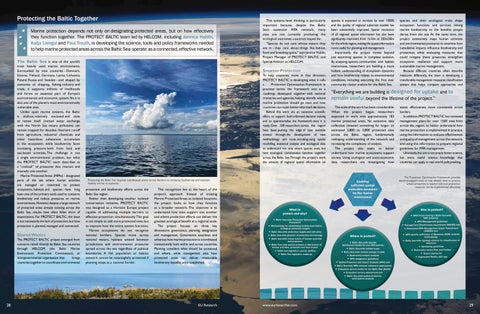
Protecting the Baltic Sea requires coordinated action across borders to conserve biodiversity and maintain healthy marine ecosystems.
protection and biodiversity efforts across the Baltic Sea region. Rather than developing another isolated conservation initiative, PROTECT BALTIC was designed as a Horizon Europe project capable of addressing multiple barriers to effective protection simultaneously. The goal is not simply to add more protected sites, but to improve how the entire system functions. Marine ecosystems do not recognise national borders. Species move across national waters, habitats extend between jurisdictions and environmental pressures spread across the sea regardless of political boundaries. A fish population or habitat network cannot be meaningfully protected if planning stops at a national border.
species is expected to increase by over 1500% and the quality of regional substrate models has been substantially improved. Spatial resolution of all regional spatial information has also been significantly improved, from 1x1km to 250x250m for the whole region, making the spatial information more useful for planning and management. Importantly, the project moves beyond just examining species in complete isolation. By analysing species communities and habitat interactions, researchers are building a more holistic understanding of ecosystem dynamics and how biodiversity relates to environmental conditions, including executing the first ever community cluster analysis for the Baltic Sea.
www.euresearcher.com
29
PROTECT BALTIC Enabling comprehensive effective and efficient protection and restoration measures for a resilient Baltic Sea ecosystem
Project Objectives
PROTECT BALTIC is a HORIZON Europefunded project to improve marine spatial protection efforts across the full protection governance-designation-management arc and the entire Baltic Sea MPA network. The project aims to produce the knowledge, tools, infrastructure, and mechanisms needed to operationalise an adaptive, transboundary approach to marine protection that directly embeds international protection commitments into regional work.
Project Funding
PROTECT BALTIC is funded by the European Union under Grant agreement ID 101112866. Views and opinions expressed are however those of the author(s) only and do not necessarily reflect those of the European Union or the European Climate, Infrastructure and Environment Executive Agency (CINEA). Neither the European Union nor the granting authority can be held responsible for them.
Project Partners
https://protectbaltic.eu/partners
Contact Details
Paul Trouth, PROTECT BALTIC Communications Coordinator Baltic Marine Environment Protection Commission Katajanokanlaituri 6b, 00160 Helsinki, Finland T: +358 207 412 649 E: protect-baltic@helcom.fi W: https://protectbaltic.eu W: https://protectbaltic.eu/news
Jannica Haldin, Katja Laingui, and Paul Trouth (left to right)
Jannica Haldin is a marine governance expert with 15 years of experience in environmental policy and diplomacy. At HELCOM, she has led major Baltic Sea assessments and now heads the PROTECT BALTIC project Katja Laingui is an environmental professional with over 15 years of operational management experience. The Admin & Finance Coordinator of the PROTECT BALTIC management team, she specialises in marine conservation, sustainable development, and environmental education. Paul Trouth is Communications Coordinator for PROTECT BALTIC at HELCOM. With 13 years at the European Chemicals Agency, he specializes in strategic communications and making complex scientific and policy topics accessible to diverse audiences.
30
Partners from across the Baltic Sea region meet during the PROTECT BALTIC Annual Meeting, bringing together expertise in conservation, science, policy and management.
Beyond Borders Science alone, however, does not drive environmental change. One of the project’s defining features is its strong emphasis on cooperation and stakeholder engagement. Because PROTECT BALTIC originated from country-level needs identified through HELCOM, governments have remained involved throughout the process.
Alongside the development of an MPA Portal designed as a central hub for managers and stakeholders, PROTECT BALTIC is working to improve public understanding of marine protection through webinars, youth engagement activities, ocean literacy materials, by launching MPA Day in Europe and the continued strategic involvement in global MPA Day implementation, so helping translate
“Species do not care whose waters they are in — they care about things like habitat, food and breeding space.” At least twice a year, ministry representatives and policymakers from all Baltic Sea EU Member State countries meet with the project team to review progress, discuss findings and ensure outputs remain practical and politically relevant. Political priorities change, governments shift and environmental policies evolve. Over a five-year project, maintaining relevance requires constant communication and flexibility. “Change is rarely fast, but long-term cooperation can create lasting improvements for the Baltic Sea,” says Katja Laingui, who works as an Admin and Finance Coordinator for the project. Public engagement also forms an important part of the project’s long-term vision.
scientific findings into accessible knowledge for citizens and local communities. “Everything we are building is designed for uptake and to remain useful beyond the lifetime of the project,” says Paul Trouth who is responsible for the Communication and Dissemination of the project. This long-term vision may eventually include location-based digital tools helping visitors learn more about species, habitats and protection measures in real time. For the PROTECT BALTIC team, success will not be measured simply by how many protected areas exist, but by whether those areas genuinely function as an effective ecological network. In a sea shared by many nations, protecting biodiversity may ultimately depend on something deceptively simple: learning to work together across borders.
EU Research