Photograph by Tuomas Haapalehto
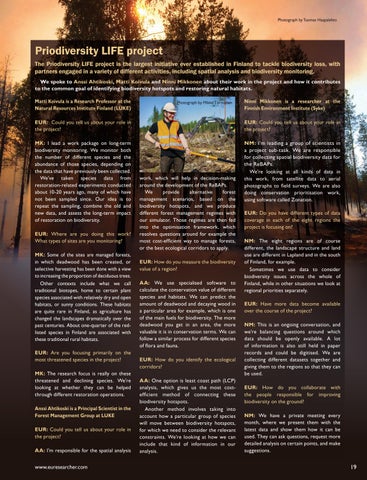
Priodiversity LIFE project The Priodiversity LIFE project is the largest initiative ever established in Finland to tackle biodiversity loss, with partners engaged in a variety of different activities, including spatial analysis and biodiversity monitoring. We spoke to Anssi Ahtikoski, Matti Koivula and Ninni Mikkonen about their work in the project and how it contributes to the common goal of identifying biodiversity hotspots and restoring natural habitats. Matti Koivula is a Research Professor at the Natural Resources Institute Finland (LUKE)
Photograph by Mikko Törmänen
Ninni Mikkonen is a researcher at the Finnish Environment Institute (Syke)
EUR: Could you tell us about your role in the project?
EUR: Could you tell us about your role in the project?
MK: I lead a work package on long-term biodiversity monitoring. We monitor both the number of different species and the abundance of those species, depending on the data that have previously been collected. We’ve taken species data from restoration-related experiments conducted about 10-20 years ago, many of which have not been sampled since. Our idea is to repeat the sampling, combine the old and new data, and assess the long-term impact of restoration on biodiversity.
NM: I’m leading a group of scientists in a project sub-task. We are responsible for collecting spatial biodiversity data for the ReBAPs. We’re looking at all kinds of data in this work, from satellite data to aerial photographs to field surveys. We are also doing conservation prioritisation work, using software called Zonation.
EUR: Where are you doing this work? What types of sites are you monitoring? MK: Some of the sites are managed forests, in which deadwood has been created, or selective harvesting has been done with a view to increasing the proportion of deciduous trees. Other contexts include what we call traditional biotopes, home to certain plant species associated with relatively dry and open habitats, or sunny conditions. These habitats are quite rare in Finland, as agriculture has changed the landscapes dramatically over the past centuries. About one-quarter of the redlisted species in Finland are associated with these traditional rural habitats. EUR: Are you focusing primarily on the most threatened species in the project? MK: The research focus is really on these threatened and declining species. We’re looking at whether they can be helped through different restoration operations. Anssi Ahtikoski is a Principal Scientist in the Forest Management Group at LUKE EUR: Could you tell us about your role in the project? AA: I’m responsible for the spatial analysis
www.euresearcher.com
work, which will help in decision-making around the development of the ReBAPs. We provide alternative forest management scenarios, based on the biodiversity hotspots, and we produce different forest management regimes with our simulator. Those regimes are then fed into the optimisation framework, which resolves questions around for example the most cost-efficient way to manage forests, or the best ecological corridors to apply. EUR: How do you measure the biodiversity value of a region? AA: We use specialised software to calculate the conservation value of different species and habitats. We can predict the amount of deadwood and decaying wood in a particular area for example, which is one of the main fuels for biodiversity. The more deadwood you get in an area, the more valuable it is in conservation terms. We can follow a similar process for different species of flora and fauna. EUR: How do you identify the ecological corridors? AA: One option is least coast path (LCP) analysis, which gives us the most costefficient method of connecting these biodiversity hotspots. Another method involves taking into account how a particular group of species will move between biodiversity hotspots, for which we need to consider the relevant constraints. We’re looking at how we can include that kind of information in our analysis.
EUR: Do you have different types of data coverage in each of the eight regions the project is focusing on? NM: The eight regions are of course different, the landscape structure and land use are different in Lapland and in the south of Finland, for example. Sometimes we use data to consider biodiversity issues across the whole of Finland, while in other situations we look at regional priorities separately. EUR: Have more data become available over the course of the project? NM: This is an ongoing conversation, and we’re balancing questions around which data should be openly available. A lot of information is also still held in paper records and could be digitised. We are collecting different datasets together and giving them to the regions so that they can be used. EUR: How do you collaborate with the people responsible for improving biodiversity on the ground? NM: We have a private meeting every month, where we present them with the latest data and show them how it can be used. They can ask questions, request more detailed analysis on certain points, and make suggestions.
19
Photographed by the Priodiversity LIFE team
Restoring habitats to protect biodiversity Biodiversity loss is a major concern in Finland, with many natural habitats and species under threat due to a variety of factors, including intensified land use and climate change. The team behind the Priodiversity LIFE project are working to help reverse the decline of biodiversity in Finland and restore natural habitats across the country, as Viliina Evokari explains. The ongoing loss of biodiversity across Finland is causing widespread concern, with nearly half of the country’s natural habitat types classified as threatened and many species in decline, in large part due to intensive land use. The Priodiversity LIFE project has been formed to help try and reverse this decline, focusing primarily on eight counties across Finland. “We’re trying to identify regional hotspots for biodiversity within those eight counties, so that we can identify the priorities in those areas,” explains Viliina Evokari, manager of Priodiversity LIFE. The project brings together partners from across Finland, with the shared goal of protecting and restoring biodiversity in these areas through coordinated, concerted action. “The Centres for Economic Development, Transport, and the Environment together with the local stakeholders are developing regional biodiversity actions plans (ReBAPs), based on scientific information,” says Evokari. “We have used heat maps to identify biodiversity hotspots, then we will use the available resources to take practical action.”
Biodiversity hotspots These biodiversity hotspots are not isolated locations free from external influences, so the surrounding environment is also a major consideration in the project. “We think that we need kind of buffer zones around these protected areas and biodiversity hot-spots,” stresses Evokari. Areas identified as important for biodiversity are not automatically protected, nor is land use in the surrounding area immediately
20
restricted. However, providing information to stakeholders about the local environment and the species within it means that biodiversity can be taken into account in future decisions around land use, alongside economic considerations. This issue of the buffer zones around biodiversity hotspots will be addressed in the ReBAPs, along with identifying ‘green’ corridors to connect ecologically important areas, part of the wider goal of identifying
explains. These data will then inform the development of the ReBAP’s for the eight counties, which are broadly representative of Finland’s environmental diversity. “Finland is a big country, and Lapland in the North is completely different to counties in the South, where the problems around biodiversity loss are more acute,” outlines Evokari. Once the biodiversity hotspots have been identified, such as bird habitats, rural biotopes, or forests for example, the next
“We want to build a common understanding between
The project team plans to assess the impact of the total management approach in the restoration areas, looking at its effectiveness in comparison to the more traditional approach. Some measures such as raising the water table will be done during the project, depending to a degree on the nature of the habitat. New species data will also be collected relating to restoration experiments established 10-20 years ago to obtain information on long-term species recovery, thus providing an indicator of the long-term benefits of restoration. “The status of key species helps us understand the overall condition of the habitat,” outlines Matti Koivula, Research Professor at the Natural Resources Institute Finland (LUKE). The focus with this repeat sampling of the old experiments is on the most threatened species in the different habitats. “We have abundant research-based information on species that have been declining because of human activity. For example, clear-cutting has led to the decline of hundreds of forest species since the 1950s,” says Professor Koivula. “We hope to see whether restoration operations help these red-listed species.”
Online portal This and other previously produced information will be collated and made available to stakeholders via an online restoration portal, helping to sustain the impact of the project beyond the initial eightyear funding term. The online portal will be an invaluable resource for stakeholders, such
Photograph by Jouko Mettiäinen
stakeholders, including businesses, municipalities and local people, of what needs to be done to address biodiversity loss.” a pathway towards reversing biodiversity decline. “We want to build a common understanding between stakeholders, including businesses, municipalities, and local people, of what needs to be done to address biodiversity loss,” continues Evokari. The key task at this relatively early stage of the project is to analyse the available scientific information and identify the main areas of interest, those locations where restoration efforts should be focused later on. Teams at two research organisations (the Finnish Environment Institute and Natural Resources Finland) are conducting spatial analysis as part of their role in the project, while Evokari says a lot of attention is also devoted to ensuring that the data are FAIR (Findable, Accessible, Interoperable, and Reuseable). “We have lots of data available in Finland, but they are not always accessible or easy to utilise,” she
Priodiversity LIFE Enriching biodiversity in Finland
Project Objectives
The Priodiversity LIFE project provides solutions to stop biodiversity loss. The project brings together a wide and diverse group of committed stakeholders who, together, have the potential to find the most effective and cost-efficient means to stop biodiversity loss in Finland. The Priodiversity LIFE project is coordinated by Metsähallitus Parks & Wildlife Finland.
Project Funding
The project period will be eight years, or from 2024 to 2031, and it will be cofinanced by the European Union’s LIFE programme. It has a budget of EUR 50 million, of which EUR 30 million will come from the EU’s LIFE programme.
Project Partners
There are a total of 18 project participants. Please see the website below for full details.
Contact Details
Project Manager, Viliina Evokari, Metsähallitus Parks & Wildlife Finland, P.O. Box 80 (Opastinsilta 12 C), FI-00521 Helsinki, Finland E: viliina.evokari@metsa.fi W: https://www.metsa.fi/en/project/ priodiversity-eng/
Viliina Evokari, Adj. Prof. Anssi Ahtikoski, Matti Koivula, and Ninni Mikkonen (left to right)
Project manager Viliina Evokari leads the Priodiversity LIFE -project. She works at Metsähallitus Parks & Wildlife Finland. Adj. prof. Anssi Ahtikoski from Natural Resources Institute Finland has focused on financial assessments on forestry, both at stand and landscape level. He has published over 50 scientific papers tackling with e.g., stand-level optimization and cost-efficient conservation.
step will then be to restore and manage them effectively. A concept called the total management approach has been developed, targetting the biodiversity hotspots and the surrounding green infrastructure as a whole, rather than more fractured, disparate areas of privately- or state-owned land. “There are many different organisations represented in the project, which makes it possible for us to work on both privately and state-owned land, as well as in protected areas and outside them. Nature doesn’t respect the boundaries between privately and state-owned land, so now we can look at things as a whole,” explains Evokari. “A lot of land in Finland is owned by the state, and it’s typically much easier to operate in those areas. Where we work on privatelyowned land, we do so in consultation with the landowners.”
EU Research
as organisations involved in restoration work for example, or private landowners. “We will also provide a lot of training resources via this portal,” continues Evokari. The initial focus of the project’s work is the eight counties, yet biodiversity loss is a major issue across Finland, so Evokari hopes this approach to restoring biodiversity will be adopted more widely in future. “There are at least seven other counties preparing ReBAPs at the moment, and we expect that more will follow,” she says. “We hope to get more funding to do larger-scale restoration projects across the whole of Finland. We will need extra funding to implement the ReBAPs, and then to scale it across the other counties.” The wider backdrop to this work is the EU Biodiversity Strategy for 2030, which sets out some ambitious goals around the restoration of natural habitats. The Priodiversity LIFE is one part of Finland’s efforts to reach biodiversity targets, and will provide a solid foundation for ongoing restoration work beyond the conclusion of the project in 2031. “ By the end of the project we aim to have implemented, at large scale, all the actions required to reverse biodiversity decline. We want to have a better information base about where actions need to be targeted, and more people who can do the work around monitoring and restoring biodiversity,” outlines Evokari. “We are using scientific information to identify the areas where we need to operate, those with a particularly high level of biodiversity.”
Matti Koivula is a research professor in forest entomology at Natural Resources Institute Finland. Koivula has been studying the relationship between forestry and biodiversity in two continents for about 30 years. Ninni Mikkonen is PhD biologist at the Finnish Environment Institute and has a background in ecology. She focuses on spatial conservation prioritization and ecological decision making.
www.euresearcher.com
21