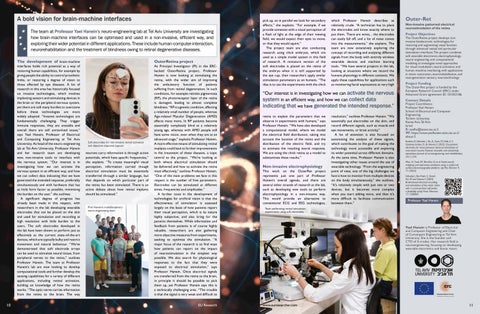
A bold vision for brain-machine interfaces The team at Professor Yael Hanein’s neuro-engineering lab at Tel Aviv University are investigating how brain-machine interfaces can be optimised and used in a non-invasive, efficient way, and exploring their wider potential in different applications. These include human-computer-interaction, neurorehabilitation and the treatment of blindness owing to retinal degenerative diseases.
10
The development of brain-machine
OuterRetina project
interfaces holds rich potential as a way of restoring human capabilities, for example by giving people the ability to control prosthetic limbs, or restoring a degree of vision to those affected by eye diseases. A lot of research in this area has historically focused on invasive technologies, which involves implanting sensors and stimulating devices in the brain or the peripheral nervous system, yet there are still many hurdles to overcome before these technologies are more widely adopted. “Invasive technologies are fundamentally challenging. They trigger immune responses, they are unstable and overall there are still unresolved issues,” says Yael Hanein, Professor of Electrical and Computing Engineering at Tel Aviv University. As head of the neuro-engineering lab at Tel-Aviv University, Professor Hanein and her research team are developing new, non-invasive tools to interface with the nervous system. “Our interest is in investigating how we can activate the nervous system in an efficient way, and how we can collect data indicating that we have generated the intended response, preferably simultaneously and with hardware that has as little form factor as possible, minimising the burden on the user,” she outlines. A significant degree of progress has already been made in this respect, with researchers in the lab developing wearable electrodes that can be placed on the skin and used for stimulation and recording at high resolution with little burden to the users. The soft electrodes developed in the lab have been shown to perform just as effectively as the current state-of-the-art devices, which are typically bulky and restrict movement and natural behaviour. “We’ve demonstrated that soft electrode arrays can be used to stimulate neural tissue, from peripheral nerves to the retina,” outlines Professor Hanein. The team at Professor Hanein’s lab are now looking to develop computational tools and further develop the sensing capabilities for a variety of different applications, including retinal activation, building on knowledge of how the retina works. “The optic nerve carries information from the retina to the brain. The way
As Principal Investigator (PI) in the ERCbacked OuterRetina project, Professor Hanein is now looking at stimulating the retina, with the wider aim of improving the ambulatory function of patients suffering from retinal degeneration. In such conditions, for example retinitis pigmentosa (RP), the photoreceptor layer of the retina is damaged, leading to almost complete blindness. “RP is a genetic condition, affecting a relatively small number of people, whereas Age-related Macular Degeneration (AMD) affects many more. In RP patients become essentially completely blind at a relatively young age, whereas with AMD people still have some vision, even when they are at an advanced stage,” explains Professor Hanein. A more effective means of stimulating retinal implants could lead to further improvements in the treatment of these diseases, a topic central to the project. “We’re looking at both where electrical stimulation should be delivered and how to activate the retina most effectively,” outlines Professor Hanein. “One of the main problems we face in this respect is the number of free parameters. Electrodes can be stimulated at different times, frequencies and amplitudes.” A further issue in the development of technologies for artificial vision is that the effectiveness of stimulation is assessed largely on the basis of how patients report their visual perception, which is by nature highly subjective, and also tiring for the patients themselves. While information and feedback from patients is of course highly valuable, researchers are also gathering more objective measures from experiments, seeking to optimise the stimulation. “A major focus of the research is to find ways how patients can report on the impact of neurostimulation in the simplest way possible. We also search for physiological responses to the fact that they were exposed to electrical stimulation,” says Professor Hanein. Once electrical signals are transferred from the retina to the brain, in principle it should be possible to pick them up, yet Professor Hanein says this is a technically challenging area. “The trouble is that the signal is very weak and difficult to
Soft electrodes for non-invasive retinal activation and objective response capture.
neurons carry information is through action potentials, which have specific frequencies,” she explains. “To create meaningful visual perception, information carried though electrical stimulation must be essentially transferred through a similar language, but that depends on which particular part of the retina has been stimulated. There is an active debate about how retinal implants should be stimulated.”
Prof. Hanein’s multidisciplinary neuro-engineering team.
EU Research
pick up, so in parallel we look for secondary effects,” she explains. “For example, if we provide someone with a visual perception of a flash of light at the edge of their viewing field, we would expect their eyes to move, or that they would squint.” The project team are also conducting research using chick embryos, which are used as a simple model system in this field of research. A miniature version of the soft electrodes is placed on the retina of the embryo when it is still supported by the eye cup, then researchers apply similar stimulation parameters as on humans. “The idea is to use the experiments with the chick
which Professor Hanein describes as relatively crude. “A technician has to place the electrodes and know exactly where to put them. There are wires, , the electrodes can easily fall off, and a lot of noise comes into the measurements,” she explains. The team are now extensively exploring the concept of recording and analysing different signals from the body with entirely wireless wearable devices and machine learning tools. “We have several projects in the lab, looking at situations where we record the humans physiology in different contexts. We apply these capabilities for applications such as monitoring facial expressions at very high
“Our interest is in investigating how we can activate the nervous system in an efficient way, and how we can collect data indicating that we have generated the intended response.” retina to explain the parameters that we observe in experiments with humans,” says Professor Hanein. “We have also developed a computational model, where we model the electrical field distribution, taking into account the location of the retina and the distribution of the electric field, and try to estimate the resulting neural response. We are using the chick retina as a model to substantiate these results.”
Non-invasive electrophysiology This work on the OuterRet project represents just one part of Professor Hanein’s overall agenda, and there are several other strands of research at the lab, such as developing new tools to perform electrophysiology in a non-invasive way. This would provide an alternative to conventional ECG and EEG technologies,
resolution,” outlines Professor Hanein. “We essentially put electrodes on the skin, and record different signals, such as muscle and eye movements, or brain activity.” A lot of attention is also focused on automating the analysis of these signals, which contributes to the goal of making the technology more accessible and exploring its wider potential across different domains. At the same time, Professor Hanein is also investigating other issues around the use of wearable technology. “From the engineering point of view, one of the big challenges we face is how to monitor from multiple devices on the body simultaneously,” she outlines. “It’s relatively simple with just one or two devices, but it becomes more complex when you start adding more, and then it’s more difficult to facilitate communication between them.”
Outer-Ret Non-invasive patterned electrical neurostimulation of the retina
Project Objectives
The OuterRetina project develops noninvasive bioelectronic technologies for restoring and augmenting visual function through advanced retinal and periocular stimulation interfaces. The project combines soft wearable electronics, electrophysiology, neural engineering, and computational modeling to investigate novel approaches for visual modulation, neural activation, and human–machine interfacing, with applications in vision restoration, neurorehabilitation, and next-generation sensory neurotechnology.
Project Funding
The Outer-Ret project is funded by the European Research Council (ERC) under Advanced Grant agreement ID: 101053186.
Contact Details
Project Coordinator, Professor Yael Hanein School of Electrical and Computer Engineering Tel Aviv University Ramat Aviv, Tel Aviv Israel E: yaelha@tauex.tau.ac.il W: https://www.yaelhanein.sites.tau.ac.il/ about-3 Ibrahim, R.,Vėbraitė, I., Re, D., Funk, P. F.,Volk, G. F., Guntinas-Lichius, O., & Hanein,Y. (2025). Dry-printed electrodes for transcutaneous electrical stimulation of innervated muscles:Towards wearable and closed-loop stimulation. Journal of neuroengineering and rehabilitation, 22(1), 226. Man, H., Funk, P.F., Ben-Dov, D. et al. Facial muscle mapping and expression prediction using a conformal surface-electromyography platform. npj Flex Electron 9, 71 (2025). Vėbraitė I, Bar-Haim C, DavidPur M and Hanein Y (2024) Bi-directional electrical recording and stimulation of the intact retina with a screen-printed soft probe: a feasibility study. Front. Neurosci. 17:1288069.
Professor Yael Hanein
Team performing retinal stimulation experiments using soft electrodes.
Yael Hanein is Professor of Electrical and Computer Engineering and Chair of Convergent Engineering at Tel Aviv University. She is the founder and CTO of X-trodes. Her research field is neuroengineering, focusing on developing wearable electronics and bionic vision.
www.euresearcher.com
11