Establishing Nature-based Solution services for transformative change Nature-based Solutions can address climate, biodiversity and societal challenges, but how can their benefits be sustained? Dr Ursula McKnight, Dr Kaidi Tamm, Hanna Hamad Johansson, Mathieu Madison and Dr Luciana Zedda explain how NBSPLUS is developing Nature-based Solution Services to support participatory governance, biodiversity, climate resilience, long-term performance and human well-being. Climate change, biodiversity loss and increasing water-related risks are placing unprecedented pressure on communities across Europe and beyond. Nature-based Solutions (NbS) are ways of working with nature to solve societal challenges, for example by restoring wetlands, creating urban green spaces or protecting rivers. By using natural processes rather than relying solely on engineered infrastructure, NbS can reduce flooding, improve environmental quality, support biodiversity and create healthier living environments. Yet despite growing investment in NbS, many initiatives remain isolated projects embedded within fragmented planning, governance and monitoring systems, limiting their impact. According to Dr Ursula McKnight, Senior Researcher at the Swedish Meteorological and Hydrological Institute (SMHI) and Coordinator of the NBSPLUS project, this fragmented, project-based approach is one of the biggest obstacles to achieving lasting impact. “Many nature-based solutions are still implemented as project-based interventions,” she explains.“What we need is a paradigm shift towards thinking about them as long-term services that require adaptive stewardship, long-term monitoring and iterative evaluation to enable learning and adjustment over time.” This need is increasingly recognised across Europe.The European Environment Agency has highlighted that the wider uptake of Naturebased Solutions is being held back by limited long-term monitoring and assessment of their environmental, social and economic outcomes. NBSPLUS addresses these gaps by bringing together experts in hydrology, climatology, biodiversity, governance and the social sciences to develop the frameworks and tools needed to plan, monitor, assess and manage NbS as part of broader social-ecological systems.
64
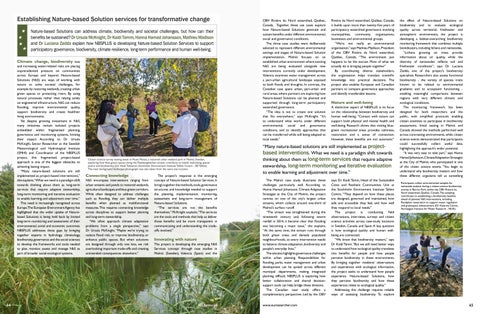
Citizen science survey testing event in Husie Mosse, a restored urban wetland park in Malmö, Sweden, exploring how blue-green spaces along the Risebergabäcken stream contribute to health, well-being, spatial justice and biodiversity. (Dr Heidi Tuhkanen, Stockholm Environment Institute Tallinn Centre - SEI Tallinn) The main background landscape photograph was also taken from the same site location.
Connecting knowledge NbS encompass interventions ranging from urban streams and ponds to restored wetlands, agricultural landscapes and blue-green corridors. While often designed to address challenges such as flooding, they can deliver multiple benefits when planned as multifunctional measures. This requires connecting knowledge across disciplines to support better planning and long-term stewardship. “We often approach climate adaptation problems from a single perspective,” says Dr Ursula McKnight, “Maybe we’re trying to reduce flood risk, or improve biodiversity, or enhance public spaces. But when solutions are designed through only one lens, we risk overlooking important trade-offs and creating unintended consequences elsewhere.”
The project’s response is the emerging concept of Nature-based Solution Services. It brings together the methods, tools, governance structures and knowledge needed to support the planning, implementation, monitoring, assessment and long-term management of Nature-based Solutions. “The services are not the benefits themselves,” McKnight explains. “The services are the tools and methods that help us deliver those benefits and be more transparent in communicating and understanding the tradeoffs involved.”
Innovating with nature The project is developing the emerging NbS Services concept through case studies in Malmö (Sweden), Valencia (Spain) and the
EU Research
OBV Rivière du Nord watershed, Québec, Canada. Together, these use cases explore how Nature-based Solutions generate and sustain benefits under different environmental, social and governance conditions. The three case studies were deliberately selected to represent different environmental settings and stages of Nature-based Solution implementation. Malmö focuses on an established urban environment where existing NbS are being evaluated alongside new interventions currently under development. Valencia examines water management across a peri-urban agricultural landscape exposed to both floods and droughts. In contrast, the Canadian case spans urban, peri-urban and rural areas, where partners are exploring how Nature-based Solutions can be planned and supported through long-term participatory watershed governance. “The idea is not to create one solution that fits everywhere,” says McKnight. “It’s to understand what works under different environmental, social and governance conditions, and to identify approaches that can be transferred while still being adapted to local needs.”
Rivière du Nord watershed, Québec, Canada, it builds upon more than twenty-five years of participatory watershed governance involving municipalities, community organisations, businesses and environmental groups. “We’re not really an environmental organisation,” says Mathieu Madison, President of the OBV Rivière du Nord watershed, Québec, Canada. “The environment just happens to be the excuse. Most of what we actually do is bringing people together.” By coordinating diverse stakeholders, the organisation helps translate scientific knowledge into practical decisions. The project also enables European and Canadian partners to compare governance approaches and identify transferable lessons.
Nature and well-being A distinctive aspect of NBSPLUS is its focus on the relationship between biodiversity and human well-being. “Contact with nature can support both physical and mental health and well-being. Research shows that visiting bluegreen recreational areas provides calmness, restoration and a sense of connection. However, these benefits are not automatic”
“Many nature-based solutions are still implemented as projectbased interventions. What we need is a paradigm shift towards thinking about them as long-term services that require adaptive stewardship, long-term monitoring and iterative evaluation to enable learning and adjustment over time.” The Malmö case study illustrates these challenges particularly well. According to Hanna Hamad Johansson, Climate Adaptation Strategist at the City of Malmö, the project centres on one of the city’s largest urban streams, which collects around one-third of Malmö’s surface runoff. “The stream was straightened during the nineteenth century and, following severe rainfall in 2014, it became clear that flooding was becoming a major issue,” she explains. “At the same time, the stream runs through both green areas and densely populated neighbourhoods, so every intervention needs to balance climate adaptation, biodiversity and people’s everyday lives.” The site also highlights governance challenges within urban planning. Responsibilities for flooding, parks, water management and urban development can be spread across different municipal departments, making integrated planning difficult. NBSPLUS is exploring how better collaboration and shared decisionsupport tools can help bridge these divisions. The Canadian case study offers a complementary perspective. Led by the OBV
www.euresearcher.com
says Dr Kaidi Tamm, Head of the Sustainable Cities and Resilient Communities Unit at the Stockholm Environment Institute Tallinn Centre. “They depend on how these places are designed, governed and maintained, how safe and accessible they feel, and how well they respond to local needs.” The project is conducting field observations, interviews, surveys and citizen science activities across case-study locations in Sweden, Canada and Spain. A key question is how ecological quality and human wellbeing are connected. “We know that biodiversity matters,” says Dr Kaidi Tamm. “But we still need better ways to understand how ecological quality translates into benefits for people and how people perceive biodiversity in these environments. By bringing together residents’ observations and experiences with ecological information, the project seeks to understand how people experience Nature-based Solutions, how they perceive biodiversity and how these experiences relate to ecological quality.” Addressing this challenge requires reliable ways of assessing biodiversity. To explore
the effect of Nature-based Solutions on biodiversity and to evaluate ecological quality across terrestrial, freshwater and atmospheric environments, the project is developing a habitat-overarching biodiversity monitoring framework that combines multiple bioindicators, including lichens and nematodes. “Lichens growing on trees provide information about air quality, while the diversity of nematodes reflects soil and freshwater conditions”, says Dr Luciana Zedda, one of the project’s biodiversity specialists. Researchers also assess functional biodiversity - the variety of species traits known to be related to environmental gradients and to ecosystem functioning enabling meaningful comparisons between regions with very different climatic and ecological conditions. The monitoring framework has been designed for both researchers and the public, with simplified protocols enabling citizen scientists to participate in biodiversity assessments. Initial testing in Malmö and Canada showed the methods performed well across contrasting environments, while citizen science events demonstrated that participants could successfully collect useful data, highlighting the approach’s wider potential. “It was very easy to take part,” says Hanna Hamad Johansson, Climate Adaptation Strategist at the City of Malmö, who participated in one of the citizen science events. “You begin to understand why biodiversity matters and how these different organisms tell us something Participants collect environmental samples for nematode analysis during a citizen-science biodiversity activity in Barron Park, within the OBV Rivière du Nord watershed, Québec, Canada. The sampling contributes to establishing a biodiversity baseline ahead of planned NbS interventions, including floodplain restoration to support water regulation and greenspace enhancement. (Dr Katarina Cetinic, Norwegian Institute for Water Research - NIVA)
65
NBSPLUS
Nature-based solution services promoting local biodiversity, wellbeing and scalable solutions
Project Objectives
NBSPLUS develops NBS Services delivering actionable knowledge and decision tools to support planning, risk assessment and trade-off analysis for NBS, and examines how socioeconomic, ecological and governance contexts may shape performance.
Project Funding
This research was funded by Biodiversa+, the European Biodiversity Partnership, in the context of the NBSPLUS project under the 2023-2024 BiodivNBS joint call. It was co-funded by the European Commission (GA No. 101052342) and the following funding organisations:The Swedish Research Council for Environment, Agricultural, Sciences, and Spatial Planning (Formas), Fundação para a Ciência e a Tecnologia, I.P., Research Council of Norway, Agencia Estatal de Investigación; Fundación Biodiversidad, Estonian Research Council (ETAG), Fonds de Recherche du Québec (FRQ). IBN, partner and subcontractor, has been co-financed by FORMAS, Agencia Estatal de Investigación; Fundación Biodiversidadand, FRQ.
Project Partners
• Swedish Meteorological and Hydrological Institute (SMHI) • University of Lisbon, Portugal (IST-ID) • Norwegian Institute for Water Research (NIVA) • Polytechnic University of Valencia (UPV) • Institute of Biodiversity – Network (IBN) • Stockholm Environment Institute Tallinn Centre (SEI Tallinn) • McGill University, Canada • Research Institutes of Sweden (RISE) • Malmö City, Sweden
Contact Details
Ursula McKnight, Ph.D., Senior Researcher Swedish Meteorological and Hydrological Institute (SMHI) Hydrological Research Unit SE - 601 76 NORRKÖPING T: +46 76 495 7634 E: ursula.mcknight@smhi.se W: https://www.smhi.se/nbsplus Dr Ursula McKnight is an ecohydrologist, and Senior Researcher at the Swedish Meteorological and Hydrological Institute (SMHI). Hanna Hamad Johansson is a climate adaptation strategist at the City of Malmö. Dr Luciana Zedda is an agricultural and environmental scientist specialising in biodiversity research and communication for Institute for Biodiversity – Network (IBN). Dr Kaidi Tamm is a Senior Expert and Head of the Sustainable Cities and Resilient Communities Unit at the Stockholm Environment Institute’s Tallinn Centre. Mathieu Madison is a biologist and environmental management specialist, and President of the Rivière du Nord Watershed Organization in Quebec, Canada.
about the environment around us. It’s a way of helping people see that protecting nature isn’t only the responsibility of the municipality - they can contribute as well.”
Building resilience As the project enters its second phase, the consortium is transforming scientific knowledge into practical tools for planners, practitioners, researchers and investors. One objective is to “stress-test” Nature-based Solutions against future climate conditions, including more frequent floods and droughts, helping identify where interventions are most likely to remain effective under changing climatic conditions. Participatory system mapping and modelling also allow stakeholders to explore interactions between ecological, hydrological, social and governance processes, revealing trade-offs while identifying opportunities to maximise multiple benefits. A major focus of the project is understanding the performance of Naturebased Solutions over time. While NbS are increasingly implemented around the world, there are still few standardised ways to determine whether they continue delivering the outcomes they were designed to achieve. “It’s about understanding performance,” explains McKnight. “What types of tools do we need to understand whether these measures are actually doing the job they were designed for? Are they reducing flood risk? Are they supporting biodiversity? Are they improving people’s well-being?” Developing these methods is central to the NbS Services concept. By combining ecological monitoring, climate modelling and stakeholder knowledge, NBSPLUS evaluates the effectiveness and multifunctionality of Nature-based Solutions. Reliable indicators will support adaptive management, guide future investment and strengthen participatory governance. The Canadian case study illustrates the importance of this collaborative approach. Rather than measuring success only through environmental indicators such as water quality, stakeholders increasingly define success in terms of resilience, adaptation and
stronger partnerships between organisations. “For a long time, we measured success using targets that we couldn’t always control,” Madison explains. “Now we’re focusing much more on resilience, adaptation and collaboration. We’re asking how science can become useful within participatory decisionmaking, so that research reaches practitioners much faster.” Reducing the gap between researchers and practitioners is one of the project’s broader ambitions. By involving stakeholders throughout the research process, NBSPLUS hopes scientific knowledge can be translated more rapidly into practical decision-making, allowing municipalities and communities to respond more effectively to emerging environmental challenges. The project also demonstrates how different governance systems can learn from one another. While the Canadian case study contributes decades of participatory watershed governance experience, the European case studies provide complementary expertise in Nature-based Solutions policy and implementation. Together, they help identify transferable approaches while recognising that successful Nature-based Solutions must always reflect local contexts. “We may not be able to create a single solution that works everywhere,” says McKnight. “But we can develop better ways of connecting knowledge across disciplines, understanding trade-offs and helping planners, practitioners, and policy-makers design solutions that work for both people and nature. Transparent decision-making, supported by appropriate financing, robust participatory processes and stakeholder engagement, will be key to maximising synergies and delivering lasting benefits.” As climate pressures intensify, application of integrated approaches like those under development within NBSPLUS will become increasingly important. Through its emerging Nature-based Solution Services concept, the project is developing the governance, monitoring and performance tools needed to help decision-makers create resilient landscapes where both people and nature can thrive.
The Albufera of Valencia, a coastal wetland where nature-based solutions support biodiversity, improve water quality and enhance landscape resilience. (Prof. Rafael Bergillos, Polytechnic University of Valencia - UPV)
66
EU Research