Protecting precious groundwater supplies Alongside detecting PFAS chemicals, researchers are also working to prevent them from contaminating groundwater. We spoke to Tamara Rodríguez and Isabel Gamallo about how their work in the MAR2PROTECT project will help protect precious groundwater resources and enable a more sustainable approach to water management. The protection of water resources requires not only the detection of contaminants, but also an effective means of preventing them from entering aquifers, a topic at the heart of the MAR2PROTECT project. In common with ALERT-PFAS, the project team is contributing to the wider goal of protecting both water quality and quantity, against a backdrop of growing concerns around water scarcity.
MAR2PROTECT project The project’s agenda centres around developing a decision support system to guide the application of the Managed Aquifer Recharge (MAR) process, in which water from both natural and alternative sources, such as treated wastewater, is deposited into underground aquifers. The decision support system is designed to ensure aquifers are recharged with good-quality water, improving
the resilience of supply networks, which is an important issue in the context of water scarcity concerns. “In some contexts, it is necessary to treat water before it is used in the MAR process, to prevent the contamination of the aquifers,” explains Isabel Gamallo, Project Manager at Cetaqua - Water Technology Centre, one of the partners in the project consortium. “We are developing a decision support system to provide support on when is the best point in time to recharge an aquifer, and where is the best place to do it.” The project team are focusing on a wide range of different pollutants and emerging contaminants alongside PFAS, including pharmaceuticals and personal care products, which also affect groundwater quality. The decision support system will be applied at seven demo sites – five in Europe and two in Africa – each with different target pollutants. “For example, in Frielas, Portugal, we are
studying PFAS. In the Emilia-Romagna region, Italy, the level of pharmaceuticals in water is a major concern, while in South Africa, the focus is on agricultural leachates,” says Dr Pereiro, coordinator of the MAR2PROTECT project. “We’re also working at the Lima River Estuary in Portugal, which is exposed to various pollutants from different sources. The Lima River Estuary has a different profile to the other demo sites in the project. It is a transitional water body where the Lima River meets the Atlantic Ocean.” The common theme across each of these demo sites is the goal of reducing the levels of pollutants in the different water sources bodies, in line with regulatory standards, and the goal of increasing supply. “We are developing a variety of novel treatment technologies, tools and sensors, which we will bring together in the decision support system,” explains Rodriguez.
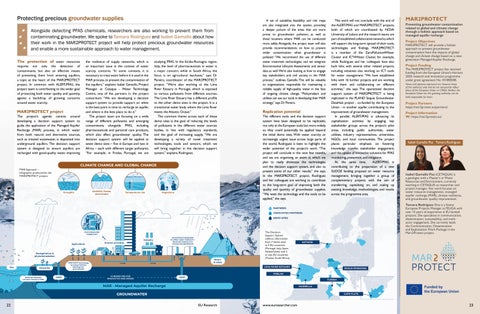
MAR Approach – infographic produced by the MAR2PROTECT project.
A set of suitability, feasibility and risk maps are also integrated into the system, providing a deeper picture of the areas that are more prone to groundwater pollution, as well as those locations where MAR can be conducted more safely. Alongside, the project team will also provide recommendations on how to prevent wider contamination when groundwater is polluted. “We recommend the use of different water treatment technologies, and we integrate Environmental Lifecycle Assessments and sensor data as well. We’re also looking at how to engage key stakeholders and civil society in the MAR process,” outlines Gamallo. This will be valuable to organisations responsible for maintaining a reliable supply of high-quality water in the face of ongoing climate change. “Policymakers and utilities can use our tools in developing their MAR strategy,” says Dr Pereiro.
Replication potential The different tools and the decision support system have been designed to be replicable, not only at the European scale but more widely, so they could potentially be applied beyond the initial demo sites. With water scarcity an increasingly urgent issue across large parts of the world, Rodriguez is keen to highlight the wider potential of the project’s work. “The project will conclude in the next few months, and we are organising an event at which we plan to really showcase the technologies and the decision support system, and also to present some of our other results,” she says. In the MAR2PROTECT project, Rodriguez and her colleagues are working to contribute to the long-term goal of improving both the quality and quantity of groundwater supplies. “We want the technology and the tools to be applied,” she says.
The Decision Support System collects information from 7 demo sites in 4 EU countries (Portugal, Italy, Spain, Netherlands) and 2 in non-EU countries (Tunisia, South Africa).
22
EU Research
www.euresearcher.com
This work will not conclude with the end of the ALERT-PFAS and MAR2PROTECT projects, both of which are coordinated by NOVA University of Lisbon, and the research teams are part of established collaborative networks, which will support the long-term spread of their tools, technologies and findings. MAR2PROTECT is a member of the ZeroPollution4Water Cluster and ICT4Water Cluster, for example, while Rodriguez and her colleagues have also built links with several other related projects, including initiatives also working on ICT tools for water management. “We have established links with 16 further projects and are working with them and collaborating on different activities,” she says. The operational decision support system of MAR2PROTECT is being replicated in the PLAND Sequía Groundwater DataHub project - co-funded by the European Union - in another aquifer, contributing to the improvement of groundwater management. In parallel, ALERT-PFAS is advancing its capitalisation activities by engaging key stakeholder groups across the project’s pilot areas, including public authorities, water utilities, industry representatives, universities, NGOs, and local communities. The project places particular emphasis on fostering knowledge transfer, stakeholder engagement, and the uptake of innovative solutions for PFAS monitoring, prevention, and mitigation. At the same time, ALERT-PFAS is contributing to the preparation of a new SUDOE funding proposal on water resource management, bringing together a group of complementary projects with the aim of transferring, capitalising on, and scaling up existing knowledge, methodologies, and results across the programme area.
MAR2PROTECT Preventing groundwater contamination related to global and climate change through a holistic approach based on managed aquifer recharge
Project Objectives
MAR2PROTECT will provide a holistic approach to prevent groundwater contamination from the impacts of global change and climate change based on a newgeneration Managed Aquifer Recharge.
Project Funding
The MAR2PROTECT project has received funding from the European Union’s Horizon 2020 research and innovation programme under grant agreement No 101082048. Views and opinions expressed are however those of the author(s) only and do not necessarily reflect those of the European Union or CINEA. Neither the European Union nor the granting authority can be held responsible for them.
Project Partners
https://mar2protect.eu/partners/
Project Information W: https://mar2protect.eu/
Isabel Gamallo Paz Tamara Rodríguez
Isabel Gamallo Paz (CETAQUA) is a geologist with a Master’s in Water Resources and Environment, currently working in CETAQUA as researcher and project manager. Her work focuses on water resource management, managed aquifer recharge (MAR), climate resilience, and groundwater quality improvement. Tamara Rodríguez Silva is a Senior European Projects Manager at FEUGA with over 15 years of experience in EU-funded projects. She specialises in communication, dissemination, sustainability, and multiactor engagement. She currently leads the Communication, Dissemination and Exploitation Work Package in the Mart2Protect project.
23