Living Labs to improve soil health Mediterranean soils are reaching a critical point, as years of degradation and the effects of climate change threaten the long-term productivity of agricultural land. The LILAS4SOILS project has launched five living labs to test Carbon Farming Practices under real farming conditions to discover which approaches can best regenerate soils and support more resilient agriculture. A large proportion of soils around the Mediterranean basin are in an unhealthy condition, and they are being degraded further by ongoing climate change, a situation which represents a significant threat to their agricultural productivity. The EU has established a Mission called ‘A Soil Deal for Europe’ to address the issue, using Living Labs to test different practices, including CFPs, and identify those that can help restore the health of soils across the region. The goal of the Mission is to establish 100 Living Labs by 2030. Funded under Horizon Europe, LILAS4SOILS encapsulates the mission’s goal and objectives, having created five Living Labs. As Sonia Pietosi, the Project Coordinator, states “the purpose of Living Labs is to bring together different stakeholders – including researchers, farmers and agri-food businesses, policymakers and civil society – to test new ideas and innovations in real-life environments. The Living Labs get innovation to the ground, moving it from controlled environments within universities and research institutes to operational and commercial farms, in order to test CFPs in real conditions and increase adoption at scale.”
LILAS4SOILS project The Living Lab approach provides deeper insights into the complexities of implementing different CFPs such as agroforestry, nutrient management and soil organic carbon (SOC) management, which are known to increase the sequestration capacity of the soil and so mitigate the impact of climate change. The Living Labs established by LILAS4SOILS will now test different CFPs and evaluate their effectiveness, which will ultimately point the way towards healthier soils. These Living Labs — IBERSOILL (Portugal/Spain), SOFRALL (France), SHARE Innovation Lab (Italy), GRECFL² (Greece) and RAGILL (Israel) — bring their own regional focus to the trials. “There are 100 active sites in the project, so 20 in each of the five Living Labs. Of these, 85 are commercial farms, and 15 are more controlled sites covering a wide variety of crops and soil types. While individual CFPs have been shown to be effective in isolation, the project team is now looking at the effectiveness of combining different practices in a real production context,” outlines Pietosi.
50
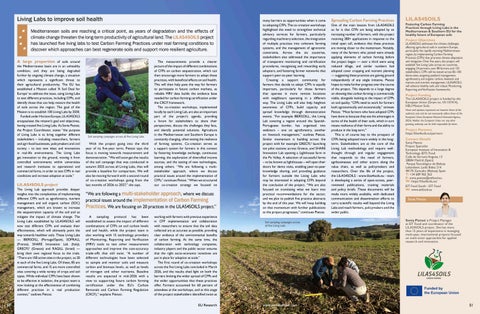
Soil sampling campaigns across all five Living Labs.
With the project going into the third year of its five-year term, Pietosi says the focus is moving towards measurement and demonstration. “We will soon get the results of the soil campaign that was conducted in autumn 2025 across all Living Labs, that will provide a baseline for comparison. We will also be moving forward with a second round of co-creation workshops going from the last months of 2026 to 2027,” she says.
The measurements provide a clearer picture of the impact of different combinations of CFPs on carbon sequestration, which can then encourage more farmers to adopt these practices, with beneficial effects on soil health. This will then help pave the way for farmers to participate in future carbon markets, as reliable MRV data builds the evidence base needed for carbon farming certification under the CRCF framework. The co-creation workshops, implemented locally by each Living Lab, are also an important part of the project’s agenda, providing a forum for stakeholders to share their perspectives, discuss the challenges they face, and identify potential solutions. Agriculture in the Mediterranean and Southern Europe is constantly changing, often testing the resilience of farming systems. Co-creation serves as a support system for farmers in this context by fostering knowledge exchange, continuous learning, the exploration of diversified income sources, and the testing of new technologies, among others. “We are following a multistakeholder approach, where we discuss practical issues around the implementation of CFPs,” continues Pietosi. “When we structured our co-creation strategy we focused on
“We are following a multi-stakeholder approach, where we discuss practical issues around the implementation of Carbon Farming Practices. We are focusing on 20 practices in the LILAS4SOILS project.” A sampling protocol has been established to assess the impact of different combinations of CFPs on soil carbon levels and soil health, while the project team is also working with 15 technology providers of Monitoring, Reporting and Verification (MRV) tools to test other measurement approaches and improve the cost-accuracy trade-offs that still exist. “A number of different technologies have been selected to sample and monitor soils and measure carbon and biomass levels, as well as levels of nitrogen and other nutrients. Baseline results are expected in mid-2026 with a view to supporting future carbon farming certification under the EU’s Carbon Removals and Carbon Farming Regulation (CRCF),” explains Pietosi.
working with farmers with previous experience in CFP implementation and collaboration with researchers to ensure that the soil data collected are as accurate as possible, providing clear evidence of the environmental benefits of carbon farming. At the same time, the collaboration with technology companies, industry players and the public sector ensures that the right socio-economic incentives are put in place for adoption at scale.” The first round of co-creation workshops across the five Living Labs concluded in March 2026, and the results shed light on both the barriers limiting the wider spread of CFPs and the wider opportunities that these practices offer. Farmers accounted for 60 percent of attendees at the workshops, and at this stage of the project stakeholders identified twice as
EU Research
many barriers as opportunities when it came to adopting CFPs. The co-creation workshops highlighted the need to strengthen technical advisory services for farmers, particularly regarding machinery selection, the integration of multiple practices into coherent farming systems, and the management of agronomic constraints. Across the six countries, stakeholders also addressed the importance of transparent monitoring and certification procedures, recognising and rewarding early adopters, and fostering farmer networks that support peer-to-peer learning. Creating a support community for farmers that decide to adopt CFPs is equally important, particularly for those farmers that operate in more remote locations with neighbours operating in a different way. The Living Labs will also help heighten awareness of CFPs, build capacity and spread knowledge through demonstration events. “For example IBERSOILL, the Living Lab covering a region around the SpanishPortuguese border, has organised two webinars – one on agroforestry, another on livestock management,” outlines Pietosi. Similar momentum is building across the project with for example GRECFL² launching ten pilot stations across Greece, and SHARE Innovation Lab opening a Lighthouse farm in the Po Valley. A selection of successful farms – to be known as lighthouses – will open their doors for demo visits, enabling peer-to-peer knowledge sharing, and providing guidance for farmers outside the Living Labs who may be interested in adopting CFPs beyond the conclusion of the project. “We are also focused on translating what we learn into practical recommendations for the sector, and we plan to publish five practice abstracts by the end of this year. We will keep building on that momentum with further publications as the project progresses,” continues Pietosi. Soil sampling campaigns across all five Living Labs.
www.euresearcher.com
Spreading Carbon Farming Practices One of the main lessons from LILAS4SOILS so far is that CFPs are being adopted by an increasing number of farmers, with the project receiving 280+ applications in response to the initial open call, evidence that these practices are moving closer to the mainstream. Notably, many of the farmers who joined were already applying elements of carbon farming before the project began — over a third were using reduced tillage, and similar numbers had adopted cover cropping and nutrient planning — suggesting these practices are gaining ground independently of any single initiative. Pietosi hopes to make further progress over the course of the project. This depends to a large degree on showing that carbon farming is commercially viable, alongside looking at the impact of CFPs on soil quality. “CFPs need to work for farmers both agronomically and economically,” stresses Pietosi. “Most farmers who have adopted CFPs have done so because they see the advantages in terms of the health of their soils, which in turn means resilience of their farms and the ability to produce in the long term.” This is of course key to the prospect of CFPs being adopted more widely in the longterm. Stakeholders are at the core of the Living Lab methodology and require wellthought through and regular engagement that responds to the need of farmers, agribusinesses and other actors along the value chain, as well as policymakers and researchers. Over the life of the project, the LILAS4SOILS - www.lilas4soils.eu - team is developing a series of open-access, peerreviewed publications, training materials and policy briefs. These documents will be made more widely available, with dedicated communication and dissemination efforts to carry scientific results well beyond the Living Labs and reach farmers, policymakers and the wider public.
LILAS4SOILS
Fostering Carbon Farming Practices through Living Labs in the Mediterranean & Southern EU for the healthy future of European soils
Project Objectives
LILAS4SOILS addresses the climate challenges affecting agricultural soils in southern Europe, particularly the rapidly warming Mediterranean region, by implementing Carbon Farming Practices (CFPs) that promote climate adaptation and mitigation. Over five years, the project will establish five Living Labs across six countries, engaging 24 partners, over 80 farmers and 125 stakeholders. CFPs will be tested across 85–100 demo-sites, targeting peatland management, agroforestry, soil organic carbon, livestock and manure, and nutrient management. LILAS4SOILS will advance healthy soils and robust Monitoring, Reporting and Verification frameworks.
Project Funding
The LILAS4SOILS project is funded by the European Union (Grant no. 101157414), HEU Mission Soils. Views and opinions expressed are however those of the author(s) only and do not necessarily reflect those of the European Union, European Research Executive Agency (REA). Neither the European Union nor any other granting authority can be held responsible for them.
Project Partners
https://lilas4soils.eu/partners
Contact Details
Sonia Pietosi Project Specialist European Institute of Innovation & Technology (EIT) Food Calle de Serrano Anguita, 13 28004 Madrid (Spain) Parque Tecnológico de Bizkaia Lekandene. Laida Bidea 214. 48170 Zamudio (Bizkaia) Spain T: +34 689 965 562 E: sonia.pietosi@eitfood.eu W: https://lilas4soils.eu/ EIT Food South - EIT Food W: www.eitfood.eu
Sonia Pietosi
Sonia Pietosi is Project Manager at EIT Food and coordinator of the LILAS4SOILS project. She has more than 15 years of experience in managing multi-year, international projects focused on multi-actor approaches for applied research and innovation.
51