Landscapes for Nature and People Protecting biodiversity depends not only on safeguarding isolated habitats, but on how landscapes are managed as connected systems that support both people and nature. The LANDPATHS team, led by Associate Professor Malgorzata Blicharska at Uppsala University, is exploring how governance, citizen participation and land-use strategies can promote resilient multifunctional landscapes.
60
Citizen voices A defining feature of LANDPATHS is its participatory approach. Instead of researchers studying landscapes from afar, the programme works with communities to co-create visions – or “imaginaries” – of future multifunctional landscapes. Researchers and stakeholders jointly explore what landscapes should look like in the future, what barriers stand in the way and what governance pathways could help achieve change. One particularly innovative method has been the use of citizens’ juries. In the forested region of Voxnadalen, invitations were sent to 5000 residents, from which a representative mini-public of citizens was assembled to reflect diversity in age, education, background and life experience. Across two weekends, participants heard evidence from experts, deliberated in small groups and debated the future of municipal forest management.
Across Europe, landscapes are under growing pressure. Climate change, biodiversity loss, urbanisation, food production, forestry and competing economic demands increasingly shape how land is used and managed. Yet landscapes rarely serve a single purpose. Forests provide timber, recreation and habitats for wildlife. Coastal regions support livelihoods, tourism and ecosystems. Urban green spaces contribute to biodiversity while improving physical and mental wellbeing. The challenge is clear: how can landscapes simultaneously support biodiversity, economic activity and human wellbeing? This question lies at the centre of LANDPATHS, a five-year Swedish research programme funded by the Swedish Environmental Protection Agency and the Swedish Agency for Marine and Water Management. Bringing together researchers across institutions and disciplines, the programme seeks to develop governance and management strategies that strengthen biodiversity while promoting multifunctional landscapes that benefit different actors in society. Rather than treating landscapes as static spaces, LANDPATHS views them as dynamic systems shaped by overlapping uses, competing interests and shared futures. At its core lies a deceptively simple idea: biodiversity should not be treated as an afterthought. “Many people think biodiversity is about protected areas and a few species somewhere,” explains Prof. Malgorzata Blicharska. “But biodiversity depends on wider landscapes and connectivity between places. Protected areas alone are not enough.” The programme began in 2022 and spans forests, agriculture, coasts, mountains and urban landscapes. Yet researchers stress that these categories are largely practical distinctions. In reality, landscapes overlap, as do the people, policies and priorities that shape them. A suburban area may border forests and farmland; a coastal region may simultaneously support fisheries, tourism, conservation and housing. For LANDPATHS, the key question is therefore not simply ecological, but social and political: how can societies govern landscapes to balance competing functions while protecting biodiversity?
while strengthening ecosystem resilience? Could coastal conservation help revitalise local economies? LANDPATHS explores these questions not through theory alone, but through practical engagement with the people who live and work in these landscapes.
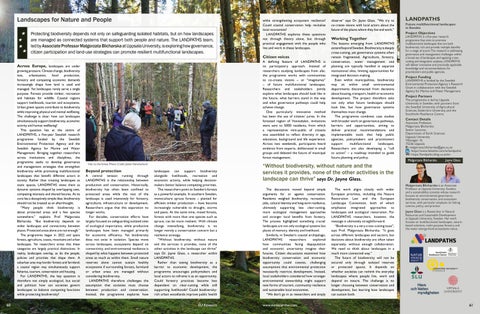
Visit to the forest. Photo Credit: Johan Hammerlund
Beyond protection A central tension running through LANDPATHS is the relationship between production and conservation. Historically, biodiversity has often been confined to protected areas while the rest of the landscape is used intensively for forestry, agriculture, infrastructure or development. Researchers argue that this separation no longer works. For decades, conservation efforts have largely focused on safeguarding isolated sites of ecological importance, while productive landscapes have been managed primarily for economic efficiency. Yet biodiversity does not exist in isolation. Species move across landscapes, ecosystems depend on connectivity, and environmental resilience is shaped by what happens between protected areas as much as within them. Small nature reserves alone cannot sustain healthy ecosystems if surrounding forests, farmland or urban areas are managed without considering biodiversity. LANDPATHS therefore challenges the assumption that societies must choose between production and conservation. Instead, the programme explores how
landscapes can support biodiversity alongside livelihoods, recreation and economic activity, while helping decisionmakers better balance competing priorities. The researchers point to Sweden’s forests as a powerful example. In southern Sweden, monoculture spruce forests – planted for efficient timber production – have become increasingly vulnerable to drought, storms and pests. At the same time, mixed forests, forests with more than one species such as spruce, can be more resilient. With climate change intensifying, biodiversity is no longer merely a conservation concern but a resilience strategy. “Without biodiversity, without nature and the services it provides, none of the other activities in the landscape can thrive” says Dr. Jayne Glass, a researcher within LANDPATHS. Rather than seeing biodiversity as a barrier to economic development, the programme encourages policymakers and local actors to reframe it as an opportunity. Could forestry practices become less dependent on clear-cutting while still supporting livelihoods? Could biodiversityrich urban woodlands improve public health
EU Research
observe” says Dr. Jayne Glass. “We try to co-create visions with local actors about the future of the places where they live and work.”
Working Together The lessons emerging from LANDPATHS extend beyond Sweden. Biodiversity is deeply cross-cutting, yet governance systems often remain fragmented. Agriculture, forestry, conservation, water management and planning are typically handled in separate institutional silos, limiting opportunities for integrated decision-making. Even within municipalities, biodiversity may sit within small environmental departments disconnected from decisions about housing, transport, health or economic development. The project therefore asks not only what future landscapes should look like, but how governance systems themselves must change. The programme combines case studies with broader work on governance pathways, barriers and opportunities, aiming to deliver practical recommendations and implementable tools that help public agencies, policymakers and practitioners support multifunctional landscapes. Researchers are also developing a “call to action” – a roadmap intended to guide future planning and policy.
“Without biodiversity, without nature and the services it provides, none of the other activities in the landscape can thrive” says Dr. Jayne Glass. The discussions moved beyond simple arguments for or against conservation. Residents weighed biodiversity, recreation, jobs, cultural identity and long-term resilience, ultimately supporting less clear-cutting, more ecological management approaches and stronger local benefits from forestry. The process highlighted something crucial: landscapes are not only ecological systems but places of memory, identity and livelihood. Similarly, in Sweden’s coastal archipelago, LANDPATHS researchers explored how communities facing depopulation and economic uncertainty imagine their futures. Citizen discussions examined how biodiversity conservation and economic opportunity could coexist, challenging assumptions that environmental protection necessarily restricts development. Instead, local stakeholders considered how stronger environmental stewardship might support new forms of tourism, community resilience and sustainable local economies. “We don’t go in as researchers and simply
www.euresearcher.com
The work aligns closely with wider European priorities, including the Nature Restoration Law and the European Landscape Convention, both of which emphasise integrated approaches to landscapes and ecological restoration. For LANDPATHS researchers, however, the message is ultimately straightforward. “Biodiversity is a very cross-cutting issue”, says Prof. Malgorzata Blicharska. “It goes across different landscapes and sectors, but decisions about biodiversity are often taken separately, without enough collaboration. We need to think about landscapes in a much more connected way.” The future of biodiversity will not be secured only through isolated reserves or protected spaces. It depends on whether societies can rethink the everyday landscapes where people live, work and depend on nature. The challenge is no longer choosing between conservation and development, but learning how landscapes can sustain both.
LANDPATHS
Future multifunctional landscapes in Sweden
Project Objectives
LANDPATHS is a five-year research programme that aims to promote multifunctional landscapes that are both biodiversity rich and provide multiple benefits for a range of actors. The research is addressing governance and management challenges within a broad set of landscapes and applying crosscutting and integrative analyses. LANDPATHS will deliver innovative and practically applicable knowledge and recommendations for practitioners and public agencies.
Project Funding
LANDPATHS is funded by the Swedish Environmental Protection Agency´s Research Grant in collaboration with the Swedish Agency for Marine and Water Management.
Project Partners
The programme is led by Uppsala University in Sweden, with partners from the Swedish University of Agricultural Sciences, Södertörn University, and the Stockholm Resilience Centre.
Contact Details
Associate Professor, Malgorzata Blicharska Senior Lecturer, Department of Earth Sciences Uppsala University Villavägen 16 75236 Uppsala E: malgorzata.blicharska@geo.uu.se : https://www.linkedin.com/in/landpaths/ W: https://landpaths.blog.uu.se/en
Malgorzata Blicharska
Jayne Glass
Malgorzata Blicharska is an Associate Professor at Uppsala University, Sweden, and a sustainability scientist whose research focuses on environmental governance, biodiversity conservation, and ecosystem services, with particular emphasis on linking science, policy, and practice. Jayne Glass is a Researcher in Natural Resources and Sustainable Development at Uppsala University, Sweden. Her work focuses on multifunctional landscapes, naturebased solutions, multi-purpose forestry and the water-energy-food-ecosystems nexus.
61