A New Era of Food Safety As climate change, geopolitical instability and changing consumption patterns reshape global food systems, new food safety risks are emerging in unexpected places. Nathan Meijer, Bas van der Velden and Debora Serra explain how the HOLiFOOD project is pioneering an AI-powered, holistic approach to identifying emerging hazards and strengthening Europe’s capacity to protect public health. Food safety is often taken for granted in Europe. Yet behind this confidence lies a complex network of farmers, food producers, laboratories, regulators and risk assessors working to keep food safe. In fact, today, that system is facing growing challenges. Climate change, geopolitical disruptions and shifting dietary habits are creating new food safety risks and making traditional monitoring approaches less effective. At the same time, EU initiatives such as the European Green Deal and Farm to Fork Strategy are driving the transition towards more sustainable food systems. Policymakers therefore need better tools to anticipate trade-offs and support evidencebased decisions. The EU-funded HOLiFOOD project is tackling this challenge by developing a new, integrated framework for food safety risk analysis. Combining artificial intelligence (AI), big data technologies, advanced laboratory methods and stakeholder engagement, the project aims to help authorities identify emerging risks earlier and respond more effectively.
Emerging Risks One of the project’s central concepts is the idea of emerging risks. These are hazards that are either entirely new or becoming more significant because of changing environmental or societal conditions. According to Nathan Meijer, Project Coordinator at Wageningen Food Safety Research, mycotoxins provide a clear example. These toxic compounds, produced by fungi, have long been associated with warmer regions of the world. However, climate change is altering their distribution. “We’ve known about some hazards for decades, but all of a sudden we start to see them popping up in new products, new regions, or at higher concentrations,” explains Meijer. “Mycotoxins are a good example. They were traditionally associated with other parts of the world, but now we are increasingly seeing them in parts of Europe because of climate change.” As temperatures rise and weather patterns shift, mycotoxins are increasingly being detected in parts of Europe where they were previously uncommon. Hazards that
62
concentrated. This creates opportunities for more efficient risk-based monitoring. Rather than increasing testing indiscriminately, resources can be directed towards locations and products where hazards are most likely to occur. At the same time, the project recognises the importance of maintaining a degree of random sampling. Relying exclusively on historical patterns can create blind spots and potentially overlook new threats. The framework therefore combines predictive intelligence with broader surveillance strategies. The project’s holistic philosophy extends beyond data modelling. Researchers are also employing untargeted high-resolution mass spectrometry and metagenomics approaches to detect chemical and microbiological hazards that may otherwise remain unnoticed. Instead of searching only for known contaminants, these methods enable scientists to identify unexpected signals and emerging threats.
Beyond Assessment
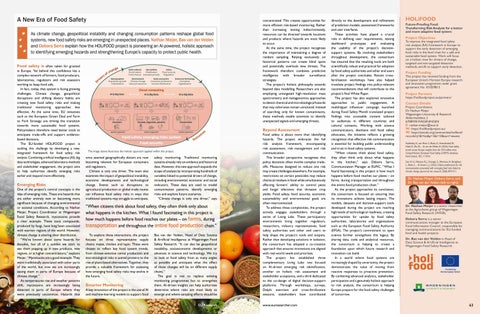
The image above illustrates the holistic approach applied within the project.
once seemed geographically distant are now becoming relevant for European consumers and regulators. Climate is only one driver. The team also examines the impact of geopolitical instability, economic developments and technological change. Events such as disruptions to agricultural production or global trade routes can influence food safety risks in ways that traditional systems may struggle to anticipate.
safety monitoring. Traditional monitoring systems already rely on evidence and historical data. However, this new approach expands the scope of analysis by incorporating hundreds of variables linked to potential drivers of change, including environmental, economic and social indicators. These data are used to model contamination patterns, identify emerging risks and explore future scenarios. “Climate change is only one driver,” says
“When citizens think about food safety, they often think only about what happens in the kitchen. What I found fascinating in this project is how much happens before food reaches our plates – on farms, during transportation and throughout the entire food production chain.” To explore these interactions, the project focuses on three representative supply chains: maize, chicken and lupin. These were chosen to reflect key food system trends, from climate-sensitive cereal production and microbiological risks in animal proteins to the rise of plant-based alternatives. Together, they provide a valuable framework for assessing how emerging food safety risks may evolve in the future.
Smarter Monitoring A key innovation of the project is the use of AI and machine-learning models to support food
Bas van der Velden, Head of Data Science & Artificial Intelligence at Wageningen Food Safety Research. “It can also be geopolitical instability, socioeconomic developments or advances in science and technology. We try to look at food safety from as many angles as possible and anticipate what the effect of these changes will be on different supply chains.” The goal is not to replace existing monitoring programmes but to strengthen them. AI-driven insights can help authorities determine where risks are most likely to emerge and where sampling efforts should be
EU Research
Food safety is about more than identifying hazards. The project embraces the full risk analysis framework, encompassing risk assessment, risk management and risk communication. This broader perspective recognises that policy decisions often involve complex tradeoffs. Measures designed to reduce one risk may create challenges elsewhere. For example, restrictions on certain pesticides may reduce chemical residues in food while simultaneously affecting farmers’ ability to control pests and fungal infections that threaten crop yields. Food safety, food security, economic sustainability and environmental goals are often interconnected. To address these complexities, the project actively engages stakeholders through a series of Living Labs. These participatory environments bring together regulators, researchers, industry representatives, food safety authorities and other end users to help shape the project’s tools and outputs. Rather than developing solutions in isolation, the consortium has adopted a co-creation approach that ensures innovations are aligned with real-world needs and priorities. The project has established three complementary Living Labs: one focused on AI-driven emerging risk identification, another on holistic risk assessment and stakeholder acceptance, and a third dedicated to the co-design of digital decision-support platforms. Through workshops, surveys, Delphi exercises and cross-fertilisation sessions, stakeholders have contributed
www.euresearcher.com
directly to the development and refinement of prediction models, assessment frameworks and user interfaces. These activities have played a crucial role in defining user requirements, testing dashboard prototypes and evaluating the usability of the project’s decisionsupport systems. By involving stakeholders throughout development, the consortium has ensured that the resulting tools are both scientifically robust and practical for adoption by food safety authorities and other end users after the project concludes. Recent crossfertilisation workshops have also helped translate project findings into policy-relevant recommendations that will contribute to the project’s final White Paper. The project has also explored innovative approaches to public engagement. A multilingual influencer campaign launched during Food Safety Month translated project findings into accessible content tailored to audiences in different countries and cultural contexts. Working with science communicators, dietitians and food safety advocates, the initiative reflects a growing recognition that effective risk communication is essential for building public understanding and trust in food safety systems. “When citizens think about food safety, they often think only about what happens in the kitchen,” says Debora Serra, Communication Manager at EUFIC. “What I found fascinating in this project is how much happens before food reaches our plates – on farms, during transportation and throughout the entire food production chain.” As the project approaches its conclusion, the consortium is focused on ensuring that its innovations achieve lasting impact. The models, datasets and decision-support tools developed during the project are reaching high levels of technological readiness, creating opportunities for uptake by food safety authorities, laboratories and organisations such as the European Food Safety Authority (EFSA). The project’s commitment to open science further strengthens this legacy. By sharing data, code and analytical resources, the consortium is helping to create a foundation upon which future research and innovation can build. In a world where food systems are increasingly shaped by uncertainty, the project demonstrates the value of moving from reactive responses to proactive prevention. By combining advanced analytics, stakeholder participation and a genuinely holistic approach to risk analysis, the consortium is helping Europe prepare for the food safety challenges of tomorrow.
HOLiFOOD Future-Proofing Food: Transforming Risk Analysis for a better and more adaptive food system
Project Objectives
To improve the integrated food safety risk analysis (RA) framework in Europe to support the early detection of emerging food risks in the food chain for a safe and sustainable food system. Work will focus on a holistic view for drivers of change, targeted and non-targeted detection methods, and AI to support early detection.
Project Funding
This project has received funding from the European Union’s Horizon Europe research and innovation programme under grant agreement No 101059813.
Project Partners
https://holifoodproject.eu/partners/
Contact Details
Project Coordinator, Dr. Nathan Meijer Wageningen University & Research Akkermaalsbos 2 6708WB WAGENINGEN E: nathan.meijer@wur.nl W: https://holifoodproject.eu/ W: https://zenodo.org/communities/holifood/ records?q=&l=list&p=1&s=10&sort=newest Kızılilsoley, N., van Meer, F., Mutlu, O., Hoenderdaal,W., Hobé, R., Mu,W., ... & van der Velden, B. (2026). Food safety trends across Europe: insights from the 392-million-entry CompreHensive European Food Safety (CHEFS) database. Food Control, 182, 111816. Sari, N. H., Feliciano, R. J., Orszagh, E., Moriceau, N., Benighaus, L., Reale, F., ... & Frewer, L. J. (2025). Citizen preferences for risk communication associated with emerging food risks linked to climate change. Journal of risk research, 28(8), 893-911.
Dr. Nathan Meijer, Debora Serra, and Dr. Bas van der Velden (left to right)
Dr. Nathan Meijer is a senior researcher at the Agrochains group of Wageningen Food Safety Research (WFSR). Debora Serra is a senior communications manager at the European Food Information Council, responsible for managing communications for EU-funded food and health projects. Dr. Bas van der Velden is Head of Data Science & Artificial Intelligence at Wageningen Food Safety Research.
63