Navigating Quotas and Identities: Displaced Persons in a New Global Order The management of mass migration and the resettlement of millions of people in the period after the Second World War can tell us a global and connected story of how a new international order emerged. Kerstin von Lingen and her colleagues in the GLORE project are investigating how resettlement was managed and experienced after 1945. The Second World War led to the displacement of millions of people across Europe and Asia, and resettling them afterwards proved to be a huge challenge. While the victorious Allies may have initially thought that most people would be happy to be repatriated to their home countries, the situation in Europe was much more complex and many displaced people (DPs) in fact refused to be resettled, for various reasons. “For example, many Jewish refugees refused to return to their home countries because everything they knew had been destroyed and their families had died. Former Soviet POWs and slave labourers were not keen on being repatriated to Stalinist Russia, because rumours quickly spread that people who came home were immediately imprisoned again,” explains Kerstin von Lingen, Professor of Contemporary History at the University of Vienna. As Principal Investigator of the ERC-backed GLORE project, Professor von Lingen is now looking to build a deeper picture of how resettlements were managed in the period between 1945-51, drawing on several sources of data, among them governmental and non-governmental documents, church files, passenger lists and ego-documents.The project’s vision is to explain how societies can cope with the enormous task of mass resettlement and how they resolve the question of integration: the politics of resettlement was central to the creation of a global order after 1945.
82
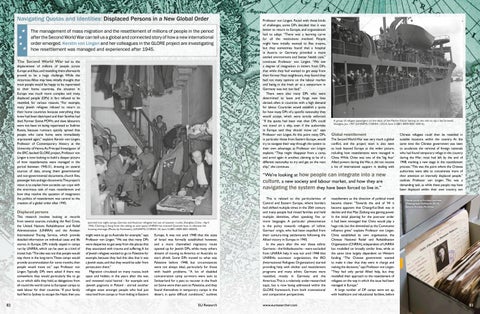
A group of refugee passengers on the deck of the Marine Falcon leaning on the rails to say a last farewell, Shanghai, Jan. 1947 (UNARMS, CNRRA / 333 A, Item S-0801-0009-0001-00014).
Global resettlement The Second World War was very much a global conflict, and the project team is also keen to look beyond Europe at the wider picture, including how resettlements were managed in China. While China was one of the ‘big four’ Allied powers during the War, it did not receive a lot of international support in dealing with
“We’re looking at how people can integrate into a new culture, a new society and labour market, and how they are navigating the system they have been forced to live in.”
Displaced persons This research involves looking at records from several sources, including the Red Cross, the United Nations Rehabilitation and Relief Administration (UNRRA) and the Arolsen International Tracing Service, which provide detailed information on individual cases and life stories. In Europe, DPs initially stayed in camps run by UNRRA, which can be seen as a kind of transit hub.“The idea was not that people would stay there in the long-term. These camps would provide accommodation for some months, then people would move on,” says Professor von Lingen. Typically DPs were asked if there was somewhere they would particularly like to go to, or which skills they held, as delegations from all round the world came to European camps to seek labour for their countries. “If your family had fled to Sydney to escape the Nazis then you
Professor von Lingen. Faced with these kinds of challenges, some DPs decided that it was better to return to Europe, and organisations had to adapt. “There was a learning curve for all the institutions involved. People might have initially wanted to flee trauma, but they sometimes found that a hospital in Austria or Germany provided a more settled environment and better health care,” continues Professor von Lingen. “We see a degree of resignation in letters from DPs, that while they had wanted to get away from their former Nazi neighbours, they found they had not many options on the labour market and being in the fresh air at a sanatorium in Germany was not too bad.” There were also many DPs who were determined to leave and forge new lives abroad, often in countries with a high demand for labour. Countries would establish a quota for how many DPs of a specific nationality they would accept, which were strictly enforced. “If the quota had been met then DPs could not travel on a ship, even if the authorities in Europe said they should move on,” says Professor von Lingen. At this point many DPs, in particular those from Eastern Europe, would try to navigate their way through the system to their own advantage, as Professor von Lingen explains. “They might disappear from a camp, and enrol again in another, claiming to be of a different nationality to try and get on the next ship,” she continues.
Jammed into eight camps, German and Austrian refugees live out of steamer trunks. Shanghai, China - April 1946. Clothing is hung from the ceiling to save space UNRRA has erected Quonset huts to alleviate the housing shortage (Photo by Rothstein), (UNARMS, CNRRA/ 30, Item S-0801-0009-0001-00059).
might want to go to Australia for example,” says Professor von Lingen. “We see that many DPs were desperate to get away from the places that they associated with trauma and suffering. A lot of Jewish refugees wanted to go to Palestine for example, because they had this idea that it was a Jewish state, and that they would be safer from persecution there.” Migration circulated on many routes, both open and hidden, in the years after the war, and renewed racial hatred - for example anti -Jewish pogroms in Poland - stirred another refugee wave amongst people who had just returned from camps or from hiding in Eastern
Europe. It was not until 1948 that the state of Israel was formally established however, and a more channelled migratory route opened up for Jewish DPs, while many others dreamt of moving to America or Australia to start afresh. Some DPs moved to what was Palestine before 1948, but circumstances were not always ideal, particularly for those with health problems. “A lot of disabled concentration camp survivors were sent to Switzerland for a year, to recover in the fresh air. Some were then sent to Palestine, and they found themselves in temporary camps in the desert, in quite difficult conditions,” outlines
EU Research
This is related to the particularities of Central and Eastern Europe, where borders had shifted multiple times in the 20th century and many people had mixed families and held multiple identities, often speaking five or more languages. A particular phenomenon is the policy towards refugees of ‘ethnic German’ origin, who had been expelled from their century-long settlements following the Allied victory in Europe in 1945. In the years after the war these ethnic Germans - the Volksdeutsche - were excluded from UNRRA help. It was not until 1948 that UNRRAs successor organization, the IRO (International Refugees Organization) started providing help with shelter and resettlement programs and many ethnic Germans were resettled, mostly in Germany and the Americas.This is a relatively under-researched topic, but is now being addressed within the GLORE framework, from both transnational and comparative perspectives.
www.euresearcher.com
resettlement as the direction of political travel became clearer. “Towards the end of ‘44 it became apparent that Chiang-Kai-Shek was in decline and that Mao Zedong was gaining power. In the initial planning for the post-war order it had been envisaged that China would play a huge role, but this diminished as the Communist influence grew,” explains Professor von Lingen. China established its own organisation, the Chinese National Relief and Rehabilitation Organisation (CNRRA), independent of UNRRA but modelled on broadly similar lines, while at the same time largely dependent on Western funding. “The Chinese government wanted to make it clear that they were in charge and making the decisions,” says Professor von Lingen. “They had only partial Allied help, but they modelled their approach to the resettlement of refugees on the way in which the issue had been managed in Europe.” A large number of DP camps were set up, with healthcare and educational facilities, before
Chinese refugees could then be resettled in suitable locations within the country. At the same time the Chinese government was keen to accelerate the removal of foreign nationals who had found temporary refuge in the country during the War; most had left by the end of 1948, marking a new stage in the resettlement process. “This was the point where the Chinese authorities were able to concentrate more of their attention on internally displaced people,” outlines Professor von Lingen. This was a demanding task, as while these people may have been displaced within their own country, von Name cards at Arolsen archives (Photograph: Gollhardt 2014), Source: Arolsen Archives
83
GLORE
Global Resettlement Regimes: Ambivalent Lessons learned from the Postwar (1945-1951)
Project Objectives
The project team aims to shed new light on the complex practices of resettlement, focusing on the period between 1945-51, when the authorities were dealing with mass displacement following the end of the Second World War.Their vision is to explain how societies can cope with the enormous task of mass resettlement and how they resolve the question of integration. We see the politics of resettlement as central to the creation of a global order. This research will lead to a fuller understanding of the modern world, and the large-scale movements of refugees and economic migrants that we see today.
Project Funding
Funded by the European Union (ERC, GLORE, ECGA Nr. 101053242) Views and opinions expressed are however those of the author(s) only and do not necessarily reflect those of the European Union or the ERC. Neither the European Union nor the granting authority can be held responsible for them.
Team Members
• Jiayi Tao, BA MA PhD, • Pauli Aro, BA MA Mres, PhD, • Raphaela Monika Bollwein, BEd MA • Lena Clara Christoph, BA MA • Elisabeth Czerniak, BA MA • Anna Deriugina BA MA • Johannes Glack, BA MA • Konstantin SchischkaZeidler BA BEd MA MEd (Digital Humanities)
Contact Details
Photo by Barbara Mair/Uni Wien
Principal Investigator, Prof. Dr. Kerstin von Lingen, M.A. Institut für Zeitgeschichte Universität Wien Spitalgasse 2-4/Hof 1 (1l-01-20) 1090 Wien T: +43-(0)1-4277-41216 E: kerstin.von.lingen@univie.ac.at W: https://global-displacement-andresettlement.univie.ac.at/ Vienna Global Research Blog for the History of Refugees: https://blog-dgg.univie.ac.at/
84
Prof. Dr. Kerstin von Lingen, M.A.
Prof. Dr. Kerstin von Lingen, M.A. is the Chair of Contemporary History at the University of Vienna, a position she had held since 2019. Her research focuses on the history of genocide and violence, especially the Holocaust, forced migration and decolonisation processes.
Mass inoculation of Chinese children at TB clinic, Shanghai, China - November 1947 (Photo by Larry Gahn), (UNARMS, CNRRA / 769, Item S-0801-0007-0001-00026).
Lingen says the environment was often very unfamiliar. “Northern China is very different to southern China. There are vast distances involved and entirely distinct cultural traditions and languages,” she stresses. One of the observations the team has made, with the help of digital humanities methods, is the phenomenon of ‘multiple resettlements’, and sometimes even second generation refugee
Professor von Lingen. This reflects a degree of flexibility in how migrations were managed, a willingness to adapt plans in line with circumstances. “We call that the learning system. If a plan doesn’t work, then you need to adapt,” continues Professor von Lingen. “We can see phases in the way the resettlement process was managed, and people on the ground had a lot of autonomy, particularly in remote areas.”
“Previous historical research has largely focussed on the international framework for resettlement, and on the personal experiences of displaced people, but we lack an understanding of the complex practices of resettlement. By using archival as well as digital humanities methods, we shall fill this gap.” fates. “We have found Russian emigrées fleeing the October revolution in 1917, then somehow ending up in Harbin, China, in the 1920s,” says Professor von Lingen. “They then fled the Japanese advance to Shanghai in the 1930s, and after being resettled by the Allies to the Philippines in the late 1940s, they then found their way to the US in the 1950s.” The project’s agenda also encompasses research into the Allied staff who moved to China to work in supporting the resettlement of DPs, with a lot of movement between Europe and Asia in the Summer of 1945. These were often people who had previous experience of China, maybe they were fluent in Cantonese or Mandarin and were enrolled with UNRRA or CNRRA, and were on the spot. “They are missionaries, businessmen, church people, who have knowledge of humanitarian aid,” says
There was a degree of leeway in how DP camps were managed, and some people saw their role as being about more than simply providing food and shelter, but also in helping people overcome the trauma they had experienced. This is an important step towards dealing with the past and successfully integrating in a new country. “We’re looking at how people can integrate into a new culture, a new society and labour market, and how they are navigating the system they have been forced to live in” outlines Professor von Lingen. This is a prominent issue today, with large numbers of people fleeing war-torn areas across the world, so Professor von Lingen and her team are keen to bring their work to wider attention. “We have an active blog, as well as a podcast, and we are very interested in visualizing our findings through digital humanities,” she stresses.
EU Research