The overlooked part of biodiversity: Putting genetic diversity in the spotlight Genetic diversity is the foundation of biodiversity and is essential for species survival, adaptation, and ecosystem resilience. Now countries across the world have pledged to monitor and report on it. The GINAMO project team is developing evidence-based, practical tools for monitoring genetic diversity, as Dr Christina Hvilsom and Dr Myriam Heuertz explain. Individuals
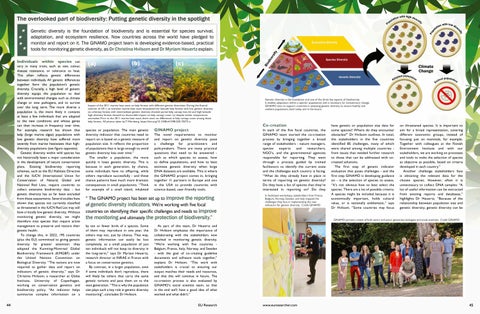
within species can vary in many traits, such as size, colour, disease resistance, or tolerance to heat. This often reflects genetic differences between individuals. All genetic differences together form the population’s genetic diversity. Crucially, a high level of genetic diversity equips the population to deal with environmental changes such as climate change or new pathogens, and to survive over the long term. The more diverse a population is, the more likely it contains at least a few individuals that are adapted to the new conditions and whose genes can then increase in frequency over time. For example, research has shown that kelp (large marine algae) populations with low genetic diversity have suffered more severely from marine heatwaves than highdiversity populations (see figure opposite). Genetic diversity within wild species has not historically been a major consideration in the development of nature conservation plans. Existing biodiversity reporting schemes, such as the EU Habitats Directive and the IUCN (International Union for Conservation of Nature) Global and National Red Lists, require countries to collect extensive biodiversity data - but genetic diversity has so far been excluded from these assessments. Several studies have shown that species not currently classified as threatened in the IUCN Red List may still have critically low genetic diversity. Without monitoring genetic diversity, we might therefore miss species that require active management to preserve and restore their genetic health. To change this, in 2022, 195 countries (plus the EU) committed to giving genetic diversity far greater attention: they adopted the Kunming-Montreal Global Biodiversity Framework (KMGBF) under the United Nations Convention on Biological Diversity. “The nations are now required to gather data and report on indicators of genetic diversity,” says Dr Christina Hvilsom, a researcher at Globe Institute, University of Copenhagen, working on conservation genetics and biodiversity policy. “An indicator helps summarise complex information on a 44
Impact of the 2011 marine heat wave on kelp forests with different genetic diversities. During the Austral summer of 2011, an extreme marine heat wave devastated low latitude kelp forests with low genetic diversity (a), whereas forests with intermediate genetic diversity showed partial kelp canopy loss (b) and high latitude high-diversity forests showed no discernible impact on kelp canopy cover (c) despite similar temperature anomalies. Prior to the 2011 marine heat wave, there were no differences in kelp canopy cover among these kelp forests. All photos taken by T. Wernberg. https://doi.org/10.1038/s41598-020-70273-x
species or population. The main genetic diversity indicator that countries need to report on is based on a genetic measure of population size. It reflects the proportion of populations that is large enough to avoid genetic diversity loss over time.” The smaller a population, the more quickly it loses genetic diversity. This is because in each generation, by chance, some individuals have no offspring, while others reproduce successfully - and these chance patterns have much more dramatic consequences in small populations. “Think for example of a small island, inhabited
GINAMO project The novel requirements to monitor and report on genetic diversity pose a challenge for practitioners and policymakers. There are many practical questions that need to be answered such as which species to assess, how to define populations, and how to best estimate genetic diversity when large DNA datasets are available. This is where the GINAMO project comes in, bringing together 11 partners in Europe and one in the USA to provide countries with science-based, user-friendly tools.
“ The GINAMO project has been set up to improve the reporting of genetic diversity indicators. We’re working with five focal countries on identifying their specific challenges and needs to improve the monitoring and ultimately the protection of biodiversity.” by ten or fewer birds of a species. Some of them may reproduce in one year, the others may not, just by chance. That way, genetic information can easily be lost completely, so a small population of just ten individuals will not keep its diversity in the long-term,” says Dr Myriam Heuertz, research director at INRAE in France with a focus on conservation genetics. By contrast, in a larger population, even if some individuals don’t reproduce, there will likely be others that carry the same genetic variants and pass them on to the next generation. “This is why the population size plays such a key role in genetic diversity monitoring”, concludes Dr Hvilsom.
Genetic diversity is the foundation and one of the three key aspects of biodiversity. It enables adaptation within a species’ populations and is necessary for evolutionary change. GINAMO aims to support countries in assessing genetic diversity to ensure healthy and resilient populations, both today and in the future.
Co-creation In each of the five focal countries, the GINAMO team started the co-creation process by bringing together a broad range of stakeholders - nature managers, species experts and researchers, NGO’s, and the governmental agencies responsible for reporting. They went through a process guided by trained facilitators to identify the current state and the challenges each country is facing. “What do they already have in place in terms of reporting on genetic diversity? Do they have a list of species that they’re interested in reporting on? Do they In facilitated workshops, stakeholders from France, Belgium, Norway, Sweden, and Italy mapped the challenges they face in implementing the new indicators for genetic diversity. Credit GINAMO
have genetic or population size data for some species? Where do they encounter obstacles?” Dr Hvilsom outlines. In total, the stakeholders in the five countries identified 85 challenges, many of which were shared among multiple countries from issues that needed further research to those that can be addressed with cocreated solutions. The first step of genetic indicator evaluation that poses challenges - and the first step GINAMO is developing guidance on - is the selection of species to assess. “It’s not obvious how to best select the species. There are a lot of possible criteria: A species might be included because it is economically important, holds cultural value, or is nationally emblematic,” says Dr Hvilsom. “Some countries may focus
on threatened species. It is important to aim for a broad representation, covering different taxonomic groups, instead of focusing just on mammals, for example. Together with colleagues at the Finnish Environment Institute and with our stakeholders, we are working on processes and tools to make the selection of species as objective as possible, based on criteria developed in each country.” Another challenge stakeholders face is obtaining the relevant data for the chosen species. However, often it is unnecessary to collect DNA samples: “A lot of useful information can be extracted from existing reports and databases,” highlights Dr Heuertz. “Because of the relationship between population size and genetic diversity, genetic diversity can be
GINAMO partners consist of both senior and junior geneticists, biologists and social scientists. Credit GINAMO
As part of this team, Dr Heuertz and Dr Hvilsom emphasise the importance of collaborating with the stakeholders now involved in monitoring genetic diversity. “We’re working with five countries Belgium, France, Italy, Norway, and Sweden - with the goal of co-creating guideline documents and software tools together,” explains Dr Hvilsom. “This work with stakeholders is crucial to ensuring our output matches their needs and resources, and that this will continue in future. The co-creation process is also evaluated by GINAMO’s social scientist team, so that in the end we’ll have a good idea of what worked and what didn’t.”
EU Research
www.euresearcher.com
45
GINAMO
Genetic Indicators for NAture MOnitoring
Project Objectives
Genetic diversity helps species survive environmental change over time. Across the world, countries have now committed to assessing and reporting indicators of genetic diversity. GINAMO supports the implementation and use of these genetic indicators in practice by developing the science behind calculating genetic indicators using DNA and non-DNA data. In a facilitated and scientifically evaluated co-creation process with stakeholders, it develops user-friendly tools and pipelines.
Project Funding
European Biodiversity Partnership, in the context of the GINAMO project under the 2022-2023 BiodivMon joint call. It was co-funded by the European Commission (GA No. 101052342), The Research Council of Norway,The Belgian Science Policy, L’Agence nationale de la recherche, Ministero dell’Università, Naturvårdsverket, Rymdstyrelsen, Deutsche Forschungsgemeinschaft and Innovation Fund Denmark.
Project Partners
https://ginamo.org/team/
Contact Details
Project Coordinator GINAMO, Christina Hvilsom, PhD Globe Institute, University of Copenhagen, Denmark E: christina.hvilsom@sund.ku.dk W: www.ginamo.org
Christina Hvilsom
Myriam Heuertz
Christina Hvilsom is a researcher based at the Globe Institute, University of Copenhagen in Denmark. She leads research at the interface of biobanking, conservation genetics, and biodiversity policy. As coordinator of the EU Biodiversa+ GINAMO project, Christina works to integrate genetic indicators into biodiversity monitoring frameworks, helping strengthen evidence-based conservation action from local to global scales. Myriam Heuertz is a Research Director at INRAE, the French National Research for Agriculture, Food and Environment. Her work focusses on population and conservation genetics of tropical trees, and on developing and mainstreaming genetic indicators for biodiversity policy, monitoring, and conservation practice.
46
assessed without running genetic analyses. Of course, DNA data will often provide the most accurate estimates - but a count of mature individuals is often enough for a rough estimate. This can reduce the costs and workload for genetic diversity assessments.” Once all necessary data has been gathered, the indicators can be calculated, with the GINAMO team working to develop improved methods. “Calculating indicators is not always straightforward, because there are multiple alternative approaches to choose from that do not always give the same result. We have done research to identify the best approaches under different scenarios. Together with
measures. “If a species’ populations are too small to maintain genetic diversity, further action might be necessary to protect it,” outlines Dr Hvilsom. “If needed, one can first run more detailed genetic analyses. Is there evidence of inbreeding? What is happening within the genome? This kind of information can help develop concrete management options.” For example, genetic diversity loss can be halted by increasing the habitat available to the species and by connecting isolated populations with each other. In some cases, natural populations can be supplemented by individuals raised in captivity or translocated from larger wild populations.
“If a species’ populations are too small to maintain genetic diversity, further action might be necessary to protect it” stakeholders, we have developed userfriendly calculation tools and made them easily accessible in an open web platform. The project team is currently improving and refining the tools further, again in collaboration with stakeholders.” Dr Heuertz says this work has also attracted interest from the private sector. “Some companies that offer consulting services on genetic diversity are very interested in our tools, and they’ve given us some very useful feedback,” she continues.
Action Ultimately, low genetic diversity indicator values should prompt conservation
Such measures to protect and restore genetic diversity are central to biodiversity protection and achieving the goals set out in the KMGBF. The project team is in regular dialogue with policy-actors, aiming for the inclusion of genetic diversity indicators in national action plans for biodiversity protection. “We hope that genetic diversity management will become much better integrated with species- and ecosystem-level biodiversity management efforts,” says Dr Heuertz. The importance of genetic diversity within species is now more widely recognised, and research in this area will continue, well beyond the conclusion of GINAMO.
The workshops arranged by GINAMO allowed for stakeholders to discuss both challenges and solutions and to kick-start new collaborations around genetic diversity reporting. Credit GINAMO
EU Research