Who Shapes Development?
GEOFORMATIONS
International development cooperation involves a vast network of governments, donors, NGOs, local organisations and communities, yet surprisingly little is understood about how decisions are actually made. We spoke to Professor Susan P. Murphy about how the Geoformations project is mapping the governance relationships that constitute and animate international development, to support more effective, inclusive and locally led development cooperation. International development is often discussed in terms of funding commitments, humanitarian responses and sustainable development goals. Yet behind every development initiative lies a far more complex system of relationships that determines who makes decisions, how resources are allocated and whose voices are ultimately heard. Who, then, really shapes international development? According to Professor Susan P. Murphy, there is no simple answer. Development cooperation involves a vast web of relatively autonomous actors and organisations all interacting in different ways across different contexts. Understanding how these relationships influence decision-making lies at the heart of the ERC-funded Geoformations project. Rather than focusing solely on the outcomes of development projects, the research examines the often-invisible governance networks linking these diverse actors and organisations. By revealing how decisions are made in practice - and whose voices shape them - the project aims to generate new evidence that can strengthen the governance of development cooperation interventions and place local voices more firmly at the centre of decision-making. “There is a presumption that everybody involved in development is essentially working towards the same objectives and sharing the same interests” says Murphy. “In reality, it is a radically diverse and highly complex space, involving very different organisations with different priorities, governance systems and ways of working.”
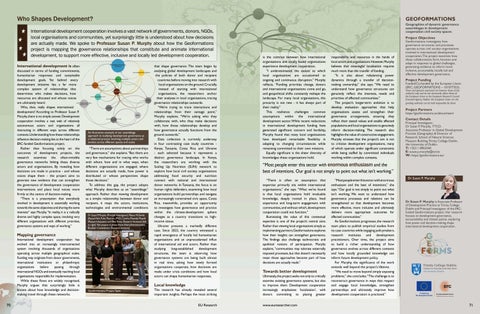
An illustrative example of our assemblage approach to studying development governance as a relational process involving multiple actors and entities across different spaces and scales
“There are assumptions about partnerships and governance,” she explains. “But there are very few mechanisms for tracing who works with whom, how and in what ways, when different organisations are engaged, where decisions are actually made, how power is distributed or whose perspectives shape those decisions.” To address this gap, the project adopts what Murphy describes as an “assemblage” approach. Rather than viewing development as a simple relationship between donor and recipient, it maps the actors, institutions, technologies and environmental conditions Dr Susan P. Murphy (Principal Investigator), Maeve McGandy (Researcher), Ruby Paterson (PhD), Cynthia Mwende Maswili (Research Assistant) and Ellen Ravey (Research Assistant) {left to right}. Not present in photo: Elaine Elders(Administrator), Brooklyn Cowenferenc (Research Assistant).
Mapping governance International development cooperation has evolved into an increasingly interconnected system involving thousands of organisations operating across multiple geographical scales. Funding may originate from donor governments, international institutions or philanthropic organisations before passing through international NGOs and eventually reaching local organisations responsible for implementation. While these flows are widely recognised, Murphy argues that surprisingly little is known about how knowledge and decisionmaking travel through these networks.
70
that shape governance. The team began by analysing global development landscapes and the policies of both donor and recipient countries before moving into research with local organisations on the ground. Crucially, instead of starting with international organisations, the researchers anchor their analyses in local organisations, tracing governance relationships outwards. “We’re trying to trace interactions and relationships from their vantage point,” Murphy explains. “We’re asking who they collaborate with, who they make decisions with, how those relationships develop and how governance actually functions from the ground outwards.” Data collection is currently underway in four contrasting case study countries Kenya, Tanzania, Costa Rica and Ukraine - each selected because it represents a distinct governance landscape. In Kenya, the researchers are working with the Scaling Up Nutrition (SUN) network to explore how local civil society organisations addressing food security and nutrition connect with national and international donor networks. In Tanzania, the focus is on human rights defenders, examining how local organisations build partnerships and navigate an increasingly constrained civic space. Costa Rica, meanwhile, provides an opportunity to investigate how governance and practice within the climate-development sphere changes as a country transitions to highincome status. Ukraine presents a markedly different case. Since 2022, the country witnessed a rapid emergence of locally led humanitarian organisations and an unprecedented influx of international aid and actors. Rather than studying long-established development structures, the team is observing how governance systems are being built almost in real time, asking how newly formed organisations cooperate, how decisions are made under crisis conditions and how local actors can shape humanitarian responses.
Local knowledge Geoformations Project Team
The research has already revealed several important insights. Perhaps the most striking
EU Research
Geographies of dynamic governance assemblages in development cooperation civil society spaces
Project Objectives
is the contrast between how international organisations and locally based organisations experience development cooperation. “I underestimated the extent to which local organisations are accustomed to ongoing and continuous disruption,” Murphy reflects. “Funding priorities change, donors and international organisations come and go, and geopolitical shifts constantly reshape the landscape. For many local organisations, this precarity is not new - it has always part of their reality.” This resilience challenges common assumptions within the international development sector. While recent reductions in international development funding have generated significant concern and hardship, Murphy found that many local organisations have developed remarkable flexibility in adapting to changing circumstances while remaining committed to their own missions. Equally significant is the sheer diversity of knowledges these organisations hold.
responsibility and resources in the hands of local actors and organisations. However, Murphy believes that meaningful localisation requires much more than the transfer of funding. “It is also about rebalancing power dynamics through a transfer of decisionmaking ownership,” she says. “We need to understand how governance structures can genuinely reflect the interests, needs and priorities of affected communities.” The project’s longer-term ambition is to develop evaluation approaches that help organisations assess and strengthen their governance arrangements, ensuring they reflect their stated values and enable affected populations and local organisations to genuinely inform decision-making. The research also highlights the value of constructive engagement. Murphy stresses that the project’s aim is not to criticise development organisations, many of which operate under significant constraints while being staffed by committed individuals working within complex contexts.
Geoformations investigates how governance structures and processes operate across civil society organisations involved in international development cooperation. The project examines how these collaborations form, function and adapt in response to global challenges, generating evidence to inform more inclusive, accountable, locally led and effective development governance.
Project Funding
Funded/Co-funded by the European Union (ERC, GEOFORMATIONS – 101077353). Views and opinions expressed are however those of the author(s) only and do not necessarily reflect those of the European Union or the European Research Council Executive Agency. Neither the European Union nor the granting authority can be held responsible for them.
Project Partners
https://geoformations.eu/about/team/
Contact Details
Principal Investigator, Dr Susan P. Murphy, FTCD. Associate Professor in Global Development Practice (Geography) & Director of Research, School of Natural Sciences Museum Building, Trinity College Dublin, the University of Dublin. T: +353 1 8963540 E: susan.p.murphy@tcd.ie W: https://geoformations.eu/
“Most people enter this sector with enormous enthusiasm and the best of intentions. Our goal is not simply to point out what isn’t working.” “There is often an assumption that expertise primarily sits within international organisations,” she says. “What we’ve found is that local organisations hold invaluable knowledge, deeply rooted in place, lived experience and long-term engagement with communities, and without which, development cooperation could not function.” Illuminating the value of this contextual expertise is one of the project’s central aims. Rather than viewing local organisations simply as implementing partners, Geoformations explores how their insights can strengthen governance. The findings also challenge technocratic and apolitical notions of participation. Murphy explains, “communities may tolerate externally imposed processes, but that doesn’t necessarily mean those approaches become part of how decisions are actually made.”
Towards better development Ultimately, the project seeks not only to critically examine existing governance systems, but also to improve them. Development cooperation increasingly emphasises ‘localisation’, with donors committing to placing greater
www.euresearcher.com
“Most people enter this sector with enormous enthusiasm and the best of intentions,” she says. “Our goal is not simply to point out what isn’t working. We want to understand how governance processes and relations can be strengthened so that development becomes more effective, more inclusive and ultimately delivers more appropriate outcomes for affected communities.” As Geoformations progresses, the research team plans to publish empirical studies from its case countries while engaging policymakers, research institutes and development practitioners. Over time, the project aims to build a richer understanding of how governance evolves across different contexts and how locally grounded knowledge can inform future development policy. For Murphy, the significance of the work extends well beyond the project’s lifetime. “We need to move beyond simply exposing problems,” she concludes. “The challenge is to reconstruct governance in ways that respect and engage local knowledges, strengthen partnerships and ultimately improve how development cooperation is practiced.”
Dr Susan P. Murphy
Dr Susan P. Murphy is Associate Professor of Development Practice at Trinity College Dublin and Principal Investigator of the ERCfunded Geoformations project. Her research focuses on development governance, accountability and climate justice, exploring how power and decision-making shape international development cooperation.
71