A path towards a circular economy in lithium-ion batteries Electric vehicles are an increasingly common presence on our roads, reducing the environmental impact of the transport sector, yet supplies of critical materials are not infinite. We spoke to Martin Devaulx de Chambord, Julius Ott, Juan Castro and Aleix Vila Cano about their work in developing new technologies to recover critical raw materials from car batteries. The development of the electric vehicle market is helping reduce the environmental impact of the transport sector, and demand for lithium-ion batteries continues to grow as countries seek to meet their emissions reduction targets. Mining lithium in the first place causes significant environmental damage however and supplies are not infinite, leading to an increased focus on recycling lithium and other materials and moving towards a more circular model of usage, an issue at the heart of the EU-funded FREE4LIB project. “We are developing several processes in FREE4LIB to recover critical materials from car batteries, as well as from other mobility devices, for example electric scooters,” says Martin Devaulx de Chambord, European Affairs consultant at Alienor, one of 22 partners in the project consortium. This covers not just lithium, but also cobalt, nickel and manganese, all four of which are essential to the production of lithium-ion batteries. The project team is developing 21 different technologies, aiming to recycle materials from lithium-ion batteries at the end of their lives and enable their re-use in new products. “We start with collecting endof-life lithium ion batteries, then they are dismantled and disassembled into healthy and unhealthy cells. The unhealthy cells are then treated with different processes,” explains Julius Ott, a researcher at the University of Graz working on the project. This leads to the production of so-called ‘black mass’, essentially an aggregate of different materials, which Ott says is then separated, enabling the recycling of resources and their reuse. “Different purification and precursor production strategies lead into the eventual production of new battery cells,” he says. The project partners have been working to develop different technologies across the entire value chain, with the ultimate aim of recycling materials so that they can be reused in the circular economy. One project partner is developing a process for the carbothermal reduction of black mass for example. “This involves a low temperature pyro-metallurgy step, plus a leaching step,” outlines Juan Castro, a researcher at the CARTIF research centre in Spain, the project’s overall coordinator. Alongside pre-treatment
74
This work holds valuable lessons for developers of other digital product passports, which are a central part of efforts to improve recycling rates more generally, not just car batteries. Building on his experience in FREE4LIB, Vila Cano is committed to sharing the project’s findings more widely. “We’re going to provide guidelines on how to use blockchain technology in a digital passport product environment, on how it can be used effectively. This technology must be implemented as a multi-organisational way of sharing information,” he says.The project team is contributing to the wider debate about digital product passports, and helping shape their ongoing development. “We want to help build a foundation of knowledge that can then be used in EU-wide guidelines, or legislation on digital product passports for car batteries,” outlines Devaulx de Chambord.
Legislative and regulatory framework
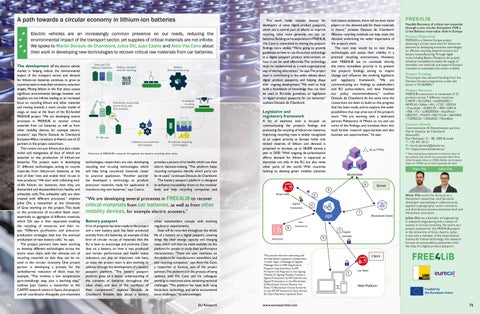
Overview of FREE4LIB’s research throughout the battery recycling value chain.
technologies, researchers are also developing recycling and re-using technologies, which will help bring recovered materials closer to practical application. “Another partner has developed a technology to produce precursor materials, ready for application in manufacturing new batteries,” says Castro.
provides a picture of its health, which can then inform decision-making. “The platform helps recycling companies identify which parts can be re-used,” continues Devaulx de Chambord. The battery passport platform is designed to enhance traceability down to the modular level, and help recycling companies and
A lot of attention now is focused on communicating the project’s findings and promoting the recycling of lithium-ion batteries. Improving recycling rates is widely recognised as an urgent priority, as Europe holds only limited reserves of lithium and demand is projected to increase up to 58,000 tonnes a year in 2030. “With ongoing de-carbonisation efforts demand for lithium is expected to skyrocket not only in the EU, but also many other parts of the world. With countries looking to develop green mobility solutions
A lot of progress has been made in the project and a new battery pack has been produced entirely from old batteries, an example of the kind of circular re-use of materials that the EU is keen to encourage and promote. Clear data on a battery, on how it was produced and certain performance and health status indicators, can play an important role here, an issue the project team is also working to address through the development of a battery passport platform. “The battery passport platform gives us a better understanding of the contents of batteries throughout the value chain, and also of the condition of their components,” explains Devaulx de Chambord. Reliable data about a battery
other stakeholders comply with evolving regulatory requirements. Data will be recorded throughout the whole life of a battery on a digital passport, covering things like their energy capacity and charging rates, which will then be made available via the platform for people to study their performance characteristics. “There are user interfaces on the platform for manufacturers, assemblers, and also recycling companies,” says Aleix Vila Cano, a researcher at Eurecat, one of the project partners.The platform is in the process of being updated, with Vila Cano and his colleagues working to overcome some remaining technical challenges. “The platform has been built using blockchain technology, and we’ve encountered some challenges,” he acknowledges.
EU Research
FREE4LIB
Feasible Recovery of critical raw materials through a new circular Ecosystem FOR a Li-Ion Battery cross-value chain in Europe
Project Objectives
FREE4LIB is a Horizon Europe project advancing a circular value chain for lithium-ion batteries by developing innovative technologies for efficient recycling, material recovery and battery remanufacturing. Through digital tools, including Battery Passports, the project enhances traceability, increases the supply of secondary raw materials, and supports Europe’s transition to sustainable, low-carbon mobility.
Project Funding
This project has received funding from the Horizon Europe programme, under the Grant n°101069890. *
Project Partners
FREE4LIB consortium is composed of 22 partners across 7 different countries: CARTIF • ACCUREC • ALIENOREU • AIMPLAS • Kellen • AVL • CSIC • ERION • Fraunhofer • EURECAT • IREC-CERCA • FBK • ITL • LUREDERRA • NextMove • NESSTEC • POLIMI • RECYCLIA • SAKARYA • TORRECID • UNIGRAZ • Watt4Ever
Contact Details
Communication & Dissemination partner, Martin Devaulx de Chambord AlienorEU Rue Montoyer 31 - BE 1000 Brussels T: +32 491 39 21 E: martin.devaulx@alienor.eu W: https://www.freeforlib.eu/ * Views and opinions expressed are however those of
the author(s) only and do not necessarily reflect those of the European Union or CINEA. Neither the European Union nor CINEA can be held responsible for them.
Aleix Vila
Julius Ott
Aleix Vila works for Eurecat as a blockchain researcher and full-stack developer specializing in cybersecurity, applied cryptography, smart contracts, and distributed systems-technical lead and blockchain instructor.
“We are developing several processes in FREE4LIB to recover critical materials from car batteries, as well as from other mobility devices, for example electric scooters.” Battery passport
and reduce emissions, there will be even more players on the demand side for these materials in future,” stresses Devaulx de Chambord. Effective recycling methods can help meet this demand, underlining the wider importance of the project’s work. The next step would be to test these technologies and assess their viability in a practical recycling environment. However, with FREE4LIB set to conclude shortly, the more immediate priority is to present the project’s findings, aiming to inspire change and influence the evolving legislative and regulatory framework. “We are communicating our findings to stakeholders and EU policy-makers, and have finalised our policy recommendations,” outlines Devaulx de Chambord. At the same time the consortium are keen to build on the progress that has been made, and to explore the wider possibilities that may arise out of the project’s work. “We are working with a dedicated partner, Politecnico di Milano to try and use some of the findings, and translate them into both further research opportunities and also business use opportunities,” he says.
Julius Ott has a bachelor of engineering in industrial engineering and a master of science in circular economy. He works as a project assistant for the FREE4LIB project at the University of Graz, Austria. Julius is also also a member of the International Society for Industrial Ecology. His research focuses on sustainability assessment with the help of a digital product passport. The process flow for executing and storing battery passport transactions: 1) User Signs a Message 2) Signed Message Sent to API (Application Programming Interface) 3) API Forwards the Request to the Signing Module 4) Signing Module Creates a Signed Transaction 5) API Submits the Signed Transaction to the Blockchain 6) Blockchain Oracle Detects the Event 7) Blockchain Oracle forwards to the API 8) Transaction Data Stored 8) Client Retrieves Updated Data
www.euresearcher.com
75