FLOPRES: Smart Solutions for Flood Warning and Prevention
FLOPRES Flash Flood Prediction and Prevention System
Flash floods can have a devastating impact on people and communities, and they are growing increasingly common as climate change intensifies. The FLOPRES project team are developing an integrated solution designed to collect and assess data on flood risk, helping communities adapt to the effects of climate change, as Rastislav Puchala and Dušan Kočický explain.
Project Objectives
FLOPRES develops an integrated system for flash flood prediction and prevention by combining IoT-based monitoring of water levels and hydrometeorological variables, hydrological modelling, and GIS-based analysis. The project supports early warning, risk assessment, and spatial planning, including nature-based solutions, to enhance climate resilience and reduce flood impacts in vulnerable regions of Slovakia and Poland.
Many parts of Europe have been experiencing increasingly intense storms over recent years due to climate change, with clouds able to hold more rain as a result of warmer air. This raises the risk of flash flooding, which may then be further heightened by conditions on the ground. “Harder soil has a reduced capacity to absorb rainwater for example, while human activities like deforestation and certain types of agricultural practices also increase the risk of flash flooding. Some river basins have not been managed effectively, with a lot of concrete and other non-porous materials used in local infrastructure,” outlines Rastislav Puchala of Slovakian company ESPRIT. As part of the EU-backed FLOPRES project, Puchala and his colleagues at ESPRIT are working with project partners to develop an integrated solution designed to provide early warning of flash floods, together with an expert module which helps people adapt to the effects of climate change. “This is a complex system, comprised of an early warning module and an expert module. The early warning module collects and assesses data, and provides information about how harm to lives and property can be avoided,” Puchala explains.
Flash flood risk The project team are combining different types of data in this work, with the aim of building a fuller picture of the risk of flash floods in three regions in Slovakia and also in Poland. Rainfall projections and weather forecasts are a central component, while Puchala says other types of data are also included. “We have Internet of Things (IoT) sensors out in the country, collecting data on water levels in rivers, and then
Project Funding
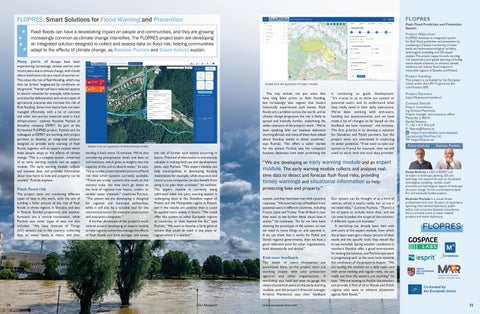
Sample from the application of early-warning module.
sending it back every 15 minutes. We’re also considering precipitation levels and data on soil moisture, which gives us insights into the capacity of the soil to absorb water,” he says. This provides a more detailed picture of flood risk than other systems currently available. “There are similar systems that work on the national scale, but they don’t go down to the level of regional river basins, creeks, or smaller water channels,” continues Puchala. “The system we are developing is designed for regional and municipal authorities, while it will also be a valuable tool for the commercial sector, for example construction and insurance companies.” A further dimension of the project’s work centres around developing an expert module to help regional authorities manage the effects of flash floods and limit damage, and assess
the risk of further such events occurring in future. This kind of information is enormously valuable in making land use and development plans, says Puchala. “The expert module can help municipalities in developing housing masterplans for example, while insurance and construction companies can also benefit from using it to plan their activities,” he outlines. The expert module is currently being calibrated while the early warning system is undergoing tests in the Slovakian region of Prešov and the Małopolska region in Poland, and if the results are positive then it could be applied more widely in future. “We could offer this system to other European regions or countries, or even beyond the EU,” says Puchala. “We want to develop a fairly general system that could be used in any place or region where it is needed.”
This may include not just areas that have long been prone to flash flooding, but increasingly also regions that haven’t historically experienced such events. Flash floods are a problem across the world, and as climate change progresses the risk is likely to spread and intensify further, underlining the wider relevance of the project’s work. “We’ve been speaking with our business diplomats working abroad, and many of them have talked about flooding events in those countries,” says Puchala. This offers a wider market for the system; Puchala says the company’s business diplomats have been promoting the
system, and they have been met with a positive response. “We have had a lot of feedback from potential users in different countries, including France, Spain and Turkey. They all liked it, now they want to see further detail about how it works,” he continues. “So far we have been showing the prototype of the system, so now we need to move things on and optimise it. If we can show that it works for Polish and Slovak regional governments, then we have a good reference point for other organisations, both domestically and abroad.”
The needs of users themselves are paramount here, so the project team are working closely with civic protection agencies and other organisations. A workshop was held last year to gauge the views of potential users on the early warning module, and the project’s financial manager Kristína Marettová says their feedback
Photo by Bernd Dittrich on unsplash.
EU Research
is continuing to guide development. “It’s crucial to us to show our system to potential users, and to understand what they really need in their daily operations. We’ve been working with end-users, handing out questionnaires, and we have made a lot of changes so far based on the feedback we have received,” she stresses. The first priority is to develop a solution for Slovakian and Polish partners, but the project team are interested in exploring its wider potential. “If we want to take our system to France for example, then we will need to work with the local data provider.
“We are developing an early warning module and an expert module. The early warning module collects and analyses realtime data to detect and forecast flash flood risks, providing timely warnings and situational information to help protecting lives and property.”
End-user feedback
34
This project is co-funded by the European Union under the LIFE Programme. EU contribution: 60%.
Sample from the application of expert module.
www.euresearcher.com
Our system can be thought of as a kind of vehicle, which is nearly ready, but to run it we need data,” outlines Puchala. “There’s a lot of space to include more data, and we can even broaden the scope of the solution, if different types are available.” A workshop has already been held with end-users of the expert module, from which the project team got a clearer picture of their needs and the specific tools they would like to see included. Spring weather conditions in northern Slovakia offer a good environment for testing the solution, and Puchala says work is progressing well, as the team look towards the conclusion of the project in August. “We are testing the solution on a daily basis, and with snow melting and regular rains, we can really see how the sensors are working,” he says. “We are looking to finalise the solution, and provide it first of all to Slovak and Polish regions who want to enhance protection against flash floods.”
Project Partners
https://flopres.eu/members/
Contact Details
Project Coordinator, Ing. Kristína Marettová Project manager and economic officer Pletiarska 2, 969 01 Banská Štiavnica T: +42 1 917 910 619 E: flopres@flopres.eu : https://www.linkedin.com/company/ flopres/posts/?feedView=all W: https://flopres.eu/
Dušan Kočický
Rastislav Puchala
Dušan Kočický is CEO of ESPRIT and an expert in landscape planning, GIS and hydrology. His research focuses on distributed hydrological modelling, rainfall–runoff processes and hydrological impacts of landscape structure change. He has coordinated multiple EU- and nationally funded projects. Rastislav Puchala is a result-driven professional with over 25 years of experience spanning international diplomacy, public policy, and corporate business consultancy. He is currently active in water-related projects and water diplomacy.
35