Engaging citizens in soil monitoring Soils across Europe are significantly degraded, threatening their long-term ability to support food production and filter water, as well as perform other essential functions. European citizens have a major role to play here in gathering data that can then inform efforts to restore the health of soils, an issue at the heart of Tanja Mimmo and Oleg Osychenko’s work in the ECHO project. More than 60% of EU soils are in in a relatively poor state of health, with high levels of contaminants and continued erosion among the factors which threaten their ability to perform essential functions. The European public can play a major role here in gathering data, which can then inform efforts to restore the health of soils across the continent, an issue at the heart of Professor Tanja Mimmo’s work as coordinator of the EU-backed ECHO project. “In the project we’re encouraging citizens to gather more soil health data,” she outlines. The project brings together 16 partners from nine European countries, reflecting wider concern about the health of soils across the continent. “We aim to gather soil health data across Europe, covering different countries, land uses and biogeographical regions. We will also look into the potential of exploiting citizen science-generated data for monitoring programmes,” continues Professor Mimmo.
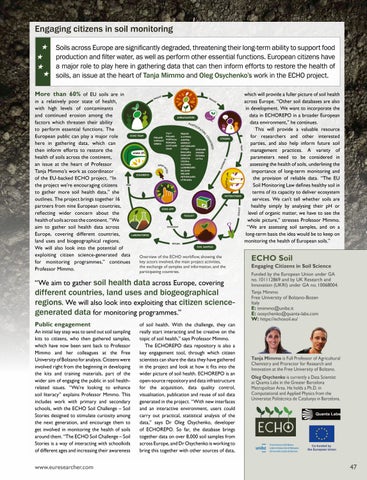
which will provide a fuller picture of soil health across Europe. “Other soil databases are also in development. We want to incorporate the data in ECHOREPO in a broader European data environment,” he continues. This will provide a valuable resource for researchers and other interested parties, and also help inform future soil management practices. A variety of parameters need to be considered in assessing the health of soils, underlining the importance of long-term monitoring and the provision of reliable data. “The EU Soil Monitoring Law defines healthy soil in terms of its capacity to deliver ecosystem services. We can’t tell whether soils are healthy simply by analysing their pH or level of organic matter, we have to see the whole picture,” stresses Professor Mimmo. “We are assessing soil samples, and on a long-term basis the idea would be to keep on monitoring the health of European soils.” Overview of the ECHO workflow, showing the key actors involved, the main project activities, the exchange of samples and information, and the participating countries.
“We aim to gather soil health data across Europe, covering
different countries, land uses and biogeographical regions. We will also look into exploiting that citizen sciencegenerated data for monitoring programmes.” Public engagement An initial key step was to send out soil sampling kits to citizens, who then gathered samples, which have now been sent back to Professor Mimmo and her colleagues at the Free University of Bolzano for analysis. Citizens were involved right from the beginning in developing the kits and training materials, part of the wider aim of engaging the public in soil healthrelated issues. “We’re looking to enhance soil literacy” explains Professor Mimmo. This includes work with primary and secondary schools, with the ECHO Soil Challenge – Soil Stories designed to stimulate curiosity among the next generation, and encourage them to get involved in monitoring the health of soils around them. “The ECHO Soil Challenge – Soil Stories is a way of interacting with schoolkids of different ages and increasing their awareness
www.euresearcher.com
of soil health. With the challenge, they can really start interacting and be creative on the topic of soil health,” says Professor Mimmo. The ECHOREPO data repository is also a key engagement tool, through which citizen scientists can share the data they have gathered in the project and look at how it fits into the wider picture of soil health. ECHOREPO is an open-source repository and data infrastructure for the acquisition, data quality control, visualisation, publication and reuse of soil data generated in the project. “With new interfaces and an interactive environment, users could carry out practical, statistical analysis of the data,” says Dr Oleg Osychenko, developer of ECHOREPO. So far, the database brings together data on over 8,000 soil samples from across Europe, and Dr Osychenko is working to bring this together with other sources of data,
ECHO Soil
Engaging Citizens in Soil Science Funded by the European Union under GA no. 101112869 and by UK Research and Innovation (UKRI) under GA no. 10068004. Tanja Mimmo Free University of Bolzano-Bozen Italy E: tmimmo@unibz.it E: oosychenko@quanta-labs.com W: https://echosoil.eu/
Tanja Mimmo is Full Professor of Agricultural Chemistry and Prorector for Research and Innovation at the Free University of Bolzano. Oleg Osychenko is currently a Data Scientist at Quanta Labs in the Greater Barcelona Metropolitan Area. He holds a Ph.D. in Computational and Applied Physics from the Universitat Politècnica de Catalunya in Barcelona.
47