Getting to the roots of plant diversity The application of fertilisers has led to significant quantities of nitrogen and phosphorus being transferred to soils in natural habitats across Europe, which is contributing to biodiversity loss. In the framework of the DiviN-P project, an international consortium coordinated by Professors Martin Wassen and Jerry van Dijk is investigating the relationship between nutrient availability, plant diversity and climate. The widespread use of fertilisers has led to substantial emissions and losses of nitrogen (N) and phosphorus (P) to the atmosphere and aquatic environments, which have enriched naturally nutrientpoor ecosystems, affecting plant species composition and diversity. This topic lies at the heart of Professor Martin Wassen’s work as the initiator and principal architect of the DiviN-P project, which brings together four partners from across Europe. “The project is about the effect of nutrients – especially nitrogen and phosphorus – and their balance on plant diversity. These nutrients are provided in agricultural fertilisers, which have been instrumental in increasing food production capacity, but they also have negative effects on the plant diversity of natural and semi-natural habitats,” he outlines. The project team has compiled a large dataset, covering grasslands across Europe, Asia and beyond. “We currently have more than 5,000 grassland sites in the database. We have measured nutrient levels, biomass production and plant diversity,” Professor Wassen says. “We are also looking at the causal relations between nutrient availability and plant species diversity, and how some plants may benefit more than others from higher nutrient levels and changes in nutrient balance, and can then out-compete other species. And since the total species list contains some 1,500 vascular plant species this database enables us to examine an enormous amount of species interactions in their real world habitats.”
Vegetation recording, Oudewater, the Netherlands.
www.euresearcher.com
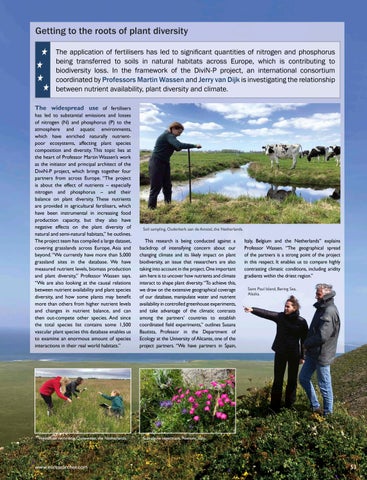
Soil sampling, Ouderkerk aan de Amstel, the Netherlands.
This research is being conducted against a backdrop of intensifying concern about our changing climate and its likely impact on plant biodiversity, an issue that researchers are also taking into account in the project. One important aim here is to uncover how nutrients and climate interact to shape plant diversity. “To achieve this, we draw on the extensive geographical coverage of our database, manipulate water and nutrient availability in controlled greenhouse experiments, and take advantage of the climatic contrasts among the partners’ countries to establish coordinated field experiments,” outlines Susana Bautista, Professor in the Department of Ecology at the University of Alicante, one of the project partners. “We have partners in Spain,
Italy, Belgium and the Netherlands” explains Professor Wassen. “The geographical spread of the partners is a strong point of the project in this respect. It enables us to compare highly contrasting climatic conditions, including aridity gradients within the driest region.” Saint Paul Island, Bering Sea, Alaska.
Sub-alpine vegetation, Piëmont, Italy.
53
Plant interactions and diversity The wider aim is to prevent biodiversity loss, and so ensure the effective functioning of ecosystems. If the number of species in an ecosystem decreases then certain functions may be impaired, such as pollination, water regulation, and nutrient cycling, which may have a severe impact on human life. “From the human perspective, biodiversity loss also implies the loss of services, of the benefits that we get from ecosystems,” explains Professor Bautista. This underlines the importance of protecting plant diversity. The focus here is on plant diversity in herbaceous ecosystems, from mires and fens to dry grasslands. While these ecosystems share some characteristics, they may differ in terms of things like soil type, management, and wetness, while the presence of alien species is a further complicating factor. “Some alien species may grow faster in higher temperatures, or they may have an unusual root system which helps them capture nutrients from deeper in the soil,” says Professor Wassen. The project team is also investigating the impact of alien species on native plant communities, and how this impact may change with nutrient availability. While some species can arrive in a new region and spread relatively slowly, without having a big impact on native plants, some other alien plants can have more dramatic effects and become invasive. As part of her role in DiviN-P, Professor Bautista is looking into the underlying factors behind the rapid spread of one of those invasive species. “We want to know if nutrient availability modulates the invasive capacity of Pennisetum setaceum (fountain grass). So
Led by Mara Baudena, senior researcher at the National Research Council in Torino, Italy, DiviN-P researchers are also working to include interactions between species in models, which is a complex area of investigation. The idea here is to select a few mechanisms and processes, then test their importance in terms of their impact on biodiversity. For example, exploring the role of niche similarities in driving species interactions and diversity, and then testing whether the predicted outcomes correlate with the data from the project field sites and the experiments conducted.
DiviN-P greenhouse experiment at the University of Alicante.
in our experiments we grow this species, together with native species, and we modify the balance of nutrients. Then we can see under which conditions we could expect this species to out-compete the native species, to be more or less dangerous,” she says. Other experiments in the DiviN-P project, led by Professor Harry Olde Venterink, from the Vrije Universiteit Brussel, investigate how plants spreading northwards from southern regions compete with native grassland species, and whether nitrogen and phosphorus fertilization influences these interactions. The outcome of these interactions between species shape plant communities, alongside the availability of resources locally. Data on nutrient availability in the local environment of the grassland sites considered in the project can open up deeper insights into the
tolerance range of certain plants. “If you have data on 5,000 plots and a species occurs in say 1,000 of them, then you can analyse the nutrient and climate gradients. You can then model the optimum conditions of a species, and look to understand its ecological niche,” outlines Professor Wassen.This can be thought of as essentially the range of conditions that a species can tolerate; Professor Wassen says that species with a narrow ecological niche are often less able to deal with change in their local environment. “Some species may have a very specific niche, and just a slight divergence in the site conditions can make the environment unattractive,” he explains. “By characterizing the nutrient niches of a wide range of grassland species, we can better understand how nutrient availability and balance shape the diversity and composition of grassland communities.”
and natural resources administrations to address the issue. The project could play an important role here by identifying areas particularly vulnerable to biodiversity loss and then relating efforts to manage them more effectively. “From our results, we hope to identify regions, ecosystems and species of special concern. We aim to provide useful information for managers and policy-makers, which can then guide them in identifying priorities,” says Professor Bautista. A deeper understanding of the relationship between climate, nutrient availability and plant diversity
“The project is about the effect of the availability and balance of nutrients – especially nitrogen and phosphorus – on plant diversity. While the widespread use of agricultural fertilisers has greatly expanded food production, it also has negative effects on plant diversity.” Working together with stakeholders This work is still ongoing, and the project partners will work together with the relevant stakeholders to identify the key messages and insights to inform policy and practice.“We have followed quite a collaborative action model of knowledge transfer,” explains Professor Bautista. “The idea behind the model was to focus knowledge transfer on stakeholder engagement and participation in the project, so they have been closely involved in DiviN-P right from the start, for instance in helping us select sites and species to work with.” This collaborative approach will heighten awareness of the impact of nutrient enrichment on biodiversity, and in the process encourage stakeholders such as agricultural organisations
would then enable a more precisely targeted approach to land management. “It’s about identifying the conditions under which a particular invasive species may become more dangerous, or an endangered species more vulnerable, and in which areas conservation and management actions are most likely to make a difference,” continues Professor Bautista. The project team are keen to share their findings more widely and help shape a more integrated policy in future. “The EU has passed legislation trying to limit the impact of nitrogen, but less attention has been paid to phosphorus. We want to encourage a more integrated nutrient policy on the European level, which includes also the balance between these nutrients,” says Professor Wassen.
54
DiviNP research team.
National Park Drentsche Aa, the Netherlands.
EU Research
www.euresearcher.com
Protecting plant diversity via stoichiometric nutrient networks across Europe
Project Objectives
DiviN-P aims to identify which types of plant communities are most vulnerable to species loss and turnover in response to changes in nutrient supply, nutrient stoichiometry, species invasions and climate change, in order to deliver management and planning recommendations to conservation practitioners and environmental policy makers.
Project Funding
DiviN-P has received funding from the Dutch Research Council (NWO), the Research Foundation Flanders (FWO), the Ministry of Universities and Research of Italy (MUR), and the Agencia Estatal de Investigación (AEI) through the PCI2022 call, under the Biodiversa+ European Biodiversity Partnership.
Project Partners
• Utrecht University, The Netherlands (coordinator) • Vrije Universiteit Brussel, Belgium • National Research Council in Torino, Italy • University of Alicante, Spain
Contact Details
Project Coordinator, Dr. Jerry van Dijk Copernicus Institute of Sustainable Development Utrecht University Princetonlaan 8a, 3584 CB Utrecht The Netherlands T: +31 30 253 4410 E: j.vandijk2@uu.nl W: https://www.biodiversa.eu/2023/04/19/divin-p/
Martin Wassen, Jerry van Dijk, Susana Bautista, Harry Olde Venterink, and Mara Baudena (left to right)
Martin Wassen is Emeritus Professor of Environmental Sciences at Utrecht University. Jerry van Dijk is Associate Professor at Utrecht University. Susana Bautista is Professor of Ecology and Head of the Multidisciplinary Institute for Environmental Studies at the University of Alicante. Harry Olde Venterink is Professor of Plant Ecology at the Vrije Universiteit Brussel. Mara Baudena is a Senior Researcher at the National Research Council in Torino (CNR-ISAC).
Natural Park of Marguareis, Cuneo, Italy.
Lathyrus Cicera
DiviN-P
Ophrys Scolopax
55