Curiosity at the heart of soil education Soil is essential to life, yet many of us lack knowledge about its composition and the vital functions that it performs. The CURIOSOIL project team are working to enhance soil literacy across Europe, which will contribute to the wider goal of restoring soil health in the face of human-induced pressures, as Sónia Rodrigues and Cristina Biddlecome explain. The soil beneath our feet plays a number of vital ecological roles, such as supporting food production, filtering water and sequestering carbon. Many of us take these functions for granted however, and lack basic knowledge about both the composition of soil and its wider importance, an issue central to the EU-funded CURIOSOIL project, which brings together 14 partners from 10 countries across Europe. “Our main goal is to improve soil literacy in Europe,” says Sónia Rodrigues, the project’s coordinator. The backdrop to this work is growing concern over the status of European soils, a large proportion of which are degraded and face serious threats to their health. “Pollution and contamination adversely affect the health of soils, while there are also other threats, such as erosion and compaction,” continues Rodrigues.
CURIOSOIL project As part of her role in the project, Rodrigues is now working alongside the CURIOSOIL team to spread knowledge about soil across the population, which will then have a wider impact in terms of how people understand and relate to it. The starting point here is the project’s soil literacy assessment framework, which defines a baseline of what people know already. “We are running assessments and surveys in several different countries,” outlines Rodrigues. This work is still ongoing, and the overall picture is not yet entirely clear, but Rodrigues says soil education policy analysis has revealed some differences. “Some countries give greater prominence to soil in education than others,” she acknowledges. “People may also be more aware of threats to soil health in countries that have recent experience of extreme events like floods, where soil degradation has affected its capacity to absorb water.” The next step then is to develop materials for different educational levels, from primary and secondary schools, right through to university students. Lessons are being prepared for teachers to use, while a Massive Open Online Course (MOOC) will be developed for the university level, designed to engage and enthuse students. “We are developing challenges at the university level,
58
explains Rodrigues.A lot of emphasis is placed in the project on promoting this message, and stimulating people’s curiosity about soil. “Curiosity is integral to the project, it’s playful and multi-sensorial. We’re not only trying to boost soil as a subject in itself, but also to infuse it into other, existing topics,” outlines Cristina Biddlecome, the project’s communications manager. “For example, we’ll use an interactive exhibit to encourage people to engage with soil in a sensory and memorable way.”
women have shaped soil science and education, aiming to encourage younger girls to participate and address the gender imbalance. These campaigns help shine a light on soil and give it greater prominence in the public consciousness, and while the project is only around halfway through its funding term, Biddlecome says their work is already bearing fruit. “We get a lot of engagement from farmers and researchers, who appreciate our work in bringing soil to life,” she says. The project team hope to build on this positive momentum over the rest of the
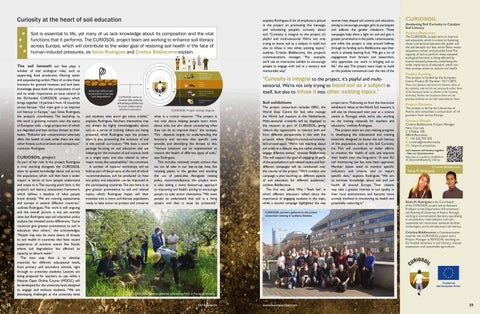
“Curiosity is integral to the project, it’s playful and multisensorial. We’re not only trying to boost soil as a subject in itself, but also to infuse it into other, existing topics.” Soil exhibitions CURIOSOIL Project concept diagram.
and students who enrol get extra credits,” explains Rodrigues. Teachers themselves may not always be highly knowledgeable about soil, so a series of training videos are being prepared, while Rodrigues says the project team is also promoting the inclusion of soil in the overall curriculum. “We have a work package focusing on soil education and are lobbying for the inclusion of soil science, both as a single topic and also related to other major issues, like sustainability,” she continues. A number of national workshops will be held as part of the project, at the end of which recommendations will be produced on how soil policy and education can be improved in the participating countries. The aim here is to give greater prominence to soil and related topics, which Rodrigues hopes will then translate into a more soil-literate population, ready to take action to protect and conserve
what is a critical resource. “The project is not only about helping people learn more about soils, but also about considering what they can do to improve them,” she stresses. This depends largely on understanding the functions and services that specific soils provide, and identifying the threats to this. “Various solutions can be implemented to restore the health of different types of soils,” says Rodrigues. This includes relatively simple actions that we can all take in our day-to-day lives, like rotating plants in the garden and avoiding the use of pesticides. Alongside making policy recommendations, the project team is also taking a more bottom-up approach to improving soil health, aiming to encourage people to take action themselves. “We want people to understand that soil is a living system and that it must be protected,”
The project consortium includes ISRIC, the World Data Centre for Soil, who manage the World Soil museum in the Netherlands. Multi-sensorial artworks will be displayed at the museum as part of CURIOSOIL, giving visitors the opportunity to interact with soil from different perspectives, in line with the project’s ethos (https://curiosoil.eu/curiositykit/curiosoil-app/). “We’re not teaching about soil solely in a didactic way, but rather aiming to engage different senses,” stresses Biddlecome. This will support the goal of engaging all parts of the population in soil-related topics, and four different campaigns will be conducted over the course of the project. “We’ll conduct one campaign a year, touching on different aspects of soil education for different audiences,” outlines Biddlecome. The first was called; ‘Why I Teach Soil’, in which different educators talked about the importance of engaging students in the topic, while a second campaign highlighted the way CURIOSOIL partners gathered at the project consortium meeting in Ljubljana, Slovenia.
project term.“Following on from the interactive exhibition’s debut at the World Soil museum, it will also be showcased next year at a science centre in Portugal, while we’re also working on the training materials for teachers and educators,” outlines Rodrigues. The project team are also making progress in developing the educational and training materials, designed to boost the soil literacy of the population, such as the Soil Curiosity Kit. This will contribute to wider efforts to monitor the health of soils and improve their health over the long-term. “A new EU soil monitoring law has now been approved. Member States need to monitor specific indicators and criteria, and to report specific data,” explains Rodrigues. “We aim to increase knowledge about soil and soil health all around Europe. Then citizens may take a greater interest in soil quality in their local environment, and become more actively involved in monitoring its health and potentially restoring it.”
CURIOSOIL
Awakening Soil Curiosity to Catalyse Soil Literacy
Project Objectives
The CURIOSOIL project aims to improve soil education, which is critical to fostering closer connections between the public and the soil beneath our feet, which filters water, sequesters carbon and provides food. The capacity of soil to perform these essential ecological functions is being affected by human-induced pressures, underlining the wider importance of education, which can then prompt action to restore soil health.
Project Funding
This project is funded by the European Union, Project ID Number: 101112875. Views and opinions expressed are however those of the author(s) only and do not necessarily reflect those of the European Union or [Name of the Granting Authority]. Neither the European Union nor the granting authority can be held responsible for them.
Project Partners
The project is led by the University of Aveiro and comprises a consortium of 14 partners from across Europe
Contact Details
Cristina Biddlecome, Project Manager Nest City Lab, C d’Àlaba, 100, 08018 Barcelona T: +34 626 703 503 E: cristina@revolve.media W: https://curiosoil.eu Let’s improve soil literacy together - Take our Questionnaire: https://wur.az1.qualtrics.com/jfe/form/ SV_0UOe3rAYIlKdzKe?Q_CHL=qr
Cristina Biddlecome Sónia M. Rodrigues
Sónia M. Rodrigues is the Coordinator of the CURIOSOIL project and an Assistant Professor at the Department of Environment and Planning of University of Aveiro, Portugal, working in environmental chemistry specializing in soil pollution, metal behavior and risks, sustainable soil restoration, advanced fertilizer technologies, and in soil education/ soil literacy. Cristina Biddlecome is Communication Lead for the CURIOSOIL project and a Project Manager at REVOLVE, working on EU-funded initiatives in soil literacy, climate adaptation, and sustainable agriculture.
CURIOSOIL partners gathered at Gramona Farm in Portorož, Slovenia.
EU Research
www.euresearcher.com
59