The future of Carbon Farming The more carbon can be stored in soil, the less there is in the atmosphere, so increasing sequestration capacity can help mitigate climate change. We spoke to Tristano Bacchetti De Gregoris about how the Credible project is helping carbon farming initiatives across Europe learn from each other and develop robust approaches for land managers to maximise carbon sequestration. There is a growing recognition that soil can play an important role in the fight against climate change by removing carbon from the atmosphere and storing it, a process known as carbon sequestration. Carbon farming methods like keeping soil covered with vegetation and reducing tillage can make an important contribution in this respect, while Tristano Bacchetti De Gregoris, research strategist at SAE Innova in Spain, says they also have other positive effects. “The carbon farming concept encompasses different methods, including agriculture on arable lands, agroforestry, peatland restoration and grassland and forestry management techniques. These methods also lead to other environmental benefits, such as improving biodiversity and water retention,” he explains. However, increasing organic content in the soil may not necessarily boost profits for farmers, so there is also a business component to carbon farming. “Climate finance has emerged over recent decades as a tool to put money into climate action, for example promoting carbon emission reductions. That kind of system is now being adapted to the agriculture sector,” he notes.
This approach is designed to support the economic viability of carbon farming and so encourage more farmers across Europe to adopt these practices. A farmer may want to stop ploughing their land for example, to prevent carbon in the soil
Several carbon farming research initiatives have been established across Europe over recent years, including a number exploring the impact of specific carbon farming practices. Now, as coordinator of the EU-funded Credible project, which
“The carbon farming concept encompasses different methods, including agriculture on arable lands, agroforestry, peatland restoration and grassland and forestry management techniques.” from being released to the atmosphere, but this may in turn reduce its productive capacity, for which farmers then need to be compensated. Financial mechanisms are in place here to encourage the adoption of carbon farming practices that have not yet been implemented at scale. Monitoring, reporting, and verification (MRV) systems are used to build data streams, providing a picture of the impact of different practices and interventions in terms of the volume of CO 2 removed, or emissions avoided, which can then be converted into revenue for farmers.
brings together 21 partner organisations from across Europe - spanning research, farming, technology and policy -, Bacchetti De Gregoris is working to build momentum around them. “The role of Credible is to help all these different projects connect and learn from each other,” he outlines.
Credible project A key first step is to ensure that projects are working to common standards using established methodologies, so data gathered from different locations can then be easily compared and the impact of carbon farming
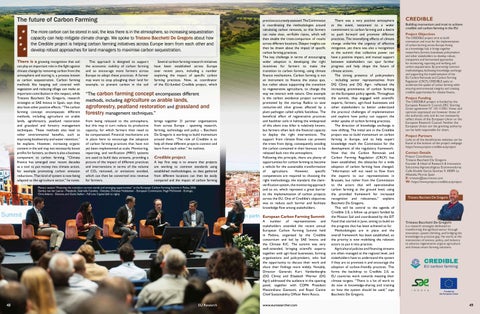
Plenary session “Financing the transition: current trends and emerging opportunities” at the European Carbon Farming Summit in Padua, 2026. Gerdus van der Laarse - Metabolic, Gabriella Cevallos - Deloitte, Christian Holzleitner - European Commission, Hugh McDonald - Ecologic, Chris Adamo - Danone, and Giulia Stellari - Fall Line Capital (left to right).
practices accurately assessed. The Commission is coordinating the methodologies around calculating carbon removals, so that farmers can make clear, verifiable claims, which will then enable the cross-comparison of results across different locations. Deeper insights can then be drawn about the impact of specific carbon farming practices. The key challenge in terms of encouraging wider adoption is developing the right incentives for farmers to make the transition to carbon farming, using climate finance mechanisms. Carbon farming is not an instrument to finance the status quo, but rather about supporting the transition to regenerative agriculture, to change the way we interact with nature. One example is the carbon avoidance project currently promoted by the startup Radica to save centuries-old olive groves affected by a plant pathogen called xyllela fastidiosa. The beneficial effect of regenerative practices and healthier soils in halting the widespread of this silent tree killer is relatively known, but farmers often lack the financial capacity to deploy the right interventions. The support from climate finance can prevent the trees from dying, consequently avoiding the carbon contained in their biomass to be released back into the atmosphere. Following this principle, there are plenty of opportunities for carbon farming to become a vehicle for the sustainable transformation of agriculture. However, specific competences are required to choosing the right methodology, the standard, the claimverification system, the monitoring approach and so on, which represent a great barrier to the implementation of carbon projects across the EU. One of Credible’s objectives was to reduce such barrier and facilitate knowledge flow among stakeholders.
European Carbon Farming Summit A number of representatives and stakeholders attended the recent annual European Carbon Farming Summit held in Padova, organised by the Credible consortium and led by SAE Innova and the Climate KIC. The summit was very well-attended, bringing scientific experts together with agri-food businesses, farming organisations and policymakers, who had the opportunity to discuss their work and share their findings more widely. Notably, Director Generals Kurt Vandenberghe (DG Clima) and Elisabeth Werner (DG Agri) addressed the audience in the opening panel, together with COPA President Massimiliano Giansanti, and Royal Canine Chief Sustainability Officer Rémi Rocca.
48
EU Research
www.euresearcher.com
There was a very positive atmosphere at the event, testament to a wider commitment to carbon farming and a desire to push forward and promote different practices. The intensifying effects of climate change underline the urgency of effective mitigation, yet there was also a recognition at the summit that collective power can have a positive impact, and mutual support between stakeholders can spur further progress and help shape the future of climate actions. The strong presence of policymakers - including senior representatives from DG Clima and DG Agri- reflected the increasing prominence of carbon farming on the European policy agenda. Throughout the summit, they engaged with scientific experts, farmers, agri-food businesses and other stakeholders to better understand the practical challenges of implementation and explore how policy can support the wider uptake of carbon farming practices. The direction of knowledge exchange is now shifting. The initial aim in the Credible project was to build momentum on carbon farming in Europe, and to help expert knowledge reach the Commission for the development of the regulatory framework. Now that the Carbon Removals and Carbon Farming Regulation (CRCF) has been established, the obstacles for a wide adoption of carbon farming have changed. “Information will not need to flow from the experts to our representatives in Brussels, but rather from the Commission to the actors that will operationalise carbon farming at the ground level, using the provided framework for increased recognition and robustness,” explains Bacchetti De Gregoris. This will be central to the agenda of Credible 2.0, a follow up project funded by the Mission Soil and coordinated by the EIT Food that started in June, aiming to build on the progress that has been achieved so far. Methodologies are in place and the overall framework has been established, so the priority is now mobilising the relevant actors to put it into practice. Agricultural policies and financing streams are often managed at the regional level, and stakeholders have to understand the system if they are to promote it and encourage the adoption of carbon-friendly practices. This forms the backdrop to Credible 2.0, as EU countries work towards meeting their climate targets. “There is a lot of work to do now in knowledge-sharing and training on how the system should be used,” says Bacchetti De Gregoris.
CREDIBLE Building momentum and trust to achieve credible soil carbon farming in the EU
Project Objectives
The CREDIBLE project aims to build momentum and trust for the implementation of carbon farming across Europe. Acting as a knowledge hub, it brings together researchers, farmers, businesses, policymakers and other stakeholders to develop robust, transparent and harmonised approaches for monitoring, reporting and verifying soil carbon sequestration. By promoting common methodologies, facilitating knowledge exchange and supporting the implementation of the EU Carbon Removals and Carbon Farming Regulation (CRCF), CREDIBLE seeks to accelerate the uptake of carbon farming while ensuring environmental integrity and creating credible opportunities for climate finance.
Project Funding
The CREDIBLE project is funded by the European Research Council, ERC Starting Grant agreement Nº 101112951.Views and opinions expressed are however those of the author(s) only and do not necessarily reflect those of the European Union or the European Research Council. Neither the European Union nor the granting authority can be held responsible for them.
Project Partners
Links to all the beneficiaries websites can be found at the bottom of the project webpage https://www.project-credible.eu/project
Contact Details
Project Coordinator, Tristano Bacchetti De Gregoris Founder & Head of Research & Innovation Soluciones Agroecológicas Ecoinnovadoras Calle Alcalde García Sánchez 9, 30009. La Albatalía, Murcia. Spain E: tristano@sae-innova.com W: https://www.project-credible.eu/project
Tristano Bacchetti De Gregoris
Tristano Bacchetti De Gregoris is a research strategist dedicated to transforming the agrifood sector through innovation, system thinking, and bridging the knowledge-to-practice gap. He works at the intersection of science, policy, and industry to advance regenerative organic agriculture and climate-smart farming solutions.
49