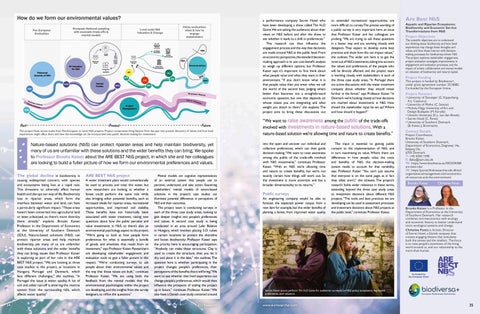
How do we form our environmental values?
a performance company Secret Hotel who have been developing a show called The H2O Game.We are asking the audiences about their views on NbS before and after the show, to see whether it leads to a shift in preferences.” This research can then influence the engagement process and the way that decisions are made around NbS at the public level. From an economic perspective, the standard decisionmaking approach is to use cost-benefit analysis to weigh up different options, but Professor Kaiser says it’s important to first think about what people value and what they want in their environment. “If you don’t know what it is that people value then you enter what we call the world of the second best. Judging what’s better then becomes not a straightforward economic question, but one that depends on whose values you are integrating and what weight you attach to them,” she explains. The project aims to bring these discussions out
The project flows across scales from Pan-European to Local NbS projects. Project components bring lessons from the past into present discovery of values and how lived experiences might affect them and how this knowledge can be incorporated into public decision-making for investment.
Nature-based solutions (NbS) can protect riparian areas and help maintain biodiversity, yet many of us are unfamiliar with these solutions and the wider benefits they can bring. We spoke to Professor Brooks Kaiser about the ARE BEST NbS project, in which she and her colleagues are looking to build a fuller picture of how we form our environmental preferences and values.
34
The global decline in biodiversity is
ARE BEST NbS project
causing widespread concern, with species and ecosystems being lost at a rapid rate. This threatens to adversely affect human health and disrupt our way of life. Biodiversity loss in riparian areas, which form the interface between water and land, can have a particularly significant impact. “These areas haven’t been converted into agricultural land or been urbanised, so there’s more diversity there already,” explains Brooks Kaiser, Professor in the Department of Economics at the University of Southern Denmark (SDU). Nature-based solutions (NbS) can protect riparian areas and help maintain biodiversity, yet many of us are unfamiliar with these solutions and the wider benefits they can bring, issues that Professor Kaiser is exploring as part of her role in the ARE BEST NbS project. “We are looking at three case studies in the project, at locations in Hungary, Portugal and Denmark, which face different challenges,” she outlines. “In Portugal the issue is water quality. A lot of soil and other run-off is entering the riverine system from the surrounding hills, which affects water quality.”
A water treatment plant would conventionally be used to process and treat this water, but now researchers are looking at whether a forest could perform the same role while also bringing other potential benefits, such as increased shade for riparian areas, recreational opportunities, and improved soil stability. These benefits have not historically been associated with water treatment, raising new questions about how the public perceive and value investments in NbS, so there’s also an environmental psychology aspect to the project. “We’re going to look at how people form preferences for what is essentially a bundle of goods and amenities that result from an investment,” says Professor Kaiser. Researchers are developing stakeholder engagement and evaluation tools to gain a fuller picture in this respect. “We’re conducting surveys to ask people about their environmental values and the way that those values are built,” continues Professor Kaiser. “We are using both the feedback from the mental models that the environmental psychologists within the project are developing, and the insights from the survey designers, to refine the questions.”
Mental models are cognitive representations of an external system that people use to perceive, understand, and take action. Examining stakeholders’ mental models of nature-based solutions in the project’s case studies can illuminate potential differences in perceptions of NbS and their outcomes. The project team is conducting surveys in each of the three case study areas, looking to gain deeper insights into people’s preferences and values. A second case study is being conducted in an area around Lake Balaton in Hungary, which involves placing 3-D cubes in certain locations to protect the shoreline and boost biodiversity; Professor Kaiser says the priority here is encouraging participation. “Anybody can make these structures. Clay is used to create the structure, then you let it dry and place it in the lake,” she outlines. The question here is whether participating in the project changes people’s preferences, their perceptions of the benefits that it will bring.“We want to see whether that lived experience can change people’s preferences, which would then influence the prospects of scaling the project up in future,” continues Professor Kaiser. “We also have a Danish case study centered around
EU Research
to extended recreational opportunities, are more difficult to convey.The precise wording of a public survey is very important here, an issue that Professor Kaiser and her colleagues are probing. “We are trying to ask these questions in a better way and are working closely with designers. They expect to develop some best practices and show how this can impact values,” she outlines. The wider aim here is to get the most out of NbS investments, taking into account the values and preferences of the people who will be directly affected, and the project team is working closely with stakeholders in each of the three case study areas. “In Portugal there are active discussions with the water treatment company about whether they should invest further in the forest,” says Professor Kaiser. “In Denmark we’re looking closely at how decisions are reached about investments in NbS. How should the stakeholder input be set up? Where and how should it happen?”
“We want to raise awareness among the public of the trade-offs involved with investments in nature-based solutions. With a nature-based solution we’re allowing time and nature to create benefits.” into the open and uncover our individual and collective preferences, which can then guide decision-making. “We want to raise awareness among the public of the trade-offs involved with NbS investments,” continues Professor Kaiser. “With an NbS we’re allowing time and nature to create benefits, but we’re not exactly certain how things will work out. So the investment is more uncertain and has a broader dimensionality to its returns.”
Public surveys An engineering company would be able to forecast the expected power output from a new dam for example, but the wider benefits of planting a forest, from improved water quality
This input is essential to gaining public consent to the implementation of NbS, and in turn maximising its value. Where there are differences in how people value the costs and benefits of NbS, the decision-making system needs to account for that variability, says Professor Kaiser. “You can’t just assume that everyone is on the same page, as in fact they often aren’t,” she stresses. The project’s research holds wider relevance in these terms, extending beyond the three case study areas to investment decisions about different NbS projects. “The tools and best practices we are developing can be used in assessment processes and investment decisions about NbS projects at the public level,” continues Professor Kaiser.
Are Best NbS
Aquatic and Riparian Ecosystems: Biodiversity and Economic Service Transformations from NbS
Project Objectives
The scientific objectives are to understand our thinking about biodiversity and how lived experiences may change these thoughts and values, and how these interact with decisionmaking processes for biodiversity-driven NbS. The project explores stakeholder engagement, project evaluation strategies, improvements in engagement and evaluation processes, and the impact of artistic collaboration and mental models on valuation of biodiversity and natural capital.
Project Funding
This project is funded by Biodiversa+, under grant agreement number 2510085. Co-funded by the European Union.
Project Partners
• University of Stavanger (G. Kipperberg, A.L. Cojocaru) • University of Minho (C. Santos) • Moholy-Nagy University of Art and Design Budapest (M. Karyda) • Utrecht University (K.L. van den Broek) • Secret Hotel (C. Fentz) • University of Southern Denmark (B. Kaiser, J. Bronmann)
Contact Details
Project Coordinator, Brooks Kaiser, University of Southern Denmark, Department of Economics, Degnevej 14a, Esbjerg Oe, 6705 Denmark T: +45 6550 1590 E: Baka@sam.sdu.dk W: https://www.biodiversa.eu/2025/04/08/ are-best-nbs/ W: https://portal.findresearcher.sdu.dk/en/ organisations/management-and-economicsof-resources-and-the-environment/
Brooks Kaiser
Christine Fentz
Brooks Kaiser is a Professor in the Department of Economics at the University of Southern Denmark. Her research combines microeconomics with ecology and economic history to better understand socio-ecological systems and change. Christine Fentz is Artistic Director of Secret Hotel, a Danish company that creates engaging theatre that stimulates both the senses and the intellect. The focus is to raise people’s awareness of the living world around us, and our relationship to the more-than-human.
Secret Hotel actors perform The H2O Game for audiences surveyed on NbS policy acceptance, expressed preferences, and valuation.
www.euresearcher.com
35