Steps towards the detection of ‘forever chemicals’ The presence of PFAS chemicals in our surroundings is a prominent concern, as they don’t degrade and represent a persistent threat to both human health and the environment. We spoke to João M. M. Araújo and Ana B. Pereiro about how the ALERT-PFAS project team is developing tools and technologies to detect these ‘forever chemicals’ and limit their impact. The presence of per- and polyfluoroalkyll substances (PFAS) in water, soil and air is a prominent concern, as these chemicals don’t degrade and high levels of exposure can have adverse health effects. There are well over 10,000 of these PFAS, manufactured for use in a variety of different products, from firefighting foam, to waterresistant clothing, to cookware. “PFAS are highly durable and have a powerful ability to repel oil and water and resist heat, making them useful in a wide range of consumer products and industrial applications,” says João M. M. Araújo, Assistant Professor in the NOVA School of Science and Technology, NOVA University of Lisbon. However, these chemicals can seep into the environment
relatively easily and accumulate in different areas, for example in groundwater, representing a significant threat to health. “PFAS are transported very easily, and they can go from soil, to water, to groundwater,” explains Dr Araújo. This has led to intense debate about regulating the production of PFAS and limiting their wider impact. While the production of some PFAS has been banned, there are not yet clear alternatives to these chemicals in certain essential applications, says Dr Araújo. “PFAS chemicals are still used in firefighting foams, for example. Firefighters must do regular practice in airports and military installations, where it is mandatory to test the equipment,” he outlines. This is one
major source of PFAS contamination, which can then move into the wider environment, an issue that Dr Araújo is working to address as part of his role in the EU-backed AlertPFAS project. “The main goal in the project is to develop a transnational strategy to detect, prevent and mitigate PFAS contamination in the SUDOE region (South-West Europe), which includes Portugal, Spain and SouthWest France,” he says.
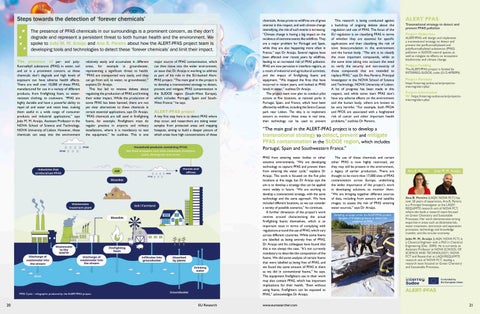
ALERT-PFAS project A key first step here is to detect PFAS where they occur, and researchers are taking water samples from protected areas and mapping hotspots, aiming to build a deeper picture of which areas have high concentrations of these
EU Research
This research is being conducted against a backdrop of ongoing debate about the regulation and use of PFAS. The focus of the EU regulation is on classifying PFAS in terms of whether they are essential for specific applications and then classifying the risk of toxic bioaccumulation in the environment and the human body. “The aim is to classify the most important compounds, while at the same time taking into account the need to verify the security and non-toxicity of those compounds that are intended to replace PFAS,” says Dr Ana Pereiro, Principal Investigator in the NOVA School of Science and Technology, NOVA University of Lisbon. A lot of progress has been made in this respect, and while some inert PFAS don’t have any adverse effects on the environment and the human body, others are known to be very harmful. “For example, both PFOA and PFOS are associated with a heightened risk of cancer and other important health problems,” outlines Dr Pereiro.
ALERT PFAS Transnational strategy to detect and prevent PFAS pollution
Project Objectives
ALERT-PFAS will design and implement a transnational strategy to detect and prevent the perfluoroalkylated and polyfluoroalkylated substances (PFAS) pollution in SUDOE natural spaces, as well as mitigate its effects on ecosystem biodiversity and climate change.
Project Funding
The ALERT-PFAS project is funded by INTERREG-SUDOE, code: (S1/2.4/P0099).
Project Partners
https://interreg-sudoe.eu/en/proyectointerreg/alert-pfas/
Project Information W: https://interreg-sudoe.eu/en/proyectointerreg/alert-pfas/
“The main goal in the ALERT-PFAS project is to develop a transnational strategy to detect, prevent and mitigate PFAS contamination in the SUDOE region, which includes Portugal, Spain and Southwestern France.” PFAS from entering water bodies or other sensitive environments. “We are developing technology to capture PFAS and prevent them from entering the water cycle,” explains Dr Araújo. This work is focused on the five pilot locations at this stage, but Dr Araújo says the aim is to develop a strategy that can be applied more widely in future. “We are working to develop a transnational strategy, with the same technology and the same approach. We have included different locations, so we can consider a variety of possible scenarios,” he continues. A further dimension of the project’s work centres around characterising the actual firefighting foams themselves, which is an important issue in terms of complying with regulations around the use of PFAS, which vary across different countries. While some foams are labelled as being entirely free of PFAS, Dr Araújo and his colleagues have found that this is not always the case. “It’s not currently mandatory to describe the composition of the foams. We did some analysis of certain foams that were labelled as being free of PFAS, and we found the same amount of PFAS in them as we did in conventional foams,” he says. The equipment firefighters use in their work may also contain PFAS, which has important implications for their health. “Even without using foams, firefighters can be exposed to PFAS,” acknowledges Dr Araújo.
PFAS Cycle – infographic produced by the ALERT-PFAS project.
20
chemicals. Areas prone to wildfires are of great interest in this respect, and with climate change intensifying, the risk of such events is increasing. “Climate change is having a big impact on the incidence of extreme events like wildfires. They are a major problem for Portugal and Spain, while they are also happening more often in France,” says Dr Araújo. Several regions have been affected over recent years by wildfires, leading to an increased risk of PFAS pollution. PFAS are now pervasive in interface regions, as a result of industrial and agricultural activities, and the impact of firefighting foams and equipment. “We mapped the fires that have occurred in recent years, and looked at PFAS levels in water,” outlines Dr Araújo. The project team now plan to conduct pilot actions at five locations, at national parks in Portugal, Spain, and France, which have been affected by wildfires, including the Sintra-Cascais park near Lisbon. The idea is to implement sensors to monitor these areas in real time, then technology can be used to prevent
www.euresearcher.com
The use of these chemicals and certain other PFAS is now highly restricted, yet they may still be present in the environment, a legacy of earlier production. There are thought to be more than 17,000 sites of PFAS contamination across Europe, underlining the wider importance of the project’s work in developing solutions to monitor them. “We are bringing together different sources of data, including from sensors and satellite images, to assess the risk of PFAS entering water sources,” says Dr Araújo. Sampling campaign under the ALERT-PFAS project. Samples of firefighting foams to detect the presence of PFAS.
Ana B. Pereiro
João M. M. Araújo
Ana B. Pereiro (LAQV, NOVA FCT) has over 20 years of experience, Ana B. Pereiro is a Principal Investigator at the LAQV/ REQUIMTE research unit of NOVA FCT, where she leads a research team focused on Green Chemistry and Sustainable Processes. Her work demonstrates strong expertise in areas such as (bio)materials, water treatment, extraction and separation processes, technology and knowledge transfer, and the circular economy. João M. M. Araújo (LAQV, NOVA FCT) is a Chemical Engineer with a PhD in Chemical Engineering (Dec. 2009). He is currently an Assistant Professor at NOVA SCHOOL OF SCIENCE AND TECHNOLOGY | NOVA FCT and Researcher at LAQV/REQUIMTE research unit of NOVA FCT, leading a research team focused on Green Chemistry and Sustainable Processes.
21