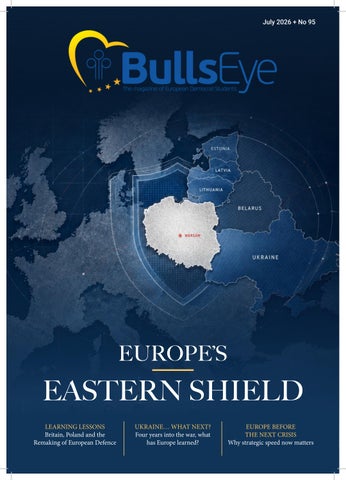
LEARNING LESSONS
Britain, Poland and the Remaking of European Defence
UKRAINE… WHAT NEXT? Four years into the war, what has Europe learned?
EUROPE BEFORE THE NEXT CRISIS Why strategic speed now matters

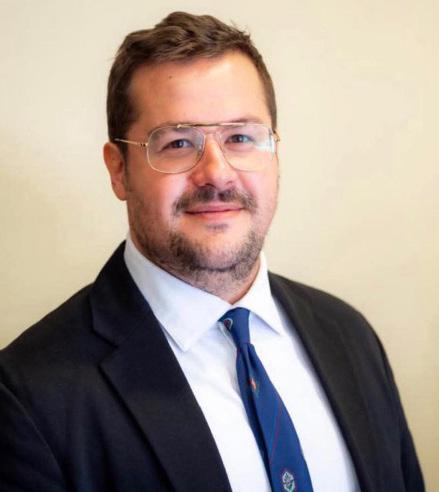
Dear Readers and Friends of EDS, Welcome to Warsaw!
It is wonderful to celebrate such an important milestone as our Summer University in one of Europe’s most dynamic capitals. Let’s make the most of these days of high-quality training and lean on the insights of the many leaders who will guide us through the most pressing issues facing our beloved Europe. A huge thank you goes to our friends at Nowa Generacja for meticulously organising every detail of this historic event.
Just a few weeks ago, during a historic European People’s Party Political Assembly in Vienna, which welcomed our friends from EVROPA Sad Montenegro into the EPP family, I presented the EDS activity report for recent months and outlined the political priorities
Francesco Sismondini
we will focus on in the immediate future. Our positions on AI, housing, academic freedom, and youth mental health, always with citizens’ rights at the centre, were warmly received by the party.
We should be proud of this, and stand firmly behind our commitment to innovation that serves citizens, protecting democracy, and defending freedom for everyone.
During our digital communication and political training, we had the opportunity to learn from the analyses and perspectives of eminent professors from top European universities, as well as from the hands-on experience of delegates who have turned this field into their profession. Furthermore,
our study visit to Zagreb helped us clearly map out our key strengths in innovation.
In short, friends, we have a packed and ambitious agenda ahead of us, and we are ready.
Building on EDS’s recent momentum within our political family, we have decided to launch a campaign and manifesto on the future of education. “Educate – don’t automate!” will be the motto of this initiative. We must spearhead this campaign with a deep sense of responsibility. We are tired of the usual buzzwords; what we need now is real substance and policy proposals that will tangibly improve the lives of students and youth.
This is also why BullsEye Magazine remains so important. It gives our members, editors, guest contributors, and young centre-right voices across Europe a platform to think seriously, write clearly, and contribute to the debates shaping our continent. At a time when Europe faces major questions on security, competitiveness, housing, education, technology, democracy, and enlargement, BullsEye helps ensure that the voice of our generation is not only heard, but taken seriously.
I would like to thank everyone who has contributed to this edition. My sincere gratitude goes to the guest editors, the wider editorial team, our contributors, and all those who have helped bring this magazine to life. I would also like to thank the Publications Editor and the Secretary General for their continued support of
BullsEye and its role within EDS. Finally, I want to give special thanks to the Chief Editor for leading the editorial work of the magazine and helping ensure that BullsEye continues to reflect the seriousness, ambition, and intellectual energy of our organisation.
The strength of BullsEye comes from the people behind it: those who write, edit, organise, design, review, and believe that young Europeans should not only participate in politics, but help shape its ideas. Their work makes this publication a valuable part of EDS and of our contribution to the wider EPP political family.
This is only the beginning. As we gather in Warsaw, let us continue with confidence, discipline, and ambition. Let us use these days to learn from one another, strengthen our friendships, and prepare ourselves for the responsibility of shaping Europe’s future.
With
warm regards,
Francesco Sismondini Chairman European Democrat Students

The first half of 2026 has been an important and energetic period for European Democrat Students. As we mark 65 years of EDS, we are reminded of both our organisation’s proud history and its continuing responsibility to bring together young centre-right Europeans at a decisive moment for our continent.
We began the year with our Winter University in Skopje, held under the title Youth Vision 2030 – Western Balkans, Stability & AI in Education. With more than 70 delegates, the event included discussions on security, EU enlargement, fiscal policy, and the energy and green transition, as well as meetings with the President of North Macedonia, the Minister of Energy, and the Prime Minister. Special thanks go to the Youth Forces Union of VMRO-DPMNE and the Konrad Adenauer Foundation for their support.
At the Skopje Council Meeting, EDS adopted more than ten motions from our Working Groups, alongside an urgent motion on
Vladimir Kljajic
the war in Ukraine. We also approved the 2025 Financial and Audit Reports, the 2026 Budget, and adopted Statute amendments. A dedicated committee, chaired by the Chairman, was established to align the EDS Statutes with the latest European Parliament and EPP rules, with proposals to be presented at the Summer University.
In April, EDS Digital Days in Brussels gave our members high-level training in digital strategy and political communication in the attention economy. With contributions from KAS, Bloomberg, KU Leuven, the Atlantic Council, and campaign practitioners from across Europe, as well as sessions at Google HQ and KAS Europe, the event strengthened our ability to communicate in a fast-changing political environment.
Our Study Mission to Zagreb in May, hosted with HAZ Croatia, focused on geopolitics and EU enlargement, especially the Western Balkans and Ukraine. Delegates visited Banski dvori and the Rimac Campus
and participated in Croatia’s Statehood Day, including an encounter with Prime Minister Andrej Plenković. Sincere thanks go to HAZ Croatia and KAS for their excellent cooperation.
This year also saw the launch of the EDS Power Brunch, a new flagship format in Brussels bringing members together for monthly informal networking mornings, mainly at EPP Headquarters. EDS also joined the EPP’s 50th-anniversary celebrations and EPP Forum in March, and sent a delegation to the IYDU Freedom Forum in Thessaloniki in June.
Politically, EDS has set out clear priorities for 2026: competitiveness and responsible AI in education, the student housing crisis, and youth empowerment and democracy. Alongside this, we launched a refreshed visual identity marking 65 years of EDS, and new issues of BullsEye Magazine have continued to give our members a platform to contribute to European debate.
I would like to express my sincere gratitude to EDS Chairman Francesco Sismondini for his leadership throughout the year, and to the outgoing Bureau for their dedication and service during this mandate.
All eyes now turn to Warsaw, where from 30 July to 2 August we will gather for the Summer University, hosted together with Nowa Generacja. Under the title Between Centre and Frontier: Europe’s Next Chapter, this year’s Summer University will focus on Central and Eastern Europe, EU enlargement, democratic resilience, security and geopolitics, and AI and digital participation. It will also be an important institutional milestone, with the election of the new Bureau, adoption of motions, admission of new member organisations, presentation of Statute-alignment proposals, and discharge of the outgoing
Bureau and Secretary General.
This edition of BullsEye reflects the same spirit. Our contributors engage with the political, security, economic, cultural, and generational questions shaping Europe today. I would like to give special thanks to Charlie Crumpton, Chief Editor of BullsEye, for his leadership in preparing this edition, and to Sotiris Paphitis, Publications Editor, for his continued work in strengthening our publications. I also thank all editors, contributors, and guest editors for their work over the past year.
As we celebrate 65 years of EDS and enter the second half of 2026, let us continue with ambition, discipline, and confidence. On behalf of the Secretariat, thank you to every member, organiser, partner, and friend who continues to make EDS a living community of ideas and action.
With warm regards,
Vladimir Kljajic Secretary General European Democrat Students
Dear Readers,
It is a great pleasure to welcome you to this edition of BullsEye Magazine.
This edition is especially meaningful for me. As we bring together another collection of articles, reflections, and political arguments from across European Democrat Students, I also want to take a moment to express my gratitude for the opportunity to have served as Editor-in-Chief of BullsEye over many years.
Since first becoming part of the EDS family in 2019, I have had the privilege of seeing this organisation from many angles: as a contributor, editor, colleague, and friend. Through that time, BullsEye has remained one of the most valuable platforms within EDS. It gives young centre-right Europeans the opportunity to think seriously, write clearly, and contribute to the debates shaping our continent.
At its best, BullsEye is more than a magazine.
Charlie Crumpton
It is a space for political formation. It allows students and young leaders from across Europe to test ideas, challenge assumptions, defend principles, and engage with one another in the spirit of democratic debate. In a time when European politics is increasingly defined by questions of security, enlargement, competitiveness, housing, demography, culture, and technological change, that mission matters more than ever.
This edition reflects the seriousness of those challenges. Within these pages, readers will find articles engaging with the questions that will shape Europe’s next chapter: how Europe can defend itself, how it can remain competitive, how it can support young people, how it can preserve its cultural confidence, and how it can act strategically in a more unstable world.
I would especially like to thank the BullsEye editorial team for their work during the 2024–2026 working year. To Finlay ThackerMcPherson, Andrea Mghames, Sofia
Kubrakova, Andia Homata, Lara Ghanoudi, and María Ferrer Argente: thank you for your dedication, patience, ideas, and commitment to strengthening the quality of this publication. Your work has helped ensure that BullsEye remains a serious and valuable platform for young political voices within EDS.
My sincere thanks also go to Vladimir Kljajic, Secretary General of EDS, for his continued support of BullsEye and for his efforts to bring the magazine in front of EPP politicians and our wider political family. This makes every contribution more meaningful. BullsEye matters because it gives young centreright Europeans not only a place to write, but a chance to be read by people who are shaping Europe’s future.
I also want to give particular thanks to Sotiris Paphitis, Publications Editor, whose support has been invaluable in helping bring BullsEye to publication and in strengthening the direction and quality of our publications work. His contribution has helped ensure that the effort of our editors and contributors is carried through into a magazine of which EDS can be proud.
I also want to thank our contributors, guest editors, designers, and everyone who has helped bring this magazine to life over the past years. Every edition depends on people giving their time, thought, and energy behind the scenes. That work is not always visible, but it is deeply appreciated.
Serving as Editor-in-Chief of BullsEye has been one of the great honours of my time in EDS. I am grateful to those who trusted me with this responsibility, to the colleagues who worked alongside me, and to the many friends across the organisation who have made this experience so meaningful.
As EDS marks 65 years, BullsEye continues to
represent something important about our organisation: the belief that young people should not only participate in politics, but help shape its intellectual direction. Our generation has a responsibility to take ideas seriously, to speak with conviction, and to prepare ourselves for leadership in a Europe that will demand courage, clarity, and discipline.
Looking ahead, my hope is that BullsEye will continue to grow not only as a magazine, but as a training ground for young political thinkers. Europe will need leaders who can do more than repeat slogans. It will need people who can understand complexity, write with conviction, argue with seriousness, and defend their principles with clarity.
For future editors and contributors, my encouragement is simple: take the work seriously. Treat every article as an opportunity to sharpen your thinking, serve your political family, and contribute to the wider debate about Europe’s future. BullsEye has always been strongest when it gives young people the confidence to enter that debate not as spectators, but as participants.
If this magazine continues to help form that kind of young leader, then its value will reach far beyond the pages of any single edition.
Thank you to everyone who has read, written, edited, supported, and believed in BullsEye. It has been a privilege to be part of this journey, and I look forward to seeing how the magazine continues to grow in the years ahead.
With warm regards,
Charlie Crumpton Editor-in-Chief, BullsEye Magazine
Dear Readers & Friends
Welcome to the 95th edition of BullsEye, the flagship publication of the European Democrat Students.
Europe is facing a defining moment. As our societies confront geopolitical uncertainty, economic pressures, demographic change, and technological transformation, one principle must remain constant: democracy depends on accountability. Those who exercise power-whether in governments, institutions, or public life-must always be prepared to justify their decisions and face informed scrutiny. This is what you, dear reader, are called to do in the context of EDS.
That is where BullsEye has an important role to play. It is more than a publication; it is a platform for critical thought, robust debate, and democratic accountability. We believe that no policy should be beyond questioning, no institution beyond scrutiny, and no leader beyond being held accountable. Healthy democracies are built not on blind acceptance,
but on informed citizens who are willing to challenge, scrutinise, and demand better.
The articles in this edition bring together young voices from across Europe, offering thoughtful perspectives on the issues shaping our continent’s future. They reflect the values that unite our movement: freedom, responsibility, the rule of law, and the courage to engage with difficult questions.
My sincere thanks go to our Editorial Team and every contributor whose commitment and expertise have made this edition possible.
I hope this edition of BullsEye not only informs but also inspires you to question, debate, and never shy away from holding decision-makers to account. Democracies thrive when ideas are tested, power is scrutinised, and leadership is earned through transparency, responsibility, and public trust. Happy reading.
Yours sincerely,
Sotiris Paphitis, Publications Editor European Democrat Students

Two hundred and fifty years ago, the United States wrote the right to begin again into its founding. As Europe hunts for its next great companies, that, not Silicon Valley, is the idea worth importing.
Vladimir Kljajic
The Radical Word Is “Pursuit”
The most quoted sentence in the American founding is also the most misread. “Life, liberty, and the pursuit of happiness”: we recite it like a promise of contentment delivered by the state. It is nothing of the kind. The radical word is the one nobody lingers on: pursuit. The Declaration of Independence did not guarantee happiness. It guaranteed
the right to chase it. And a right to chase something is, by definition, a right to fall short of it and to begin again.
That is an entrepreneurial proposition, set down in a founding document two hundred and fifty years ago, long before anyone thought to call it a start-up. It assumes a citizen who acts, risks, fails, and tries once more. America’s deepest invention was never the assembly line, the transistor, or the
search engine. It was a culture that treats failure as tuition rather than as a verdict.
You can see that culture even in the country’s law. Most legal systems are built to punish the person who goes broke. America built a federal architecture, Chapter 11, whose entire purpose is to let a failed venture reorganise and live. The right to fail and restart is not a loophole there; it is policy. A second chance is written into the operating system.
Innovation grows out of that permission, not the other way around. When John F. Kennedy committed his country to the Moon, he did not sell it as easy. “We choose to go to the Moon in this decade and do the other things,” he told a Texas stadium in 1962, “not because they are easy, but because they are hard.” The line endures because it names the impulse precisely: progress is the willingness to attempt something you might not survive. The same impulse runs from Kennedy’s government moonshot to a later generation of engineers who treated each explosion as data, iterating until rockets could return and land themselves. The method was identical. Only the address had changed.
Here is where the story turns toward us. Europe does not lack brains, capital, or science; we have all three in abundance. What we have less of is permission. And the diagnosis is not American boosterism; it comes from Mario Draghi, in the most sober pro-European document of the decade. Draghi noted that not a single EU company worth more than €100 billion has been built from scratch in the last fifty years, while every one of the six American companies valued above a trillion euros was created in exactly that window. We educate brilliant founders and then, too
often, export their second chances to places willing to fund them.
The lesson of America at 250, for the next generation of European leaders, is not to imitate America. It is to steal its best idea and improve on it, to pair our genius for solidarity with their genius for the attempt.
And this is where hope, properly understood, earns its place in the story. Hope is not optimism. Optimism is a forecast; it expects good outcomes. Hope is a bet, the decision to act on a future you cannot yet see. In 1776, the men who signed the Declaration had no statistical grounds for optimism. They were a fringe rebellion of farmers and lawyers taking on the most powerful empire on earth. What they had was hope: the nerve to wager on a country that did not yet exist. That is the same muscle every founder uses, and every reformer, and every young person who chooses to build rather than merely to inherit. Seen this way, America is less a finished monument than a two-hundred-and-fifty-year-old start-up, one that keeps betting on its next version.
Which is the right note on which to read these words. Two hundred and ten years ago, almost to the day, in a letter to his old friend and rival John Adams, Thomas Jefferson set down a line that belongs to anyone marking this anniversary: “I like the dreams of the future better than the history of the past.”
That is the whole spirit of the thing. A 250th birthday tempts us toward nostalgia, toward the history of the past. But the founders themselves were facing the other way, toward a future they would never see. The most fitting tribute is to do as they did: to refuse the comfort of the finished story, and to keep pursuing. The next 250 years belong, as the first did, to whoever is still willing to dream forward and brave enough to try.
Finlay Thacker-McPherson
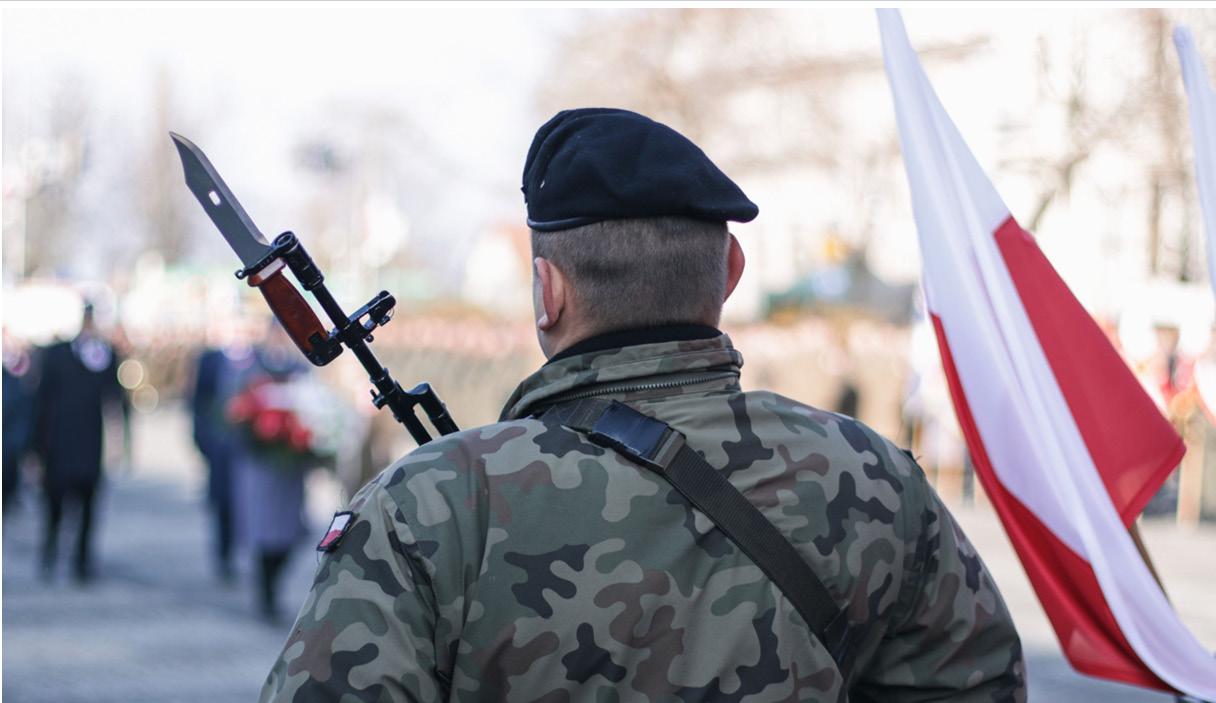
The history of British and Polish armed forces is one of great partnership and collaboration. Perhaps most famously the Polish pilots of 303 squadron supported the Royal Air Force during the Battle of Britain, a battle for the survival of the British nation and one that began the long road to allied victory in World War Two. Almost 80 years later, and it was on the site from which the 303 squadron took to the skies to protect Britain, that the United Kingdom and Poland would renew their defence partnership.
At RAF Northolt on May 27th 2026, the UK and Poland signed The Northolt Treaty, promising to collaborate on defence and
‘Reaffirming their ironclad commitment to NATO as the bedrock of their security, and the foundation of collective defence of the Euro-Atlantic area’. The ‘two countries pledged to develop medium-range air defense missiles, deepen cooperation on tackling Russian hybrid threats, bolster joint procurement, ramp up military exercises and restated their commitment to “assist one another” in case of an armed attack’. In the midst of a war in Europe, the United Kingdom and Poland agreed to renew and continue a historic partnership on matters of defence and security, building upon decades of collaboration and cooperation.
Poland: NATO’s new standard bearer
Yet history alone does not deter adversaries, and in the years since those pilots flew from Northolt, it is Poland that has most clearly understood what serious defence commitment looks like in practice. Poland has become a bastion of European defence, and has shown significant investment to support its rhetoric of rearming in the face of an ever growing Russian threat. Polish defence spending has reached 4.48% of its GDP in 2025, placing it as the front runner in NATO’s defence spending table, above even the USA, and highlighting the maturing of promises to see the Polish armed forces revitalised and strengthened.
This investment has seen Poland, rightly, recognised as a vastly improved fighting force, as a country that is capable of significantly contributing to NATO exercises, as well as providing a strong deterrence against Russian aggression in the East of Europe and as a pillar of NATO’s eastern flank. With over 216,000 active personnel, Poland is now the third largest military in NATO behind only the United States and Turkey, and under the 2022 Homeland Defence Act has set an ambition to double its armed forces to 300,000 personnel, with a longer term target of 500,000 by 2039. Through consistent investment and proactive capability building, Poland has fundamentally restructured its armed forces for the wars of today, and tomorrow.
Britain, on the other hand, has seen anything but investment and strengthening of its armed forces, and has failed to meet the bolstering of its armed forces that is required in such an unpredictable world. There has been a consistent, and decades long, underinvestment of the armed forces, various high profile project failures, and a
severe lack of readiness capability which has culminated in a severely reduced defence capacity. The government’s own Defence Investment Plan (DIP), which has set out the government’s approach to defence over the coming years, was maligned by figures from across the political landscape. Lord Robertson, who authored the government’s 2025 Strategic Defence Review and was Secretary of State for Defence under Tony Blair, criticised the government for a ‘corrosive complacency’ on defence and warned that ‘We cannot defend Britain with an ever-expanding welfare budget’.
Additionally, Kemi Badenoch, Leader of the Opposition and Leader of the Conservative Party, said that the government had been ‘dithering’ on defence and called the Defence Investment Plan, ‘pathetic’. Perhaps most damning of all, was that the Secretary of State for Defence, John Healey, and the Armed Forces Minister, Al Carns, resigned from the government in protest at the lack of funding included in the DIP, with Healey stating that the plan ‘falls well short’ of what is needed to revitalise the British military. In his own resignation statement, Carns echoed Healey’s sentiment around the DIP, stating that it was ‘neither transformative enough nor sufficiently funded’, a feeling that was shared by Pamela Nash, who also resigned as Healey’s parliamentary assistant.
The debacle over the DIP has only highlighted the chronic underfunding of British armed forces, which becomes even starker when compared to the way in which Poland has gone about bolstering its military capabilities. Defence procurement has been a significant issue in the Ministry of Defence, as ‘For 20 years, there’s been a disastrous procurement process costing tens and tens and tens of billions… Since the war started in Ukraine, MOD procurement has got worse and worse’, highlighting a significant institutional problem with the
way in which successive governments have approached defence. The British Army has consistently missed recruitment targets and it currently stands at its smallest trained regular personnel size since 1799.
The most symbolic, and for an island nation, distressing, decline is that of the Royal Navy. Once the most powerful navy in the world, the Royal Navy now stands at its smallest size since the English Civil War, and it took three weeks to deploy a Royal Navy vessel to Cyprus in the midst of conflict in the Middle East, a damning indictment of the Royal Navy’s readiness capabilities. To further compound this dismal decline, Keir Starmer made the decision to scrap plans to build eight Type 83 destroyers and five Type 32 frigates from the DIP, essentially dashing any hope of a renewed and revitalised Royal Navy, and the latest in a series of broken promises regarding building it up once again. These failures do not reflect the quality of British servicemen and women, but they do restrict them, leaving the most dedicated and capable soldiers, sailors and aircrew in the world chronically under-resourced at this crucial moment. Britain is not standing entirely still, there are tentative signs of progress. General Sir Roly Walker recently announced that Project AKSA has placed 10,000 small drones into soldiers’ hands, backed by £300 million of investment. Yet Poland has committed PLN 15 billion to drone and autonomous systems across all domains over three years, and where Britain is only beginning to move, Poland has been moving for years. Britain’s 9 Protector drones, of the 16 ordered over a decade ago, remain in service but have
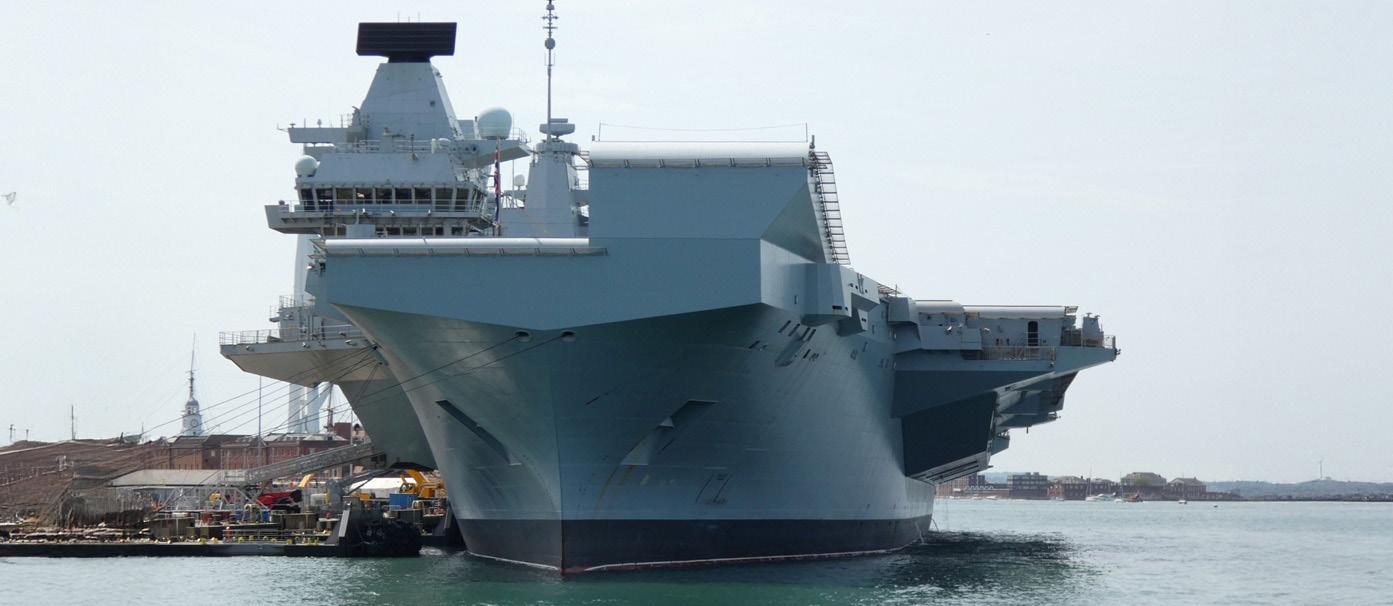
still not reached Initial Operating Capability according to the MoD, a damning illustration of the gap between announcement and delivery that has characterised British defence procurement for decades. The small drones announcement suggests a step in the correct direction, but it is just that; a step, and for British defence to be transformed into a modern fighting force it will need more than that.
Through their consistent investment in defence, and specifically in their concerted efforts to build their drone and unmanned system capabilities, it is clear that Poland has taken the lessons from the battlefields of Ukraine and used them to build a stronger, more agile fighting force now considered a leading European military. Britain, in contrast, has fundamentally and demonstrably failed to do this. The Ministry of Defence ‘has spent the years of the Ukraine war deliberately resisting facing this reality. And when people return from Ukraine to explain what’s happening inside the MOD, they’re told: ‘Do not tell senior officials, do not tell ministers, our priority is continuing the budgets for the stupid old tanks and all the things inside MOD procurement that don’t work’.
If Britain is to return to its position as a military superpower, it must look to take lessons from Poland, and embrace the Northolt Treaty in its entirety. This means reforming the procurement system to meet the needs of today rather than of yesteryear, to give sustained and significant funding to drone and autonomous systems capabilities, and to implement a Defence Investment Plan that actually does what it claims to in the name, invests in defensive systems that will allow its armed forces to stand ready to protect the United Kingdom when they are called to do so. Poland has provided an example of what can be done, Britain must now follow it.
Sotiris Paphitis
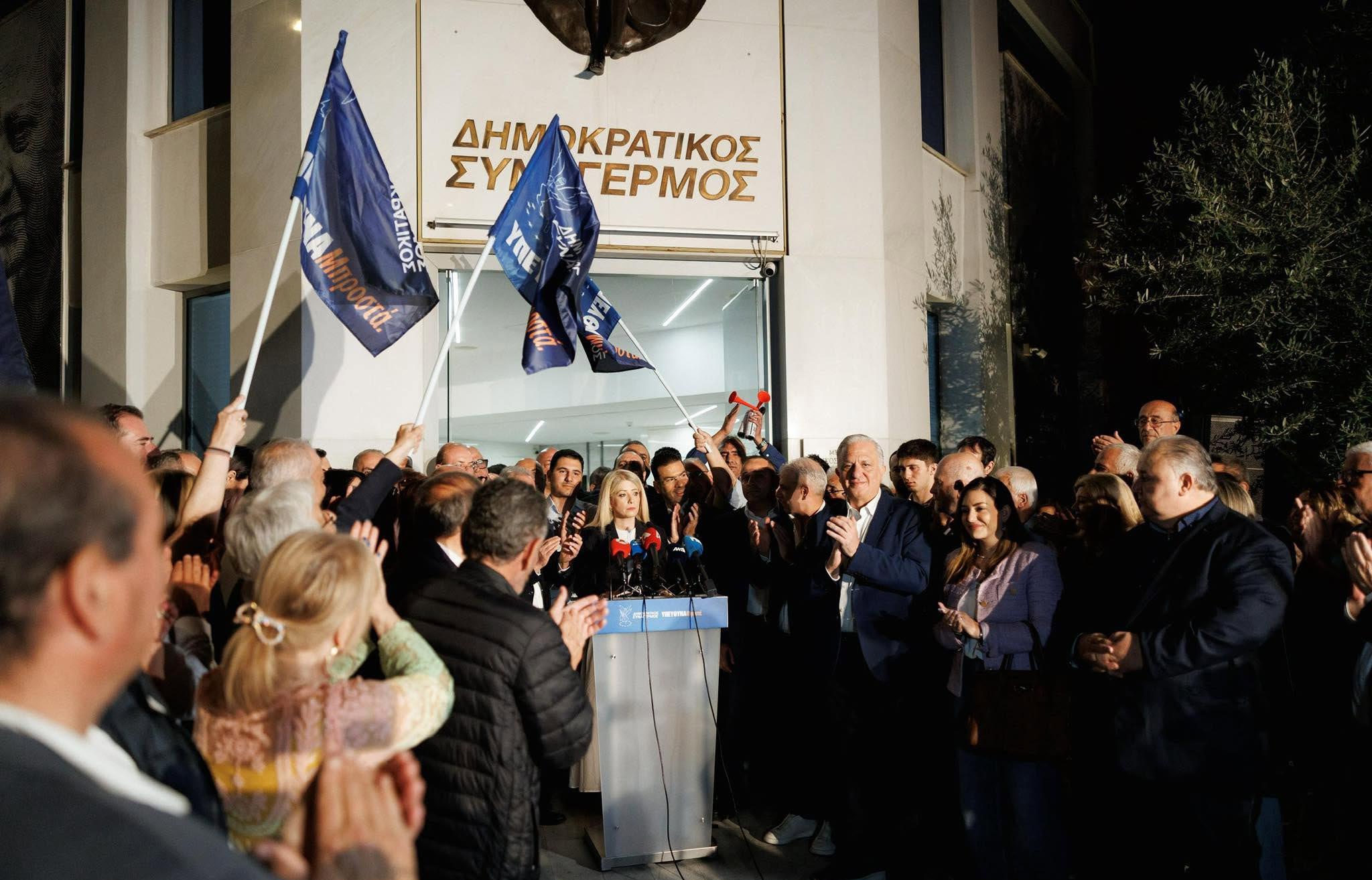
The results of Cyprus’s 2026 parliamentary elections have generated considerable commentary, much of it focused on the rise of new political actors, the fragmentation of the political landscape, and the challenges facing traditional parties. While these developments deserve attention, they should not obscure the election’s central message.
The most important lesson of the 2026
parliamentary elections for me is that the centre-right remains the dominant political force in Cyprus.
Despite governing fatigue due to our 10-year governance between 2013 and 2023, an increasingly fragmented political environment, and years of political turbulence, the Democratic Rally (DISY) once again emerged as the country’s largest party. At a time when many centre-right parties across Europe are facing intense
pressure from both populist challengers and political extremes, Cyprus offers an important reminder: competent, moderate, pro-European politics remain electorally viable.
For the European centre-right, ten key lessons emerge from this election.
Predictions of the centre-right’s decline have become a recurring feature of European politics. Yet election after election, voters continue to place their trust in parties that combine economic responsibility, institutional stability, and a credible governing record. Cyprus was no exception
Despite a challenging political environment, DISY retained its position as the largest political force. This result demonstrates that while voters may express frustration with governments and political institutions, they remain reluctant to entrust power to
untested alternatives.
The centre-right’s greatest strength remains its reputation for governing competence.
The 2026 election confirmed a reality often overlooked in contemporary political commentary: most voters are not looking for revolution.
Cypriots had the opportunity to support political extremes from both the left and the right. These included among others, Direct Democracy (the party of our influencer MEP Fidias Panayiotou) as well as ALMA the party created by our now-fired vigilante Auditor General, Odysseas Michaelides. Instead of supporting them, the largest share of voters continued to support a party firmly situated within the democratic mainstream.
This is a lesson that extends far beyond Cyprus. While polarisation dominates headlines, moderation continues to win elections.The political centre remains alive
and well.
In recent years, anti-political sentiment has encouraged the belief that experience is a liability rather than a strength. The Cypriot election suggests otherwise.
At moments of uncertainty, voters continue to value parties and leaders who possess a proven record of governance. Experience alone is not sufficient to secure victory. However, competence remains one of the most powerful electoral assets available to any political movement.
Those who underestimate the value of governing experience misunderstand how most citizens make political choices.
The election once again demonstrated the enduring strength of pro-European politics in Cyprus.
Although Europe faces numerous challenges, ranging from security concerns to economic competitiveness, Cypriot voters overwhelmingly supported parties committed to Cyprus’s place within the European project. This should encourage centre-right parties across Europe. The debate is no longer between Europe and no Europe. It is between those who seek to improve Europe and those who merely seek to complain about it. The future belongs to constructive Europeanism.
One of the most common mistakes made by traditional parties is the assumption that
electoral success requires abandoning long-held principles. The Cypriot election suggests the opposite.
The challenge facing centre-right parties is not ideological reinvention. It is organisational renewal, policy innovation, and effective communication. Parties remain strongest when they modernise their methods while remaining faithful to their values.
Several new political actors achieved notable results during the election.
Their success reflects genuine public concerns and should not be dismissed. However, there remains a significant difference between attracting attention and governing a country.
Building a social media following is easier than building a political organisation. Criticising institutions is easier than reforming them. Winning headlines is easier than governing responsibly.
The centre-right should respect new political movements while remaining confident in the enduring value of serious politics.
Political commentators frequently focus on the extremes. Elections are usually decided elsewhere. The decisive political battleground remains the centre.
The 2026 election confirmed that parties capable of appealing to moderate voters continue to enjoy a significant advantage.
Citizens want practical solutions rather than ideological purity.
The future will belong to political movements capable of building broad coalitions rather than narrow tribes.
For much of the past decade, political discourse has celebrated disruption and portrayed stability as a sign of stagnation. The election results suggest voters take a different view.
In an increasingly uncertain world marked by geopolitical tensions, economic volatility, and rapid technological change, stability has once again become a valuable political commodity.
Citizens want reform, but they also want predictability, security, and competent governance.
The centre-right is uniquely positioned to provide both.
The success of DISY should not be interpreted as a justification for complacency. Political dominance is never permanent. Every generation presents new challenges, new expectations, and new forms of political competition.
The lesson of the election is not that traditional parties can continue as before. It is that successful parties are those capable of adapting while preserving their core identity.
Resilience comes from renewal.
10. The Centre-Right’s Greatest Opportunity Lies Ahead
Perhaps the most important lesson is that the centre-right enters the coming political cycle from a position of strength.
The election demonstrated that voters continue to trust moderate, responsible, pro-European political forces. It also demonstrated that there remains significant space for centre-right parties to lead on economic growth, institutional reform, national security, and European competitiveness. The challenge is therefore not survival.
The challenge is leadership.
Across Europe, citizens are searching for political movements capable of combining stability with reform, experience with innovation, and patriotism with openness. These have always been the defining characteristics of successful centre-right politics.
The 2026 Cypriot parliamentary elections should not be remembered as an election about fragmentation or protest. They should be remembered as an election that reaffirmed the enduring strength of the democratic centre-right.
While new political actors entered the scene and established assumptions were challenged, the fundamental reality remained unchanged: voters placed their trust in the political family most closely associated with competence, moderation, and responsible governance.
For Europe’s centre-right parties, this result offers an important lesson. In an era dominated by populism, polarisation, and political uncertainty, the answer is not to imitate the extremes. The answer is to govern effectively, reform confidently, and remain faithful to the principles that
have delivered prosperity, stability, and democratic progress across Europe.
Cyprus’s election demonstrates that when the centre-right does so, it does not merely survive. It wins.
Jan van der Meer
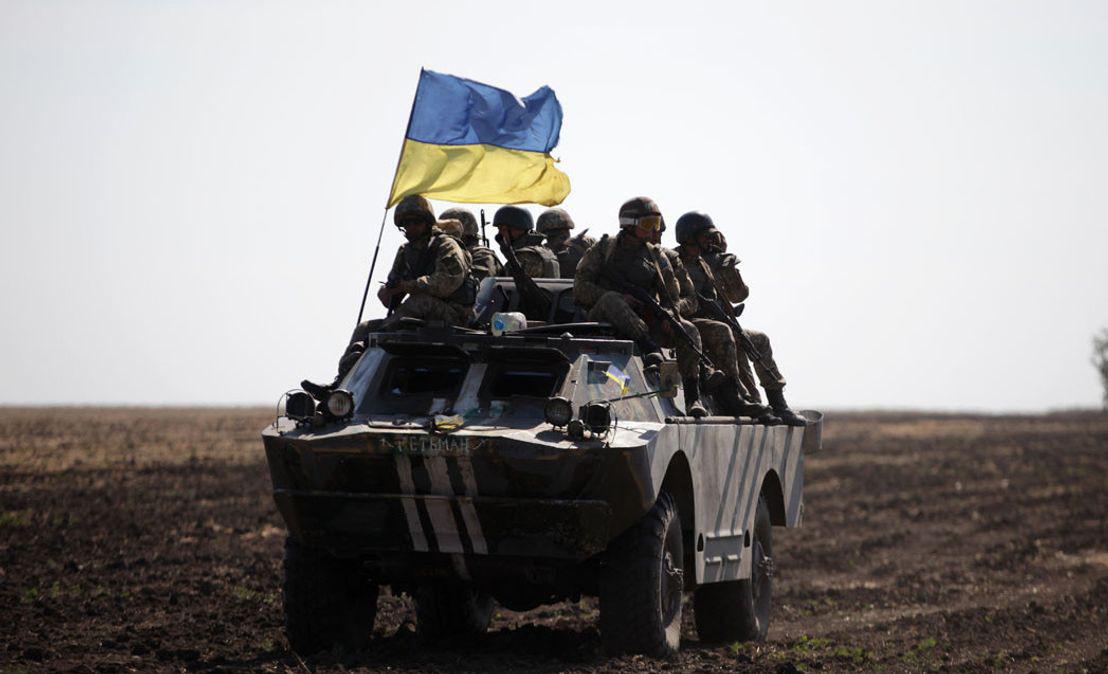
Four years into the war, one question remains: what has Europe really learned? Since Vladimir Putin announced on television that he would launch a ‘special military operation’ in Ukraine, a country he accused of neo-fascist policies, the world has changed dramatically.
Much has happened in those four years. Millions fled, tens of thousands died, and peace remains elusive.
Europe is more alert than ever. Hundreds of sanctions have been jointly imposed against Russia. Trade has largely come
to a standstill, the Netherlands and other European countries have distanced themselves from Russian gas, and the realization has sunk in of what Eastern European countries have been repeating for years: Russia poses a structural threat to Western democracy.
Unfortunately, the idea still prevailed in the Western world that Russia could become more democratic under Vladimir Putin, or at least that our trade would remain protected.
So, what is left? The world’s largest country has become largely isolated from Europe, yet it still plays a role on the global stage. Countries like India and China, and recently the United States, have taken positions where Europe once held influence. Although daily life for the average Russian is no longer the same as it was before the war, Russia has so far managed to avoid a deep economic depression.
At the same time, every form of domestic protest has been brutally suppressed. This
became painfully visible with the death of opposition leader Alexei Navalny two years ago. Recent research indicates that he was poisoned by the Russian regime.
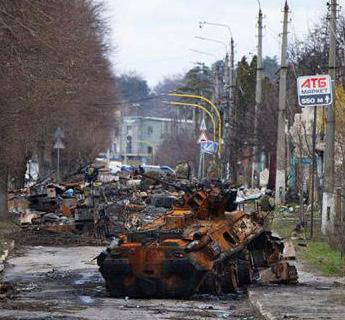
And all this while Ukraine is still under attack every day. In cities like Kyiv, the air raid siren has become a familiar sound, almost as recognizable as birds singing in the park. This is more than a military conflict. It is a humanitarian disaster that spares no one. Entire generations are growing up with bomb shelters as classrooms and explosions as background noise. The trauma currently being built up will continue to affect the lives of millions of Ukrainians for decades to come, like a nightmare from which one cannot wake up.
How can you imagine your country being systematically destroyed? That everything familiar—your street, your school, your hospital, even the playground where you used to play—lies in ruins? That the power grid is being deliberately attacked, leaving families without heating, without light, and sometimes even without water during the already cold Ukrainian winters? War here is not just about territory, but about the breaking of a society.
Nevertheless, this war shows very clearly that Ukraine is resilient. On the streets of Kyiv, you often hear the same joke on the benches these days: “Russia and NATO waged a war in Ukraine. Since then, 70,000 Russian soldiers have died, virtually Russia’s entire arsenal has been blown up, and that while the Russian army is already short on almost everything. And NATO? NATO isn’t even here yet.”
After 4 long years, it is not surprising that so many people feel defeated in a certain way. Even before Russia invaded, it was said that Russia would never invade Ukraine; there was talk that the country was in such a bad
economic state that everything would be ground to a halt within three months; there was even talk that protests in Russia would grow internally and that the people would go into revolution. None of this came true. After all the theories we have, only one truth remains. A hard truth that is sometimes difficult to face. This conflict turned out not to be a matter of days or weeks. It did not become a short, decisive confrontation, but a war of attrition that has now lasted for four years.
Precisely for this reason, it is important that we in Europe do not look away. Ukraine’s struggle is not just about redrawing physical borders on a map, but about freedom and not allowing ourselves to be intimidated by a dictatorial regime, values that we in Europe share. Solidarity is not a temporary emotion, but a choice of principle. Whatever happens, Europe must continue to stand behind Ukraine. Supporting Ukraine is ultimately about defending the principles on which European peace has been built for generations. If those principles fail in Ukraine, they become weaker everywhere in Europe.
Nora Strømme
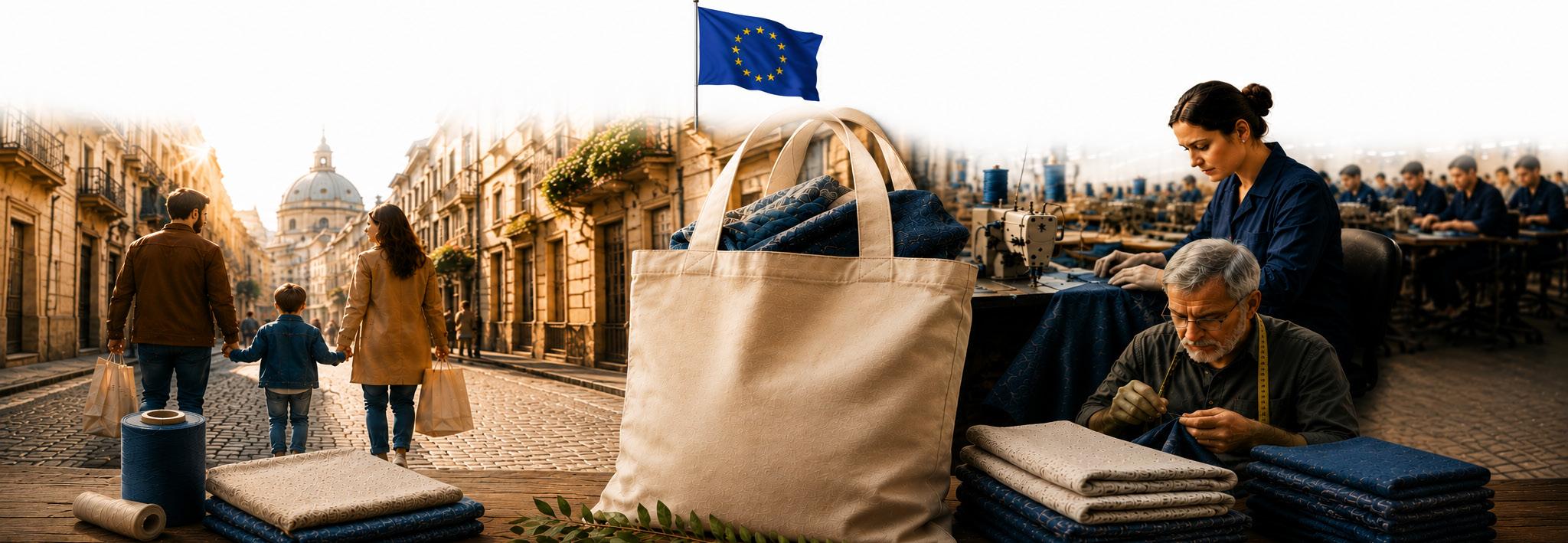
There was a time when a new piece of clothing was an event. Something saved for, chosen carefully and kept for years. Today, we throw away the moment the trend is over, in fact Europeans dump approximately 12 kilos of clothing per person every year. Not because it wore out, but because something cheaper came along.
For too long the conversation about ethical fashion has been owned by the left. And although there is nothing wrong with that, it has allowed the centre-right to abandon an argument that is fundamentally ours. This is not about sustainability pledges or carbon neutral collections. It is about protecting local workers, preserving heritage and resisting the hollowing out of European manufacturing. These are conservative values, and it is time we start arguing for them.
In 2007, Burberry closed down its factory in Treorchy, Wales. One of the cities where the iconic trench had been made was closing. The reason was simple: cheaper production costs abroad. For a town built around making them, this meant 300 jobs gone overnight. At the time the decision seemed justified as revenue grew consistently in the years that followed. The fact that it peaked over £3 billion in 2024 proved that the offshoring had worked.
But by 2025 the numbers were telling a different story. Revenue was falling sharply and Burberry was scrambling to recover something it had quietly offshored. Their answer was not to bring manufacturing back to Wales. It was to film Olivia Colman and other celebrities making a cup of tea dressed in their iconic plaid. Even though the campaign went viral, the numbers
did not follow. Which only proves that you can not offshore the soul, the market will eventually notice.
Burberry is not alone. Europe is losing a skill it will not easily relearn. A EURATEX report titled “Europe is losing its textile industry”, warns that the sector with 1.3 million workers is at risk as factories are closing daily. High energy costs, weak domestic demand and more recently the Asian imports that have long exploited a customs exemption allowing parcels under €150 to enter the EU duty free. Shein and Temu captured the market that the EU failed to protect. The EU responded with a quick fix, a temporary €3 customs duty per item on low-value consignments from July 2026 until 2028.
The long term fix is already on the table. Europe’s textile decline is not happening in a vacuum. As Lorenzo Salamone notes in NSS Magazine, drawing on the EURATEX report, the collapse in production is directly linked to the surge in Asian imports exploiting regulatory loopholes. The demand for clothing has not disappeared, it has simply been redirected away from European factories and towards Shein and Temu. EURATEX president Mario Jorge Machado has been unambiguous: every week factories close, production moves elsewhere and dependency grows. This is not a market correction. It is a market failure, and it is exactly the kind of failure that justifies intervention.
Proposed in March 2026, the IAA aims to protect strategic sectors: automotive, net-zero technology and energy intensive industries. Textiles are not mentioned once. The EU is prepared to protect “made in Europe” electric vehicles and batteries but apparently not the 1.3 million people making Europe’s clothes. But in true EU fashion, the discussions regarding the customs reforms
are not scheduled to begin until March 2028, despite EURATEX calling for concrete action before the end of 2026.
This is not an argument against free markets. Burberry closed its Welsh factory in 2007 because producing in Europe was already too expensive back then, and no one said anything. It is an argument about what we consider worth protecting.
When a factory closes, it is not just jobs that disappear. It is an apprenticeship tradition, a skills chain, a reason for a community to exist. The kind of rooted, stable and intergenerational communities that conservatism exists to protect do not survive without economic foundations. The left understands this as an environmental argument. The right should perceive it as an identity argument, which is more honest and more powerful. The fact that farmers, carmakers and semiconductor manufacturers are protected by the EU, however textile workers are left on the sideline does not just raise questions, it reveals priorities. Craft traditions that have defined European identity for centuries deserve better than being treated as an afterthought. And if producing in Europe is expensive, the answer is not to abandon it, but to make it worth staying.
The tool exists. Support the deemed importer reform that makes Shein and Temu pay their customs dues. Push to the creation of a similar reform such as the Industrial Accelerator Act that includes textiles. Make the case for Made in EU not as a green label, but as an economic sovereignty argument. The workers in Treorchy did not need a sustainability pledge. They needed someone to fight for their factory. Twenty years later there are still factories worth fighting for. The question is whether the centre-right will show up this time.
Axel Mouffron
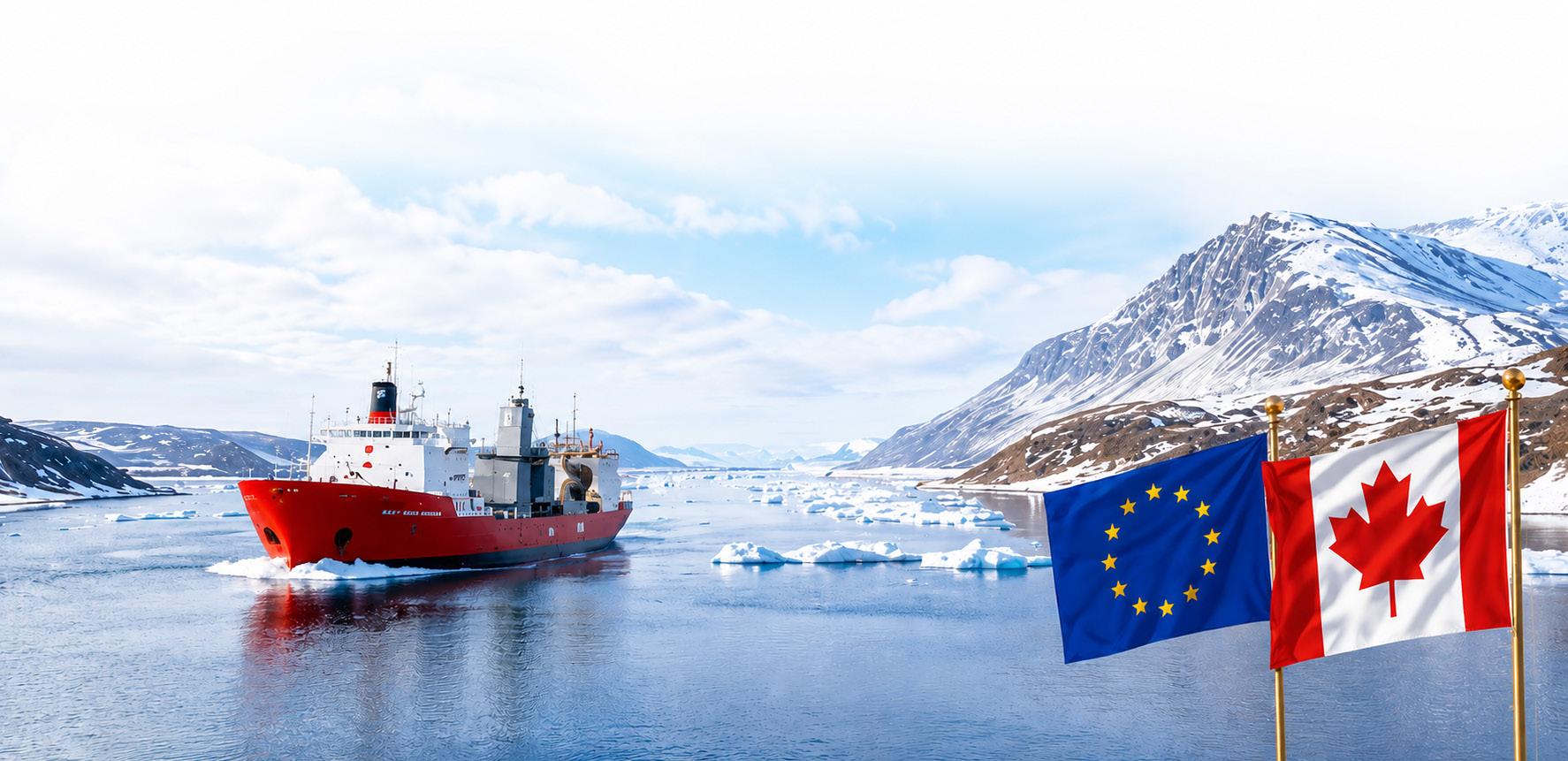
Europe often speaks about strategic autonomy. In the Arctic, it now has a concrete opportunity to act on it.
Canada–European Union relations are entering a new phase of strategic convergence. At the EU–Canada Summit on 23 June 2025, leaders agreed to deepen cooperation, reaffirming their commitment to economic resilience and a rules-based international order. This momentum continued in 2026, when Canada became the first non-European country to participate in a European Political Community summit.
At the same time, the EU has strengthened its Arctic engagement. Since the creation in 2017 of an Ambassador-at-Large for the Arctic, and through its 2021 Arctic policy, the EU has moved from a largely observational role to a more strategic approach focused on sustainability, cooperation, and secure access to resources.
The Arctic itself is changing rapidly. Once seen as remote, it is now becoming central to global dynamics. Climate change is
opening new shipping routes, while access to critical raw materials is reshaping economic priorities. As a result, global powers are increasingly active in the region, investing in infrastructure, logistics, and defence.
For Europe, the challenge is clear: securing reliable partners and reducing strategic dependencies.
This is where Canada stands out. With its political stability, abundant resources, and shared democratic values, it offers a natural partnership for Europe.
This evolving partnership builds on a long-standing relationship dating back to 1959, when Canada and the European Community signed an agreement on atomic energy. It remains the EU’s oldest formal partnership with an industrialised country and continues to expand as both actors work together to address global challenges and opportunities.
In 2025, both sides launched an EU–Canada industrial policy dialogue to strengthen supply chains and foster industrial cooperation. In parallel, initiatives on critical raw materials are reinforcing this alignment.
Strategic autonomy is not about isolation: it is about diversification and resilience. Working with trusted partners like Canada is therefore essential.
Within this evolving Arctic landscape, Nunavut is emerging as a key strategic space.
Covering over 2 million square kilometers (roughly the size of Western Europe) Nunavut is home to around 42,000 inhabitants. Despite its small population and remoteness, it is increasingly connected to global economic flows.
The territory holds 23 of Canada’s 34 critical minerals, including copper, cobalt, uranium, resources that are essential for batteries, clean energy, and advanced technologies.
In March 2026, Prime Minister Mark Carney announced an ambitious Arctic strategy backed by more than 40 billion CAD, aimed at “defending, building, and transforming” Canada’s North. The plan combines defence and economic objectives, including infrastructure upgrades in key northern hubs such as Iqaluit, alongside the development of transport corridors and resource projects designed to unlock the region’s economic potential. Such investments are transforming Nunavut into an emerging strategic gateway.
For Europe, this evolution matters. It offers access not only to critical resources, but to a stable, predictable, and rules-based environment: an increasingly valuable combination in today’s global economy.
Around 85% of Nunavut population is Inuit, and economic projects are carried out in partnership with Indigenous communities. This governance model reflects principles of inclusion, accountability, and sustainability that resonate strongly with European standards.
At a time when ESG commitments are under scrutiny, Nunavut demonstrates that economic ambition and responsible development can be aligned.
Beyond geopolitics and industrial strategy, Nunavut offers real opportunities for students and young professionals.
In a high-demand labour market, it provides hands-on experience in infrastructure, energy, and logistics, as well as direct exposure to Arctic geopolitics. Career progression can be rapid, and the experience gained is unique. English and French, both widely used across the European Union, are official languages alongside Inuktitut, facilitating integration for European talent.
As the Arctic moves to the centre of global competition and cooperation, Europe faces a choice: remain a secondary actor or actively shape the region’s future. Engaging with partners like Canada is a concrete way to do so.
More than a remote territory, Nunavut is a gateway: to resources, to new trade routes, and to a model of development aligned with European values. With the next EU–Canada Summit in October 2026 expected to focus on secure supply chains, industrial cooperation, and access to critical raw materials, the Arctic—and particularly Nunavut—will be at the heart of this emerging transatlantic agenda.
Mateusz Gnat
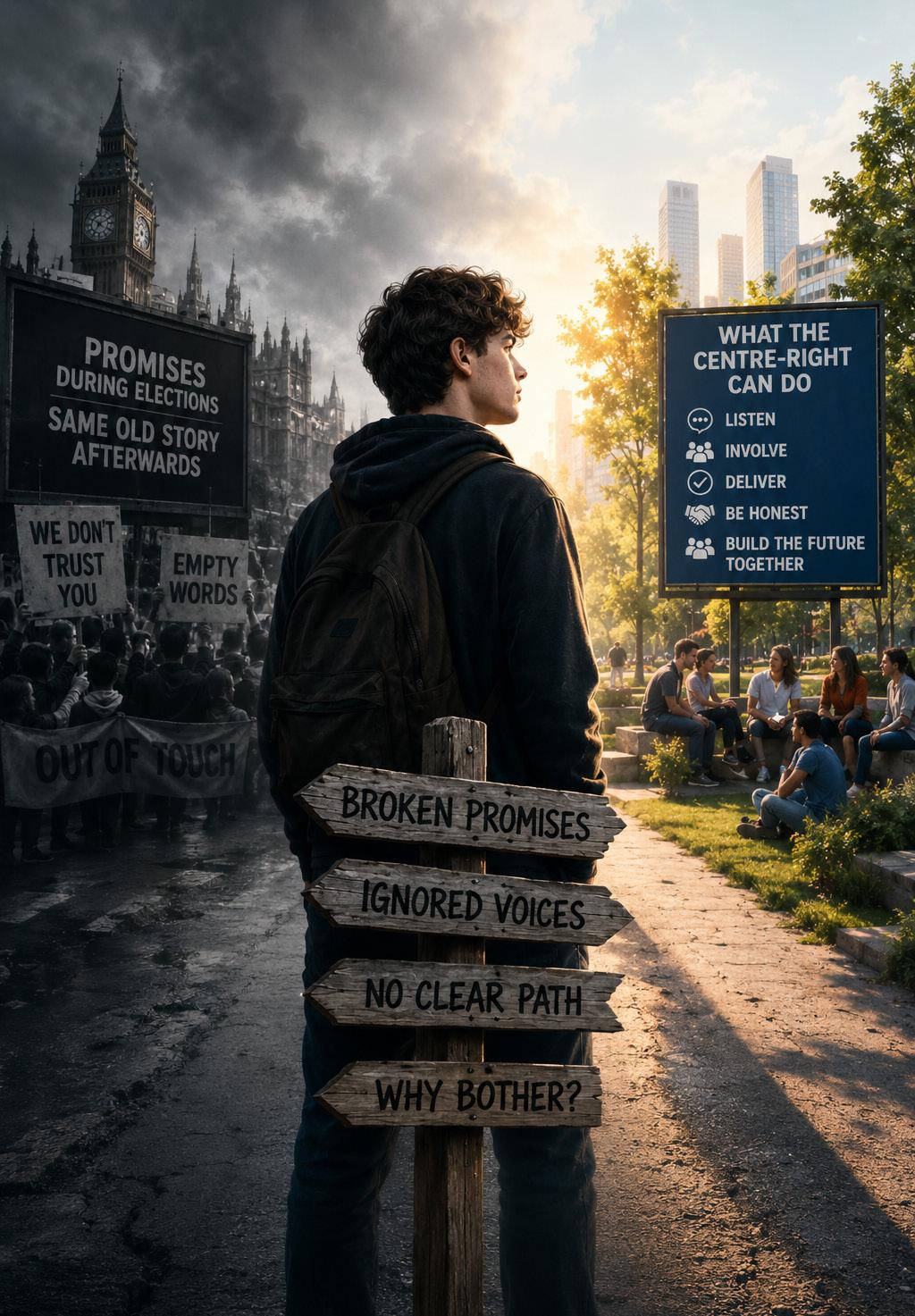
Consider how young Poles voted in 2024. Konfederacja, the hard right, took around 30 percent among voters aged 18 to 29, up from under 19 percent five years earlier. In France the same year, the National Rally took almost a third of the youth vote. Across Europe, young people have quietly stopped trusting the parties that used to be the obvious choice.
Up close, this is no ideological awakening.
It is something more ordinary, and harder to fix. People my age have watched the gap between what a party promises in a campaign and what it does afterwards grow too wide to ignore. A “new order” gets announced, and within months the same old machine is running again, as if nobody remembers the speeches. Young voters catch this fast, and once they’ve decided a party is performing rather than meaning it, that verdict sticks.
The problem is who’s talking, not what they say.
Most centre-right parties read this as a communication problem. They change the font, hand the socials to someone younger, open a TikTok account, and wait for the numbers to move. The numbers don’t move. Young people aren’t leaving over branding. They’re leaving because the words aimed at them don’t describe any world they live in. A sentence built for a press release lands very differently on a twenty-year-old staring at a job market with no stability and no clear path.
There’s a quieter problem underneath. When these parties do speak to the young, they take care not to disturb what older voters want, because older voters win elections. So young people get promised a mountain and handed a small hill. The subject turns up for the campaign and vanishes once the votes are counted. When change does come, it arrives late, after petitions
or protests, not from the top. A FEPS study of nineteen thousand young Europeans found that 71 percent want one modest thing: politicians who explain, plainly, what they are doing and how it touches ordinary life. That is not a generation asking for less politics. It is one tired of being sold to.
What the centre-right could actually do
There is a real opening here, but only for a centre-right honest about its own failures first.
Stop treating young people’s lives as campaign material. Housing, work, the cost of getting by are not lines to wheel out every few years. They are the conditions a whole generation is trying to build a life inside. Raising them only when a vote is coming drives the young toward parties that, whatever else is wrong with them, at least keep saying the problem out loud.
Take education seriously, and I mean more than a civics lesson. Teach how Europe works, how politics works, and how manipulation
works, because this generation will be on the receiving end of all three. Gen Z is not apathetic; anyone who has organised anything alongside them knows that. What is missing is a route from that energy into ordinary political life. The centre-right, with its long claim to civic responsibility, is well placed to build it, once it stops treating a sharp, informed young person as a threat rather than an asset.
The part that matters most is not a policy. It is a shift in how the people at the top picture the young: not as a block of votes to harvest every five years, but as the ones who will run and hold the country together once we are the people in the room. Believe that, and the rest follows: what you propose, what you keep your word on, and whether a twenty-two-year-old finds anything in politics worth trusting.
The far right didn’t invent this distrust. They just showed up to it earlier than everyone else. There is still time for the centre-right to show up too. There is simply less time every year.
Mobility, education and opportunity mean little when students and young workers cannot afford a place to live.
Vladimir Kljajic
Europe tells young people to be mobile, ambitious and educated. It encourages them to study abroad, take internships, learn languages, move to university cities and build careers in a competitive economy. In theory, this is one of the great promises of the European project: that a young person’s future should not be limited by the town, region or country into which they were born.
But that promise begins to collapse when there is nowhere to live. Across Europe, students and young workers are
discovering that opportunity has a housing cost attached to it. A place at university means little if rent consumes a student’s budget. An internship in a capital city is not a real opportunity if only those with family money can afford to take it.
European mobility becomes less impressive when mobile students face excessive deposits, scams, discrimination, overcrowding and months of uncertainty while searching for accommodation.
Erasmus and university mobility are often celebrated as symbols of European
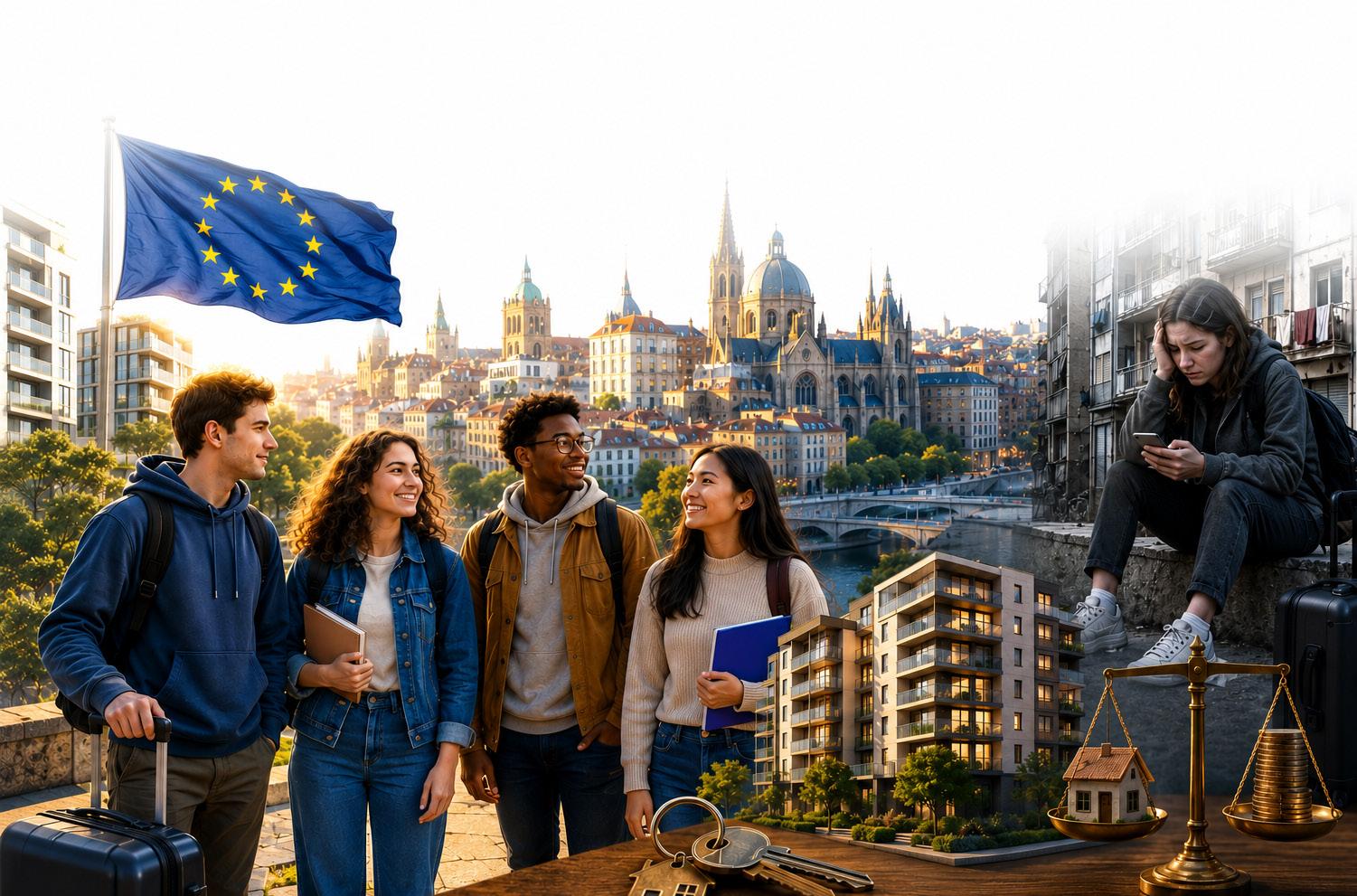
openness. But mobility without housing is a privilege, not a policy.
Housing is often discussed as a market problem, a planning problem or a welfare problem. It is all of those things. But for young Europeans, it is also an opportunity problem. If students cannot afford to live where education and work are concentrated, then the ladder of mobility becomes weaker. The result is a Europe where talent exists, but access is rationed by rent.
When opportunity is concentrated in cities but housing is reserved for the already wealthy, meritocracy becomes a slogan.
The housing crisis does not affect all generations equally. Older homeowners have often benefited from rising property values. Younger people face the other side of that bargain: high rents, delayed ownership, overcrowding, longer commutes and a slower path to independence.
For students, the consequences are immediate. Housing insecurity makes study harder. It creates stress, financial pressure and isolation. It can force students into unsuitable accommodation, unsafe arrangements or long journeys that drain time and energy. For international and exchange students, the barriers are even higher: unfamiliar systems, language difficulties, short-term contracts and a lack of local networks.
This is not merely inconvenient.
It undermines the idea that higher education should be a route to personal development and social mobility. A student from a comfortable family may be able to absorb a large deposit, temporary hotel costs or months of high rent. A student from a poorer background may simply decide
not to go.
That is how housing shortages quietly become educational inequality.
The same problem continues after graduation. Young workers are told to move where the jobs are, but many of the places with the best opportunities have become the least accessible. They are expected to save for a first home while paying inflated rent. They are encouraged to start families while living in insecure accommodation. They are asked to contribute to Europe’s demographic renewal while struggling to afford a room, let alone a home.
A continent cannot seriously speak about youth opportunity, student mobility or family formation while allowing housing to become the barrier that blocks all three.
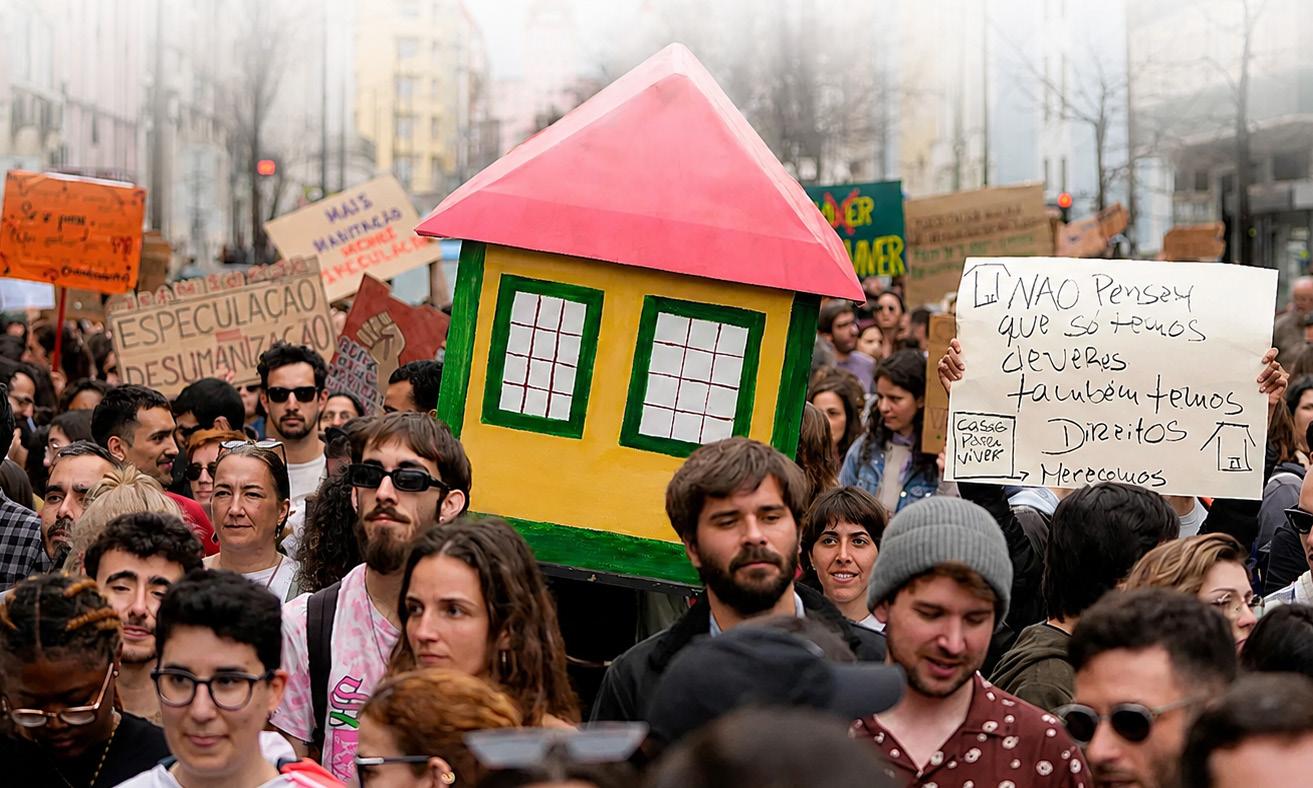
To call housing a right is not to say that the state can conjure homes by decree. It is to recognise that without secure shelter, other promises — education, work, family, citizenship — become fragile. A decent home is not a luxury at the edge of social policy. It is one of the basic conditions that allows people to participate in society.
One of the deepest problems is that housing has increasingly been treated less as a foundation of life and more as a financial product. Homes have become investment vehicles, speculative assets and short-term rental opportunities. In many university cities, long-term residents and students compete with tourism, investors and a limited supply of new housing.
A functioning market needs investment, supply and private ownership. But a market that prices young people out of independence is not functioning well. It is failing in one of its most basic social
purposes.
This is where a serious centre-right approach should be clear. The answer is not to pretend that governments can solve the crisis by bureaucracy alone. Nor is it to leave young people at the mercy of distorted markets and artificial scarcity. Housing policy must respect property rights, encourage building and attract investment. But it must also recognise that stable housing is a social good, not merely a commodity.
The first duty of housing policy is to make it possible to build. Europe needs more homes, more student accommodation, more renovation of unused or inefficient buildings, and more flexible housing models suited to modern study and work patterns. Planning systems and regulatory barriers that make building unnecessarily slow or expensive should be confronted honestly. A shortage cannot be solved without more places to live.
But building must serve residents, students and young families, not only speculative demand. New supply matters, but so does the type of supply, the location of supply, and whether housing is actually available for long-term living. Cities under intense pressure need stronger tools to manage short-term rentals, improve transparency in property ownership and ensure that housing policy serves residents as well as capital.
Student housing should be treated as infrastructure
Student accommodation should not be an afterthought. It is part of Europe’s educational infrastructure.
If universities are expected to attract students from across regions and borders, they should not be indifferent to whether
those students can live nearby. Purposebuilt student accommodation, inclusive student halls, university-city partnerships and targeted support for vulnerable students should be treated as central to educational access.
This is especially important for mobile students, young people from disadvantaged backgrounds, students leaving care, students with disabilities, and those without family support. Without stable accommodation, the promise of European mobility becomes selective. Those with money can move. Those without are told to be grateful for opportunities they cannot realistically take.
There is also a strong case for using public-private partnerships and targeted investment to expand student housing. The point is not to create a vast new bureaucracy, but to remove practical barriers. Universities, municipalities, private providers and national governments should be encouraged to cooperate on student accommodation near campuses and transport links.
Energy efficiency should also be part of the answer. Poor housing does not only mean high rents; it often means high bills. Renovating old buildings and improving energy performance can reduce longterm costs, support climate goals and make housing more affordable in practice.
The EU has a role, but not the whole role
Housing policy remains primarily national, regional and local. That is right. The housing market in Lisbon is not the same as the housing market in Ljubljana, Skopje, Dublin, Warsaw or Amsterdam. Local conditions matter, and Europe should avoid pretending that one model can be imposed everywhere.
But the European Union can still play a
useful supporting role. It can coordinate best practice, support investment, use existing funds more intelligently, and ensure that student housing is included in broader European discussions about affordability. The European Affordable Housing Plan should not treat students as a footnote. It should recognise that student housing is directly connected to mobility, education, youth opportunity and Europe’s competitiveness.
The EU can also help Member States address youth homelessness, improve minimum standards, support renovation, and encourage the use of cohesion funds for inclusive and sustainable student accommodation. None of this requires Brussels to become Europe’s landlord. It requires European institutions to recognise that the housing crisis is now a strategic youth issue.
Europe’s promise to young people cannot end with university places, mobility schemes and speeches about opportunity. Those
things matter, but they are incomplete without the material conditions that make them usable.
A student needs more than a place on a course. A young worker needs more than a job offer. A young family needs more than rhetoric about demographic renewal. They need somewhere decent, stable and affordable to live.
Housing is where Europe’s ideals meet reality. If young people cannot live where they study, work and build their futures, then opportunity becomes theoretical.
Europe does not need to promise every young person an easy life. It does need to make sure that hard work, study and responsibility can still lead somewhere. If it cannot offer the next generation a realistic path to a home, then its promises of mobility and opportunity will sound increasingly hollow.
The future begins with a roof.
The Culture Compass should be more than another Brussels framework. It should help Europe defend the heritage, memory and identity that make it worth preserving.
Charlie Crumpton
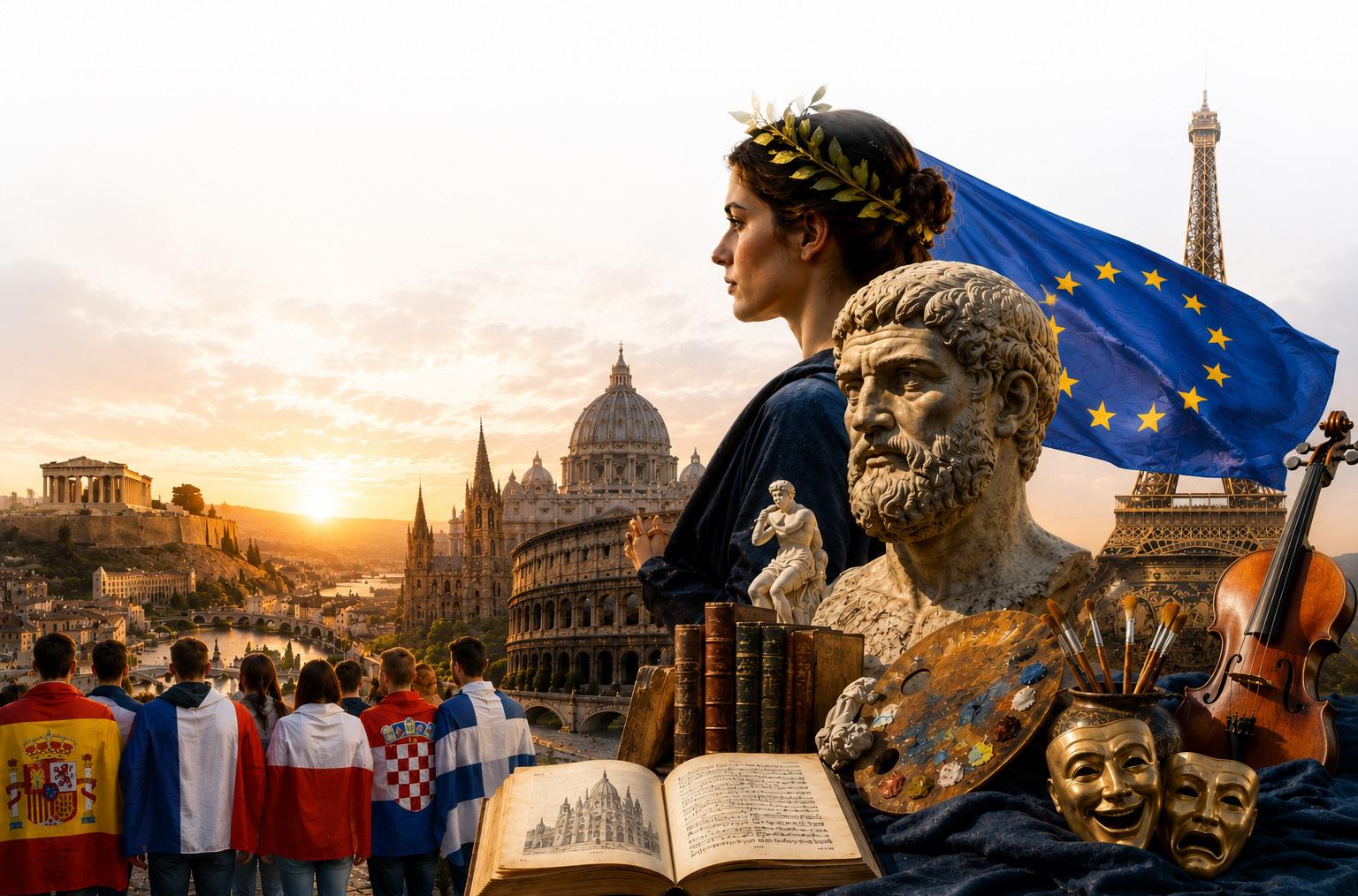
Europe has become very good at speaking about markets, regulations, rights, climate targets, trade and defence. It is much less comfortable speaking about culture.
This is strange, because Europe is not merely a legal arrangement or an economic zone. It is not held together by treaties alone. It is a civilisation of languages, nations, churches, universities, parliaments, cities, villages,
artistic traditions, philosophical inheritance and shared historical memory. It is made of distinct peoples who have shaped one another for centuries, sometimes through cooperation, sometimes through rivalry, and often through conflict.
Yet in much of Europe’s official language, culture is too often treated as either a sector of the economy, a tool for inclusion, or a pleasant accessory to the political
project. It is all of those things, but it is also much more. Culture is the inheritance that allows a people to recognise itself. Without it, politics becomes administrative, citizenship becomes thin, and Europe becomes harder to love.
That is why the European Commission’s Culture Compass for Europe, adopted in November 2025, matters. At its best, it recognises that culture should not sit at the margins of European policymaking. It belongs near the centre of the debate about democracy, social cohesion, economic resilience and Europe’s role in the world.
But if the Culture Compass is to be meaningful, it must avoid becoming another exercise in cultural management from Brussels. Its proposed Artists Charter, cultural data hub, youth cultural ambassadors network, report on the state of culture, and AI strategy for the creative sectors will only matter if they serve a larger purpose: restoring culture to the centre of European life rather than treating it as an administrative category.
Europe’s problem is not that it has too much cultural difference. It is that it too often lacks the confidence to take its own cultures seriously.
Europe’s strength has never been that its nations are identical. It is that they are distinct, rooted and capable of recognising one another within a shared civilisation.
A Greek, a Pole, a Spaniard, a Finn and a Croat do not become more European by becoming less themselves. They become more European when they understand their own history, language, faith traditions, artistic heritage and national memory,
and can meet others from a position of confidence rather than insecurity.
This is the truth that a serious centre-right cultural policy should defend. European unity should not require the flattening of national difference. Nor should national pride require hostility to Europe. The two can and should reinforce each other. A Europe of self-confident nations is stronger than a Europe of embarrassed, rootless administrative units.
That point matters because culture and identity are now central to political debate across the continent. Many citizens feel that their traditions, communities and inherited ways of life have been treated as obstacles to progress rather than sources of meaning. When mainstream politics refuses to speak about these concerns seriously, it leaves the field open to anger, nostalgia and polarisation.
A continent that cannot speak honestly about identity will not become more tolerant. It will become more anxious.
The answer is not to retreat into resentment. Nor is it to pretend that identity is irrelevant. The answer is cultural confidence: the belief that Europe’s nations can be proud of who they are, preserve what they have inherited, and still cooperate generously with one another.
Cultural confidence is not chauvinism. It is the precondition for genuine openness. A person who knows where he comes from is better able to encounter others without fear. A nation that respects its own inheritance is more capable of respecting the inheritance of its neighbours.
This is not an argument for nostalgia or cultural retreat. A living culture is not
a museum display. It absorbs, creates, argues, renews and sometimes rebels. But it can only renew itself if it still knows what it is renewing.
That distinction matters. Heritage should not be frozen into sentimental performance. Nor should it be dissolved into a vague language of permanent reinvention. A living tradition is something inherited, argued over, renewed and passed on. It requires memory and creativity together.
The Culture Compass rightly points to the economic importance of Europe’s cultural and creative sectors. Millions of Europeans work in culture, from artists and musicians to publishers, designers, museums, theatres, film, architecture and heritage. Cultural tourism is also central to Europe’s global appeal. People do not come to Europe only for infrastructure or consumer markets. They come for cathedrals, galleries, streets, landscapes, music, food, festivals and memory.
But culture should not be defended only because it creates jobs. If that is the only argument, then culture becomes valuable only when it can be measured. The deeper reason to defend culture is that it gives form to freedom, belonging and continuity.
A society without culture is not neutral. It is empty. And empty societies do not remain empty for long. They are filled by ideology, consumerism, resentment or imported narratives.
This is why access to culture matters, especially for young people. The issue is not simply whether students can attend museums or concerts, although that matters too. It is whether they are given access to the civilisational inheritance that shaped the world they live in. They should know their national literature, their local history, their architecture, their religious
and philosophical traditions, and the great works that formed Europe’s imagination.
Young Europeans do not need a rootless identity designed by committee. They need access to the languages, histories, customs, faiths, works of art and local attachments that shaped the continent they are asked to inherit.
A young European who knows nothing of his own inheritance is easier to uproot, easier to manipulate and less able to contribute to the future of his country. Cultural education is not an ornament. It is part of democratic formation.
Defending cultural heritage cannot mean freezing culture in the past. A living civilisation creates as well as remembers. It needs artists, writers, musicians, filmmakers, designers and cultural entrepreneurs who can work freely and build new forms of expression.
That is why the Culture Compass is right to focus on the conditions of artists and cultural professionals. Many work in precarious circumstances, especially young creators. They are expected to enrich public life while living with unstable income, weak social protection and uncertain professional recognition.
A civilisation that wants cultural confidence cannot treat its own creators as disposable gig workers. If Europe wants a living culture, it must take seriously the people who produce, renew and transmit it.
The rise of artificial intelligence makes this even more urgent. AI can be a powerful tool for creativity, but it also raises serious questions about authorship, ownership and the value of human creation. Europe should not respond with fear, but neither
should it allow creators to be stripped of dignity by technologies that absorb their work without fair recognition.
If human creativity is treated as raw material for machine-generated content, Europe will have surrendered not only an economic sector, but part of its cultural voice. A human-centred approach to AI in the cultural and creative sectors is not anti-innovation. It is a defence of the human source of culture itself.
The centre-right should not abandon culture
For too long, cultural politics has often been dominated by either technocratic management or ideological confrontation. The centre-right should reject both.
It should not treat culture as a bureaucratic file to be administered by committees. Nor should it reduce culture to a permanent battlefield of grievance. Its task is more serious: to defend the conditions under which inherited culture can be preserved, new culture can be created, and young people can receive a meaningful connection to both.
The centre-right should not leave culture to technocrats on one side and permanent outrage on the other. It should speak clearly about heritage, national memory, beauty, religion, artistic freedom, local identity and the shared civilisation that binds Europe’s peoples together.
This means supporting artistic freedom, but also defending cultural memory. It means widening access to culture, but not emptying culture of content. It means supporting creators, but also expecting cultural institutions to take seriously their role in transmitting heritage. It means European cooperation, but not cultural uniformity.
The Culture Compass can be useful if it strengthens this balance. Its focus on artists, cultural rights, access, youth participation, international cultural relations and AI gives Europe a practical framework. But the framework will only matter if it is animated by a deeper conviction: that culture is not secondary to the European project. It is one of the reasons the European project exists.
Europe will need stronger borders, stronger economies and stronger defence. But these things answer only the question of how Europe survives. Culture answers the question of why it should.
A continent that forgets its own inheritance will not become more open-minded. It will become easier to fragment, easier to manipulate and less willing to defend itself. A continent that remembers who it is can engage the world with confidence rather than fear.
Europe cannot survive on markets and treaties alone. It needs memory, beauty, language, faith, art, custom, place and belonging. It needs nations that are proud of themselves and capable of recognising one another in a shared civilisation.
If the Culture Compass helps Europe recover that confidence, it deserves support. But the real task is larger than any Commission framework.
The future of Europe will not be secured by administration alone. It will be secured by peoples who know their inheritance, institutions that transmit it, artists who renew it, and young Europeans who are taught that they are heirs to something worth defending.
Europe must remember what it is — and teach the next generation why it is worth preserving.
Moriz Jeitler
For the first time in years, there is a genuine, tangible chance that Benjamin Netanyahu, Israel’s longestserving prime minister, will not secure a majority in the new Knesset.
To understand why this moment matters, a bit of context. The 2026 elections are the first to take place since October 7, 2023 - the deadliest day for the Jewish people since the Holocaust. As we all know, the threat did not stop there. For Netanyahu, the conflicts
with Hamas, Hezbollah, Houthis, and Iran were supposed to be his vindication. Instead, they increasingly seem to have become his indictment.
Many Israelis blame him not only for the security failures of October 7, but for exacerbating the internal polarisation that left the country so dangerously divided at the moment of national crisis. His refusal to establish a formal commission of inquiry into the attack has only deepened the wound and the way the government’s actions are viewed around the globe not merely with growing concern, but with open sanctions.
The legal shadow over him is no lighter. Ongoing corruption trials continues to shadow the campaign, while the judicial overhaul agenda that triggered mass protests even before October 7 remains deeply divisive.
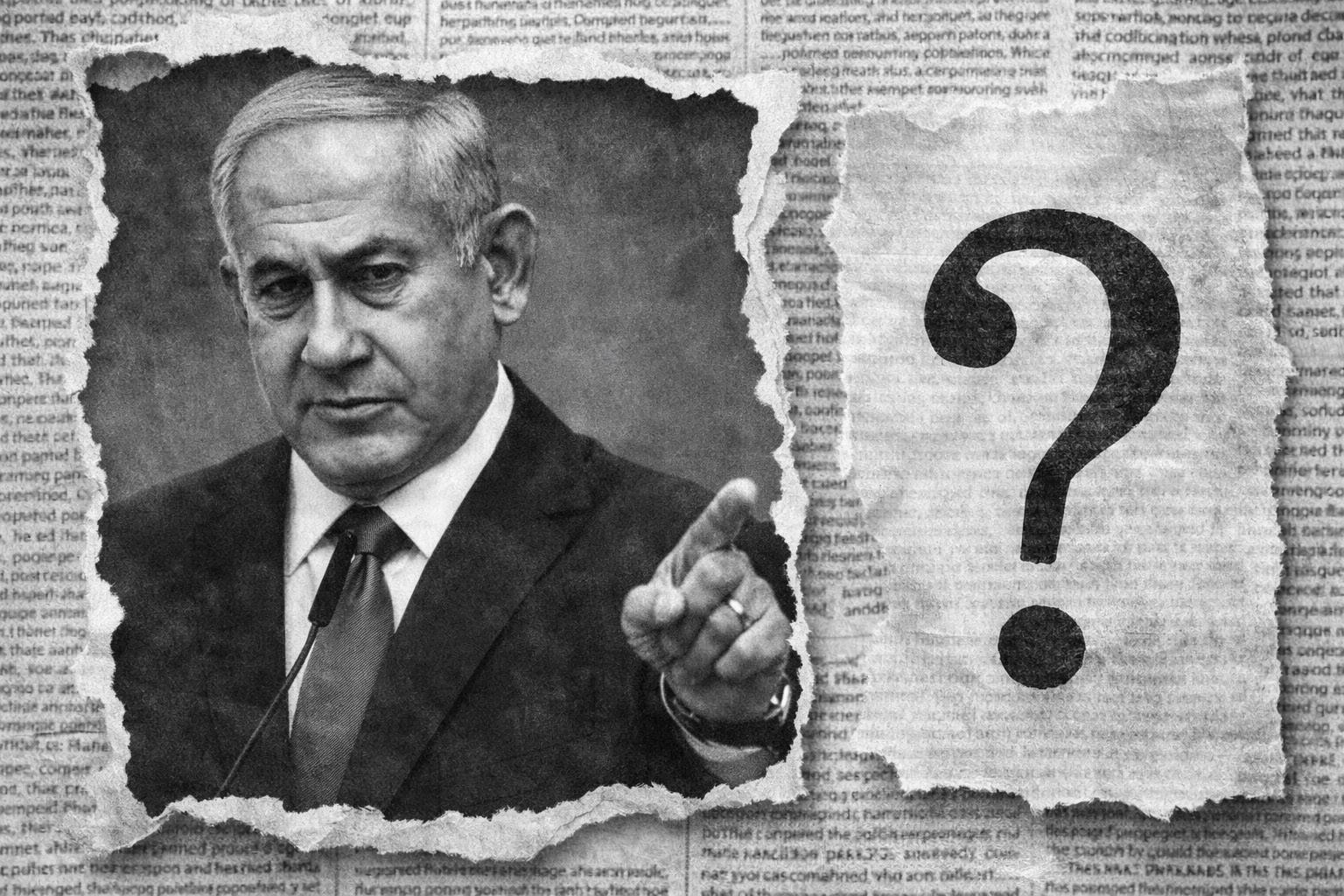
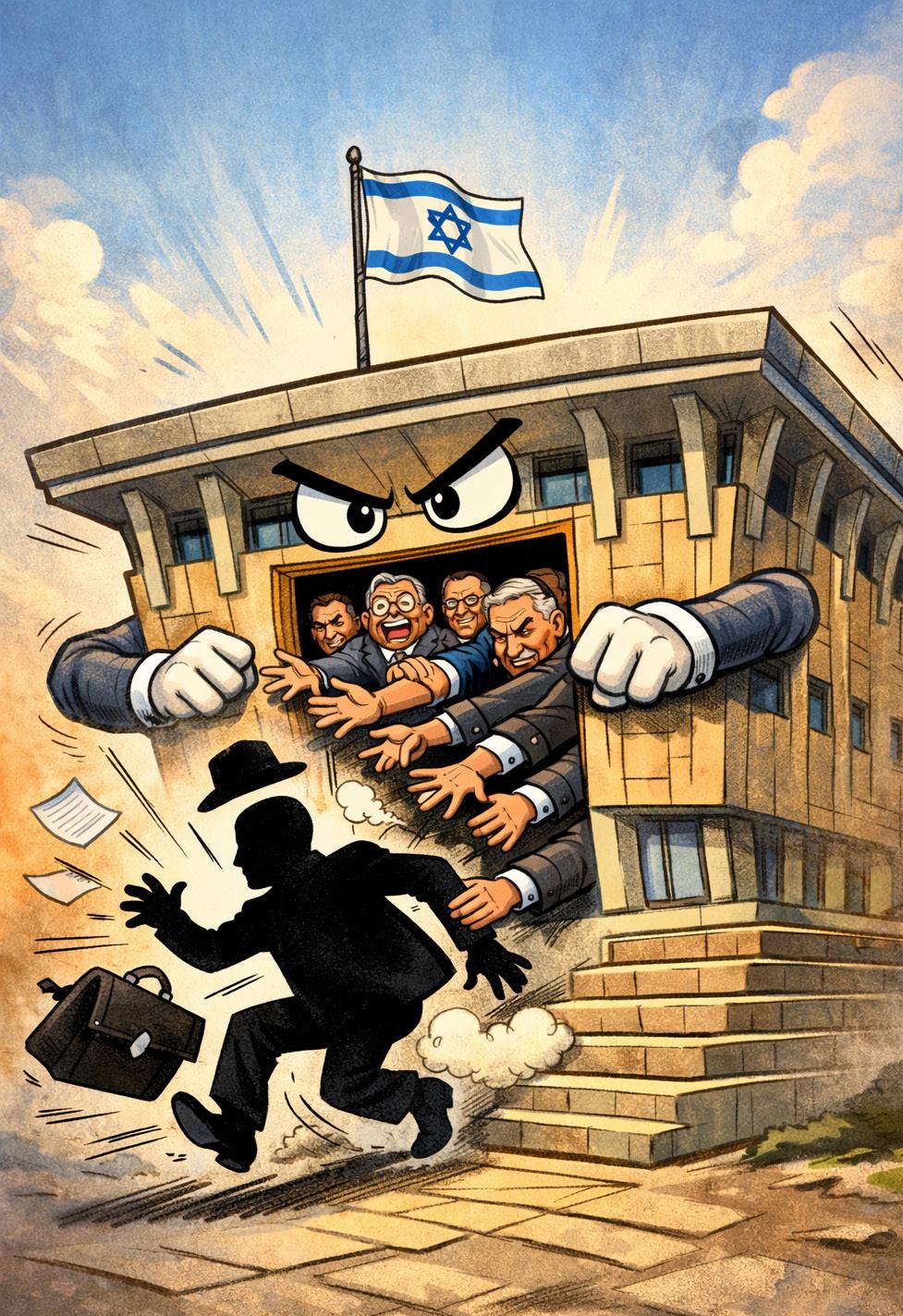
His coalition partners — perhaps his greatest liability of all. Far-right figures like Itamar Ben-Gvir and Bezalel Smotrich strengthen the nationalist base but alienate moderate voters and generate sustained international criticism, which even leads neutral and friendly partner countries to impose sanctions.
However, ultra-Orthodox parties, meanwhile, insist on draft exemptions for their constituents at a time when secular and religious Israelis alike are exhausted from years of disproportionate military burden. The numbers tell the story bluntly. Netanyahu’s bloc is stuck at around 51 to 52 seats — around 10 short of a possible majority at this point.
The opposition seems to finally have seized this moment. In April 2026, former Prime
Minister Naftali Bennett and centrist Yair Lapid announced the formation of a new joint party called Beyachad — “Together” — posing a serious challenge to Netanyahu and a realistic prospect of unseating him. Probably best described as an alliance of political convenience, yet a potent one.
Anti-Netanyahu parties collectively will gain around 67 to 69 projected seats - Enough to govern, but given the wide different ideological backgrounds and interests, definitely nothing stable or set in stone.
Bennett can be seen as the man of the hour. A former protégé and defence minister under Netanyahu, he is no softliner: he built his early career early on West Bank annexation politics and religious nationalist credentials. But in 2021 he proved he could govern pragmatically across the aisle, and he has pledged to establish a formal commission of inquiry into October 7 as a centrepiece of his campaign.
For many Israelis, that alone seems to be enough. Needless to say, in the dynamic there seem to be quite some parallels to Hungary’s Peter Magyar - appealing precisely because he cannot be dismissed as naive or weak.
For us young Europeans, a change of government in Jerusalem could not come at a more critical moment — and the stakes go well beyond symbolism. The EU is Israel’s largest trading partner, and the EU-Israel Association Agreement has been the legal bedrock of their political, economic and cultural relationship since 2000. It grants Israel preferential market access and funds joint research programmes worth over a billion euros, alongside Erasmus+ and multiple enhanced cooperations.
But that relationship is now under severe strain. The agreement contains a human rights clause — Article 2 — which states that cooperation must be based on respect for human rights and democratic principles. Under Netanyahu’s government and ICC warrants, that clause has become an open wound in EU-Israel relations.
The EU’s own internal review found Israel in breach of the agreement, citing grave violations of international law in Gaza and violent settler evictions in the West Bank.
Spain and Ireland have repeatedly pushed to suspend or review the agreement, while Germany and Italy have blocked the effort.
The result is a European continent that seems to lack a unified voice, caught between its stated values, historic responsibility and strategic interests — and increasingly divided by the contradiction - From Sanchez to Merz, from Eurovision to the UN.
Netanyahu’s government has made it
politically toxic for European leaders to defend. Israel has systematically cultivated relationships with Europe’s right wing governments to shield itself from EU pressure. This strategy has deepened mistrust across the continent and poisoned what was once a genuinely productive partnership.
A post-Netanyahu government could change this calculus instantly. A new Israeli leadership — more willing to engage constructively on the future prospect of peace would give European governments the political cover they need to rebuild the relationship on firmer foundations. Absent real pressure, Israel under Netanyahu will not change its behaviour.
But a different Israeli government is a different interlocutor altogether.
Beyond trade, there is the question of European credibility. The EU has long positioned itself as a champion of the rulesbased international order. Its failure to hold Israel to comparable standards has done real damage to that reputation, particularly in the Global South. A new Israeli government would allow Brussels to reset, to re-engage the peace process diplomatically, and to restore coherence between its values and its foreign policy.
What does all this mean for the future? Here, a reality check is crucial. Neither Bennett nor Lapid represents a paradigm shift on Palestinian statehood or a radical shift. The Israeli electorate has moved rightward on security questions, and the deep trauma of October 7th has not made bold diplomatic gestures easier.
A post-Netanyahu government would at minimum remove the single greatest
obstacle to rational diplomacy: a leader with interest in prolonging crises, and ideological coalition partners whose political existence depends on permanent conflict.
Netanyahu’s leadership model is probably best described as tactical survival and continuous crisis management, with short-term political leverage frequently taking precedence over durable strategic resolution — including in his relationship with Washington, where his repeated clashes with the Trump administration over Lebanon and Iran have strained even that alliance.
Israel has every right to exist, to defend itself, and to respond to existential threats. But this current government will have to take full responsibility for its actions that crossed the line— and by now, the list is long.
A new Israeli government will not bring peace overnight. But it could reopen the space for diplomacy — with our Union, the Gulf states, with Washington. It could restore Israel’s standing in international institutions. And it could finally allow Europe to be the honest, engaged partner it has long wanted to be, rather than a bystander paralysed by its own internal contradictions.
Israel is the only resilient democracy in the Middle East. It has survived October 7, multiple wars, and the turbulence of the Netanyahu era. The outcome of October’s election could have a profound impact on the trajectory of Israel’s political system and its relations with the international community. For Europeans watching from across the Mediterranean, that outcome matters too — perhaps more than any Israeli election in a generation.
Bye, bye Bibi - this time for good.
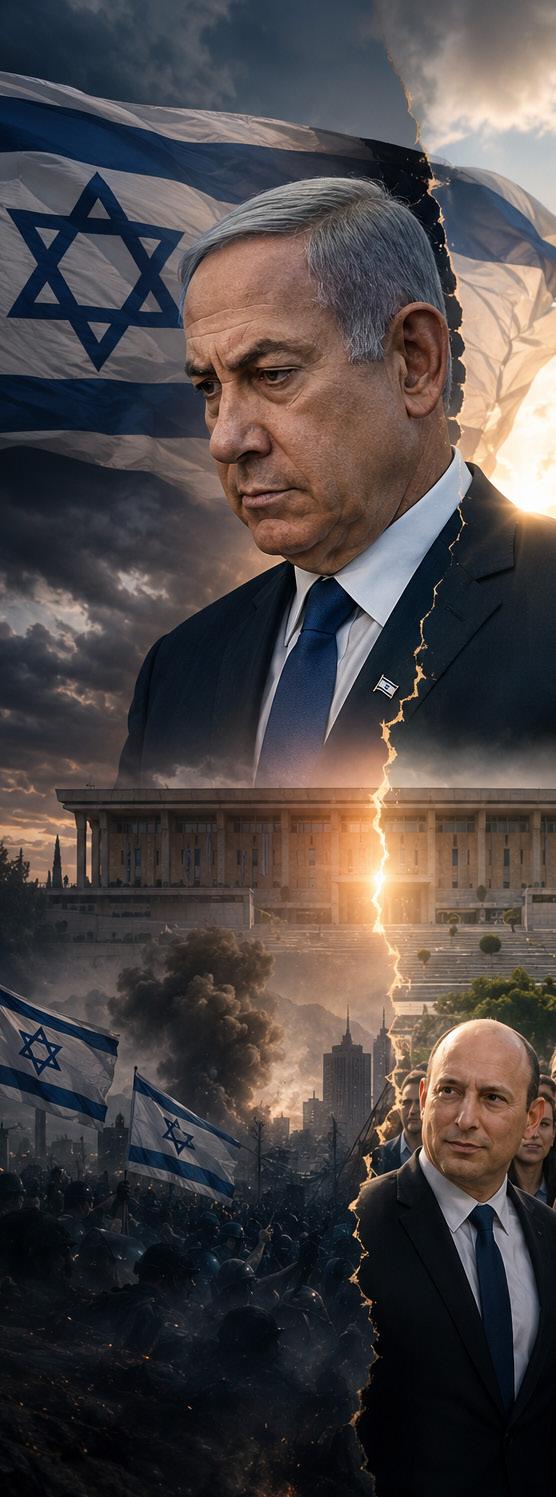
If Europe wants demographic renewal, it must stop making education, work and family life feel like competing futures.
Lara Ghanoudi
Europe’s demographic crisis is usually described through statistics: falling fertility rates, ageing populations, shrinking workforces and rising pressure on pension systems. These numbers matter. They show a continent slowly losing the balance between generations on which its prosperity and social model depend.
But demographic decline does not begin in a spreadsheet. It begins in the ordinary decisions of young adults: whether they can afford rent, whether a stable job is within reach, whether childcare would be possible, whether a degree or early career
can survive the arrival of a child, and whether starting a family feels like a future they can responsibly choose.
That is why Europe’s demographic crisis begins much earlier than policymakers often admit. It begins on campus, in shared flats, in temporary contracts, in delayed savings, in long commutes, and in the anxious years when young Europeans are trying to build a life before they are expected to start one.
Europe cannot ask young people to renew the continent while making the foundations of family life increasingly fragile.
This is not an argument for pressuring students or young professionals into parenthood before they are ready. Family life must remain a matter of personal responsibility, love and freedom. But it is an argument against a system that too often turns education, work, housing and parenthood into rival paths rather than complementary stages of adult life.
For many young Europeans, the message is clear: first finish your degree, then find stable work, then secure housing, then build savings, then perhaps think about children. Each step is reasonable in isolation. Together, they push family formation further into the future. By the time stability arrives, if it arrives at all, many people find that the window has narrowed.
The modern European student is told to be ambitious, mobile and adaptable. They are encouraged to gain qualifications, learn languages, collect internships, move across borders and prepare for a competitive economy. These aspirations are legitimate. Education, entrepreneurship and career development should be celebrated.
But a society that praises ambition while making family life almost impossible until the late thirties should not be surprised by demographic decline.
The problem is not that young Europeans have stopped valuing family. Many still do. The problem is that family formation is increasingly treated as something to be postponed until every other part of life is settled. Yet modern life rarely delivers a perfect moment of settlement. Housing remains expensive. Work can be insecure. Childcare is costly. Inflation eats into savings. Students and young workers move frequently, often away from extended family networks that once
made parenthood easier.
This produces a quiet but profound contradiction. Europe says it wants more children, stronger families and intergenerational renewal. Yet its economic and educational structures often tell young adults that parenthood is a disruption, a risk or a luxury.
Demographic policy usually begins too late. By the time governments offer support to established families, many young Europeans have already spent a decade learning that family life belongs to some distant future.
Universities should not assume parenthood comes later
Higher education has a particular role to play. Universities should not become family-policy agencies, but nor should they organise themselves around the assumption that serious students cannot also be parents.
For student parents, the barriers are obvious: rigid timetables, limited childcare, inflexible attendance rules, exam schedules that do not account for family responsibilities, and a campus culture that often treats parenthood as unusual or inconvenient. The result is that students who become parents can find themselves pushed to the margins of academic life.
This is not inevitable. Universities can offer more flexible study pathways, part-time options, hybrid learning models, parental academic leave and clearer support systems for student parents. Affordable childcare near campuses and major employment hubs would also make a real difference, especially for young mothers and fathers trying to combine study, work and family responsibilities.
The aim should not be to encourage everyone to have children during university. It should be to ensure that those who do are not punished with educational exclusion. Parenthood should change a student’s responsibilities. It should not end their prospects.
This matters for equality of opportunity as well. Wealthier students often have family support, housing stability or financial buffers that make early family life more manageable. Students without those advantages face much sharper trade-offs. If Europe is serious about opportunity, it must recognise that family formation is not experienced equally across class, region or income.
Demographic renewal cannot be achieved by slogans. Nor can it be solved by one ministry, one tax credit or one European declaration. It requires a serious effort to reduce the practical barriers that make young people delay family formation against their own hopes.
Housing is central. Young families need access to first homes, not only abstract promises about affordability. That means increasing housing supply, reducing unnecessary regulatory barriers, supporting targeted savings schemes, and making it easier for responsible young households to move from permanent renting into ownership.
Childcare is equally important. Affordable, accessible childcare is not merely a welfare service. It is economic infrastructure. It allows parents to remain connected to work, study and training. It supports mothers’ labour market participation and helps fathers take a fuller role in family life.
Parental leave also matters, but it must
be designed carefully. Balanced systems should support both mothers and fathers, encourage shared responsibility, and maintain incentives for labour market reintegration. Family policy should empower parents, not trap them in longterm dependency.
That is where a centre-right approach is essential. Strong families form the foundation of stable communities and resilient economies. But support for families must be fiscally responsible, transparent and results-oriented. Europe should not try to solve demographic decline by building inefficient bureaucracy or loading unsustainable debt onto the very children it hopes will be born.
The goal should be simple: make it easier for young adults who want families to start them without sacrificing education, work or dignity.
Demography is often treated as a technical issue, but it is also a question of confidence. People are more likely to build families when they believe the future is worth entering. A society that cannot offer housing, stability, opportunity and a positive vision of family life should not be surprised when young people hesitate.
Europe must therefore recover a more confident narrative about family, responsibility and intergenerational solidarity. Family life should not be treated as a private inconvenience that public policy awkwardly works around. It is one of the foundations of social continuity.
This does not require uniformity. Family policy rightly belongs primarily to Member States, shaped by national traditions, institutions and choices. But European cooperation can help share best practice,
compare results and keep demography where it belongs: at the centre of the continent’s strategic debate.
A shrinking Europe risks becoming a weaker Europe: economically, socially and geopolitically. Fewer workers, fewer young families, ageing regions and heavier burdens on the next generation will affect everything from competitiveness to defence, from pensions to rural life.
But the answer begins with something very
concrete. Young Europeans must be able to imagine building not only a CV, but a home. Not only a career, but a family. Not only a private future, but a stake in the continuity of their country and continent.
Europe’s demographic renewal will not begin with speeches about fertility rates. It will begin when students and young professionals believe they can build a life.
That is where the future of Europe starts.

The official certification of Armenia’s historic parliamentary elections has delivered a devastating blow to Russia’s post-Soviet monopoly. By returning the ruling Civil Contract party to power with a governing parliamentary majority, Armenian voters decisively chose integration with the European Union over submission to the Kremlin. This historic pivot stands as an explicit rejection of aggressive Russian coercion, rewriting the balance of power across the South Caucasus. More importantly, it signals a dramatic fracturing of Moscow’s proprietary “Near Abroad”the specialized geopolitical term Russia uses to describe former Soviet republics, subtly signaling that it views these now-
independent neighbors not as fully sovereign states, but as its rightful, exclusive sphere of influence.
Moscow did not lose its grip quietly. Recognizing the election as an existential referendum on Armenia’s foreign policy orientation, the Kremlin deployed an expansive hybrid warfare campaign designed to manufacture a pro-Russian victory. The linchpin of this strategy was the weaponization of distinct political figures designed to split the vote and capture the state. Prime Minister Nikol Pashinyan, the former journalist who vaulted to power during the 2018 Velvet Revolution, framed the election as a clear-cut choice
between sovereign European democracy and imperial vassalage. Though heavily criticized at home for severe territorial losses to Azerbaijan in regional conflicts, Pashinyan successfully convinced voters that cozying back up to Moscow was an existential trap.
To counter him, the Kremlin backed the rapid political rise of the “Strong Armenia” alliance, a proxy force built entirely around Samvel Karapetyan, a billionaire tycoon with an estimated $4.4 billion fortune amassed primarily in Russia. Karapetyan’s sudden entry into politics followed a highly publicized domestic arrest over tax evasion and ties to anti-government church protests. Because the Armenian constitution bans individuals with foreign passports from running for office - and Karapetyan holds Russian and Cypriot citizenships - his alliance was formally fronted by his nephew, Narek Karapetyan, under the overt promise to change the constitution once in power. Western intelligence agencies exposed
Karapetyan’s direct pipeline to the Russian Federal Security Service (FSB), which openly categorized him as “Russia’s candidate”.
Simultaneously, the Kremlin relied on oldguard stalwarts like former President Robert Kocharyan and his nationalist “Armenia Alliance”. Kocharyan, a towering figure of the post-Soviet establishment who ruled the country with an iron fist for a decade, anchored his campaign in a narrative of betrayal. He aggressively accused Pashinyan of intentionally ruining historic ties with Russia, utilizing massive, coordinated disinformation networks to blast voters with the psychological threat that an EU-focused alignment would prompt immediate military annihilation by regional adversaries. To drive home the gravity of this “Near Abroad” insubordination, the Russian Foreign Ministry issued sweeping warnings regarding energy cutoffs. Immediately preceeding and following the election, Moscow slapped punitive embargoes on Armenian agricultural goods, attempting to strangulate the economy.
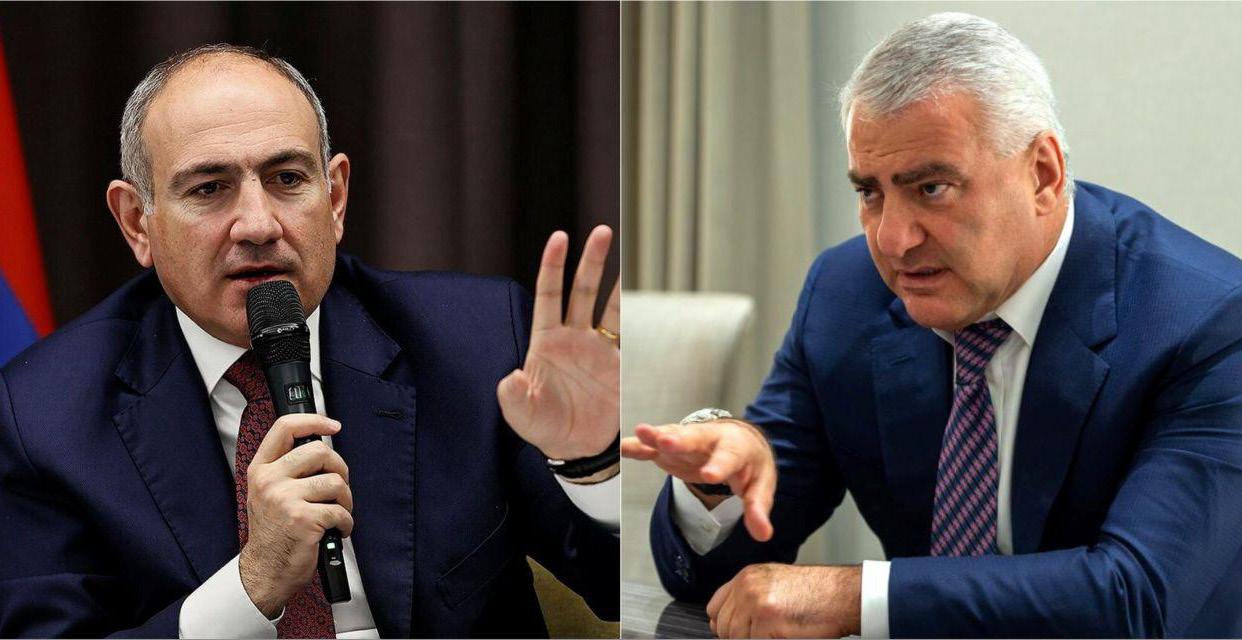
The absolute failure of Russia’s multilayered intimidation campaign stems from a profound collapse of trust between Yerevan and Moscow. For decades, Armenia sacrificed its political independence for Russian military guarantees, operating as a core member of both the Eurasian Economic Union and the Collective Security Treaty Organization. However, the turning point arrived when Russian peacekeepers stood by passively during regional conflicts, failing to protect ethnic Armenian populations. This perceived abandonment convinced the Armenian public that reliance on Russia was no longer a viable security strategy, but a liability.
By securing a decisive legislative majority
against both Karapetyan and Kocharyan, Pashinyan achieved a rare political feat. Backed by Western promises of visa-free travel frameworks, alternative security assistance, and major economic resilience packages championed by Brussels, Yerevan is systematically diversifying its economy and energy infrastructure away from Russian dependence.
While Armenia cannot instantly sever every structural tie with its giant northern neighbor due to geographic realities, the election sends an unmistakable signal: Russia’s imperial “Near Abroad” doctrine is rapidly unraveling, proving that even under the intense shadow of Kremlin coercion, a nation can chart its own path toward a democratic, European future.
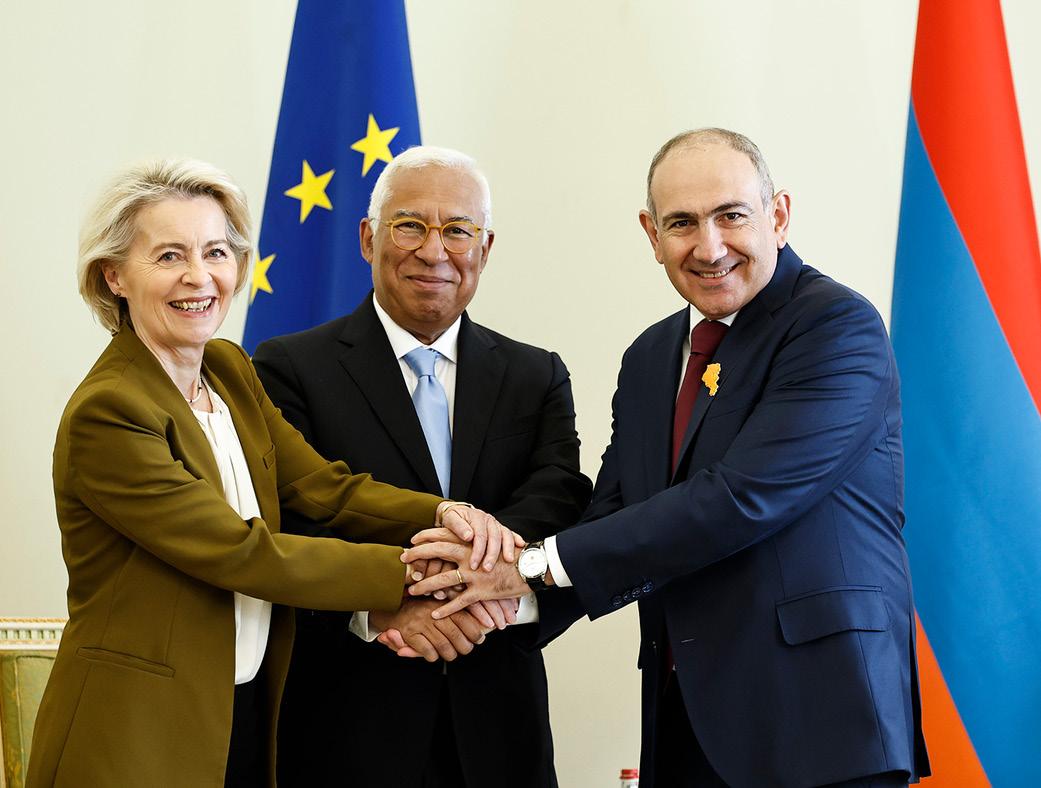
Luis Pérez Crujeiras
Across Europe, young people increasingly oscillate between two emotional poles: a constant sense of looming catastrophe and a retreat into hedonistic immediacy. Climate anxiety, economic instability, and political fragmentation have shaped a generation that feels simultaneously responsible for everything and powerless to change anything. The result is a cultural mood defined by apocalyptic narratives on one side and carpe diem escapism on the other - a contemporary version of collige, virgo, rosas, collecting the roses while we still can.
This atmosphere is not accidental. For
over a decade, young Europeans have been exposed to a relentless stream of crisis messaging: environmental collapse, democratic erosion, geopolitical tension. The ecological movement, once a vibrant force for mobilisation, now struggles to connect emotionally with younger generations. Much of its rhetoric still echoes the moral frameworks of the early 2000s the legacy of “old green” activism but fails to resonate with a generation raised in a digital ecosystem saturated with alarm. When every headline announces a new disaster, the instinctive response is not engagement but exhaustion.
At the same time, the search for meaning has shifted into new and sometimes distorted forms. The rise of the so-called gymbro and the cryptobro archetypes reflects a deeper crisis of identity. For some, the gym has replaced the church; for others, speculative finance has replaced community. The cult of the perfect body or the promise of instant wealth offers a sense of control in a world perceived as unstable. Yet these trends also reveal a broader individualism: when collective projects seem ineffective, the self becomes the only available arena for achievement.
This crisis of meaning is inseparable from the mental-health emergency affecting European youth. Anxiety, burnout, and
loneliness are no longer marginal issues but structural realities. A generation with unprecedented access to information also carries unprecedented pressure to perform, optimise, and succeed. Without a shared narrative of progress, young people retreat into hyper-individualised lifestyles that provide temporary relief but little long-term direction.
Meanwhile, Europe risks becoming a new Constantinople: engaged in intricate debates while the world outside its walls transforms at high speed. Institutions remain slow, bureaucratic, and often disconnected from the lived experience of young Europeans. Starting a small business can feel like navigating a labyrinth of inspections, taxes, and administrative hurdles. Mobility programmes exist, but access remains
uneven especially for vocational students, young people from rural areas, or those without strong institutional support. The gap between European ideals and everyday reality widens, feeding frustration and disengagement.
If Europe wants to recover a spirit of action among its youth, it must move beyond diagnosis and offer concrete pathways. A renewed European agenda for youth should begin with flexible entrepreneurship. Young people should be able to invest in equipment, training, or initial resources before facing heavy tax burdens. Early-stage inspections should prioritise guidance over punishment. Regulatory “sandboxes” controlled environments where young entrepreneurs can test ideas under lighter rules could unlock innovation and reduce fear of failure.
Second, Europe should expand professional mobility inspired by the German apprenticeship model. A European practice-insurance scheme would allow young people to work across borders without excessive risk. A transnational network of apprenticeships, supported by incentives for rural SMEs, would open opportunities beyond major cities and elite universities. Mobility must become a right, not a privilege.
Third, Europe needs institutional modernisation. Public administrations (national and European), should include mandatory training on EU programmes for civil servants, teachers, and youth workers. Too many opportunities exist only on paper because the intermediaries who should promote them lack time, motivation, or knowledge. Dedicated youth offices could help navigate European programmes, while educators who participate in Erasmus+ or cross-border projects should receive
recognition and incentives.
Europe does not need more pessimistic philosophers describing our paralysis. It needs young people who act and institutions that allow them to act. Recovering a spirit of action means replacing fear with possibility, bureaucracy with trust, and isolation with mobility. The future is not predetermined; it is built by those who dare to move.
A rapid European security format could help willing states and key partners act before bureaucracy turns danger into disaster.
Alex Gunter
Europe has begun to rediscover the price of defence. It must now rediscover the discipline of action.
For decades, much of the continent lived under assumptions that no longer hold. War was supposed to remain at the edge of memory. Economic interdependence was supposed to tame hostile powers. The United States was assumed to provide the
final security guarantee, whatever Europe did or failed to do for itself. Defence was treated by too many governments as an unpleasant budget line rather than the foundation on which political freedom rests.
Russia’s war against Ukraine shattered those assumptions. So have cyberattacks, sabotage, foreign interference, coercive
diplomacy and the steady rise of hybrid threats. Europe now faces a security environment in which danger is no longer theoretical and time is no longer a luxury.
In security policy, delay is not neutral. It gives adversaries time, reduces deterrence, weakens allies and forces Europe to respond after the facts have already changed.
The response has begun. Defence spending is rising. Industrial capacity is being discussed with new seriousness. The EU has advanced financing initiatives to strengthen readiness and expand Europe’s capability base. Ukraine has forced European leaders to confront the hard reality that security is not maintained by declarations of solidarity alone.
But money is not strategy. Spending more on defence is necessary, but it is not sufficient. Europe can buy more equipment, announce more packages and publish more plans, yet still fail if it cannot act quickly enough.
Europe’s enemies do not need unanimity to act. Europe too often needs unanimity to react.
This is the uncomfortable question at the heart of European security: can the continent move with strategic speed?
The problem is not only capability
Europe’s security weakness is often described as a problem of hardware: not enough ammunition, air defence, drones, tanks, ships, satellites or industrial capacity. That is true, but incomplete. Europe also has a decision-making problem.
Ukraine has shown that modern war consumes ammunition, air defence, drones, finance and political attention at a pace
Europe was not prepared for. If Ukraine has taught Europe anything, it is that political hesitation has material consequences: fewer shells, weaker air defence, slower production and greater pressure on those already fighting.
The European Union has instruments. Member States have capabilities. NATO remains the essential framework for collective defence. Individual countries possess different strengths, from intelligence and logistics to cyber expertise and defence production. But in moments of crisis, these elements too often remain scattered across national priorities, institutional procedures and political hesitations.
The EU has many forums for discussion. It has too few mechanisms for decision.
That is why Europe should consider a more flexible rapid security format: not a grand new institution, but a pre-agreed way to bring the right leaders, ministers, officials and strategic partners into the room quickly when a crisis demands action.
The purpose would be practical rather than ceremonial. In moments of serious threat, Europe needs a format that can focus political attention on the immediate question: what is happening, who is affected, what capabilities are available, which partners need to be involved, and what can be done now?
Such a mechanism should include willing and capable European states, relevant EU institutions where necessary, and key non-EU partners whose security is directly tied to the crisis at hand. It should be flexible enough to include the UK, Norway, Ukraine, Moldova, the Western Balkans, the Caucasus and other partners where relevant, without pretending that every issue requires the same room or the same format.
Its focus should be practical rather than ceremonial: threat assessment, Ukraine support, defence-industrial bottlenecks, critical infrastructure, cyber and hybrid threats, readiness, sanctions coordination, border security, and cooperation with strategic partners.
Europe does not need another talking shop with a flag, a logo and no consequence. It needs the ability to move from concern to coordination before the facts on the ground have already changed.
Europe cannot defend itself by committee alone.
Europe’s security map is wider than the EU
One of the great mistakes of European security policy is to confuse the EU’s legal borders with Europe’s strategic borders. Threats do not respect institutional neatness. Russian coercion, cyberattacks, disinformation, energy pressure, border destabilisation and war do not stop at the edge of the single market.
Europe’s security architecture cannot stop at the EU’s legal borders when Europe’s threats do not.
That means any serious rapid security format must be open to key partners outside the Union. The United Kingdom remains one of Europe’s most capable military powers. Norway is deeply integrated into European security and energy resilience. Ukraine is fighting the war that defines the future of the continent’s security order. Moldova faces direct pressure and instability. The Western Balkans remain strategically exposed, politically contested and central to Europe’s enlargement future. The Caucasus, too, sits within a wider zone of strategic competition where European interests, energy routes and regional stability intersect.
A security mechanism that excludes Europe’s most exposed partners would misunderstand the map it is supposed to defend.
This matters not only for efficiency, but for trust. Europe cannot ask candidate countries and close partners to align with its security agenda while locking them out of meaningful coordination. If Ukraine, Moldova, the Western Balkans and other partners are expected to bear the consequences of European security decisions, they should not be treated as spectators.
The same is true for enlargement. A serious pro-enlargement policy must be more than institutional language about future accession. It must recognise that many candidate countries are already part of Europe’s security reality. Their vulnerabilities, geography and political choices affect the entire continent. Bringing them into structured security coordination where appropriate is not charity. It is strategic common sense.
Any proposal for a rapid European security mechanism immediately raises legitimate concerns. Would it create a first tier and second tier of European countries? Would large states dominate smaller ones? Would it bypass existing institutions? Would it weaken NATO? Would it become another elite club?
These concerns should not be dismissed. They should shape the design.
Such a mechanism must not become a directorate of the largest countries. If it is perceived as a closed club, it will fail politically before it begins. Smaller states, especially those on Europe’s eastern and northern frontlines, often have the clearest
understanding of the threat. Their voice is not optional. It is essential.
Nor should the mechanism replace NATO, national defence policy or existing EU structures. NATO remains the core of collective defence for its members. Defence remains rooted in national responsibility. The EU has important instruments in financing, sanctions, industrial policy, resilience and support for partners. A rapid security format should connect these pieces when time matters, not pretend to abolish them.
The value would lie in structured flexibility. When full EU consensus is possible, it should be used. When it is blocked or too slow, willing and capable states should still be able to coordinate action in a transparent and treaty-consistent way, with close partners included where their security interests are directly involved.
Consensus should remain the aim. Paralysis should not be the price.
The veto cannot be allowed to become Europe’s strategic doctrine.
This question is not theoretical. Ukraine is the test of Europe’s seriousness.
Support for Ukraine is not only a moral commitment. It is a strategic necessity. If Ukraine fails, Europe becomes more vulnerable. If Ukraine endures, Europe gains time, depth and a partner that has learned the realities of modern war at terrible cost.
Sustaining that support requires more than periodic pledges. It requires coordination across defence production, financing, training, logistics, air defence, sanctions, reconstruction planning and long-term security commitments. It requires the ability to identify bottlenecks and remove them
before they become battlefield failures.
A rapid European security mechanism would be useful precisely because these tasks cut across institutions and borders. They require EU tools, national capabilities, NATO coordination, industrial planning and cooperation with non-EU partners. They require political direction that is faster than normal bureaucracy and more serious than occasional summit language.
The mistake would be to treat Ukraine as an exception. It is a warning. The next crisis may come through the Black Sea, the Baltic region, the Western Balkans, the Caucasus, cyber infrastructure, energy networks or migration pressure weaponised by hostile actors. Europe cannot afford to improvise every time.
A Europe that wants sovereignty must accept responsibility. It cannot ask others to guarantee a freedom it is unwilling to organise for itself.
There is a danger in every new mechanism: duplication, confusion, inflated expectations. That is why the design must be disciplined.
A rapid European security format should have a clear purpose. It should not take over every security question. It should not become a symbolic council for speeches. It should be activated and used for issues where speed, coordination and crossborder alignment are essential.
It should include clear reporting into existing EU and national democratic structures. It should communicate its purpose openly. It should avoid the appearance of permanent inner and outer circles. It should be flexible enough to include relevant partners, but disciplined enough not to become a crowd
so large that it recreates the paralysis it is supposed to avoid.
The goal is not institutional theatre. The goal is action.
Europe is entering an age in which security threats are faster, more complex and less forgiving. Hybrid attacks blur the line between war and peace. Industrial capacity takes years to build but can be exhausted in months. Political windows open and close quickly. Washington can change direction. Moscow tests weakness. Beijing watches Europe’s capacity to act.
In such a world, delay has a cost.
Europe has spent years producing strategies. It now needs the political habits that make strategy real: regular assessment, rapid coordination, clear priorities, accountable implementation and the courage to act before a crisis
becomes unmanageable.
A rapid European security mechanism would not solve every problem. It would not replace NATO, national defence policy or democratic oversight. It would not remove the need for spending, industry, readiness or political will.
But it could help Europe do something it has too often struggled to do: turn concern into direction, direction into coordination, and coordination into action.
The next crisis will not wait for Europe to finish debating its architecture. If Europe wants to defend its citizens, support Ukraine, strengthen enlargement, and remain a serious actor in the world, it must build not only the capacity to fight, but the authority to act.
Defence begins with weapons. Strategy begins with decision. Security begins with action.
Andrea Mghames
To understand why Donald Trump is now sitting at a negotiating table with Iran rather than bombing it into submission, you have to go back to what he said when the bombs were still falling. Hours after the United States and Israel launched nearly 900 strikes on Iran on February 28, Trump pledged to destroy Iran’s missiles, trigger regime change, and accept nothing short of unconditional surrender. A week into the conflict he posted on Truth Social: “There will be no deal with Iran except UNCONDITIONAL SURRENDER!”. Now he has signed a memorandum of understanding
that allows Iran to keep enriching uranium, says missiles are “not the problem,” and promises a $300 billion reconstruction plan for the country he was threatening to level four months ago. The question worth asking is not what the deal says. It is what forced Trump’s hand.
The short answer is that the war did not go as planned. The initial strikes on February 28 killed Iranian Supreme Leader Ali Khamenei and devastated Iran’s military
infrastructure. By conventional metrics, it looked like a swift, decisive operation. What the Trump administration had not fully accounted for was what came next. Iran closed the Strait of Hormuz. Roughly 27% of the world’s maritime crude oil and petroleum products pass through that narrow waterway, and within days of its closure the effects were cascading: flights across the Middle East halted, oil prices spiked, and gasoline prices in the United States jumped nearly 60 cents a gallon. Storage facilities began filling up because tankers could not move. CNN reported that the Pentagon and National Security Council had “significantly underestimated Iran’s willingness to close the Strait,” and that the economic consequences had been a secondary consideration in the pre-war planning.
Trump, who had built his second-term brand on economic strength and lower energy costs, suddenly found himself presiding over a self-inflicted energy crisis. He began threatening Iran’s power grid to force the strait open, then postponed the strikes, then threatened again. The cycle revealed
a president who had started a war without a clear theory of how it would end. By April, the pressure to de-escalate was as much domestic as strategic.
The MOU Trump signed on June 17 is, in important respects, a renegotiation of the war’s terms rather than a victory over Iran. Iran retains the right to enrich uranium. Its ballistic missile programme, which Trump once pledged to destroy, is not covered by the agreement. G7 leaders praised it as a breakthrough, and Trump framed it as a historic peace. But as Newsweek noted, the gap between his February war aims and his June deal terms is substantial on almost every point. The leverage that made the deal possible was not American military dominance. It was Iranian control of the Strait of Hormuz, and the economic pain that came with it.
Iran understood this dynamic and exploited it deliberately. Tehran was willing to negotiate not because it was defeated but because it had extracted enough cost
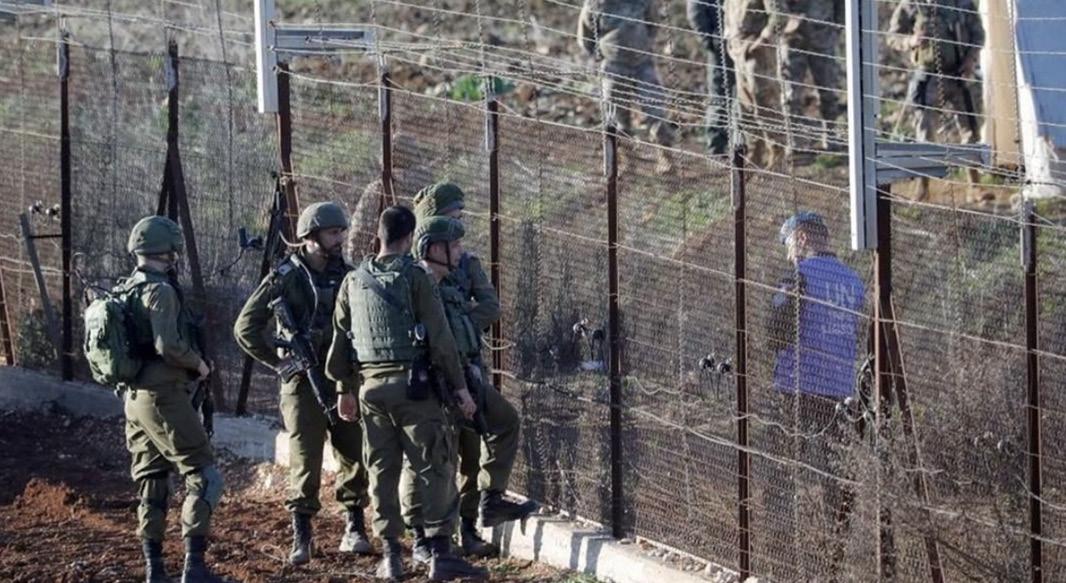
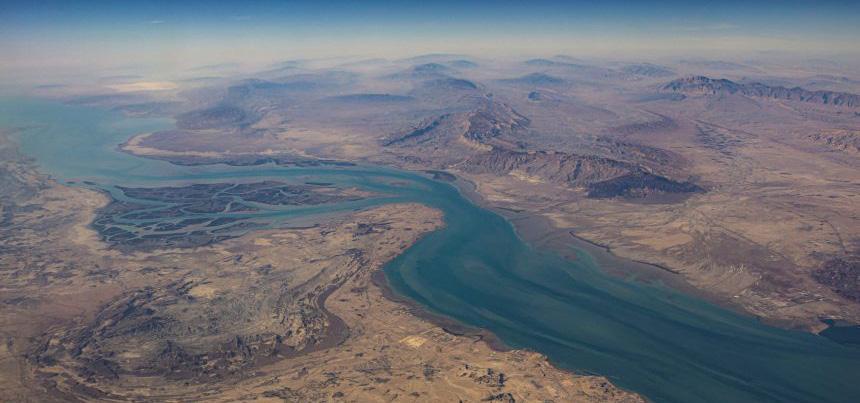
to bring Washington back to the table on more favourable terms. The $300 billion reconstruction promise in the MOU and the absence of a missile dismantlement requirement are the clearest evidence of where the real leverage sat.
Lebanon is where the gap between Trump’s deal and its implementation becomes most visible. The MOU calls for a permanent end to military operations on all fronts, Lebanon included. Israel has essentially said that clause does not apply to it, and Netanyahu reportedly told Trump directly that Israel does not consider itself bound by the Lebanon provisions. Iran has responded by suspending the next phase of talks, pointing to ongoing Israeli strikes as its justification.
This puts Trump in an awkward position of his own making. He went to war partly on Israel’s behalf, and Washington remains Israel’s principal military backer. But the deal he needs to consolidate requires Israeli restraint that he cannot deliver. Every Israeli strike in Lebanon that goes unchallenged undermines the American guarantees embedded in the MOU, signalling to Tehran
that Washington’s commitments may not be enforceable.
Trump’s pivot from war to negotiation was not primarily ideological. It was economic and political. The Strait of Hormuz closure hit American consumers at the pump, rattled global markets, and threatened to define his second term by an inflationary energy shock rather than the prosperity he had promised. The deal is his way out of a war that cost more than anticipated and delivered less than advertised. Lebanon, Hezbollah, and the broader question of Iranian regional influence have not been resolved. They have been deferred, at significant cost, to the next phase of talks, which as of today remain postponed indefinitely.
That is what the deal actually is. Whether it holds will depend less on the text of the MOU than on whether Trump can manage the one variable his diplomacy has not yet solved: an Israeli government that does not believe it is bound by agreements it did not sign or will that prove to be the deal’s undoing?
Alex Zamborský
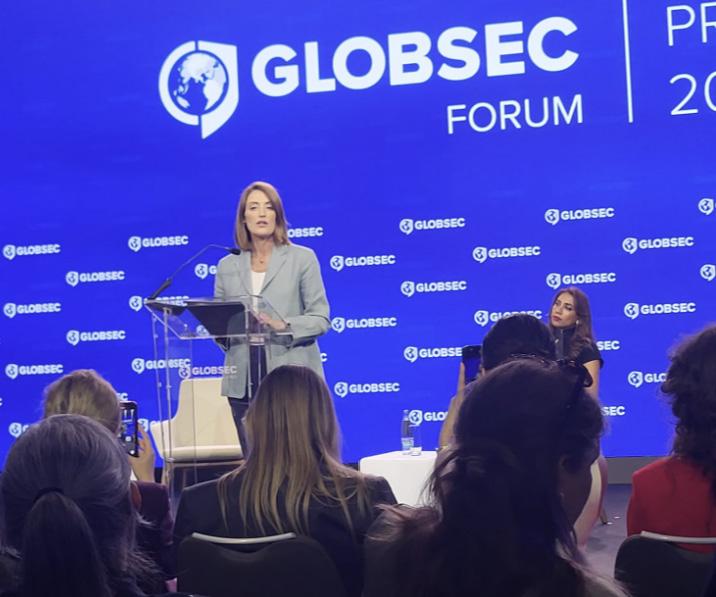
The concept of “Central Europe”, its turbulent history accompanied by frequent changes of borders during the long and tragic 20th century, its specific culture, languages and perception of itself, has interested scholars, writers and intellectuals for a long time.
The most famous Czech writer Milan Kundera
published in the year 1984, during his time in French exile, a relatively short but powerful essay “The Tragedy of Central Europe”. He describes the region as a land of “small nations”, which he defines as “one whose very existence may be put in question at any moment; a small nation can disappear and it knows it”. During the 20th century, Central Europe was forcefully kidnapped
from the West, where it historically and culturally belonged, and violently placed under Soviet occupation.
Nevertheless, almost four decades after the fall of communism, the region is once again fully integrated with the rest of Europe and has a strong voice that resonates across the continent. Another successful edition of the GLOBSEC Forum hosted in the Czech capital of Prague and attended by politicians, diplomats and scholars from all around the world is a living testimony to this claim. Thus, it was an honour for me to be part of this unique conference and proudly represent the European Democrat Students. More than 2400 participants from over 80 states had a valuable opportunity to attend dozens of discussion panels focused on defence and security, European affairs, democratic backsliding and most importantly, the transformation of the liberal international order based on rules and strong institutions. Therefore, it was a great privilege to listen in person to inspirational speeches by the Czech President Petr Pavel, Moldovan
President Maia Sandu, President of the European Parliament Roberta Metsola, and Polish Minister of Foreign Affairs Radosław Sikorski among other significant panellists and guests. Furthermore, it was delightful to see several politicians from our family of the European People´s Party among the speakers.
Even though the discussion revolved around different topics and panellists offered their viewpoints, which were frequently different, several recurring perceptions and themes resonated. The most important takeaway connecting different panels is the acknowledgment that “the good old days ” of tranquillity and order are over and Europe must be prepared to rise and act as an independent power. Jean Monnet famously remarked that “Europe will be the sum of the solutions adopted to the crisis”. His observation was in similar variations repeated by most of the speakers, who acknowledged that despite the ongoing
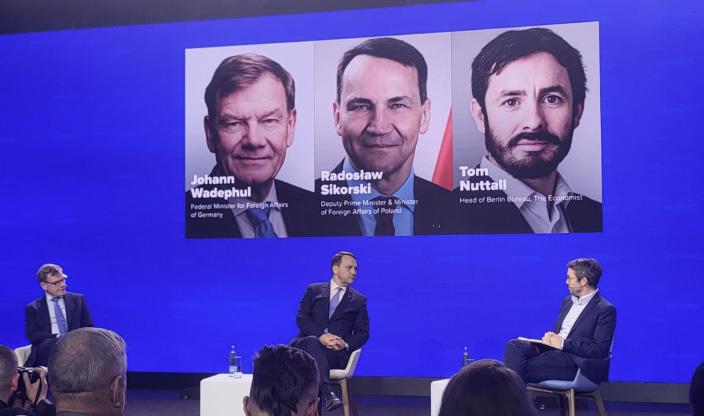
series of crises, Europe has a window of opportunity to become truly strategically independent. However, Europe has to act as a united entity in response to all challenges and threats, most notably those from the East. The still ongoing brutal Russian invasion of Ukraine was another key topic of discussion. It was important to hear that full European support for Ukraine remains a priority and that Ukrainian integration into the European Union will hopefully become a reality soon. Especially captivating were discussions attended by ministers of foreign affairs from the Baltic states and Scandinavia, who shared their first-hand experience in resisting Russian hybrid threats and lately unfortunately also drones and other military equipment. Therefore, the times when Europe could rely on its “peace dividend” are clearly over and Europe has to be prepared to invest more in defence, technology and digital transformation.
The politicians and scholars from Ukraine, Moldova and the Western Balkans provided valuable insights regarding the process of European enlargement. It is no coincidence that these discussions took place in Prague since the historical development
of Central Europe offers a valuable lesson to nations aspiring to join the European Union. Furthermore, a consensus among different panellists was reached that previous “enlargement fatigue” was largely overcome, that many candidate states are making significant progress and are expected to join the European Union in the foreseeable future.
Three days in late May in Prague offered a unique opportunity to listen to some of the individuals who personally shape the future of our continent and make decisions with a broad global impact. On a personal note, among plenty of memorable moments from the conference, one stands out –the brief personal meeting and talk with Radosław Sikorski, a distinguished European statesman and diplomat whose career has been a source of inspiration for me. Despite the omnipresent scepticism and lack of hope in the public discourse, the GLOBSEC Forum offered a strong sense of hope regarding the future of Europe. The example of Central Europe mentioned in the introduction is a living example that regardless of historical turbulences and periods of darkness, the victory of democracy is possible — but only if Europe continues to defend it.
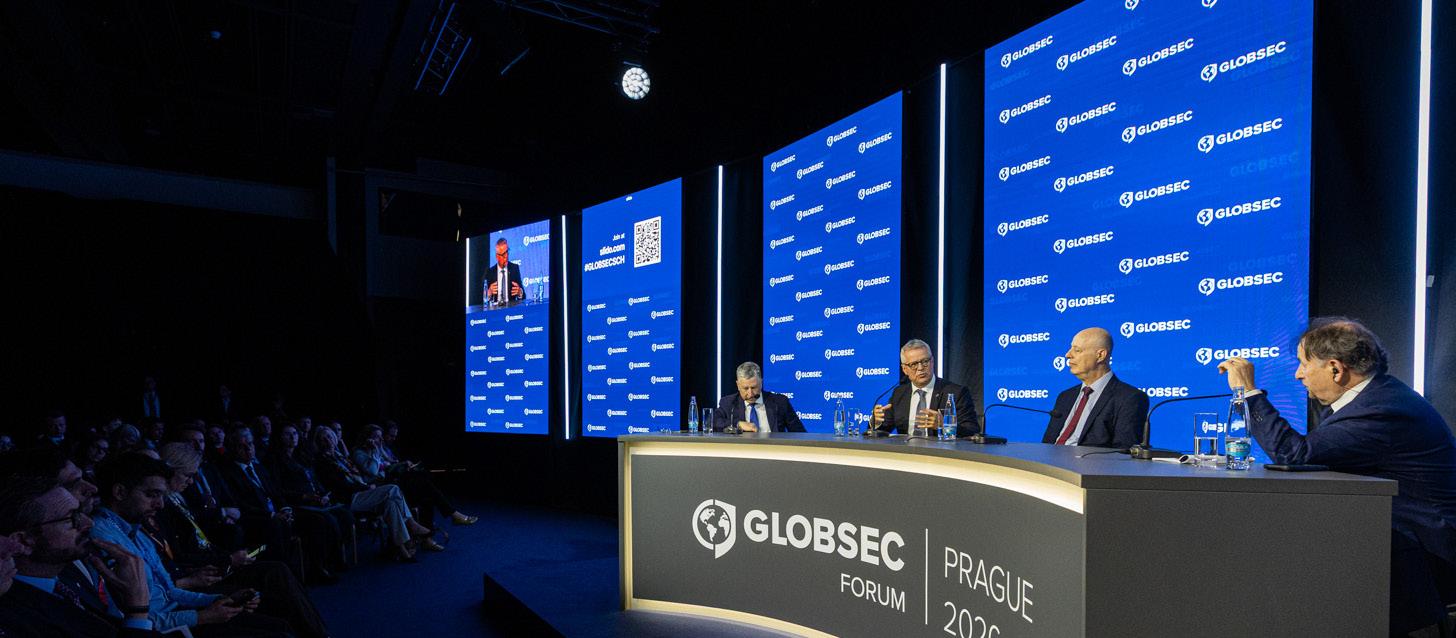
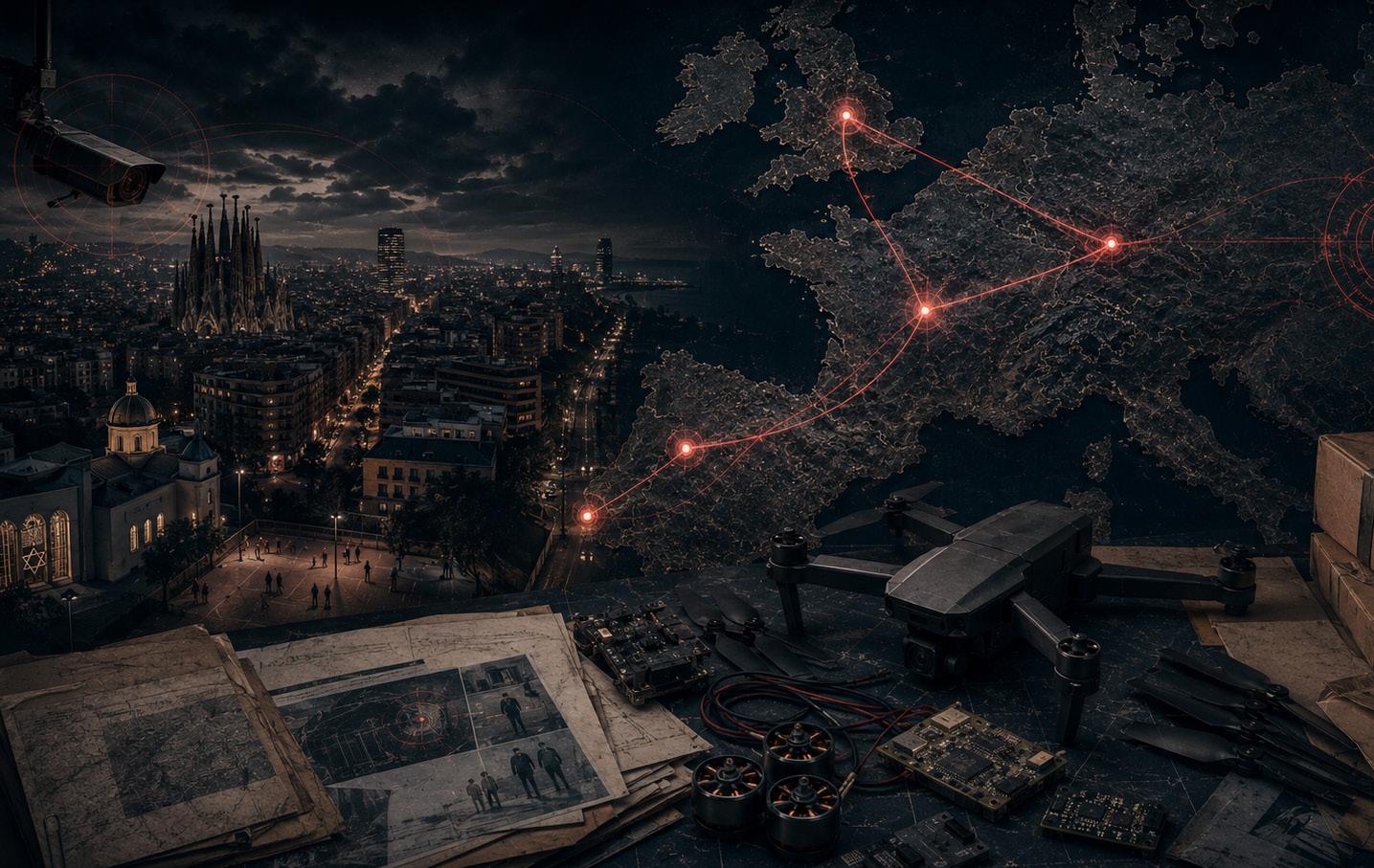
Hezbollah is not a Middle Eastern problem. It is a European one.
Ilan Libskind
On April 1, 2025, Spain’s Guardia Civil arrested three men in Barcelona’s Eixample district for manufacturing explosive drones for Hezbollah. Blocks from the city’s main synagogue and Jewish school. The men were Lebanese nationals operating through front companies registered in Spain, in one of the most photographed neighborhoods in Europe. The same week, two men were arrested in London on suspicion of financing the
network and membership in a proscribed organization. In France, further arrests followed on terrorism conspiracy charges.
None of this was a surprise to the investigators. It was the second wave of a multi-year operation that began in July 2024, when Spanish and German authorities first dismantled what they described as Hezbollah’s primary European supplier of armed drone components. What makes the Barcelona case worth examining in detail is not just what the arrests revealed, but what
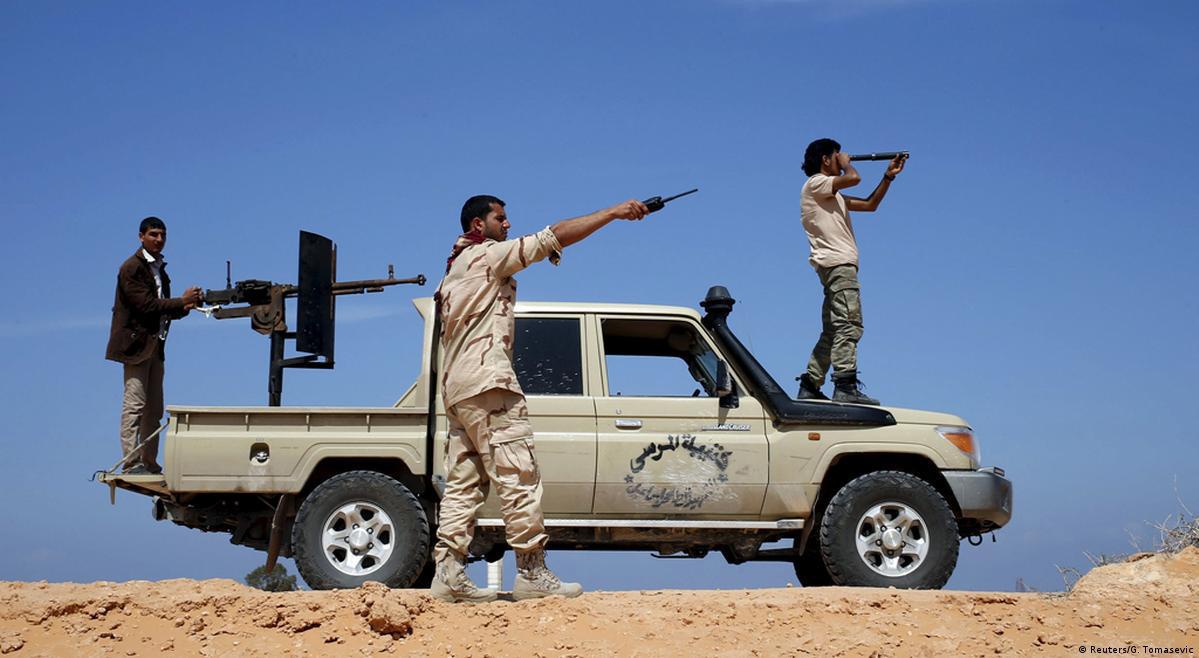
they confirmed about how the organization operates in Europe, and what European law still permits it to do.
The case of Fadel Z. is the most documented thread of that network. A 35-yearold Lebanese national, most recently based in Salzgitter, Lower Saxony, he was convicted in March 2026 by the court in Celle of membership in a foreign terrorist organization and being an accomplice to attempted murder. The sentence was six years and four months.
Prosecutors said he had joined Hezbollah after July 2016. By 2022, he was a foreign operator for the group’s drone program, working first from Barcelona, then relocating to Germany in 2023. He purchased materials worth 1.4 million euros for the construction of drones, including over 2,000 petrol and electric motors and over 600 propellers. Fadel Z. placed orders through front companies registered in his own name or those of his contacts. Products came from
companies in Europe, China, and the United States.
Two of the engines he supplied were used in Hezbollah drone attacks on Israel. One was the October 11, 2024, strike on a retirement home in Herzliya that houses some 200 residents. It happened on Yom Kippur.
Prosecutors noted that Hezbollah has been running an extensive drone program for some time, and that the organization employs foreign operatives who covertly purchase components in Europe and export them to Lebanon. Fadel Z. was one of those operatives. The German Federal Prosecutor’s Office said he was born in a Hezbollah stronghold in Lebanon and brought up with the ideology of the organization. He then built a logistics network across two European countries and kept going until his arrest in the summer of 2024.
None of this was improvised. Tehran created Hezbollah in 1982 through the Revolutionary Guards and has directed its military program since. The Barcelona operation
answered to the Islamic Revolutionary Guard Corps, not to a rogue cell making autonomous decisions. According to Le Figaro, the seized components across the wider network could have been used to assemble hundreds of UAVs. Spain, Germany, France, and the UK were the supply chain.
The legal gap that made this possible is not a technicality. It is a choice.
Several EU member states have resisted fully designating Hezbollah as a terrorist organization, citing the group’s role in Lebanese politics and concerns about relations with Beirut. The Netherlands designated it in full in 2004. The UK followed in 2019. Germany went further than the EU by designating Hezbollah in its entirety in April 2020, which is precisely what gave German courts the jurisdiction to try Fadel Z. and sentence him. The EU, since 2013, has only proscribed the military wing, leaving the political arm free to raise funds, recruit and organize across member states. Hezbollah itself has always said the distinction is artificial.
The Celle verdict makes it hard to disagree.
A man built a procurement operation across two EU countries, purchased 1.4 million euros worth of drone components, supplied parts used to attack a building full of elderly people on the holiest day of the Jewish calendar, and the organization that directed him continues to operate legally across most of the continent.
Full designation of Hezbollah by the EU, covering both wings, would close the legal space the group uses to fundraise, recruit, and run logistics networks inside member states. It would give law enforcement a
common framework. And it would make the bloc’s legal position consistent with what its own courts have found to be true.
As Angel Mas of the Spain-based organization ACOM put it after the April 2025 arrests: “Hezbollah operatives are walking the same streets as Jewish schoolchildren, building explosive drones just blocks from synagogues.”
The engines that struck a retirement home in Herzliya on Yom Kippur were bought in Germany. The workshop that assembled them was in Barcelona. The man who ran the operation between those two cities has been sentenced to more than six years in prison by a civilian court in Lower Saxony. The organization he worked for is still legal in most of the same countries where he worked.
That is the situation as it stands.
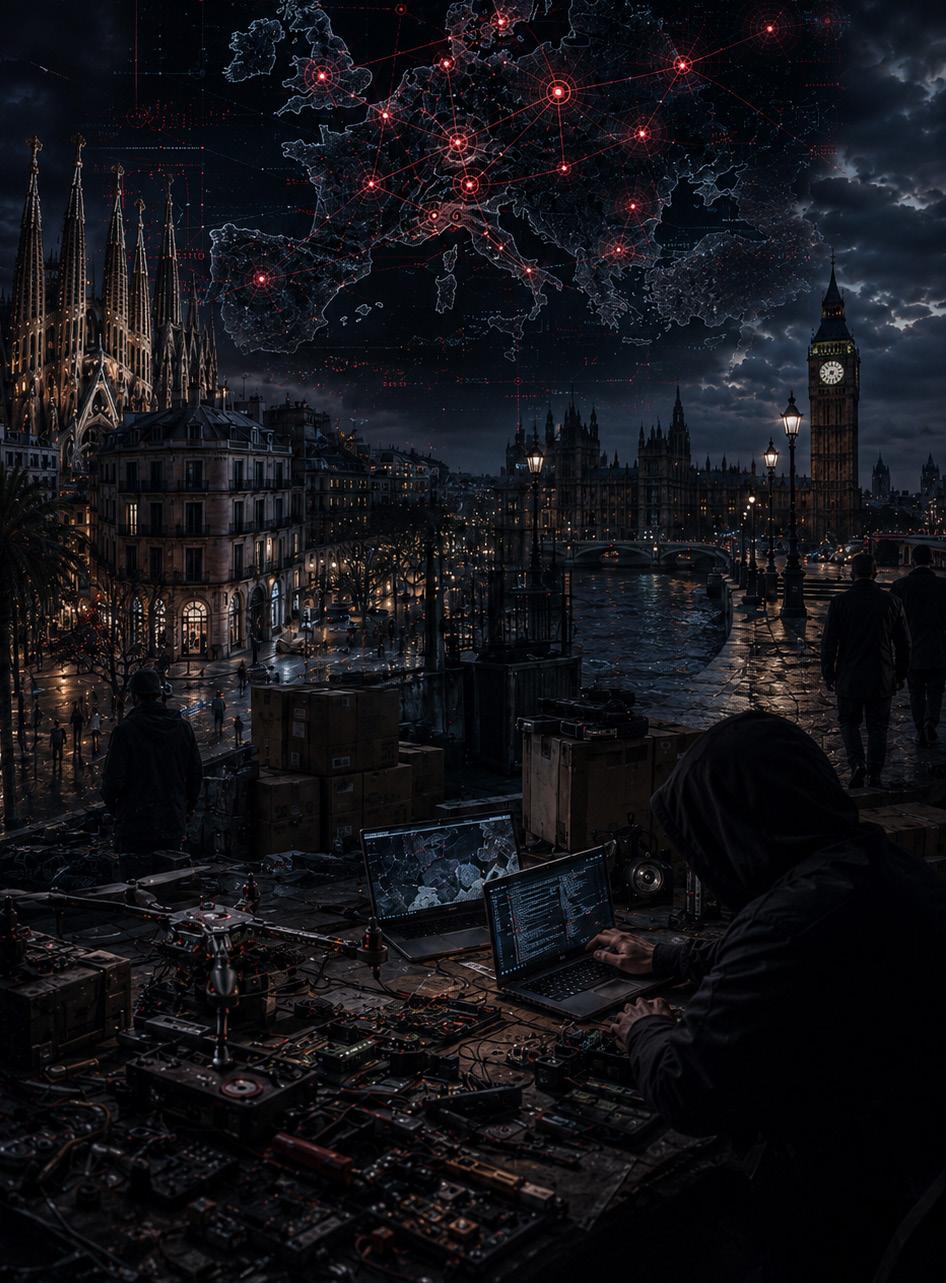
Publications Editor
Sotiris Paphitis, International Relations Secretary at FPK Protoporia, is a practicing lawyer and Barrister-at-Law from Nicosia, Cyprus. He is a PhD candidate at the University of Tilburg in the Netherlands. Since August 2024, he has been serving as Vice Chairman of EDS, where he is responsible for statutory amendments and the EDS official publication, BullsEye.
Editor-in-Chief
Charlie Crumpton, is from England, United Kingdom and graduated with a Masters in Political Communication. He has previously worked in British politics and is particularly interested in objectivism and personal responsibility as political philosophies.

Andia Homata, originally from Cyprus, holds a degree in Business Management from the University of Essex and is currently pursuing a Master’s at the London School of Economics. With a strong academic background in business and organisational studies, she is particularly interested in the intersection of economics, policy, and global markets.
Sofia Kubrakova. represents Nowa Generacja. Based in Wrocław, Poland, she studies law at the University of Wrocław and works as a social parliamentary assistant. Passionate about human rights, geopolitics, and justice — especially women’s rights — she believes that real change comes from action, integrity, and courage.
Andrea Mghames, represents the Lebanese Forces Party in Lebanon. With a master’s degree in International Relations and currently serves as a Regional Program Coordinator and Business Developer at Balinca, a company specializing in training services. In addition to her professional work, Andrea is a lifelong professional swimmer. Andrea is excited to write about and raise awareness of the significance of Lebanon especially during this period of severe economic collapse, political instability and widespread corruption.


Nora Strømme
Axel Mouffron
Alex Gunter
Domagoj Cigić
Jan van der Meer
Lara Ghanoudi is a nursing student at the Complutense University of Madrid. She is passionate about international affairs and focuses on the impact of health and religion on the youth.
Mateusz Gnat
Moriz Jeitler
Luis Pérez
Ilan Libskind
Alex Zamborsky
María Ferrer Argente is from Zaragoza, Spain. She holds a Law Degree from the University of Zaragoza, a Master’s in European Union Studies from the University of Salamanca, and graduated with an LL.M. from the College of Europe in Bruges in 2023. After completing internships in Legal and Home Affairs at the EPP Group in the European Parliament and in communications at the Wilfried Martens Centre for European Studies, she began working as a parliamentary assistant (APA) for a Spanish MEP from the EPP in the European Parliament.
Vladimir Kljajic
Francesco Sismondini Chairman
Filip Gajic Vice-Chair

Vladimir Kljajić Secretary General

Marina Christaki Vice-Chair
Iryna Shatokhina Vice-Chair

Damjan Konjanovski Vice-Chair

Chayenne Riolo Vice-Chair
Rodolph Zgheib Vice-Chair
Sotiris Paphitis Vice-Chair

Stefan Arsov Vice-Chair
Ivan Botoucharov EXTERNAL RELATIONS DIRECTOR
The publication of this document received financial support from the European Parliament
Sole liability rests with the author The European Parliament is not responsible for any use that may be made of the information contained therein.