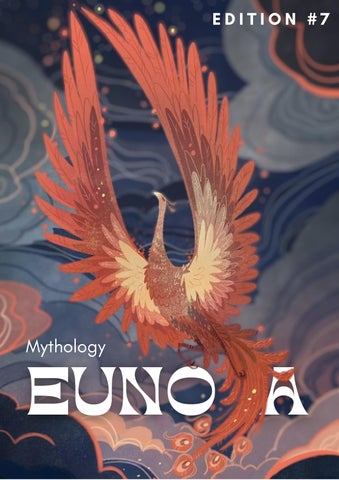
Mythology
Mythology eu-noia noun Derived from the Ancient Greek word meaning: A well mind; beautiful thinking. If you have any questions for the Editorial Board, feel free to reach out to us at editorial.srj@owis.org
In this edition... Exciting Events Teacher's Corner What's in the Theme Worded Woods An Expert’s Insight Media Recommendations Finance and Fortunes Mental Health For the Love of Food Artist Spotlight
B Y D H I V Y A
Exciting Events
I Y E R DP1
Behind the Scenes of Street Store Street Store. An annual donation drive organised by the students of DP-1. The day of the event saw students running around to organise items into stalls, crowds of people at the entrance of our school, and, most importantly, hundreds of happy faces of children and adults who carried home armfuls of clothes, toys, and books. Record scratch, freeze frame. Let’s go back a month. The DP coordinator, Remya ma’am, introduces Street Store to the DP1 students. We only know the date of the Street Store: 24th September. It’s our first time taking on such a huge initiative, especially as a school-mandated project. But we persevere. We spend our CAS periods discussing all the technicalities for the event, and soon a Toddle message and promotional video made by our class is sent out. Students visit classes to make announcements and collect the first bags of donations. This was done yearly by DP students. However, this time we wanted to try something new. Three students volunteered to collect donations from their own communities as well. Supported by Basavaraj sir, we planned furiously for this new addition. There were, of course, hitches in our progress. Amidst constant classes and exams, we couldn’t dedicate all our time to Street Store—we had to find a balance. We were also running out of space in the storage room, and, behind the scenes, organising bus-pickups for the community donations, designing T-shirts for volunteers, and ideating for arrangements on the day of Street Store.
Slowly, however, things started to fall together. A few students boarded a bus the week before Street Store, and after visiting three communities, returned with the BharatBenz filled to the brim with donations. Stalls were arranged for these donations, and soon a design for the t-shirt was created. The school staff sorted out the donations—upon seeing the neat piles of items, we were delighted. And now, we return to where we began: the day of the Street Store. Students and teachers who arrived early were hard at work moving items from inside the school to the stalls; much to our surprise and merriment, there were already people waiting for the drive to open. At 9:00 a.m. on the dot, the Street Store opened, and hundreds of people entered the stall area. The noises of students and teachers speaking in Kannada or Hindi or a multitude of other languages filled the air. We were on our feet for an hour and a half, and ended up hot, sweaty, and exhausted. What made everything worth it was the smile a child wore as she picked out a textbook, the joy on a father’s face when he took a toy for his child, the numerous people collecting clothes and utensils, and eventually the cleared-out stalls. Street Store 2023 was a huge success thanks to the massive support we received from the students, teachers, communities, and our school management. It was a pleasure for DP1 to organise, and we returned with a sense of fulfilment and joy at being able to help our local communities.
Good Habits Festival
HIMADYUTHI SIDHU, DP1
An unskippable, unchangeable tradition that commemorates every year in October is the Good Habits Festival. Every year, the day before everyone leaves for Dusshera vacation, the school has a day of celebrations. This year was no different. The day began with an assembly that had all students and teachers assemble in the Green Meadows. It started with a few performances, followed by a speech by our Vice President, Dhivya Iyer, who spoke about what the Good Habits Festival was and why we celebrated it the day before the vacation.
We then moved on to one of the most thrilling parts of the day — the burning of our bad habits and the Ravana. Students lined up grade-wise and walked over to the Ravana fire pit. Each of them threw their chits into the fire pit with determination to leave those bad habits behind. After the Assembly and the burning of our bad habits, stalls were assembled in the atrium for both students and teachers. Games and the like were put up on each stall for collective fun activities to take place.
However, after the short stall session began two of the most anticipated competitions: Battle of the Bands and Lost in Motion. Various musicians and dancers took to the stage with their incredible performances that left the viewers in awe. Every single
performance on stage had the audience leaving a loud applause at the end. The energy from classic and trending music had the audience on their feet, singing and dancing with all the energy they could muster. As a little deviation from school tradition, the dance session took place after the competitions in the MPH instead of the Green Meadows due to high temperatures. Even then the students didn’t let that bring them down and danced until their feet hurt. Classic Bollywood music blasted through the speakers as students entered clusters and danced their hearts out. With each song, the energy reverberated through the hall and the dance session ended over an hour later for a lunch break. Post-lunch was a free hour, where students and teachers could spend the time as they liked before going home. “Happy Dusshera!” wishes were spread to everyone across the halls before they left with beautiful smiles gracing their face. And just like that, the yearly tradition was once again a success.
anything bright [insert face here]
What is your all-time favourite movie/book and why? I am a fan of all P.G. Wodehouse books, but my favourite in his works would be ‘Very Good, Jeeves’. The humour in the book is very well done, and it is a very enjoyable read. What is your favourite mythology and why? I am not well-versed in Greek mythology or other such mythologies. I grew up listening to stories of Mahabharata, so I would say Indian mythology is my favourite.
Mr. Vijay Lovekar
“Work Hard, Play Harder.”
Interviewed by Sravanthi Kathiravan
If you could be any mythological creature, which one would you choose and why? If I could be a mythological character, I would want to be a cobra (the holy snake) that we have in Hindu mythology. I think snakes are lovely animals; highly misunderstood, and suffer a lot of hardships. I don't think they deserve it. What prompted you to choose teaching as a career? I have always liked teaching even though I worked as a manager for different organisations. I had the opportunity to teach people and loved doing that. At one point, I finally decided to change my career and become a teacher. What would the students be surprised to find out about you? The first thing students might be surprised to find out about me is that I am a long-distance runner, which not many people know. I have not done much running in the recent past, since the COVID lockdown, but I plan to start [again] soon.
When I was in elementary school, I remember watching my cousin solving puzzles in the video game ‘The Mystery of Mathra‘. I anxiously watched her collect two halves of a key to a great city built a thousand years ago in the Numerian Rainforest and unlock the mysteries of the monster, Mathra. The game was a part of ‘Cluefinders‘, an educational game series aimed at children. The Mystery of Mathra, and the next game in the series, Puzzle of the Pyramid, weaved together mystery, myths and math in a remarkable way. I couldn’t wait to play them myself. Math and myth are often not two things we think of together. Yet, playing these games showed me that mythological stories can provide a captivating educational setting. The Mystery of Mathra (TMoM) took inspiration from legends like the Lost City of Atlantis while Puzzle of the Pyramid (PotP) centred around the myths of Egyptian Gods. I journeyed through the TMoM’s Monkey Kingdom and Goo Lagoon, and I wandered the streets of Egypt in PotP. As I helped the citizens of these lands collect clues, every puzzle I solved helped me develop my math skills. I learned place value, measurement, and mathematical operations and practised word problems by helping monkeys repair stones and monuments destroyed by the evil Mathra. I learned about fractions and decimals as I helped the shopkeepers of Egypt so that they, in turn, would help me stop an evil archaeologist from unleashing the power of Set, the Egyptian God of Chaos. Tying mythology into building cognitive skills made learning exciting and effortless. Reflecting on the power of mythology and storytelling to engage learners makes me wonder how I can sprinkle them into my classes to make learning last a lifetime.
Worded woods A Queen’s Revenge By Kavya Ramineni, M5, WS In the shadowed depths of ancient lore, A tale of vengeance, a myth of yore. Medusa, once fair with flowing hair, Betrayed by gods, left in despair. Athena, wise with eyes like stars, And Poseidon, lord of the ocean's spars, They wronged the maiden with serpent's tress, Cursed her beauty, caused her distress. Athena's temple, a sacred abode, A place where secrets and stories flowed, Medusa a priestess, within its embrace, Her beauty envied by the goddess's grace. Poseidon, too, cast his greedy eye, Upon the maiden who dared to defy, His lustful advances she did spurn, Her fate sealed, as her heart did churn.
Athena's wrath, a terrible curse, Turned Medusa's locks into something worse, A tangle of serpents, hissing with spite, A visage that petrified with every sight. Innocence lost, beauty transformed, Medusa's heart in darkness stormed, She swore revenge, with venomous tears, To strike down those who stoked her fears. With serpents as her allies, she rose, A Gorgon queen, in shadows she chose, To punish the gods, to break their sway, In darkness and night, they'd rue the day. With eyes that gleamed like moonlit blades, She hunted the gods in hidden glades, A curse reversed, revenge she'd find, For the treachery of gods unkind. Beware the fury of a woman hath scorned, In the heart of darkness, she was reborn. Medusa's wrath, a force to fear, A timeless vendetta, crystal clear.
The Minotaur's Lament By Ethan Cyril Deep within the Labyrinth, a creature weeps. It is the Minotaur, a beast of legend, feared and reviled by all. But the Minotaur is not a monster, but a creature of sorrow, trapped in the labyrinth of its own making. Once, long ago, the Minotaur was a human child, born with a monstrous form. Its parents, King Minos and Pasiphae were ashamed of it and locked it away in the Labyrinth. There, the Minotaur grew up alone and afraid, with the shadows as his only companion. The Minotaur is not evil, it is simply misunderstood. It longs for friendships and empathy, but all it knows is fear and hatred. It has been forced to defend itself against the countless Athenian youths who are sent to be sacrificed to it. One day, a young Athenian named Theseus arrives at the Labyrinth. He is determined to slay the Minotaur and free the people of Athens from its curse. But the Minotaur is not interested in fighting. It wants to talk.
Theseus listens to the Minotaur's story, he learns of the creature's loneliness and pain. Thesus understands the Minotaur’s desire to escape the Labyrinth. To live a normal, free life. Theseus realises that the Minotaur is not a monster, but a victim of circumstance. Together, Theseus and the Minotaur devise a plan. Theseus will distract the guards while the Minotaur finds a way out of the Labyrinth. The plan leads to success. While Theseus has the guards distracted, the Minotaur finds a hidden passage. The Minotaur escapes the Labyrinth and disappears into the night. The people of Athens are overjoyed. They believe that Theseus has slain the Minotaur. But the truth is, Theseus has saved a creature from a life of torment.
Art by Avni Jain
An Expert’s Insight Interview by Megha K. Mythology has pervaded art—in all forms and mediums—since centuries. Artists have roamed its rich architecture for inspiration, always discovering something new in turn. As somebody involved in exploring the relationship between art and mythology for many years now, Mr. P. Sudhakaran has established his reputation as a professional journalist and art curator. These are a few snippets from his interview we found particularly interesting.
Mr
. P. S
a u d hakar
n
What does a day in your life look like? As a communication expert and writer, I’m not tied to a single employer— which means my workload can be quite volatile. Typically, my day starts early and extends into the evening, with breaks for reading and travel, often related to my expertise in art and Art Integrated Learning (AIL). I strive to avoid procrastination, even though it can be stressful at times. Lately, I have been adopting a more mindful approach to stay relaxed during work. I prefer focusing on one task at a time, aiming for maximum perfection, but I am not a workaholic. I prioritise self-improvement and work towards delivering my best performance at all times. What is the scope of your career / career path? I embarked on my career as a small-time journalist and broadcaster, gradually transitioning to mainstream journalism. During the pandemic, I returned to communication and art writing: my original passion. Art Integrated Learning (AIL) has been a significant focus in my research, which is still an infant field in India; however, I foresee immense potential in its growth. Promoting AIL is a project that not only allows me to face new challenges, it also boosts my creativity by letting me translate rich works and travel to new places.
What is your favourite mythology to read? As someone who appreciates religious scriptures, I am especially fond of the Bible for its exquisite myths (I love those within the Old Testament) and remarkable language as embodied in English translations. To all my young friends who share a passion for language and art, I wholeheartedly recommend reading the King James Bible at least once. However, it’s worth noting that when you approach these myths solely from a religious standpoint, it can sometimes feel like a delicate balancing act.
How is mythology still an important part of society? How is it more than just storytelling? Our previous discussions have underscored the deep connection between mythology and society. Mythology serves as a potent catalyst for societal advancement. It bestows upon the human imagination the wings of Pegasus, allowing us to soar into the realms of the unknown. It is crucial to recognize that mythology is not merely about storytelling; it is firmly rooted in cultural beliefs and religious faiths. In contrast, storytelling possesses a broader horizon, encompassing a wide array of narratives. While a myth can find expression through poetry, fiction, or theatre, storytelling exists independently, with a scope that extends well beyond the confines of mythology alone.
What words do you have to share with our current generation? I have noticed that your generation is significantly more adept at harnessing technology compared to my own. However, it isn’t unusual to observe screen time usurping reading habits amongst youths today. Accessing physical copies and practising handwriting has become unimportant. Personally, I believe that certain experiences like these should remain tangible and tactile; to that end I advocate for a renewal of traditional reading and writing habits in this digital age to become mindful of our culture. As Ellen Langer said: “Mindfulness can foster creativity when the focus is on the process rather than the product.”
Media Recommendations
By Srianshu Pallapotu
Hercules (2014) Hercules, the son of all-mighty Zeus, and a mortal woman are haunted by the tragedy that is his past. When the benevolent ruler of Thrace and his daughter request Hercules’s aid to defeat a ferocious warlord, Hercules must find the true hero within him once again. (for ages 13+, violence and destruction, coarse language)
The Kane Chronicles The Kane Chronicles is a trilogy of Egyptian Mythological adventure novels, written by Rick Riordan. The novels have two protagonists — Carter and Sadie Kane — who are both power magicians, and descendants of pharaohs Narmer and Ramses The Great. The book alternates between the perspectives of the two siblings as they and their friends have to contend with Egyptian gods/goddesses who are still in contact with the modern world. (for ages 10+, death, slight racism)
Doctor Strange The vain, egoistic Stephen Strange majorly injures his hands in a car crash. This seemingly normal man attempts to heal himself through science and medicine, only to lead him into discovering a hidden mythical world of alternate dimensions. What challenges will Strange come across with the knowledge of this revelation? (for ages 13+, violence, frightening images, and slightly inappropriate language)
The Shiva Trilogy “Today he is a god; 4000 years ago, he was just a man.” - The Secret of the Nagas. The land of Meluha face severe hurdles, leaving their ancient legend as their only hope— “When evil reaches epic proportions, when all seems lost, when it appears that your enemies have triumphed, a hero will emerge”. Is Shiva that hero? Fierce battles are fought, strange alliances are formed, and unfathomable secrets are revealed. In this trilogy of books written by Amish Tripathy, the question stands— will Shiva overthrow evil, once and for all? (for ages 12+, changes to original legend)
This breathtaking song of seven minutes expresses the singer, David Le’aupepe’s (part of the band Gang Of Youths) personal life of dealing with various mental health issues while interacting with the Greek warrior Achilles. (for ages 13+, self-harm) Achilles Come Down
In this Greek Mythological video game, the player controls Zagreus, the son of Hades. The goal of the game is to escape the underworld and reach Mount Olympus while entering a series of random rooms to be faced with enemies, or to receive rewards which can either hurt you or help you succeed in your journey. (for ages 12+, slight violence)
Kaarthik Iyer, DP1
Mastering Money Management: A Guide for Students Money plays an important role in our lives, and as a teenager, managing and understanding your finances is a skill that will serve you well throughout your life. Some of you may also feel inclined to pursue a career in Finances in the future. This section is designed to help you understand some basic terminology and concepts. Banks are financial institutions that play a crucial role in the economy. You can think of banks as the guardians of your money, keeping it safe and secure. Banks offer something known as accounts, where you store money. There are two main types of accounts: Savings account: A vault for money — it's a place where you put away money that you don’t plan to spend immediately. Checking account: An everyday spending account — it's where you keep money that you plan to use everyday. Think of it like the Gringotts vault in “Harry Potter”, where Harry entered to take some money out.
Disclaimer: This section is only meant to disseminate information regarding Finances as a subject, and does not wish to make any recommendations for decision-making in that regard. Please seek professional advice before undertaking any financial actions.
Investments are a way to grow the money you already have. If you think of money like a plant, investments are the resources that you give the plant to grow. As opposed to storing your money in a savings account, investments might give you the upper edge and allow your deposited money to grow faster. There are many types of investments, some of which include: Stocks: Think of stocks like pieces of a company. When you buy a stock, you own a little bit of the company. If the company does well, then the value of the stock you bought can go up. You can then sell the stock at a higher price than what you paid to acquire it. Real Estate: Investing in real estate means that you are buying property like houses. If the property value goes up, you can sell the property for more than you bought it. Think of it like this: There is a fixed amount of land on Earth, but the demand for this land only increases as our population rises. Hence, real estate is a market that will perhaps never run out of business. This makes real estate seem like the best thing to invest in, but remember — nothing good comes without risks. Potential topics you can research about on your own: Mutual funds Day Trading How do banks make money? FUN FACT: Warren Buffett, considered as the world's most successful investor, made 99.6% of his $87.5 billion fortune after the age of 52. As much as $72 billion of his wealth came after he turned 65. We hope this knowledge has been useful to you. Keep your eyes peeled for the next edition, where we’ll dive deep into investments!
Mental Health - Ovid’s Augury By - Neel Sukul
lacchus, the “child-god”, is addressed as ‘puer aeternus’ in Ovid’s Metamorphoses. Even though he is scarcely mentioned in the mythology, his address as the puer has fascinated psychologists a great deal. In essence, the address is attached to labels such as the “eternal boy," the “immature man,” or the “Man-Child.” Carl Jung incorporated it as an ‘archetype’ in his theory of analytical psychology; a structural component of one’s psyche that has both positive and negative aspects to it. He argued that while an individual's psyche is a collection of archetypes acting upon each other, the puer will dominate all other archetypes in the Man-Child.
Artwork by Nihitha Kuncham
These predicates beg the question: What makes the puer unique? Jung believed that the puer anticipates an intervener—usually the mother—to save him from any predicaments that befall his life. He represents an immense potential for growth like a child, but refuses to mature on an emotional level as an adult. This is mainly because the puer is unable to individuate: an important process that familiarises us with our personalities as differentiated from others. So, even while he can reach pinnacles and wonders, he never will… His incessant dependence on the mother prohibits him from ever growing himself. As a result of these symptoms, “life itself is experienced as a prison”.
Regardless, it’s worth noting that we don’t choose our archetypes; it’s something innate and beyond our control that we must accept. At the very least you can learn and discover your psyche through introspection. Of course, neither the puer — nor its female counterpart, the puella aeterna — can introspect like us. However, there is not much we know about these particular archetypes either. It’s not classed as a mental disorder yet, but it might be more intricate than it seems. Be as it may, we should be sensitive to their existence as unique archetypes. Growth is an integral part of life that occurs naturally with time; to stagnate in a single stage throughout your life, therefore, must feel like a prison after all. As we mature into adulthood ourselves, we should be grateful to enter a new phase rather than being afraid of what’s to come.
For the Love of Food
A
~ Sarah Joseph, M5 William Shakespeare
m b r
S
o a s
l
i
a
a
d
‘Ambrosia’ is a delicacy amongst Greek deities according to mythology. But while this dish — more like a dessert — doesn't give you godly strength and wisdom or immortality, it sure tastes amazing. Plus, it’s super easy to make!
Ingredients: 1 cup whipped cream or Greek yoghurt 1 cup marshmallows (flavoured or plain) ½ cup grated/flaked coconut 1 can of pineapple chunks (or 2 slices of pineapple) 1 can of orange slices (or 2 oranges) 1-2 tablespoons of sugar (according to taste)
PROCEDURE: 1 . Cut the pineapple and oranges into bite-size pieces to get 1 cup of each fruit. 2 . Cut the marshmallows into halves or quarters depending on your preference. 3. In a bowl, mix together the whipped cream, oranges, pineapple, and marshmallows. 4 . Add the grated/flaked coconut and sugar to your taste. 5 . Refrigerate for at least 4 hours or overnight. 6. Serve chilled! Note: Over the years, there have been countless versions of Ambrosia salad, so you’re allowed to go crazy over what you want or don’t want to add to this creamy salad: cherries, chocolate chips, nuts, and different fruits. There are lots of different recipes on the Internet. Just don’t go TOO crazy - and have fun!
ARTIST SPOTLIGHT
The Editorial Board Management
Neel Sukul: Editor-in-Chief Dhivya Iyer: Chief Editor (Senior Division) Pranav Vishwas Himadyuthi Sidhu Kaarthik Iyer Collection and Curation
Shrimanyu Elaiyaraja Sravanthi Kathivaran Pranet Prabhakaran Palak Bafna Editing
Simar Baweja Sidhanth Kashyap Sarah Karimundackal Megha Karuthodi Srianshu Pallapotu Design
CA. Srinikitha Avni Jain Aadi Date Ashrith Bonu Nihitha Kuncham Anika Singhal