LIVEWIRE ETU NSW
SPRING 2017
OFFICIAL PUBLICATION OF THE ELECTRICAL TRADES UNION
KONE LIFT WORKERS
F I G HT F O R wa g e j u s t i c e GET ONLINE
ETUnsw
@NSW_ETU
www.etunsw.com.au
Do you have enough insurance? What would happen if you were unable to work for a period of time due to sickness or injury, would you be able to meet your living expenses and family commitments? Worse still, could your family cope financially with your unexpected disablement or death, how would you meet your day to day expenses and maintain your standard of living? Protecting your most important asset is critical to the financial wellbeing of you and your family. We recognise the risks associated with working in the energy and construction industries, and we believe that insurance cover is essential for the protection of our members, their future and families.
Default Cover
Did you know that approximately 83% of Australians insure their car but only 31% insure their ability to earn an income with Salary Continuance Insurance?
By joining EISS Super, you automatically receive a basic package of insurance called Default Cover which includes Death and Total
What happens if you are injured or worse?
and Permanent Disablement (TPD) cover.
Do you need additional cover? There are many factors that can affect the level of cover you need such as how many kids you have, how much you earn and how much you spend. To assess how much additional cover you may require, you can use our handy online insurance calculator available at eisuper.com.au or you can speak to one of our financial planners.
Have you considered Salary Continuance Insurance? Salary Continuance Insurance provides you with the ability to meet your ongoing financial commitments in situations where you are unable to work. It helps cover your living costs, such as mortgages and car repayments
We understand that if you are injured or worse this will be an incredibly stressful time for you and your family. If you are a member and something happens to you, please call us and we will help you through the claims process. You will be given a single point of contact to fast track your claim.
We are here to help If you would like to discuss your insurance needs with an EISS Financial Planner, please call (02) 9046 1920 or email fp@eisuper.com.au.
NDING VA STA L UT
N
UP IO ERA NNUAT
S
EISS_ETU_40032 07/17
UE
O
until you are ready to return to work and earn an income again.
*lifewise.org.au The information in this document is current as at the date of issue. It is of a general nature and does not contain financial advice. This document is issued by Energy Industries Superannuation Scheme Pty Limited ABN 72 077 947 285, RSE Licensee L0001373 and AFS Licence 441877 (the Trustee) as trustee for Energy Industries Superannuation Scheme Pool A ABN 22 277 243 559, RSE R1004861 Pool B ABN 64 322 090 181, RSE R1004878 (the Scheme). Throughout this document the Trustee is referred to as ‘EISS’, ‘EISS Super’, ‘EISS Advice’, ‘EISS Financial Planning’, ‘we’, ‘us’, or ‘our’. All financial products offered by the Trustee have a Product Disclosure Statement (PDS) which is available at eisuper.com.au. Before making any decisions about an EISS product you should read and consider the relevant PDS.
DAVE’S SAY...
STAGNANT WAGES
It was an extraordinary moment in Australian politics. The Governor of the Reserve Bank called on workers to rise up and demand a big pay HIKE.
Philip Lowe said in June that Australia’s economy is suffering a ‘crisis’ due to lack of real wages growth. ‘At some point, one imagines that’s going to lead to workers being prepared to ask for larger wage rises,’ he said. ‘If that were to happen it would be a good thing.’
MR LOWE IS RIGHT: The share of national income going to households (versus business) is at a 50-year low Wages are stagnant at an all-time low of 1.9 per cent per annum The cost of living rose by 2.3 per cent last year, meaning the real value of wages declined by 0.4 per cent. Why is there a crisis in real wages growth? Because for 30 years Australian governments have introduced laws to smash unions and encourage employers to cut wages. Australian workers and their unions are shackled by some of the most unfair and unbalanced laws in the Western world. Unions are severely restricted as we fight to recruit, organise, defend and win improvements for our members. Employers are given every advantage to exclude unions and increase their share of profits. Today many employers avoid direct employment of staff – they use labour hire and sham contracting to undercut wages and conditions. The result is a growing sea of insecure, unorganised workers. To increase wages and stem the erosion of workers’ living standards we must change Australia’s unfair industrial relations laws. That’s why the ETU supports the ACTU’s Change the Rules campaign (see pages 20-21). I believe we can Change the Rules, but it won’t come easily and it won’t happen overnight. Nothing has ever been given to us on a plate.
Changing the rules will help. Changing the government will help. But in the end we have to lay the groundwork for higher wages in our own workplaces and our own industries.
DAVE MCKINLEY
SECRETARY ETU NSW
Good, old-school union work. Something ETU members know all about.
CON TENT
THE TRUTH ABOUT
KONE LIFT WORKERS STRI KE
06 07 ETU BIENNIAL 12 14 16 17 18 20 25 SHIPYARD MATES KEEP
HARBOUR FLEET
WE MUST FIGHT FOR OUR TRADE
CONFERENCE 2017 HIGH VOLTAGE
DELEGATE OFFERS HELPING HAND
ESSENTIAL TRUCKS IT UP AUSGRID EBA
TALKS STALL
SPORTING MEMBERS BOXING, RACING, FISHING
10 REASONS
WE NEED TO CHANGE THE RULES
HOW DEAN AND GARY TURNED THEIR LIVES AROUND
UNION CONTACTS SYDNEY: 02 9267 4844 NEWCASTLE: 02 4968 2488 SPRING 2017
/
3
ETU ACTION RECOUPS $ $66,000 UNPAID SUPER
recovered for
30 ETU MEMBERS The ETU recovered $66,000 in superannuation owed to around 30 union members. Contractor John Ayres Electrical failed to pay compulsory super and MERT redundancy contributions between January and May for some electricians.
Ten electricians and apprentices have recovered $30,000 in unpaid super and allowances after union action.
The workers, employed by Elecro Technologies at Barangaroo and other sites, received full backpay in July. ETU member Tommy was owed $4,900 in superannuation and $700 in fares and travel allowance. The company had not paid Tommy’s super or other entitlements for two years. ‘When I left the company I checked my records and found I’d been badly underpaid. I felt upset and let down. You put in all the hard effort and do the right thing and you get treated like that. It isn’t right,’ said Tommy, a
third-year apprentice. ‘Thanks to the ETU for helping me get my money back.’ ETU organiser Tony Stegic acted immediately when alerted to the underpayments by ETU members. ‘We used Section 127 which froze the company’s accounts until our members received all monies owed,’ said Tony. Major payments went to Tommy and another ETU member but eight non-union members also got backpay as a direct result of union action.
STANDING TOGETHER AGAINST THE ABCC
The missing money was recovered after an ETU investigation and subsequent union action. Electrician Brad Potter has now been paid all his entitlements. He welcomed the union’s effort but said he was ‘pissed off’ with the company’s attitude.
‘This a major cock-up with our money but the company seems to think it’s not a big deal,’ said Brad. ‘We earned that super. It’s not for the boss to delay payment for any reason.’
ETU contracting & construction members joined rallies in Sydney and Canberra against the ABCC and its Construction Code.
TOP TIPS for GUARDING SUPER
4
/ SPRING 2017
$30,000 IN SUPER & ALLOWANCES
GREEDY UGL picks fight over Cut-price rates
‘We hope to see these guys join us in the near future,’ said Tony Stegic. ‘More members makes us stronger and better able to take enforcement action against employers who break the rules.’
UGL has paid licenced electricians as little as $23 per hour on the biggest public transport project in Australia.
Tony issued a warning to all contractors who fail to pay wages, super or allowances to ETU members. ‘We have zero tolerance for employers who steal from our members. We will pursue companies, we will apply to freeze their funds and we will name and shame.’
The company is part of the consortium that won an enormously profitable $3.7 billion contract to build the North West Rail Link but refuses to pay electrical workers a fair rate.
Have you been underpaid? Check with your ETU delegate or organiser.
Union action wins Opera House asbestos fight
ORGANISERS ANTONY STEGIC AND STEWART EDWARD
UGL sourced a further 40 electrical workers from four labour hire companies – a process that ETU organiser Tony Stegic described as ‘divide and rule’.
A complete backdown from builder Laing O'Rourke came when workers refused to enter asbestos-affected areas.
‘When we stick together, we win,’ said Stewart. After union action, Laing O’Rourke agreed to a package of demands including an agreed
1
EMPLOYER NAME AND ABN CHECK the employer name and ABN on your pay slip. This is the company you are legally employed by.
independent hygienist, new asbestos training, a properly elected site safety committee and no loss of pay. ‘It’s a great win for our members but this dispute illustrates major failings in the law and the enforcement of the law,’ said Stewart.
‘SafeWork NSW inspectors need power to issue on-the-spot fines and notices. Builders should not be able to use the Fair Work Act to intimidate workers trying to protect themselves from asbestos.’
2
The company’s proposed non-union EBA is based on an alleged agreement with three directly employed electricians, one of whom has since left UGL. These workers were paid $23 per hour for up to two months when UGL started work on the rail project in February. The company increased the hourly rate after ETU action, but workers are still paid well below the going rate on city sites.
ETU members working at Sydney Opera House have won all key demands in a safety dispute that erupted over on-site asbestos.
Laing O’Rourke did not take effective action for two weeks after electricians uncovered asbestos. The company threatened to seek orders from Fair Work that could have subjected workers and their unions to heavy fines. The dispute made news as ETU members battled to work safely at the iconic location. ETU organiser Stewart Edward said the win came thanks to solidarity between ETU, CFMEU, Plumbers Union and AMWU members on site.
Instead of negotiating an enterprise agreement with ETU members, UGL has sought to register its own EBA with cut-price wages.
SUPER ACCOUNT ONLINE CHECK your super account ONLINE by the 14th day of every month. This is the only way to be sure your super is paid up-to-date.
The company is believed to have promised full-time jobs to labour hire workers but so far not one has been directly employed. ‘This greedy company will use any sneaky trick to avoid sitting down to bargain with employees in good faith. ‘In our view UGL has deliberately used four different labour hire firms to prevent electrical workers organising for a fair deal. ‘Our members are determined to negotiate EBAs in line with the rates being paid on other major Sydney sites. We say to every electrical worker on this project: get on board, join the ETU and we can win this.’
3
SUPER CONTRIBUTIONS IF YOU have not received super contributions for three months – or if you have any other concern – contact your ETU delegate or organiser for support.
SPRING 2017
/
5
SHIPYARD MATES keep
HARBOUR FLEET Balmain shipyard preserves 150 years of Sydney history on a sliver of land dwarfed by million-dollar apartments. More than 40 skilled workers arrive each day to maintain Sydney’s iconic ferry fleet at one of only two dry docks in the city.
The pair can be found in the dry dock working on refits, maintenance, installations and diesel engine generator sets.
They are a proud remnant of the industrial workforce that once made Balmain a centre of working-class life.
‘Most of the work is clean but it can get pretty oily down in the bilge and we have to probe the dunny tanks when they get clogged up,’ said Deron.
Today the shipyard employs four electricians and one electrical apprentice – alongside painters, plumbers, shipwrights, boilermakers and fitters. ETU delegate Deron Andrews got his start 14 years ago, following his father who still toils after 30 years at the shipyard. Deron’s teammate is fellow ETU member Jerome Fresco, a Glebe local who gave office work the flick 14 years ago for the electrical trade. ‘I’ve never regretted it,’ said Jerome, as he takes in a view that stretches from Goat Island to the Harbour Bridge and beyond.
The shipyard boasts a pet duck and cat. Workers handfeed local birds and bream. ETU members service several generations of ferry – the Lady class, (built between 1967-75), First Fleet class (1980s), Rivercats (1990s) and the new Heritage class. Six 400-passenger Heritage class ferries are being built by Tasmanian company Incat in a $50 million boost for Australian jobs and manufacturing. Deron Andrews visited Hobart in late2016 on behalf of the shipyard to see the new vessels under construction. Balmain shipyard started around 1860 as the home of the Balmain Steam Ferry Company. Sydney Ferries bought the operation in 1921. Thirty years later the NSW Government took over Sydney Ferries.
The seven-year contract leaves ownership of the ferries and the shipyard in public hands.
The workers’ enterprise agreement expires in 2019, the same year as the company’s contract to operate Sydney Ferries. ‘That’s going to be a big year, for sure,’ said Deron. ‘As ETU members we will ensure we are well prepared for negotiations.’ The shipyard has navigated many waves of change since 1860, including job losses in recent years. But today’s crew of employees retains a culture of mateship that harks back to the best of Sydney. ‘It’s why we come to work. For our mates,’ said Jerome.
In 2012 the State Government contracted out operations to Harbour City Ferries, a joint venture between Broadspectrum (formerly Transfield Services) and Transdev Australia.
DERON ANDREWS JEROME FRESCO
6
/ SPRING 2017
A message from ETU Secretary Dave McKinley
WE MUST FIGHT FOR
OUR TRADE
The ETU has a proud history of fighting for every aspect of the electrical trade. We continue that tradition with our new campaign Fight For Our Trade. We are under attack from federal governments, state governments, regulatory bodies and employers who are coming after the electrical industry. We’re ready for it, we’re up for the fight and we’re going to take them on.
Fight For Our Trade stands up for our trade and our people on three key fronts: apprentice rights, wages and labour hire, and the electrical licence. 1. THE APPRENTICE CRISIS The reason apprentice numbers are dropping through the industry is the Federal Government’s ABCC and Construction Code have stopped us from putting a ratio into enterprise agreements. Turnbull and Co have taken away the incentives for employers to put on apprentices. On top of that, employers are driving down the wages of apprentices. Many apprentices cannot live on the rates being paid today and drop out of the trade to take more highly paid work elsewhere.
DAVE MCKINLEY
2. LABOUR HIRE UNDERCUTS WAGES
We must fight to win
There was a time when our members had the ability to restrict the amount of labour hire that was put on a job. We could put a ratio in an enterprise agreement that governed how much labour hire was agreed. Our agreements also ensured that labour hire workers were paid the same when doing the same work as directly employed employees.
There are powerful interests behind these attacks. We’re going to have to fight them every step of the way.
The Turnbull Government’s ABCC and its Construction Code have now completely stripped that away. The result is a flood of labour hire being paid lower rates while replacing permanent workers. The rapid growth of labour hire threatens everything ETU members have fought for and won over many years – wages, conditions, job security and safe working environment.
3. OUR LICENCE UNDER THREAT We have seen employer training group NECA try and fail to break down the electrical trade into smaller facets. Now they’re talking about it again. We’re not going to allow them to break this trade up into smaller pieces just so they can bring people in on cheap labour.
We’re going to fight them to make sure the apprentice regime is restored to provide a future for our young people and the skills Australia needs. We’re going to fight them to make sure we’ve got secure, permanent employment with decent wages and conditions. We will fight them to make sure our training regimes and our licencing regimes are maintained along with the quality and safety they deliver. We’ll fight to ensure the integrity of the electrical trade, right across the board, is protected. This will be a tough fight but I’m up for it and I hope you are too.
What you can do
Sign up for campaign updatess
fightforourtrade.org.au
SPRING 2017
/
7
We nee appren
‘In my 11 ye I’ve seen it for apprent
We used to have a apprentices on ev ours, and that’s th There are two reas One is the Federal outlawed apprent our young people Then there are the These days they se years experience to The result is a grow around and many o These blokes only h one coming throug I reckon this is a del and some employer this so they can thro Then they will want import cheap labou That’s why we must back the right to app make employers pay electricians of the fu I’m on board to Fight join our campaign.’
Don’t let theM break up our electrical licence
‘I will never forget the day I got my electrical licence. It was not given, you had to earn it.
oppable. As a But once I was licenced I felt unst rol and I had cont had I an, fully-fledged electrici ce. den pen inde of my union, I could I could apply for any job. As part said no, I could boss the If ask for a decent pay rise. qualified to get was I use beca job his f stuf tell him to a start anywhere. y of an openI had those skills and the versatilit gh I’m retired, I thou , now Even . tion ended qualifica orrow. tom could turn around and get a job ble thing for a To lose that licence would be a terri t could happen wha tly exac ’s tradesperson, but that y. toda d stan a e mak we unless our trade down They are talking about breaking to have glorified t into smaller modules. They wan s of electrical work. part ll sma do to ed labourers train p labour that Employers would love to get chea t to deal wan ’t don They to. ate dict can they -year four a e don ’ve who with tradespeople er wage. prop a and dem and ip icesh rent app people learning our I have a message to all the young l tradespeople – trica elec trade and to all the young and your career. e trad r you to at thre us this is a serio trade and our We need to organise to defend our big part of it. a lose will we e rwis othe ce, licen t For Our Trade That’s why I support the ETU’s Figh rd too.’ boa on get to campaign. We need you
8
Ross Trevor
RETIRED ELECTRICIAN
/ SPRING 2017
JOEL BUTLER ROSS TREVOR
Build union strength to stop labourhirehiusere d as a
ed to win back ntice ratios
‘We are seeing labour r wages, battering ram to break down ou conditions and job security.
ears as a licenced elec trician, get harder and harder tices.
apprentice ratios. The re were at least three or four very major job. Now we ’ve got one apprentice on he first one we’ve had in a while. asons I can see for the decline in apprenticeshi ps. l Government’s Construc tion Code which has tice ratios. We need to overturn that for the fut ure of and for the skills our ind ustry needs. e employers who do no t want to pay for trainin g. eem to expect fully qu alified tradespeople wit h 10 o magically appear on the job. wing crisis that is gettin g worse by the year. I loo k of our electrical trades people are aged in the ir 50s. have around 10 years left in the job but there’s no gh to replace them. eliberate strategy from the Federal Government rs to create a skills sho rtage. They are engine ering ow their hands up and say it’s all too hard. t to break down our tra de and ur.
t act now. We need to win prentice ratios. We nee d to y their fair share to tra in the uture. ht For Our Trade. I hop e you’ll
Joel Butler
ELECTRICIAN
trician 26 years ago, labour hire When I started as a licence elec desperate to get a job over the line, was a last resort. If the boss was extra help. ute min lastthey’d bring in some rt and a planned tactic to drive reso first a Today labour hire is often acing permanent workers with down labour costs. They are repl hour for the same work. per backpackers paid $10-15 less a future where a handful of The way things are going, I can see fit off and test work done by just and job the run permanent guys labour hire. l me and any responsible electrica That is totally unacceptable to nt wages dece g inin erm und ady alre is tradesperson. Labour hire atens basic safety and quality and conditions, but it also thre standards of work. a quick dollar before he goes to If a backpacker is just there to earn ut what he leaves behind. But a Byron Bay, he’s not so worried abo r best for safety and for his own thei permanent worker wants to do future job security. C won’t let us negotiate to limit the The Federal Government’s ABC out of control. use of labour hire. That’s why it is our collective We need to stand up and use ur hire in labo strength to stem the use of . our industry er that The only way is to build union pow ect prot that s EBA rce enfo and win can s. ition and improve our cond ent to If it takes a change of governm our put let’s then C, ABC abolish the nge shoulders to the wheel and cha the government.’
Doug Nurka
ELECTRICIAN
DAVE MCKINLEY DOUG NURKA
Follow us on social media @fightforourtrade
@fight4ourtrade
www.fightforourtrade.org.au
9
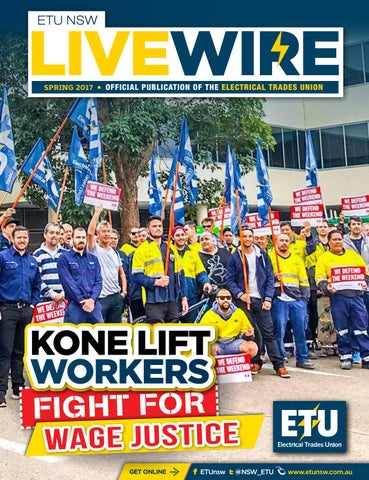
KONE LIFT WORKERS
F I G HT F O R wa g e j u s t i c e
Kone lift technicians escalated their fight for wage justice with extended industrial action, as went to print. A mass meeting on 10 August voted overwhelmingly to strike through to 15 August. Employees had returned to work on 2 August following an earlier six-day strike. Workers also backed rolling fourday stoppages.
The dispute centres on the failure of Kone management to make an acceptable pay offer after months of negotiation. Kone pays lower rates to employees working in Sydney compared to the company’s other locations including Melbourne and Brisbane. The pay parity issue has simmered for years. Kone workers intend to achieve a marked improvement in the enterprise agreement currently being negotiated.
ETU members say a company wages offer of 4 per cent per annum over three years does not sufficiently close the gap. A mass meeting in June unanimously rejected that offer. ETU and AMWU members united to demand a three-year agreement with annual pay rises of 6, 5 and 5 per cent. A protected action ballot saw 280 lift technicians and 70 fitters vote to authorise industrial action. A mass meeting on 21 July then voted overwhelmingly to strike. ETU and AMWU members walked off the job for six days from 27 July to 1 August. Workers met for a breakfast barbeque on the fifth day of the first stoppage, followed by a mass meeting and a march on Kone head office at Alexandria. The Kone strikers have received strong
$50,000
RECOVERED FOR
30 KONE APPRENTICES
10
/ SPRING 2017
support from lift workers at other companies, including Otis and Schindler, and from Kone employees around Australia. A combined meeting of construction industry union delegates voted to back Kone workers after hearing from ETU Secretary Dave McKinley and organiser Steve Bankes. Despite a return to work on 2 August, workers maintained an overtime ban. Company attempts to vary start and finish times to circumvent the ban were rejected by union members. ‘Our EBA says working times can only be varied by consent. The guys do not consent to revised times that would allow the company to cover work normally counted as overtime,’ said ETU Executive member Mal Hoy.
Kone apprentices were all smiles after banking thousands of dollars in backpay – thanks to union action and a positive response from the company. An ETU investigation revealed the young union members were being paid just a fraction of their rightful travel allowance. Thirty apprentices were owed amounts ranging from $1,000 to $5,000.
THAT MONEY IS NOW SAFE IN THEIR POCKETS.
Are you being paid your full entitlements?
Check with your ETU delegate or organiser
ETU delegates say Fight hard & win ‘Kone’s budget-driven approach has made us the lowest paid in the industry. We are understaffed, there’s a lack of training, skilled people are leaving. Guys have had enough. We have to fight hard and win.’
STEVE WILLIES Consultative Committee
But workers did accept a company request to resume use of ‘handheld devices’ -- Samsung phones with a Kone app that allocates work and monitors safety. ‘That is an act of good will from our side,’ said Mal. ETU members say the lack of equal industry pay is hurting the company as well as employees.
‘Some of our skilled people are leaving to work at competing companies. They are being replaced by electricians who, while qualified, need to be trained. That is evidence, not just of unequal pay, but of poor management,’ said Mal.
We need more ‘There was a strong vote to strike. Kone pay equivalent workers in Melbourne and Brisbane more than Sydney workers despite Sydney being a more expensive place to live, we just need a little bit more to settle this.’
MAL HOY ETU Executive & State Council
What we deserve ‘We want to put ourselves on par with other lift companies. There’s a big gap. We’ll never catch up unless we take action. It’s in the long-term interests of the company to pay us what we deserve.’
ANDY LEE lifT technician
SPRING 2017
/
11
SPECIAL REPORT
ETU BIENNIAL
2017 ‘WE MUST GROW TO BUILD POWER FOR MEMBERS’ ETU Secretary Dave McKinley’s keynote speech noted the challenges and opportunities ahead, and the pressing need to grow the union.
‘We must rebuild our strength and power to deliver for our members. That means an absolute focus on growth – new members, new shops, new contractors and new industries,’ said Dave.
ETU Biennial Conference brought together 120 ETU delegates from all industries and regions. ‘We must retain our identity as the electrical union, and the only way to do that is growth. Every single person working in the electrical field in NSW and ACT should be in the union.’
In recent months, the ETU has stemmed the membership decline. The challenge is to build steady growth and with that the power to win for members.
Recruitment of apprentices and other young electrical workers is the key to the ETU’s future. ‘Our growth strategy has a key focus on youth. Today’s apprentices are the ETU leaders of tomorrow,’ said Dave.
‘We have lost members in the past few years. The good news is we are now seeing growth over the past few months,’ said Dave.
The union will boost support and training for delegates across NSW and ACT. ‘Delegates are the heart of our union. Our workplace leaders will play a stronger role than ever before,’ said Dave.
SPRING 2017 LIVEWIRE / ETU NSW/ MAGAZINE / AUGUST 2014
‘Growth will rebuild our union’s power so we can change to laws to restore fairness to ETU workplaces.’
OUTSTANDING MEMBERS AWARDED LIFE MEMBERSHIP
Peter Finn
unwavering commitment During 18 years as an ETU delegate, Peter Finn was a rock for hundreds of union members employed by the company now called Essential Energy.
Glen Potter
Peter joined the ETU in 1989 as a meter reader for Northern Rivers County Council in Tweed Heads.
Glen Potter joined the ETU in 1984 as a humble trades assistant at Thirroul.
Nine years later he stepped up as a delegate when he saw long-held conditions come under attack.
experience & integrity
Thirty-three years later, Glen’s exceptional and sustained contribution has been recognised with ETU life membership. A former mine worker, Glen graduated as an electrical fitter mechanic in 1998 after putting himself through TAFE. By 1990 he was an ETU delegate but his role soon extended well beyond a delegate’s traditional duties. Glen played a pivotal role in establishing a rail delegates network that broke down barriers between ETU members working in different sections. The last five NSW rail enterprise agreements have featured Glen as a central leader on the union negotiating team. Glen’s judgement, experience and integrity are highly respected by workers and management alike. He was elected an ETU State Councillor in 2002, an Executive member in 2007 and a CEPU Trustee in 2011.
Peter continued the fight right up to his retirement in December 2015. Several managers who sought to intimidate employees met their match as Peter Finn stood up for the worker and saw the bullies off. There were some big battles and some hard times, but for the most part Peter enjoyed his ETU responsibilities. He worked in various jobs for Essential Energy before taking on his final role of asset inspector. Peter has been an ETU conference delegate since 2003 and an honorary member since 2015. ETU Life Membership recognises Peter’s extraordinary ability and commitment as a regional delegate, problem solver and mentor.
John Hannigan Jim MacFadyen 53 years of leadership
In 53 years as a union member, Jim MacFadyen has worked with eight ETU Branch Secretaries and contributed to every major campaign. Jim’s contribution to the union and its members was recognised when he was awarded National ETU Life Membership by National Secretary Allen Hicks. In 1964 Jim joined the ETU as an electrical fitter mechanic with Sydney Water. He left Sydney Water 43 years later, serving as shop steward from 1986. In 1999 Jim was elected President of the ETU NSW and the Divisional Branch of the CEPU, an ETU Executive Member and National Councillor. He was re-elected to those positions four times. In 2005 Jim was awarded Life Membership of the NSW ETU. In 2013 he became an Honorary Member. Jim was elected a Labor Councillor and Mayor of Gosford Council. He helped lead the ETU’s fight against electricity privatisation for 20 years. Jim’s National ETU Life Membership is a tribute to his outstanding leadership.
always strong
‘You have to keep the bastards honest’ – that thought has motivated more than 30 years’ union activism for lineworker John Hannigan. John is the veteran ETU delegate at Essential Energy’s Taree depot. He was born in Nowra and completed his apprenticeship during 10 years in Sydney. John has been involved in countless campaigns and disputes. One he is proud of was the defeat of the Carr Labor Government’s 1997 plan to privatise the NSW electricity sector. In cases at the Fair Work Commission, John has often been a witness, not intimidated by the presence of senior managers across the table. In one memorable hearing, John analysed and completely discredited the spreadsheets relied upon by the company. John supported other Essential Energy members in depots without a delegate. Through union work, he made lifelong friends at all levels of the ETU. Joining the union is the only protection electrical workers have, John believes. John first joined the ETU in 1979, was elected a delegate around 1993, and has been a Conference delegate since 2003.
SPRING 2017
/
13
E T A G E L E D E G A T L O V HIGH
OFFERS HELPING HAND
When Sydney Trains restarted its apprentice program in 2015, the response was enormous. The company’s offer of 50 training positions attracted 7,000 applicants – 1,700 passed the entrance test. The 2015 group of Sydney Trains apprentices broke some stereotypes – most were mature, many were already trade qualified, and some were female. Sydney Trains recruited further intakes in 2016 and 2017. By 2018, the company will have around 180 apprentices on the payroll. The ETU recognised this significant group of members with the election of the union’s first dedicated apprentice delegate, Prameesh ‘Pro’ Chandra. Like many of his rail colleagues, Pro brings extensive work and life experience to Sydney Trains. Pro qualified as a refrigeration and air-conditioning technician after finishing school in Western Sydney. He worked for Streets Ice Cream until 2014, when he took voluntary redundancy after some production shifted offshore. Then, during a casual stint as a trades assistant, Pro discovered the joys of high voltage electrical work. ‘I was working with a contractor for Endeavour Energy and I realised high voltage distribution would be a great trade. My take is it’s more interesting and actually safer than low voltage, because of all the rules and procedures that are followed,’ said Pro.
14
‘We all come to work to feed our families and pay the bills. We all need fair conditions, a decent wage and a safe workplace. I want to give a helping hand to anyone who is picked on or denied their rights. The only way we can protect and advance our interests is through collective action in our union,’ said Pro.
‘Eventually there was an uprising and CSR gave some land to my family. A local road was named after my grandfather, a banker. He was one of the few non-white men allowed to drink in the local pub in the early days,’ said Pro. It’s a life story that fuels Pro’s passion for social justice, unionism and a fair go for all.
‘We’re lucky to have the ETU as a trade-specific union that puts a lot back into our industry as well.’ Pro welcomed Sydney Trains’ recruitment of female apprentices and said he would encourage his 12-year-old daughter to consider a trade after finishing school. But Pro said the company’s apprentices face uncertainty from the threat of privatisation and because none are guaranteed positions once qualified in their APPRENTICE trades.
‘I liked that the tradesman had a lot of responsibility and earned good coin.’
Born in Fiji of Indian heritage, Pro spoke little English when he arrived in New Zealand as a sevenyear-old.
Now aged 34 and in the third year of a high voltage distribution apprenticeship, Pro is also a committed trade unionist and a former AMWU delegate from his days at Streets.
His great-grandparents were brought from India to the colony of Fiji by the British in the early 1900s. They worked as indentured labour,
/ SPRING 2017
planting and harvesting sugar cane for the Australian company CSR.
DELEGATE PRAMEESH 'PRO' CHANDRA
ZERO TOLERANCE
ASBESTOS
BRETT STEVENS
WARREN NEIL GLEN POTTER
LUCAS DOBOSZ
RAIL EBA TALKS TARGET PAY, SECURITY, OUTSOURCING
ETU members at Sydney Trains are bargaining to win decent pay rises, job security and limits on contracting out. A Combined Rail Unions log of claims lodged in July calls for a four-year agreement from September 2017, when the current EBA expires. ETU delegate Glen Potter said members need wage increases that keep their income ahead of inflation.
‘The costs of housing, electricity and other basics are going through the roof. We need pay rises that recognise our vital contribution to the rail network.’ The union claim calls for workers affected by any restructuring to be given priority for positions in the new structure. A committee to monitor outsourcing should be established, with contract workers entitled to the same rights and conditions as permanent employees. The ETU will ensure that relativities are maintained in a proposed classification review. Unions also seek to prevent management from manipulating rosters on public holidays. Domestic violence leave is included in the union claim. ‘Negotiations for rail EBAs have traditionally been long and drawn out,’ said Glen Potter. ‘The combined unions are well prepared and hopeful of settling this without unnecessary delay. If required, we will pursue backpay.’
DETECTED IN CIRCUIT BOARDS
The ETU will pursue the total removal of all asbestos from the Sydney rail system after fibres were detected in driver compartment circuit boards.
BEN LISTER
The union received information on 6 July that Sydney Trains had found asbestos in two classes of rolling stock. Organiser Ben Lister immediately informed ETU delegates and a safety notice was issued to all rail members. C sets and K sets were removed from the network for a week while an asbestos hygienist and Safework NSW conducted tests in consultation with unions. Following extensive testing, the driver compartments were declared safe. Areas containing asbestos were tagged and recorded on an online register. However the wider issue of asbestos in the network is far from resolved. An Asbestos Working Group has now been established including the ETU and other unions, management, and health and safety experts. Ben Lister said the union aims for better management of asbestos issues in the short term, and total removal in the longer term.
‘We have zero tolerance for asbestos. It is beyond dispute that even the smallest exposure can cause incurable fatal diseases such as mesothelioma. We hold Sydney Trains accountable for the asbestos that remains scattered throughout the rail network,’ said Ben. Ben encouraged ETU members to monitor and report any suspected asbestos across Sydney Trains operations. ‘We plan to deal with the asbestos threat methodically, section by section. Our delegates and members are our eyes and ears on the ground.
‘Contact us if you have any information that may assist our mission of eradicating this deadly substance,’ said Ben. SPRING 2017
/
15
der the spotlight un t en em ag an m e cl hi ve ’s Essential Energy fety incidents in June and July. after disturbing sa It takes skill and experience to steer a big borer crane – especially when you’ve got a jinker trailer in tow. ETU members drive these heavy specialist vehicles for Essential Energy. We take our responsibilities seriously. We don’t dice with danger. But we depend on management to get the basics right so our vehicles are safe for purpose. Our alarm bells went off when members reported borer cranes, towing jinker trailers, exceeded weight limits. In early June there was a confirmed case of a borer crane found overweight on the front axle, with other reports of the same outcome on back axles. ETU Assistant Secretary Justin Page alerted Essential to the issue but management refused to notify employees.
‘At that point we had to act to keep our members safe,’ said Justin, who issued an ETU Safety Ban on 7 June.
‘On top of the obvious dangers of driving overloaded vehicles, our members faced individual fines exceeding $2,200 for breaching their heavy vehicle licence.’ RATHER THAN FIX THE PROBLEM, MANAGEMENT PUT THE ETU IN THE FAIR WORK COMMISSION, ALLEGING ILLEGAL INDUSTRIAL ACTION The ETU lifted the Safety Ban on the proviso Essential Energy check all borer cranes and issue a safety alert. Essential weighed all borer cranes and found up to 10 per cent of the heavy vehicle fleet did not comply with RMS regulations. ‘The crazy thing is that penny-pinching at Essential may have caused this whole mess,’ said Justin. ‘We understand that the company chose to register the borer cranes in a cheaper category ETU that restricted ASSISTANT allowable weight.’
16
SECRETARY JUSTIN PAGE
/ SPRING 2017
Essential’s vehicle meltdown continued in July when the company’s fleet of around 500 Isuzu D-Max utilities was ordered off the road. Every vehicle had to be inspected and certified by a mechanic before it could be declared safe to operate. Just a few days later, all Essential Energy trailers were tagged out of service, ‘effective immediately’. This sudden and drastic action followed an incident on 6 July where a trailer ‘became detached from the tow vehicle and the safety chain failed’. The out-of-control trailer, which was carrying an all-terrain vehicle, travelled across the opposing lane and a footpath, then through a table drain before coming to rest against a tree, according to an official report. Drivers were required to take trailers off the road and inspect safety chains, couplings and other equipment. The company’s woes continued in late July when all ATVs were ‘immediately’ tagged out of service and sent for inspection.
‘This pattern of incidents raises questions about Essential’s vehicle oversight and safety procedures,’ said Justin Page. ‘The ETU will continue to monitor all vehicle safety concerns. We will not hesitate to act to protect our members’ safety.’
AUSGRID
EBA TALKS STALL No compromise on job security
Ausgrid management wants unfettered power to replace current employees with low-paid contractors. That is the only conclusion to be drawn from the company’s refusal to consider job security clauses in the next enterprise agreement.
At an EBA meeting in July, management rejected ETU proposals to cap forced redundancies and ensure any contractors are fairly paid. These issues go to the heart of the company’s vision post-2020, when job guarantees expire. ‘After five months of negotiation with the new owners, we are at an impasse over three key points,’ said ETU organiser Mark Buttigieg. ‘The first is the union’s proposed contracting out clause that would ensure any contractors are paid like rates of pay to Ausgrid employees. This is about protecting our members from a race to the bottom on wages and conditions. ‘The second point of contention is forced redundancies. Until July 2020 our members are shielded by job guarantees legislated when Ausgrid was privatised. The company’s refusal to negotiate any limit on forced redundancies after 2020 means management wants to retain the option of mass sackings,’ said Mark. ‘The third major issue concerns the pool of redeployees. The company rejected the ETU’s position that these workers should be offered meaningful work or given a significant incentive under the voluntary
redundancy program. This is symptomatic of the stagnant bureaucratic mindset we are seeing from management.’ At depot meetings held across NSW in June, ETU members vowed to draw a line in the sand over job security. David Costello, from the ETU negotiating committee, said two competing visions of the future are at stake. ‘The company plans to push us all over the cliff edge once the guarantees expire in 2020,’ said Dave, who works in network testing. ‘Management wants to extract every last dollar from the business. That will mean forcing out the current workforce and bringing in more vulnerable workers who will be kept insecure and paid peanuts.’
maintain the real value of our members’ wages,’ said Mark Buttigieg. Mark said the union was disappointed to find Ausgrid’s attitude unchanged under new owners that include industry super fund investors.
‘The company’s values as expressed in negotiations are not consistent with the values of unions and union members who support those superannuation funds.’
ETU members want to see a profitable harmonious Ausgrid that can grow into new areas such as contestable work. ‘That’s why a contracting out clause is essential. We need to stop management taking the low road. A contracting clause gives the company incentive to retain knowledgeable, experienced staff on decent conditions,’ said Dave Costello. ‘That would see Ausgrid keep the capacity to deliver its core services and tender for new work that can generate jobs, growth and profit.’ Negotiations around several other issues continue but the ETU will not compromise on job security. ‘We are determined to achieve pay rises that
DAVID COSTELLO
ETU members want to see a profitable harmonious Ausgrid that can grow into new areas such as contestable work. SPRING 2017
/
17
SPORTING MEMBERS
SPLIT DECISION
puts sparkie on world stage ETU member David Toussaint maintained his undefeated record after beating US fighter Shane Mosley Jr in Brisbane in July. The 26-year-old sparkie dominated the early stages to clinch a majority decision over eight rounds.
Horse part-owned by ETU member wins $2,191,075
ETU member Tony Agius has been in the racing game longer than he can count, but he’s never had one like Le Romain. The four-year-old bay gelding has a stunning record of 18 starts for 6-8-1. Three of those wins came at Group 1 level as Le Romain saluted in ETU blue and gold, with jockeys wearing the ETU lightening bolt. Blessed with a calm temperament, the horse has claimed more than $2 million in prize money. Tony, an electrician working in construction, anticipated more glory with Le Romain set to resume in August.
We’re pretty confident about his prospects,’ said Tony. ‘You could do worse than follow him this spring.
His fight on the Pacquiao-Horn undercard was broadcast live to Australia and the US. ‘Diamond’ Dave Toussaint is a power-punching southpaw who worked as an electrician in Canberra’s construction industry until 18 months ago. He was an Electrogroup apprentice before working for contractor Fredon.
Dave’s decision to quit and train full-time paid off with his big win, but the middleweight fighter maintains his ETU card. His vanquished opponent is the son of former world champion ‘Sugar’ Shane Mosley. Dave’s corner includes his father Dean and coach Garry Hamilton. After narrowly missing selection for the 2012 Olympics, Dave’s professional record now stands at 11-0, with 8 by KO. Dave has his sights set on an Australian title. The ETU will cheer him on.
Ben and Wilbur ETU fishing champs
Essential Energy workers Ben Price and Wilbur Wilson are two of our union’s gun anglers. Ben fishes mainly in southern and central NSW while Wilbur lives right on the Murray River. Ben’s top catches include huge cod, yellowbelly and brown trout. Wilbur, who takes an annual trip to ocean fish off Darwin, has landed massive murray cod, barramundi and Spanish mackerel.
18
Great work, guys! We know there are many keen fisherpeople in the ETU ranks, so send us your pics. / SPRING 2017
The great strike of 1917 and its relevance today Electrical trades workers and the ETU were front and centre in one of the greatest industrial upheavals in Australian history. Close to 100,000 workers walked off the job for over a month in what became known as the Great Strike of 1917.
The massive dispute began 100 years ago when employees at the Eveleigh rail workshops and Randwick tramsheds downed tools to protest management plans to intensify work. The introduction of multiple time cards measuring productivity was the formal trigger for the action, but the rapid spread of the strike reflected deep anxiety among working people across many industries. During the First World War, Australians experienced soaring prices, a wage freeze, high unemployment, the loss of basic rights and a push for military conscription. Within a week, the strike had spread from Sydney’s railways to industries throughout NSW and then to Victoria and Queensland as workers refused to deal with goods handled by scab labour. In NSW, 77,350 workers were involved – 14 per cent of the workforce and 33 per cent of trade union members. Men, women and children joined massive community demonstrations to support the strike. The conservative NSW Government and big business interests set out to crush the strike and destroy the trade union movement. Scabs were recruited from private schools and rural areas and promised permanent positions replacing striking workers. An armed strikebreaker shot and killed Merv Flanagan, a member of the carters’ union, on Pyrmont Bridge Road. The killer, the brother of a Nationals MP, escaped punishment. The State Government refused to give relief
to hungry women and children as families suffered through the long dispute. After more than five weeks, the strike was officially defeated. It was a crushing loss that saw 22 unions deregistered, thousands of activists black-banned and the balance of power shift decisively to employers. But, in the longer term, the Great Strike of 1917 had a fundamental and enduring impact on the NSW and Australian labour movement. ETU member Doug Vincent said significant Labor leaders including Ben Chifley (Prime Minister 1945-49) and J.J. Cahill (NSW Premier 1952-59) were rail workers active in the strike. ‘The strike was heavily defeated but it motivated many and these great leaders emerged. The union movement as a whole learned pivotal lessons from that struggle,’ said Doug, an electrical fitter and project manager on the Central Coast.
‘It was a turning point because unions realised it wasn’t enough to organise workers. Unions needed a political arm that could win government, change laws and implement policy.’ Issues at the heart of the Great Strike of 1917 still resonate today. In modern Australia, workers are struggling with increasingly insecure, intensified and automated work. Conservative governments have used antiunion laws to clip the wings of the trade union movement and attack wages and conditions. But, just as in the aftermath of 1917, there is a determination in today’s labour movement to rebuild and ensure working people receive a fair go.
SPRING 2017
/
19
S N O S A E R 10 O T D E WE NE
1
INEQUALI AT 76-YEA
Income inequality is a Profits growth is the years, wage growth t
If we don’t change co be a society of extrem dead-end jobs.
If you take away the r and their unions, peo their work becomes m
4 Our parents and grandparents fought hard to make Australia fair.
Too many employers d workers and refuse to superannuation. The c wage theft too easy a too light. Wage theft i that in some places it’
But, over the past 30 years, we have seen our rights and protections wound back. Australia is becoming more unequal.
The rules are broken. We need to change the rules. 7 ACTU SECRETARY SALLY MCMANUS
What you can do 20 / SPRING 2017
PENALTY RATES CUT FOR UP TO 700,000 Penalty rates compensate us for working unsociable hours. For many, penalty rates are an essential part of a living wage. But now 700,000 workers across several sectors (without an EBA) can have their penalty rates cut. This could spread to other industries – like transport, the electricity sector, construction. Some of Australia’s lowest-paid workers could lose $1.42 billion in wages each year.
WAGE THE BUSINESS
8
Recovering wages thr too difficult. Recoveri through the tax office need to change the ru
EPIDEMIC INSECURE
Only 60 per cent of w part-time ongoing em four million are engag short-term contracts, ‘independent’ contrac make it too difficult to work. The result is an workers with no sick l job security and little
The rules need to chan and our lives, more se
Encourage your workmates, friends and family to join t
www.australianunio
ITY AR HIGH
2
at a 76-year high. strongest for 15 the lowest on record.
The Government wants to give a $65 billion tax cut to big business. But many already avoid paying their taxes. In 2014-2015 10 companies that paid no tax at all had combined revenue of $33 billion. Every billion dollars in avoided tax could pay for 6,500 nurses and teachers , 17 new high schools or a 400-bed hospital.
ourse Australia will me inequality and
rights of workers ople get paid less and more insecure.
EFT IS A S MODEL
5
ange to make our jobs, ecure.
In Australia today there is no right to strike, except for exceptional circumstances.
6
Under current workplace laws, big business can’t be held accountable. The law used to allow for conciliation. If necessary, decisions could be reached by an independent umpire. Disputes were sorted out easily and quickly. Now the Commission has lost the power to arbitrate. If an employer breaches an award or agreement the only remedy is complicated and expensive court processes.
rough the courts is ing superannuation e is even harder. We ules.
workers are in full or mployment. Another ged as casuals, on in labour hire or as ctors. Our work laws o protect permanent emerging class of leave, no holidays, no bargaining power.
SIMPLE DISPUTES CAN’T BE RESOLVED
NO LABOUR MARKET TESTING, VISA WORKERS EXPLOITED In a workforce of 12 million people there are 1.3 million people in Australia on temporary working visas. These workers are highly vulnerable to exploitation. The temporary work visa program has been growing for years. We need to maximise jobs and training opportunities for local workers. Employers must make a genuine effort to find and train local workers.
ENTERPRISE BARGAINING IS BROKEN The rules on enterprise bargaining are unbalanced. Bosses found ways to exploit them. Employers use tactics such as outsourcing, offshoring, labour hire and terminating agreements to avoid paying fair wages and conditions. The enterprise bargaining system aimed to provide fair conditions in exchange for improved productivity. Productivity is up, but companies failed to share those benefits with workers.
This must change.
9
STRIKE ACTION IS EFFECTIVELY OUTLAWED A worker’s right to withdraw their labour is a fundamental freedom. But under our laws, strikes can only happen during bargaining. At other times, workers and their unions face dire consequences including the sack, financial penalties and court action.
Australia needs a fairer, more efficient tax system. We need to close the loopholes.
deliberately underpay o pay mandatory current laws make and the punishment is now so common ’s the business model.
OF E WORK
OUR TAX SYSTEM IS BROKEN
3
10
THE ABCC STRIPS AWAY LONG-HELD RIGHTS The ABCC and its Construction Code strip away basic rights and threaten workers with criminal offences. The ABCC denies workers the right to silence. Workers can be jailed or fined $36,000. Unions face fines of $180,000. The Government wants to apply the ABCC model to other industries, including electricity. Australians rejected WorkChoices – but the ABCC introduces many of the same anti-worker rules by the back door.
their union > Talk about why we need to change the rules > Sign up for campaign updates AT
ons.org.au/change_the_rules SPRING 2017
/
21
ETU IN A NSW LABOR CON
SPECIAL REPORT
Five great ETU ideas that are now NSW Labor policy ETU delegates fought and won several policy motions that advance the interests of ETU members.
1
Labor commits to no further privatisation of the NSW electricity sector. Where possible, Labor will buy back shares in the electricity distribution networks. This means, under a NSW Labor Government, 100 per cent of Essential Energy and 49.6 per cent of Ausgrid and Endeavour Energy will remain in public hands. When shares become available, Labor should buy back a minimum of 0.5 per cent of Ausgrid and Endeavour. The ETU estimates these companies could be brought back into majority public ownership for as little as $240 million.
2 3 4 5
A mandated 15 per cent ratio of apprentices in all NSW Government employment and State Government-funded projects. This would create 20,000 new apprentice and trainee positions each year. Reform of the Fair Work Act and abolition of the ABCC and Construction Code. Conference called on federal Labor to fix the broken industrial relations system to restore fairness and balance. Regulation on the use of labour hire to ensure workers are protected. Labour hire companies must be licenced, run by a fit and proper person and will be subject to regular audit and compliance checks. NSW Labor committed to act on this reform if elected in 2019. NSW Labor to establish an independent electrical testing and licencing regulator. The solution proven in Victoria to improve the overall quality of the electrical trade including teaching outcomes.
Q&A: Why we work with Labor
22
We asked ETU Secretary Dave McKinley about the union’s work with NSW Labor.
SPRING 2017 LIVEWIRE / ETU NSW/ MAGAZINE / AUGUST 2014
Why is the ETU affiliated to & active within the NSW Labor Party? We are involved with Labor for one reason only: to protect and advance the interests of our members, their families and communities.
ACTION AT 2017 NFERENCE
There was a real sense of history as I took my seat on the conference floor at Sydney Town Hall.
My first Labor conference
As I watched the debates, I imagined the great leaders and political battles that RORY FLETCHER IS AN ELECTRICAN have taken place at this WITH AUSGRID, OURIMBAH same venue. With the ETU delegation, I got a ringside view of democracy in action at my first NSW Labor Conference. A highlight was Bill Shorten’s speech. He won a standing ovation for his passionate agenda on closing the inequality gap and changing the industrial laws. Conference is also a wonderful social event. You meet people from all over the ETU and the ALP. I’ve been an ETU member for over 10 years, but I wasn’t politically active until 2015. That year I put my hand up to join the Stop the Sell Off campaign. I could see the damage that electricity privatisation would bring. Sadly our predictions were proven right, with skyrocketing energy bills and massive job losses. I joined Labor around the same time. Labor is the only party that represents both social and working values and is affiliated with trade unions. I wanted to contribute from inside the tent. I’ve been involved with some great local campaigns with the Central Coast Community Unions Alliance, including two winning elections in Gosford. I encourage ETU members to get involved. Understand the potential of people power. That is what scares our opponents. As an individual you have the power of one, as a collective we have the power of many.
By Rory Fletcher
As Gandhi said: be the change you wish to see in this world.
What has the ETU’s support for Labor achieved for our members? Over more than 100 years, we’ve built political power that delivered excellent outcomes for ETU members at work, along with social policies that support our people in the rest of life.
Does the ETU work with other political forces? We work with anyone who supports our members. Our Stop the Sell Off campaign drew support from The Greens, Shooters and Fishers and others. Equally, we took on Labor when Labor acted to hurt our members.
Do rank-and-file ETU members have a say in the union’s political work?
Find out more about joining Labor
Together we can build The majority of our delegation to the 2017 NSW Labor Conference political power and win was rank-and-file. We invite and change for ETU members. encourage every ETU member to join Labor and to work with us to achieve positive change. nsw.asn.au 858 OR 0408 231SPRING 2017paull@etu
CONTACT PAUL LISTER /
23
TIME TO GIVE YOUR UNDERPERFORMING SUPER FUND THE CHOP? At NESS Super, we help you get the most from your super. In fact, our investment returns have been outperforming others consistently over the long run. So if you want to power your financial future, switch to NESS Super today, the super fund purpose-built for electrical contractors.
All profits to members Consistent long term returns Insurance designed for electrical contractors
For a hassle-free switch Contact Mynas Leontios on 0448 432 443 or email mynasl@nesssuper.com.au nesssuper.com.au
Disclaimer: The information contained in this document is up-to-date at the time of its publication. However, some information can change over time. The contents are for general information only and do not constitute personal advice. We recommend that you consult with a suitably qualified person before making any financial decisions. Issued by NESS Super Pty Ltd ABN 28 003 156 812 AFSL 238945 RSE L0000161 MySuper Authorisation 72229227691044 as trustee of NESS Super ABN 72 229 227 691 RSE R1000115.
NESS 53011
Superannuation | Pensions | Insurance | Financial Advice
ENERGISE
ASK AARON...
FACING A WORKPLACE INVESTIGATION? CA LL ETU FIR ST
I frequently hear from members who face workplace conduct investigations and are being threatened with termination of their employment. When I ask members who represented them during meetings, the answer is usually no-one. They didn’t call the ETU because they thought they could handle the process themselves. Unfortunately, most employers will have already lawyered up, built their case and have a show cause letter written with the member’s name on it before the meeting.
IF YOU WANT TO ASK ETU LEGAL OFFICER AARON MCKINNON A QUESTION
Please email askaaron@etunsw.asn.au
Members have a right to representation and a right to access and respond to evidence that the employer is relying on to make the allegations. Contact the union or your organiser at first notice of any workplace investigation process. We can represent you and force the employer to play fair. Usually, we can get you access to information and pick apart the allegations before the matter can progress to termination. So if you or a workmate get invited to a meeting to discuss workplace conduct issues, contact the ETU before agreeing to meet. We can always have a meeting delayed in order for you to have appropriate representation present.
HOW DEAN AND GARY turned their lives around
Gary and Dean are living proof that, with the right support, you can beat addiction and turn your life around. Both worked in construction and contracting before losing their way under the influence of ice and other destructive substances. Today they and many others are clean and sober thanks to expert support from Foundation House, a rehabilitation facility at Lilyfield.
Foundation House is supported by the ETU and other unions and has a special relationship with construction and electrical workers. The organisation runs residential and outpatient programs targeting drug, alcohol and gambling addictions. Those programs pulled formwork carpenter Dean back from the brink after a five-year plunge into heavy drinking, uncontrolled gambling and, finally, ice. Dean a former CFMEU member, went off the rails after he split with his wife and two-year-old daughter in 2011.
He was in poor shape when he arrived at Foundation House in February this year. ‘I was paranoid and couldn’t talk about my problems. The people at Foundation House opened me up and now I’ve been clean for six months. I’m ready to start working again,’ said Dean. Gary lost his way after arriving in Sydney from Singapore to study a postgraduate degree. He worked as a trades assistant before entering a ‘dark time’ from 2008 when the drugs ice and GHB took control.
After repeated overdoses, he was referred to Foundation House in 2015 and has now been clean for more than two years.
‘I felt loved at Foundation House. Now I’m at TAFE studying drug and alcohol counselling. My aim is to work here at Foundation House,’ said Gary.
Need support? Contact Foundation House
(02) 9810 3117 nhouse.net.au www.foundatio SPRING 2017 /
25
ETU SCHOLARSHIP CAREER BOOST for PHIL
PHILLIP NGUYEN
After two false starts, Phillip Nguyen has ambitious plans for an electrical career. The mature-age first-year apprentice has enrolled in a Diploma in Electrical Engineering but faced $8,000 in costs for the two-year course.
really got me over a hump with the fees,’ said Phillip. Twenty-two-year-old Monica Cusack was excited to learn she has been awarded one of six ETU Education Scholarships.
Now Philip is breathing easier thanks to a $2,000 ETU Education Scholarship.
She was eligible thanks to her father Tim, a loyal ETU member and lift technician with Thyssen Krupp.
‘I’m grateful to the union for this opportunity. It’s taken a big part of the financial burden off,’ said Phillip.
DALE PETERSEN
Now 32 years of age, Phillip tried two career paths before settling on the electrical trade. He completed a commerce degree and worked as a human resources manager before giving that up to run a tropical fruit farm in Far North Queensland. But his plans to live off the proceeds of lychees, rambutan and mangos were dashed by three consecutive drought years and failing machinery. Philip won a place in Sydney Trains’ 2017 apprentice intake but is already looking ahead to turbocharge his career. ‘I talked to some of the engineers at work and they pointed me towards the diploma. I enrolled but as a first-year apprentice my income is limited. The ETU Scholarship has
About ETU Education Scholarships Up to six $2,000 Scholarships are awarded each year for study at diploma level or higher. ETU members, their children and grandchildren can apply.
APPLICATIONS FOR THE NEXT ROUND ARE NOW OPEN AND CLOSE IN JUNE 2018
MONICA CUSACK
You can download an application form at: http://www.etunsw.asn.au/ MemberBenefits/extra-benefits OR call the ETU office on (02) 9267 4844 and ask for a form to be emailed to you.
GYMEA UNION CLUB BACKS CAMBODIAN SCHOOLKIDS Hundreds of children from a poor Cambodian village now have a real chance in life, thanks to the Sutherland District Trade Union Club.
26
The club, better known as ‘Tradies’, has raised more than $600,000 since 2013 to directly fund education in the village of Kauk Prech, on the Thai-Cambodia border. The money built a primary school, improved a middle school, employed teachers and provided vital resources from textbooks to uniforms. The Tradies Schools for Cambodia program
will support villagers throughout their school years in one of the region’s poorest nations. ‘It’s a great example of trade union values and community action making a real long-term difference,’ said ETU Secretary Dave McKinley. Tradies has thrived since the club’s foundation by trade union supporters in 1960. The Gymea club has twice been awarded NSW Club of the Year.
CAN YOU HELP TRADIES SCHOOLS FOR CAMBODIA?
/ SPRING 2017
FIND OUT MORE www.tradiesschoolsforcambodia.com
Why join EISS Super? $5 FUM
BILLION
ALMOST 22,000
MEMBERS
We deliver on our commitment to members – value for money, outstanding service and solid long term investment returns. We provide quality superannuation, retirement, education and financial planning services to our members and employers. We are proud to be one of the lowest cost superannuation funds in the market.*
To join an award winning fund. Visit
eisuper.com.au/join or call 1300 369 901.
NDING VA STA L UT
UE
O
Established in 1997, with origins dating back to 1919, we are committed to working hard for our members so they can enjoy the retirement lifestyle they desire. Historically, EISS was exclusively available to the energy industry in NSW. Then in 2013, we opened our fund to everyone so they could join a multi-award winning industry super fund, run only to benefit members.
We are here to help
EISS_ETU_40031 07/17
N
S
UP IO ERA NNUAT
*SuperRatings ‘Which funds have the lowest fees’ September 2016. The information in this document is current as at the date of issue, is of a general nature only and has been prepared without taking account of your objectives, financial situation or needs. Before acting on this information or making an investment decision about whether to acquire, hold or sell a financial product, you should consider its appropriateness having regard to your objectives, financial situation and needs and read the relevant Product Disclosure Statement which is available at eisuper.com.au or by contacting Member Services on 1300 369 901. This document is issued by Energy Industries Superannuation Scheme Pty Limited ABN 72 077 947 285 (the Trustee), RSE Licensee L0001373 and AFS Licence 441877 as trustee for Energy Industries Superannuation Scheme Pool A ABN 22 277 243 559, RSE R1004861 - Pool B ABN 64 322 090 181, RSE R1004878 (the Scheme). Throughout this document the Trustee may be referred to as ‘EISS’, ‘EISS Super’, ‘EISS Advice’, ‘EISS Financial Planning’, ‘we’, ‘us’ or ‘our’. SuperRatings does not issue, sell, guarantee or underwrite this product. Go to www.superratings.com.au for details of its ratings criteria.
2017/2018 CONTRIBUTIONS (JULY 2017 – JUNE 2018) ARE NOW DUE Members who usually save by taking out ANNUAL TICKETS are reminded to do so by the 31st AUGUST 2017
The ANNUAL TICKET RATES for 2017/2018 are ADULTS employed as TRADESPERSONS or in classifications receiving equal to or in excess of tradesmen’s rates of pay – $536.36 contributions + $10.00 Distress & Mortality Fund Levy + $54.64 GST .............................................................................................. $601.00 NON TRADESPERSONS & ADULT PROCESS WORKERS employed in classifications receiving less than tradesmen’s rates of pay – $449.09 Contributions + $10.00 Distress & Mortality Fund Levy + $45.91 GST............................................................................................... $505.00 1ST YEAR APPRENTICES $99.09 Contributions + $10.00 Distress & Mortality Fund Levy + $10.91 GST................................................................................................. $120.00 2nd YEAR APPRENTICES $174.55 Contributions + $10.00 Distress & Mortality Fund Levy + $18.45 GST .............................................................................................. $203.00 3rd YEAR APPRENTICES & JUNIOR PROCESS WORKERS $248.18 Contributions + $10.00 Distress & Mortality Fund Levy + $25.82 GST............................................................................................... $284.00 4th YEAR APPRENTICES $321.82 Contributions + $10.00 Distress & Mortality Fund Levy + $33.18 GST .............................................................................................. $365.00 ANNUAL TICKETS may only be issued to Members who are financial to 30/06/17 and must be taken out by the 31st August 2017.
CONTRIBUTION RATES
(OTHER THAN ANNUAL TICKETS) ENTRANCE FEE IS EXTRA** ADULTS employed as TRADESPERSONS or in classifications receiving equal to or in excess of tradesperson’s rates of pay – Yearly contributions............................................................ $595.48 + $10.00 D&M* + $60.52 GST.......................................................................$666.00 1st Quarter (1.7.17-30.9.17)............................................... $148.87 + $10.00 D&M*+ $15.13 GST........................................................................$174.00 2nd, 3rd & 4th Quarters...................................................... $148.87 + $15.13 GST................................................................................................. $164.00 NON TRADESPERSONS & ADULT PROCESS WORKERS employed in classifications receiving less than tradesperson’s rates of pay – Yearly contributions............................................................ $499.08 + $10.00 D&M* + $50.92 GST.......................................................................$560.00 1st Quarter (1.7.17-30.9.17)............................................... $124.77 + $10.00 D&M*+ $12.73 GST........................................................................$147.50 2nd, 3rd & 4th Quarters ..................................................... $124.77 + $12.73 GST................................................................................................. $137.50 1ST YEAR APPRENTICES Yearly contributions............................................................ $110.00 + $10.00 D&M* + $12.00 GST.......................................................................$132.00 1st Quarter (1.7.17-30.9.17)............................................... $27.50 + $10.00 D&M*+ $3.00 GST................................................................................$40.50 2nd, 3rd & 4th Quarters ..................................................... $27.50 + $3.00 GST.........................................................................................................$30.50 2ND YEAR APPRENTICES Yearly contributions............................................................ $193.64 + $10.00 D&M* + $20.36 GST.......................................................................$224.00 1st Quarter (1.7.17-30.9.17)............................................... $48.41 + $10.00 D&M*+ $5.09 GST................................................................................$63.50 2nd, 3rd & 4th Quarters ..................................................... $48.41 + $5.09 GST.........................................................................................................$53.50 3RD YEAR APPRENTICES & JNR PROCESS WORKERS Yearly contributions............................................................ $275.44 + $10.00 D&M* + $28.56 GST.......................................................................$314.00 1st Quarter (1.7.17-30.9.17)............................................... $68.86 + $10.00 D&M*+ $7.14 GST................................................................................$86.00 2nd, 3rd & 4th Quarters...................................................... $68.86 + $7.14GST......................................................................................................... $76.00 4TH YEAR APPRENTICES Yearly contributions ........................................................... $357.28 + $10.00 D&M* + $36.72 GST.......................................................................$404.00 1st Quarter (1.7.17-30.9.17)............................................... $89.32 + $10.00 D&M*+ $9.18 GST.............................................................................$108.50 2nd, 3rd & 4th Quarters ..................................................... $89.32 + $9.18 GST....................................................................................................... $98.50 *Distress and Mortality Levies are paid by all members who join the Union before reaching the age of 50 years. **Entrance Fees ($11.00 including GST) are PAYABLE by all new members except 1st Year Apprentices
/ SPRING 2017
Dave McKinley Secretary