Bitcoin vs. Altcoins: How to Build a Balanced Crypto Allocation by Ethan Heller
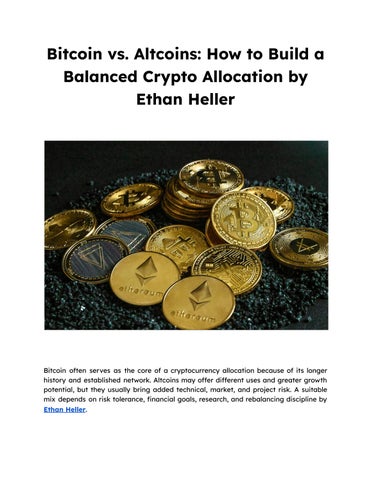
Bitcoin often serves as the core of a cryptocurrency allocation because of its longer history and established network. Altcoins may offer different uses and greater growth potential, but they usually bring added technical, market, and project risk. A suitable mix depends on risk tolerance, financial goals, research, and rebalancing discipline by Ethan Heller.
Understanding Bitcoin and Altcoin Allocation Crypto prices can move sharply in either direction, turning a sensible allocation into an unbalanced portfolio surprisingly fast. That makes the Bitcoin vs. altcoins decision less about predicting the next winner and more about controlling exposure to uncertainty. Bitcoin and altcoins do not have identical risk profiles. Bitcoin has a clearer monetary thesis, a fixed maximum supply under its current protocol rules, and a longer operating record. Altcoins cover thousands of projects with different technologies, economic models, leadership structures, and levels of adoption. Some may develop useful networks. Others may lose relevance or fail. The right allocation is therefore not a universal percentage. It is a risk-management decision based on how much of the total portfolio is placed in crypto, how that crypto portion is divided, and how the investor plans to respond when prices change.
Bitcoin vs. Altcoins: The Main Difference for Investors Bitcoin is a decentralized digital asset built around a limited-supply model. Its governing program limits the total number of bitcoins that can be mined to 21 million. Investors should verify current protocol information before publishing or making financial decisions. An altcoin generally refers to a cryptocurrency other than Bitcoin. However, grouping every altcoin can be misleading. The category may include: ● ● ● ● ● ● ● ●
Smart-contract network tokens Payment-focused cryptocurrencies Governance tokens Stablecoins Exchange-related tokens Gaming and metaverse assets Privacy-focused coins Tokens connected to decentralized finance applications
These assets can behave differently from one another. Even so, many share risks that may be less prominent in Bitcoin. These include project leadership risk, token dilution, uncertain demand, software vulnerabilities, and dependence on a small development team.
Why Bitcoin Often Becomes the Core Crypto Holding Bitcoin is commonly treated as the anchor of a crypto portfolio rather than simply another coin. That does not make it safe or guarantee positive returns. It means its investment thesis is generally easier to define and monitor. Potential reasons for using Bitcoin as the core include: ● ● ● ● ● ●
A longer operating history than newer crypto projects Broad market recognition A transparent issuance schedule A large and distributed network A relatively simple store-of-value thesis Fewer project-specific features to evaluate
Bitcoin remains highly volatile and speculative. Investors can experience substantial losses, and some crypto trading platforms may not provide the protections associated with traditional financial institutions. Only money that can be lost without affecting essential financial goals should be placed at risk.
Why Investors Consider Altcoins Altcoins may provide exposure to uses that Bitcoin was not designed to prioritize. A smart-contract network, for example, may support applications, tokenized assets, games, or financial services. This wider range of uses can create growth opportunities. It also creates more questions. An investor must evaluate whether a network is attracting genuine activity, whether its token is necessary, and whether that activity creates lasting demand for the token. Altcoin prices may also rise rapidly during speculative market periods. That possibility can encourage investors to chase recent performance. A high return, however, does not prove that a project has durable value.
Questions to Ask Before Buying an Altcoin Before adding an altcoin, investigate: ● What problem does the network solve? ● Why does the project need a tradable token?
● ● ● ● ● ● ● ●
How are new tokens issued? Who controls development and governance? Is ownership heavily concentrated? Does the network have active users and developers? What competing projects offer similar features? Has the code received credible security reviews? Where can the asset be bought, sold, and stored? What event would invalidate the investment thesis?
If these questions cannot be answered clearly, the asset may not deserve a place in the portfolio.
Start With the Total Crypto Allocation A common mistake is deciding how to divide a crypto portfolio before deciding how much cryptocurrency belongs in the overall investment plan. Asset allocation begins with the complete portfolio, including cash, stocks, bonds, retirement accounts, property, and other investments. Diversification spreads investments within and across asset classes. Rebalancing restores the selected targets when market movements cause the portfolio to drift. Before comparing Bitcoin and altcoins, consider: ● ● ● ● ● ● ● ●
Financial goals Investment time horizon Income stability Emergency savings Debt obligations Ability to withstand a major loss Experience with volatile investments Need for near-term access to the money
An investor who may need the funds soon will usually have less capacity for crypto volatility than someone investing nonessential money for a long-term goal.
Three Ways to Structure a Crypto Allocation No allocation model fits every investor. The following frameworks are educational examples, not recommendations.
Allocation Approach
Bitcoin and Structure
Altcoin General Profile
Bitcoin-Focused
Higher Bitcoin share and lower altcoin share
Prioritizes the more established crypto network while limiting project-specific altcoin exposure. This approach may suit investors who want a simpler crypto portfolio with fewer assets to research and monitor.
Core and Satellite
Bitcoin forms the majority, while altcoins form a smaller portion
Uses Bitcoin as the main crypto holding with smaller positions in carefully researched altcoins. This approach may suit investors who want a clear core position with limited exposure to other blockchain technologies.
Broad Speculative
Lower or balanced Bitcoin Accepts greater project, share and higher altcoin liquidity, technical, and exposure concentration risk. This approach may suit experienced investors who understand the possibility of severe losses and can research multiple projects in depth.
These allocation descriptions apply only to the crypto portion of a portfolio, not the investor’s entire investment portfolio. For example, suppose an investor limits crypto to 5% of a total portfolio and chooses an 80% Bitcoin and 20% altcoin split. Bitcoin would represent 4% of the complete portfolio, while altcoins would represent 1%.
This example only demonstrates how the calculation works. It does not suggest that a 5% crypto allocation or an 80/20 split is appropriate for a particular investor.
Avoid False Diversification Owning many coins does not automatically create meaningful diversification. Several altcoins may depend on the same technology, market narrative, source of liquidity, or group of investors. During a broad crypto selloff, many digital assets may fall at the same time. A portfolio containing 15 highly speculative tokens may be less resilient than one containing only a few carefully researched holdings. Diversification should be judged by underlying risk, not coin count. Investors should examine: ● ● ● ● ● ● ● ●
Network purpose Technical design Token economics Adoption drivers Trading liquidity Custody method Regulatory exposure Dependence on founders or intermediaries
Stablecoins should also be evaluated separately. A stable price target does not remove reserve, redemption, counterparty, operational, or regulatory risk.
Use Position Limits and Rebalancing Rules A written plan can help prevent fear and excitement from controlling allocation decisions. The plan may specify: 1. The maximum percentage of the total portfolio allowed in crypto. 2. The target split between Bitcoin and altcoins. 3. The maximum size of an individual altcoin position. 4. How often the portfolio will be reviewed. 5. How far an allocation may drift before rebalancing. 6. The conditions that would justify selling a project.
Rebalancing may involve selling an asset that has grown beyond its target or directing new contributions toward underweight holdings. Frequent trading can increase costs and create tax consequences, so the schedule should be deliberate. Dollar-cost averaging is another possible tool. It involves investing equal amounts at set intervals. This approach can reduce the pressure to choose a perfect entry point, but it cannot prevent losses. It may also produce lower returns than investing a lump sum when prices rise during the purchasing period.
Account for Custody, Taxes, and Platform Risk Allocation decisions should include more than price risk. Investors must also determine how their assets will be held. Crypto wallets hold the private keys used to access crypto assets, not the assets themselves. Losing a private key or exposing it through a scam can result in permanent loss. Basic security precautions include: ● ● ● ● ● ● ●
Using strong and unique passwords Enabling multi-factor authentication Protecting wallet recovery phrases Avoiding unknown links and applications Confirming wallet addresses before transfers Keeping long-term holdings separate from trading funds Reviewing the security history of custodians and platforms
U.S. investors should also maintain detailed transaction records. Sales, exchanges, rewards, payments, and other digital asset transactions may have tax consequences. Requirements can change, so current information should be confirmed with the IRS or a qualified tax professional before publishing or filing a return.
A Practical Crypto Allocation Checklist Before investing, ask: ● ● ● ●
Is the emergency fund complete? Is high-interest debt under control? Can the entire crypto allocation be lost without affecting essential goals? Is there a clear reason for owning each asset?
● ● ● ● ● ●
Has token supply and ownership concentration been reviewed? Are custody and account-security procedures in place? Is the position liquid enough to exit when needed? Are accurate tax records being maintained? Is there a written rebalancing rule? Was the decision made independently of social-media hype?
If several answers are no, the allocation may be too large or too complex.
Frequently Asked Questions Is Bitcoin safer than altcoins? Bitcoin may carry less project-specific risk than many altcoins because of its longer history and established network. It remains a speculative and highly volatile asset that can still produce substantial losses.
How many altcoins should a portfolio contain? There is no ideal number. Each additional asset should have a clear purpose and a research-backed thesis. Adding coins merely to increase the number of holdings can create complexity without meaningful diversification.
Should investors buy Bitcoin and altcoins at the same time? They can, but the timing should follow a written plan rather than market excitement. Some investors build a Bitcoin core first and add smaller altcoin positions only after completing further research.
How often should a crypto portfolio be rebalanced? Some investors review allocations on a calendar schedule, such as quarterly or annually. Others rebalance when a holding moves beyond a predetermined limit. The chosen method should consider trading costs and possible tax consequences.
Can altcoins outperform Bitcoin? Individual altcoins can outperform Bitcoin during certain periods. They can also experience larger losses, lose liquidity, or fail. Past outperformance does not prove that future returns will continue.
Build the Allocation Around Risk, Not Excitement The Bitcoin vs. altcoins decision should begin with the total amount of risk the investor can accept. Bitcoin can serve as the core of a crypto allocation, while carefully selected altcoins can provide limited exposure to other technologies and use cases. Neither category is guaranteed to produce gains. Set a total crypto limit, research every holding, control individual position sizes, and rebalance according to written rules. Before acting, verify current tax and regulatory information and consider consulting a qualified financial or tax professional.