The Park
February 2018
1
From Me To You...
Welcome!
to the February edition of The Park a magazine for Litchfield residents. Every month I sit down at my computer to write this piece and I usually have an idea of what I will say. A general theme, some lines thought out in my head. Then I let it fly. Sometimes it is pretty close to my original plan, sometimes I go off on a tangent. The majority of my articles have an example or a snippit from my life, usually involving my children. Let’s face it, kids do say the darnedest things! Growing up in England, my childhood was mostly bucolic. I had my moments, trials and tribulations you could say, but it was pretty nice all in all. Except for Sunday mornings. Yes, church. Not because the pews were uncomfortable - they were. Not because the singing was painful - it was, my mother is tone deaf but refuses to let that stop her from belting out the hymns. Not because the world was beckoning from outside, begging me to play and be free - of course it was. My problem was that my father was the vicar, or minister. He was great at it. His voice rang with conviction, he was kind and gentle with his flock and always sang beautifully. The problem was his sermons. To get inspiration he looked at his life, and in particular his children. Whatever stupid thing we had done that week was sure to be brought up as a humorous anecdote that he
could use to teach the lesson of the day. It was mortifying. We lived with these people and as well meaning as they were, they would always chuckle over our misadventures and talk to us about them later. One time I remember Dad told the story of our one and only attempt at clock maintenance. He had on old clock that I believe he found at a yard sale, intending to wind it up and put it on the mantelpiece. It must have needed more than winding so he gave it to us to see what we could learn from it. As the story goes we gave it back to him pretty quickly in pieces. Many pieces. It filled a large cardboard box that we found somewhere. I don’t remember the meaning behind this sermon, perhaps that there is more inside us that is apparent on the surface, or not to judge the outside of people as what is inside is so much more. Or don’t give your children a clock to play with. What ever it was I remember squirming on my pew as the congregation chuckled along. Now I find myself on the other end of the story. Remembering my childhood I try to be sensitive to my children’s feelings but let’s face it, they will most likely never read this, and as 3 out of 4 are now grown with their own lives they might like to hear these stories. It does, however, remind me of a TV show I used to watch. Perhaps you did too. Here is one of my favorite quotes from Friends that seems appropriate in this situation: “Oh my God. I’ve become my father. I’ve been trying so hard not to become my mother, I didn’t see this coming.” — Rachel Green, The One With Phoebe’s Cookies
Catherine Uretsky
Editor, The Park Magazine info@estrellapublishing.com 623.594.9283
2 The Park
February 2018
Published by Estrella Publishing LLC, PO Box 6962, Goodyear AZ 85338. Additional copies and article reproductions can be obtained for a fee by contacting info@EstrellaPublishing.com Catherine Uretsky, Publisher and Editor 623.594.9283 info@EstrellaPublishing.com Al Uretsky, Publisher and Sales Executive 623.594.9283 info@EstrellaPublishing.com All contents Š 2010-2018 Estrella Publishing LLC. All Rights Reserved. Reproduction in any form, in whole or part, without written permission from Estrella Publishing LLC is prohibited. Estrella Publishing accepts freelance contributions, there is no guarantee that materials will be used or returned. Estrella Publishing is not responsible for the views of contributing writers and assumes no responsibility for errors appearing within. Opinions expressed are those of the writers and not necessarily those of the Publisher or Advertisers. Estrella Publishing reserves the right to restrict all advertisement to their proper classification and to edit or reject any copy at its sole discretion. Neither this publication nor Estrella Publishing is an agent of or in any way affiliated with the associated Developer nor Homeowners Association, or any of their respective affiliates. This publication has not been approved by, sponsored by, or endorsed by the associated Developer nor Homeowners Association in any way.
Catherine Uretsky Publisher & Editor
The Park
Al Uretsky Publisher & Sales Exec
February 2018
3
Hearing Aids Being an informed health care consumer is hard work. There is information everywhere. But how do you sift through it and make sense of it all? And how do you know what is reliable and what isn’t? Sorting through the noise when buying hearing aids is no exception.
and ensures that the level of amplification is appropriate across the entire frequency spectrum. Follow-up hearing aid adjustments, along with training to help consumers adjust to amplification and re-learn how to hear and process sounds they had been missing, further increase user satisfaction.
In the past several months, there has been significant media coverage and social media discussion about the Over-the-Counter Hearing Aid Act of 2017, which will make certain types of hearing aids available over the counter in the next several years. At the same time, there are many advertisements about devices called Personal Sound Amplification Products (PSAPs) - which are not hearing aids and are not designed to treat hearing loss - adding to the confusion.
4) Personal sound amplifiers (PSAPs) are not hearing aids and are not cleared by the FDA to treat hearing loss. Consumers need to be careful not to confuse hearing aids with PSAPs, which simply turn up the volume - sometimes to dangerously high decibel levels - regardless of the individual’s specific hearing needs. Over-amplifying in this way may put the consumer at risk of greater hearing damage.
To help consumers cut through the clutter, the Better Hearing Institute (BHI) has pulled together six essential facts for people with hearing loss who are considering the purchase of hearing aids. 1) Addressing hearing loss promptly and appropriately is important for health and quality of life. Research shows that hearing loss is linked to cognitive decline and dementia, depression, an increased risk of falls and hospitalization, and greater health care costs. Hearing loss also is linked to cardiovascular disease, diabetes, moderate chronic kidney disease, obesity, sleep apnea and rheumatoid arthritis, studies show. 2) Hearing loss is not a simple mechanical issue and cannot be remedied as easily as buying a pair of reader glasses at the grocery store. Hearing loss is a complex sensory loss. It involves brain function and frequency losses specific to the individual. Human hearing involves a multifaceted interplay between specific parts of the ears and brain. For this reason, hearing aids - which are designed specifically to compensate for hearing loss - must be cleared by the U.S. Food and Drug Administration (FDA) to ensure safety and efficacy.
5) Seeing a hearing care professional is the best safety net for proper diagnosis and treatment. Going to a hearing care professional helps ensure that any underlying medical issue behind a hearing loss is identified and addressed. It also helps ensure that the person’s hearing loss is safely and effectively treated. Audiologists and hearing aid specialists are expressly trained in all aspects of hearing aids and amplification, and they are statelicensed. They have the most appropriate and accurate equipment to give a precise read of an individual’s current hearing level. 6) Currently, hearing aids are only sold by licensed hearing care professionals. The way hearing aids are sold, however, will change in a few years due to the Over-the-Counter Hearing Aid Act of 2017, which was signed into law in August 2017. Nevertheless, the complex nature of hearing loss will not change. For information on types of hearing loss, visit http://www.betterhearing.org/news/heres-whatyou-need-know-about-different-types-hearing-loss.
3) Hearing aids need to be custom-fitted and programmed specifically for the individual so they correctly address those specific frequencies the individual has trouble hearing. The beauty of authentic hearing aids is that they’re tailored - through personalized fitting, programming and follow-up adjustments - to correctly address those specific frequencies the individual has trouble hearing. This gives the wearer the greatest benefit
4 The Park
February 2018
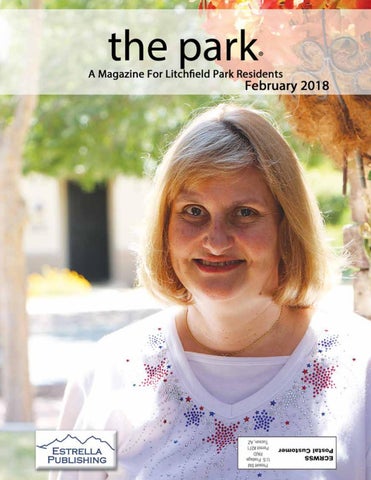
On Our Cover
Sheresa Greer
Our beautiful cover model this month is local resident Sheresa Greer. She lives with her mother Judi in Litchfield park and although she looks serene here, her journey here has been anything but. Born to her mother and father (a Vietnam War Veteran) her life has been plagued with health problems. Diagnosed by a close family friend (who happened to be a Pediatrician), with a rare form of Lymphoma at 7 years old, Sheresa had to endure two years of chemotherapy and radiation. She recovered and not only graduated from Xavier but went on to Loyola Marymount University in Los Angeles. She established her life in California and married but at age 25 tragedy struck once again. Sheresa suffered from a cardiac arrest and fell into a coma. Thankfully she recovered from the coma but she had to learn how to walk and talk all over again. Although she conquered these obstacles she was left with cognitive deficits. She has permanent short-term memory loss and struggles with gait issues.
Sadly Sheresa’s husband was not able to cope with the many health issues and setbacks that Sheresa faced. He left her and she moved back to Litchfield Park to live with her mother Judi. The love Judi has for her daughter is a thing to behold. She obviously cherishes her daughter and delights in their time together. Sheresa’s days are now filled with Occupational, Physical and Speech Therapies. Things her mother is glad to provide, but wishes had been there more during Sheresa’s journey.
Although Judi is a pillar of strength she leans on therapy herself and recommends it to anyone caring for a family member. Looking back on all of her daughter’s health problems, Judi wonders if her husband’s exposure to Agent Orange may have played a role. Who knows? One thing I am sure of is that despite all her issues, Sheresa is a beautiful, caring soul with much to offer her family and the world. Be sure to say hello to Sheresa and Judi when you see them in the neighborhood.
Life was still not done handing Sheresa lemons. At age 31 cancer came knocking at her door once again. This time it was Leukemia and it took two years to find a life-saving bone marrow donor.
KFNX Exclusively Features Laura Ingraham and Michael Savage Ranked Top Ten Shows in the Country
THE LAURA INGRAHAM SHOW
THE SAVAGE NATION WITH MICHAEL SAVAGE
To advertise, host a show, or for more information: Call (602) 277-1100 or visit our website: www.1100kfnx.com
The Park
February 2018
5
Life As A Caregiver I am a pretty positive person by nature. I tend to view things with the glass half full. That doesn’t mean I’m a Pollyanna. But it means I would rather be happy than sad. But dealing with a loved one with Alzheimer’s disease sometimes makes being happy a challenge. It not only impacts your day-to-day existence, but in can creep into how you react to other issues that come up. Take this week, for example. The husband of a very good friend of mine had a severe stroke early in the week. The prognosis is unclear, but he has a very long road ahead of him, if he makes it at all. His wife is just devastated. They both are just wonderful people whom I adore. And there’s nothing I can do to fix this. Oh yes…..I am there for her. I call and comfort and pray and support. And I will make meals and run errands and whatever else I can do to assist. But that’s about it. Doesn’t seem like very much. But I know it is. I am so sad and very teary. Then a day later, I found out that a dear friend of mine is under hospice care and is unresponsive. She had cancer about 2 years ago, beat it and moved back up to Washington state with her husband to be closer to family. Then the bloody cancer came back…with a vengeance. Treatments haven’t worked and all I’ve been able to do (with the help of our two other friends who all paled around together as a group) is declare my love and support through sending cards and texts. There is nothing I can do to fix this. I am so sad and very teary. And then today I learned she died. My dear friend died….way too soon. But at least she is out of her pain and with the angels.
And that’s what happens to caregivers. They take on all the natural burdens of life and have a harder time coping with them because they pile up inside. I am lucky that I can get through them. God truly made me strong in many ways. But I am also quite emotional at the same time. Not the fall-apart emotional. But the teary and heavy-heart kind. I wasn’t able to cry my eyes out over the loss of my friend until my mom was settled and ready for bed. I wasn’t able to be quiet and pensive and deep in my thoughts over the stroke my friend had until mom was comfortable and secure for the night. But that’s the way it is. I must be strong for her and not visibly sad or it will only make her sad. For the moment anyway. She won’t remember why I’m sad, but like I said, she & I live in the moment. So what’s the solution to help keep my sanity and allow me to take care of myself? Working out is good. Taking short respites is also good. And I do both. But my love for my mom is unconditional and watching her go through this brings tears to my eyes as fast as I can snap my fingers. Which is what I wish I could do to rid her of this horrible disease! Submitted by Kathy Linton, West Valley Resident
Also today, as I was giving my mom her breakfast, she tried to find a word to express what she wanted me to do. And it wouldn’t come. And she broke down and cried out of total frustration. The inability to find words to express yourself is an effect of Alzheimer’s. She hasn’t had that problem very often, so this could be a sign of continued deterioration. I settled her down, was kind and soft with her and explained that this was a symptom of Alzheimer’s, not about her being stupid (which she claims she is). She snapped out of it quickly and she resumed breakfast. But I couldn’t fix it. And when I left her room, I was sad and teary.
6 The Park
February 2018
Home Sweet Home
Rent vs. own: Which is right for you?
If you’re thinking of buying your first home, you’ve probably wrestled with the decision to rent or own your home - and for good reason. Owning a home is a big commitment. With it comes a lot of responsibility and a long-term financial relationship. But which is right for you? To answer that, let’s lean into the facts. The improving housing market Good news! Since the depths of the recession, the housing market has made a heroic comeback. That can be attributed to a number of factors, including a drop in unemployment and a stronger economy. But as the housing market has recovered, it has experienced some growing pains. With a sharp increase in demand, housing supplies are being strained. This means, among other things, that prices are going up. For families and individuals still recovering financially, finding affordable housing options can be difficult. This applies to home sales and rentals. Making the decision With rental and sales markets heading toward record highs, the decision falls back to what is best for you. Specifically, what is financially feasible. Let’s look at the basic numbers. According to the U.S. Census Bureau, the median gross rent paid from 2012 to 2016 was $949 monthly. Compare that with the median selected monthly owner costs with a mortgage, which was $1,491 over the same time period.
Then there are utilities. The median monthly electricity cost for renters in 2015 was $82, with owners paying $117. For piped gas, the median amount renters pay monthly is $42, while owners pay $58.
For renters, it is wise to carry renter’s insurance. Some landlords will also charge maintenance and other fees. Utility costs will also vary depending on the quality of the structure and materials used as well as size of the rental space. Homeowners will pay property taxes, insurance and an estimated $500 annually for routine maintenance, according to the Census Bureau. The benefits of homeownership At a glance, it may seem that renting is the lower cost option. But there are certain benefits to homeownership that may offset the additional regular costs. According to the Tax Policy Center, the primary benefit to owning a home is imputed rental income. Simply put, making a monthly payment on a home that you own is like paying rent to yourself. While that money is not taxed, it comes with another benefit - potential tax deductions. When you file your federal taxes, you may be able to deduct a portion of the mortgage interest you pay. Talk to a tax professional for more information on the expenses you can deduct and the limits for those deductions. Beyond the numbers Homeownership provides a variety of benefits beyond the numbers. For many people, a home is the largest investment they will ever make. The upgrades, work and care put into the home that you own can add value to your investment. It also adds a sense of pride knowing that it is yours. “Having a place to call your own, a place to return to at the end of the day, makes life better,” said Vanderbilt Mortgage and Finance, Inc. President Eric Hamilton. “You can see it from the moment they make the decision - that sense of pride. It’s a life-changing event and a memory that will last a lifetime.”
The Park
February 2018
7
Home Features As we move through the different stages in our lives, our housing needs change too. The home you were excited to move into in your 30s might not be ideal for those now nearing retirement. According to the Joint Center for Housing Studies of Harvard University, between 2015 and 2035, the number of people over the age of 75 living alone will nearly double from 6.9 million to 13.4 million. Being prepared for retirement and aging is important, so we’re going to take a closer look at the specific housing features that would most benefit those who are looking to downsize or find that perfect home to “age in.” 1. Walk-in showers Installing a walk-in bathtub or large shower is a good idea for ease and safety. Having extra room to move is not only aging-friendly, but a timeless trend that is easy to maintain. Clayton, one of America’s largest homebuilders, features optional walk-in showers with benches that are available in many of their homes. This is a feature that’s great at any age. 2. Wide doors and hallways Spacious doors and wide hallways do the double duty of making your home look great while providing enough space to maneuver a wheelchair or walker through if needed.
8 The Park
3. Open floor plans A home design trend that is perfect for any homeowner age is an open floor plan. But for boomers, an open floor plan is more than just an aesthetic feature. Having wide spaces that allow you to move around is essential to maintaining your independence as you grow older. It also helps add more natural light and is ideal when gathering with family and friends. 4. Low maintenance Fixing up an older home with good bones might look fun on TV, but it’s not something you will want to deal with in your retirement. Rather than trying to troubleshoot problem after problem, look for a newly constructed home. Not only will you have fewer maintenance issues, but you can design a flexible floor plan that fits your lifestyle. 5. A customizable floor plan The features listed so far are part of what is commonly known as age-in-place design. These home features work for people of all ages, but are designed so you can age into them. In addition, make sure the home you purchase is single-story and fits the lifestyle you want for your future. As you grow older, you realize there is no one, perfect dream home. Rather, there are different dream homes for different stages of your life.
February 2018
WHETHER YOU ARE BUYING OR SELLING
At TK LUXURY GROUP we treat every HOME/CLIENT the same, whether its $200,000 or $2 Million
FEATURED LISTING
19808 West Amelia Avenue – Pasqualetti Mountain Ranch | 4 Bed | 3.5 Baths | Theater Room / Bonus Room 3,620 sqft | 1 Full Acre | www.19808Amelia.com | Offered at $649,000
• Professional Photography • 3D Matterport Virtual Video • High-Res Digital Video • Zillow Video Tour • High-Res Digital Color Flyers
Tim Klimek
• Real Estate Search Engine Syndication (Zillow, Trulia, Realtor.com, Etc.) • Websites: www.VerradoRealty.com and www.TKLuxuryGroup.com • 24/7 Verrado Customer Service • Inquire About Occupied Owner Program
• Print Advertising (Postcards, Magazines and Brochures) • West Valley Experts • Staging and Decorating • Advise and Consult • Retail Office on Main Street
www.TKLuxuryGroup.com | 623.688.4447 We’re defined by the Luxury Experience we offer The #1 Team in Verrado – TK Luxury Group And the #1 Brokerage in Verrado – Verrado Realty Averaging – ONE sale EVERY 4 days
The Park
February 2018
9
10 The Park
February 2018
College Costs
With student debt increasingly becoming a longterm burden on graduates and families, says Peter Gayle, a vice president for Prudential Advisors, it’s never been more important to minimize the out-ofpocket expenses to put a student through college and reduce reliance on student loans.
To put the weight of student debt in perspective, The Federal Reserve Bank of New York noted that in 1995, 54 percent of graduates had loans averaging $11,491. It’s more recent data in 2015 showed 71 percent of graduates joined the workforce with student debt averaging slightly more than $35,000. What’s more, the Federal Reserve Bank of New York estimates 25 percent of those who owe federal student loans are delinquent or in default. The good news is that anyone willing to put in the time can likely find programs that help foot the bill - helping to reduce the need to take out loans - so a student’s education won’t break the budget or jeopardize a financial future. According to Gayle, families can take a few initial steps before choosing a school: * Learn how the financial aid process works and get the most out of options that don’t need to be repaid. * Understand each school’s actual net price after financial aid - and set realistic expectations, choosing from the most affordable institutions. * Explore types of financial aid, including grants, work study programs and scholarships; examine the specific types of aid available per school and find out how much of a family’s demonstrated financial need each school will cover. * Understand the kinds of loans available, including a variety of federal loans and private loans, which may be used to fill any financing gaps after exhausting other options. * Understand how parents’ “available income” is
Maint enance -Repair s -New Inst al l s- Insul at ion Pl umbing -Commer cial -Resident ial 6 0 2 -7 6 5 -COOL CLUFFMECHANICAL.COM ROC-2 4 2 7 5 5 The Park
used to calculate how much parents are expected to contribute to their child’s education, especially for federal financial aid purposes. Several guides, including Prudential Financial’s www.prudential.com/payingforcollege, can help families take a carefully considered approach to financing a college education while safeguarding a student’s long-term financial future, including the ability to save for retirement.
For families that must use student loans, the federal government is making it easier to understand how to borrow, process applications and repay loans through new online tools. Since 2010, all new federal loans, except Federal Perkins Loans, have been issued through the U.S. Department of Education, which offers information about borrowing and repaying loans. There are multiple options to repay federally funded student loans, which generally require repayments to start six or nine months after a student graduates, leaves school or drops to half-time enrollment. A few popular choices for repayment include types of income-driven plans, which calculate payments based on a borrower’s ability to repay. One catch: It’s critical to re-certify income and family size annually to avoid huge monthly payment increases. When debt becomes too burdensome, some loan programs offer forgiveness through public service, federal government employment, and options like teaching in underserved school districts. Private loans are trickier since there is no standard: Interest rates and repayment terms vary from lender to lender. It’s also worth considering the need for life insurance to cover the full loan balance to aid co-signers or beneficiaries in the event of the borrower’s death, says Gayle. Financial advisors would be well-equipped to help explore this and other options, Gayle notes. Studies show college education can be worth the price. The U.S. Census Bureau estimates that students who attend college can earn nearly twice as much over their lifetimes as those with only a high school diploma. But with college tuition continuing to rise, families must find the most effective way to finance a child’s college education to avoid jeopardizing their ability to save for retirement.
February 2018
11
Volunteer! Did you know that 35,000 hours of volunteering is the equivalent of working 40 hours a week, 52 weeks a year with no days off for 17 years? For American Legion Auxiliary (ALA) member Sarah Brooks, who was recently recognized for volunteering more than 35,000 hours in service to military veterans, those are hours spent offering fellowship, kindness and attention to those who made sacrifices for our freedom. Brooks’ decadeslong dedication to the military community has helped hundreds of veterans in the Grand Rapids, Michigan, area. The veterans she serves have become her family, her lifeline and a blessing she never thought she would receive. How did the 91-year-old come to dedicate her life to serving others? “It starts with a hello,” Brooks said. Brooks shares her time between a veterans home, ALA-sponsored events and a veterans rehabilitation center. “A hello can be the bridge to a great interaction and a wonderful memory. In my 59 years of volunteering, I can say I don’t have a favorite memory from my volunteer efforts because every day is a new and beautiful experience,” Brooks said. People can give back in many ways, such as donating material items like canned goods and clothes or offering financial support. But giving time is one of the most unselfish actions we can perform. By becoming personally involved with others
12 The Park
through volunteering, we have the opportunity to deliver simple acts of kindness that can help others find healing, support and a new beginning. In addition, volunteering has real benefits for the volunteer. It can provide a sense of fulfillment that benefits our minds and bodies. Studies have shown that people who volunteer live longer, healthier and happier lives. “When I returned home from military service in my early 20s,” said Victoria Pridemore, a former truck driver, battalion paralegal and division chief paralegal in the U.S. Army, “I wasn’t sure how I could serve my community since I didn’t have the means to donate monetary gifts to any organization. I realized I could have an impact on my community just through my actions and donating my time.” In 2012, Pridemore founded ALA Unit 1 in Washington, D.C., to help serve veterans and families in that area. While Sarah Brooks recently received a lifetime achievement award from the ALA for her 59-year commitment to service, Pridemore reminds us that there is no “small” act of kindness and service. “Every give-back moment is an opportunity to have a real impact,” she said. Pridemore and Brooks agree that all it takes is a few hours and a heartfelt commitment to caring to help change someone’s life. To learn how to get involved and volunteer, visit www.ALAforVeterans. org.
February 2018
Perception Have you ever heard the phrase ‘perception is reality’? I find two things interesting about the maxim. It’s only been around since the 1980s. I thought it was coined many, many years earlier. It’s also the basis for the MATRIX movie franchise. When you start your day, do you choose the red pill or blue?
should actually wear them in public. To say I’m a large guy might be an understatement and I look amazing in yoga pants. Yoga pants show off my physique and are very comfortable. The red pill version…Eew! Everyone else’s reality is not equal to my perception. In all honesty, I very much know yoga pants aren’t for me.
In the movie, the character Morpheus offers Neo a choice. He can take the red pill to learn, gain knowledge, have freedom, adversity, and the brutal truth of the real world. The blue pill allows him to enjoy blissful ignorance through an illusion. I won’t give any more spoilers in case you haven’t seen the movie. So, which pill would you take? I think there should be a dose of both.
A new option might be the purple pill. It’s a mix of both with the correct side kicking in when we need it. Work, school, and other obligations are the red pill of reality. Daydreaming and imagination are the blue pill of relief.
The magic of Santa Claus, Tooth Fairy, and Great Pumpkin is real to millions of people. The eyes of a child when he or she sees Santa tells the entire story. It’s reality because it’s real. Comic book legend Stan Lee calls his readers “true believers” because many of us believe his heroes exist. Is it the effects of the blue pill? A more serious effect of the blue pill can be summed up in two words: Yoga pants. Everyone can wear them, but not everyone
I’ll state the obvious: You are part of reality. This means everyone views you through the effects of the red, blue, or purple pill. In your reality, you’re just doing your thing. People on the red pill perceive you based on your designation, like friend, parent, coworker, customer, and such. Some might see you as their superhero or role model. This makes you magical. Always remember that as the true reality. Submitted by John Safin, Southwest Valley Chamber of Commerce
Golf Tournament
& Silent Auction
Supporting Brain Injury Survivors and their Families
Sunday, March 18, 2018 Western Skies Golf Club 1245 E. Warner Rd., Gilbert, AZ
Registration Opens 1/1/18 Check-in 6:30 am, 7:30 am Shotgun Start / Scramble
Early Bird Registration $100 Per Person Through Midnight of 1/31/18
Late Registration $125 Per Person Through Midnight of 2/17/18
Includes: Golf Hat, Cart, Practice Balls and Lunch
Includes: Cart, Practice Balls and Lunch (Does not include Golf Hat)
$20 - Lunch (Open to Everyone) - 12:00 pm Silent Auction - 6:30 am–Appox. 12:30 pm
To Golf, Have Lunch Only, Become a Sponsor, or Make a Donation Visit www.wmffundraising.myevent.com Our Sponsors
Questions:
Justin (480) 332-8835 - nosralj@gmail.com or Kelly Socha (612) 232-3945 - ksocha42@gmail.com
@wm_forward
weremovingforward
We’re Moving Forward
We’re MOVING FORWARD! is a 501(c) 3 non-profit organization
The Park
February 2018
13
Healthy Living A new year brings new opportunities to focus on health and fitness. The following are four easy ways to boost your health in less than five minutes per day.
Drink water before each meal. Drinking enough water each day helps to boost hydration, improve energy and aid digestion. But drinking before meals may offer another benefit - it can help you to eat less and lose more weight. One study found drinking 16 ounces of water in the half hour before meals led to nearly three pounds of weight loss on average over a 12-week period when compared to those who did not drink before a meal. Make it a habit to take your multivitamin every morning. No matter how healthy your diet, you may fall short on essential nutrients day to day. “Taking a multivitamin is one of the best ways to ensure you are meeting all of your nutritional needs consistently,” states Erin Palinski-Wade, RD, CDE, and spokesperson for Swisse Wellness. When choosing a multivitamin, not just any option will do. “Look for brands that have been clinically tested to ensure they can be utilized and absorbed by the body,” points out Palinski-Wade. “I recommend Swisse Ultivite (R) multivitamins as these products have been analyzed in over 13 clinical studies and been shown to improve energy and mood, reduce stress and increase mental alertness in both men and women.” Practice belly breathing. High stress levels can increase blood pressure, affect your immune system and cause you to pack on the pounds. To instantly fight stress, remember to breathe. Practicing deep breathing exercises, such as belly breathing, can reduce heart rate and lower stress hormones quickly, helping to prevent
14 The Park
stress from having a negative impact on health. To practice, place one hand on your chest and the other on your belly. Breathe in slowly through your nose into your belly. You should feel the hand on your stomach being pushed outward while the hand on your chest remains still. Hold the breath for a few seconds, and then push it out through pursed lips, like you were whistling. Repeat for three slow, deep breaths to instantly feel less stressed. Pick up the intensity of your workout - for one minute. Finding time to exercise can be a challenge, but there is good news for those with maxed-out schedules. A recent study found that just one minute of high-intensity exercise may be equivalent to 45 minutes of moderate-intensity exercise. Although you shouldn’t ditch your workout routine completely, when you are short on time, aim to fit in small bursts of exercise throughout the day. Just make sure your doctor clears you for intense exercise before getting started.
February 2018
The Park
February 2018
15
Staying Safe on the Mountain You can feel it in the air: The ski and snowboard season has arrived, and some areas in the U.S. are already open for business. As snow sports continue to gain popularity, millions of people will be hitting the slopes this winter. During the 2016-17 ski season, the National Ski Areas Association (NSAA) reported that U.S. ski areas tallied an estimated 54.7 million skier and snowboarder visits, up 3.7 percent from the previous season’s 52.8 million total.
Helmet usage on the rise
inspired the #RideAnotherDay campaign. On the day before Christmas in 2010, Kelli was skiing in northern Wyoming near their home with her oldest child, Elise, 5. When Kelli stopped to help Elise put her ski back on, a snowboarder traveling at more than 50 mph collided with them. The accident was devastating. Elise and the 23-yearold snowboarder died instantly, and Kelli sustained a traumatic brain injury and paralyzed arm.
Eighty percent of skiers and snowboarders wore helmets during the most recent ski season, setting yet another record for helmet usage at ski areas across the country. While helmets can help to reduce or prevent certain injuries, they are not foolproof, and there are other safety concerns while skiing.
After months of rehabilitating at Craig Hospital, learning to walk, eat and swallow, Kelli has made a remarkable recovery, although she still has some paralysis on the right side of her body. To honor their daughter and create a lasting legacy, Kelli and her husband, Chauncy, partnered with the NSAA to launch a safety campaign titled #RideAnotherDay.
Proving that helmets alone do not prevent all injuries, data from Craig Hospital shows an increase in the number of patients admitted each year from snow sports accidents (up 50 percent in 2017 over 2012).
“My hope is to get this message out to others,” said Kelli. “If anyone hears this message just once, they will hopefully change how they act and conduct themselves out on the mountain.”
With the increase in skier and rider visits, safety is always a top concern. Substantial growth in the number of skiers and riders wearing helmets has made participation in snow sports safer, along with awareness and education campaigns that emphasize the responsibility each skier and rider has every time they take to the slopes. For example, The NSAA and Craig Hospital, a worldrenowned rehabilitation and research hospital in Denver for people who have sustained a spinal cord and/or brain injury, are partnering to promote several industry safety campaigns: #RideAnotherDay and ParkSmart.
As an avid skier, ski racer and one of the early pioneers of adaptive skiing programs, Dr. Thomas E. Balazy, medical director of Craig Hospital, is a strong proponent of helmets. “Helmets can definitely prevent head injuries while skiing or riding,” said Dr. Balazy. “I would never go out without one, and while I believe that everyone who participates in this sport should wear one at all times, responsible, safe skiing and riding is the best way to prevent serious injuries on the mountain.” Ride another day
These types of accidents, while horrific, are rare. In fact, during the 2015-16 season, only 39 fatalities occurred at U.S. ski areas out of the 52.8 million skier/snowboarder days reported for the season. To put that in perspective, more than 1,000 people died from bicycle collisions with automobiles during that same time. Keeping skiers and riders safe while skiing and riding is top of mind for those in the ski industry. The following tips are from the #RideAnotherDay campaign, which is being promoted at more than 300 ski areas around the country:
Kelli Johnson, along with her daughter Elise,
16 The Park
February 2018
* Be ready to avoid objects and other skiers. * Maintain a safe speed and always ski in control. * Stay alert to what’s going on around you, especially other skiers and riders. * Plan ahead and ease up at blind spots, check uphill when merging onto trails and give others plenty of room when passing. Terrain park safety The explosive growth of terrain parks at ski resorts (94 percent of U.S. ski resorts have at least one terrain park), has led to the NSAA launching the
The Park
ParkSmart campaign. It tackles some of the unique differences between skiing or riding on traditional ski area trails versus riding in the ever-popular terrain parks. Freestyle terrain parks can include jumps, half pipes, rails, ramps and more. Some simple safety and etiquette tips for terrain parks include: * Start small - Work your way up. Build your skills. Know your limits and ability level and select the appropriate freestyle terrain for you. * Make a plan - Every feature. Every time. Some features are set up to be used one after the other, without stopping, and others individually; jumps are for jumping and rail takeoffs are for using the rail. * Always look - Before you drop. * Respect - The features and other users. * Take it easy - Know your limits. Land on your feet. Learning how to ski and ride safely and understanding the rules and etiquette of the mountain can help ensure a fun, safe season on the slopes. For more information on the #RideAnotherDay campaign or ParkSmart, visit NSAA.org.
February 2018
17
Puzzles & Games Sudoku for February
4
8
1
2
5
7
3
6
6
4
8
1
7
9
7 4 9 8 5 3 2
9
3
5
9
1
8
7
2
3
1
6
7
4
5
1 6 3 4 2 9 8
6 7 2 9 8 5 3
2 3 6 5 7 4 1
7 5 8 4 1 9 2 6
3
9
4
8
4
5
5
4
8
2
6
3
1
8
2
9
3
7
3
7
8
6
7
1
3
2
7
5
2
8
4
1
6
4
9
5
Sudoku Solution 5
Numbers from 1-9 must appear only once in each row, column and box. Good Luck!Solution is on our website www.EstrellaPublishing.com
9 1
9
9 2
WORD SEARCH
7
Valentine Riddles Q: What did the stamp say to the envelope on Valentine’s Day? A: I’m stuck on you! Q: What travels around the world but stays in one corner? A: A stamp. Q: Why is lettuce the most loving vegetable? A: Because it’s all heart. Q: What do squirrels give for Valentine’s Day? A: Forget-me-nuts. Q: What did one volcano say to the other? A: I lava you. Q: What is a vampire’s sweetheart called? A: His ghoul-friend. Q: Why did the banana go out with the prune? A: Because it couldn’t get a date. Q: What happens when you fall in love with a french chef? A: You get buttered up. Q: What did the caveman give his wife on Valentine’s Day? A: Ughs and kisses! Q: Why did the boy put candy under his pillow? A: Because he wanted sweet dreams. Q: What did the paper clip say to the magnet? A: I find you very attractive.
18 The Park
February 2018
Business Directory AUTO SERVICES Desert Princess Car Service Litchfield Auto Repair
602.300.7076 623.882.8700
BUSINESS & NETWORKING Estrella Partners Group
623.594.9283
FINANCIAL & LEGAL SERVICES 623.386.1940 Edward Jones - Chris Carlton Kramer Legacy Documents 623.300.1884 State Farm Insurance-T Gremillion 623.386.7767 HEALTHCARE & BEAUTY Healthy Life Family Medicine Permanent Make Up Skincare Extraordinaire
623.889.3477 602.295.7373 623.826.3726
HOUSEHOLD SERVICES Al’s Plumbing Beckham Electric Cluff Mechanical Heating & AC Desired Handyman Dirt Busters House Cleaning
623.329.5170 480.370.1014 602.765.COOL 623.910.5183 623.977.6725
The Park
Estrella Mountain Pest Control J&H Appliance Repair JBS Roofing Urgent Air Younger Brothers Exterminating
623.680.6619 623.925.5427 623.247.9252 602.377.1999 623.487.3147
LANDSCAPE & POOLS Jackrabit Nursery Pool & Landscape AZ
623.386.4700 480.999.3348
REAL ESTATE Realty One Group - Budge Team 623.694.3907 623.688.4447 Verrado Realty - T Klimek RECREATION Eleutheria Wellness KFNX 1100AM Radio
623.986.5110 602.277.1100
RETAIL Budget Blinds of Goodyear Estrella Ordnance Pure Patio Steel Shield Security Doors
480.629.8854 623.262.2154 623.299.8000 623.977.3277
February 2018
19
WE LOVE TAKING CARE OF YOUR ROOF! Let Your Residential & Commercial Roofing Contractor actor Show You How Much!
“Let Our Family Cover Yours” New Construction, Repairs, Recovers, Maintenance Installation of Gutters & Attic Insulation Shingles, Tile, Built Up, Single Ply, Foam & Coatings, Metal, Shake
20 The Park
www.JBSroofingAZ.com
February 2018