This LCA shows that our Wild Glass® ,100% PCR recycled glass, has a substantially lower environmental impact across all categories considered, including a 27% reduction in Climate Change impact , with overall reductions ranging from 23% to 65% compared to standard flint glass.
What is Wild Glass?
Our Wild Glass® is made of 100 % post -consumer recycled glass , collected from the vicinity of the production facilities .
By repurposing used glass, we can reduce the melting temperatures needed to produce new bottles . This process significantly cuts energy consumption and associated carbon emissions . Moreover, our concept leads to a lower rejection rate and higher efficiency, resulting in a greater proportion of acceptable bottles . We embrace minor aesthetic variations, as long as the bottles maintain their functional integrity .
To assess the environmental performance of Wild Glass®, we compared it with standard flint glass using Life Cycle Assessment (LCA) methodology.
We compared our Wild Glass® with its natural competitor:
Our environmental assessment utilised the Life Cycle Assessment methodology to compare Wild Glass® , our 100% post -consumer recycled glass with “Flint” the standard alternative available on the market.
For this analysis, we used the DA Eco Philos 500ml bottle, which weighs 500 grams, as a benchmark.
The production process was modelled using the same production line and furnace for all glass colours .
The study covered the entire lifecycle, from raw material sourcing to end -of-life, within the framework of the European Union.
O L O G Y
We used the LCA methodology backed by certified tools and quality standards.
For the evaluation, the following tools and resources were applied:
• SimaPro software, version 9.4.
• Ecoinvent Database , version 3.8.
• The CML -IA baseline method, version 3.08/EU25, covering all impact categories.
Compliance with ISO 14040 and ISO 14044 quality standards was also ensured.
Analysis, data and results.
Detail of the source, the data origin and the inventory
Raw materials
Reach Extraction and processing of necessary materials for manufacturing of the product in the plant in Trento (Italy).
Packaging Raw Materials Transport Production Transport to Estal Distribution End of life
Extraction and processing of materials for the manufacture of the product packaging In the plant in Trento (Italy).
Transporting of materials and containers from their origin supplier to the production plant in Trento (Italy)
Production of the glass bottle in Trento. Waste generated during this phase not included .
Transportation of the finished bottle to the facilities of Estal in Sant Celoni (Barcelona).
Distribution of the bottle from Estal’s facilities to customers assuming 400Km (FTL of 32tn EURo 6)
Treatment of the glass bottle and its packaging as waste. Spanish and European data are considered representative.
Source Information from Estal and secondary sources. Information from Estal and secondary sources. Country of origin provided by Estal and distances calculated with Google Maps. Information from Estal Location of facilities provided by Estal, distances calculated with Google Maps.
Average distance between facilities and customers validated by Estal. Ratios of the different management routes (recycling, incineration and landfill) obtained from Eurostat.
General comparison
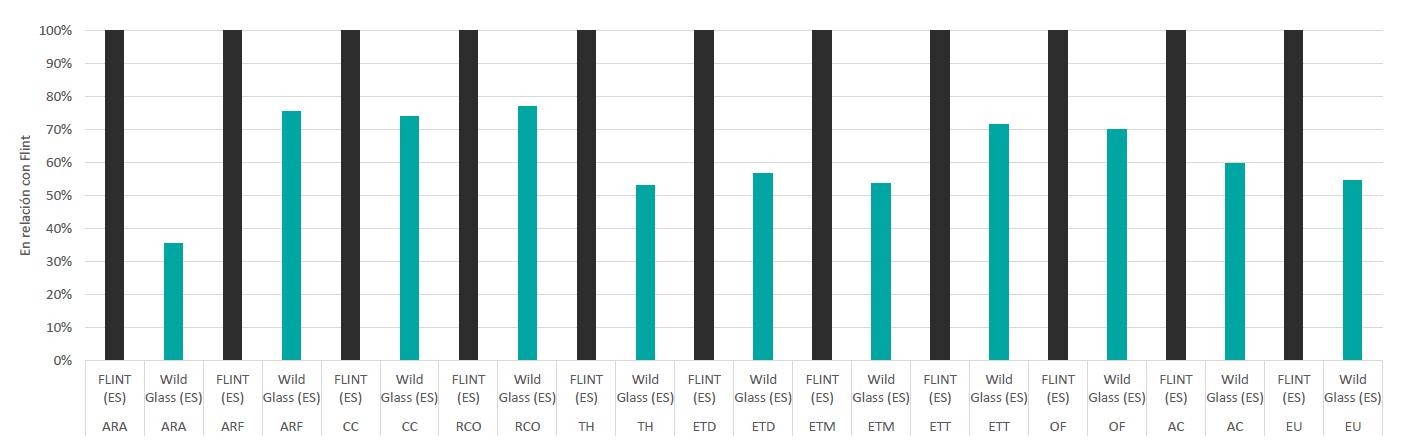
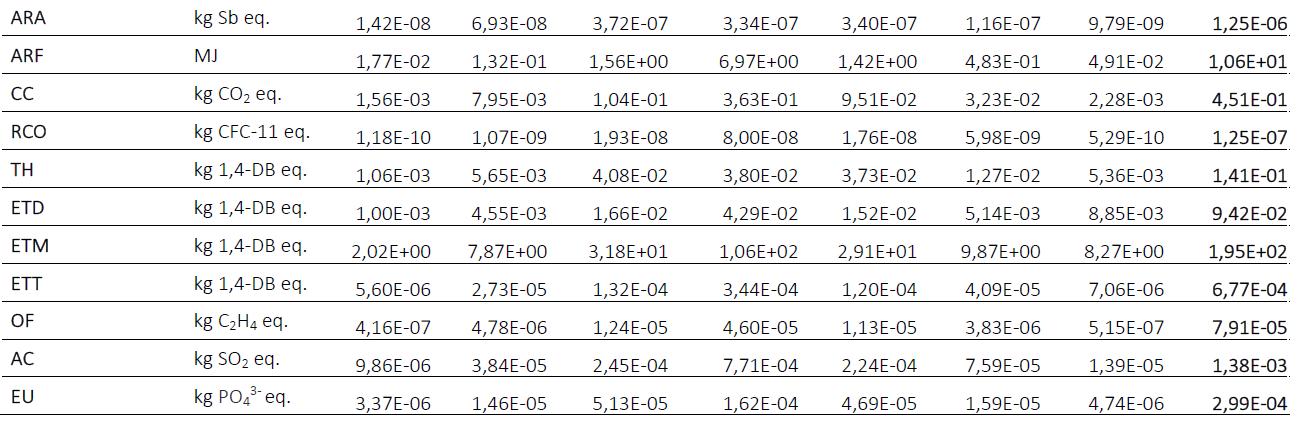
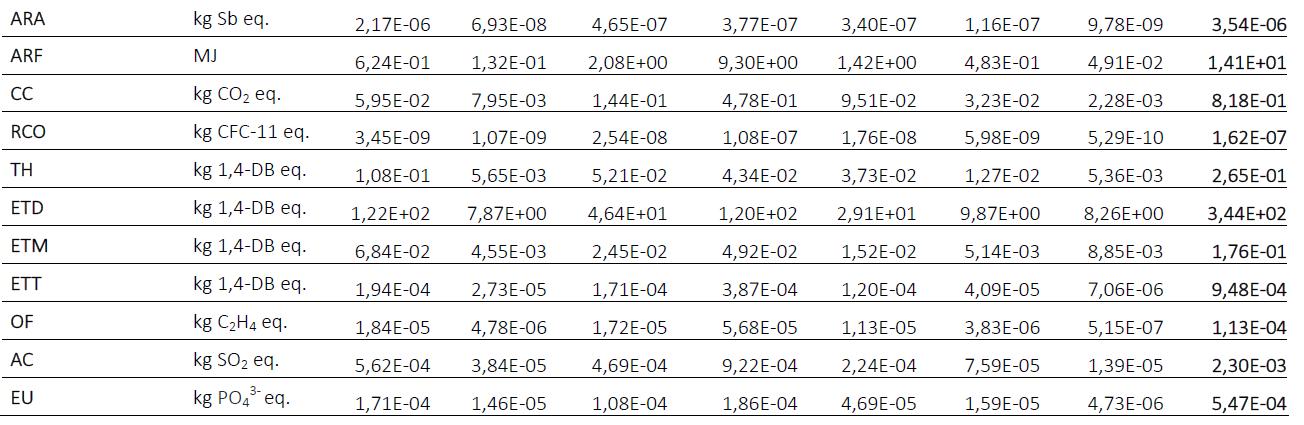
• Wild Glass shows a substantially lower environmental impact in all categories considered .
• Wild Glass's environmental impacts are 23-65% less than Flint.
ARA: Depletion of abiotic resources (metals, minerals, etc)
ARF: Depletion of Fossil Resources (diesel, gas, coal, etc)
CC: Climate change
RCO: Depletion of the ozone layer
TH: Human Toxicity (emission of toxic substances into the air)
ETD: Freshwater Ecotoxicity
MTE: Marine Ecotoxicity
TTE: Terrestrial Ecotoxicity
OF: Photochemical oxidation (Accumulation of substances in the atmosphere, especially in cities)
AC: Acidification (reduction of pH in the environment)
EU: Eutrophication (Increase in Phosphorus and Nitrogen in water)
Wild Glass LCA Results
ARA: Depletion of abiotic resources
ARF: Depletion of Fossil Resources
CC: Climate change
RCO: Depletion of the ozone layer
TH: Human Toxicity
ETD: Freshwater Ecotoxicity
MTE: Marine Ecotoxicity
TTE: Terrestrial Ecotoxicity
OF: Photochemical oxidation
AC: Acidification
EU: Eutrophication
Flint LCA Results
ARA: Depletion of abiotic resources
ARF: Depletion of Fossil Resources
CC: Climate change
RCO: Depletion of the ozone layer
TH: Human Toxicity
ETD: Freshwater Ecotoxicity
MTE: Marine Ecotoxicity
TTE: Terrestrial Ecotoxicity
OF: Photochemical oxidation
AC: Acidification
EU: Eutrophication
Results and Conclusions of the Comparative LCA Study :
1.
Wild Glass is 100% PCR, eliminating the need to extract and transport raw materials.
2. 3. 4.
Thanks to the use of PCR recycled glass, the manufacturing of new bottles requires fewer resources, including a reduced amount of auxiliary materials like Sodium Carbonate.
Production efficiency has improved due to reduced natural gas consumption, dropping from 6.3 to 4.5 MJ.
The Wild Glass concept enhances production efficiency by reducing the rejection rate of bottles during manufacturing .
Positive impact on sustainability:
The Wild Glass bottle, made from 100% post -consumer recycled (PCR) glass , is capable of reducing the environmental impact across all categories considered by the Life Cycle Assessment (LCA) between 23% and 65%.
The primary reasons for these positive results are:
• Substitution of raw materials with recycled glass.
• Reduction in the total amount of auxiliary materials, such as sodium carbonate, required for glass production.
• Decreased need for transporting raw materials.
• Improved production efficiency.
• The Wild Glass concept results in fewer discarded bottles.
Our Production Partners.
Research Partner
The analysis was conducted by Inèdit , an independent third party renowned for its pioneering work in strategic eco -innovation.
As a leader in industrial ecology, Inèdit specialises in Life Cycle Analysis (LCA) and eco -design at the Universitat Autònoma de Barcelona (UAB) .
With over 13 years of experience in guiding organisations through circular economy initiatives, their goal is to inspire and empower these organisations . They are committed to helping companies navigate the challenges and seize the opportunities that arise from the circular economy and the drive towards decarbonisation .