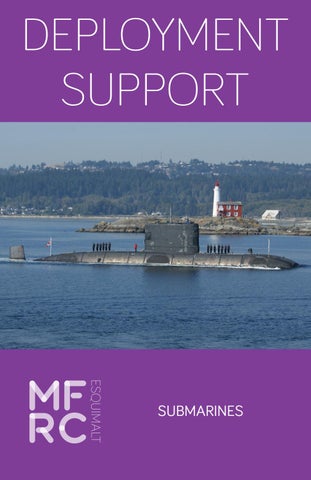
DEPLOYMENT SUPPORT
SUBMARINES i
Table of Contents Welcome! How to use this handbook......................................................................................................................................................................iv The MFRC: who we are, how we can help & how to reach us.........................................................................v A note about R2MR.......................................................................................................................................................................................vii
Spouse/Partner* of a Canadian Armed Forces (CAF) Submariner.................................. 1 *This means you: girlfriends, boyfriends, wives, husbands, common-law spouses, and anyone who is in an established relationship with a CAF submariner Preparing for deployment........................................................................................................................................................................1 Deployment............................................................................................................................................................................................................7 Homecoming and post-deployment ..........................................................................................................................................9 Supporting Children & Teens.................................................................................................. 13 Preparing for deployment........................................................................................................................................................................13 Deployment............................................................................................................................................................................................................17 Homecoming and post-deployment ..........................................................................................................................................23 Parent of a Canadian Armed Forces (CAF) Submariner.................................................... 25 Preparing for deployment........................................................................................................................................................................25 Deployment............................................................................................................................................................................................................29 Homecoming and post-deployment............................................................................................................................................32 Additional Deployment Resources......................................................................................... 36 Mail..................................................................................................................................................................................................................................36 Urgent messages ............................................................................................................................................................................................37 Serious Incidents...............................................................................................................................................................................................37 Member Assistance Program (MAP)..........................................................................................................................................38 Family Information Line (FIL)..............................................................................................................................................................38 R2MR Tools............................................................................................................................................................................................................38 Dealing with the Media...............................................................................................................................................................................39 Military 101...............................................................................................................................................................................................................42 Family Navigator................................................................................................................................................................................................42 FAQ’s & Common Acronyms Defined.......................................................................................................................................43 QR Codes.................................................................................................................................................................................................................44
Notes.......................................................................................................................................... 49
iii
Welcome!
Welcome! How to use this handbook If you have a loved one deploying on a submarine out of CFB Esquimalt or CFB Halifax, this handbook is for YOU. Your handbook is divided into five chapters. The first chapter (Welcome!) and the last chapter (Additional Deployment Resources) contain important information that is applicable to anyone who is dealing with a submarine deployment. Chapters 2, 3 & 4 contain tips, resources, and information that are specific to particular groups within the submarine community. Within each chapter you will find resources grouped specifically for pre-deployment, deployment, and post-deployment. • Chapter 2 is geared towards the spouse/partner of a CAF Submariner • Chapter 3 is additional information for anyone who is supporting children and/or teens through deployment • Chapter 4 is specifically for the parents of a CAF Submariner Web links for resources have been included wherever possible and QR codes for iv
most resources are available on pages 44. Visit the link or use your smart phone’s QR reader to scan the code and find more information.
Welcome!
You can also call your deploying unit’s MFRC 24 hour line for details or to ask questions about any of the resources in this handbook: • CFB Esquimalt 250-363-2640 or 1-800-353-3329 • CFB Halifax 902-427-7788 or 1-888-753-8827 Please note: Some links may have changed since the creation of this handbook. Please visit the website for the most up-to-date information. Esquimalt, www.esquimaltmfrc.com or Halifax, www.halifaxmfrc.ca.
The Military Family Resource Centre (MFRC) Who we are The MFRC is a non-profit organization which aims to support individual, family, and community needs by providing services and supports that address the uniqueness of military families. Each MFRC is governed by a volunteer Board of Directors which is composed of at least 51% family members of full-time serving Canadian Armed Forces (CAF) members. The board, staff and volunteers at your MFRC are dedicated to your well-being and to helping you navigate through deployment and the many unique elements of the military lifestyle. Programs and Services at your MFRC The MFRC provides programs and services that fall into three categories: Deployment Deployment is any work related separation. It could be sea trials, workups, a traditional deployment, a course, or any other reason that your CAF member is away. This handbook describes many of the programs and services offered by your MFRC to support you and your family through a deployment. Relocation Relocation is something that most military families will have to deal with at some point, sometimes repeatedly. The MFRC offers programs and services to help you and your family prepare for the transition and get settled in your new community. We have partnered with community agencies to assist you with your Employment and Educational needs. Social and Mental Wellness Your family’s well-being has a significant impact on your CAF member’s operational readiness. MFRC’s offer programs and services to help you make your family’s wellbeing a top priority. v
Welcome!
How we can help When your loved one deploys, having access to the many services offered by your MFRC can make a huge difference. A deployment, or a work-related separation, is a unique situation that requires some preparation and sustained effort by both the CAF member and their loved ones. It is our hope that this handbook will provide you with answers to some of the questions you might be asking, and that you will use it as a starting point to discover all that your MFRC has to offer. We encourage you to use this handbook, MFRC websites, and your MFRC staff and volunteers as tools to help you throughout the deployment. How to reach us If you need assistance, want to remain connected, or are looking for information, you can reach out in one of the following ways: • CFB Esquimalt Call the 24 Hour Information Line at 250-363-2640 (toll free: 1-800-353-3329) Via the web www.esquimaltmfrc.com • Email at mfrc@shawcable.com • CFB Halifax Call the 24 Hour information Line at 902-427-7788 (toll-free: 1-888-753-8827) Via the web www.halifaxmfrc.ca • Email at info@halifaxmfrc.ca MFRC Locations Signal Hill MFRC 1505 Esquimalt Road, Esquimalt, BC
Halifax MFRC Windsor Park Bldg 106 Halifax, NS
CPAC MFRC 2610 Rosebank Road, Colwood, BC
Shearwater MFRC Hampton Gray Memorial Centre Shearwater, NS Sydney MFRC (Satellite) 1 Desbarres St, Victoria Park Sydney, NS
vi
A note about communication
Maintaining a connection Your MFRC understands that during a submarine deployment there is the additional challenge of having little to no communication with your submariner, sometimes for the duration of the separation. Understandably, this reality can be difficult to manage; however, there are some ways to lessen the hardship. In each section of this handbook you will find suggestions for “maintaining a connection” with your deployed loved one, even when direct communication isn’t an option. Making the resources work for you Throughout this handbook you will find resources intended to support you during deployment. Many of these resources were created to address the challenges faced by CAF families in general. Because of the unique nature of submarine deployments, you may find that some of these resources require a bit of adaptation to suit your needs, particularly when it comes to communication during deployment.
A note about R2MR The Road to Mental Readiness (R2MR) is a training package created by the CAF to foster resilience and mental wellness in the CAF member. Components of the training package are completed at different times throughout the CAF member’s career including specific training for the cycle of deployment. The CAF recognizes that families are “the strength behind the uniform” and understands the sacrifices and contributions of military families to successful missions. For this reason, the R2MR program has an entire component created specifically for family members. The purpose of the family member training package is to provide you with guidance and skills to help alleviate some of the stress of the deployment experience on you and your family. Throughout this handbook, you will see links to R2MR resources that might be especially helpful to you during the deployment cycle. Because of the unique nature of submarine deployments, you may find that these resources require some adaptation to suit your needs or that some resources are more helpful to you than others. However, R2MR resources provide an excellent starting point for building and maintaining resilience in any military family. vii
Welcome!
Any time a CAF member deploys there are challenges that must be overcome by both the member and their loved ones. No two deployments are the same, nor will any deployment present identical challenges. The nature of the CAF lifestyle demands that military families are resilient and adaptable and submarine families are certainly no exception.
R2MR resources are available at your local MFRC as well as online. Please visit the link below to access the entire family member training package or call your local MFRC for more information.
Welcome!
www.forces.gc.ca/en/caf-community-health-services-r2mr-family/index.page
viii
Spouse/Partner
Spouse/Partner* *this means YOU: girlfriends, boyfriends, wives, husbands, common-law spouses, and anyone who is in an established relationship with a CAF submariner. In this chapter you will find resources intended to support you through your deployment experience as the spouse/partner of a CAF submariner. If you are also supporting children and/or teens through deployment, please see chapter 2 of this handbook for specific resources and tips pertaining to their deployment experience. Above all, remember that the deploying unit’s MFRC is available to assist you 24/7: • Esquimalt MFRC at 250-363-2640 or 1-800-353-3329 • Halifax MFRC at 902-427-7788 or 1-888-753-8827
Preparing for Deployment If you are preparing for a deployment you might be feeling anxious, frustrated, confident, mad, confused, excited, scared, proud, or all of the above, or none of the above. You might feel your emotions are swinging from one extreme to the other and your routine has been turned upside down. You might feel calm and collected and your days are “business as usual.” Rest assured, however you are feeling it is OK and it is normal. There is no “right” way to feel during pre-deployment and no “right” way to deal with the pre-deployment phase. There is a widely accepted model for the “cycle of deployment” and you will notice it is mentioned throughout this chapter. There are seven stages to the cycle, and you can expect to experience the first two in the pre-deployment phase. “Anticipation of 1
Loss” is the first stage and it looks different for everyone. You and your partner are facing the reality of the deployment and you might feel torn between preparing for the separation and spending every waking moment together. Most will find themselves somewhere in between. The second stage is “Detachment and Withdrawal.” At some point you may begin to feel an emotional detachment as your partner begins to focus on the mission and your focus turns to your own preparation.
Spouse/Partner
For some couples this happens before the boat departs and for some it happens in the first days or weeks of the separation. The process will be different for everyone but knowing the cycle and having a general idea of what to expect could help you cope. Whatever pre-deployment looks like for you, it is generally agreed that spending some time preparing for deployment will pay off as you make your way through the rest of the deployment cycle. This is particularly true for submarine families as there can be very little communication with the submarine during a deployment. Until the submarine comes into port, you won’t have the luxury of an email or a phone call to ask the questions you forgot to ask before the boat sailed. For submarine families, extensive preparation is essential to a successful deployment. The tips and resources on the following pages are designed to help you with this preparation. If you have any questions or feel like you need additional support as you prepare for deployment, your MFRC is just a phone call away! Remember: you are strong and resilient and you are not alone. Some ideas for “maintaining a connection” with your partner during deployment: Check with local MFRC to see if services are available. • Plan to read the same book as your partner during the deployment. When the boat returns, you can share your thoughts and ideas about the book – a book club for two! • Create a memory box. Add notes and mementos throughout the deployment. When your partner returns, you can go through the box together and share your memories.
CFB Esquimalt • Join the Submarines Family Network to stay in touch with other families from the same boat. Staying close to your deployment family could help you feel closer to your partner, and it can make a big difference to have the support of those who truly understand what you’re going through. • Check with the MFRC to see if the boat is offering Family Grams or Mail Dates for your deployment. -- Family Grams are short electronic messages that can be sent to your loved 2
one periodically during an extended deployment. Note that the Family Gram program is only available during select deployments, as requested by the boat. Check the Esquimalt MFRC website for details www.esquimaltmfrc.com. -- On extended deployments you may have the opportunity to send letters or care packages to your partner. See page 36 of this handbook for postal information and then check with your MFRC to see if mail dates are being offered during your deployment
Pre-Deployment Tips • Learn your partner’s rank, service number, and department on board the boat. • Be sure you know how to reach your partner in case of an emergency (see page 37 of this handbook). • Pick up deployment resources from your local MFRC. • Join the Submarines Family Network. This is a great way to stay in the information loop and connect with others in the submarine community. • Plan on attending the boat’s pre-deployment briefing. • If possible, visit your partner’s boat to see where he or she will be living and working during the separation. • Check out the MFRC’s series of instructional videos on dealing with deployment: www.esquimaltmfrc.com or www.halifaxmfrc.ca • Discuss your partner’s preferences for homecoming. You may not have a chance to communicate again before homecoming day and it is important to agree on a plan that suits you both. Homecoming is not a time for surprises. Pre-Deployment Checklist Legal Will Power of Attorney Check that your Next of Kin Form is correct and up to date (DND 2587) Life Insurance List of all important documents and where they are located Other relevant insurance 3
Spouse/Partner
CFB Halifax • Join a Family Network for information. Staying close to your deployment family could help you feel closer to your partner. It can make a big difference to have the support of those who truly understand what you’re going through. See Halifax MFRC website: www.halifaxmfrc.ca/deployment/deployment-services-eng/ for details. • On extended deployments you may have the opportunity to send letters or care packages to your partner. See page 36 of this handbook for postal information and then check with your MFRC to see if mail dates are being offered during your deployment.
Spouse/Partner
Financial Create a Deployment Budget Accounts & Safety Deposit Boxes Banking access PIN #, Keys Investments Allotments Income Tax Online Banking Passwords Payment Plan for • Utilities • Phone • Cable • Rent / Mortgage • Credit Cards
Create an Emergency Fund Home Mortgage/Rent Property Tax (Homeowners Grant) Home insurance Security Maintenance & Warrantees Computer Password Travel Passport/Visa for all family members Immunization Health Insurance claim forms & numbers Dental Plan claim forms & numbers Medical Records Family Care Plan Car Maintenance & Service Records Insurance Registration & Driver’s License Mechanic Phone Number/Roadside Assistance # /Warranty info Storage
4
Phone Numbers for Information/Support Military Family Resource Centre Get your Military Family Identification Card at your local MFRC before deployment (Esquimalt only) Parents/InLaws Child’s Emergency Contact Family Network Email
GETTING CONNECTED & STAYING INFORMED Pre-Deployment Briefing Depending on the length of the deployment, a pre-deployment briefing may be held by the unit. Typically guest speakers will include the boat’s Command Team, the MFRC, the Fleet Mail Office, a military doctor, and a military lawyer. Pre-deployment briefings usually take place in the evening at the deploying unit’s local MFRC. This is an opportunity to: ask your questions directly to the Command Team, register for MFRC services, and hear about upcoming deployment activities. In Esquimalt call 250-363-2640 and in Halifax call 902-427-7788 to find out if your boat is holding a pre-deployment briefing. Submarines Family Network When you join the Submarines Family Network, you will be added to an email list to receive any informational updates that becomes available during the deployment. You will also be notified of social activities and opportunities to connect with other submarine families throughout the deployment. The volunteers who run the Submarines Family Network are submarine spouses who understand the unique nature of the community and the lifestyle. Visit your deploying MFRC website to find out how to connect with your Family Network! Staying in Touch (SIT) Services or Warm Line Calls SIT Services/Warm line calls are available to you during extended deployments. A staff member from the deploying unit’s MFRC will call or email you monthly to check in, keep you informed about the deployment, and see how you are coping with the separation. The SIT staff will not offer advice or counselling; their role is to offer information, a friendly voice and a listening ear. All conversations are confidential. 5
Spouse/Partner
For Specific Child Related Concerns (all above plus) Emergency Childcare Plan Requirements for travel abroad with children when one parent is absent Relevant school info
Call your local MFRC to find out if SIT Services are being offered for your deployment. Adult Deployment Workshops (check with your local MFRC for details and availability) MFRC’s, offer a wide variety of adult workshops that are designed to support you through the unique challenges of deployment. Learn about everything from dealing with transitions to making connections with other military spouses to dealing with deployment stress. These free workshops are scheduled in response to the needs of the community. Check out the Deployment Section of the MFRC website.
Spouse/Partner
PRE-DEPLOYMENT RESOURCES Slideshow: The Deployment Cycle This slideshow contains practical tips for dealing with the deployment cycle: pre-deployment, during deployment, and post- deployment. Consider sitting down with your partner to have a look at this resource. The tips could help prepare you both for the upcoming separation. www.esquimaltmfrc.com/deployment/deployment-cycle.php Video: The D Word Whether you are a seasoned military spouse or you are about to experience your first deployment, this video could help you to put the deployment experience in perspective. It also provides some useful tips for dealing with the separation. Access the entire series of instructional videos on dealing with deployment through the Esquimalt MFRC’s website. www.esquimaltmfrc.com/deployment/videos.php Pre-Deployment Family Training (R2MR) This self-paced, online family training is designed to help you understand the challenges you could face during deployment and give you some new tools and ways to approach each challenge. It will also help you recognize your own personal strengths and identify resources in your community that could support your well-being throughout the deployment. Visit the website for much more information and to access the training modules: www. forces.gc.ca/en/caf-community-health-services-r2mr-family/pre-deployment-familytrng.page Or call your local MFRC for information on R2MR training sessions * see page vii for a note about communication ** see page vii for a note about R2MR 6
Deployment So you made it through the pre-deployment phase and are now dealing with the deployment. For some, this can come as a relief after the countdown and the build up to deployment. For others, the realities of deployment can hit hard and bring difficult challenges. You might be feeling a bit of both, or maybe neither. However you are feeling about the deployment phase, it is OK and it is normal.
Deployment Tips • Be security conscious. Don’t broadcast any information about the deployment. • Be safe. Don’t advertise that you are alone or have a military member away. • Practice self-care. Take time to exercise, eat healthy, get a massage, have “you” time. • Become familiar with the Submarines Family Network and MFRC activities. • Get connected. Meet with friends, volunteer, remain involved in daily life and refuse to become isolated. • Set realistic goals for yourself for the deployment period. • If you are struggling, call a friend, call your local MFRC, or call the Member Assistance Program at 1-800-268-7708.
GETTING CONNECTED & STAYING INFORMED CFB Esquimalt Submarine Community Connections These monthly sessions provide opportunities for loved ones of submarine crews to learn more about what life is like onboard, as well as what it is like to be part of this unique community. If you are an experienced submarine spouse, come share your knowledge and ideas about what has worked well for you in the past. Bring your dinner and “brown bag” it! Check the website at www.esquimaltmfrc.com for upcoming dates and register by calling 250-363-2640 at least one week in advance. Away Cafés and Community Dinners These evenings provide a social opportunity for you to connect and share with others who are dealing with deployment over a cup of coffee or a warm meal. MFRC Staff will be on hand to answer any questions you might have. Share your tips about dealing with the military lifestyle including deployments, or come and learn from those who have done it all before. These evenings are a great reminder that there is strength in 7
Spouse/Partner
You can expect to experience the next two stages of the deployment cycle during this phase: “Emotional Disorganization” and “Recovery and Stabilization.” This is a formal way of saying that deployment can be hard but once you find your own routine and form some new habits, things tend to get a little easier. The tips and resources on the following pages are designed to help you find your deployment balance. Remember, you are strong and resilient and every deployment has a finish line.
numbers.
Spouse/Partner
Registration for Away Cafes and Community Dinners is required for all participants at least 5 days in advance of session dates. Free child care is available at time of registration. For dates, check www.esquimaltmfrc.com. To register, call 250-363-2640. Deployment Events and Activities The MFRC offers seasonal events such as Canada Day Celebrations; Thanksgiving Potluck; Valentine’s Day Craft; Easter Egg Hunt; and many others! These events are a great way to get connected and have some fun with others who are dealing with a deployment. Be sure to visit the “Upcoming Activities” page of the Esquimalt MFRC website or call 250-363-2640 for more information. CFB Halifax Coffee Connections Coffee Connections is a growing community based program with military family and other community members. All are welcome and have the opportunity to get together and share some common experiences while socializing and interacting with others. For more information, call 902-427-7788. Out n’ About Once a month adults get together for a few hours on the town. What a great opportunity to get out of the house with other military members and their families and try something new. This program is open to all military members, their families and friends (19+). For more information, call 902-427-7788. Coffee Social Families who are experiencing a short-term deployment (for example during two week exercises or a three month operation) or a work related separation due to IR or courses are invited to join the coffee social to meet other families, share conversations and have discussion with a tea/coffee. Child care is usually available. For information, call 902427-7788. Monthly event calendar For more information on events happening in the Halifax region check out their events calendar at www.halifaxmfrc.ca/index.php/en/calendar.
DEPLOYMENT RESOURCES Dealing with Stress Deployment can be stressful. This brochure from the Public Health Agency of Canada will help you answer the question “how can I most effectively deal with stress?” Find some great tips for enhancing your life by changing your approach to stress. 8
www.phac-aspc.gc.ca/cd-mc/mi-mm/stress-eng.php Stress Strategies The Psychology Foundation of Canada offers an interactive online toolkit for preventing and managing stress. www.psychologyfoundation.org
Homecoming & Post-Deployment You can expect to go through the final three stages of the cycle of deployment during the homecoming and post-deployment phase. “Anticipation of Homecoming” is generally a happy and hectic time as you prepare yourself for your partner’s return. Following homecoming day, the next stage is called the “Renegotiation of Relationships.” You have probably both changed a little during the deployment and you will have to do some work to get back to your new normal. All couples experience this stage and it will go on longer for some than it does for others. Be patient with each other and seek help if you need it. “Reintegration and Stabilization” is the final stage of the deployment cycle. Eventually your partner will settle in and you will both find your post-deployment balance as things in your household begin to stabilize. Try not to be discouraged if this takes a little longer than you would like. Remember, everyone goes through the deployment cycle at a different pace and in different ways. Now go ahead and give yourself a big pat on the back for making it this far – you deserve it! 9
Spouse/Partner
If you need help If you feel like you need support at any time during the deployment, there are several resources available to you. Don’t hesitate to reach out for help. • Call your local MFRC -- Esquimalt MFRC: 250-363-2640 or 1-800-353-3329 -- Halifax MFRC: 902-427-7788 or 1-888-753-8827 Support and emergency services are available to you 24/7. Your MFRC can connect you to local resources and provide information specific to your deployment, when it is available. • Call the Member Assistance Program (MAP): 1-800-268-7708 MAP is a 24/7 voluntary and confidential bilingual counselling service for CAF members and their families. MAP counsellors will provide you with immediate support and then refer you to further supports in your local area if you both deem it necessary. • Call the Family Information Line (FIL): 1-800-866-4546 FIL counsellors can provide your family with information, support, and referrals to the various services offered to CAF families across the country. It is available 24/7.
Spouse/Partner
Homecoming & Post-Deployment Tips • Ignore any rumours; only listen to official information regarding the boat’s return. • Participate in reunion activities and workshops offered by your MFRC. • Homecoming is not a day for surprises for you or your member, try to remember the plan that you and your partner discussed for homecoming day. • Anticipate and understand that both you and your partner may have changed and grown during the deployment. • Watch the video “Re-establishing Your Relationship” on the MFRC website. Consider watching it again with your partner once the boat is home. • Expect that it may take some time to re-establish intimacy. • Reduce overscheduling during the reunion period so that you will have time with your partner and individual time for each of you. • Be patient with one another. • Look for ways to maintain activities and social connections that were important to you during the deployment. • If you are having difficulty reconnecting with your partner, there are resources at your MFRC to assist you.
GETTING CONNECTED & STAYING INFORMED Homecoming Info Due to the unique nature of a submarine deployment, arrival information may not be available until the last minute. If you haven’t already, it is strongly recommended that you join the Submarines Family Network email list now in order to receive the most up-to-date information about homecoming as it becomes available. You can also call the Esquimalt or Halifax MFRCs 24/7. CFB Esquimalt Adult Workshops at the MFRC Military families have identified reunion as one of their most challenging times to manage. Attempting to re-establish your close and intimate relationship with your partner can be particularly tricky. It could help you to have an understanding of what to expect during the reunion phase and what it might be like for your returning partner. Your MFRC offers two workshops that focus on these specific challenges: “Re-establishing Your Relationship” and “Return & Reintegration.” For more information or to register for a workshop, call 250-363-2640 or visit the MFRC website. www.esquimaltmfrc.com/deployment/upcoming-events.php
10
Spouse/Partner
HOMECOMING & POST-DEPLOYMENT RESOURCES Videos: Re-establishing Your Relationship & They’re Back! Re-establishing Your Relationship: This video aims to help you and your partner get your relationship back to a comfortable place that you see and feel as normal. They’re Back! This video helps illustrate the homecoming and post-deployment phase and provides some practical tips to make your reunion as smooth as possible. Access the entire series of instructional videos on dealing with deployment through the Esquimalt MFRC website. www.esquimaltmfrc.com/deployment/videos.php Reintegration for Spouses/Partners (R2MR)** As much as homecoming and post-deployment can be a tricky time to navigate, it is also a time to celebrate! This resource from R2MR will help you reflect on your achievements during deployment as well as offer you some tips and strategies for a successful reunion with your partner. www.forces.gc.ca/en/caf-community-health-services-r2mr-deployment/reuniting-partner-spouse.page * see page vii for a note about communication ** see page vii for a note about R2MR Post-Deployment Family Training (R2MR)** This self-paced, online training is designed to help you manage the homecoming and 11
post-deployment phase. Ideally you would complete this training just before the return of your partner; however, you might find it useful even after your partner has returned home. Visit the website for much more information and to access the training modules: www. forces.gc.ca/en/caf-community-health-services-r2mr-family/post-deployment-familytrng.page
Spouse/Partner
Or call your local MFRC for information on R2MR training sessions. For more tips and resources, check out the MFRC websites at www.esquimaltmfrc.com or www.halifaxmfrc.ca. If you need help Many couples struggle with getting their relationship back on track during the postdeployment phase. It is entirely normal to feel a bit awkward around your partner after an extended separation or to have a tough time getting things “back to normal.” If you would like some support during the post-deployment phase, please don’t hesitate to contact your local MFRC.
12
Children/Teens
Supporting Children & Teens In this chapter, you will find resources intended to guide you in your support of children and/or teens throughout the deployment cycle. Above all, remember that the MFRC is available to assist you 24/7 at: • Esquimalt MFRC: 250-363-2640 or 1-800-353-3329. • Halifax MFRC: 902-427-7788 or 1-888-753-8827
Preparing for Deployment It is likely you will see a range of reactions and emotions in your child as your family goes through the pre-deployment stage. Children thrive on routine and structure and with a deployment looming they may be experiencing some uncertainty and even some anxiety or fear about what is to come. Every child will react differently to each stage of the deployment cycle. If your child has gone through a previous deployment, he or she may react differently to this deployment than to the previous one. Children are complex beings but they are also resilient and there is much that you can do to prepare your children for deployment and to support them through the deployment cycle. Throughout this chapter you will find tips and resources to guide you as your family 13
navigates pre-deployment, deployment, and post-deployment. Remember, if you have any questions at any time, your MFRC is just a phone call away! Some ideas for “maintaining a connection” with the deployed parent during deployment: (Check with your local MFRC for up to date services)
Children/Teens
• Join the Submarines Family to stay in touch with other families from the same boat (check with local MFRC to see if available). Staying close to your deployment family could help the whole family feel closer to the deployed parent, and it can make a big difference to have the support of those who truly understand what you’re going through. • Check with the MFRC to see if the boat is offering Family Grams or Mail Dates for your deployment. -- Family Grams are short electronic messages that can be sent to your loved one periodically during an extended deployment. Note that the Family Gram program is only available during select deployments, as requested by the boat. Check the Esquimalt MFRC website for details www.esquimaltmfrc.com. -- On extended deployments you may have the opportunity to send letters or care packages to your partner. See page 36 of this handbook for postal information and then check with your MFRC to see if mail dates are being offered during your deployment • Plan ahead for special events. For example, if the child will have a birthday while the boat is gone, be sure that the deployed parent writes in a card or leaves a gift to be given on the child’s birthday. • Older children can plan to read the same book as their parent during the deployment. When the boat returns, they can share thoughts and ideas about the book – a family book club! • For younger children, have the deploying parent record a bedtime story to be played for the child during deployment. • Create a memory box. Encourage the children to add notes and mementos throughout the deployment (i.e. school work the child is particularly proud of or a badge earned in swimming lessons or scouts). When the deployed parent returns, the family can go through the box together and share memories. • Create a deployment tree. Similar to a memory box, a deployment tree is a visual representation of the family’s experiences during the deployment. Make a tree trunk out of construction paper and post it on the wall at your home. Then periodically add a leaf or two as a family, writing the things you would like to share with your deployed loved one about what happened that day or that week. Pre-Deployment Checklist Complete your Family Care Plan (more info below). Complete your Emergency Child Care Plan (more info below). 14
PRE-DEPLOYMENT RESOURCES Family Care Plan Administered by the unit, the Family Care Plan makes sure you have a plan in place to care for your family in the event of an emergency call-out, planned deployment or unforeseen situation. This plan takes the whole family into account and must be completed by every CAF member. Visit the link below to download the Family Care Plan template and view the e-learning tool. www.esquimaltmfrc.com/social-work/familycareplan.php Emergency Child Care Plan In addition to having the Family Care Plan in place it is important for you to develop your Emergency Child Care Plan. This is a personal, detailed back up plan for each of the children in your care in case of emergency. Prepare a plan for each child in your family, keep a copy for yourself, and give a copy to a friend or relative who can care for 15
Children/Teens
Discuss a budget for the children’s extracurricular activities during the deployment (check out the MFRC/PSP Activity Guide for ideas!). Pick up deployment resources from your local MFRC. Check with local MFRC about availability/requirements for free MFRC child care punch card. Inform the children’s teachers/care givers about the upcoming deployment. Check out the resource “Caring for the Military Child” and consider recommending it to the children’s caregivers. www.esquimaltmfrc.com/services/children/caring-military-child.php Check the schedule of Children’s Deployment Workshops offered by the MFRC and register your children to take part. Update emergency contacts at school, extracurricular activities and/or daycare. Be prepared for emergencies; make a list of emergency contacts and keep it in an accessible spot (Poison Control Centre, walk-in clinic, fire, police, hospital, next door neighbour, the MFRC, etc.) If applicable, get a signed and notarized letter from the member for any cross border travel with the children. Update the children’s passport(s), if applicable. Pick up the MFRC’s booklet Parenting from Afar for ideas to keep you connected to the deployed parent. Pick up your free Children’s Deployment workbooks for children aged 3-12. Check out the MFRC’s series of instructional videos on dealing with deployment: www.esquimaltmfrc.com/deployment/videos.php Make a plan for taking care of your own health and wellness during the deployment. When you are the sole caregiver, it is easy to become focused on the children and their well-being. Remember that in order to care for them you must also take care of yourself. See chapter two of this handbook for ideas.
your child in an emergency. If you would like some help completing your Emergency Child Care Plan, call your local MFRC. www.esquimaltmfrc.com/services/parenting/emergency-child-care.php Video: The D Word This video helps illustrate the deployment experience and provides practical tips for dealing with the separation. The video is geared towards the entire family with a short segment at the end that focuses specifically on children and teens. Access the entire series of instructional videos on dealing with deployment through the Esquimalt MFRC’s website.
Children/Teens
www.esquimaltmfrc.com/deployment/videos.php Pre-Deployment Family Training (R2MR)** This self-paced, online family training is designed to help you understand the challenges that you and your children could face during deployment and give you some new tools and ways to approach each challenge. It will also help you recognize your own personal strengths and identify resources in your community that could support your family’s well-being throughout the deployment. Visit the website for much more information and to access the training modules: www.forces.gc.ca/en/caf-community-health-services-r2mr-family/pre-deploymentfamily-trng.page. Or call the MFRC for information on R2MR training * see page vii for a note about communication ** see page vii for a note about R2MR
16
Deployment Now that you’re into the deployment stage, you may be noticing some different behaviour in your children. Every child is different and will have a different deployment experience. The following excerpt from the Parenting from Afar booklet provides a snapshot of what your children might be experiencing: Preschool children are gaining independence but still need parents when feeling insecure. They worry about being left behind or separated from their parents. Preschoolers may think their behaviour caused their parent to leave. School-age children have a world outside of the family. Their lives focus on school and peers. They usually are concerned about how a deployment will affect the everyday routines of their lives (e.g., who will drive to soccer practice). Even more than school-age children, preteens focus on school, activities, and peers. They are concerned about their parents’ safety and how having only one parent at home will affect their lives.
For more information, including signs of stress during deployment and tips for building your child’s resiliency skills, pick up a copy of the Parenting from Afar booklet from your MFRC and explore the rest of the tips and resources in this section. Deployment Tips • Establish daily routines and stick with them to help children feel safe. • Share responsibility. Have the children choose what chores they want to be responsible for and develop a schedule. • Sign the children up for the MFRC’s Children’s Deployment Workshops and/or pick up the Deployment Children’s Workbooks from your local MFRC. • Check in with the children at regular intervals to discuss how they are coping with the deployment. • Stay busy. Find a hobby or weekly activity for everyone, including you.
17
Children/Teens
Teenagers are most concerned with working out their own identity and fitting in with their peers. A deployment may affect them less because of their peer group affiliation.
Parenting Cycle of Deployment When you deploy, it is completely natural for you to experience a wide range of emotions. Understanding the Parenting Cycle of Deployment will help you to understand the feelings that you and your family may experience before, during and after a deployment. Phase
1
PREPARING FOR DEPLOYMENT Children/Teens
Anticipation of Loss Reactions might include: Child: Young children have difficulty understanding time; older children need time to adapt. May ask questions such as, “Do you really have to go?� Deployed Parent: Busy with preparation plans, wanting to spend time with family, feeling excitement about the mission, starting to disengage. At-Home Parent: Concerned about practical matters, has feelings of sadness or irritability, also needs to support partner and children.
18
Detachment & Withdrawal Reactions might include: Child: May sense stress and act out, have more tantrums, show regressive behaviours. Deployed Parent: Might minimize their importance with young children. At-Home Parent: Young children might cling to the parent at home, worried that they will also leave. May withdraw from deployed parent or feel numb.
DURING DEPLOYMENT Disorientation Phase
2
Reactions might include: Child: Young children might not understand that the parent will be gone for a long time. Older children may experience mixed emotions of anger and relief from the tension of Phase 1.
At-Home Parent: Disorientation or feeling overwhelmed as he or she sets up new family routines as a single parent.
Reactions might include:
Anticipation of Homecoming
Child: Finds a “new normal” in daily routines and communication with deployed parent.
Reactions might include: Child: May take cues from at-home parent; reactions differ depending on the child’s age.
Deployed Parent: Settles into a deployment routine. May communicate via telephone, email or video chat and participate in parenting decisions.
Deployed Parent: Feelings of excitement and anxiety, wondering whether they will be accepted or needed by their families or whether their children will remember them. At-Home Parent: Feelings of joy and excitement in anticipation of being reunited. Apprehensive about how their CAF member will feel about any changes they made during their absence.
At-Home Parent: Begins to feel more comfortable with the reorganization of roles and responsibilities.
AFTER DEPLOYMENT Homecoming & Reintegration Phase
3
Reactions might include: Child: May react emotionally, have behavioural issues, experience separation anxiety or feel concerned that the parent will leave again. Deployed Parent: May be tired, may have difficulty adjusting to the change in environment. At-Home Parent: Need to renegotiate parenting roles, possible loss/gain of independence. Adjustment of returning parent is related to the ability of the parent at home to manage stress.
Stabilization Reactions might include: Child: Adapts to a new “normal” and enjoys the support of a stable household again. Deployed and At-Home Parent: Feeling more relaxed and comfortable with each other, new realities, acceptance that everyone is changed by the time apart; futureoriented, establishing equilibrium, new parenting routines together.
19
Children/Teens
Deployed Parent: Parenting stress can affect the ability to work; possible disruption in attachment due to difficulties in communication; may compartmentalize home/ work to cope.
Equilibrium
GETTING CONNECTED & STAYING INFORMED CFB Esquimalt Deployment Events and Activities The MFRC offers seasonal events such as: Canada Day Celebrations; Thanksgiving Potluck; Valentine’s Day Craft; Easter Egg Hunt; and many others! These events are a great way for both you and your children to get connected and have some fun with other families who are dealing with a deployment. Be sure to visit the “Upcoming Activities” page of the Esquimalt MFRC website or call 250-363-2640 for more information.
Children/Teens
Children’s Deployment Workshops at the MFRC Children’s Deployment Workshops help children adjust to a parent being away on deployment. Workshops offer an opportunity for children to interact with other children who are going through a similar experience. These workshops will help validate your child’s feelings about deployment. There are programs for Preschool (age 3-5yrs), School Age (age 5-8yrs) and Preteen (age 9-12yrs). For more information or to find out when the next set of workshops will be offered, call 250-363-2640 or check the website www.esquimaltmfrc.com. CFB Halifax Monthly family activities These activities offer families the opportunity to come out and socialize while trying a new activity, and give families the chance to connect and create new friendships and support systems for when the unexpected deployments or postings happen. Saturday or Sunday once a month Cost: Varies depending on the activity Deadline to Registration: check online calendar Monthly event calendar For more information on events happening in the Halifax region check out their events calendar at www.halifaxmfrc.ca/index.php/en/calendar.
DEPLOYMENT RESOURCES CFB Esquimalt Deployment Respite Child Care Program Free Respite Child Care (for children six months up to school age) is available through the MFRC for one continuous 3 hour period per week up to a maximum of 4 sessions per month when a military parent is deployed (or away for work related reasons) for 21 consecutive days or more. Punch Cards (available at the MFRC) are used to keep track for the period during which each family can access the program. 20
Parents must complete registration forms and follow established guidelines. This program is made possible by donations to the MFRC through the Government of Canada Workplace Charitable Campaign (GCWCC). If you have unique child care needs, please contact us. Register up to 8 days in advance of session. CFB Halifax Casual Care - Halifax and Shearwater Site The Casual care program provides affordable quality child care for parents to participate in activities provided by the H&R MFRC, to attend meeting/appointments or to have a break, especially during a work related separation. For details and information, call 902-427-788 or 1-888-753-8827.
Raising Your Military Child Is your child struggling at school during deployment? Is your teen confused about house rules when a parent is deployed? Are you experiencing difficulty with your child or teen during deployment? This interactive presentation covers many deployment and relocation issues that may exist for your child - no matter their age. www.esquimaltmfrc.com/services/parenting/military-child.php Caring for the Military Child This online training tool is designed to help educators and child care providers learn about the unique challenges of the military lifestyle. Consider sharing the link below with your child’s daycare provider, teacher, babysitter, or anyone else who cares for your child. www.esquimaltmfrc.com/services/children/caring-military-child.php
21
Children/Teens
All Locations Children’s Deployment Workbooks and Parent Guide Are you having trouble finding a children’s deployment workshop date or time that works for you? Do you live too far away from the MFRC to participate in the onsite Children’s Workshops? What about doing your own Children’s Deployment Workshops at home? The MFRC has developed Children’s Deployment Workbooks for children 3 to 12 years of age and an easy to use Parent Guide for the parent at home which also includes tips and activities for the deployed parent. Stop by any MFRC location to pick up your copy today! Copies are also available for deployed members to take on board the boat. Deployment staff members are available to assist you throughout the deployment with email support. Please call 250-363-2640 or 1-800-353-3329 for more information or visit the website www.esquimaltmfrc.com.
Parenting from Afar This booklet is designed to help maintain the connection between the parent/caregiver at home and the parent who is away so that you can continue to raise your child together. The term “parenting” is used to include anyone who acts in a parenting role for the child while one parent is away. In the case of a single parent, it could be a grandparent; for a dual-service couple, it could be a trusted friend; and, for some, it could be an ex-partner in another part of the country. All of you share love and concern for your child. The Parenting from Afar booklet is available for pick up at your MFRC. Supporting Young Children During Deployment (R2MR)** This R2MR resource describes some common reactions to deployment in young children and some strategies for supporting young children through deployment.
Children/Teens
www.forces.gc.ca/en/caf-community-health-services-r2mr-deployment/supportyoung-children-during-deployment.page Reaching IN…Reaching OUT This website offers comprehensive resources to help you build resiliency in yourself and your children under the age of 8. The tools will help you help your child bounce back from life’s challenges, build caring relationships, practice self-control, and gain confidence and a positive outlook. www.reachinginreachingout.com Straight Talk About Teens Adolescence is a time when children want more independence and can begin to question or challenge authority, some more so than others. Throw in the added stress of deployment, and supporting teens through the deployment cycle can be a real challenge. This comprehensive booklet takes a candid look at “what makes teens tick,” “what matters to teens,” “communicating with teenagers,” and “fair and effective discipline with teenagers.” Pick up your copy at the MFRC or follow this link to download the e-version: www.psychologyfoundation.org/pdf/StraightTalkTeens.pdf Supporting Teens During Deployment (R2MR)** Deployment causes strong emotions for everyone in the family. It can be especially hard on teens, but your support can go a long way toward helping your teen deal with the difficulties of deployment. In fact, the deployment period can be a time of personal growth, as your teen takes on added responsibilities and makes emotional adjustments. Follow the link below to find tips for supporting your teen through the deployment cycle. 22
www.forces.gc.ca/en/caf-community-health-services-r2mr-deployment/supportteenagers-during-deployment.page * see page vii for a note about communication ** see page vii for a note about R2MR
Homecoming & Post-Deployment As homecoming approaches, you may be feeling both excited and a little worried about the reunion. The children are feeling the same way. After an extended separation, it is quite normal to feel a bit conflicted about the return of your CAF member. While everyone is happy and excited at the prospect of having the deployed parent home again, their return will bring changes to the routine that you and the children have established during their absence. Remember that change is stressful for both children and adults. Talk openly with the children about the adjustments that will have to be made but remember to emphasize the positives. Homecoming is a wonderful time, especially if the family is prepared and everyone has realistic expectations. Spend some time preparing the children for the reunion and then give yourself a big pat on the back – the finish line is in sight! Homecoming & Post-Deployment Tips • Include the children in homecoming preparations. • Ignore any rumours; only listen to official information regarding the boat’s return. 23
Children/Teens
If you need help If you feel like you need support at any time during the deployment, there are several resources available to you. Don’t hesitate to reach out for help. • Call your local MFRC -- Esquimalt MFRC: 250-363-2640 or 1-800-353-3329 -- Halifax MFRC: 902-427-7788 or 1-888-753-8827 Support and emergency services are available to you 24/7. Your MFRC can connect you to local resources and provide information specific to your deployment, when it is available. • Call the Member Assistance Program (MAP): 1-800-268-7708 MAP is a 24/7 voluntary and confidential bilingual counselling service for CAF members and their families. MAP counsellors will provide you with immediate support and then refer you to further supports in your local area if you both deem it necessary. • Call the Family Information Line (FIL): 1-800-866-4546 FIL counsellors can provide your family with information, support, and referrals to the various services offered to CAF families across the country. It is available 24/7.
• With their deployed parent returning, roles, routines, and responsibilities will likely change for the children. Have this discussion so they are prepared. • Attempt to maintain some daily routines so the children have a sense of structure. • Expect that everyone in the family will have a different reaction to the reunion and remember that homecoming rarely goes “according to plan.” Be flexible. Supporting Children through the Homecoming Transition (R2MR)** Reunion can be an emotional time for all members of the family. Follow this link to a handy tip sheet for supporting children, from infants to adolescents, through the homecoming and post-deployment transition.
Children/Teens
www.forces.gc.ca/en/caf-community-health-services-r2mr-deployment/assisting-children-during-transition.page Post-Deployment Family Training (R2MR)** This self-paced, online training is designed to help you manage the homecoming and post-deployment phase. Ideally you would complete this training just before the boat’s return; however, you might find it useful even after the deployed parent has returned home. Visit the website for much more information and to access the training modules: www. forces.gc.ca/en/caf-community-health-services-r2mr-family/post-deployment-familytrng.page Or call your MFRC for information on R2MR training * see page vii for a note about communication ** see page vii for a note about R2MR
24
Parent of a CAF Member In this chapter you will find resources intended to support you through your deployment experience as the parent of a CAF submariner.
Parents
Above all, remember that the MFRC is available to assist you 24/7 at: • Esquimalt MFRC: 250-363-2640 or 1-800-353-3329. • Halifax MFRC: 902-427-7788 or 1-888-753-8827.
Preparing for Deployment As the parent of a CAF submariner who is preparing to deploy, you are probably experiencing some conflicting emotions. You may feel worried, fearful, sad, proud, excited, angry, envious or anxious. There is no “right” way to feel during pre-deployment and no “right” way to deal with the pre-deployment phase. Whatever you are feeling, there are several resources in this handbook to help you cope throughout the deployment cycle. Even though your son or daughter is an adult, it is normal to be concerned for his or her safety. It can be helpful to learn what you can about the deployment and about your son or daughter’s role on board the boat. Staying within the boundaries of your existing parent/child relationship, and keeping in mind that operational security can limit the information that is available to you, try to be as informed as possible throughout the deployment. Remember that your son or daughter is highly trained and well equipped to contribute to the boat’s mission. One useful strategy in preparing for the deployment is to have open communication 25
with your son or daughter. Try to understand that your son or daughter may be feeling excited about the deployment and the opportunity to put what they have learned into practice. Attempt to see deployment as an opportunity for both of you to grow and develop new strengths. Above all, remember that the best thing you can do is offer your encouragement and support and give your son or daughter the peace of mind that you are taking care of yourself while he or she is deployed. The tips and resources on the following pages are intended to help you do just that.
Parents
Remember: if you have any questions or feel like you need additional support as you prepare for your son or daughter’s deployment, your MFRC is just a phone call away! Some ideas for “maintaining a connection” with your son or daughter during deployment: • Join the Submarines Family Network to stay in touch with other families from the same boat. Staying close to your deployment family could help you feel closer to your son or daughter, and it can make a big difference to have the support of those who truly understand what you’re going through. • Check with the MFRC to see if the boat is offering Family Grams or Mail Dates for your deployment. -- Family Grams are short electronic messages that can be sent to your loved one periodically during an extended deployment. Note that the Family Gram program is only available during select deployments, as requested by the boat. Check the Esquimalt MFRC website for details www.esquimaltmfrc.com. -- On extended deployments you may have the opportunity to send letters or care packages to your son or daughter. See page 40 of this handbook for postal information and then check with your MFRC to see if mail dates are being offered during your deployment Pre-Deployment Checklist Contacts for Information/Support Military Family Resource Centre Family Network Email Important Information to know Mailing information Member’s rank, service number, unit Care package drop off locations How to reach the member in an emergency Member’s email address
26
If you have Power of Attorney for your son/daughter, ask for the information on: Financial Accounts & Safety Deposit Boxes Banking access PIN #, Keys Investments Allotments Income Tax Online Banking Passwords Payment Plan for • Utilities • Phone • Cable • Rent / Mortgage • Credit Cards
Travel Passport/Visa for all family members Immunization
Parents
Home Mortgage/Rent Property Tax (Homeowners Grant) Home insurance Security Maintenance & Warrantees Computer Password Car Maintenance & Service Records Insurance Registration & Driver’s License Mechanic Phone Number Storage If you are responsible for Pets Microchip/Tattoo number Registration number Feeding information Veterinary information Medical information Routines
27
Parents
If you are responsible for grandchildren Emergency Childcare Plan Requirements for travel abroad with children when the parent is absent Relevant extra curriculum information Childcare information Medical information Relevant school information If you are at a distance If you don’t live in the Victoria/Halifax area it might feel like a bit of a challenge to stay “in the loop” when it comes to your son or daughter’s deployment. However, there are lots of ways to get connected and stay informed from a distance! Here are some suggestions: • Get in touch with the local MFRC of your CAF member’s deploying unit. You can ask for deployment information to be sent by mail and there may be opportunities to participate in workshops and briefings online. Call to find out what is being offered for your deployment. Toll free Esquimalt 1-800-353-3329, Halifax 1-888753-8827. • Sign up for Staying in Touch (SIT) Services/warm-line call (more info on the next page). • Join the Submarines Family Network. Even if you are unable to attend Family Network events, you will still receive information about the deployment via email and you will have opportunities to network with other families from your son or daughter’s unit via Facebook (more info on the next page). • Get to know your local MFRC. There are MFRCs all across Canada and even in the USA and Europe. Visit www.familyforce.ca to find your nearest MFRC. Don’t hesitate to reach out for information and support. As the parent of a CAF member, you are always welcome at the MFRC. • Become familiar with the resources in this handbook. Many are available online and web links have been included throughout for your convenience. If you have a smart phone, you can scan the QR codes at the back of the book for instant access to specific resources. If you prefer you can call the MFRC and ask about receiving deployment resources in the mail.
GETTING CONNECTED & STAYING INFORMED Pre-Deployment Briefing Depending on the length of the deployment, a pre-deployment briefing may be held by the unit. Typically guest speakers will include the Command Team, Fleet Mail Office, Base Clinic, MFRC, and AJAG. Pre-deployment briefings usually take place in the evening at the CPAC MFRC. This is an opportunity to: find out where the boat is going and why, ask your questions directly to the Command Team, register for MFRC services, and hear about upcoming deployment activities. Call the MFRC of the deploying unit’s base to find out if your boat is holding a pre-deployment briefing. If a briefing occurs, 28
selected slides will be available online following the briefing. Submarines Family Network When you join the Submarines Family Network, you will be added to an email list to receive any informational updates that become available during deployment. You will also be notified of social activities and opportunities to connect with other submarine families throughout the deployment. The volunteers who run the Submarines Family Network are submarine family members who understand the unique nature of the community and the lifestyle. Visit your local MFRC website to find out how to connect with your Family Network! Staying in Touch (SIT) / Warm Call Services SIT Services are available to you during extended deployments, whether you live locally or at a distance. A staff member from the MFRC will call or email you monthly to check in, keep you informed about the deployment, and see how you are coping with the separation. The SIT staff will not offer advice or counselling; their role is to offer information, a friendly voice and a listening ear. All conversations are confidential. Call your deploying Base’s MFRC to find out if SIT Services are being offered for your deployment
PRE-DEPLOYMENT RESOURCES
Visit the website for more information and to access the training modules: www.forces. gc.ca/en/caf-community-health-services-r2mr-family/pre-deployment-family-trng.page Or call your MFRC for information on R2MR training sessions ** see page vii for a note about R2MR
Deployment Once the boat has sailed and the deployment has begun, it is important to re-establish your daily routines. Keeping a sense of “normalcy” will help you to adjust to your son or daughter’s absence and to better cope with the challenges of deployment. Even if you already live at a distance from your son or daughter, keeping yourself busy during 29
Parents
Pre-Deployment Family Training (R2MR)** This self-paced, online family training is designed to help you understand the challenges you could face during deployment and give you some new tools and ways to approach each challenge. It will also help you recognize your own personal strengths and identify resources in your community that could support your well-being throughout the deployment.
deployment will help the time to pass. Find out what is happening at your local MFRC and take part in activities that will help you get to know other CAF families. It is up to you to build your support system and then to lean on those supports during deployment. As the parent of a deployed CAF member, you are always welcome at the MFRC and you have access to a wide variety of resources. Take the time to get to know your MFRC and to explore the resources it has to offer. Deployment Tips • Be security conscious. Don’t broadcast any information about the deployment. • Take part in deployment workshops offered through the MFRC. If you are at a distance, find out if there are online workshops offered during your son or daughter’s deployment. • Don’t believe everything you hear. Do your best to ignore rumours and media reports and check out the facts with your MFRC.
Parents
If you are at a distance Dealing with a deployment can be challenging, and even more so if you are isolated. Help yourself through the deployment by getting connected and staying informed. Make a point to: be in touch with your MFRC for resources and support join your Family Network, sign up for Staying in Touch (SIT) services, and visit the website for more ideas at www.esquimalt.com or www.halifaxmfrc.ca.
GETTING CONNECTED & STAYING INFORMED CFB Esquimalt Submarine Community Connections These monthly sessions provide opportunities for loved ones of submarine crews to learn more about what life is like onboard, as well as what it is like to be part of this unique community. If you have experience with submarine deployments, come share your knowledge and ideas about what has worked well for you in the past. Bring your dinner and “brown bag” it! Check www.esquimaltmfrc.com for upcoming dates and register by calling 250-363-2640 at least one week in advance. Away Cafés and Community Dinners These evenings provide a social opportunity for you to connect and share with others who are dealing with deployment over a cup of coffee or a warm meal. MFRC Staff will be on hand to answer any questions you might have. Share your tips about dealing with the military lifestyle including deployments, or come and learn from those who have done it all before. These evenings are a great reminder that you are not alone. Registration for Away Cafes and Community Dinners is required for all participants at least 5 days in advance of session dates. Free child care is available at time of registra30
tion. See the MFRC website for more information: www.esquimaltmfrc.com or call 250-363-2640. Deployment Events and Activities The MFRC offers seasonal events such as Canada Day Celebrations; Thanksgiving Potluck; Valentine’s Day Craft; Easter Egg Hunt; and many others! These events are a great way to get connected and have some fun with others who are dealing with deployment. Be sure to visit the “Upcoming Activities” page of the Esquimalt MFRC website or call 250-363-2640 for more information. CFB Halifax Coffee Connections Coffee Connections is a growing community based program with military family and other community members. All are welcome and have the opportunity to get together and share some common experiences while socializing and interacting with others. For more information, call 902-427-7788. Out n’ About Once a month adults get together for a few hours on the town. What a great opportunity to get out of the house with other military members and their families and try something new. This program is open to all military members, their families and friends (19+). For more information, call 902-427-7788.
Parents
Monthly family activities These activities offer families the opportunity to come out and socialize while trying a new activity, and give families the chance to connect and create new friendships and support systems for when the unexpected deployments or postings happen. Saturday or Sunday once a month Cost: Varies depending on the activity Deadline to Registration: check online calendar Coffee Social Families who are experiencing a short-term deployment (for example during two week exercises or a three month operation) or a work related separation due to IR or courses are invited to join the coffee social to meet other families, share conversations and have discussion with a tea/coffee. Child care is usually available. For information, call 902427-7788. Monthly event calendar For more information on events happening in the Halifax region check out their events calendar at www.halifaxmfrc.ca/index.php/en/calendar. 31
DEPLOYMENT RESOURCES Dealing with Stress Deployment can be stressful. This brochure from the Public Health Agency of Canada will help you answer the question “how can I most effectively deal with stress?” Find some great tips for enhancing your life by changing your approach to stress. www.phac-aspc.gc.ca/cd-mc/mi-mm/stress-eng.php Stress Strategies The Psychology Foundation of Canada offers an interactive online toolkit for preventing and managing stress.
Parents
www.psychologyfoundation.org
Homecoming & Post-Deployment Congratulations, you are nearing the end of the deployment and homecoming is in sight! As the parent of a returning CAF member, you might be both excited and a little anxious about the homecoming. Try to maintain realistic expectations. If you discussed homecoming day before the boat sailed, you will have a good idea of what your son or daughter is expecting and planning for. Do your best to stick to those plans; homecoming is not a time for surprises. For any family experiencing the end of a deployment, there is a period of adjustment that can be awkward, exciting, wonderful, difficult, and everything in between. Your son or daughter may have mixed emotions about coming home. During deployment a submarine’s crew forms tight bonds and your son or daughter has likely become accustomed to living life within a strict routine. Be patient during the transition period 32
and give your son or daughter as much space as he or she needs. Trust that eventually things will stabilize and you will work together to find a new normal. Homecoming & Post-Deployment Tips • Ignore any rumours; only listen to official information regarding your son or daughter’s return. If you have questions, contact your MFRC. • Abide by your son or daughter’s wishes for homecoming day. This is not a time for surprises. • Be patient. Let your son or daughter know that you are interested in hearing about their deployment experience when they are ready to talk. • Contact your local MFRC if you think your son or daughter is having trouble re-integrating into everyday life. Supporting Children through the Homecoming Transition (R2MR)** If you are at a distance If you live out of the area, you may not have the opportunity to meet your son or daughter in person on homecoming day. Re-connecting from a distance presents some challenges but it is possible to show your support from wherever you are in the world. Keep the lines of communication open. Let your son or daughter know that you are interested in their deployment experience and ready to listen when they feel ready to share. If you are able to travel to Victoria/Halifax for homecoming, make sure that your son or daughter is aware of your plans. Homecoming is not a time for surprises.
Parents
Explore the homecoming and post-deployment resources on the following pages for more tips. Remember, if you would like additional support during the homecoming period, your MFRC is just a phone call away.
GETTING CONNECTED & STAYING INFORMED Homecoming Info Due to the unique nature of a submarine deployment, arrival information may not be available until the last minute. If you haven’t already, it is strongly recommended that you join the Submarines Family email list now in order to receive the most up-to-date information about homecoming as it becomes available. You can also call the MFRC 24/7.
HOMECOMING & POST-DEPLOYMENT RESOURCES* Videos: Singles Homeward Bound & They’re Back! Singles Homeward Bound: This video will give you some insight into your son or daughter’s homecoming experience. See the reunion from their perspective through this video that is written for the single member, and learn some tips and strategies for supporting your son or daughter upon their return. 33
They’re Back! This video helps illustrate the homecoming process and provides some practical tips to make your reunion as smooth as possible. Access the entire series of instructional videos on dealing with deployment through the Esquimalt MFRC’s website. www.esquimaltmfrc.com/deployment/videos.php Reintegration for Parents (R2MR)** This R2MR resource contains lots of great information about the homecoming process of a CAF member and is geared specifically towards the member’s parents, extended family members and friends. www.forces.gc.ca/en/caf-community-health-services-r2mr-deployment/reuniting-withfamily-friends.page
Parents Parents
Post-Deployment Family Training (R2MR)** This self-paced, online training is designed to help you manage the homecoming and post-deployment phase. Ideally you would complete this training just before the boat’s return; however, you might find it useful even after your reunion with your son or daughter. Visit the website for much more information and to access the training modules: www. forces.gc.ca/en/caf-community-health-services-r2mr-family/post-deployment-familytrng.page Or call your local MFRC for information on R2MR training sessions. * see page vii for a note about communication ** see page vii for a note about R2MR If you need help If you feel like you need support at any time during the deployment, there are several resources available to you. Don’t hesitate to reach out for help. • Call your local MFRC -- Esquimalt MFRC: 250-363-2640 or 1-800-353-3329 -- Halifax MFRC: 902-427-7788 or 1-888-753-8827 Support and emergency services are available to you 24/7. Your MFRC can connect you to local resources and provide information specific to your deployment, when it is available. • Call the Member Assistance Program (MAP): 1-800-268-7708 MAP is a 24/7 voluntary and confidential bilingual counselling service for CAF members and their families. MAP counsellors will provide you with immediate 34
support and then refer you to further supports in your local area if you both deem it necessary. • Call the Family Information Line (FIL): 1-800-866-4546 FIL counsellors can provide your family with information, support, and referrals to the various services offered to CAF families across the country. It is available 24/7.
Parents
35
Additional Deployment Resources Mail One of the best parts of an extended deployment is sending mail to your deployed loved one. The CAF provides a free mail service for those who wish to send a letter or a care package to a loved one who is deployed outside of Canada. Parcels can be sent postage free by dropping them off at most MFRC locations or Base Mail Offices (if you are outside of Greater Victoria, check with your local MFRC). Mail is sent to deployed personnel from CFB Esquimalt or CFB Halifax according to a pre-set mailing schedule. Depending on the boat’s schedule, customs, and other variables, it can take a few weeks or more for your loved one to receive your letter or package. If you are sending something for a special occasion, be sure to plan ahead and send it with lots of time to spare. The correct mailing address for a submarine: CFB Esquimalt Member’s Rank/Last Name/First Initial HMCS (Boat’s Name) PO BOX 17000 STN FORCES Victoria BC V9A 7N2
CFB Halifax Member’s Rank/Last Name/First Initial HMCS (Boat’s Name) PO Box 99000 STN FORCES Halifax, NS B3K 5X5
Additional
Don’t forget your name and address on the outside of the package and be sure to include your phone number in case the mail office has questions about your package. You must also include a clear list of contents on the outside of the package. If you are at a distance and sending a package through Canada Post, be sure to complete a customs form. (CP-72) Maximum dimensions for a parcel are as follows: length = 100cm, width = 40cm and height = 40cm. Maximum weight for a parcel is 20kg. Visit the MFRC website for a list of prohibited items and other important details around mailing guidelines and restrictions. 36
www.esquimaltmfrc.com/deployment/postal-information.php www.halifaxmfrc.ca/index.php/en/deployment/deployment-mail-guidelines-eng/ You can also call the Fleet Mail Office at Esquimalt 250-363-2176 or Halifax 902427-1313 with any questions.
Urgent Messages The MFRC is here to support you if you need to send an urgent message to your deployed loved one. Due to the intermittent nature of communication with the boat, expect that there could be delays in reaching your loved one. If you are dealing with a family emergency and you feel the need for a chaplain’s support, MFRC staff will assist you in that process. CFB Esquimalt 250-363-2640 or toll-free 1-800-353-3329 CFB Halifax: 902-427-7788 or toll-free: 1-888-753-8827 Be prepared to provide the following information about your deployed loved one: • Rank, last and first name • Unit • Department (if known) • Service number (if known) Don’t hesitate to contact the MFRC for assistance.
Serious Incidents
Responding to Stressful Events: Taking Care of Ourselves, Our Families, and Our Communities This brochure from the Public Health Agency of Canada has some excellent tips for fostering resiliency and taking care of ourselves and each other in times of stress. www.phac-aspc.gc.ca/publicat/oes-bsu-02/comm-eng.php Responding to Stressful Events: Helping Children & Teens Cope These brochures from the Public Health Agency of Canada will help you recognize 37
Additional
In the event of a serious incident during deployment, information will be distributed to the Submarines Family Network contact list as it is made available by the boat’s Command Team. For this reason, it is vitally important to make sure that you are registered with your boat’s Family Network. Call your local MFRC to register See the publications below for some tips and strategies for coping with stressful events.
and understand some common reactions of children and teens during times of high stress. In addition, they offer some excellent tips for helping children and teens cope with stressful situations. Helping Children Cope: www.phac-aspc.gc.ca/publicat/oes-bsu-02/child-eng.php Helping Teens Cope: www.phac-aspc.gc.ca/publicat/oes-bsu-02/teens-eng.php
Member Assistance Program (MAP) 1-800-268-7708 MAP is a voluntary, confidential and bilingual service offered by the CAF to members and their families. Any individual wishing to talk to a professional counsellor or to make an appointment can simply call the Member Assistance Program 24 hours a day, 365 days a year. For more information, visit the MAP website by following the link below or call 1-800268-7708: www.forces.gc.ca/en/caf-community-support-services-map/memberassistance-program.page
Family Information Line (FIL) 1-800-866-4546 The military lifestyle has its benefits and its challenges. The FIL can offer you the support you need to face any challenge that is a result of the unique nature of the military lifestyle. The FIL offers confidential, personal and bilingual assistance. FIL counsellors can help your family obtain information and provide reassurance, support and referral to the various services offered to CAF families. FIL counsellors provide supportive counselling seven days a week, twenty-four hours a day. When you call the FIL, you will be connected to friendly, experienced professionals who are well-versed on CAF communities and services. FIL counsellors can also connect you with helpful national and local resources, including your local MFRC. Additional
For more information visit: www.familyforce.ca or call 1-800-866-4546.
Road to Mental Readiness (R2MR) Tools These tools from R2MR can help you recognize mental health concerns in yourself or your CAF member and apply coping strategies to deal with deployment stress. Visit the following link for much more information about how to use these tools. If you need immediate assistance, call the MFRC 24 hour line: CFB Esquimalt: 250363-2640 or 1-800-353-3329 CFB Halifax: 902-427-7788 (toll-free: 1-888-7538827. www.forces.gc.ca/en/caf-community-health-services-r2mr-family/index.page 38
Dealing with the Media During an extended deployment some of you may be approached by the media or by the MFRC on behalf of a media outlet looking for an interview. You are free to talk to the media at any time; however, you are not obligated to, nor should you allow yourself to feel pressured. If you do choose to grant an interview, there are some things you should know that will make it easier for you to be well prepared. Guidance The MFRC has staff who are available to provide guidance prior to and during your interview. Call your local MFRC. Training (Esquimalt only) Media awareness training is available through the MFRC. For more information or to register for this training, call the Esquimalt MFRC Gather background Ask the reporter what is the story about exactly and what will be the angle? You might also consider asking the reporter if they have any previous military experience. It will help you tailor your language to their level of knowledge. It also helps to know what kind of media outlet the reporter works for. Is it a local or national newspaper, radio or television outlet? What are the expectations? You have a right to know how long the interview will take. Will they be recording you? Recording can help to ensure that your quotes are accurate. You can also ask to limit the scope of an interview. For instance, you can say that you are not prepared to speak on a particular subject.
General advice • Be polite and keep your temper. • Be certain of the question. • If you don’t know an answer, say so. Offer to find out. • If you can’t answer a question, say why. • Be truthful. • Emphasize positive points. • Avoid speculation.
39
Additional
Develop messages This is the most important thing you can do! Be clear about the message that you want to get across before the end of the interview. If you start to feel uncomfortable at any point, focusing on your pre-determined message will help you get back on track. You’ve probably heard many famous people use this technique: “I can’t tell you anything about that; however, I can tell you…”
40
REACTING
• Easily agitated, angered, frustrated or tired • Difficulty focusing • Decreased interest in activities • Nervous • Impatient • Unusual sadness • Difficulty sleeping • Vigilance • Problems with daily functioning (home, work, school)
• Ask for help when necessary • Set limits and boundaries • Balance demands and priorities • Identify unhealthy coping • Apply problem solving skills • Keep lines of communication open
HEALTHY
• Calm & steady • Normal fluctuations in mood • Fit, fed, rested • In control physically, mentally, emotionally • Performing well • Behaving ethically and morally • Sense of humour • Engaging in relaxation and recreation • Socially active • Confident in self & others
• Maintain healthy lifestyle • Focus on task at hand, small steps • Controlled breathing • Nurture a support system • Join a deployment support group • Plan time for rest & fun • Recognize limits, take breaks
• Talk to someone, ask for help • Tune into own signs of distress • Make self care a priority • Accept that you cannot do it all • Get help sooner, not later • Maintain social contact, don’t withdraw
• Persistent anxiety or sadness • Feeling hopeless • Angry reactions • Noticeable fatigue • Poor concentration • Inability to enjoy activities • Excessive distrust & resentment • Sleep disturbances • Hyper vigilance • Persistent physical symptoms (aches and pains) • Severe deterioration in daily functioning (home, work, school)
INJURED
ILL
• Follow doctor’s recommendations • Accept offers of help from friends • Learn and try new ways to cope • Be honest with yourself about how you are doing • Focus on regaining health • Don’t give up on yourself
• Excessive anxiety, fatigue or sadness • Regular panic attacks • Angry outbursts • Severe memory lapses • Cannot concentrate • Cannot perform daily routine • Significant sleep disturbances • Loss of control • Avoiding or withdrawing • Significant change in behavior • Indications of suicidal thoughts, intentions • Symptoms get worse over time instead of getting better
MENTAL HEALTH CONTINUUM MODEL
Additional
• Be calm and relaxed • Use all senses • See positive mental images • Keep it simple • Use movement • Rehearse it first to improve performance
VISUALIZATION • Become aware of self-talk • Stop the negative messages • Replace with positive messages • Practice thought stopping • “I can do this.” • “I will focus on what I can do.”
SELF-TALK
• Deep Breathing: Rule of 4 • Inhale to count of 4 • Hold for count of 4 • Exhale for count of 4 • Repeat 4 times a minute • Practice for 4 minutes • Breathe into the diaphragm
AROUSAL CONTROL
Family & Friends Local Military Family Resource Centre www.familyforce.ca Employers & Colleagues Family Information Line 1-800-866-4546 Minister/Spiritual Advisor Canadian Forces Chaplains
Family Physician Canadian Forces Member’s Assistance Program 1-800-268-7708 Provincial Hospitals Psycho-social Services on local base Community Mental Health Resources OSISS Family Peer Support Coordinator www.osiss.ca
If you are concerned about signs of stress in yourself or in a family member get it checked out. Resources include:
Break it down into small manageable pieces
• Specific: your behavior • Measurable: see progress • Attainable: challenging & realistic • Relevant: want it or need it • Time-bound: set finish line
GOAL SETTING
THE “BIG 4” COPING STRATEGIES
Additional
41
Military 101 If you are new to the military lifestyle, there is a good chance that you have some questions. The Military 101 workshop can be a great way to have your questions answered, meet other members of the military community, and learn about some of the rewards and challenges of being a CAF family. The workshop is led by an experienced facilitator and you will hear from a panel of military partners who will share their stories. Walk away with confidence in your new military environment, knowing that others are walking the same path with you and that there are supports available along the way. Visit the MFRC websites to see upcoming dates for Military 101. • www.esquimaltmfrc.com/event/military-101 • www.halifaxmfrc.ca/index.php/en/programs/adult-programs-eng For more information or to register call: Esquimalt at 250-363-2640 or Halifax at 902-427-7788 “Military 101 was very helpful! It allowed me to wrap my mind around a few things. It helped me understand the navy lifestyle.” Military Spouse
Additional
Family Navigator The unique challenges of the military lifestyle can be even more formidable when you are supporting a family member with unique needs. The Family Navigator connects CAF families with local resources, tools, and information to support them with their unique circumstances when it comes to: • Relocation; • Supporting a family member such as a child with special needs, person with a disability, an elderly parent who requires extra support, or a CAF member with an operational injury; • Navigating mental health services; • Finding childcare; • Dealing with military lifestyle challenges; • Coping with a diagnosis of a health concern; and • Finding direction when you’re not sure who to call. If you are looking for some tools to support you with the unique challenges that come with the military lifestyle, the Family Navigator can help you find the support you need. For more information, call your local MFRC or visit the website at: www.familynavigator.ca. 42
Some Common Acronyms Defined AJAG: Assistant Judge Advocate General – provides the CAF community with advice on legal matters such as wills and power of attorney CPAC: Colwood Pacific Activity Centre – one of the Esquimalt MFRC’s two locations IR: Imposed Restriction – when a CAF member is posted to a new geographic location and it is determined that a move will not be in the best interests of the family MFRC: Military Family Resource Centre – available to assist CAF families with deployment, relocation, and social and mental wellness OPSEC: Operational Security – you can play a role in keeping your CAF member safe by protecting any information you know about the deployment SIT Services: Staying in Touch Services – offered by email or phone call to a CAF member’s immediate family periodically during an extended deployment
Frequently Asked Questions Q: I need to get in touch with my deployed CAF member, and it’s an emergency. A: Call the MFRC of the deploying base CFB Esquimalt: 250-363-2640 or 1-800353-3329 CFB Halifax: 902-427-7788 or 1-888-753-8827. Q: I’m having a difficult time with this deployment. Is there anyone I can talk to? A: Yes! You have a few options. Call your local MFRC . You will be put in touch with MFRC social workers or base chaplains. You could also call the Member Assistance Program at 1-800-268-7708 or the Family Information Line at 1-800-866-4546. All three options are confidential and free. Q: My children and I would like to stay busy during the deployment. How can I find out about the many programs and activities available to CAF families? A: Visit your local MFRC website to find out about events, workshops, and programs that are available to you. In CFB Esquimalt visit www.esquimaltmfrc.com, in CFB Halifax visit www.halifaxmfrc.com. Your MFRC Information and Referral team is available 24/7. Additional
43
ALL QR Codes QR or “quick response” codes are computer generated symbols that can be scanned by most smart phones and allow the user to connect instantly with the resource or information imbedded in the code. Depending on the QR code, you might be directed to a website or a .pdf resource or even a phone number. If you don’t already have one, download a QR scanner to your smart phone today. It’s quick and easy and there are lots of free options. Happy scanning! CFB Esquimalt
Esquimalt MFRC Website
MFRC Upcoming Events
Family Networks
Postal Information
Additional
Military 101
44
CFB Halifax
Halifax MFRC Website
MFRC Upcoming Events
Family Networks
Postal Information
Adult Programs
Emergency Childcare form
Deployment Resources
Additional
45
Additional
General QR Codes
46
Emergency Child Care Plan
Family Care Plan
The Deployment Cycle Slideshow
MFRC Deployment Videos
MAP Website
MAP Phone # (scan to call)
Raising your Military Child
Caring for the Military Child
Straight Talk About Teens
Responding to Stressful Events: Helping Children Cope
Responding to Stressful Events: Helping Teens Cope
Responding to Stressful Events: Taking Care of Ourselves, Our Families, and Our Communities
Stress Strategies Toolkit
Family Training Package (R2MR)
Additional
47
Additional
48
Pre-Deployment Training for Family Members (R2MR)
Supporting Young Children During Deployment (R2MR)
Supporting Teens During Deployment (R2MR)
Tips for HLTA (R2MR)
Supporting Children through the Homecoming Transition (R2MR)
Reintegration for Spouses/Partners (R2MR)
Reintegration for Parents (R2MR)
Post-Deployment Training for Family Members (R2MR)
Family Navigator
Notes
Additional
49
Notes
50
Notes
51