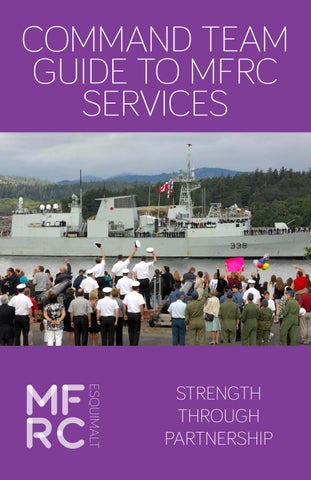
Command Team Guide to TEAM Working with COMMAND Your MFRC GUIDE TO MFRC SERVICES
STRENGTH THROUGH PARTNERSHIP
Table of Contents Introduction �������������������������������������������������������������������������������������������������������������������������������������� iv Military Families: Strength Behind the Uniform �������������������������������������������������iv What Does the MFRC Do? ����������������������������������������������������������������������������������������������������1 Military Family Resource Centre �������������������������������������������������������������������������������������������1 The MFRC and You �������������������������������������������������������������������������������������������������������������������������� 2 Pre-deployment �����������������������������������������������������������������������������������������������������������������������������4 Deployment Assistance Group (DAG) ������������������������������������������������������������������������� 4 Family Care Plan ��������������������������������������������������������������������������������������������������������������������������������� 4 MFRC Family Information Form �����������������������������������������������������������������������������������������5 Unit Liaison Reps ���������������������������������������������������������������������������������������������������������������������������������5 Family Briefing ����������������������������������������������������������������������������������������������������������������������������������������6 Deployment Support Group (DSG) ���������������������������������������������������������������������������������8 Departure Planning and Execution �����������������������������������������������������������������������������������9 Deployment Phase ������������������������������������������������������������������������������������������������������������������� 10 Family Networks �������������������������������������������������������������������������������������������������������������������������������� 10 Staying in Touch (SIT) Service ���������������������������������������������������������������������������������������������11 Sunday Sessions ���������������������������������������������������������������������������������������������������������������������������������11 Workshops �����������������������������������������������������������������������������������������������������������������������������������������������12 Children’s Deployment Workshops ��������������������������������������������������������������������������������12 Children’s Deployment Workbooks ��������������������������������������������������������������������������������12 Significant Incident ��������������������������������������������������������������������������������������������������������������������������13 Reintegration and Reunion Support ������������������������������������������������������������������������������14 Post-Deployment ������������������������������������������������������������������������������������������������������������������������15 Post-Deployment Feedback �������������������������������������������������������������������������������������������������15 Summary �����������������������������������������������������������������������������������������������������������������������������������������16 Appendix A: MFRC Unit Liaison Program ��������������������������������������������������������������� 17 Appendix B: MFRC Services ����������������������������������������������������������������������������������������������19 Appendix C: MFRC Scenarios and Answers ������������������������������������������������������� 20 Appendix D: Command Team Checklist �����������������������������������������������������������������23 Appendix E: Frequently Asked Questions ��������������������������������������������������������������24
Introduction Military Families: Strength Behind the Uniform Message from MARPAC Commander MARPAC is blessed with a Military Family Resource Centre that provides incredible support to our families. As Commanding Officers, you are fortunate to have this highly skilled and experienced team a phone call or email away. The strength behind our uniforms is our families, and I expect you to engage your Esquimalt MFRC frequently during your time in Command. This guide is filled with many tips learned and refined throughout our MFRC’s 25-year history, including supporting ships and submarines deployed on operations around the world. It is an important reference for you and your Command teams, and I encourage you to provide any feedback on it to the MFRC.
W.S. Truelove, Rear-Admiral,
Commander MARPAC/JTFP I
Message from Executive Director We believe all military families are strong, independent, resilient and resourceful. They cope with many unique and challenging circumstances, including long deployments. As leaders in Deployment Services, MARPAC has embraced the value and significant role families play in the well-being of their Canadian Forces members and ultimately their deployability. Recognizing their importance, MARPAC has joined in a full partnership with the Military Family Resource Centre to provide the member and their family with firsthand information and an extensive array of services that address the social, physical and emotional needs of the family during deployment. When families are made a part of the team and these relationships are nurtured, Commanding Officers have reported less stress, reduced financial costs, improved crew morale and reduced stress on the family. Working collaboratively with families, Canadian Forces partners, the deploying ship and senior leadership, we are able to ensure that we can attain this goal. The purpose of this guide is to demonstrate the value of the partnership between the MFRC and your ship or unit. We are incredibly proud of the work our Canadian Forces members do at home and around the world, and recognize that much of the strength that makes the CF member successful is support from their family, who also make sacrifices on behalf of our country. Gaynor Jackson Executive Director EMFRC
Canadian Forces Family Covenant
What Does the MFRC Do? The Esquimalt Military Family Resource Centre (EMFRC) is a charity governed by a volunteer Board of Directors comprised of a minimum of 51% military family members. The MFRC is an independent organization and works in partnership with the Canadian Armed Forces (CAF) to deliver programs and services to members and their families.
Military Family Resource Centre What We Offer A unique approach to working with military families: Governed by military families for military families. MFRCs are the only nonprofit, registered charitable organization dedicated to working specifically with military families. Our vision is for proud, self-reliant military families thriving in a dynamic and supportive community. Helping the military achieve operational missions: Canadian Forces members know that when they deploy, there is an organization dedicated to assisting their families should emergencies arise. Members can deploy with peace of mind and focus on the mission. A safe and enriching place for military families to go: MFRCs offer a large menu of services ranging from child care to information services to deployment support to crisis support. With more than 25 years of being part of CF communities, it is the place families know to go to for information and support. Connected to community needs: The MFRC has extensive experience in developing programs and services to meet the unique needs of military families. This strengthens families and helps build resilient military communities across the country. Professional staff and volunteers: The MFRC is managed and staffed by trained professional staff and volunteers.
1
The MFRC and You How We Work Together The MFRC staff team works with the Command Team and families to: • Provide resources and support for families before, during, and after a work-related separation. • Enhance the ability of CF members to be ready for duty. • Ensure families have opportunities to connect with and support each other during periods of separation. • Ensure families are aware of and have access to relevant programs and services designed to assist them manage CF-related separation and reunion. • Ensure families are aware of and prepared for the challenges they may encounter before, during and after separation. How we can support your command team and ultimately, make your job easier Your role is getting ships out to sea. Our role is making sure the family unit is stable so that your sailors can be on those ships and can focus on the operational mission at hand! • To achieve this, we offer a variety of programs and services specifically for military families that address the unique lifestyle challenges and help families build resiliency so they can develop the tools they need to deal with future challenges.
2
• We are a 24/7 resource agency for families, members and Command. Because we have been in the community consistently for 25 years, we have a good understanding of resources available in both the military and civilian communities. We are a constant and, in some cases, the local corporate memory. • We have a good proven track record and can be a valuable resource to any supervisor trying to find the best solution to support their people. • Get to know us as early as possible so we can be the best support to you. The MFRC is there to support you no matter what the ship’s programme might be. Deployments simply trigger a specific, tailored level of support. In fact, many Commands that we have developed relationships with will call just to ask about specific resources that might assist their crew who are experiencing challenges. Although we are there to support members and families at any time, many units tend to find our services particularly helpful in managing the challenges of deployments.
3
Pre-deployment Once a ship has been identified to deploy, and as requested by that ship, the Military Family Resource Centre starts the pre-deployment phase. MFRC staff meet with the relevant Command team, normally the Commanding Officer, Executive Officer and Coxswain. This meeting is vital in building two-way communication and trust between command and the MFRC as support for families hinges on the Command team. During this meeting the staff discusses what services and support the MFRC can provide to the members and their families throughout the deployment and together with Command develops the schedule of events for the deployment. Methods of communication between command and the Deployment Support Program are agreed to and funding as well as other support measures for the family network are set.
Deployment Assistance Group (DAG) Approximately 6-8 weeks prior to departure, MFRC staff are available to spend a few days with the unit or on board the ship. The purpose of this DAG process is to speak to each member of the crew or unit. Many members are not fully aware of the services, programs and supports that are available to them and their families. When you hold your Deployment Assistance Group (DAG) please be sure to invite the MFRC as part of the process.
TIP
Family Care Plan All CF members MUST complete a Family Care Plan, form DND 2267. Members are responsible for ensuring they have a Family Care Plan in place to care for partners, children or other family members during deployments and emergency call outs. These plans are valuable tools in preventing family emergencies and reducing stress. If members need to establish a Family Care Plan, the MFRC can help.
4
TIP
Administered by the local MFRC, the Emergency Childcare Service (ECS) provides timely, affordable and regulated child care for CF families to address their childcare needs. It supports the ability of the CF members to be available for duty if their childcare plan fails.
MFRC Family Information Form We rely on your support for contact information. Please provide us with an up-to-date emergency contact list so that if you require, we can contact your families in case of emergencies. There is nothing worse than having incomplete contact information when something serious happens and we are asked to contact families. Your members need to know that this information is mandatory and these lists are only used if the CO makes a decision that families need to be contacted if, for example, something happens, the mission changes or specific information needs to get out. The lists are used for no other reason.
Unit Liaison Reps What has worked well over the years is the Unit Liaison Program. This program has become a great vehicle for information exchange between your unit and the MFRC. We can get more information out to your people and, in return, they can let us know what the needs of your unit are.(See Appendix A) TIP
It works well when the Command team takes the time to appoint the right Unit Liaison from each of the three messes, giving them a better connection to all crew members.
5
Family Briefing Pre-deployment briefings are joint MFRC/deploying ship presentations for families and the members. Ideally, they occur four to six weeks prior to a departure. All partners in support participate in informing and educating the families and crew as to their commitment to supporting the families while the ship is deployed. This has proven to be highly valued by the families and CF members, as it is a tangible demonstration from the senior leadership that the Canadian Forces recognizes the value of families. While it is up to the Command Team, we suggest a letter from the CO inviting each family to attend with the member of the deploying ship. The MFRC can assist with this upon request. Some COs have changed the daily routine to make the briefing a part of the work day so it is mandatory for members to then invite the families to attend; available on-site child care makes this easier for families. Send a letter from the CO, inviting each unit member and loved one to the pre-deployment brief. Provide onsite child care to make it easier for families to attend.
TIP
For some families, this may be their first contact with the Canadian Forces and Military Family Resource Centre and it may be their first time experiencing a deployment of any length, so the briefing to families and members is based upon family preparation. In our experience, there are three keys to a successful deployment: 1. Families are prepared and have planned for the event. 2. Families are aware of resources available to them. 3. Families are connected and not isolated. The goal of the briefing is to ensure that all of these elements are addressed.
6
Traditionally the ship or unit invites the following guests and subject matter experts: • COMCANFLTPAC • N1 • FCPO, Flt CPO or BCPO • CO443 (if HELAIR Det deploying) • Padre • Fleet Mail Office • PA • AJAG • CF Health Services
7
In addition the MFRC will invite Personnel Support Program (PSP), Canadian Forces Exchange (CANEX) and Service Income Security Insurance Plan (SISIP) financial services to set up a display so that family and members become familiar with their services. Sample Questions: The following are questions that were most often asked by participants at past briefings: • How long will they be gone? • What is their role? Where are they going? What is the potential risk to them? • When will they return? • Will there be LTA or reverse LTAs? • What about extra pay or benefits? • Can we send them morale mail? • What about email? How will I be able to communicate with my loved one? • How do I contact my loved one in case of emergency? • I’m a single member; who looks after my home while I’m deployed? The MFRC will guide you through the process of setting up a pre-deployment family briefing.
TIP
Deployment Support Group (DSG) DSG is the common CF title for the traditional Naval Shore Element, Army Rear Party and Air Sponsor Group. The function of the DSG for MARPAC is carried out by the MFRC in close partnership with N1 staff and with the close cooperation of the Base Orderly Room CFB Esquimalt. The role of a DSG is to contribute to the well-being of deployed CF members and their families.
8
The DSG shall provide: • Access to local military family resources, programs and services. • Information on civilian family-related programs and services. • Accurate and timely mission information. • Assistance during family-related emergencies.
Departure Planning and Execution The departure of the ship is a very stressful time for the member and the family. We have learned that the departure ceremony provides the family, the member and the community with an opportunity to be recognized by the Canadian Forces. Having the Chain of Command acknowledge the sacrifices of the family and the member is valuable in building the trust and the relationships between all partners in deployment. The Military Family Resource Centre, in partnership with the ship, provides families with the opportunity to gather over refreshments and learn about programs and services available to them. The MFRC sets up an information booth near the departure site with information packages for those who may have missed the predeployment briefing. On many occasions the ship’s CO will invite the families on board just prior to departure. This is a great opportunity for families and children who haven’t seen the surroundings in which their loved one will be working and living for the next few months. The CF Road to Mental Readiness Program (R2MR) offers pre- and post-deployment training to CF members. It is available through www. forces.gc.ca/en/caf-community-health-services-r2mr-deployment/ index.page TIP
Acknowledging the sacrifices made by military families during the departure ceremony makes families and members feel valued. This builds trust and creates a better relationship between your command and the families.
9
Deployment Phase It is helpful for you to know a little bit about the programs and services available to your families through the deployment phase.
Family Networks Family Networks are based upon a community development model. The families of the deployed ship and MFRC staff work together to plan, organize and deliver programs and activities for the families of the deployed unit.
At each pre-deployment briefing or family briefing and at departure there will be a sign-up table for family members to join the Family Network. MFRC staff will assist Family Networks in holding meetings and activities as required and networks are encouraged to make their network work for them and serve them best. Financial support for group activities is provided by the deploying Unit Fund to the MFRC which maintains a trust account for each network. Where such funding is allocated, it will be shared fairly and in an equitable manner. The Family Network will require some funding. Be sure to incorporate this into your planning process.
10
TIP
Staying in Touch (SIT) Service The MFRC’s Staying in Touch (SIT) service offers families the opportunity to receive regularly scheduled telephone calls from MFRC staff. The purpose is to ensure that families of CF members remain connected to base and community resources and services during work-related separations. They offer a friendly voice and a listening ear. All contacts are strictly confidential. CF Members can request SIT services for their loved ones when filling out the Family Information Form. Family Members may sign up for the service at pre-deployment briefings, departure ceremony, during Sunday Sessions or by contacting the MFRC.
Sunday Sessions Whenever a ship deploys for more than 90 days the option to hold Sunday Sessions for families is available for that ship. Sunday Sessions are normally held monthly at the Colwood Pacific Activity Centre. They consist of a potluck lunch, a family network planning session, a briefing from the CO to families via conference call (with a PowerPoint slide show). Sessions also include Wellness Workshops for adults and, if available, video teleconference calls between members and their loved ones. A Senior Leadership rep from CANFLTPAC normally attends these sessions to lend support and often will ensure a subject matter expert is in attendance to address “hot” issues pertaining to the deployment. Child care is provided by the MFRC, and pre-registration is required. TIP
Sunday Sessions enable you to strengthen the connection between the command and families by talking to them directly during deployments.
11
Workshops How people react to separations can be highly individual, and it is important for families to know that there is no “right way” for them to react to deployment-related separations. Sometimes, just knowing that others share similar concerns will help normalize and validate the experience of separation. A series of six workshops for adults is offered during Sunday Sessions: • Dealing With Deployment • Making Connections • Stress Busters • Transitions • Re-establishing Your Relationship • Return and Reunion
Children’s Deployment Workshops Deployment separation can be a confusing time for children. Deployment Workshops for children help them adjust to a parent being away on deployment. Workshops offer an opportunity for children to interact with other children who are going through the same experience. These workshops will help validate your child’s feelings about deployment. Workshops are available for children starting from pre-school age all the way to teens.
Children’s Deployment Workbooks
For those families who cannot attend the on-site Children’s Deployment Workshops, we have developed a take-home workbook series for the at-home parent to use. These workbooks are bilingual, free and are available at each MFRC location. The MFRC offers a parenting from afar booklet that includes tips for deployed parents. Be sure to get copies for your members before you deploy!
12
TIP
Significant Incident We all know that being in the military is inherently dangerous and that such things as accidents or changes of mission can happen. It is especially challenging for families when this occurs and the ship is far from home. Families have told us again and again that they don’t want to hear about these events on the radio or TV, but want to hear it from the military first. Maritime Forces Pacific senior leadership has made a commitment to families that they will work with the Military Family Resource Centre to provide families with information as quickly and as accurately as they can when unexpected or tragic events occur. Family callouts may be in response to a significant event that affects a deployed ship, to provide families with information prior to a media release or to inform families about changes to schedule etc. It is up to the Chain of Command how and when to engage the services of the Military Family Resource Centre. Emergency Family callouts may only be commenced when requested by the CO of a deployed unit or by the local CF Commander. The objectives of the MFRC during a family callout are: • To provide timely accurate information. • To ensure the information is delivered in a compassionate and understanding way. • To ensure callout it is carried out in an efficient and effective manner by trained staff. • To ensure concerns from families are followed up. • To ensure any additional information sessions, supports or resources are put in place to support families. TIP
Please be sure that you provide the MFRC with an up-to-date emergency contact list. This ensures that the MFRC can support the Command team in the event of a significant incident.
13
Reintegration and Reunion Support
The MFRC usually experiences a spike in requests for counselling support services 6-12 weeks post-deployment as families adjust after the homecoming. We know that by providing effective preventive support/ education to members and their families, some of these challenges can be mitigated. MFRC staff is available to offer Reintegration and Reunion training/ resources for extended missions either on board or through an appropriate crew member such as the Padre. The CF Road to Mental Readiness Program (R2MR) post-deployment training package is designed to be delivered by a team consisting of an operator (CAF member or retired CAF member) combined with an experienced CAF/DND mental health clinician. It is also available as online course. The benefits of a Return and Reunion program: • Reduction in incidents after return from deployment • Improved member performance and focus • Enhanced life skills • Reduces stress and empowers members with information and resources • Improved retention • Saves command leadership time and stress For extended deployments it is required that you have a reintegration program plan in place.
14
TIP
Post-Deployment Homecoming, and the anticipation of having the family unit together once more, generates its own kind of anxiety. The energy level is heightened as the family members look forward to “the day.� Along with the expected excitement, family members experience feelings of uncertainty. To aid in the celebration of reunion, the Network and Deployment Services team create activities that acknowledge what was accomplished during the deployment. Families come together to participate in a group welcome home banner-making party and then when Homecoming day arrives the MFRC will be on site to offer the ship and families assistance.
Post-Deployment Feedback We are always interested in how the deployment went from your perspective with regards to MFRC support and services. After the deployment, we will look for opportunities to request feedback from both the Command Team and your members in order for us continue to enhance the MFRC services for future deployments. This is important to us and your input is what shapes the support for future deployments. TIP
For more information on the benefits of conducting reunion training, check out the Return and Reunion Fact Sheet! www.esquimaltmfrc. com/assets/doc/R-and-R-Fact-Sheet.pdf
15
Summary We have learned so much working in partnership with the senior leadership in Esquimalt and with our families. It is absolutely vital that families are seen as, and are treated as, full partners in deployment. Knowing the challenges, dangers and needs of the member and the ship that is deployed provides the Military Family Resource Centre with the information necessary to know what the families may be experiencing. We are then able to plan and provide the necessary support, information and resources. Ensuring families are informed and supported makes them a valued part of the team. Keeping them connected and supported does result in better relations, trust, improved morale and a much better understanding about the military by families that will pay dividends to the CF. If you would like more information or would like to arrange a meeting, please call the Executive Director at 250 363 3080. Helpful References
MARPACORD 2-50 DAOD 50441 DAOD 5044-3 CANFORGEN 164/05
16
Appendix A MFRC Unit Liaison Program The MFRC Unit Liaison program was created to facilitate communication between units and MFRC staff. The Unit Liaison Member is the unit point of contact for the MFRC and the Family Support Network. The goal of the program is to keep units informed about the programs and services available through the MFRC and to develop opportunities for you to provide feedback to the MFRC. Unit Liaison training is offered annually by the MFRC; our Deployment Coordinator is always available to brief new appointees to the position. We recommend that you appoint a liaison and at least one backup for occasions when the primary liaison is absent. Many ships appoint one liaison from each of the three messes; they find that this gives them a better connection to all crew members. Duties of the Unit Liaison • Educate and inform members and their families about the programs and services available through the MFRC. Function as a resource person, working closely with the MFRC to determine how services can best be developed to support the unit. • Actively seek to engage members during an In-Routine: Connect with new unit members to provide information about resources and contacts for the MFRC. Offer new members a welcome package containing pertinent information about the MFRC. • Meet with the MFRC staff before, during, and after deployment: Become familiar with the Family Network (in particular the network coordinator) to ensure that a point of contact is established and
17
families have access to information, especially during deployment. • Ensure that weekly communication takes place during deployments. Stay updated on what takes place at home while the ship/unit/ member is deployed. • Participate in an annual training session with the MFRC to evaluate the effectiveness of the Unit Liaison program and to provide appropriate recommendations. • Serve as a peer support person by being available to co-workers to listen and direct them to an appropriate resource when required. MFRC Responsibilities in the Unit Liaison Program • By request, MFRC staff will supply each liaison member with information pertaining to the MFRC to be given to each member during the In-Routine. • As required, the MFRC staff will submit to the liaison member information to be included in the unit’s Routine Orders. • MFRC staff will attend the unit’s pre-deployment family briefings and are available to attend the unit’s annual Professional Development Days to brief on the programs and services offered at the Centre. • The MFRC will conduct annual training with the liaison members to evaluate the effectiveness of the Unit Liaison program, share ideas and tackle challenges. • When the ship, unit or individual member is deployed, MFRC staff will contact the liaison member as necessary via email. When the ship is alongside or the unit is not actively deployed, contact will be initiated as required. • By request, MFRC staff will meet with liaison members to discuss any pertinent information or provide resources, or both.
18
Appendix B MFRC Services Pre-Deployment ☐☐ Deployment Assistance Group (DAG) ☐☐ MFRC Contact Information Form ☐☐ Unit Liaison Reps ☐☐ Family Briefing ☐☐ Deployment Support Group (DSG) ☐☐ Departure Planning and Execution
Deployment Phase ☐☐ Family Networks ☐☐ Staying in Touch (SIT) Service ☐☐ Sunday Sessions ☐☐ Workshops ☐☐ Children’s Deployment Workshops ☐☐ Children’s Deployment Workbooks ☐☐ Significant Incident ☐☐ Reintegration and Reunion Support
Post-Deployment ☐☐ Counselling ☐☐ Workshops ☐☐ Deployment feedback session
19
Appendix C
MFRC Scenarios and Answers Below are examples of situations that may occur at your command, as well as the best responses for each situation. Preparing to deploy: As a new CO, you have just found out that your ship will be leaving on an extended deployment in 30 days. You meet with your command team to discuss preparations and your Cox’n raises a concern about family support. You know that there are support agencies out there to assist but don’t really know what they can offer or who takes the lead. What is your next step in ensuring that your families are adequately prepared and supported to deal with the deployment? Answer: Initiate contact with the MFRC Executive Director to learn more about the support they can provide. They will assist you in putting together a deployment plan that will include: • Pre-deployment briefing • DAG participation • Deployment activity schedule of monthly information sessions • Establishment of a family network • Ongoing communication processes • Menu of specific service/programs to be offered
20
Communication: You are currently on a three-month WESTPLOY, and having recently achieved HR, you have been redirected to a NATO-led response to increased tensions in the Persian Gulf region. You don’t have a lot of information, but you know that the mission change will be reported in the press within 10 days. The Commodore has asked for your communication plan on how you are going to inform families. What course of action are you going to take to ensure that your families are informed? Answer: Contact N1 and the MFRC Executive Director to initiate a callout to families. N1 will speak with the MFRC to ensure that the consistent message from the ship will go out to families and ensure that Public Affairs holds the press release until all efforts have been exhausted to contact families. Family concerns: You are in the smoking area and overhear a conversation between two of your PO2s. One of them, who is a francophone, has just relocated from Ottawa and is obviously quite distraught and talking about the difficulties his son is having with the adjustment. He realizes you have overheard part of the conversation and decides to engage you in the discussion. He confides in you that his son does not speak English well and has been talking about “not wanting to live anymore.” He is at a loss about what to do; you know that if he does not deal with the situation soon, he is not going to be able to concentrate on anything else. What is your next course of action to assist him in dealing with his situation?
21
Answer: Contact the MFRC Executive Director. The two key issues here are the language challenge and the potential self-harm. The MFRC has staff dedicated to second language services and counselling services. In this situation, they would put them both together so they could develop the best plan to support the child and his family with the pressing concerns (suicide risk assessment). The other related issue is the adjustment challenges due to the recent relocation, and the MFRC has a variety of support services that can assist this family in adapting to their new community particularly relating to the language barriers. Family concerns: Your ship is about to sail for a two-week deployment. You are currently sailing with a bare minimum of Cert 4 Mar Eng on board. There are no others available ashore due to optempo. You become aware of an issue with one of your Cert 4s. The family has recently ended a long IR period and has joined the member on the west coast. There are children with significant special needs. The family has been working hard to get the required supports in place since relocating, but it has been difficult. In fact, the sailor has been given numerous periods of time off to address these issues. The spouse also has some specific health issues that flare up from time to time. Four days before deployment, the spouse’s medical condition worsens to the point where she cannot provide care to the children. The Family Care Plan has failed due to other factors. Your EO informs you that his search for a temporary replacement has come up empty. Where do you turn, as you need to come up with some support plan to allow the sailor to proceed to sea? Answer: The agency that primarily assists with family concerns is the MFRC. You can contact the MFRC Executive Director to see what options can be put into place to assist with this situation. Staff will brainstorm options with the family that pertain to each family’s unique situation and will craft a plan together that will hopefully work for all. In the past, emergency respite dollars have been used to place childcare providers in the home, or to fly family members out for the short duration.
22
Appendix D Command Team Checklist Command Team Family Support Deployment Checklist Time
Task
Notes
9-12 weeks before deployment
Meet with MFRC leadership & staff
Agreements should be reached on all family support issues at this meeting, including; MFRC DAG participation, Predeployment Brief, Communication Channels and frequency, at sea R&R Training, Sunday Session dates, departure and homecoming supports, deployment handbooks, Family Network financial support
5-7 weeks before
Hold DAG Process
Invite suggestions – MFRC, AJAG
4-6 weeks prior
Schedule Pre-deployment Brief
At CPAC, invite suggestions: Snr Off., AJAG, Padre, CFHS, FMO, admin SME
3 weeks prior
Finalize Departure details with Flt CPO1, MFRC and QHM
3 weeks prior
Pick up resource package from MFRC for Ship’s Library & Sick Bay
1 week prior
Cox’n sends MFRC contact List to MFRC
Deployment Day
Departure
Depl Day +1
Cox’n sends updated MFRC contact list
Depl Day +25
Upload PPT for Sunday to MARPAC FTP site
CO, XO or Cox’n should contact, Flt CPO & MFRC prior to each PPT upload to ascertain current “hot topics or areas of concern for families so they can be addresses during the brief
Depl Day +55+85+115 +145+175
Upload PPT for Sunday to MARPAC FTP site
contact, Flt CPO & MFRC
Depl Day +30
First Sunday session
Once again after brief MFRC & Flt CPO will provide feedback to you on any concerns that were raised post briefing
Depl Day +60+90+120 +150+180
Sunday sessions
As required
Appoint Return & Re-integration Onboard OPI/POC (padre if carried) Confirm R&R at sea dates, ports and team make-up
Bunking considerations (male/female) Normally 2nd last Foreign port to last Foreign port
Homecoming 3 weeks
Confirm homecoming support details
Flt CPO, MFRC, QHM & SOVP
Homecoming 1 week
Cox’n forwards guest access list for Homecoming
Flt CPO, MFRC
Homecoming Day
Enjoy
Homecoming +30 days
Provide feedback to MFRC ED on support for deployment
Short PDR on what worked well and what should be improved from the ship’s point of view.
23
Appendix E Most people know there is an MFRC but often don’t know what it can do for them until a need arises. This section will provide answers to some of the questions that are commonly posed by members.
Frequently Asked Questions I don’t need the MFRC and neither does my family. It’s true that some families choose not to use MFRC programs and services or do not require them. However, one day you may find yourself in a position where you want or need to access the MFRC. Many military families thought they would never use our services, only to tell us years later that they were glad we were there. The worst-case scenario for us (and it has happened several times) is going to a ship’s homecoming or another community event and hearing someone say, “I didn’t know that you existed and I sure could have used your services.” We see ourselves as a safety net for the military community. Just as you have financial insurance for your family, it’s good to have lifestyle insurance. The MFRC can provide that for you. Connecting with the MFRC and making sure all family members are informed will help them and you make decisions and access information if it is needed. I am single and don’t have any children. What can the MFRC do for me? The MFRC has many services that benefit everyone, including single members, couples without children, reservists and parents of military members. The MFRC’s 24 hour Family Information and Referral
24
Services team is available to everyone. Relocation, deployment, emergency, and social work services are accessible to single members and their families, including their parents. When I use MFRC services, how do I know I’ll have my privacy and confidentiality respected? This issue is extremely important to the MFRC. It’s hard to work, live and seek help in the same community. Many military families are extra sensitive to confidentiality. The MFRC works in partnership with the military, but is not required to divulge any information unless required by law, or if the organization is requested to do so by the client. Staff and volunteers are bound by strict privacy and confidentiality policies and laws. What your members need to know is that if they are reluctant to use the MFRC for confidential services, we can help direct them to other resources or organizations. The important thing is that they get the support they need. The MFRC can help them find that support. Why does the MFRC need family contact lists from ships, units and members? This information is only used in cases of significant incidents. In case of an emergency or unique occurrence during a deployment, the ship or unit often requests that the MFRC distribute urgent information to military families or call them to gather for a briefing by the Command Team. This emergency only contact list is held, and secured, by the MFRC and only engaged at the request of the Formation Commander, the Fleet Commander or the CO of the ship. So, the information collected in these lists is actually for the MFRC to use at the direction of Command. To address legitimate privacy concerns on the part of CF members, a Privacy Code is in place for the protection of personal information held by MFRCs and establishes strong obligations as to how MFRCs must protect personal information in their custody.
25