Design: Klaudia Jeremiejko, Katarzyna Pasierbiewicz, Jan Hrubý
Editing: Maria Uritu, Ilgaz Kiran, Cristina Aterido
Contributors: Wim Gabriels, Simone Lepore, Rui Vinha, Kaja Kaczkiełło, Anja Milković, Marco Comotti, Neli Kalinova-Schmieder, Céline Guérin, Sabri Ben Rommane, Tiago Nunes, Gorka Guerrero, Adrián Vozmediano, Maria Uritu, Ilgaz Kiran
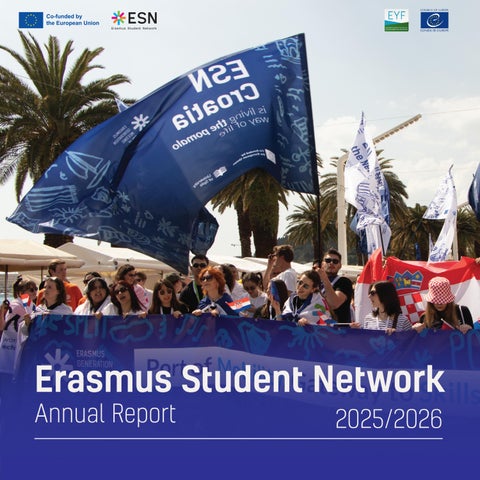
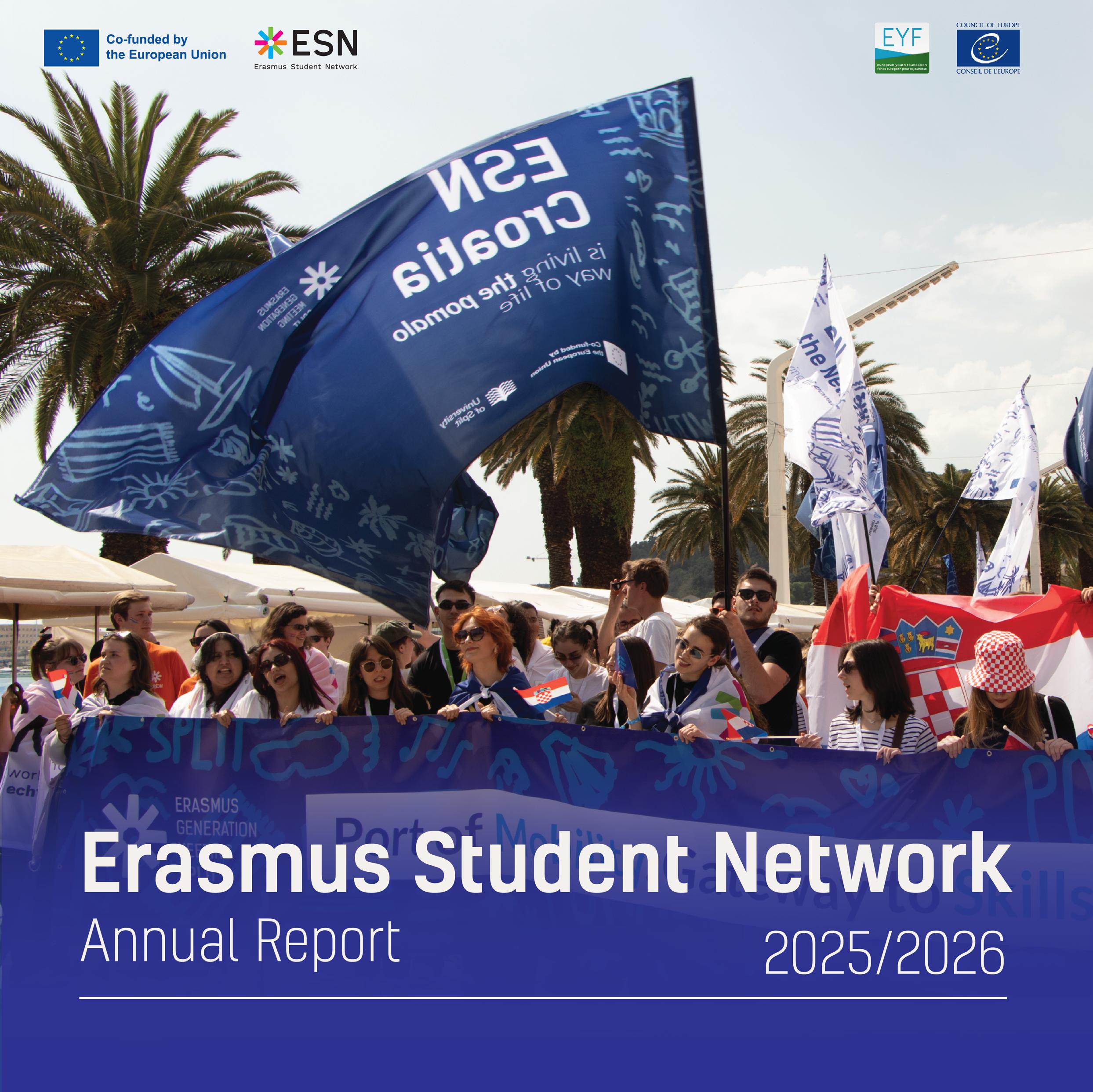
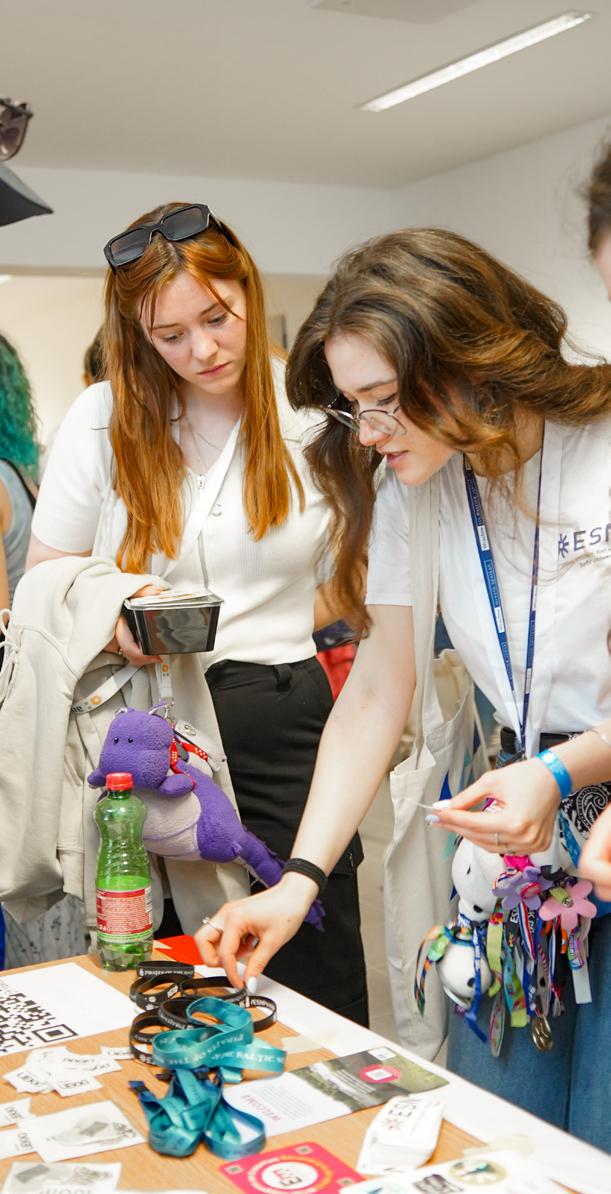
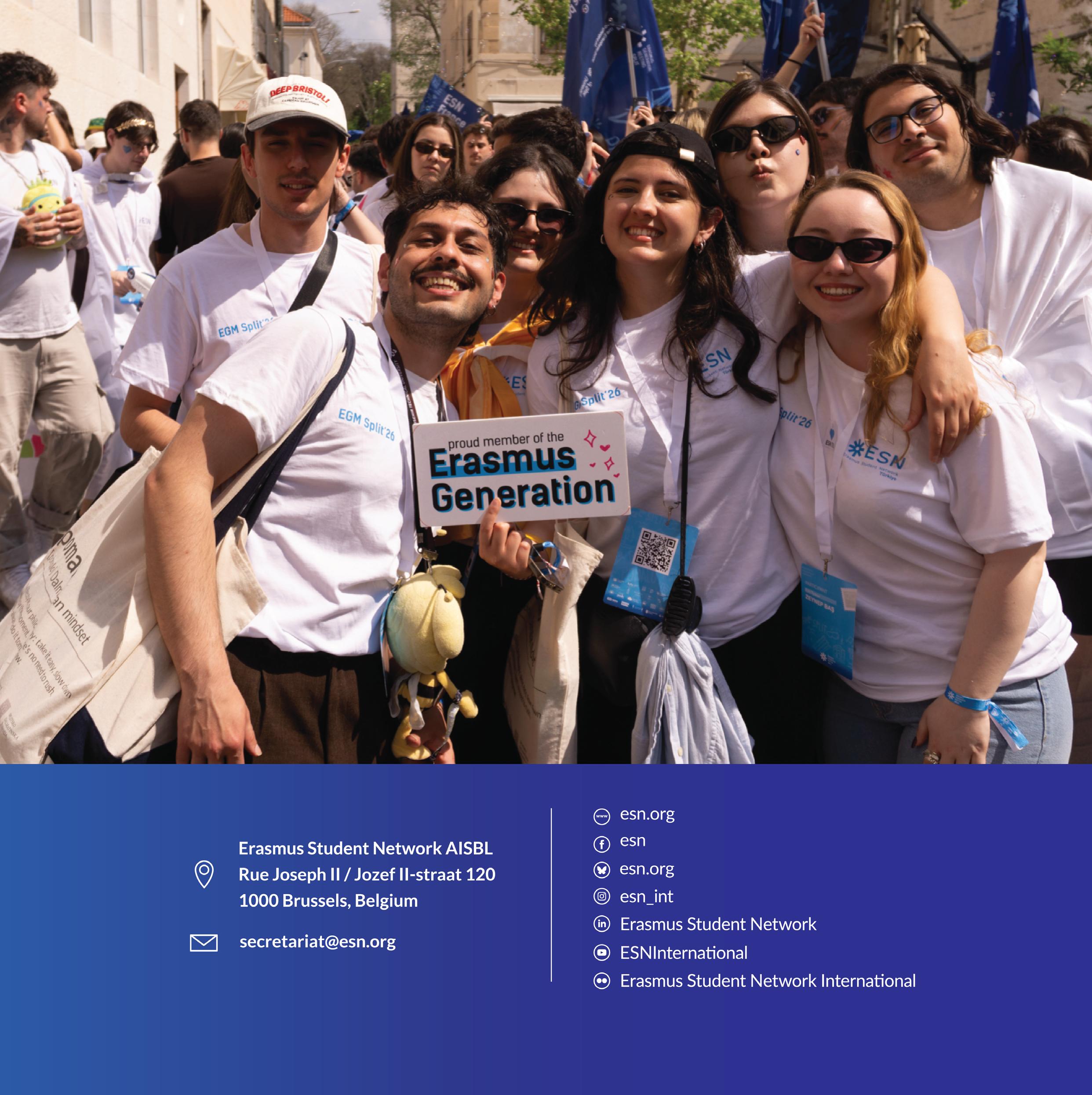
Cover photography: Erasmus Student Network AISBL
Funded by the European Union. Views and opinions expressed are however those of the author(s) only and do not necessarily reflect those of the European Union or the European Education and Culture Executive Agency (EACEA). Neither the European Union nor EACEA can be held responsible for them.
Us on a European level, never forget the added value of a programme such as the one of yours. We tend in Europe to talk about what doesn’t work, about the problems we have, about the challenges we have, but we don’t talk about the successes. And Erasmus is one of the most amazing ones.
As Student Network, I think you deserve more recognition. You deserve more funding and you deserve more help.
Roberta Metsola, President of
the European Parliament
Foreword
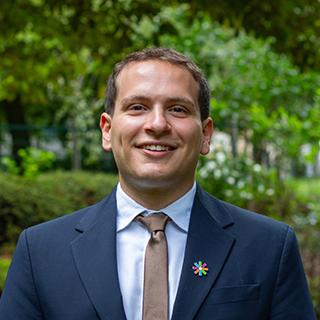
Simone Lepore
President of the Erasmus Student Network
The academic year 2025/2026 has been marked by commitment, responsibility, and continued dedication to our Network. Throughout the past months, volunteers across ESN have worked tirelessly to support international students, strengthen our communities, and contribute to the development of the Erasmus Generation.
In a constantly evolving environment, our Network has continued to demonstrate the importance of solidarity, intercultural dialogue, and active participation. Every initiative, event, and project carried out this year reflects the shared belief that international mobility remains one of the most valuable opportunities for young people to grow, connect, and contribute positively to society.
This year also represented an important moment for reflection and development within ESN. Through the daily work of local sections, national organisations, and international structures, we continued striving to improve the quality of the experience we provide to students and volunteers alike. The dedication shown throughout the Network highlights not only the strength of our organisation but also the sense of responsibility carried by every individual who contributes to it.
At the heart of ESN are the volunteers who dedicate their time, energy, and passion to creating welcoming environments for students far from home. Their efforts often go beyond what is visible, yet they remain the foundation upon which our Network continues to grow. Their commitment embodies the spirit of ESN: students supporting students, while fostering openness, understanding, and human connection across borders.
As long as there are students who face barriers to access international opportunities, as long as there are experiences that can be improved, and as long as there are voices that need to be heard, ESN work will continue.
As we look back on this year, we do so with gratitude for everyone who contributed to our shared mission — volunteers, partners, alumni, and supporters who continue to believe in the value of international mobility and intercultural exchange. The challenges ahead remind us that the role of organisations such as ESN remains essential. Together, we will continue working to ensure that future generations of students can experience the same sense of belonging, opportunity, and personal growth that international mobility has provided to so many before them.
On behalf of the International Board, I would like to sincerely thank every member of our Network for their dedication and contribution throughout this year. It is through your commitment that ESN continues to represent not only a Network, but a community built on shared values and a common vision for the future.
Highlights
Celebrating Europe’s Leading Mobility Destinations
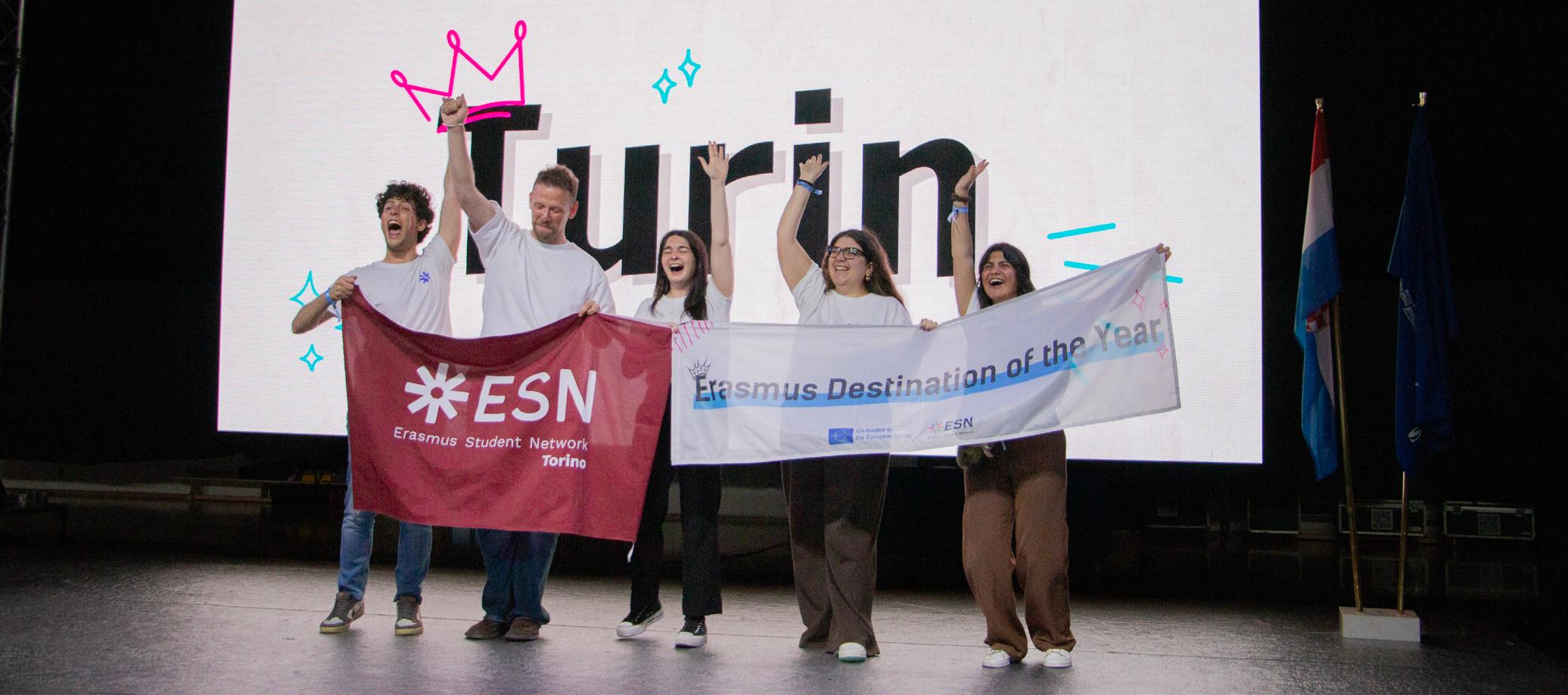
Turin was selected as the Erasmus Destination of the Year 2026 during the fifth edition of the Erasmus Generation Meeting. The initiative recognises cities that demonstrate a strong commitment to supporting student mobility and improving the international student experience.
The city stood out for its combination of historic heritage and contemporary innovation, offering a dynamic academic environment and strong support for both local and international students. Turin’s cultural scene, research and innovation ecosystem, green spaces, and renowned culinary traditions further contributed to its recognition as a leading mobility destination.
Other candidate cities included Gothenburg, Istanbul, Munich, and Santander, each presenting their city to the participants of EGM Split 2026.
The selection was made through a combination of votes by attendees of EGM and an evaluation conducted by an external jury composed of representatives from the European Commission, EAIE, Nuffic and ACA, who made their selection based on stakeholder collaboration, impactful initiatives, and the quality of mobility support services.
Storytelling on Sustainable Mobility Journeys
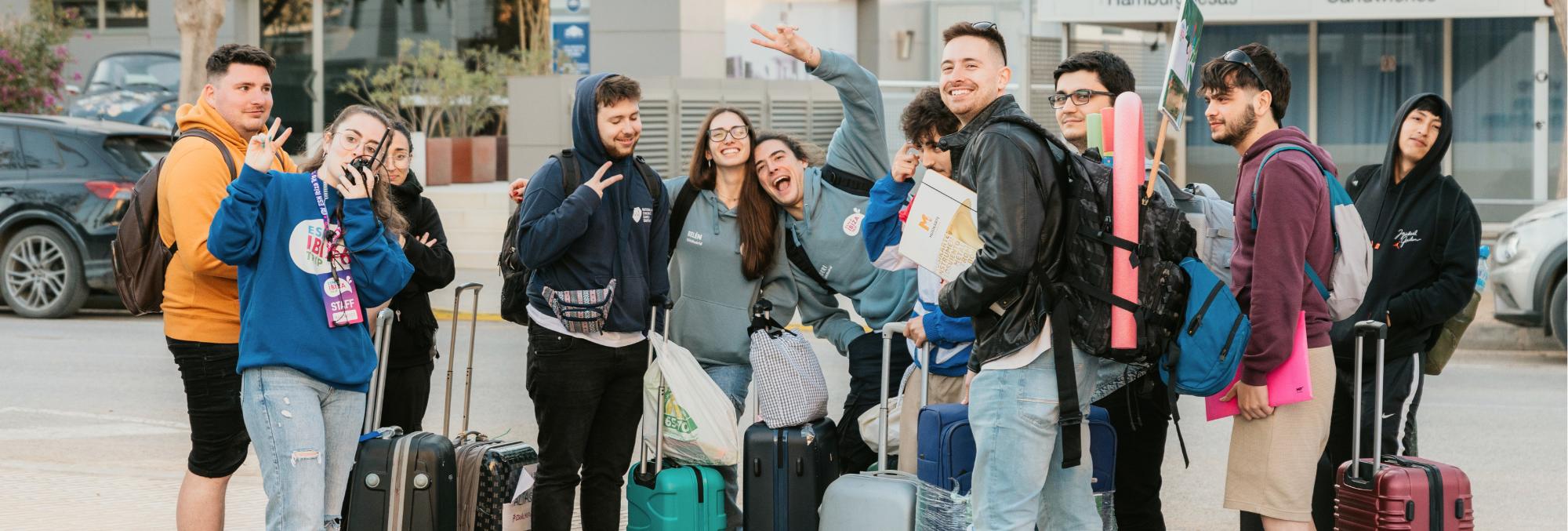
Throughout the past academic year, sixteen Erasmus students travelled sustainably to their Erasmus+ destinations, choosing lower-emission means of transport such as trains, buses, and bicycles and transformed their trips into engaging stories.
The initiative highlighted how sustainable travel to the mobility destination could become an enriching learning experience itself, encouraging participants to engage more closely with the places, cultures, and communities encountered along their routes. Beyond reducing environmental impact, the journeys showcased the personal growth, intercultural learning, and meaningful connections built through slow travel.
Through videos, testimonials , blog articles , webinars, and social media content, students documented their journeys and shared personal experiences of travelling across Europe in a more environmentally conscious way.
By sharing their stories across different digital formats, the storytellers promoted peer-to-peer learning and inspired students to consider more sustainable approaches to international mobility. This initiative was carried out within the framework of the Sustainable Erasmus+ Travel Project , supporting the promotion of more sustainable mobility practices in international higher education.
Photography credits: ESN Spain
Anchoring Skills Through Mobility at the Erasmus Generation Meeting Split 2026
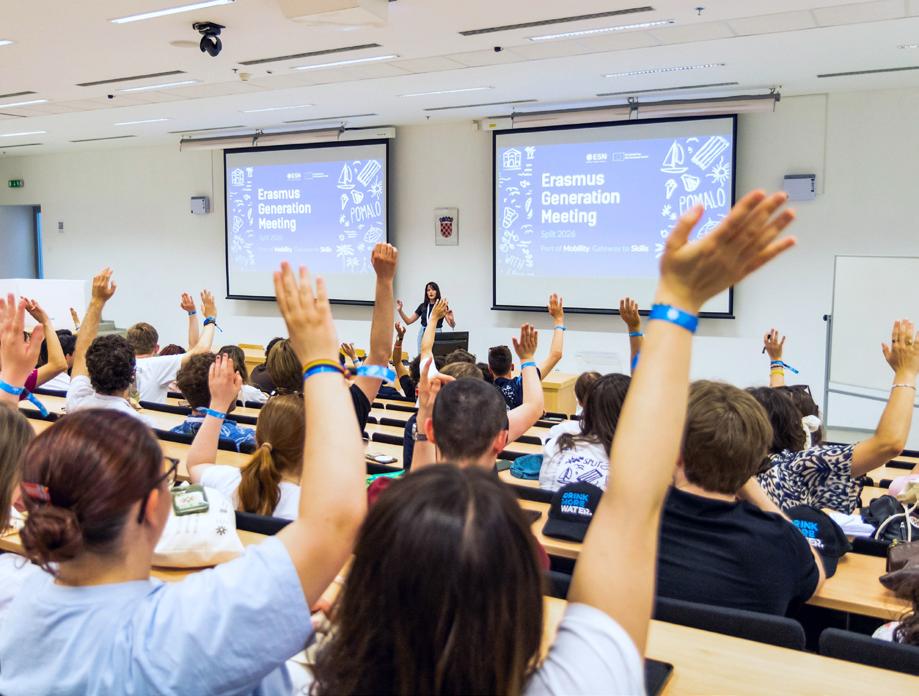
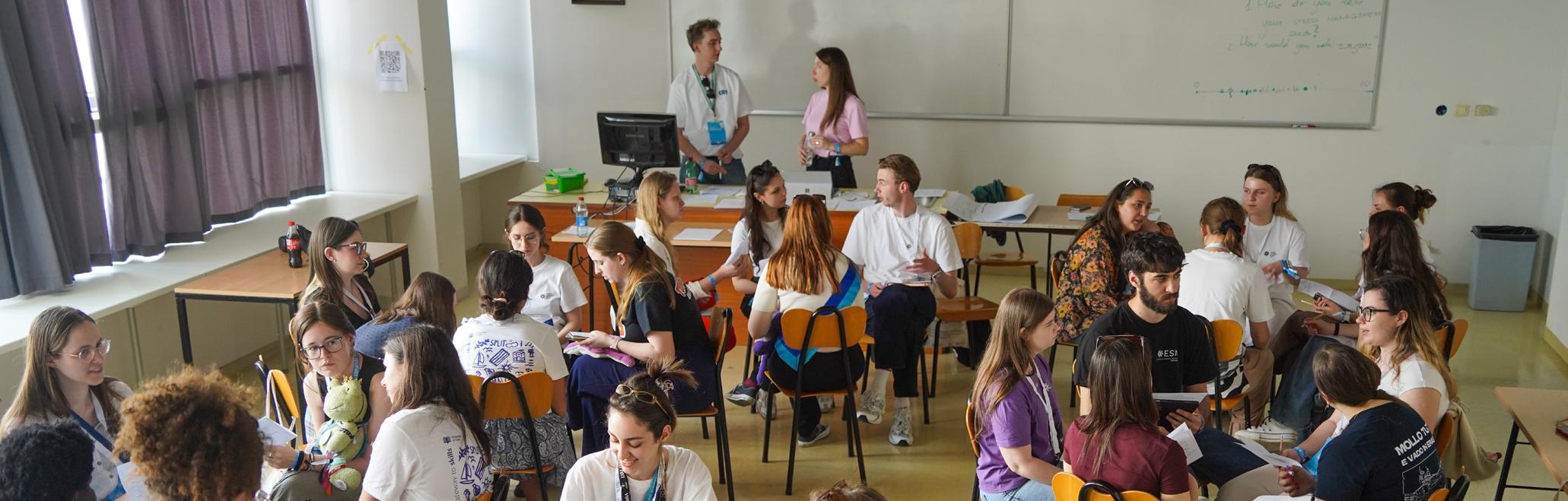
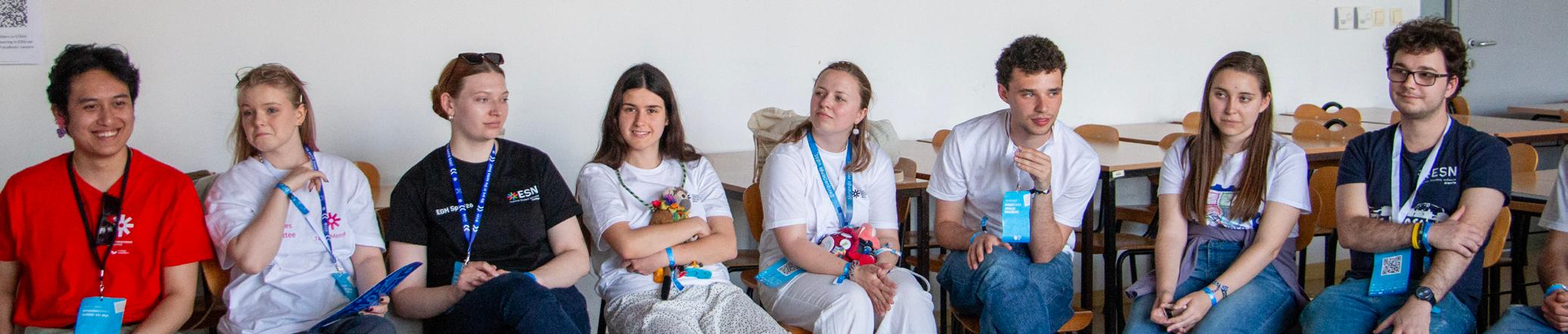
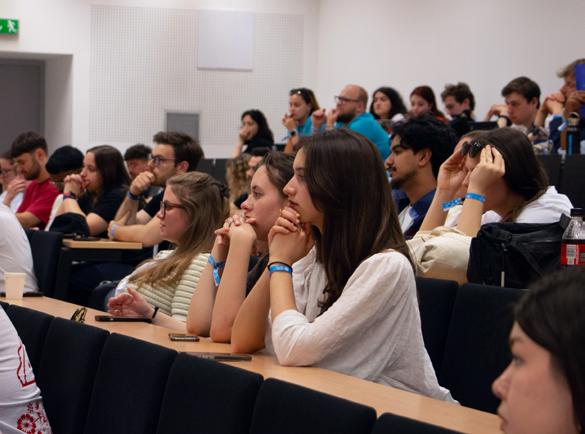
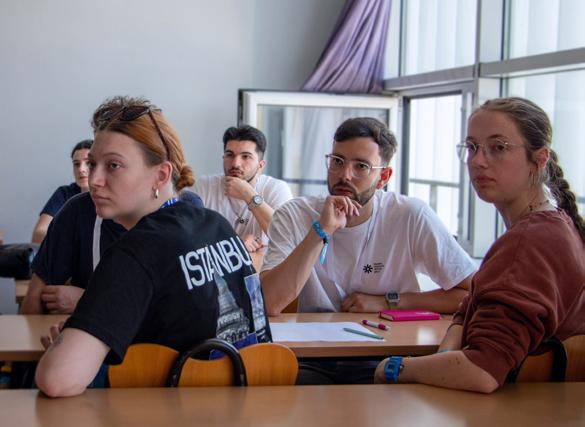
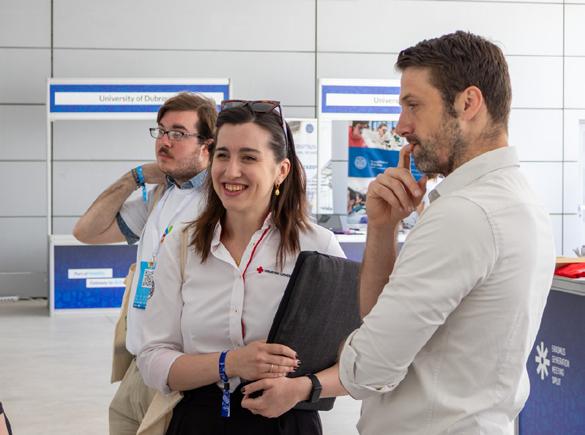
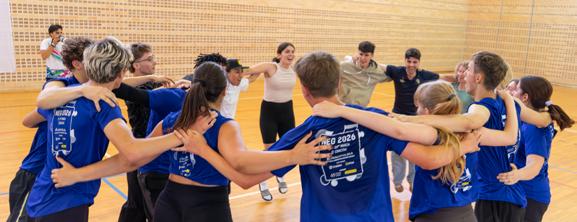
The fifth edition of the Erasmus Generation Meeting took place in Split, Croatia, between 16 and 19 April 2026, bringing together more than 1,000 volunteers for Europe’s largest student-led conference. Held under the theme “Shaping Skills through Student Mobility”, the event focused on strengthening academic recognition of learning outcomes and competencies acquired through international mobility experiences.
The programme featured more than 100 sessions centred around two key pillars: the development of competences through volunteering and mobility, and the impact and recognition of student engagement. Discussions highlighted how volunteering, mobility, and active participation in student initiatives contributed to the personal and professional development of young people, while also underlining the importance of inclusive and high-quality mobility opportunities. Recognition of formal, non-formal, and informal learning
outcomes, as well as the skills and competences gained through international experiences, remained a key focus of EGM Split 2026.
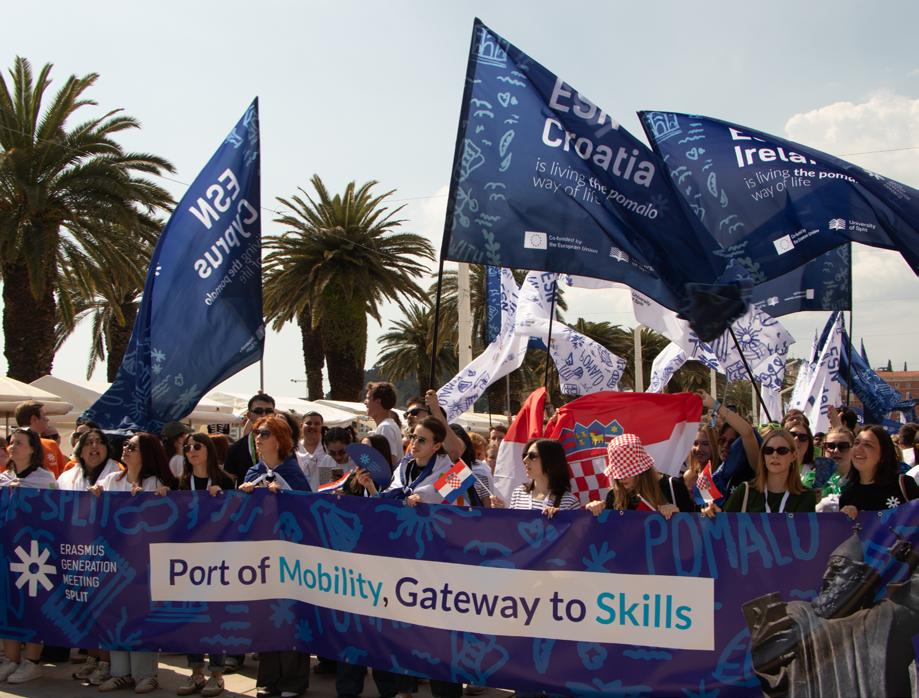
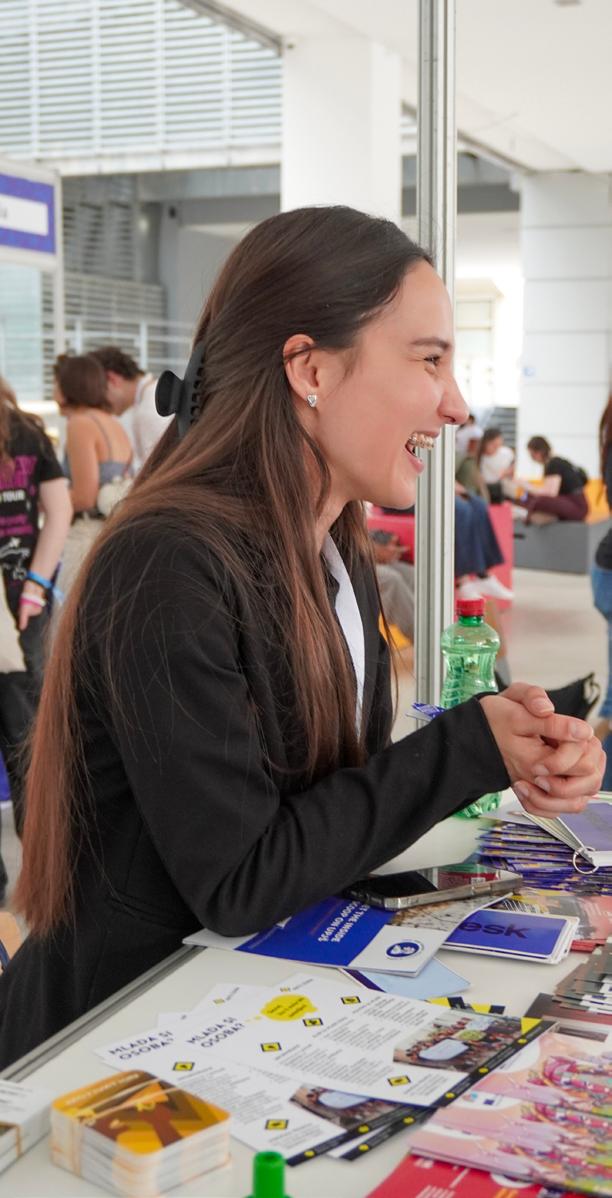
The main ceremonies were hosted at the iconic Gripe Hall, while additional programme activities took place at the Faculty of Science and the Faculty of Economics, University of Split. The event also featured the traditional Flag Parade through Split’s old town, the Welcome Ceremony with keynote speeches and cultural performances, and the EGM Expo, which served as a hub for promoting mobility opportunities and strengthening cooperation across Europe.
Once again, the Erasmus Generation Meeting became a point of connection where students, volunteers, and stakeholders came together to shape the future of international education and mobility in Europe.
Erasmus Careers: From Education to Employment
Reimagining Trust: The ErasmusIntern Platform Evolves
For years, ErasmusIntern.org has connected European students with international internships. Yet outdated technology, design, and occasional scam listings had eroded user confidence. ESN chose transformation over patches. The new, modern platform introduces a new interface, with verified listings, robust quality assurance, and a new vision: linking traineeships not just to employment, but to lasting career development. The result: a trusted European platform connecting student talent with organisations through Erasmus+ traineeships and early career opportunities built on quality, clarity, and genuine commitment to student success. This succeeded through collaboration. Universities, partners, and institutional stakeholders became champions, weaving the narrative across Europe’s education and employment communities.
Building the Evidence Base for Quality Erasmus+ Traineeships
Digitalising Erasmus Traineeship Application & Support (DETAS) has built one of the most impactful knowledge bases on Erasmus+ traineeships. ESN’s research has involved hundreds of students, employers, and higher education staff in EU countries, mapping how traineeships are supported and where students face gaps in guidance, access, and quality. This work also led to the creation of toolkits for HEIs and companies to manage Erasmus+ traineeships and is feeding into the EU’s work on traineeships. At a time when this topic is high on the agenda, DETAS is offering a strong evidence base to improve the whole traineeship journey, shaping the revamped Erasmusintern.org platform: Erasmus Careers.
BIM research & Tools
Within the Boost Your International Mobility project , ESN International researched the connection between Educational Policies and Employment policies. This was done by comparing European policy instruments with national and regional policies focused on France, Spain and Croatia, through document analysis and expert interviews. This was published in a comparative analysis titled “International Student Mobility and Labour Market Perspectives:”; identifying the lack of synergies between the different policies and the lack of recognition for international competences in labour market policies. To allow mobility participants to better express themselves, a card game was developed, as well as a mobility-personality test and social media filters.
Education to Business: Turning Learning into Real-World Impact
Through Erasmus Talent & Innovation Labs (ETI Labs), ESN is developing a cutting-edge approach to connect higher education, mobility and the labour market. Building on one of the most comprehensive EU- and mobility-focused research strands on University–Business Cooperation, the project analyses how students and recent graduates can gain digital, green and entrepreneurial competences through real challenges. From the Recent-Graduate Traineeship Track to the ImpacThon methodology, ETI Labs is creating practical frameworks for high-quality traineeships, stronger HEI-company cooperation, and future Labs where students, HEIs and employers co-create solutions with real social and economic impact.
Local Communities and Impactful Activities
Social Impact Days
The Social Impact Days (SID) is a biannual two-week initiative by ESN that promotes volunteering, civic engagement, and internationalisation at home, connecting international students with local communities through meaningful activities. During the SID activities carried out within the year, the network members collectively organised 822 events across six cause areas, reaching a total of 81,292 participants; though one exceptionally large event accounted for 50,000 of those, putting the realistic reach closer to 30,000 participants, with a median of 23 participants per event. Activities were spread across a diverse range of causes, with Culture leading at 25%, followed closely by Education & Youth at 24%, Health & Wellbeing at 16%, Social Inclusion at 14%, Skills & Employability at 11%, and Environmental Sustainability at 10%.
Encouraging Active Citizenship at Local Level
Between October 2025 and January 2026, ESN organised 11 local engagement events across 11 countries as part of the SPEAK OUT project, empowering young people to take a more active role in democratic and civic life. Through debates, workshops, and peer-learning activities, participants explored how European opportunities and policies relate to their everyday realities and local communities. Bringing together 344 participants, the activities strengthened young people’s confidence to express their views, engage in dialogue on European values, and actively contribute to more inclusive and participatory communities.
Voices of Change: From Values to Action From Welcome to Belonging: Nurturing Student Agency
Between 13 March and 16 May, ESN organised 6 local multiplier activities across 5 countries as part of the Voices of Change project , empowering young people and volunteers to translate European values into concrete local action. Through workshops, dialogues, role-play activities, peer-learning sessions, and guided reflection, participants explored topics such as inclusion, human rights, civic engagement, intercultural dialogue, peacebuilding, and active citizenship. Bringing together 213 participants, the activities strengthened young people’s ability to communicate across cultures, reflect on social barriers, and apply values such as solidarity, participation, and human rights education in their volunteer work and community engagement.
This spring, 14 ESN sections across 12 countries implemented a different approach to student integration. Supported by the EUniverse project, these sections challenged traditional ways of welcoming students by creating spaces where international students could take a more active role in their arrival experience. Through 18 local activities , including communitybuilding workshops, wellbeing sessions, and practical orientation, over 1,200 students participated as co-creators of their own orientation. This allowed participants to navigate their new environments with greater confidence and take ownership of their mobility, fostering a genuine sense of belonging from the very beginning of their exchange.
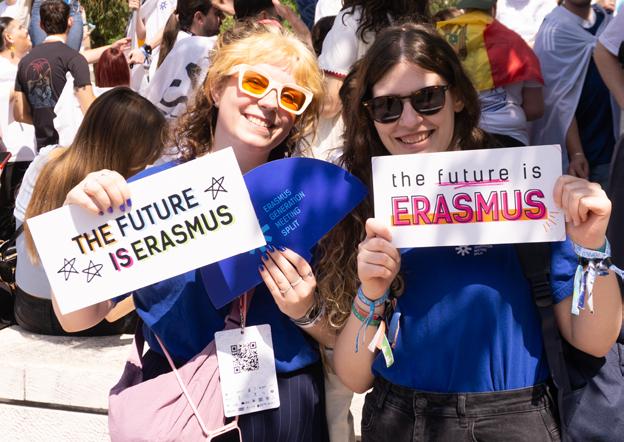
The Future is Erasmus
Statement Conference
ESN, together with 16 European higher education stakeholders, endorsed the joint statement “A stronger Europe needs a properly funded Erasmus+”, calling for increased investment in the Erasmus+ Programme for 2028–2034. The statement emphasised the need for Erasmus+ to address evolving educational, social, and economic priorities across Europe. Through this initiative, ESN represented students’ and alumni’s views. The statement also called for maintaining the programme’s accessibility and long-term benefits, especially for learners with fewer opportunities, to ensure that Erasmus+ continues to strengthen the European Higher Education Area.
Amendment
ESN and sixteen partner organisations representing higher education and student interests submitted joint amendments to the European Commission’s draft regulation for the Erasmus+ Programme (2028–2034). This initiative aimed to promote an ambitious, inclusive, and accessible programme that maintains learning mobility and transnational cooperation as central elements. The joint proposal advocated for a minimum programme budget of €60 billion, continued support for higher education mobility, stronger alignment with other EU funding, and expanded international cooperation. It also emphasised transparent governance, programme resilience during crises, and clear processes for associating countries such as the United Kingdom and Switzerland.
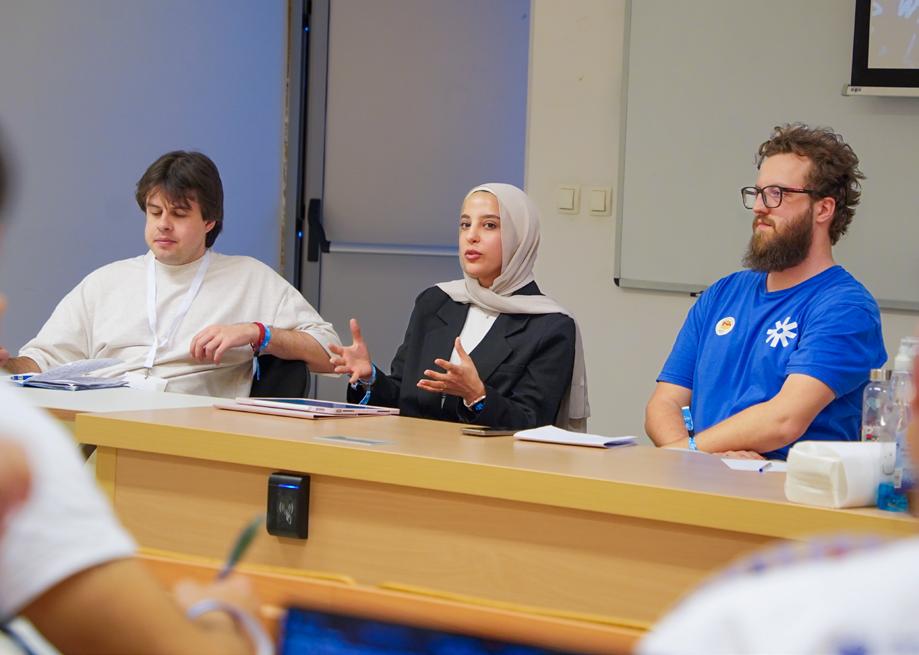
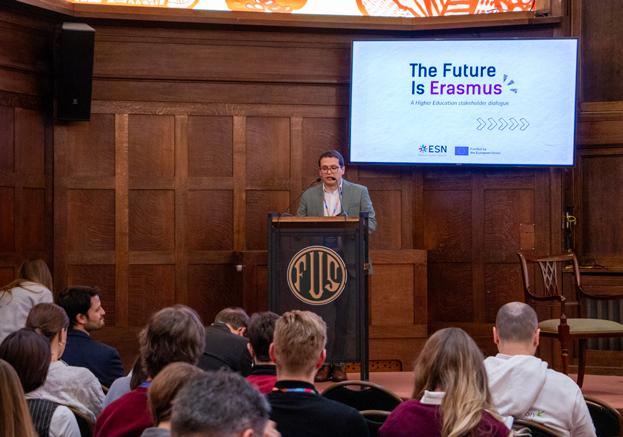
On 27 January 2026, ESN, with the support of the Erasmus+ Student and Alumni Alliance (ESAA), organised the “Future is Erasmus Gathering”. The event brought together stakeholders to discuss the future of the Erasmus+ Programme beyond 2027. The conference included a keynote address by Stephan Geifes (DAAD), a high-level panel on the future of higher education in Erasmus+, and interactive breakout sessions on skills development, inclusion, the European Universities Initiative, and the international dimension of Erasmus+. The event concluded with reflections from representatives of the European Commission and the Permanent Representation of Ireland to the EU, connecting stakeholder discussions to ongoing EU policymaking.
Supporting the Health and Well-Being of International Students
Understanding Mental Health Challenges of Students Empowering Volunteers to Support Students
Studying abroad can be life-changing, but it can also be mentally demanding.
To improve the support received by students, ESN has taken part in the Mobile Minds in Motion project , which strives to provide students on mobility and staff with research-backed tools, resources and support networks needed to ensure that the Erasmus experience remains a rewarding and healthy experience. The first findings include a report examining the challenges students face while studying abroad and offer recommendations to better support their well-being and inclusion.
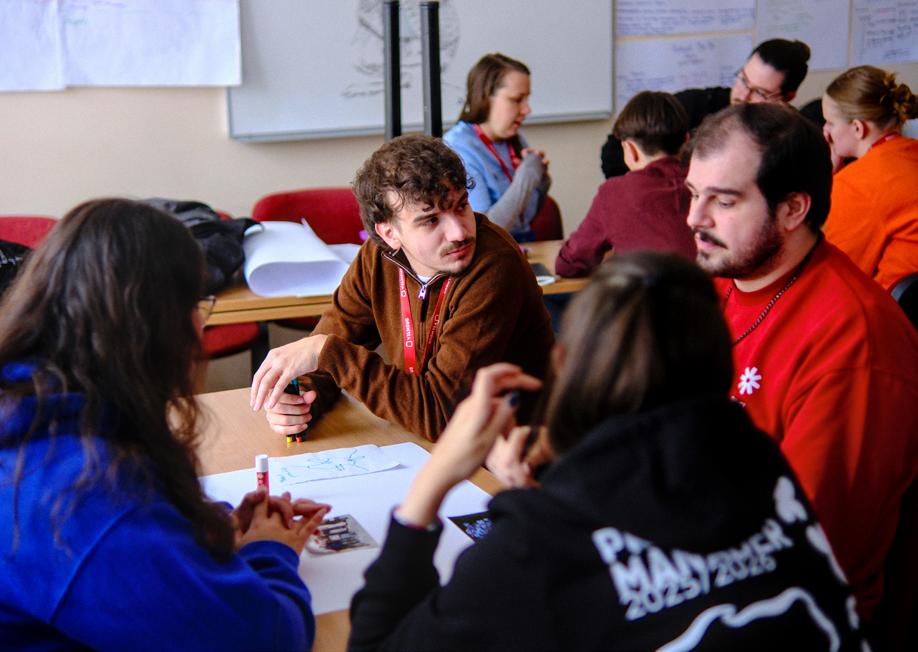
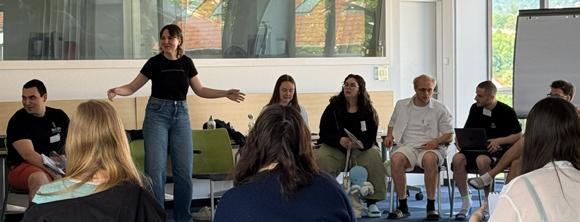
ESN implemented a Study Session on “Mental Health & Well-being without Borders”, in cooperation with the Council of Europe’s Youth Department, which aimed at empowering volunteers to take actions towards fostering mental health and well-being among international young people. The 33 participants, representing 17 countries, worked on creating spaces for discussions and designing future plans for action to better support international students.
Promoting Physical Activity during Erasmus
The International Erasmus Games (IEG), ESN’s flagship sports competition, returned for its 11th edition in Porto, Portugal, bringing together over 200 international students competing in basketball, volleyball, and futsal. The initiative empowers students across Europe to stay physically active during their mobility experience by progressing from local competitions to the national level, and ultimately representing their country of mobility at the international stage.
ESN and Student Mobility Around the World
Vision for the Mediterranean Higher Education Building Bridges Across the Atlantic Through Erasmus+ Strengthening Euro-Asian Mobility Cooperation
ESN participated in discussions on the European Commission’s New Pact for the Mediterranean, emphasising the significance of student mobility and higher education cooperation in strengthening ties between Europe and the Southern Mediterranean. ESN highlighted the need for balanced, inclusive mobility opportunities to promote intercultural understanding, skills development, and employability across the EuroMediterranean region. ESN welcomed the Pact’s emphasis on education, youth, and innovation and called for greater support for equitable partnerships between higher education institutions across the Mediterranean. The organisation also stressed the need for transparent recognition systems, simplified mobility procedures, quality assurance, and active student participation in the development and implementation of mobility initiatives.
On 14 August 2025, ESN participated for the first time in the Farewell Reception for the beneficiaries of the Chinese Government Scholarship, organised by the Chinese Mission to the EU in Brussels. The hybrid event brought together students, policymakers, higher education institutions, and youth organisations to support European scholarship recipients preparing for their studies in China. ESN contributed the student perspective to discussions on international mobility, inclusion, and intercultural preparation. During the event, ESN highlighted the importance of peer support, accessible pre-departure information, and community building in ensuring successful mobility experiences. Drawing on insights from the XV ESNsurvey, the organisation emphasised the value students place on practical guidance and peer-to-peer exchange when preparing for international mobility.
In 2025, ESN sent its first official delegation to Colombia to attend events aimed at strengthening cooperation between Europe, Latin America, and the Caribbean in education, mobility, and intercultural dialogue. By participating in policy discussions, stakeholder meetings, student fairs, and alumni activities, ESN shared student and alumni perspectives on the future of EU-LAC cooperation and the role of Erasmus+ in building international partnerships. Throughout the week, ESN representatives met with higher education institutions, European and regional stakeholders, Erasmus+ alumni organisations, and prospective students. They promoted international mobility as a catalyst for inclusion, global citizenship, and mutual understanding. The delegation also emphasised the need for peer support, accessible mobility opportunities, and stronger cooperation frameworks between the regions, especially in sustainability, innovation, and educational exchange.
Fostering Inclusion and Diversity in Student Mobility
Inclusive Access and Participation
ESN, and the DiEM project consortium, prepared a report on the current state of access and participation in Erasmus+ mobility opportunities, identifying key barriers and challenges faced by students with fewer opportunities, understanding their motivations for participation, and evaluating the effectiveness of existing support systems offered both by the programme and by higher education institutions. The report showcases the mobility experiences of students from low-income families, first-generation students, LGBTQ+ students, students from rural areas, students from ethnic minority backgrounds and students with disabilities.
Inclusive Mobility Heatmap
Through the DiEM project, ESN developed the Heatmap, which illustrates the level of inclusiveness within international mobility across Erasmus+ programme countries. Available at inclusivemobility.eu, it offers a comparative overview of how inclusion measures are applied in practice, highlighting the progress of the Erasmus+ inclusion and diversity horizontal priority. The tool allows policymakers to draw further practices that can be implemented across countries, and provides essential information to ensure students are fully informed of their rights.
Virtual Assistant “Ask Erasmus”
ESN developed “Ask Erasmus”, a dedicated chatbot designed to help students navigate mobility opportunities via the Erasmus Generation Portal. By utilising trusted, university-validated information, the tool provides accessible and comprehensive details on various exchange programmes. In doing so, it addresses a key barrier to mobility: the lack of awareness and clear information. By simplifying the search process, “Ask Erasmus” offers students reliable guidance and ensures that essential programme specifics are just a click away.
Quality Mobility
ESCI
ESN contributed to the European Student Card Initiative (ESCI) by supporting the European Commission’s consultation on the future of the initiative within the next Erasmus+ Programme (2028–2034). The consultation focused on evaluating and improving key ESCI components, including Erasmus Without Paper, the Erasmus+ App, and the European Student Card. By supporting this process, ESN contributed to ensuring that student perspectives are reflected in the future development of Erasmus+ digital tools and international mobility across Europe.
DACEM
Choosing a host institution often starts with course catalogues, but across Europe, they rarely speak the same language. Through Digitising Academic Catalogues for Enhanced Mobility (DACEM), ESN contributed research and strategic student insights to the prototype platform dacem.eu that helps universities present course and practical information in a clearer, more harmonised way. Now online, DACEM will continue to grow as a tool for more informed and confident mobility choices.
State of Automatic Credit Recognition
Automatic credit recognition is essential for seamless mobility, yet hurdles remain. This report , prepared by ESN with the AUREA project consortium, presents a comprehensive analysis of automatic academic recognition across the European Higher Education Area. It raises awareness of persistent challenges that students face, such as inconsistent implementation, curricular incompatibilities, and gaps in Learning Agreement processes. By providing evidence-based insights, the report supports the transition toward seamless mobility, ensuring students’ academic achievements and learning outcomes are fully and automatically recognised across Europe.
Expanding benefits for the Erasmus Generation
Digital ESNcard Flixbus Zalando
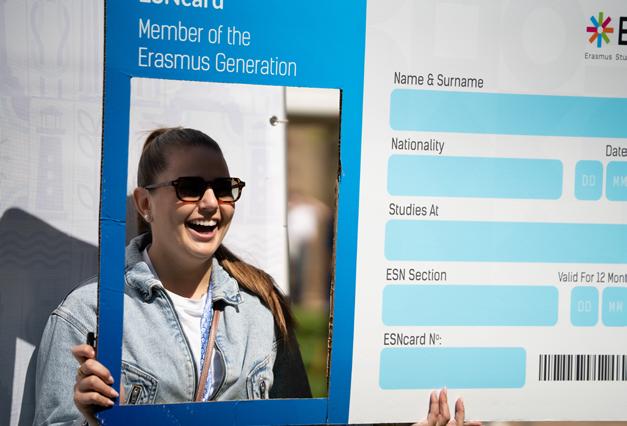
The digitalisation process of the ESNcard, the membership card of Erasmus Student Network, is closer than ever. During the past year, significant advances have been made in turning the ESNcard into a digital version, allowing international students to enter a digital ecosystem and expanding the opportunities available to them. The implementation is expected to begin in the next academic year, and soon the ESNcard will be available in digital form in the first three countries: Estonia, Croatia, and the Czech Republic.
The ESNcard portfolio expanded in 2025 through a new partnership with Zalando. With this collaboration, ESNcard holders received exclusive gift card offers and discounts in more than 20 countries. The initiative supported international students in finding affordable fashion and lifestyle products while adapting to life abroad during their mobility experience. The partnership quickly gained traction, with nearly 8,000 gift cards issued in the final quarter of 2025 and more than 44,000 distributed during the first quarter of 2026.
Students benefited from discounted travel on FlixBus routes connecting more than 2,500 destinations across 39 countries, making it easier to explore new places, experience different cultures, and stay connected throughout their mobility journey. Last year, the partnership generated more than 75,000 bookings and voucher redemptions, with engagement peaking during key mobility periods — underscoring the important role seamless and accessible transport plays in student mobility across Europe. By encouraging sustainable and convenient travel choices, the partnership strengthened ESN’s commitment to enriching international experiences.
Year in Review
18-28 September 2025
Community Meetings
Autumn
4 communities met in Aveiro, and 2 met in Brussels, all to deepen the knowledge and skills of volunteers.
15-19 October 2025
Community Actions by Youth
The capacity building training was tailored to the needs of 40 youth workers, equipping them with the knowledge, skills, and resources necessary to effectively engage in Peace and Human Rights Education initiatives within their communities.
20-23 November 2025
Autumn General Assembly
The General Assembly of ESN gathered in Wrocław, Poland to address key topics and make decisions about the future of the Network.
5-15 February 2026
Community Meetings Spring
3 Communities met in Vilnius, and 3 Communities met in Tallinn. In total, 137 volunteers got the chance to learn and improve their skills.
9-19 October 2025
Regional Platforms
The yearly Regional Platforms training happened in Santiago de Compostela, Budapest, Lenk im Simmental, Yerevan, and Riga, with the aim of building capacity in volunteers and improving the quality and impact of their work.
24-26 October 2025
Local Changemakers Training
42 locally active ESN volunteers gathered in Braga to learn and develop outreach initiatives that empower young people to become local changemakers.
12-14 December 2025
Grants Lab
This training, organised at ESN’s Headquarters, equipped participants with hard skills related to grant application and project management. It inspired members to be more actively involved in ESN International’s projects.
26-30 March 2026
Innovative Thinking Labs
Through non-formal education trainings in theme “Youth Movements in Times” of Political Polarisation 60 BES and ESN participants explored critical thinking, media literacy, information verification, and how youth organisations navigate societal challenges, political polarisation, and misinformation.
22 February - 2 March 2026
Eduk8 Starter
This training for trainers took place this year in Krakow, Poland, where 40 participants learned how to confidently design, deliver, and evaluate sessions rooted in non-formal education principles.
16-19 April 2026
14-17 May 2026
28-31 May 2026
Spring General Assembly International Erasmus Games
The main decision-making body of ESN gathered to make important decisions, including electing new Statutory Bodies.
This year’s IEG brought together over 200 participants in Porto to engage in inclusive competitions across 3 different sports disciplines.
Erasmus Generation Meeting Split
The 5th edition of EGM gathered +1,000 participants in order to inspire future leaders to act as changemakers of society, while having the local community of Split and stakeholders celebrate together the achievements of the Erasmus Generation!
17-24 May 2026
Study Sessions
The Study Session brought together 35 ESN members and experts focused on “Mental Health and Well-Being without Borders”. Participants explored ways to foster mental health and wellbeing among international young people and developed future actions.
10-14 June 2026
Youth Advocacy Training
The multiplier training brought together 40 young people and youth, local-level workers. The activity strengthened their ability to collaborate with local authorities, build partnerships, support youth engagement, and advocate for the recognition of youth organisations at international level.
ESN in the Media
ESN Italy and WWF Italy join forces for a more sustainable future.
WWF | November 21, 2025
ESN Italy and WWF Italy signed an agreement to work together on sustainability, volunteering, and environmental education. The partnership will involve Erasmus and international students in WWF initiatives, local events, training, and national campaigns to promote environmental protection and active citizenship.
European university associations are demanding 60 billion euros for Erasmus+
Forschung & Lehre | January 7, 2026
ESN was listed among 17 organisations calling for at least €60 billion for Erasmus+ in the 2028–2034 EU budget. The joint statement argues that stronger investment is needed to support learning mobility, skills development, inclusion, innovation, and Europe’s long-term competitiveness.
ESN Portugal advocates for “the possibility of postal voting in all national elections” and “the extension of voting periods
Publico | January 14, 2026
ESN Portugal advocates for more inclusive voting rights for students in temporary academic mobility. In the context of the Portuguese presidential elections, ESN Portugal highlights the need for electoral mechanisms that better reflect temporary academic mobility, including postal voting in national elections and extended voting periods abroad, to ensure more inclusive democratic participation.
Wroclaw will be the Erasmus capital in 2027! Prestigious Erasmus Generation Meeting to be held in our city
Wrocław.pl | February 27, 2026
Wrocław was announced as the host city of EGM 2027, ESN’s major international event bringing together the Erasmus Generation. The event will take place from 15–18 April 2027, will gather around 1,000 students and 200 institutional partners, with support from volunteers across Poland, Wrocław University of Technology, and the Wrocław City Office.
Dubrovnik Students Raise Over €7,600 at Charity Market
The Dubrovnik Times | March 11, 2026
ESN Dubrovnik co-organised the fifth annual Charity Market with local student organisations, raising €7,616.01 for the humanitarian organisation “Tata je tata.” The event brought students and the local community together through fundraising, family activities, and volunteering in support of a local cause.
About Us
The Erasmus Student Network (ESN) is the largest student association in Europe. It was born on 16th October 1989 and legally registered in 1990 to support and develop student exchange. We are present in 1,000 Higher Education Institutions across more than 40 countries.
The Network is constantly developing and expanding. 17.655 active members, who in many sections are supported by so-called ‘buddies’, act as mentors for international students. Thus, ESN involves over 29,000 young people offering its services to around 350,000 international students every year.
ESN works for the creation of a more mobile and flexible education environment by supporting and developing student exchange, as well as providing an intercultural experience also to those students who cannot access a period abroad (“internationalisation at home”).
Mission Enrichment of society through international students’ mobility.
Principles
• ESN works in the interest of international students.
• ESN works to improve the social and practical integration of international students.
• ESN represents the needs and rights of international students on the local, national and international level.
• ESN provides relevant information about mobility programmes.
• ESN motivates students to study abroad.
• ESN works with the reintegration of homecoming students.
• ESN contributes to the improvement of different mobility programmes.
• ESN cares about its members.
• ESN values volunteering and active citizenship.
Vision By 2031, the Erasmus Student Network will be the leading organisation supporting international mobility, providing space for competence development and student engagement to three million members of the Erasmus Generation, empowering them to become change-makers in society.
Strategic Priorities
International Mobility and Student Support
ESN will support international students throughout all phases of mobility, ensuring that mobility is an enriching experience not only for students but for society as a whole.
Volunteer Management and Development
ESN volunteers will be ambassadors of mobility and international students, reflecting the Network’s Values in their work.
Governance and Membership
ESN will focus on strengthening its governance structure and ensuring clear, efficient and democratic decision-making processes with a strong and united membership.
Visibility, Outreach and External Relations
ESN will be a unified and widely recognised brand of the Erasmus Generation, serving as the voice of international students and the leading advocate for mobility programmes.
Digitalisation of Mobility and IT Infrastructure
ESN will set clear IT standards, align with the digitalisation priorities in different mobility programmes, and guide IT development within the Network.
Impact and Community Management
ESN will work on creating a lasting impact on society by positioning international mobility at the heart of local communities.
Values
Students helping students
We commit ourselves to volunteering for the benefit of international mobility.
Love for Europe and beyond as an area of peace and cultural exchange
We cherish the world as a space of peace, diversity, and cultural exchange that embraces the richness of a more interconnected world.
Unity in diversitydiversity, in unity
We all have different backgrounds but share one common aim and goal.
Openness with tolerance
We embrace diversity by understanding, accepting, and learning from others.
International dimension of life
We believe international experiences enrich personal growth, foster mutual understanding, and strengthen collaboration beyond borders.
Fun in friendship and respect
We believe in the importance of making the most of the international mobility experience while respecting others.
Cooperation inintegration
We share a holistic view towards internationalisation in higher education.
Structure
To be able to achieve the aims of the organisation, as well as fulfil our mission and vision, and uphold our values, ESN is structured on three levels: local, national and international.
General Assembly
Statutory Bodies
International Board Arbitration Board Audit Commission
Secretariat Committees Project Teams Liaison Office
Non-statutory Bodies
Support Structures
ESN consists of 500+ local associations, or so-called Sections, working daily with international students.
They organise activities, provide services, and represent the interests of international, exchange, and local students of one or several higher education institutions in their city.
Sections of a country meet during National Assemblies, where they have the chance to exchange best practices. The Sections also elect their National Board, which is in charge of leading the National Organisation, conducting national projects and representing ESN towards national institutions and stakeholders.
The General Assembly (GA) is the highest decision-making body of the Erasmus Student Network, which votes on all Statutes and Standing Orders proposals, on all nonstatutory proposals and the election of the International Board, the Audit Commission, the Arbitration Board, and the GA Chairing Team. The GA meets twice per year.
Finance
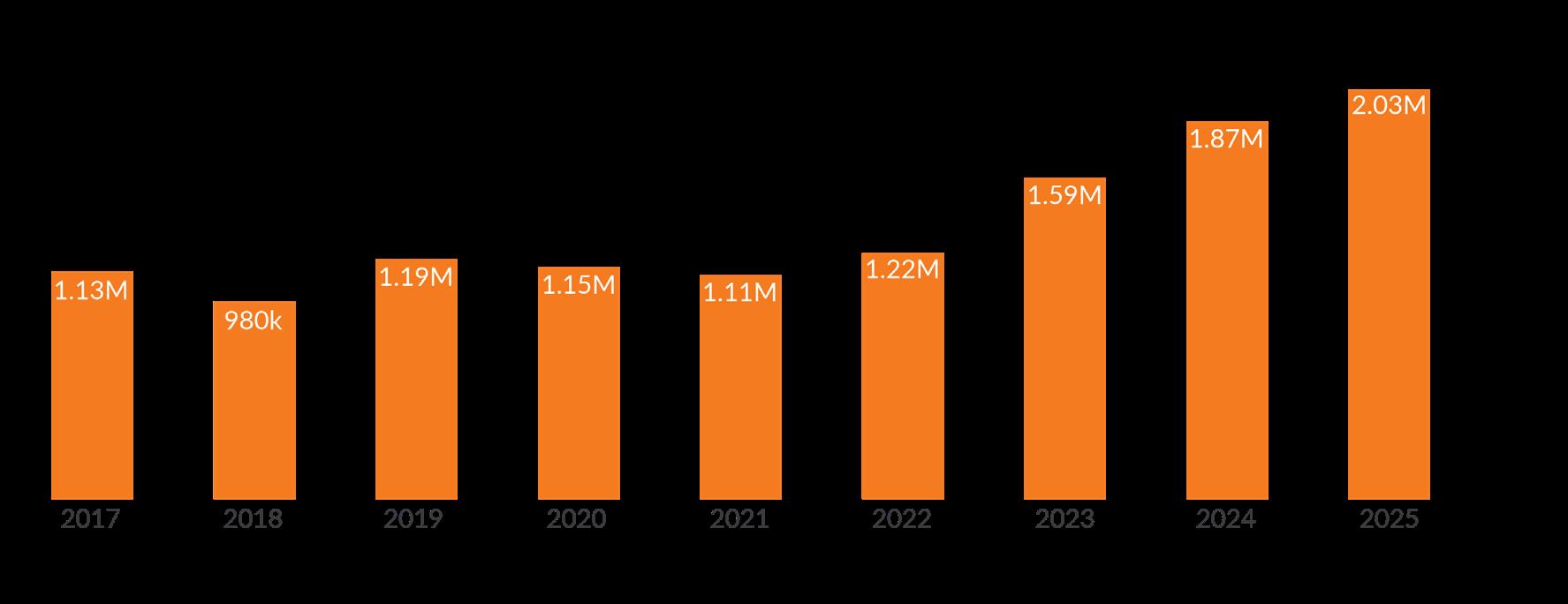
€ 2.026.406
Budget through the years (€)
€ 1.829.573
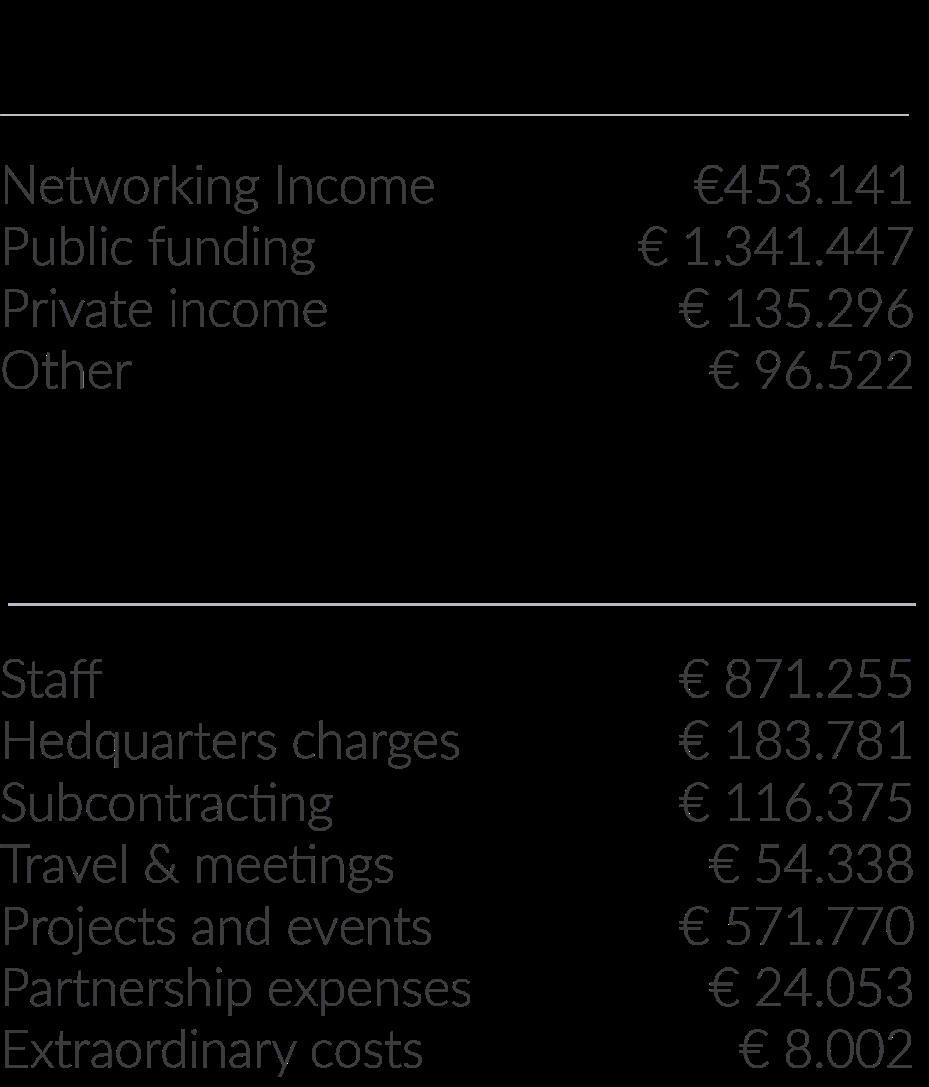
The Erasmus Student Network concluded the 2025 financial year with a positive balance of €196,834, marking the first year in the organisation’s history in which total revenue surpassed €2,000,000.
The budget for this year was prepared with a strong focus on reinforcing the long-term financial sustainability of the organisation, following some years characterised by financial uncertainty. The positive financial outcome reflects prudent and responsible financial management throughout the year, while ensuring continued investment in the strategic priorities established for 2025.
Although total revenue remained close to the projected amount, the positive result was primarily driven by expenditure remaining below budgeted levels. At the same time, ESN maintained a solid performance across its main income streams.
Overall, the financial result achieved in 2025 represents an important milestone in the financial consolidation of ESN International. It contributes significantly to strengthening the organisation’s reserves and reinforces its capacity to ensure long-term stability, resilience, and sustainability in the face of future uncertainties.
in 2025/2026
External Relations
ESN as a Member
European Youth Forum (YFJ)
The YFJ is a platform of over 100 youth organisations in Europe, representing both National Youth Councils and International Non-Governmental Youth Organisations. ESN is active within the Forum to bring the voice of internationally-minded young people further. These include participation in the European Youth Event and engagement in the EU Youth Dialogue. youthforum.org
FOREU4ALL
FOREU4ALL is a community of practice for European University Alliances. It brings together all 64 European University Alliances, along with other higher education stakeholders such as student organisations and university associations. The main goals are to strengthen collaboration and share best practices within the higher education sector, particularly through the universities that are part of these Alliances. ESN’s role is to be the voice of international students and to explore how we can strengthen the role of students within these structures. education.ec.europa.eu org
Lifelong Learning Platform (LLLP) International Association of Universities (IAU)
The LLLP brings together 42 European networks covering all sectors of education and training, including networks for higher education and training, vocational and adult education, and plays an important role in advocating for better education systems for all. ESN is active through platforms like the Erasmus+ Coalition, participation in the LLLP pool of experts, or by contributing to consultations and campaigns. lllplatform.eu
Generation Climate Europe (GCE)
Generation Climate Europe (GCE) is the largest coalition of youth-led networks on climate and environmental issues at the European level. GCE unites the largest youth-led networks in Europe, bringing together 381 national organisations across 46 countries in Europe. As one of its founding members, ESN is actively involved in the working groups on clean mobility and sustainable development. gceurope.org
The IAU is the leading global association of higher education institutions and organisations from around the world. It convenes and connects almost 600 Members from more than 130 countries to identify, reflect, and act on common priorities. As an associate member of IAU, ESN acts as the global voice of higher education to a wide range of international and intergovernmental organisations, in particular UNESCO. iau-aiu.net
Global Student Forum (GSF)
Global Student Forum (GSF) is the global umbrella organisation of the world’s major representative, independent and democratic student unions of school and university students. GSF represents and advocates for the educational, cultural, economic, and social interests of over 300 million learners worldwide. ESN has been actively involved in the working groups promoted by GSF, especially the ones connected with learning mobility, such as “Mobility and Recognition”. globalstudentforum.org
Institutional Partners ACA
The Academic Cooperation Association is an umbrella organisation of national funding agencies for international education and research, which has among its members many of the leading Erasmus National Agencies. ESN has collaborated with ACA in several aspects to improve mobility throughout the ECEM project, where we are partners, and with participation in several TCAs and events, such as the Inclusion Academy and What’s New in Brussels.
aca-secretariat.be
Coimbra Group
The Coimbra Group is one of the leading university networks in Europe, bringing together some of the continent’s most internationalised and historical universities. It works for the benefit of its members by promoting internationalisation, academic collaboration, excellence in learning and research, and service to society through “creating special academic and cultural ties”. For the past years, ESN and the Coimbra Group have been enhancing their collaboration through a memorandum of understanding, creating more synergies in the fields of education and research.
coimbra-group.eu
The European Association for International Education (EAIE) is a European centre for expertise, networking and resources in the internationalisation of higher education, founded in 1989. ESN and EAIE aim to establish a framework to promote and foster cooperation, through mutual promotion, events, and exchange of expertise in favour of the student community involved in the activities and initiatives of the two organisations.
eaie.org
Union for the
Mediterranean
The Union for the Mediterranean (UfM) is an intergovernmental organisation that brings together 43 countries to strengthen regional cooperation and dialogue through specific projects and initiatives that address inclusive and sustainable development, stability and integration in the Euro-Mediterranean area. A key milestone of this year’s Forum was the renewal of the Memorandum of Understanding (MoU) between ESN and the UfM. This renewed agreement strengthens a long-standing partnership and sets the framework for three more years of joint action in the fields of youth participation, academic mobility and intercultural understanding across the Mediterranean. ufmsecretariat.org
ESN and Public Funding
Contact our Director at director@esn.org if you are interested in a partnership with ESN for any grant or tender application.
ESN has participated in projects funded by the Erasmus+ programme and other programmes for many years now. We benefit from two operating grants: one from the European Commission and one from the Council of Europe’s European Youth Foundation. We have had several annual “Work Plans” from the European Youth Foundation since 2016. Furthermore, ESN has participated in several tenders covering topics such as the impact of student mobility and digitalisation of the Erasmus+ programme.
Other Projects
• DigiUp
• DETAS
• DIEM
• SET
• EUniverse
• ECEM
• BIM
• EUC Voices
• ETI Labs
• DACEM
• ESC-tension 2
• Green Erasmus 2.0
• AUREA
• DETAS
• Voices of Change
• Mobile Minds in Motion
• MoWeHome
• IN KEY
Building on almost a decade of work from HousErasmus+ to HOME, HOME² kept student housing at the centre of the mobility agenda. This year, the project strengthened one of Europe’s strongest research bases on housing from a mobile student perspective, while advancing shared data standards, updated quality labels and digital solutions through the Erasmus+ App. The Milan conference marked a key step in turning this evidence into policy recommendations and practical tools for safer, more transparent and inclusive housing.
ETI LABS
SPEAK OUT SHIFT HOME2
Through Erasmus Talent & Innovation Labs , ESN is building a new way to connect higher education, mobility and the labour market. The project produced high-quality European research on University-Business Cooperation, looking at how students and recent graduates can develop digital, green and entrepreneurial competences through real challenges. The research is contributing to create an innovative Recent-Graduate Traineeship Track and the cutting-edge ImpacThon methodology. The goal is to create a framework for high-quality traineeships, stronger HEI-company cooperation and living Labs where students can develop skills and connect with the job market.
The project aims to promote intercultural societies by engaging international youth in local communities to combat stereotypes and counter misinformation. Together with Euralter, it fosters an inclusive vision of Europe, and empowers youth as changemakers, through training, dialogues, and large-scale events. In fall 2025, the Local Changemakers Training andan outreach campaign were launched. ESN Sections implemented local events in fall 2025, and National ESN organisations implemented National Policy Dialogues in Spring 2026.
The Student-centred Higher Education Innovation for the Future of Teaching project is a transnational initiative aimed at transforming European higher education by embedding student-centred learning methodologies and developing flexible academic pathways. Coordinated by ESN, the project responds to critical challenges such as academic rigidity, skills mismatches between graduates and the labour market, and the limited recognition of learning outcomes from international mobility. SHIFT seeks to foster “trialogues” between universities, students, and employers to ensure that educational outcomes align with modern workforce demands, while enhancing student agency in shaping their own learning experiences.
Corporate Partners
ESN is committed to enhancing the mobility experience for students and making it more accessible and affordable through strategic partnerships. One of the ways ESN aims to improve student mobility is by collaborating with commercial partners who provide unique advantages to international students through the membership card of the Erasmus Generation, the ESNcard.
Accommodation Cultural experiences
Finding accommodation in a new country can be one of the most challenging aspects of student mobility. Through partnerships with Spotahome, ESN supports students in finding reliable and flexible housing options abroad. In addition, Eurosender helps students manage their relocation through affordable door-to-door shipping services across Europe.
Travelling
Travel plays a central role in the international student experience. Long-standing transport partners such as FlixBus and Ryanair continue to make it possible for students to travel across Europe at affordable prices, helping ensure that mobility remains accessible no matter the destination Students can make use of luggage storage services from Stasher, making it easier to explore cities without carrying heavy bags. For those looking for organised trips or group travel experiences, YES-Trips offers tailored journeys designed specifically for students, bringing together people from different countries and backgrounds. When it comes to accommodation, ESNcard holders can rely on MEININGER Hotels for flexible and budget-friendly options.
Discovering local culture is an important part of living abroad and helps students build a stronger connection with their host city. ESN encourages mobility students to gain a deeper understanding of local cultures and engage with local communities. Through the partnership with Fever, ESNcard holders can enjoy a wide range of events and experiences, including concerts, exhibitions, and immersive activities. In 2025, ESN also welcomed FREETOUR.com as a new partner. The platform offers free and budget-friendly tours and activities.
Connectivity services
Digital services are increasingly important in supporting students abroad. Not only for practical needs but also for staying connected to friends and family at home. ESN partners with providers such as Airalo and Saily to help students stay connected internationally, while NordVPN and ExpressVPN contribute to safer and more secure online experiences for students during their mobility period.
All international partners are listed in: Discover our Discounts | ESNcard
Ryanair
Tomorrowland
Tomorrowland is world-famous for uniting young people from all over the world under its festive spirit. Through the partnership with ESN, ESNcard holders gain access to a dedicated ticket sale at pre-sale prices, as well as a special gathering moment with other ESNcard holders during the event.
MEININGER Hotels
In 2025, ESN launched a new partnership with MEININGER Hotels. With hotels in cities across Europe, MEININGER offers affordable and flexible accommodation that fits the needs of international students and young travellers. Through the partnership, ESNcard holders can benefit from special discounts to make the most of their mobility experience.
Pernod Ricard
Since 2017, ESN and Ryanair have worked together to make international mobility more accessible and affordable for students across Europe. During the 2025/2026 academic year, the partnership reached a major milestone: over one million international students have travelled with Ryanair through the ESN partnership. This achievement reflects the continued importance of affordable travel in enabling international experiences and student exchange.
For 17 years, ESN and Pernod Ricard have collaborated on the Responsible Party programme, promoting safer nightlife environments and raising awareness around responsible alcohol consumption among international students. The programme has received positive reactions from both students and European stakeholders.
By partnering with various companies, ESN concentrate on important and key aspects of student life where we believe students will gain the most benefits and enjoy their mobility the most. The key sectors include travel, accommodation and hospitality, online education services, consumer products, and other lifestyle-related activities such as cultural events and festivals.
ESN Websites
ESN.org
ESN.org is the heart of ESN’s digital presence, reaching over 390k users and attracting 806k page views. The official website welcomes a diverse audience: stakeholders, potential partners, curious students, and the wider public. It offers clear information about who ESN is and what the organisation does. It’s where people first discover ESN’s mission and impact.
ErasmusGeneration.org
ErasmusGeneration.org , developed by ESN, is the home of the people of the Erasmus Generation. With 777k page views and 143k users, the platform welcomes anyone dreaming of studying or working abroad. It’s a welcoming space where young people can find everything they need: practical tips, inspiring stories, and testimonials from peers who’ve already lived the international experience. It also features grant simulators to help with financial planning, mobility programmes from around the world, dedicated country pages, and much more. Made by students for students, it captures the real voices and wisdom of those who’ve walked the path, helping others navigate their own adventures abroad with confidence and authenticity.
Erasmus Careers Platform
ErasmusIntern.org is evolving into ErasmusCareers.org , a comprehensive platform built for the future of international traineeships, launching in Autumn 2026.
This transformation goes far beyond a visual refresh. It represents a complete reimagining of how students discover opportunities and how organisations find talented professionals. With enhanced security protocols, advanced matching algorithms, and a fundamentally redesigned user experience, Erasmus Careers will set a new standard for reliability and accessibility across Europe’s internship landscape.
The platform will serve as a unified European ecosystem, consolidating the fragmented world of international traineeships into one trusted space. Every feature, from streamlined verification processes to intelligent opportunity matching, has been carefully engineered to remove friction and build confidence for both students embarking on their careers and organisations seeking exceptional talent.
As a trusted European gateway, Erasmus Careers will deliver more than listings and applications. It will ensure that every traineeship opportunity meets rigorous standards, and every student profile reflects genuine potential. Whether you’re a student ready to gain real-world experience abroad or an organisation seeking motivated talent, you’ll be part of a community dedicated to fostering excellence in European professional development.
People
International Board 2025/2026
President
Vice President for Development
Web
Vice President for Governance
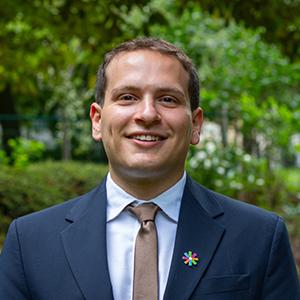
Simone Lepore
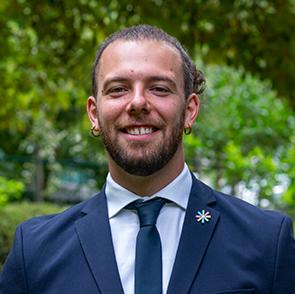
Rui Vinha
Anja Miljković
Treasurer
Marco Comotti
Project Administrator
Kaja Kaczkiełło
ESN Secretariat
Project
Communication
Training & Development Assistant
Web Developer
Wim Gabriels
Gorka Guerrero
Maria Uritu
Annie Coleman
Trassa Ní Fhloinn
Adrián Vozmediano
Sabri Ben Romanne
Director Office Manager
Partnership Manager
Alexandre Devisscher
Communications Officer
Web Developer
Ilgaz Kiran
Chrissy Teule
Tiago Nunes
Junior Communications Officer
Céline Guérin
Events & Project Officer
Neli Kalinova-Schmieder
& Policy Officer
& Media Trainee
Klaudia Jeremiejko
Madalina Bandarau
Digital Marketing Trainee
Events & Trainings Officer
International Board 2026/2027
Web Project Administrator-elect
Zuzana Liskova
Cristina Aterido
Simone Lepore
Tiffany Linh Van de Walle
Marco Comotti
Marta Winkler
Maja Gozdowska Treasurer-elect
Mikaela Rachkov
Shams Jouve
Heloise Zilotti
Madalina Bandarau
Volunteers of ESN International
General Assembly Chairing Team
Axel Poidevin (Switzerland)
Arbitration Board
Mahdi Esmaeili Badri (Türkiye)
Audit Commission
Ahmed Hassanin (France)
Andreea-Cristina Pintea (Romania)
Liaison Officers
Martina Bo (Italy)
Hazal Sude Satkın (Türkiye)
Dominika Guzik (Poland)
Patricia Mielke (Sweden)
Nathan Lusseau (France)
IT Contributors
Afonso Castro Vaz Osório (Portugal)
Christina Metalouli (Greece)
Dimitris Kritsotakis (Greece)
Gabrielius Leonavičius (Lithuania)
Luka Šulc (Croatia)
Marco Natali (Italy)
Mario Čosić (Croatia)
Pablo Espin (Spain)
Legal Team
Fabienne Golle (Germany)
Nathan Moore (UK)
Audit Team
Konstantina Kaligeropoulou (Greece)
Erik Sardarian (Armenia)
HR Manager
Laura Sophia Franke (Switzerland)
Regional Support Team
Regional Coordinators
Paula Patrī cija Avotiņa (Latvia)
Mari Nieves López (Spain)
Jude Waites (UK)
Regional Training Coordinators
Barbora Králíčková (Czech Republic)
Minerva Martínez Bermúdez (Italy)
Community Managers
Education Community Manager
Anna Kowalczyk (Poland)
HR and Network Community Manager
Hélder Simões (Portugal)
Training and Activities Community Manager
Emilia Kinga Brzęk (Italy)
Business and Finance Community Manager
Maja Gozdowska (Poland)
Communication Community Manager
Gonçalo Santos (Portugal)
Membership Team
Achilleas Moschos (Greece)
Alessandro Stocco (Italy)
Diego Traver Larraz (Poland)
Efe Erdo ğan (Türkiye)
Elia Bibbeau (Finland)
Gabrielius Leonavičius (Lithuania)
Ghassan Alajlouni (Jordan)
Paulina Bednarek (Poland)
Tiffany Linh van de Walle (Belgium)
Zuzanna Przyborkiewicz (Poland)
International Committees Chairing Teams
International Committee for Education
Noémi Papp (Hungary)
Network Committee
Andreia Raluca Ivan (Romania)
Isabella Kontschinsky (Finland)
Gellert Szarvas (Hungary)
Activities Committee
Andrea Kovács (Romania)
Eleftheria Tsaknaki (Greece)
Feyza Çelikta ş (Türkiye)
Communication Committee
Giuseppe Mansella (Italy)
Georgos Papadopoulos (Greece)
Lenka Nedvě dová (Czech Republic)
IT Committee
Luka Šulc (Croatia)
Gonçalo Tavares (Portugal)
International Teams
ESNsurvey
Valerii Kholoimov (Ukraine)
Tomás Sena (Portugal)
International Erasmus Games
Adam Pawleta (Poland)
ESNcard
Francesco Siculella (Italy)
Just īne V ī tola (Latvia)
Bartosz Douglas Milne (Poland)
ESN Eduk8 Team
Andrea Amaranto (Italy)
Betül Kurban (Türkiye)
Arnaud Buthey (Switzerland)
Erasmus Generation Meeting
EGM Content Team
Riccardo Potenza (Italy)
Tereza Simou (Greece)
Marta Winkler (Poland)
Marco Natali (Italy)
EGM Advisory Team
Attilio Apostoli (Italy)
National Organisations
ESN Albania albania@esn.org
ESN Armenia armenia@esn.org
ESN Austria austria@esn.org
ESN Azerbaijan azerbaijan@esn.org
ESN Belgium belgium@esn.org
ESN Bosnia and Herzegovina bih@esn.org
ESN Bulgaria bulgaria@esn.org
ESN Croatia croatia@esn.org
ESN Cyprus cyprus@esn.org
ESN Czech Republic czech_republic@esn.org
ESN Denmark denmark@esn.org
ESN Estonia estonia@esn.org
ESN Finland finland@esn.org
ESN France france@esn.org
ESN Georgia georgia@esn.org
ESN Germany germany@esn.org
ESN Greece greece@esn.org
ESN Hungary hungary@esn.org
ESN Iceland iceland@esn.org
ESN Ireland ireland@esn.org
ESN Italy italy@esn.org
ESN Jordan jordan@esn.org
ESN Kazakhstan kazakhstan@esn.org
ESN Latvia latvia@esn.org
ESN Lichtenstein lichtenstein@esn.org
ESN Lithuania lithuania@esn.org
ESN Luxembourg luxembourg@esn.org
ESN Malta malta@esn.org
ESN Moldova moldova@esn.org
ESN Montenegro montenegro@esn.org
ESN the Netherlands netherlands@esn.org
ESN Norway norway@esn.org
ESN Poland poland@esn.org
ESN Portugal portugal@esn.org
ESN Romania romania@esn.org
ESN Serbia serbia@esn.org
ESN Slovakia slovakia@esn.org
ESN Slovenia slovenia@esn.org
ESN Spain spain@esn.org
ESN Sweden sweden@esn.org
ESN Switzerland switzerland@esn.org
ESN Türkiye turkey@esn.org
ESN Ukraine ukraine@esn.org
ESN United Kingdom uk@esn.org
This information can be freely used and copied for non-commercial purposes, provided that the source is acknowledged.