Listening to parents with care experience and strengthening the support around them
Scoping Paper, June 2026
By Janet Grauberg & Richard Crellin Co-Facilitators of Esmée’s Leaving Care Learning Programme
Introduction
This short scoping report was produced in winter 25/26 for Esmée Fairbairn Foundation to inform future work to support parents with care experience. The report:
1. Summarises messages from young people, reported in published documents, heard at events, or told to us by members of a Young People’s Steering Group, about their lived experiences, including the types of services that they found supportive.
2. Provides a short summary of some of the open-access and grey literature research available on the numbers, experiences and outcomes of parents with care experience.
3. Describes voluntary sector and statutory sector services, mostly in England and Wales, which support parents with care experience, or which are open to wider groups, such as all young parents, and those with care experience find valuable.
4. Provides links to key documents such as good practice charters in widespread use, and includes a Bibliography of relevant reports and research.
It should be read alongside a summary of recommendations for key issues to consider when funding services for parents with care experience, made by the Parents with Care Experience Steering Group.
Janet Grauberg & Richard Crellin Co-Facilitators, Leaving Care Learning Programme
Section 1: What parents with care experience say
1. We experience stigma and judgement
Young people who become pregnant/are future parents say that they experience stigma and judgement as a result of their care experience. They say that professionals make assumptions that they lack parenting capacity, due to their own experience of being parented. Young mothers, in particular, are assumed to lack parenting capacity and may be put under pressure not to continue with the pregnancy.
Professionals such as those in the NHS or DWP, with less understanding of what it means to be care-experienced, may be more quick to judge than PAs or social workers.
In the worst cases, pregnancy may mean an automatic safeguarding referral and assessment process. During an assessment process, a young person’s care history can be raised as evidence of concern as the local authority has access to records which it does not have for every young person. An example cited was of a young person who ran away once from a foster carer at the age of 12 and this was cited in a parenting assessment
While pregnancy was a cause for excitement and celebration among their peers, careexperienced young people reported that this wasn’t their experience. When the baby was born, parents with care experience said they felt professionals were more likely to pick up on issues, rather than celebrate their successes and the baby’s milestones.
2. We don’t ask for help for fear of having our baby taken away from us
Pregnant mothers and parents with children consistently report that one impact of the stigma and judgement is that they are unwilling to ask for help, because they think that professionals will see this as an indication that they aren’t able to look after their baby. In the Who Cares? Scotland Report only a third of those spoken to said they felt comfortable asking for help from professionals.
This isn’t just about issues directly related to being a parent, it extends to asking for help with mental health, physical health or practical issues such as benefits or accommodation while pregnant or a new parent.
3. We don’t feel we get the support we need
A lack of support is a consistent theme. In the Who Cares? Scotland Report only 37% of those spoken to said they got the support they needed. A point often repeated was that all care leavers are in a time of transition – moving out of a foster or residential home, starting at college or at work, accessing benefits for the first time. Pregnancy and parenthood means many more new issues to deal with, including NHS appointments, different benefits, and likely different accommodation, which can be overwhelming.
In particular, parents with care experience said that they did not have the “village” of informal support, such as family members, to draw on.
Members of the Steering Group said that, even if social care workers were supportive, this wasn’t always the case with other professionals. They wanted awareness-raising activities with NHS, DWP, Early Help, including a flag on NHS systems, so that staff in these professions would understand the challenges that care-experienced young people might face and offer additional support as necessary.
The Ohana group of parents with care experience in Hertfordshire commented on the lack of financial support available, and the cost of activities that most parents took for granted (coffee shops, soft play). One person was going to court to give evidence against a violent partner. Children aren’t allowed in court; but she did not have the funds for childcare. She feared that if she did not attend court, he would not be convicted. Other financial pressures cited included the cost of childcare and the cost of returning to education; these costs often prevented parents from returning to work or education even when they were motivated and qualified to do so.
The NYAS report pointed out that Care Experienced parents are often looking for support on a number of issues at the same time, including navigating child protection proceedings, finances and housing. Over half of the young women using their service also wanted support with dealing with unhealthy relationships and domestic abuse.
4. Access to mental health support is especially difficult
The Barnardo’s Report interviewed 12 people, who all said that they had concerns about their mental health, but many of them had faced barriers to accessing support on this. Mental health challenges were a key point raised in the GMYN co-design work in Salford.
The NYAS report said that mental health support awas an issue for all the service users they interviewed, and project workers spoke of a number of young mothers who felt unable to go outside or travel on public transport, even to take their child to nursery or
school. The project workers encouraged the young women to engage where relevant, but the main problem was lack of provision – for example citing a three-month waiting list for a domestic abuse service.
5. Suitable housing is also a real challenge
The Ohana group commented that they were only allocated family housing once the baby was born, meaning that they were moving immediately after the birth, adding to their stress. Their experience was of housing without carpets, gardens or working lifts, meaning carrying prams up the stairs, no places to play etc.
The NYAS report states that 61% of the parents with care experience they work with are facing issues with housing, needing help getting somewhere to live, or setting up a safe home for them and their baby, child or children. This was a particular issue for the 19% of young women who were living in Temporary Accommodation (hostels or hotels) at the time of referral. Nearly 60% were living independently but many of these situations were described as fragile.
6. We value spaces where we can connect with people like us for peer support
Partly as a result of the challenges with accessing mainstream support, parents with care experience repeatedly said that peer support was crucial for them. Places for them to connect with other parents, and other care leavers, were the top ask from both the Who Cares? Scotland and NLCBF groups.
7. We benefit from support from professionals who encourage us, empower us, advocate for us, and help us navigate multiple systems
Although different terms are used, parents with care experience repeatedly describe the type of professional support they find helpful.
The Barnardo’s Report says “Young people valued personable, supportive, and encouraging relationships and being told ‘well done’ when they are doing well. They wanted professionals who could act as a ‘mum-like figure’ able to give advice and guidance on how to navigate the challenges of early parenthood.”
The GMYN group proposed a “Capacity Connector” who would take “a proactive role in understanding the individual needs and challenges of each parent, from healthcare appointments to housing and educational opportunities. By building trusting relationships, the connector would advocate for care-experienced young people as parents and help them to easily access the resources and support networks available to them, ultimately empowering them to navigate their journey with greater confidence.”
The parents who were part of the NLCBF’s parents with care experience group said that they particularly valued support from professionals to introduce them to new groups or activities, but preferred them not to introduce themselves as their “worker” as it risked adding to their stigma.
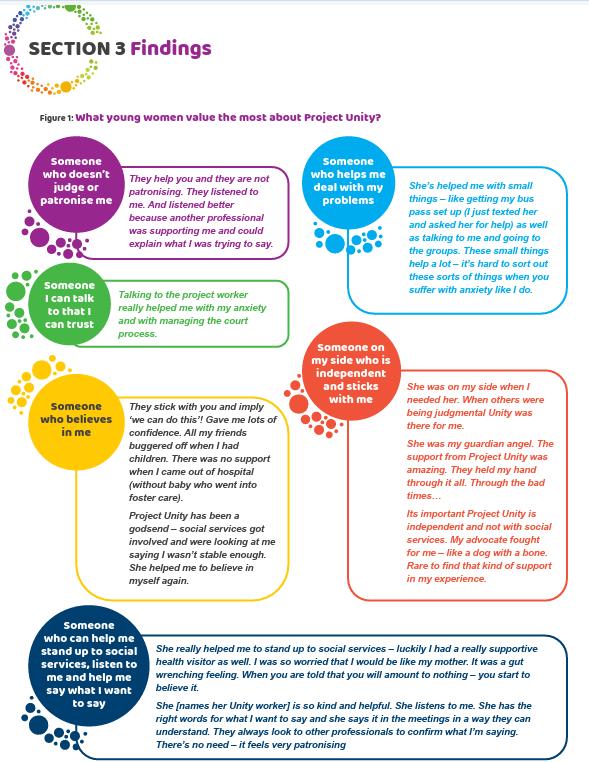
The NYAS report says that the women interviewed “placed the intensive one-to-one support as the centrepiece of the service model and the most helpful element.” This was described as a mix of emotional and practical support in order to give them “a fighting chance” to safely parent their baby, child or children. Appendix 1.1 gives examples of the support that the young women valued.
8. We especially value support that is independent from social services
The NYAS report states that they young people supported valued the emotional and practical support, but also that this was independent from social services. This is likely to be connected to the fact that 70% of their client group were facing child protection investigations or care proceedings.
9. There’s a postcode lottery, depending on where you live
Young people involved in groups drawn from more than one local authority, for example a member of the Young Person’s Steering Group, commented that different local authorities and NHS services had different offers for parents with care experience. Variations included
• Attitudes to safeguarding referrals (in some areas this was mandatory, despite guidance to the contrary, and possibly built-in to recording systems)
• Financial support. Camden Council provides a one off grant of £1000 to parents with care experience to help with buying essential equipment. Other councils have a “Baby Box” scheme.
• PA support. Some councils have a dedicated or designated PA for pregnant young people/ new parents; others expect all PAs to offer support if a young person in their caseload becomes pregnant/ a parent.
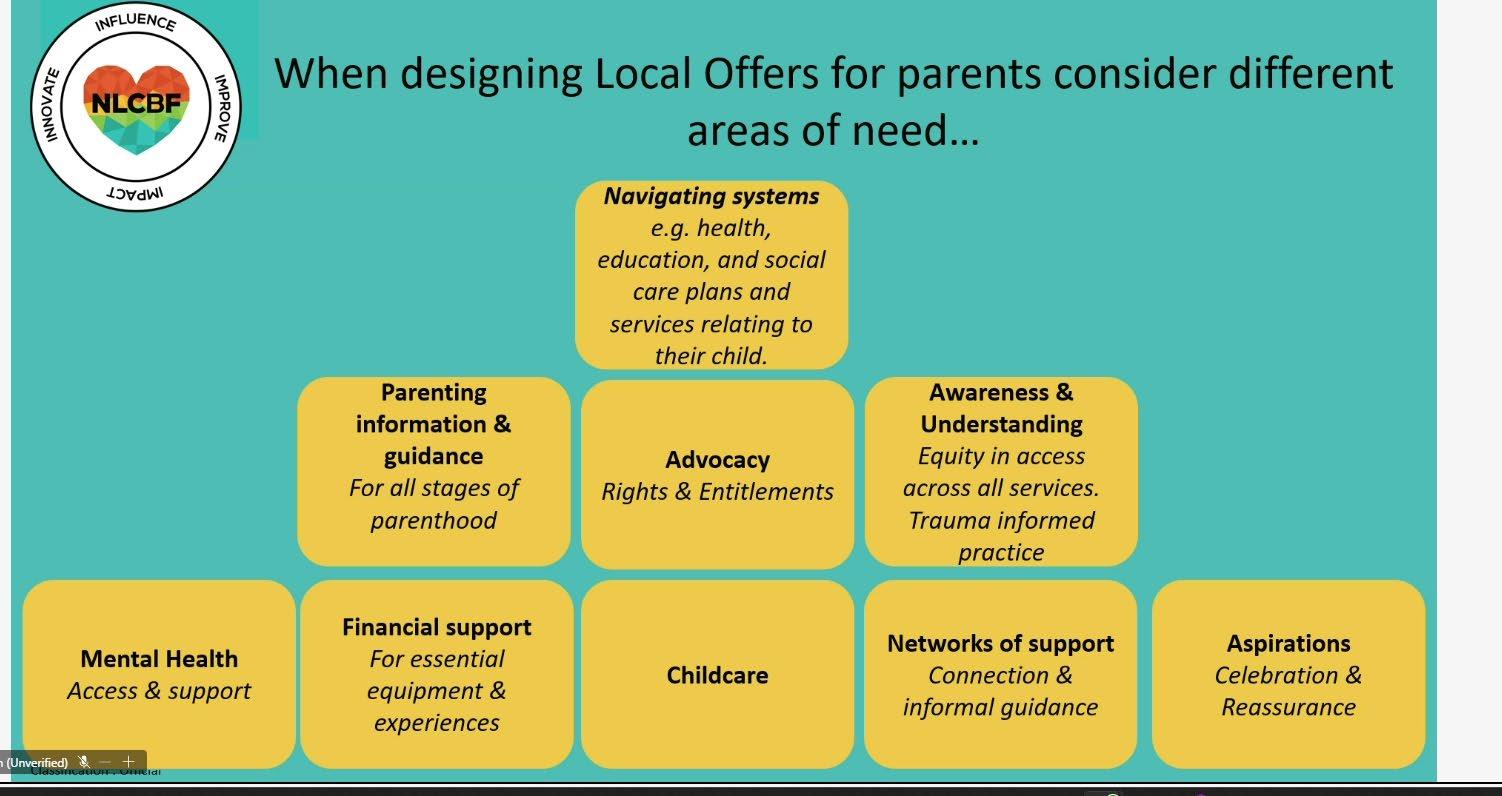
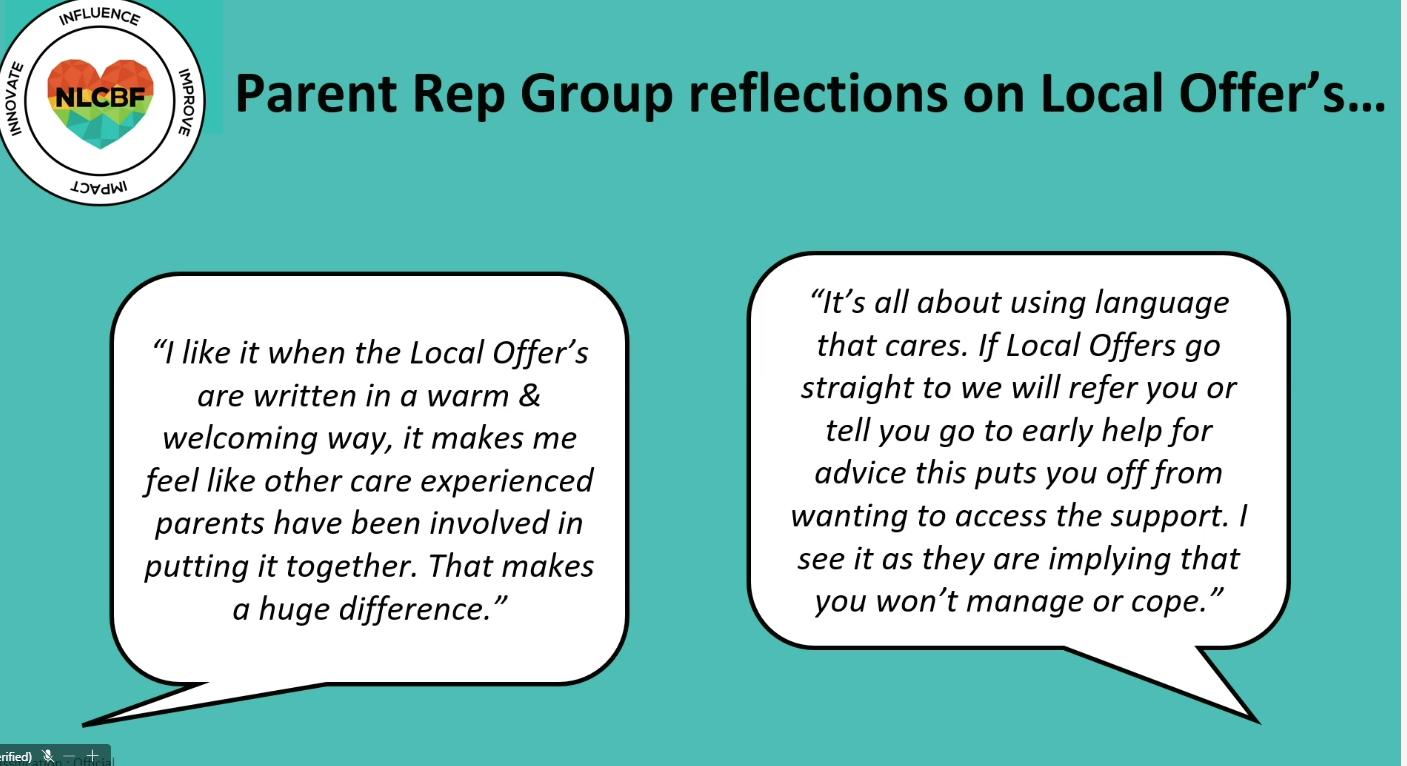
The NLCBF brought together a group of parents with care experience to review Local Offers. They said that several seemed to be “tick box” exercises, whereas others had obviously been co-designed with young parents themselves. Appendix 1.2 summarises what they thought should be in all Local Offers.
10. The most important thing about services for parents with care experience is that they should be co-designed with us, as parents
A consistent feature of the conversations with parents (eg in the Steering Group or in the GMYN Report) is that they need to be involved in designing the offer for them, otherwise it won’t meet their needs and they won’t buy in.
Steering Group members also said that the co-design needed to happen repeatedly, as parents and their children grew older and moved on – what was right for one group was not necessarily right three years later.
Section 2: What the research says
Statistics
1. There are no nationally collected statistics on those with care experience who become pregnant or become parents.
2. However, research studies all show that women with care experience are more likely to become parents at a young age than the general population.
Data from a Teenage Pregnancy research study, reported in Community Care in 2008 found that “Looked-after young people are at greater risk of teenage pregnancy and are 2.5 times more likely to become pregnant than other teenagers.”
The Centre for Social Justice undertook a Freedom of Information request to English Local Authorities in 2014 and found that “22 per cent of female care leavers become teenage parents. This is about three times the national average.”
3. Research also tells us that mothers with care experience are more likely to have their children taken into care, including as a newborn than the general population.
The CSJ report referred to above found that “at least one in 10 young care leavers aged 16-21… had a child taken into care in the last year”.
Roberts et al (2019) reports that in a cohort of children of parents with care experience in Wales, 26% of children were separated from their parents at the time of data collection; with a further 34% in receipt of some form of statutory intervention. This compares to 1% of children in state care in Wales and 3% in receipt of care and support (including those ‘looked after’, on the Child Protection Register and those with a Care and Support Plan.)
Cusworth et al (2022) report that in Scotland, in a sample of babies taken into care before one year old, over a third of mothers (37%) and a quarter of fathers (24%) had been in care themselves as a child.
The Parsons, Fitzsimons & Schoon research (2024) used the British Cohort Study and Millennium Cohort Study to demonstrate that 11% of children with a care-experienced mother experience time in care compared to 3% of children of mothers with no care experience.
4. Sadly, mothers with care experience are also more likely to have children repeatedly taken into care or placed for adoption.
Broadhurst et al’s (2017) research into vulnerable birth mothers who experience repeat care proceedings concluded 40% of the study sample were care-experienced (based on analysis of 354 case files and 72 interviews).
Roberts et al. (2017) found that care leavers in Wales were overrepresented amongst birth parents whose children were placed for adoption.
5. However, the vast majority of children with a mother with care experience do not go into care themselves.
Issues facing parents with care experience
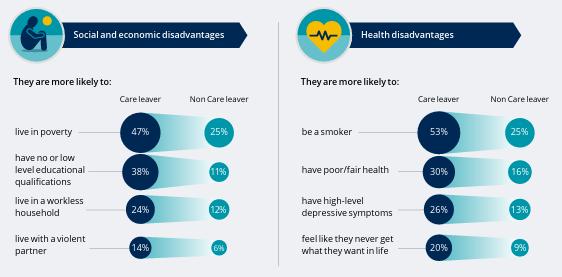
6. Overall, mothers with care experience suffered multiple disadvantages.
The policy briefing at Parsons et al (2024) summarises the findings from a detailed study of care leavers as mothers. It finds “They had lower levels of education than their peers and were more likely to be in workless families, on benefits or in poverty. They were more likely to live in rented, damp housing, to lack peace and quiet at home and to be dissatisfied with the areas where they lived. They were more likely to experience force by a partner, to have poor physical or mental health and to be dissatisfied with life.”
In statistics, it summarises the position as below.
7. Poor mental health among mothers with care experience is a strong theme in the research.
Poor mental health is a common factor for all newborns going into care, irrespective of parental care status, with Broadhurst et al (2017) finding parental mental health concerns in 70% of cases. These concerns often co-occurred with learning disability, cognitive impairment or substance misuse issues.
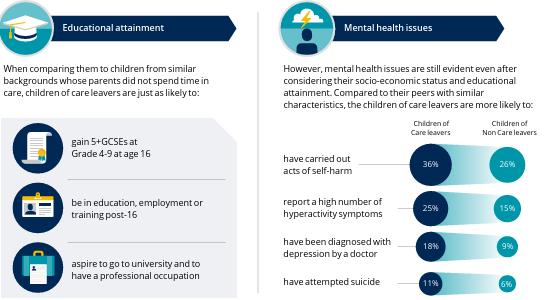
Parsons et al (2024) found that mothers with care experience had high levels of mental health struggles, including high risk of depression and anxiety. They were nearly onethird more lively to have been diagnosed with depression and twice as likely as those without care experience to have a high level of depressive symptoms.
The research, including the Bogen-Johnston et al (2024) study also highlights the relationship between mental health and sexual/reproductive health, noting that, compared to other teenagers, young care leavers tend to have poor sexual and reproductive health, including poorer contraceptive use and increased rates of transmission of STIs and HIV. Those in care and those around them may not be aware of the relationship between trauma, mental health and sexual reproductive health, with young people conflating sex with love and affection. Bogen-Johnston et al note that there is evidence of increased risk of poor sexual health during the key transition of exiting the care system.
8. Sadly, the evidence also shows that poor mental health is also experienced by the children of care leavers.
The Parsons et al (2024) policy briefing says “Both parents [with care experience] and offspring are at greater risk of mental health problems, including symptoms of depression and anxiety. Their children have increased levels of behavioural problems, self-harm and suicidal intent.” The research calls for further analysis to examine and explain this association.
The research also notes that, while children of care leavers have similar educational outcomes to children of mothers from similar socio-economic backgrounds who weren’t in care, mental health issues are evident, suggesting “prolonged and indirect emotional scarring.”
Section 3: Services for parents with care experience
1. There are a few services offered to young people with care experience before they or their partner become pregnant
One example is the “My Future Me” Programme, run by charity “For Baby’s Sake”. This is currently being piloted with Hertfordshire County Council. For Baby’s Sake runs counselling and support for new parents across the country, and this pilot programme responds to them identifying that up to 25% of the parents attending that programme are care-experienced. It “offers care-experienced young people tailored, one-to-one therapeutic support over six months, with additional needs-based follow-up, for up to six months more, providing support for up to a year in total.” The programme’s focus is on building healthy relationships, emotional regulation and understanding trauma from their childhoods. There is an optional model on “preparing for future parenthood.”
Susannah Bowyer at Research in Practice also described two local authority projects in Leeds and Stockport which work with young people to help them think about whether they are ready for parenthood, before it happens.
2. There are also services for mothers who have had one or more babies taken into care, such as Pause
The evaluation of the Pause model (Boddy et al, 2020) reports that the approach is effective for all women. It included a care leavers’ pilot, and the report argues that
• “given heightened risk of child removal for care-experienced women who become pregnant at a young age, and the sharpened ethical duty of the state as their corporate parent (and ‘corporate grandparent’ to their children), there is a particularly strong argument for the extension of this kind of support for young women who are looked after or care leavers”; and
• “ … it can also be hypothesised that similarly resourced and designed work would have preventive value for intervention with women involved with child protection services before the removal of a child into public care.”
• A pilot programme for young women transitioning out of care has recently been launched, called “Reach – Relate, Empower, Achieve, Compassion, Hope ” It is described as offering tailored therapeutic, practical and behavioural support and aims to test whether early relational support for care-experienced young women can break the intergenerational cycle of care experience and reduce the trauma associated with it.
• Several participants mentioned a video from Just for Kids Law, titled “If I Could Talk To Me,” which they had found helpful.
3. There are more services for care-experienced women who become pregnant - some of these are focused on situations where social care may be involved
The Family Rights Group has advice on their website, and information via their advice line, for young parents with care experience, which was co-designed with parents with care experience
The Izzy Project, developed by charity Birth Companions, offers specialist, relationshipled support to women living or giving birth in the London Borough of Hackney who are at risk of, or experiencing separation from their baby shortly after birth, many of whom have care experience. They describe the service as a navigator/ advocacy offer. It was co-designed by members of the Birth Companions Lived Experience Team who have personal experience of children’s social care involvement during pregnancy and early motherhood, and with input from over 40 stakeholders from Hackney’s maternity, perinatal mental health, and children’s social care services. Staff at Birth Companions say that this means the service has huge buy-in from statutory partners, as well as offering bespoke support to local mothers. They were at pains to stress that it isn’t necessarily about changing the outcome of separation but ensuring that the women’s voices are heard. They also continue to offer support after separation, when much else, e.g. perinatal mental health support, stops.
The Trevi homes in Plymouth were cited as an example of good practice, with therapeutic support for mothers, primarily those with substance misuse issues, to be supported and assessed.
NYAS (National Youth Advocacy Service) in Wales (NYAS Cymru) delivers Project Unity, a holistic support to care-experienced young women and mothers up to age 25. This mixes one-to-one support providing advice and advocating for the young person’s rights and services, with peer sessions to provide social opportunities and access peer support. There is more information in a mid-term evaluation by Dr Anne Crowley
4. There are also services for parents to be/new parents aimed at, or delivered by, Local Authorities and the NHS, which have been cited as good practice
The charity Birth Companions has developed a charter which sets out how services and systems in England should support all women involved with children’s social care from conception to their child’s second birthday - the period known as the '1001 critical days'. It outlines 14 principles to help protect women’s rights to safe, fair and compassionate
care and calls for a national health and social care pathway for pregnant women and mothers of infants who are subject to pre-birth or parenting assessment, or child protection proceedings. Work has started to develop this new pathway, with the expectation of a draft by the end of 2026.
Louise Roberts and the team at CASCADE (Cardiff University) have developed a Best Practice Charter for Councils on supporting parents in and leaving care. This is widely cited in conversations with local authorities as the best starting point for local authority teams looking to improve their services for this group.
Where the parent is young (under 24) they may meet the eligibility criteria for the Family Nurse Partnership programme, which is a manualised programme commissioned in a number of local areas. It is an intensive, targeted home-visiting programme for firsttime young mothers and families. Family nurses support mothers enrolled in FNP to have a healthy pregnancy, improve their child’s health, development and school readiness and reach their own goals and aspirations.
Some local authorities have a specialist Personal Adviser who works alongside case working PAs for care-experienced young people who become pregnant. For example, Danielle Colton from Bristol City Council has developed a timeline identifying when actions need to be taken across NHS, social care, housing, benefits, birth registration etc, and ensuring the young person has a hospital bag packed and a car seat to take the baby home in. They will also provide information to the PA about young mums’ groups in the area, Children’s Centres etc.
Birmingham & Solihull NHS have a dedicated website for parents with care experience, and professionals who work with them, including training videos for midwives and links to resources for parents.
NHS Sussex has worked with care leavers and maternity services to produce a new maternity pathway for care leavers, which is considered to be best practice. /
5. Generally, there are few services for parents after a child has been removed
The lack of support for parents after a child has been removed is referred to in the NYAS review. One manager is cited as saying “Where the outcome is that the baby or child is removed and placed in care long term – everyone just pulls out immediately –the infant is no longer at risk but there is no support for the young mother – a care leaver that the local authority has responsibilities towards. They are so low – they give up on themselves – go off with that violent partner, or into prostitution and it could all happen again. Project workers are able to support the young women with their anger and upset and the trauma of losing their child. We try and persuade them to get help for themselves – mental health or other therapeutic support”.
The Izzy Project from Birth Companions also continues to work with women if they are separated from their child. They pointed out that statutory perinatal mental health services stop if the baby is no longer with the child.
One project for mothers who are separated from their children is Giving Hope, developed as a spin-off from the “Born into Care” project led by Lancaster University. Giving HOPE (Hold On, Pain Eases) aims to reduce the trauma experienced by mothers and babies separated close to birth due to safeguarding concerns. Alongside training for practitioners and work to change policy and practice, and co-designed with those with lived experience, it has developed “HOPE boxes. “Two boxes, one for the mother and one for the baby, contain carefully chosen items intended to provide comfort, reduce trauma, and offer support as they navigate the child protection and family justice systems. They are a gift from mother to mother and a resource, designed to support practitioners to provide more trauma-informed and compassionate care.”
6. For the majority of care leavers who keep their child, there are many voluntary organisations which run specialist programmes for parents with care experience
The Mental Health Foundation has, until recently, run a programme called “Young Mums Connect.” This ran in Nottingham and Greenwich, with referrals from Early Help and another parents’ charity respectively. It provided peer support, trips and activities to young mothers with care experience who were otherwise isolated.
The Rees Foundation runs “Parents Together” in partnership with the Family Hubs service in Birmingham. It is run by a care-experienced childminder and offers Family Fun Days, a peer group with guest speakers, a drop in “stay and play” at the Rees Café, mindfulness sessions and 1-1 counselling support for anyone who would like it. All parents also get a “Baby Bundle” of toys and practical baby things, as well as a subscription to the Dolly Parton Imagination Library.
Herefordshire Community Foundation have funded Homestart Herefordshire to deliver a support offer for parents with care experience. This offers both 1-1 support (the usual Homestart model), and a group for peer support, which was a request from the parents. This meets at a venue with a sensory room in the centre of Hereford. Homestart draws on its network to offer gifts/ loans of equipment, such as baby buggies, and partners with other local charities such as Hereford Food Bank. They noted that a number of referrals from midwifery services were for care-experienced young people who were placed in Herefordshire from other boroughs and were not known to the local authority.
Leicestershire Cares has developed a peer group for parents who access its wider employability services. This offers peer group sessions, trips and outings for the families, as well as informal advocacy for the parents as required. It was developed as a response to parents with care experience telling staff at Leicestershire Cares that they didn’t feel the generic Early Help service met their needs.
Some of these are tailored to particular aspects, for example Drive Forward Foundation has identified parents with care experience as a group they wish to focus on in their future work supporting young people with care experience into employment, and London charity Settle supports care-experienced young people, including parents, into housing.
7. And there are many examples of projects being run by Local Authorities too
Warwickshire Council offers a “Baby Box.” The project, initially developed by a careexperienced employee at the council, was launched in 2020 to support looked after young people and care leavers who have become parents. It provides useful supplies and information to help young people prepare for parenthood. Feedback from parents with care experience suggests that the experience of receiving something positive and valuable from the Local Authority, more often a source of anxiety or distrust, is as important in building positive relationships and confidence as the content of the box itself.
The NLCBF brought together parents with care experience to review Local Offers. Good practice ideas included:
• Grants to help meet additional costs (Camden provides £1,000; Oldham provides £15 extra per week for a year)
• “Baby Banks” for nappies, 2nd-hand clothes etc in the Care Leavers Hub – discreet and helpful
• Local authorities paying for private speech & language assessments when there were concerns about language delay, as a “pushy parent” would
• A specialist PA to help with appointments, accompany to “stay and play” etc
• Fire Brigade providing free safety checks e.g. fire alarms, stair gates, cupboard locks etc.
8. Parents with care experience may also be eligible for programmes on offer to vulnerable parents more widely such as those in poverty or young parents
The charity WILD, based in Cornwall, offers young parents ‘real-life’ weekly groups, and online chat groups, as well as one-to-one help for dads, mums and parents and extra help for families who are finding things hard. They estimate that up to 40% of the young parents who come to WILD have some care experience, even if they are not legally defined as “care leavers”, and that up to 20% are homeless. They offer trauma-informed and individualized parenting support, having found that many of the young people they work with are referred to universal programmes such as the Solihull Parenting Programme but are unable to access it due to the trauma they have previously experienced.
The Children’s Foundation offer Baby Box to disadvantaged parents in the North East. They say “The baby box is all about supporting babies in the North East to have the best start in life. The box has a unique focus on baby development and is packed full of developmentally stimulating books and toys. It includes essentials like a changing mat, bath towel, and first toothbrush to get families started with baby care.” It’s not wholly clear, but this seems to be given to parents on the basis of a midwife referral.
9. There are some projects specifically for fathers with care experience, or fathers where the mother has care experience
The Rees Foundation runs a group called “Men Matter” – a monthly online session for dads run by a Mental Health First Aider, as part of their Birmingham Start for Life project.
The Herefordshire Homestart project referred to above includes a group for fathers, including biological fathers and father figures, run by a Homestart male support worker.
Support for dads with care experience was highlighted as a gap in the NYAS Project Unity evaluation; and NYAS were considering a pilot project as part of their Wales service.
10. There are a small number of organisations who offer support and training for staff and organisations working in this field
Become have recently added a “care-experienced parents” module to their training for PAs. This is currently a standalone module, but the intention is that it will become part of their L4 Accredited training for Personal Advisers. The training:
• Describes the experience of parents with care experience, drawing on the Barnardo’s “Care Experienced Parenthood” report and focus groups done with parents on the Become panel.
• Works through issues a young person might face during pregnancy/ at birth, including assessments, care proceedings & court processes, drawing on the Family Rights Group online advice and the Pause approach for women who have had children removed
• Reviews all the different sources of advice and support a young parent might benefit from including parenting support such as Home-Start, benefits and grants available, including for parents who might want to return to education, require childcare etc.
WILD run a national network for young parents groups. This was established to support implementation the National Framework for supporting teenage parents, developed by
Public Health England and the Local Government Association. There are 80 members across the UK and they both meet to share practice but also to influence policy, linking with DH and DfE, and with relevant All Party Parliamentary Groups. Key issues they are currently working on include perinatal mental health in young parents, including fathers, and domestic violence.
11. The research by Amy Lynch at Warwick Business School gives a helpful way of thinking about what success means for parents with care experience.
Since the bulk of the scoping study was completed in autumn 2025, a new research article (Lynch, Oswick & Currie 2026) has been published. This reviews the academic and grey literature on services for parents with care experience and draws out the characteristics of various models: therapeutic, social, partnership, advocacy and co-production. It also highlights five ingredients that lead to implementation success: shared leadership, receptivity of context, co-production, learning and adaptation and outcome measurement.
Sources, appendices, bibliography
Section 1 Sources:
• Barnardo’s (2022). Care Experienced Parents Unite for Change
• Who Cares? Scotland (2022). “Believe in Us”. Care Experienced Parents: Findings from the Annual Participation Programme.
• GMYN (2025). When we are seen: Developing best practice for care-experienced young people as parents in Salford.
• Helena Wride (GMYN) reporting back on questions she had asked her group
• Jade Kieft (National Leaving Care Benchmarking Forum (NLCBF) reporting back on a three month project with a panel of parents with care experience.
Section 2 Sources:
Bogen-Johnston, Leanne, Edelman, Natalie L., Sellers, Ruth (2024) Interventions to support reproductive and mental health among care leavers: A systematic review. Adoption & Fostering, 48 (1). pp. 82-104. ISSN 0308-5759. E-ISSN 1740-469X. (doi:10.1177/03085759231212496) (KAR id:105493)
Broadhurst, K., Mason, C., Bedston, S., Alrouh, B., Morriss, L., McQuarrie, T., Palmer, M., Shaw, M., Harwin, J. and Kershaw, S. (2017). Vulnerable Birth Mothers and Recurrent Care Proceedings. Final Main Report. (Accessed 9 December 2025)
Centre for Social Justice (2015). FINDING THEIR FEET Equipping care leavers to reach their potential. Centre for Social Justice. (Accessed 9 December 2025)
Community Care (2008). Teenage pregnancies among children in care: research. (Accessed 1 December 2025).
Cusworth, L, Hooper, J, Henderson, G, Whincup, H and Broadhurst, K, (2022). Born into care in Scotland: circumstances, recurrence and pathways. Scottish Government. (Accessed 1 December 2025)
Lynch, A., Oswick, R., & Currie, G. (2026). Developing Innovations to Enable Care-Experienced Parents’ Successing: A Narrative Review. Youth, 6(1), 4. (Accessed 25 March 2026).
Parsons, S, Fitzsimons, E, Schoon, I (2024). Long-term outcomes for care leavers who became parents and experiences of their children - Evidence on the intergenerational transmission of disadvantage in two British cohort studies. CLS research report. (Accessed 1 December 2025).
Roberts, L, Meakings, S, Forrester, D, Smith, A, Shelton, K (2017). Care-leavers and their children placed for adoption Children and Youth Services Review, Volume 79, 2017, Pages 355-361, ISSN 0190-7409. Accessed 9 December 2025.
Roberts, Louise, Maxwell, Nina and Elliott, Martin 2019. When young people in and leaving state care become parents: What happens and why? Children and Youth Services Review p.104
Appendix 1.1 – What young women value about Project Unity
Source: Crowley (2022) p22.
Parents with Care Experience: Scoping paper
Appendix 1.2 – What the NLCBF Parents with Care Experience want from Local Offer
Source: (Extract from Slide Presentation – NLCBF’s Network for PAs supporting parents with care experience).
Bibliography
Barnardo’s (2022). Care Experienced Parents Unite for Change. (Accessed 1 December 2025).
Birth Companions (2023). Birth Charter for women with involvement from children’s social care Birth Companions. (Accessed 1 December 2025).
Boddy, J. Bowyer, S, Godar, R, Hale, C, Kearney, J, Preston, O, Wheeler, B, Wilkinson, J (2020). Evaluation of Pause. Department for Education. (Accessed 1 December 2025)
Bogen-Johnston, Leanne, Edelman, Natalie L., Sellers, Ruth (2024) Interventions to support reproductive and mental health among care leavers: A systematic review. Adoption & Fostering, 48 (1). pp. 82-104. ISSN 0308-5759. E-ISSN 1740-469X. (KAR id:105493)
Broadhurst, K., Mason, C., Bedston, S., Alrouh, B., Morriss, L., McQuarrie, T., Palmer, M., Shaw, M., Harwin, J. and Kershaw, S. (2017). Vulnerable Birth Mothers and Recurrent Care Proceedings. Final Main Report. (Accessed 9 December 2025)
Centre for Social Justice (2015). FINDING THEIR FEET Equipping care leavers to reach their potential. Centre for Social Justice. (Accessed 9 December 2025)
Community Care (2008). Teenage pregnancies among children in care: research. (Accessed 1 December 2025).
Cusworth, L, Hooper, J, Henderson, G, Whincup, H and Broadhurst, K, (2022). Born into care in Scotland: circumstances, recurrence and pathways Scottish Government. (Accessed 1 December 2025)
Crowley, A (2022). Project Unity Mid-Term Review NYAS. (Accessed 16 December 2025)
Department for Education (2025a). Local offer guidance. Guidance for local authorities on the local offer for care leavers. (Accessed 22 December 2025)
Department for Education (2025b). The Children Act 1989 guidance and regulations Volume 3: planning transition to adulthood for care leavers.
GMYN (2025). When we are seen: Developing best practice for care experienced young people as parents in Salford. Greater Manchester Youth Network (personal correspondence)
Lynch, A., Oswick, R., & Currie, G. (2026). Developing Innovations to Enable Care-Experienced Parents’ Successing: A Narrative Review Youth, 6(1), 4. (Accessed 25 March 2026).
Parsons, S, Fitzsimons, E, Schoon, I (2024). Long-term outcomes for care leavers who became parents and experiences of their children - Evidence on the intergenerational transmission of disadvantage in two British cohort studies CLS research report (Accessed 1 December 2025).
Pause (2024). Kinship Care: Birth mothers’ experiences of having children in kinship care. (Accessed 1 December 2025).
Public Health England (2019). A framework for supporting teenage mothers and young fathers. (Accessed 16 December 2025).
Roberts, L, Meakings, S, Forrester, D, Smith, A, Shelton, K (2017). Care-leavers and their children placed for adoption. Children and Youth Services Review, Volume 79, 2017, Pages 355-361, ISSN 0190-7409. Accessed 9 December 2025.
Roberts, Louise, Maxwell, Nina and Elliott, Martin 2019. When young people in and leaving state care become parents: What happens and why? Children and Youth Services Review p.104.
Roberts, L. 2021. The children of looked after children: outcomes, experiences and ensuring meaningful support to young parents in and leaving care. Policy Press. Book, Good Practice Charter for Local Authorities and associated resources. (Accessed 1 December 2025).
Who Cares? Scotland (2022). “Believe in Us”. Care Experienced Parents: Findings from the Annual Participation Programme (Accessed 1 December 2025).