New Connections: The
1. Introduction
The New Connections programme was a pioneering pilot initiative launched by the Esmée Fairbairn Foundation It was designed to address long-standing structural barriers within the Foundation's own funding practices that had systematically limited access for smaller, newer, and historically underfunded organisations, particularly those operating outside traditional charitable models
With £15 million in ringfenced grant funding, the programme tested a deliberately different approach for the Foundation By removing the conventional open-call process and proactively identifying and inviting aligned organisations, New Connections sought to centre equity, trust, and accessibility in its grantmaking The cohort of 20 organisations was selected precisely because they represented vital, high-impact work within Esmée's three priority areas: A Fairer Future, Confident Communities, and Our Natural World, but were often excluded from mainstream funding streams due to restrictive governance or income criteria.
For Esmée, New Connections was a deliberate learning experiment from its inception. The Foundation aimed to move beyond transactional grantmaking to understand:
● How organisations generate systemic value is typically marginalised in traditional philanthropic processes
● The efficacy and challenges of diverse governance structures, including Community Interest Companies (CICs)
● How its own internal criteria and practices needed to evolve to serve equity-led, grassroots groups better.
● The tangible impact of building a peer learning network among underrepresented leaders
To facilitate this ambitious learning journey, Esmée partnered with Do it Now Now (DiNN) as the network facilitator and learning partner DiNN’s role, as outlined in the programme design, was to create and hold an inclusive, responsive space for the grantee cohort This involved:
● Co-designing and delivering a tailored programme of workshops, residentials, and peer learning sessions
● Facilitating advocacy and dialogue between grantees and Esmée, ensuring lived experience directly informed the Foundation’s evolving practices.
● Establishing real-time learning loops to capture insights, challenge assumptions, and co-create recommendations for systemic change within funding
This report serves as the culminating analysis of the full New Connections programme. It draws upon the baseline understanding established at the outset, the planned activities and framework, and, critically, the final outcomes, reflections, and post-programme data gathered from participants. It seeks to answer the core questions posed at the start: what was learned, what changed, and what does this mean for the future of equitable, trust-based funding at Esmée Fairbairn Foundation and beyond
2. Onboarding & Foundational Co-Design
The successful launch of the New Connections programme hinged on a deliberate, inclusive onboarding and co-design process This initial phase served a dual purpose: to formally integrate the 20 grantee organisations into the network and, more critically, to collaboratively establish the programme’s priorities and structure, informed by their lived experiences and expressed needs
Guided by DiNN, this process moved beyond administrative setup to function as the first act of participatory leadership. A detailed onboarding survey captured essential logistical information, confirmed primary contacts, access requirements, and permissions, and laid the groundwork for trust and transparency The core of this phase, however, was a co-design session held on 11th July 2024, during which participants identified and ranked thematic barriers and enablers critical to their organisational journeys
Key Themes and Prioritised Barriers.
From a pre-defined list of themes derived from the co-design conversation, participants selected their top five and ranked each as a High, Medium, or Low barrier The aggregated results immediately revealed a clear picture of the cohort’s most pressing systemic challenges:
● Overwhelmingly High Barriers: The themes of ‘Capacity & Resources’ and ‘Fundraising & Access to Finance’ were consistently ranked as High-barrier areas Participants directly linked a lack of stable, core funding to burnout, constrained strategic vision, and an inability to scale impact. As one leader noted, "Having access to a steady stream of income presents the biggest challenge in terms of capacity and resources the vision and strategic planning can't be realised in its full entirety"
● Critical Contextual Barriers: ‘Social & Cultural Capital’ and ‘Support & Allyship’ were also frequently cited as high barriers, particularly for organisations led by racially marginalised communities Participants highlighted that a lack of recognition and relational power within mainstream sectors directly impeded access to funding and partnership opportunities.
● The Cost of Impact on Wellbeing: Notably, ‘Health & Wellbeing’ and ‘Joy + Celebration of work’ were selected as top-five themes by multiple organisations, often framed as casualties of the high-barrier financial and capacity challenges. One response poignantly stated, "Celebrations should be high, because we do not have chances to celebrate This can keep small orgs going during hard times"
From Diagnosis to Design: Shaping the Programme
This exercise was not merely diagnostic; it was directive Participants were asked how the programme could collectively address a top barrier Their responses shaped the subsequent programme design:
● They called for practical skill-sharing -"sharing tools, techniques, knowledge"
● They sought advocacy and systemic influence -"systematically working through each theme and sharing our findings... with those who hold power."
● They explicitly requested safe, collaborative spaces for peer support and to address complex issues such as bias in funding
Furthermore, expectations for the planned residentials were clearly articulated: a strong desire for expert-led learning, leadership development, networking, and inspirational spaces that would translate directly into practical organisational growth
For those actively engaged, the onboarding and co-design phase began to build a collective learning community with a shared diagnosis of challenges. It established a participant-owned framework that helped ensure the ensuing programme of workshops, residentials, and advocacy sessions would be relevant and responsive to the systemic barriers the cohort had identified. This foundational step validated the programme's core ethos of trust and co-creation, setting a precedent for the participant-led approach that would define the New Connections journey
2.1 The Cohort: A Profile of Participating Organisations
The New Connections programme was built around a cohort of 20 organisations, represented by 27 individual participants This group was intentionally designed to reflect the programme's core aim: to partner with smaller, community-rooted entities that are doing important work within Esmée's strategic priorities yet face structural barriers in the traditional funding landscape The following profile, based on data gathered at onboarding, provides an anonymised overview of the cohort's key characteristics.
Leadership and Lived Experience
The cohort was overwhelmingly led by individuals from racially marginalised communities Specifically, 65% of the main organisational participants identified as Black, African, Caribbean, or of Mixed Black heritage, with a further 25% identifying as Asian or other global-majority ethnicities. This demographic profile underscores the programme’s success in engaging leaders whose lived experience is central to their expertise, a quality often undervalued in conventional funding assessments
Geographic Reach and Thematics Reach
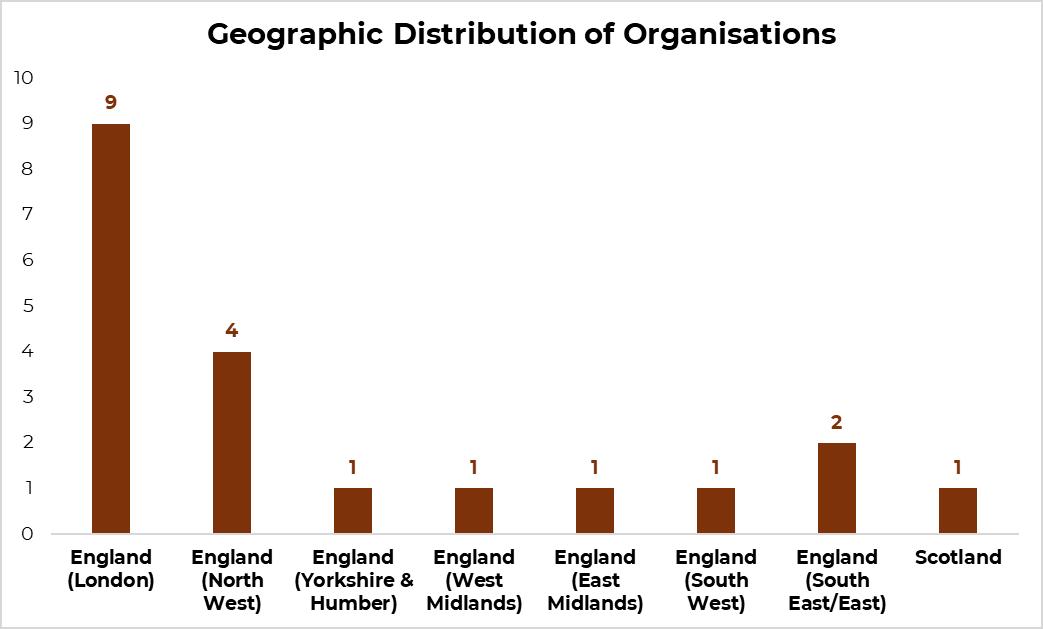
The organisations formed a UK-wide network of community-led work. As illustrated in Figure 1, although a significant cluster was based in London, the majority were rooted in communities across England and Scotland, including the North West, the Midlands, Yorkshire, and the South West. This national spread reflects that the need for more equitable funding is not confined to philanthropic hubs but is a widespread issue
Figure 1: Geographic Distribution of the Participating Organisations
Strategic Alignment and Impact Goals
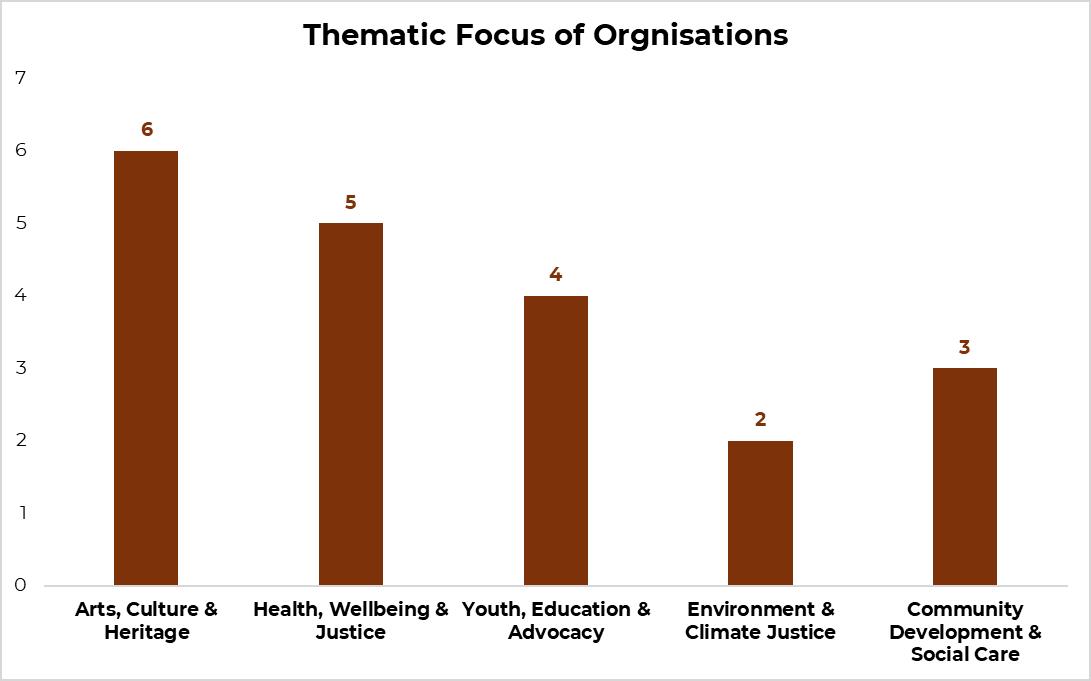
The cohort demonstrates a sophisticated alignment with Esmée’s impact goals, often operating across multiple priority areas A deep commitment to Racial Justice and "A Fairer Future" underpins the majority of the cohort's work, particularly through efforts to improve systems, policies, and practices across education, child protection, and maternal health Furthermore, many organisations are redefining "Our Natural World" by addressing the lack of diversity in the environmental and marine sectors and by viewing access to nature as a fundamental right for the global majority These groups are filling critical gaps by moving beyond direct service delivery to lead movement-building and systemic advocacy.
Figure 2: Thematic Focus of the Organisations
Diverse Governance and Legal Structures
The cohort's legal structures reflect a pragmatic choice of agility and community accountability over traditional charitable models Analysis reveals that 65% of organisations are incorporated as Community Interest Companies (CICs), while the remainder are split between Charities, Private Limited Companies, and Unincorporated Collectives Governance is deeply rooted in lived experience; many organisations are led by sole executive directors who balance strategic leadership with frontline delivery These structures are often chosen for operational speed, though they can create barriers to accessing institutional funding that prioritises traditional charitable governance
Financial Landscape and Strategic Use of Funding
The financial profile of the cohort highlights a significant "missing middle": organisations that have demonstrated impact but lack the core stability to sustain it Based on financial data reported for either the 2021-22 or 2022-23 period, annual business incomes vary considerably across the group, with some organisations newly established and reporting no prior turnover, and others reporting annual incomes above £100,000 Regardless of size, a universal theme identified during onboarding was a precarious reliance on short-term, project-restricted funding
3. Programme Roadmap of Learning and Connection.
The New Connections programme was structured as a dynamic, participant-led journey It moved from foundational co-design to intensive expert-led training, culminating in collective advocacy To maintain a trust-based, responsive environment, the delivery was organised into thematic blocks to address the specific barriers the cohort identified during onboarding
3.1 Programme Activities
The New Connections programme was structured as a blended learning journey, combining virtual expert-led workshops with immersive in-person residentials This design balanced the delivery of practical, skill-based content with the deep relational trust necessary for authentic peer learning and advocacy
The journey began in July 2024 with a foundational Co-design Workshop, where participants set the programme’s priorities This was followed by the first expert-led sessions on Wellbeing and Advocacy & Systems Change, which established core themes of sustainability and strategic influence The initial Residential in November 2024 solidified the cohort into a community, transforming individual grantees into a collective with a shared voice
The programme intensified in 2025 with a series of capacity-building workshops addressing the cohort's most pressing barriers: Financial Sustainability (March), Organisational Capacity (April), and Networks & Influence (May). A Wellness Retreat in June provided a dedicated space for restoration and resilience, responding to the burnout identified earlier The journey culminated in the final Advocacy Residential in October 2025, during which the cohort engaged in direct, structured dialogue with the Foundation's leadership and presented evidence-based recommendations for systemic change
Throughout, each expert-led session followed a consistent format of interactive training, external speakers, and practical application, supported by pre- and post-session resources from the DiNN team to reinforce learning
3.2. The Learning Journey in Practice
The programme unfolded in phases, moving from co-design and trust-building through capacity development to advocacy and systemic dialogue. Each phase combined expert-led workshops with immersive residentials, creating a rhythm of learning, reflection, and collective sense-making
Phase 1: Laying the Foundation – From Isolation to Collective Voice (July –November 2024)
The programme began with a deliberate inversion of traditional power dynamics: participants, not funders, set the agenda In the initial Co-design Workshop (11 Jul 2024), leaders diagnosed the most pressing barriers to their growth, with Capacity & Resources and Fundraising emerging as universal challenges This was more than a survey; it was an act of relational trust-building that ensured the programme would respond to lived, not assumed, needs.
The first residential (14–15 Nov 2024) deepened this shift, transforming the cohort from a group of grantees into a trusted peer community In structured co-design sessions, leaders moved beyond operational challenges to name the emotional and systemic costs of their work They spoke openly about:
● The impossibility of a long-term strategy when core roles are freelance or temporary due to restrictive project funding
● The exhaustion of navigating systemic racism and tokenism, particularly amid a wavering political commitment to racial justice post-2020
● The hidden labour of being asked to consult or “represent” without fair compensation or credit.
A powerful consensus emerged: what was missing was not just funding, but relational power and recognition within the philanthropic ecosystem Participants expressed a strong desire for funders to simplify applications, provide long-term unrestricted grants, and engage transparently; these requests became a guiding thread for the entire programme By the close of this residential, the cohort had established a shared advocacy agenda, validating the programme’s core belief that those closest to the impact must shape the solutions
Phase 2: Building Resilience – From Survival to Sustainable Practice (March –June 2025)
This phase equipped leaders with the tools to fortify their organisations while prioritising their own sustainability The Financial Sustainability workshop (27 Mar 2025) provided frameworks for diversifying income and building investment readiness, directly addressing the fundraising barriers identified at the start
These technical sessions were paired with a dedicated experiential offering: the Wellness Retreat (26–27 Jun 2025) Created in response to the burnout and trauma surfaced in Phase 1, the retreat offered a protected space for restoration and vulnerability. Facilitated by Vivify Therapy's wellbeing experts, it blended psychotherapy, coaching, and embodied practice to help leaders reconnect with purpose and joy
Participant feedback was profound Leaders described the retreat as “safe and peaceful,” “transformative,” and a “valuable space to connect with people who face similar challenges” They left with renewed clarity, practical tools for setting boundaries, and a deeper sense of peer accountability Requests for more radical, collective frameworks of care and less corporate-style wellness models underscored a desire to link well-being directly to social justice The retreat underscored a central programme finding: an
organisation’s health is inseparable from the well-being of its leadership, a direct challenge to funder biases against “core costs” for care and recovery
Phase 3: Exercising Influence – From Dialogue to Systemic Advocacy (October 2025)
The final phase focused on translating lived experience into strategic influence and structural change. The earlier training in Advocacy and Systems Change (25 Sep 2025) equipped the cohort to frame their insights into actionable recommendations
This preparation culminated in the final residential (23–24 Oct 2025), a landmark session that facilitated direct, accountable dialogue between the cohort and the foundation’s leadership. In a powerful shift from grantee-to-funder reporting to partner-to-partner learning, participants presented clear systemic critiques:
● Tokenism and shifting funder priorities that leave organisations vulnerable when public attention wanes
● Funding amounts that fail to keep pace with inflation perpetuate resource scarcity
● Restrictive governance expectations that smaller, Black-led organisations cannot meet are held to.
● The psychological toll of the “freelance-to-founder” journey and lack of mental health support
Alongside these challenges, the cohort celebrated tangible wins enabled by flexible funding: expanded research, the creation of safe community spaces, and the ability to trial new models without fear of immediate failure
In response, foundation leadership shared their learning journey, acknowledged their position as a white-led institution committed to evolving its racial justice practice, and outlined concrete next steps: increased unrestricted funding, simplified governance, and a commitment to collective action in a hostile political climate
This “Advocacy in Action” moment was the programme’s ultimate expression of trust-based partnership. It ensured the journey concluded not with a certificate, but with a meaningful redistribution of insight and influence, embedding the cohort’s expertise into the foundation’s future strategy
3.3. Attendance Challenges and Programme Engagement
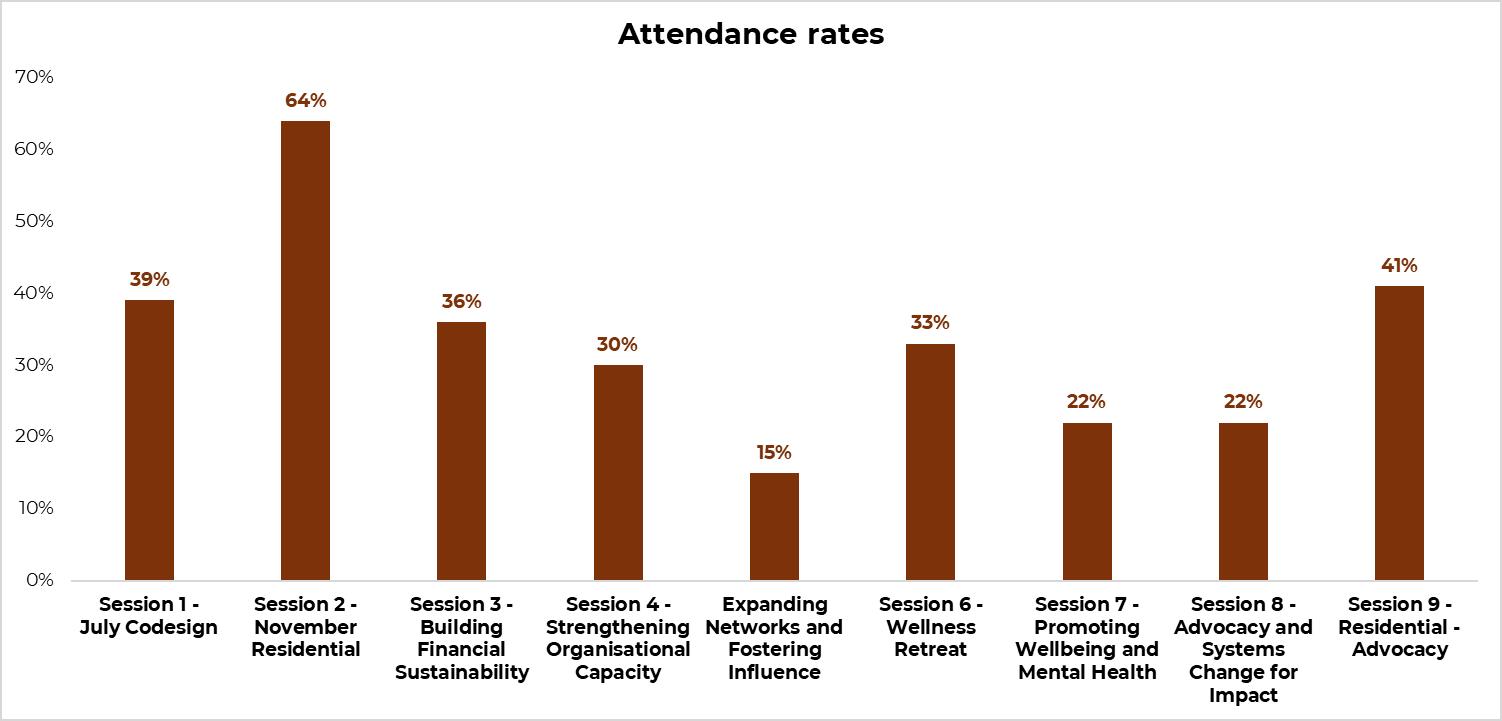
Throughout the delivery of the New Connections Network, attendance across programme sessions was a recurring challenge for both DiNN and the Esmée Fairbairn Foundation. While the programme was designed to be voluntary and flexible to accommodate the demanding schedules of grassroots leaders, fluctuating attendance rates posed significant challenges to cohort cohesion and the consistent delivery of planned learning outcomes
As illustrated in Fig 3, attendance rates varied significantly across the nine core sessions, ranging from 64% during the November Residential to 15% for the workshop on Expanding Networks and Fostering Influence.
Regular review meetings between DiNN and Esmée served as a forum for identifying and addressing the factors driving these trends Key challenges noted in the minutes included:
● Capacity Constraints of Small Organisations: From the outset, it was recognised that participants were leaders of small, often under-resourced organisations The minutes from May 2025 explicitly note that low attendance was frequently "due to low capacity within their organisations to take part" and "clashes with other priorities" This was a fundamental structural challenge inherent in supporting time-poor leaders
● The Nature of Programme Engagement: The programme's design included a £10,000 upfront payment to grantees specifically to enable participation in the peer learning network, intended to cover both time and expenses Despite this, attendance remained variable, which had a ripple effect on group dynamics and the ability to build sequentially on prior learning. Discussions in April 2025 highlighted a reflection that "if held again in the future, it may be worth considering inviting orgs to apply, so they are aware of the commitment"
● Difficulty Engaging Absent Members: Strategies to include those who could not attend sessions were a persistent agenda item In October 2024, Esmée asked, "How can we make sure those who aren't in attendance feel included?" DiNN actions included sharing session notes and recordings via the online learning platform and exploring hybrid access to residentials
● Unforeseen Personal and Organisational Circumstances: Attendance was also affected by unpredictable events, including bereavement, burnout, and staff changes within cohort organisations The minutes document instances of
Figure 3: Session Attendance Rates Across the Programme.
last-minute drop-outs due to such circumstances, which the delivery team worked to accommodate with sensitivity
DiNN proactively managed these challenges through ongoing communication with both the cohort and Esmée. Actions included one-to-one check-ins with participants, providing asynchronous access to materials, and adapting session plans to benefit both regular and intermittent attendees The significant attendance at residential events (64% and 41%) suggests that longer, immersive gatherings were highly valued and easier for participants to prioritise, underscoring the importance of this format for deep engagement
While variable attendance posed a challenge to the original delivery model, the open dialogue between DiNN and Esmée ensured responsive management. It also provided critical insights into the realities of supporting small, grassroots organisations, where programme delivery must continually navigate and adapt to the pressing operational demands leaders face
4. Programme Outcomes: From Learning to Tangible Impact.
The New Connections programme was designed as a learning journey that moves from diagnosis through capacity building to advocacy This section details the key outcomes observed across the programme’s core activities, beginning with the foundational residential retreats.
These immersive gatherings were critical in transforming the cohort from a collection of grantees into a cohesive community with a shared voice They directly shaped both individual resilience and collective influence, providing the necessary space for depth, trust, and reflection that virtual sessions could not.
4.1 Residential Outcomes
The programme’s three residentials each served a distinct purpose in the cohort’s development, with outcomes building sequentially from community formation to systemic dialogue.
The First Residential (November 2024)
The initial gathering’s primary outcome was the co-creation of a shared advocacy agenda. Participants moved from individual challenges to a collective analysis of systemic barriers, identifying critical pressure points within philanthropic practice Feedback confirms this shift, with the opportunity for connection highly rated (average 8.4/10) and cited as the most valuable element Leaders described the “Panel Discussion on Support and Allyship” as a standout moment for building the solidarity crucial to this work, noting that participants shared challenges “in a safe space without fear of judgment”
The experience left participants feeling “hopeful” and “inspired by the talented individuals,” with one reflecting that it “allowed me to reflect on my own role as a leader” While the residential successfully established a participant-led ethos, feedback highlighted a desire for clearer links between co-design activities and tangible
programme shaping, ensuring all voices were heard equally, a valuable insight for future facilitation
The Wellness Retreat (June 2025)
Responding directly to identified burnout, this retreat validated that well-being is foundational to sustainable impact Participant feedback demonstrates a profound impact: all respondents are highly likely to recommend the experience, and 80% give the maximum 10/10 rating Qualitative testimonials powerfully capture the outcome: leaders arrived “exhausted” and left “rested and full of joy,” describing the retreat as “transformative,” “safe and peaceful,” and “a valuable space to connect with people who face similar challenges” The impact moved beyond respite to practical change, with participants gaining “clarity, renewed vision” and committing to new boundaries, such as implementing work-specific phone numbers.
A key learning that emerged, linking leadership wellbeing to organisational capacity, was directly informed by this feedback A pointed suggestion called for moving “away from the language of business and corporate wellness to more radical ideas of abolition and justice,” indicating a desire to deepen the structural analysis of care within social change work
The Final Advocacy Residential (October 2025)
The culmination of the learning journey, participants presented a powerful, evidence-based critique of systemic funding barriers This ranged from the inflationary erosion of grants to the specific administrative and cultural burdens placed on Black-led organisations. Crucially, this critique was accompanied by a celebration of tangible successes enabled by the programme’s flexible funding These included expanded research, the creation of safe community spaces, and the newfound ability to innovate without fear of immediate failure.
In response, foundation leadership engaged not as evaluators but as learning partners. They acknowledged their position within a white-led institution and outlined concrete next steps, including a commitment to greater funding flexibility and simpler governance
4.2 Facilitator-Led Workshops
The six expert-led workshops were designed as a direct response to the systemic barriers prioritised during the co-design phase, namely 'Capacity & Resources', 'Fundraising & Access to Finance', and 'Health & Wellbeing' Moving beyond the programme’s descriptive roadmap, the sessions delivered tangible outcomes by equipping leaders with practical frameworks and catalysing a shift in mindset from surviving systemic constraints to strategically navigating them
The learning journey began by addressing a foundational barrier: leader sustainability The 'Promoting Wellbeing and Mental Health' session created a rare, sanctioned space for leaders to name the isolation and burnout inherent in mission-driven work A critical outcome was the collective validation that a leader's mental clarity is an operational necessity, not a personal luxury Participants were given permission to model rest and practical strategies for boundary-setting, directly confronting the cultural pressure on
leaders from Black-led organisations to work "twice as hard" This early focus on wellbeing established it as a core capacity issue, a theme that resonated throughout the programme.
With a strengthened foundation, the workshops tackled strategic growth. The 'Advocacy and Systems Change for Impact' session achieved a significant cognitive shift, moving leaders from a service-delivery mindset to a systems-influence perspective The primary outcome was the cohort's adoption of a common language and tools, such as the "Iceberg Model" and "Theory of Change", for diagnosing root causes and planning collective action. This empowered participants to reframe their work, recognising that "relationships are the currency of impact" and that sustainable change requires building coalitions around a shared vision, not merely executing projects
The most urgent barrier, financial precarity, was addressed through the 'Building Financial Sustainability' and 'Corporate Sponsorship Q&A' workshops. The key outcome was a strategic shift from a scarcity mindset to an agency mindset Leaders moved away from seeing themselves as supplicants ("Olivers with begging bowls") and began developing actionable plans to diversify income, including product sales, corporate partnerships, and membership models They developed critical lenses for assessing potential corporate allies, learning to "not just chase the money" but to seek strategic partnerships that provide skills, volunteers, and platform access, while mitigating the risks of misalignment.
To translate strategy into operational reality, the 'Strengthening Organisational Capacity' workshop demystified organisational finance and risk A major outcome was increased financial literacy, as leaders gained confidence in interpreting core financial statements, such as the Profit & Loss and Cash Flow statements Crucially, they learned that "numbers just tell a story," empowering them to add qualitative narrative to financial reports for funders. The session also prompted a shift towards process-driven models to mitigate key-person risk, a vital step for building resilient, scalable operations
Finally, the 'Expanding Networks and Fostering Influence' workshop provided the tools to leverage newfound strategic clarity externally The outcome was the translation of network theory into immediate action. Participants completed the session by identifying and contacting three new prospects, applying the principle that "your network is your net worth" They explored tools such as CRM systems to manage relationships strategically, shifting networking from an ad hoc activity to a core organisational function aimed at building influence and consortia for larger-scale work
4.3 Critical Friend Sessions
Complementing the group workshops, the programme offered bespoke Critical Friend sessions, providing leaders with confidential, one-to-one support from experienced practitioners This process began with leaders booking sessions through a dedicated platform, where they outlined their specific challenges and expectations These pre-session insights enabled the Critical Friends to prepare tailored guidance, ensuring that each conversation was focused and effective The sessions culminated in structured feedback that documented the issues discussed, the outcomes achieved, and the agreed action steps
The process and its outcomes are illustrated through the following anonymised case studies:
● Case Study A: Redefining Leadership & Creative Focus
An organisation in the arts sector sought support in restructuring leadership roles to protect and prioritise core creative output In their booking, the leader expressed a need to move away from overwhelming administrative and producer responsibilities that diverted energy from their primary talent The aim was to explore sustainable operational models that would enable founders to focus on mission-critical creative work while maintaining strong relationships with funders. Through the Critical Friend sessions, the leader developed strategies for role clarity, organisational redesign, and defining a future partnership approach with key stakeholders.
● Case Study B: Strategic Planning & Governance Development
A health-focused non-profit engaged in a series of sessions to strengthen its long-term strategic and governance framework. Initial discussions centred on finalising a three-year strategy and clarifying strategic next steps This evolved into deeper work to diversify income through corporate partnerships and to enhance PR and social media presence. The Critical Friend’s feedback highlighted a focus on “strategy overview and governance,” leading to a concrete plan to reconstitute the Board and to schedule a dedicated strategy and governance day This journey demonstrated a clear progression from advisory discussion to actionable organisational change
● Case Study C: Scaling Impact & Leader Sustainability
A wellbeing collective used its session to address scaling challenges and to improve the founder’s work-life balance Discussions focused on implementing structures and processes to reduce leadership workload, shifting from a reactive to a proactive approach to the annual operational plan, and balancing the core goals of client retention, revenue growth, and personal sustainability The Critical Friend provided tailored advice on establishing an advisory board for expertise and guidance, valuing leadership time to justify strategic investments in external support, and analysing gaps in the existing team structure The leader was offered a follow-up session to review progress and ensure support continued beyond the initial conversation
For those who engaged with them, the Critical Friend sessions provided valuable one-to-one support As one Critical Friend reflected, the sessions revealed that passionate founders are "extremely capable" at addressing community needs but often require support with the "business knowledge" needed to scale their impact, including strategy development, tool implementation, and impact measurement Feedback from participating leaders confirmed the value, with them reporting that the sessions "helped them to think big" and provided clarity on how to achieve their ambitions This personalised support offered a way to apply broader learning from the workshops to individual organisational contexts
5. Pre- and Post-Programme
Outcomes
This chapter presents an analysis of participant data gathered before the New Connections programme began and after its completion It is important to note that both the baseline survey and the final evaluation each captured responses from 13 participants, representing just under half of the overall cohort As such, the findings reflect the experiences and perspectives of those who engaged most deeply with the programme rather than a full cohort-wide assessment The analysis is structured around Esmée's core learning themes, Impact, Governance & Risk, and Network Value, to assess how the programme influenced strategic confidence, operational approaches, peer collaboration, and the funder-grantee relationship
5.1 Confidence in Achieving Organisational Goals
At the outset, leaders expressed a cautious optimism about their organisational trajectories Confidence in achieving their 2025 goals ranged from 6 to 8 out of 10 This reflected a reality where ambition was often tempered by systemic barriers. As one participant noted, the capacity for long-term thinking was constrained by more immediate pressures:
“While creativity and partnerships remain strong, systemic challenges continue to make ambition feel like a luxury rather than a viable strategy”
For those who engaged consistently, this cautious optimism had solidified into grounded confidence Post-programme ratings remained strong, with many scores at 8 or higher More telling than the numbers was the qualitative shift in some leaders' narratives, as their focus moved from surviving systemic constraints to proactively navigating them with clearer tools and peer support
“We’ve been able to utilise the expertise of consultants to work on our theory of change and figure out the way forward in a very hostile climate”
5.2 Most Significant Change: From Aspiration to Realisation
In the pre-programme survey, participants hoped the programme would deliver expanded networks, improved financial sustainability, and stronger strategic planning. These were seen as interconnected pathways to greater stability and impact
By the end, the most frequently cited change was the profound value of peer connections and a sense of collective identity. This was closely followed by tangible progress in organisational development, securing new funding, restructuring governance, and implementing more sustainable work practices The shift was from hoping for external resources to effectively leveraging them.
“The most significant change was the combination of my renewed confidence as a leader, I learned how to take care of my wellbeing better, and the programme gave me greater clarity in our organisational strategy”
5.3 The Value of Connection
The desire for a strong peer network was a leading expectation before the programme began, with many rating its anticipated value at 9 or 10 Leaders sought to break out of isolation, share best practices, and find solidarity.
“I hope to expand my networks and share best practices”
In the post-programme survey, these high expectations were met and often exceeded The network was consistently rated between 7 and 10 in value, with in-person residentials singled out as particularly transformative. The sense of validation and shared understanding emerged as a powerful antidote to the isolation of leading a small organisation
“The residentials in person have been invaluable because having the peer networks has been validating and also key to furthering my own work” “We’re all in the same boat”
5.4 Peer Learning and Collaboration
While confidence in peer learning was moderately high at the start, the lived experience proved more impactful than anticipated More than half of post-survey respondents reported forming new connections or collaborations or gaining critical insights from peers. This learning often translated into practical changes, from exploring international funding to adopting new wellbeing practices
“Looking outside of the UK for funding is something we will look into” “How an organisation’s impact can’t be measured by its size, often the smallest organisations have the most impact”
The network evolved from a hoped-for resource into an active community of practice, providing both strategic insight and emotional sustenance
5.5 Responsiveness to Feedback
Participants began the programme with clear hopes for how Esmée might evolve, greater flexibility, longer-term funding, and a deeper understanding of the realities faced by Black-led organisations
“I hope Esmée will be able to accept more organisations like the ones in New Connections… and that the systematic racism that often leads organisations like ours to set up as a CIC instead of a charity is understood”
Post-programme feedback indicates these hopes were addressed Scores for Esmée's openness and responsiveness averaged 8 out of 10, with positive comments highlighting specific, tangible actions The shift was perceived as meaningful, moving towards a more equitable and trusting relationship
“They’ve removed some funding criteria”
“Our grant manager has been very supportive, and we feel able to approach her with any concerns… We feel there will be a positive response.”
5.6 Key Messages for Future Practice
The most important messages participants wanted Esmée to retain centred on sustained, trusting investment:
“To invest in testing out different models for how we create sustainability in communities”
“Please resource this group after the programme ends, the work we can all do collectively as individual orgs really makes a difference.”
“Long-term funding is key”
These reflections underscore the foundation's desire not only to continue this model but also to deepen its commitment to long-term, flexible support rooted in genuine partnership
5.7 DiNN’s Facilitation: Meeting and Exceeding Expectations
Delivery partner DiNN’s role was to create and hold the space for this learning journey. Post-programme feedback on their facilitation was overwhelmingly positive, with ratings ranging from 8 to 10 Participants commended the team’s skill, empathy, and the thoughtful design of the programme, particularly the wellbeing retreat.
“The team have been brilliant”
“This programme exceeded my expectations… It’s genuinely taught me that I don’t need to be so hard on myself Asking for help is fine”
“Icie, Leah, Tilda and Vivify Therapy have been great facilitators”
The facilitation successfully translated the programme’s ethos of co-design and trust into a tangible and valued experience.
6. Conclusion and Recommendations
The New Connections programme has been a profound learning experiment, testing a model of philanthropic partnership built on equity, trust, and co-creation By centring the lived experience and expertise of historically underfunded organisations, the programme generated critical insights not only for participants but also for the Esmée Fairbairn Foundation itself For those who engaged consistently, the combination of flexible funding, intentional capacity-building, and authentic dialogue demonstrated the potential to build resilient leaders, strengthen ecosystems, and redistribute influence
The programme validated its core hypothesis, structural barriers in traditional funding, such as restrictive governance criteria, short-term project grants, and complex
applications, actively stifle the impact of vital, community-rooted work Conversely, the programme demonstrated that proactive invitation, flexible, unrestricted funding, and the creation of a peer-support network can unlock significant potential. For those who engaged most deeply, the journey from isolated grantees to a confident community of advocacy partners stands as the programme's most powerful outcome
Key Learnings for Equitable Grantmaking
1. Funding as Capacity-Building: The provision of flexible, core funding was not merely a financial transaction but the essential first step in a capacity-building intervention It granted leaders the "bandwidth" to engage in strategic learning, plan for the long term, and prioritise their wellbeing.
2 Wellbeing is Foundational to Impact: The overwhelming feedback on the Wellness Retreat and wellbeing sessions underscored that leader sustainability is a prerequisite for organisational sustainability. Funder support must recognise and resource the human cost of driving social change in marginalised communities
3 Trust is Built through Redistributed Power: The most transformative moments occurred when power dynamics were deliberately inverted, during the co-design sessions, the Wellness Retreat, and especially the final advocacy dialogue Authentic partnership requires funders to establish mechanisms for accountable listening and to act on feedback.
4 “Missing Middle” Organisations are High-Impact Partners: The cohort, predominantly CICs and small teams led by people of colour, demonstrated exceptional strategic alignment with Esmée’s goals and a capacity for systems change Their legal structures are often a pragmatic choice for agility and community accountability, not an indicator of lower capability or impact.
The New Connections programme has laid a robust blueprint for what equitable, learning-led philanthropy can achieve Its ultimate success will be measured by the extent to which these lessons are institutionalised, ensuring that the Foundation’s resources and partnerships consistently build the power, resilience, and influence of those best placed to create a fairer future