W
BEFORE M
E
E
“INDIVIDUALLY, WE ARE ONE DROP. TOGETHER, WE ARE AN OCEAN.” RYUNOSUKE SATORO
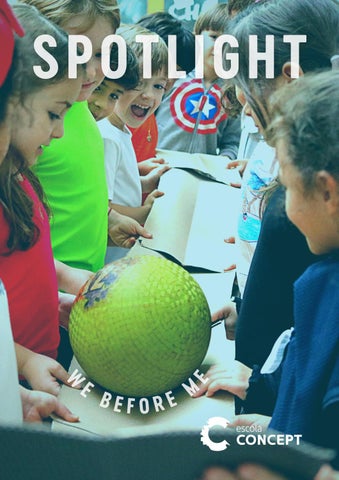
WE BEFORE ME WHAT MAKES US TRULY STRONGER?
At Concept, we strive to create opportunities where our learners can become active participants and protagonists of their own stories. Throughout this year, we have seen them cross all kinds of barriers and turn into even better versions of themselves. Some developed their writing, others their public speaking skills. We were amazed by music productions and inspiring artwork. Each learner showed their potential whether on campus or in our Virtual Village. They have been great. But something really special happens when they are great together. That’s the key element that strengthened our entire community for the last months. Our ability to collaborate. Together, our learners have designed and created their own projects, organized charity campaigns, and outdid themselves both academically and personally. In this special edition of SPOTLIGHT, we’ll discuss what makes Collaborative Learning so important for our school and the types of collaborative practices we embrace on a daily basis.
COLLABORATIVE
LEARNING
Studies and research in several countries show how collaborative learning has countless benefits for children's social and personal development. At Concept, the curriculum is based on four pillars: Collaboration, Entrepreneurship, Sustainability, and Digital Fluency. The pillars structure a proposal for an integrated development, which creates several opportunities for students to expand their learning through meaningful and challenging experiences.
Actively involving students in activities in pairs or in groups is essential to develop a sense of teamwork in problem-solving and synthesizing information. Being in a group, students express their communication skills to defend diverse points of view, listen to different opinions, and build decisionmaking skills based on the group and not the individual.
Some of the main benefits of collaborative learning are: Developing leadership skills; Working with common goals; Developing listening and understanding from different perspectives; Improving oral communication; Stimulating the sense of responsibility;
At Concept, we believe that learning is an active and constructive process in which students work together and collaboratively, not only absorbing new information and ideas but proposing creative solutions and building something new with a common goal. Collaborative learning promotes important connections to transform differences into powers, with a focus on solving problems for community living.
LEARNING SPACES THAT FOSTER COLLABORATION Collaborative learning takes place mainly during the academic journey planned by educators, while guiding activities with students. However, the school environment also promotes this development and collaborative work. In the learning spaces, for example, most tables are arranged for collective use, the walls of the rooms open up so that classes can share projects, ideas, and exchange information. At the moment, due to the distancing of classes in isolated bubbles, students have been restricted to working with their classmates.
To collaborate is to value the journey Collaborating is a practice inherent to human beings. We, Homo Sapiens, develop and evolve thanks to our ability to collaborate and live in a community. So sharing and contributing is in our essence, even though we can often forget about it in a competitive world that values winning and losing, being better and more powerful, at the expense of learning from the process and evolving with the challenges that the other brings us, as a community for a collective good. We, as human beings, are collaborative beings, and much of our anxieties brought by the modern world are rooted in purposeless competitive principles, where we care more about the final result and do not value the journey.In order for us to remember our collaborative essence, it is important that we remember some principles that help us in this process. The first is the certainty that we are not alone and we can always find connections around us. For that, we need to be open to possibilities, which is the second principle. If we are closed up, we will not be able to learn from what is around us.
ieB eR > em e n ol ebm a t o n era ew taht r
en p o g n
With different people collaborating, we find, our fourth principle, trusting and caring, because one delivers everything that can be delivered so that we can collaborate, without fear, knowing that the other will also be kind and caring with me, for the good of our encounter.
ilities -> Liv b i s s o ing to p
wit hd i
The collaborative environment creates the possibility for each of us to meet, exactly the way we are, and contribute precisely for being who we are. In this environment, then, the most important does not exist, because nothing exists without the other's existence.To collaborate is to evolve together, and we cannot fail to exercise our vital competence.
sre v e r hto is t y rof > gnirac T r dna gnitsu
As a third principle, we find diversity, because there is no real cooperation if we are not working with those that are different; together we can create something that neither I, nor you, nor the others could create alone. Something that we create when we collaborate together only exists because we are together.
TOGETHER
AND CONNECTED!
What should we expect from a school in the 21st century? We cannot ignore the great advance of technologies and how they are connected with learning methodologies. And one of the methodologies that is evident is Collaborative Learning. This is perhaps the biggest challenge that educators have faced in their learning environments.
Collaborative Learning allows not only a change in the learning process but allows the implementation of a new school culture, where everyone collaborates on behalf of the community. There is an appreciation of “doing�, students develop a posture of taking projects off the paper and executing together, with integration and collaboration.
With this issue in mind, the school has several concerns because only transmitting the content is not sufficient enough for a quality education. But when adopting the methodology of Collaborative Learning in schools, the learner needs to be able to assume a leading role in the learning process, and put aside the passive attitude, and adopt an active position.
Technology has been changing the way we consume, produce, and is even influencing the way we connect. During this pandemic year, it became clear how technology is transforming the way we learn and teach.
Allied to educational strategies, technological tools are innovative devices in the management of learning, enabling students to learn and develop social skills, such as integration, cooperation, and empathy. And nothing better than listening to our Technology Coordinator at Escola Concept SĂŁo Paulo, about her vision of the role of technology in the school environment.
How do technological tools stimulate creative processes and integration among learners? Digital tools bring new possibilities and make complex processes accessible, such as editing videos and creating websites using friendly and visual tools. Distances are reduced by interaction and collaboration tools. Creating a shared document and developing a text or presentation in partnership with a colleague who is far away is a reality already common in virtual environments.
How to involve digital technologies as learning strategies? In a context of meaningful teaching and learning, all the elements that compose it must act as facilitators of the process and should not become the center of attention. Technologies are tools that empower learners and educators, bringing new possibilities for problem-solving.
Among the School's pillars are Digital Fluency and Collaboration, how do these two pillars connect in teaching as a whole? Give an example. In a virtual school setting, technology is a facilitator of social and collaborative relationships. Keeping the school's purpose and the vision of the pillars in mind, the pedagogical proposals using technology go in the same direction, creating propositional moments of interaction and collaboration. Technology allows learners and educators to organize, create content, and share information in a dynamic and efficient way.
We know that gamification is an excellent form of learning, requiring concentration and focus from students, in addition to being an efficient form of team collaboration. At Concept, how does this happen? Gamification is the use of elements of the game in learning contexts, for example: collaboration, progression, achievements, goals, storytelling, Instant feedback... At Concept, these are elements that are always present in the project's journey, starting from real problems, that has its story and its characters, that has a problem to be solved, and in the individual journeys of the learners who receive personalized feedbacks at all times and in the interactions with the educators, they trace their learning journeys.
What are the main online platforms used in the learning process? At Concept, we prioritize the use of interactive platforms that put learners in an active position, content producers, and that offer feedback to educators and students. Today we have Google Classroom as a tool that organizes the activities of the projects, Educacross develops mathematical skills, Follet, à rvore de Livros and news to develop reading skills, among other tools that educators choose to create more interactive classes like Padlet, Nearpod, Jamboard‌
TRADITIONAL EDUCATION IS ABOUT CELEBRATING AND REWARDING INDIVIDUAL ACHIEVEMENTS. THERE IS ROOM FOR THAT, BUT INNOVATION IS A TEAM SPORT. THERE IS NO INNOVATION WITHOUT DEEP AND REGULAR COLLABORATION. TONY WAGNER
COLLABORATIVE LEARNING AT HOME Collaborative Learning has been redefining the relationship between learner and educator, as it challenges learners to become more active and responsible for their own learning journey. Escola Concept promotes collaborative practices on a daily basis, through classes and projects that aim to empower our learners with self-management skills and improve their knowledge acquisition and retention, in addition to strengthening teamwork. But how can we stimulate a similar environment at home?
Check-out the infographic for some tips on how to help your child keep the learning going.
cultivate good habits. thinking flexibly*
Finding humor, seeking joy, exploring wonderment, experiencing awe, and making connections, are habits that Concept intentionally focuses on to equip our students to be lifelong learners in a fast-paced and fast-changing world. You can nurture those same habits at home, by motivating your child with expectations and encouragement and a positive reward system.
get involved. taking responsible risks*
You are a co-participant in your child’s educational process. What project is he/she working on at the moment? What books are being discussed in class? What challenges are being faced? When you ask questions, read together, or help out in an activity, you ensure the development of a collaborative mindset at home.
spark curiosity. creating, imagining, innovating*
Learning happens all the time. A family meal, the discovery of a new hobby, an inspiring story, starting a DIY project... Outside of the classroom, there’s still a world of opportunities to motivate your child’s curiosity and sense of collaboration. The secret is to make learning fun and do it together! What new adventure can you two begin today?
build a safe space. managing impulsivity*
To keep a learning routine at home is not always easy, so it’s essential that your child always has a safe space to be encouraged to express doubts, feelings, and insecurities. Choose a little corner in your home, decorate it with positive quotes and beautiful colors, and turn it into your own safe space! There, you and your child must be free to talk and be heard without reservations.
the school is your friend. listening with understanding and empathy*
Escola Concept's program is designed to nurture the dispositions of lifelong learners who collaborate to co-create. But we want to make sure we are achieving that. As a school, we are constantly giving feedback to parents as to how our learners are evolving, and to better assess that, we need to hear from you and your experience at home.
* habit of mind in focus
SUSTAINNOVATE: #CONNECTME CAMPAIGN A social impact project that was born within Concept is growing and needs the support of the community of our three schools. A group of mothers and educators from Concept SĂŁo Paulo who have been meeting since March, have already obtained support from the Americanet company, which allowed free access to the internet for students at the municipal school CIEJA Perus, in early August. The company installed an antenna in the school yard CIEJA Perus I, promoting access for the entire region. During the pandemic, 60% of students were out of contact with the school, supporting and helping them to reestablish the connection with the school and with learning is essential for the continuity of the school year.
HOW TO ENGAJE Now is your chance to help! Donate cell phones, tablets or computers that are not used at home and allow the learning to continue in the homes of the students of CIEJA Perus I. Visit the website of the #connectme CONEXĂƒO AMIGA campaign and see how to donate: CLICK HERE!
HAVE YOU HAD THE CHANCHE TO READ OUR PUBLICATIONS ON ISSUU? CLICK HERE AND CHECK OUT THE PAGE WHERE YOU CAN FIND ALL OF THE LATEST EDITIONS!
SPOTLIGHT FOLLOW US ON SOCIAL MEDIA:
W
BEFORE M
E
E