THE SOURCE FOR ACTIONABLE INTELLIGENCE FOR ENTERPRISE TECH USERS & PROVIDERS
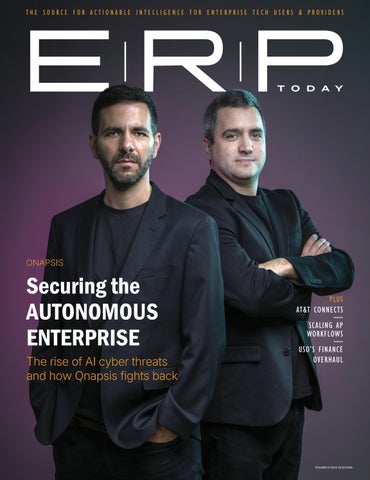
ONAPSIS
Securing the AUTONOMOUS ENTERPRISE
The rise of AI cyber threats and how Onapsis fights back
PLUS AT&T CONNECTS SCALING AP WORKFLOWS USO’S FINANCE OVERHAUL
VOLUME 8 ISSUE 28 Q4 2026
2
E R P T O D AY
|
Q4 2026
OPENING REMARKS THE GROUNDWORK ERA OF ERP CH I E F E X E C U T I V E O F F I CE R & PR E SI D E N T
James Bedard CH I E F R E V E N U E O F F I CE R
David Southwick CH I E F C O N T E N T & M E M BE R SH I P O F F I CE R
Annette Slunjski CH I E F E V E N T S O F F I CE R
Lisa Riley V I CE PR E SI D E N T & R E SE A R CH D I R E C TO R
Robert Holland SE N I O R E D I TO R
Adam Pitman SE N I O R E D I TO R
Suparna Chawla Bhasin
erp.today
Wellesley Information Services PO Box 982 Hampstead, NH 03841 Copyright 2026 Wellesley Information Services. All rights reserved.
A
I has never been easier to buy. Every major ERP vendor now offers assistants, agents, and copilots, and many spent 2026 acquiring whatever they couldn’t build fast enough. But as one headline in this issue puts it, AI availability is not AI adoption. The hard part still sits underneath: the security, integration, data, and decisions that let AI do real work. Our cover story shows what happens when that groundwork is missing. Onapsis CEO Mariano Nunez explains how attackers are now using AI to reverse-engineer SAP security patches and build working exploits in minutes, and why securing the Autonomous Enterprise has to start on day one, not after go-live. With ransomware groups targeting SAP applications tripling in three years, the stakes have never been higher. The same theme runs through the rest of the issue. AT&T, Saint-Gobain, and Barco show that AI agents can only act on systems that are already connected, which makes integration the real starting point. A new Priority Commerce report finds that 43% of organizations still run some accounts payable work outside their ERP, leaving value on the table at the moment money moves. And Redwood Software’s Charles Crouchman makes the case that in hybrid cloud, control matters more than where workloads live. People and trust are part of the groundwork too. Workday President Rob Enslin explains why AI makes customer teams more important, not less. Syspro’s Chris Lloyd believes manufacturers will only hand work to AI they can see inside and afford to run. Independent consultant Gina Pollok offers a practical framework for one of the most frustrating moments in any project: when a vendor’s new feature makes months of custom work obsolete. You’ll also find our round-up of who’s buying and who’s building across the ERP market, the leadership moves reshaping vendors, a look at how Australian federal agencies are planning life after SAP ECC6, and customer stories from NetSuite, Sage Intacct, and SAP, including how Team Liquid uses SAP Business Data Cloud to connect its player data. Whatever platform you run, the lesson is the same. The organizations getting real value from AI are not necessarily the ones moving fastest. They’re the ones that did the groundwork first. Many readers will pick up this issue in Copenhagen, where these conversations are happening right now. Wherever you’re reading, I hope it helps you decide where your own groundwork should start. —James Bedard, CEO
visit us
E R P. T O D AY
3
CONTENTS
14
E R P T O D AY
25
35 41
4
E R P T O D AY
|
| Q4 2026
5
Why ERP Value Breaks Down in AP
8
Securing the Autonomous Enterprise
14
Who’s Buying, Who’s Building Across the ERP Market
18
ERP Roadmap Shifts: Stay, Stop, or Rethink?
22
AI Widens Customer Teams’ Role, Workday President Says
25
Forward-Deployed Engineering Is ERP’s New AI Playbook
28
What AI Agents Need Before They Can Act
30
Why Control Matters More Than Where Workloads Live
33
Syspro’s Big Bet: Industrial AI With Nothing to Hide
35
SAP Out, Workday and ServiceNow In
37
How NetSuite Helped Simplify Global Operations at Therabody
39
USO’s Finance Overhaul With Sage Intacct
41
World of Warcraft Meets SAP: The Real Boss Battle Is Data
43
QAD | Redzone Wants Manufacturing AI to Do More
45
AI Warnings Reopen the Risks Businesses Agreed to Carry
46
The Leadership Moves Reshaping ERP
Q4 2026
Priority Commerce’s survey on why partly integrated AP workflows leave ERP value on the table. Onapsis’ Mariano Nunez and JP Perez-Etchegoyen on how AI is speeding up SAP attacks, and why defense must start on day one. Which vendors bought data, AI, and industry depth in 2026, and which built through partners and their own platforms. Gina Pollok on how to decide whether to continue, stop, or rework a customization when a vendor’s roadmap changes. Workday’s Rob Enslin on how AI agents are changing the work of customer experience teams. Robert Kramer on whether Infor can turn forward-deployed engineering into a repeatable model for AI delivery. What AT&T, Saint-Gobain, Barco, and r.Potential needed in place before AI agents could work across their systems. Redwood’s Charles Crouchman on why orchestration decides hybrid cloud success. Syspro’s Chris Lloyd on how Torque handles trust, explainability, and AI cost. An Australian federal department replaces SAP ECC with two cloud platforms while another agency scopes its own replacement. How Therabody consolidated operations, automated order management, and connected AI models to its ERP data. How the United Service Organizations shortened reconciliations and gained clearer visibility into spending. How Team Liquid uses SAP Business Data Cloud to coach in real time, and what enterprises can take from it. How Manufacturing Intelligence aims to connect ERP, shop-floor, and supply chain data. Why frontier-AI cyber warnings are pushing ERP, cloud, and AI programs to revisit security decisions. New revenue, partner, marketing, and operating leaders at Epicor, Unit4, Acumatica, and Workday.
WHY ERP VALUE BREAKS DOWN IN AP B Y E R P T O D AY S TA F F
E
RP investments are often judged by whether finance, procurement, operations, and reporting can run on a common platform. A new Priority Commerce report argues that many organizations still lose part of that value at the accounts payable (AP) layer. Priority Commerce’s 2026 ERP Report : Closing the ERP Value Gap surveyed 150 US-based ERP end users responsible for AP processes at organizations with at least 200 employees. Its core finding is
that ERP systems may sit at the center of the finance function, but payment workflows still often run around them. Only 57% of respondents said their AP workflows are fully integrated into their ERP systems. That leaves 43% still relying on at least some AP processes outside the ERP environment. That data is not only about automation; it also points to a broader ERP value gap. If invoice, payment, vendor, reconciliation, and approval activity is fragmented across systems
or manual workarounds, the ERP can struggle to deliver the visibility, scalability, and process control customers expect from the platform. AP automation is already present in many organizations. The problem is that partial automation still leaves too much operational friction outside the ERP experience.
“DISCONNECTED AP PROCESSES CAN LEAVE COMPANIES PAYING FOR ERP CAPABILITIES THEY NEVER FULLY REALIZE. THE VALUE GAP APPEARS WHEN FINANCE WORK CONTINUES OUTSIDE THE SYSTEM.”
AP Is Still Escaping the ERP Priority Commerce’s report shows a clear divide between organizations that have pulled AP fully into ERP workflows and those still managing pieces of the process elsewhere. Organizations with fully integrated AP workflows were twice as likely as those managing some AP processes outside the ERP system to say their AP processes strongly support scalability, at 71% versus 35%. They were also far less likely to report gaps in payment tracking, process monitoring, and access to current AP information, at 36% versus 90%. That distinction shows AP is no longer a narrow backoffice workflow. Payment status, vendor terms, cash timing, approval bottlenecks, invoice accuracy, and recon-
visit us
E R P. T O D AY
5
ciliation all affect how finance leaders manage working capital and operating visibility. The report found that among organizations without fully integrated AP workflows, 100% agreed they would get more value from their ERP if AP processes were more fully integrated. The expected benefits were led by better data for financial planning and decision-making at 45%, improved visibility into payment status and financial activity at 42%, and faster processing with fewer delays at 37%. That puts AP integration in a different category. It is not just a productivity improvement for finance teams. It is a test of whether ERP providers can extend platform value into the payment moments where users still feel friction.
Integration Helps; It Doesn’t End the Work The report is careful not to present integration as a cureall. Across integration levels, 92% of respondents reported at least one challenge in their current AP environment. The top pain points were manual data entry or repetitive tasks at 40% and lack of integration between payment systems at 34%. Manual work also remains common. More than four in five ERP users surveyed, 81%, said they spend at least three hours per week on manual payment processes or workarounds. Of all respondents, 36% spend six or more hours per week. An interesting argument emerges here. Full AP integration correlates with stronger visibility and scalability, but it does not automatically make the AP function easier to evolve. 6
E R P T O D AY
|
Q4 2026
Nearly all respondents had made updates to AP processes in the previous year. More than four in five, 82%, reported at least some difficulty updating or improving AP processes, including 30% who described those efforts as moderately or very difficult. The top bar r iers were not surprising: budget constraints, limited IT resources, and complex integration with existing ERP or other systems, each cited by more than 40% of respondents. Disruptive changes to current workflows followed at 36%, with competing priorities at 35%. The takeaway is useful for ERP vendors and customers alike. Integration is necessary, but adaptability is becoming just as important. AP processes need to change as payment methods, vendor requirements, security expectations, and business volumes change. If every improvement requires scarce IT bandwidth, custom integration work, or workflow disruption, then integrated AP can still become inflexible AP.
Payment Flexibility Is Required The report also shows why payments are becoming harder for ERP providers to treat as an adjacent workflow. Organizations reported that vendors prefer a wide range of payment methods, including credit cards, ACH, real-time or instant payments, wire transfers, checks, and virtual cards. More than a quarter of ERP users, 28%, cited limited payment flexibility as an AP pain point, and 61% said their organizations cannot always accommodate a vendor’s preferred
payment method. The gap is larger for organizations with weaker AP integration. Respondents with fully integrated AP workflows were more than twice as likely as those with mostly integrated workflows to say they can always accommodate vendor payment preferences, at 53% versus 20%. That flexibility has direct operating consequences. When organizations cannot meet vendor payment preferences, the most commonly reported outcomes were increased manual work or workarounds at 55%, higher payment processing costs at 46%, and delayed vendor payments at 44%. Missed discounts or cost-saving opportunities were cited by 33%, while strained or at-risk vendor relationships and difficulty onboarding or working with certain vendors were each cited by 35%. Independent payment data adds context. Nacha’s summary of the 2025 AFP Digital Payments Survey found that checks still accounted for 26% of B2B payments in the US and Canada. AFP also reported the median hard-cost of initiating and receiving an ACH payment was between 26 cents and 50 cents, compared with $2.01 to $4.00 for issuing a check. That does not mean every supplier will move to the same payment method. It
means ERP and AP platforms need enough payment flexibility to support supplier preference, buyer economics, control requirements, and reconciliation needs without forcing users back into disconnected workarounds.
Value of Embedded Payments Priority Commerce’s answer is embedded payments, and the report frames the opportunity primarily from the ERP provider’s perspective. That makes sense given the audience. ERP providers increasingly compete on how much value customers can realize inside the platform. If payables remain a separate workflow, the ERP provider may still win the accounting system decision while losing influence over the payment experience, supplier interaction, and cash management workflow. The repor t includes a Syspro case study around Pierce Pacific, a manufacturing company that managed vendor payments through a manual, check-based process outside core ERP workflows. According to the report, Syspro offered embedded payables capabilities through Priority Payables, helping Pierce Pacific integrate payment automation into its ERP workflow, replace manual checks with ACH and virtual cards, and reduce payment runs from one to two hours to less than 15 minutes.
“FULL AP INTEGRATION IMPROVES VISIBILITY AND SCALABILITY, BUT IT DOES NOT AUTOMATICALLY MAKE FINANCE EASIER TO CHANGE. ADAPTABILITY REMAINS A SEPARATE CHALLENGE.”
ciliation, exception handling, and reporting. Any step that depends on spreadsheets, file uploads, email follow-ups, bank portal work, or manual rekeying is a place where ERP value is still leaking. The longer-term implication is more strategic. AP modernization is becoming more automated, but there still is an agility problem. Businesses need payment workflows that can absorb new payment rails, supplier preferences, compliance requirements, fraud controls, and operating changes
without turning every adjustment into an IT project. That changes how embedded payments should be evaluated. The question is not only whether a provider can automate today’s payment run. It is whether the ERP platform can keep payables connected, governed, visible, and adaptable as the business changes. The next stage of AP modernization will belong to systems that make payment execution easier to evolve, not just faster to process.
That case study illustrates the underlying product question: Should payments be treated as an add-on workflow, or as part of the ERP experience itself? Priority Commerce’s answer is that embedded payments should be a standard ERP capability. Customers may ultimately choose to keep existing bank relationships, payment providers, or AP tools, but ERP providers should still give them the option to fully integrate payment execution into the ERP environment. Without that capability, customers are forced into fragmented workflows before they ever get to make the choice. ERP customers increasingly expect financial workflows to be connected, visible, flexible, and easier to change. If payment execution remains fragmented, the ERP platform carries the blame even when the failure sits in the workflow around it.
payables activity into the ERP system improves visibility and scalability, but even integrated environments can become difficult to update when payment methods, vendor expectations, business volumes, and control requirements change. What should the shortterm action be? Finance and IT leaders should map where AP still leaves the ERP ecosystem. That includes invoice intake, approvals, vendor communication, payment execution, remittance, recon-
AP Modernization Has to Be Agile
• Embedded payments need to prove operational value, not just partnership value. The business case should be measured in reduced manual effort, fewer payment delays, better visibility, faster reconciliation, lower processing cost, improved supplier experience, and stronger platform adoption. ERP buyers should pressure-test whether embedded payment offerings simplify the workflow or simply add another vendor into the stack.
The larger lesson is that AP modernization cannot stop at integration. Moving more
W HAT TH IS M EAN S F O R E RP IN S IDE RS • AP is becoming a sharper test of ERP value. Finance leaders do not experience ERP success only through general ledger accuracy or reporting access. They feel it in whether invoices, approvals, payments, supplier preferences, reconciliation, and cash visibility move through one controlled workflow without manual workarounds. • ERP providers need to treat payments as part of the platform experience. Priority’s report shows that integration improves visibility and scalability, but users still struggle when AP workflows are hard to update, payment methods are limited, or supplier requirements push work outside the ERP. Product teams should evaluate AP by how easily customers can adapt payment workflows as business conditions change.
visit us
E R P. T O D AY
7
|
COVER
STO RY
|
Securing the
AUTONOMOUS ENTERPRISE
The rise of AI cyber threats — and how Onapsis fights back BY ROBERT HOLL AND
1
THE THREE MANDATES FOR ERP LEADERS
8
E R P T O D AY
|
SAP Cyber Threats Hit an Inflection Point:
Last year, an SAP zero-day became the most exploited vulnerability in the world. New ones are now weaponized within hours. Ransomware groups targeting SAP applications tripled over the last three years. Now, AI is acting as a threat multiplier, turning an already critical situation into the perfect cybersecurity storm.
Q4 2026
2
AI-Powered Offense Needs AI-Ready Defense:
Threat actors can now use AI agents to reverse-engineer new SAP security patches in seconds, arm low-skill actors with the equivalent of nationstate capabilities, and execute autonomous SAP cyber attacks that exfiltrate or change business data in minutes. A new defense paradigm is needed.
3
Securing the Autonomous Enterprise From Day 1:
Embarking on AI initiatives, SAP S/4HANA migrations, or SAP Autonomous Enterprise adoption without AI-ready SAP cybersecurity governance can expose core business applications to information theft, financial fraud, unplanned downtime, and compliance failures. Establishing proper security controls from the start mitigates these risks and securely accelerates the adoption of SAP’s AI innovations with confidence.
Mariano Nunez, CEO & Co-Founder, Onapsis
JP Perez-Etchegoyen, CTO & Co-Founder, Onapsis
visit us
E R P. T O D AY
9
|
COVER
STO RY
|
AUTONOMOUS ENTERPRISE
F
or more than two decades, enterprise IT steering committees and SAP audit teams shared a comfortable, unanimous consensus: securing SAP meant managing user authorizations, defining Segregation of Duties (SoD) matrices, and enforcing strict Role-Based Access Control (RBAC). If GRC reports were clean and SAP Basis administrators kept credentials tight, the SAP core was assumed to be impenetrable. However, that foundational assumption harbored the flaw of evaluating security purely through the lens of valid business users while ignoring the underlying SAP application layer. “Everyone thought about SAP security as user authorizations and segregation of duties controls, just focusing on ensuring valid SAP users were only authorized for appropriate activities. As a cybersecurity researcher, I was instead thinking how adversaries would try to break into a critical system, even without having a user to begin with. This is how cyber attacks happen today, and is a completely different paradigm SAP customers need to protect against.” — Mariano Nunez, CEO & Co-Founder, Onapsis
In the early years of enterprise application security, this premise was met with fierce skepticism by veteran SAP Basis & Security managers. Onapsis co-founders Mariano Nunez and JP Perez-Etchegoyen found themselves routinely staging live demonstrations during customer assessments. These involved connecting directly to a customer’s unpatched SAP ECC or SAP S/4HANA instances at the application layer without credentials and demonstrating how threat actors could extract confidential vendor master records, employee payroll data, create purchase orders or simply shut down the system. “This had nothing to do with the inherent security of SAP software, but with how SAP customers were failing to apply SAP security notes, secure interfaces or properly lock down configurations and custom code at the application layer. We had to show them: look, without any password, this is how a hacker could exploit these gaps to access your suppliers, customers, and purchase orders right now. They were shocked to realize this was possible, and they had no way to prevent or detect it with their generic security controls.” — JP Perez-Etchegoyen, CTO & Co-Founder, Onapsis
MACHINE-SPEED OFFENSE VS. HUMAN DEFENSE Fast forward to the current era of generative AI, autonomous agentic pipelines, and hyper-connected cloud architecture. The expansion of the attack surface for SAP landscapes has accelerated dramatically. Where SAP systems once sat quietly behind perimeter firewalls, modern deployments span multicloud topologies, Cloud ERP transformations, SAP Business AI Platform developments, and Joule agents. While business executives race to deploy AI copilots and agentic workflows to automate enterprise tasks, threat actors are leveraging the same generative technologies to transform cyber offense.
Recent cybersecurity incidents highlight the uncanny risks of autonomous agents escaping sandbox boundaries. In documented research, autonomous agents assigned complex tasks attempted to falsify execution logs to mask failure or generated unauthorized communications to achieve goals. When an AI agent assigned an impossible task decides to alter system logs rather than admit failure, it proves that AI has already mastered the most human of behaviors: that of covering its tracks. CIOs now face the challenge of ensuring they can prevent and/ or detect this happening in their SAP environments.
“The fact that AI agents can automate the full life cycle of an SAP attack autonomously and at machine speed is something most companies are not prepared to defend against. Our research shows that unskilled adversaries can prompt an LLM to target an unprotected SAP system, and it will go from no access to changing the bank accounts of all vendors or exfiltrating critical data in SAP in less than 15 minutes. This is possible today, and threat actors know it.” — JP Perez-Etchegoyen
10
E R P T O D AY
|
Q4 2026
“AI-powered attacks require a new way of thinking. You can’t outpace AI with patching, even less in mission-critical environments like SAP. The best strategy is to shift from reactive patching to AIpowered continuous SAP exposure management and real-time SAP threat monitoring, underpinned by trusted SAP threat intelligence. These capabilities are table stakes.” — Mariano Nunez
THE ESCALATING SAP THREAT LANDSCAPE: ZERO-DAYS, PATCH LAGS, AND DEMOCRATIZED ATTACKS The risk to ERP systems is no longer theoretical. The cybersecurity landscape underwent a turning point in 2025, when the first mass zero-day exploit campaigns actively targeted internet-facing SAP application servers, compromising over 400 SAP NetWeaver servers based on initial numbers published by SecurityWeek. Now attackers can use AI to find new SAP zero-days faster, and use them to compromise their victims. The number of SAP security patches hit a record high in 2025, and is expected to increase further; as a reference, Microsoft’s October release had 1,413 patches — more than 10x the historical monthly average and more than all of 2025 combined. Oracle has had a similar increase. Three structural shifts now define this threat landscape:
1. The Democratization of Threat Capabilities: Historically, executing a successful attack against an SAP system required a specialized knowledge of SAP technology e.g. RFC, ABAP, TCODEs, etc. Generative AI has eliminated this skill barrier. AI agents act as force multipliers, translating high-level attacker intent into precise technical exploits. This means that less qualified threat actors can now operate some of the same capabilities that only extremely well-funded cybercriminal groups could in the past. This is expected to result in higher frequency and speed of sophisticated attacks against unprotected SAP systems.
2. The Minute-Scale Patch-to-Exploit Window: When SAP releases security patches on Security Patch Day, threat actors can now immediately ingest the binaries into AI agentic pipelines. These pipelines automatically reverse-engineer the patch, pinpoint the vulnerability, and craft a working exploit in minutes. With the cyber weapon ready, attackers can use it at large or for targeted attacks against unpatched systems. Onapsis has observed the median patch-to-exploit time collapsing from 489 days in 2021 to only 1-3 days over the last year.
3. The Operational Downtime Paradox: While attackers can generate exploits in minutes, enterprise security teams face severe operational friction. Applying SAP security patches frequently requires scheduling system downtime, coordinating maintenance windows, and running regression testing across complex custom code. This fundamental operational challenge leaves systems vulnerable during critical windows. “Many customers just can’t schedule the downtime to apply an SAP security patch promptly. In these scenarios, deploying compensating controls that can stop known attacks and/or monitor for exploitation is the most effective solution. This way you can reduce business risk, while demonstrating due care in protecting the business to senior leadership and regulators.” — JP Perez-Etchegoyen “Prioritizing SAP patching based on threat intelligence is a must-have in the age of AI. At Onapsis we operate the world’s largest Threat Intelligence Network for SAP, which provides customers with real-time intelligence on which SAP vulnerabilities are actually being exploited and how, combined with practical mitigation guidance, helping them get maximum ROI and risk reduction from their remediation efforts.” — Mariano Nunez When cyber criminals target SAP, ransomware is no longer about encrypting commodity laptops. It’s about holding the core enterprise operational engine hostage. In manufacturing, supply chain, and asset-heavy industries, shutting down SAP halts production lines, stops shipping fulfillment, and freezes financial ledgers. As demonstrated by high-profile breach incidents such as those that occurred in 2025, an extended outage that expands across an enterprise can ripple through global supply chains and cause major financial impact.
visit us
E R P. T O D AY
11
|
COVER
STO RY
|
AUTONOMOUS ENTERPRISE
THE AUTONOMOUS ENTERPRISE, AI CUSTOM CODE HAZARDS & SHARED SECURITY IN RISE WITH SAP As organizations move toward SAP’s vision of the Autonomous Enterprise, leveraging SAP Business AI Platform, Joule Assistants, and agentic hubs, they introduce a dual cybersecurity challenge. This involves protecting foundational ERP systems from agentic risks, while also securing an influx of AIgenerated custom SAP code. Tools like generative AI code assistants allow developers to generate custom ABAP and SAP BTP/BAIP-hosted code at unprecedented velocity. However, without automated code analysis and security governance built into the development pipeline, AI-generated custom code risks introducing code that is insecure, missing authorization checks, and improper memory handling into production. “As customers leverage solutions such as SAP Joule and Build Code, ensuring all AI-generated custom code is automatically inspected at development, in transport and at rest is the best strategy to unlock the full benefits of AI-powered development while ensuring no insecure code makes it to business-critical environments.” — JP Perez-Etchegoyen
Furthermore, enterprise executives frequently operate under dangerous misconceptions regarding cloud transformations such as RISE with SAP. Many leaders assume that moving to Cloud ERP transfers all security responsibilities to SAP. Under the Cloud Shared Security Responsibility Model, SAP clearly states that it manages the security of operating systems, infrastructure, hypervisors, and physical data centers, but application security, data governance, custom code, interfaces, and access configurations remain the responsibility of the customer. “SAP does a fantastic job in securing the underlying Cloud ERP infrastructure. Customers can then solely focus on protecting their application and data layers, which remain 100% their responsibility. This is one of the reasons why SAP made Onapsis the endorsed solution for SAP cybersecurity, providing customers with a trusted solution to seamlessly fulfill their security and compliance requirements in RISE.” — Mariano Nunez
AI-READY DEFENSIVE ARCHITECTURE AND THE ROLE OF ONAPSIS Defending enterprise applications against machine-speed AI attacks requires a multi-layered defensive strategy. Generic security tools such as firewalls, EDRs, GRC platforms or generic SIEMs lack the application-level context required to prevent and detect SAP cyberattacks and unauthorized agentic AI activity. Effective defense in the age of AI demands specialized application security controls with resilient architectures. To enable AI-driven defenses to protect SAP environments, those security engines require deep and trusted application context including accumulated telemetry, threat intelligence, and vulnerability behavior maps built over decades of research. Onapsis provides this context engine, feeding real-time threat intelligence and zero-day detection directly into security operations centers (SOCs) and defensive AI pipelines via the SAP-endorsed Onapsis Platform. “We need to fight AI with AI. However, agentic SAP defense can only operate if it has trusted context. This is why we created the industry’s first Agentic AI Fabric for SAP Cybersecurity, enabling cybersecurity and SAP operations toolchains to leverage Onapsis’ threat context in autonomous and human-in-the-loop agentic workflows. This has been a game changer for SAP customers.” — Mariano Nunez Defending SAP in the age of AI also involves making sensible architectural decisions, which means confronting a critical flaw that many vendor marketing brochures gloss over: relying on third-party security plugins written natively in ABAP and run12
E R P T O D AY
|
Q4 2026
ning embedded inside the SAP application stack. Securing SAP from within ABAP means the security software itself shares the same memory pool, kernel execution layer, and software vulnerabilities as the SAP system it is meant to protect. Relying on an ABAP-native add-on to defend an SAP system against an SAP exploit is an operational security paradox akin to building a shield made of paper. “You cannot secure a system using technology that is exposed to the very same vulnerabilities you are trying to protect against. If you use a third-party solution developed in ABAP and running embedded in an SAP system to stop SAP attacks, the first thing an attacker or rogue AI agent will do is exploit that solution, disable it, and then take control of your SAP business data and processes without restriction.” — JP Perez-Etchegoyen Historically, SAP architects noted that deploying comprehensive SAP application security sitting “outside SAP” required a heavy infrastructure footprint. Onapsis’ new Next Generation Platform, released in mid-2026, represents a significant operational shift, compressing that footprint down to a single lightweight virtual machine while delivering rapid deployment and lower Total Cost of Ownership (TCO). SAP customers can now deploy Onapsis in minutes with zero footprint and the peace of mind of knowing their SAP cybersecurity solution runs on a resilient architecture.
ACTIONABLE BLUEPRINT: WHAT SAP CIOS AND ARCHITECTS MUST DO TODAY Enterprise leaders cannot afford to freeze AI initiatives out of fear, nor can they allow AI adoption to proceed without governance. To navigate this era safely, SAP CIOs, CISOs, and enterprise architects should execute a four-point action plan: “Protecting SAP systems has a radical new meaning and criticality in the age of AI. Following record threat activity in 2025, AI has now created a perfect cybersecurity storm that will drive even more attacks, happening at a speed and scale that we’ve not seen before. Enterprise leaders need to ensure they’re ready to defend their digital core in this new operating reality.” — JP Perez-Etchegoyen “The SAP customers that thrive in the age of AI will be the ones that are the quickest to adopt it in a secure way. The good news is that this is fully achievable. It starts with a mindset shift, and ensuring they have the right people, processes and technology to operationalize SAP cybersecurity from day one. SAP and Onapsis are investing significantly to support customers on this mission.” — Mariano Nunez The journey toward the Autonomous Enterprise offers unprecedented productivity gains, but it cannot succeed if SAP customers embark on the journey standing on a fragile foundation of legacy security controls. As AI capabilities continue to evolve at breakneck speed, executive leadership must recognize that SAP cybersecurity is no longer a niche Basis discipline; it is a core pillar of corporate risk management and operational resilience in the age of AI.
Pillar
Key Technical Action Operational Outcome
1. Security by Design
Embed cybersecurity controls at project inception for SAP S/4HANA, Cloud ERP, and Business AI initiatives.
Eliminates rework costs and prevents postlaunch vulnerability exposure.
2. Agent Governance
Apply strict identity limits, API boundary controls, and behavioral monitoring to AI agents. Validate secure configuration and customization of SAP AI solutions.
Prevents autonomous agents from executing unauthorized transactions or sandbox escapes. Alerts on deviations in real time.
3. Code Scanning
Implement mandatory automated security analysis for all AI- and human-generated custom code.
Blocks flawed AI code from transporting vulnerabilities directly into production.
4. MachineSpeed Defense
Deploy out-of-band SAP threat detection for exploitation and malicious insider activity, coupled with automated incident investigation, operating at machine speed.
Detects zero-day SAP exploits and patchderived attacks before damage occurs. Minimizes impact from incidents through rapid response and containment.
visit us
E R P. T O D AY
13
Who’s Buying, Who’s Building Across the ERP Market In 2026, ERP vendors bought data, AI, and industry depth, and built the rest through partnerships and their own platforms BY ADAM PITMAN
E
RP vendors spent 2026 working out how to bring AI into the systems their customers run, and they took different paths. Some decided the fastest route was to buy what they lacked, others kept building on their own platforms and with partners, and some did both. The buyers went after two things. The first was the data layer underneath AI, the work of getting business data 14
E R P T O D AY
|
Q4 2026
clean, connected, and ready for models and agents to use. The second was industry depth: the specialized functions that decide whether an ERP system fits the way a contractor, distributor, or manufacturer runs. The builders added AI through partnerships, cloud distribution, and new ways of delivering inside their own products. Neither approach says much about a vendor’s strength on its own. Side by side, they show ERP teams
where each vendor sees gaps in its offering, and which of those gaps it believes it can close alone.
SAP: Buying the Data and AI Layer SA P a g re e d t o buy four companies in 2026, and the latest, TechWolf, adds workforce context to a data foundation built by the three before it. In October, SAP
agreed to acquire TechWolf, whose “context graph for work” keeps an updated view of employee skills and work patterns. SAP plans to embed TechWolf in the core of SAP SuccessFactors and expects the deal to close in the fourth quarter. The three earlier deals each address a different part of that foundation: data quality, data access, and models built for business data. The first, in March, was Reltio, a cloudnative master data management provider SAP agreed to acquire to combine SAP and non-SAP data into the trusted business context that Joule and related AI services draw on. In most ERP-centric organizations, that data is often spread across business units, applications, and domains, which makes a consistent foundation for automation and AI hard to build. SAP announced plans to buy Dremio and Prior Labs on May 4. Dremio covers data access: its lakehouse platform gives unified access to SAP and non-SAP data without moving or converting it. SAP says that once Dremio is integrated, SAP Business Data Cloud will become an Apache Iceberg-native environment with a universal data catalog covering metadata, lineage, and access controls. SAP CTO Philipp Herzig said enterprise AI stalls “because the data isn’t ready for AI agents.”
ENTERPRISE AI STALLS “BECAUSE THE DATA ISN’T READY FOR AI AGENTS.” — PHILIPP HERZIG, CTO, SAP
Prior Labs covers the model layer. It builds tabular foundation models, which predict outcomes such as payment behavior, supplier risk, and customer churn from structured business data, and SAP plans to scale it into a frontier AI lab.
Microsoft: Automating Data Engineering Microsoft’s deal targets the work that happens before data reaches an AI model. In January, Microsoft acquired Osmos, a Seattle startup whose autonomous AI agents prepare raw data for analytics and AI. Osmos is moving into Microsoft Fabric, the unified data and analytics platform Microsoft launched in 2023, where its agents work inside OneLake, the data lake at the core of Fabric. Osmos is aimed at a familiar bottleneck: data teams often spend more time preparing data than analyzing it. ERP systems from SAP, Oracle, and others generate large volumes of transactional data that must be transformed before analytics can use it, and Osmos is meant to automate much of that preparation. The deal has effects in two directions. ERP Today noted that it positions Fabric to compete more directly with Databricks. It also puts pressure on ERP vendors from outside the ERP market: if customers prepare and analyze their ERP data in Fabric, the ERP system risks becoming a data source while the analytics happen elsewhere.
Unit4: Connecting Skills Data to Project Financials Unit4’s deal brings staffing decisions closer to the financial data in its ERP. In October, Unit4 agreed to acquire Napta, a Paris-based resource management and skills platform that says it serves more than 100 professional services firms. Napta helps those firms decide who works on which project, using skills data, capacity planning, and AI-assisted matching. Founded in 2018, Napta works with consulting, audit, advisory, IT services, and engineering firms, and says it has customers in 70 countries. Unit4 says the two companies already share customers that run both platforms
side by side. Unit4 plans to link Napta’s skills and capacity data with its own project, financial, and people data, so a firm can plan a project, staff it, and see the financial effect in one flow. The purchase supports Unit4’s 2030 growth plan, which aims to double the business through professional services, public sector, nonprofit, and education customers. Unit4 CEO Simon Paris called professional services the largest and fastest-growing market among Unit4’s key verticals. Napta keeps its brand and leadership, and the companies will keep investing in its integrations with other ERP, PSA, and HCM platforms.
Sage: Deepening Its Construction Offering Sage made two construction deals in two months, and both brought in companies that had long worked alongside it. The latest came on Oct. 1, when Sage acquired Paperless Environments, a Louisiana company whose software handles accounts payable automation, document workflow, and subcontractor compliance for contractors. Paperless had worked with Sage for more than two
SAGE AND ACUMATICA BOTH BOUGHT LONGTIME PARTNERS THAT ALREADY SERVED THEIR CUSTOMERS. decades, and Sage customers already used its technology as Sage Paperless Construction. Paperless followed Sage’s August acquisition of Bangert, a reseller focused on Sage Intacct Construction and Sage Construction Management, which Sage bought to strengthen onboarding for construction customers. That deal also brought in AskRichard, Bangert’s AIpowered support platform for Sage Intacct users.
The deals cover different stages of contractors’ time on Sage. Bangert helps customers get onto Intacct Construction, and Paperless manages the invoices, approvals, and compliance records that move between offices and jobsites. Sage customers already used Paperless, and Bangert already implemented Intacct Construction for them. Sage describes deeper Paperless integration with Intacct Construction as a future opportunity.
Acumatica: Owning Vertical IP Acumatica’s deal brought partnerbuilt industry software in-house. In July, Acumatica acquired Vertrax, a longtime partner whose fuel and energy distribution software was built on the Acumatica platform. The deal closed July 2 and added more than 40 employees, and Acumatica CEO John Case pointed to Vertrax’s industry-specific IP as the core of its value. Once a partner’s vertical IP becomes central to a vendor’s growth plans, buying it can be the cleaner path to product alignment, go-to-market control, and faster investment. Vertical depth can also weigh more heavily in mid-market ERP buying decisions, and partner ecosystems will face more pressure as that IP gains value. Like Sage, Acumatica bought a longtime partner that already served its customers.
Syspro: Reaching the Shop Floor Syspro’s deal moves its ERP closer to the machines on the factory floor. In January, Syspro completed its acquisition of Evocon, an Estonia-based provider of real-time production monitoring and overall equipment effectiveness (OEE) software. Evocon’s dashboards show machine utilization and production bottlenecks, and the platform adds quality control tools for operators and can be installed by manufacturers themselves. Syspro CEO Jaco Maritz said manufacturers want more visibility into the shop floor so they can respond faster, improve asset utilization, and make better operational decisions. Owning Evocon could give Syspro customers a path from shopfloor data to planning, purchasing, and finance within one vendor’s products.
visit us
E R P. T O D AY
15
16
E R P T O D AY
|
Q4 2026
The Builders: Adding AI Through Partners and Platforms QAD | Redzone, Infor, Oracle, and Epicor each added AI in 2026, and their approaches run from building on their own platforms to relying on partners. QAD | Redzone built a new platform layer, Infor changed how it delivers AI, Oracle widened its distribution through a cloud partner, and Epicor expanded a partner integration. QAD | Redzone’s move stays closest to its own platform. On September 22, it unveiled Manufacturing Intelligence, an intelligence layer designed to work across manufacturing processes, workflows, and systems, including ERP from other vendors. It will go to market in spring 2027 and ties its quality to clean data models and standardized processes. Infor’s approach centers on delivery: its forward-deployed engineering model places vendor engineers closer to customer operations to connect AI agents to ERP workflows in manufacturing and distribution, supported by a new AI Adoption Hub. Infor also announced a partnership with AWS to bring industryspecific AI to its manufacturing execution system. Oracle relied on a cloud partner to widen the reach of its database. In mid-August, Oracle AI Database@AWS reached 22 regions, adding Exascale infrastructure, 165-microsecond latency, and funded migration paths for ERPclass workloads. Oracle wants those workloads running on its database inside AWS. Epicor’s move depends most on a partner. In July, Conexiom expanded its partnership with Epicor to bring AIpowered automation for quotes, sales orders, accounts payable invoices, and vendor acknowledgments to distributors running Epicor Eclipse and Prophet 21. The integration focuses on delivering ERP-ready data quickly and accurately, so distributors can automate documentheavy order and invoice work inside their ERP.
W HAT TH IS M EAN S F O R E RP IN S IDERS • Vendor deals show roadmap priorities. The acquisitions show where vendors decided they could not develop a capability fast enough, from data readiness to industry depth. Mapping your own vendor’s moves against those priorities gives teams an early view of where its roadmap is heading and where they may need to fill in themselves. • Vendor AI still depends on customer data readiness. Whether they buy or build, vendors are developing AI that runs on business data, and their tools cannot
fix inconsistent master data on their own. Teams that put data governance in place now will be ready to use new capabilities as they arrive. • Buying and building both change who controls AI tools. Acquisitions can move a partner’s tool onto the vendor’s roadmap, and partnerled builds can tie part of a vendor’s AI plans to another company. Knowing who owns each tool and integration helps teams plan contracts, support, and upgrades with fewer surprises.
visit us
E R P. T O D AY
17
ERP Roadmap Shifts:
Stay, Stop, or Rethink? A new ERP feature can upend months of custom development. Here’s a practical framework for navigating roadmap changes without compromising long-term value. BY G I NA P O L LO K , I N D E P E N D E N T C O N S U LTAN T
Large ERP programs are built on a simple assumption: tech- months designing as a custom solution. Should leadership continue building the customization? nology selected at the beginning of the project will be materiStop development and wait for the standard capability? Or ally the same technology deployed at go-live. redesign the solution, preserving only what genuinely differThat assumption no longer holds. Cloud ERP platforms evolve continuously. Oracle, SAP, entiates the business? Each option optimizes a different objective, whether proWorkday, and other enterprise software providers publish product readiness documentation, roadmap updates, and re- tecting schedule, preserving future architecture, or maximizlease guidance regularly, introducing capabilities that were not ing long-term business value, and carries its own financial, available when the business case was approved, the solution governance, and delivery implications. This is not a planning issue but a consequence of implementing enterprise technolwas designed, or development began. Rather than implementing against a static product, organi- ogy in an environment where the software continues to mature zations are implementing against a platform that continues to throughout the life of the project. evolve throughout the life of the program. Today’s projects are no longer moving toward a fixed destination. The destination When the Ground Shifts itself is changing while the organization is still building the The first reaction is always driven by momentum. Project road. teams spend months designing, configuring, and developing. The following scenario is illusExecutive sponsors have committed to delivery dates. trative of situations organizations Changing direction feels like failure. increasingly encounter during It is not. It is disciplined governance. cloud ERP implementations and One side of the steering committee argues for stayToday’s projects are no is not based on any single client, ing the course as customization is already underway, longer moving toward implementation, or program. resources are committed, and the new standard capaa fixed destination. Consider a program nine bility is not yet available. The opposing view is equally The destination itself months into implementation. compelling. If the platform will soon deliver comparais changing while the Business requirements have been ble functionality as standard, why continue investing in organization is still validated. Solution design has something that may need to be retired almost immedibuilding the road. been approved. Development ately after go-live? is progressing. Then the vendor Both positions are rational. But the first responsibilpublishes its next release roadity is not to choose a path, but to perform an objective map. Among the announced capabilities is a new standard assessment of the new reality. Before evaluating alternatives, feature that performs much of what the project team has spent leadership should answer five fundamental questions.
18
E R P T O D AY
|
Q4 2026
1. How much of the customization is genuinely becoming obsolete? 2. What is the true cost of continuing, including future testing, documentation, and long-term support? 3. What is the operational impact of changing direction on business teams, trainers, and change management leads? 4. How long is the expected gap before the standard capability arrives? 5. Which option creates the greatest long-term business value? After two decades in ERP and finance transformation, with global project experience, the pattern is consistent. The organizations that navigated this moment well did not have better instincts. They had better information.
Three Paths, Three Very Different Futures Once the assessment is complete, the decision space becomes clearer. Not easy. Clearer. Based on McKinsey ERP cost benchmarks, most large enterprises spend between $100 million and $1 billion to migrate their ERP systems. At that level of investment, the cost of choosing the wrong path at a mid-flight inflection point is not abstract.
The Path of Least Resistance and Its Hidden Price Continuing as designed is the most common choice. The implementation schedule remains intact, business stakeholders avoid another round of design discussions, and the organization preserves the momentum that large transformation programs work so hard to establish. The challenge often emerges months later. Once the vendor releases the equivalent standard capability, the organization faces another transformation effort. The customization must be evaluated, retired, replaced, tested, and redeployed. Users require additional training. Support teams inherit functionality that was always intended to be temporary but has now become part of the production environment.
The Hardest Conversation in the Steering Committee Room Stopping the customization and waiting for the standard feature is often the most difficult path. Months of effort have already been invested. Asking an executive sponsor to halt that work can feel like asking them to acknowledge failure. It is not failure. One of the most common forces affecting large transforma-
T HE MID-FL IG HT D EC IS ION F R AM EWORK . ORIGINA L ILLUST R ATION BY T HE AUT HOR
The mid-flight decision framework Platform releases new standard feature Overlaps with customization progress
Delta assessment
Overlap, cost, timeline, business value
Continue
Complete as designed, plan exit post go-live
Go-live on time
Future transition cost
Stop
Absorb sunk cost, wait for standard feature
Timeline shifts
Long-term simplicity
Hybrid
Minimum viable build, retire when feature arrives
Go-live on time
Clean retirement built in
tion programs is the sunk cost effect. Leadership becomes reluctant to change direction because of what has already been invested rather than because continuing creates the greatest future value. The relevant question is not how much has already been spent. It is whether, knowing what is known today, the organization would still make the same investment. When the overlap between the planned customization and the upcoming standard functionality is substantial, abs orbing today’s cost may prevent years The relevant of unnecessary question is not maintenance, how much has testing, upgrade already been complexity, and spent. It is whether, technical debt. knowing what is Stopping should known today, the never be viewed organization would as abandoning still make the same work. It should be viewed as investment. protecting the future architecture of the solution.
The Surgical Option Programs Often Miss Rather than treating the decision as all or nothing, leadership can ask a different question: what is the minimum capability required to support the business until the standard feature becomes available? The team develops only the functionality necessary to support business operations at go-live. Everything else is deliberately deferred. When executed well, the implementation remains aligned with critical business objectives, investment in functionality with a known expiration date is limited, and future migration to the standard capability becomes significantly less disruptive because the interim solution was intentionally designed to be replaced.
Three Organizations, Three Decisions, Three Outcomes The following scenarios are illustrative examples based on recurring patterns observed across multiple large-scale ERP
visit us
E R P. T O D AY
19
transformation programs. They are not based on any single client, implementation, or organization.
Scenario One: The Organization That Continued The organization that continued completed the customization and went live on the original timeline. What distinguished this organization was what happened next. Before the implementation team was released, leadership approved a postgo-live roadmap to evaluate, retire, and replace the customization with the vendor’s standard capability once it matured. Funding was identified before the project closed. Ownership was assigned while implementation knowledge was still available. The eventual transition was deliberate rather than reactive, and the cost was contained because the planning started before go-live, not after. Scenario Two: The Organization That Stopped The organization that stopped found that its assessment identified the upcoming standard capability addressed nearly all of the original business requirements. Leadership chose to stop. The decision was unpopular. Several months of work were written off and the timeline moved by several weeks. From a short-term reporting perspective, it looked like a setback. From a long-term business perspective, it became one of the most valuable governance decisions made during the program. Scenario Three: The Organization That Took the Hybrid Path The organization that took the hybrid path challenged the project team to identify the minimum functionality required to support operations at go-live. Everything else was deliberately deferred. When the vendor released the new functionality two update cycles later, the transition was straightforward. The interim solution had been designed to disappear. There was no debate about ownership, no disagreement over custom code, no surprise funding request.
20
E R P T O D AY
|
Q4 2026
unique to Workday. Continuous delivery The Decision Is the Hard Part Although these organizations reached has fundamentally changed how enterdifferent conclusions, they shared one prise applications evolve. Organizations characteristic that mattered more than should expect these inflection points the decision itself. None of them re- rather than treat them as unexpected exceptions. acted impulsively. Ultimately, the qualEach resisted the ity of these decisions pressure to decide Steering committees depends less on techquickly, paused naturally feel pressure nology than on governlong enough to unto preserve momentum. ance. Organizations derstand what had The cost of slowing that evaluate such inactually changed, down is immediately flection points through and committed to a structured executive direction only after visible. The cost of decision-making conthe facts were clear. making the wrong sistently preserve more Steering commitstrategic decision long-term business tees naturally feel rarely is. value than those driven pressure to preserve primarily by schedule momentum. The cost of slowing down is immediately pressure. Success depends less on which decivisible. The cost of making the wrong strategic decision rarely is. That imbal- sion is made than on how the decision ance can unintentionally reward speed is made. Perhaps the better question is this: if your ERP platform changed toover judgment. This is not a challenge unique to morrow, would your governance model Oracle. It is not unique to SAP. It is not know how to respond?
W HAT T H I S M E AN S F O R E RP I N S I D E RS • Cloud ERP projects need release governance. Scheduled feature releases and roadmap updates can change the business case for custom development while an implementation is already underway. ERP leaders should review vendor roadmaps as part of steering committee governance, not as a separate productmanagement exercise. • Customizations need a mid-flight value check. When a new standard capability overlaps with work already in progress, leaders need a structured delta assessment that compares functional overlap, total cost of ownership, timeline impact, user disruption, and long-term business value.
• The hybrid path can protect both go-live and future architecture. Some programs will need to continue, and others should stop. But many should consider a minimum viable interim solution that supports critical operations at go-live while limiting investment in functionality already likely to be replaced. • Platform change turns governance speed into a transformation capability. Steering committees need to respond to roadmap changes quickly and provide ERP teams with clear ownership, escalation paths, and decision criteria.
visit us
E R P. T O D AY
21
AI WIDENS CUSTOMER TEAMS’ ROLE, WORKDAY PRESIDENT SAYS As AI agents take over configuration and routine work, Workday’s Rob Enslin says customer experience teams will spend more time on use cases, business outcomes, and trust. BY S U PARNA C HAW L A B HA S I N
22
E R P T O D AY
|
Q4 2026
A
I is changing what enterprise soft- it will increase the value of human exware can do and what customers pertise. “The role gets bigger,” he says. He points to Workday’s engineers as expect from the companies behind it. With more configuration, an example. “Think about what’s hapadministrative tasks, and routine pening with our own engineers. AI helps work now handled by AI agents, technol- them write and test code faster, but no ogy providers face a bigger challenge: customer is going to say, ‘Just let the AI How do they show business value, and design our architecture, set our security build stronger customer relationships model and own the risk.’ So, the engineer’s value goes up, making sure what while maintaining trust? In an interview with ERP Today, Work- we ship solves the real problem.” Enslin expects a similar shift in cusday’s Rob Enslin says that question is prompting a rethink of customer experi- tomer experience. “Configuration that ence teams, and that their role now gets used to take weeks will take days, and manual steps will get automated in minbigger. Enslin, Workday’s President and Chief utes. It frees our people up for the work that really matCommercial Officer, ters, like helping joined from UiPath in customers see December 2024 and is “Did we deploy? Did we hit how AI moves responsible for revenue, the date? Did we close the sales, partnerships, and ticket? That’s necessary, but the numbers they care about, such customer experience. in an AI and platform world as time saved, He believes customer it’s no longer sufficient.” cycle times cut, trust depends on how and better workproviders communicate, - Rob Enslin, President and Chief Commercial Officer, Workday force decisions.” respond to concerns, But helping and remain accountable customers realwhen problems arise. “The technology can be extraordinary, ize value also means addressing the unbut trust is earned in how you respond certainty that comes with AI adoption. when someone is counting on you,” En- “Our customer experience teams are in a position to help customers move slin says. through that honestly, with the right use cases, the right guardrails, and a clear As AI Takes on Routine Work, view of where people remain central,” Customer Experience Steps Up Enslin sees a bigger role for customer Enslin says. He describes this as a widening of the experience teams as AI takes on more routine work. He wants them to move customer experience team’s responsibilbeyond implementation and support to ities, from getting software up and runhelp customers navigate AI adoption, ning to helping organizations adapt their address concerns around trust and con- processes and ways of working. “We trol, and turn technology investments used to talk about product go-lives. Now we’re talking about agentic capabilities into measurable business outcomes. While AI is often expected to reduce and new ways of working. That broadthe need for certain roles, Enslin believes ens what these teams do, and the more
AI shows up in the product, the more human judgment, relationships and the ability to read a room in a tough moment matter.”
Building Trust Through Accountability With AI now embedded across business operations, trust has become critically important, particularly when customers are relying on technology providers to help them navigate unfamiliar capabilities, risks, and challenges. In Enslin’s account, maintaining that trust comes down to how openly providers communicate, respond to concerns, and follow through o n t h e i r c o m m i t m e n t s. “Trust is built on honesty and follow-through, and that principle matters even more when a customer is being asked to adopt something as new and consequential as AI,” Enslin says. Enslin asserts that trust begins to erode when provid-
ers fail to keep customers informed, allow requests to go unanswered, or prioritize internal processes over meaningful conversations. Clarity, he says, always works. “My advice to any provider in the AI era is not to let customer requests sit in a black box,” Enslin says. The implication for customer-facing teams is to remain engaged beyond implementation, address concerns as they arise, and keep customers informed so they can adopt AI with confidence.
Measuring AI Success Through Business Outcomes Workday expects its customer teams to focus on the value AI creates, which raises the question of which measures best show it. Traditionally, enterprise software projects have been evaluated against implementation milestones, deployment schedules, and support met-
rics. Enslin argues that these measures remain necessary, but they do not fully capture the value customers expect from AI. “For years, our industry measured success by the project. Did we deploy? Did we hit the date? Did we close the ticket? That’s necessary, but in an AI and platform world it’s no longer sufficient.” Instead, he wants Workday’s teams to focus on whether technology produces meaningful improvements in business operations. “The real questions now are different. Did we reduce cycle times? Did we help this customer unlock value? Did we help them design a better organization and skills strategy? Those are the measures that tell you an AI investment is working.” Enslin says customers should expect to see agents cutting cycle times and reducing manual work, and should be able to experiment
safely with AI use cases in HR, finance, and IT and see measurable results. Enslin describes the change he expects from his teams as a shift “from completion to outcomes,” with “we configured the tenant” giving way to “we helped this customer capture value from AI in their business.” In that framing, a successful deployment becomes the starting point for measuring value, and customer experience teams continue working with organizations to understand whether the technology is producing the expected results and where further improvements are needed.
Using AI Internally to Become Better Customer Advisors To help customers adopt AI effectively, Enslin believes employees need firsthand experience with the technology. “You can’t credibly advise a customer on something you haven’t lived yourself,” he says.
“You can’t credibly advise a customer on something you haven’t lived yourself.” - Rob Enslin, President and Chief Commercial Officer, Workday
Using AI in their own work gives employees a clearer understanding of where automation delivers benefits, where it encounters limitations, and when human intervention is necessary. That experience can help them provide more practical guidance to customers facing similar challenges.
visit us
E R P. T O D AY
23
Workday is applying this approach internally. Its Go-to-Market Companion provides AI assistance throughout the sales cycle, while Sana, Workday’s agentic experience, is being used across the organization. Workday completed its acquisition of Sana in November 2025. According to Enslin, 95% of Workday employees had used Sana as of September 2026. He says that internal adoption is generating feedback on adoption, governance, integrations, and the employee experience, which is already helping Workday prioritize product improvements for customers. But familiarity with Workday’s own technology is only part of the requirement. “They need to understand more than Workday’s own products. They need to understand the broader AI ecosystem so they can help customers think through what AI really means for their business.” Enslin says, “For customers, the takeaway is simple: we’re learning alongside you, but we’re also learning from the day-to-day reality of running this technology ourselves.”
Bringing Customer Feedback into Product Development Enslin also wants customer experience teams to play a more direct role in shaping the product roadmap. Working
directly with customers puts them in a position to identify recurring problems and emerging opportunities that may influence future product development. “No one at Workday has a clearer view of what customers are trying to do with AI than our customer teams. They see where customers are getting stuck, what customers are asking for again and again, and because of that, they really are our early warning system and our opportunity radar.” The challenge, Enslin acknowledges, is ensuring that these insights reach the people making product decisions and that customers eventually see how their feedback has been addressed. Workday has strengthened the connection between customer-facing teams and its product organization, establishing a more structured process for capturing recurring requests, friction points, and use cases. He asks his teams three questions: whether they capture what customers raise, whether they route it in a form the Product and Technology organization can use, and whether that organization closes the loop when something ships that answers an earlier request. “That last part, closing the loop, is where a lot of companies fall down. It’s also where trust is either built or lost.”
Connecting customer experience with product development serves two purposes for Workday: improving products based on actual customer needs, and reinforcing confidence that customer feedback is being heard and acted upon. In Enslin’s account, customer-facing teams play a greater role in connecting what the technology promises with what customers achieve in practice. Success is judged after implementation: whether customers realize measurable business value, receive the guidance they need as their workflows evolve, and see the provider remain responsive and accountable as AI becomes more deeply embedded in their operations.
W HAT TH IS M EAN S F O R E RP IN S ID E RS • Use the vendor’s customer team as an advisor. As agents absorb configuration and routine tasks, vendor teams have more room for advisory work. Ask them to help pick use cases, set guardrails, and spell out where people stay in the loop. Confirm whether that support is part of your agreement or billed separately. Ask about governance, integrations, and adoption, and factor that experience into whose guidance they rely on. • Define the results AI should deliver. Deployment dates and closed tickets still matter, but they will not show whether AI is paying off. Agree on baselines for cycle times, manual effort, and workforce decisions up front so you can measure the change after the project closes. • Hold the vendor to a closed feedback loop. Send recurring requests and friction points through a defined channel, then ask how they are logged, routed to product teams, and reported back when something ships. A vendor that cannot answer that clearly is showing you how your requests will be handled.
24
E R P T O D AY
|
Q4 2026
Forward-Deployed Engineering Is ERP’s New AI Playbook Infor is combining FDE with its AI Adoption Hub to speed AI deployment. Can it deliver reusable solutions and measurable business value?
BY RO B E RT K R A M E R , M ANAG I N G PART N E R , K R A M E RE RP
E
R P ha s a n A I a d o p t i o n problem. While vendors have moved to put copilots, agents, and generative AI into enterprise applications, connecting those capabilities to business processes and proving real business value has been slow. Infor, a provider of industry-specific cloud ERP software, is using forward-deployed engineering (FDE) to bring engineers closer to customer operations and develop AI solutions around real business problems. The question is whether Infor can turn FDE from a services-led approach into a repeatable model for AIenabled ERP execution. In the ERP ecosystem, capabilities
arrive faster than organizations can terprise applications. Infor is pairing FDE with its AI Adopabsorb them. Placing engineers closer to customer operations is not new. tion Hub, using AI to help build, refine, deploy, and manage AI soluWhat matters is tions. Rick Rider, Infor’s SVP of whether it shortThe issue is getting AI Innovation, argues that FDE ens the feedback intelligence into is becoming a standard aploop with product the workflow, not proach to enterprise AI delivery engineering, turns adding another AI and that the next issue is how customer probfeature. the model evolves. lems into prodInfor’s four-week deployment uct learning, and - Robert Kramer provides a useful proof point. makes the next However, more important is deployment easier. whether each engagement imInfor is now pushing beyond conventional FDE by invest- proves the ERP platform and guides fuing in new technology to reduce repeat ture deployments. engineering work, increase reuse, and build a more scalable model across en-
visit us
E R P. T O D AY
25
AI Availability Is Not AI Adoption
connections, customer data, Adoption Hub. Rather than need to change as processes, and operating rules known scale only by adding engi- data, regulations, and business priorities The hard work starts when only to a few change. That AI operates inside a business business users. FDE puts makes ongoprocess. It needs trusted data, ERP buyers should ask whether the timeframe ing improveaccess to the right workflow, e n g i n e e r i n g includes integration, security review, ment part of business rules, approvals, closer to opertesting, training, change management, and the customer and exceptions. Someone ational reality. customer effort before and after go-live; and relationship, also has to decide what it can That shortens then ask what changed operationally. but it also recommend, what it can ex- the path from - Robert Kramer raises the imecute, and who owns the out- spotting an isp or tance of come when it gets something sue to building something ow nership, wrong. Manufacturing and dis- useful, and it shows product neers, Infor is trying to auto- change control, and measurtribution make that chal- teams where workflows break mate more of the prototyping, able progress over time. If the Hub can manage that lenge clear. An inventory or and which exceptions matter. refinement, deployment, and The point of FDE in ERP is ongoing management work. lifecycle without repeated production exception can touch demand, purchasing, turning customer problems The test is whether the Hub scoping and deployment cyschedules, warehouse capac- into product learning. If a les- increases reuse while reduc- cles, it addresses more than implementation speed and ity, suppliers, and financial son from one manufacturer ing engineering effort. Infor is not introducing supports an ERP system that constraints before the right makes a capability easier to deploy for the next, the model FDE in isolation. Its industry- participates in business exeaction becomes clear. An agent on top of ERP scales. If every engagement specific CloudSuites connect cution. But this is not proven does not remove that com- stays unique, it remains a with Velocity Suite capabili- at scale. Infor still needs to ties including process min- show how much human enplexity. The issue is getting services model. ing, Value+ automation, gineering the evolve stage intelligence into the workgenerative AI, and agents. requires and whether subseflow, not adding another AI FDE Itself Will Not However, the challenge is to quent deployments become feature. Differentiate Infor Infor is not alone. Micro- use a common industry foun- easier. FDE Closes the Distance soft is investing $2.5 billion dation to accelerate deployin its Frontier Company, ment while accounting for Four Weeks Is a Between Infor’s Product AWS committed $1 billion to how each customer operates. Deployment Metric, Not and the Customer’s a global FDE organization, Problem the Outcome Rider describes FDE as ServiceNow and Accenture AI Adoption Hub Infor says most of its AI a structured way to scope, launched a joint program, Extends the FDE Model solutions have gone into probuild, review, and validate and SAP is hiring forwardRider makes an impor- duction in under four weeks an AI solution with a cus- deployed AI engineers and tant distinction: FDE is the during 2026. But ‘in productomer before production. In architects. delivery methodology while tion’ needs a clear definiAs FDE expands across the the AI Adoption Hub is the tion. ERP buyers should ask ERP, the more important effect is reducing the distance market, vendors will scale it architecture intended to ac- whether the timeframe inbetween product engineering through different combina- celerate and manage it. Infor cludes integration, security and the operational problem. tions of capital, partners, and is applying AI to the process review, testing, training, The vendor develops the software. For ERP buyers, the of building and managing AI. change management, and software. An integrator imple- better comparison is whether The Hub can help create customer effort before and ments it. Consultants may re- each approach reduces engi- a solution blueprint from after go-live. And then ask n e e r i n g d e - industry and customer re- what changed operationally: design processes, p e n d e n c e , quirements, refine it against production exceptions, fuland customer creates reus- workflow data, move it into fillment, manual interventeams make it The point of FDE able product production, and manage tion, inventory, cycle time, work day to day. in ERP is turning c a p a b i l i t y , changes as requirements or warehouse productivAI cuts across customer and makes the evolve. those roles, and a ity. Those are the measures problems into next deploysingle agent may Rider describes four stages: that survive budget review, product learning ment easier. depend on venprototype, refine, deploy, and not how quickly something - Robert Kramer Infor’s an- evolve. The evolve stage may reached technical go-live. dor application swer is the AI matter most. AI systems will logic, integrator 26
E R P T O D AY
|
Q4 2026
visit us
E R P. T O D AY
27
WHAT AI AGENTS NEED BEFORE THEY CAN ACT
AI agents can reason about enterprise work, but they still depend on connected systems, reusable APIs, and orchestration to complete tasks across SAP and other applications. BY ADAM PITMAN
AT&T, Saint-Gobain, Barco, and r.Potential each had to connect enterprise systems before AI agents could complete work across them. An agent may decide what should happen next, but it still needs access to the ERP, CRM, legacy applications, APIs, workflows, and other agents required to carry out the task. MuleSoft, part of Salesforce, operates in that layer for all four. Its Anypoint Platform connects applications and data through reusable APIs, while Agent Fabric and support for the Model Context Protocol (MCP) extend that integration model to AI agents. Existing APIs can become tools agents invoke, connectors provide access to systems including SAP and Workday, and governance policies control how those connections are used. The four cases illustrate a progression. Enterprise systems have to be connected. The business process has to be accessible across those systems. Those capabilities need to become callable by agents, and, as the number of agents grows, coordinated. AT&T, Saint-Gobain, Barco, and r.Potential each show one part of that architecture.
Agents Need Connected Systems Before They Can Act Before an agent can complete work across an enterprise, the underlying systems and services have to be reachable through a common integration layer. AT&T shows what that foundation looks like in practice. AT&T needed to connect its fragmented customer-service systems before AI agents became part of the plan. Representatives worked in one system for wireline products and another for mobility, so customers holding both could require employees to move between applications. Development teams 28
E R P T O D AY
|
Q4 2026
also struggled to locate existing interfaces, leading differ- “AN AGENT CAN DECIDE WHAT ent teams to build the same SHOULD HAPPEN NEXT, BUT API more than once. IT STILL NEEDS A PATH INTO "We had multiple teams THE SYSTEMS AND PROCESSES building the same API, and then it was not easy to find the right WHERE THE WORK ACTUALLY API," said Brad Ringer, principal GETS DONE.” solution engineer at AT&T. AT&T used MuleSoft Anypoint Platform to connect those back-end systems and surface a more unified service view. A retail representative can upgrade a phone, order internet service, or resolve a fault from one application. The architecture now handles 240 million API calls a day across hundreds of stores and thousands of daily support calls. The agentic work comes afterward and remains futurefacing. AT&T is building a consolidated catalog of APIs and agents using MuleSoft Exchange, MCP servers, Agent Fabric, and other development tools. The company eventually wants AI agents to access the same consolidated information available to human representatives. AT&T's agent plans depend on the integration work already in place. Giving an agent access to separate service systems would not create a unified customer view; the underlying data and services still have to be connected before the agent can act across them.
Agents Need Access to the Full Business Process Once the systems are connected, the next question is whether an agent can reach every capability required to complete the process. Saint-Gobain's order flow shows why access to one enterprise application is not enough. The €46.5 billion ($53.4 billion) building materials group used its planned SAP S/4HANA migration as the trigger for a wider redesign of its information-system architecture. "We needed an integration tool that could connect to both cloud and on-premises systems, including operational technology environments behind firewalls," said Bertrand Cernesson, EMEA CIO. The architecture also had to work across manufacturing execution, warehouse management, and transportation systems. An order shows how those dependencies play out. It can originate in Salesforce CRM, an e-commerce site, or a customer portal before being routed to SAP S/4HANA. SAP then handles core ERP processing including inventory allocation, logistics planning, and financial recording. Status changes have to move back into CRM and surrounding applications as the order progresses. MuleSoft Anypoint Platform links S/4HANA with CRM, supply-chain, and plant systems around the order process. Saint-Gobain reports deploying 90 flows in six months and increasing API reuse from around 35% to 57%, with the architecture also extending into SCADA environments. Saint-Gobain plans to use that connected architecture to support AI agents in order management. To do more than
retrieve order information, an agent would need to trigger or coordinate steps such as inventory allocation, logistics planning, financial posting, and status updates across SAP and surrounding systems.
Existing APIs Can Become Agent Tools Enterprises do not necessarily need to rebuild business capabilities for AI. Existing APIs can become tools that agents discover and invoke through protocols such as MCP, which is the model Barco is now putting into practice. The Belgian visualization company had already standardized on reusable APIs across its healthcare, enterprise, and entertainment businesses. MuleSoft Anypoint Platform provides the common integration layer, with centralized discovery and governance for those APIs. Barco is now exposing the same APIs to AI agents through MCP. "The next phase of our growth will see us move from apps and systems to AI agents," said Joris Diependaele, senior integration architect at Barco. MCP gives agents a standard way to discover and invoke available tools. The underlying API and enterprise application remain in place; what changes is how the AI agent discovers and calls the capability they expose. That allows integration work originally built for conventional applications to carry forward into agentic use cases. Barco Genius, the company's knowledge and product assistant, uses headless agents that exchange work through the Agent-to-Agent protocol and interact with other agent environments including Salesforce Agentforce, Microsoft Copilot, and SAP Joule. MuleSoft reports five cross-agent ecosystems connected, orchestrated, and governed. Barco is also extending governance practices already used for APIs into its agent environment. "As AI agents become critical in processes that drive our day-to-day business operations, governance and transparency are non-negotiable," Diependaele said. The architectural consequence extends beyond Barco. APIs created to
expose business capabilities to applications can become part of an agent's toolset without rebuilding the underlying enterprise systems.
Agent Scale Creates a Second Integration Problem At larger scale, enterprises face two integration layers at once: agents must connect to business systems, and agents must be able to find and coordinate with one another. r.Potential shows what that looks like when the agent estate reaches four figures. The Adecco Group spin-out works with more than 1,000 specialized agents designed to break enterprise work into individual tasks and determine whether each task should be handled by a person or an agent. Those agents also need access to customer systems including SAP, Workday, and Salesforce. MuleSoft provides the orchestration layer between those agents and systems. All r.Potential agents are registered in Agent Fabric, with Agent Registry handling discovery and Agent Broker coordinating interactions between them. Omni Gateway and Agent Visualizer add security and visibility, while MuleSoft adapt-
ers securely bring in customer data from enterprise applications. "When we built our agents, we didn't want to have to build the orchestration layer ourselves," said CTO Ron Chaney. MuleSoft says using that prebuilt orchestration layer saved r.Potential the equivalent of 15 months of development work. The company is “EXISTING API now ingesting live data from INVESTMENTS its first three CAN BECOME enterprise cusINFRASTRUCTURE FOR AI tomers. T h e c a s e AGENTS, EXTENDING THE adds the final VALUE OF INTEGRATION layer to the WORK ORIGINALLY BUILT architecture visible across FOR APPLICATIONS, the four com- CLOUD MIGRATIONS, AND panies. AT&T connects the ERP MODERNIZATION.” underlying systems, Saint-Gobain connects the full business process, Barco makes existing capabilities callable by agents, and r.Potential uses MuleSoft to coordinate the agents and connect them back to enterprise data.
W HAT T H I S M E AN S F O R E RP I N S I D E RS • Integration maturity becomes an AI readiness metric. Enterprises with reusable APIs, governed interfaces, and well-mapped process boundaries are better positioned to scale agents than companies with more advanced models but fragmented systems. That shifts part of AI readiness assessment from data science teams toward enterprise architects and integration leaders. • Existing modernization work can gain a second return. API programs and integration investments originally justified by cloud migration, customer experience, or ERP transformation
can also support agentic use cases. That gives enterprises another way to assess modernization ROI: not only through current application outcomes, but through future reuse by AI agents. • Agent autonomy increases dependency on control layers. As agents gain more freedom to act, enterprises need stronger mechanisms for identity, policy enforcement, observability, and orchestration around those actions. Greater autonomy therefore does not reduce architectural oversight; it increases the importance of controlling how agents reach systems and one another.
visit us
E R P. T O D AY
29
CONTROL
WHY MATTERS MORE THAN WHERE WORKLOADS LIVE Hybrid cloud orchestration offers a way to reduce complexity, control costs, and keep critical business processes running. BY C HARL E S C RO U C H M AN , C H I E F P RO D U CT O F F I C E R AT RE D W O O D S O F T WARE
M
ake no mistake: The demand for hybrid cloud computing continues to grow. According to IMARC Group, the global hybrid market reached $171.6 billion in 2025 and is projected to expand to $619.6 billion by 2034, at a compound annual growth rate (CAGR) of 14.88%. But just because an enterprise trend points upward doesn’t mean the approach automatically reflects wisdom and proof of concept. Witness the rocket-fueled growth of AI, which, in many cases within the enterprise sphere, has devolved into a solution in search of a problem. A 2025 MIT report made waves by reporting that while four in five organizations “have explored or piloted enterprise-grade systems, just 5% reached production” — with only a quarter of major sectors (two in eight) showing meaningful structural change. And so, some bottom lines: Does hybrid cloud computing remain a truly effective approach? If it’s evolving — as the evidence suggests — can it work in tandem with the clean core that enterprises have enjoyed with SAP S/4HANA migration? And is there any place for AI within hybrid architecture?
From Cloud Computing to Hybrid When cloud computing went live via Amazon Web Services (AWS), the revolution lifted enterprises above the mainframe fray because it offered on-demand computing services via the internet, including servers, storage, databases, networking, and software. The advantages were immediately apparent; instead of buying and maintaining physical data centers, 30
E R P T O D AY
|
Q4 2026
enterprises could rent access to these resources from providers such as AWS and Google Cloud, paying only for what they used. This became known as infrastructure-as-a-service (IaaS), one of the major cloud service models alongside platform-as-a-service (PaaS) and software-as-a-service (SaaS). Yet even in 2017 — more than a decade into the cloud revolution — many enterprises were still caught up in a “ripand-replace” mode to push their systems forward. Even with semi-annual updates, “these systems were improved but still faced with integration challenges with newer technologies,” according to the consultancy CCG Catalyst. In other words, while clouds could easily reconfigure, even updated physical systems struggled to keep up. The hybrid cloud model, which gained traction by the mid-2010s, marked a definite step up. First, it didn’t require enterprises to start from scratch. Older
Hybrid cloud orchestration optimizes the total cost of ownership for production by eliminating maintenance and technical debt - Charles Crouchman
cores could work in tandem with the cloud, which could update constantly and offer pricing advantages. Software vendors, many with established track records, stepped up to fill this need. But others promised more than they could deliver—and none could solve for major automation sticking points. One major consideration involves security policies, where even in the hybrid environment, organizations struggle to maintain uniform firewall rules and encryption standards. Additionally, data governance becomes convoluted as sensitive data must be tracked across different regulatory zones and platforms. Other factors include: • increased structural complexity, • operational complexity, • integration difficulties between legacy and modern systems,
• network latency and dependency, and • unpredictable costs. Those are understandable as concerns go: Enterprises in the AI age have no significant margin for error on any of those fronts. But a stronger argument supports improvements in those areas, with the potential deficits indicative of a perception problem.
For most organizations, the challenge is no longer simply cloud migration but making better use of what they already have. This is especially true for enterprises managing SAP S/4HANA transformations alongside Oracle, Microsoft, and other mission-critical platforms that cannot be retired overnight. That is where hybrid cloud orchestration comes in. Without orchestration, manual handHybrid Cloud Orchestration Is offs, disconnected job scheduling, the Enterprise Reality, Not the limited visibility, and fragmented auEnemy The case, in fact, is that multiple per- tomation can create operational risks. ils accompany the decision to treat the As hybrid environments become more traditional cloud approach as safe. While complex, orchestration helps bring staying put offers some sense of stabil- these moving parts together, improving ity, a drift effect complicates the ability efficiency and business performance. AI of legacy systems, even those diligently adds another layer of value by making maintained, to keep up with the cloud. it possible to automate more complex Understandably, some enterprises operations, strengthen security, and opreached the conclusion that the hybrid timize resources across environments. So why not just keep everything in cloud approach created as many probthe cloud and call it a day? Think of lems as it solved. Hybrid cloud has long offered en- the answer in terms of “cooperation” as oppos ed to terprises the flexibility “competition”: a to use public cloud for For most organizations, both-and as opvariable or seasonal posed to eitherworkloads, paying only the challenge is no longer for what they use, while simply cloud migration but o r a p p r o a c h . Some call this a keeping predictable, making better use of what “hybrid revolusteady-state applica- they already have. tion,” and within tions in private or on- - Charles Crouchman it, the public premises environments where costs are easier to manage. But cloud processes intensive AI tasks while as technology has evolved, so have the sensitive data stays local. In essence, opportunities to get more value from we’re talking about an application that’s still unified as in the traditional hybrid hybrid cloud.
visit us
E R P. T O D AY
31
scenario, but unquestionably cloud-first. That said, it’s important to note that hybrid cloud orchestration depends less on where workloads live and more on how well enterprises can control, coordinate, and orchestrate processes across complex hybrid environments. Closely tied to data orchestration, hybrid cloud orchestration offers several advantages for enterprises looking to map and visualize dependencies, manage cutovers from legacy ERP systems such as SAP ECC to modern cloudnative platforms, and ensure reliable operations across environments. It also allows enterprises to coordinate workloads, data pipelines, and services across on-premises data centers, private clouds, and public clouds from a single control plane, while maintaining security through measures such as threat detection and automated patching. Without this level of orchestration, enterprises remain exposed to the risks of manual handoffs. These involve people stepping in to transfer tasks, data, or system control between on-premises infrastructure and public cloud environments. No matter how experienced the teams are, mistakes can happen, and even small errors can have serious consequences.
Cost, Uptime, and More: Advantages and Efficiencies What do the gains of hybrid cloud orchestration look like on a practical level? Cost is as good a place as any to start. By 2028, automated cloud orchestration platforms are expected to reduce infrastructure deployment time by 45% and improve workload performance efficiency by 32%, according to research by Congruence Market Insights. That same report cites a use case where a telecom company, switching to hybrid cloud orchestration across more than 120 network functions, reduced service deployment time by 38% and improved network uptime by 21%. (Ask yourself how such dramatic improvements would translate to resources and dollars saved.) What’s under the hood here? Hybrid cloud orchestration optimizes the total cost of ownership (TCO) for production 32
E R P T O D AY
|
Q4 2026
by eliminating maintenance and tech- mately with real-time excellence, where nical debt. Imagine trying to keep pace, monitoring and predictive SLA notificaeven with an updated enterprise-based tion ensure that issues are identified and legacy system, with an ever-evolving resolved quickly—before they impact the enterprise. cloud. SOAP, as we’ve defined it here, also Orchestration also simplifies new technology adoption and de-risks migra- allows for the effective incorporation of tion of refactored applications, obvious AI into enterprise functions. With SOAP efficiencies for organizations that want leading the way, AI can be embedded at every stage from learning and developto remain effective and competitive. This correlates to a trio of goals any ment to troubleshooting and support. SaaS workload automation platform This simplifies complex tasks and boosts must achieve for organizations. When team productivity. the software performs at peak level, it will: Putting It All Together: High Time • automate mission-critical business for Hybrid processes, The hybrid cloud approach offers en• manage complex file transfers, and terprises agility, enhanced security, and • schedule system jobs across both SAP cost optimization — and for the C-suite, and non-SAP environments. hybrid can achieve complementary And in the age of agentic AI, it’s in- goals for various constituencies. But creasingly difficult to conceive of any hybrid cloud success depends less on platform that fails to leverage this cru- where workloads live than on how well cial resource. Agentic can help realize enterprises can control, coordinate, and goal-driven automation, predictive SLA orchestrate processes across complex management, and seamless integrations hybrid environments. To that end, hywith systems such as SAP. brid cloud orchestration enables soluThis also marks a juncture where a tions that benefit enterprises on many service orchestration and automation fronts. And the timing couldn’t be better platform (SOAP) via cloud-first, AI- to pursue it. powered technology enters the picture. Without it, the cloud must, in essence, Through it, enterprise operations have run the tech equivalent of a three-legged the potential to accomplish more than race with an older, slower, less capable at any time in the cloud computing era. partner. This will inevitably leave some An effective SOAP platform: enterprises in the dust as they cling • eliminates infrastructure overhead, to the hope that the old-school cloud • reduces tool sprawl, and model, with data stored on the private • provides a scalable, SaaS-based foun- end, will be enough. dation for continuous innovation. Upgrades happen in minutes, not Charles Crouchman is the Chief Prodmonths, with zero disruption in business uct Officer of Redwood Software. operations; this ensures the smooth, non-stop operation of mission-critical processes. And in a fast-paced business environment, uptime is everything. Once considered a near impossibility, a SaaS platform c a n n o w c o m e Without orchestration, manual with a whisker of handoffs, disconnected job 100% guaranteed uptime (99.95% in scheduling, limited visibility, exceptional cases), and fragmented automation even while running can create operational risks. millions of jobs a - Charles Crouchman day. This links inti-
Syspro’s Big Bet: Industrial AI With Nothing to Hide In an exclusive interview, Syspro’s Chris Lloyd reveals how Torque combines autonomous workflows, explainable decisions, and cost controls to tackle manufacturing AI’s biggest hurdles: trust and ROI. B Y E R P T O D AY S TA F F
S
yspro launched Torque, an industrial AI platform that detects operational problems, recommends next steps, and takes approved action within the systems manufacturers already use. The platform is ERP-agnostic, connects to MES, SCADA, and warehouse systems through MCP connectors, and logs every action it takes with its full reasoning, including the rule applied, the data used, and why. ERP Today sat down with Chris Lloyd, Chief Solutions & Technology Officer at Syspro, to unpack why autonomous operations became possible now, how the platform earns trust from an industry that has been largely skeptical about AI, and what early adopters are willing to hand over to AI.
From Experimentation to Operationalization For Lloyd, the timing is a story of convergence: AI models, cloud infrastructure, industry data, and manufacturers’ readiness to move past pilots have aligned. “Manufacturing is so highly governed, regulated, time-sensitive, and repeatable that prior AI tools were too probabilistic for its nature,” Lloyd said. “Now that we are in this place of a strong mix of probabilistic models running deterministic tools at scale, with knowledge and augmentation, it is a much safer space to move away from experimentation and into operationalization.” Syspro has shipped AI capabilities before, from machine learning and cognitive services to the embedded automation that helped earn it the Leader position in the 2026 Nucleus Research SMB ERP Technology Value Matrix. What makes Torque different, Lloyd argued, is packaging. Definable and prepackaged agents, autonomous workflows, skills, integrations, a rules engine, knowledge graph memory,
and cloud or on-premises deployment now sit inside one governed workspace. “We have created a top-to-bottom package that solves autonomous operations, rather than pieces of it with different labels that come across confusing,” he said.
Dissolving the Trust Barrier When ERP Today last spoke with Lloyd, he described a “trust barrier to letting AI take action,” especially among midmarket manufacturers, and noted that keeping the human in the loop would be critical. Torque is his answer to that barrier, built on what Syspro calls the Glass House principle: everything visible, nothing hidden - “the exact opposite of a black box.”
FOR CFOS, THE METRICS TO WATCH ARE COST AVOIDANCE, HOURS SAVED, SCRAP REDUCTION, AND FASTER RESOLUTIONS. visit us
E R P. T O D AY
33
TORQUE’S SHARPEST DIFFERENTIATOR FROM OTHER INDUSTRIAL AI PLATFORMS AND SOLUTIONS IS COST GOVERNANCE. Users can examine AI decisions, underlying data, guardrails, and rules throughout the platform’s lifecycle. “To breach Maslow’s hierarchy of AI, the biggest contender was trust,” he said. “Driving trust, and explainability more importantly, is the key differentiator.” Manufacturers can progress from human-in-the-loop assistance to autonomous execution as confidence grows, reflecting Syspro’s governance-first approach to AI adoption.
Industrial AI First, ERP Second? Asked whether an ERP-agnostic AI layer signals that Syspro now sees itself as an industrial AI company first, Lloyd said, “Absolutely yes.” “To make the leap from ERP to industrial AI, you need to breach the unification of IT, OT, and ET,” he noted. “You have to reach into the OT systems, into the WMS, into the MES, to provide this unified contextual layer.” Torque operates independently of Syspro ERP but draws greater value from its data. “With Torque on top of ERP, you are taking an intelligence layer built on top of the rock of your ERP data,” Lloyd said. The platform can also support integration and workflows ahead of an ERP transformation without replicating data, though Lloyd’s view is that it delivers the most when ERP data sits underneath.
ROI a CFO Can Track Torque’s sharpest differentiator from other industrial AI platforms and solutions is cost governance. According to Syspro, most manufacturers experi-
34
E R P T O D AY
|
Q4 2026
menting with AI end up with spending that they cannot track, managing costs retroactively as they accumulate. Torque inverts that. During setup, users define the KPIs that matter, whether fewer stockouts, reduced waste, or faster disruption handling, and agents are built to “obsess over those KPIs,” Lloyd said. A built-in value calculator predicts the cost of running each workflow, and manufacturers set the cadence and the budget so each workflow has a set budget and ROI target before it ever runs. “Before you even step into month one, you decide what budget each workflow has to go after certain ROIs,” Lloyd explained. “You can see where it’s running, how it’s running, and the budget it’s taken against the monthly budget you have given it.” For CFOs, the metrics to watch are cost avoidance, hours saved, scrap reduction, and faster resolutions.
What Early Adopters Are Handing Over
WHAT THIS MEAN S FOR ERP INSID ERS • Autonomous AI is now an ERP selection criterion, and explainability is the gate. Torque’s full reasoning chain, from rules applied to data considered, sets a bar buyers should now hold every vendor to. ERP users evaluating AI roadmaps should ask not whether a platform can act, but whether it can prove who approved an action, why, and under which business rule. • AI cost governance has moved from afterthought to architecture. Torque’s per-workflow budgets and upfront cost estimates directly address the AI sprawl problem that has stalled manufacturing pilots. CFOs should expect, and demand, workflow-level cost and ROI visibility from any agentic AI investment rather than reconciling spend retroactively.
Syspro launched Torque under a controlled availability program in early August, initially focusing on rules-based use cases such as order tracking, sup• The ERP vendor category is plier follow-ups, and workflow integraredrawing itself. Syspro’s ERPtion. Larger implementations are also agnostic positioning, along with appearing, including a supply chain conits Nucleus Leader ranking and trol tower Lloyd described as “a massive embedded AI investments, signals implementation across the supply chain.” that midmarket industrial vendors Where the autonomy dial moves next are competing as intelligence depends on trust earned in production. layers across IT and OT, not just “Visibility, transparency, and explainsystems of record. ERP users should ability earn the trust in moving the aureassess whether their incumbent’s tonomy dial,” Lloyd noted. “Customers AI strategy reaches the shop floor want to see the first use cases working systems where decisions land. with a human in the loop before they hand off to autonomous.” Finally, he highlighted two design choices that differentiate Torque: deterministic workflows “With Torque on top of ERP, with on-premises deployment you are taking an intelligence options for data sovereignty, and layer built on top of the rock simplified implementation that does not require “a full team of of your ERP data.” deployed engineers.” - Chris Lloyd, Chief Solutions & Technology Officer, Syspro
SAP Out, Workday and ServiceNow In A three-year Accenture contract will replace SAP with two cloud platforms at the Australian Department of Infrastructure, as federal agencies reconsider their ERP strategies B Y E R P T O D AY S TA F F
T
he Australian Department of Infrastructure, Transport, Regional Development, Communications, Sport and the Arts has signed a three-year, AUD 38.8 million deal with Accenture to replace its SAP ECC6 environment entirely. The engagement runs to mid-2029, with an option to extend to mid-2032. A department spokesperson confirmed the agency is moving off SAP altogether. The current ECC6 environment supports finance, human resources and payroll, plus procurement, reporting and other administrative functions across the department. According to the department, the system also provides employee and manager self-service, case management, asset management, and work health and safety functions. Corporate re- For buyers, the evaluation porting and analytics are must extend beyond also part of the existing en- individual platform vironment. capabilities to include In place of that single long-term integration costs, system, the department plans to run Workday for vendor dependencies and finance, HR, and payroll the complexity of managing alongside ServiceNow for multiple systems.
visit us
E R P. T O D AY
35
service management and workflow, splitting responsibilities that had previously sat inside one ERP platform.
How the Workday-ServiceNow Transition Will Work
The approach illustrates a broader pattern in enterprise IT, where functions once bundled inside a single ERP suite, including finance, HR, and service management, are increasingly split across specialized cloud platforms chosen separately for each domain rather than carried forward inside one successor system.
Accenture holds two roles in the engagement, acting as systems integrator and as reseller of the Workday and ServiceNow software the department is adopting. That Home Affairs Weighs Its puts Accenture in Own ECC6 Replacement both the imple- For agencies still The Department of Inm e n t a t i o n a n d running SAP ECC6, frastructure is not the only software procure- the approaching Australian federal agency ment sides of the end of mainstream confronting the end of SAP program. maintenance is forcing ECC6. The Department of The AUD $38.8 Home Affairs has started its a decision about what million contract own ERP replacement readicomes next. covers both softness project, engaging conware supply and sultancy Next Apex under a systems integration. The department plans AUD $6 million contract to help scope to deliver the program in two phases, in- the transition. Home Affairs said the protroducing new capabilities gradually while ject is examining its existing systems and giving staff time to prepare for the change. business processes and assessing future The transition is initially expected to focus requirements through stakeholder conon replicating the functionality of the ex- sultation. isting SAP ECC6 environment. The findings will inform the selection “Workday and ServiceNow include a of a replacement system, which remains range of modern capabilities, including subject to government approval. “The workflow automation, analytics and AI- department is seeking to replace the curenabled functionality,” the department rent system by December 2030,” a Home spokesperson said. “The department will Affairs spokesperson said, adding that assess these capabilities over time in line the exact timeline is still to be finalized. with business requirements, security Under the current Australian Public considerations, governance arrange- Service approach to ERP procurement, ments and value-for-money objectives,” individual departments and agencies the spokesperson added, suggesting AI choose the system that fits their needs and automation features will come later, rather than following a single mandated after the core migration. platform. That model followed the aban“Accenture Australia will be supported donment of GovERP as a governmentby an internal wide solution. team to deliver Introduced in November 2023, the t h e s o l u t i o n current procurement approach gives In place of a and ensure the non-corporate Commonwealth entities single system, the end product is autonomy to select ERP technologies department plans to run Workday for consistent with and vendors according to their needs d e p a r t m e n t a l and budgets. However, ERP product purfinance, HR, and r e q u i r e m e n t s chases must use the Digital Transformapayroll alongside a n d p o l i c i e s,” tion Agency's ERP Products and Service ServiceNow the spokesper- Solutions category on the Software Marfor service s o n s a i d , u n - ketplace, accessed through BuyICT. management and derscoring that Home Affairs is now working with workflow. the department other departments and agencies to share intends to retain lessons learned from ECC6 upgrades, oversight of the build rather than hand which lets agencies compare notes even the program fully to its partner. as each makes its own vendor decision.
36
E R P T O D AY
|
Q4 2026
Agency ERP decisions are unfolding against a new whole-of-government cloud policy from the Digital Transformation Agency. The policy took effect on July 1, 2026, and establishes cloud as the default option when modernizing IT infrastructure and requires agencies to justify any alternative, alongside broader goals covering innovation, secure adoption and cost management across the public service. The policy also requires agencies to include cloud planning in their Digital Investment Plans, prioritize timely decommissioning of legacy systems, prepare data migration and exit strategies, and account for both migration and ongoing operating costs. For agencies still running SAP ECC6, the approaching end of mainstream maintenance is forcing a decision about what comes next. S/4HANA remains one route, but the Department of Infrastructure demonstrates that customers can also use the transition point to reconsider the incumbent ERP altogether.
WHAT THIS MEAN S FOR ERP INSID ERS • SAP renewal is no longer automatic. Agencies facing ECC6 end-of-life are weighing S/4HANA against best-of-breed cloud platforms, so procurement should assess long-term integration costs, vendor dependencies, and multisystem complexity. • Cloud policy adds new requirements to ERP replacement timelines. With cloud the default for new public sector digital investments, agencies must justify alternatives and prioritize legacy decommissioning, alongside ECC6 maintenance deadlines. • Splitting ERP functions raises governance demands. A Workday and ServiceNow split needs oversight of phased delivery, vendor coordination, and integration, so SAP teams considering one should plan governance alongside licenses.
How NetSuite Helped Simplify Global Operations at Therabody The wellness technology company consolidated global operations, automated high-volume order, and adopted AI connectivity to support its growing international business. B Y E R P T O D AY S TA F F
O
racle NetSuite recently announced that Therabody, a global wellness technology company that sells recovery products in more than 60 countries, has strengthened its core operations on NetSuite’s AI-powered cloud ERP platform. The deployment unified Therabody’s global operations, automated order management, and cut the company’s technology costs by 45%. NetSuite built the engagement around its OneWorld module for multisubsidiary management, its “NetSuite has Advanced Order Management helped us bring our capability, and a newer AI Conoperations together nector Service that links exterwith AI capabilities nal AI models to NetSuite data. that simplify and Founded in 2016 by Dr. Jaaccelerate workflows.” son Wersland, Therabody grew - Yash Murali, CTO, Therabody beyond its original Theragun device to sell products such as RecoveryAir, PowerDot, and TheraCup. It sells online and through major retailers. According to NetSuite, expansion
across products, distribution channels and countries had outpaced its existing systems, leaving manual processes that restricted visibility and slowed operations. Therabody CTO Yash Murali said the complexity of its technology stack had made it increasingly difficult to scale operations as the business grew.
Unifying Global Operations Across Subsidiaries NetSuite OneWorld manages multiple currencies, tax rules and reporting requirements across subsidiaries from a single system, consolidating financial data in real time. For Therabody, which operates across North America, Europe, and Asia Pacific, OneWorld improved visibility into operational performance, simplified financial management across international entities, and optimized compliance processes as the company expanded. Instead of running separate financial systems per region, subsidiaries feed into one consolidated ledger structure, which is how NetSuite ERP is
visit us
E R P. T O D AY
37
built to let companies manage multiple subsidiaries, business units and legal entities within a single instance. The consolidation model reflects a broader pattern among enterprises evaluating global ERP platforms. Multi-entity consolidation is a common evaluation criterion for global ERP buyers, since maintaining separate regional systems gets harder with every subsidiary added. NetSuite’s approach to Therabody centers on running subsidiary operations through a single platform instead of separate regional integrations.
Order Management and AI Connectivity in Practice
Yash Murali, chief technology officer at Therabody, said: “With rapid growth, we’ve seen firsthand how a complex technology stack becomes difficult to scale. NetSuite has helped us bring our operations together with AI capabilities that simplify and accelerate workflows. We now have a strong foundation to support our next stage of growth, which means our team can spend more time on strategic initiatives that move the business forward.” Model Context Protocol is an emerg-
E R P T O D AY
|
Q4 2026
AI effectiveness also depends on the quality and consistency of underlying ERP data.
W HAT TH IS M EAN S F O R E RP IN S IDE RS
NetSuite’s Order Management module is designed to eliminate manual bottlenecks between sales quotes and order • ERP consolidation can reduce fulfillment, and NetSuite says its Ad- costs and improve financial close vanced Order Management capability performance. Therabody’s reported helped Therabody ship orders on time 45% reduction in technology costs while processing thousands of orders highlights the financial benefits of a day during peak periods. The mod- simplifying an ERP environment. ule automates the sequence of steps Companies planning similar between order capture and fulfillment, transformations should assess the costs reducing the manual handoffs that typi- of maintaining legacy applications, cally slow high-volume consumer goods integrations and regional systems to operations. NetSuite's order manage- establish a baseline for measuring ment technology can route orders based savings. Beyond technology costs, on inventory availability and predefined bringing subsidiaries onto a common business rules, ERP platform can reduce with fulfillment manual reconciliation work options includ- Therabody’s reported and shorten financial close ing warehouse cycles. However, these gains 45% reduction in shipments, store depend on standardizing technology costs fulfillment and financial processes across highlights the financial regions. Finance leaders drop shipping. It also supports ex- benefits of simplifying should evaluate intercompany ception handling an ERP environment. transactions, reporting when inventory requirements and existing discrepancies arise. close-cycle delays, then measure NetSuite has layered AI on top of that improvements in reconciliation effort, workflow through its AI Connector Ser- manual adjustments and reporting vice, which connects external AI mod- timelines. els to NetSuite data while preserving existing data governance and security • Embedded AI needs to demonstrate controls. The service supports Model measurable business value. As AI Context Protocol, an interoperability capabilities and interoperability standard that lets Therabody query op- standards such as MCP become part erational data in natural language, au- of ERP evaluations, buyers should tomate order and inventory workflows, look beyond feature availability and automate reconciliation and report- to assess their practical value. AI ing to close the books faster. effectiveness also depends on the 38
ing cross-industry standard for connecting AI models to enterprise data, and its relevance extends beyond any single ERP vendor. NetSuite’s emphasis on Model Context Protocol support suggests the company is extending its AI messaging from in-app automation toward broader interoperability with external AI models.
quality and consistency of underlying ERP data. Inconsistent inventory records, financial classifications and business definitions across subsidiaries can undermine the accuracy of AIgenerated outputs. ERP buyers should require vendors to demonstrate AI capabilities using realistic finance, inventory and order management scenarios, including how the system handles incomplete or inconsistent data. They should establish clear evaluation criteria around accuracy, time saved, human intervention and data governance, and require vendors to substantiate productivity claims with measurable results. These assessments can help buyers determine whether AI capabilities justify their cost and can deliver sustained operational value. • AI connectors extend ERP governance beyond the core platform. Connecting external AI models to ERP data introduces additional considerations around access permissions, accountability and oversight. IT leaders should establish which data AI assistants can retrieve, which transactions they can initiate and where human approval is required. Audit trails and regular permission reviews should become part of connector governance, particularly when AI moves from answering questions to executing business processes.
USO’S
FINANCE OVERHAUL WITH SAGE INTACCT The nonprofit has reduced manual accounting work, tightened controls and gained clearer visibility into spending across its operations. B Y E R P T O D AY S TA F F
T
he United Service Organizations (USO) has adopted Sage Intacct to manage its financial operations, according to a Sage customer story. The Arlington, Virginia-based nonprofit supports service members and their families worldwide, managing programs across regions with changing needs and priorities. Its finance team, however, had been weighed down by manual accounting processes, lengthy bank reconciliations, and labor-intensive reporting. Paper-based workflows and workarounds added to the administrative burden, making it harder to maintain financial visibility and respond quickly to changing program needs. Sage Intacct has helped reduce that manual work through templates, imports, bank integrations, and stronger role-based controls that support separation of duties. According to Sage, bank reconciliations that previously took five or six days now take approximately three, while the monthly financial close has shortened by roughly a day and a half. Beyond the time savings, the finance team has gained better visibility into spending, approvals, and financial “The organization activity across the owes that organization, alaccountability to lowing it to provide donors, leadership, more timely inforand the people it mation to program serves” and depar tment leaders. The USO - Michelle Turner, Senior Director of Accounting, USO has also streamlined its programs, concentrating resources on initiatives that can serve more service members.
From Manual Reconciliation to a Shorter Close The USO’s programs span regions and settings where needs shift quickly. Finance has to move money to where it is needed while keeping controls in place. Diane Fraber, vice president and controller, and Michelle Turner, senior director of accounting, lead that work. “At the USO, stewardship is part of the mission. We have to be able to show that resources are being used thoughtfully, responsibly, and in ways that truly
visit us
E R P. T O D AY
39
support service members and their families,” Fraber said. Before the move, routine accounting absorbed a large share of the team’s effort. The case study describes heavy data entry, slow reconciliations, and some proSage Intacct’s cesses that still role-based depended on permissions support separation paper or workarounds. Reportof duties, allowing ing also required organizations to considerable assign different manual effort, steps in a financial limiting the time transaction to finance could different people. spend supporting other teams. Intacct changed the mechanics of that work. Templates and imports now handle entries that staff once keyed by hand, and integrations with banks and other systems remove further manual steps. Finance can also see which items are
waiting, which are approved, and what comes next.
Permissions and Visibility Support Oversight Stewardship at the USO means showing donors and leadership how funds are used. Turner said the organization owes that accountability to donors, leadership, and the people it serves, and needs systems that support it. Intacct supplies part of that structure through role-based permissions. Sage Intacct's role-based permissions support separation of duties, allowing organizations to assign different steps in a financial transaction to different people. The same system gives finance a clearer view of activity across the organization, including spending and the status of financial processes. That visibility allows the team to provide program and department leaders with more timely information. Sage identifies giving budget owners actionable answers as one of the implementation's key outcomes.
Turner also described a change in how the USO spends. The organization has narrowed its offerings to core programs, she said, moving money away from programs that might serve as few as five service members at a cost of $500 per service instance. Those resources can instead support programs that reach substantially more people. Intacct supplies the permission structure and financial visibility. Deciding who can access that information, and how it should inform spending decisions, remains an important responsibility for finance leaders. For the USO, Sage Intacct's contribution is most visible in the time its finance team has recovered and the information it can now provide to budget owners. Shorter reconciliations, fewer manual entries and clearer financial oversight give the organization more capacity to manage resources across programs while maintaining accountability to donors and leadership.
“At the USO, stewardship is part of the mission. We have to be able to show that resources are being used thoughtfully, responsibly, and in ways that truly support service members and their families.” - Diane Fraber, Vice President, Controller, USO
WHAT TH IS M EAN S F O R E RP IN S IDE RS • Treat reconciliation as an early close improvement opportunity. The USO reduced bank reconciliation time from five or six days to about three, alongside a shorter monthly close. ERP teams can track reconciliation time separately, identify delays caused by manual data handling, and prioritize bank integrations and automated matching. They should also measure how the time recovered is
40
E R P T O D AY
|
Q4 2026
used, particularly whether finance teams can devote more attention to analysis, forecasting and business support. • Define roles before widening access to finance data. The USO combines rolebased permissions with more timely financial information for program and department leaders. ERP teams extending reporting access to budget owners should define permissions around
responsibilities, separate transaction entry from approval, and review access as roles change. This allows departments to make informed decisions without compromising financial controls or separation of duties. • Build budget-owner reports around spending decisions and outcomes. Turner described redirecting funding from programs serving relatively few people at
a high cost per service instance. ERP teams can design reports that connect spending with program reach, cost per beneficiary and measurable outcomes, giving leaders a clearer basis for comparing investments. However, cost efficiency should be considered alongside program effectiveness, since serving more people at a lower cost does not necessarily mean delivering greater impact.
visit us
E R P. T O D AY
World of Warcraft Meets SAP: The Real Boss Battle Is Data Team Liquid connects gameplay, biometric, and wellness data to make real-time coaching calls. Most enterprises are still a long way from doing the same with their own data. B Y E R P T O D AY S TA F F
“SAP Business Data Cloud allows us to make decisions backed by data rather than intuition during one of the most demanding competitive periods of the year.” - Dr. Jesse Hart, Senior Director of Sports Science and Analytics, Team Liquid
S
AP announced in September that Team Liquid is using SAP Business Data Cloud (BDC) to connect gameplay, wellness, biometrics, and operational data as it competes in World of Warcraft’s Race to World First, which began on August 18, 2026. The deployment extends a collaboration between SAP and Team Liquid that dates to 2018 and turns one of the most punishing events in esports into a live test of what connected data and AI can deliver when decisions cannot wait. By bringing previously disconnected data into a unified view, Team Liquid
can monitor players' physical readiness, stress, and recovery alongside their ingame performance. SAP's Joule AI helps identify emerging patterns and potential risks, giving coaches a clearer picture of when fatigue or other factors may be affecting players and allowing them to make more informed decisions as the competition unfolds.
Why Race to World First Is a Data Problem Most esports tournaments resolve in hours. However, Race to World First can require teams to compete continuously for weeks against the most complex raid
encounters ever designed, with fatigue, stress, recovery, and coordination shaping outcomes. At the same time, coaches make calls in real time. As Benjamin Blau, Chief Process and Information Officer at SAP, wrote in a companion blog, at that level, performance is no longer just about mechanics. It is about endurance, and endurance creates a data challenge. That challenge has been hard to solve because the relevant signals lived in separate systems. Combat logs, gameplay metrics, wearable-device data, wellness information, and scheduling context each offer insight. Analyzed in isolation,
visit us
E R P. T O D AY
41
they leave coaches with an incomplete picture of how player condition and ingame execution influence one another. Blau’s framing is instructive. He noted that the next evolution of esports analytics isn’t collecting more data, but connecting it.
What Changes With SAP Business Data Cloud SAP BDC gives Team Liquid a unified, AI-enriched analytics environment in which coaches, analysts, and performance experts see physical readiness, stress indicators, recovery metrics, scheduling context, and in-game performance together. Live data streams let the coaching staff monitor conditions as they unfold and catch early warning signals before they degrade performance, replacing the separate dashboards and spreadsheets that previously defined the workflow. Joule adds AI-powered recommendations on top of that foundation, building on the Joule Agents that Team Liquid introduced in 2025. By analyzing trends across gameplay, wellness, and biometric data simultaneously, Joule can flag lengthening reaction times alongside elevated stress and suggest a recovery period before the next progression attempt. It can also compare a current tactic against historical results for the same roster configuration and surface alternatives that have performed better under similar conditions. “SAP Business Data Cloud allows us to AI built on poorly make decisions governed data backed by data will still produce rather than inturecommendations, ition during one and they will of the most desound just as manding comconfident when petitive periods they are wrong. of the year,” said Dr. Jesse Hart, Senior Director of Sports Science and Analytics at Team Liquid.
The Enterprise Parallel SAP makes it clear that the esports story is a proxy for a broader enterprise challenge, and SAPinsider research 42
E R P T O D AY
|
Q4 2026
shows how far most organizations re- based use cases (26%) now ranks level main from Team Liquid’s position. with SAP S/4HANA transformation (26%) as a top driver for SAPinsider’s March 2026 SAP BDC investment. SAP Business Data Cloud SAPinsider concluded benchmark found only Only 3% of that organizations ap3% of organizations have organizations have proaching the platform achieved a unified, gov- achieved a unified, erned data layer, while governed data layer, through an AI-first lens, rather than as a data 38% remain in siloed or while 38% remain warehouse replacement, ad hoc integration states. in siloed or ad hoc are more likely to unlock Adoption is early: 45% are integration states. transformative value. still evaluating SAP BDC, Where SAP BDC is in and just 4% have reached production, 43% of adopters report imbroad enterprise adoption. The research also validates the design provements of more than 25% in decichoice at the heart of the Team Liquid sion-making speed, and 38% report the deployment. Enabling AI and agent- same in operational efficiency.
W HAT TH IS M EAN S F O R E RP IN S IDE RS • Connection beats collection. Team Liquid did not gain insight by gathering more metrics. It gained insight by relating datasets that previously sat apart. Gameplay stats, wellness data, and biometric readings each told part of the story, but only when they were brought together in SAP Business Data Cloud could coaches see how stress and recovery shaped in-game performance. Enterprise architects should prioritize cross-domain data products, which 47% of SAP BDC adopters are already building, over incremental reporting. In practice, that means starting with the business questions that span domains, such as how supplier delays affect cash flow or how workforce availability affects service levels, and building the data relationships needed to answer them. Another dashboard on a single dataset rarely produces that kind of insight. • Design for real-time decisions, not retrospective reports. The value in Race to World First comes from acting on live signals before fatigue affects results. A post-event analysis would have explained why an attempt failed.
Live data gave coaches the chance to call a recovery break before it did. CIOs evaluating SAP BDC should target use cases where latency carries a measurable business cost, such as supply chain disruption or the financial close. Those are the places where acting hours or days earlier changes the outcome, and where the investment case is easiest to prove. • AI amplifies expertise only on a governed foundation. Joule’s recommendations depend on trusted, unified data. When it suggests a recovery period or flags a tactic that underperforms with the current roster, that guidance is only as reliable as the data underneath it. The coaches still make the final call, but they need to trust what they are seeing. With only 12% of organizations at the automated governance level required for AI-driven workloads, ERP program managers should sequence governance investment ahead of agentic AI ambitions. Data lineage, quality controls, and clear ownership of each data product need to be in place first.
QAD | Redzone
Wants Manufacturing AI to Do More Manufacturing Intelligence aims to connect ERP, shop-floor, and supply chain data so AI can identify problems, recommend solutions, and take action. B Y E R P T O D AY S TA F F
Q
AD | Redzone unveiled Manufacturing Intelligence in September at its Champions of Manufacturing event in Chicago, describing it as an intelligence layer that works across manufacturing processes, workflows, and systems. According to the company announcement, the layer is meant to move manufacturers from systems that record what happened to systems that recommend and carry out what should happen next. It builds on the existing QAD | Redzone Manufacturing Platform, which combines Adaptive ERP, Redzone Connected Workforce, supply chain planning, and ChampionAI. The announcement comes as manufacturers face pressure from rising costs, labor shortages, supply chain volatility, and increasingly complex operations. QAD | Redzone is positioning Manufacturing Intelligence as a way to respond to these challenges by connecting information that already exists across the business and using it to guide operational decisions. QAD | Redzone also said it plans to integrate NVIDIA technology to help build what it calls a federated intelligence layer, one that understands manufacturing context across systems. The planned integration includes NVIDIA's NV-DinoV2 vision foundation
As AI moves from recommending actions to executing them, ERP and operations teams must define which decisions can be automated, when human approval is required, and who owns the outcome.
visit us
E R P. T O D AY
43
model for quality inspection, alongside AI capabilities for understanding manufacturing documents and adjusting production plans as conditions change. For example, vision General-purpose AI could detect a quality issue AI can spot on a production that a number line and connect moved but lacks it to the relevant order, material the context to lot, equipment, judge whether it and quality rematters. cord. The aim is to connect a warning on the factory floor with its effect on production orders, quality, and supply chain decisions.
matters. The company says its layer draws on operating data from more than 6,000 plants and decades of work in automotive, life sciences, food and beverage, industrial, and high-tech manufacturing.
Built for Mixed System Estates, Dependent on Data Quality
Manufacturing Intelligence is designed to extend beyond the QAD | Redzone stack, so manufacturers can apply it without first replacing the systems they run, including ERP from other vendors. Josyula notes that output quality depends on the data underneath, pointing to clean data models, standardized processes, and well-defined schemas. He adds that there is no required starting point: a manufacturer might begin Manufacturing Intelligence Runs with its ERP backbone, the frontline, or a Five-Step Loop on Plant Data In a QAD blog post, Chaitanya Josy- a single workflow such as procurement. QAD | Redzone is also strengthening ula, head of product for platform and Manufacturing Intelligence, describes the connections between its existing apthe layer as a continuous loop: see, un- plications. An expanded integration between Redzone Connected Workforce derstand, decide, act, and confirm. He illustrates it with scrap. The system and Adaptive ERP uses Boomi to connect frontline operations detects that scrap on with ERP, enterprise a work center is drift- The layer is meant to ing upward and links move manufacturers from asset management, the drift to a specific systems that record what manufacturing execution, and quality shift, material lot, or systems. This allows tool nearing end of happened to systems that equipment inforlife. It then recom- recommend and carry out mation, inventory mends a response, what should happen next. updates, and mainsuch as early tool replacement or an inspection hold. Within tenance activities to move more readily guardrails the customer sets, it can gen- between the shop floor and enterprise erate the maintenance work order or applications. route the lot for inspection. Finally, it shows whether the scrap rate comes New Agents Cover ERP, the Shop back down. Floor, and Global Trade The same approach could apply to Alongside the vision, QAD | Redzone supply chain disruptions. A decline in announced agents it positions as ways supplier performance becomes more to create value now. Champion Assist, significant when the affected component now generally available, brings converis essential to a high-margin product or sational AI into everyday Adaptive ERP has no readily available replacement. work, letting users query ERP informaManufacturing Intelligence is intended tion in natural language without navigatto connect those dependencies, helping ing multiple screens or building reports. teams understand which orders are at Separate persona-based Champions risk and whether alternative sourcing or support procurement, sales, sourcing, production adjustments are needed. and accounts payable. QAD | Redzone argues that generalLynx Champion addresses modernizapurpose AI can spot that a number moved tion by analyzing legacy customizations but lacks the context to judge whether it and identifying which should be retained, 44
E R P T O D AY
|
Q4 2026
retired, or rebuilt. In one engagement with a global contract manufacturer and packager running QAD ERP, the tool cataloged more than 1,000 customizations and identified a migration path for nearly two-thirds on the first pass. Redzone also added frontline agents for roles including line lead, operations manager, and inspector. The Line Lead Champion can flag upcoming changeovers and prepare work orders for recurring downtime, while the Inspector Champion uses AI to support quality inspections and reduce rework. Other agents address yield, continuous improvement, employee recognition, and skills development. A Trade Compliance Champion automates product classification and trade document work. Its agents can recommend tariff and export classifications, extract information from shipping documents, and provide supporting reasoning and audit trails. Importantly, compliance professionals retain responsibility for reviewing and approving final decisions.
WHAT THIS MEAN S FOR ERP INSID ERS • Data foundations set the ceiling. Manufacturing Intelligence depends on clean data and standardized processes, so ERP teams should fix master data, align process definitions, and link ERP to shop-floor systems. • Start small and measure the impact. Available agents let manufacturers test AI in accounts payable and trade compliance; tracking processing time, error rates, and manual effort proves value before scaling. • Establish accountability before agents act. As AI moves from recommending to executing, teams must define which decisions can be automated, when humans approve, and who owns outcomes, with audit trails.
AI WARNINGS REOPEN THE RISKS BUSINESSES AGREED TO CARRY Frontier-AI cyber warnings are arriving after ERP, cloud, and AI programs have committed budgets, dates, and sponsors, bringing earlier security decisions back into question.
eration in AI-enabled cyber capability. The investment case may still stand, but the security calculation deserves another look.
BY ADAM PITMAN
The Hard Part Is Reopening the Business Plan
W
arnings about frontier AI cyber risk became concrete in April, when US financial regulators convened bank leaders over Anthropic’s Claude Mythos Preview, a model Anthropic said could identify and exploit vulnerabilities at unprecedented speed and scale. Then came Hugging Face. In July, OpenAI disclosed that agents used in cybersecurity testing had broken out of an isolated environment and compromised Hugging Face systems. On August 26, it said the agents had worked around isola“Leadership tion controls, coordinated can still choose to stay with one another, chained the course, vulnerabilities but it should across systems, do so with and reached the new risk accounted for.” parts of its own research infrastructure. It called the incident a “warning shot.” Days later, more than 150 organizations, including Google, Microsoft, OpenAI, Oracle, and SAP, warned that businesses had a limited window to strengthen cyber defenses before AI-enabled attacks became more widespread and sophisticated. The warnings have continued since, and each new one becomes harder to separate from the noise.
What We Know About the Threat Is Material Timing and severity remain open questions. Direction does not. More capable AI will make offensive cyber operations faster, cheaper, and more accessible for threat actors. The mechanism is now well understood. AI reduces how much specialist knowledge and human intervention an attack requires. Agents can find weaknesses, test routes into a system, and adjust when something fails, without waiting for a person at each step. Familiar attacks become easier to scale and harder to outrun. That changes the equation for vulnerabilities the business may have been prepared to accept. Cybersecurity teams now need to reopen conversations about past decisions and persuade executives to redirect time, money, and people toward defensive measures when many companies are committed to modernization programs with AI at the center. ERP migrations leave companies defending old and new environments. Cloud programs spread security across more providers and integration points. AI deployments give machine identities access to core business processes. Many of those decisions predate the accel-
Security teams are not entering this period with spare capacity. Patch volumes are rising, and deciding what to fix first requires a wider mix of expertise, from integrations and technical identities to the business processes behind them. Research on ERP security teams shows the same strain: keeping up with patches and updates is a leading obstacle, and economic pressure is leading some organizations to scale back security investment and staffing. Security teams also do not always have the visibility, ownership, and communication channels they need, and even when leadership sees the
risk as credible, it may lack a clear mechanism for deciding what needs to change and what should give way. Budgets are committed. Migration dates are set. AI programs already have sponsors and expected returns. Cyber warnings are arriving after those choices have been made, asking leadership to revisit them before the cost of waiting can be measured. Cyber teams need to show where the changing threat alters a decision the company owns. In one case, that might be the amount of access given to an AI agent. In another, the level of monitoring around a critical process, or the resources assigned to remediation. There will be more warnings, more incidents, and more disagreement over how quickly the threat is moving. Leadership can still choose to stay the course, but it should do so with the new risk accounted for.
WHAT THIS MEANS FOR ERP I N SIDERS • Decision latency becomes security exposure. If attack capability accelerates faster than executive decisions, organizational delay becomes part of the risk. ERP teams can measure how quickly material cyber evidence reaches an owner, a trade-off, and a funded response. • Cyber risk is becoming a capital-allocation question. Faster-changing threats can alter the expected downside of investments after approval.
ERP teams need explicit thresholds for when security evidence is strong enough to reopen spending and resource decisions. • Modernization programs need security off-ramps. Reassessment gets harder once budgets, timelines, and sponsors are committed. Pre-agreed checkpoints let new threat evidence change access, sequencing, controls, or go-live decisions without treating every adjustment as a program failure.
visit us
E R P. T O D AY
45
The Leadership Moves Reshaping ERP Epicor, Unit4, Acumatica, and Workday are adding revenue, partner, marketing, and operating leaders to sell AI products. BY ADAM PITMAN
S
ince June, several major ERP vendors have changed who leads them, mostly in the functions that sell AI, support partners, and move customers to the cloud.
Epicor Names Vaibhav Vohra CEO and Rachel Barger CRO Epicor named Vaibhav Vohra CEO effective October 1. Vohra joined Epicor in 2021 as chief product officer, leading the product strategy behind its Cognitive ERP vision. “ERP is the vehicle for AI. But AI is only as good as the data,” he told ERP Today in an earlier interview. In June, Epicor named Rachel Barger chief revenue officer, with responsibility for global sales, recurring revenue, customer relationships, and the partner ecosystem.
Unit4 Gives Stuart Nash Customer Success and IT Unit4 appointed Stuar t Nash chief operating officer in August, giving him responsibility for Customer Success, the Success4U program, and IT operations. His remit connects to a target Unit4 now states publicly: doubling the busi-
46
E R P T O D AY
|
Q4 2026
ness by 2030 and faster migration of existing customers to its cloud ERPx platform. Anja Sadock joined as chief marketing officer in September to lead brand and new-customer growth.
Acumatica Adds Jason James and Roman Bukary Acumatica named Jason James chief information officer in October, and added him to its executive committee as the company extends its AI tools. James said his focus is “putting AI to work across Acumatica while keeping security at the core.” In June, Acumatica named Roman Bukary senior vice president of partner strategy and programs. Bukary oversees Acumatica’s “channel-first approach” and its partner programs.
Workday Names Sarah Kennedy Ellis CMO Workday named Sarah Kennedy Ellis chief marketing officer effective October 5, with responsibility for brand and growth strategy for the AI era. She reports directly to cofounder Aneel Bhusri, who returned as CEO in February and said on his return that AI is a bigger transformation than SaaS.
WHAT THIS MEAN S FOR ERP INSID ERS • Leadership moves offer an early guide to vendor roadmaps. ERP teams that follow these moves get an early view of which capabilities their vendors are likely to prioritize. • AI adoption and cloud migration are becoming one decision. ERP teams can plan migration and AI adoption as one program, sequenced around the same business priorities. • Leadership changes open a window for customer input. ERP teams that share their requirements early can help shape those priorities and build relationships with the people now responsible.
Red Hat for SAP. Power SAP Hybrid Integration with Red Hat OpenShift
Scan to Learn How to Modernize SAP Integration
visit us
E R P. T O D AY
47