THE SOURCE FOR ACTIONABLE INTELLIGENCE FOR ENTERPRISE TECH USERS & PROVIDERS
HOW ENTERPRISE AI CAN DELIVER VALUE LOOKBACK: RACE FOR CLOUD, AI READINESS
Andre Bechtold
WHY SAP CHANGE STILL STALLS
EXCLUSIVE INTERVIEW
SAP’s
Experience
VOLUME 5 ISSUE 25 Q4 2025
Mind
+ IBM Business Maturity Index Assessment Get a tailored analysis of your workloads and a clear roadmap for when and how to start—with minimal business disruption. IBM’s AI-powered Business Maturity Index assessment reveals how prepared your organization is for Oracle Cloud adoption. Ready to optimize and innovate? Schedule a consultation and take the first step towards transforming your Oracle applications in the cloud.
Schedule now
Red Hat for SAP. Red Hat for SAP. Power SAP Hybrid Power SAP Hybrid Integration with Integration with Red Hat OpenShift Red Hat OpenShift
Scan to Learn How to Modernize SAP Integration Scan to Learn How to Modernize SAP Integration
OPENING REMARKS LOOKING AHEAD TOGETHER: A NEW CHAPTER FOR ERP TODAY EDITORIAL EDITOR-IN-CHIEF
Rachel Williams rachel.williams@wellesleyglobal.com CONTENT DIRECTOR
Tarsilla Moura tarsilla.sampaio@wellesleyglobal.com DESIGN DIRECTOR
Ceci Perriard ceci.perriard@wellesleyglobal.com SENIOR EDITORS
Adam Pitman adam.pitman@wellesleyglobal.com Chris Vavra christopher.vavra@wellesleyglobal.com VP & RESEARCH DIRECTOR
Robert Holland robert.holland@sapinsider.org V P & R E S E A R C H A N A LY S T
Susan Galberaith susan.galberaith@wellesleyglobal.com EXECUTIVE TEAM CEO
James Bedard james.bedard@wellesleyglobal.com CHIEF REVENUE OFFICER
Constance Sayers constance.sayers@wellesleyglobal.com CHIEF MARKETING OFFICER
Abbegayle Morrow abbegayle.morrow@wellesleyglobal.com CHIEF EVENTS OFFICER
Lisa Riley lisa.riley@wellesleyglobal.com PHOTOGRAPHY
shutterstock.com
erp.today
Wellesley Information Services PO Box 982 Hampstead, NH 03841 Copyright 2024 Wellesley Information Services. All rights reserved.
T
his year closes on a momentous note for ERP professionals—and for this magazine. Across the ecosystem, 2025 was the year cloud ERP, AI, and data integrity stopped being slideware and became non‑negotiable foundations of how enterprises actually run. This issue also marks a new beginning for ERP Today, and for me personally. Stepping into the editor‑in‑chief role brings both excitement and responsibility. This community sits at the heart of modern enterprise operations, and our coverage must be as rigorous as the systems you manage. My goal is to make ERP Today the publication you look forward to each quarter— where the stories are sharp, honest, and grounded in the realities ERP professionals face—while our digital channels keep pace with you, covering critical and breaking developments in real time. Our cover story drops you into SAP’s Experience Centers and the fully productive S.Mart Store in Walldorf, a 24/7 autonomous retail environment running on the same SAP platforms it showcases. It is a living lab where customers co‑design end‑to‑end processes, test AI‑enabled scenarios, and feel what a “clean core” means when it drives real inventory, payments, and returns—just one of several deep dives in this issue into how vendors are making transformation tangible. From there, we head to Las Vegas, where our Oracle AI World coverage cuts through the hype around generative AI. IBM‑led sessions make a blunt point: AI only scales when disciplined architectures, governed data fabrics, and ERP foundations are already in place. That theme echoes across other features in this edition exploring readiness, operating models, and multi‑agent futures. Data integrity emerges as another defining theme. In “Data Integrity is the New ERP Mandate,” we look at manufacturers tackling the “hidden factory” of paper processes and siloed systems, and how semantic layers, virtualization, and decommissioning strategies are delivering a governed source of truth without ripping out core ERP—alongside coverage of sustainability, talent, and architecture that traces the same arc from fragmentation to coherence. This is also a fresh chapter for ERP Today’s newsroom. Content Director Tarsilla Moura joins to deepen our focus on AI, governance, and enterprise architecture, while Senior Editors Adam Pittman and Chris Vavra bring frontline perspectives on cybersecurity, manufacturing modernization, and industry-led ERP innovation. Together, we will challenge assumptions, ask braver questions, and celebrate |those turning ERP from systems of record into systems of intelligence—across every issue and every story we publish.
ERP TRANSFORMATION SUCCEEDS WHEN THE UNDERLYING DATA FOUNDATION IS COHERENT, ACCESSIBLE, AND GOVERNED.
Rachel Williams, Editor-in-Chief, ERP Today
5
14
CONTENTS E R P T O D AY
07
| Q4 2025
ERP Without the Bottlenecks
Three mid-market cloud ERP use cases
24
10
Data Integrity Is the New ERP Mandate
Why trusted, governed data now determines ERP success
12
Creating Supply Chain Value Through Analytics and AI
How embedded intelligence is reshaping planning and execution
14
The New SAP Defense
Zero Trust, unified risk management, and modern SAP security
16
Cover Story How SAP Experience Centers win transformation
24
The Cloud Velocity Trap for Testing
Why outdated QA habits are derailing modern ERP programs
26
What Enterprises Must Build Before AI Can Deliver
Data and AI governance insights from Oracle AI Word: IBM’s Sessions
40
31
Cloud Overhaul
Amey’s use cause highlights cloud ERP transformation
32
Year in Review A lookback on cloud migration and AI integration lessons from 2025
40
Shedding Data Baggage for a Leaner SAP Cloud
Why cloud ERP programs stall without a plan for legacy data
42
Raising Stakes for Cloud Data Sovereignty
“AI factories” and sovereignty pressures are reshaping ERP architectures
46
Why SAP Change Still Stalls
Research-backed reasons for why SAP change management lags
48
Lessons from Inetum’s COBORG Framework A repeatable framework for moving GenAI past the pilot phase
54
52
When Systems Hit Their Limits
What manufacturers learn from ERP system stress signal
54
Cybersecurity, Meet Digital Sovereignty
The EU’s sovereignty agenda is revolutionizing cybersecurity
58
Lessons from Black Friday
Peak-demand events are the ultimate ERP stress test
60
Engineering the Future of Tax
A case study on strategies to modernize tax compliance
SHUT TER STOCK .COM
EXECUTIVE TOOLBOX
Connected Construction
ERP Without the Bottlenecks How three mid-market firms used Acumatica to cut friction, surface real-time data, and empower front-line teams.
BY RACHEL WILLIAMS with reporting by Robert Holland
Cloud ERP is more than just a finance upgrade for con‑ struction and field service companies; it is becoming the operating system for resilience, real-time deci‑ sions, and lean growth. Across three recent ERP
Today Expert Exchange conversations with leaders at Tester Construction, Tech Electronics, and Carlson LaVine Construction, it be‑ came clear that moving to Acumatica was less about swapping systems and more about stripping out bureau‑ cracy, unlocking frontline insights, and preparing for an AI‑driven future.
Resiliency in a Volatile Market Tester Construction’s Acumatica journey began in the aftermath of COVID-19, when paper files, remote servers, and dial‑in Quick‑ Books proved painfully inadequate for a suddenly remote world. That crisis forced a rethink of backoffice processes, pushing
the company to digitize reviews, scan documents, and streamline workflows so project teams could keep “building beautiful projects” while finance stabilized the operation, Tester’s CFO Jay Feinman explained. Four years on, Feinman describes a fundamentally different finance engine: real‑time data fed directly
visit us
E R P. T O D AY
7
| EXECUTIVE TOOLBOX |
Turning Integration into True Connection Tech Electronics went live on Acumatica after realizing that integrated systems were masking a maze of indirect costs and delays. Project managers emailed ware‑ houses to confirm materials, managers chased finance for basic numbers, and every report came with caveats about overnight batches and missing transactions. For CEO Manish Chan‑ drak, those signals showed the company was not truly connected. Employees were filling system gaps with email, spreadsheets, and shared folders, while cus‑ tomers waited days for an‑ swers that should have been instant. By moving to a sin‑ gle connected data platform, Tech Electronics cut dupli‑ cate licensing, eliminated many manual aggregation exercises, and began surfac‑ ing the same real‑time infor‑ mation to the field, the back office, and leadership. Empowering Frontline Teams Without Losing Control At Carlson LaVine, Execu‑ tive Director Matt Shamp explained that Acumatica’s “maximum flexibility”
8
E R P T O D AY
|
Q4 2025
forced a shift in mindset. Frontline managers could finally shape their own reports and views instead of waiting on IT. Shamp describes the change as moving from static PDF re‑ porting to “live data that’s malleable,” where managers filter, pivot, and build what they need in‑house. That democratization of configuration required new governance, not less re‑ sponsibility. Carlson LaVine invested heavily in role de‑ sign during implementation,
setting clear boundaries on access and data entry so business users could experi‑ ment safely while finance and leadership protected integrity, security, and com‑ pliance.
Lean Operations, Faster Closes, Happier Projects All three organizations re‑ port tangible operational benefits from moving to a cloud‑native, connected ERP. Tester Construction has reduced back‑office head‑ count while improving the speed and quality of rec‑ onciliations, enabling daily bank recommendations, streamlined account pay‑ able, and the ability to turn around owner reports within 24 hours. Those efficiency gains allow the company to
“If you know it’s wrong today, you just have to rip off the Band‑Aid.” — Jay Feinman, CFO, Tester Construction
lower some fees and support open‑book reporting without adding administrative bur‑ den. On the project side, au‑ tomated invoice notifications mean field teams spend more time building and less time chasing paperwork. Superintendents and project managers are prompted by email to review and approve bills, can drill into docu‑ ments from anywhere, and can immediately tell subcon‑ tractors whether payment is delayed by funding, insur‑ ance, or compliance status. At Carlson LaVine, flex‑ ible reporting has supported a lean staffing model and more direct client relation‑ ships by eliminating layers between the customer and the people doing the work. Designing for Users, Not Silos A common thread across the three episodes is the insist‑ ence that ERP transforma‑ tion is a business project, not an IT upgrade. Tech Electronics de‑ liberately structured design sessions around cross‑functional teams, with a consulting partner bringing finance, opera‑ tions, and field service ex‑ pertise into the same room and a mandate to simplify and automate rather than re‑create legacy departmen‑ tal handoffs. Leadership involvement proved critical to resisting the gravita‑ tional pull of old processes. Chandrak describes actively rejecting four‑step work‑ flows that simply mirrored functional silos, insisting instead that a single role own an end‑to‑end task
SH UT T ER STOCK .COM
into Excel, tight controls that prevent silent deletions, and a month‑end close measured in days rather than weeks. With stronger controls on cost codes, reconciliations, and review steps, the team trusts the figures they see and spends far less time putting out fires, enabling earlier visibility into margin risks and market shifts.
| EXECUTIVE TOOLBOX |
wherever the connected sys‑ tem made that possible. Both Tech Electronics and Carlson LaVine emphasize that without this kind of user‑centric, cross‑depart‑ ment design, organizations risk turning a modern ERP into yet another bottleneck.
SH UT T ER STOCK .COM
Future‑Proofing for AI and IoT Looking ahead, these lead‑ ers see the ERP decisions they are making today as the foundation for the next dec‑ ade of automation, AI, and IoT. Tech Electronics, deeply embedded in building au‑ tomation, already connects signals from internet‑ena‑ bled devices such as alarms, HVAC systems, and security cameras into its ERP so that a detected issue can auto‑
matically generate a case tied to the correct contract and customer. Chandrak expects ERP workflows to change radi‑ cally within a few years as AI takes over much of the clicking, routing, and anomaly detection that currently absorbs human time. In that world, the companies with the biggest advantage will be those
that already have clean, uni‑ fied, well‑structured data in a truly connected system and a vendor that offers con‑ temporary interfaces, open APIs, and a clear innovation roadmap.
“There’s no point in making such a big investment and making the shift if you’re going to replicate everything that you did and the way you did it.” — Manish Chandrak, President and CEO, Tech Electronics
W HAT T H I S M E AN S F O R E RP I N S I D E RS • Connected ERP shifts construction finance from recordkeeping to real-time operational control. Across the three companies, moving to Acumatica allowed finance teams to shorten close cycles, improve data confidence, and surface issues earlier in the project lifecycle. When ERP systems deliver trustworthy, realtime information, finance leaders can move beyond historical reporting and play a more active role in margin management, risk identification, and pricing decisions. • Frontline access to shared data reduces friction across projects and customer interactions. Giving project managers and superintendents direct visibility into invoices, inventory, and payment status eliminates informal workarounds that slow response times and introduce errors. When the field, back office, and leadership all work from the same data set, organizations can reduce delays, simplify approvals, and respond to customers with greater confidence. • A unified ERP foundation prepares mid-market firms for AI-driven operations. By standardizing data models and streamlining workflows today, these organizations are positioning ERP as a hub that can orchestrate automation, surface insights, and respond to signals from connected devices. As AI becomes embedded in day-to-day operations, companies that have already embraced a connected ERP will be better equipped to adapt quickly—whether the next disruption comes from technology, regulation, or market volatility.
visit us
E R P. T O D AY
9
Data Integrity is the New ERP Mandate Having a unified foundation for ERP matters now more than ever. BY C H R I S VAV R A
Data integrity is a defining success factor for modern ERP programs. As organiza‑ tions accelerate their digital initiatives, expand data estates, and adopt cloud analytics platforms, ensuring operational, financial, and customer information has become a strategic differen‑ tiator. Without reliable data, the promises of automation, 10
E R P T O D AY
|
Q4 2025
AI-driven insights, predictive operations, and cross-func‑ tional reporting collapse. Across the manufacturing, distribution, and service sec‑ tors, organizations are com‑ ing to the same simple truth: ERP transformation suc‑ ceeds when the underlying data foundation is coherent, accessible, and governed. Today’s data integrity agenda goes beyond cleansing master records. Enterprises must modernize how data
is connected, retained, and distributed across business units without resorting to ex‑ pensive rip-and-replace ERP initiatives. The effects, when done right, go well beyond the datasets. Silos, Paper Processes, ‘Hidden Factory’ The data integrity challenge is most visible on the shop floor. Despite decades of ERP investment, many industrial organizations still rely on manual processes that are paper-based and siloed. SAPinsider research shared during a manufacturing webinar revealed 79% of fac‑ tory operators still depend on handwritten checklists or offline workflows. This fragmentation produces the “Hidden Factory,” which
consists of non-value-added activities, delays, data en‑ try errors, and inconsistent reporting that erodes profit‑ ability. Experts from CAI Software and Hubbell Incorporated emphasized during the web‑ cast that while manufactur‑ ers have a lot of data, the information is often unstruc‑ tured or untrustworthy. As a result, supervisors are man‑ aging symptoms rather than root causes. Without realtime overall equipment ef‑ fectiveness (OEE), downtime analysis, or reliable workcenter metrics, organizations reinforce reactive firefighting instead of being proactive. Creating trustworthy data starts with Stage 1 digital foundations focused on visibility and accurate real-
SH UT T ER STOCK .COM
| EXECUTIVE TOOLBOX |
| EXECUTIVE TOOLBOX |
time capture to establish consistent reporting across the platform. The goal is to ensure everyone operates from a single source of truth based on fact-driven deci‑ sion-making. Governing Data Without ‘Replatforming’ Large enterprises with di‑ versified system landscapes face an even more complex integrity challenge. A USbased steel manufacturer recently confronted this reality as it attempted to har‑ monize data across multiple systems. Rather than under‑ take a system overhaul, the company adopted CData Virtuality as a semantic layer to unify data access across
ERP transformation succeeds when the underlying data foundation is coherent, accessible, and governed. cloud, on-premises, and ap‑ plication sources. By virtualizing data instead of physically moving it, the organization eliminated months-long integration cycles. Reporting workflows that previously depended on manual extracts and case-bycase data preparation were automated. Finance gained consistent cross-divisional reporting. Sales regained trust in historical perfor‑ mance data. Production bonus calculations became real-time. AI-driven safety applications began receiving
accurate inputs. Most impor‑ tantly, the executive team gained unified visibility into global performance for the first time. This transformation required more than new technology; it demanded a cultural reset. Through col‑ laborative design workshops and executive alignment efforts, teams embraced a shared view of data as a stra‑ tegic asset. The manufacturer established a future-ready foundation capable of sup‑ porting new divisions, realtime streaming, and change data capture enhancements without altering core ERP systems. Integrity Through Managed Data Data integrity also suffers when organizations hold onto legacy ERP landscapes longer than they should. En‑ terprises often maintain dec‑ ades-old SAP and non-SAP systems solely to preserve historical records, but these platforms become expensive, insecure, and difficult to au‑ dit. Maintaining this legacy is important because it has sen‑ sitive historical data, but they also must adhere to modern data retention and privacy regulations. Centralizing the historical data from these systems through decom‑ missioning into a modern, managed archive simplifies governance and ensures compliance. Successful decommission‑ ing follows a methodical, three-phase approach that provides a structured path forward. • Phase 1: Analysis and retention definition. This
W HAT T H I S M E AN S F O R E RP I N S I D E RS • Integrity drives measurable efficiency gains. Technology leaders will see day-to-day workflows shift from manual data preparation toward automated, self-service access models. Companies such as the steel manufacturer demonstrate ROI measured in faster reporting cycles, eliminated rework, and months-tominutes integration acceleration. • Market momentum favors unified data layers. As semantic layers, virtualization platforms, and decommissioning solutions gain traction, ERP professionals will increasingly operate in hybrid environments spanning SAP, Oracle, Microsoft, and cloud data platforms. Daily responsibilities will include evaluating providers based on governance controls, integration flexibility, metadata transparency, and realtime performance. • Adoption success requires disciplined implementation. Case studies show how cultural alignment, iterative workshops, and operator-toexecutive visibility are critical for trustworthy data operations. Expect to prioritize cross-functional governance bodies, invest in foundational data models, and lead structured decommissioning programs that reduce technical debt while modernizing reporting and analytics capabilities.
involves analyzing data within the legacy system to define clear retention policies. It precisely identi‑ fies the data that must be preserved to meet specific requirements, which helps companies avoid unneces‑ sary migration of obsolete information. • Phase 2: Data extraction and consolida‑ tion. The platform connects to legacy applications and other sources to extract the required data, documents, and their original business context. This information
is then consolidated into a single, secure, and acces‑ sible historical data archive to help ensure continuity. • Phase 3: System decommissioning. Once all necessary historical data is securely archived and vali‑ dated, the organization can decommission the legacy system and terminate the associated software licenses. This action ends any associated costs and eliminates the security and compliance risks related to the old system.
visit us
E R P. T O D AY
11
| EXECUTIVE TOOLBOX |
How analytics and AI are forging the future of supply chain management networks. BY C H R I S VAV R A
The supply chain man‑ agement sector has been subjected to a lot of hype related to AI. There has been extensive talk about autono‑ mous networks, automated planning, and faster deci‑ sions than ever before. Like so many promises, the value is not coming from the tech‑ nology itself, but rather by embedding analytics and AI into operations. Converging intelligent automation, embedded ana‑ lytics, and human expertise 12
E R P T O D AY
|
Q4 2025
is helping supply chains shift roles and reengineer work‑ flows to create possibilities that were unavailable in tra‑ ditional systems. AI’s Benefits as Value Engine One of the more persistent challenges in supply chain environments is the volume of repetitive tasks such as status checks, availability questions, and coordination emails. These tasks, while not complicated, consume a lot of time that could be bet‑ ter spent on more complex tasks. In a recent 4flow webinar,
experts emphasized the path to meaningful AI begins with solving these problems. Companies should be asking which operational inefficien‑ cies take up too much time and can be automated. For example, digital as‑ sistants powered by natural language processing are
Organizations that succeed are positioning AI as an enabler of judgment rather than a substitute.
Turning Planners into Strategic Storytellers While AI is helping supply chain teams reclaim time, analytics are transforming what planners can do with the free time they now have. For a long time, planning was a linear process: gener‑ ate a plan, execute it, then analyze performance later. However, with technologies such as SAP Integrated Busi‑ ness Planning (IBP) embed‑ ding analytics directly into planning workflows, the old model is being replaced by a simultaneous “plan and ana‑ lyze” loop. This shift is fundamen‑ tally redefining the supply chain planner’s role. Kenton Harman, senior director of digital supply chain in the SupplyChainPaths practice at CloudPaths, argued that planners should be strate‑ gic storytellers. They need to understand the context behind the plan instead of
SH UT T ER STOCK .COM
Creating Supply Chain Value Through Analytics and AI
demonstrating measurable gains in areas like transpor‑ tation visibility and customer service. By summarizing emails, retrieving shipment statuses, and resolving rou‑ tine questions, these tools can accelerate response times by up to 30%. This frees up supply chain professionals to handle tasks such as managing exceptions, addressing dis‑ ruptions, and optimizing workflows. This supports a broader message: AI creates value by elevating human work rather than replacing it. Organizations that suc‑ ceed are positioning AI as an enabler of judgment, not a substitute for it.
| EXECUTIVE TOOLBOX |
SH UT T ER STOCK .COM
being entirely focused on the numbers. Embedded analytics en‑ able planners to visualize the impact of their assumptions in real time, understand trade-offs, and communicate insights to executives. Instead of providing spreadsheets, planners now produce higher-quality plans that have narrative, context, and foresight for the intended audience. A compelling example il‑ lustrates this shift: An adop‑ ter of SAP IBP’s Analytics Stories discovered a previ‑ ously overlooked revenue op‑ portunity because planners were able to visualize emerg‑ ing patterns in their demand and supply data. The insight was not hidden due to lack of intelligence—it was hid‑ den because traditional tools could not reveal it. Within six months, this analyticsdriven approach reshaped the organization’s entire sales and operation planning (S&OP), strengthening align‑ ment between planners and leadership and elevating the planner’s role from executor to strategist. Expanding Visibility, Prioritization, Resilience One of the greatest opera‑ tional values AI provides is the ability to help organiza‑ tions navigate the constant disruptions facing modern supply chains. Risk rat‑ ing models and intelligent prioritization engines help managers determine which disruptions matter most, where attention is needed, and what implications may occur downstream. This kind of decision intel‑
ligence helps change sup‑ ply chain workflows from reactive to strategic control. Teams can gain a clearer sense of which issues have the highest business impact, giving them a competitive advantage. However, capitalizing on this potential requires clos‑ ing the persistent talent gap between data scientists and operational experts. Opti‑ mization models can only deliver value if they are in‑ fused with business reality, and operational insights only scale when translated into analytical frameworks. Or‑ ganizations need translators who understand the dimen‑ sions of supply chain design. Partners such as 4flow play this bridging role, ensuring AI models reflect real-world processes and enabling end users to interpret model out‑ puts confidently. Native, Not Add-Ons Both sets of insights point toward the same future: By 2030, leading supply chains will operate as integrated eco‑ systems where AI, analytics, planning, and execution flow together. Data will not be cleansed as an afterthought; analyt‑ ics will not be bolted onto planning tools; and AI will not be de‑ ployed on a case-bycase basis. Instead, intelligence will be native to processes, continuously embedded in decision chains, and integral to how supply chain profes‑ sionals work.
W HAT T H I S M E AN S F O R E RP I N S I D E RS • ERP vendors should prioritize embedded intelligence. There is a shift toward AI-driven operational automation. Meaningful value emerges when AI eliminates low-value, repetitive tasks, allowing humans to focus on higher-level decision-making. For ERP vendors and system integrators (SIs), the shift demands modernization roadmaps that treat AI as an operational core, emphasizing intelligent work orchestration. • Embedded analytics is redefining planner roles. This is pushing ERP ecosystems toward narrative-driven decision environments. By merging planning and analysis into a simultaneous loop, platforms like SAP IBP shift planners from transactional execution to strategic storytelling. ERP systems must increasingly support contextualized insights, scenario modeling, and executive-ready narratives within the workflow itself. • The ERP industry is shifting. ERP modernization must emphasize resilience as a foundational design principle by using intelligent prioritization and decision intelligence. Vendors and SIs must embed risk-aware models while addressing the talent gap between data science and operations. This signals a future in which AI, analytics, and data quality as embedded, continuous capabilities support autonomous decisions and partner ecosystems.
At the 2025 Automa‑ tion Fair in Chicago, a key theme for the future of manufacturing was to go from automation to auton‑
omy. Rockwell Au‑ tomation CEO Blake Moret said a key part of this process is sim‑ plifying the complex and using AI to bring everything together in as simple a form as possible. With the right data and systems, this can become a day-to-day reality for supply chain management teams.
visit us
E R P. T O D AY
13
The New SAP Defense Zero Trust networks, unified risk management, and SAP-certified monitoring tools form the backbone of modern enterprise protection. BY JOE PEREZ AND ADAM PITMAN
SAP systems have long been the backbone of enterprise operations. As organizations migrate to SAP S/4HANA and adopt hybrid-cloud ar‑ chitectures, these platforms are becoming the central en‑ gine of the intelligent enter‑ prise—integrating finance, supply chain, manufactur‑ ing, and HR across increas‑ ingly complex environments. The stakes of a security 14
E R P T O D AY
|
Q4 2025
breach have never been higher. Every integration multiplies the attack surface, from third-party applications to cloud-based analytics. Tra‑ ditional perimeter defenses leave critical gaps, while siloed compliance practices create blind spots across business-critical systems. Security for SAP envi‑ ronments now requires a layered approach rooted in Zero Trust, supported by Unified Risk Management (URM) and strengthened by modern security tools.
This model addresses both technical vulnerabilities and organizational risks as SAP landscapes evolve into inter‑ connected digital cores. Security-Driven Networking Extends Zero Trust Traditionally, enterprises relied on perimeter-based security to protect SAP sys‑ tems. Firewalls, VPNs, and basic access controls were sufficient when SAP land‑ scapes were on-premises and isolated. Today, that model no longer addresses
insider threats, compro‑ mised privileged accounts, lateral movement, or the ex‑ panded attack surface intro‑ duced by hybrid and cloud integrations. Zero Trust principles— where every user, device, and session is continuously verified—help close these gaps. Security-driven net‑ working extends Zero Trust across SAP environments by providing visibility, seg‑ mentation, and real-time policy enforcement across on-premises and cloud com‑ ponents. Cybersecurity teams often rely on integrated network‑ ing and security solutions to operationalize this approach. FortiGate Next-Generation Firewalls (NGFWs) enforce segmentation, inspect ses‑ sions, and protect SAP ap‑ plication servers, databases,
SH UT T ER STOCK .COM
| EXECUTIVE TOOLBOX |
| EXECUTIVE TOOLBOX |
and Fiori interfaces, reducing lateral movement and en‑ forcing least-privilege access. FortiManager complements this with centralized policy orchestration and network oversight, enabling consist‑ ent enforcement across SAP systems. Fortinet further extends Zero Trust with FortiWeb Cloud to protect SAP Fiori and web interfaces from OWASP-classified attacks, and FortiCASB to provide visibility into connected SaaS services. Together, these solutions establish a secure networking foundation for modern SAP environments. Application-Level GRC with URM Network security alone is not enough. Organizations must also govern what happens
AI is increasingly becoming a fundamental architectural element within SAP landscapes, influencing how systems automate, connect, and scale.
inside SAP applications. Application-level risk spans user permissions, transactional activity, con‑ figuration changes, and data access. Left unmanaged, these risks can lead to privi‑ lege misuse, Segregation-ofDuties (SoD) conflicts, and unauthorized access to sensi‑ tive data. When governance, risk,
and compliance (GRC) processes operate in silos, organizations face inconsist‑ ent policies and blind spots across SAP and non-SAP systems. URM addresses this by integrating GRC activities across enterprise applica‑ tions and centralizing over‑ sight. Pathlock Application Access Governance con‑ solidates user access and role management across enterprise systems, enforc‑ ing consistent SoD policies and reducing privilege creep. Pathlock Cybersecurity Ap‑ plication Controls extend this with continuous monitoring of configuration changes, code, and data interactions, while Pathlock SAP Access Risk Analysis provides realtime visibility into access conflicts and sensitive per‑ missions. Operationalizing URM gives cybersecurity teams a holistic perspective on applicationlevel threats, turning frag‑ mented data into actionable insight and proactive, enter‑ prise-wide risk management. SAP-Native Add-On for FullStack Protection As organizations modernize SAP landscapes, fragmented security stacks struggle to keep pace with hybrid environments spanning S/4HANA, cloud, and legacy systems. Disconnected tools can slow response times and obscure high-risk areas. Layer Seven’s Cybersecu‑ rity Extension for SAP con‑ solidates application-level protections into a single SAPcertified add-on. Installed di‑ rectly on SAP ECC, S/4HANA, BW, or GRC systems, it
W HAT T H I S M E AN S F O R E RP I N S I D E RS • Security-driven networking makes Zero Trust practical at scale. By continuously validating every user, device, and session, organizations can prevent insider threats, enforce least-privilege access, and stop lateral movement across SAP landscapes. Integrated solutions like Fortinet provide unified visibility, segmentation, and policy control across on-premises and cloud environments. For cybersecurity leaders, investing in these tools means they can modernize SAP securely, maintain consistent governance, and confidently support complex hybrid and cloud deployments. • Unified GRC platforms make compliance a strategic advantage. Integrating GRC activities across SAP and non-SAP systems allows organizations to detect privilege conflicts, SoD violations, and anomalous activity before they escalate. Tools like those from Pathlock provide consolidated access governance, continuous monitoring, and real-time risk analysis, giving security teams a holistic view of application-level threats. This enables proactive, enterprise-wide risk management, reduces blind spots, and turns compliance from a reactive burden into a driver of operational efficiency. • Consolidated SAP security drives efficiency and resilience. Layer Seven’s Cybersecurity Extension consolidates patching, monitoring, compliance, and threat detection into a single SAP-certified solution. Continuous monitoring, intelligent risk scoring, and seamless integration streamline remediation and compliance reporting, reducing exposure across SAP and connected systems. This unified approach transforms application security from a reactive task into a proactive enabler, supporting consistent policies, faster response, and enterprise-wide resilience during SAP modernization and cloud adoption.
provides rapid visibility into vulnerabilities without requiring additional infra‑ structure. Continuous monitoring of user activity, configura‑ tion changes, and custom code execution allows teams to detect anomalies early, streamline compli‑
ance reporting, and prior‑ itize remediation through intelligent risk scoring. For organizations moderniz‑ ing SAP landscapes, Layer Seven transforms applica‑ tion security from a reactive task into a strategic enabler that complements Zero Trust and URM practices.
visit us
E R P. T O D AY
15
|
S ECT I O N
N AM E
|
TITLE
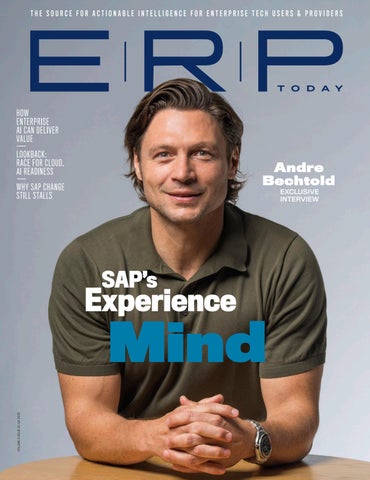
Andre Bechtold EXCLUSIVE INTERVIEW
SAP’s
Experience
Mind
SAP’s Andre Bechtold turns experience centers, live stores, and unified learning into a new blueprint for customer-centric, AI-ready transformation.
BY RACHEL WILLIAMS, WITH REPORTING BY ROBERT HOLLAND AND PHOTOS BY WOLFRAM SCHEIBLE 16
E R P T O D AY
|
Q4 2025
visit us
E R P. T O D AY
17
|
COVER
STO RY
|
ANDRE BECHTOLD
T
he first hint that SAP’s Experience Centers are no longer “nice show‑ rooms” but engines of transforma‑ tion is that Andre Bechtold now calls himself a retailer. In Walldorf, SAP’s first fully productive S.Mart Store, developed in partnership with Aramark over four months and launched in April 2025, runs on the same sys‑ tems it showcases. SAP employees buy real goods around the clock so the company can feel the pain and prove the value of its software in practice, not on slides, as described in SAP’s own S.Mart Store overview and joint announcement with Aramark. For Bechtold, who leads Experience Centers, in‑ dustry strategy, and Learning at SAP, the point is simple: If SAP expects customers to put their core business on its platforms, it must live those pro‑ cesses end to end itself. In sn exclusive interview with Bechtold, he explains: “We want to produce something together with a customer in the model factory, ship it to the store, sell it there, and handle returns—as our own customer,” describing the next evolution of Experience Centers as real laborato‑ ries for complex industry scenarios. The timing is strategic. Research highlighted by Qualtrics’ XM Institute indicates that by 2025, 89% of businesses expected to compete primarily on customer experience rather than product or price, and that increasing customer retention by just 5% can boost profits by up to 95%.
From Showroom to Living Lab SAP’s Experience Centers recently received an award from the Association of Briefing Program Managers, but Bechtold insists the real story is what happens next. What began as polished demo environments has become a continuously evolving network of physical and virtual spaces where SAP co-creates tangible, industry-specific use cases with customers and partners. 18
E R P T O D AY
|
Q4 2025
The S.Mart Store in Walldorf is the clearest proof of that shift. SAP notes that the original S.MART concept, unveiled in 2022 as a smart-store show‑ case, has now been reimagined as a fully opera‑ tional 24/7 autonomous retail environment on the Walldorf campus. SAP and Aramark’s 2025 announcements credit Aramark as the operating partner and name technology partners including Diebold Nixdorf, VusionGroup, C2RO, payfree, Lenovo, Intel, and Adyen. What they created is a store that custom‑ ers gain entry to through the S.Mart Grocery App which generates a personal Store Access QR Code that is shown at the door. Once inside, the tech advancements continue via the use of an RFID checkout, computer vision for personalization and theft prevention, digital temperature moni‑ toring, and automated stockout detection to let employees complete purchases in under 50 sec‑ onds, with no on-site staff. This shift forces SAP to confront the pain and value of its products in day-to-day retail opera‑ tions, from replenishment and merchandising to returns. Retail was a deliberate starting point be‑ cause everyone understands how a grocery basket or fashion purchase works. “Consumer products and retail are always a little bit easier,” Bechtold says, because visitors can immediately connect their own experiences to SAP processes and soft‑ ware. The bigger ambition, he adds, is to take the same end-to-end approach into more complex domains such as semiconductors, high tech, life sciences, energy, and utilities.
Industry-First, Platform-Always Behind the theatrics of model factories and smart stores sits a deliberate architectural philosophy. Bechtold frames it as starting with standard hori‑ zontal processes on SAP’s cloud ERP and Business Technology Platform, then layering in precisely focused, industry-specific extensions where they
will generate future value rather than recreating customizations from the past. “First we think about the process from here to there,” he says. “Then we decide where standard is enough and where a vertical extension will mat‑ ter in two, five, or 10 years.” That discipline is criti‑ cal in process-heavy industries such as chemicals, mining, and utilities, where regulatory constraints, technical sovereignty, and safety considerations make change both urgent and risky. AI now plays a prominent role in those con‑ versations. In Experience Centers, AI is not po‑ sitioned as an abstract platform feature but as a concrete optimizer for industry processes— from predicting demand and reducing waste to steering maintenance, compliance, or water us‑ age—according to Bechtold. SAP underlined this direction at its SAP Connect event in October 2025, where it announced that WalkMe, acquired earlier in the year, is now embedded across all
SAP Customer Experience solutions to guide us‑ ers through complex workflows in real time and drive continuous adoption. Bechtold’s team uses the Experience Centers as neutral ground to prototype AI-enabled scenarios with customers, test their appetite for new oper‑ ating models, and feed proven patterns back into SAP’s industry roadmaps.
Water, Climate, the Next Frontier One of the most striking examples of that road‑ map-first mindset is water. Bechtold describes water management as “maybe the next big thing,” citing the combined pressures of climate change, uneven distribution, and water-intensive indus‑ tries such as mining. In newer SAP locations such as India, where wa‑ ter scarcity is a daily concern, his team is exploring how SAP’s portfolio can help increase efficiency across sourcing, treatment, reuse, and distribution.
visit us
E R P. T O D AY
19
|
COVER
STO RY
|
ANDRE BECHTOLD
That means looking beyond utilities into industrial water use, then designing Experience Center sce‑ narios that show how data-driven optimization can reduce waste and improve resilience. The work is still in research and design, but Bechtold sees the potential to make water a flagship example of SAP’s ability to marry sustainability and operational ex‑ cellence.
Turning Customers into Co-Designers The Experience Centers are also changing how SAP talks to its customers. Installed-base clients still sometimes arrive expecting two days of Power‑ Point and product pitch, but leave, Bechtold says, surprised by a different dynamic: The conversation starts with their industry, their key processes, and their outcomes. Only later do they ask which prod‑ uct sits behind each scenario. That reversal is more than theatrics. By build‑ ing demos as realistic, cross-product process flows, Bechtold’s team finds friction points and usability gaps that would be invisible in traditional featureled demos, then feeds those insights back to prod‑
20
E R P T O D AY
|
Q4 2025
uct teams. In effect, Experience Centers act as a continuous usability lab, revealing where SAP can simplify flows, reduce clicks, tighten integration, and tell more intuitive stories through UX. The approach works particularly well with netnew customers who still think of SAP as a mono‑ lithic ERP and a set of disjointed line-of-business tools. When they see the breadth of the portfolio in a single, concrete industry story—often deliv‑ ered in an environment where internal satisfaction scores exceed 90%, according to Bechtold—many recalibrate their assumptions about cost, capabil‑ ity, and time-to-value.
Learning as a Strategic Product If Experience Centers are SAP’s front stage for cus‑ tomer engagement, learning is the backstage infra‑ structure that makes the performance repeatable. Bechtold’s operational scope spans product and solution learning, certification, and enablement for SAP employees, partners, and customers, and he has pushed to unify what were once separate tracks into a single, modular learning journey.
“Not a showroom—a co-innovation space running real business.”
The logic is direct: Everyone touching a cus‑ tomer, from SAP sales and services to partners and student talent, should speak the same lan‑ guage and work from the same demo systems, content, and best practices. That has meant col‑ lapsing duplicate demo landscapes, aligning cur‑ ricula across audiences, and embedding the SAP Discovery Center’s best-practice use cases directly into learning paths instead of treating them as op‑ tional extras. Consistency is essential when release cycles are measured in weeks and customers expect cloud innovation to land without disruption. A certifi‑ cation that is two years old may still provide valid foundations, but without continuous learning around tools such as SAP Business Data Cloud, SAP Signavio, SAP Cloud ALM, and WalkMe, pro‑ fessionals risk making outdated recommenda‑ tions that undermine transformation projects.
Students, Talent, and the Boredom Problem One of the most revealing insights in Bechtold’s portfolio came from a simple question to working students and interns in the Experience Centers: Are your SAP university courses engaging? “Most of them told me it’s super boring,” he recalls. They did not want generic training; they wanted real in‑ dustry use cases like the ones they saw in the Ex‑ perience Centers. SAP formalized this shift in November 2024 when it launched SAP Learning Hub, student edi‑ tion. According to SAP’s own FAQs for the program, actively enrolled students receive full access to the Learning Hub course portfolio, two free global cer‑ tification attempts, unlimited live expert sessions with SAP instructors, and 12 months of renewable
access to cloud-based practice systems, provided they verify enrollment with a university email and SheerID. Because SAP certifications have a defined valid‑ ity period and now require recurring assessments, students who certify during their studies can take those credentials straight into job applications with partners or SAP itself. Bechtold’s team is reworking content to be more tangible and narrative-driven, encouraging students to build on SAP technolo‑ gies rather than other cloud platforms. For those interested in sales or pre-sales careers, SAP mirrors Experience Center setups in training locations and teaches not only product knowledge but also cus‑ tomer-centric storytelling—how to explain busi‑ ness value, not just features and functions.
Enterprise Architects, Composable Futures As customers move to cloud ERP, modular suites, and AI-infused platforms, enterprise architects have become some of the most critical and overloaded roles. Recognizing this, SAP launched a major initia‑
visit us
E R P. T O D AY
21
|
COVER
STO RY
|
ANDRE BECHTOLD
“Adoption starts the day we prototype together, not at go-live.”
22
E R P T O D AY
|
Q4 2025
tive to build new enterprise architect training and certifications in close collaboration with services teams and product experts, according to Bechtold. He calls enterprise architecture “one of the most complex roles,” especially for installed-base customers transforming heavily customized land‑ scapes while trying to keep the core clean and move toward composable architectures. The new curricula emphasize not just tool proficiency but also reference architectures and concrete examples from the Experience Centers, such as the retail ref‑ erence landscape behind the S.Mart Store. Modularity is central here too. Learning paths are structured so early-career professionals and students can gain entry-level knowledge that later stack into full enterprise architect certifications, shortening the journey while maintaining rigor. SAP is also pushing partners to bring their enter‑ prise architects up to the same knowledge level as internal services teams, closing the gap that has historically plagued joint projects.
AI, Knowledge Foundations, Trust Bechtold is candid about AI’s double-edged nature in learning and enablement. On one hand, he uses AI daily for research, briefing preparation, and summarization. On the other, he warns that with‑ out a strong foundational understanding, people will struggle to distinguish between trustworthy insights and hallucinations. The answer, in his view, is to anchor AI-ena‑ bled learning experiences in authoritative con‑ tent sources. For SAP topics, that means ensuring large language models are grounded in SAP-owned content and curated learning assets, so that per‑ sonalized learning paths, summaries, and recom‑ mendations reflect the company’s latest thinking rather than random web content. That does not re‑ move the need for human judgment, but it shifts AI from risky shortcut to reliable accelerator. This AI-led approach also shapes how SAP sup‑ ports different learning preferences and demo‑ graphics worldwide. Whether a learner prefers interactive e-learning, classroom instruction, hy‑ brid formats, or short-form mobile content com‑ mon in markets like China, the underlying digital content is consistent and modular, ensuring that what is taught in one format aligns with what is offered in another.
Partners, Clean Core, Shared Accountability For Bechtold, aligning partners around the same knowledge and practices as SAP is not a govern‑ ance nicety; it is a survival requirement. Customers do not differentiate between a partner mistake and
an SAP mistake when projects go off the rails; in both cases, SAP’s reputation suffers. SAP has responded by designing enablement programs with partner organizations from the ground up, tying certifications and proven experi‑ ence to the partner’s competency framework and access to certain categories of projects. Crucially, partners now share the same demo landscapes and learning content as SAP employees, helping reduce disconnects that once appeared between sales promises, pre-sales demos, and implementa‑ tion realities. The clean-core principle sits at the center of this collaboration. For large, complex legacy custom‑ ers, partner architects are expected to understand SAP’s tools, methodologies, and transformation patterns for programs such as RISE with SAP, rather than defaulting to bespoke customization that undermines upgradeability and innovation. For mid-market customers, the emphasis is on keeping things as standard and simple as possi‑ ble, avoiding over-engineered deployments that obscure value.
Adoption, Trial-and-Buy, Real Value Adoption sits at the junction of Experience Centers, learning, and partner execution. Cloud business models depend on renewals; renewals depend on customers actually using what they have bought and seeing tangible outcomes. Bechtold rejects the idea that adoption and net-new customer ac‑ quisition are competing priorities. In his view, suc‑ cessful adoption stories provide the references and proof points that make net-new deals easier. His team has connected prototyping closely with learning. In many engagements, particularly with net-new customers, SAP spins up a cloud ERP sandbox, loads customer data, co-defines key use cases, and prototypes the future solution together over several months. That “trial-and-buy” model means customers are learning how to use the sys‑ tem while it is being tailored to their needs, and when the license deal is signed, the prototype can go productive with minimal disruption. ERP is not a simple SaaS app; wrong configura‑ tions can be expensive to reverse. Close support during prototyping reduces that risk while accel‑ erating adoption, as users move into production already familiar with the environment they have helped shape. In the S.Mart Store and other Experi‑ ence Center scenarios, that same principle applies internally: SAP’s own teams adopt and stress-test the solutions first, making benefits and pitfalls far more than theoretical slides—an approach the S.Mart materials emphasize in positioning SAP itself as an internal reference customer.
Learn more about SAP
visit us
E R P. T O D AY
23
|
FE AT U R E
|
ORIGINAL SOF T WARE
The Cloud Velocity Trap for Testing Carl Andrews, CEO of Original Software, on why old testing habits are killing new ERPs.
T
he weekend before go-live af‑ ter a major ERP migration is rarely peaceful. For CIOs and IT leaders, it is often a pe‑ riod of nervous anticipation as they wait to see whether months of labor and millions of dollars will yield a seamless Monday morning or a disastrous halt to production. According to industry statistics, the odds are not favorable. More than 70% of ERP migrations fail to meet their orig‑ inal objectives, and the culprit is rarely the software itself. Instead, failure often stems from a key misunderstanding of the unglamorous but essential discipline of testing.“From my perspective, it’s not so much that testing goes wrong, but that testing is more of an afterthought,” says Carl Andrews, CEO of testing and quality assurance (QA) provider Original Soft‑ ware. In an interview with ERP Today, An‑ drews unpacks why modern cloud migrations are exposing the cracks in traditional QA strategies and why the in‑ 24
E R P T O D AY
|
Q4 2025
dustry’s rush toward AI might be prema‑ ture if the foundations are not fixed first.
lously planned events that were executed then forgotten until the next cycle. How‑ ever, Cloud ERP disrupted that cadence The Frequency Shift entirely. Historically, organizations operating on“With today’s cloud ERP, that fre‑ premises ERPs, such as legacy SAP ECC quency of change is totally different,” environments, lived by a comfortable, Andrews notes. The shift to SaaS and sedate cadence. During that time, or‑ cloud-native environments means up‑ ganizations performed a significant up‑ dates happen continuously. If a business grade—and the requisite testing—every retains the old-world mentality of wait‑ few years. These were large and meticu‑ ing until the last minute to test, they are walking into a trap. “By the time it gets round to By the time it testing, it’s too late and the project inevitably slips or, gets round to in some cases, worst,” he testing, it is warns. Andrews adds that this too late and creates a dangerous fric‑ the project tion. “Leaders under pres‑ sure to deliver on time and inevitably under budget are tempted slips. to take shortcuts on QA. But in a modern ecosys‑ tem, a shortcut is often a CARL ANDREWS, CEO OF ORIGINAL SOFTWARE dead end,” he says.
able to sweep in, write all the tests, and fix the bugs with a single click. Andrews is quick to temper those ex‑ pectations. “There is no ‘magic red but‑ ton’ you can press to get all your testing done in one go,” he says. “AI doesn’t inherently know a company’s unique business processes or how its myriad systems integrate. That knowledge re‑ sides with the Subject Matter Experts (SMEs) who know the workflows inside and out.” However, once that human founda‑ tion of documenting and understanding processes is laid, AI shifts from hype to a powerful accelerator. For example, Orig‑ inal Software uses AI to visually spot the difference in automated regression tests and identify changes between software versions that the human eye might miss. “It’s a massive time-saver,” Andrews notes. “We’ve seen results with recent businesses where they multiplied the tests they can run by 10 once they move to automation.”
The QA Team’s Future
SHUT TERSTOCK .COM
The Spaghetti Ecosystem The complexity of the modern IT land‑ scape compounds the risk, as an ERP system no longer sits in isolation. It is connected to upwards of 50 other criti‑ cal business applications, from CRMs to legacy green-screen apps. “One small change in one system or application might break a business pro‑ cess, and without that end-to-end test, you might not know until it’s too late,” Andrews explains. This is where the human element becomes vital. Teams could fail to un‑ derstand the gap between how the old system worked and how the new one must work. “When organizations cut corners on documenting these processes, they lose the institutional knowledge required to verify that the business can actually function on Day 1,” Andrews adds.
AI: Helper, Not Holy Grail Inevitably, the conversation turns to AI. The industry hype suggests AI should be
Does this mean the end of the human tester? Not yet, says Andrews, who views AI’s current role as augmentation rather than replacement. “By offloading the laborious data crunching and regression checking to algorithms, human SMEs are free to return to their actual day jobs instead of being pulled into endless testing cy‑ cles,” Andrews explains. “In one case, this shift allowed one of our custom‑ ers to return six full-time employees to their primary roles, saving the business in excess of £100,000 per year.” That is the equivalent of over $130,000. Andrews believes the future of test‑ ing lies in speed, and the goal for com‑ panies like Original Software is to take organizations from low testing maturity to high maturity in weeks, not years. As ERP vendors continue to push busi‑ nesses toward the cloud, the volume of change will only increase. “The organi‑ zations that survive will be the ones that stop treating testing as a checkbox at the end of a project and start treating it as a continuous, strategic discipline,” he concludes.
W HAT T H I S M E AN S F O R E RP I N S I D E RS • Risk perception within organizations often needs recalibration. Many CIOs aim for zero risk, but project timelines suggest otherwise. Achieving a safe go-live requires treating testing as an essential activity rather than an afterthought or expendable budget line item. The frequency of change in Cloud ERP environments demands a continuous testing strategy. Effective testing should begin during the planning phase of an ERP migration, not just before deployment. • Documentation is the precursor to automation. Automation cannot proceed without a thorough understanding of existing processes. Prior to adopting advanced tools, Andrews recommends organizations having their SMEs manually test and document current business processes. This creates the dual benefit of building a library of training materials for new staff and providing the precise roadmap required to build reliable automated tests later. • Reliance on a “Magic Red Button” mindset can be misleading. AI functions as a force multiplier rather than a complete strategy. It performs well in areas such as parsing release notes, prioritizing changes, and completing visual regression tasks, but it still depends on human oversight to confirm correct system behavior. ERP Insiders must get the basics right, then use AI to scale capacity—not to fix a broken process.
Learn more about Original Software
visit us
E R P. T O D AY
25
E VEN T
|
ORACLE AI WORLD’S IBM SESSIONS
What Enterprises Must Build
Before AI Can Deliver A look inside the sessions at Oracle AI World, where customer stories drove home that real AI impact begins with data discipline, governance, and ERP foundations built for scale. BY C R AI G P O W E RS AN D TARS I L L A M O U R A
W
alking through the halls of Oracle AI World in Las Vegas this year, it was easy to get swept up in the usual showcase of flashy demos and broad-strokes key‑ notes about AI-powered reinvention. Cutting through the noise, IBM emerged as a counterweight to the hype, remind‑ ing enterprises that meaningful AI im‑ pact does not begin with models or agents, but with the discipline to build the right foundations. At several sessions led by IBM, the message was clear: AI innovation may be urgent, but it will not succeed with‑ out baked in preparation, planning, processes, and the operational matu‑ rity to support AI at scale. Rather than promising overnight breakthroughs, IBM’s perspective reframed the week’s discussions around what must be true 26
E R P T O D AY
|
Q4 2025
inside an organization before any of the promised intelligence can deliver outcomes.
with the organization’s business ar‑ chitecture, governance, and operating models. IBM’s role ensured those ele‑ ments worked in concert, turning the Clean Core, Clear Data, Readiness existing cloud platform into an engine As ERP Today reports, only 31% of digi‑ for transformation rather than assuming tal transformations succeed, as initia‑ the platform alone would deliver value. tives often falter when data, processes, Education First’s leaders detailed how and architecture are not ready. One of they modernized their data fabric, uni‑ the early IBM-led sessions at the con‑ fied financial and operational data, and ference, “From cloud to established a single source competitive edge: Re‑ of truth using Oracle Fu‑ AI succeeds thinking Oracle for AI sion Applications with success,” illustrated this only when IBM’s help. Such steps point. The case of Educa‑ organizations were key in reversing the tion First, presented by its build the odds of failure and estab‑ CFO and CIO alongside foundations for lishing a robust ERP foun‑ IBM’s global Oracle offer‑ intelligence to dation to support analytics ing lead, showed how even operate with as well as emerging AI and with significant investment automation capabilities. reliability and in SaaS and Oracle Cloud, The takeaway for ERP outcomes hinge on how impact. and enterprise-applica‑ the technology is aligned tion teams? Scalable AI
SHUT TERSTOCK .COM
|
visit us
E R P. T O D AY
27
|
E VEN T
|
ORACLE AI WORLD’S IBM SESSIONS
adoption depends on strong under‑ lying systems. Clean data, a unified core, and aligned business processes can help ensure that new intelligence enhances well-structured workflows rather than magnify existing complex‑ ity. IBM grounded this principle in its decades-long partnership with Oracle, which includes L4 delivery status, joint engineering work across Oracle Cloud Infrastructure (OCI), and the integra‑ tion of IBM’s Granite models with OCI. Together, these elements form the tech‑ nical basis that many Oracle customers rely on when moving from experimenta‑ tion to operational AI.
The Agentic AI Advantage Later in the week, the session “Agen‑ tic AI with real ROI: Fuel performant agents with IBM Granite Models and OCI” shifted the discussion from readi‑ ness to what enterprise-scale AI can look like once that foundation is in place. IBM emphasized that deploying one or two generative models is not enough. Enterprises must consider or‑ chestrating a portfolio of agents, each specializing in different functions, and integrate them with business processes and hybrid-cloud infrastructure. This is where IBM’s own models (Granite) and environments (watsonx) are paired with OCI to create the architecture to support this scale.
T h i s c o m b i n a t i o n Enterprises Fusion and IBM are ap‑ matters because multiproaching multi-agent AI: must master data, agent systems need to Oracle Fusion provides be coordinated compo‑ governance, and the infrastructure and ap‑ nents that interact with architectural plication fabric, while IBM finance, HR, procure‑ discipline before supplies the model layer, ment, customer service, AI can truly scale. orchestration logic, and supply chain, and more. governance backbone for IBM explained how its those agents to operate governance workflows with consistency. For ERP and controls extend across these agents, leaders, this matters because domains using watsonx orchestration to monitor cannot be treated as isolated islands. AI decisions, manage handoffs, and apply agents trained for one workflow must consistent policy across domains. This be aligned with others. The preparation approach—tying model governance to work is the difference between experi‑ the operational reality of ERP systems— mentation and enterprise adoption. ensures that AI agents will behave pre‑ dictably in regulated or high-impact Realities of AI-Enabled processes. Applications To help organizations operational‑ Two other sessions drove home how ize this complexity, IBM linked these preparation manifests in functional do‑ agentic concepts back to its Consulting mains. Advantage Model. IBM outlined how its In the session, “A proven framework architectural blueprints and governance to build agile supply chains,” IBM and frameworks map directly onto Oracle Oracle noted only 6% of organizations Fusion Applications, giving enterprises claim full end-to-end supply chain vis‑ a structured way to integrate agents into ibility, highlighting the wide preparation cross-functional workflows without dis‑ gap. The session discussed how IBM and rupting core operating models. Rather Oracle Fusion Applications are helping than treating agent deployment as an organizations build integrated planning, experimental add-on, IBM positioned execution, and responsiveness capabili‑ it as a continuation of foundational de‑ ties by first remaking the data founda‑ sign work that ensures agents can scale, tion, business rules, and supply chain reuse each other’s capabilities, and re‑ architecture before integrating AI-pow‑ main auditable over time. ered tools. This is a clearer picture of how Oracle Next, the session “Beyond the buzz: Harnessing the power of Gen AI in HR” tackled payroll, manual processes, and compliance. Legacy systems and dis‑ connected applications force organi‑ zations into reactive mode; the path forward requires creating unified HR platforms, defining rules around gener‑ ative AI use, and ensuring real-time in‑ sights rather than batch-reports. Again, IBM emphasized that AI tools are pow‑ erful, but only once they sit on struc‑ tured, well-governed data platforms.
Governance and the Human Element One of the most consistent themes across the event was governance. In a world eager to talk innovation, the ques‑ tion turns quickly to “Is this safe? Is it 28
E R P T O D AY
|
Q4 2025
INSIGHTS FROM THE GROUND These moments from the session rooms captured what end users are actually doing, struggling with, and learning as they bring AI into ERPconnected environments.
IBM Case Study
SHUT TERSTOCK .COM
IBM operates a supply chain supported by 20+ intercon‑ nected systems, making traditional “lift and shift” automation insufficient. Before deploying AI, IBM’s team eliminated unneces‑ sary work and simplified processes to remove manual friction points. AI agents were introduced only after this simplifica‑ tion—agents now democra‑ tize data access, respond to natural-language questions, and surface insights without dashboards or reports. IBM reported $316 million in cost savings over three years, alongside major re‑ ductions in inventory losses. AI adoption drove cul‑ tural change: the company saw a new generation of supply chain talent at‑ tracted by AI-enabled roles.
Decision cycles acceler‑ ated as teams learned to sense, decide, and act faster, supported by continuously improving agents. IBM frames 2024 as the year AI became embedded in daily operations; the cur‑ rent state is projected as agents taking on more com‑ plex tasks autonomously.
DirecTV Case Study DirecTV is building an en‑ tirely new tech stack and supply chain platform on a deadline that requires golive by July 2026. The transformation is anchored in a definition of supply chain agility: respon‑ siveness, flexibility, visibility, and speed of change. DirecTV inherited a tan‑ gled ecosystem across CRM, logistics, ERP, and supplier networks, and cited unifying these as a major early chal‑ lenge. The company’s AI strat‑ egy begins with a unified data fabric as the enabler to forecast improvements, AI simulations, and real-time supplier collaboration. AI is being used for sce‑ nario testing before opera‑ tional decisions are made, supporting a shift from responsive to predictive op‑ erations.
accurate?” In IBM-led discussions, gov‑ ernance was not framed abstractly. IBM tied it directly to the assets it brings to Oracle Fusion customers, starting with how the Consulting Advantage Model enables AI integration without compro‑ mising compliance or auditability. Speakers also pointed to the gov‑ ernance features built into the Granite models. Because Granite was developed with transparent data practices, tunable behaviors, and policy-based controls,
DirecTV is overhauling its success metrics: measuring scenario-building speed, activation performance, demand–supply alignment, and agent-adoption levels. A key insight shared: AI agents’ success depends not only on outputs, but on how often humans need to over‑ ride their decisions.
Verisk Case Study Verisk is replacing a 26-yearold on-premises PeopleSoft system with Oracle Fusion Cloud Enterprise Resource Planning (ERP) and Ora‑ cle Fusion Cloud Human Capital Management (HCM) across finance and HR. The shift is CFO-spon‑ sored, driven by costreduction mandates, KPI improvement, and the need for standardized processes in a highly regulated envi‑ ronment. With Oracle Fusion Appli‑ cations live, Verisk now has
the models can operate as agents in regulated environments with less risk of drift or unpredictability. Those controls become even more important inside watsonx, where governance workflows track lineage and evaluate outputs be‑ fore applying enterprise policies con‑ sistently across multi-agent systems. IBM connected these governance ca‑ pabilities to the work on ContextForge, which enables agents to select the right context, knowledge base, or task han‑
core HR and finance data in a single, unified ecosystem, enabling new AI-driven value opportunities. The organization is building a multi-year roadmap, combining platform capabilities, process efficiencies, and agentic AI; 2026 is the target for broader deployment. Verisk is treating AI adoption as a governancefirst journey, requiring architecture reviews, busi‑ ness-unit alignment, and C-suite approval. Use cases span error cor‑ rection, predictive analytics, variance analysis, and pro‑ active fraud detection, each handled as a mini-program with strict ROI criteria. Verisk is evaluating con‑ versational agents from Oracle, IBM, and internal teams, noting that impact is as much about upgrading workforce capability as cost savings.
dler automatically. For Oracle Fusion customers, this means governance ex‑ tends across multiple agents as they coordinate decisions across the ERP system. And in supply chain and HR— two domains where IBM already has established frameworks—governance determines how AI recommendations influence planning, compliance, and workforce decisions. That means ERP leaders should con‑ sider treating AI adoption not as a vendor
visit us
E R P. T O D AY
29
|
E VEN T
|
ORACLE AI WORLD’S IBM SESSIONS
call-out for “we can do generative,” but as a structured program with controls. IBM explained the goal of agentic AI is to el‑ evate human work, not replace it, which in turn makes governance and oversight essential. Without that foundation, the risk is not just failed ROI, but failed trust. Where Transformation Goes Next Taken together, the customer-led ses‑ sions at Oracle AI World showed a uni‑ fied progression across industries, with each organization tackling data quality, governance, and operating models be‑ fore scaling AI. From those discussions, the following threads leading to the next phase of AI-enabled ERP transformation dominated: AI readiness continues to outweigh AI experimentation; the case studies pre‑ sented across Education First, Verisk, DirecTV, and IBM reinforced that strong data foundations and aligned business processes remain essential prerequisites for successful adoption. Multi-agent architectures emerging across finance, HR, and supply chain
demand enterprise discipline, with cross-domain workflows and controls becoming central to scale. The longstanding Oracle-IBM part‑ nership served as a reminder that hy‑ brid cloud alignment and coordinated vendor ecosystems are increasingly critical to delivering practical, end-toend innovation. Governance considerations are be‑ coming a focal point for organizations as they seek to manage new risks around auditability, regulatory compliance, and model oversight. While generative AI offers speed and automation, the supply chain and HR discussions made clear that these ben‑ efits matter only when accompanied by visibility and control. IBM’s roadmap adds another dimen‑ sion to this trajectory. Its forthcoming custom agent, built on ContextForge and the IBM Consulting Advantage Model Context Protocol servers, aims to match tasks automatically with the appropriate assistant, agent, or docu‑
ment collection, supporting scale as organizations move beyond pilots into live operations. This direction aligns with a broader industry shift: ERP en‑ vironments are evolving from systems of record into systems of intelligence, in which AI agents operate as embedded, components of core processes. The overarching takeaway is that the era of broad, exploratory AI pro‑ jects is transitioning into one centered on value, scale, and trust. Innovation now depends less on novel models and more on organizational readiness, ar‑ chitectural coherence, and disciplined execution. For enterprises modernizing ERP systems or integrating AI into op‑ erational domains, the foundation laid today will determine the capacity to op‑ erationalize AI tomorrow.
Learn more about Oracle + IBM
W HAT T H I S M E AN S F O R E RP I N S I D E RS • Integration discipline determines whether AI can operate reliably inside ERP systems. The sessions at Oracle AI World demonstrated that enterprises advancing fastest on AI are those stabilizing core data structures and aligning business architecture before deploying agents or generative capabilities. IBM’s work with Oracle Fusion customers shows how unified operating models, governed data fabrics, and consistent process standards form the conditions in which multi-agent systems can function without creating
30
E R P T O D AY
|
Q4 2025
operational risk. For ERP stakeholders, the implication is: AI maturity will increasingly track the quality of integration, not the quantity of added features. • Governance architecture is a strategic differentiator in AI-enabled ERP modernization. IBM’s Consulting Advantage Model, Granite’s embedded control features, watsonx governance workflows, and ContextForge orchestration collectively highlight how governance now determines the ceiling
of AI adoption inside enterprise applications. These capabilities reflect a broader trend toward embedding policy, auditability, and safety into the model layer itself rather than treating governance as an add-on. As multiagent systems begin influencing mission-critical workflows, ERP leaders will increasingly judge providers and partners by the sophistication of their governance stack. • Ecosystems anchored in engineering alignment are setting the pace for AI deployment. The OracleIBM partnership illustrates
how AI transformation accelerates when platform and services strategies are built in tandem. The joint Granite+OCI architecture shown at Oracle AI World signals a market shift toward vertically integrated AI capabilities that extend from infrastructure to workflow orchestration. For ERP providers and enterprise architects, this reflects how future competitiveness will depend on partnerships that merge application intelligence with cloud performance and synchronize platform innovation with enterprisegrade delivery.
|
N EWS
B R I EF
|
SAP
Cloud Overhaul Amey Completes Cloud ERP Overhaul with SAP S/4HANA and NTT DATA Business Solutions TARS I L L A M O U R A
A
mey, a UK-based infrastructure and engineering services company, has completed a large-scale ERP cloud migration. Under its modernization project, the company has moved from a 20-yearold SAP ECC system to SAP S/4HANA Cloud, Private Edi‑ tion, hosted on Google Cloud Platform. According to a November 12 media statement from NTT DATA Business Solutions UK&I, the migration was delivered on time and on budget as part of Amey’s broader technology moderni‑ zation program. The implementation reportedly establishes a cloud-first foundation that supports Amey’s data, finance, procure‑ ment, and supply chain operations across its UK infra‑ structure services, which include transportation networks, utilities, and public services. The company’s goal is to bet‑ ter its operational agility and apply AI-enabled processes to areas such as resource planning and project execution. Amey partnered with NTT DATA Business Solutions, which used a standardized conversion methodology through its SAP S/4HANA Technical Conversion Centre of Excellence. The approach emphasized automation, pre‑ configured solutions, and testing through Tricentis tools to validate core business processes and minimize disruption. The project also delivered data quality improvements us‑ ing Natuvion solutions, removing more than 100 redundant company codes to create a more efficient ERP environment and lower infrastructure costs. Additionally, Amey and NTT DATA Business Solutions conducted a pilot exploring the use of generative AI for highway safety to test how the platform’s potential can support future innovation. Both organizations plan to continue collaboration through a long-term transformation roadmap that includes expanded SAP Fiori adoption, enhanced accounts receiv‑ able management, integration of SAP Business Data Cloud, and sustainability tools such as Green Ledger.
W HAT T H I S M E AN S F O R E RP I N S I D E RS • Complex ERP transitions are becoming more predictable. Amey’s migration illustrates how established organizations with long-standing SAP ECC environments are completing full-scale transitions to SAP S/4HANA Cloud. It reflects a growing reliance on factory-style, automation-based conversion models to control cost and risk during complex cloud migrations. • Data readiness is emerging as a critical success factor. The project also highlights the importance of data readiness as a driver of post-migration efficiency. Streamlining company codes and removing obsolete data allowed Amey to achieve performance and cost improvements at go-live—a practice increasingly seen as essential to ERP modernization. • Automation and testing are redefining project assurance. For organizations planning similar programs, the use of automated conversion and advanced testing tools such as Tricentis may serve as reference points for balancing transformation speed with operational stability. Amey’s inclusion of a generative AI pilot further signals that companies are beginning to integrate advanced technologies into ERP initiatives early in their modernization cycles rather than as secondary projects.
visit us
E R P. T O D AY
31
|
S ECT I O N
N AM E
|
TITLE
32
E R P T O D AY
|
Q4 2025
TESTING, T R A N S F O R M AT I O N , AND THE RACE TO AI-READY ERP IN 2025 BY TARS I L L A M O U R A
visit us
E R P. T O D AY
33
|
FE AT U R E
|
YEAR IN REVIEW
I N 2 0 2 5 , C LO U D M I G R AT I O N B E CA M E T H E F O U N DAT I O N F O R A I R E A D I N E S S , AU TO M AT I O N , A N D S M A RT E R E R P O P E R AT I O N S .
I
n 2025, the conversation a ro u n d c l o u d m i g ra t i o n shifted from why to how. According to SAPinsider’s 2025 research report on SAP S/4HANA deployment, for instance, 31% of the organi‑ zations who responded to the survey have transitioned to SAP S/4HANA, while another 27% are in im‑ plementation. Additionally, 54% of re‑ spondents said they plan to incorporate AI or generative AI capabilities into their SAP S/4HANA deployment. If 2024 was the year cloud ERP be‑ came non-negotiable, 2025 was the year organizations learned how hard— and how rewarding—successful cloud migration can be. Across ERP Today’s coverage, cloud migration was explored through real-world transformations at companies like Gap and 24 Hour Fit‑ ness as well as global ERP vendors SAP, Oracle, and Unit4. The year’s reporting surfaced three clear themes: • The need for strong testing and qual‑ ity assurance at every stage of migration • The growing importance of cloud ecosystems and vendor partnerships for a competitive edge • The recognition that cloud readiness and AI readiness are now inseparable. This review outlines what organiza‑ tions learned in 2025 and what ERP end users should prepare for in 2026.
continuous, automated validation cy‑ cles. That level of automation through‑ out the migration process reportedly reduces errors and provides the quality assurance needed for critical ERP work‑ loads. Opkey’s partnership with Gap highlights this well, as it showed how automation accelerated both testing and confidence: Gap reduced migration downtime and validated critical finance workflows in record time. Similarly, under-tested integrations remain one of the top causes of postmigration system outages. Investing early in test automation and data vali‑ dation has achieved faster, more stable go-lives this year. Organizations also learned that test readiness is a core part of business risk management.
Ecosystem Partnerships Shaped the Market Cloud migration in 2025 was also de‑ fined by strategic alliances, particularly among hyperscalers and ERP providers. The Oracle and Amazon Web Services (AWS) enhanced partnership showed the power of co-engineering in multi-cloud adoption. By enabling Oracle database services to run on AWS infrastructure, the two giants opened new hybrid de‑ ployment pathways for customers wary of being locked in with a single vendor. In essence, the partnership gave customers more flexibility and reduced dependency on a given provider.
Meanwhile, Unit4’s expansion of cloud migration services showed how mid-market ERP providers are evolv‑ ing from software suppliers to managed service partners. Unit4’s investment in managed transition and vertical-specific migration programs reflected a maturing SaaS economy. Vendors are expanding their roles and helping smaller organi‑ zations modernize with less disruption. Cross-vendor momentum was also highlighted during SAP Sapphire 2025 and SNP’s Transformation World event. SNP and SAP’s growing partnership shows how data migration is the founda‑ tion of modernization, not the final step. Enterprises are moving toward real-time analytics and AI-powered decision sup‑ port. Cloud migration is increasingly about collaboration, interoperability, and shared accountability across providers.
AI Readiness Redefined ‘Cloud First’ Perhaps the most transformative takea‑ way from 2025 was that cloud migration is increasingly about preparing for AI. At SAP Sapphire 2025, nearly every keynote tied cloud migration to AI en‑ ablement. SAP Private Cloud Edition through the RISE methodology, for ex‑ ample, was positioned both as a route to SAP S/4HANA and as the foundation for integrating agentic AI and real-time data processing. Speaking on AI-powered cloud migration, Mercedes-Benz CIO
Testing Took Center Stage One of the most consistent lessons of 2025 was that testing and validation are now central to a successful cloud migra‑ tion strategy. In the second quarter of the year, ERP Today reported that traditional manual testing methods are being replaced with 34
E R P T O D AY
|
Q4 2025
I N 2 0 2 5 , C LO U D M I G R AT I O N B E CA M E T H E F O U N DAT I O N F O R A I R E A D I N E S S , AU TO M AT I O N , A N D S M A RT E R E R P O P E R AT I O N S .
Cathey Lehman said: “We’re leveraging AI across our entire value chain. We’ve deployed our internal ChatGPT-like so‑ lution, and we’re excited to expand with SAP’s Joule and Business AI stack.” Oracle’s collaboration with AWS also reflected this trend, connecting data‑ base modernization directly to gen‑ erative-AI readiness. By enabling new deployment models, Oracle positioned its customers to scale AI workloads and analytics more efficiently. And for Unit4, SaaS adoption was explicitly linked to delivering “people-centric AI,” where automation and predictive analytics improved user experience as much as employee productivity and operational efficiency. Across major players, 2025 marked the point where cloud migration be‑ came the foundation for AI integration.
Compliance, Continuity Still Matter While innovation dominated headlines, 2025 also reminded ERP leaders of the governance side of modernization. As early as January, Oracle warned enterprises that legacy governance, risk, and compliance (GRC) tools are expir‑ ing faster than their migration timelines. Cloud migration now requires parallel investments in security, auditing, and policy automation, as organizations are being forced to adopt new, cloud-native GRC tools to maintain auditability and control. Similarly, Opkey’s State of Cloud & ERP Operations Report 2025 empha‑ sized operational resilience is the true benchmark for success. That means en‑ suring migration while systems remain stable through continuous updates, multi-region redundancy, and zerodowntime maintenance.
Looking Ahead to 2026 As 2025 closes, the cloud migration wave is far from over. The next stage will fo‑ cus on intelligence, automation, and resilience. Looking ahead to 2026, ERP Today expects three trends to dominate: 1. Predictive migration tools that use
TESTING, PA R T N E R S H I P S , AND CONTINUOUS VA L I DAT I O N EMERGED AS PILLARS OF SUCCESSFUL C LO U D M I G R AT I O N . AI to analyze system dependencies, au‑ tomate recommendations, and reduce downtime. 2. Continuous upgrades that merge migration and maintenance into a sin‑ gle process. 3. Integrated governance platforms that bring together compliance, secu‑ rity, and data quality. For ERP insiders, the lesson from 2025 is cloud migration is not a one-time project, but a continuous process of im‑ provement. ERP innovation will be de‑ fined not by how fast organizations move to the cloud, but by how intelligently they evolve once they get there.
W HAT T H I S M E AN S F O R E RP I N S I D E RS • Testing is strategic, not just technical. Automated, continuous testing now defines successful migration programs. Vendors and clients alike need to treat validation as a business safeguard, not an IT checkbox. • Ecosystem alignment is a differentiator. The OracleAWS partnership and SAP-SNP collaboration showed that interoperability is winning over exclusivity. ERP leaders are choosing partners, not just platforms. • Cloud migration leads to better AI integration. Organizations are not moving to the cloud just for scalability. They are doing it to unlock AI, analytics, and agentic workflows. Enterprises that modernize now will be better positioned
visit us
E R P. T O D AY
35
FE AT U R E
|
YEAR IN REVIEW
ERP AI
INTEGRATION
FROM PROMISE TO PERFORMANCE IN 2025 ERP systems matured in 2025 by better integrating AI and shifting from automating tasks to enabling informed actions. BY TARS I L L A M O U R A
E
nd users in 2025 stopped seeing AI as a futuristic buzzword for enterprise plan‑ ning. What had long been pitched as a fu‑ ture differentiator finally began delivering measurable operational benefit this year. According to ERP Today’s reporting on the manufacturing sector, 82% of companies increased technology budgets specifically to build AI-ready ERP capabilities. It is a clear sign that competitive pressure is now tied directly to intel‑ ligent automation and decision support. At the same time, ERP vendors shifted strategies. Rather than layering AI on top of long-standing workflows, they redefined the role ERP plays in‑ side the business. ERP systems now extend beyond recording what has happened to guiding users to‑ ward what should happen next. From mid-market players outlining “assist, advise, act” frameworks to large vendors positioning ERP as an AI-first solu‑ tion, AI has evolved from a feature into the core of how ERP delivers operational value. This year’s trends made it clear that organiza‑ tions realizing value treated AI adoption as an op‑ erational and a governance shift. They understood that automating decisions demands the same rigor 36
E R P T O D AY
|
Q4 2025
as automating transactions. Here is how AI in ERP moved from promise to performance through four drivers that shaped the market in 2025: • Vendor strategy positioning ERP as the system where AI creates business value • User experience transforming as conversational and agentic interactions replace traditional navi‑ gation • Gaps in execution maturity showing how readi‑ ness determines which AI investments deliver outcomes • Operational responsibility shifting as AI decisionmaking requires new governance and confidence controls. AI is redefining how ERP operates today. The pri‑ ority heading into 2026 is not simply to scale adop‑ tion, but to mature the structures that ensure AI improves performance without compromising trust.
Vendor Strategy Shifted In 2025, ERP vendors reshaped their positioning around AI. Enterprise providers spoke openly about reorienting their platforms around intelligence-led operations. In interviews and product briefings, senior leaders described ERP not as an adminis‑
SHUT TERSTOCK .COM
|
visit us
E R P. T O D AY
37
|
FE AT U R E
|
YEAR IN REVIEW
trative system but as the place where AI can interpret business context, anticipate changes, and guide users toward the next best action. The emphasis moved from process automation and compliance to decision quality, speed, and resilience. No longer just a feature that enhances the platform, AI now justifies having the platform in the first place. Automation can reduce effort, but AI can elevate per‑ formance. An ERP system must there‑ fore guide end users through scenarios, highlight risks before they materialize, and surface opportunities while deci‑ sions are still fluid. ERP Today’s coverage also showed how quickly mid-market vendors inter‑ nalized this shift. Throughout the year, providers presented AI-first roadmaps with workflows designed around intel‑ ligence from the outset. Unit4 illustrated this with a maturity model built on “as‑ sist, advise, act,” positioning AI as a partner in operational decision-making rather than simply a tool for task reduc‑ tion. This framing resonated because it translated AI adoption into a sequence that organizations could execute: start by supporting the user, progress to in‑ formed recommendations, and ulti‑ mately allow the system to complete actions on the organization’s behalf. This reframing pushed decision mak‑ ers to reexamine ERP’s role in govern‑ ance and productivity. Vendors set new expectations: improved insight quality, reduced process latency, and the abil‑ ity to operate at enterprise speed even during disruption. ERP now competes on intelligence. With the market align‑ ing around this vision, ERP buyers enter 2026 asking a new question—not which ERP will automate best, but which ERP will decide best.
User Experience Transformed Another development in 2025 was a shift in how users interacted with ERP systems. Conversational access and em‑ bedded AI assistants began functioning in live environments, changing the basic expectations of how ERP can be lever‑ aged. Historically, users needed deep process knowledge to locate transac‑ tions and assemble insight from data. 38
E R P T O D AY
|
Q4 2025
That burden is fading. Users increas‑ ingly issue requests in natural language, and systems interpret intent, execute steps, and confirm results. ERP Today’s Sapphire coverage of‑ fered tangible examples of this transi‑ tion. Agent-based automation surfaced exceptions to planners before they initiated any search, prompting early intervention. Vendors also showcased generative capabilities able to translate large data sets into concise explanations of causes, risks, and recommended ac‑ tions. What previously required dash‑
from task completion to oversight. In other words, accountability still mat‑ ters. Effective use of AI-driven ERP de‑ pends on understanding how the system reaches its conclusions and when hu‑ man intervention is needed. This marks a fundamental change in the human– system relationship, and it places new expectations on leaders to ensure con‑ fidence in the decisions AI generates.
Execution and Readiness Merged As AI capability expanded, execution ma‑ turity became the clearest determinant of business impact. Organ‑ izations that prepared for AI as a change in operations (rather than a feature rollout) saw the strongest outcomes. Those already operating in the cloud, with aligned data structures and clear ownership of processes, were able to embed in‑ telligence into planning and execution cycles with ease. Others struggled to progress beyond pilot stages. Deployments stalled when ERP data lacked coherence across functions or when automated guidance conflicted with entrenched workflows. In these cases, AI did not expose flaws in technology as much as lack of prepared‑ ness in governance and accountability. The difference between value realized and value anticipated came down to whether leaders treated AI as a workflow enhancement or a shift in how decisions are made and measured. ERP Today’s transformation coverage highlighted the need for preparation across multiple dimensions: data qual‑ ity and integration, clarity about when AI augments judgment versus takes primary responsibility for the decision, and alignment on who owns outcomes. Those that framed AI adoption within this lens advanced quickly; those that treated AI as a technical upgrade faced rework and hesitation. This divide will deepen as AI contin‑
AI IN ERP SHOWED BUSINESS VALUE, BUT SUCCESS DEPENDS ON READINESS, DATA QUALITY, AND OPERATIONAL DISCIPLINE. boards, filters, and reports now is delivered as guidance at the moment when decisions need to be made. As insight moved closer to action, the structure of work also changed. Teams spent less time collecting data and more time evaluating outcomes and validat‑ ing judgments. Decisions accelerated not because users worked faster, but because systems eliminated delays be‑ tween recognizing a problem and re‑ sponding to it. ERP Today documented multiple scenarios where AI-driven recommendations replaced static pro‑ cesses, allowing parameters such as supplier disruption or demand variabil‑ ity to dynamically influence workflows. With ERP becoming less visible to us‑ ers but more influential in their daily work, new expectations emerge. When systems proactively suggest, execute, or escalate, the user’s responsibility shifts
ues to reveal operational gaps. In 2025, that revelation became a forcing func‑ tion for ERP leaders to standardize data, simplify processes, and strengthen crossfunctional governance before expanding autonomous capabilities any further.
Operational Responsibility Shifted ERP has long been accountable for data accuracy and process compliance. In 2025, it became accountable for per‑ formance outcomes as well. Agentic AI—highlighted in supply chain and service operations coverage—began to act directly, not merely prompting users for approval. Systems responded to con‑ ditions dynamically, adjusting plans or routing work while situations were still unfolding. This development raised strategic questions documented in ERP Today interviews, such as: • How are decisions reviewed when hu‑ mans did not make them? • What constitutes a “business-ap‑ proved” risk tolerance for modeldriven actions? • Which roles are responsible for retrain‑ ing or overriding automated behavior?
Organizations that invested in guard‑ rails such as clear escalation paths, auditability of model decisions, and transparency into the rationale behind recommendations advanced automa‑ tion with confidence. Meanwhile, oth‑ ers had to slow deployment to preserve oversight. The shift is subtle but deeply felt. ERP is no longer a passive system invoked by the business; it is an active participant in running the business. That requires lead‑ ers who are prepared to manage digital judgment, not just digital workflow.
ERP’s AI Shift: A Business Performance Imperative Decidedly, 2025 marked a turning point in ERP evolution. AI integration matured from isolated proofs of con‑ cept to operational capabilities with measurable influence on enterprise performance. ERP Today’s reporting throughout the year showed: • Vendors reimagining ERP as a deci‑ sion engine • Users engaging less in navigation and more in judgement • Technical readiness dictating progress
• Governance structures adapting to maintain trust in automated actions. These changes position ERP at the center of business execution. As organi‑ zations head into 2026, acceleration alone cannot define AI strategy. Leaders must reinforce accountability, transpar‑ ency, and performance measurement in step with expanding intelligence. Com‑ panies prepared both architecturally and culturally will turn AI progress into operational advantage. Looking to 2026, three priorities stand out: • Copilot-embedded ERP workflows moving from dashboards to live op‑ erational support • Composable ERP architectures ena‑ bling plug-in specialized AI modules without full platform upgrades • Enhanced governance and explain‑ ability ensuring transparency, audit‑ ability, and ethical compliance. With AI reshaping ERP faster than many expected, successful AI integra‑ tion demands this mindset shift: ERP is not a system to modernize, but a sys‑ tem that continuously modernizes the business.
W HAT T H I S M E AN S F O R E RP I N S I D E RS • The shift to AI-first ERP means the competitive edge now comes from how well the system can guide decisions. The focus heading into 2026 is not which platform automates the most workflows, but which one improves judgment and resilience under pressure. Due diligence must focus on how AI evaluates scenarios, escalates risk, and ensures oversight when recommendations become automated actions. AI readiness is a business capability; clean
data structures, cloud operating models, and shared accountability are now prerequisites for ROI. • Agentic ERP is changing daily work fast. ERP Today coverage showed AI interventions surfacing disruptions and prompting corrective actions before users intervened, whether through SAP’s agentic workflows or Oracle’s supply chain AI agents. Conversational access, proactive exception handling, and agent-led automation mean less
time navigating screens and more time validating the right call. Training must now cover when to trust automation and when to challenge it. Trust grows when end users understand why the system recommended a path; ERP leaders should ask vendors how explainability and escalation are built into their design. • Discipline around testing, data, and governance is the new differentiator. Transformation leaders
learned in 2025 that readiness determines returns. ERP Today stories on automated testing and the urgency around cloudnative GRC reinforced one message: AI amplifies the state of the estate it enters. Strong data foundations and continuous validation produce momentum, while fragmented processes and audit gaps slow everything down. Heading into 2026, success depends on control and confidence; on the ability to scale AIenabled ERP without losing stability or accountability.
visit us
E R P. T O D AY
39
|
CUSTO M ER
S U CCESS
|
SNP GLOBAL
Shedding Data Baggage for a Leaner SAP Cloud Why the SAP cloud ERP journey must begin with a data reckoning. BY ROBERT HOLL AND AND RADHIK A OJHA
T
he promise of migrating to SAP Cloud ERP Private (pre‑ viously RISE with SAP) is compelling. It represents a decisive path to the cloud, a strategic leap towards streamlined processes, reduced IT com‑ plexity, and enhanced business agil‑ ity. For many organizations, this move entails a vision of a clean, intelligent enterprise core that is free from past technological debt. However, this journey to a clean digi‑ tal core begins with a transparent and honest assessment of the organization’s existing data. The reason for this impor‑ tant assessment is best illustrated by the example of moving into a new, minimal‑ ist smart home, yet insisting on bringing every piece of clutter from the old, over‑ stuffed attic. The old furniture clashes with the new architecture, and its sheer volume prevents the home from func‑ tioning as designed. Many companies fall into a similar trap in their migration to SAP Cloud ERP Pri‑ vate. They invest in the robust, modern 40
E R P T O D AY
|
Q4 2025
architecture of SAP S/4HANA, only to add decades’ worth of accumulated, uncurated, and often irrelevant data. As a re‑ sult, the promised agility from migration remains elusive, costs spiral unexpect‑ edly, and the project’s complexity soars.
The Hidden Costs of Data Baggage In the on-premises world, the cost of storing old data was a relatively linear and predictable expense. However, in the cloud, data volume and system com‑ plexity are primary cost drivers, particu‑ larly within hyperscaler environments such as AWS, Microsoft Azure, or Google Cloud. Therefore, every gigabyte of re‑ dundant or obsolete data that an organi‑ zation migrates, incurs a recurring cost for storage, computing, and licensing. This slowly erodes the total cost of own‑ ership (TCO) benefits that the business sought to achieve with the migration. Beyond the direct financial impact, this data baggage introduces friction into the transformation: • Project risk and duration: Migrating
unnecessary data increases the technical complexity and timeline of a SAP Cloud ERP Private (RISE with SAP) project. Ad‑ ditionally, the testing, validation, and cu‑ tover phases become more challenging. • Performance degradation: Bloating a new SAP S/4HANA Cloud Private Edi‑ tion environment with historical data that isn’t required for daily operations can lead to sluggish performance. This constrains the very business processes the organization aims to accelerate. • Compliance and security hurdles: Legacy data is often a minefield of out‑ dated information subject to complex retention and privacy regulations. Mov‑ ing it without proper governance is a significant compliance risk.
Making Data Lean, Compliant, and Accessible Kyano Manage supports organizations with intelligent archiving and compli‑ ant decommissioning of SAP legacy systems as part of its broader platform capabilities. Before a cloud migration, Kyano Manage automates the archiving of historical data, including testing and validation, to ensure that only relevant, clean, and legally compliant information is transferred to the new SAP S/4HANA environment. This enables data volume reductions of 30–70% before a single byte is moved to the cloud. Kyano Manage also addresses the challenge of retiring legacy systems, re‑ moving the cost and risk associated with keeping outdated applications running “just in case.” Legacy data is transferred to a secure, structured archive with au‑ tomated retention policies, ensuring long-term, audit-proof access. Crucially, business users retain access to archived data via the familiar SAP GUI, allowing them to retrieve historical orders or fi‑ nancial records without disruption. This makes Kyano Manage particularly well suited for organizations dealing with complex carve-outs, mergers, or global system consolidations.
An Uncluttered Future
SHUT TERSTOCK .COM
Therefore, a genuine transformation requires a more intelligent, deliberate approach.
migration itself. Kyano Manage ensures the long-term health and efficiency of the SAP landscape. Moreover, Kyano Manage introduces A Lifecycle Approach to Data a continuous data lifecycle discipline to Transformation the transformation process. It empowers This is where a strategic approach, companies to prepare for a clean start in through platforms like SNP Kyano, be‑ the cloud by systematically addressing comes essential. Kyano re‑ the data problem before, frames the transformation during, and after the mi‑ A genuine journey into three logical gration. By integrating phases: Foundation, Move, transformation this capability into a SAP and Manage. While Kyano requires a more Cloud ERP Private (RISE Foundation provides the cru‑ intelligent, with SAP) project, com‑ cial upfront system analysis deliberate panies can significantly and data-driven planning, approach. reduce migration effort, Kyano Move executes the cloud costs, and overall flexible, near-zero downtime project risk.
In conclusion, if migrating to SAP Cloud ERP Private (RISE with SAP) is the ve‑ hicle for an organization’s digital trans‑ formation, Kyano Manage is the fuel required to make the journey a success. By tackling the data problem head-on, organizations move beyond simply lift‑ ing and shifting their old landscape and its inherent problems to the cloud. They are actively curating a lean, cost-effec‑ tive, and agile environment built for the future. By integrating an intelligent data management strategy into your trans‑ formation project, organizations can implement their transformation more quickly and securely, while also man‑ aging data sustainably in the long term. The journey to the cloud is an opportu‑ nity for a fresh start. The most successful organizations will be those that seize the chance to leave the clutter behind.
visit us
E R P. T O D AY
41
RAISING STAKES BY TARS I L L A M O U R A
A CLOUD-RUN AI PLATFORM ON-PREMISES IS REDEFINING HOW ENTERPRISES BALANCE SOVEREIGNTY, SCALE, AND ERPADJACENT AUTOMATION. 42
E R P T O D AY
|
Q4 2025
SHUT TERSTOCK .COM
FOR CLOUD-DATA SOVEREIGNTY, ENTERPRISE ARCHITECTURE
visit us
E R P. T O D AY
43
|
FE AT U R E
|
AW S E N T E RS T H E AI FACT O RY
A
mazon Web Services (AWS) is intro‑ ducing its own on-premises AI factory, bringing cloud innovation and control directly into customer facilities and reshaping how organizations run AI alongside their ERP systems. The new AWS AI factories, an‑ nounced at the 2025 AWS re:Invent, install Nvidia GPUs, AWS Trainium chips, high-speed network‑ ing, storage, and security into customers’ existing data centers. The factories also are wrapped with managed services like Amazon Bedrock and Sage‑ Maker so organizations can develop and deploy AI applications at scale without building their own GPU data center from scratch. AWS described the offering as a dedicated AI infrastructure that “operates like a private AWS Region” inside the customer facility, giving lowlatency access to compute, storage, and AI services while helping meet security, sovereignty, and regu‑ latory requirements.
The Sovereignty Bottleneck AWS is addressing a specific pain point: Enterprises handling sensitive data have been stuck choosing between expensive on-premises hardware or cloud deployments that run into sovereignty and compli‑ ance limits. Network World reports that AI factories extend the AWS Outposts model to AI, installing dedicated hardware and software on-premises so customers can run AI and agentic applications without cross‑ ing data-residency red lines. AWS CEO Matt Gar‑ man framed it as a private AWS region that uses the customer’s existing space and power while maintaining cloud-like elasticity, a response to mounting data sovereignty pressures. A tech indus‑ try analyst quoted called it “arguably AWS’s most significant move in the sovereign AI landscape,” while cautioning that commitments may resemble Oracle’s Dedicated Region model with multi-year, high minimum spend. AWS is not alone. Oracle has already added Nvidia processors to Cloud@Customer, Micro‑ soft is bringing Nvidia GPUs into Azure Local, and Google Distributed Cloud also ships managed GPU stacks. Other examples include the Sage AI Factory and the recently announced Deutsche Telekom and NVIDIA partnership to build one in Europe. Nvidia, Dell, and HPE have their own AI factory or private cloud for AI offers, all chasing the role of default on-premises AI platform. 44
E R P T O D AY
|
Q4 2025
AI Factory Explained Nvidia’s own glossary defines an AI factory as a spe‑ cialized computing infrastructure that manages the whole AI lifecycle from data ingestion through train‑ ing, fine-tuning, and high-volume inference, where the “product” is intelligence measured by token throughput that drives decisions and automation. In a complementary view, Harvard Business School professors Marco Iansiti and Karim Lakhani described AI factories as interconnected pipelines of data sources, machine learning (ML) algorithms, experiments, and software that create a virtuous cycle between user engagement, data collection, prediction, and continuous improvement. A March 2025 Nvidia blog puts that abstraction into tangible terms, describing AI factories as pur‑ pose-built data centers optimized for AI reasoning workloads, tightly integrating GPUs, high-perfor‑ mance networking, storage, and orchestration so organizations can “manufacture intelligence at scale” rather than run isolated pilots. Computer Weekly draws an important line be‑ tween two flavors of AI factory. Sovereign AI fac‑ tories are national-scale investments, often using Nvidia’s “AI as national infrastructure” framing. Enterprise AI factories, by contrast, focus on pro‑ ducing many smaller automations using templates and standard processes, which helps control costs and reduces the need for large, complex data-engi‑ neering projects. Duncan Anderson, formerly CTO of IBM Watson AI, characterized enterprise AI fac‑ tories as ideal for “large volumes of small AI work” that can often rely on point-to-point data integra‑ tions rather than heavy upfront data engineering, reducing the hurdle for incremental automation around existing systems. Crucially for ERP leaders, enterprise AI factories are not pitched as replacements for systems of re‑ cord. They sit alongside systems like Oracle, SAP, and Salesforce, with AI agents and automations handling tasks around them rather than displacing them. AI factories focus on discrete processes and stand‑ ardized outputs, while ERP continues to own core transactional integrity and canonical data models. That puts AI factories in the same orbit as ERP, but on a different layer, where they automate decisions, recommendations, and workflow steps around the transaction backbone rather than replacing it. Running an internal AI factory demands data engineers, ML and cloud infrastructure specialists, risk and ethics expertise, and strong IT security ca‑ pabilities. Only a small minority of organizations reportedly have in-house skillsets at that level.
Factory-Scale AI for ERP McKinsey & Co frames AI factories as operating models as much as infrastructure steps. Moving from bespoke, siloed AI experiments to an “indus‑ trialized AI factory” requires standardized, auto‑ mated MLOps pipelines that let teams churn out “race-ready, risk-compliant, reliable models” and embed them into core processes and customer journeys. That model relies on reusable data prod‑ ucts, modular pipelines, and shared monitoring, which align closely with how ERP systems already think about canonical data, shared services, and process governance. Nvidia’s AI factory narrative adds a geopoliti‑ cal and infrastructure layer, highlighting national and enterprise investments from EU-backed AI factories to telecommunication players building them for upskilling and sustainability. It pitches full-stack blueprints and “validated designs” for enterprises to raise AI factories on premises or in the cloud in weeks.
AWS AI Factory Impact on ERP AI factories from AWS arrive at that playing field as a cloud-provider-managed version of the same idea, tightly integrated with Bedrock, SageMaker, and Trainium. For ERP-heavy organizations in regulated sec‑ tors, AWS AI factories effectively move the AI development and inference plant into the same
ORGANIZATIONS ARE SHIFTING FROM ISOLATED EXPERIMENTS TO A REPEATABLE SYSTEM FOR PRODUCING DECISIONS, AUTOMATIONS, AND MEASURABLE INTELLIGENCE AT SCALE. physical footprint as the ERP core. Sensitive data can stay in existing data centers and jurisdictions, while AI workloads still use AWS services and Nvidia’s full-stack software without bespoke inte‑ gration of GPUs, storage, and networking. Per Net‑ work World, the factories combine the on-premises control of AWS Outposts with the broader service catalog of AWS Local Zones, promising both lowlatency access to ERP data and a wider palette of AI and agentic services. That positions AWS as one of several compet‑ ing “factory as a service” providers, but with the benefit of its two decades of cloud operations and native integration into the broader AWS ecosystem. The net effect is having an AI layer become a dis‑ tinct, industrialized platform that runs beside ERP systems yet is managed like a cloud service. That has direct implications for how organizations think about data architecture, integration, security, and day-to-day operations.
W HAT T H I S M E AN S F O R E RP I N S I D E RS • Sovereign-ready AI platforms will become standard companions of ERP cores. As AWS, Nvidia, and others ship AI factories into customer data centers, ERP vendors and system integrators will need clear patterns for running AI agents, copilots, and decisioning services in these environments while keeping systems of record authoritative. Reference architectures that position
AI factories as adjacent intelligence plants rather than ERP replacements will be critical in regulated and public sector settings. • Industrialized AI will favor ERP teams that can supply clean, reusable data products. The perspectives above that focused on repeatable “small AI work” point toward standardized data and pipelines as the foundation of value. ERP
product and platform leaders who integrate stable, governed data products and process events into AI factories will be better positioned than those who treat AI integrations as one-off point projects around each module. • AI factories will reshape skills, governance, and risk postures around ERP programs. AI factories concentrate decision
automation around core business processes, expanding the tools and services in play but also potential security vulnerabilities. That raises the bar for roles spanning data engineering, ML operations, security, and risk within ERP-centric transformations, making centralized governance of AI models, agents, and automations a shared concern across ERP, cloud, and security teams.
visit us
E R P. T O D AY
45
|
EXPE RT
O P I N I O N
|
A N A LY T I C S A N D A I
Why SAP Change Still Stalls New Basis Technologies Index Reveals Speed as Top Concern for SAP Change Managers BY ADAM PITMAN
C
an you implement SAP change without disrupting business as usual? It is a question many change manag‑ ers are prepared to answer. Their chief worry is speed and whether they can make an SAP change before it impacts a business process. That concern is why most enterprises avoid making SAP changes altogether. According to a new study by Basis Tech‑ nologies, the SAP Change Management Index 2025, 84% of respondents reported their organizations avoid SAP changes because they fear business disruption. It is a valid concern, but organiza‑ tions are now using new solutions to overcome the challenge. Martin Met‑ calf, CEO of Basis Technologies, said SAP change managers who adopt intel‑ ligent tools and workflows are redefining the opportunity cost. “With intelligent change management, they can under‑ stand change readiness across systems and teams, apply global insights to their specific business context, create blue‑ 46
E R P T O D AY
|
Q4 2025
prints in minutes rather than months, spot problems before they happen, and get change right at the first time of ask‑ ing,” he explained.
New Goals, Old Challenges for SAP Change Managers Basis Technologies partnered with Censuswide to survey more than 200 SAP change managers who use one or both of SAP ERP and SAP S/4HANA in the UK, US, and Germany. The Index focused on how managers responsible for SAP change view their work. More than half said their roles have become more strategic: 54% reported their roles evolved from troubleshooting to driving transformation through com‑ munications, training, and engagement. These roles are traditionally associated with strategic business leadership, which means SAP change managers have found they have new touchpoints across business, IT, and HR teams, along with stress points tied to aligning stake‑ holders to achieve business goals. Accordingly, the SAP Change Man‑
The pace of change keeps rising—SAP teams must bridge the gap between what they know and what their tools allow them to do. MARTIN METCALF CEO OF BASIS TECHNOLOGIES
agement Index 2025 found legacy is‑ sues have impacted managers’ ability to embrace the new role functions. When asked what challenges were most com‑ mon, SAP change managers reported the following: • Starting from scratch every time (46%) • Months needed to gather require‑ ments (44%)
W HAT T H I S M E AN S F O R E RP I N S I D E RS • Change management cannot move fast enough. The SAP Change Management Index 2025 shows managers believe they have the skills but lack the tools and resources needed to execute without disrupting normal business operations. That reflects a gap between capability and confidence that holds some businesses back from achieving higher levels of efficiency and competitiveness.
• Inability to scale change management (42%) • Zero visibility on what others have tried (40%). Despite this, 93% of respondents said they believed their teams had the skills to manage SAP change. That suggests SAP change managers know how to implement strategic initia‑ tives but given their organizations’ hesi‑ tancy to make SAP changes (84%), not all are equipped with the resources and tools needed to deliver that change at the speed of business.
SHUT TERSTOCK .COM
Shift Toward AI-Assisted Change Management Robert Holland, vice president and re‑ search director of SAP Insider, said, “The difference today is that the pace of change continues to increase.” Holland has found that some leaders do not have the skillset to support investment into AI, while “most organizations are plan‑ ning to either outsource [SAP S/4HANA migration] or leverage experts and consultants to assist with solution de‑
ployment, business case development, change management, knowledge shar‑ ing, and optimizing workflows.” He concluded, “Organizations must find a way to bridge these gaps and more effectively manage change in their SAP environments.” AI adoption has emerged as a strong favorite for SAP change managers. According to SAP change managers surveyed in the SAP Change Manage‑ ment Index 2025: • 59% will use AI to automate manual aspects of change management • 53% will use AI to align with SAP’s Joule capabilities • 50% will use AI to analyze change with trend pattern data. These findings show a shift toward data-informed, AI-assisted change management in SAP environments. While legacy challenges remain, the use of intelligent automation and predictive analytics signals that SAP change managers are finding new ways to move from reactive execution to pro‑ active leadership.
• Intelligent Change Management (ICM) is a turning point. As SAP change managers evolve their roles from reactive implementation to engagement across a wider range of stakeholders, ICM has become a necessity. ICM allows change managers to leverage their expertise to drive continuous improvements across their SAP environments at the speed businesses increasingly require. • AI-powered tools are closing the capability-confidence gap. Solutions like Klario and ActiveControl from Basis Technologies help SAP change managers turn their environments into a competitive advantage. These tools address the legacy issues managers flagged as constraints in the Index, allowing them to focus on highervalue roles, such as strategy development and implementation.
visit us
E R P. T O D AY
47
COBORG FRAMEWORK LESSONS FROM INETUM’S
A WAVE OF GENERATIVE AI INVESTMENT IS FLOODING THE MARKET, YET MOST ENTERPRISES REMAIN STUCK IN PILOTS THAT NEVER SCALE. BY TARS I L L A M O U R A
E
veryone wants to “do something with AI,” but few organi‑ zations are seeing results. Despite an estimated $30–40 bil‑ lion invested globally in generative AI, a recent MIT study found 95% of projects fail to deliver value. It also found 74% of companies struggle to scale AI beyond pilots, while 30% abandon proofs of concept altogether. MIT called it the “Ge‑ nAI Divide,” Forbes reports. Too often, initiatives meant to elevate business performance remain stalled experiments because of a lack of alignment. Many organizations test Generative AI tools like ChatGPT and Copilot without a clear strategy for how those tools connect to business goals. The result? Fragmented pilots, limited adoption, and little measurable ROI. That is the “AI adoption paradox” that Inetum, a European digi‑ tal services provider operating in 19 countries, aims to solve with COBORG™. Drawing on its long-standing focus on data and AI and third-party recognition of its capabilities, Inetum positions itself to support more collaborative approaches to AI development. The Cognitive Brain of Your Organization, or COBORG™, is a proprietary integrated AI framework designed to move companies beyond ambi‑ tion to real-world impact.
48
E R P T O D AY
|
Q4 2025
E R P. T O D AY
49
|
CUSTO M ER
S U CCESS
|
INETUM
Why AI Adoption Stalls Enterprise AI adoption does not fail because of a lack of technol‑ ogy. The challenges lie with a lack of structure. Several recurring pain points keep projects from scaling. They include: • Hallucinations and trust is‑ sues. AI models can produce convincing yet inaccurate results, undermining confidence and in‑ creasing compliance risks. • Unclear human roles. Em‑ ployees often question where hu‑ man judgment adds value when AI systems take over decision-making tasks. • High upfront costs. Data readi‑ ness, integration, and infrastruc‑ ture investments feel daunting without a clear or immediate ROI. • Cultural resistance. Without change management driving employee engage‑ ment, even the most advanced AI tools face low adoption. Organizations struggling with these barriers are stuck in pilot purgatory. Many make the mistake of testing AI in isolation without linking pilots to strategic goals, leaving value and operational im‑ pact unrealized.
AI SUCCEEDS WHEN ORGANIZATIONS REPLACE PILOT-DRIVEN EXPERIMENTATION WITH CLEAR GOALS, TRUSTED FRAMEWORKS, AND A CULTURE READY TO ADOPT INTELLIGENT WORKFLOWS
COBORG: The Missing Link Developed to bridge the gap between experi‑ mentation and execution, COBORG combines a practical methodology with modular design and
automation to help organizations scale adoption and ensure responsible deployment within weeks instead of years. At its core, COBORG merges five transformation pillars: business, IT, data, time, and people. These pillars are supported by the following suite of intel‑ ligent accelerators to convert AI theory into results: • Entropy-based assessment quantifies variability in workflows to determine where AI should take de‑ cisions versus where humans must make decisions. • AI safety package reduces hallucinations by up to 70% through multi-model validation and guard‑ rails that strengthen trust and explainability. • Data lineage accelerator automatically maps enterprise data flows, improving traceability and cutting data-preparation costs by about 40%. • Agentic factory, a low-code environment for deploying domain-specific AI agents and adapters, enables implementation within weeks. • Human-in-the-loop design ensures ethical oversight and accuracy by combining automation with human validation. Each element reflects Inetum’s belief that AI value begins with focus and trust. Together, they help users avoid pilot purgatory and align AI with business goals.
Inetum’s Role: Technology Meets Culture Technology alone, without people, does not evolve a business. Knowing this, Inetum positions itself as a technology integrator, architect, and partner in cultural transformation. Its approach combines technical depth with change enablement to make AI adoption fast and confident, transparent and responsible, and most of all human centric.
W HAT T H I S M E AN S F O R E RP I N S I D E RS • AI governance is becoming an ERP imperative. Inetum’s COBORG framework shows that successful AI adoption depends on the same governance and accountability principles that have long underpinned ERP systems. As generative AI becomes embedded in core ERP platforms, leaders will
50
E R P T O D AY
|
Q4 2025
need clear data lineage, explainability, and risk controls to ensure automation strengthens rather than destabilizes business operations. • Human roles must stay central in automation strategy. COBORG’s human-in-the-loop design reinforces that AI value increases when
people remain part of the decision-making chain. For ERP-driven organizations, maintaining defined human oversight—particularly in finance, supply chain, and compliance processes— will be critical to sustaining trust, accuracy, and cultural buy-in. • Scalable impact requires more alignment, not
more experimentation. Inetum’s focus on linking AI to measurable business goals reflects a broader shift ERP leaders should heed. Pilots and proofs of concept must give way to integrated, outcomebased deployments where AI improves process efficiency, decision speed, and customer value across the ERP infrastructure.
Kathy Quashie, EVP and CEO of Inetum Growing Markets, frames it this way: “AI isn’t just a tech up‑ grade—it’s a cultural shift. Success with AI isn’t about deploying tools; it’s about embedding AI thinking into every decision, every collaboration, and every customer experience. European businesses will not succeed by simply investing in AI; they will succeed with AI when they embrace this transformation as a business-wide mandate, not just a CIO task. Those who do will accelerate change, unlock growth, and lead in a competitive global market. AI won’t just power processes—it will redefine success.” Dr. Bippin Makoond, SVP Global Practice Man‑ ager, Data and AI, and Global Head of Innovation at Inetum, echoes the point from an operational lens: “The biggest barrier to enterprise AI adoption isn’t algorithms—it’s ambiguity. COBORG tackles this by giving teams the confidence to work with AI through a framework that blends science, governance, and hu‑ man insight. Our goal is to make AI safe, scalable, and transformative. AI should empower—not overwhelm. Success with AI means moving beyond technology to foster trust, clarity, and creativity in how organiza‑ tions solve problems and design experiences. When creativity meets intelligence, businesses unlock new possibilities and reimagine what’s achievable.” Early implementations of COBORG show this bal‑ ance at work, with 10 to 15 high-impact use cases identified, thousands of employees trained in AIaugmented workflows within weeks, and around 30% budget optimization through smarter prioritization of initiatives. Plus, Inetum clarifies the boundary be‑ tween human judgment and reliance on automation,
THE REAL UNLOCK FOR ENTERPRISE AI ISN’T MORE MODELS, IT’S ALIGNMENT OF STRATEGY, GOVERNANCE, DATA, AND PEOPLE. helping organizations maintain a sense of control rather than competition.
The Goal: Positive Customer Impact COBORG is already being applied across sectors to translate AI ambition into tangible outcomes. Exam‑ ple use cases include: Data lineage automation that improves transpar‑ ency and auditability for regulated industries. Workflow optimization that reduces repetitive tasks and speeds decision cycles. Chat2Value that turns everyday collaboration tools into engines of structured documentation and back‑ log generation. These applications show how enterprises can con‑ nect AI directly to operational performance, lowering costs, increasing trust, and accelerating deployment. COBORG demonstrates that AI success depends as much on people and culture as on algorithms and data. By embedding trust, clarity, and structure into every stage of adoption, Inetum helps enterprises move from experimentation to building AI into the fabric of their operations. In a market overflowing with AI hype, Inetum’s approach stands out for its clear directive: “Think Small, Act AI,” and embed in‑ telligence into your culture today.
visit us
Learn more about Inetum
E R P. T O D AY
51
|
IN TERV I EW
|
ERP STRESS TESTS
When Systems Hit Their Limits The lessons manufacturers learn when their systems are tested BY C H R I S VAV R A
52
E R P T O D AY
|
Q4 2025
E
RP systems are entering a new phase in their evolu‑ tion, one defined less by transactional recordkeep‑ ing and more by proactive disruption management. As manufacturers modernize their environments, ERP shifts from a sys‑ tem of documentation to a system of interpretation. This transformation helps mitigate difficult situations such as downtime or unexpected complica‑ tions that push systems to the limit, highlighting their resilience. “ERP systems are evolving from tra‑ ditional, transaction-driven tools into platforms that give teams clearer in‑ sight into what’s happening across operations,” says Chris Lloyd, chief solu‑ tions technology officer at Syspro. “The next ERP generation won’t replace hu‑ man judgment but will enhance it with real-time context, modular architec‑ tures, and AI-enabled intelligence that raise organizational responsiveness.”
Supply Chain Challenges as Opportunities Increasing supply chain uncertainty where agility and visibility outweigh pure production volume drives this shift. “Recent years have exposed the fragility of global supply networks, from cybersecurity concerns to logistics con‑ straints and inconsistent consumer de‑ mand,” says Syspro CEO Jaco Maritz. These challenges are forcing manu‑ facturers to re-think their operating models and supply chains. “The ERP
Legacy ERP built for predictable processes must support continuous sensing and rapid scenario evaluation as supply chains grow more volatile.
ment lacks necessary elasticity.” Abramson says the most effective organizations are those that treat ERP as a live operational system to avoid downtime.
Rethinking ERP Architecture, Analytics To reduce fragility, manufacturers are rethinking ERP architecture itself. Lloyd says many firms are shifting to modular, scalable models and of‑ ten adopting containerized deploy‑ ment techniques to isolate and adjust system components as demand fluctuates. “This modularity not only improves performance consistency but also en‑
SHUT TERSTOCK .COM
The earliest signs of stress surface in real-time workflows, revealing where ERP environments lack elasticity.
implication is significant: Legacy imple‑ mentations built for predictable, linear processes must now support continuous sensing, collaborative partner interac‑ tion, and rapid scenario evaluation,” Mar‑ itz says. “Companies adjusting their ERP strategies are prioritizing real-time infor‑ mation flows and integrated risk signals to avoid lagging indicators that hamper decision-making.” Stress testing ERP performance during peak periods such as the holiday season or other seasonal pushes has become an important indicator of whether moderni‑ zation efforts are delivering the intended resilience. “The earliest signs of strain appear when real-time processes begin to slow— delayed order acknowledgments, lag‑ ging inventory updates, or longer cycle times in high-volume workflows,” says Dan Abramson, SVP of sales, Americas, at Syspro. “These minor degradations often compound quickly when demand spikes, revealing where the ERP environ‑
ables organizations to adopt new fea‑ tures, AI services, or integration layers without destabilizing core processes,” Lloyd says. “Just as importantly, it strengthens alignment between IT and operations, ensuring the ERP re‑ flects real business workflows rather than historical assumptions.” Predictive analytics and observa‑ bility tools are becoming essential as ERP evolves into a platform for realtime operational intelligence. “Analytics will play an increas‑ ingly important role in helping manu‑ facturers understand what’s happening across their environments and where at‑ tention is needed,” Lloyd says. He notes that organizations will rely more on tools that evaluate data on demand pat‑ terns, operational trends, and process behavior before they become issues. “The most important consideration is ensuring the data is reliable and con‑ sistent because both analytics and AI depend on accurate information,”
W HAT T H I S M E AN S F O R E RP I N S I D E RS • ERP’s evolution toward proactive disruption management is redefining modernization priorities. There has been a decisive shift from transactional ERP to real-time interpretive systems designed to handle volatility. For ERP vendors and system integrators, this elevates the importance of architectures that surface integrated risk signals, operational context, and early warning indicators. • Continuous sensing and elasticity are critical for next-generation ERP systems. Manufacturers’ stress-test experiences reveal that operational strain emerges first in real-time workflows, highlighting gaps in system responsiveness. ERP leaders should prioritize elastic scaling, integrated signal flows, and orchestration capabilities. • Modular ERP architectures and trustworthy data foundations are enablers of resilience. The shift toward containerized, modular deployments reflects a broader industry movement to decouple capabilities, adopt AI services safely, and align technology with real business workflows. The data provided must be consistent because everything that follows is dependent on it.
Lloyd adds. “When those foundations are in place, teams can respond faster and with greater confidence.” These developments indicate ERP’s fu‑ ture lies in proactive orchestration rather than reactive processing. This shift, al‑ ready common in other areas of manu‑ facturers, can help organizations prepare for the next disruption or stress test.
visit us
E R P. T O D AY
53
|
FE AT U R E
|
SECURITY
CYBERSECURITY, MEET From regulation to infrastructure, the EU’s push for digital sovereignty is turning cybersecurity into a core operating principle for enterprises. BY ADAM PITMAN
54
E R P T O D AY
|
Q4 2025
DIGITAL SOVEREIGNTY
T
he drive for digital sovereignty in the European Union (EU) is reshaping cybersecurity. Over the past decade, the digital sovereignty initiative has evolved from ab‑ stract, values-based statements to practical concerns regarding the speed and scope of implementation. As regulations take full effect, business leaders are re‑ thinking cybersecurity—how they secure data, manage third-party dependencies, and embed governance. Cybersecurity is becoming a more visible and strategically im‑ portant discipline that integrates legal, operational, and techni‑ cal perspectives. This redefines how cybersecurity professionals work in the EU, influencing global best practices and establishing a new regulatory model that may inspire other countries in their own reforms.
SHUT TERSTOCK . COM
A New Paradigm Historically, cybersecurity initiatives have largely been driven by the need to protect sensitive and proprietary data in high-value solutions like ERP systems. However, EU digital sovereignty regu‑ lations have increasingly transformed it into a mandatory disci‑ pline, with policymakers prioritizing control over data, systems, and digital services within the EU. The Cybersecurity Act, for example, introduced auditable, EUwide security standards, matched with certification schemes that demonstrate compliance. More recently, the Cyber Resilience Act (CRA) made cybersecurity a mandatory part of manufacturing and service delivery. These regulations, among others, have reshaped cybersecu‑ rity in the EU and established mandates that define a new way of working for professionals, including: • Lifecycle-embedded security integrating design, deployment, updates, and decommissioning into ongoing responsibilities • Jurisdictional awareness ensuring daily tasks and strategic decisions align with EU legal frameworks and digital sovereignty regulations • Infrastructure alignment directing at‑ tention toward the critical systems and networks being protected • Proactive risk management identify‑ ing and mitigating threats and vulner‑ abilities before incidents occur • Collaborative governance coordinat‑ ing efforts across internal units, external vendors, and regulators to maintain ac‑ countable, auditable security practices. These principles not only inform how professionals work, they drive demand
AS SOVEREIGN CLOUD INFRASTRUCTURE TAKES SHAPE, CYBERSECURITY HAS BECOME A STRATEGIC DIFFERENTIATOR THAT IS SETTING GLOBAL BENCHMARKS.
visit us
E R P. T O D AY
55
|
FE AT U R E
|
SECURITY
for dedicated infrastructure, tools, and ca‑ pabilities. This demand has, in turn, neces‑ sitated investment from cloud and enterprise providers that seek to establish digitally sov‑ ereign environments for professionals ready to embrace the new paradigm.
The Market Response
EU DIGITAL SOVEREIGNTY HAS TRANSFORMED CYBERSECURITY FROM A DEFENSIVE FUNCTION INTO A LIFECYCLE-EMBEDDED, AUDITABLE DISCIPLINE.
As EU regulations take hold, leading cloud and enterprise providers are investing in the infrastructure, capabilities, and partnerships required for digital sovereignty. Currently, Oracle has announced plans to invest €2.58 billion ($3 billion) in EU cloud and AI in‑ frastructure, while AWS has committed €7.8 billion ($9 billion) to expand its cloud footprint in Europe. SAP, mean‑ while, has earmarked more than €20 billion ($23 billion) for an integrated sovereign-cloud platform that combines infrastructure, applications, and AI under EU governance SAP’s larger investment reflects the breadth and depth of its stack: it must ensure every layer—from infrastructure and applications to data management, AI, and industryspecific solutions—meets requirements for EU sovereign. As cloud providers establish sovereign infrastructure in the EU, best practices are trending toward clearly de‑ fined data boundaries and vertically integrated security controls. This puts cybersecurity at the forefront due to the critical role infrastructure now plays. For example, SAP’s EU-based data centers and cloud regions create controlled environments where data, ap‑ plications, and AI remain under EU jurisdiction. Cyberse‑ curity teams can more readily embed protections across the full system lifecycle, turning infrastructure into a
platform for continuous operational security. New security-by-design frameworks, mon‑ itoring tools, and cross-border partnerships give teams real-time visibility and control, letting them manage risks more proactively. Meanwhile, strategic partnerships with regu‑ lators and vendors establish shared practices and workflows, enabling teams to coordinate governance across internal and external stakeholders, while contributing to collabo‑ rative governance structures.
Impact Beyond Europe EU-sovereign infrastructure helps cybersecurity teams move from a reactive, compliance-focused posture to a more proactive, strategic, and self-sufficient security para‑ digm. Its impact will likely be felt beyond Europe in the years to come. Foreign-headquartered companies that serve the EU market are already investing in local infrastructure, tools, and partnerships to comply with stricter regulatory stand‑ ards. This creates a tipping point for broader adoption: EUaligned practices may spread because they are effective, cost-efficient, or beneficial to customers. Companies that already employ cybersecurity staff in the EU for regulatory compliance may find it more efficient to centralize security operations there. This would allow busi‑ nesses to reduce cross-border data hurdles while extending EU-standard practices to less regulated markets abroad. Alternatively, companies that ensure lifecycle-integrated security could find it not only meets EU audit requirements but differentiates products in other markets. This can sim‑ plify production in global sourcing hubs, lower supply
CY BE R SE C UR IT Y IM PAC T
L EG I SL AT ION
EU DIGITAL SOVEREIGNTY LEGISLATION 2019
2022
Cybersecurity Act (June 27, 2019)
Data Governance Act (June 23, 2022)
Created uniform security baselines that push vendors to meet auditable standards.
56
E R P T O D AY
Reinforced the need for trusted data-handling with clear safeguards and auditability.
|
Q4 2025
2023 NIS2 Directive (Dec 14, 2022) Elevated cybersecurity by mandating controls, reporting, and accountability.
Digital Operational Resilience Act (Jan 16, 2023) Embed ICT risk management, strengthening end to end operational security.
2024 Data Act (Dec 13, 2023) Enforced secure shared data flows, increasing the importance of strong access controls and system-level protections.
AI Act (Aug 1, 2024)
Cyber Resilience Act (Dec 10, 2024)
Defined cybersecurity role in AI development and use, providing protections against misuse and data leakage.
Moved cybersecurity toward continuous oversight to manage risks proactively across their entire digital ecosystem.
SAP’S DIGITAL SOVEREIGNTY PLAY INVESTMENT AREA
CYBERSECURITY FEATURES
Cloud infrastructure
The SAP Sovereign Cloud portfolio provides EU cloud regions and data centers built with secure-by-design architecture, network segmentation, and encryption.
On-site-hosting
SAP Sovereign Cloud On-Site provides SAP-operated infrastructure in customer-owned or selected data centers with full audit and control of physical and logical access.
Enterprise applications
SAP has integrated platforms, business applications, and services with lifecycle security, identity management, and compliance monitoring.
AI services
SAP EU AI Cloud integrates SAP infrastructure with third-party AI under EU jurisdiction, including monitoring, access control, and data security.
Partnership ecosystem
Partnering with cloud providers, AI vendors, and others to create an EU-compliant network for shared standards and information exchange.
chain risk, and build trust with new customers in emerg‑ ing foreign markets. The so-called “Brussels Effect” goes further. When the General Data Protection Regulation (GDPR) took effect in 2018, it exposed businesses worldwide to the impact of extraterritorial legislation. Since then, several major markets have adopted laws echoing GDPR dataprotection principles. Now, EU regulations are formalizing an approach to cy‑ bersecurity that integrates legal, operational, and techni‑ cal knowledge into workflows. Countries modernizing their digital governance laws are likely to adopt elements of this model, especially around data-flow documentation, risk assessments, and locally governed systems. Meanwhile, integrated governance regimes are attractive to governments that view digital sovereignty as a strategic asset or digital economies as growth engines. Business leaders need to prepare for legislation that integrates secu‑ rity throughout a product’s lifecycle, enforces jurisdictional awareness, and aligns critical infrastructure with national interests. Supply-chain transparency also appears set to expand beyond targeted, sector-specific interventions in select European markets. A more widely enforceable mandate would make supply-chain visibility and third-party over‑ sight core elements of risk management for cybersecurity teams, whether others adopt new regulations based on the EU model or not. As these regulations take shape, EU cybersecurity prin‑ ciples—lifecycle-integrated security, jurisdictional aware‑ ness, and infrastructural alignment—are likely to become international benchmarks.
W HAT T H I S M E AN S F O R E RP I N S I D E RS • Cybersecurity has become more visible. EU digital sovereignty transforms cybersecurity into an operational discipline that ERP teams must integrate across design, deployment, and governance. Enterprises are moving towards a unified framework for secure, consistent system operations as a result. This shift creates clearer expectations for how data flows are
documented, how systems are maintained, and how risk is managed across interconnected ERP environments. • Infrastructure has become a strategic differentiator The market is reorganizing around platforms that treat security as a built-in advantage. Cloud providers are building sovereign environments that give
ERP leaders predictable data boundaries and vertically integrated security controls. These investments accelerate the move toward lifecycleembedded security, allowing ERP teams to design systems that meet regulatory requirements while reducing crossborder complexity. • EU standards are becoming international benchmarks. Enterprise
technology is beginning to standardize around EU-driven security and data-governance norms. ERP programs operating across regions will increasingly follow EU-aligned governance, documentation, and infrastructure models. This creates a path toward unified security practices that reduce fragmentation, streamline global operations, and strengthen trust with
visit us
E R P. T O D AY
57
|
IN TERV I EW
|
ERP STRESS TESTS
Lessons from
Black Friday
Black Friday may be the clearest measure of whether ERP systems can operate as real-time control centers or collapse into bottlenecks. BY C H R I S VAV R A
B
lack Friday is the ultimate counts. The manufacturers that thrive stress test for ERP sys‑ are those that use ERP as an early-warn‑ tems. Manufacturers and ing system to act faster than the market retailers use it to deter‑ can affect them.” mine whether platforms Peak periods also expose com‑ are architected for real-time mon failure modes that signal the operational control or simply function‑ architectural and workflow adjust‑ ing as transactional record-keepers. ments. According to JP van Loggeren‑ As they confront unprecedented spikes berg, chief customer officer at Syspro, in order volume, supply chain volatil‑ even a single disruption can ripple ity, and constantly shifting across operations. “Manu‑ consumer demand, the abil‑ facturers and distributors Organizations ity of ERP systems to han‑ need real-time telemetry dle issues has emerged as a that excel and visibility across produc‑ defining measure of whether under extreme tion, supply chain, and fac‑ they are ready. tory-floor systems,” he says. demand are “Black Friday exposes “O r ga n i z at i o n s t hat e x‑ the ones that whether an ERP is truly built cel under high demand for real-time control,” says can see what’s are those that can see what’s Dan Abramson, SVP at Sys‑ coming and coming, predict and pro. “Systems that can’t sur‑ act quickly act quickly, and keep pro‑ face issues instantly cesses moving smoothly to maintain create bottlenecks, signifi‑ while maintaining control cantly slowing operations at operations. over operations and working a time when every second capital.” 58
E R P T O D AY
|
Q4 2025
Keeping ERP System Accurate, Efficient Inventory accuracy, long recognized as a chronic pain point, becomes a direct test of operational intelligence during high-volume events. “Any blind spot in multi-node fulfillment, whether up‑ stream at a supplier or downstream in distribution, can lead to stockouts or delays,” Loggerenberg says. “Real-time supply chain visibility and embedded traceability give manufacturers and distributors the control they need over stock levels, production health, and dis‑ tribution.” Accurate and actionable data, he adds, can turn peak-season pressure into operational confidence. Black Fri‑ day also reveals the growing importance of data governance as a pillar of ERP sta‑ bility. At the same time, cybersecurity risk has increased as almost everything is connected to the internet. “Temporary systems, seasonal staff and remote connections further in‑
W HAT T H I S M E AN S F O R E RP I N S I D E RS crease risk,” Loggerenberg says. “Gov‑ ernance gaps show up as operational disruptions and can damage brand and customer loyalty. The most impactful practices combine zero-trust principles with regular audits of remote access and endpoint security.”
SHUT TERSTOCK .COM
Building on Black Friday Lessons Using the post-Black Friday review as a way to examine what worked and what did not in an ERP system is an essential ritual for successful companies. “After the rush, the focus should shift from output to insight,” Abramson says. “Manufacturers need to audit where visibility broke down, where supplier or internal bottlenecks emerged, and how temporary systems performed.” Abramson adds the lessons learned from any Black Friday mishaps should translate into operational resilience. Teams that learn from their mistakes, he says, will be ready for any chal‑ lenges that come their way.
• Real-time operational control is a defining benchmark for modern ERP scalability. Peak-demand events such as Black Friday separate systems built for proactive visibility from those confined to transactional processing. This shift signals clear implications for vendors and integrators: Product roadmaps must prioritize real-time telemetry, predictive disruption detection, low-latency data flows, and architectures that sustain rapid decision cycles across manufacturing and retail operations. • Data integrity and governance are equally critical for ERP stability. High-volume periods expose inventory blind spots, multi-node fulfillment gaps, and governance weaknesses that degrade performance and elevate
cybersecurity risk. ERP vendors and retailers need to embed stronger data governance, traceability, zero-trust security principles, and audit-ready controls directly into cloud architectures and integration strategies. • Continuous post-event analysis is essential to ERP modernization. Structured postBlack Friday evaluations reveal where visibility failed and where workflows, suppliers, or temporary systems created bottlenecks. This provides a roadmap for modernization initiatives and helps manufacturers and retailers make better decisions on scalability, partner alignment, systems integration, and operational readiness for volatile demand cycles.
visit us
E R P. T O D AY
59
|
CASE
STU DY
|
OR ACLE VERTEX
ENGINEERING
THE FUTURE OF TAX WITH OCI AND VERTEX
How Black & Veatch Modernized Tax Compliance BY SUSAN GALBERAITH
B
lack & Veatch engineers have been leading the way in delivering engineering, procurement, consulting, and construction for over a century. Their trusted and sustainable water, power, and industrial expertise help clients solve their tough‑ est infrastructure challenges. As the company expanded globally, managing thousands of projects across hundreds of global jurisdictions, the complexity of procurement and tax compliance grew exponentially. 60
E R P T O D AY
|
Q4 2025
The Challenge: Global Complexity Strains Legacy Systems Black & Veatch continued to see global tax mandates intensify and digital com‑ pliance become a board-level priority. The company’s existing tax solution was creating bottlenecks in performance, scalability, and integration. It was time to modernize its legacy tax infrastructure. The goals: support global growth, reduce downtime, and meet evolving regulatory demands. As the business moved into new markets, IT faced mounting pres‑ sure to:
• Ensure high availability and uptime, • Support real-time integration, • Scale tax operations to meet multi-juris‑ dictional compliance requirements, and • Empower tax with analytic capabilities to be even more strategic. To meet these challenges, Black & Ve‑ atch launched a digital transformation initiative focused on finance, HR, and procurement. Central to this effort was the migration from a heavily customized version of Oracle E-Business Suite to Or‑ acle Cloud ERP, which was deployed in Oracle Cloud Infrastructure (OCI). Black & Veatch chose OCI for its scala‑ ble, secure, and high-performance cloud platform and ability to manage enterprise workloads. As part of the Oracle ERP mi‑ gration, the company transitioned the on-premises tax engine to the cloud, lev‑ eraging the Vertex Accelerator for Oracle Cloud ERP.
“The ease of adopting and moving to the cloud is what was most impressive to me. Within three months, I’m already seeing improvements in reporting and other tax processes.” — CLIFFORD YEAGER, APPLICATION PORTFOLIO MANAGER, BLACK & VEATCH
SHUT TERSTOCK .COM
The Solution: Vertex Accelerator, Vertex O Series ROI timing was critical for Black & Ve‑ atch; it wanted to accelerate the timeto-value for the project. The Vertex Accelerator for Oracle Cloud ERP al‑ lowed the team to set up the Vertex tax engine faster and quickly get started. The Vertex prebuilt integration sup‑ ports advanced tax management with a robust UI that simplifies onboarding, automates data mapping, and enables real-time testing.
The Accelerator ensures: • Accurate tax determination using loca‑ tion and product taxability logic, • Automated configuration and rule setup, and • Real-time transaction monitoring and reporting. When Black & Veatch migrated to Oracle Cloud ERP running on OCI, the company also migrated to Vertex’s solutions for Oracle Cloud, integrated through the Ac‑ celerator for Oracle Cloud ERP. This tran‑ sition not only enhanced tax automation
and performance but also aligned seam‑ lessly with the company’s broader cloudfirst IT strategy. “The ease of adopting and moving to the cloud is what was most impressive to me, and the fact that within three months I’m already seeing improvements in re‑ porting and other tax processes,” says Clifford Yeager, application portfolio manager at Black & Veatch. “We like the reports. We like the tax solution. We can now mature on this application.” Built on a trusted foundation, Vertex solutions on OCI’s enterprise-grade ar‑ chitecture provided the performance, scalability, and security needed to sup‑ port global tax operations. Vertex O Series provided the robust global tax controls needed to meet Black & Veatch’s growing international project base. See The Value Equation: Vertex O Series on OCI (Diagram 1, page 62). Working with Capgemini and Vertex, Black & Veatch was also able to customize workflows to ensure seamless data flow across inter‑ company transactions. Migrating to Vertex solutions on OCI enabled the IT team to deliver a modern tax platform that is ready for the future of tax. It is also closely aligned with Black & Veatch’s 110-year history and commit‑ ment to delivering innovation and hu‑ man infrastructure projects that shape the fabric of organizations. This trans‑ formation resulted in: • Automated global tax updates and com‑ pliance reporting, • Increased accuracy in tax determina‑ tion, including complex intercompany transactions, and • A complete, highly customized Oracle Cloud ERP migration and Vertex O Series migration on time.
The Power of Partnership The strategic partnership between Oracle and Vertex gave IT leaders at Black & Ve‑ atch confidence in the long-term viability of the solution. Vertex, an Oracle Part‑ ner Network (OPN) member for over 30 years, offers validated integrations with Oracle Cloud ERP and Oracle E-Business Suite. Oracle itself uses Vertex for global tax, which supports the reliability and scalability of the integration.
visit us
E R P. T O D AY
61
|
CASE
STU DY
|
OR ACLE VERTEX
With this strong relationship in place, Black and Veatch’s IT team knew inno‑ vation roadmaps would consistently be aligned. The deep integration between Oracle ERP systems and Vertex tax solu‑ tions gave them the ability to automate indirect tax determination and tax pro‑ cesses across the enterprise.
This long-term commitment to the partnership made it clear they could count on: • More prebuilt connectors for Oracle ERP and other platforms as they evolve, • Continuous performance tuning and cloud-native optimization, and • Shared roadmap visibility.
The Value Equation: Vertex O Series on OCI VERTEX O SERIES • Financial System Integration: Vertex seamlessly integrated with Oracle Cloud ERP and other systems to provide centralized tax control and visibility. • Tax Updates: All tax updates are managed by Vertex across the ever-changing tax rules and rates for the 12,000+ taxing jurisdictions across the US and globally. • Native Cloud Solution: Vertex O Series reduced time and cost spent on system maintenance related to tax processes. • Security & Access: Role-based access enabled effective control of tax processes and data visibility. Audit logs helped ensure SOX compliance. Federated security and single sign-on (SSO) enhanced protection. • Data Governance: Vertex solutions automate the update and maintenance of tax rates and rules, while delivering more granular tax data post determination, providing more accurate application of tax to every transaction. • Self-Service Access to Product Knowledge: Vertex Copilot generative AI enables real-time responses to product questions streamlining implementation and maintenance and saving IT time.
62
E R P T O D AY
|
Q4 2025
ORACLE CLOUD INFRASTRUCTURE • 99.99% Uptime SLA: OCI’s high availability zones and fault-tolerant architecture ensured uninterrupted tax calculation and reporting, even during peak transaction periods. • Elastic Scalability: The IT team could dynamically scale Vertex workloads based on seasonal demand and geographic expansion. • Integrated Security and Compliance: Built-in security controls and automated patching would help ensure meeting stringent data privacy and regulatory requirements. • Streamlined DevOps and Automation: Native OCI tools allow IT teams to automate deployment, monitoring, and updates to reduce operational overhead.
Why the Black & Veatch Story is Important By standardizing on Vertex O Series in‑ tegrated with Oracle Cloud ERP on OCI, Black & Veatch has replaced fragmented legacy tax infrastructure with a unified, automated platform that scales for global growth. The combination of prebuilt in‑ tegration, enterprise-grade cloud reliabil‑ ity, and always-current tax content has reduced operational risk while improving accuracy and visibility across thousands of projects and jurisdictions. Tax is a strategic cloud workload. Treat‑ ing global tax as a first-class workload on OCI shows how specialized engines like Vertex O Series can sit alongside core ERP to support complex, multi-juris‑ diction operations without sacrificing performance or control. For ERP and product leaders, this shows the value of tightly integrated, cloud-native tax ser‑ vices that can scale with global program demands rather than relying on custom, brittle extensions. Prebuilt accelerators change ERP transformation dynamics. The Vertex Accelerator for Oracle Cloud ERP dem‑ onstrates how prebuilt integrations, configuration automation, and real-time testing can compress time-to-value in large ERP migrations. For systems inte‑ grators and enterprise architects, this is a model where accelerators and validated connectors are central to de-risking com‑ plex moves off legacy estates and aligning project timelines with business expecta‑ tions. Ecosystem partnerships shape ERP roadmaps. The long-standing collabo‑ ration between Oracle and Vertex, com‑ bined with OCI’s platform capabilities, highlights how ecosystem depth influ‑ ences ERP buyers’ confidence in longterm tax, compliance, and performance outcomes. This use case signals that validated integrations, shared roadmaps, and cloud-optimized joint solutions are becoming decisive factors in platform and partner selection.
Step into the future of testing The original AI-powered testing platform for any application
Get a free personalized online Testing Health Check today!
originalsoftware.com visit us
E R P. T O D AY
63