SENIOR EDITOR Adam Pitman adam.pitman@wellesleyglobal.com
CHIEF RESEARCH OFFICER Robert Holland robert.holland@sapinsider.org
EXECUTIVE TEAM
CEO James Bedard james.bedard@wellesleyglobal.com
CHIEF REVENUE OFFICER David Southwick david.southwick@wellesleyglobal.com
CHIEF EVENTS OFFICER Lisa Riley lisa.riley@wellesleyglobal.com
PHOTOGRAPHY shutterstock.com
OPENING REMARKS
THE EXECUTION ERA OF ERP
The AI conversation has taken a different tone lately. Customers are not asking whether they should adopt AI, or even how. What they want to know now is, can they operationalize it? Can they guarantee measurable results?
Until recently, enterprise technology leaders have focused on cloud migration, digital transformation, data modernization, and AI experimentation. Those priorities remain important, but enterprises now need to prove that intelligence can move beyond dashboards, pilots, and isolated use cases into the workflows, decisions, and operating models that run the business every day.
The stories in this issue explore that transition from intelligence to execution. Our cover story on the ERP Today Awards 2025 highlights a lesson repeated by winners, finalists, and judges alike: Implementation success is no longer enough. The most impactful projects delivered measurable business outcomes, strengthened trust, improved decision-making, and changed how organizations do business. Across customer experience, operational innovation, AI, and transformation initiatives, success depended less on technology itself and more on adoption, execution, and sustained organizational change.
That same theme appears throughout our executive interviews. Armstrong World Industries’ Brent Lewis argues that AI is ultimately a business problem supported by a data foundation. SAP’s Yaad Oren looks beyond today’s AI wave toward the next generation of architectures, data platforms, robotics, and quantum computing. SAP executives Maura Hameroff and David Vallejo make the case that ERP is becoming more important in the AI era because it provides the business context, governance, and process intelligence that autonomous systems require.
Other contributors approach the challenge from a different angle. Tirumala Rao Chimpiri contends that many organizations do not suffer from a data problem or even an AI problem, but a decision-flow problem where insight fails to become coordinated action. Infor’s Rick Rider pushes back against predictions of a “SaaSpocalypse,” arguing that industryspecific SaaS platforms remain the critical context layer AI agents need to operate effectively. Meanwhile, Syspro CEO Leanne Taylor reinforces that ERP itself is evolving from a system of record into a system of decision and execution.
These perspectives show how enterprise software is taking on a new measure of value. What is under inspection are intervention, orchestration, and outcomes rather than access to information alone. Organizations already have more data than they can consume. The challenge is converting that intelligence into trustworthy action.
That transition raises difficult questions. How should enterprises govern AI agents? How can organizations maintain trust while increasing autonomy? What role should ERP platforms play when decision-making becomes increasingly distributed between people and machines? And how do leaders create enough operational discipline to take advantage of technologies that continue to evolve at extraordinary speed? Those questions cut across ERP vendors, industries, and geographies. Whether an organization runs SAP, Oracle, Microsoft, Infor, Syspro, IFS, Workday, or another platform, the underlying challenge is still creating an environment where intelligence continues through execution.
That may prove to be the defining ERP challenge of 2026.
—Tarsilla Moura, Chief Editor
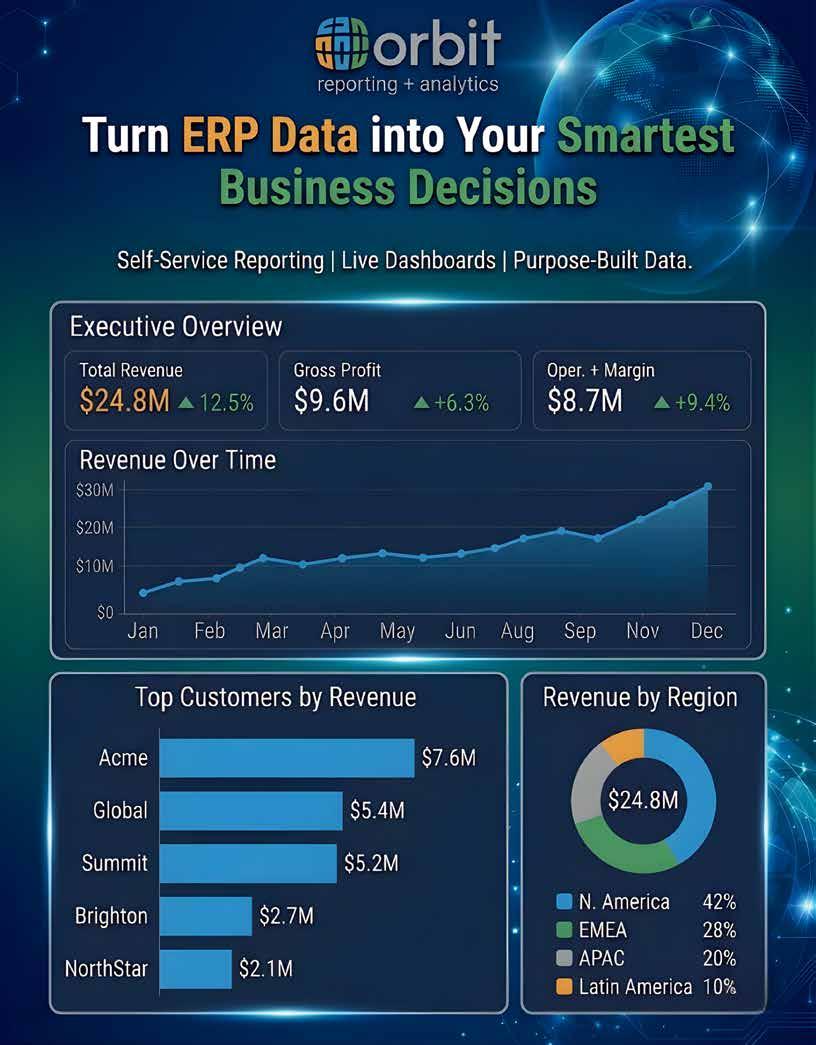
Advanced Analytics for the modern ERP World.
THE ERP TODAY AWARDS 2026
DECEMBER 2026 | LONDON
Winners will be revealed at our exclusive awards ceremony in London on December 3, 2026, bringing together the brightest minds in ERP for an unforgettable celebration of achievement, insight, and networking.
Nothing to lose!
Think your organisation or team is doing something exceptional? This is your chance to prove it.
Submissions Extended through August 31st.
www.judgify.me/2026erptodayawards
AI, operational execution, and real-world impact defined ERP leadership in 2025
BY TARSILLA MOURA
The 2025 ERP Today Awards made one thing clear: Successful system deployment is sometimes the easy part. What truly tests ERP leadership is what comes after—not implementation, but turning data, automation, and platforms into measurable business outcomes.
Across the winners and finalists, a consistent pattern emerged. The strongest projects did not treat ERP as infrastructure. They used it to drive customer engagement, operational performance, compliance, resilience, and transformation at scale.
A webinar organized by ERP Today with several award winners and finalists sharpened that conclusion. The panelists spoke less about go-lives and more about the work that made their projects stick: trust, data ownership, user adoption, business confidence, and measurable changes in how people actually work.
Below is a full breakdown of the winners and finalists by category, with added insights from the winners’ panel.
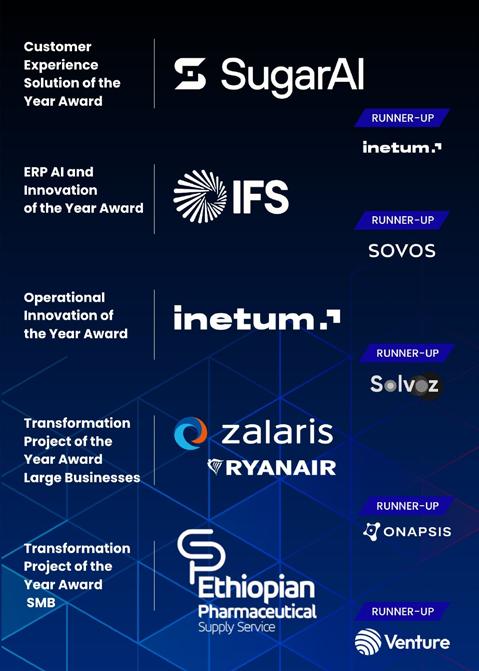
Customer Experience Solution of the Year
Customer experience has moved into the core of ERP strategy. CX is becoming part of day-to-day enterprise operations, with customer data informing sales, service, inventory, and fulfillment decisions inside the systems where work already happens.
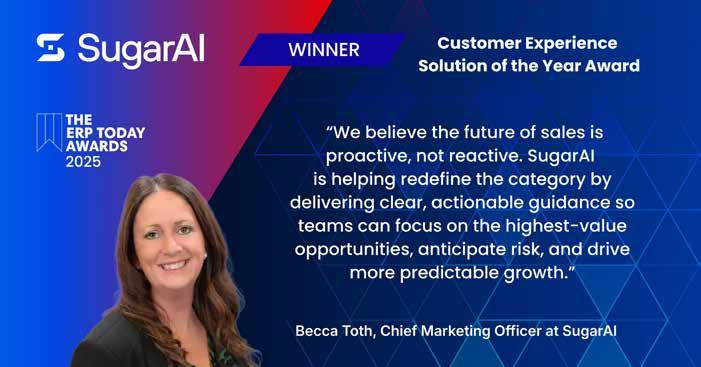
SugarAI won for its work with Country Fare, transforming fragmented sales data into a unified, actionable customer view. The system enabled real-time insights into behavior and preferences, allowing sales teams to move from reactive processes to proactive engagement strategies.
Becca Toth, Chief Marketing Officer at SugarAI, said the biggest impact was “turning data into action.” Country Fare, she said, could “spot changes in customer buying behavior before they became lost accounts,” helping drive 21% company growth, a 40% increase in revenue from existing customers, and a 20% reduction in time previously spent pulling together manual reports.
The more important sign of success was behavioral. “The real turning point for them wasn’t just the numbers,” Toth said. “It was when they saw our solution become part of the team’s daily sales conversations.”
She added that sales reps were able to identify at-risk customers and new opportunities with more confidence. “That’s when they knew the solution had really become an essential part of how they sell, not just a piece of technology.”
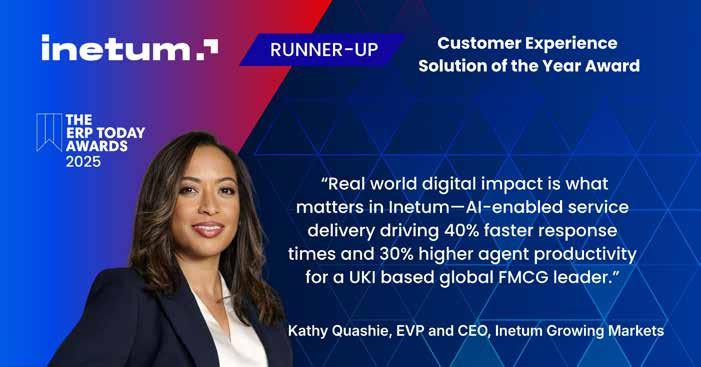
Inetum was recognized as runnerup for its AI-driven service delivery optimization project for a global FMCG organization, improving workload management, reducing backlogs, and accelerating response times in high-volume environments. Judges emphasized the practical impact on service operations, particularly how AI-driven prioritization improved response times and day-to-day execution.
Operational Innovation of the Year
Operational innovation is expanding beyond traditional enterprise environments, with ERP being applied to new sectors and increasingly complex operating models.
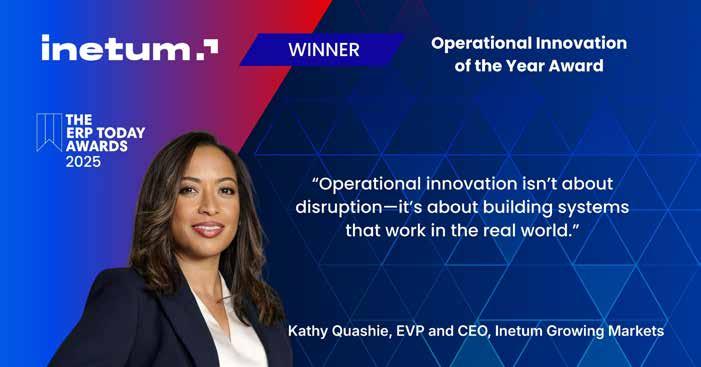
Inetum won for its SAP S/4HANA Public Cloud implementation with Erri Berri, replacing fragmented systems with a unified platform spanning budgeting, planning, and operational reporting. The project stood out for its speed and execution, completing in a compressed timeline while delivering measurable improvements in process accuracy and efficiency.
Judges pointed to the combination of speed, disciplined execution, and measurable efficiency gains as evidence of a scalable, real-world transformation. Kathy Quashie, EVP and CEO, Inetum Growing Markets, described the project as proof that “disciplined execution and speed can go hand-in-hand.”
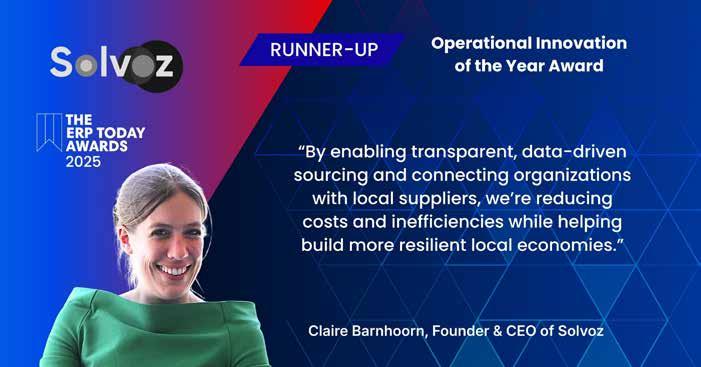
Solvoz earned runner-up recognition for Mawared MENA, a procurement platform that digitizes sourcing and purchasing processes in humanitarian environments, improving transparency and decision-making in resource-constrained settings.
During the webinar, Claire Barnhoorn, Founder and CEO of Solvoz, put the project into operational context. In humanitarian and development environments, she said, procurement can represent “65% to 80% of organizational spend.” With needs rising faster than funding, procurement becomes one of the clearest places to improve outcomes.
The harder problem is fragmentation. Barnhoorn said traditional systems often assume organizations already know their suppliers and procurement processes. “In crisis environments, or in humanitarian deployments, that assumption doesn’t often hold,” she said. Suppliers can be hard to identify, procurement teams
work under extreme time pressure, and transparency requirements are high.
For Solvoz, the goal was not simply to digitize a process for one organization. It was to create shared market infrastructure. “The real success is not if the technology works,” Barnhoorn said. “The real test is, have people changed the way they work because of it?”
ERP AI and Innovation of the Year
AI in ERP has shifted from experimentation to embedded execution, with leading vendors integrating intelligence directly into core platforms.
IFS won for IFS.ai, a platform that embeds AI across asset management, service, and manufacturing operations. The solution stood out for integrating AI into the core system rather than layering it externally, enabling predictive maintenance, optimized service delivery, and improved operational decision-making.
Judges were impressed by the depth of AI integration across the platform, demonstrating enterprise-wide impact rather than isolated use cases.
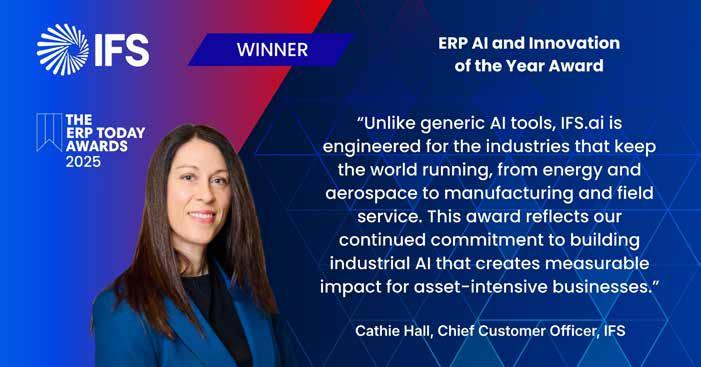
“Unlike generic AI tools, IFS.ai is engineered for the industries that keep the world running, from energy and aerospace to manufacturing and field service,” Cathie Hall, Chief Customer Officer at IFS, told ERP Today. “This award reflects our continued commitment to building industrial AI that creates measurable impact for asset-intensive businesses.”
Sovos was named runner-up for its real-time tax compliance platform, which provides continuous visibility into global regulatory obligations, applying rules at the point of transaction and reducing reliance on post-process reconciliation.
Judges highlighted the solution’s immediate applicability in a complex domain, delivering continuous compliance visibility without adding process friction.
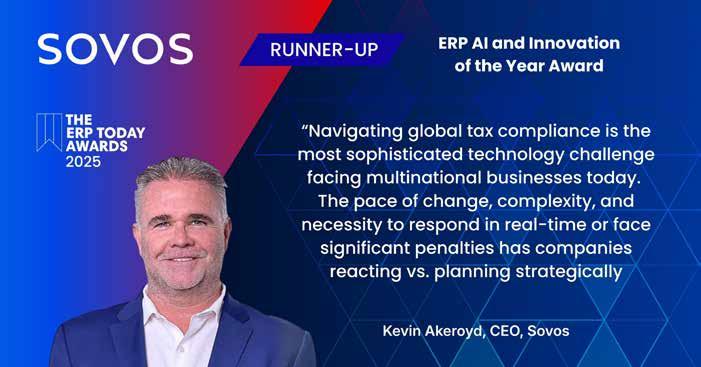
“Navigating global tax compliance is the most sophisticated technology challenge facing multinational businesses today,” said Kevin Akeroyd, CEO of Sovos. “The pace of change, complexity, and necessity to respond in real time or face significant penalties has companies reacting versus planning strategically.”
SMB Transformation Project of the Year
Transformation at the SMB level is proving that scale is not the defining factor. Impact is.
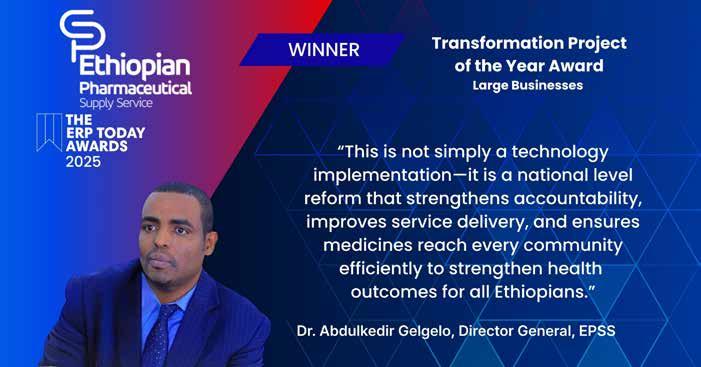
The Ethiopian Pharmaceutical Supply Service (EPSS) won for its digital transformation of Ethiopia’s pharmaceutical supply chain, replacing fragmented systems with a coordinated, data-driven platform. The initiative improved visibility into inventory, demand, and distribution, strengthening access to essential medicines across the country.
During the webinar, Dr. Abdulkedir Gelgelo, Director General of EPSS, said the organization’s mandate is to procure, store, and distribute medicine to more than 5,000 health facilities across Ethiopia. Before the transformation, he said, much of the supply chain relied on manual processes, with inventory, finance, and HR running in fragmented systems.
The case for transformation was not abstract. “If we don’t automate this system, there will be product out of stock,” Gelgelo said. “Mothers and children won’t be getting needed supplies.”
EPSS implemented SAP nationwide in 2022 under a project called SMILE. Gelgelo said the initiative moved core process automation from a low baseline to roughly 70% and required sustained change management, stakeholder engagement, training, and leadership commitment.
“The software made 75% of auto -
mation possible,” he said. “But the change management is what made it real.”
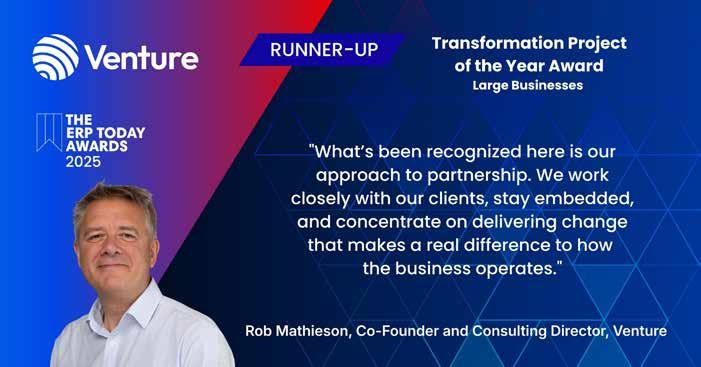
Venture was recognized for its work with Biffa, aligning operational improvements with sustainability goals through better visibility, coordination, and process standardization. In the webinar, Rob Mathieson, Co-Founder and Consulting Director at Venture, said Biffa had been operating on a mainframe system that went live in 1992, with complex financial processing across 70 legal entities.
The business case, he said, came down to visibility. Biffa needed better insight into financial performance, regulatory compliance, supply chain, and sustainability. But the project also reinforced a lesson that ran through the full panel.
“Implementing technology is almost relatively the easy piece,” Mathieson said. “What’s harder is the data migration, the adoption, the change management, and the human element.”
Large Enterprise Transformation Project of the Year
At the enterprise level, transformation is defined by the ability to manage complexity at scale without disrupting operations.
Zalaris won for modernizing Ryanair’s payroll system, creating a unified, scalable platform that improved visibility, compliance, and operational control across a large international workforce.
Sandra Fallon, Head of Payroll at Ryanair, said that Ryanair entered its partnership with Zalaris in 2023 and has since moved 10 European countries into SAP, covering more than 12,000 employees and bringing payroll operations into a centralized Dublin environment for the first time.
The problem was data ownership and scale. Ryanair had used payroll
bureaus across different European countries, and Fallon said the team “never really felt that [they] owned [their] own data.” Much of the work still depended on spreadsheets, and the previous system could not keep pace with growth.
That changed how the business viewed payroll. The centralized model, Fallon said, was “a game changer” in helping Ryanair deliver accurate payroll on time. She also noted that Ryanair now has greater confidence to bring more payroll operations under the same umbrella.
Neil Worthy, Senior Project Manager at Zalaris, said the project depended on trust and standardization. “Payroll’s obviously a key thing for employees,” he said. “Employees need to trust that payroll’s going to work.”
Onapsis was named runner-up for its security-led transformation approach, embedding protection and compliance directly into ERP environments to strengthen resilience and business continuity. Judges highlighted the strategic role of security in enabling transformation, positioning risk management as a core business capability.
“Our Secure RISE Accelerator helps reduce risk and remove security and compliance barriers, enabling enterprises to complete their transformations on time and in budget without compromising security,” said Sadik Al-Abdulla, Chief Product Officer at Onapsis.
“The projects that stand out now are those that prove technology actually changed the business after the system went live.”
The Bigger Picture
ERP is no longer evaluated on implementation success alone. Across all categories, the 2025 results show the next phase of ERP is defined by embedded intelligence, operational execution, measurable business outcomes, and the ability to make change stick.
The 2025 award winners and finalists repeatedly returned to the same themes—start with the business problem, protect focus, invest in change management, free up the right people, and measure whether the organization works differently after the project.
Toth said the strongest projects start with the business problem, not the technology. The most compelling stories, she said, are not only about software or metrics, but about “the moment when the organization starts behaving differently.”
Barnhoorn made a similar point about AI. “I don’t think it’s enough to talk about AI alone,” she said. “It’s not the story. The real question is if the technology can change how decisions are made.”
Worthy summed up the execution discipline behind successful transformation: “What’s the core thing that I’m trying to achieve? What am I trying to make better? You can focus on many different things, but there’s got to be a limited number of core aims. Without that, you’ll lose focus.”
For ERP vendors, partners, and enterprise leaders, the bar has moved from deployment to impact. The projects that stand out now are the ones that prove technology actually changed the business after the system went live.
“Implementing technology is relatively easy. What’s harder is the data migration, the adoption, the change management, and the human element.”
• Customer experience is a key operational function inside ERP. The SugarAI and Inetum submissions show that customer insight only becomes valuable when it changes how teams prioritize work, manage risk, and act in daily workflows. In 2026, the strongest CX submissions will need to show how customer data changes behavior, not just how dashboards improve visibility.
• Visibility, trust, and behavior change define operational maturity. Inetum’s Erri Berri project shows the value of disciplined execution inside a cloud ERP
WHAT THIS MEANS FOR ERP INSIDERS
program, while Solvoz shows how structured procurement can create impact across an ecosystem. In 2026, operational innovation entries will stand out by proving that technology changed execution in the real operating environment, not just inside the implementation plan.
• AI differentiation is shifting from features to architecture. IFS and Sovos show two sides of the same trend: AI is becoming more valuable when it is embedded into industry-specific workflows, whether in asset-intensive operations or real-
time tax compliance. In 2026, AI submissions will need to show where intelligence sits in the operating model and how it improves decisions at scale.
• Transformation strategy goes beyond efficiency into societal, environmental, and public-service outcomes. EPSS shows how ERPled transformation can support national health infrastructure, while Venture’s Biffa project shows how modernization can strengthen sustainability and financial control. In 2026, SMB transformation entries will be judged less
on organizational size and more on ambition, execution quality, and broader business or societal impact.
• Enterprise transformation includes trust, resilience, and security as design principles. Zalaris and Ryanair show how standardization can strengthen payroll accuracy and data ownership across a complex workforce, while Onapsis shows why ERP security is now part of transformation success. In 2026, large enterprise entries will need to show that scale did not come at the expense of control.
CUSTOMER EXPERIENCE AT THE CORE OF ERP STRATEGY
Customer experience (CX) now sits at the center of ERP strategy. This year’s Customer Experience Solution of the Year Award highlights how organizations are using ERP systems not just to manage customer relationships, but to drive engagement, retention, and growth. The award recognizes projects that deliver measurable improvements in how businesses engage, serve, and retain customers through enterprise technology. In 2025, the strongest entries were those that demonstrated a clear connection between data, insight, and action.
WINNER
SUGARAI AND COUNTRY FARE
This year’s winner, SugarAI, was recognized for its project “Turning Sales Data into Customer Success: Country Fare’s CX Transformation with SugarAI.” The project allowed Country Fare to convert fragmented sales data into a unified view of the customer for better daily operations.
Rather than relying on static reporting, the solution enabled Country Fare to anticipate customer needs, personalize engagement strategies, and align sales activity to actionable data. Sales teams gained real-time insight into behavior, preferences, and buying patterns. The award judges highlighted the clarity of the transformation: Data was not just centralized, it was operationalized. The result was a measur -
able shift in how the business engages with its customers, moving from reactive sales processes to proactive relationship management. It is a clear example of how ERP-integrated CRM platforms can drive both customer satisfaction and commercial performance.
“We’re honored to receive the ERP Today Customer Experience Solution of the Year Award,” Becca Toth, Chief Marketing Officer at SugarAI, tells ERP Today. “We believe the future of sales is proactive, not reactive. SugarAI is helping redefine the category by delivering clear, actionable guidance so teams can focus on the highestvalue opportunities, anticipate risk, and drive more predictable growth.”
RUNNER-UP
INETUM AND CX IMPACT AT SCALE
Inetum earned runner-up for its project, “From Overload to Optimization. Redefining Service Delivery with AI for a UKI-Based Global FMCG Leader,” which focused on service delivery performance inside a high-volume, fast-moving environment. Inetum deployed an AI-driven approach to manage workload, prioritize tasks, and support faster resolution across service operations.
Inetum’s CX work demonstrated its ability to deliver meaningful improvements in customerfacing processes. Teams gained better visibility into demand and capacity. The system identifies pressure points and helps allocate resources more effectively, which reduces backlog, improves response times, and supports a
more consistent service experience.
Judges highlighted the practical impact. The project improves how teams operate day to day while strengthening the overall customer experience. It shows how service optimization and customer outcomes are closely linked when the right data is in place.
“Real world digital impact is what matters in Inetum—AI-enabled service delivery driving 40% faster response times and 30% higher agent productivity for a UKI based global FMCG leader,” says Kathy Quashie, EVP and CEO, Inetum Growing Markets. “These are not ambitions, but measurable business outcomes and service you can trust.”
CUSTOMER
INETUM WINS FOR ERRI BERRI; SOLVOZ NAMED RUNNER-UP FOR MAWARED MENA PLATFORM.
OPERATIONAL INNOVATION BEYOND TRADITIONAL BOUNDARIES
Operational innovation is no longer confined to efficiency gains within traditional enterprise environments. It is evolving, and this year’s Operational Innovation of the Year Award highlights how organizations are rethinking operations across a wide range of environments—from cultural institutions to global supply chains.
The category recognizes projects that deliver meaningful improvements in efficiency, agility, and performance through enterprise technology.
WINNER
INETUM BUILDING A FUTURE-READY BUSINESS
Inetum won Operational Innovation of the Year for “Erri Berri Builds a Future-Ready Business with SAP S/4HANA Public Cloud.” Erri Berri worked with Inetum to replace fragmented systems and manual workflows with a centralized ERP platform.
The project moved the business onto SAP S/4HANA Public Cloud and gave teams a unified system for budgeting, planning, project management, and operational reporting.
The implementation required major internal alignment. Erri Berri had to adapt processes to SAP standards, migrate data, train users, and manage change across departments. The project was completed in six months, which stood out to judges as a strong example of focused execution. Teams can now manage end-to-end processes
from budgeting through project closure with better accuracy and fewer delays.
The judges recognized the project for its practical operational impact. Inetum’s support combined consulting, technical implementation, and change management, while SAP’s public cloud infrastructure gave Erri Berri a secure and scalable foundation for future growth, integration, and AIdriven enhancements.
“Operational innovation isn’t about disruption—it’s about building systems that work in the real world,”
Kathy Quashie, EVP and CEO, Inetum Growing Markets, tells ERP Today. “Delivering SAP Cloud ERP in 16 weeks, on budget, for Erri Berri created an integrated operating model built to scale. Proof that disciplined execution and speed can go hand-in-hand.”
SOLVOZ DRIVING IMPACT IN HUMANITARIAN OPERATIONS
Solvoz was recognized as runner-up for its platform Mawared MENA, which digitizes procurement and supply chain operations in the humanitarian and development sector—environments that often rely on fragmented systems, manual processes, and limited visibility across purchasing activities. Mawared MENA introduces a centralized, digital platform that standardizes procurement workflows and improves transparency. Organizations can manage sourcing, vendor selection, and purchasing decisions within a structured system, replacing ad hoc and paper-based processes. Teams gain clearer insight into demand, supplier performance, and spending patterns.
Judges focused on the practical impact. In complex operating environments, even small im -
provements in procurement can have significant downstream effects. By introducing consistency and data-driven processes, Solvoz helps organizations operate more effectively and allocate resources with greater confidence.
“We’re honored to be recognized by ERP Today. Mawared MENA shows that procurement, when structured as shared infrastructure across markets rather than fragmented processes, can deliver both efficiency and system-wide impact,” says Claire Barnhoorn, Founder & CEO of Solvoz, Advocacy and Strategy Lead Mawared MENA. “By enabling transparent, data-driven sourcing and connecting organizations with local suppliers, we’re reducing costs and inefficiencies while helping build more resilient local economies.”
AI IN ERP REACHES TURNING POINT
AI in ERP has entered a new phase that is being defined by execution rather than experimentation. This year’s ERP AI and Innovation of the Year Award recognizes solutions that move beyond isolated AI use cases to deliver enterprise-wide impact. The category focuses on product innovation and development inside core ERP systems. This year’s judges looked for platforms that improved performance, supported better decisions, and enabled meaningful transformation at scale.
WINNER
IFS.AI ACROSS THE ENTERPRISE
IFS took top honors for its flagship platform, IFS. ai, which earned the highest scores from the judging panel for both scope and real-world applicability.
What set IFS.ai apart was the depth of its integration. Rather than positioning AI as an overlay, IFS has embedded intelligence directly into its core ERP platform, spanning asset management, service operations, and manufacturing environments. The platform represents a clear evolution in ERP: AI is no longer a bolt-on capability, but a foundational element of how the system operates.
Judges were particularly impressed by the platform’s ability to support industrial-scale use cases. From predictive maintenance to opti -
mized service delivery, IFS.ai demonstrates how AI can enhance decision-making, reduce downtime, and improve operational performance across complex enterprise landscapes.
“Winning the ERP Today Award for AI and Innovation of the Year is a recognition we are proud to receive on behalf of our customers, whose real-world results are at the heart of what IFS.ai was built to deliver,” Cathie Hall, Chief Customer Officer at IFS tells ERP Today. “Unlike generic AI tools, IFS.ai is engineered for the industries that keep the world running, from energy and aerospace to manufacturing and field service. This award reflects our continued commitment to building industrial AI that creates measurable impact for asset-intensive businesses.”
RUNNER-UP
SOVOS AND GLOBAL COMPLIANCE
Sovos was named runner-up for its solution, “Sovos Intelligence—Mirror Visibility for RealTime Tax Compliance.” The project applies AI to global tax compliance, which is one of the most demanding areas of enterprise operations.
By embedding real-time intelligence into ERP workflows, Sovos gives finance and compliance teams continuous visibility into obligations across jurisdictions. The system tracks regulatory changes, applies the correct rules at the point of transaction, and flags risks before they become issues. This reduces reliance on after-the-fact reconciliation and helps organizations stay aligned with complex, fast-changing requirements.
Judges highlighted the sophistication of the solution and its immediate practical value for
multinational enterprises. The platform fits into existing processes without adding friction, while improving accuracy and control. For multinational enterprises, this means fewer surprises, faster reporting cycles, and stronger confidence in compliance across global operations.
“Navigating global tax compliance is the most sophisticated technology challenge facing multinational businesses today,” says Kevin Akeroyd, CEO, Sovos. “The pace of change, complexity, and necessity to respond in real-time or face significant penalties has companies reacting vs. planning strategically. Sovos is on a mission to transform compliance from a necessary requirement to a force for growth, and solutions such as Mirror Visibility with AI enable us to do that.”
ERP AI AND INNOVATION OF THE YEAR AWARD
ZALARIS WINS FOR RYANAIR
PROJECT; ONAPSIS NAMED RUNNER-UP FOR SECURITY-LED TRANSFORMATION.
LARGE ENTERPRISE TRANSFORMATION SETS NEW BENCHMARKS
Transformation at the enterprise level is often defined by complexity. Most initiatives require coordinating global operations, managing risk, and delivering change at scale, all without disrupting business continuity. In particular, large-scale transformation requires precision and control. The Transformation Project of the Year Award for Large Businesses recognizes organizations that successfully execute complex change across global operations.
WINNER
ZALARIS AND RYANAIR REIMAGINE GLOBAL PAYROLL
Zalaris won in this category for its project, “Ryanair’s Payroll Transformation—Future-Ready Global Payroll with Zalaris,” which focused on modernizing payroll for one of Europe’s largest airlines, replacing fragmented processes with a more unified, scalable model.
Ryanair needed a payroll operation that could support a large international workforce, handle complexity across multiple regions, and maintain accuracy in a high-volume environment. Zalaris delivered a future-ready payroll platform designed to improve consistency, compliance, and operational control. The implementation strengthened visibility across payroll operations and gave teams a more reliable foundation for managing workforce data. By standardizing processes and improving automation, the project reduced manual effort and helped payroll teams work with greater speed and accuracy.
Judges focused on the complexity of the environ -
ment and the quality of execution. Payroll transformation at this level demands precision, careful oversight, and close alignment between technology and business needs. The project stood out because it improved a critical enterprise function while giving Ryanair a platform to support future growth and workforce agility.
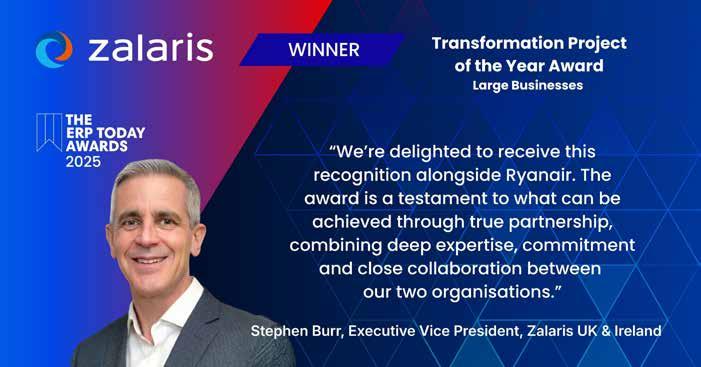
“We’re delighted to receive this recognition alongside Ryanair. The award is a testament to what can be achieved through true partnership, combining deep expertise, commitment and close collaboration between our two organizations,” Stephen Burr, Executive Vice President, Zalaris UK & Ireland, tells ERP Today.
“The creation of a one-stop shop payroll for Ryanair has revolutionized how we process payroll,” adds Sandra Fallon, Head of Payroll, Ryanair. “Having data processed in one place is hugely efficient and allows for end to end oversight of the data.”
RUNNER-UP
ONAPSIS POSITIONS SECURITY AS TRANSFORMATION
Onapsis was recognized as the runner-up for its ERP security transformation program, which reframes security and compliance as central to enterprise transformation. The project focused on protecting mission-critical ERP systems and strengthening operational resilience.
In large enterprises, ERP platforms sit at the center of finance, supply chain, procurement, HR, and customer operations. Onapsis showed how security and compliance can support transformation by reducing risk across the systems that keep the business running. The work improved visibility into vulnerabilities, compliance gaps, and threats. By helping organizations identify and address risk before disruption occurs, the program supports stronger business continuity and better governance.
Judges highlighted the project’s strategic relevance. Security is often treated as a technical control, but this sub-
mission showed its role in enabling confidence, resilience, and long-term transformation. Onapsis stood out for reframing ERP protection as a business-critical capability with direct implications for continuity, compliance, and enterprise performance.
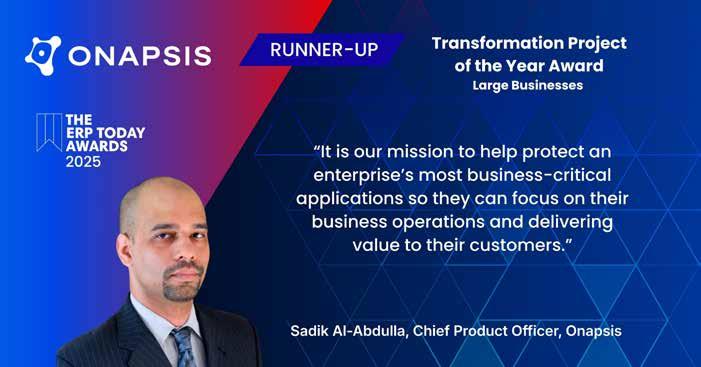
“We are honored to be recognized by ERP Today for our Onapsis Secure RISE Accelerator in the Large Enterprise Transformation category,” says Sadik Al-Abdulla, Chief Product Officer at Onapsis. “Our Secure RISE Accelerator helps reduce risk and remove security and compliance barriers, enabling enterprises to complete their transformations on time and in budget without compromising security. It is our mission to help protect an enterprise’s most business-critical applications so they can focus on their business operations and delivering value to their customers.”
TRANSFORMATION PROJECT OF THE YEAR
AWARD FOR LARGE BUSINESSES
THE ETHIOPIAN PHARMACEUTICAL SUPPLY SERVICE WINS; VENTURE RECOGNIZED AS RUNNER-UP FOR BIFFA TRANSFORMATION.
TRANSFORMATION AT ANY SCALE DRIVES SMB IMPACT
Transformation projects of all sizes continue to raise the bar. Digital transformation is often associated with large enterprises, but this Small and Medium-Sized Business (SMB) category shows that some of the most ambitious and impactful projects are happening at smaller scales.
The Transformation Project of the Year Award for SMBs recognizes organizations generating under $1 billion in revenue that have achieved outstanding results with clear outcomes and strong execution through the strategic use of
WINNER
EPSS DRIVES NATIONAL-SCALE TRANSFORMATION IN PUBLIC HEALTH
The Ethiopian Pharmaceutical Supply Service (EPSS) was named the 2025 winner for its project, “Pioneering Digital Transformation in Ethiopian Public Health Logistics.” The initiative involves digitizing the pharmaceutical supply chain across Ethiopia, replacing fragmented processes with a more coordinated, data-driven system.
The goal was to improve how medicines are procured, stored, and distributed across a complex national network. This required aligning multiple stakeholders, standardizing workflows, and introducing technology into areas where manual processes had been the norm. EPSS worked to integrate systems, improve data accuracy, and ensure teams across the organization adopted new processes. The result is a more connected supply chain with better visibility into inventory, demand, and distribution, allowing for faster response to shortages and more effective allocation of resources across the healthcare system.
Judges focused on the scale and real-world impact. The project improves access to essential medicines and strengthens the reliability of public health logistics. It shows how ERP-led transformation can deliver measurable outcomes beyond the organization itself, with direct implications for population health.
“The recognition of the digital transformation of EPSS reflects Ethiopia’s broader commitment under the Digital Ethiopia 2030 strategy to build a digitally enabled, transparent, and efficient public sector,” Dr. Abdulkedir Gelgelo, Director General of EPSS, tells ERP Today. “This is a result of the vision, commitment, and collaboration of the EPSS leadership and donors such as The Global Fund. EPSS’s ERP transformation […] lays the foundation for further digital change. This is not simply a technology implementation—it is a national level reform that strengthens accountability, improves service delivery, and ensures medicines reach every community efficiently to strengthen health outcomes for all Ethiopians.”
VENTURE AND BIFFA ALIGN TRANSFORMATION WITH SUSTAINABILITY
Venture was named runner-up for its project, “Sustainability in Every Sense: A Partnership That Transformed Biffa,” which centered on modernizing Biffa’s operations through a close partnership approach that used enterprise technology to support both performance and sustainability goals.
The initiative addressed operational inefficiencies while creating a platform for more consistent and scalable processes across the business. It focused on improving visibility, coordination, and control across key workflows. By replacing fragmented systems and introducing more structured processes, the project enabled better decision-making and more efficient use of resources. Sustainability was built into the approach, with technology supporting efforts to reduce environmental
impact alongside operational improvement.
Judges highlighted the strength of execution and the clarity of outcomes. The project shows how ERP transformation can support broader business priorities when it is tightly aligned with strategy. It stands as a strong example of how organizations can use enterprise systems to drive both operational and environmental progress.
“What’s been recognized here is our approach to partnership,” says Rob Mathieson, Co-Founder and Consulting Director, Venture. “We work closely with our clients, stay embedded, and concentrate on delivering change that makes a real difference to how the business operates. That’s exactly how we worked with Biffa, and we’re delighted to see it recognized.”
TRANSFORMATION PROJECT OF THE YEAR
AWARD FOR SMBS
ELECTRICITY BEHIND
THE LIGHT BULB THE
Brent Lewis, Senior Manager of Data & AI at Armstrong World Industries, on why the companies that will run AI in 2028 are the ones walking carefully right now.
BY TARSILLA MOURA
For Armstrong World Industries, AI strategy started with a practical question from the CEO: How is the company going to use AI?
The answer from the IT and data team was not to start with a tool. It was to step back and ask what kind of data foundation the business would need to scale AI across the enterprise.
Brent Lewis, Armstrong’s Senior Manager, Data & AI, discussed that work during a 2026 SAP Sapphire session on building a data foundation ready for AI. In a conversation with ERP Today, Lewis described how Armstrong’s history, M&A strategy, SAP landscape, and business need for faster answers shaped its approach to data and AI.
Armstrong is a 166-year-old company that manufactures ceiling, wall, and specialty architectural products. Its data environment has become more complex through business splits, divestitures, acquisitions, and integration across SAP and non-SAP systems. That complexity made AI a business opportunity, but also exposed the importance of data structure, governance, and scale.
Q: You had a session at Sapphire. Can you give an overview of what you presented?
BL: The presentation was about our plan as an organization to have a data foundation that was ready for AI. We’re not a
young company, and there’s been a lot of change over that period of time.
Our data has become very complex. We had a company that included flooring, ceilings, and walls. That split into two companies, and I represent the ceilings and walls company. That was a big data split. Then we divested our European and Pacific Rim markets, which created additional data complexity.
Our growth strategy has also involved M&A. We typically do two to three acquisitions a year, which creates another layer of complexity, especially because those companies often aren’t on SAP systems when we bring them in.
We were having a hard time keeping up with the business need for good data. What happens is the business needs answers, so people export data and get an answer. That may work in the moment, but it becomes very difficult to control. Different people can end up with different answers.
Then AI hit the mainstream consciousness, and we realized quickly that AI is a business challenge, not an IT challenge. Data is the IT problem. We knew we needed a very different data foundation. We structured our base data platform around SAP Business Data Cloud and Databricks, with other capabilities around that. The Sapphire presentation was about how we got there, why we did it, where we are today, and what our future ambitions are.
Q: How is AI a business problem and data an IT problem?
BL : Early in the journey, we saw consistently across research from firms like Gartner, KPMG, PwC, and others that AI cannot be treated as an IT fix. IT can help the business, just like with any application, but adoption won’t happen if AI is only driven by IT.
If AI is done right, it should accelerate the business strategy. Anything we do in AI has to tie back to the business strategy somewhere. That means the business process being impacted matters. The business has to bring the value case, and IT helps support it.
I like an analogy I heard about elec-
tricity. When people first saw a light bulb, they thought that was electricity. But it wasn’t. It was a light bulb, which was a use of electricity. AI is similar. AI is not the thing itself. It’s an integrated system behind the thing. ChatGPT, for example, is like the light bulb. The AI foundation behind it is the electricity.
We try to tell the business, ‘You tell us what your light bulb looks like, and we will make sure electricity gets to the lamp. We will help productionize it and make sure you can turn on 100 of those if you want.’
Q: How are you approaching the journey from data foundation to scaled AI?
BL: We use a crawl-walk-run approach. To scale AI successfully, we have to be able to run. If the vision is a fully autonomous organization, that’s running at full speed. If you try to go from nothing to sprinting, you’re going to fall and hurt yourself.
So we ask, ‘What does crawling look like? How do we get off the floor and start moving?’ It’s like watching a child learn to walk. You fall down, get up, and learn a lot of lessons along the way.
Now we’re at the walking stage. Our foundation is there, and we have two things in production that we can scale. We also have a list of things we plan to do this year. That’s how we start walking faster, with the goal of running by 2028.
Q: Do you have an example of an AI use case that has worked well?
BL: Pricing. We have a core business, which includes products like standard ceiling tiles. We also have an architectural specialties business, which includes more bespoke products such as unique ceiling designs, specialty walls coverings or column covers.
In that architectural specialties business, pricing works differently because of how the products are manufactured. Previously, someone would take data from our BW system and other sources, put it into a spreadsheet, and use that spreadsheet to provide budget pricing. We call it budget pricing, not a quote,
because it’s the first step in the process. We had some changes in personnel, and the manager asked whether this could be a good use case for AI. We automated the entire process. Now, a salesperson can interact with the system through a chat interface and ask for pricing on a certain type of product. The system asks the needed follow-up questions, uses the relevant data, and provides budget pricing. We also monitor accuracy and drift.
It helped in two ways. The person who had been doing the manual work could move into a more effective role, and the sales team could get an answer on the spot. It improved productivity and user experience.
It also improved visibility. Before, a spreadsheet would produce answers that were shared by email, and visibility could get lost. Now, the process captures data in real time and can feed dashboards that show pricing movement and buying behavior.
Q: Was that SAP-built or custom?
BL: It was custom-built. Business Data Cloud and Databricks give us flexibility. As an on-premise customer, we’re challenged in terms of how much Joule functionality we can access. But the connection to Databricks in our Business Data Cloud environment is robust. We can connect to the data we need, share it through Delta, and serve that out for AI on the other side. I think many customers don’t realize how selfserving these tools can be now if they have the right team in place.
We also changed our team as part of the data transformation. You cannot change your process without changing your people. Now we have a team that can support Databricks, work with the business on use cases, design pilots, push them into production, and support the operating model around that.
Q: How is Armstrong’s relationship with SAP, and how does it shape the path to cloud and AI?
BL: We have been an SAP customer for
about 27 years. SAP is a very good ERP system, and one of its strengths is how customizable it is. If you think about how a business differentiates itself from competitors, a lot of that shows up in customizations. The ERP system has to support that, and SAP has done that well.
The challenge for a customer like us is moving from a heavily customized onpremise environment into subscription models, cloud models, and now consumption models. That evolution makes the relationship more complex. We’re a publicly traded company and are sensitive to operating expense, so moving from capital expense to operating expense doesn’t always fit easily with our business model.
Our SAP system has been customized over many years to support how we differentiate the business. That customization now creates some of the pain in getting to the next model.
SAP and customers like us often want the same future state. For example, SAP would like customers to keep their semantic value in the SAP ecosystem when they build agents, and I agree with that vision. But as an on-premise customer, the question is: How does SAP help us get there?
This is an investment with a high business impact. We’re aligned on the vision, but getting from the old environment to that future state is the hard part. Q: What are your customers asking Armstrong for, and how does that shape your technology needs?
BL: Our customers largely buy through a distribution network. We work through distributors to sell to end customers, so our customer interactions often go through those distributors.
As we have grown through M&A, we have added adjacent products and capabilities. Many of those acquired companies have their own brands and systems. That can make it difficult for customers to know where to buy a product.
Over time, we saw some customer pain points emerging, particularly around who to go to for buying across
the expanded portfolio and our new brand companies.
We’re very intentionally trying to make the customer experience feel like a unified Armstrong experience, where customers know where to go and how to get what they need. That’s also a data and systems challenge because acquisitions often come with non-SAP systems that need to be integrated over time.
Q: How do acquisitions affect Armstrong’s ERP roadmap and broader integration planning?
BL: If we stopped buying companies today, it’d probably take several years to get all companies onto the roadmap. At two to three acquisitions a year, you need a strong plan for how each company comes into the environment. That’s a key area of focus for us now.
“AI IS A BUSINESS CHALLENGE, NOT AN IT CHALLENGE. DATA IS THE IT PROBLEM.”
The timeline depends on the company being acquired and where it is in its development cycle. Every acquisition is unique, and each one brings its own level of complexity. You have to understand what systems the company is using, how mature those systems are, what data needs to move, and what needs to happen before the next step. ERP is often later in the integration process because the plan has to be customized for each company so we can support its growth while managing the near-term impact on the broader business.
Licensing and data are two areas where we’ve gotten better with experi -
ence. If an acquired company has 300 users on one system who’ll eventually need to move into Microsoft and SAP environments, what’s the licensing impact? What’s the sizing impact for data? Those are the kinds of nuances we now think through earlier in the integration plan.
Q: What advice would you give to companies that are growing through acquisitions and trying to manage data complexity?
BL: It depends on the maturity of the company being acquired. Do they have a strong system already, or are they working mostly out of less mature tools? That changes the approach.
One lesson for us was the importance of runbooks. We developed runbooks early for infrastructure, which is the first thing we integrate. You absorb the infrastructure, secure it, and standardize it. That’s very important.
Now we’re extending that thinking to the rest of the integration process. As companies are acquired, what are the steps? What needs to move, why does it need to move, and when should it move?
My advice is to get that plan early, especially if you plan to acquire more than one company. The AI tools available now can also help. They can analyze data complexity, identify what needs to be transformed, and help create a more solid plan than what would have been possible a few years ago.
Q: What are you focused on for the rest of 2026?
BL: From a data perspective, our 2026 goal is to put six use cases into production by the end of the year. We have one, so we need to get the other five.
That’s the walking stage for us, showing the business that we can do this. We put the plan in place, and now we can execute it.
The team is in place, the business is excited, and people are starting to understand what we can build. It has been really fun to watch that evolution.
WHAT’S NEXT? AFTER AGENTS,
SAP Labs US is already working on what comes after the autonomous enterprise.
BY TARSILLA MOURA
At SAP Sapphire, held in Orlando last month, much of the conversation centered on SAP’s Autonomous Enterprise, Joule Studio, AI agents, and the Business AI Platform.
Yaad Oren is already looking past the current agent wave.
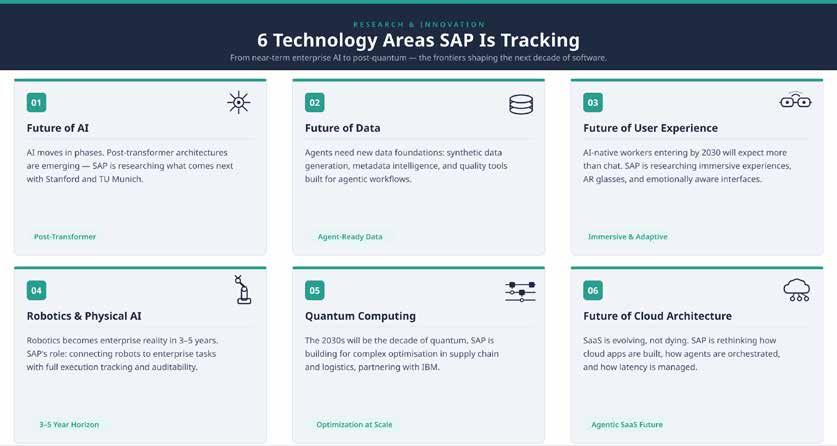
Oren is SAP’s Global Head of Research & Innovation and Managing Director of SAP Labs US. SAP Labs, he explained, continuously explores emerging technologies that could shape enterprise software five to ten years down the line. In a conversation with ERP Today, Oren described six areas SAP is tracking closely:
• the future of AI
• the future of data
• the future of user experience
• robotics and physical AI
• quantum computing
• the future of cloud architecture.
• SAP and broader ERP customers need to act on today’s AI capabilities, he said, but they should also start looking at and forming a point of view on what comes next.
Q: How do you describe your role at SAP Labs US and in Research & Innovation?
YO: SAP Labs US builds products across AI, cloud, and many other areas. When we say “labs,” we mean development teams. SAP has more than 30,000 people based in the US, and around 6,000 of us are building product.
The other role I have reports into Philipp Herzig, SAP’s CTO. I drive a global organization called Research & Innovation. The name says what we do: We explore emerging technologies and try to apply them to product, while also looking at what could shape the IT industry five to ten years from now.
Some of what you heard at Sapphire, including the Autonomous Enterprise, AI agents, and Joule Studio, involved work my team helped with. But we are also looking at technologies that are further out.
Q: What are the main technology areas your team is tracking?
YO: We are looking at six areas. The first is the future of AI. Today, the enterprise conversation is around the
“THE 2020S IS THE DECADE OF AI; THE 2030S WILL BE THE DECADE OF QUANTUM.”
Autonomous Enterprise and what we believe are best practices for enterprise AI. But AI moves in phases. Ten years ago, there was another generation of AI. Then came generative AI. Five to ten years from now, there will be another disruption.
When ChatGPT came out in 2022, many people were surprised. But in
YAAD OREN
research, we saw the direction earlier, when the 2017 “Attention Is All You Need” paper appeared and transformer architectures started to develop. Now, if you go to AI research conferences, you can see new architectures emerging again. They are not yet actionable for customers, but we are working on what we call post-transformer architecture with universities including Stanford and the Technical University of Munich.
The second area is the future of data. Everything is based on data, and the data platform will need more foundational services in the future. Customers may need synthetic data generation to train agents, new data quality tools, new metadata intelligence, and new ways to understand data generated by agents.
The third is the future of user experience. We are in a paradigm shift in how people interact with enterprise systems. Today that includes conversational interfaces, voice, and adaptive experiences such as spaces. My kids, for instance, are AI-native, not just mobile-native or digital-native. When they enter the workforce around 2030, they will expect a different way to interact with software. That’s why we are researching immersive experiences, glasses, and even interfaces with more emotional connection.
The fourth area is robotics and physical AI. We believe robotics and physical AI will become part of enterprise reality in the next three to five years. SAP is not building robots, but we are enabling the SAP layer that connects robots to enterprise tasks. A robot needs to be able to execute a task, report what it did, and make that auditable.
The fifth is quantum computing. SAP’s CEO [Christian Klein] has said the 2020s is the decade of AI and the 2030s will be the decade of quantum. It’s still early, but we are already working on optimization at scale. Quantum can help with complex optimization problems with many variables, which is highly relevant for supply chain, logistics, and similar use cases. We are collaborating with IBM and other partners in this area.
The sixth area is the future of cloud architecture. SaaS is not dead, but it’s
evolving. As agents become more widespread, we need to think about how future cloud applications will be built, how agents will be orchestrated, and how we optimize latency and other architectural requirements.
Q: You mentioned the future of data. Does that include data about what AI agents are doing?
YO: Yes, that’s a big part of it. The Business AI Platform is about building agents, giving them context and reasoning, and governing them. Governance is very important, and it does not always get enough attention because it’s not as visible as the application experience.
With LeanIX, SAP has Agent Hub, which gives companies a registry of agents. That may sound simple, but
“WITH AI AGENTS EVERYWHERE, COMPANIES NEED MORE INNOVATION AROUND GOVERNANCE.”
many companies don’t have one. It’s important to know where the agents are, including agents not built by SAP. Through agent-to-agent protocols, SAP and non-SAP agents can be listed in one registry.
Signavio can also support agent mining, so companies can see agent behavior and trace it back. If agents are going to be everywhere, companies will need more innovation around how they govern agents, analyze behavior, manage exceptions, monitor generated data, and create trust.
One way to think about it is that companies need a blanket over all their agents. If anyone in any department
can create an agent, how does the enterprise know that agent is part of the catalog? How can they trace it? That’s a future data and governance problem.
Q: How much do customer needs shape these research priorities?
YO: Customers are first and foremost. Every year in the first quarter, we run an exercise to understand our priorities. We talk to customers, especially innovative customers, about challenges beyond the next one or two roadmap cycles. We also talk to analysts, journalists, academia, venture capitalists, and startups. It’s useful to see where smart money is going and what researchers are working on.
No one has a crystal ball, so we look across many signals. Customers are a major part of that process.
Q: Have the priorities changed from last year to this year?
YO: The six strategic areas have not changed, but the emphasis inside them has.
AI is moving very fast, so the future of AI has become even more important. Data has also become more prominent because customers will need more tools than what the current industry data platform provides today. Physical AI is also becoming more important, though it is still more use-case-specific. Inside AI, multiagent orchestration is advancing quickly. At Sapphire, we talked about assistants. “Assistant” is not a technical term; it’s a framing. Agents do the work, and assistants coordinate them. In finance, for example, one agent may look at open invoices, another may match invoices and accounts, and another may draft a communication. The assistant coordinates the process.
Q: How is AI changing the role of the software engineer?
YO: I still believe strongly in software engineering. The role will evolve, but in enterprise software, engineering remains critical.
It’s amazing what LLMs can do, and everyone should learn how to use them. But enterprise applications need to scale. They need verification, governance, security, and enterprisegrade quality. That’s very different from a consumer app.
Software engineers need to embrace AI tools and know how to work with them. They also need to know where they add value: verifying the code, making sure the right data is used, guiding agents, and ensuring the application works in an enterprise setting.
Q: How should customers, partners, and hyperscalers collaborate to push innovation forward?
YO: First, customers and leaders need to raise their heads and look at the horizon. They don’t need to buy anything related to every future technology today, but they should have an opinion about what’s coming in the next three to five years. They should talk to people in research, academia, startups, and the technology ecosystem so they aren’t surprised by the next shift.
Second, we collaborate through in -
dustry groups and partnerships. I’m on the board of several institutes, including the Silicon Valley Leadership Group, and I co-chair its physical AI and robotics work. We work with other companies to promote and understand these topics.
Third, we work directly with customers and partners on co-innovation projects. Bosch is one example. Bosch, Boston Dynamics, and SAP worked together on an inspection robotics use case. We’ve also worked with Accenture and Vodafone on robotics-related use cases connected to enterprise asset management.
Q: What advice would you give companies that want to build their own research and innovation capability?
YO: They need to understand that research and innovation require a different operating model.
My team fails often because we’re an incubation team. It’s similar to venture capital. A venture firm may have many investments, and one big success can make the portfolio. Our success rate is higher than that, but the operating model is different from a standard product organization.
We release many beta services and measure adoption. If something sticks and customers use it, we move it toward a product. That means companies need a different funding model, with more patient capital. The return may not come the same way it does when funding version 18 or 19 of an existing product line, but the upside can be much bigger.
Second, they need sponsorship from the C-level, ideally the CEO. If projects fail and there’s no executive sponsorship, people will ask why the work is continuing. You cannot stop in the middle.
Third, they need a strategy and a clear definition of success. It can’t be random experimentation. A company should know what it is trying to achieve, such as creating a new growth driver over the next few years rather than only extending the existing product line.
Finally, they need the right talent. My advice is to find the most curious people you have. You need people with deep technology skills, but also people who move fast, are passionate about technology, and want to learn across many areas.
TAKING THE ROBOT OUT OF THE HUMAN
BY TARSILLA MOURA
MAURA HAMEROFF AND DAVID VALLEJO MAKE THE CASE THAT AI ISN’T MAKING ERP LESS IMPORTANT; IT’S MAKING IT UNAVOIDABLE.
At SAP Sapphire 2026, SAP made the case that ERP is no longer only the operational system behind finance, procurement, supply chain, HR, and manufacturing. It is becoming the business context layer AI needs to move from productivity experiments into enterprise execution.
During on-site interviews in Orlando, Maura Hameroff, SVP of Cloud ERP Product Marketing and CMO for RISE with SAP, and David Vallejo, VP and Global Head of Digital Supply Chain at SAP, described how AI is changing the way customers think about ERP modernization, supply chain resilience, migration, and the role of business applications. Their comments converged on one point: AI only becomes useful at scale when it understands the business processes, data, policies, and constraints that run the enterprise.
Q: Why should someone who is not an SAP-only customer pay attention to Sapphire?
It’s different to walk the show floor, speak with experts, and see how these technologies could apply in a business. That’s where attendees start connecting the dots between innovation and their own operations.
Q: How is AI changing the way companies think about ERP?
Hameroff: AI is bringing ERP back to the forefront. There was a period where some customers asked why their ERP needed to evolve. But if you have broken data, fragmented processes, or undocumented workflows, AI cannot reason over that effectively.
CEOs are putting pressure on their organizations to become more agile with AI. That creates a new conversation around ERP because ERP is the system that understands how the business runs. When customers look at ERP through the lens of AI, they start asking how it can support modern commerce, supply chain optimization, customer experience, and decision-making, not just close the books.
“AI
IS BRINGING ERP
SYSTEMS BACK TO THE FOREFRONT.”
Hameroff: This Sapphire has been a step-function change for SAP. Whether you are an SAP-only customer, running SAP and non-SAP systems, or evaluating who can help you run your business differently, the value is seeing how SAP is connecting business and AI.
A lot of companies are already using AI for personal productivity or day-to-day work. But when it comes to financial close, logistics, manufacturing, or business processes that run the company, AI is not broadly used at scale because it does not automatically understand what is underneath the hood. SAP has 50 years of industry and process knowledge, and we are combining that with AI so customers can move from pilots into actual decision-making.
Vallejo: The value is seeing the innovation in action. It’s one thing to read about these capabilities or see a concept in a presentation.
ERP has to be strategic. It’s the brain of the company. The question is how to augment that brain so the business can move differently.
Vallejo: Applications are becoming more important, not less important. AI needs guardrails, policies, compliance, and business rules. That’s what enterprise applications provide. SAP has spent more than 50 years understanding business processes, and AI can now work on top of that process knowledge with a higher level of trust.
That matters in supply chain because AI isn’t just answering a question. It may be helping decide how to plan inventory, respond to a logistics disruption, schedule maintenance, or understand the impact of energy prices on manufacturing and transportation.
Q: Many enterprises run fragmented landscapes. How does SAP think about SAP and non-SAP systems working together?
Hameroff: Most customers don’t start with a design principle of having multiple ERPs. Fragmentation usually comes from acquisitions, country decisions, or industry-specific needs. Customers generally want to standardize on one ERP because they want continuous business processes across the company.
But we also know customers live in mixed landscapes. Through SAP Business Data Cloud and agent-to-agent interoperability, our intent is to
help customers bring together SAP and non-SAP systems. That can include Salesforce, other CRM systems, marketing systems, or industry applications. We get more requests around those types of integrations than customers saying they deliberately want to split their business across several ERP providers.
Vallejo: This is where the data layer becomes critical. In supply chain, data comes from applications, machines, trading partners, inventory systems, logistics networks, and manufacturing environments. SAP is creating a data fabric through SAP Business Data Cloud so customers can access contextualized data without necessarily copying everything.
The goal is to create a richer environment where an AI agent can understand projected inventory, customer priority, available manufacturing capacity, credit information, and supply chain constraints. That’s the data foundation agents need to make informed decisions.
Q: What are the biggest challenges SAP customers are facing right now?
Hameroff: I would put them in two categories. First, many SAP customers are still on older versions of our products and need to modernize. They want to move, but the complexity can make the journey feel too long or the ROI too far away. That’s why SAP is investing not only in technology, but in the transformation journey itself, including assistants and agents that help with migration, optimization, and faster time to value.
The second challenge is AI. Customers know they need to do something with AI, but they also know fragmented data and undocumented processes limit what AI can do. That’s why the ERP conversation is becoming more strategic.
Vallejo: In supply chain, uncertainty is one of the biggest challenges. Energy prices, for example, are not just a question of where the price is today, but how it might develop over the next six to nine months. That affects manufacturing, logistics, pricing, cost, and planning.
AI can help companies model scenarios and understand risk. If conditions get worse, what’s the impact on the business? If they improve, where is the opportunity? Supply chain is becoming less of a cost-optimization function and more of an engine for growth and competitive advantage.
Q: Where does AI create the most immediate value in supply chain and manufacturing?
Vallejo: One starting point is automation of work that is still too manual. Supply chain practitioners don’t want to spend their time moving data from point A to point B, consolidating spreadsheets, or running batch reports. AI can help with fuzzy data and contextual understanding in a way traditional automation cannot.
Take inbound logistics. Many companies still have paper documents when a truck arrives, such as bills of lading. Someone has to take those papers and key them into a system to create a goods receipt. We created AI capability that combines optical character recognition with generative AI, so the system can understand the document, match the data, and enter it. The match rate out of the gate was extremely high, around 99%, and it improves as the system learns.
That changes the work. We’re not replacing the human with a robot, we’re taking the robot out of the human.
Q: How should companies approach migration from another ERP system into SAP?
Hameroff: When customers are moving from another ERP into SAP, we generally recommend a greenfield approach. Data models are different, so it is not usually successful to think of it as a technical migration. Customers should map their business processes from where they are today to the target model and rebuild in a way that supports the future.
Even some existing SAP customers choose that path, especially if they are on older SAP ECC installations and want to rethink how ERP should work. They may decide not to carry forward legacy processes and customizations. And timelines vary. Some customers can have parts of the business up and running in six months with a greenfield approach. More complex businesses need a phased model, but the key is to start seeing benefits before everything is finished.
“AI NEEDS A DIGITAL FOUNDATION; IT CANNOT WORK WELL ON ANALOG CONDITIONS.”
Q: What advice would you give a company early in the cloud journey?
Hameroff: Have a plan, but don’t make it only a mathematical ROI exercise. Customers can get stuck comparing what it costs to run today with what it costs to run in the future. The better question is what they want to do differently as a business.
Look at the business processes that matter most. What can be optimized in the store experience, online experience, supply chain, or customer experience? How does that help the company compete?
Once that’s clear, then you can work backward into the solutions and transformation path.
Vallejo: Start with digitizing a process that matters. In supply chain, a lot of companies still do planning in spreadsheets. I’ve seen companies running supply chain with dozens of spreadsheets. One customer had 52 spreadsheets, and after implementing integrated business planning, they were able to retire them in three months.
Companies don’t need to treat enterprise transformation as one daunting five-year project. Start with a process, digitize it, add analytics, then add AI. But AI needs a digital foundation. It cannot work well on analog conditions.
Q: Are certain industries moving faster on AI than others?
Hameroff: In general, industries that are less regulated and more customer-facing move faster. Retail and services can often adopt AI more quickly than industries with heavier regulatory or physical operations constraints.
But leadership matters. Some companies in highly regulated sectors, including oil and gas, can move faster because they have made a strategic choice to modernize. Customers that make a board-level decision to move ERP and connect back office and front office will move faster.
Vallejo: I see stronger innovation in industries with higher margin pressure. Consumer products companies, for example, have had to automate and optimize because they’re often fighting for small margin improvements. They cannot afford highly manual supply chains.
But maturity matters more than industry alone. SAP is increasingly looking at customers by where they are in their journey. Are they still running on
paper and spreadsheets? Are they digitized? Are they ready for analytics and AI? That maturity view is often more useful than segmenting only by company size or industry.
Q: What new supply chain capabilities are you most focused on?
Vallejo: AI is opening a new dimension, but we’re also continuing to innovate at the application layer. One example is SAP Logistics Management, or LGM. SAP has very rich products for extended warehouse management, transportation, and optimization, but not every customer needs a full warehouse management deployment for a small stockroom or spare-parts location. LGM combines simple warehouse management, transportation management, and freight management in an AIfirst and mobile-first experience.
We’re also bringing together asset management, asset performance management, and field service management through Field Service and Asset Management. For asset-intensive industries such as utilities and mining, that means moving beyond silos. If a machine detects vibration or heat, agents can create a maintenance order, identify the right worker with the right certifications, generate work instructions, and schedule the job at the right time.
Q: What broader market trends should enterprise leaders watch?
Hameroff: ERP is at the top of the priority list for many companies again. Leaders should treat ERP as an opportunity to modernize and gain an edge. The conversation has changed because of AI and because the market is changing across industries.
Vallejo: Companies are also looking more seriously at suites. Many customers have learned that if they keep adding separate solutions for ERP, inventory, warehouse, expense management, and planning, they eventually end up with a fragmented landscape that makes data fabric and AI much harder.
The market is also realizing SAP can cover a broader spectrum than many people assume. SAP can support very complex global enterprises, but we can also do simple. Customers increasingly want a system that can grow with them without forcing them to keep migrating from one platform to another
MAURA HAMEROFF AND DAVID VALLEJO
Where the biggest names in enterprise tech tell you what they really think, Live!
Rao Chimpiri argues that after two decades of ERP investment, the problem was never the data—it was always decision flow.
BY CHRIS VAVRA
Enterprise ERP platforms have never been more advanced. Organizations now have access to real-time dashboards, predictive analytics and sophisticated AI capabilities embedded directly into their systems. However, many still struggle to translate insight into coordinated action.
In this interview, Tirumala Rao Chimpiri, a senior ERP and enterprise technology professional, discusses why this gap persists, how it manifests in realworld environments and what ERP leaders need to rethink to make intelligence operational.
Chimpiri is also Chair of the IEEE Computer Society Long Island Section and has more than two decades of experience in ERP modernization and digital transformation across financial services, telecommunications, manufacturing and public-sector environments. He writes and speaks on ERP and enterprise transformation through industry publications and professional forums.
In the ERP Today article, “Closing the ERP Intelligence Gap,” he introduced the CAIP-HE reference framework as a structural model for addressing the intelligence-to-action gap in ERP systems, highlighting how breakdowns often oc-
cur as insight moves across decision boundaries into execution.
Q: Many organizations are investing heavily in AI and analytics within ERP. Why do outcomes still keep falling short?
TRC: The issue is rarely the absence of data, analytics or AI capability. In most environments, those capabilities are already functioning as intended. Insights are generated, risks are identified, and systems are surfacing sophisticated signals. Where things begin to break down is what happens after insight appears. In many ERP environments, insight exists in one part of the system, while decision ownership and execution mechanisms sit elsewhere.
Without a clear structure connecting those layers, organizations accumulate
intelligence without improving how they act on it. That is the intelligence-to-action gap. Many organizations attempt to address this by adding more analytics or AI, but without addressing how decisions are structured, those investments often increase complexity rather than improve outcomes.
Q: You describe this as a decision-flow problem. What does that mean in practical terms?
TRC: I describe this as decision flow architecture, which is a concept aligned with how the CAIP-HE framework evaluates how decisions move across systems. Decision flow is simply how an organization moves from insight to decision to coordinated execution across systems and teams. In practice, those stages are often disconnected. Analytics platforms generate insight, leadership interprets it, and ERP systems are expected to operationalize it. But when those layers are not intentionally connected, decisions stall, execution becomes inconsistent and accountability becomes difficult to trace.
The issue is not technical. It is structural. What is often missing is an explicit design for how decisions move across systems, which is a gap many organizations do not formally address.
Q: Where do organizations often experience breakdowns when trying to move from insight to action?
TRC: When viewed through the CAIPHE framework, there are three consistent breakdown patterns that show up across most ERP environments. The first is the gap between insight and decision. Signals are generated, but there is no clear ownership or mechanism to translate them into decisions.
The second is the gap between decision and execution. Decisions are made, but they are not systematically carried into workflows or systems, often relying on manual coordination. The third is the gap across functions.
When decisions require coordination across multiple areas, there is no
structured way to align execution across those boundaries. These are not technology gaps. They are structural gaps in how organizations move from insight to coordinated action.
Q: What early signals do you typically see when an organization is struggling with this?
TRC: You often see strong adoption of analytics, but decisions still rely on manual follow-ups and coordination. Automation improves efficiency within individual areas, but it does not translate into coordinated outcomes across the organization. Another signal is that governance mechanisms exist, but they tend to react after decisions are made rather than shaping how decisions are executed.
A simple diagnostic I often use is this: When an insight emerges, is there a clear and structured path for that insight to become coordinated action across systems? If that path is unclear, the organization is likely dealing with a decision-flow gap.
Q: What should ERP leaders focus on to close this gap, based on your experience?
TRC: ERP leaders need to shift focus from acquiring capabilities to inten -
tionally designing how decisions move through the organization. In many ERP transformations, decision movement is assumed rather than designed, which is why gaps persist even after major technology investments.
Instead of asking what features are being implemented, it helps to ask: how does a decision travel from the point where insight is generated to the point where action is executed? That means understanding where insight originates, who owns the decision, how execution is triggered, and how accountability is maintained. Closing the gap is less about adding new tools and more about designing clear decision pathways.
Q: Is this challenge specific to certain industries or ERP platforms?
TRC: No. These patterns show up consistently across industries and platforms. Whether you look at financial services, manufacturing, higher education, public-sector systems, or broader enterprise environments, the underlying challenge is the same. Organizations generate insight, but struggle to move that insight into coordinated execution. The context changes, but the structural problem does not.
Q: Can you share a real-world example of how this gap shows up in practice?
“ORGANIZATIONS GATHER INTELLIGENCE WITHOUT IMPROVING HOW TO ACT ON IT.”
TRC: A common example is in supply chain operations. A predictive model may identify a potential disruption early, which should give the organization time to respond. Without a clearly defined decision pathway, that insight does not automatically translate into action. Instead, teams need to validate the signal, determine ownership, align across procurement, finance and operations, and then execute changes across systems.
By the time that coordination happens, the window for effective action may already be reduced. The issue is not the availability of insight. It is the absence of a structured mechanism to move that insight into timely, coordinated execution.
AI AGENTS ARE AS USEFUL AS THEIR FOUNDATION
Infor’s Rick Rider argues that AI agents need enterprise context to work, and enterprise SaaS is exactly where that context lives.
BY CHRIS VAVRA
The “SaaSpocalypse” might be catchy, but it misses the context that actually powers autonomous AI in the enterprise. In this Q&A, Infor SVP of product management Rick Rider argues that far from being hollowed out, vertical, industry-specific SaaS is becoming the foundation that makes AI agents reliable in production. With headless ERP, sovereign-by-design cloud infrastructure, and AI tested in real customer environments, Rider outlines a future defined less by replacement and more by precision and agility.
Q: How do you respond to the “SaaSpocalypse” narrative that claims autonomous AI agents will largely hollow out traditional enterprise SaaS platforms?
RR: It’s true that AI is revolutionizing the software development and SaaS offer-
ings, but the “SaaSpocalypse” narrative is conflating disruption with complete elimination. AI agents are good at automating task-level work and even orchestration activities across multiple systems, but enterprise SaaS carries decades of transactional data, compliance logic and industry-specific workflows. One isn’t eliminating the other soon because enterprise SaaS still possesses the context that agents require. If anything, the opportunity lies when they’re paired together.
Q: Why do you believe horizontal SaaS platforms are more exposed to disruption from autonomous AI agents than deeply vertical, industry-specific applications?
RR: I believe that disruption is occurring across both. However, horizontal applications traditionally may utilize less
complex workflows and therefore are more easily interoperable and replaceable for high-level tasks.
By contrast, vertical platforms are encoded with deep logic and workflow complexity of specific industries—anything from how a car manufacturer handles production anomalies to how a retailer manages supply chain visibility. That level of microvertical specificity can’t be easily replicated by generalpurpose AI agents or LLMs.
Q: How does decades of industryspecific data in vertical SaaS practically strengthen AI agents, rather than being threatened by them in production environments?
LT: An AI agent is only as useful as its foundation, which is data and the amount of specific context. Vertical SaaS injects years of operational history, allowing an agent to make precise, reliable decisions. It’s easy to imagine an agent without that specificity outputting plausible-sounding results that are ultimately off the mark. In a business scenario, we can’t afford the potential mistakes that can come without deep domain knowledge that vertical SaaS provides.
Q: Can you explain how headless ERP architectures change the way AI agents orchestrate workflows compared with traditional, tightly coupled ERP suites?
LT: Right now, everyone is talking about AI’s cost-cutting capabilities. What I find compelling about AI is how it’s creating value and agility. Headless ERP architectures are where we’re seeing that value potential. Where traditional systems are tangled webs of UI, business logic and data, headless ERP separates the execution layer from the business process and experience layers, creating room for hyper-personalization without traditional customization and real-time flexibility that moves and evolves alongside your workforce’s needs.
Q: What architectural capabilities distinguish a genuinely “headless” ERP from a legacy system with APIs simply bolted on afterwards for integration needs?
LT: Legacy systems with bolted-on APIs are ultimately wrappers: They don’t change how your system thinks or operates. It’s critical for true headless ERP to be built with a genuinely API-first design at a microservice level, as it’s the only way a business is really going to see the scaled flexibility and ultimately the innovation results that the architecture promises on paper.
“AN AI AGENT IS ONLY AS USEFUL AS ITS FOUNDATION, WHICH IS DATA AND SPECIFIC CONTEXT.”
Q: From your vantage point, why are European enterprises approaching autonomous AI in ERP and SaaS more cautiously than U.S. organizations?
LT: European enterprises operate inside a denser, fast-evolving regulatory environment, and that shapes how they evaluate risk. Without the right technology partner by your side and solutions that provide clear audit trails, autonomous AI in ERP and SaaS can spiral into compliance problems quickly. The central concern of their caution is understandable and it’s why, at Infor, we want to meet global customers where they are at, providing the governance and transparency to match diverse environments.
Q: How do regulatory expectations and data-sovereignty concerns in Europe tangibly shape the design and rollout of autonomous AI features?
LT: In this environment, it’s critical to be customer first. European customers need to know where data is processed, who has access, and how decisions are logged. Meeting that needs to ensure we can reliably serve our global partners pushed us towards a sovereign-bydesign infrastructure—like our recent deployment on AWS European Sovereign Cloud, where the entire application layer, including AI, runs within EU jurisdiction.
Q: Why does Infor wait until customers are running AI capabilities live before declaring features generally available, and what advantages does this bring?
LT: When a vendor declares an AI-powered product generally available before having the chance to test it running in real production environments, its customers are the ones risking the cost of unforeseen problems. Prioritizing the customer means testing products against real data, edge cases and operational pressure before it’s their problem to solve. We want to be precise not only with our AI, but in everything we release to our customers.
Q: What have you learned about integration, data strategy, and security that most influences how you design AI-native SaaS and ERP products today?
LT: My experience directly informs my AI goal: How can we make a platform that people jump to deploy and adopt. I’m focused on making AI-native products that get our customers’ workforce excited about evolving their companies with technology—and it takes intersecting trust, accuracy and ease of use to get there. You certainly can’t achieve that adoption expectation without having a rock-solid and proven connected platform, which we do in our Infor OS cloud platform.
HOW TO INTERVENE BEFORE SHOP FLOOR DISRUPTION
Syspro CEO Leanne Taylor argues that ERP’s AI moment isn’t about intelligence, it’s about intervention
BY CHRIS VAVRA
Syspro is sharpening its AI strategy around the argument that manufacturers and distributors do not need more AI tools sitting outside the business system. They need intelligence embedded inside the workflows that run orders, inventory, production, finance, and distribution.
In a conversation with ERP Today, Syspro CEO Leanne Taylor discussed how the company is thinking about AI as an “activation layer” for ERP, why governance has to be built into the architecture, and how manufacturers can avoid AI sprawl by focusing on use cases that produce measurable operational outcomes.
Q: Since you became CEO of Syspro, how have you been thinking about the company’s next phase?
LT: It’s a good time to be CEO of Syspro. Jaco Maritz, who has been CEO for a number of years, has been instrumental in helping me step up and get ready for this next chapter of the Syspro story. We moved through a strong year of foundational regrowth in 2025, and that puts us in a strong position as we move into 2026, especially as we get ourselves ready for the AI shift we are making.
Q: Syspro has been talking about AI as the activation layer for ERP. What does that mean?
LT: There’s a huge expectation around AI, and then there is the reality. There are no playbooks for this. AI is incredibly valuable, but it does not transform operations on its own. It needs to operate inside a system where you can really start to release that value.
As we looked at our AI strategy and where we can help customers drive value, it became clear that we have to build AI as part of an integrated orchestration into ERP. It cannot be a separate standalone layer sitting outside ERP, which is sometimes what we see in the market.
Q: What kinds of AI capabilities are most useful for turning ERP data into operational action, instead of just creating more dashboards?
LT: There’s definitely a place for dashboards and reporting. Internally, we just delivered our first board meeting where we did not use a single slide deck. The reporting was fully driven through the system, so there is value to that.
But the real question is where AI is genuinely going to affect timing, risk mitigation, and productivity. You have to tie it back to an outcome. For example, can we get sales orders matched against pricing, inventory, credit, and fulfillment constraints before they create downstream issues? Today, ERP transactional data supports parts of that, but there is still a human doing a lot of the work.
The value comes when we can augment that work with digital capability, keep the human in the loop, and accelerate what teams are already doing.
Q: How are manufacturing and distribution use cases shaping Syspro’s AI roadmap?
LT: In manufacturing, the interesting thing is that different subverticals can have very similar process patterns. What has been important for us is identifying the common process elements and risk elements that we can focus on. The risk is AI sprawl. You can build anything, but anything does not necessarily yield results.
For us, the question is where agentic AI can add a tangible outcome. Can we attribute this AI orchestration back to ROI? Predictive maintenance is a good example. We can start to move from reporting what is happening to getting ahead of what is happening, so the business can see outcomes that matter.
Q: How does that change when customers move from predictive to prescriptive or agentic use cases?
LT: Supply chains are disrupted in a way we haven’t seen before. The value is not only that we can become more prescriptive. It is that we can be prescriptive within the complications customers are facing in the market and still manage to a cost base that was set before those disruptions happened.
You often start with a use case that looks generic. Then, as you move it forward, you ask what else it can do and where else it can help. It becomes a golden thread that can run all the way through the business.
But all of this depends on having the data and the context. I compare it to trying to play a piece of music on a piano that does not have all the keys. You can still play the music, but it will not be effective. That context layer is where the use cases start to become truly effective.
Q: How important are subject matter experts in that process?
LT: That’s one of the differences when you work in ERP and in verticals as deeply as we do. You have deep subject matter experts inside the organization and within the customer base.
As you bring that knowledge and IP together with AI, it starts to generate opportunities that maybe we would not have put together in the first place. It gives you a digital expertise in the room that you can bounce ideas off. There is a real opportunity to accelerate how we identify use cases by combining human and digital subject matter expertise.
Q: Governance and security are major concerns, especially in manufacturing environments with legacy systems. How is Syspro approaching that?
LT: That’s why we made a very deliberate strategic and architectural deci -
“AI SPRAWL IS RISKY. YOU CAN BUILD ANYTHING, BUT ANYTHING DOES NOT NECESSARILY YIELD RESULTS.”
sion to build the intelligence layer into Syspro. It’s governed by the trust and policies that already exist. One of the challenges with standalone legacy systems is that third-party point solutions often try to build an API layer on top of them without the same governance.
In manufacturing, you have to trust the operation. If you cannot trust the operation, no one is going to use it. That’s why Syspro AI Studio sits at the heart of the intelligence layer. It is not a bolt-on or a copilot. It is architected to be embedded into the data, the process, and the orchestration, so it is not sitting outside the governance boundaries.
Q: How does AI Studio make this accessible to operational teams?
LT: There’s so much content about how to use AI that it can become overwhelming. You think you are on top of it, and by Monday something else has been released.
Syspro AI Studio is an orchestration platform that allows customers to design rule-based agents and digital workers in common language. You do not need seven degrees in prompt engineering.
The people who understand how a company operates and what the outcomes need to be are not necessarily prompt engineers or R&D teams. AI Studio enables those users and champions inside the Syspro environment to configure and drive the agentic outcomes they need without significant coding capability.
Q: How should executives think about proving ROI from AI in ERP?
LT: Ultimately, we have to get to a point where we can underwrite outcomes together. If we deploy AI inside your ERP environment, factory floor, or distribution center, can we prove inventory optimization to a defined level?
From an executive point of view, many leaders are saying they do not necessarily want to cut headcount. They want to scale the business without adding significant cost. For the first time, if you look at roles such as sales order entry clerks,
SCAN
debtors clerks, or finance teams, you can bolster the team with digitally orchestrated capability and capacity without significantly driving up cost.
I think the journey starts with levels of AI automation that people become comfortable with. Then it moves to digital workers with human-in-the-loop orchestration. Eventually, we move to autonomous workers that are very rulebound and governed through orchestration. That is where automation becomes safe because it is controlled.
Q: Where do AI activation projects tend to stall?
LT: In the mid-market, we often see early adopters inside a company. It might be the IT lead or the head of operations who can see the value. But the executive team has not bought in yet.
Executives have to understand the fundamental shift in the business, because this has to be owned and accountable at the executive level. If executives are not bought in, it is a tough journey for the organization.
The second area is trust. If people trust what is happening in their system, their mindset shifts. But to change a mindset, people have to see it working. You cannot just ask someone to believe it is going to happen.
That trust orchestration and executive ownership are the two areas where we see customers either running quickly or lagging behind.
Q: What do you expect ERP to look like over the next three to five years?
LT: In the medium term, I see ERP moving away from tracking the business to actively operating the business, underpinned by AI. We move from a system of record to a system of decision and a system of execution. That will not happen overnight. There will be leading and lagging organizations, just as there were with cloud.
But it will become evident very quickly that there are more effective ways to run businesses. There is an ability to scale and an ability to remove risk
from the business. That is what this shift will give business owners.
Q: What is Syspro focused on as it brings this strategy to customers?
LT: Chris Lloyd, our Chief Product Officer, and I are focused on not creating AI sprawl. The use cases have to be tangible, realistic, and able to land with customers now. We can iterate and build from there.
At the same time, AI Studio allows customers that are further ahead to start creating their own agentic workforce inside ERP through Syspro, so we are not slowing down those who are ready to run faster.
The important thing for us is that customers see the value and trust us. As we launch and go live, we need to stay extremely close to customers to see where they are building trust and what is preventing it.
“IF PEOPLE TRUST WHAT’S HAPPENING IN THEIR SYSTEMS, THEIR MINDSET SHIFTS.”
That goes from the executive layer all the way down to factory workers. Ultimately, they need to say, ‘This is with me, not instead of me. It enables me to do my job faster and to a quality I would not have been able to achieve in the same timeframe without it.’
Each partner microsite contains exclusive content from the leading enterprise software and service providers to help CxOs navigate their digital transformation journey and stay ahead of the curve.