text by
Erin Dennison
photography courtesy of
FilmRise
MORE THAN SEX, DRUGS, AND VIOLENCE Controversial filmmaker Elizabeth Wood talks fake blowjobs, cocaine, and white privilege
“I always figure it out.” A platinum-haired young woman confidently whispers to her babyfaced kingpin boyfriend during visiting hours at the county jail. Leah (Morgan Saylor) is equal parts nihilistic, well-intentioned, and selfindulgent—a human recipe that gives shape to the film’s bold title. Her drive for martyrdom threw her into a new world— one where she traded her privilege for a hall pass to the barrio (Ridgewood, Queens).
W
hile many elements of Wood’s debut feature are based on her experience (she earned a BA at The New School and her MFA at Columbia) the script isn’t exactly autobiographical. White Girl follows Leah, a liberal arts student, who begins to sell cocaine in order to get Blue (Brian Marc) out of jail. As a 19-year-old Oklahoma City transplant, Leah has a lot in common with the film’s writer/director Elizabeth Wood. Ultimately, the film is a 90-minute interpretation that’s been processed, flipped, stretched, and condensed into a digestible edit inspired by Wood’s former life. “Real life is much stranger. The first version of the script was 180 pages and was true to life— it was so crazy and experimental.” That realism pushed her to get the movie made. “What I lacked in filmmaking professionalism I made up for with personal experience.” The script’s first draft wasn’t exactly palatable. Wood shared an anecdote in which producers (Gabriel Nussbaum and Matthew Achterberg) took her to dinner and ordered the most expensive bottle of wine to soften the news that 30 pages had to be cut. Initially a hard pill to swallow, the production delay allowed Elizabeth to hone in on casting. On the hunt for a younger actress to play Leah, Wood found then 19-year-old Morgan Saylor. The two grew close during the revision process. They had the luxury of time to chat and hang out often, which allowed them to take deep dive into the character prior to shooting. Then there was Blue. Oddly enough, casting a Puerto Rican actor was a tall order. “I came out to LA for one week and they were like, ‘What about Lil Romeo? What about Dave Franco?’ And I said, ‘It matters that he’s a Puerto Rican character.’” Enter Brian Marc, a Brooklyn-native who memorized the entire script for his audition.
But the two lead actors didn’t hit it off right away. To build rapport, Elizabeth decided to jump in the deep end on the first day of shooting—a freezing New York morning masquerading as a summer day. “They were in the car, about to get out, and I said, ‘Okay, guys, just start making out! Rip off his shirt!’ They said, ‘That wasn’t in the script,’ and I told them, ‘Yeah, just go for it!’ I knew I wasn’t going to use it, but I wanted to get them a little warmed up.” The unorthodox approach set the tone for the story’s unflinching material. White Girl is fraught with sex, drugs, and partying—content that earned the film an unrated designation from the MPA A (read: a dice roll for financiers). But if that’s your principal takeaway (ahem, Variety), odds are, you’re probably an older white dude. “[Leah’s sexuality] is very authentic. I’ve found that the only people—which so far has only been a handful of people—who thought the sex was just for shock value were older or white men.” The director argues that those distracted by Leah’s exploits are missing the point. “I feel like, more importantly, the film is about race and whiteness and gentrification and gender. So if you get held up by sex, I think it’s a personal issue.” While there’s no shortage of cocaine (B-12) and blowjob scenes (including one rumored instance of actual oral sex, which caused on-set SAG auditors to flag the production’s 22 day shoot), the mostly fake/maybe real (?) dicks are eclipsed by the film’s social commentary: gentrification, racial injustice, and sexual currency are all presented as complex, interwoven narratives packaged by unsettling optics. “There was definitely this eye-opening moment. It’s like being a liberal arts kid at New School and taking a class on whiteness… things that you somehow thought you knew but didn’t actually know… things that you never experienced first-hand.
NO.
˚42
WINTER
‘16-‘17
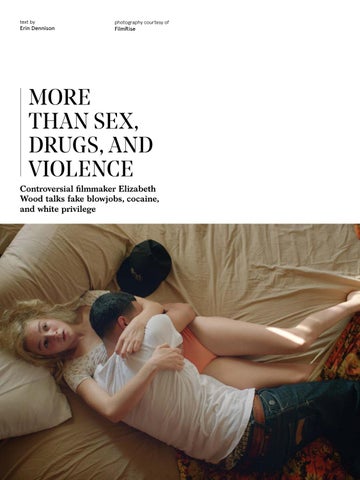
Morgan Saylor in White Girl (2016)
The film is a visceral marriage of youthful rawness—a moment when the power of sexuality and consciousness of racial privilege converge. We never really talked about race in school, like you felt like you understood it, but you couldn’t have until you saw it.” The film is a visceral marriage of youthful rawness—a moment when the power of sexuality and consciousness of racial privilege converge. As a character, Leah is not a two-dimensional cautionary tale of a young woman’s vulnerability. Depending on the scene, she is either the victim or the perpetrator, and her brazen naivety has grim repercussions for both herself and Blue. She has tools to manipulate her circumstance. Yet those tools come with heavy consequences. Amidst graphic scenes por traying the reality of the criminal justice system, White Girl maps an unsettling reality: Despite being brutally attacked, Leah’s victimization ultimately pales in comparison to the systemic racism that subjugates Blue. No matter how dark things got, Leah’s privilege was waiting with open arms.
White privilege is a hot-button concept for both ideological sides, and for wildly different reasons. Whether you acknowledge its role in your reality, are striving to overcome its barriers, or are refusing to confront your potential complicity—race is at once the loudest, most uncomfortable, transformative and hopeful part of today’s national conversation. White Girl is not a lesson in morality, it’s an examination of a society through the lens of Wood’s personal experience. The film asks tough questions it cannot hope to answer alone. As a storm of public opinion builds around the film’s release, Wood savors the opportunity to be at the eye of a storm threatening moral complacency.“That’s why I wanted to make movies and go through this process… If I didn’t care, I could be doing something so much easier than directing. The energy I put into it is like more than anything I ever have.” With valor comes hard-won wisdom. As Wood says, “Right now, though, I’m trying to slow down, not make any rash decisions.”