THE LEADING MAGAZINE FOR MAINTENANCE ENGINEERS FROM ERIKS
ISSUE 28
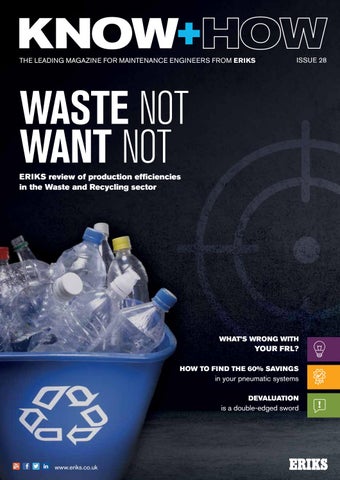
WASTE NOT WANT NOT ERIKS review of production efficiencies in the Waste and Recycling sector
WHAT’S WRONG WITH
YOUR FRL? HOW TO FIND THE 60% SAVINGS
in your pneumatic systems DEVALUATION
is a double-edged sword
www.eriks.co.uk
LATEST NEWS
3
Smart Road
5
IN DEPTH ERIKS regional hubs
15
IN FOCUS Loctite
TECH UPDATE Sonomax™
7
CONTENTS ISSUE 28 LATEST NEWS
Industry 4.0
3
Autumn Statement - a good foundation Smart road infrastructure – the driving force behind the future of transport November sees hike in prices and rise in orders across UK Manufacturing Sector Going green!
IN-DEPTH 5
Save time and money with SKF Housing Kits How to grease where you can’t A major cause of industrial injury – and how to protect against it Cutting the cord – not the power
IN FOCUS: FOOD INDUSTRY
7
10
Doing more with less Industry 4.0, we’ve got your number Having problems with loose nuts... Ready shreddy go! Turning jams into granules Simply safer Safety is in your hands Are you having some gyp?
ENERGY SAVING
The inside story
TECHNOLOGY UPDATE
13
IN FOCUS
keep up to date with all the latest news from ERIKS
28
What’s wrong with your FRL?
BEST PRACTICE
32
How to find the 60% savings in your pneumatic systems
DEBATE 34 Devaluation is a double-edged sword
1
Know-How : Issue 28
DON’T MISS OUT
CONTENTS
In this issue, you’ll get an inside look into ERIKS’ new regional hubs and the resources they provide to help improve productivity, efficiency, and sustainability. Along with product launches and the latest news affecting British industry, we delve into some in-depth analysis and thought-leadership for the sector. Inside you can expect to see detailed insight on how industry 4.0 can help you to keep track of your machines’ condition for smarter maintenance; and how to prevent nuts, bolts and threaded connections from loosening up on waste management machinery to avoid premature failure and costly downtime. In our energy saving section, IMI Norgren points us towards the tell-tale signs that an FRL isn’t working efficiently and whether it is time to upgrade, whereas Festo Training tells us how to make as much as 60% savings in pneumatic systems.
WELCOME TO THE LATEST ISSUE OF KNOW-HOW
Industry experts, Polyco and Unilever Plant discuss why health and safety rules and regulations need to be better adhered to, whether it’s through making the correct PPE more readily available or positioning protective skin cream dispensers where they’re hard to ignore. We also take a look at a number of case studies for the sector, including how ERIKS is working with British Gypsum in East Leake and how Rexnord ensures tyre shredders are kept running to avoid production downtime and repair costs.
Delivering the latest news, industry developments and technologies, this edition of Know+How looks at the waste and recycling sector and the key challenges that face it.
Continuing to address some of the most pressing issues affecting the industry, in this issue The Debate looks at the devaluation of sterling and its impact on the UK’s export activity. Despite many thinking the rebalancing of sterling was necessary, devaluation is a double-edged sword, and it might not have the effect on exports that people are expecting.
In tough and arduous environments like those found in the waste and recycling sector, safety is imperative, just as productivity and energy savings remain a top priority for the collection, disposal and recycling of a variety of materials. While the number of waste and landfill sites may be falling, the dual issue of keeping equipment running and maintaining productivity, is as important as ever.
As ever, if you have any comments you would like to raise on the topics contained in this issue you can email the editor at: knowhoweditor@eriks.co.uk or you can visit Know+How’s own website: www.eriks.co.uk/KnowHow where you can register for your own personal copy, enquire about the subjects and products discussed or contact one of the contributors.
DEBATE! Devaluation is a double-edged sword See page 34
I look forward to hearing from you.
Mike Ferris COO Products & Solutions, Editor in Chief
Published by ERIKS UK, Amber Way, Halesowen, West Midlands, B62 8WG
2
LATEST NEWS
A SOLID FOUNDATION
AUTUMN STATEMENT While it may have been Philip Hammond’s first and last autumn statement, there was a refreshing reflection on the current state of the British economy. While growth forecasts may have reduced from 2.2% to 1.4% Mr Hammond was quick to highlight that it was slower than expected, equivalent to the IMF’s forecast for Germany and higher than the growth forecast for either France or Italy.
With productivity at the core of the autumn statement announcement, the chancellor has also committed £23bn to a new National Productivity Investment Fund to be spent on infrastructure and innovation over the next five years. With additional backing for regional investments including support for Local Enterprise Partnerships in the North of England, South West, South East, and London the statement places a great emphasis on increasing the country’s productivity levels and the development of a ‘high-skill economy’.
SMART ROAD INFRASTRUCTURE THE DRIVING FORCE BEHIND THE FUTURE OF TRANSPORT
Conversation surrounding the potential for driverless cars has been circulating for some time but, while the focus of many reports has been the vehicles themselves, research from the University of Michigan’s Mobility Transportation Center (MTC) has highlighted the importance that communication will play with the wider smart road infrastructure. Based on observations made at Mcity - a 32 acre artificial town built to test driverless cars in real-life transport situations - it is hoped the information will help to design vehicles and road infrastructure that work in harmony with one another. Vehicles currently being tested use a variety of sensors and radar technology to inspect their surroundings and to help identify their location and environment. Understanding how technology works with infrastructure will be key for its future success.
3
Know-How : Issue 28
LATEST NEWS
GOING GREEN! GOOD NEWS FOR
UK MANUFACTURING
NOVEMBER SEES HIKE IN PRICES AND RISE IN ORDERS For more information on ERIKS UK, please visit www.eriks.co.uk.
According to CBI’s latest Industrial Trends Survey, which questioned 430 UK manufacturers, things are on the up. Despite export orders falling slightly, order books have returned to levels seen during summer. In the upcoming quarter, CBI predicts that production will continue to flourish, meeting levels not seen since February 2015 and withstanding any upcoming challenges. However, the last three months did see output volumes slowly stall, failing to meet growth expectations. Due to the fall in the pound, average selling prices are also anticipated to increase at the fastest rate since January 2014, with the food and drinks sector accounting for 75 per cent of the rise. CBI chief economist, Rain Newton-Smith commented: “It’s good to see manufacturers’ overall order books at healthy levels, and the outlook for output growth remaining robust as we head into Christmas.”
BRITAIN GOES COAL FREE FOR ALMOST SIX FULL DAYS During the third quarter of 2016. Britain was able to sustain itself on low-carbon energy alone for nearly six whole days – a new record for the country. In fact, the milestone marks the first time in 135 years that Britain has produced its electricity without burning coal, and ignites the movement towards a future powered solely by renewable energy. Imperial College London and power firm Drax reported the news, also noting that 50.2 per cent of the UK’s electricity consumption throughout the same quarter was produced from sustainable, low-carbon sources – a statistic that looks promising against a mere 20 per cent in 2010. In addition, in Scotland, all electricity demand for a whole 24 hour period was met, based on wind power alone, further reinforcing the potential that renewable energies present for Great Britain as a whole.
“But the weak pound is beginning to make its mark, and prices are expected to rise, especially in the food and drink sector. On the flip side though, export orders remain above average."
www.eriks.co.uk
4
THE INSIDE STORY What’s inside the new ERIKS Regional Hubs to help your productivity, efficiency and sustainability? An earlier issue of Know+How looked at the new ERIKS Regional Hubs, and how they’re bringing the resources of a national organisation to easily accessible, local hubs. So exactly what kind of resources can you expect to find in your nearest ERIKS Regional Hub, to help improve your performance, productivity and profitability?
IN-DEPTH
5
28 Know-How : Issue 27
IN-DEPTH
What the Regional Hubs are not is just as important as what they are. Because they’re definitely not just a shop front or a forwarding address, trying to put a regional presence on a centralised organisation. What they are is a fully resourced, fully stocked, fully supported source of ERIKS know-how, products and experience, brought right to where you want it.
In the time it takes most companies simply to acknowledge your order, the Product Customisation Cell within a Regional Hub can build and test whatever customised assembly you require – to the highest standards, in the fastest time, and across a wide range of products from gaskets to hydraulic hose, and pneumatic assembles to complete drives. The know-how you need
In fact, they go even further. Because ERIKS Regional Hubs are fully-focussed on the regions where they’re based, and staffed by customer service and engineering personnel who know and understand the region, they offer highlyspecialised support for the major industries within each region. So you can expect a product stockholding tailored to the requirements of your industry, with factory-fresh key parts and consumables from leading brands available off-the-shelf, and all fully traceable. You can also rely on continuity of supply, and in-depth product and engineering expertise.
Steve Waugh CEO, ERIKS UK
Fully resourced, fully stocked, fully supported
Which means you can get the products you want more quickly, and the answers and support you need more easily. Workshops that work
Time-served specialist engineers
Every ERIKS Regional Hub includes a highlyequipped engineering workshop, ready to repair or restore any of your critical mechanical and electrical LV and HV assets, drives, valves, pumps and switchgear.
Repair, replace, customise
But it’s not only the equipment that counts. The workshops are staffed by time-served specialists with extensive experience, who can apply ERIKS’ know-how to providing you with effective, economical, reliable repairs and refurbishments. And if components are needed that are hard to find or only available on a long lead time, they can call on the support of dedicated machining cells within the same Regional Hub, to manufacture the required part on the spot.
The right equipment, the right components and the expertise to go with them are all part of the ERIKS Regional Hubs’ offering. But there’s more you can call on too. ERIKS’ all-round repair and replace capabilities mean you’re never forced into a decision that might not be right for you. Instead you’ll be given an impartial recommendation based solely on your situation, application and requirements, so you can make your own choice. For larger projects our technical specialists have the support of a design and engineering team, equipped with CAD and design analysis tools. They provide cost-effective solutions for standard parts customisation, sub-assemblies and full turnkey projects – including project management. For repairs or maintenance for movable assets, the workshop has everything that’s needed for the job, or there’s a mobile team to carry out work on fixed assets on your site. A site visit is often included before any proposals are made, to make sure you get a solution that’s tailored to your specific application. And whatever the proposal may be, your ERIKS Regional Hub will be able to see it through from beginning to end – including testing and certification to international standards if required. Lastly, ERIKS’ know-how enables our Regional Hubs to look at every issue from a Total Cost of Ownership viewpoint. So you’ll always receive a long-term, cost-effective solution – not a cheap short-term fix that you’ll pay for in the end.
This speed and flexibility is a major advantage of the ERIKS Regional Hubs.
www.eriks.co.uk
6
HEARING LOSS A major cause of industrial injury – and how to protect against it
highly wasteful and costly, Sonomax custom-fit earplugs are comfortable in use, and re-usable too. In fact they’re guaranteed for 2 years. Better still, unlike traditional custom-fit solutions which can take days or even weeks to have made, Sonomax can be quickly made-to-fit, on-site. Because they fit the specific shape of each individual’s ears, Sonomax earplugs are extremely effective, providing on average a 30dB PAR (Personal Attenuation Rating: essentially the level of noise filtering provided).
Industry-related hearing loss affected an estimated 15,000 people in the UK last year. Part of the problem is that existing solutions can be uncomfortable, ineffective, costly, or time-consuming to fit. But now Sonomax™ custom-fit hearing protection offers an easy-to-wear, cost-effective solution that can be tailor-made to fit in just 5 minutes. Unlike earphones, which can be uncomfortable to wear for long periods so are often disregarded by employees, , and disposable ear plugs which are
TECHNOLOGY UPDATE SAVE TIME AND MONEY WITH
SKF HOUSING KITS Researching and ordering a bearing housing unit piece by piece takes time and costs money. So SKF have done the hard work already, by putting together a kit with everything required to create a reliable, long service life, high-performance bearing system.
7
28 Know-How : Issue 27
The new kit comprises an SKF Explorer spherical roller bearing, plummer block housing and housing seals, locating rings, and end cover (for housings positioned at the shaft end). The SKF Explorer bearing has a high load-carrying capacity, both radially and axially. Made from wearresistant bearing material – with high running accuracy, low friction, and good head dissipation – it’s supplied with an SE or SNL plummer block housing (depending on size), according to ISO 113. The robust housing is designed for simple mounting and dismounting, and has an efficient grease guiding system built in.
Kits are available with either a four-lip or V-ring seal, and for bearings with a tapered bore an adaptor sleeve with lock nut and lock washer is included.
When a lubrication point is hard to access, how do you lubricate? And when it’s a food industry application, how do you lubricate with an NSF registered lubricant? OKS has the answer, in an aerosol. When they need a proven, food-safe, waterproof high-pressure grease, many people already choose OKS 480. Now OKS 481 provides all the same benefits, in a 400ml aerosol. That means you can apply a fully synthetic, NSF H1 registered grease even to the trickiest lubrication points.
Cordless power tools have always been a compromise between cordless convenience and mains power. Do you want tools that work anywhere – until their battery power runs out – or do you want unlimited power, but only as far as the power cord will reach?
Suitable for high loads, pressures and temperatures, OKS 481 is perfect for bearings that have contact with cleaning agents and disinfectants, and on mechanical units like levers, joints and hinges.
Now you don’t have to choose. DeWalt® claim to have changed the game, with the launch of the DeWalt® XR FLEXVOLT battery pack. The world’s first 18/54V convertible battery pack, the XR FLEXVOLT means power tool users no longer have to choose restricted movement with a cable or reduced power with a battery. Now they can have all the power they need to work anywhere they want.
And the power boost isn’t limited just to smaller tools. At the same time as introducing the new power source, DeWalt® have launched a new range of eight XR FLEXVOLT heavy duty construction power tools, which they say will completely transform the jobsite of tomorrow. The backwards compatibility of the DeWalt® XR FLEXVOLT makes it a highly cost-effective purchase. But it’s made even more valuable through its dualvoltage capability. When the voltage automatically switches to the higher level, it gives the XR FLEXVOLT the power needed to drive the wide choice of cordless, heavyduty construction tools in the new DeWalt® XR FLEXVOLT range. And the faster application speed also means that despite the higher voltage, there’s less energy used overall, which means an improved runtime even on heavy-duty applications.
Once applied, it’s resistant to washouts by chemically treated water, has high she Suitable for application temperatures from -30°C to 160°C, OKS 481 is the ideal alternative to OKS 480 when you need to grease even where you can’t.
TECHNOLOGY UPDATE
HOW TO CUTTING GREASE THE CORD THOSE NOT THE HARD TO REACH POWER BITS...
For further information visit the ERIKS Know+How Blog to discover more
www.eriks.co.uk
8
WASTE NOT WANT NOT Doing more with less
p11
Industry 4.0, we’ve got your number
p13
Having problems with loose nuts...
p15
Ready shreddy go!
p17
Turning jams into granules
p19
Simply safer
p21
Safety is in your hands
p23
Are you having some gyp?
p26
IN FOCUS
www.eriks.co.uk
9
IN FOCUS
DOING MORE
WITH LESS... A CONCEPT WHICH IS BECOMING IMPORTANT FOR MANUFACTURING
At the end of the last decade there were around 140 landfill sites in the UK. By the end of the current decade, that number is expected to have dwindled to a third. And the reduction in waste volumes is not over yet.
The food waste recycling plan announced in July has the target of reducing annual food waste by 10 million tonnes. But the need for transfer and transportation of waste – whether at an energy-from-waste plant, a recycling facility or a landfill site – will still remain. So manufacturers and OEM contractors have an increasingly important role in designing and adapting systems and solutions to meet the sector’s needs. Doing more with less is a widely-used mantra in the business and consumer worlds, as a means of controlling costs and driving efficiencies. Now, with a near twelve-fold hike in landfill taxes per tonne in just under ten years, efficiency and cost control go hand in hand with waste reduction.
www.eriks.co.uk
The concept is also becoming important in manufacturing, under the banner of “ephemeralisation” – in other words: technology advances that enable us to do more with less. The development of automation technologies is driving these efficiencies, no less in the waste and recycling sector than anywhere else. While the future of the sector is not entirely clear, what is certain is that there will always be some form of waste stream that requires disposal, removal and conveyance, and that businesses will continually be striving to improve efficiencies and costs. Designing and building everything from specialist conveyors to sorting and handling equipment, the role of OEM manufacturers and the supply chain has never been so important in ensuring businesses maintain productivity and efficiency at all times.
10
DOING MORE WITH LESS... The concept is also becoming important in manufacturing, under the banner of “ephemeralisation” – in other words: technology advances that enable us to do more with less. The development of automation technologies is driving these efficiencies, no less in the waste and recycling sector than anywhere else. While the future of the sector is not entirely clear, what is certain is that there will always be some form of
waste stream that requires disposal, removal and conveyance, and that businesses will continually be striving to improve efficiencies and costs. Designing and building everything from specialist conveyors to sorting and handling equipment, the role of OEM manufacturers and the supply chain has never been so important in ensuring businesses maintain productivity and efficiency at all times.
Maintaining efficiency Keeping the equipment running and maintaining productivity day-to-day demands continual monitoring and maintenance. From vibration analysis to thermal imaging for the detection of overheating, stresses and leaks, there are numerous processes and maintenance tactics that businesses can employ – either as part of a regular maintenance programme, or in a continual monitoring process. Working with experts in the field can ensure a real understanding of the components and the data they provide, so that in the event of a breakdown – or as part of a preventative maintenance programme – the best possible solutions are in place.
11
Know-How : Issue 28
As operations change it’s also worth considering the changing demands on equipment, and how these might affect the productivity of plant. For example, seemingly simply repairs may only be glossing over problems, as a larger or different load may demand more advanced drive and belt solutions. The automated answer Automation can provide effective support. Sensor technology, connected to an end-user’s PLC or telemetry system, enables maintenance teams to gain remote access to vital monitoring data via a secure and transparent communication channel. Cloud-based services such as ERIKS Asset Guard
IN FOCUS
Food waste recycling plan announced in July is targeted with reducing annual food waste by 10 million tonnes.
Plus take continual readings of equipment performance, provide alerts when incidents occur, and identify trends.
through re-engineering or by entirely changing the maintenance approach or frequency.
Such a detailed overview of key mechanical functions enables minor faults to be identified and dealt with as soon as they arise, instead of being left unchecked.
Regardless of the changes afoot throughout the waste and recycling sector, some aspects will not change. So it pays to be prepared, to look to the future, and ultimately to find processes and partners that can help to take the pressure off the day-to-day running of the site, and keep operations and applications running smoothly.
Another increasingly popular concept is Root Cause Analysis – designed to get, quite literally, to the root of a problem rather than simply repairing or replacing what seems to be the troublesome component. Implementation of programmes like this can be complex and time-consuming, but in the long-term can help to reduce maintenance costs. With the real issue identified, future problems can be prevented either
www.eriks.co.uk
Despite its name, “routine maintenance” should never become just a routine. It’s an incredibly important part of the mix, which should be clearly focused on and prioritised in businesses which want to be prepared – whatever lies ahead.
12
WE’VE GOT YOUR NUMB3R INDUSTRY 4.0 helps keep
tabs on your machines' condition
It’s never been easier to find out what’s going on with your machines. Thermography, oil analysis and vibration monitoring give you the best picture you’ve ever had of the condition of equipment. But data doesn’t always add up to answers. And more data doesn’t necessarily mean a clearer picture. So how can Industry 4.0 help you make the best use of the data available? Industry 4.0 – sometimes described as “the next Industrial Revolution” – uses the cloud and the Internet of Things to make data more readily available so it can be more effectively applied or acted on. Essentially it’s about maximising connectivity – and for machine condition monitoring that means helping you keep constant tabs on key measurable parameters, without having to be standing by the machine and without having to wait for a written report. By bringing all this data together in one place, instantaneously by using processing algorithms, you’ve got all the information you need, at your fingertips, to help you make quicker and more accurate decisions about equipment maintenance and repair.
13
Know-How : Issue 28
It’s like a doctor giving a preliminary diagnosis after listening to your chest with a stethoscope, then getting it confirmed with an X-ray and maybe a blood test too. But using Condition Monitoring decision making with Internet 4.0 connectivity, there’s no need to book a second appointment. You get the information instantly, in real time. Sharing for success Getting the right data in the first place depends on having the right monitoring equipment. The waste and recycling sector is a tough environment where rugged, robust devices are essential. It’s also essential to know what’s worth monitoring. With vibration being a fact of life for many items of equipment in the sector, it’s not likely that overall parameter vibration monitoring will reveal any useful results, so you need expert advice on what signal processing and monitoring will be most use. With real-time monitoring in place you’ll need safeguards too. For example, you’ll want to ensure that alerts and alarms can’t be reset until they have been acted on. And they should be configured so they’re not interacting with live systems. After all, you don’t want a faulty sensor triggering an automatic safety shutdown which could cause hours of unnecessary downtime.
IN FOCUS
Efficiency and condition data combined Real-time monitoring Smart maintenance
When you’ve collected all this valuable data, it’s important to consider where it should go to be most useful. For example, sharing it with ERIKS via the cloud gives you the opportunity to take advantage of years of know-how and multi-machine, multi-industry experience, which can help you spot issues earlier and take more effective remedial action more quickly. Bringing it all together Much of the technology that’s required for machine condition monitoring with Industry 4.0 is already available. It might even already be in place on your machines. Inverters and PLCs, for example, have huge amounts of information embedded within them. All that’s required is for it to be extracted, monitored and analysed. Many devices already monitor efficiency, but not condition. However, combine the efficiency data from these devices with condition data from others, and you have a comprehensive “portrait” of your machine which only requires analysis and interpretation to put you in the picture. Cloud-based monitoring also gives you’re the opportunity to benefit from aggregated data across other machines.
www.eriks.co.uk
The joined-up data can tell you what’s happening to identical equipment on the site or other sites. So if a similar issue has arisen and been resolved, you’ve got a shortcut to knowing what action to take. Smart thinking Let’s assume you have your monitoring devices in place. They’re providing you with large amounts of valuable data. Now how can you use it in the smartest possible way to reduce your maintenance costs and downtime, and optimise your productivity? The opportunity to take early remedial action is one benefit, as we’ve already discussed. But that doesn’t have to be limited to ad hoc reactions to potential emergencies. With ample data to analyse, and based on extensive industry experience, ERIKS could help you develop a smart maintenance plan combining preventive and predictive maintenance. We could also advise on the most advanced, energy-efficient, reliable products on the market, and support that advice with Total Cost of Ownership tools. That will provide you with the information you need to upgrade whenever you’re ready, to achieve even better productivity and energy-use performance, with lower maintenance costs and a longer service life.
To find out more, call your local ERIKS Service Centre. Or if you haven’t got our number, visit www.eriks.co.uk
14
ARE YOU HAVING PROBLEMS WITH
LOOSE NUTS AND BOLTS?
15
Know-How : Issue 28
Why assemblies fail Traditional thread locking devices combine security and dismountability. But they’re not up to the job in the waste management environment. Subjected to the stresses of heavy vibration, they simply can’t maintain bolt tension and clamping forces. It’s this loss of bolt tension that’s the leading cause of failure in threaded assemblies. And what, in turn, causes the bolt tension loss? In most cases, it’s relaxation and self-loosening. Just like loosening-up, relaxation is something that’s good for people, bad for bolts. In a bolt it leads to a change in bolt tension, and that leads to reduced clamping forces. Most often, it’s due to one of two triggers: settling – the pressure-induced smoothing of the surface roughness, or creeping – the time-dependent yielding of substrates when loads exceed the compressive strength of the material (clamping gaskets are a typical example). It only needs inadequate elastic capacity of the assembly, or bolts which are too stiff, or the selection of the wrong length to diameter ratio, and relaxation is inevitable. And there can be no compensation for loss of bolt tension. The other cause of loss of bolt tension – selfloosening – is caused by any type of dynamic load. This could be vibration (the most likely cause in waste management machinery), changes in temperature, insufficient clamp load, or poorly fitting parts – allowing relative movements to increase the risk of self-loosening. Any of these load changes will lead to short-term frictionless situations, allowing the bolt to unwind from the nut. These will be very small movements, but eventually the cumulative effect will be enough to significantly loosen the threaded assembly. The only way to reduce relaxation is through changes in parts design – such as the length to diameter ratio – or changes in the use of elements. Self-loosening, on the other hand, can be avoided by using appropriate thread locking devices.
Your thread locking options
IN FOCUS
A loose threaded joint on a piece of waste management machinery is just asking for trouble, premature failure and potentially costly downtime. With heavy vibration a fact of life in this type of equipment, how can threaded joints be made secure, but dismountable?
There are essentially two ways to lock threads: mechanical methods or adhesives. Mechanical devices have some benefits, but because there are gaps between the threads most types will never completely withstand vibrational loosening – so the problem still isn’t solved. The alternative – thread locking adhesives – ensures a successful result even under heavy vibration. And its effectiveness has been proven. These adhesives work so effectively to resist vibrational loosening because they fill all the voids between the nut and bolt. The result, in comparative tests, is impressive. A range of joints, secured in a variety of ways, was subjected to accelerated vibration tests on a transverse shock machine. A benchmark was set with a “naked” nut and bolt, tightened to a typical 80% proof load. From a bolt tension of 30kN, this came loose after just 15 seconds. The tests show a spring washer performed just as badly. A nylon ring nut lasted almost twice as long – but that’s still only around 25 seconds. A distorted locknut survived for a little longer, though most of the bolt tension quickly disappeared. However the joint secured with thread locking adhesive simply refused to fail, and showed no loss of bolt tension or even the slightest self-loosening.
SECURING DISMOUNTABLE BOLTS Vibration test success Effective thread locking
Sticking to the task Joints treated with thread locking adhesive are clearly the most effective protection against self-loosening. And the most effective thread locking adhesive comes from LOCTITE®. LOCTITE® has been leading the way in developing anaerobic adhesive technology for many decades – and continues to make advances. There’s now a huge LOCTITE®-branded range available, offering choices in viscosity, strength, temperature resistance, chemical resistance, oil tolerance, cure speed, hardness and flexibility. The latest LOCTITE® products are also rated for higher temperature use, and are more tolerant of surface contaminants. So even when your equipment is operating in the toughest conditions under the heaviest vibration, you can relax. Because you can rely on LOCTITE® to prevent loosening-up.
To find out more, visit the ERIKS Know-how Blog: http://knowhow.eriks.co.uk
www.eriks.co.uk
16
READY SHREDDY
GO! If you’re rebuilding a large machine comprising numerous components – some of which need repairing, some replacing – then co-ordinating suppliers and engineering companies can mean going round in circles, longer lead times and higher costs. But if you find the right company to handle the entire project, then it’s sure to roll along smoothly. The asset in question was a tyre shredder at one of the UK’s tyre recycling centres, where up to five million tyres a year are recycled into fine rubber crumb. Fire had damaged the shredder to such an extent that a large number of components needed repairing or replacing: from the motors and gearboxes to the couplings, bearings and drive chains. However the customer also decided to take the opportunity to update their machine – a large energy consumer – to increase its energy efficiency.
17
Know-How : Issue 28
As one of the very few companies in the UK capable of offering a full rebuild for such a large piece of machinery without outsourcing, and with relationships with over 1,000 qualified suppliers, ERIKS was naturally asked to assess and quote for the job. Repair, Replace… Update With the quote approved, ERIKS’ first step was to send in engineers from its engineering workshops in Dudley, to undertake a comprehensive strip-down and inspection of the machine. Every component was examined to determine whether it was suitable for economical repair or if it required replacing. ERIKS’ comprehensive supplier resource enabled the company to specify and supply the best components for the job: not simply to rebuild the shredder but also to update it and optimise its performance and efficiency.
IN FOCUS
Maximising efficiency When the machine’s two in-line reduction gearboxes in the main drive system were stripped, the gears were assessed as being suitable for retaining. However the fluids, seals and bearings were replaced like-for-like or upgraded as necessary. Leading-brand components were selected for their quality, reliability, high wear factors and low friction co-efficient to maximise efficiency. To drive the handing rotors, right-angle Fenner® gearboxes were installed, with the opposing ends mounted on NSK self-lube pillow block-housed bearings. This reduces the maintenance requirement as well as increasing the robustness of the system’s design. The same attention to detail – and to optimising efficiency, power handling and wear capacity – was given to all the components supplied by ERIKS, which included seals, gearbox bearings, drive chain and sprockets. The aim was optimum power handling and wear capacity, to ensure a longer running life but without the unnecessary expense of overspecification.
A significant step towards improving its energy efficiency was replacing the OEM-supplied motors which drive the main shears – used to reduce the tyres to the fine crumb. ERIKS specified 22kW WEG high-efficiency motors from the W22 range, with smaller WEG motors to drive the primary handling rotors that feed the tyres into the shears. To connect the motors to the inline gearbox ERIKS recommended and supplied Fenaflex Tyre Couplings. With their excellent shock-absorbing properties, these highly efficient couplings isolate the motors from vibration and torsional oscillations. They also have complete freedom from backlash, which is ideal for reversing applications, especially when using geared drives.
UNMATCHED
comprehensive service
1,000
qualified suppliers
ON TIME,
on budget, total refurb.
Despite the scale of the project and the number of different components involved, ERIKS’ extensive engineering know-how completely eliminated the need for outsourcing – making it easier to manage the project and keep close control of its costs. As Mahesh Patel, Engineering Manager, ERIKS UK, explained: “We have a lot of experience in both the supply and maintenance of industrial components. This has allowed us to develop a service that very few companies can match. We worked with the customer throughout the project, specifying and supplying the best components for the job to rebuild and update the shredder. “Because there was no need for us to outsource any aspect of the job to other companies, we were able to drastically reduce lead times, and the rebuild was completed on time.”
Tolerating misalignment on all planes, the couplings are exceptionally easy to fit. They also allow the detection of wear simply through visual inspection. This saves downtime and labour costs, by eliminating the need for a machine strip-down for maintenance checks.
www.eriks.co.uk
18
TURNING JAMS INTO
GRANULES If you take a dive on a synthetic football pitch, or your child falls off a swing in the playground, the chances are there won’t be any serious injury. That’s because the synthetic surfaces are made up of rubber granules, obtained from shredded tyres. When a processor of truck and bus tyres into these granules was losing production, due to jams in their main shredder, Rexnord provided the solution.
19
Know-How : Issue 28
Every time the customer’s tyre shredder failed, it failed catastrophically. Such was the inertia stored in the machine that a jam instantly led to the drive belts snapping. And that led to production downtime and increased repair costs.
prevents the drive belts from snapping, and protects the gearbox from damage. Fast response It’s not only the Autogard’s response to a jam which is quick. It’s also the alerting of the operator. As soon as a jam occurs and the Autogard disconnects the gearbox, the machine operator is informed. This means a problem is spotted in real time and the cause of the overload can be quickly traced, identified and rectified – with minimum downtime. Once the jam has been cleared, it’s also quick and easy to reset the Autogard. This can be done either by reversing the direction of the drive, or – if that’s not possible – by a simple manual reset. Flexible protection The Rexnord Autogard 400 Series can be fitted on either the high- or low-speed side of a gearbox, making it a highly flexible solution in all applications.
Protects drive belts, gearbox and asset
With over 80 years’ experience in protecting assets against this kind of overload, Rexnord had the answer.
It also offers the option for factory-pre-setting of its release torque – enabling machine builders to specify the precise point at which it needs to disconnect, to provide optimum protection to the drive belts, asset and gearbox.
Unlimited limiting Bi-directional torque spike protection Quick, easy resetting
The Rexnord® Autogard® 400 Series Torque Limiter is a ball-detent-type limiter, which is a fast, costeffective method of preventing overloads and consequent damage to drive belts. Fitted to the drive train between the customer’s tyre shredder and its gearbox, the Autogard provides instant, automated protection for belts, equipment and gearbox.
An additional built-in safety option is the facility for the release torque setting to be protected: preventing unauthorised users from changing it and potentially putting equipment at risk. The comprehensive, cost-effective, bi-directional protection of the Autogard Torque Limiter enables longer life at high speeds, ensures a lower total cost of ownership – and can make a torque spike as harmless as a tumble in a rubber-surfaced playground.
Now, whenever a jam occurs in the shredder, the Autogard Torque Limiter immediately disconnects – which isolates the torque spike caused by the jam,
www.eriks.co.uk
20
SIMPLY
SAFER Five thousand were injured at work. 16,000-145,000 working days were lost on average in 2009/10 and 2014/15. And fines across the waste industry totalled over £2,063,000.* Ignoring health and safety is clearly not a safe thing to do.
The problem is, it’s very easy for an employee to forget that their safety gloves won’t last forever. Or to think that standing on a concrete floor won’t do any harm. But in the waste sector, it’s not easy to overlook a fatal injury rate that’s up to twenty times the all-industry standard, and an injury rate that’s around double. Health and safety should never be about blame, but they can be about responsibility. And with so many rules and regulations laid down for the waste industry, the responsibility can be onerous. So what you need is a way to make health and safety an integral – and easy – part of everyone’s working day.
health and safety incident. There’s also damage to your company’s reputation to consider. And it’s not just what your customers think. Recruiting and training new employees is a significant cost in an industry where staff retention is difficult. So how much harder and more costly will it be if your business is known to have a poor health and safety record? But improving health and safety can reduce staff turnover, which in turn cuts your recruitment costs. So the first thing to do is make it harder to ignore health and safety than it is to follow the rules. Making PPE safer
Keeping your reputation safe Health and safety can’t be ignored, or forgotten, or treated as a one-off. They’re essential, and ongoing. There are not only physical repercussions for employees and financial ones for your business from a
21
Know-How : Issue 28 27
The latest EU PPE regulation – introduced in April 2016 – has stronger rules covering PPE sold in the EU. If you buy any PPE, part of your responsibility is to make sure that each manufacturer of every item complies with the regulations. For example, they will
against chemical splashes or other injuries, or boots for protection against heavy dropped waste, a vending machine can issue it. Don’t stand for it Another health and safety issue is often overlooked because it is, literally, under your feet. If your employees stand and walk on unforgiving concrete while they work, the cumulative effect can be fatigue and injury, leading to reduced productivity and absenteeism. There is, however, a simple answer. Wearwell matting provides a more comfortable and safer (non-slip) surface to stand on, which has been proven to reduce injury and absenteeism, and increase productivity. Save your skin A health and safety issue doesn’t have to be dramatic, or bloody, or even all that obvious. It can just be insidious, unsightly, and ultimately very costly. Five in every hundred workers were affected by work-related illness in the waste industry in 2014/15.
need to provide a declaration of conformity, and proof of the sample testing process they carry out. The easiest way to ensure that all the PPE products you buy meet these criteria is to buy only from a single, trusted supplier – such as ERIKS – who will only source PPE from manufacturers who are fully compliant. ERIKS will also provide you with all the necessary documentation as proof of compliance.
Occupational skin disease, for example, costs €600m a year across the EU and results in 3 million lost working days a year. Yet simply positioning protective skin cream dispensers – like those available from Deb – where they’re hard to ignore, backed up with some initial education on skincare, can put health and safety literally in the hands of your employees.
Not just for coffee PPE only works when it’s used or worn. So the key is to make that easy. Install a PPE vending solution lineside – or right outside a staff restroom where it has to be walked past on every break – and suddenly it’s as easy to be protected as it is to get a cup of coffee from a vending machine. Whether your employees need masks for protection against odours, gloves and goggles for protection
www.eriks.co.uk
Just as with the PPE vending and the Wearwell matting, you’ve discharged your duty of care, and made it easy to be safe. When being proactive about safety in this way saves your employees from injury or illness, that’s reason enough to do it. But when it also saves money by reducing staff turnover, and helps you meet safety and employee retention KPIs – which in turn helps you optimize productivity – then any short-term cost is soon, and safely , outweighed.
22
SAFETY
IS IN YOUR HANDS
The waste and recycling industry is a dangerous one to work in. It’s true that the number of accidents has fallen in recent years – but it’s still four times higher than the national average, and even double the rate in manufacturing and construction. Fortunately, reducing accidents further can be as quick and easy as putting on a pair of gloves. Bernard Garvey Technology Director, Polyco
Construction poses dangers from falling masonry and falls from scaffolding, for example. Manufacturing can involve heavy machinery and fast-moving components. Waste and recycling’s dangers may not be so obvious or so dramatic, but they still have to be faced every day, and they can be life-changing too. A hand injury such as a puncture wound from an infected needle is not usually fatal. Nor is a deep cut to the hand. But it can affect quality of life, require time off work, and stop someone earning a living. So when there’s an easy solution, it makes sense for employers and employees to use it. Handfuls of gloves Safety gloves are easy to find, easy to wear, and effective. In fact the only difficult thing about them can be choosing the best one for the particular protection you need, from the huge selection on the market.
23
Know-How : Issue 28
IN FOCUS
Bernard Garvey, Technology Director of Polyco, suggests carrying out a simple hand protection assessment survey to make sure you make the right choice. This can identify the hazards and risks each worker faces in their particular working environment, and help define their specific protection requirements. Based on this information, a reputable manufacturer can suggest the most appropriate protection, and offer a product trial. This is also a good way of getting worker “buy-in” to the idea of hand safety. When they experience how comfortable and yet how effective safety gloves can be, they’ll be happy to wear them on a daily basis – and their feedback can be valuable in making the right selection.
the HexArmor range of protective gloves, which offer protection over and above the EN388 puncture resistance standard. HexArmor gloves are made using SuperFabric – an advanced material which uses tiny guard plates adhered to high-performance fabrics. The result is superior protection against puncture, cut and abrasion injuries.
Protection above standard Above averagerisk industry Simple safety solution
Whilst EN388 uses standard testing equipment, HexArmor is tested in addition using a 25 gauge needle. Which – for employees facing the risk of needle-stick injuries on a daily basis – is handing them highly reassuring protection.
Superior protection The most comprehensive range of hand protection for the waste and recycling industry is provided by Polyco. The company is also the sole UK distributor of
www.eriks.co.uk
24
RX® DIsPOsAbLE MAsks
RX® FLAT-FOLD DIsPOsAbLE MAsk
RX® PRE-FORMED (CuPPED) DIsPOsAbLE MAsk
RX® PRE-FORMED (CuPPED) AND REINFORCED DIsPOsAbLE MAsk
Take a breather. RX® Disposable Masks offer a high level of protection against dust particles, mist and fumes - now you can breathe easy!
EXCELLENT COMFORT AND PROTECTION
Safety ProductS
25
Know-How : Issue 28
RX® Disposable Masks are an essential requirement when working in atmospheres where harmful gases, vapours, smoke or mist particles are present. Offering a high level of protection and constructed using non-allergenic materials, RX®Disposable Masks are lightweight and ergonomically shaped for a comfortable fit.
Manufactured to the highest standards, our range of masks include adjustable nose and head straps to ensure a good, air-tight seal, an exhalation valve for easier breathing and conform to the latest European standards. Feel the difference. Order your RX® disposable masks today. Call 0800 006 6000 or visit www.eriks.co.uk
HAVING A BIT OF GYP?
WE KNOW A MAN WHO KNOWS A MAN
IN FOCUS
When a British plasterboard manufacturer faced a challenging project, it was ERIKS who they chose to help them supervise and co-ordinate, and ultimately to deliver a successful conclusion. regular repair, making them less cost-effective. It was decided it was time not only to replace the gearboxes, but also to take the opportunity to review the whole system – gearbox, gearbox housing, shaft, shaft housing, and the scrolls themselves – and bring it up to a more up-to-date specification. With this in mind, two of the four recycling scrolls were dismantled and shipped to ERIKS’ Drives Technology and Gearbox Solutions Centre in Dudley. Bringing it together With the scrolls now completely disassembled, ERIKS engineers looked at each individual component with a view to finding a more efficient solution. A new design was presented to the client and approved, and tenders issued for the various elements. With experience and expertise across a wide range of engineering disciplines, the job of assembling and testing the new design also fell to ERIKS. This was made more complex by the fact that the original gearbox was obsolete, making it impossible to source a like-for-like replacement, and the version ultimately specified was dimensionally different from the original.
OPPORTUNITY to review the whole system
RE-INSTALLED
within 5 months
WIDE RANGE
of engineering disciplines
It’s not often that an engineering project – whether it’s a repair, a refurbishment or a replacement – is straightforward. And when components are being supplied by manufacturers from across Europe, it only adds to the complications. It’s at times like these you need a project management team with the experience and the know-how to take control. Taking it apart… The equipment requiring attention was recycling scrolls , the scrolls comprise four drives, positioned side by side, driving large knives which cut into defective plasterboard. This allows the plaster to be sieved out and recycled back into the process.
With components being sourced from throughout Europe, managing the project and keeping to the required timescales was challenging. However, despite the difficulties which inevitably arise during a project of this scale, ERIKS had the new equipment re-installed within five months from initial strip-down, including design work. With two recycling scrolls back in operation , the satisfied customer then asked ERIKS to repeat the process for the remaining two. This time, with the design work available from the first two drives, the complete project took under four months. Now production is back to full capacity for recycling its internal plasterboard waste – with minimal interruption.
The gearboxes had already been refurbished after 10 years of use, but were now beginning to require
www.eriks.co.uk
26
WHAT’S WRONG WITH YOUR
FRL?
An out-of-date, damaged, failing or faulty FRL (filter, regulator, lubricator) will be unsafe, environmentally unfriendly, and a waste of energy and money. Fortunately, there are three easy ways to spot whether your FRL is too old to be efficient, and six problems to look out for that point to the need for an upgrade. How does your FRL measure up?
ENERGY SAVING
27
Know-How : Issue 28
ENERGY SAVING
As the inventors of the FRL, IMI Norgren know what makes them work, what makes them work better, and what makes them work best. So if you follow the Best Practice advice below, you can be sure of reducing your compressed air costs, reducing maintenance costs, and complying with all relevant Health and Safety regulations and environmental protocols for disposal of contaminants.
A new FRL from the IMI Norgren Olympian Plus 64 Series will not only operate with maximum efficiency – ensuring effective lubrication, optimum pressure control and minimum pressure drop. It will also be fully compliant with: BS 6005: 1997 Health and Safety at Work regulations, and regulations for the safe disposal of contaminants.
How old is your FRL? But that’s not all. If your IMI Norgren FRL has been in place for so long that no-one can remember exactly how long, it’s probably time it was upgraded. A more specific guide to the age of your FRL is its construction or colour: Over 15 years old? All Olympian Plus series FRLs with polycarbonate bowls are now more than 15 years old. Over 20 years old? If your FRL is painted green, it is at least 20 years old. Over 25 years old? If your FRL has a metallic filter element, it is at least 25 years old.
The Olympian Plus 64 Series of FRLs is also completely interchangeable – and it can be replaced in seconds, without disturbing pipework. So you can save an hour at least on maintenance. And comprehensive service kits are available, making the Olympian Plus 64 Series FRL fully serviceable, to help prolong its efficiency, compliance and service life.
IMI Norgren FRLs are robust, rugged and reliable. But now there are new and even more efficient versions available, if yours is 15 years old or older, it’s definitely time to upgrade – to guarantee compliance and save money too. If it is younger than 15 years old, but shows any of the signs of failure below, then you can still make efficiency gains and energy and cost savings by upgrading to the latest version. Upgrade advantages If you’ve taken a long hard look at your FRL and it matches any of the points above, then an upgrade now will make all the difference to cost-efficiency, environmental and Health and Safety compliance, and productivity.
Turn over to find out about 6 PROBLEMS TO LOOK OUT FOR... www.eriks.co.uk
28
6 PROBLEMS to look out for...
UPGRADING
1
4
EFFICIENCY
2
5
3
6
guarantees compliance and saves money
gains, energy and cost savings
REDUCED
maintenance times
Damaged, cracked or hazed polycarbonate bowl If the bowl of your FRL exhibits any of these signs, it must be replaced to comply with BS 6005:1997 and BS 5378: pt. 1. To be compliant, it must also be replaced if it has paint contamination or is more than 10 years old.
Non-compliant auto drain Environmental rules do not allow contaminants to flow freely onto the plant floor. They must instead be collected and disposed of properly. If the auto drain of your FRL does not make this possible, the FRL must be replaced. Increased pressure drop A drop in pressure of just 0.25 bar costs you up to £50 a year based on a 40-hour week. A drop of 1 bar will cost you £100 a year. The pressure drop is caused by blocked filters, which become progressively more blocked over time.
Poor pressure control Maintaining optimum pressure control of compressed air is important for your productivity, cost-efficiency and safety. If the pressure is not being correctly regulated and creeps up, every 1 bar of excess pressure will increase your energy costs by 7%. An older regulator which is not maintaining optimum pressure will negatively affect your process and your costs. Ineffective lubrication Internal components inevitably age, and become less efficient as they do so. This will reduce the effectiveness of the lubricator – and may even stop lubricant from getting through at all, which will have significant and potentially costly knock-on effects. Time-consuming maintenance If your current airline system needs replacement, it can take up to an hour. Upgrade to the IMI Norgren Olympian Plus series and it can be done in minutes, without even having to disconnect the pipework.
So whatever is wrong with your FRL, you can put it right now with an upgrade to an IMI Norgren Olympian Plus 64 Series.
29
Know-How : Issue 28
QuickFix THE Emergency Belt In a breakdown situation the Fenner QuickFix belt provides you with a fast and reliable solution to get your plant up and running - with minimum downtime and fuss - whilst a replacement belt is on order.
Available in 5 metre boxes and in wedge belt and V belt combined profile so a couple of boxes of each section size, will cover any eventualities you may encounter.
For FennerÂŽ, call ERIKS.
Why Choose Fenner QuickFix Belts
Perfect for:
Dual groove profile, means one belt fits both V and wedge belts Jointed belting ensures minimum strip down when installing Can be made to any length Quick and simple to install
Hospitals Airports Facilities Management Companies Universities Anyone with a large number of belt drives
www.fptgroup.com
T : 0845 006 6000 ERIKS UK Amber Way, Halesowen, West Midlands, B62 8WG Tel: 0121 508 6000 Fax: 0121 508 6255 Fenner is a registered trade mark of J. H. Fenner & Co.
HOW TO FIND THE SAVINGS IN YOUR PNEUMATIC SYSTEMS
60% BEST PRACTICE
Where some people see energy being wasted, others see potential energy savings. So if you have pneumatic or compressed air supply systems – especially if they’ve been installed for any length of time – you’ve got a significant source of wastage. But you’ve also got a source of savings of up to 60%.
Gary Fuller Festo Training Programme Manager
Energy costs represent the biggest chunk of the total cost of setting up and running compressed air systems. In fact, they account for around 75%. So allowing poor design, inappropriate use, incorrect settings and leaks to create inefficiencies and air losses can add up to a substantial waste of energy – and money – over the life of a system. In fact, according to the Fraunhofer Institute for Systems and Innovation Research ISI on Compressed Air Systems in the EU, as much as 35% of the energy cost of generating compressed air is wasted. So how can you reduce the waste and cut your costs? Chain reaction The key to successful savings is to take a comprehensive look all along the pneumatic chain, and then to take an integral approach. Optimise your compressed air systems’ energy usage in this way and you’ll realise not just one benefit, but several that are inextricably linked:
reduced energy costs reduced operating costs reduced maintenance and servicing costs reduced unplanned production downtime and associated costs.
31
Know-How : Issue 28
BEST PRACTICE
Q. How can I save energy when I need constant vacuum pressure for reliable holding of objects? A. The need for constant vacuum pressure for object holding is a myth. Continuous air consumption can be avoided by using an energysaving, air-saving circuit. This is particularly effective with smooth, non-porous surfaces. Festo’s OVEM closed-loop vacuum generators monitor vacuum levels and only consume air when required. Typical savings can be as high as 60%. Q. How can I reduce compressed air consumption without reducing the effectiveness of my system? A. Many systems use excessive, wasteful force, which means unnecessary energy consumption. Correct sizing of pneumatic drives – reducing to the next smallest piston diameter, for example – can reduce compressed air consumption by up to 40%. It also helps reduce procurement costs.
Save from the start
35%
of compressed air system energy costs is wasted
Like any other technology, pneumatic and compressed air systems are more efficient if they’re professionally designed, set up, used and maintained. The kind of savings this approach can offer are highlighted in a new guide from Festo – a leading supplier in industrial automation technology. “In this guide,” explains Gary Fuller, Festo Training Programme Manager, “we focus on advising plant managers on how they can implement measures to reduce energy wastage, with in-depth statistics and details about compressed air technology.” Full of detailed and practical advice, the guide outlines the efficient technologies that ensure machines and systems consume fewer resources and less energy, reduce CO2 emissions and operating costs, and increase sustainability and overall productivity. And you don’t have to wait to read the guide to find the answers to some of your most important pneumatic system energy saving questions – because here they are:
Q. How can simply moving a valve save me money? A. Shorter tubing means saving energy. Unnecessary dead volume in tubing can create wasted consumption, especially where small actuator volumes are involved. Positioning a valve as close as possible to its gripper, for example, means you can use the shortest possible tubing length, achieve savings of up to 25%, and improve cycle times. Q. Is switching off power worth the effort? A. Eliminating airflow in systems at a standstill during non-productive phases can save you up to 20%. Energy efficiency modules such as Festo’s E2M can provide active, intelligent control of the compressed air supply – automatically shutting it off during system standstills and restarting it for production. Q. Does weight matter? A. Reducing weight and friction of moving elements can have a major effect. This is particularly true on multi-axis systems, where initial over-sizing becomes compounded. Selecting the optimum mix of components and technology – for instance, using lightweight pneumatic grippers for moving applications – can help realise energy savings of up to 18%.
To download a free copy of the Energy efficiency@Festo guide, visit: http://knowhow.eriks.co.uk/pneumaticsystems
www.eriks.co.uk
32
Getting you moving quicker than ever BS Conveyor Chain
Renold is proud to offer a range of BS Conveyor Chain ‘off the shelf’ from our UK Chain Service Centre! • • • •
Chains Available with 3,000 – 30,000lb Breaking Loads 1.5” – 6” Pitch Hollow or solid pin variants available Full range of connecting links and cast iron sprockets
In addition to the standard range, Renold is also able to supply conveyor chain with integral K attachments on a fast turnaround. For more details, contact ERIKS.
www.renold.com
DEVALUATION
DEBATE
A DOUBLE-EDGED SWORD Much has been made in recent weeks of the devaluation of sterling and its impact on the UK’s export activity.
conclusion that commercial free trade was a necessary precursor to the generation of wealth and economic success.
To some, it is a long-overdue rebalancing after years of overvaluation. Certainly the 25 per cent drop in the value of the pound will, in theory, help exports, which have been particularly hampered by the ‘strong pound’, in recent years.
Nowhere has the impact of globalisation and free trade been felt more profoundly than in the manufacturing sector. The UK’s car industry for example sits at the centre of a global manufacturing supply chain that uses more than 20,000 parts for each individual car, imported into the UK from the Eurozone, Korea, China, Japan and beyond.
However, devaluation is a double-edged sword. The most obvious downside is that our foreign holidays, cars and other goods, imported from abroad, will inevitably increase in price. The ‘Marmite War’ between Tesco and Unilever over a 10 per cent increase in the price of a jar of yeast extract, is potentially a forerunner of the higher retail prices that the British public may have to get used to, in a post-Brexit world. However, there is another reason why the jury must still be out on whether the devaluation of sterling will provide the export boost many have predicted. Adam Smith, the 18th Century Scottish economist, was inspired to write his greatest book, The Wealth of Nations, whilst watching the trading ships coming in and going out of Kirkcaldy docks, reaching the
Inevitably, the devaluation of sterling will drive up the cost of these components. Whilst devaluation may mean that car buyers in France and Germany get more for their Euros when buying UK-built cars, it is highly likely that this benefit will be offset by the increased cost of the components that go into the finished vehicle. Ditto washing machines, dishwashers, boilers and pumps, to name but a few of our UK-manufactured goods. Almost all the experts agree that the rebalancing of sterling was necessary, but it is still far too early to say whether it will have the impact on our exports that many people predict.
DEBATE www.eriks.co.uk
34
ERIKS INDUSTRIAL Products, Services & Solutions
LIFE SUPPORT FOR PRODUCTS
EXTENDED PERFORMANCE with our PREVENTATIVE MAINTENANCE know-how
More TLC, less TCO
PREVENTION IS BETTER THAN A CURE...
n Preventative maintenance and root cause failure analysis
It also extends life and lowers costs. Our comprehensive condition monitoring support services cover all forms of preventative and predictive maintenance both on site and remotely.
n Impartial repair, replace or systems upgrade
n Customisation and design engineering
n On-site installation and commissioning n Sub-assemblies and kitting solutions
Call: 0845 006 6000 to speak to your local ERIKS Service Centre www.eriks.co.uk