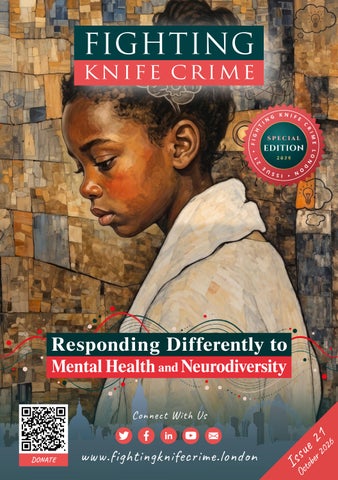
FIGHTING KNIFE CRIME
www.fightingknifecrime.london
I
DONATE
Oc s s u tob e er 2 20 1 26
Connect With Us
FIGHTING
FIGHTING
SCAN HERE TO KNIFE CRIME DOWNLOAD FIGHTING KNIFE CRIME MEDIA ASSETS
SCAN HERE
FKCL Magazine - Issue FOR 21 OUR
HOME PAGE AND HELPLINES
KNIFE CRIME
MAKE THE CHANGE NOW www.fightingknifecrime.london
A completely confidential online space for young Londoners to find solutions to a better way of living
KEEP SAFE FIND SUPPORT REACH OUT FIND A JOB ● FIND A MENTOR ● FIND FRIENDS MUSIC ● MEDIA ● ARTS ● SPORT ● NEW SKILLS
Fighting Knife Crime London is about Changing the future for all our Young People
SCAN FOR OUR LONDON-WIDE DIRECTORY OF ORGANISATIONS AND COMMUNITY PROJECTS
FIND MORE SIGNPOSTING RESOURCES HERE FROM OUR PARTNERS AT LOCAL VILLAGE NETWORK
Point your phone camera at the QR codes and wait for your device to detect the link.
ww w.f igh ting kni fec rim e.lo ndo n @KnifeCrimeLdn
@Fighting Knife Crime London
Fighting Knife Crime LDN 2
@Fighting Knife Crime London
info@fightingknifecrime.london www.FightingKnifeCrime.London
Cant' find what you need? Contact info@fightingknifecrime.london
FIGHTING KNIFE CRIME
FKCL Magazine - Issue 21
Painting by: Bruce Houlder - based on an
original drone photo by Chris Gorma n of
The Big Ladder Company www.bigladd er.co.uk
Issue 21
www.fightingknifecrime.london
Contents 4 Welcome to Issue 21 of Fighting Knife Crime London Magazine 8 Strengths-based support is the real antidote to knife crime 12 Is there a link between being Autistic and having poor mental health? 16 Belonging matters: autistic mental health and the power of community 20 We Did Not Have the Language or Influence 25 Understanding the Child Before Judging the Behaviour 31 Misread Distress Signals: Neurodivergence, Exclusion and Exploitation 38 Why we need to get out of young people's way when it comes to neurodiversity 42 Finding the glimmer before the crisis 48 Piecing together the prison and youth mental health crisis 54 Haunted by Homer 56 It only takes one punch, one shot, one knife to take one life NOTE: All references and footnotes have live links to enable greater research. Our signposting poster on page 2 gives immediate access to our own resources as well as those of Local Village Network. Fighting Knife Crime London Magazine is published by Iconic Media Solutions Ltd. Whilst every care has been taken in compiling this publication, and the statements contained herein are believed to be correct, the publishers do not accept any liability or responsibility for inaccuracies or omissions. Reproduction of any part of this publication for profit is strictly forbidden.
www.FightingKnifeCrime.London
3
FIGHTING KNIFE CRIME
FKCL Magazine - Issue 21
Foreword to our 21st Edition Responding Differently To Mental Health And Neurodiversity By Rachel Duncan, Trustee of FKCL, and Aunt of James Bascoe-Smith or me this subject has always demanded the special attention that FKCL now gives it in this 21st Edition. Bruce Houlder, our founder, has asked me if I would consider introducing it to you. First, some context. I have lived with undiagnosed ADHD while navigating fast-paced environments, constant change, and the emotional weight of experiences that demanded more of me than anyone could see. When knife crime entered my family’s life, it collided with my neurodivergence, coping mechanisms, responsibilities, and humanity. Everything changed on the day my nephew, James Bascoe-Smith, was brutally attacked in a case of mistaken identity. Trauma doesn’t arrive gently; it crashes in. And for someone living with undiagnosed ADHD, already juggling rapid fire thoughts, heightened emotions, and the invisible labour of masking, the impact was seismic. Supporting James through his recovery while managing my own mental health became a journey of survival, advocacy and self discovery. In the whirlwind of hospital visits, court dates, community meetings and life altering decisions, I learned
F
4
how neurodiversity shapes trauma, how it intensifies overwhelm, how it complicates healing, and how it can also fuel extraordinary determination. In 2024 I experienced a deeply traumatic breakdown, I thought I was a failure, I failed James, my family, my community. I took many months of recovery to accept that I was not a failure; it was a signal. A reminder that even the strongest among us need space to breathe, to process, to be held. Yet, from that pain came purpose. Becoming a trustee of Fighting Knife Crime London was not just a role it was a lifeline. A way to transform chaos into action, fear into advocacy, and lived experience into change. Our work is rooted in truth: knife crime is preventable, and community led solutions save lives. James’s story is proof of that. This is not only about violence and recovery. It is about the intersection of mental health, neurodiversity and community activism. It is about the unseen battles fought behind public courage. It is about how ADHD, often misunderstood, often undiagnosed especially in Black women, shapes the way we show up in www.FightingKnifeCrime.London
FIGHTING FKCL Magazine - Issue 21
moments of crisis and in movements for change. Most of all, it is about legacy. • A legacy built from survival, from truth telling, from refusing to let trauma silence us • A legacy that demands safer futures for young people • A legacy that calls each of us to act. By the time you read this, the government’s much-awaited Independent Review into Mental Health Conditions, ADHD, and Autism by Prof Peter Fonagy will be in FKCL’s Resources section. The timing therefore for FKCL’s special edition on mental Health and neurodiversity could not be better. as we were determined that it should advance the discussion and explain what so many in different circumstances and different walks of life may find useful in dealing with the shattering consequences of poor mental health, and how we interact with those who are so affected. The question running through this edition of might be expressed as” what might change if, before judging the behaviour of a young person, we tried harder to understand what lies behind it?” The nine contributions that follow approach that question from very different directions. Their authors bring expertise from youth justice, autism and neurodiversity, psychotherapy, community organisations, theatre, mentoring, and the criminal justice system; the latter as our contributor makes clear is neither equipped nor required to deal with the problems these pages address. There are expert contributions to from those who work in our prisons. What is striking is how frequently they arrive at related conclusions. Mental health, neurodiversity, trauma, poverty, exclusion, race, family circumstances, education and a young person’s need to ‘belong’ cannot be considered in isolation. Nor can we www.FightingKnifeCrime.London
KNIFE CRIME
assume that behaviour which appears difficult, disruptive or even threatening necessarily tells us the whole story. This edition begins with Steph RobertsBibby, Chief Executive of the Youth Justice Board for England and Wales, who makes a powerful case for strengths-based support. She reminds us that long before a child carries a knife there may have been a complex chain of missed opportunities and unmet needs. The evidence she cites is sobering; children entering the justice system have disproportionately experienced special educational needs, school absence and exclusion, social-care involvement and other vulnerabilities. Her argument is not that neurodivergence causes offending. It is that unmet need can create vulnerability, and that early, individualised and joined-up intervention can make a profound difference. Dr Luke Beardon, Senior Lecturer in Autism at Sheffield Hallam University and a leading writer and researcher on autism, challenges us to think differently about the relationship between autism and mental health. His deceptively simple formulation - Autism + Environment = Outcome - shifts attention from trying to change the autistic person towards considering the environment in which that person is expected to live. If an environment continually requires someone to suppress their authentic self, misunderstandings and distress should perhaps not surprise us. His message is ultimately an optimistic one: environments can be changed. That idea is complemented by Dr Chris Papadopoulos, CEO of London Autism Group Charity, who explores the importance of acceptance, community and belonging. Autism is not a mental illness, he emphasises, although autistic people may experience mental-health difficulties. 5
FIGHTING KNIFE CRIME
His contribution shows the human value of spaces in which people do not continually have to explain themselves, disguise their differences or prove that their needs are legitimate. Sometimes apparently small adjustments-to communication, sensory surroundings or expectations—can make an enormous difference. Sayce Holmes-Lewis, Founder and CEO of Mentivity and a member of the London Policing Board, widens the lens further. Drawing on decades of work with young Londoners, he considers the intersection of mental health, neurodiversity, race, poverty and belonging. He asks how many young people have historically been misunderstood because neither communities nor institutions possessed the language, cultural understanding or curiosity needed to interpret their behaviour. Particularly important is his defence of the “third spaces”—youth clubs, sports facilities, community centres and other places where trusted relationships develop naturally. These are not optional extras. They can form part of the protective infrastructure surrounding a child. That leads naturally to the contribution from Lynda Gibbs KC (Hon), Dean of the Inns of Court College of Advocacy, and Wendy Showell Nicholas, an accredited psychotherapist and specialist in traumainformed practice. Their title captures one of the central messages of this entire edition: Understanding the Child Before Judging the Behaviour. They remind lawyers and other professionals that the child who finally arrives in a courtroom brings with them everything that happened before—perhaps trauma, bereavement, neglect, neurodivergence, communication difficulties, poverty, exclusion or exploitation. Understanding does not mean excusing harmful behaviour. On the contrary, they argue that meaningful accountability 6
FKCL Magazine - Issue 21
requires understanding the capacities and circumstances of the child we are holding accountable. Marine Bernier-Harrington, Director and Co-Founder and Kate Oliver, Community and Content Co-ordinator at The Neuro-Diversity Family Hub bring this vividly into everyday life. Through recognisable examples, they demonstrate how neurodivergent behaviour can be misread as defiance, disengagement or deliberate disruption. Differences in communication, sensory processing, attention, impulse control and emotional regulation may profoundly affect how a child reacts under pressure. Their contribution encourages parents and professionals to replace assumption with curiosity: what might this behaviour be communicating? Sara-Louise Ackrill Co -Founder of Start Differently then asks us to consider another influence: the beliefs about mental health and neurodiversity that young people inherit from adults. Families, cultures and institutions inevitably transmit attitudes about diagnosis, disability, medication and what constitutes “normal” behaviour. Her challenge is an important one: sometimes adults need to get out of young people’s way, listen to their experience and allow them greater ownership of who they are. There is a wonderfully practical expression of hope in Elizabeth Lahav’s contribution Finding the Glimmer Before the Crisis. Drawing on her experience of dance and her work as a Dance Movement Psychotherapist and as the Founder and CEO of Streetz Ahead, she explores how dance, mentoring, creative therapy and theatre can provide safety, identity, expression and connection. It reminds us that prevention need not always look like an intervention. A dance www.FightingKnifeCrime.London
FIGHTING KNIFE CRIME
FKCL Magazine - Issue 21
class, a theatre group, a mentor or simply an adult who recognises a young person’s talent may provide something immensely important: a place to belong and a different future to imagine. Finally, Ava Chowdhury-Turner, a prison coach with StandOut and an aspiring criminal barrister, takes us inside the prison system. Her examination of prisoner and youth mental health reminds us what can happen when difficulties have not been successfully addressed earlier. She also highlights significant gaps in what we know and argues for better research and investment in evidence-based support. It is an appropriate place to end, because it brings us back to the cost— human as well as financial—of waiting until crisis before acting. These are not simply expressions of opinion. The assertions made throughout this edition are researched and referenced, and they come from contributors with substantial professional or lived experience of the subjects about which they write. Readers can follow the evidence and examine the sources for themselves. That matters to us at Fighting Knife Crime London. But evidence only has value if we are prepared to learn from it. Across these nine contributions, several lessons recur: identify need earlier; listen before labelling; understand before judging; recognise neurodiversity rather than punish difference; preserve the places in which young people can belong; support trusted relationships; and intervene before difficulty becomes crisis. None of this removes personal responsibility. Nor does it suggest that every act of violence can be explained by mental ill-health, trauma or neurodivergence. The message is more challenging than that. It asks whether, as families, schools, health www.FightingKnifeCrime.London
services, communities, police, courts and government, we are doing enough soon enough. If we want fewer young people entering the criminal justice system, we cannot begin our work at the courtroom door. We must begin much earlier—with the child, their family, their school, their community, their differences, their strengths and their hopes. Perhaps the most important lesson in this edition is also the simplest: before asking what is wrong with a young person, we should ask what has happened, what they need, what they can become—and what we can do to help them get there. We hope you enjoy reading these insights and encourage others to share them widely across the sector. In this edition, we have slight departure from our usual format, as our Founder Bruce Houlder attempts a poetic and philosophical departure which engages the lessons of Homer’s Odyssey in our approach to the challenges our lives present in his poem ‘Haunted by Homer’.
Rachel Duncan
Trustee of FKCL, and Aunt of James Bascoe-Smith
FIGHTING KNIFE CRIME
www.fightingknifecrime.london
Rachel Duncan 7
FIGHTING KNIFE CRIME
FKCL Magazine - Issue 21
Strengths-based support is the real antidote to knife crime by Steph Roberts-Bibby, Chief Executive Officer, Youth Justice Board for England and Wales or anyone looking closely at serious violence, it soon becomes clear that long before a child holds a knife, a complex chain of adult and institutional failures has taken place. If we are genuinely committed to eradicating knife crime across London's boroughs and beyond, we must look beyond reactive enforcement and tackle the root causes that leave children vulnerable to exploitation and at risk of being harmed. We must embrace the evidence base, recognise the potential in all children and provide joined-up tailored support long before a crisis occurs.
F
Vulnerability and knife crime – a detailed picture Recent analysis published by the Ministry of Justice 1 detailing the education and social care backgrounds 8
of children who enter the justice system reinforces what practitioners across youth justice, education, health, social care and the police have long known. Children cautioned or sentenced for offences are among the most vulnerable in our society. They are children living with unaddressed needs, histories of school exclusion, persistent absenteeism, unidentified neurodivergence, and early contact with children’s social care. The numbers from the Ministry of Justice analysis paint a picture of systemic disconnect. 65% of children cautioned or sentenced for a knife offence had received Special Educational Needs (SEN) support at some point in their schooling, compared with 38% of the general pupil population. While 4% of the overall pupil population hold an Education, Health and Care (EHC) plan for complex needs, www.FightingKnifeCrime.London
FIGHTING KNIFE CRIME
FKCL Magazine - Issue 21
Education, Health Care (EHC) plan
All pupils 4% Any offence Knife offence Antisocial behaviour and acquisitive offence Violence against women and girls offence
Special Educational Needs (SEN) support
38%
11%
57% 61%
27%
22% 15% 22%
No identified SEN
65% 64% 59%
13% 22% 19%
Source: The proportion of all pupils split by SEN, offence and pupil group, for pupils matched to KS4 academic years 2013/14 to 2018/19 - Patterns of education, social care and youth offending: Education and social care background, the Ministry of Justice
that figure jumps to 22% for children cautioned or sentenced for knife offences. This is more than five times the rate of their peers. Among children with SEN who were cautioned or sentenced for knife offences, a staggering 70% were identified with Social, Emotional, and Mental Health (SEMH) compared to 23% across the general SEN pupil population. These statistics do not show that special educational needs cause crime. Rather, they demonstrate that unmet needs create vulnerability. When we examine the journey of a neurodivergent child who enters the justice system, we consistently find common, preventable barriers. Neurodivergent traits may go unrecognised during early primary school years. Frustration or processing delays may therefore be mistaken for defiance or aggression. The system often responds with punitive measures such as suspensions and ultimately exclusion. This can lead to isolation and greater susceptibility to peer pressure, grooming, and criminal exploitation. When we exclude a child from mainstream education, we sever their www.FightingKnifeCrime.London
access to safe structures, positive adult role models, and prosocial peer groups. We push them to the margins, creating a vacuum that criminal networks and exploiters are all too eager to fill. From stigma to strengths As Professor Amanda Kirby highlighted in her landmark report Neurodiversity A Whole-Child Approach for Youth Justice2, at least one in three people moving through the justice system is neurodivergent. This is double the rate in the general population. To break this cycle, we must move away from a rigid, one-size-fits-all approach. A child’s neurodivergence should be understood and accommodated. At the Youth Justice Board, our guiding principle is the Child First decisionmaking framework . This evidence-based strategy means seeing the child first and recognising their unique developmental stage, experiences, and potential. It guides practitioners to build on the child’s individual talents, interests, and positive relationships rather than focusing solely on risk or deficit. By helping them 9
FIGHTING KNIFE CRIME
construct a positive self-image and a meaningful path forward, the child can move away from labels that lock them into a criminal trajectory. In the YJB’s case management guidance4, we advocate that support plans must be developed with the child, not just for them. Interventions should directly link to a child’s future aspirations whether in creative arts, sports, vocational trades, or technology. When a child sees a viable, positive future for themselves, the appeal or perceived necessity of carrying a weapon drastically diminishes. In that guidance, we also advise practitioners on how to adapt their work for a child with mental health needs. This is because evidence suggests that trauma-informed and relationshipbased approaches help to build trust and engagement. They encourage children to talk about the issues that are concerning them and help them cope with their anxieties - as well as ensuring they get the right level of professional support. This is very important because The Youth Endowment Fund5 has identified that a significant factor behind serious violence is Adverse Childhood Experiences (ACE). We recognise that many children involved in violence are sometimes victims themselves. This requires a nuanced response that addresses both children’s needs and their actions. The importance of early intervention Minimising formal justice system contact wherever possible is crucial, which means making good use of early intervention and diversion. HM Inspectorate of Probation6 has called for greater national consistency in how diversion is used, and we will continue to work with our partners to support this. This includes our work 10
FKCL Magazine - Issue 21
with the Metropolitan Police to extend its Deferred Prosecution Scheme to selected knife possession offences. Government guidance published in 2026 now expects all police forces to make deferred prosecution available for selected child knife possession cases where it is appropriate and prosecution or a Youth Conditional Caution would not be suitable. Since April 2026, these cases are recorded nationally under the new Outcome 23. This individualised approach is also reflected in the National Police Chiefs’ Council’s (NPCC) Child Gravity Matrix, which guides police decision-making for children and has been developed in coordination with the YJB. For knife possession offences, it specifically asks decision-makers to consider whether the child was influenced by bullying, peer pressure, coercion, manipulation or exploitation. More broadly, the Matrix identifies factors including neurodiversity, speech, language and communication needs, and vulnerability to exploitation as relevant when deciding the appropriate response. These factors do not remove a child's responsibility for their actions, but they help ensure that decisions take proper account of the child's circumstances, needs and level of culpability. Education sits at the heart of serious violence prevention. Schools must be equipped and resourced to adopt inclusive models and address bullying. Treating neurodivergence or SEMH needs with disciplinary exclusions exacerbates the very vulnerabilities that may lead to knife crime. Early identification of needs, accessible classroom materials, sensoryfriendly spaces, and staff trained in www.FightingKnifeCrime.London
FIGHTING KNIFE CRIME
FKCL Magazine - Issue 21
neurodivergence are some of the ways that children can be prevented from falling through the cracks. The Youth Endowment Fund7 recently published new analysis showing that children who were bullied between the ages of 8 and 12 were one and a half times more likely to carry a weapon at age 15 than those not involved in bullying — even after accounting for family and neighbourhood factors. Children who bully others showed stronger associations with later violence, especially those involved in repeated or physical bullying. This reinforces the value of evidence based anti bullying approaches in schools and early identification of children who may need targeted support.
professional curiosity and responsibility will support frontline practitioners to challenge, escalate and tenaciously persist where concerns remain. This is the best route to achieve safer outcomes for children, victims and communities.
References: [1] Patterns of education, social care and youth offending - GOV.UK published 14 May 2026 [2] Neurodiversity – a whole-child approach for youth justice (Professor Amanda Kirby, HM Inspectorate of Probation 2021). [3] A guide to Child First (Youth Justice Board, 2022) [4] Case management guidance - Guidance - GOV.UK [5] Youth Endowment Fund: Adverse and positive childhood experiences and their associations with children’s involvement in violence: analyses of data from the Millennium Cohort Study. [6] The effectiveness of diverting children from the criminal justice system: meeting needs, ensuring safety, and preventing reoffending, An inspection by HM Inspectorate of Probation and HM Inspectorate of Constabulary and Fire & Rescue Services [7] The association between bullying and violent crime | Youth Endowment Fund
Steph Roberts-Bibby
Working towards joined-up solutions Youth justice services cannot work in isolation. Local authorities, health providers, police, and grass-roots community organisations must share data and insights earlier. By spotting persistent absence or emotional distress early, agencies can intervene together before a child experiences exploitation or harm. It is simply unacceptable that a child is more likely to be criminalised because their brain works differently. Thanks to incredible multi-agency partnership work that aligns with these principles we have seen real progress in recent years, including historical reductions in first-time entrants and fewer children in custody. But, to ensure a truly equitable system, these evidence-based learnings must also be fully embedded across education, social care, health, and policing. A sector-wide culture of www.FightingKnifeCrime.London
Chief Executive Officer, Youth Justice Board for England and Wales
www.yjresourcehub.uk
Steph Roberts-Bibby 11
FIGHTING KNIFE CRIME
FKCL Magazine - Issue 21
Is there a link between being Autistic and having poor mental health? And what can society do about it all?
by Dr Luke Beardon, Senior Lecturer in Autism at Sheffield Hallam University o – let’s start with the easy bit, the answer to the question posed in the title. Is autism related to having poor mental health? Well, as is almost invariably the case when it comes to all things related to autism, the answer isn’t quite as simplistic as perhaps one might think. There is a clear duality – and, possibly, what might be considered an oxymoronic response, because there is a valid case to say both yes and no. The reality is that there are clear indications that there is a far higher recorded prevalence of all kinds of poor mental health within the Autistic population 1, not least including the dire statistics on Autistic suicide 2. And yet – in my view being Autistic per se
S
12
should not – and, often, does not – lead directly to mental health issues. If both of these responses are correct, how can the conundrum be explained? The answer is relatively simple. My argument is that being Autistic 3 means nothing other than being Autistic. Whilst being a clear truism the statement still holds value – being Autistic should not subsequently dictate what will happen to you in life. And yet the statistics are glaringly and worryingly clear; therefore, there must be something else at play if we are to understand why the prevalence of poor mental health is so high. This is why I came up with the equation: AUTISM + ENVIRONMENT = OUTCOME 4 www.FightingKnifeCrime.London
FIGHTING KNIFE CRIME
FKCL Magazine - Issue 21
What this means is that environmental factors play a huge part in what any specific outcome might mean for any given Autistic individual, not just being Autistic in and of itself. This is both utterly depressing and optimistic at the same time; utterly depressing because it demonstrates just how badly Autistic people are being treated by society, but optimistic in that there is plenty that can be done about it. A simple analogy could be made with, for example, being left-handed. Imagine a world in which you were the only left-handed person in your environment – you would be somewhat at a disadvantage. What pathway would suit you better: to be whacked on the left hand every time you tried to use it in order to force you to conform and fit in with the way everyone else does things, which makes you feel like a lesser person and that something is wrong with you; or for society to recognise that while being left-handed means that you are in a minority group, it doesn’t in any way make you lesser as a human and that, in fact, if there is one of you there may well be more. Therefore, society decides to create an environment in which all facilities are equally accessible to all. All of a sudden, you are fully accepted in society, your feelings of poor self-worth disappear, and you thrive – and as a byproduct all those right-handed people who have poor mobility in their right hands through injury or similar are also massively enabled. Whilst this is an incredibly simplistic analogy, the principles remain the same when applied to the Autistic population within most of current society. Autistic people are ‘encouraged’ to conform and to suppress their authentic selves. www.FightingKnifeCrime.London
Society tends not to adapt to the needs of the Autistic population, choosing instead to go for a ‘majority rules’ type approach. Autistic people are left feeling as though being themselves in an authentic way is not enough. Autistic people are being exposed to traumatic-inducing rules and regulations that apply well and are a good fit for the majority – but may in fact increase risk of discrimination to the Autistic population5. This might sound like hyperbole – but the reality, as noted earlier, is there is a stark contrast between the Autistic population and the non-autistic population when it comes to mental ill-health, life expectancy, and suicidality – so, really, it is more of a case of this crisis going under the radar, rather than not existing at all. So – what is it within the ‘environment’ that needs consideration for change? I’ve identified six areas (one of which is subsequently broken down into three): The Autistic self Anyone else involved Sensory Society Values
Attitudes
Knowledge
Policies/Procedures Law/Criminal Justice System
I can’t do justice to any of the above, but for the sake of narrative stimulation here are some brief comments that could be pertinent in relation to each. The Autistic Self I have a belief that there is a direct correlation between understanding of self and well-being – simply, the better one understands one’s own ‘true’ self, the better the chances there are of 13
FIGHTING KNIFE CRIME
genuine contentment. This is because we all make decisions in life that involve ourselves, and the better we know ourselves the less risk there is of those decisions being incorrect. But – we know that there are huge problems with autism identification6 (i.e. diagnosis7) so there are plenty of folk out there who are Autistic who don’t know it, leaving them metaphorically in the dark. You obviously don’t need a formal diagnosis to know that you are Autistic – but, even then, the odds are stacked against you. If society perpetuates ongoing myths about autism (which, in my view, it absolutely does) and you ‘buy into’ those myths – you will still have a distorted sense of your own authenticity – again, putting you at a considerable disadvantage. Anyone Else Involved I am fortunate enough to teach the Post Graduate Certificate in Autism8 but places are limited; I honestly wish that anyone who wanted to attend could do so! I came up with the concept of Autistic Epistemology9 – in other words, where does so-called autism knowledge come from, how much of it is actually valid, and what damage is done to the Autistic community when there is a belief in invalid ‘knowledge’? Sensory Quite simply, as an Autistic person, you will highly likely process sensory environments differently to those who are not autistic10. But – how many Autistic people have both an up-to-date sensory profile, along with a sensory audit of their environments – with appropriate reasonable adjustments in place? The answer, I suspect, is very few indeed – which puts individuals at considerable risk of distinct disadvantage. 14
FKCL Magazine - Issue 21
Society This could be an entire article in its own right – but the impact that society has as a whole on the lives of Autistic people with the problematic ‘values’ enforced, problematic attitudes towards Autistic people, and problematic ‘knowledge’ that is often applied indiscriminately – that impact is huge and can have a devastating effect on the well-being of Autistic people. Just today I read a news article on developing mice brains with reference to ‘complex conditions’ and lumps together ‘epilepsy, autism, and cerebral palsy’11 – this is the kind of rhetoric that Autistic people are faced with on a daily basis. I am the first to note that living as an Autistic person almost invariably means life is so much harder – and that society has a duty to balance those inequalities. But those disadvantages, I am convinced, stem from how Autistic people are treated – not being autistic in isolation. Policies/Procedures From reward charts at school through to behaviour policies through to having job interviews, the world is rife with ‘ways of doing things’ that put the Autistic person at a disadvantage12. The Equality Act (2010) states that there is a responsibility to provide reasonable adjustments to ensure equal access for people with disabilities (and classes autism within this context13) and yet there are innumerable examples across the age range of Autistic people being disadvantaged compared to their non-autistic peers. Law/Criminal Justice System Feel free to refer to my Doctoral thesis14 if you are interested in why I have included this – suffice to say that far too many Autistic people involved with the CJS – in a disproportionate manner. And the CJS is reported to be failing Autistic people. www.FightingKnifeCrime.London
FIGHTING KNIFE CRIME
FKCL Magazine - Issue 21
So – what can be done about all of this? My view is that the equation of Autism + Environment = Outcome is at the core of the whole issue, and that to better the lives of Autistic people we should have total focus on all those components of the environment identified above to adapt and change in order to redress all of the inequalities that Autistic people face. Simple things like changing narratives to make them less offensive (replacing words such as disorder for example) and embracing the concept of ‘Autistic Courtesy’15 in which I argue that we should be adapting environments before people have to ask for adjustments. Make no mistake – trying to make the individual become less authentic and conform can destroy lives – adapting the environment to suit them instead can save them.
Further Reading [1] Autism and MH https://www.mentalhealth.org.uk/ explore-mental-health/a-z-topics/autism-and-mental-health [2] Autism and Suicide https://www.rcpsych.ac.uk/ docs/default-source/improving-care/nccmh/suicideprevention/workshops-(wave-4)/wave-4-workshop-2/ suicide-and-autism---slides.pdf?sfvrsn=bf3e0113_2 [3] Note on term – I use capital ‘A’ when referring directly to Autistic individuals, and small ‘a’ at all other times [4] Beardon, L. (2017). Autism in Adults (2nd ed.). Sheldon Press [5] Beardon, L. (2025). Reasonable Adjustments for Autistic Adults How to Make Your Life Better. Hachette UK [6] Autism Under Diagnosis https://www.autism. org.uk/learn/knowledge-hub/professional-practice/ under-diagnosis-of-autism-in-england [7] I prefer the neuro-neutral term ‘identification’ rather than ‘diagnosis’ which has connotations of seeking something out that requires treating/curing/fixing [8] PGC Autism https://www.autism.org.uk/learn/what-wedo/training/postgraduate-certificate-autism-sheffield-hallam [9] Autistic Epistemology https://senmagazine.co.uk/ autism/25306/autistic-epistemology/ [10] Sensory https://www.autism.org.uk/advice-andguidance/about-autism/sensory-processing [11] BBC News https://www.bbc.co.uk/news/articles/ c60m3k28j81mo [12] Beardon, L. (2024). Reasonable Adjustments for Autistic Children How to Make Their World Better. Hachette UK [13] Equality Act https://www.autism.org.uk/adviceand-guidance/employment/what-are-reasonableadjustments-and-when-can-they [14] Thesis https://shura.shu.ac.uk/7155/1/Beardon_ aspergers_-_full.pdf [15] Autistic Courtesy https://becoming-you-the-podcast. buzzsprout.com/2442552/episodes/16996468-s1e6embracing-neurodiversity-with-dr-luke-beardon www.FightingKnifeCrime.London
Luke has worked for over three decades in the autism field. He is a staunch advocate of autistic individuals’ rights and seeks to redress inequalities often faced by the autistic community. He has published several books on autism and has won multiple autism-related awards, as well as several inspirational teacher awards. He is currently the Course Leader for the Post Graduate Certificate in Autism run in collaboration with the National Autistic Society, has supervised several students to complete their Doctorates, and supports teaching and supervision on the MA Autism. Luke frequently speaks at National and International conferences sharing his passion for all things autism-related. Luke runs various courses at different academic levels in autism, including a Masters qualification, while continuing to research and consult in the field of autism. In 2011 and 2012 he was nominated for and subsequently awarded the Inspirational Teacher and Research Awards as voted by students.
Dr Luke Beardon
Senior Lecturer in Autism at Sheffield Hallam University
www.shu.ac.uk
Dr Luke Beardon 15
FIGHTING KNIFE CRIME
FKCL Magazine - Issue 21
Belonging matters: autistic mental health and the power of community by Dr Chris Papadopoulos, CEO, London Autism Group Charity or many autistic people, seeking support means having to explain themselves before anyone can begin to help. Why a busy room is overwhelming. Why speaking on the telephone is difficult. Why they can appear to be coping in public and have nothing left when they get home. When these experiences are repeatedly misunderstood, asking for help can become another exhausting task. At London Autism Group Charity, we take those experiences very seriously. Our community activities, peer connections and specialist support share a common purpose: helping people feel understood and supported in their everyday lives. That means paying attention to relationships, identity, sensory needs and the freedom to be yourself. Autism is not a mental illness. Autistic people can, however, experience mental
F
16
health difficulties and need appropriate care. A neurodiversity-informed approach recognises differences in how people think, communicate and experience the world. It also recognises disability and substantial support needs. Respecting someone's identity and responding to their distress belong together. Neither should be used to dismiss the other. The cost of being misunderstood Stigma can be obvious, through bullying or discrimination. It can also be quieter: having your needs dismissed, your communication judged as rude, or your distress treated as an overreaction. When these messages become part of how someone sees themselves, stigma turns inward. This is internalised stigma, or self-stigma, often described as internalised ableism. A person may come to believe that their natural ways of communicating, moving or www.FightingKnifeCrime.London
FIGHTING FKCL Magazine - Issue 21
processing information are wrong, that their needs are burdensome, or that they must hide who they are to deserve acceptance. We encounter this in our work, and challenging it is an important part of supporting autistic identity and wellbeing. For some people, hiding becomes a way of getting through the day. This is often called masking: rehearsing conversations, forcing eye contact or holding back movements that help you feel settled. Research links greater masking with poorer mental health, though the relationship is complex. It can also help someone protect themselves from rejection or judgement. Simply telling them to stop does little to change the world they have to navigate. We need to make it safer for people to express their needs. That might mean a quieter room, a different way to communicate or a request for an adjustment being met with understanding. People should not have to reach a crisis before we believe them about what they find difficult. Acceptance means being able to exist without continually proving that your differences are acceptable. Research by Cage and colleagues links autistic adults' experiences of acceptance with their mental health. Acceptance cannot prevent every difficulty, but the environment around us matters. Being met with compassion can ease the pressure to mask and help us become less critical of ourselves. What autistic-led community can offer This is what we want people to experience at our community cafés and activity days: somewhere welcoming, compassionate and low-pressure, where www.FightingKnifeCrime.London
KNIFE CRIME
they can be themselves. If someone stims, dresses differently, takes longer to process information or communicates in an unexpected way, why should that need correcting? What matters is safety and respect for yourself and others. You can join a game, sit quietly or spend time alongside people without having to keep a conversation going. Even small demands can feel very different when you are already worn out. Someone who has spent the day coping with noise, monitoring their behaviour and meeting other people's expectations may have little left for another request. It is worth asking what they are already carrying before assuming they are unwilling to engage. Demand sensitivity varies, and accumulated pressure is one part of that picture. Offering choices, time, predictability and permission to decline can help. Our walks, film club and Fridays at Farringdon give people different ways to connect, because no single format suits everyone. There is also good reason to rethink familiar assumptions about autistic communication. In a study by Crompton and colleagues, autistic people shared information effectively with one another. Although this was not a study of community services, it raises a useful question: how much depends on who we are with and whether we understand each other? Communication is something we do together. Autistic leadership helps bring that understanding into everyday decisions. How easy is it to register? Do people know what to expect? Can they step away without having to explain themselves? These details 17
FIGHTING KNIFE CRIME
can make a real difference. Autistic people need a meaningful say in how support is designed and delivered, and opportunities to tell us what could work better. At LAGC, we welcome selfidentifying autistic people without requiring a formal diagnosis to access our community. We also recognise the place of families, carers and allies. Access should reflect the purpose of the activity and the person's needs, while maintaining appropriate boundaries and safeguarding. Community and specialist support For some people, meeting others is an important first step. Others need more individual help, or find that a group simply does not suit them. We commission autistic professionals to support people with mental health and autistic identity, taking time to 18
FKCL Magazine - Issue 21
understand whether the support is right for them. Community connection belongs alongside properly funded mental health services, with access to assessment and treatment when needed. Finding the right person matters too. Shared identity can help, but so do professional skill, trust and feeling listened to. People need a say in their support and the freedom to tell us when it is not helping. We should keep asking whether it is making a difference to the things that matter to them. Keeping this work going takes resources. Small charities cannot offer unlimited appointments or fill every gap in public services. Reliable funding helps preserve the relationships and spaces people come to trust. Before making a referral, it is worth finding out whether the organisation can offer what that person needs. www.FightingKnifeCrime.London
FIGHTING FKCL Magazine - Issue 21
Lessons for professionals For anyone working with young people, families or adults, much of this begins with everyday interactions. Explain what will happen and why. Put useful information in writing and give people time to take it in. Ask how they prefer to communicate, and check that you have understood each other. Take care when interpreting behaviour. Limited eye contact, a flat tone or a delayed response does not tell you how much someone cares. Ask about sensory pressures, uncertainty and previous experiences of being misunderstood. Offer a quieter setting where possible. Work with the person to identify what would make the interaction more manageable. The relevance to a publication concerned with young people's futures lies in inclusion, dignity and access to support. Autism should never become shorthand for dangerousness, and we should not present community activities as a proven intervention against violence. Our contribution is to show why autistic people deserve to be understood and supported as whole people. That requires listening before deciding what progress should look like. It might mean accessing specialist care, understanding your autistic identity or finding somewhere you feel comfortable returning to. It should never require becoming less recognisably yourself to earn belonging. Autistic-led community support can offer repeated experiences of being accepted as you are, helping challenge the self-stigma that says otherwise. Making space for authenticity, autonomy and connection is central to the environments we want to create. www.FightingKnifeCrime.London
KNIFE CRIME
References and further information: [1] Psychosocial factors associated with camouflaging and its relationship with mental health and wellbeing: systematic review https://pubmed. ncbi.nlm.nih.gov/37741059/ [2] Cage, Di Monaco and Newell (2018): Experiences of Autism Acceptance and Mental Health in Autistic Adults https://doi.org/10.1007/ s10803-017-3342-7 [3] Crompton and colleagues (2020): Autistic peerto-peer information transfer is highly effective doi.org/10.1177/1362361320919286 [4] London Autism Group Charity https://www.londonautismgroupcharity.org/
Dr Chris Papadopoulos
CEO, London Autism Group Charity
www.londonautismgroupcharity.org
Dr Chris Papadopoulos
19
FIGHTING KNIFE CRIME
FKCL Magazine - Issue 21
We Did Not Have the Language or Influence
Race, Mental Health, Neurodiversity and the Young People We Failed to Understand by Sayce Holmes-Lewis, Founder and CEO, Mentivity & London Policing Board Member
have worked with young people in London for almost three decades across football, education, youth work and mentoring, and more recently policing, accountability and policy. Yet some of the language now used to understand young people simply were not widely known when I started. Neurodiversity. Trauma-informed practice. Emotional dysregulation. ADHD. Racial trauma. Masking. Executive functioning. The experiences behind those words are not new. What is relatively new is the language through which British institutions recognise and categorise them.
I
20
For many of us raised within African and Caribbean diasporic communities, mental health was not necessarily discussed through today’s clinical language. Distress could be understood through faith, family, spirituality or behaviour. Some responses provided powerful forms of collective care; others could create silence, shame or misunderstanding. But we should be careful not to tell this history as though our communities had no knowledge until institutions gave us the terminology. African and Caribbean communities have longstanding traditions of kinship, spirituality, collective care and healing. www.FightingKnifeCrime.London
FIGHTING FKCL Magazine - Issue 21
What we often lacked was influence over the institutions deciding which forms of knowledge were legitimate, which behaviours were considered normal and what happened when somebody fell outside those definitions. Mental health does not exist in a vacuum, and neither do the systems The experiences of African and Caribbean communities in Britain cannot be separated from histories of enslavement, colonialism and empire, or their contemporary consequences. Racism, poverty, housing inequality, school exclusion, insecure employment and displacement do not sit outside mental health. They shape the conditions within which wellbeing is protected or eroded. Centre for Mental Health's ‘A Space to Be Me’ identifies racism, discrimination and poverty as risks to young Black people’s mental health. Economic inequality must therefore be part of any serious conversation about mental-health disparities. Financial insecurity can mean overcrowding at home, parental stress, food insecurity and fewer safe places, pressures a child does not leave at the school gate. Yet institutions can encounter adverse behaviours without understanding the conditions surrounding it. This becomes particularly important with neurodiversity. A child struggling to sit still becomes “disruptive”. Difficulty with executive functioning becomes “laziness”. Overwhelm becomes “aggression”. These descriptions are not neutral. They are judgements made through institutional ideas about acceptable behaviour, communication and learning. Accountability and boundaries still matter. But greater understanding www.FightingKnifeCrime.London
KNIFE CRIME
should make us question not only a young person’s behaviour, but the lens through which that behaviour is interpreted. Race further shapes that interpretation. Black children can be perceived as older, more culpable and less vulnerable than their peers, a process often described as adultification. When vulnerability is overlooked, behaviour that should invite curiosity, care or safeguarding can instead attract punishment, exclusion or criminalisation. If distress, trauma or neurodivergence is interpreted primarily as defiance, aggression or threat, institutional responses can become another source of harm. As situations escalate, the response can move from support and safeguarding towards restraint, detention or police intervention, which recreates the cycle of harm. This is where race, mental health and policing become inseparable from questions of power and accountability. Mental Health, Policing and Accountability Sean Rigg died in 2008 following Metropolitan Police restraint in Brixton during a mental-health crisis. His inquest found the prone restraint used against him was unnecessary and unsuitable, and contributed more than minimally to his death. Kevin Clarke died in Lewisham in 2018 following a mental-health crisis and police restraint, which his inquest named as a contributing factor. Oladeji “Deji” Omishore died in 2022 after being Tasered by police on Chelsea Bridge and going into the Thames. His inquest found he was experiencing a mental-health relapse; the IOPC found 21
FIGHTING KNIFE CRIME
no indication that officers’ conduct breached professional standards. The circumstances and findings differ. But collectively they raise a question: what needs to exist before distress reaches the point where emergency, clinical or police systems become the response? My community experience around policing and accountability has also shown me what can happen at the sharpest end of this continuum when opportunities for engagement were met with enforcement. NHS Mental Health Act statistics for 2024/25 show Black or Black British people in England were detained at 262.4 per 100,000, compared with 65.8 for White people, almost four times the rate. That statistic cannot explain every case. But disproportionality of this scale requires us to examine the system as well as the person experiencing it. Who is understood as vulnerable? Who is perceived as threatening? Whose distress receives care? Whose distress encounters force? An investigation may conclude an individual case without resolving those wider questions. When disproportionate harm persists while institutional explanations remain incomplete, ambiguity becomes an accountability issue in itself. It also requires us to look at what has disappeared before crisis occurs. Third Spaces: Community infrastructure What policy now describes as “third spaces” is not a new discovery for our communities. We have long understood the importance of places beyond formal institutions where relationships, identity, knowledge and belonging develop. 22
FKCL Magazine - Issue 21
Growing up on the Aylesbury Estate, I experienced this through youth clubs, football cages, community centres, neighbours and elders. These were not simply places to keep young people occupied. They were part of the community’s own protective infrastructure. A coach notices when someone stops attending. A youth worker recognises changed behaviour. An elder knows the family. These relationships can identify distress before it becomes a crisis, because they notice before institutional intervention is required. This is what can be lost through regeneration and gentrification. Redevelopment is often measured through physical assets while the social assets being displaced remain invisible. When families are dispersed and community spaces disappear, accumulated relationships, cultural knowledge and informal systems of care can disappear with them. In many circumstances, regeneration displaces the infrastructure that makes a community. From Third Spaces to the First Sector When I founded Mentivity in 2016, I looked at systemic problems in isolation, to be solved through mentoring, education and youth development. A decade later, I recognise we have now created an early-intervention ecosystem, by collaborating and developing services and spaces directly with community. Relationships are our foundation. A young person might engage through football, esports, mentoring, alternative provision, creative expression or simply spending time at Mentivity House. They www.FightingKnifeCrime.London
FIGHTING FKCL Magazine - Issue 21
KNIFE CRIME
do not need a diagnosis, referral or crisis to belong. We build rapport. Rapport creates understanding. Understanding enables trust. Trust creates belonging. Belonging creates the conditions for upskilling, early intervention and opportunity. Relationship precedes intervention. This is why I increasingly reject the hierarchy embedded within the term “third sector”. I call community organisations like ours the first sector organisations, because frequently we are there first: before exclusion, before a clinical threshold, before arrest and before hospitalisation. Increasingly, we also provide the much needed third spaces communities have lost with restricted resources. Yet those with the greatest proximity can still have the least influence over the solution. Redistributing Influence and Capital For too long, communities have been researched, consulted, assessed and commissioned at, while decisions affecting them are made elsewhere. Strategies are developed, outcomes determined and funding allocated before those with the deepest proximity have meaningful influence over the response. These processes are extractive and harmful. Community organisations do not lack expertise. Too often they lack capital, infrastructure and access to decisionmaking power. They hold relationships, cultural knowledge, lived experience and accumulated trust, yet these assets are rarely afforded the same legitimacy as institutional scale, financial reserves or professional credentials. We need to redistribute influence alongside investment. www.FightingKnifeCrime.London
Changing Systems Requires a Decolonial Approach. Decolonisation cannot simply mean changing terminology while leaving those structures intact. Communities should help define the problem, shape strategy, design responses and determine what success looks like. This is not about rejecting clinical, academic or statutory expertise. It is about ending the assumption that these are the only forms of expertise carrying authority. The contradiction is stark: those with the greatest proximity can possess the greatest insight while holding the least capital and influence. The community must be at the forefront of systems change. Invest Before Crisis The Government’s Youth Matters: Your National Youth Strategy recognises trusted adults, belonging, safe spaces and earlier support. The challenge is translating those principles into sustained community infrastructure and meaningful influence. Mentoring cannot compensate indefinitely for poverty. Youth work cannot solve insecure housing. A trusted adult cannot remove structural racism. A short-term programme cannot replace community infrastructure. 23
FIGHTING KNIFE CRIME
FKCL Magazine - Issue 21
References and further reading: [1] https://www.centreformentalhealth.org.uk/ wp-content/uploads/2024/10/CentreforMH_ ASpaceToBeMe.pdf [2] https://www.gov.uk/government/publications/ youth-matters-your-national-youth-strategy/youthmatters-your-national-youth-strategy [3] https://digital.nhs.uk/data-and-information/ publications/statistical/mental-health-act-statisticsannual-figures/2024-25-annual-figures/detentionsdifferences-between-groups-of-people [4] https://www.policeconduct.gov.uk/publications/ background-circumstances-sean-riggs-death [5] https://www.policeconduct.gov.uk/news/iopcreopen-investigation-circumstances-surroundingdeath-kevin-clarke [6] https://www.policeconduct.gov.uk/publications/ investigation-police-contact-chelsea-bridge
Early intervention must mean more than intervening earlier in crisis. It means intervening in the conditions that make crisis more likely. We know more now than when I began this work. We have more language and a better understanding of neurodiversity, trauma, race, belonging and mental health. But language without influence will not redistribute power. The question cannot simply be how we make young people more resilient. We must ask: what are we asking them to be resilient to, who has the power to change those conditions, and whose knowledge is trusted when solutions are designed? If we wait until exclusion, arrest, detention, hospitalisation or crisis before surrounding young people with resources, we have already missed opportunities to act. Protect and resource the third spaces. Invest in relationships. Value community knowledge. Redistribute influence and capital. Build the ecosystem before young people fall, and let us sustain it together for years to come. 24
Sayce Holmes-Lewis
Founder and CEO, Mentivity & London Policing Board Member
www.mentivity.com
Sayce Holmes-Lewis www.FightingKnifeCrime.London
FIGHTING FKCL Magazine - Issue 21
KNIFE CRIME
Understanding the Child Before Judging the Behaviour By Lynda Gibbs KC (Hon), Dean, ICCA and Wendy Showell Nicholas hen a child enters a courtroom, it is an alien environment and one in which they assume they will be judged by everyone there who seems more familiar with that arena. That child may appear disengaged. They may avoid eye contact, interrupt, seem unable to listen, or react angrily when challenged. They may appear indifferent to what has happened or incapable of appreciating its seriousness. To those encountering them for the first time, the temptation is often to describe their behaviour as difficult, disrespectful, disruptive, aggressive, non-compliant. That behaviour is the final chapter of a much longer story. Our respective professional experiences - one in traumainformed practice, TIP, social work and psychotherapy, and the other
W
www.FightingKnifeCrime.London
developing training for those prosecuting and representing children and vulnerable people within the justice system - have repeatedly brought us back to the same question. How well do we understand a child or young person before we decide what their behaviour means? That question matters more than we might think because children rarely arrive in the criminal justice system untouched by everything that has happened before. In order to understand this fully, we must adopt a biopsychosocial model. Adverse childhood experiences are hugely impactful. For many children, there may have been trauma, bereavement, neglect or instability. High percentages of others have unmet mentalhealth needs, neurodivergence, communication difficulties or special 25
FIGHTING KNIFE CRIME
educational needs and disabilities. Some children will have experienced repeated school exclusion, family breakdown, poverty, exploitation, violence or involvement with social care. Frequently these experiences do not occur in isolation. They accumulate horribly. None of this means that harmful behaviour should be ignored or that children and young people should not be expected to take responsibility for their actions dependent of course upon their age. Understanding is not the same as excusing. But meaningful accountability requires us all to understand what we are asking a child to account for, what capacities they possess, what experiences have shaped their responses, what systemic issues have contributed to the child appearing in a court room and what might realistically help them behave differently in future. Children are more capable than adults of moving away from criminal behaviours and developing better strategies. 26
FKCL Magazine - Issue 21
When behaviour communicates something we have failed to hear Professionals working with children quickly learn that behaviour can often communicate what a young person cannot, or does not yet have the linguistic skills to, say. A child who appears hostile may very well be frightened. A child who cannot remain still may be overwhelmed rather than deliberately disruptive. A young person who appears indifferent may have learned that detachment is safer than showing vulnerability. Someone who repeatedly fails to attend appointments or comply with instructions may have difficulties with executive functioning, anxiety, literacy, memory or organisation that have never been recognised. Trauma experiences also affect the way children and young people perceive and respond to authority. Experiences of danger, instability or abuse can create heightened sensitivity to threat. A response that appears www.FightingKnifeCrime.London
FIGHTING FKCL Magazine - Issue 21
disproportionate to an adult observer may make much more sense when viewed through a child’s experiences. This creates difficulties because systems are often designed around observable behaviour. Schools respond to disruption. Police respond to offending. Courts respond to alleged criminal acts. Health services respond to symptoms. Social care responds to identified safeguarding concerns. The child, however, experiences none of those boundaries. Their education, mental health, family circumstances, neurological development, relationships and behaviour all coexist. The services responding to them operate separately, with different thresholds, language, and resources. That is incredibly confusing. The result can be that each ‘institution’ responds to one manifestation of the difficulty without any holistic responsibility for understanding and understanding the whole child. Bronfenbrenner captures this in his ecological systems theory as far back as 1979 and it was expanded and modified into the 2000's. When unmet need becomes misconduct Behaviour that might once have been understood as a welfare, educational or health problem gradually becomes reframed as a disciplinary problem and, eventually, a criminal one. For example, consider a child struggling in school, or whose parents who do not bring them to school regularly (this could be for numerous reasons, DV, substance misuse, mental health issues or just neglect). The child begins falling behind and struggling and their behaviour becomes increasingly challenging. Sanctions often follow. www.FightingKnifeCrime.London
KNIFE CRIME
That child may be repeatedly removed from lessons or excluded, which in turn disrupts their education and alters their social group. Their connection with education weakens. Their difficulties remain unidentified or insufficiently supported. They spend more time outside structured environments and become more vulnerable to exploitation or offending. This is much more of a problem than we realise or acknowledge. No single event necessarily causes what follows in the scenario above. Nor is there an inevitable trajectory from exclusion from school to criminal justice involvement, but we know that the statistics are clearly demonstrative of a link. A British Journal of Criminology study (Cornish & Brennan, 2025) using matched-pair analysis of 20,000+ pupils found excluded children had roughly double the risk of a serious violence conviction within a year. The Chief Medical Officer's own annual report on child health described youth offending teams as encountering children who "have not benefitted from early intervention," with 43% of children on community orders having identified emotional and mental health needs. Each lost opportunity for understanding and intervention can narrow the alternatives available later to those children. By the time such a child appears before a court, the justice system may be asked to respond to difficulties that have developed over many years that have become entrenched and categorised without any real context. That should concern us all. The courtroom is capable of determining questions of criminal 27
FIGHTING KNIFE CRIME
responsibility and imposing lawful consequences. It is not designed to repair childhood trauma, diagnose neurodevelopmental conditions, restore failed educational relationships or provide sustained therapeutic intervention. What if those underlying difficulties were recognised, and the justice system avoided repeatedly responding to their consequences. Participation is not simply attendance Our experience with vulnerable people in legal proceedings also raises another important issue: being physically present in a courtroom does not necessarily mean that a child is participating effectively. The vocabulary of the justice system is unfamiliar even to many adults. For a child with communication difficulties, trauma, anxiety, ADHD, autism, learning disability or poor literacy, the demands are considerable, and therefore trauma informed practice should be a basic expectation in the courtroom and any other institution with which the child has contact. A young person may be required to sit still for extended periods, understand unfamiliar terminology, follow competing accounts of events, regulate their emotions, remember advice, respond to questions and make decisions with potentially life-changing consequences. Their inability to do those things in the expected manner can itself be misinterpreted. Children are not mini-adults. Effective advocacy in this sphere therefore requires more than explaining the law. Those representing children must be alert to communication needs, vulnerability and the possibility that conventional approaches to taking 28
FKCL Magazine - Issue 21
instructions or preparing a case may simply not work. It means using shorter questions, allowing more time, checking understanding rather than asking whether something has been understood, using visual aids, taking breaks, modifying language or considering the environment in which conversations take place. These are not concessions that remove responsibility from a young person. They are measures that make meaningful participation, and therefore meaningful responsibility, possible. Prevention begins long before the courtroom If, as a society, we genuinely hope that fewer children enter the criminal justice system, prevention cannot begin with the first arrest. It must begin wherever difficulties first become visible. That may be a nursery noticing developmental differences; a school recognising that repeated behavioural sanctions are not changing behaviours; a GP identifying anxiety or depression and taking steps to address it; social care understanding the cumulative effect of instability; or a youth worker recognising that a young person is being drawn into exploitative relationships. The crucial question is not simply, “How do we stop this behaviour?” It is also, “What is this behaviour telling us about the child and their world?” That requires professionals to be curious and invested before becoming punitive. It requires systems capable of sharing information appropriately - we know this is very challenging - and acting before difficulties meet increasingly high thresholds for intervention. It www.FightingKnifeCrime.London
FIGHTING FKCL Magazine - Issue 21
requires recognition that children may communicate distress through behaviour rather than words. It also requires services with sufficient resources to respond once the need has been identified. Early recognition without accessible intervention merely produces a better documented unmet need. A trauma-informed approach is not an absence of boundaries There can sometimes be fear that trauma-informed practice means lowering expectations, avoiding consequences or explaining away harmful behaviour. It need mean none of those things. A trauma-informed approach asks professionals to understand the context in which behaviour occurs and to avoid responses that unnecessarily reproduce fear, or humiliation. It combines appropriate boundaries with an understanding of what will help a young person regulate, participate, learn and change. And the system is already beginning to develop in this way: it is the Youth Justice Board's own stated principle, Child First (2022), and the same public-health reframing sits behind Scotland's Violence Reduction Unit. Accountability may be more meaningful when a young person understands what they have done, its effect upon others and what is expected of them. A purely punitive response may achieve immediate compliance but is unlikely to change the circumstances or thinking that produced the behaviour. The question is therefore not whether society should choose between accountability and compassion. It is whether accountability without understanding is likely to achieve the change we say we want. www.FightingKnifeCrime.London
KNIFE CRIME
Understanding before responding Perhaps the most important cultural shift would be a simple one: moving from asking “What is wrong with this child?” towards asking “What has happened to this child, what does this child need, and what will help them move forward?” That question does not belong exclusively to therapists, teachers, social workers, lawyers or judges. It belongs to us as a society. By the time a child reaches the criminal justice system, opportunities may already have been missed. But that does not mean that the justice system itself should stop being curious. Every professional encounter with a child remains an opportunity—to recognise a vulnerability, enable genuine participation, identify an unmet need or interrupt a trajectory that otherwise risks becoming entrenched. If our principal objective is to help young people change their lives for the better, the starting point must surely be to understand the child before we judge the behaviour.
References and further reading: [1] Service needs of young people affected by ACEs: UK qualitative evidence https://pmc.ncbi.nlm.nih. gov/articles/PMC7467867/ [2] Understanding the prevalence of ACEs (Public Health Wales) https://phw.nhs.wales/files/aces/theprisoner-ace-survey/ [3] No safe space: cumulative disadvantage, exclusion, offending and victimisation (Butler et al., Public Health, 2026) https://www. sciencedirect.com/science/article/pii/S0033350625005633 [4] Exclusion from School and Risk of Serious Violence: A Target Trial Emulation Study (Cornish & Brennan, British Journal of Criminology, 2025) https://academic.oup.com/ bjc/advance-article/doi/10.1093/bjc/azaf015/8051126 [5] Timpson Review of School Exclusion, 2019 https://data. parliament.uk/DepositedPapers/Files/DEP2019-0527/ Timpson_Review_of_School_Exclusion_May_2019.pdf [6] Evidence Review: Poverty, Youth Crime and Violence (Youth Endowment Fund/UCL, 2025) https:// youthendowmentfund.org.uk/reports/evidence-reviewon-poverty-and-youth-crime-and-violence/ 29
FIGHTING KNIFE CRIME
[7] A Guide to Child First (Youth Justice Board, 2022) https://yjresourcehub.uk/a-guide-to-child-first-youthjustice-board-for-england-and-wales-october-2022/ [8] Royal College of Speech and Language Therapists written evidence to Parliament https://committees. parliament.uk/writtenevidence/87008/pdf/
FKCL Magazine - Issue 21
[12] Children's Commissioner for England: mental health waiting times press notice (May 2025) https:// www.childrenscommissioner.gov.uk/news-and-blogs/ press-notice-childrens-commissioner-calls-for-urgentaction-to-tackle-waiting-times-and-inequality-inmental-health-care-for-children/
[9] https://ifs.org.uk/publications/effect-sure-startyouth-misbehaviour-crime-and-contacts-childrenssocial-care
[13] Too Little, Too Late: Early Help and Early Intervention Spending in England (Action for Children) https://media.actionforchildren.org.uk/documents/ Too_Little_Too_Late_Report_Final.pdf
[10] "No One Knows": offenders with learning disabilities and learning difficulties (Talbot, Prison Reform Trust) researchgate.net/ publication/232990964_No_One_Knows_Offenders_ with_learning_disabilities_and_learning_difficulties
[14] High thresholds for neglect delaying interventions (Community Care) https://www.communitycare.co.uk/ content/news/high-thresholds-for-neglect-delayinginterventions-to-protect-children-find-safeguardingheads
[11] Chief Medical Officer Annual Report, Chapter 12: Youth Justice https://assets.publishing.service.gov.uk/ media/5a74ba66e5274a3 cb2866b51/33571_2901304_CMO_Chapter_12.pdf
[15] Using the biopsychosocial model for identifying subgroups of detained juveniles at risk of re-offending https://capmh.biomedcentral.com/articles/10.1186/ s13034-021-00379-1
Lynda Gibbs KC (Hon) Dean
Wendy Showell Nicholas
Lynda was called to the Bar in 1993 and practised in criminal and family law on the Midland Circuit before embarking on a legal academic career. She became Dean of the ICCA ( Inns of Court College of Advocacy) n 2019 and leads post qualification and Bar training. Lynda was appointed KC Honoris Causa in 2020 in recognition of her work to promote a fairer justice system for children and vulnerable people, and to improve Bar training. She sits as a fee-paid Judge in the Mental Health Tribunal.
Wendy Showell Nicholas is a BACP accredited psychotherapist and organisational consultant with over 20 years of experience supporting individuals and institutions whose work carries an exceptional human cost. Specialising in vicarious trauma, trauma-informed culture change, and professional resilience, Wendy works with legal professionals, healthcare leaders, social workers, educators and national policymakers across England and Wales. Her work spans individual psychotherapy, strategic organisational consultancy, and national training programmes — integrating clinical insight with practical, evidence-informed approaches to culture, leadership, and wellbeing.
30
www.FightingKnifeCrime.London
FIGHTING FKCL Magazine - Issue 21
KNIFE CRIME
Misread Distress Signals: Neurodivergence, Exclusion and Exploitation by Kate Oliver, Community and Content Co-ordinator and Marine Bernier-Harrington, Co-Founder & Director, The NeuroDiversity Family Hub pupil won't answer a teacher's question. They shout, swear and walk out. Later, the same young person struggles to answer a police officer, grows agitated during a stop, and takes too long to respond to an instruction. It is easy to describe this as difficult or defiant behaviour. Sometimes it is. But sometimes there is something else going on. Neurodivergent young people can experience differences in attention, communication, sensory processing, impulse control and emotional regulation. Autism, ADHD, dyslexia, dyspraxia, Tourette syndrome and other forms of neurodivergence can affect how a child responds to demands and stressful situations. These differences can result in behaviour such as not following instructions, interrupting, avoiding eye
A
www.FightingKnifeCrime.London
contact, avoiding a task, an angry outburst or being shutdown and unable to speak or move. Communication breakdowns can also happen because of differing social styles between neurotypical and neurodivergent people, not just because of how the person behaves. Here's what that can look like in practice. Laura arrived at our club with yet another detention. Laura is an autistic Year 10 student in secondary school in London who comes to our club every week. She often does her homework on arrival, likes a bit of art and craft, and just chills and chats with us. In this safe environment we have no concerns about her, and we wondered why she gets so many detentions. Exploring this with her, we realised the lack of understanding from the teachers and school. For example, when asked 'Are you ready for a good lesson, 31
FIGHTING KNIFE CRIME
Laura?' she replied 'No, I'm not', because it was the truth. Perhaps it was the end of a tiring day, or she needed to stretch her legs, or this was not a lesson she enjoys. She said what she felt. No filter. She didn't realise that this was a question to which she was meant to reply 'Yes, I am, Miss'. The teacher wasn't really asking an open question; it is part of a social code. She did not get the cue because this is not her communication style. When the neurodivergent link is missed or ignored, this kind of behaviour is often interpreted in ways that make the situation worse. If this pattern is repeated it can affect a child's schooling, their relationships with adults or authority, and even their exposure to exploitation. Are they really coping? Other neurodivergent people may seem to be coping and fitting in. The may in fact be extremely quiet and compliant. On parents evenings Shania's parents were always told that she was a pleasure to teach. Her attendance was excellent and she was working at a good level academically. She was extremely wellbehaved, very quiet and a bit dreamy. This didn't really sound like the lively, chatty, cheeky girl they knew at home, but they were glad she was doing well at school. Meanwhile, every Sunday night Shania would say she felt sick and couldn't go to school the next day. The parents couldn't match the positive reports with Shania's clear distress about going to school. School were not really concerned as she seemed to them to be doing well. When she began to struggle with low mood, anxiety and EBSNA (Emotion Based School Non-attendance) and contact with school increased, teachers and parents began to realise just how 32
FKCL Magazine - Issue 21
different Shania was at home and at school. In talking to Shania, the parents began to realise that 'quiet' meant unable to speak due to anxiety, 'dreamy' meant tapping out because she was overwhelmed and 'extremely wellbehaved' meant highly anxious about making a mistake or getting into trouble. Eventually, thanks to an experienced educational psychologist, an autism diagnosis followed. A young person who looks calm and cooperative may be using considerable effort to manage an environment that they find difficult. Frank is 6 years old. He has ADHD. We noticed that when he arrives at The NDF Hub kids' club, he runs around screaming and disturbing everyone. We wondered why he was doing this, so we asked him what he was thinking. He said, 'I have to be quiet all day and sit without moving. I've been so good all day, but I can't do it any more.' So we agreed with Frank that when he comes in, he is allowed to express his big feelings, and we encouraged him to go to a zone where he can regulate without disturbing the other children in the club. Masking all day is just too hard! Many neurodivergent young people mask: copying others' behaviour, suppressing ‘stimming’ or hyperactivity, rehearsing social scripts, hiding signs that they're close to being overwhelmed. They may hold everything together at school and then experience a significant loss of control at home, or the other way around. Masking is perhaps not a surprising response to stigma, but research is emerging about the cost to a young person’s mental health. For professionals, a heavily masking child can be easier to manage but also presents a difficulty. The behaviour www.FightingKnifeCrime.London
FIGHTING FKCL Magazine - Issue 21
that adults see is not always a reliable indication of how well a young person is coping and this can make it harder to spot signs of real struggle before everything falls apart. Masking is not unique to autism. A young person with ADHD may work hard to compensate for difficulties with attention and executive functioning. Someone with dyslexia may avoid reading or writing because previous experiences have made these activities stressful. A young person with Tourette syndrome may be dealing with involuntary movements or vocalisations that other people mistake for deliberate disruption. Neurodivergence and School Exclusion People with ADHD can thrive in fastchanging, unpredictable environments. The ADHD brain naturally resists traditional boundaries, and this can lead to inventive and original thinking and problem solving. However, these same traits can lead to impulsivity and rule breaking so it's perhaps not surprising that ADHD is particularly relevant to discussions about school exclusion. A large population study in Wales followed more than 414,000 pupils and found that children with recorded neurodevelopmental disorders were more likely to experience absence and exclusion. The association was particularly marked for ADHD. Among 14-year-olds in the study, 15.1% of those with ADHD had experienced an exclusion. That doesn't mean children with ADHD shouldn't face consequences for harmful behaviour, or that every exclusion involving an ADHD diagnosis was wrong. It does mean schools need www.FightingKnifeCrime.London
KNIFE CRIME
to look at who is always in detention or being suspended, the kind of child one teacher described to me as having ‘detention like part of their timetable, scheduled in at the end of the day’. Impulsivity, difficulties with attention and working memory, and problems regulating emotions can all affect a child's ability to stop what they are doing, take in an instruction and respond in the expected way. A pattern of incidents may therefore be telling us something about the child's needs, the environment or the demands being placed on them. The Youth Justice Board has highlighted the high prevalence of neurodevelopmental needs among children in the youth justice system, including ADHD, autism, dyslexia, dyspraxia, dyscalculia and developmental language disorder. These differences can affect communication, understanding and engagement with services. That has implications well before a child reaches the criminal justice system. Other forms of neurodivergence can be missed too There is less research linking some forms of neurodivergence directly to exclusion and criminal justice involvement, so it is important not to overstate the evidence. However, the patterns are similar to those with autism and ADHD. Many people with Tourettes have sharp visual-spatial reasoning and exceptional concentration. Individuals used to managing tics can develop excellent awareness of their physical and emotional state and good impulse regulation. But it is not always possible to control tics. Tics are involuntary, 33
FIGHTING KNIFE CRIME
but movements and vocalisations can be mistaken for deliberate acts of disruption or disrespect. A 2023 review of research into stigma associated with Tourette syndrome found reports of discrimination in education, including young people being punished for tics and, in some cases, being encouraged to leave mainstream education without appropriate formal procedures. Dyslexic people can be creative thinkers with good spatial reasoning and big-picture problem solving. But there's no doubt that it presents challenges too. Difficulties with reading, writing and processing written information can lead to frustration and avoidance, particularly if the dyslexia goes undiagnosed or the right support is not available. A child who refuses to read aloud or repeatedly fails to complete written work may be seen as lazy, disorganised or disengaged when they are actually struggling with a task. HM Inspectorate of Probation has flagged similar communication difficulties to those linked to ADHD and autism as barriers that make it harder for children to follow and take part in youth justice proceedings. Dyslexia and other learning differences are also relevant when children come into contact with the justice system. HM Inspectorate of Probation identifies communication difficulties associated with conditions including dyslexia, ADHD and autism as factors that can make it harder for children to understand and participate in youth justice processes. A recent qualitative study of neurodivergent people with experience of the criminal justice system included people with ADHD, dyslexia, autism and OCD. Participants described experiences of being labelled disruptive or lazy rather 34
FKCL Magazine - Issue 21
than having their differences properly understood. The study was small and cannot be used to draw conclusions about all neurodivergent people, but it provides useful insight into how these labels can affect people's experiences of education and the justice system. School provides protection The disparity in suspension rates and absence rates between pupils with SEN and those with no identified SEN has continued to grow since the pandemic. According to DfE statistics, children with identified special educational needs are excluded from school at far higher rates than their peers. Pupils with special educational needs (SEN) in England experience suspension and permanent exclusion rates nearly four times to six times higher than peers with no identified SEN. The attendance gap has also widened. The persistent absence rate (missing more than 10% of school) is 14.7% for those with no identified SEND, 27.8% for those with SEND support and 34.3% for those with an EHCP. A child with an EHCP is roughly 6.2 times more likely to be severely absent (missing half or more of the school year) compared to a child without any identified special needs. Obviously, this is important for education and life chances, but for other reasons too. School isn’t just about lessons. It provides routine, trusted adults, friendships, supervision and a steady stream of chances for someone to notice when a child's life is going off track. Take a child out of that structure, and those protections go with them. Where Exploitation Enters the Picture Exclusion doesn't inevitably lead to exploitation. Most excluded children www.FightingKnifeCrime.London
FIGHTING FKCL Magazine - Issue 21
never become involved in criminal activity, and neurodivergence itself doesn't cause offending. But there's real evidence that exclusion can be one step on a longer, darker path. The Child Safeguarding Practice Review Panel's review of children at risk of criminal exploitation found that practitioners and families often saw permanent exclusion as a tipping point. The underlying risks were usually already there; exclusion accelerated them, especially when a child was left without proper education in place afterwards. More recent analysis of 193 child safeguarding practice reviews found the same threads running together: exploitation linked to missing incidents, incidents linked to exclusion, and, in some cases, children excluded for behaviour that was itself a symptom of exploitation already underway. That's a hard thing for a school to catch in the moment: a child's behaviour changes and gets punished, but the real cause, happening entirely outside the school gates, goes unaddressed. Meanwhile, a child no longer in school has more unsupervised hours and fewer adults checking in on them. Into that gap steps someone offering belonging, money, status or excitement. How can we prevent those gaps from opening up? It's really important for professionals working with children and young people to have training in contextual safeguarding. This takes a big picture, whole child approach, looking at risk in neighbourhoods, peer groups and online spaces as well as home and school. Social workers partner with local groups, businesses and schools with the goal of making the wider social setting safe rather than just focusing on an individual. www.FightingKnifeCrime.London
KNIFE CRIME
An approach with neurodivergence in mind Research with neurodivergent children who had passed through both education and youth justice systems found the same failure repeating: systems that unintentionally labelled, isolated and stigmatised the children they were meant to help. The researchers called for something more child centred. What might that look like? • Note what happened just before the behaviour. Look at contextual factors which may have triggered the behaviour such as sensory overload, a change in routine, social friction, a demand that was genuinely too much at that moment. • Consider whether neurodivergence might be affecting the behaviour. ADHD, autism, dyslexia, Tourette syndrome and other conditions can affect behaviour in different ways. N.B. A young person's individual profile matters more than the diagnostic label. • Check whether they actually understand the instruction. Extra processing time, breaking instructions into smaller steps or phrasing something so that it is clearer and more direct, can change the outcome entirely. • Describe what happened rather than interpreting why it happened. ‘The young person did not answer’ is different from ‘the young person was obstructive’. Keeping those things separate can prevent assumptions becoming part of a permanent record. • Find out if something changed recently. A sudden rise in incidents, absences, exclusions or missing 35
FIGHTING KNIFE CRIME
episodes should prompt questions about what's going on in that child's life, not just a response to the latest incident. • Listen to the child or young person, with curiosity and an open mind. Adults tend to believe adults over children, but the child’s perspective may add something you had not considered. Just showing that you are listening to their account with an open mind can make all the difference to that young person’s mental state and their experience of the situation. Understanding behaviour does not mean ignoring boundaries or excusing harm. It means making an informed response which can make the difference between responding to a problem and recognising a child who needs help. Keeping a young person connected to education, trusted adults and positive relationships can be part of keeping them safe. Find out more about how we at The Neurodiversity Family Hub create a safe, supportive, neurodiversity affirming community around children, young people and their families here: https://theneurodiversityfamilyhub.org. 36
FKCL Magazine - Issue 21
Further Reading: [1] Cook, J., Hull, L., Crane, L. & Mandy, W. (2021), Camouflaging in autism: A systematic review. Reviews 29 studies and finds preliminary evidence linking greater camouflaging with poorer mental-health outcomes, noting limitations in the evidence base. https://www.sciencedirect.com/science/article/abs/ pii/S0272735821001239 [2] John, A. et al. (2022), Association of school absence and exclusion with recorded neurodevelopmental disorders, mental disorders, or self-harm. Nationwide Welsh cohort of more than 414,000 pupils. https://www. researchgate.net/publication/356500716_Association_ of_school_absence_and_exclusion_with_recorded_ neurodevelopmental_disorders_mental_disorders_ or_self-harm_a_nationwide_retrospective_electronic_ cohort_study_of_children_and_young_people_in_ [3] Jedrzejewska, A. & Dewey, J. (2022), Camouflaging in Autistic and Non-autistic Adolescents. Examines masking in online versus offline contexts. https://link.springer.com/ article/10.1007/s10803-021-04953-6 [4] Ross, A., Grove, R. & McAloon, J. (2023), The relationship between camouflaging and mental health in autistic children and adolescents. Study of 733 autistic children and adolescents. https://www.researchgate. net/publication/365673099_The_relationship_ between_camouflaging_and_mental_health_in_autistic_ children_and_adolescents [5] Reframing stigma in Tourette syndrome: an updated scoping review (2023). Documents stigma, discrimination and inadequate educational responses. https://link.springer.com/article/10.1007/s00787-023-02332-3 [6] Jay, M. A. et al. (2023), Risk of school exclusion among adolescents receiving social care or special educational needs services. Whole-population English cohort of over one million pupils. https://discovery.ucl.ac.uk/id/eprint/10174522/ [7] Macdonald, S. J. & Peacock, D. (2026), Dis/ ableist criminology. Small qualitative study of www.FightingKnifeCrime.London
FIGHTING KNIFE CRIME
FKCL Magazine - Issue 21
people with ADHD, dyslexia and autism/OCD who had encountered the criminal justice system. https://pureportal.bcu.ac.uk/en/publications/disableistcriminology-conceptualising-the-social-harms-experienc/ [8] Disabling and criminalising systems? (2022). Interviews with 19 neurodivergent children in England in or recently released from custody https://www.sciencedirect. com/science/article/pii/S2666353822000327 [9] Youth Justice Board, Neurodiversity in the youth justice system. https://www.gov.uk/government/ news/neurodiversity-in-the-youth-justice-system
Kate Oliver
Community and Content Coordinator, The NeuroDiversity Family Hub
Marine Bernier-Harrington
Co-Founder & Director The NeuroDiversity Family Hub
[10] Child Safeguarding Practice Review Panel, It was hard to escape: Safeguarding children at risk from criminal exploitation. https://tce.researchinpractice.org. uk/it-was-hard-to-escape-safeguarding-children-atrisk-from-criminal-exploitation/ [11] Fox, N. (2026), School exclusion, missing children and serious harm. Analysis of 193 child safeguarding practice reviews. https:// scholar.google.com/citations?view_op=view_ citation&hl=en&user=3qudROsAAAAJ&citation_ for_view=3qudROsAAAAJ:9yKSN-GCB0IC
theneurodiversityfamilyhub.org
[12] Ambitious about Autism, When Will They We Learn? Exclusions Consultation Response (2017). Historical evidence on informal exclusion of autistic pupils. https://www.ambitiousaboutautism.org.uk/sites/default/ files/resources-and-downloads/files/when-will-we-learnunlawful-exclusions.pdf [13] Department for Education, Suspensions and permanent exclusions in England: 2024 to 2025 (published July 2026). https://www.gov.uk/ government/statistics/suspensions-and-permanentexclusions-in-england-2024-to-2025
The Neurodiversity Family Hub provides a welcoming, inclusive community for neurodivergent children and young people aged 0–25 and their families. Run by and for neurodivergent people, we understand the joys and challenges families may experience and offer a safe, supportive space where everyone can feel understood, valued and connected. In our community we often see the results of behaviour related to neurodiversity being misread as 'difficult', 'defiant' or 'disengaged'. The stories we share here are real (with identifying details changed). This article will explore the reasons behind some of that behaviour and what professionals (and parents) might do to approach it with curiosity and an understanding of neurodivergence in order respond more helpfully. www.FightingKnifeCrime.London
Kate Oliver
Marine Bernier-Harrington 37
FIGHTING KNIFE CRIME
FKCL Magazine - Issue 21
Why we need to get out of young people's way when it comes to neurodiversity by Sara-Louise Ackrill, Co-founder, Start Differently ne of the hardest things to resolve for people in therapy is what belonged to their parents and caregivers and what they would have chosen to bring into their adult lives, if they had consciously thought about it. Ideally, when we were young people, we would have tackled this as part of our individuating from our families of origin and gone out into the world clear on what we wanted for ourselves, what we believed in and knowing about what does us good and what does us harm. But all the way through our lives, we are to a degree enmeshed with what we grew up with, and this often involves carrying opinions on • who gets to have a mental health or neurodiversity label • Who gets to use the word disabled • whether meds should be part of the picture
O
38
• and how often we should be interacting with medical professionals. If you grew up in a family that wouldn't contemplate taking a paracetamol for a headache, then you are likely still that person now, many years later. And sometimes cultural values come into this too. We don't tend to realise how malleable we were as young people and while we are dependent on parents and caregivers, we are beholden to their thinking on a huge range of topics. If your parent doesn't believe in neurodiversity, then you won't be seeing a doctor any time soon. You may also believe you are lazy or stupid or have constant family tensions as your unfathomable behaviour looks like the cause of yet another ruckus. If your parents and their parents didn't do meds, then you can struggle with ADHD all you like but you won't be getting meds and there will be repeated messages www.FightingKnifeCrime.London
FIGHTING FKCL Magazine - Issue 21
about trying harder and resilience and questions about why you are underperforming. If your family aren't into labels, you may or may not have a diagnosis but you might never find out you are 'wired differently' and be kept in the dark about having a markedly different brain activity to most of the population and left to wonder why you're so 'weird' 'mad' 'bad' or 'crazy'. I've worked as a psychological therapist now for 13 years, and I have rarely met a young person who was anti-labels, anti-diagnosis, or anti meds. What I have seen are a lot of young people being told they are fine and need to try harder. Or to just get some strategies. Or to not use their labels as an excuse. And this is something I can empathise with; the world is hard and parents want children who are going to weather the storm, especially in preparation for the time they are no longer around. I am not a parent myself but I realise that labels can be weaponised by everyone and we are all susceptible to being asked to do things that we don't want to do at times. In those moments, any excuse might feel like a good excuse. But the reality is that for the odd occasion where a young person might hide behind a label or use it obstructively, there are far more young people well on their way to developing mental health problems through not having their neurodiversity ‘seen’. It is not unusual to see people who are 16-30 who are considering taking their own life because they feel trapped, confused, angry and frustrated. They can't get their school or uni work done. Their parents don't want to hear the reasons. The young person feels www.FightingKnifeCrime.London
KNIFE CRIME
terrible they are letting their parents down and they cannot fathom what is wrong with them that they cannot get that assignment or the revision done. Young people tend to use social media and although it gets a bad rep, it is a source of great understanding and relatability when it comes to neurodivergent young people. Rejection Sensitive Dysphoria1, justice sensitivity, having a literal take on the world, spoon theory2, comorbidity with physical health conditions, complex trauma3, self-advocacy, having relationships… these are all elements of being neurodivergent that we would never know about if we waited for doctors, schools or social workers to tell us about them. Thank goodness for freely available, entertaining and validating resources on platforms like TikTok and Instagram. But too often, this is the young person's only source of feeling like they are a part of normality and then they get told they are having too much screen time and should go out more. Online, young people find their tribes wherever they might be in the world, and in a way that is nigh on impossible in real life. You cannot walk down the High Street on a weeknight and ask people if they are neurodivergent or live with anxiety or OCD. But online you can filter people quickly and find groups and hang outs and get chatting immediately about things that in real life, you might not divulge to another 39
FIGHTING KNIFE CRIME
person over the course of a 20 year friendship! (Obviously there is good and bad in that). In the 'in person' world, it's very easy to be isolated, scared and trapped when you’re neurodivergent, let alone also young and vulnerable simply through being the age you are. Conclusion My message is that I would like parents and carers to be more open minded when it comes to labels, medication and doctors, and to get out of their young person's way. It is rare, nowadays, that a young person doesn't just accept they are neurodivergent. That they don't see a label as offering clarity. They rarely want to use anything as an excuse or to get them off the hook. If anything, in my experience, young people need to learn how to make life easier for themselves, and to beat themselves up a lot less. Young people are not usually terrified of meds or stigma. They are likely to know that 1 in 5 people is neurodivergent, and they might even refer to it as a superpower. I am not fond of the superpower narrative because neurodiversity does bring strengths, but only in the sense that we have to learn to master it first. Like giving someone a violin — that doesn't make them a great player, it just gives them an opportunity to learn to play. Learning to master neurodiversity takes a lot of practice and affirmative support, the right information and an environment where people feel safe to be themselves. But most of all it requires people to feel psychologically safe with the people caring for them. The same people who are often, without meaning to, keeping a lid on the young person’s potential by passing on outdated beliefs, assumptions and anxieties that were never theirs to deal with in the first place. 40
FKCL Magazine - Issue 21
References: [1] Rejection Sensitive Dysphoria is explained here Rejection Sensitive Dysphoria (RSD): ADHD and Emotional Dysregulation [2] Spoon theory is a system people with long-term health conditions use to describe how they spend energy. The Spoon Theory written by Christine Miserandino [3] Pete Walker defines complex trauma as ‘the cumulative psychological impact of prolonged childhood abuse or neglect, resulting in Complex PTSD (CPTSD) with lasting emotional, cognitive, and relational effects’. Suggested books are You’re Not Broken: Break free from trauma and reclaim your life: Woodhouse, Dr Sarah and Waking the Tiger: Healing Trauma: The Innate Capacity to Transform Overwhelming Experiences: Levine Ph.D., Peter A., Frederick, Ann although there are many good ones nowadays
Sara-Louise Ackrill is a therapist, author, consultant and speaker working in neurodiversity and her clients are based all over the world. She is the London-based co-Founder of Start Differently, a non-profit working to get neurodivergent people into employment, self-employment and entrepreneurship.
Sara-Louise Ackrill
Co-founder, Start Differently
www.startdifferently.org.uk
Sara-Louise Ackrill www.FightingKnifeCrime.London
FIGHTING
L I V E R P O O L S T U D I E S I N I N T E R N AT I O N A L S L A V E R Y
KNIFE CRIME
FKCL Magazine - Issue 21
The Infernal Tambopata
British Slavery in Twentieth-Century Peru and Bolivia NIC MADGE The Infernal Tambopata exposes Britishlinked rubber slavery and its lasting impact on modern industries.
w w w. l i v e r p o o l u n i v e r s i t y p r e s s . c o . u k ‘This is a remarkable work of historical scholarship that compels us to rethink what we know about the Amazon rubber boom and Britain’s role within it... A major contribution to the histories of empire, capitalism, Indigenous peoples, and human rights, it compels readers to confront the enduring human costs of imperial commerce.’ - Dr Silvia Escanilla Huerta, University of Maryland Baltimore County
NOVEMBER 2026
Hardback | 9781805969426 | £125.00 / $160.00 Ebook | 9781805969433 | £125.00 / $160.00 352 pages | 234 × 154 mm
20% off the RRP when purchasing directly from the LUP website
K E Y F E AT U R E S •
•
A U T H O R I N F O R M AT I O N
Nic Madge spent four decades at the heart of the English legal system as a human rights solicitor and Circuit Judge. He also wrote books, contributed to journals and gave lectures. In parallel, he researched social and economic history. He is a Fellow of the Royal Geographical Society.
•
Meticulously researched, drawing on many previously unpublished sources including the diaries and correspondence of external disinterested observers and the company’s own internal correspondence and accounts. As a manuscript reviewer put it: “No one is going to match, let alone outdo Madge’s research.” Describes British enslavement during the 20th century, dispelling the myth that British enslavement was limited to the British Empire and ended on the formal legal abolition of slavery. Examines similarities with contemporary forms of slavery prevalent in the world today and aids the understanding of their modus operandi.
MORE IN THE SERIES Slavery’s Long Goodbye Chris Evans Decolonizing Representations of Slavery in European Museums A. Faucquez and A. Michael with R. Gosson
w w w. l i v e r p o o l u n i v e r s i t y p r e s s . c o . u k www.FightingKnifeCrime.London
SUBSCRIBE
F O L LO W @ L I V U N I P R E S S . B S K Y. S O C I A L
P U B41 LISH
FIGHTING KNIFE CRIME
FKCL Magazine - Issue 21
Finding the glimmer before the crisis How dance, mentoring, creative therapy and theatre can help young people find safety, voice and hope by Elizabeth Lahav, Founder and CEO, Streetz Ahead
alking up to Mrs Miller's blue front door as a seven-yearold was something I dreaded every Wednesday evening after school. Although I had been desperate to start dance classes, this was not the dance or the space I was expecting. There was a strict set of rules: hair tied up in a bun, pointy toes and everything done in the right way. This was not me. I felt scared of making mistakes, scared of being shouted at and scared of getting it wrong. I did not feel safe in the very thing that was my absolute passion - dance. Back in the 1980s, having divorced parents was taboo, but we were too busy having fun with our eccentric babysitters: a six-foot-five potter from St Lucia, who would blast loud music whilst we danced around the house, and our wonderful little Sarah from Russia, who would give us mountains of biscuits every night. I grew up with my siblings during the latchkey
W
42
generation: roller-skating in the streets, making hideouts in the park and getting home by the time the streetlights came on. Despite potentially being denied stability by our parents, who were busy working abroad or studying with the Open University, we turned a blind eye to arguments and parties and focused on the thing we all loved - dance. I continued searching for my dance, and when I was 14, I found Weekend Arts College, now Wac Arts. We could all wear what we wanted, and it was about being with people who had the same passion. Clubbing every weekend meant that dance entered my life in all aspects. My childhood reminded me that risk-taking can sit very close to a young person's search for excitement, identity and connection. Where Streetz Ahead began During my education and dance degree, I discovered the National Dance www.FightingKnifeCrime.London
FIGHTING FKCL Magazine - Issue 21
Institute in New York, where I shadowed its founder, Jacques d'Amboise during my third year. He took dance into some of the most challenging schools in the Bronx, Manhattan and New Jersey, working with children from homes and communities affected by poverty, instability and crime. For some of those children, dance was the only stable part of their lives. It gave them a moment of escape, and then the strength and courage to find a physical way through. I knew this was my calling. When I asked if I could take the National Dance Institute to the UK, Jacques told me that I did not need him and that I could do this on my own. This is where Streetz Ahead began in 1995. It started with six children I met at a summer camp in Tottenham and grew to 200 children a year as we continued taking street dance into schools. Back then, there were few after school clubs and virtually no dance clubs especially for boys. My husband and I taught every class, mixed all the music, set up the performances in local halls, presented the shows and then cleaned up at the end. We did everything we could to keep the cost down because, in our minds, dance was not a luxury; it was necessary for living a healthy life. Today, around 3,500 children experience a programme through Streetz Ahead. Since completing my master’s degree in ‘Dance Movement Psychotherapy’, we have developed more opportunities for children to become physically and mentally fit for life through dance, performance, mentoring and creative therapeutic work. Early intervention and the tiny glimmer When I read about the exceptional changemakers featured in Fighting Knife www.FightingKnifeCrime.London
KNIFE CRIME
Crime London Magazine, I am in awe of the work people are doing to make a difference, often after experiencing life-changing trauma themselves. Their lived experience enables them to stand alongside young people whose own experiences may feel earth-shattering. Through Streetz Ahead, we try to find the young people who have struggled, who find life challenging, who may not always be at the top of the class or who come from difficult backgrounds. Early intervention can strengthen the things that protect a young person: a safe place, a trusted adult, positive peers, a way to express emotion, a sense of achievement and a believable future. Our programmes give children a pathway and role models who can believe in them. They give them something to hold on to while families may be trying to hold on to some kind of normality themselves amid sky-high bills and a never-ending list of challenges. Early intervention can give a child a safe space in which to experiment, learn and build trusted relationships with local people who may look like them and understand some of the difficulties they face. We look for the tiny glimmer: an interest in music, movement, choreography, lighting, mentoring or helping a younger child. If somebody notices that glimmer and gives it oxygen, it can grow into confidence, commitment, skill and passion. It can become the beginning of a different pathway. Behaviour is often a coping mechanism Through our BASE programme Body and Soul Education – an in school mental health provision - we work with children in primary school because this early intervention is critical in giving 43
FIGHTING KNIFE CRIME
them the vocabulary to articulate and understand their emotions. If a child understands why their throat feels blocked, their stomach is in knots or their legs are shaky; why they pull out their hair, pick at their skin, wet the bed, shout out or punch, they have a better chance of asking for help. These signs can be a cry for help. It is not always about a child misbehaving, and I dislike the term 'attention seeker'. Perhaps the child needs attention; perhaps the behaviour is the only way they currently know how to communicate that need. Defences are coping mechanisms. A child who denies kicking somebody, even when a teacher saw it happen, may not be able to manage the stress of owning up in that moment. Denial can feel easier to survive than the shame or fear of what might follow. When we are under intense stress, our nervous system prioritises survival. The reflective and decision-making functions associated with the prefrontal cortex can become harder to access, while threat responses take over. We may fight, flee, freeze or try to appease. This happens at every age. A rational response is more likely when we have first been helped to calm down and the stress response has had time to settle. This does not mean removing boundaries or excusing harm. It means learning to hold a boundary without using blame, shame or humiliation. If we can be present with primary-school children, teach them to articulate their needs and train staff to use compassionate communication, we make reflection, responsibility and repair more possible. As children become teenagers and adults, rigid defences can become 44
FKCL Magazine - Issue 21
damaging. Projection may mean placing feelings we cannot bear in ourselves onto somebody else. Displacement can send anger towards a safer target. Regression can take us back to earlier ways of coping; avoidance and withdrawal can keep painful feelings out of sight; rationalisation can help us explain away behaviour rather than face it. These defences may protect us briefly, but if they become our only response, they can damage relationships, stop us taking responsibility and leave the original pain untouched. When words are too difficult During lockdown, when everything paused, I found myself needing to take a moment to go back into education and study for a master's degree. Dance Movement Psychotherapy meant that I could begin to make the crucial link between the body and mind. It has given me and Streetz Ahead a new direction in how I lead my company, with knowledge and understanding. I run weekly supervision with our mentors and therapists, giving us time to pay attention to what the body is communicating when words are difficult to find. ADMP UK describes the work as offering "opportunities for expression and communication through movement, particularly when words are difficult to find." That is exactly what I have seen. A child may not be able to say, "I feel powerless," but their body may become very small, remain at the edge of the room or move with explosive force to show an inner aggression they cannot put into words. I will always remember the moment I entered a classroom after hearing a teacher exploding at a class of children. When I sat with the children in a circle, I asked them to freeze in their positions and then notice www.FightingKnifeCrime.London
FIGHTING FKCL Magazine - Issue 21
their shoulders; every child had raised, tense shoulders. During the check-in, I asked them either to say how they were feeling or to show me. One girl lifted her hand and showed us her palm, then stroked it with her other hand as if she were attempting to soothe herself. It was so powerful that she was able to show that she was hurting inside and needed comfort. Movement can give that child a safe way to experiment. They can take up space, lead, stop, follow, set a boundary, be seen or move in rhythm with somebody else. A meta-analysis of 41 controlled studies involving 2,374 participants found that Dance Movement Therapy and dance interventions were associated with improvements across a range of psychological outcomes. The researchers reported promising evidence relating to depression, anxiety, quality of life, interpersonal skills and cognition, while also recognising differences and limitations across the studies. Creative work is not a replacement for specialist mentalhealth support, but it can be a powerful part of prevention, expression and recovery. The psychoanalyst Donald Winnicott wrote: "It is in playing and only in playing that the individual child or adult is able to be creative..."¹ Dance, play and imagination give children somewhere to rehearse life: to experience trust, frustration, cooperation, agency, recovery and the courage to be seen. Writing theatre so children can see difficult stories play out This is also why I write theatre. I want schools to be able to bring children into a professional theatre at an early-intervention stage and let them www.FightingKnifeCrime.London
KNIFE CRIME
experience the magic and power of a story playing out in front of them. On stage, we can explore subjects that we often avoid in everyday life - including grief and loss - without telling a child what they should feel. They can recognise something of themselves, watch another person find a way through and begin a conversation when they are ready. Jade and the Beanstalk is a professional children's hip-hop theatre production that I have written for Streetz Ahead. Inspired by Jack and the Beanstalk, it follows Jade, a girl with a huge imagination who lost her mother when she was very young. Jade tries to process her grief through the stories she creates, while her hardworking father, a tailor, struggles to understand what is real and what is another one of her adventures. Through hip hop dance, narration, animation and an original hip-hop soundtrack, Jade's imaginary worlds reveal the real feelings underneath them. The production explores grief, love, resilience and hope, showing how imagination and the arts can help us express and move through experiences that may otherwise feel impossible to name. It is not suggesting that everybody grieves in the same way. It is opening a difficult conversation and giving children a safe, embodied and memorable way into it. Jade and the Beanstalk will be performed at Bernie Grant Arts Centre, Tottenham, from 14 to 16 October 2026. School bookings include a follow45
FIGHTING KNIFE CRIME
up mental-health workshop. Tickets are £5 and £10. School booking form: https://docs.google.com/forms/d/e/1FAIpQLS fiNKcQ-BnASIQS3FS-ZFVz05O64UAMMXVK8y2BMbWusQRxg/viewform Keeping young people connected My love of dance gave me a chance to feel connected; it was, in essence, a sort of defence mechanism that helped me cope with growing up between two families. Dance was the part of my life where I could escape, be myself and build the essential tools that kept me from wandering too far away. I was lucky to find this escape, which helped me to cope while growing up, and my aim has always been to work with young people through dance, mentoring, creative therapies and theatre, giving them opportunities to discover their passion, what makes them light up inside and what makes them feel important. I want them to have the space to discover what makes them tick and what makes them feel whole, away from the pressures of social media, which can sometimes become another way of avoiding suffering or feelings that are difficult to face. A dance class cannot change every circumstance around a child. Mentoring cannot remove poverty, bereavement or family conflict, and no creative programme can carry the responsibility for preventing knife crime on its own. But a consistent space, a trusted relationship and the chance to create rather than destroy can matter enormously. Hope does not always arrive as something dramatic. Sometimes it is a child giving eye contact for the first time, a child returning the following week or somebody brave enough to step onto a stage. Our job is to notice that tiny glimmer, protect it and keep giving it oxygen until the young person can recognise the light as their own. 46
FKCL Magazine - Issue 21
References: [1] Association for Dance Movement Psychotherapy UK. What is Dance Movement Psychotherapy? https://www. admp.org.uk/dmp/what-is-dance-movement-psychotherapy [2] Koch, S. C., et al. (2019). Effects of Dance Movement Therapy and Dance on Health-Related Psychological Outcomes: A Meta-Analysis Update. https://doi. org/10.3389/fpsyg.2019.01806 [3] Center on the Developing Child at Harvard University. Toxic Stress. https://developingchild.harvard. edu/key-concept/toxic-stress/ [4] 1 Winnicott, D. W. (1971). Playing and Reality, Chapter 4, "Playing: Creative Activity and the Search for the Self," p. 54. Tavistock Publications. https://www.routledge.com/ Playing-and-Reality/Winnicott/p/book/9780415345460
Elizabeth Lahav is the founder and CEO of Streetz Ahead, a registered charity established in Tottenham in 1995. She is a Dance Movement Psychotherapist with a professional background in teaching, learning mentoring and creative youth work. Streetz Ahead advances the education and development of young people through dance and performance, alongside mentoring and creative therapeutic approaches.
Elizabeth Lahav
Founder and CEO, Streetz Ahead
streetzahead.org
Elizabeth Lahav www.FightingKnifeCrime.London
FIGHTING FKCL Magazine - Issue 21
www.FightingKnifeCrime.London
KNIFE CRIME
47
FIGHTING KNIFE CRIME
FKCL Magazine - Issue 21
Piecing together the prison and youth mental health crisis By Ava Chowdhury-Turner, Prison Coach & Aspiring Barrister Introduction – the prison mental health crisis apacity is not the only crisis facing the prison system. According to the latest (2025) HMIP report, the majority of adult prisoners are experiencing some form of mental health problem. This comes as no surprise to those working in prisons or criminal justice (my professional role is to coach adult prisoners for the charity StandOut). What may be more surprising is how little we know about the full psychological profile of the prison estate, with the last comprehensive survey taking place in 1997. This paper makes the case for both a new research effort and further investment in evidence-based interventions to support prisoner wellbeing. Whilst courses like StandOut have a genuine impact on the wellbeing of
C
48
those able to access them, positive interventions to support prisoner wellbeing are few and far between. Waiting lists for talking therapies are often longer than their remaining custodial sentences. Meanwhile, conditions in prison do not help. According to HMP/YOI Pentonville’s most recent annual report: ‘many prisoners’ spend 22 hours a day behind cell doors. The last HMIP report states, "Depressingly”, that “time out of cell for prisoners has still not recovered” from the last COVID-19 lockdown. The mental health of prisoners, particularly young adults, is key to understanding both offending and reoffending rates. However, prisoner mental health disorders also exist within the context of a more general decline in young people’s wellbeing, with referrals to mental health services reaching over one million in 2025 (approximately 1 www.FightingKnifeCrime.London
FIGHTING FKCL Magazine - Issue 21
in 10 children and almost double the 564,000 in 2018-19). Youth mental health crisis: the bigger picture Since 2010, there has been a sharp rise in young people in England reporting symptoms of mental distress. An analysis of the key drivers of this trend from the Youth Future Foundation (Pierce et al, 2025) points to the combination of poverty stresses with ‘reduced and unstable services for children and young people’. Funding for these services has been cut by 73% in real terms between 2010-11 and 202324, resulting in the closure of at least 1,243 council-run youth centres and the loss of over 4,500 youth worker jobs. At the same time, despite increases in funding, a bottleneck in Child and Adolescent Mental Health Services (CAMHS) has caused a ‘treatment gap’, with only the most critical cases receiving support. Earlier intervention is hard to access, especially for some of the most disadvantaged groups who need it most. These include those experiencing Adverse Childhood Experiences (ACEs) and young people from ethnic minority backgrounds. Asian and Black children were not only less likely to be referred to mental health services than their White peers, they were also referred later. As a result, 25% of Black children and 16% of Asian children were referred when in crisis (compared to 7.4% of White children). Conversely, minority groups are overrepresented within prisons, comprising 27% of the prison population, compared to 18% of the general population. The reduced access to mental health support reduces the chance of a formal diagnosis, which in turn reduces the www.FightingKnifeCrime.London
KNIFE CRIME
chance of support in custody - or even of being recognised by research focusing on those with diagnosed conditions, such as that of DHSC, above. Social media adds further fuel to the youth mental illness fire. Several recent studies point to the association between increased use of social media and higher levels of depression and anxiety, as well as some of the likely drivers of that association, including impacts on sleep and certain developmental pathways important in adolescence. There is also evidence of behavioural contagion through the normalisation of harm viewed on social media. A 2024 Youth Endowment Fund study found that in the previous year, 70% of 13-17 year olds had seen real-world physical violence or weapon-carrying on social media over the previous year. Only 6% had actually searched for the content and 25% had it actively suggested and promoted to them. Strikingly, 39% admitted that viewing the content made them more likely to carry a weapon themselves, and 80% said it made them feel unsafe in their local area. But, again, this digital landscape does not affect all young people equally. Online exposure to real-world violence disproportionately targets young people facing other risk factors including racial prejudice and neurodevelopmental vulnerabilities. Nationally, 77% of Black children and 74% of mixedethnicity children encounter violent online content compared to 69% of White peers. This exposure escalates drastically alongside neurodivergence and socio-environmental vulnerability: 77% of children with Special Educational Needs (SEN) see online violence (versus 67% without). Furthermore, eighty-nine 49
FIGHTING KNIFE CRIME
percent of children suspected of a crime by police, and 94% of those approached to hold drugs, weapons, or money, had seen violent content online in the past year. Social media does not, therefore, exist in isolation from offline trauma, but acts as a digital mirror and accelerator of factors which predispose real-world offending. All of this means that young people who were already most at risk of contact with the criminal justice system are also most likely to have (often-undiagnosed) mental health issues and most likely to have those risk factors compounded by over-exposure to violent online content and social media as a whole. They are also the least likely to have been able to access support. Where do we go from here? The existing research into the youth mental health crisis provides a good starting point for understanding the mental health of prisoners (particularly young offenders). The above-identified drivers of the crisis build a picture of what could improve the mental health of young offenders too, i.e. increasing community support and tightening regulation of social media. However, completing the picture of the needs and subsequent drivers of the prison population requires full and current data. Why does all this matter? Understanding and improving the mental health of the prison population is not only beneficial to the prisoners experiencing untreated mental health crises, but also to managing risk to society. Poor mental wellbeing in the population as a whole, especially among 50
FKCL Magazine - Issue 21
the young, is associated with both offending and reoffending. One example of this is that increased anxiety is reflected in attitudes and behaviours related to knife crime. A 2025 Ben Kinsella Trust survey found that two thirds of young people surveyed harboured anxiety about knife crime. During my work supporting prisoners after release, I worked with a care-leaver with learning difficulties and complex mental health needs who asked me whether buying a stab-proof vest was legal, explaining his own wouldn’t work. When I asked why, he told me he had attempted to construct one out of books. Others take a more aggressive approach to self-defence, so that the pervasive anxiety results in normalising knife-carrying (Ben Kinsella Trust, 2025). While the prison system cannot affect broader societal drivers of poor mental health, such as poverty, social media or reduced investment in youth and community centres, there may be more scope to intervene to improve the mental health of prisoners within prison and, thereby, reduce reoffending. There is some evidence that programmes like StandOut can support prisoners to process emotions and invest time into bettering their confidence and overall wellbeing. Research and feedback from participants indicates that one of the biggest areas of impact we have is in mental health and wellbeing. As described, prison increases levels of trauma and considerable effort is made by StandOut coaches to build confidence, resilience and mental wellbeing in preparation for release. StandOut measures changes in participants’ wellbeing using the internationally recognised WarwickEdinburgh Mental Wellbeing Scale www.FightingKnifeCrime.London
FIGHTING FKCL Magazine - Issue 21
(WEMWBS) and 83% of participants have an increase of at least one point on this scale during the course. In feedback forms, 98% of participants reported increased confidence and 95% reported increased motivation following the course – key indicators of improved mental wellbeing. Beyond the statistics, in my own experience I have witnessed significant changes in the men that we support, with participants demonstrating newfound confidence in areas like oracy (culminating in a public speech at their graduation), immense support for one another and expressing genuine hope for finding stability after release. Conclusion The prison estate is experiencing a mental health as well as a capacity problem. To move beyond both will require more than back-end solutions such as building more under-staffed prisons or contradictorily releasing individuals early despite increasing sentence lengths. Instead, we could intervene more effectively by investing in three areas: firstly, at the front-end of the prison system to reduce the risk of offending in the first place, through safer youth and community spaces and earlier access to mental health services for the highestrisk groups. Secondly, within prisons, we need more interventions designed to improve the wellbeing and personal development of prisoners in custody, with the aim of reducing reoffending. Thirdly, however, to maximise the effectiveness of such solutions requires better evidential backing including the urgent need for an up-to-date national www.FightingKnifeCrime.London
KNIFE CRIME
survey of prisoner mental health. I believe the valuable data this would capture should inform any future vision for solving the prison crisis.
Ava Chowdhury-Turner Ava is a Prison coach at StandOut (https://www.standout.org.uk), and plans to work at the criminal Bar. She was Called to the Bar by Middle Temple earlier this year, having completed the Bar Practice Course with ICCA in 2025.
Ava Chowdhury-Turner Prison Coach & Aspiring Barrister
Ava Chowdhury-Turner
If you wish to do more research on these issues, Ava’s full full bibliography for the content of this article is below: [1] Borschmann, R., Janca, E., Carter, A., Willoughby, M., Hughes, N., Snow, K., Stockings, E., Hill, N.T.M., Hocking, J., Love, A., Patton, G.C., Sawyer, S.M., Fazel, S., Puljević, C., Robinson, J. and Kinner, S.A. (2020) ‘The health of adolescents in detention: a global scoping review’, The Lancet Public Health, 5(2), pp. e114–e126. Available at: https:// www.thelancet.com/journals/lanpub/article/PIIS24682667(19)30217-8/fulltext [2] Children’s Commissioner for England (2026) Children’s and Young People’s Mental Health Services: 2024–25. London: Children’s Commissioner’s Office. Available at: https:// www.childrenscommissioner.gov.uk/resource/childrensand-young-peoples-mental-health-services-2024-25/ 51
FIGHTING KNIFE CRIME
[3] Danechi, S. and Cooney, F. (2026) Prison population statistics. House of Commons Library Research Briefing, SN04334. London: House of Commons Library. Available at: https://researchbriefings.files. parliament.uk/documents/SN04334/SN04334.pdf [4] Department of Health and Social Care (2025) The health of people in prison, on probation and in the secure NHS estate in England: Annual Report of the Chief Medical Officer. London: Department of Health and Social Care. Available at: https://assets.publishing.service. gov.uk/media/69c53add23fcbcd838a6f773/healthof-people-in-prison-on-probation-and-in-secure-nhsestate-in-england-full-report.pdf [5] Durcan, G., Saunders, A., Gadsby, B. and Hazard, A. / Centre for Mental Health (2023) Prison Mental Health Services in England, 2023. London: Centre for Mental Health. Available at: https://www.centreformentalhealth. org.uk/wp-content/uploads/2023/04/Prison-mentalhealth-services-in-England-2023.pdf [6] Haylock, S., Boshari, T., Alexander, E.C., Kumar, A., Manikam, L. and Pinder, R. (2020) ‘Risk factors associated with knife-crime in United Kingdom among young people aged 10–24 years: a systematic review’, BMC Public Health, 20(1451), pp. 1–18. Available at: https://link.springer. com/article/10.1186/s12889-020-09498-4 [7] HM Chief Inspector of Prisons (2020) Segregation of men with mental health needs: A thematic review by HM Chief Inspector of Prisons. London: HM Inspectorate of Prisons. Available at: https://static1.squarespace.com/ static/5b7ea2794cde7a79e7c00582/t/660b4cb16 66c354078032a5a/1755622709513/Segregationthematic-2024.pdf [8] HM Chief Inspector of Prisons (2024) The long wait: A thematic review of delays in the transfer of mentally unwell prisoners. London: HM Inspectorate of Prisons. Available at: https://cdn.websitebuilder.service.justice.gov.uk/ uploads/sites/19/2024/02/The-long-wait-web-2024.pdf [9] HM Chief Inspector of Prisons (2026) Annual Report 2025–26. HC 432. London: HM Inspectorate of Prisons. Available at: https://cdn.websitebuilder. service.justice.gov.uk/uploads/sites/19/2026/07/ HMI-Prisons-ARA-25-26-FINAL.pdf [10] Ministry of Justice (2026) Cross-Government Neurodiversity Action Plan: Final progress update. London: GOV.UK. Available at: https://assets.publishing. service.gov.uk/media/69830f2420fe1bb69ac243af/ neurodiversity-action-plan-final-update.pdf [11] House of Commons Library (2018) Mental health in prisons. Research Briefing. London: House of Commons Library. Available at: https:// researchbriefings.files.parliament.uk/documents/ CDP-2017-0266/CDP-2017-0266.pdf [12] House of Commons Library (2025) Parliamentary briefing on social media restrictions for children. London: House of Commons Library. Available at: https://researchbriefings.files. parliament.uk/documents/CBP-10468/CBP-10468.pdf [13] Howard League for Penal Reform / Lord Burnett of Maldon (2026) Sentence Inflation, its causes and consequences for prisons, rehabilitation and public finances. Howard League Blog (Neill Law Lecture). London: The Howard League for Penal Reform. Available at: https://howardleague.org/blog/ sentence-inflation-its-causes-and-consequences-for-prisonsrehabilitation-and-public-finances/ [14] National Audit Office (2017) Mental health in prisons. HC 42, Session 2017–2019. London: National Audit Office. Available at: https://www.nao.org.uk/wp-content/ uploads/2017/06/Mental-health-in-prisons.pdf [15] Newcastle University (2018) Reduction in psychiatric beds associated with rise in prison numbers. Newcastle: Newcastle University Press Release. Available at: https://www.ncl.ac.uk/press/articles/ archive/2021/11/prisonnumbers/ 52
FKCL Magazine - Issue 21
[16] Ofcom (2026) Children’s Online Experiences Research Report. London: Ofcom. Available at: https:// www.ofcom.org.uk/siteassets/resources/documents/ online-safety/research-statistics-and-data/protectingchildren/childrens-online-experiences-researchreport.pdf?v=418198 [17] Office for National Statistics (1998) Psychiatric morbidity among prisoners in England and Wales: Summary report. London: The Stationery Office. Available at: https://www.researchgate.net/ publication/10762020_Psychiatric_Morbidity_ Among_Prisoners_in_England_and_Wales [18] Prison Advice and Care Trust (Pact) and Centre for Mental Health (2025) Mental Health in Prisons: Crisis and Opportunity. London: Pact & Centre for Mental Health. Available at: https://www.prisonadvice.org.uk/ media/exjhcwhz/mental-health-in-prisons-crisis-andopportunity.pdf [19] Prison Reform Trust (2021) Prison Reform Trust response to the Justice Committee inquiry on mental health in prisons. London: Prison Reform Trust. Available at: https://prisonreformtrust. org.uk/wp-content/uploads/old_files/Documents/ Consultation%20responses/Mental%20health%20 justice%20committee%20inquiry%20PRT%20evidence.pdf [20] Prison Reform Trust & Centre for Mental Health (2017) Self-harm and suicide rising as prisons struggle to meet mental health need. London: Prison Reform Trust. Available at: https://prisonreformtrust.org.uk/selfharm-and-suicide-rising-as-prisons-struggle-to-meetmental-health-need/ [21] PLOS ONE / BrainWaves Study Group (2025) ‘The BrainWaves study of adolescent wellbeing and mental health: Methods development and pilot data’, PLOS ONE. Available at: https://journals.plos.org/plosone/ article?id=10.1371/journal.pone.0338009 [22] StandOut (2025) StandOut Annual Report 2024–25. London: StandOut Charitable Trust. Available at: https://static1.squarespace.com/ static/5bd1c22652395821ba11b05d/t/6909 e9ce15464d680a3b1824/1762257362072/ StandOut+Annual+Report+2024-25.pdf [23] StandOut Internal Data (2026). [24] Turner, E.J. and Brahams, D. (2025) ‘Knife crime in adolescents in the United Kingdom’, Medico-Legal Journal, 93(3), pp. 115–117. Available at: https://journals. sagepub.comdoi/10.1177/00258172251348305 [25] UK Parliament (2025) Knife Crime: Children and Young People. Hansard Parliamentary Debates, House of Commons, Vol. 764, 20 March 2025. London: UK Parliament. Available at: https://hansard. parliament.uk/commons/2025-03-20/debates/ E8E0359F-BC0E-45A8-9399-8CAA6877D774/ KnifeCrimeChildrenAndYoungPeople [26] Youth Endowment Fund (2024) Children, Violence and Vulnerability 2024: Social Media and Violence. London: Youth Endowment Fund. Available at: https:// youthendowmentfund.org.uk/reports/childrenviolence-and-vulnerability-2024/ [27] Youth Endowment Fund (2025) Sharing Power: Peer Action Collective (PAC) Research Report. London: Youth Endowment Fund. Available at: https://youthendowmentfund.org.uk/wp-content/ uploads/2025/10/PAC-A4-REPORT-V4-ACCESSIBLE.pdf [28] Youth Futures Foundation (2025) Understanding drivers of recent trends in young people’s mental health. London: Youth Futures Foundation. Available at: https://youthfuturesfoundation.org/publication/ report-understanding-drivers-of-recent-trends-inyoung-peoples-mental-health/
www.FightingKnifeCrime.London
FIGHTING KNIFE CRIME
FKCL Magazine - Issue 21
Buy Art Here
www.FightingKnifeCrime.London
www.brucehoulder.art
53
FIGHTING KNIFE CRIME
FKCL Magazine - Issue 21
Haunted by Homer
For those of you that saw the Film – Odyssey, here are some poetic and philosophical reflections By Bruce Houlder
hether on a cloudy autumn day when I sit on a river-bank armed with the magic of those who sat near here before some day, or recall just one who settled here to paint with me on a day less clement. Give me one small part of the heart which I did see that day. The intangible quality of a single moment might offer something there to find, and builds the pictures of our days that fills the void in every human heart. For to mix pigments on a summer’s day, or as the sun is setting on winter night allows the harmonics of our world to mingle, flow, to granulate, to thrill, sometimes to surprise, or simply merge, disunite, survive or die.
W
Or whether in another frame, that seems to leave no reference point to art, we witness brutal hearts that too many seem to have, though still blessed with fortune that others do not have. Such selfishness rarely speaks to truth, but informs the values we can learn. How do we bind such paradox? What teachers do we have? Is Homer one whose who teaches, and if so how do we learn from stuff that harbour myths and legends that so many do create? There is no one hand, imagination, nor single art that drives us to recreate these 54
brutish incarnations of a connected mind. No single rule that drives me to conform to something worth a little more. The journey that each day we start to take has no pre-destined end, nor is it one that ends for those who choose not to hear our teacher but give eternal sins a greater sway. Why should a soul be often slow to recognise a true love that bursting always with new shoots draws its zest from all that went before and the hope that is to come, even hope of lasting longer than a life. For Art and Beauty sits in souls combined with nature that our God or Gods have given us to share. There is no power beyond our selfcontrol, or hopeful heart that shows us each days end. It could be a death of spirit, or another’s life, or a show of Beauty, or Happiness unparalleled; for that comes when our God decrees, seems random and too rarely just. Remember what was real or might be myth; for myth it is that often speaks quite perfect truth. So let me live by hope by perseverance, pride in little wins, of struggle, and with joy at each days end. The foolish themes that drive the modern legends of temporal delight, and those whose appeal to a Narcissus fleeting through a thousand shallow streams, hold no delight for me, these days, unlike some days I lived. I no www.FightingKnifeCrime.London
FIGHTING FKCL Magazine - Issue 21
longer, nor should I ever, gainsay the wisdom wrought through suffering, not just of others, but my own. Each soul on earth is richer far by feeding on the past, drawing richness from what many lives have taught, and what over ages each has learnt. But learning is not a search for absolutes, the false truth where imagination lacks a course to steer. Nor is learning gained through short temptations preferred today by those who lives surround us now, but do not seek the lives-long permanence of truth. The randomness of life is measured too by the evils we should reject. They are few but teach us much. Take Hubris first. The pride of thinking we are more than all we are, or have ever been. The sin that lacks the wisdom to learn or respect the gains that others make, far better than the brief achievement you possess. Narcissus comes again to mind who so in love with self was doomed to love himself and what little he possessed, and in such a state found he lost all joy. Think too of those who warned against the danger in pursuing a reckless brief advantage, and die in consequence. Eat not the herds of Helios that are placed on earth to feed more than your brief and avaricious need. Look too towards Circe and learn of all she teaches. The gift of friendship and the kindness of a those who welcome strangers in. Abuse such gifts at peril and cast aside the brute that sits with us all, or nothing you have learnt will give you peace or ever will again. www.FightingKnifeCrime.London
KNIFE CRIME
Learn sacrifice and choice, though hard, are for the best, and what seems easy is often not what teaches best. Lean not towards excess in anger or in grief for nothing good will ever flow from there. Look to find the gentle learning path of which I speak. Do not, like Hector defile or disrespect those who gifts and qualities once often sat higher than your own. In doing so you insult the sacred nature of all souls and do not respect your teacher, however earthly or God like such may be. The deadly sins are aptly named and fear them do. These at least are not scarcely myth. Tire not, and trust, for the journey may be long. Be patient and what may come your way may have a purpose far beyond one mortal life to see. Home is where we sit. It may just be in our hearts. The gift of myth and legends are teachers to us all. Ignore them not. Sit well within your heart and sing the song that draws you home, and fear not the Siren voices that destroy. This was inspired by the new book HOMER HAUNTED The Many Afterlives of an Ancient Poet by Henry Power. Published by Bloomsbury
Bruce Houlder
Founder FKCL 5TH AUGUST 2026 55
FIGHTING KNIFE CRIME
FKCL Magazine - Issue 21
It only takes one punch, one shot, one knife to take one life By Eugene Scardifield
t only takes one punch, one shot, one knife to take one life. Now there’s a grieving mother who screams at the skies above her and on her knees at the grave she claws at the earth for the boy who she gave her life to after his birth. She’s heart broken to the core and not sure if she can go on anymore
I
It only takes one punch, one shot, one knife to take one life. Now there’s a grieving father who lays awake at night wishing he tried harder, his guilt is out of control and now he has no soul. He wants to take his sons place and be his saving grace It only takes one punch, one shot, one knife to take one life. Now there’s a grieving daughter who’s supposed to be getting wed but can’t even face getting out of bed, the best day of her life has gone from good to bad because walking her to the altar was supposed to be her dad
56
It only takes one punch, one shot, one knife to take one life. Now there’s a grieving sibling, a brother who always thought he could protect his mother and his whole family but now he’s lost in the depths of insanity, he’s constantly on the brink and reaching for that next drink. It only takes one punch, one shot, one knife to take one life. Now there’s a grieving sister who feels like she’s caught up in a twister because now she is missing her big brother who would always pick up the phone and listen, she’s struggling to see this now her reality It only takes one punch, one shot, one knife to take one life, but it isn’t just one life that’s taken it’s a whole family that is now trying to cope with its hearts breaking.
Author; Eugene Scardifield
www.FightingKnifeCrime.London
FIGHTING KNIFE CRIME
FKCL Magazine - Issue 21
FIGHTING
www.fightingknifecrime.london
KNIFE CRIME
FIG H
KNI
TING
FE C
RIM
E
FIGHTING KNIFE CRIME MAGAZINE SUBSCRIPTION ADVERT Co nn ec
w w w .f ig
h ti n gk n
t W it h
Us
if ec ri m e.
DO NATE
lo n d on
16 ue 5 Is sJuly 202
Subscribe Free to Our Magazine
Supporting the fight against Knife Crime!57
www.FightingKnifeCrime.London
FIGHTING KNIFE CRIME
FKCL Magazine - Issue 21
FIGHTING
KNIFE CRIME
Connect With Us
www.fightingknifecrime.london Published By 58
www.FightingKnifeCrime.London