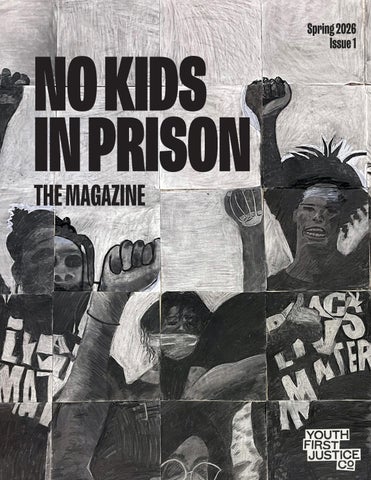
Spring 2026 Issue 1
NO KIDS IN PRISON THE MAGAZINE
Editorial Team Brit Christopher, Literary Curatorial Apprentice Gabriel Arika, Visual Art Curatorial Apprentice Karla Robinson, Editor Michaela Pommells, Executive Director Sophie Engel, Designer
Outreach and Distribution Team State Leads California: Samantha Ureña Padilla Connecticut: Jordy Ojedis Kansas: Marquan Teetz Louisiana: Talisha Daniels Minnesota: Gabriel Arika Pennsylvania: Brit Christopher
NO KIDS IN PRISON THE MAGAZINE
Youth First Justice Collaborative is a national network of campaigns committed to ending youth incarceration by dismantling the youth prison model, shutting down youth facilities and reallocating resources to effective community-based programs. For more information visit www.nokidsinprison.org Follow us on IG at @no_kids_in_prison
No Kids In Prison Magazine © 2026 by Youth First Justice Collaborative is licensed under Creative Commons Attribution-NonCommercialNoDerivatives 4.0 International
Cover Art Artist Statement: Inspired by the music video “The Bigger Picture” by Lil Baby. The song is a powerful song because it’s about how the cops are abusing their power and they prejudge Black people, assuming they’re suspicious or violent. Lil Baby talks about how tragic George Floyd’s death is and how the system is corrupt. We should not judge people by their skin color, but by their mind. Certain cops see Black people and dehumanize us without thinking twice. They hear us say “I can’t breathe, I can’t breathe” and keep going. The system is messed up and we need more good people to fix it. Cover Art: bigger picture, 7.5 x 7.5 foot charcoal drawing created by nine different students at Nassau County Juvenile Detention Center, New York
Brit Christopher, Literary Curatorial Apprentice photo credit: Wren Rene
Gabriel Arika, Visual Art Curatorial Apprentice photo credit: Mark Strandquist iii
YOUNG PEOPLE LEAD THE WAY SOLUTIONS THAT BRING COMMUNITIES TOGETHER ACCOUNTABILITY FOR ALL + BY ALL iv
Welcome to the first ever No Kids In Prison Magazine I’m thrilled you’re holding this beautiful collection of art in your hands! I cannot adequately express how beautiful this process has been and how many people poured into this magazine. Artists from 14 states and as young as 11 years old are represented in these pages.Thank you to every artist, writer, and organizer who submitted their work and shared their brilliance. I‘m so grateful to the artists who are currently incarcerated who used their phone calls and visits to edit their writing and the people working in facilities who strategized for months to get submissions and approval. Thank you to everyone who encouraged others to submit their work and the families and teachers who supported our youth artists. I appreciate every person who attended an editing session and hosted events so their community could work on their submissions together. I feel blessed to have worked with the Curatorial Apprentices, Brit Christopher and Gabriel Arika, at our weekly Editorial Team meetings.This has been a true community effort and I hope this collection feels like a gift. This magazine is both a throwback and a step into the future. If you were around in the late 1900’s (insert smile here) you remember when we had stacks of magazines to flip through for inspiration and information. Magazines aren’t as common now and that makes this first issue even more special. In a moment when true American history is being deleted, this is an archive that will live on. Please take your time and marinate in the beautiful poetry, powerful essays and stunning artwork in these pages. Think of this magazine as a towel to wash your eyes of the stereotypes that surround Black and brown youth and a way to connect with people across the country. As we work to dismantle carceral systems and habits, we’re building a world that values every young person and the community that surrounds them. I hope you feel inspired to create and share what’s happening in your corner of the world. Sincerely,
Karla Robinson Editor If you ever felt like the system wasn’t built for you If you’ve ever seen someone you love get locked away before they had a chance to grow If you carry stories that no one ever asks to hear, this is for you. No Kids In Prison magazine is a space for truth, for healing, for voices that have been ignored for too long. Artists, writers, photographers and storytellers, especially those impacted by incarceration Your story matters. Your art matters. If you lived it, dreamed it, or fought for it; this is for you. Thank you for joining us to build something that speaks louder than bars, Something that can’t be locked away. Sincerely,
Gabriel Arika Visual Art Curatorial Apprentice v
CREATIVE WRITING 5 ������������������������������������������������������������������������������������������������������������������������� Justice for Youth, Ayana Hoberg 6.................................................................................................... Guilty Until Childhood Ends, T’Onia Avery 9 ......................................................................................................... 19 Tomorrow - YJ&O, Samaya R.C. Vails What We Want Baltimore to Know About Us: 10 ................................................................... The Unspoken Voices of Baltimore’s Youth, Sela Powell 11 .................................................................. I Don’t Make Your Community Unsafe, Anwar Williams 12 �������������������������������������������������������������������������������������������������������������������������������escape room, Talisha Daniels 14 .................................................................Community Led-Diversion Perspective, Jarue Lawson Direct File to Liberation: 16 ............................................................................A Conversation with Imena Phillips, Brit Christopher 19 ���������������������������������������������������������������������������������������������������������������������������������Listen to Me, Rawhese Love 22 ������������������������������������������������������������������������������������������������������������������������ Justice & Peace, Anilah Landry 25 ................................................................................A Second Chance Awaits Her, De’Sherra Gaston 27 �������������������������������������������������������������������������������������������������������������� Alone in the Matrix, Marquan Teetz 28 ........................................................................ Freedom’s Not Just Physical, Kristen Nicole Powell 35 �������������������������������������������������������������������������������������������������������������������������������������Stay Supreme, Erin Merdy 36 .............................................................................Menstruation While Incarcerated, JoAnna Marks 38........................................................................................................... Help Me Understand, Aniah Ferguson 39 ����������������������������������������������������������������������������������������������������������������������������������������Let Me Vent, Anonymous 40 ��������������������������������������������������������������������������������������������������������������������������������������������� Who I Am, Anonymous 43 ............................................................................................ Something To Think About, Semaj Streeter 44 ....................................................................We Build Men Out of Broken Boys, Devin A. Giordano 49 ����������������������������������������������������������������������������������������������������������������������������� Resilience, Stephanie Murphy 52 ............................................................................... A Conversation Never Shared, Latrisha Lowman 54 ............................................................................................People Who Are Hurt, Steffanie E. Laureano
vi
VISUAL ART Untitled 2019, Joseph “Shavuo” Goodwin..........................................3 Survivor, Bishop McIndoe................................................................................4 Achieving New Heights, Dereion S..........................................................7 Be The Change, Dallas Downey..................................................................8 We Good, Donna Grace Koh...........................................................................15 The Real Lady Liberty, Luz Hernandez ................................................21 For Roses Growing Young, Keshad Adeniyi......................................23 DayDreamer, Samantha Cortez...................................................................24 Untitled 2024, Joseph “Shavuo” Goodwin.........................................26 Eye, Leon Guerra......................................................................................................29 Untitled, Diante B...................................................................................................34 The Extra Yard, Dimoné Fleming................................................................37 Dust to Dust, Bishop McIndoe.....................................................................41 I Am AT LIBERTY, Tamara Cherduville.....................................................42 Controlling Me, Bishop McIndoe................................................................45 Watermarks On My Wooden Floor, Samantha Cortez.............48 A mother’s pledge at the river’s edge, Garrett Q. Barr............50 Love is a verb, Garrett Q. Barr.......................................................................55
COMMUNITY FEATURES Freedom, Freedom Side School .................................................................20 Dreaming of A World Where All Youth Are Free: Reflections on “Freedom Constellations” 2020-2024................30 Journey to Justice Bus Tour.......................................................................46
Appendix vii
Dear Community, We created this magazine because youth incarceration is not inevitable, it is a choice. And if it is a choice, it can be undone. These pages point toward a world where care replaces punishment, where communities are resourced instead of criminalized, and where healing and accountability are practiced without harm. This magazine is a reminder that abolition is not just about what we are ending, but about what we are building together. This publication reflects a deep commitment to the restoration of dignity, of imagination, of belonging. It holds space for grief and anger, but it is ultimately rooted in hope. Hope that grows from community. Hope that comes from young people who continue to dream and organize even when systems fail them. Hope that insists our futures can be expansive, loving, and free. This is more than a collection of pages. It is a platform shaped by youth artists, designers, journalists, activists, and organizers who know firsthand the harm of systems that punish instead of protect. Contributors are not asked to explain their pain for consumption; they are invited to share analysis, vision, creativity, and strategy on their own terms. Here, young people contribute to and curate the work itself, deciding what stories matter, what futures feel worth fighting for, and what care looks like beyond cages.
2
This magazine exists because young people have always been telling the truth through art, through organizing, through survival, through imagination even when the world refuses to listen. The No Kids In Prison Magazine was created as a space where those voices are not only heard, but centered, trusted, and held with care. This inaugural issue comes from a belief that something different is possible when directly impacted young people are given the space to lead. It marks a beginning shaped by the urgency of this moment and the possibility of what comes next. A world without youth prisons is not abstract or distant; we have already seen youth incarceration decline, and we know this future is possible within our lifetimes. We offer this magazine as both a reflection and an invitation. To learn, to feel, to be challenged and to join us in creating a world where no child is caged, and every young person has what they need to thrive.
In solidarity,
Michaela Pommells Executive Director, Youth First Justice Collaborative
Joseph “Shavuo” Goodwin, Untitled 2019, acrylic, 16 x 20 in, New York 3
Bishop McIndoe, Survivor, acrylic, 12 x 16 in, New York
4
JUSTICE FOR YOUTH
Ayana Hoberg, New Mexico
The youth are never forgiven When they make a mistake They become dumb and violent and insane Because the blame can’t fall to those that taught them The blame will not fall to those that hurt them That’s how it’s always been The youth are never heard When they scream the truth Their words are manipulated and ignored and used against them Because if they were heard the system would crumble If they were heard power would fall So they will never be heard The youth are trapped They are locked in prisons They are locked inside of themselves They are locked in the arms of people who bruise them They don’t even know they’re trapped The youth have never had forgiveness or freedom or a voice The youth have never had justice Will that ever change?
5
GUILTY UNTIL CHILDHOOD ENDS T’Onia Avery, Kansas
I was youngjust lack of understanding. Didn’t know the words they used, didn’t know why my hands were together like prayer, but with fists. They say innocent until proven guilty, but I watched my brother in shackles, orange suitand it looked the other way around. They tell you: take the deal. They don’t tell you: how a felony follows you home, to your school, your job, your futurehow it lives longer than your childhood. I met my lawyer in the hallway, ten minutes before court. He said: take this, or sit for two more months. No one told me I could say no.
They say, “Do you understand?” but your lawyer says, “just say yes.” And you do. Because you’re scared. Because you’re alone. They make you feel like you’re evil, like you’re broken, like the color of your skin is the crime. But I am not a criminal. I am not a bad person. I am still unlearning the lies they forced on me. Not to trust the systemthat’s what I learned. Freedom is something you have to buy. And some of us were never meant to afford it. I just want peace. I just want happiness. Divine wisdom and knowledge. A world where kids aren’t sentenced for being young, for being poor, for being Black, for being human. No kids in prison. Ever.
This poem was compiled and edited by T’Onia Avery with support from I Am Why. It was inspired by her work as a Youth Leader for the Gault Center Report in 2025. Through a partnership with Progeny, system impacted youth were interviewed about their legal system involvement. The lines of this poem were taken directly from these anonymous interviews. 6
Dereion S. Achieving New Heights, digital art 7
Dallas Downey, Be The Change, digital art, 8.5 x 11 in, Minnesota 8
19 TOMORROW YJ&O
Samaya R.C. Vails, New York As a young person, you don’t get me You see me as an adult, but I still feel the kid in me You used to charge me at 16 & 17, now you saying I got until 18 I’m 18 now but when I turn 19 tomorrow that means that you can charge me again like you would have if I was 16 & 17 But how is it that I am once again falling under a policy that I was protected from for some time? Do you think turning 19 doesn’t still make me a kid? Neurologists told me I fully develop when I am 25. New sciences say I fully develop when I am in my 30’s. You see me as an adult… but am I an adult? Does being charged as an adult really mean I am an adult? Are you charging me because of my age or because of my offense? Raise the Age (RTA) is a New York state legislation that increases the age for a young person to be charged and housed as an adult in the criminal legal system. In 2018, the age increased from 16 and 17 to 18 years old. The Youth Justice Opportunities Act (YJ&O) is a refined version of RTA that seeks to expand the age requirement for a young person to be charged and housed as adult in the criminal legal system from 18 years old to 25 years old, while also creating restorative and rehabilitative programs as responses and alternatives to incarceration. They all say Raise the Age is killing the young, but that’s not true. There’s stories, yes, but where’s the investment in Raise the Age after it was passed? YO stands for youth offender status and YA stands for young adult status. People barely use YO in the courts. It seems hard for me to get a YO in the courts. I heard of YJ&O, you know YOUTH JUSTICE OPPORTUNITIES ACT It’s willing to protect me until I am 25 They changed it from YO to YA. YA = young adult status. They removed the shame of being an offender and they put humanity next to my youth. But not only that, it’s an opportunity act. You were once young. How can you forget that you were once young? No, we don’t have the same upbringings, but where’s the grace for my youth, the youth you not too long ago left. I mean if God looks at both of us, He just sees 2 kids. You’re just a bigger kid. But you may not even be a bigger kid, maturity wise. So are you really the big kid? You try to convince others that people like me, Black and Brown youth, are not worthy of redemption. Raise the Age was just the front of the page. Don’t confuse it as the last page. 9
WHAT WE WANT BALTIMORE TO KNOW ABOUT US:
The Unspoken Voices of Baltimore’s Youth Sela Powell, Maryland
We want Baltimore to know that we feel misunderstood, unrepresented, and underestimated. We are capable of so many things, but feel a lack of resources, limelight, and knowledge. We are just figuring things out as individuals, as we are not children, yet we still aren’t quite adults. However, society and law are constantly flipping between everyone expecting us to act like adults and the age when we actually become one. We go to school and work and have to see, live in, or hear about underdeveloped neighborhoods. However, adults believe that none of it affects us. Baltimore doesn’t develop and fund its schools enough. Some subjects taught in most schools are outdated and aren’t up to date with the modern trends and pace of society. There are some teachers that are underqualified to teach and don’t understand us. And school doesn’t teach youth important life skills we need to know: for example, how to sign up for health insurance, get a job, or file taxes. They don’t teach at a slow enough pace for the children to learn. Some youth would strongly benefit from individualized learning plans. If they keep teaching the same way they have been, youth will continue to be underachievers and unemployed. So, say you are lucky enough to live in a part of Maryland that the mayor built up or refurbished.
10
We still see the news and have just gotten through a whole pandemic that changed our view of society as a whole. Even though we are still growing and discovering who we are as people, family and society expect us to go to school, find a job, and decide what we want to be after the next 4-8 years. We want society to know that we aren’t all lazy. However, some of us go to college like we are told so we can “get a good job”—now what? We owe money in student loans, and “there aren’t enough jobs for people,” “they aren’t hiring,” or the “good government jobs are laying people off.” Sometimes these are our parents dealing with these issues, including unemployment. But society expects us to be unaware, oblivious to the things happening because “you’re a kid,” “kids don’t pay attention to things like that,” or because society doesn’t want to be held accountable. Elected officials focus on lowering youth crime rates and applaud the kids prone to making bad choices for doing good, or persuade them with rewards. However, you don’t focus on your kids who have been doing good all along just because that is what is expected of them. Your youth who see it as their calling to serve their city and fellow youth struggle to find programs, and when they do find them there isn’t enough space for everyone or they aren’t properly trained on how to be professional. Many youth feel and agree upon these struggles. But they are afraid to speak up and voice their opinion for fear of being shunned or ostracized because of others social biases. So yes, we can be dreamers and achievers, and whatever you want us to be for a perfect future. But you, Baltimore, have to let us know that we are heard and appreciated by you as well.
No Kids In Prison Exhibit, Illinois
I DON’T MAKE YOUR COMMUNITY UNSAFE Anwar Williams, Pennsylvania
Lately I’ve been thinking back to when I was a part of the Survivor Justice Network (SJN). I joined in 2024, at the time I was 16 going on 17. I wanted to be a part of positive change in my community. We were a collective of trauma informed individuals working to address root causes and safety. During my time with SJN I’ve learned something that affects me and the youth in my community til this day. THE VILLAGE THAT RAISED ME IS AFRAID OF ME We canvassed the Mantua area of West Philly asking questions such as “Do you feel safe in your neighborhood?” and “Do you think there’s a better alternative to prisons and detention centers?” There was a surplus of people within the community that felt it was unsafe for many reasons. However, the most touched on reason from the community was that the ‘youth’ made it unsafe. And there were people, elders, parents, and educators who were essentially okay with youth incarceration. They argued that if they aren’t locked up then “where will we put them?” “Maybe it’ll get them right,” a woman said. Get them right? As in rehabilitation with no resources directed at repairing their mental health and restoring
relationships within the community? They spoke of everything that is wrong with the youth but spoke NOTHING of what molded them into the way they are. Things like the system, their village, the lack of community engagement or support, the internet, media, and oppression. They spoke of the youth, the kids as if they’re just “bad” with no rhyme or reason. Black and brown youth are perceived as “dangerous,” “rowdy,” “disrespectful” and “bad” by their peers, elders, and society. As if we aren’t a reflection of our families, environment, and community. The community doesn’t like how the youth presents themselves, but I must ask… What taught us? Was it our parents? The community? TV? Our corrupt and violent government? My first thought when hearing people say “youth make the community unsafe” is that it’s ridiculous to be afraid of someone that came from you. In order to feel safe in our communities and actually rehabilitate it and heal our land and our people, we must come together. The village needs to embrace the youth. We are a reflection of you. Teach us, support us, and lead by example. Everyone knows the saying “It takes a village to raise a child.” But people often forget that “the child who is not embraced by the village will burn it down just to feel its warmth!”
11
escape room
Talisha Daniels, Louisiana
at a moment’s time i notice the walls i think of the confinement the restriction the walls become shrunken i become bigger then smaller than a part of it then nothing lights on
my prison | how much of this space is mine | how much is | how do i | what is this | what point is free | at which point of my restriction do i creep into the other parts of myself | what happens when i face these parts | another door another door | the way someone else’s clouds the room and | mine responds and becomes mine mixed with those coexisting existences that scare me and define me
rigid stuck behavior the door is here
the door is also here a maze of my own truths spewing from me and creating borders that i have to now break down
my joy can’t even spill out i have to be okay with it to be seen why does the dark feel so bright
this world with its own energy | coexisting with mine | swallowing and draining from it | i have dreams of hurt | and dreams of me hurting | and others that are hurt | ones of extreme weight | ones of mild pain
today's mirror shined brighter today the dark spoke so loudly the tip of the spear was the end for me
a death and a grief
a bow must be taken for the fallen and a candle for the way out
not free until we all free going and going making use of what is
here and more feeling
lights out
COMMUNITYLED DIVERSION PERSPECTIVE Jarue Lawson, Pennsylvania
My name is Jarue the A.S.S.I.S.T. (Afrikan Supporting Strength Inspiration & Success Together.) I’m the adult advocate of Care, Not Control’s Youth Advisory Board. I am a strong advocate for community-led diversion instead of responses that enslave our children.
The children in my community are my babies. Community-led diversion is organic and truly can They are under attack and we are responsible meet our children where they are. Restorative for their futures. The communities that our and transformative justice practices like circles young people are being born in are designed are great guiding practices for community led with targeted disinvestment (redlining), diversion. True community led diversion means disenfranchisement (cradle to prison the community is so empowered that when pipeline), subjugation (the crack era policies), there is a transgression against the community miseducation (critical thought being taken said community can divert without any law out of school and schools never teaching enforcement involvement at all! We have identity through accurate history.) All of this is witnessed the failures and abuses of locking documented in our legislation, bills, and policies. up and placing our children. Look how many facilities have reported abuses and closed for I stand before you as a slave amongst freed abuses against our children like Glen Mills. men and women. The 13th Amendment says There is no data and/or evidence that locking because I was duly convicted of a crime, I am up children makes them safe, healthy and a slave. I’m a custody level one; I went to Glen productive for their lives and future. Children Mills at 15 and was in a state prison by 19. I was need to be with their families, in communities made to believe that I was to figure out a life that love, support, and empower them that was already prepared for me by people who communities that are well-resourced with were here before me, without those peoples funding and programming to engage young guidance and honest, informed instruction and people. direction. Young people need a lot of guidance, eldership, structure, and accountability from That is why we are here today, calling for people who are accountable. Remember Diversion, Now! their frontal lobes are not fully developed; Its LOVE our children, NEVER fuck dem kids! they need to be diverted! Diversion programs provide that structure, accountability, eldership, reinvestment, and education.
14
Donna Grace Koh, We Good, acrylic on canvas, 48 x 36 in, Pennsylvania
DIRECT FILE TO LIBERATION:
A Conversation with Imena Phillips Brit Christopher, Pennsylvania
Imena Phillips and Brit Christopher are former system involved youth from Philly who worked together on Care, Not Control’s UnCaged Potential: Justice from the Ground Up Podcast. Brit: Hi Imena, thanks for agreeing to this interview. Before we start, could you share your background, role with Care, Not Control (C,NC) and a few things you’re passionate about? Imena: Of course, I’m a formerly incarcerated youth. I grew up in Philly and moved back and forth between Delco and Philly throughout my youth. I had an unstable upbringing resulting in my grandparents essentially adopting me. I joined Care, Not Control’s Youth Advisory Board in July of 2024 to be a part of something that aligns with my belief that youth incarceration is harmful and should end! I’d say I’m most passionate about eliminating direct file and shifting the narrative around youth incarceration! I also love art, video games and kittens. Brit: Thanks for sharing that with us. As a part of C,NC you also participated in the UnCaged Potential: Justice From the Ground Up Podcast. Why should folks listen to and/or watch UnCaged Potential? 16
Imena: UnCaged Potential is an abolitionist podcast that uplift youth voices, educates and advocates for the abolition of youth incarceration. People should tap in and engage because of the many perspectives shared. The conversations and questions that challenge the systems that uphold youth incarceration; and I feel a lot of people can benefit from reflecting on their own beliefs, instincts, and biases. This podcast has the power to spark more conversations around the issues youth face and allow listeners to continue these discussions within their communities. UnCaged Potential also gives an introduction to Care, Not Control’s work and our goal of freeing all youth. Brit: Word, creating UnCaged Potential was definitely a blast and very informative. I agree that this podcast will generate many deep conversations. Earlier you mentioned having a passion for direct file and reshaping the narrative around youth incarceration. Could you speak more on direct file? What is it? Why should it be eliminated? And how does direct file impact a child’s life?
not fully developed in adolescents, meaning youth don’t actually comprehend the long term impact of their decisions. Direct file should be eliminated because it is extremely harmful; those charged as adults are statistically more likely to reoffend and/or remain in the judicial
Photo Credit: Naomieh Jovin
Imena: Direct file is a record that gives the District Attorney the ability to bypass a judge and charge a youth as an adult with a crime. Therefore leading them to adult jails, prisons, charges, and treatment. Research shows that the parts of the brain responsible for long-term planning and assessing consequences are
system, which is counterproductive to reformation. Permanent adult records can hinder those trying to achieve numerous career paths and higher education based on actions they made as a minor. Prosecutors are able to bypass judges to charge youth as adults, giving them sole power to disrupt a child’s entire
life. In my personal experience with direct file I was told if I did not plead out in juvenile court they would just try me as an adult. I was fearful of spending years wasted on decertification. I did not want to try my case because of the fear I felt. [Decertification is the legal
community connection, and the support of family. What makes all of this worse, time served is not a thing for youth! Meaning they’ll have to go through the juvenile system as well. This is a complete waste of the very little time a child has to be a child. They miss out on learning and growth opportunities, important milestones like graduation, prom, birthdays, life moves on and their growth is stunted. These are the harms of direct file, your biggest mistake should never follow you for life and no kids should be in prison ever. Brit: Direct file carries a lot of weight, thanks for putting us on to this info. To close out our conversation I’d like to talk a bit about your participation in closing Lima Juvenile Detention Center in Pennsylvania. What led to this closure? How did you support?
process of transferring a juvenile’s case from adult criminal court back to the juvenile justice system.] No child should be pressured to plead out with a fear for their future. Many youth who go through the adult system and get decertification end up missing out on several months to years of education, skill training,
Imena: I wish I could’ve been more of a help from an organizational standpoint on closing LIMA Juvenile Detention Center, however I participated in an interview about my experience and the illegal activity that happened there to be blunt. There were instances in which staff gave us (youth) drugs, for example marijuana oil, which as a youth, I didn’t mind or think any of it. Looking back as I’m older I know that is highly inappropriate and not okay. Male staff would take female youth to areas off camera. Someone who I became friends with while inside was treated egregiously. I remember writing grievances with them which were thrown in the trash by staff. I remember male staff gazing at me and making sexually inappropriate comments. There was a staff who
would keep us locked in our rooms from morning til second shift at 3pm. In the released documents there are even worse things that I thankfully did not have to experience or witness. I shared my story and told everything I saw because none of it was right! We weren’t safe, protected, or heard until it was too late. I’ll continue to fight for the elimination of direct file and the closure of all youth prisons in Pennsylvania because no child deserves to experience the trauma of living behind bars. Brit: Wow that was heavy. Thank you for sharing your story and journey. It’s been great chopping it up with you Imena. I know you’re doing great things within your community and with the C,NC team. Is there anything else we should know about you, Care, Not Control, or the UnCaged Potential podcast? Imena: Thank you, I’ll close out by saying UnCaged Potential: Justice from the Ground Up is a great listen. Everyone that participated in this comes from different walks of a similar path and discusses hard topics that many aren’t aware of unless directly impacted.
Check out Uncaged Potential: Justice from the Ground Up Podcast
17
Freedom Constellations Banner, Virginia
19
FREEDOM
Terrell Woolfolk, Freedom Side School, Pennsylvania I was 22 years old, a man/boy who knew everything about nothing and I had just been tried, convicted and condemned to die in prison. You would think that a young man existing within these conditions would have a basic understanding of what it meant to be free, and I did, it was just that how I conceptualized freedom was just as confining as the 30-foot walls that imprisoned me. It was an existence of absolute confinement; I was trapped within barriers that I could see and ones that I could not. I remember my father shared a quote with me that said, “stone walls do not a prison make, nor iron bars a cage,” and after sharing that quote he told me that writing would be the key to my freedom. At the time I paid the quote little mind and I scoffed at the idea of writing being the key to my freedom, those invisible walls would not allow me to see beyond the physical constraints that boxed me in. In the year 2000, 8 years into my imprisonment my father suddenly passed away. It was then that I gave writing a try, not because I was convinced that it would free me, but rather it was simply a tribute to him. On July 18th, 2022, after 30 years of a life without parole prison sentence, I found myself walking out of a PA penitentiary a free man. It was not the exodus out of that secured space that defined my freedom, but rather it was the discovery of how the reflective aspects of writing allowed me to know and accept everything about me that made me 20
who I am that liberated me. I was a free man before I stepped out from behind those walls. The written word became wings of expression that allowed me to transcend my personal prison of fear and selfdoubt. I exposed myself to myself revealing an unadulterated truth that I could not hide from, that I could not exaggerate out of existence. This manifestation eventually led me to accept everything about me that made me who I am. This in and of itself was liberating. I could finally be me without concern. My imagination detonated the dungeons of conditioning that stifled my promise to be my full authentic self by allowing me to see myself as more than what my circumstance said I was: a convict, a felon, an inmate. Although he didn’t have a chance to see the seed of liberation that he planted within a fertile mind take root. I know that my father is smiling down upon me. I’ve now embarked on the 2nd leg of a life-long journey still engaged in the work of liberation. Through my reflective process I realized that the construction of those invisible walls began the moment I became conscious of myself. So this is where the work of true liberation begins, it starts with our children. Imagine a place where the practice of creating a world without prisons, police, and surveillance is a reality. A world where we build systems of justice grounded in healing and accountability. A space where everyone has what they need to flourish. This is where I found myself. My love for freedom landed me in the middle of a vision come to life, as the Director of Family and Community Partnerships at Freedom Side School, an abolitionist elementary school for children impacted by
incarceration. In the fight to end the practice of caging human beings for the rest of their lives, a group of caretakers directly impacted by incarceration and activists imagined a space where our children would be taught what it means to be free. These founding m e m b e r s dreamt of a space where our children would be supported to think critically about the issues t h at affe ct our lives, and grounded in the truth about the world we live in. During my most formative years I was handcuffed, shackled and locked in a box that convinced me my life was worth nothing. There was a pressure that I could feel, a tug, a pull that increased in strength until finally I was sucked into this pipeline that fed penitentiaries. I was a child vulnerable and ill equipped to deal with what the world had in store for me. At Freedom Side School we are providing our children the tools needed to burst that pipe so that no more of our children will be used to satisfy the hunger of a beast.
Luz Hernandez, The Real Lady Liberty, acrylic, 12 x 24 in, New York
Children are master practitioners of imagination and imagination is the thing that makes freedom possible. In September 2026, the doors to any and everything possible will open and our first group of young freedom fighters will walk into a space dedicated to their future of a better tomorrow. “Stone walls do not a prison make, nor iron bars a cage.”
Imagine if Freedom Side School was around when I was a child. How different do you think my life would have been?
Freedom Side’s doors will open September 2026. For more information visit our website: www.freedomsideschool.org 21
Anilah Landry, Louisiana
JUSTICE & PEACE
We just want y’all to stand tall We just want justice for all We not gonna sleep till they bring justice and peace We not gone let you take away our dignity
22
We in 2025 and can barely even survive I look back at school, man us kids was livin lies Teachers they acting funny they teaching us just for money It was my school, my rights but I always put up a fight We had to eat when they said to eat and speak when they said to speak But in natural reality these school they can not keep building pressure from underneath With this racial disparity It’s the unfair treatment the fact that we never equal It’s the color of our skin they thinking we’re all a sin man But in school man we cannot win Man in schools we can not win Huh? No we can’t But look, we learn to adapt in life and that’s a fact We learn how to play a part in schools, it’s just an act We have no rights we always wrong that’s why I wrote this song Because we want justice man and justice is never wrong No rights for education, no rights for our freedom No rights for our color, no rights to our safety But in schools we just try to laugh we just try to make it We just want our freedom yea but this system is built to take it Yeah this system is built to take it, but we all just tryna make it It starts from within schools yea they just want us to lose They just want us all to fail so we all end up inside of jail But dignity in schools is what we advocate for We just wanna learn our lessons and get blessings and just explore Let the kids be kids is another campaign We taking action into the streets yeah you know this ain’t a game Cuz we tired of this system all it does is bring us pain They treat colored people different but we all bleed the same We just want you to stand tall we just want justice for all We aint gonna stop, we aint gonna sleep till they give justice and peace We just want you to stand tall we just want justice for all We aint gonna stop, we aint gonna sleep till they give justice and peace We just want y’all to stand tall We just want justice for all We not gonna sleep till they give justice and peace We not gonna let you take away our dignity
Keshad Adeniyi, For Roses Growing Young, acrylic, newspaper, and oil pastels, 48 x 48 in, New Jersey
23
A SECOND CHANCE AWAITS HER
De’Sherra Gaston, Maryland
As life awaits my true destiny I’m hit with constant reminders of the wicked world we live in All the mistakes I’ve made trying to put my life together even if it meant hurting others God doesn’t punish us for mistakes He lets us learn our own path and choices I even made a bed and laid in it Fight after fight after fight night after night after lonely nights flipping chairs, screaming, crying, long night walks
Samantha Cortez, DayDreamer, acrylic with glitter, 16 x 20 in, New York
Then slowly school suspensions almost every day to defend my feelings when I felt wronged I lost myself and turned on everyone because I was misunderstood No guidance, not even my own mother This girl lost all hope in herself Drowning, scratching, harming I blamed myself for being misunderstood when all I wanted was a second chance I’m only human, I make mistakes and only hope to find the remedy to redeem all the harsh reality I have set into Now I have a broken heart that you’ve torn apart to break me Only to wanna be set free I’m only human, I make mistakes, back against the wall until it breaks Constantly thinking of a better life Better community, less violence, more togetherness Communities are usually so divided that we never can fight together It’s always against each other You even lose yourself trying to save the ones you love just because you care, you over care you over love and then you have nothing left to fight for Your heart feels shattered and vengeful Now you’ve become the bad guy The bad guy becomes the most hated and now you feel like life isn’t even worth living for God blesses us with imperfections Humans make mistakes, right? I think I should have a second chance
25
Joseph “Shavuo” Goodwin, Untitled 2024, acrylic, 24 x 24 in, New York
ALONE IN THE MATRIX Marquan Teetz, Kansas
Walking through a coded maze, Lines of data shape my days. Trapped in silence, lost in thought, Trying to make sense of what I’m not. Not understanding the mix I see, Of illusion dressed as reality. They’ve written scripts I didn’t choose, In a life designed for me to lose. Programmed to fall for life’s cruel tricks, Taught to chase what never sticks. Every step feels like a test, And still, I can’t find any rest. Scared to speak from these trembling lips, Afraid the truth will make me slip. What if my voice is just a glitch? What if my soul’s a broken switch? I’m in a world that doesn’t love me, Cold stares and walls above me. In a system built to bind and break, Where hope feels like a cruel mistake. Taken away from all I’ve known, No more light, no place called home. The faces fade, the warmth is gone, I’m left to wander all alone. I’m only a child with no phone, No signal, no connection, on my own. Caged inside this twisted zone, A silent heart turned into stone. Keeping me from all I knew, From joy, from laughter, skies once blue. Now it’s wires, code, and empty tonesA child forgotten, all alone.
27
FREEDOM’S NOT JUST PHYSICAL
Kristen Nicole Powell, Oregon They said I was free when they opened the door but freedom doesn't live in paperwork. It don’t show up with a court date or a caseworker’s smile that fades before you blink. I was a runaway girl learning young that you can leave a place and still carry its walls inside you. Foster homes, group homes, secure care, jail, each one with its own kind of silence. Rules on the wall, cameras in the corner, a bed that ain’t yours but holds your tears anyway. They said, “We are keeping you safe.” But safety never came with softness. And I learned to make peace with the sound of my own breathing when nobody else checked if I was still alive. Freedom, I found, Is not the day you walk out. It’s the day you walk in into yourself. The day you stop apologizing for surviving places that tried to break you. The day your body stops flinching at kindness, and your heart lets a little light touch the parts you swore you’d never show again. I’ve been caged without cages, watched the clock move slower than healing. And somehow I found my rhythm again, learned how to speak life back into my own name. Now I walk like I own my own reflection. I speak like silence owes me rent. And when I look back at that runaway girl, I tell her you didn’t just survive. You became the proof that freedom starts from the inside out.
28
Leon Guerra, Eye, graphite, 8.5 x 11 in
DREAMING OF A WORLD WHERE ALL YOUTH ARE FREE Reflections on “Freedom Constellations” 2020-2024 Mark Strandquist and Kate Deciccio in conversation with Gabriel Arika and Alicia Garcia Youth are being demonized in the media and blamed daily for systemic issues created by adults. Now is a time to counter racist, xenophobic, and classist tropes with every tool, platform, and skill set available. “Freedom Constellations: Dreaming of A World Where All Youth Are Free” (2020-2024) is a multi-city campaign that harnesses our collective creative power to imagine and advocate for a future where all youth are free, safe, and thriving. Created by Mark Strandquist and Kate Deciccio in collaboration with Youth First Justice Collaborative, the project has reached hundreds of thousands of viewers through robust public programming, massive public art, augmented reality immersive experiences, city-wide billboard campaigns, guerilla projections, and the No Kids In Prison exhibition.
immersive story telling exhibits, videos, giant banners, audio pieces- all making the case for ending youth incarceration and visualizing a world where all youth are free.
Freedom Constellations Exhibit, Minnesota
Mark and Kate had the honor of sitting down with Gabriel Arika and Alicia Garcia to talk about cultural organizing and their experiences working on the No Kids In Prison Exhibit in New Jersey and Minnesota. Mark/Kate: You were both part of “Freedom Constellations” cultural strategy projects designed to increase the power of your campaigns by using art. Why is it important for young people to have opportunities to use art as a tool to engage the public and system stakeholders in issues that impact young people?
Gabriel: Some people don’t know how to use their words and they’d rather put it on display. The No Kids In Prison Sometimes imagery can Exhibit traveled across actually shout louder the country, sharing than the words and the stories, dreams that’s what’s interesting and demands of youth about cultural Freedom Constellations Public Programming, Minnesota leaders and creative organizing, used as an tools including: virtual and augmented reality, massive organizing tactic or a strategy it actually gets us closer to 30
31
our campaign goal.
states, what was that experience like? What did you want people to see in your billboards?
Alicia: “One of my favorite lessons from that project … it’s like, regardless of your age, you can make change happen Gabriel: Our messages spoke loud. To be honest I really in any ways you want. It was just truly amazing that you didn’t put that into perspective (at the time.) How many created this space and the time to make us feel heard and people are really driving on the road and how long the seen. I got to learn about the things that affect me, within billboards were up, a lot of people did see. How many my state minds did we move? and even my How many did we community, convince about and learn this world we are the different envisioning without ways in youth prisons? which I can take charge Alicia: It’s so funny and attempt ‘cause my grandma to make and me lived changevery close to the educating interstate (where one others but of our billboards was then also installed.) So every educating time she’d drive by myself at like, literally every the same time, which is like time. It’s kind almost every day, of easy for she would stop and Uncuff the Future cultural organizing campaign, New Jersey us youth to take a picture of the get washed billboard and send in the it to me…she was so background cute. But yeah, it was and it felt like truly amazing.. the youth were in locations were very power. It truly strategic spots. They felt like the stood out. moment was for us and Gabriel: Capitalism that we kind distracts us all of had the the time…days in free play to days out you’re just do whatever fatigued and there’s we wanted. a lot of distractions… Even now, oppressed and having that suppressed…we experience gotta get out of it. has helped The billboards were me a lot in special. It felt like Wren Rene, Freedom Constellations, New Jersey collegeroom for us. Like knowing space for us. Many what I want, what I wanna do, how I wanna do it.” of us don’t get a chance to be put on display like that. Especially for a big campaign, this big mission. Knowing Mark/Kate: In each city where the No Kids In Prison how capitalism and big corporations want to tokenise us exhibit traveled, we also organized with youth leaders for their own profits, it’s nice to have your own space, with and artists from across the United States, to co-design a your own message- not someone else’s. And to have your series of billboards imagining a world where all youth are message scream louder. Having your message so big, the free. You all helped create some incredible designs in your size of it, it’s important. I could see it. Everyone could see 32
it walking or driving down the street. It even glowed during the night time. That’s pretty dope. Alicia: No way would I ever have expected for myself and my friends to be on a billboard, especially together. It felt like, wow, I’m really making an impact within my community and that’s me doing it. Coming from a low income first generation family, it’s definitely not easy to see yourself in spaces like that or creating spaces like that for others. Having spaces like that, especially for younger folks, is truly important. Knowing that there’s so much more than what others may describe you as- that’s truly important. Every time I think I’m gonna do something that involves activism, that’s like the first thing I think of, how can I mingle in art? How can I think like Mark and Kate to make this work?
Check out the Abolitionist Toolkit for free downloadable art, videos about the schoolto-prison pipeline and closing prisons, virtual storytelling, curriculum for working with youth, and more!
Freedom Constellations Exhibit, Philadelphia Any photos unattributed, attribution belongs to Mark Strandquist.
33
STAY SUPREME Erin Merdy
I exert a lot of energy being Miss Congenialty. Cause I have a lot of karma waiting for me. I think of being enlightened, supreme, but it seems like an unreachable dream. I meditate and practice compassion, but these strings and attachments, holding me down. These soul ties tell me they love me, these souls lie. I pray to God to open my third eye Because I am tired. How many times have I said that in my past life? Gotta divorce the idea of performance like an ex-wife, cause I don’t want to suffer. Not all recycled souls are eco-friendly but some are wasted efforts. They pull levers trying to control my blessings; They could never. I know how to protect my energy, So them hungry ghosts can’t devour my light to just a ray beam.
Diante B, Untitled,
digital art, 8 x 10 in
Do you see me? Do you hear me? I am alive and well If I can find peace within my self, Then I can withstand somebody’s hell, I mean somebody’s jail. It was hard being behind bars without bail. Now my soul drifts freely without a sail. I have gratitude for the cards that were dealt, Even though the hardships beat on me like a belt and leave welts. They are lessons and reminders of elevation. I plan to change my karma through realization, leaving behind distractions that bring hesitations, confusing the being I was meant to be. Keeping me from growing seeds of positivity, and ascending spiritually from this reality. But alas, there is beauty in everything. That’s why I dedicated to practice alchemy and transform my hurt into a writing peace. Stay Supreme 35
MENSTRUATION WHILE INCARCERATED JoAnna Marks, Kansas
Driving on a flat tire to the shop. Arguing with your husband. Killing him for abusing you. Homeless with nowhere to go, nothing to eat. Missed court to care for family. Just the wrong place at the wrong time. And now you’re doing time. They huddle you in a cell, like cattle. 25 women. 8 are menstruating. The guards throw in 3 pads, like they’re shaking chicken feed, saying go to battle. They do. They argue and push over them, ultimately cutting them to share… But still not enough. Make them from toilet paper, a shirt, or paper. All unsanitary, but less so than bleeding openly with no panties. You first feel disgust, touching another woman's blood. Then sympathy, something I pray politicians learn to feel, so that they know this is inhumane. Do they know… What's happening behind bars? Would they care? Write them and ask. Tell them women are dying from something preventable, being shamed for something natural.
36
37
Dimoné Fleming, The Extra Yard, collage, 8.5 x 11 in
HELP ME UNDERSTAND Aniah Ferguson
I see it all, how my mind, they always try to manipulate it I just take it in and of course don’t participate Call me crazy, when I’m around? Ya heart, it accelerates my thoughts, jotted down, you don’t understand, so flip a page You? Walk in my shoes? Try to convince me on a later day A battle? That I face? Yea, I deal with that s**t day 2 day Take ya problems? Make em mine? Got a cell that they designate The color of my skin? Always labeled as the one to perpetrate Convicting all these kids? Wish the system could eliminate Expanding my knowledge, teacher please come over and elaborate The trauma I experience, I'm still trying to recuperate A cloud that stay gray, can’t surround cus I’ll suffocate The way I care for people is the way I wanted to be cared for But it’s like once I do that, they always walk towards the door I always say, I don’t need family, I’m very much fine by myself But I’ve been deprived of care nurturing love for so long I don’t think it’s good for my health I don’t hold grudges but there’s something I can’t get over Every time I dwell on it is when I’m awake and sober It shocks me the ones you love would hurt you the most And still want to float around you like Casper the Ghost I put everyone before me to comfort them through crisis I only find things divided
38
LET ME VENT Anonymous
Can I vent to you? Baby look, let me be your baby, let me vent to you Never had a shoulder to cry on so I had to find one Mom told me some hateful shit when I ain't listen Kept replaying the moments in my mind like Lord can you forgive me Never had no real love so I went searching for the realest Use 2 talk 2 cus everyday but she ratted on me and I'm in the pen Started second guessing everybody loyalty cause who really real A told me take that rap shit for real You the baby GOAT Seen my mom stressing and depressing over the bills so I had 2 get up and go get it Daddy was in and out of jail so God had sent me a Father Figure Sister keep asking me questions and I don't know how 2 answer Told my brother I need him the most But he end up going far away Seen bro drop in my face I guess I seen a part of me drop 2 Keep screaming no mercy but Lord have mercy Can you forgive me? Shout out 2 B I guessed she the only one that held it down when I went miss C told me fuck the haters man it's time to get this money Gma keep crying over the phone I guess I'm the cause of the damage Cause I have big dreams and now I feel like that shit went 2 waste They keep worrying about my whereabouts I am never scared or ducking Put that on my mom
39
WHO I AM Anonymous
Being a black man is probably one of the hardest things to do. So growing up as a kid in New Orleans wasn't easy. Losing people you love to violence. Watching your family struggle. Not having your father around. I was going through all that, but at the same time I was taught men shouldn't show no emotions. So on the inside I was really hurting. Nobody ask about my problems so I would just hold it in. That just made everything worse for me. Fe lt l ike I wa s misunderstood in many ways. I was good at basketball. That was my escape from a lot of things that I was going through at the time. It was a lot of people supporting me and I know that I probably could have gotten a scholarship if I stuck with that. And I wouldn't say it was caused by a lack of role models cause I had some positive people in my life. At the same time I wasn't mature enough to really take in what they was saying. Like I loved basketball but I hated to see my moms struggle. Just like I had some positive role models I had some bad ones too. And I didn't have no patience 40
and understanding like I have now to know that fast money is going to feel good in that moment. But fast money that take 30 seconds to get could cost years from your life or it can cost your whole life. But as you live and learn and I know that I would rather work for it and know that it's mine and nobody could take that from me because I worked for it. I was 16 when I got locked up on my first offense. I'm 18 now and took a plea for juvenile life until my 21st birthday. Jail is not a place that nobody wants to be but it gives you time to really learn yourself and slow down. It also shows you who really there for you and who you can count on when times get hard. I think my family support is probably the most important thing while being locked up, also one of the hardest things. I say that because you would lose yourself at hard times without nobody there supporting you. But also, seeing your family hurt knowing that you the reason, can be hard to deal with too. Cause for me, knowing my mom hurting because of me and it's nothing I can do about it is a different type of hurt.
Bishop McIndoe, Dust to Dust, acrylic, 30 x 40 in, New York
41
SOMETHING TO THINK ABOUT Semaj Streeter, Pennsylvania
Streets are nothing but the urban version of corporate white America! I know that caught your attention. Just think about it for a second. Just hear me out… Private schools = seeing your parents on drugs. Some kids only worry about getting their school work done on time. Other kids have to worry about whether their parents can even afford school clothes. Graduating high school is the same as getting your first piece of wreck. Going to college is like getting your own block, and the degree that lands you a sturdy job is equivalent to the privilege of a lengthy prison sentence. I won’t shy away from the truth that I see. You say we make decisions, I say the oppressor orchestrated this for me. What if the playing field were even? NO drugs to destroy our communities, funding private school educations for children who are not ours by way of criminalization and mass incarceration.
Tamara Cherduville, I Am AT LIBERTY, Massachusetts
Realistic sources of income for families to provide for themselves and still have time to care for themselves and each other. Instead of broken homes with overworked or underinspired parents too tired or worn down to do anything more but exist. Consider ending red lining, discontinuing gentrification, and allowing our people to GROW, THRIVE & LIVE.
43
WE BUILD MEN OUT OF BROKEN BOYS Devin A. Giordano
Looking back, I was not a man when I was arrested; I was a kid carrying grownup pain. The system saw my charges and disregarded my childhood. Before all of it, I was just a boy trying to disappear into the noise. Nobody saw the hurt beneath the noise, and I did not have the words to explain it. In the days that followed, I replayed every choice I had ever made. I thought about the years of anger I carried like armor. I thought about the drugs, the distance I built between myself and anyone who tried to care, the way I mistook chaos for love and pain for proof that I mattered. I was nineteen, and the system called me a man, but I was just a broken boy who had run out of ways to hide his pain. Jail has a way of stripping you bare. It takes away your excuses and your distractions; all that remains is you and the truth you have spent your whole life trying not to face. For me, that truth was heavy: the anger, the weight of a death I did not cause but could not 44
separate myself from, the shame, the confusion. I learned quickly that you cannot heal in denial, and you cannot grow behind lies. For the first time in my life, I had to sit with everything I had spent years running from. The men around me were mirrors. Each one carried a story that sounded too much like my own. We didn’t talk about it at first; most of us did not even know how. Over time, we began to name what we had buried: pain, guilt, fear, and love. I began to see a pattern, how broken boys become broken men when no one teaches them another way, how silence turns into violence, how shame becomes survival. That realization changed me. Inside these walls, I helped create You Are Not Alone, a movement that teaches men who are incarcerated to confront violence and to build empathy where silence once lived. You Are Not Alone is about rewriting the story of what it means to be a man, what it means to make amends, what it means to love after causing harm and to help reshape the way men see women and to show that accountability and empathy are not opposites; they are the foundation of healing. It did not come from perfection or purity; it came from pain. It came from the need to tell the next man, I see you. You
can change. We can do better. We can build out of compassion, guidance, and truth instead. We hosted conversations about violence, respect, and emotional responsibility. We wrote letters to women in our communities, acknowledging the harm men have caused and promising to do better. We reminded each other that healing is not weakness; it is courage. I began to notice how many men carried their guilt in silent desperation, afraid that speaking it aloud would make it more real. But silence only feeds shame. So I started talking, not about my case, but about what led to it. Other men started talking too. Some were fathers, some were barely older than boys, but all of us were trying to figure out how to live differently than we had before. Late-night conversations in the dayroom, a man breaking down mid-sentence during group, a letter from a woman who still believed in me, each one reminded me that even in a place designed to destroy connection, we could still create it. I used to think justice me ant punishment . Now I know it means transformation. Every act of empathy is a small act of abolition, and that when we choose to see the humanity in one another, even inside, we begin the
work of ending cages everywhere. Abolition, to me, is not just about tearing down prisons. It’s about building what should have been there all along, safety that does not depend on punishment, accountability rooted in love, mentors instead of guards, and communities that hold boys accountable without throwing them away. It’s about catching the fall before it turns fatal. I cannot undo my past, but I can honor it by making sure fewer boys grow up believing that pain is all they will ever be, and by helping build the kind of world where no child ends up behind bars. To any young person reading this, especially the boys who think they have to be hard to survive, please hear me. The pain you are carrying is not proof that you are broken; it is proof that you are alive, and you can still become something different. You are not your worst decision. You are not alone.
Bishop McIndoe Controlling Me, acrylic 12 x 16 in, New York
JOURNEY TO JUSTICE A first-of-its-kind interactive, mobile museum that brought the dark reality of solitary confinement into the light. History tells us that a bus can drive a movement. From Rosa Parks to the Freedom Riders to today's climate change caravans, these vehicles have carried more than passengers—they have carried progress. In the fall of 2025, the Journey to Justice Bus Tour added a new chapter to that legacy. Produced by Unlock the Box, the national campaign against solitary confinement, and Look2Justice, this groundbreaking tour proved once again that not every bus ride is about transportation; sometimes, it is about transformation. Traveling as a first-of-its-kind interactive, mobile museum and a true vehicle for change, we brought the dark reality of solitary confinement into the light. A centerpiece of the tour was the
46
book “Ending Isolation: The Case Against Solitary Confinement”, written by Christopher Blackwell, Deborah Zalesne, Kwaneta Harris, and Dr. Terry Kupers. Anchored by this vital text and featuring immersive audio installations, photo exhibits, video experiences, and VR—with content drawn directly from survivors and those most impacted—we reached thousands of individuals, making the devastating human cost of solitary confinement impossible to ignore. Ultimately, the tour was more than an exhibit; it was a celebration of the movement for human dignity. The tour may be over, but the journey continues, fueled by the communities we awakened along the way.
47
Samantha Cortez, Watermarks On My Wooden Floor,
48 acrylic, 48 x 72 in, New York
RESILIENCE Stephanie Murphy
I’ve been caged and I’ve been free And utterly enraged Frivolously free As light as one can be I’ve been battered and depleted, And grievously defeated Stood tall and preserved And overcome my fears I’ve been loved and I’ve been hated Beaten and elated Screamed in ecstasy It’s all so overrated And with each and every hindrance Persistent in resolve I’ve overcome my circumstance Resilient to it all
49
50
Garrett Q. Barr, A mother’s pledge at the river’s edge, color print shot on 35 mm film, 8 x 10 in, California
51
A CONVERSATION Latrisha Lowman
Latrisha is currently incarcerated on Rikers Island and this poem is a conversation with her mother who passed away.
Hello Beautiful, it’s been a while Can’t believe this is where you must see your child Mama I’m sorry I haven’t made you proud I feel out of touch with self and made a mess all around I know you always wanted what was best for me But losing you has surely stagnated me At least that’s what I believe… Now I know that’s a shame Taking your loss as the ultimate pain No where to lash out so I hold it all the same I should have known it would have been a matter of time For everything to unravel and I lose my mind Trying to stay sane Trying to fight the pain Ignoring all the signs So what’s your child to do My only choice was to do what I did best Turn to alcohol and drugs which created bigger mess My life has changed and everyone in it has been pulled from me I can’t believe this catastrophe I brought it on myself to a certain degree Should have sought help “mentally” I’m sure others would agree… So mother please talk to me
52
NEVER SHARED Hey my one and only, It’s not what I expected from you Please know I’ll always love you I heard you say: you’ve made a mess Be patient my child and know you’re blessed Repent for your sins, and sincerely make amends I know you feel abandoned by me, But truthfully I had to move on You see God was calling me home And if I stayed here, I would have been doing my Lord and Savior wrong Yes I understand the hurt you must have felt Trust me my child I didn't know the hand you were dealt If I could’ve stayed around it might’ve been you I buried in the ground. So even though you can no longer see me physically I pray that I’m embedded in your heart And when the wind blows you can feel me Know that you are apart of me So we’re always one of the same heart beat As you continue to grow, learning from your mistakes Giving praise to God understanding what’s at stake You’ve been given another chance to do better So I’ll watch from the heavens As you continue to climb the ladder
53
Steffanie is 11 years old and our youngest contributor.
PEOPLE WHO ARE HURT
Steffanie E. Laureano, New York Sometimes, when people find out my dad used to be in prison, they only see the label “ex-felon.” They don’t see who he is now. But I do. I see a man who turned his life around, who works hard, and who loves his family. I see someone who deserves a second chance. This is why my dad is a role model to a lot of people. My dad is not perfect, but no one is. He is kind, smart, and always there for me and our family. He teaches about doing the right thing and reminds others to stay strong, even when things are tough. To me, he is a teacher, a protector, and someone who shows love every day. The words "criminal" or "felon" don’t belong to him in my heart. Instead, I call him Dad and that means everything. It’s heartbreaking to hear his story. When he was younger, he made some bad choices. He often shares how those choices led him to be locked up for many years. He missed so much holidays, birthdays, and time with loved ones. I can tell it still hurts him deeply when he talks about
54
those times. Even though he made mistakes, he paid the price, and he came out a better person. There are so many men and women who have been through the same things as my dad. Many of them are good people who were just stuck in bad situations or never given help when they needed it. But the system doesn’t look at their hearts. It only looks at what they did wrong. That’s not fair. People should get second chances. My dad is proof that people can change. He got out, stayed out, and now tries to help others not make the same mistakes. I think that deserves respect and praise, never judgment. I’m proud of my dad. He’s made it through something really hard and didn’t give up. He shows me that second chances matter and that everyone deserves to be seen for who they are now, not who they used to be. I hope that one day, the world will stop seeing people only for their past and start seeing their future just like I see my dad.
Garrett Q. Barr, Love is a verb,
black & white print shot on 35mm film, 8 x 10 in, California
The No Kids In Prison Magazine is a platform for the raw visionary spirit of directly-impacted youth artists, writers, and organizers to reshape the national narrative around justice. We believe in community-based solutions, truth-telling, and visionary leadership. We are committed to documenting successful, community-driven solutions, advancing a nuanced narrative and challenging the harmful stereotypes that contribute to youth incarceration. Who We Are: Youth First Justice Collaborative (YFJCo) fuels a united movement of youth leaders, organizers and campaigns working to end youth incarceration. At its core, our vision is simple: No Kids In Prison. Our Partners: Our network of state partners furthers the movement at the ground level by emphasizing the leadership and voices of directly impacted young people and organizing campaigns to eliminate youth incarceration.
Thank You Iliana Pujols, Director of Youth Organizing and Leadership Jeanette Lloyd, Project Manager Susan Wilcox, Learning & Evaluation Robyn W. Guillén, Orleans Public Defender Mollie Hosmer-Dillard, Leadership Training Institute at the Nassau County Juvenile Detention Center JRose, Youth Justice Network Samantha Negron, Volunteer Editorial Assistant Youth Curatorial Support Autumn Talley and Beau RaRa Youth Distribution Team Support Jordyn Wilson, Desmond Bryant White, Xotchil M Larios, Antonio Travis
CALLS TO ACTION
Now More Than Ever, Our Youth Need Us 56
Connect with our state partners
THE FACTS
Cut it up and spread the word
Diversion programs, which redirect individuals from formal criminal justice processing to community-based services show decreases of up to 48% in re-conviction rates. (The Sentencing Project) After-school programs significantly reduce juvenile crime, with studies showing participants are 30% less likely to engage in criminal activity. (After School Alliance)
Youth summer job programs show up to a 43% decrease in arrests for violent offenses. (Brookings Institute) Credible messenger programs, which pair justice-involved youth with mentors having similar lived experiences, significantly reduce crime, with studies showing up to a 50% reduction in recidivism and a 76% drop in gun homicides in some areas. (Justice Center, Council of State Governments) 52% of youth were detained or incarcerated for non-violent offenses in 2023. Nearly 13,000 youth are detained pre-trial, meaning they are not serving a sentence. Shifting from punitive mindsets to community‑centered approaches can reduce youth offending and build safer communities. (Annie E Casey)
Fiction:
Fact:
“We’re only arresting older kids”
Sike. Some states don’t have a minimum age of arrest, while some created laws that allow them to arrest kids as young as 7, 8, 10, 12 years old. In some states, kids as young as 13 can be charged as adults, and are.
Fiction:
Fact:
“Youth confinement usually doesn’t last long.”
Wrong. 24% of youth are held more than 6 months, and 9% stay over a year.
Fiction:
Fact:
“There are hardly any youth in adult prisons or jails anymore.”
There are still people under 18 in adult facilities: about 2,000 in adult jails and 513 in adult prisons as of 2023.
Incarcerating a youth in the United States costs an average of $214,000 per year per youth. (Justice Policy Institute)
Fiction:
“Racial disparities in youth incarceration are improving.” d. Far from it. Racial disparities have worsene ative report, According to the 2025 Prison Policy Initi Black. over 47% of boys in juvenile facilities are
Fact:
Fiction:
“Locking kids up for status offenses (like skipping school) is rare.”
Fact:
Actually, thousands are held for status offenses: youth confi ned for status or technical violations account for a big slice , and 84–94% of them are in locked facilities .
locked up anymore,
st no kids are being Fiction: “Almo youth incarceration is basically over.”
Fact: Actually, there are still around 31,900 youth confined in 2023, even after a 70%+ drop in the past 25 years.
For more information visit www.nokidsinprison.org _prison Follow us on IG at @no_kids_in Sign up for our newsletter for updates and opportunities to take action to end youth incarceration!