CelebratingLifeAfter Racing


logo



logo
We are delighted to bring you this special issue of our magazine.
From show jumping to dressage, therapy horse to trail companion, eventing to show ring star and everything in between, ex-racehorses excel at it all.
We hope you enjoy reading about these off the track heroes, their retrainers, and the many racing industry programs pivotal in transitioning them into new careers
Along with our wonderful sponsors, we are committed to the welfare of all off the track horses, to their wellbeing, and to their success in finding fulfilling new lives.









Welcome to Equestrian Hub’s special Life After Racing issue. Dedicated to off the track (OTT) racehorses, it’s a celebration of the horses, their retrainers and riders, and the OTT programs and competitions that showcase these horses' diverse abilities.
As Racing Australia’s General Manager of Equine Welfare and Traceability, my focus is on the Thoroughbred and their role in Australian equestrian culture: as racehorses, sporthorses, companion horses, therapy horses, and as the source of spice and athleticism in many other performance breeds.
With Group 1s and Grand Finals occurring across the nation, spring throws the Australian Thoroughbred racing calendar into sharp focus. And while our sprinters and stayers are recognised and celebrated, away from the spotlight future generations are being born.
That Thoroughbreds are primarily produced to participate in the sport of racing can be conflicting for some. Many people have never had the pleasure of interacting with a horse, and thus have little understanding of the deep partnership possible between horses and humans. For those of us lucky enough to have horses in our lives, managing their wellbeing is likely to be our obsession. The relationship with a horse is not a casual fling, it’s a love affair.
The regulatory framework that manages a horse’s wellbeing during their racing career is the responsibility of Australia’s peak racing authorities - and since 2016, these authorities have also developed and funded a diverse range of programs to help transition retired racehorses into new and fulfilling careers. Financially, this has been made possible through a minimum one per cent prize money levy, which translates to at least $9 million annually.
And this does not include the countless unpaid hours as dedicated teams across the country, along with over 50 full-time employees, focus solely on supporting and creating opportunities for OTT horses.
So, as you turn these pages, I invite you to enter the multi-faceted world of life after racing, and to celebrate the magnificent horses that make it all possible.
With my best wishes,

Karen Day General Manager, Equine Welfare and Traceability Racing Australia


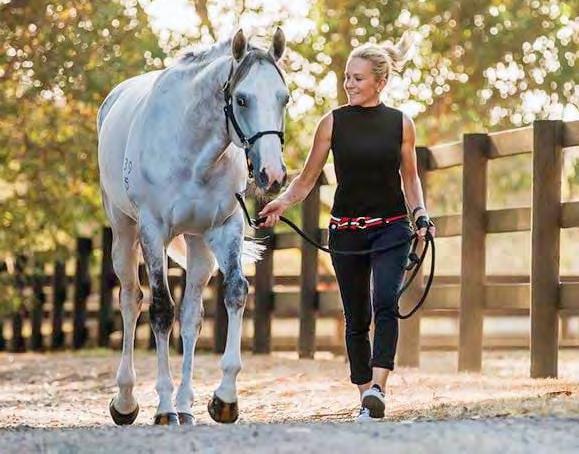
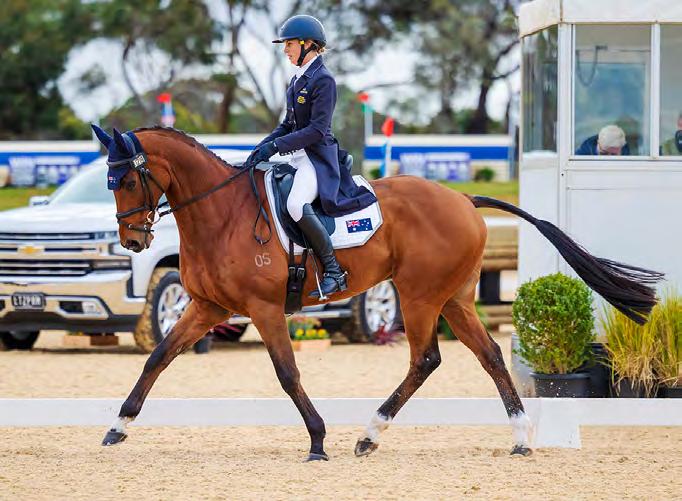

Some horses own your heart in a very special way, and for TARA MADGWICK that someone was Lunar Rise.
The first time I saw him, he was the centre of attention. It was at the Inglis Australian Easter Yearling Sale in 2011. Arrowfield Stud were parading their yearlings on the lawn at the front of the historic Big Stable and a handsome bay colt with a prominent blaze was much admired.
He later sold for $380,000 to the bid of bloodstock agent Duncan Ramage
and was the most expensive yearling by his sire sold at that sale. Named Lunar Rise, he was sent to the ‘Cups King’ Bart Cummings to be trained and raced in the famous colours of Dato Tan Chin Nam, previously carried by numerous champions including So You Think. In my role as Breednet editor, I kept tabs on Lunar Rise as his racing career progressed and was not surprised when
he won the prestigious Group III VRC Carbine Club Stakes.
As with all good racehorses, there comes a time when they can’t quite compete at the level they once did, and in the case of Lunar Rise, retirement in 2017 was the option chosen for a gelding who left racing 100 per cent sound.
He did not enjoy life in the paddocks of Think Big Stud and found the job of nannying boisterous yearlings a tiresome experience best left to others, so the question of what to do with him was one Duncan Ramage was left to ponder.
My teenage twins and I live on a small horse property on the South Coast of NSW where I grew up, and Daybreak Farm has become our little piece of horse heaven. Duncan rang me one day: “I’ve got to find a home for a special horse. He needs some sort of rewarding and fruitful career post racing and I thought you might be interested. He’s a nice person.” I was intrigued when he said the horse was a nice person and hooked completely when he told me it was Lunar Rise.

We went to Think Big Stud to try him out and long story short, Lunar Rise was soon on the float and headed to Daybreak Farm, joining us in March 2018. Somewhere on that trip home he acquired the name Lenny.
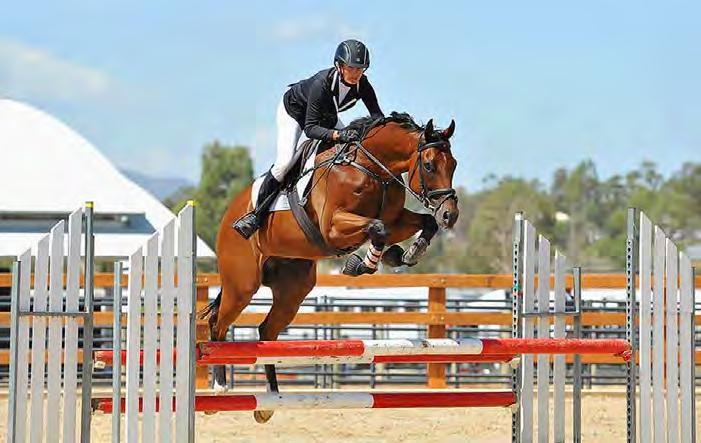
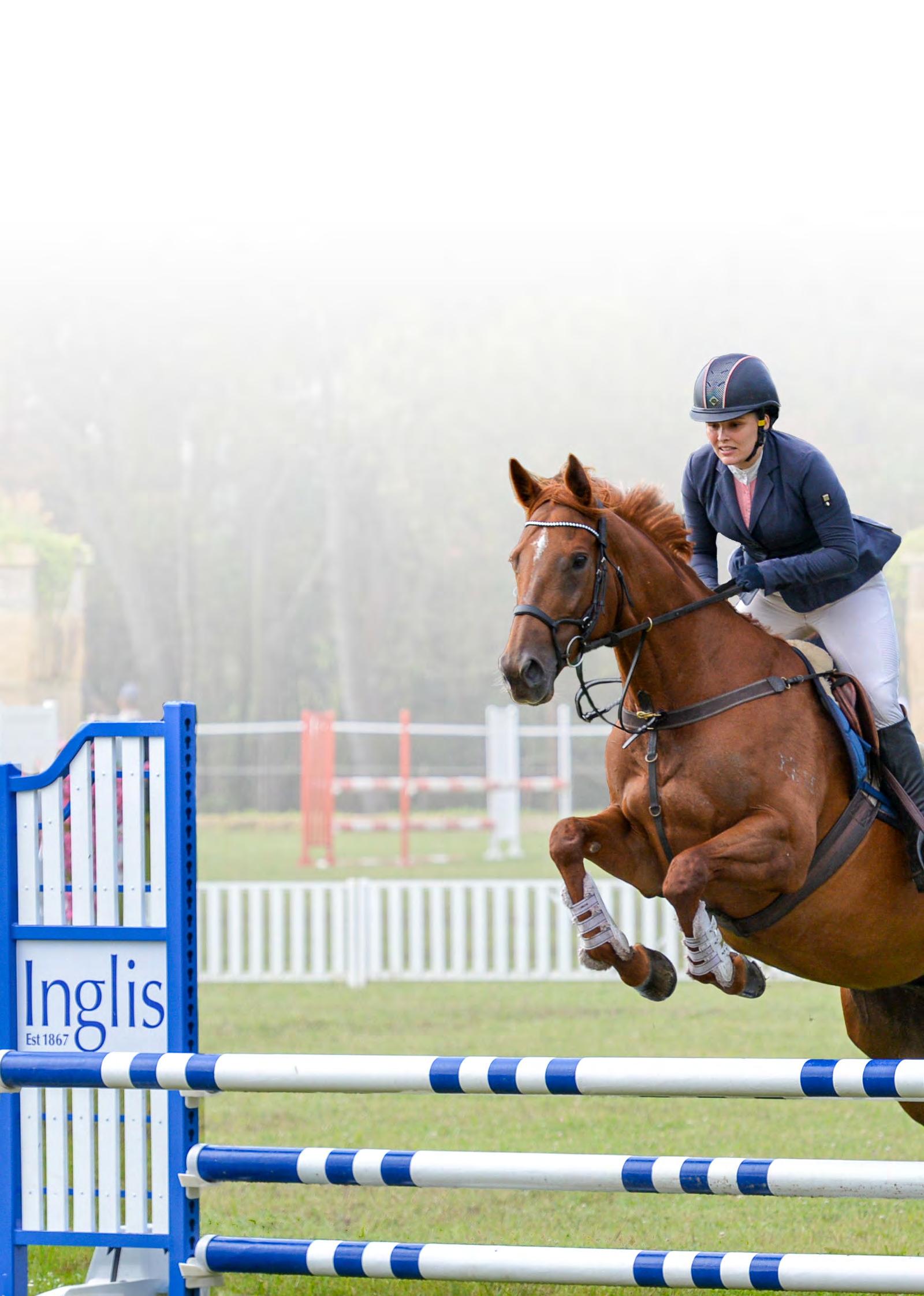
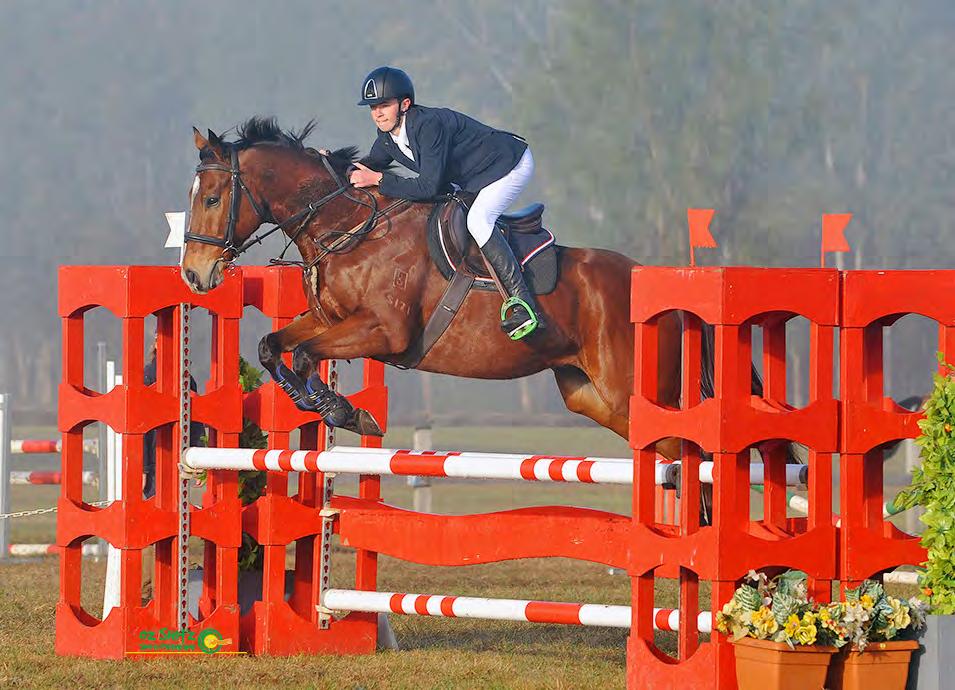
Show jumping is the discipline my children and I pursue, so Lenny was looking down the barrel of a new career as a show jumper. His willingness to oblige and do his best took him a long way and he competed at numerous shows all over the state for two years, earning a swag of ribbons. He loved nothing better than getting on the truck and heading to places unknown. When the tail gate dropped on arrival, Lenny was always the first horse off with his big happy face and eyes bright in anticipation of a new adventure.
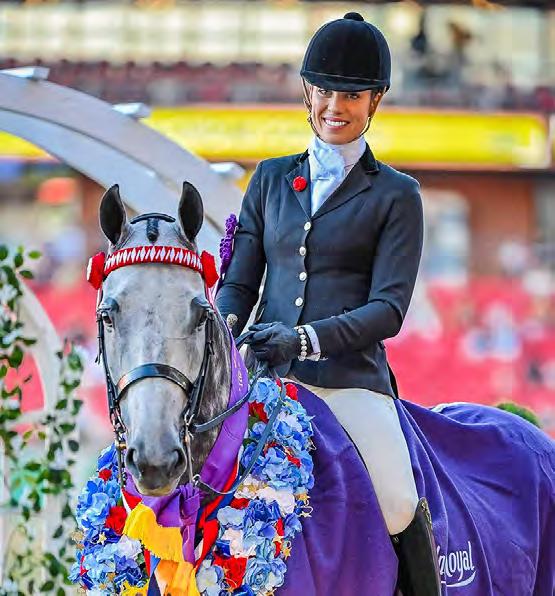
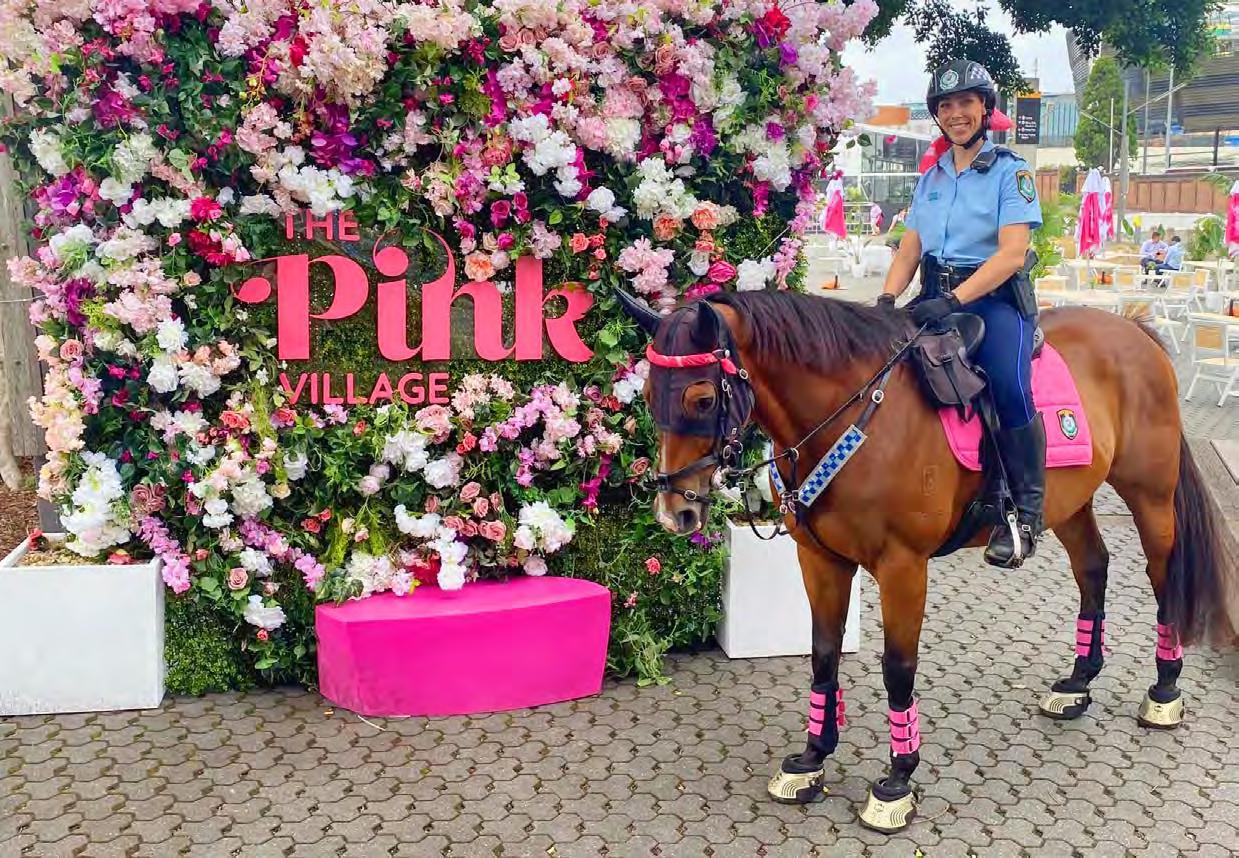
In early 2020, my children and I saw an ad for the NSW Mounted Police. They were recruiting new horses and we all concluded Lenny might be just what they were looking for. He fit all the criteria and following a three-month trial in the heart of the city, he was accepted into the Mounties and so began the next chapter of his life as Troop Horse Martin.
They retained his stable name of Lenny and he set about mastering a whole new skill set that was to take him on the ride of a lifetime, learning the art of meet and greet on street patrol, and the control and accuracy under pressure required for the spectacular Police Musical Ride at Sydney Royal. Lenny formed a close partnership with Senior Constable Emma Dickens, who was clearly smitten and happy to share their adventures with us as his career unfolded.
An early morning phone call from the NSW Mounted Police in June brought sad news out of the blue to Daybreak Farm. Just shy of his 13th birthday, Lenny suffered a bout of colic, which was not unusual in itself, but this one failed to resolve and led to surgery which was successful, but a post-operative complication resulted in his being put to sleep.
Emma reflected on the tragic loss of her beloved partner: “He was genuinely one in a million and the sweetest most special
horse I’ve had the pleasure of working with. I’m so grateful for the time I had with him even though I feel very robbed of the years of love I didn’t get to give him. However, the perk of being a beautiful horse is that he was never short of love in his lifetime, he was very loved in every career and home he’s had. I think I will spend most of my career finding another horse like him, he’s left massive hooves
to fill and I can only thank Tara and her family for bringing him to the Mounties.”

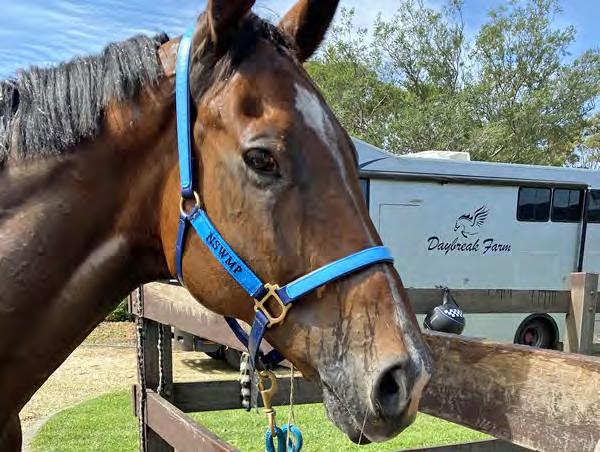
FACING PAGE: In the pink – Lenny and NSW Mounted Police officer Emma Dickens (Image courtesy Tara Madgwick).
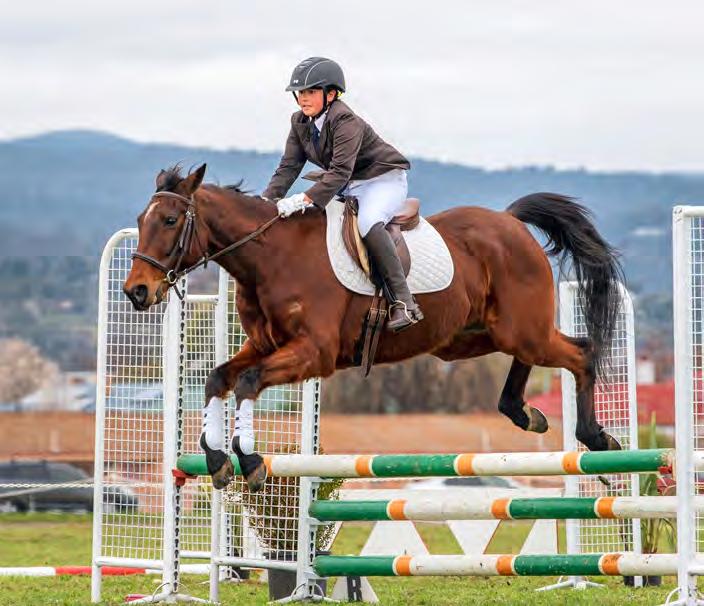
TOP: The multi-talented Lenny fitted right into his new career as a show jumper (Image by Oz Shotz Photography).
BOTTOM: Lenny looking sharp in his NSW Mounted Police headcollar (Image courtesy Tara Madgwick).
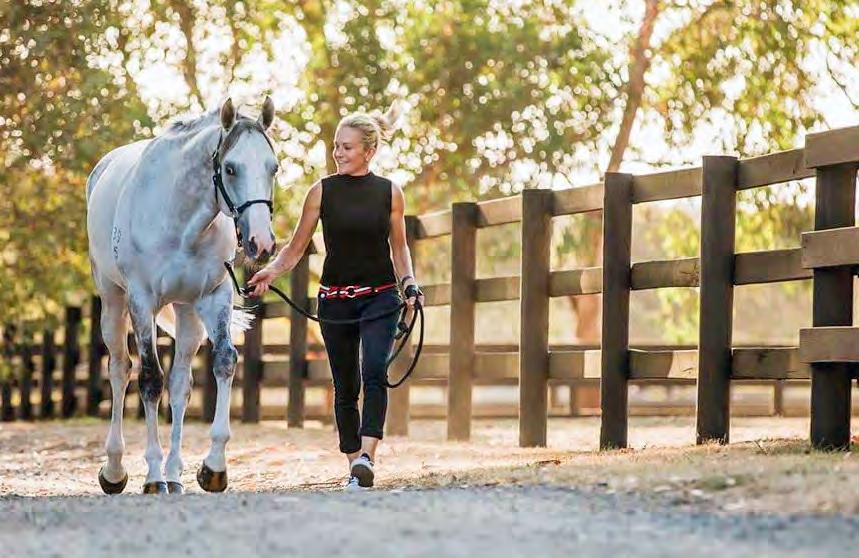
Romeo F is excelling in his new off the track career. TARA MADGWICK recalls the big grey’s past and spoke to Amanda Ross about his future.
Born beautiful and bred to win a Melbourne Cup, life has not turned out quite as expected for Romeo F, a dapple grey Thoroughbred gelding by champion sire Frankel, who turns heads wherever he goes.
Conceived in the UK, born in Australia, and in 2017 sold in New Zealand as a yearling for $475,000 to respected bloodstock agent Duncan Ramage of DGR Thoroughbreds, he was the subject
of keen interest at the Karaka sales complex that year.
A rare grey son of one of the world’s best racehorses in Frankel, he is also a half-brother to Group 1 Royal Ascot Gold Cup winner Colour Vision and to the dam of this year’s Group 1 Australasian Oaks winner Glint of Hope, a contender for the 2022 Melbourne Cup.
Duncan Ramage reflects on his purchase of the colt: “The late Trevor Stuckey and
his partner Penny Yan came to me with the idea of buying a Melbourne Cup type horse for James Cummings to train and they were very keen on Frankel, so this grey colt fit the bill.”
James Cummings was subsequently appointed head trainer for Godolphin, so the colt was sent to Peter and Paul Snowden and named Switching to Win in keeping with all the other horses raced by Trevor and Penny, which include champion miler Racing to Win, another charismatic grey that won over $3 million.
Switching to Win took a long time to mature, but his success as a racehorse was limited: “He was always very athletic and a great mover, but he lacked a change of gear … as Bart Cummings used to say about the slower horses, they can stay, but the trouble is they stay too long in the same spot,” Duncan laughs.
Switching to Win won a maiden at Gosford over 1,900 metres, but progress from that point was not forthcoming and he was eventually on-sold in 2020 for $27,500 through Inglis Digital, joining the Victorian stable of Amy and Ash Yargi.
Retired earlier this year, Switching to Win has been given the opportunity to pursue a new career in the hands of professional equestrian Amanda Ross. A well-known Olympic eventer with years of experience in transitioning off the track Thoroughbreds into equestrian disciplines, Amanda is based at Mornington in Victoria. Given a new name for a new phase of his life, the ever-handsome Romeo F has settled in well to the training required to produce a show jumper.
He made his debut at Boneo Park earlier this year, pleasing Amanda with his willingness and can-do attitude. “He’s a very rewarding horse and very trainable. One thing I love is competing at the highest level, but I also enjoy training horses at the lowest level and taking them up step by step,” she explains.
At age seven, Romeo is at the perfect time in his life to make his mark in the equestrian world with many Thoroughbreds still active into their late teens. “Their racing career is relatively short in terms of their life span, often coming to an end by age six, but they can easily go on for another 10 years after that,” she adds.
An Ambassador for the VRC since Cup Week in 2020, Amanda’s role includes the promotion of Thoroughbreds, an easy task given some of her most successful eventers have come off the track. “My 2000 Olympics horse was a Thoroughbred and 20 years later
so was my almost Olympic horse for Tokyo. Their endurance and work ethic is something you just don’t find in other breeds. My duties as ambassador are mixed and take me to the races and various charity functions, always with the goal of raising awareness for life after racing and what these wonderful horses can achieve outside of the racetrack.”
Amanda is now moving away from her previous focus on eventing to concentrate more on show jumping and Romeo’s future is likely to lie down
that path. “He has two important key ingredients to making a successful show jumper in that he is brave and careful. He’s just very light on his feet,” Amanda says. “He’ll do some off the track dressage, but mostly I see him as a show jumper working up to 95cm and 1m early next year as he gains in confidence and experience. When we bought him, we had him vetted and x-rayed and he is a very sound individual with great feet, so there is every reason to be confident he can enjoy a long and successful equestrian career.”
While the Melbourne Cup dream was not for Romeo, his close relation Glint of Hope may well take her place in the race that stops the nation this year and Amanda Ross will be at Flemington to cheer her on. “Romeo is a very special horse and I would love to find another one just like him,” she says.
FACING PAGE: Amanda and Romeo have developed a strong bond (Image by Katherine Jamison Photography).
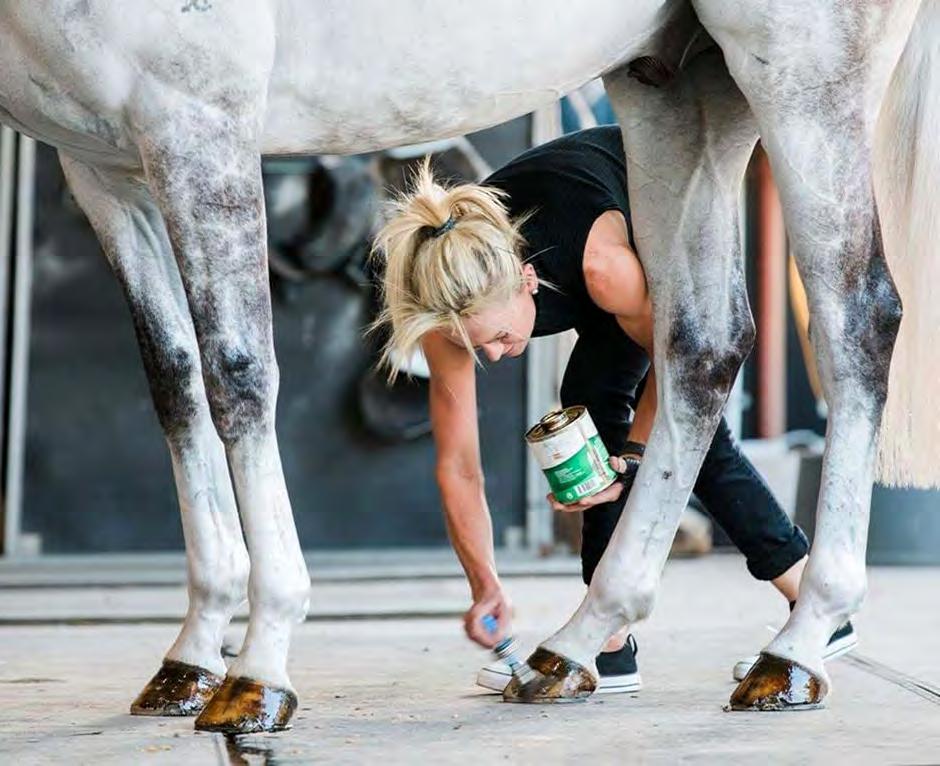
TOP: Life off the track is different, but Romeo has settled in well (Image by Katherine Jamison Photography).
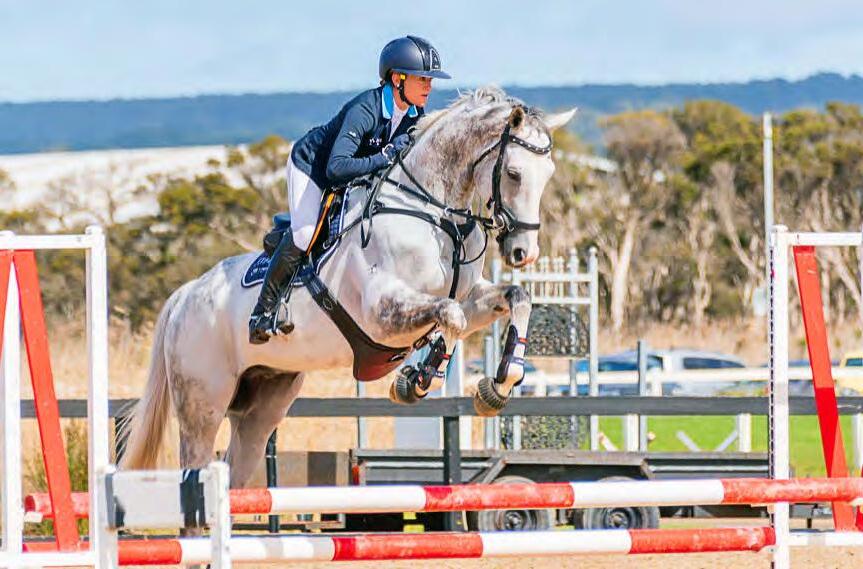
LEFT: Romeo F recently progressed from 75cm to 95cm without batting an eyelid (Image by Flick Johnston).
A recent show jumping showcase is just another example of how the careers of off the track racehorses are being supported, writes AMANDA MAC.
If you’ve been reading our Life After Racing articles for any length of time, you’ll have gathered that the horse racing industry, both at State and national level, has been working hard to ensure that the lives of off the track racehorses are safe, secure and fulfilling. You’ll also have noticed that many of these horses shine in their new careers, with Shenae Lowings’ eventer Bold Venture, and Alanna Richard’s show ring success Royal Blu immediately springing to mind. And how do they fair as show jumpers? If the inaugural Queensland Off-TheTrack (QOTT) Program Showjumping Showcase, held at last month’s Royal Queensland Show, is anything to go by, very nicely, thank you!
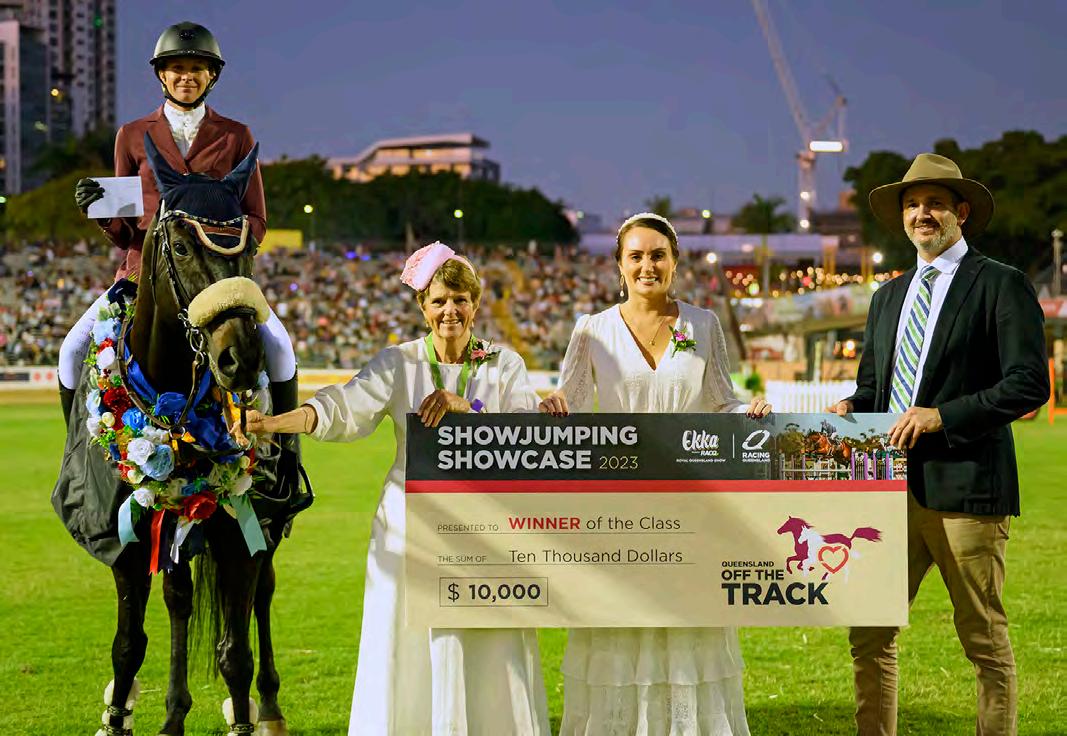
With $50,000 in QOTT-funded prize money up for grabs, the new competition offered what is currently Australia’s largest purse for a show jumping class exclusive to retired racehorses. First place attracted a prize of $10,000, while, in a move designed to acknowledge all competitors and support every OTT horse competing, the balance of the pool was payed down to the very last place getter.
Kim Duffy, Racing Queensland’s Senior Animal Care Manager, is delighted to see the competition up and running. “As an industry, we need to be much more proactive in educating the general public about our fantastic aftercare programs and the support available to retired racehorses,” she says. “Unless you are connected to racing, many people are unaware of the wonderful work being done to support our horses as they transition into second careers, and that’s why events like this are so important.”
The event, open to any registered Thoroughbred or Standardbred in Australia (as per Racing Australia or Harness Racing Australia records), is one of a number of new QOTT initiatives. “It’s vitally important that QOTT supports retired racehorses, as well as the owners who look after them for the duration of their post-racing lives,” Kim says.
When QOTT approached the Queensland branch of the RNA with the idea of running the Showcase at the Ekka, the Association couldn’t have been more supportive - and this year’s event was a spectacular success.
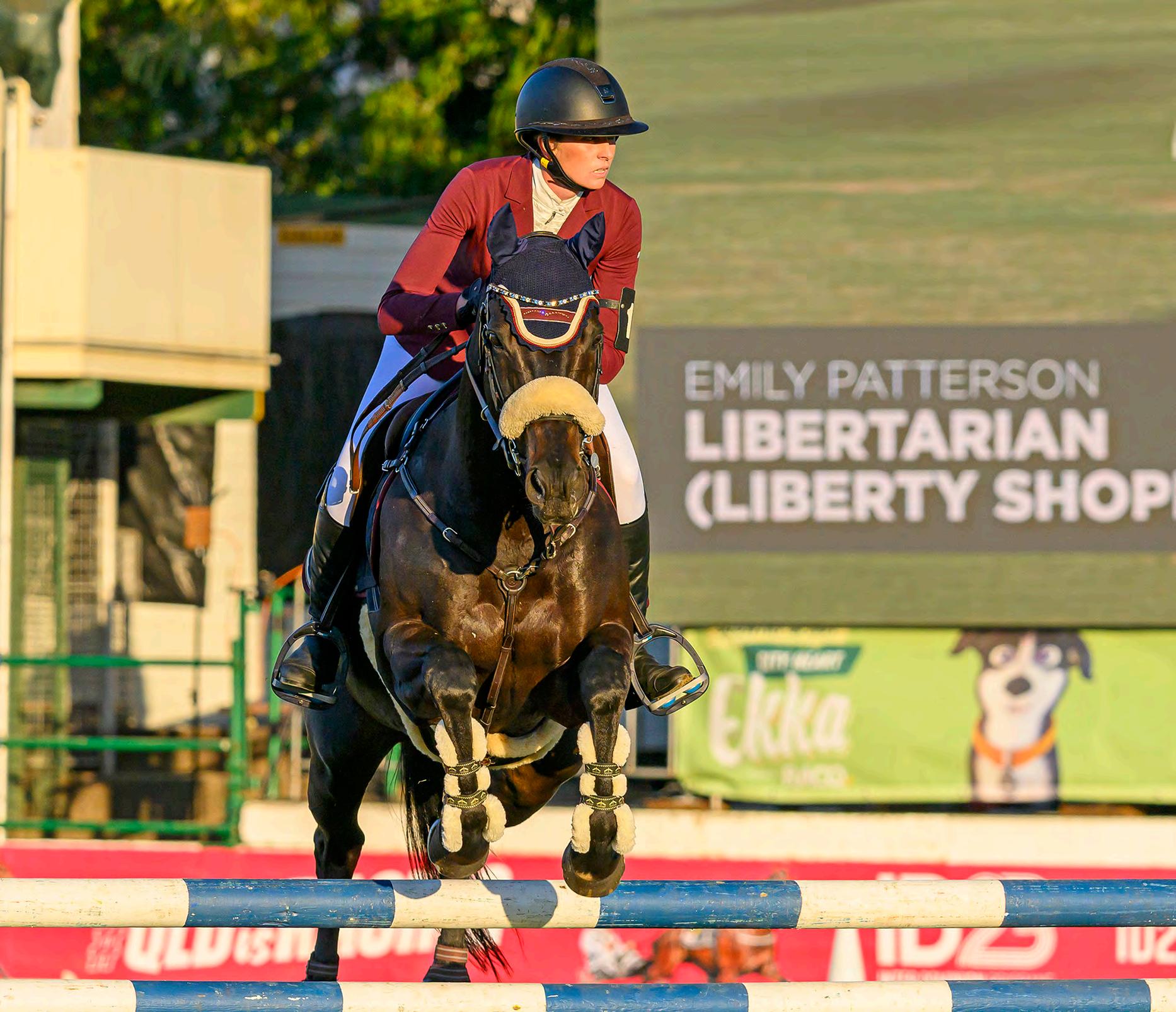
Held in the main arena before a capacity crowd, Queensland’s Emily Patterson made history as the inaugural Showcase winner. Emily, an experienced show jumper, partnered with retired racehorse Libertarian (a galloper who raced as Liberty Shopper) in what was a hotly contested 30-strong field that included a number of former Group race runners.
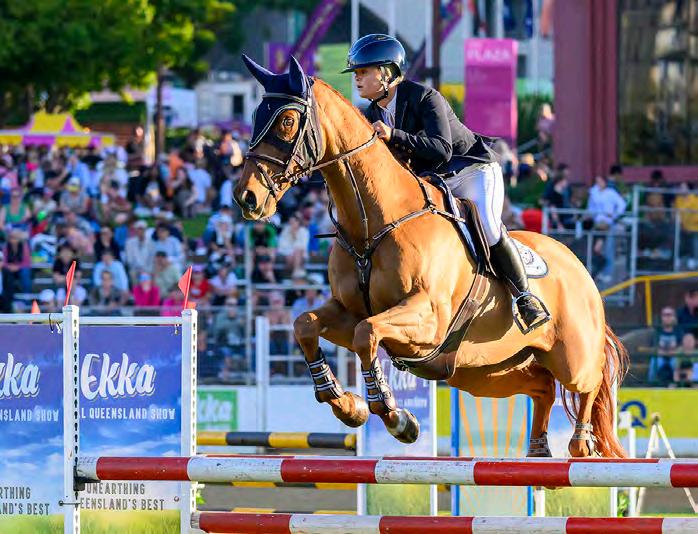
TOP: Maleah Lang-McMahon and Royal Talisman on their way to securing 3rd place.
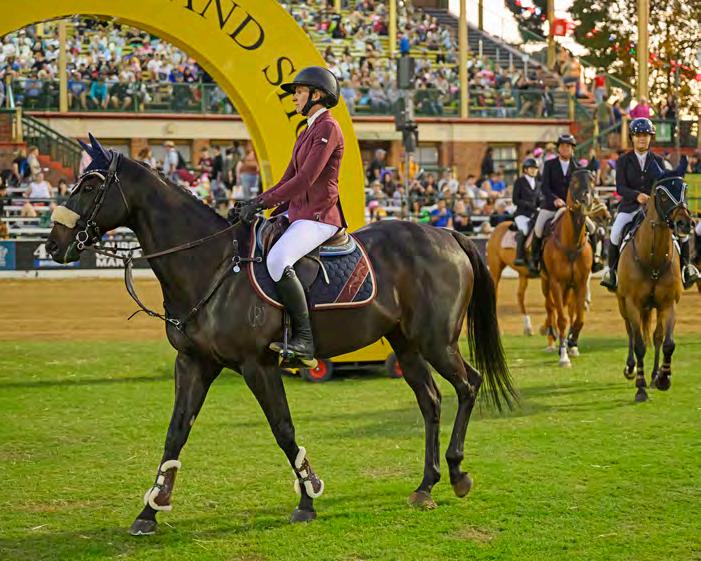
ABOVE: Emily Patterson and Libertarian lead out the field in front of an enthusiastic crowd. FACING PAGE: Eyes on the prize - Emily and Libertarian jumping into 1st place. All images courtesy Racing Queensland.
With Wayne Crompton riding the Gerry Harvey bred Double Impact, who scored over $520,000 in prize money during a 75-race career, and Olympian Ron Easey aboard Prince of Darkness (who raced as Smart Devil) in the running, the competition was always going to be fierce. Nevertheless, the ladies held their own with second and third place
going to Maleah Lang-McMahon, riding Ned O'Reilly for second and Royal Talisman for the third in a nail-biting contest that kept spectators on the edge of their seats
In a strange twist, it was a chance conversation that prompted the Showcase winner to enter Libertarian into Australia’s most lucrative show
After
jumping event for retired racehorses.
“I honestly didn’t know about the event straight up, but he’s the only Thoroughbred in Australia jumping World Cups at the moment, which is the highest you can jump,” Emily explained.
Given that Emily is passionate about Thoroughbreds, she was immediately on board and wanting to support the Showcase. She believes that this and other similar events play an important role in showing that Thoroughbreds are just as talented in the show jumping arena as Warmbloods.
Emily is understandably delighted with her win. “I’m absolutely ecstatic, I can’t believe it. We only ride as a hobby but he’s taken me around two World Cups, he’s literally just the best horse ever. His original racing owners from Victoria are here watching him today and it’s just amazing for him to win this class. He’s quite mischievous, he likes getting
into anything but he gallops up to me in the paddock and we just have the best bond and I love him so much.”
It’s vitally important that QOTT supports retired racehorses, as well as the owners who look after them for the duration of their postracing lives.
Victory for the Queensland-bred son of Statue of Liberty and Bonnie Shopper came ten years after his last race in a 21-start career that netted three wins.
Kim Duffy hailed the Showcase a huge success. “We knew the quality of show jumping would be high, and
this inaugural event certainly did not disappoint. A huge congratulations goes to Emily and Libertarian, as well as to all of our competitors who made it a memorable afternoon in the Main Arena. I also want to thank Racing Minister Grace Grace who was in attendance and had a fantastic afternoon cheering on the competition.”
Earlier in the day, nearly 200 retired racehorses had competed in a range of led and ridden classes for Thoroughbred and Standardbred Day. “It was fantastic to see so many retired racehorses thriving in their lives postracing,” Kim added, “and we cannot wait to bring the event to life again in 2024!”
And if this has you thinking about the 2024 competition, or wondering whether an OTT horse might be the right choice for you, you can find out more about the QOTT program at Queensland Off the Track.

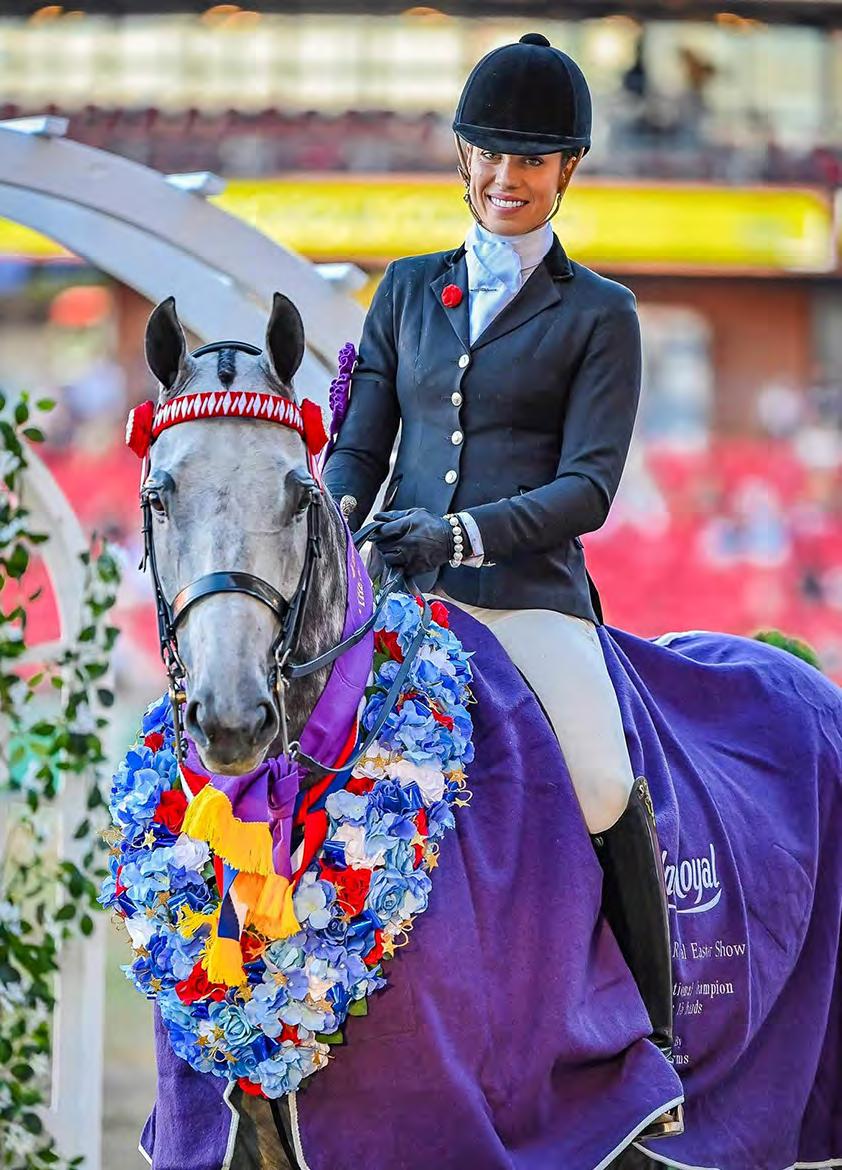
It took some time for Royal Blu’s true colours to shine, but once they did there was no stopping him, writes AMANDA MAC
Alacklustre canter down the home straight is hardly the mark of a motivated future racing star, but in Royal Blu’s case, lack of enthusiasm for the track worked to his, and to Alanna Richards very great advantage.
The then three-year-old, sired by Top Echelon out of Star of Tiarne, came to the attention of Whitmere Stud’s Greg Gerry, who liked the look of the youngster and decided to buy him. After arriving at his new home in Victoria, Blu was turned out into a paddock to let down.
In early 2020, the horse arrived at Chris and Vicki Lawrie’s Oakbank Farm to further his education. Alanna, an accomplished show rider whose relationship with the Lawrie’s goes back many years, started working on Blu and fell in love with him. “I just knew he needed to be mine,” she says. After some discussion, Alanna’s father funded Blu’s purchase, something for which she will be forever grateful. “Dad supported me with my dreams and without him none of this would be possible,” she adds.
And that was the start of a remarkable journey – and it certainly has been a journey! Initially Royal Blu had contact issues, among other problems, and Alanna wisely decided to turn him out for nine months. “I wanted to let him forget about me, forget about everyone else, and let me forget about him for a little while too,” she tells me.
After bringing him back into work in June last year, Alanna took Blu to the Adelaide Royal where he won Best Novice and Champion Off the Track, as well as his Open class. However, when later riding in a class at a Canberra show, there was a problem. “I wasn’t overly happy with how he was handling it all, so I decided to take him home, work with him some more, and then see how we’d go at Grand Nationals and the Sydney Royal.”
Chris Lawrie thought Royal Blu had the looks and movement to impress the show judges. However, because Blu was relatively new to the ring Alanna confesses that she wasn’t particularly optimistic about their chances.
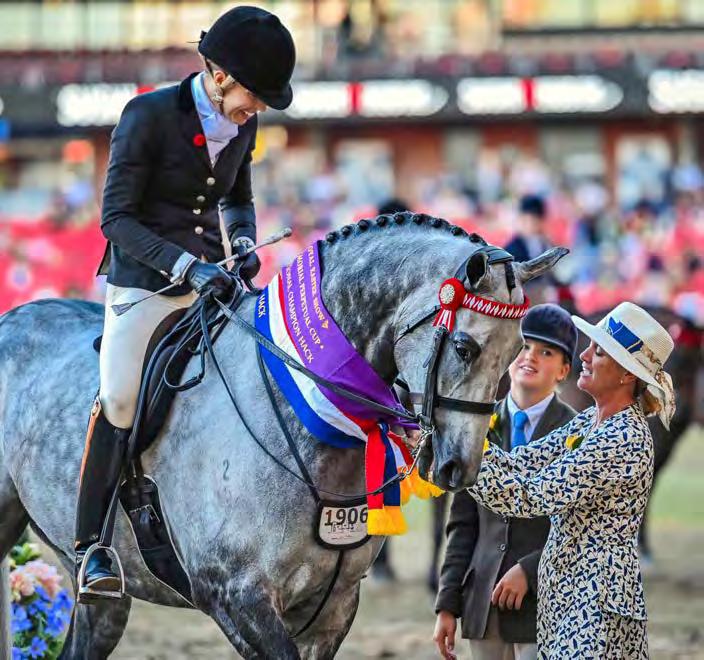
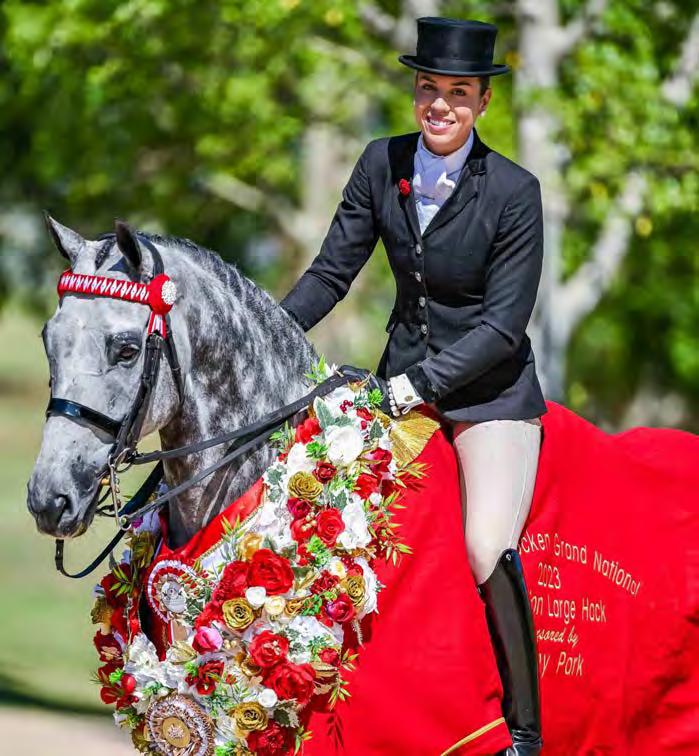
But she needn’t have been concerned. Blu surpassed himself - and in so doing justified the faith she had always had in him, while at the same time making three of her childhood dreams come true. “He was absolutely perfect,” she says. “At the Nationals we won Champion Large Open Hack, and in Sydney we won the A.V. Pope Cup and Australian National Hack. My first National Champion, first Pope Cup and first Champion Hack at a Royal Show - I still can’t quite believe it! I have Blu’s ribbons and garlands sitting on my dining room table, and I have to look at them every day just to make sure that it all actually did happen!”
It’s fair to say that Alanna and Blu have gone through difficulties on what has been at times a rocky road, but she never gave in. “There was a part of me that just couldn’t give up. I thought no, we’re going to keep going, we’re going to keep trying. I knew he had a good heart and he wanted to do the right thing. I’d had people wanting to purchase him, but I felt very strongly that I was meant to have him and finish the journey with him. I’m so glad the Universe looked after us and kept us together.” Now enjoying a break until early June, Alanna plans to bring Blu back into work in time to take him to Adelaide and the Royals.
And for those of you who might be wondering where Alanna’s much loved France is these days (see our Nov/ Dec 2022 issue), I can report that he’s enjoying partial retirement. “I still like to hop on him and ride him around. He’s my heart horse,” Alanna says. “I don’t think I could ever fully retire him, and I don’t think he’d like it either. To be honest, if it wasn’t for France, I wouldn’t be where I am today. I’m very thankful and grateful to have him in my life.”
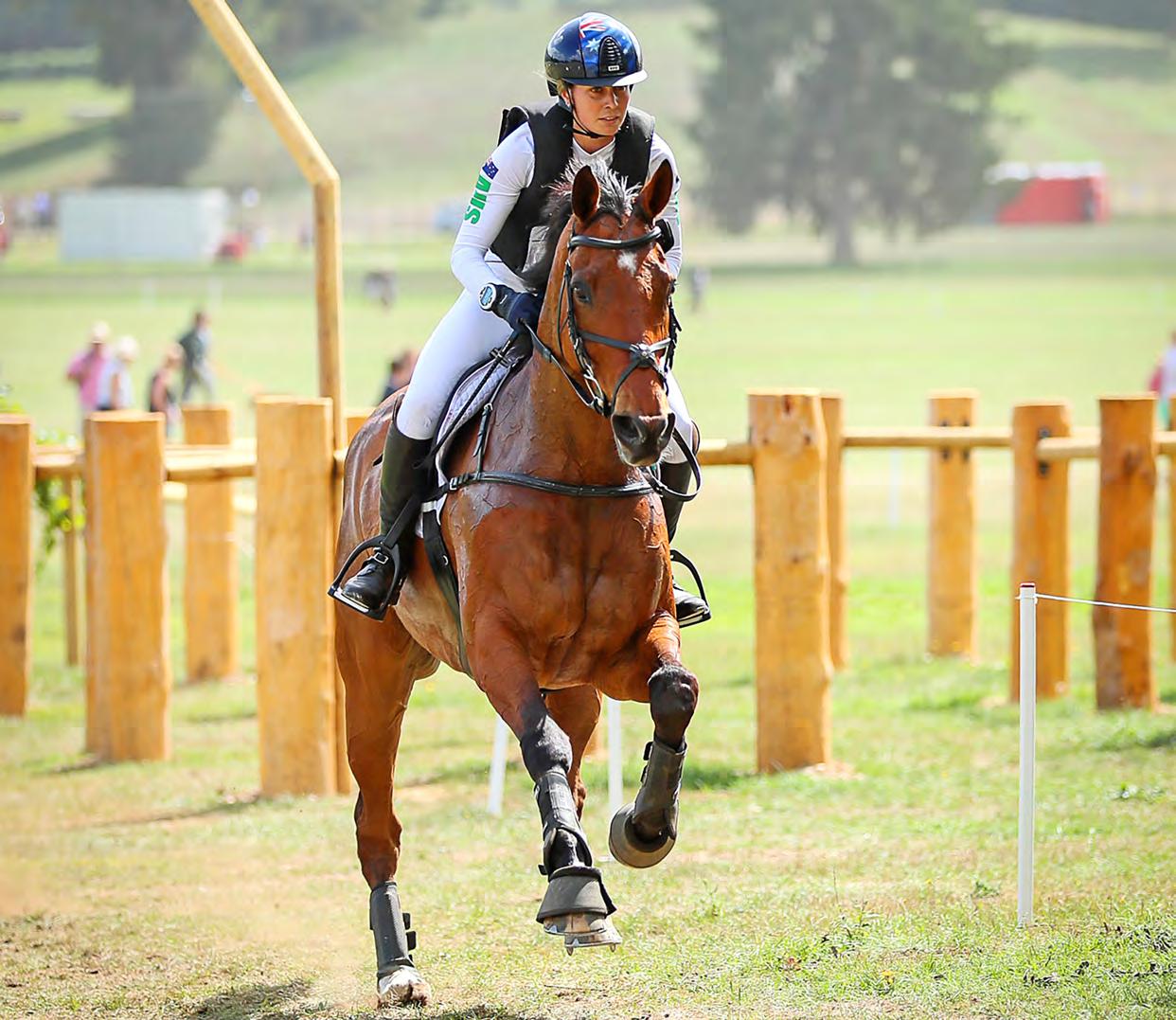
Shenae Lowings and OTT Bold Venture have made an indelible mark on the eventing world, with the best yet to come, writes AMANDA MAC
Shenae Lowings has a longstanding thing for off the track Thoroughbreds, and at last month’s Millstreet International Horse Trials, her belief in their abilities was more than justified. Aboard ex-racehorse Bold Venture (aka Bentley), she was not only a member of the team to secure Australia’s eventing ticket to the Paris Olympics, she also won the CCIO3* class outright, leading the field from beginning to end. “Getting the qualifier and then the win was just a bonus really, so yes, really happy,” she says.
Shenae, who grew up in Perth, has been riding since she was a child. Her first pony arrived when she was 10, and the pair enjoyed some success in ridden classes. However, Shenae wanted more and
moved on to a talented show jumping pony who took her through to 105cm.
But by that time, she had developed a fascination for eventing, and began attending competitions with a local agistment centre. “Once I saw what eventing was all about, I didn’t want to do anything else, it was all I ever wanted to do,” she says. Which is why, after leaving school, she eventually moved to NSW with her four horses to first base herself in Prue and Craig Barrett’s yard, and later to work with Shane and Nicki Rose at Bimbadeen Park.
The experience was invaluable. At 3* level, and partnered with Warmblood cross gelding Venture Sky High, she began to notch up some eventing successes, earning a berth in the Young Rider teams that competed at the 2015 and 2017 Oceania Games.
And then along came OTT Thoroughbred Ballyhoo, Shenae’s first real 4* horse. Now ridden by Oliver Barrett, Ballyhoo was a game changer. “He used to score really well on the flat and he was an exceptional cross country horse – there was never a question that was too difficult,” she tells me. “Unfortunately, he could have a few poles in the jumping, so he let me down in that regard. But he was one of those horses that was so beneficial; he taught me how to ride cross country, he taught me to be confident. I think every horse has their job in your career, and he had a huge role. I’ll never regret the years I had with him, he was super.”
I’m curious to know why Shenae is so taken with OTT Thoroughbreds: “They're all so different in their own ways,” she remarks. “I think if you have the ability to understand them, then that can be really valuable because they're bred for the sport: they’re bred to run and jump and they have the stamina, they have the athleticism. The issue has always been whether you can get them on the flat. I think if you can do that, you've already ticked the other two boxes. I really love working with them. Most of them
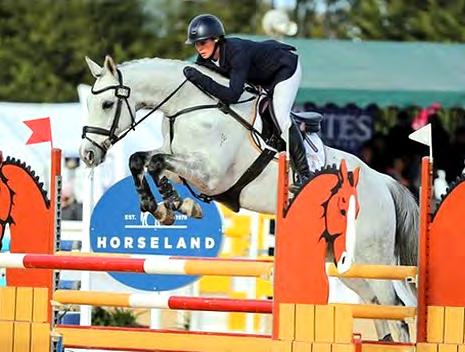
have got really great brains and they’re really willing.”
And Shenae should know – she’s worked with more than a few: “I've had probably three that I've sold after about 1* level. But I’ve actually got another one
I think every horse has their job in your career, and he had a huge role. I’ll never regret the years I had with him ...
at the moment, SS Graphite, who’s one of my favourites. He’s by Sea The Stars, so he's really well bred. He was just about to go 3* and has had a little bit of time off. But when I get back home, he should be coming back into work. He has an amazing technique over a fence, with huge scope. And he gives you an amazing feeling cross country, like he
could run and jump for days – one of the reasons why I just love this breed of Thoroughbreds. He's got great paces too, so he should be really exciting.”
But back to Bentley, who enjoyed a far from stellar track career: “He did terribly,” Shenae laughs. “I think he had three starts and he may have beaten one horse home at one of those starts!”
Having failed to impress as a racehorse, Bentley came up for sale and was advertised on Facebook, which is where he caught Shenae’s eye. “I came across the advert, which was just a standing shot, and I thought wow, that's a really, really nice type. So, I contacted the owners and literally bought him off that photo. He was in Perth and I was still in New South Wales at the time, so I asked Mum and Dad to go pick him up. It all happened really quickly.”
When Bentley came to Shenae, he was a straight off the track six-year-old, with more than his fair share of quirks. “He actually was and still is a bit tricky mentally. He’s really sharp. He is exceptionally well bred by Devaraja and he’s got a really good dam line. I think

Equi-Jewel® is the ideal conditioning supplement to increase body condition, topline, and coat quality in breeding horses, performance horses, and horses being prepared for sale.
Equi-Jewel is a high-fat, cool-energy supplement that provides a safe source of calories for horses requiring a lowcarbohydrate diet or horses that are intolerant to grain due to tying-up or gastric ulcers.
Equi-Jewel contains KER BMC™, research proven to double the acid-buffering capacity of the stomach, which moderates stomach pH and reduces the risk of gastric ulcers. KER BMC also increases the buffering capacity of the hindgut by 54% to promote improved digestion and feed utilisation.
Learn more about Equi-Jewel at ker.com
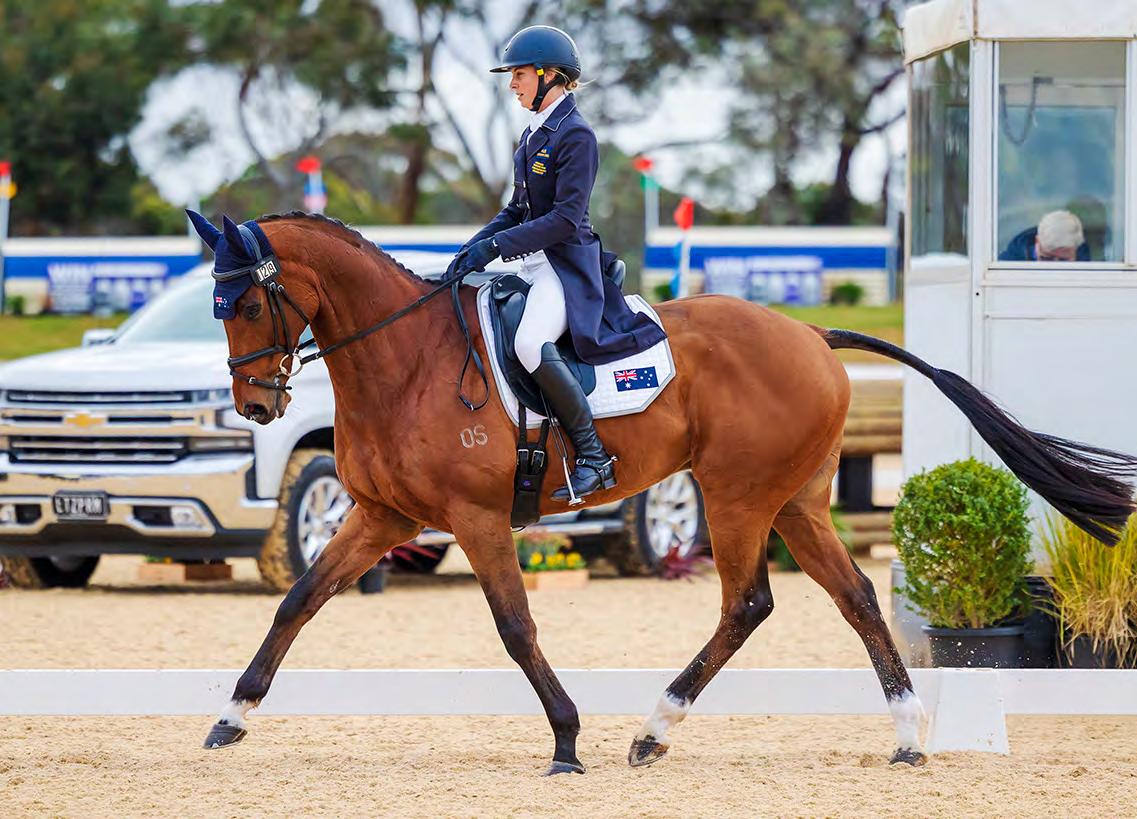
the trainers tried to make it work with him, but obviously he just wasn't put on this earth to be a racehorse.”
Bentley’s potential wasn't immediately obvious. Shenae comments: “He had it all there, he was a beautiful mover. He naturally had a really good jump and always wanted to leave the poles up. But he was so ridiculously quirky! The first day I tacked him up he bucked the saddle off, and it took me about two weeks to be able to get on him because he had always been led around a parade ring where jockeys are legged up, so he thought being made to stand next to a mounting block was terrifying!”
Initially, Shenae was unsure whether Bentley was going to be a keeper or an OTT project that she would sell on. But despite his quirks, she loved him –
and Bentley seemed to trust her. Then some months into their journey together came a turning point: “I thought wow, this could be a really serious horse, and still to this day he keeps surprising me. I think I've reached the limit on the flat and he just keeps giving more and more. He is such a trier,” Shenae explains. “He really wants to do the right thing. He just gives his all and tries his hardest so he's amazing to work with and I think that's why he's such a good horse.”
Now a 12-year-old, Bentley and Shenae’s credentials are impressive. In June 2022 there was the CCI4* at the Melbourne International 3DE; the FEI World Championships in Pratoni, Italy, later the same year; the RM Williams CCI4*S at this year’s Adelaide Equestrian Festival (where Shenae was named SA Event Rider of the Year
and presented with the prestigious Anna Savage Memorial Trophy); and of course, the win at Millstreet.
Shenae and Bentley are currently based at Kevin McNab’s yard in the UK, where she plans to stay until August so she can compete, and hopefully qualify for Olympic selection in the 4* Long at Mallow in Ireland this month. “I’m desperate to get that box ticked. Once that's done, I’ll be much more settled and I can focus and aim for the big goal.”
If you’re now inspired to take on an OTT yourself, Shenae has some advice: “Go slowly with them. You can never take it too slow with a horse but you can rush one. And teach them to relax, because it’s difficult to teach a horse that isn’t relaxed. Getting them to slow their mind and body is very helpful.”
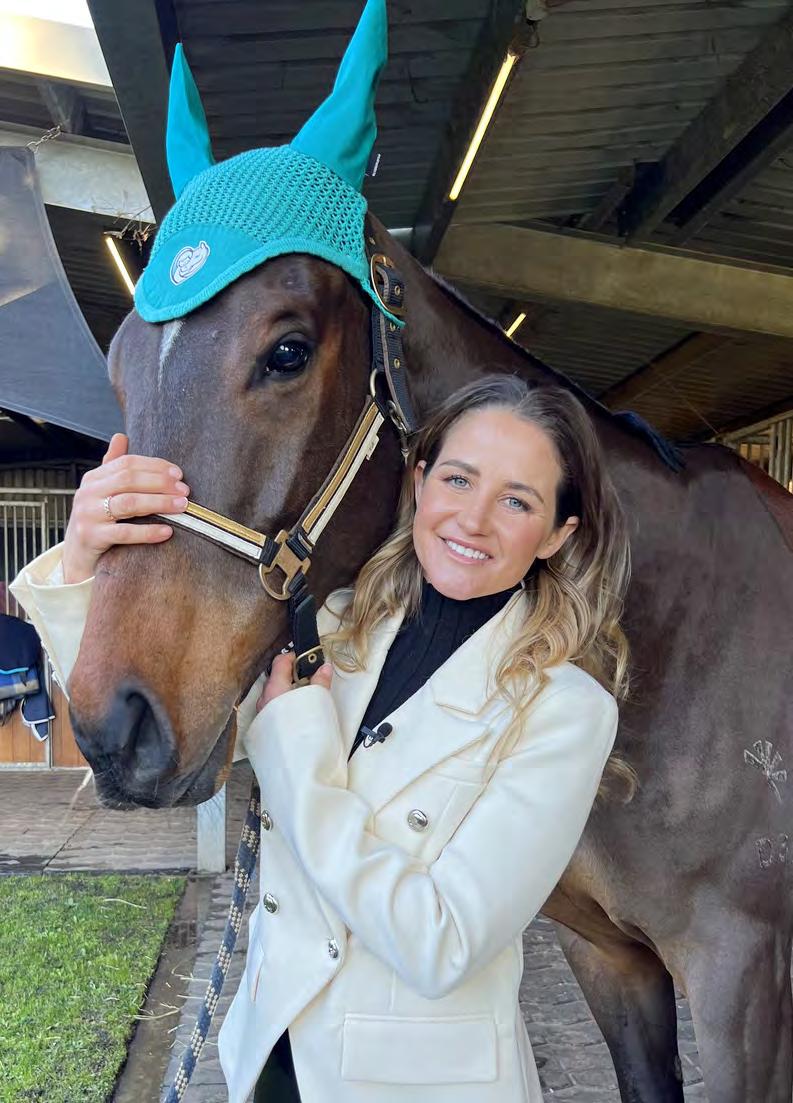
Off the track Thoroughbreds have become very popular as equine therapy horses and with good reason, writes
AMANDA MAC
Earlier this year we spoke to Rehab4Rehab founder Alisha Griffiths, who had combined her two passions of helping retired racehorses and supporting struggling children to create something very special.
A successful and in-demand charity, Rehab4Rehab offers equine therapy to children, including psychology sessions, occupational therapy, and speech pathology support. The therapies are facilitated by a team of allied health professionals, including AHPRA-registered clinical, and child and developmental psychologists, all of whom have significant experience with horses.
The Rehab4Rehab therapists work with a broad range of mental health issues, including anxiety, depression, low selfconfidence, autism, behavioural issues, trauma and PTSD. Typically, patients participate in 10 sessions to help them manage their emotions, anxiety and general wellbeing.
But why stop there? Late last year Rehab4Rehab joined forces with the KIDS Foundation to create CARM (Child and Racehorse Movement), an organisation designed to raise funds and promote child and horse wellbeing, and to expand on the work of both the KIDS Foundation and Rehab4Rehab. CARM’s profile has been championed by three high profile ambassadors: Australian jockey Michelle Payne OAM, the first female to win a Melbourne Cup; prominent media personality and journalist Jacqueline Felgate; and well-known 7 Network presenter Hamish Lachlan.
After a soft launch in November 2022, CARM was officially launched to great acclaim at Flemington Racecourse on Australian Guineas Day in March this year. And Alisha, who is the Co-Founding Director of CARM, was delighted with the response: “While the horse racing community is phenomenally large and ever-growing, many are unaware of what happens to horses once they retire from the track.
We’re excited to build this program and enhance recognition for the extraordinary power of animals and children in nurturing each other.”
Alisha says that ex-racehorses seem to have a special aptitude for equine assisted therapy and believes that it's their ability to mirror human emotions and maintain a calm state during interactions with the children that lies at the heart of this success. It has certainly been foundational in the growth of both CARM and Rehab4Rehab, and has resulted in some very positive win/ wins. “By giving retired racehorses an opportunity to connect with people, they achieve a greater sense of purpose and belonging. Likewise, this relationship is rewarding for the children. It not only aids their mental wellbeing, but enhances their confidence, their ability to care, and their social skills,” she adds.
Michelle Payne OAM, is one of the charity’s most enthusiastic supporters: “CARM changes kid’s lives,” she says, “at the same time helping retired racehorses transition from the racetrack to the community.”
Around 30 horses are involved in Rehab4Rehab, which is based at Red Hill Equestrian Centre on Victoria’s Mornington Peninsula. The process involved in a racehorse transitioning into the community generally takes between six and eight months, and their training in equine therapy costs approximately $8,000.
And it’s not just children who benefit from interacting with horses. CARM also offers corporate days during which participants are introduced to equine assisted therapy while they work on personal and professional development in areas such as mindfulness, managing emotions, leadership, goal setting, and positive physical and mental health. Proceeds from CARM corporate days go directly to the KIDS Foundation and Rehab4Rehab.
For more information, visit CARM, the KIDS Foundation and Rehab4Rehab
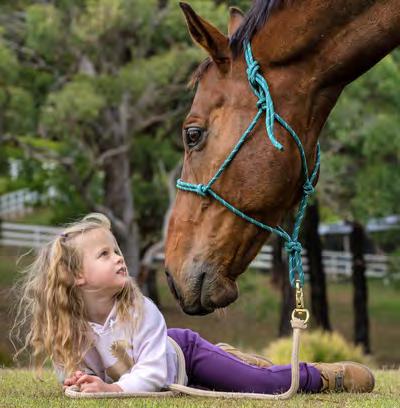
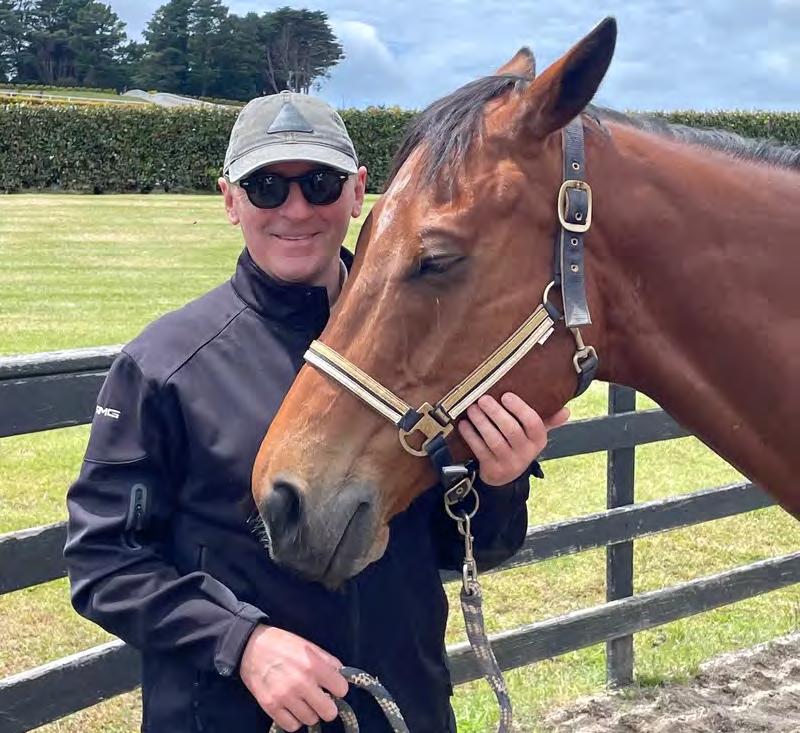
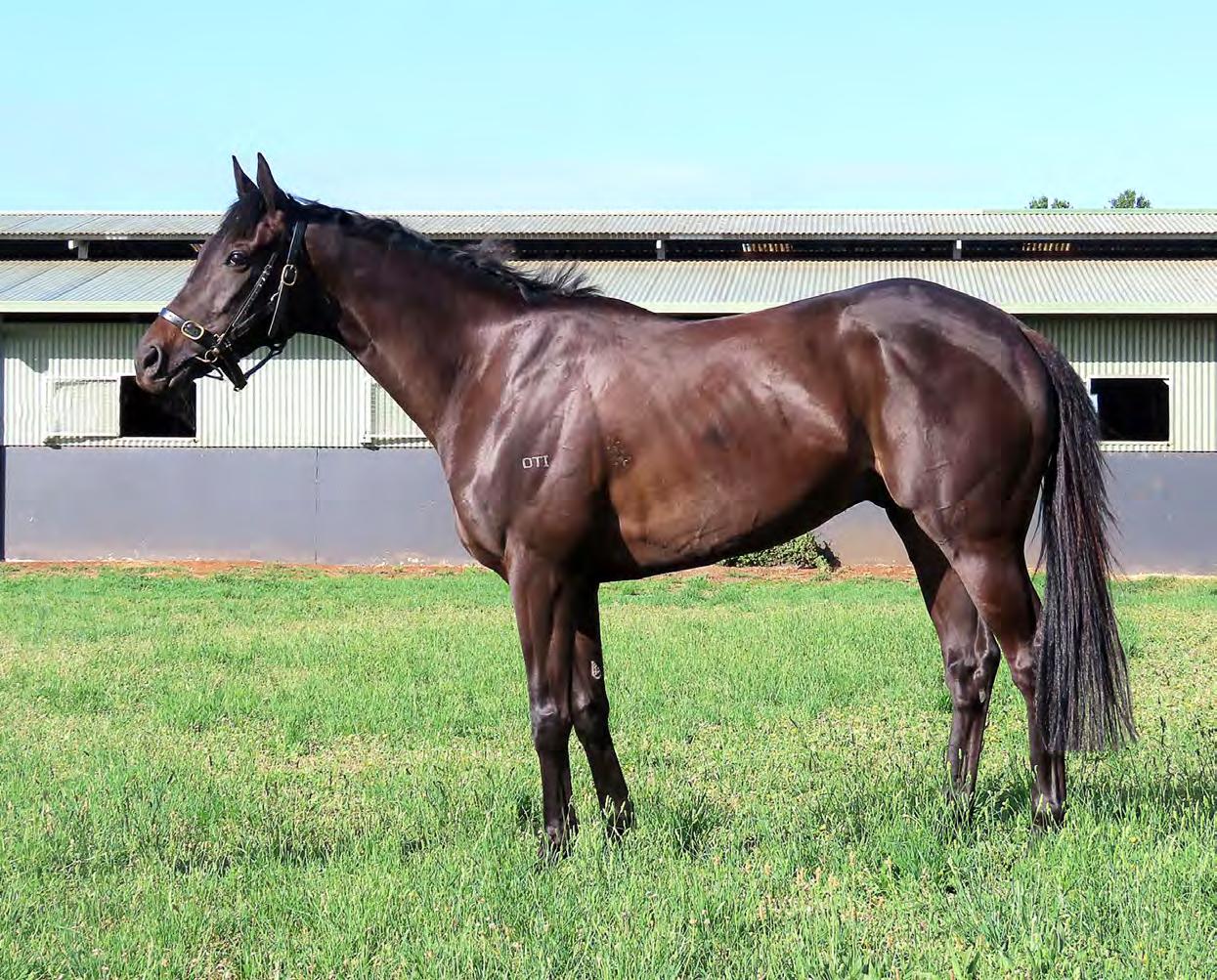
From an
almost Melbourne Cup
contender to training for dressage – the leap is not as far as you might think, writes AMANDA MAC
In 2021, Future Score, a Matt Cumani trained stayer, was scratched from the Melbourne Cup field after failing to pass his race morning vet check. The last minute scratching was a disappointment for owners and trainer alike, but the welfare of the horse, a nine-year-old imported Irish Thoroughbred gelding by Cape Cross out of Theola, had to come first.
Meanwhile, Emma Turnbull, who is a partner in a specialist criminal defence law firm with offices in Melbourne and Ballarat, was keeping a very interested eye on the horse. “A barrister friend invited me to join his racing syndicate and it just so happened that Future was the first horse to be purchased in the syndicate when I became involved. From
the very first moment I saw him, I knew he would make a magnificent show horse and hopefully a dressage horse. He's so well put together and he’s a really lovely person. Everyone loves him!”
Not one to let a potential opportunity slip by, Emma told Matt that if Future was ever to retire sound, she’d gladly give him a home.
With plenty of experience in the saddle, Emma had begun riding when she was eight years old and didn’t stop until her first year practising law when career priorities took over.
But some eight years ago, Emma returned to the sport she loves with Zephyr, a kindly Friesian Warmblood schoolmaster, and competed at Horse Riding Clubs Association of Victoria (HRCAV) events. “I did a little bit of everything with him. I've ultimately settled on dressage, so now I just do that as well as some showing. I am hopeful that Future will be the show horse I’ve been waiting for.”
Another of Emma’s four-footed favourites is LP Lucky (Bubbles) a Welsh Cob pony. It was in partnership with Bubbles that Emma was awarded the 2022 Amateur Owner Rider (AOR) of the Year, having won the AOR Preliminary, Novice, and Open Novice Championships at the 2021 and 2022 Dressage Festivals. Bubbles also won the 6-Year-Old Dressage Pony Championships at the 2022 Victoria Dressage Festival and went on to win the national championship at 2023’s Dressage & Jumping With The Stars, with Emma’s coach Karen Blythe in the saddle.
And then of course, there’s Future Score. Over his impressive Australian track career, he earned $742,706 with 31 starts for six wins, one of which was the 2020 Cranbourne Cup. His race form includes a 3rd placing in the 2022 Adelaide Cup and 4th in the Sydney Cup that same year. Based at the Cumani Racing stables in Ballarat, Future was a consistent stayer who always ran his
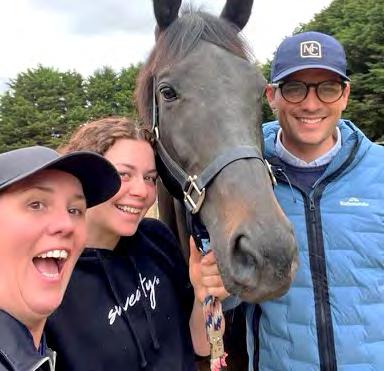
heart out. But with a hairline foreleg fracture that had been surgically reinforced, there was concern that the problem may become acute if he continued to race, so the decision was made to retire him from the track. But for Emma, that wasn’t a problem. “When I said I’d take him on if he retired sound,
He's the loveliest horse, he's learning and he tries so hard, which was his attitude as a racehorse ... he really wants to do the right thing.
I'm not talking about racing sound, I'm talking about riding sound, and they’re two entirely different propositions.”
So, in February this year she drove to the Cumani yard to collect Future. “I’ve got some photos from that day and it was pretty funny. Future had been on box rest since retiring and Matt led
him out in this hideous plastic halter,” Emma laughs. “The racing world is more practical than the equestrian world where we're all a bit matchy matchy. I was like, oh, no, we’ll take that off and put this sheepskin halter on, and I think it was then that Future decided this was a life he could take!”
Next on the agenda were several months off so Future could let down. “It’s the fair thing to do,” Emma says. “They've got to get all that grain out of their system and just learn to be a horse. Then he went to Cath Sfregola’s, one of Racing Victoria’s accredited retrainers. I knew Cath from the HRCAV scene, and had great respect for the way she deals with horses. She has a kind, soft, holistic approach, which is evident in all her training methods.”
And it was fortunate that Emma had become good friends with Elisha Hassan, a Cumani trackwork rider and strapper who was fond of Future and knew him well. Although otherwise beautifully behaved on the ground, one of the big issues Emma had with Future was that she could not get him near a mounting block. “I have Elisha on speed

Apiam’s equine veterinary credentials are well-founded with a growing number of purpose-built dedicated Equine Vet Clinics and Referral Hospitals located in Victoria, New South Wales and Queensland, working alongside our network of mixed practice clinics in delivering quality equine veterinary care.
Scenic Rim Veterinary Service
Beaudesert QLD
Agnes Banks Equine Clinic
Agnes Banks NSW
Hunter Equine Centre
Scone NSW
Victorian Equine Group Bendigo VIC
Gippsland Equine Hospital
Maffra VIC
Southwest Equine Veterinary Group
Warrnambool VIC
Find out more by visiting the Apiam Animal Health website & view the equine product range on Country Vet Animal Supplies



dial and anytime anything happened, I immediately contacted her. I explained the problem, and she was like, ‘Yeah, that's right. You just do a flying leap like a jockey and off you go’. Well, this body doesn't flying leap! But Cath did the most beautiful job with him and now he'll stand at the mounting block with the loosest rein while you hop on. It's so nice to see him learn those simple things.”
And it’s these training steps that Emma believes are vital. “Some people think you can just get an off the tracker and it’s an easy transition to turn them into a hack. But there’s a lot of horsemanship required to change the way they think. Future’s job as a racehorse was to run fast. Now he has to learn to think slow, and to learn that slow and steady is a good thing.”
And Future’s career is looking bright. “He's the loveliest horse, he's learning and he tries so hard, which was his attitude as a racehorse and he's still like that now. Cath’s feedback was that he really wants to do the right thing. And he’s really clever. Although we’re still in kindergarten, we're doing little things in training that perhaps in some ways are a little bit more advanced because he is so willing.”
Emma has some ambitious goals in mind for Future, but she’s in no hurry and wisely doesn’t want to rush his education. “If he’s ready next year, or in two years, it doesn’t matter. I’m not in the business of producing horses to move on. I’m an owner rider, so it’s a different focus. Whether he’s nine or twelve, he’ll do it when he’s ready to do it and not before.”
Included in her long-term plan is to compete with him in Racing Victoria and the HRCAV’s Off The Track events, with both dressage and the show ring in mind. “Racing Victoria have a great sponsorship program where they provide very generous prize money, saddle blankets, rugs, all sorts of bits and pieces, designed to help in training
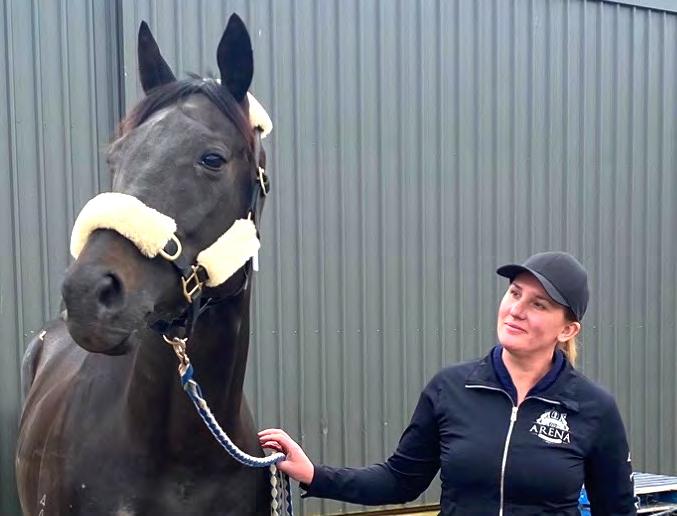
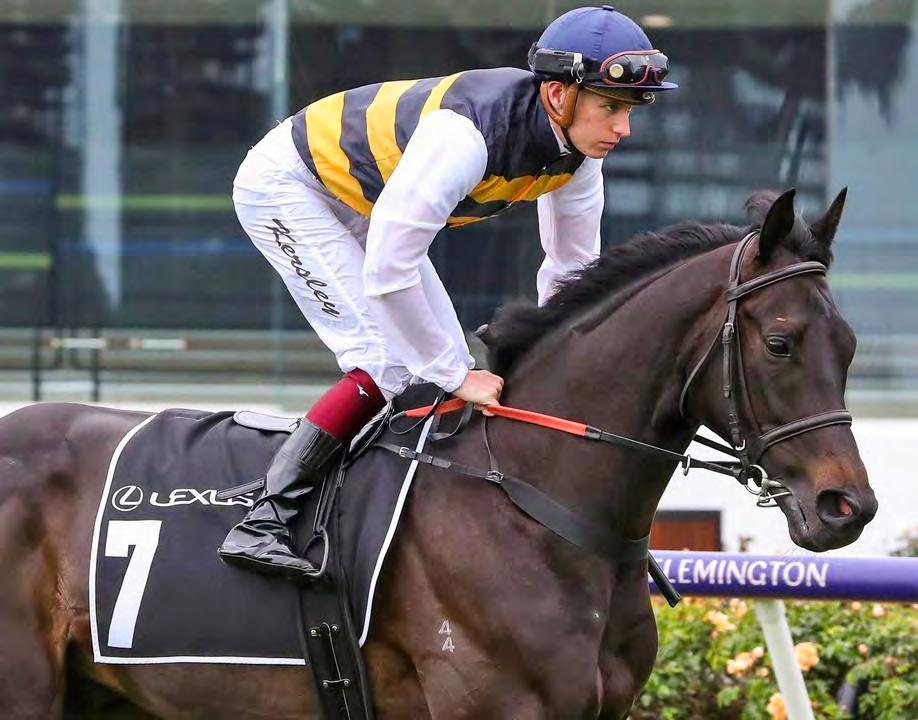
TOP: Future Score getting acquainted with some of life's little luxuries.
ABOVE: Future earned nearly $743,000 on the track (Image courtesy
and encourage and support riders to get off the trackers going out and competing. I'm hoping we'll be ready for the 2023 series, but we'll have to see because our left canter is still pretty dodgy,” she laughs.
Also on her radar is the prestigious, and hotly contested, Garryowen showing class. “I think he's the perfect Garryowen horse. He’s the size and
he’s the type so yes, I’d love to do a Garryowen on him, but we're not putting any pressure on him at all.”
Meanwhile, Future is living the life out in the paddock. He’s got his friends all around him, knows which pockets he'll find a treat in, and is surrounded by humans he loves: “He really is such a lover,” Emma chuckles, “he just wants to be your friend."
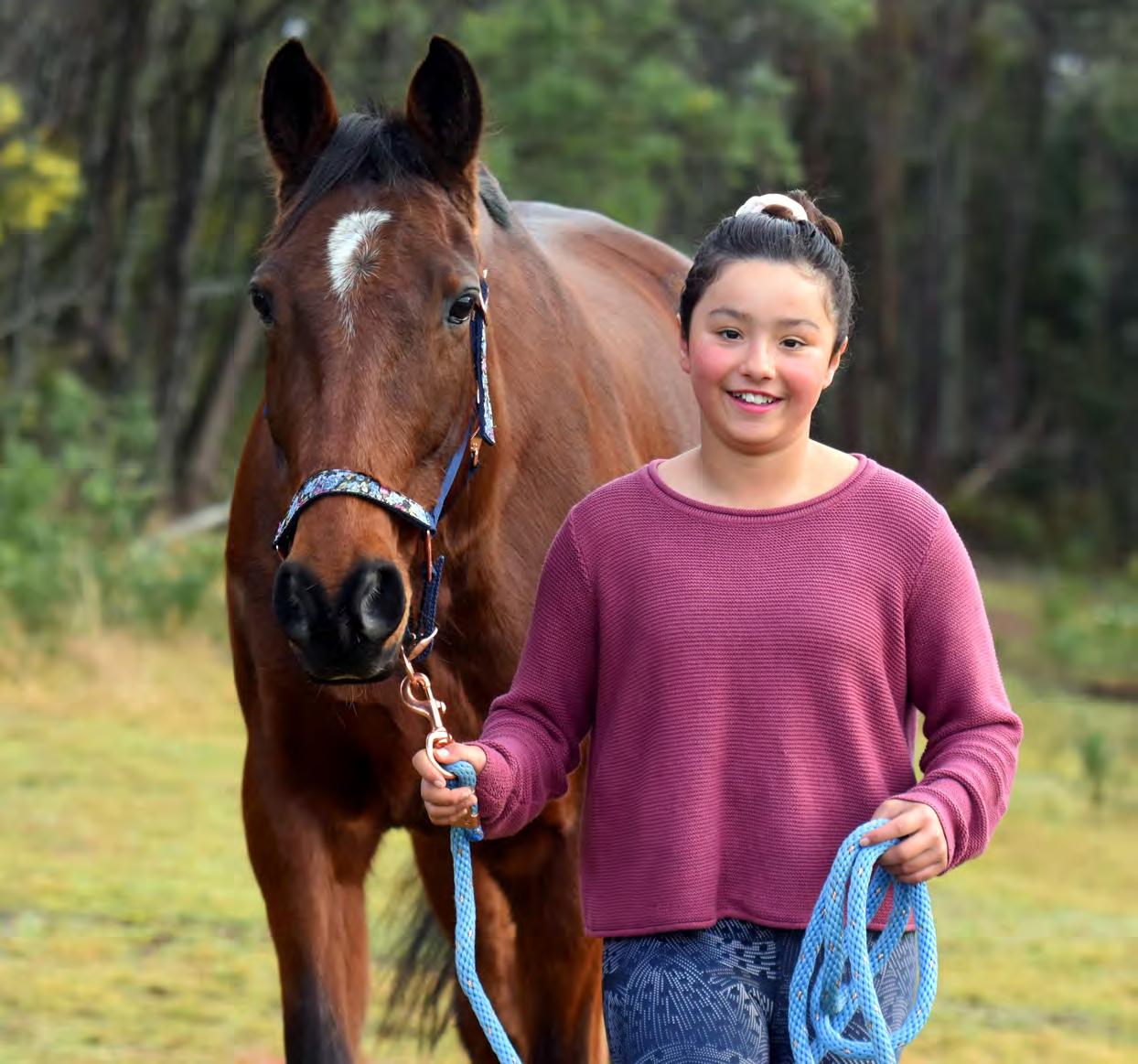
What do a thirteen-year-old novice rider and an OTT Standardbred have in common? A very special partnership and some serious Pony Club successes, writes PETER STAPLES.
Many retired Tasmanian racehorses have successfully transitioned into careers in hacking, show jumping, polo, dressage and eventing, or have become Pony Club success stories – an excellent case in point being Samantha (Sami) Barker and her OTT Standardbred Ollie.
Ollie, a former pacer who raced as Ezygatboy for premier Tasmanian harness trainer Ben Yole, has taken a particular shine to Pony Club. So much so that after he and Sami put in an outstanding performance at the Pony Club State Trials in March 2021, they
qualified for the recently held 2021 Pony Club Nationals, which due to COVID was unfortunately a virtual event only.
But to take a step back, it’s fair to say that Sami is as new to the world of Pony Club as Ollie. Now thirteen years old, she was introduced to horses just over a year ago when she was invited to go on a trail ride by her neighbor and friend Haylee Chilcott. “When I first tried riding I was petrified! But after my first trail ride I loved it, and I just kept on going out for rides with Haylee,” Sami says.
Meanwhile Ollie had had 35 starts for five wins and three placings, earning over $25,000 in the process. His first four wins were in Western Australia, after which he was relocated to Victoria where he won at Mildura before finally landing a berth in Ben Yole’s stable. But when it became apparent that he’d reached the end of his racing career, it was decided to rehome the nineyear-old gelding and earlier this year he entered the Off the Track program facilitated by Tasracing, Tasmania’s peak racing authority.
It was around the same time that Sami’s new-found love of riding had reached the point where her parents had decided to buy her a horse. But destiny intervened when Sami and Ollie became beneficiaries of Tasracing’s OTT program. Ollie was gifted to Sami, and the pair developed their partnership with the help of Kristin Pitt, a qualified Equestrian Australia NCAS coach, who gave them lessons subsidised by Tasracing as a part of its ongoing program.
And the partnership could not be more solid. The pair have a great rapport and as Sami refines and develops her skills, she teaches Ollie what he needs to learn about equestrian disciplines. “I couldn’t have got a better horse to start me off because he is just so honest, and he deals with everything I ask of him,” she says. “He’s prepared to try anything and that gives me so much more confidence.”
Keen to take her sport as far as she can, Sami’s equestrian horizons broadened considerably when she joined Lilydale Pony Club in November last year, which is when Ollie was first introduced to jumping. Although he’s an enthusiastic learner, he initially found trot poles challenging, but these days he’s popping over 80cm fences like an old hand.
Sami and Ollie progressed quickly, and earned their chance to shine at the Nationals in the sub-junior section of the Tetrathlon. A relatively new discipline, the event comprises a kilometer run, a 100 metre swim, pistol shooting, and an equestrian element that includes cross country and show jumping. “I like swimming and I am fair at running. I’m a member of a pistol club and I love jumping, so it’s a perfect sport for Ollie and me,” Sami says.
Sami has not only benefited from Kristin Pitt’s expert tuition, but also from lessons with her riding coach Jules Targett. “I’ve been lucky to have very good coaches. Jules has been helping me a lot with my jumping technique over
the last couple of months, and Kristen has helped with getting Ollie cantering and educated to deal with jumping,” she says. “I love what I’m doing with Ollie, and it’s so pleasing to see how he has grown in confidence, and that also helps my confidence grow.”
Much to the pair’s credit, Ollie is the first Standardbred to make a state Pony Club team and the only ex-pacer to compete at the Nationals.
But while Sami has relished her achievements thus far, she has her eyes fixed firmly on the future. “The next step up from Tetrathlon is Pentathlon, and that’s an Olympic sport which is the same as Tetrathlon plus fencing,” she explains. “Because I have a black belt in Taekwondo, I should be able to pick up fencing skills more easily than most, so that could be my ultimate goal. A year ago I didn’t think I would be riding as well as I am, let alone representing the state in a national competition.”
And that, without a doubt, is the stuff dreams are made of.
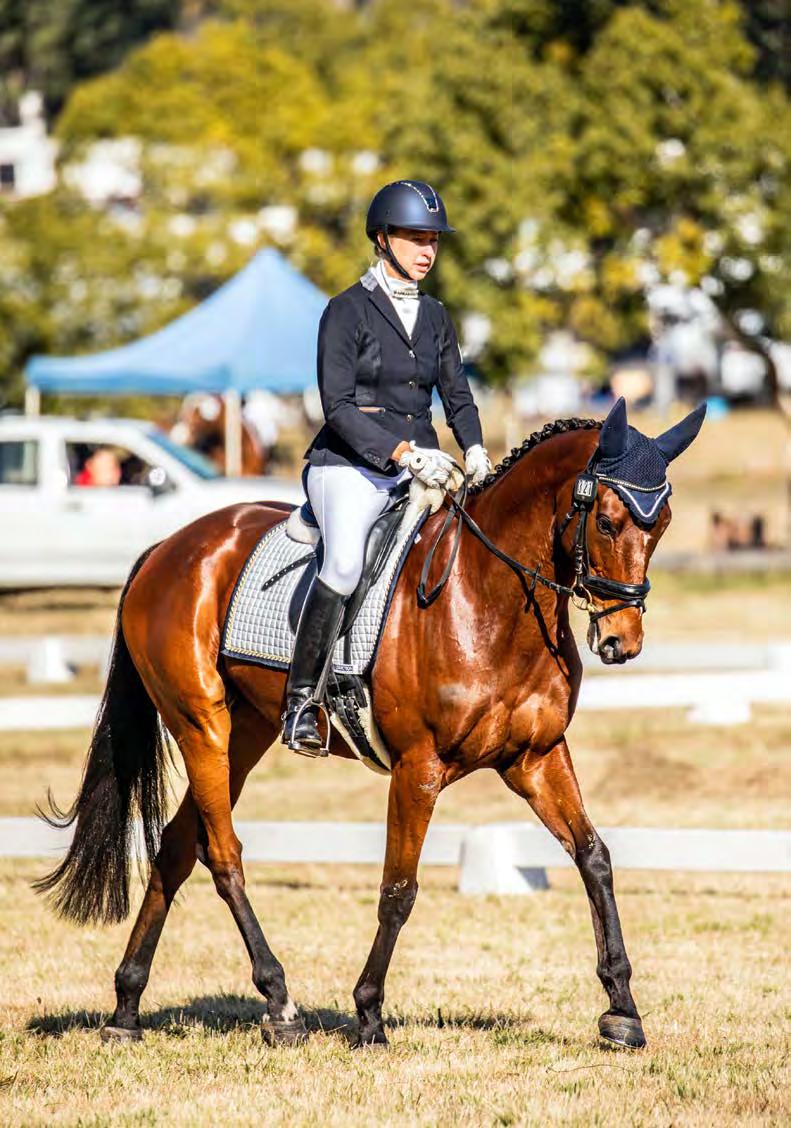

Racing Queensland is making major inroads with their off the track program for retired Thoroughbred and Standardbred horses, writes JO MCKINNON.
Racing Queensland has launched a number of significant initiatives during the past 12 months. In mid-2021 the Queensland Off-The-Track (QOTT) Program unveiled a plan to allow new off the track owners access to free instruction and individual support across a range of horse husbandry areas.
The lessons cover nutrition, groundwork, general horse care, behaviour and ridden work. This holistic approach has proved to be a huge part of the program’s success, its popularity underscored by extremely positive feedback from the participants.
Eligible for 10 lessons awarded through a voucher system, successful applicants can choose from 37 QOTT Approved Coaches. The coaches are all Equestrian Australia accredited and are located right across Queensland.
Kim Duffy, Racing Queensland's Senior Animal Care Manager, says 345 horses have so far taken part in the program and the high lesson uptake will benefit both horses and riders: "We have a variety of students in the program, from riders and owners who want to learn about feeding, nutrition and handling, to those who want to transition a horse from the racetrack to domestic life. We also cater for riders interested in many equestrian disciplines such as dressage and show jumping, so a wide range of people are participating.”
Kim, a former track work rider, competitive eventer and qualified veterinary technician, has led the development and implementation of the QOTT Program since July 2021. Much has been achieved in only a short period of time. “It’s been very busy since we’ve been up and running, with another busy couple of years to come,” she says. “It’s a dream job to be honest. I grew up riding off the track horses and fell in love with the breed. I’ve never owned or ridden another breed since.”
Another initiative of which Kim is justifiably proud is the Acknowledged Retrainers Program, which has been in place since January. Developed in
direct response to the Martin Inquiry, the program is one of a suite funded by the prize money levy implemented to support equine welfare in Queensland, and is designed to facilitate a highquality first transition for Thoroughbred and Standardbred horses.
The process of becoming an Acknowledged Retrainer is thorough, with selection based on the retrainer’s ability and experience in dealing with Thoroughbred and Standardbred horses of all abilities and temperaments. Part of the retrainer’s role is to objectively assess the suitability and character of each horse, and provide the education and retraining necessary for them to successfully find their forever home. Both the retraining and rehoming program are tailored to suit the individual requirements of each horse.
Currently QOTT has 13 Acknowledged Retrainers and in the four months since the program has been running, they have successfully rehomed 10 horses and have 11 horses in training.
Acknowledged Retrainers also assist prospective buyers in the selection of a
retired racehorse suitable for their level of experience and intended use. Kim is very happy with the retrainers’ results so far: “They’ve been amazing. The feedback we have received not only from industry participants but also the new owners has been overwhelmingly positive.”
Potential retrainers are carefully scrutinised prior to being approved. After their expression of interest is received, a rigorous application process begins: “Interested retrainers must fill out an application form with written references from a number of key people including vets, accredited coaches, people who have purchased horses from them in the past and licensed trainers they’ve worked with from the racing industry,” Kim explains. “We then review the applications before they progress to a property site assessment, where things like fencing, water supply, feed storage and the welfare of horses on their property are all checked. If successful, they enter an agreement which sets out their equine welfare and retraining obligations.”
Retrainers are provided with business, marketing and financial support,
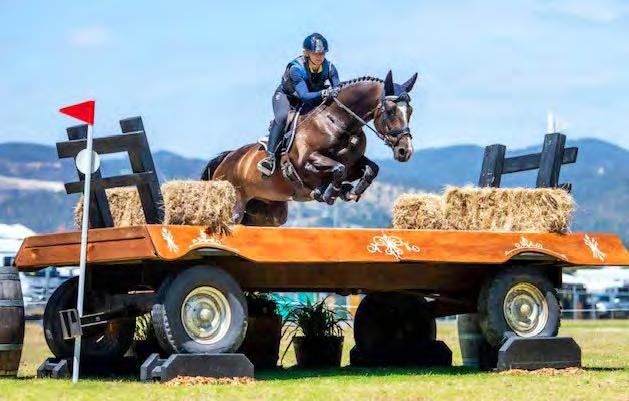
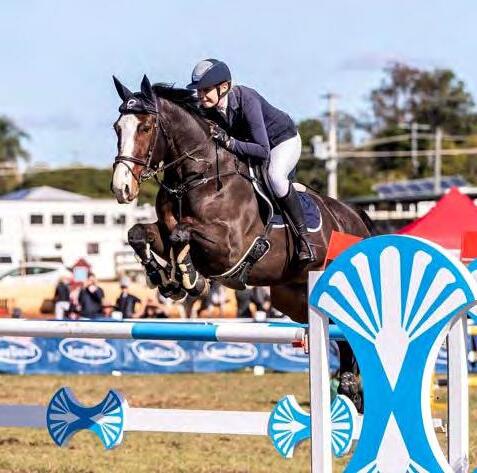
A QOTT Acknowledged Retrainer,
and internationally on state and national teams up to World Cup Level (Image
including an equine care subsidy that reimburses them for veterinary, farrier, worming, vaccination and dental costs.
The current retrainers have different models of operation, and generally prefer to take on full ownership of a retired racehorse so they can retrain and rehome them in their own time. Several have also elected to retrain under contract.
A range of other exciting initiatives are set to be launched by QOTT in the coming months, including an off the track grants program to support not-forprofit organisations and charities that provide a lifelong safety net for retired racehorses. “There’re a lot of wonderful organisations, rescue groups and sanctuaries who take on vulnerable and at-risk horses at later stages of their lives and we want to support them as much as we can,” Kim says.
An online education hub with information on how to care for and educate retired racehorses will also soon be accessible to the public, and will include fact sheets and articles written by professionals and industry experts, including qualified veterinarians.
A QOTT official Facebook page is also set to go live in the coming weeks.
To learn more about the program and its initiatives visit QOTT.
Offering first class facilities and talented retrainers, Racing and Wagering Western Australia is creating wonderful opportunities for the state’s retired racehorses. DR ANNA SMET explains.
With the aim of providing the highest standards in animal welfare, Racing and Wagering Western Australia (RWWA) is committed to ensuring quality care is available to racehorses through all stages of their lives.
In September 2020, RWWA unveiled the Off the Track WA (OTTWA) Estate, a multi-purpose racehorse welfare facility in picturesque North Dandalup. The 40-hectare property includes three barns for stabling, an Olympic sized fenced arena and a round yard, plus numerous other yards and grazing paddocks.
The estate facilitates the retraining of retired racehorses through RWWA’s OTTWA Retraining Program, as well as ensuring care is available for any emergency welfare cases that might occur.
On arrival, horses accepted into the program undergo an evaluation before being allocated to an off-site official retrainer. Retrainers participating in the program work to provide retired racehorses with the necessary skills and experience needed to transition from racing to their second career as pleasure or performance horses.
The current network of five retrainers, selected for their extensive experience in training horses – particularly in
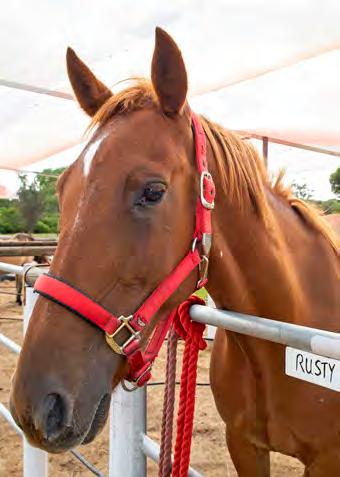
My father, Allan Hall, trained Rusty out at his property in Narrogin. He was such a gentle boy and a special part of the family.
the re-education of off the track Thoroughbreds and Standardbreds –plays a critical role in the rehoming program. Due to the diverse background and skill sets they offer, the wide variety
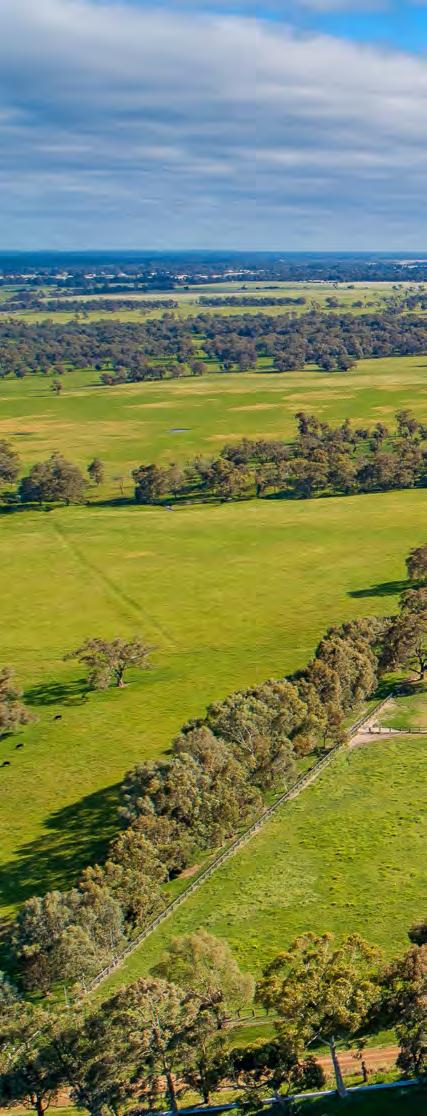
LEFT: Happy to be in his
of breeds, training requirements, and experience levels of horses entering the program is well catered for
The estate and retraining program not only form a central part of RWWA’s animal welfare commitment, but also allow for racing to continue to support organisations such as HorsePower Australia (formerly known as Riding for the Disabled).
Through the newly launched program, Rusty Rockets, a Standardbred, left his harness racing career behind and graduated from the OTTWA Retraining Program, recently joining the HorsePower Peel team as a therapy horse to assist people with disabilities.
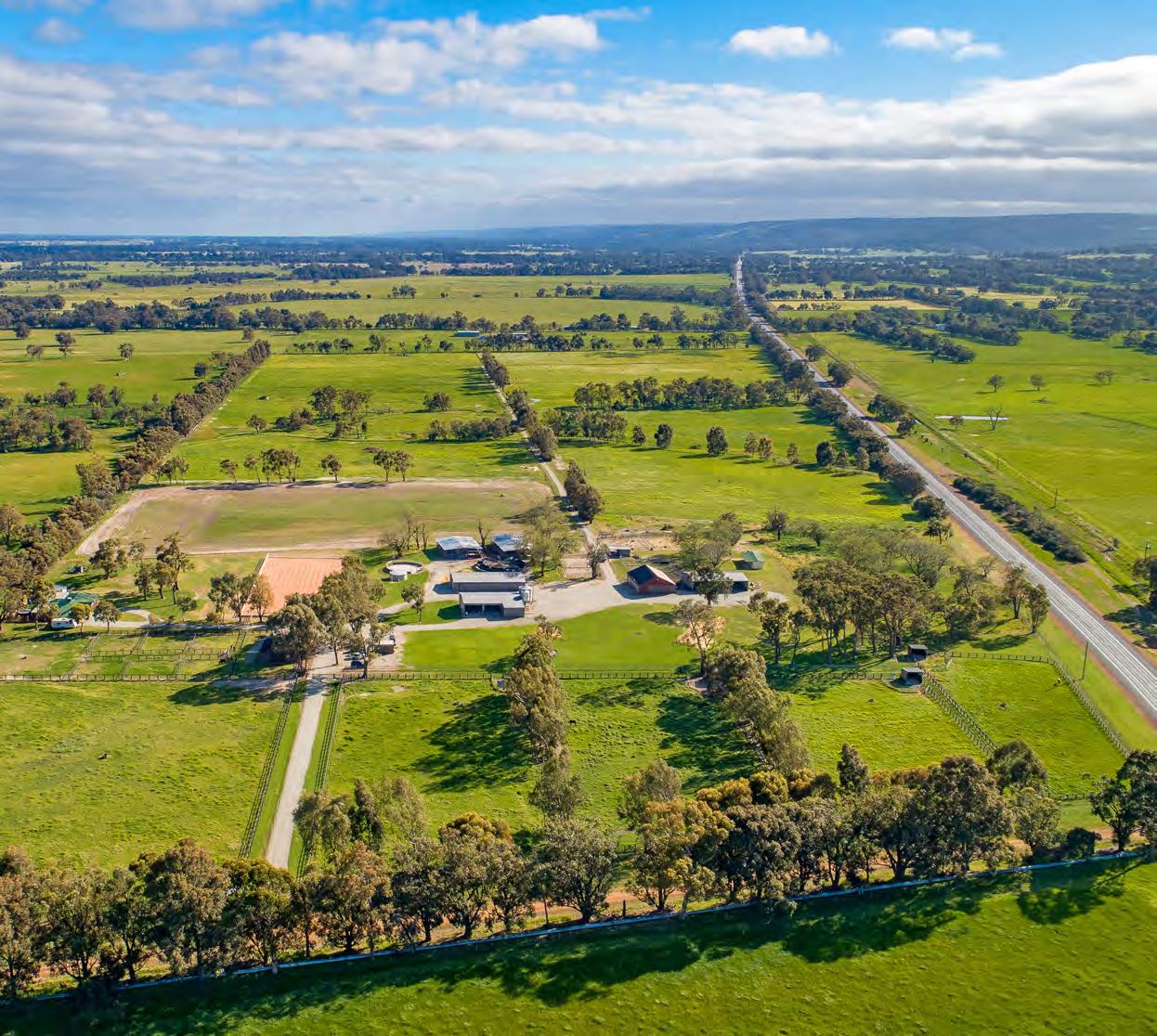
Rusty made his mark on the track with 16 wins, 50 placings, and a total of $127,864 in prize money, with several memorable wins in high-profile races.
Previous owner Gabrielle Ward has fond memories of the well-mannered and gentle Standardbred: “My father, Allan Hall, trained Rusty out at his property in Narrogin. He was such a gentle boy and a special part of the family,” she recalls.
Allan Hall remembers the day Rusty arrived at the property, where he was free to wander the beautiful 15-acre paddocks. “He was a true gentleman,” Allan says,“and the easiest horse to train, nothing was ever an issue, from floating to racing. His calm nature was
reflected in his racing, where he could produce a win after being 20 to 40 metres behind. He always had a warmth about him, and children would often make their way over to pat him.”
The devastating diagnosis of Alzheimer's disease for Allan’s wife meant he was no longer able to dedicate time to training, and the family made the decision to relocate Rusty to Perth. While that decision was heart wrenching, Gabrielle, Allan and the family knew he had more to offer and are thrilled to see Rusty’s sweet nature continuing to shine at HorsePower.
In order to complete his transition from racing athlete to therapy horse, Rusty
was sent to official retrainer Bayley Thomas. Growing up in harness racing gave Bayley a passion for Standardbreds, which sparked her interest in their retraining and rehoming post-racing. While Bayley had been doing this on a small scale since she was 15, in 2017 she realised that that’s where her true passion lay and decided to dedicate much of her life to preparing retired racehorses for their off the track careers.
With Rusty, Bayley took a unique approach, which he responded to well. “He was already saddle broken before arriving, so that made the process easier from the beginning. I was able to be on him and riding from
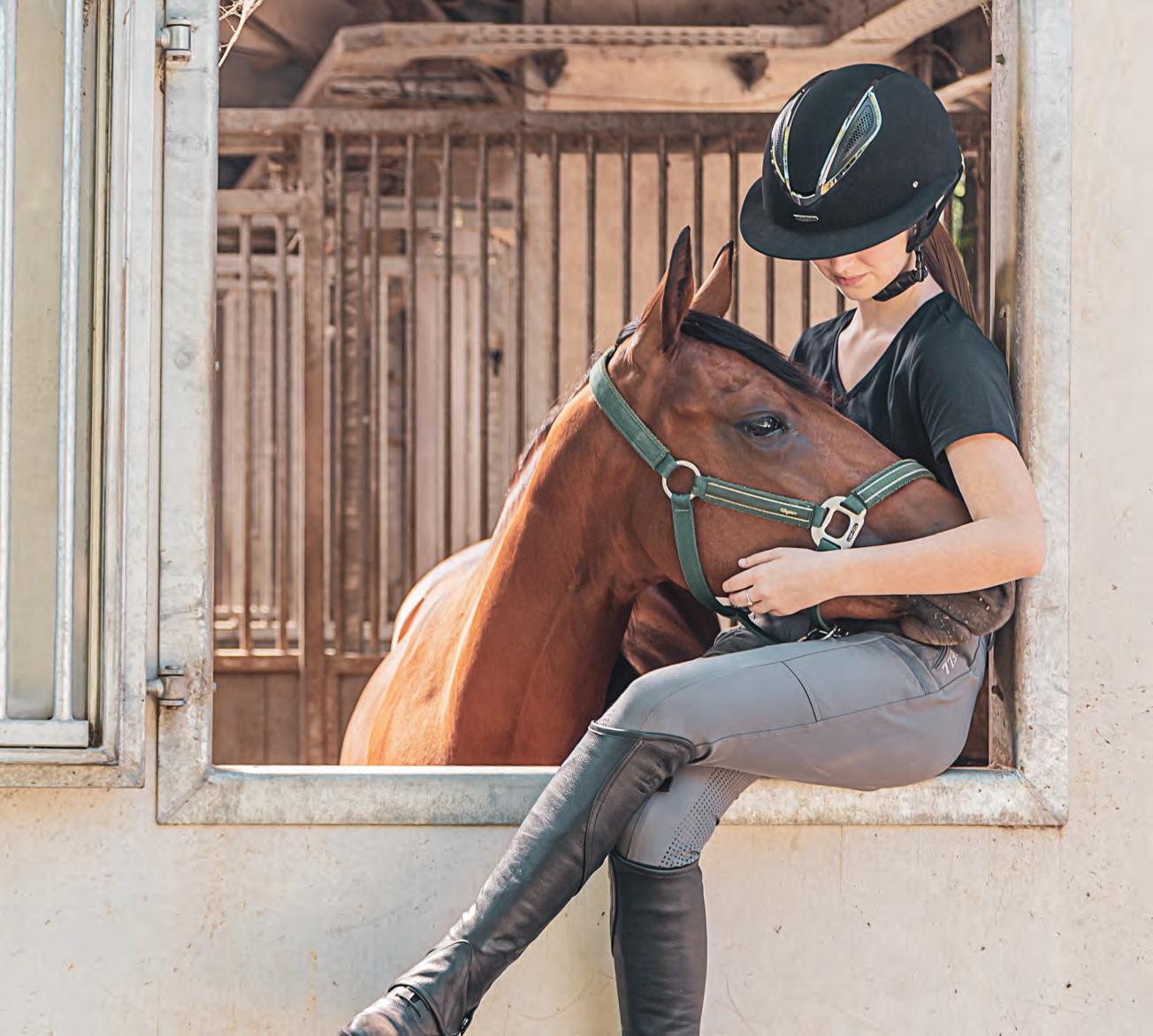
day one,” Bayley says. “Knowing the environment he would need to be ready for at HorsePower, we used a variety of techniques including a focus on voice cues and commands, the use of a small trampoline to replicate riders who might need to mount using a swing, and building his confidence with noise. He took all the training in his stride.”
When Rusty joined Bayley for retraining, he was quickly recognised for his exceptional temperament, which made him a quality candidate for the HorsePower Peel centre.
Jenny Wynn-Taylor, a HorsePower Peel riding coach highlights the direct benefits of horses being retrained by someone as talented as Bayley. “It is great to receive an OTTWA horse as they’ve had a lot of the work put into them. Because we rely on volunteers, the benefit of having someone like Bayley training them has just been tremendous. A lot of our volunteers don’t have horse experience, and the ones that do, don’t have the time to put into teaching them. So with Bayley having done all of that for us, we now just have to teach him our ways. It works really well.”
Jenny says that they’re delighted to have Rusty, as they desperately needed
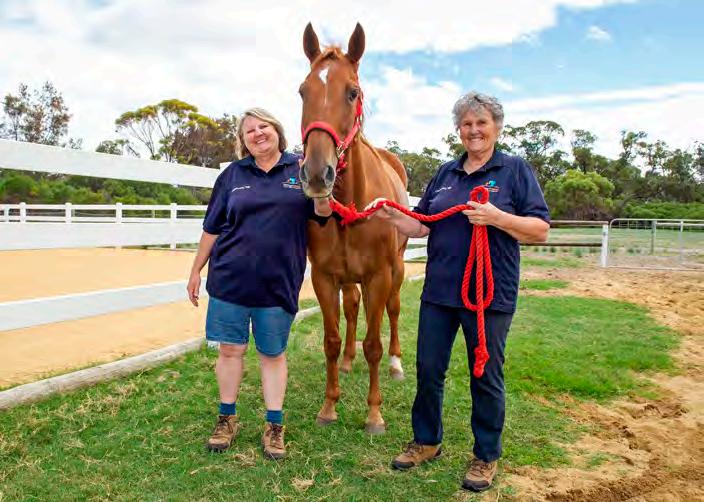
He was a true gentleman and the easiest horse to train.
another big horse to accommodate their clients. “That he can already walk, trot and canter has been a big bonus for us. We had clients who were ready to canter, so we’ve made great headway with many of them. He is going to be such a great
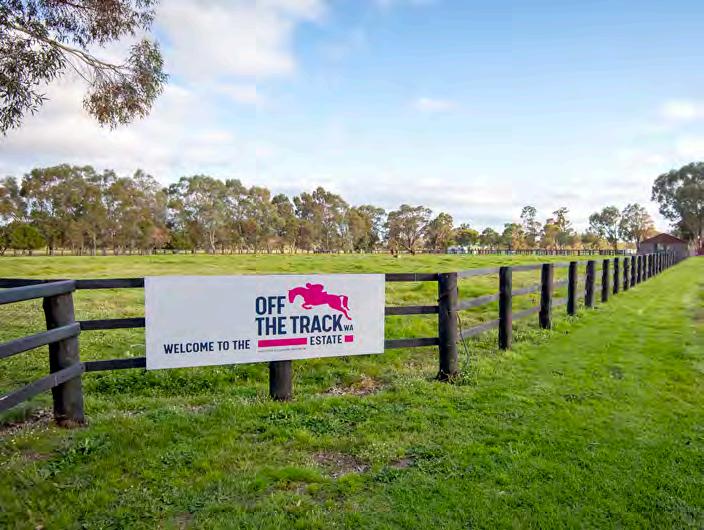
Complete with yards, barns and grazing paddocks, the estate is at the heart of Racing and Wagering Western Australia’s OTT retraining program.
addition to our team,” she adds.
Jo Needham, Vice President of HorsePower Peel, speaks highly of the OTTWA program and the opportunities it provides for their community. “On behalf of the committee of HorsePower Peel we would like to thank Off the Track and all the work they’ve done in preparing Rusty and donating him. We’d also like to recognise the support we get from Community TAB as well - it’s amazing,” Jo says. “We couldn’t do it without the supporters we have out there, and we couldn’t do it without the wonderful volunteers we have here.”
In addition to providing therapy horses, RWWA also provides $80,000 annually to HorsePower through its Community TAB program, which helps to subsidise costs for participants, as well as supporting volunteer training and horse welfare.
RWWA is working hard to lead the way in equine welfare, and looks forward to supporting more retired racehorses as they are retrained for their lives after racing.
For more information on the Off the Track WA Retraining Program, please visit: www.offthetrackwa.com.au.
LIFE AFTER RACING
After a successful racing career Most Important continues to shine, this time in the company of schoolgirl Clare Fedrick, writes AMANDA MAC.
Amultiple Group 3 winner who took home over $1 million in prize money during his illustrious track career, Most Important has now teamed up with 14-year-old Clare Fedrick to make an impressive show ring debut.
Affectionately known as Mosty and formally owned by Linda and Graham Huddy, the 10-year-old gelding by I Am Invincible out of Orange Marmalade has, Clare’s mother Rebecca tells me, a delightful personality. “I've got a funny little video of Clare sitting at the front of the stable and Mosty’s eating a carrot she’s holding in her mouth. Like most of the good ones he’s quite quirky, but so calm, relaxed, and loving at the same time.”
After retiring from the track, Most
Important enjoyed a lengthy and well-deserved spell on the Huddy’s Peachester Lodge property. Serendipitously, it was a conversation with Gemma Creighton, a Queensland Off-The-Track (QOTT) Acknowledged Retrainer, which triggered the chain of events that ended with Most Important arriving at the Fedrick’s farm just outside Gatton in Queensland, to try his luck in the show ring.
Rebecca, who had been looking for another show horse for Clare, called Gemma to see if she had any suitable OTTs in her care. At the time, Gemma was working with several of Graham and Linda’s horses, but they were destined for the show jumping arena. However, Gemma offered to contact Linda and minutes later called Rebecca back to let her know she had a candidate. “I had a general chat to Gemma about what would happen with him,” Rebecca explains, “and what it entails to be a show horse and she said, ‘yep, let’s give him a go’.” Clare was just 13 when she first rode the 16hh OTT. “He's a big boy,” her mother remarks, “but fortunately Clare has very, very long legs!”
And that was the start of a dream partnership. Clare, predominantly a show rider who occasionally dabbles in a bit of jumping, was entirely responsible for retraining Mosty, spending their first few weeks in the arena at the family farm where she taught him the tools of the show ring trade and worked on building his confidence. “He’s a very kind horse, and she's a very kind rider, so they sort of fell into place. They just get each other. We’ve had plenty of off-the-tracks, but he was different. He just did whatever Clare asked. He trusted her right from the getgo,” Rebecca recalls.
Nonetheless, Mosty’s career change was substantial so not too much was expected of him in his first year. But apparently, Mosty had other ideas. Just eight weeks into his training, the Fedricks decided to enter him at the 2022 Stanthorpe Show, where he was named Champion Novice and Reserve
Champion Open Horse. Not bad for a beginner! “He then qualified for Sydney Royal last year, and for Grand Nationalshe’d won Champions Child Hack at about four different shows to qualify for that,” Rebecca says. “He won the Champions Child Hack at EQ Childs Horse of the Year show as well, which qualified him for the Childs at Nationals.”
Then there was the highly prestigious and hotly contested Pope Cup at the Melbourne Royal. “We just expected him to go round and possibly get the gate. The horses he was up against had all been around the show ring for four or five years. He went out there and actually went to sleep in the line-up because the class took over an hour to judge,” Rebecca laughs.
And to the family’s huge delight, Most Important was awarded Highly Commended, as well as taking third place at the Show Horse Council of Australasia Grand Nationals in a rider class. Then, not ones to rest on their laurels, Clare and Mosty became the inaugural winners of the QOTT High Point Horse Award –created to recognise the OTT horse who collects the most points across a range
of equestrian disciplines throughout the year - at the 2022 Equestrian Queensland Awards. Again, not bad for a newby!
Back home on the farm, Clare, who has been riding since she was big enough to clamber aboard, continues Mosty’s training. “It’s mainly repetition now, so she will do flat work in the arena and to change it up she’ll take him for swims in the dam or a ride around the property,” Rebecca tells me.
And by the time you read this, there’s every possibility that Most Important will have added a few more accolades to the board at this year’s Sydney Royal. A shining example of what’s possible for OTT horses after their racing career is over, Rebecca reckons that he’s an absolute superstar: “As I said to Clare, this is what happens when you’ve got people who look after their racehorses - they become good horses after the track.” And you can’t argue with that.
FACING PAGE: Mosty and Clare have had a sensational start to their show ring partnership (Image by Danni Milligan Photography).
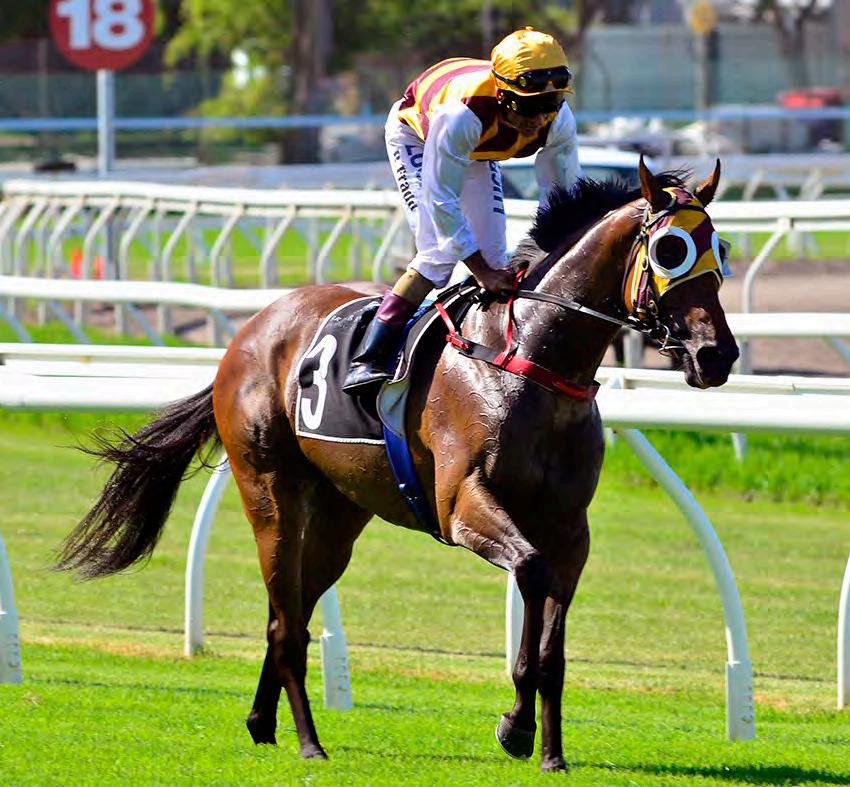
ABOVE: Most Important on the track (Image courtesy Queensland Racing).
Communications Specialist at Racing Victoria, CHRIS KENNER introduces their innovative Off the Track Community program.
Since the importation of pureblood
Thoroughbreds from England to Australia in the early 19th century, the use of the breed, while varied, has predominantly been for racing. However, over the decades the
Thoroughbred’s versatility, speed and smarts has made it not only a terrific racehorse, but also a breed much sought after for various other vocations.
The majority of Thoroughbreds today can be found in a racing stable before
going on to other careers after their time on the track, including the stud farm, the equestrian circuit, and non-competitive pursuits such as trail riding, or as equine therapy horses to assist adults and children in need.
A breed that craves purpose, the question still remains as to what becomes of a Thoroughbred once it has fulfilled its primary purpose on the race track, whether it has been successful for its owners and trainer or not.
As far back as 1898, renowned racing journalist Herbert Buckley (better known as Ribbledon) penned the article ‘What becomes of old racehorses?’ for The Australasian newspaper. While he delved into the longevity of some racehorses, Buckley also explored anecdotes of retired horses transformed into hunters, assisting baker runs, joining the circus, or heading for the breeding barn.
More than 120 years on from Buckley’s article, understanding and providing the best opportunities and a genuine purpose for every Thoroughbred following their racing career is still a work in progress.
The challenge starts with understanding the Thoroughbred population dynamic. With thousands of horses leaving the racing industry in Australia each year, the visibility and traceability of a horse’s movements beyond racing is paramount to ensuring their wellbeing. However, the existing data has traditionally been unreliable. To address this situation, the National Horse Traceability Working Group was formed in 2020 and was tasked with developing recommendations on the feasibility of a National Horse Traceability Register.
While this work is underway, with further details on the Register’s framework and operating model anticipated this year, Racing Victoria (RV) has already taken steps to create greater visibility for offthe-track Thoroughbreds in Victoria. In May 2021, the organisation introduced the Off The Track Community, an online space for OTT owners, riders looking to buy their first retired racehorse, and OTT enthusiasts wanting to engage with likeminded horse lovers.
In what is believed to be a racing world first, RV is paving the way to better understand the movement of retired racehorses across the state through this innovative program. There are thousands of off-the-track Thoroughbreds enjoying second careers in Victoria, and since the Off The Track Community became active just eight months ago, RV has gained greatly improved traceability of many of them.
With 3,900 members registered on the platform, many of whom have 20 or more years riding experience, more than half have ‘claimed’ an off-thetrack Thoroughbred. To make a claim, members search for their horse in the online database, and once found, provide RV with branding images and associated details to confirm their ownership. Along with claiming their horse, members can also provide updates on how the horse is progressing in its career after racing. To date, more than 2,000 horses have been claimed, 50 per cent of which are aged 10 or over.
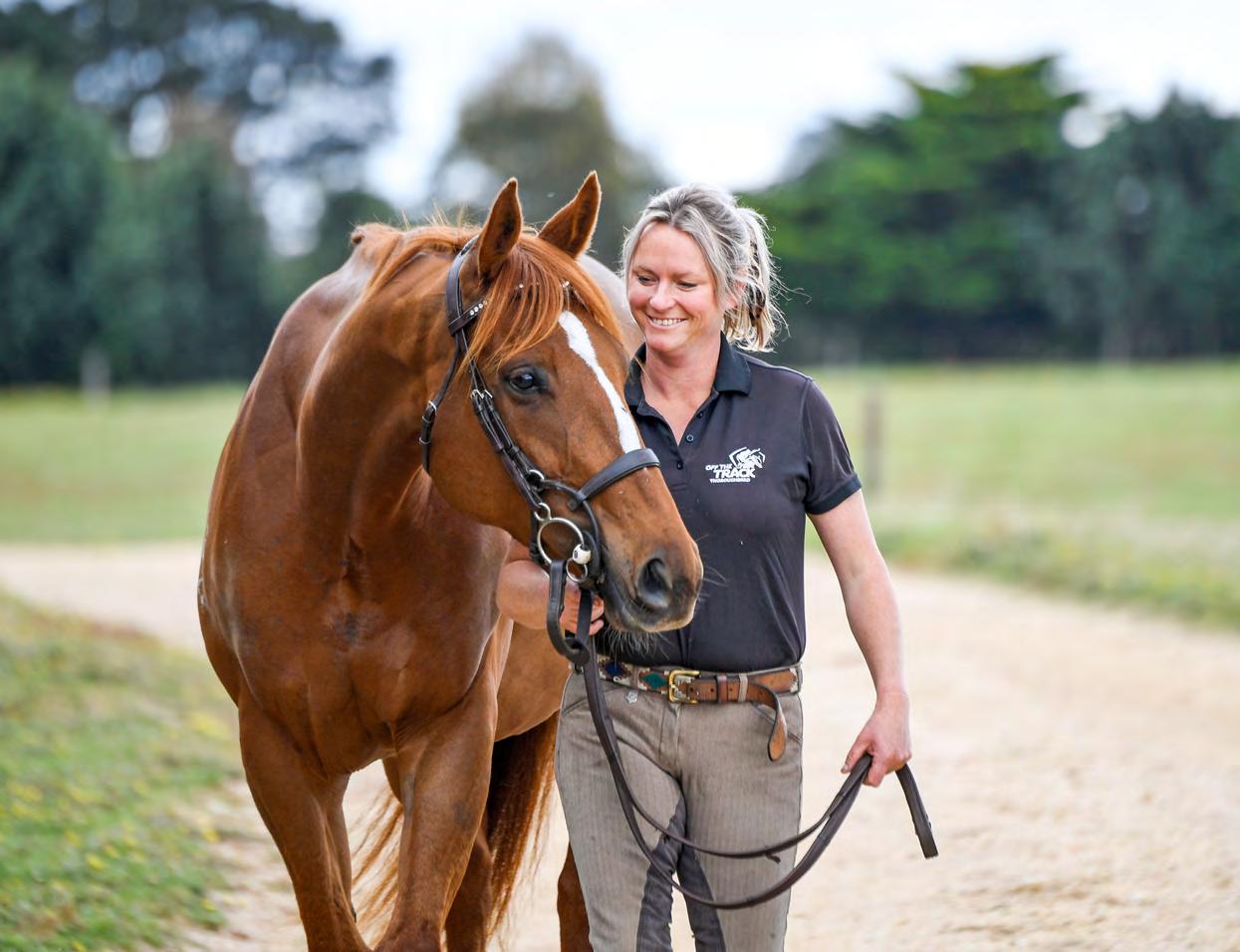
LEFT: Louise Abey with six-yearold mare Mareeza Brown on their Mornington property (Image by Reg Ryan Photography).
ABOVE: OTT Another Option with Lucy Kolomanski (Image by Michelle Terlato Photography).
In addition to being able to claim their horse, Off The Track Community members can also register as a Full Circle emergency contact, offering an important safety net for retired Victorian racehorses found in a poor welfare situation. The Full Circle program enables interested members to nominate as a contact for any registered Thoroughbred in the Off The Track Community. If a situation arises in which the horse is in need of assistance, RV’s Equine Welfare team contact the nominated Full Circle member (and there are now more than 700) to ascertain whether or not they might be able to help. Often this is simply to care for the horse until a new home is found.
The incentive-based platform, while focused on improving RV’s ability to track retired racehorses across the state, is also an important tool to support owners and riders of off-the-track Thoroughbreds through educational offerings, webinars, news, and video updates. These benefits, created following feedback from members, have been gradually added to the platform over the past eight months. The community’s exclusive content has proved to be an important tool for many off-the-track owners who wish to access tips and tricks to improve their care, training and general enjoyment of Thoroughbred ownership.
Well-supported by Victorian equestrians, over 2,000 Off The Track Community members have identified as owner-riders: dressage (1,097) followed by showing (1,027) and then eventing (1,005 ) are the most common disciplines.
The Community is also popular with those who own less competitive horses, with more than 1,000 members indicating their interest in pleasure and trail riding. However, unlike the 1800s, no horse claimed through the Off The Track
Community has yet been identified as enjoying a secondary career in the circus, or as working for a baker!
Through information provided on the platform, details for nearly 100 horses have been corrected on racing’s National Register, and 145 horses that previously had no specified owner or address at the point of retirement have now been located – small steps to further improve the visibility of Thoroughbreds in Victoria.
With many keen equestrian competitors in the Off The Track Community, a function was recently added to provide access to event calendars and entry information. The function will be upgraded this year so members can register for events through the platformyet another mechanism to help improve the visibility of retired racehorses.
And for owners and trainers looking for ways to transition their horses out of racing, there’s information on RV supported pathways and programs, as well as contact details for the RV Equine Welfare team, who are happy to offer advice on a horse’s best options.

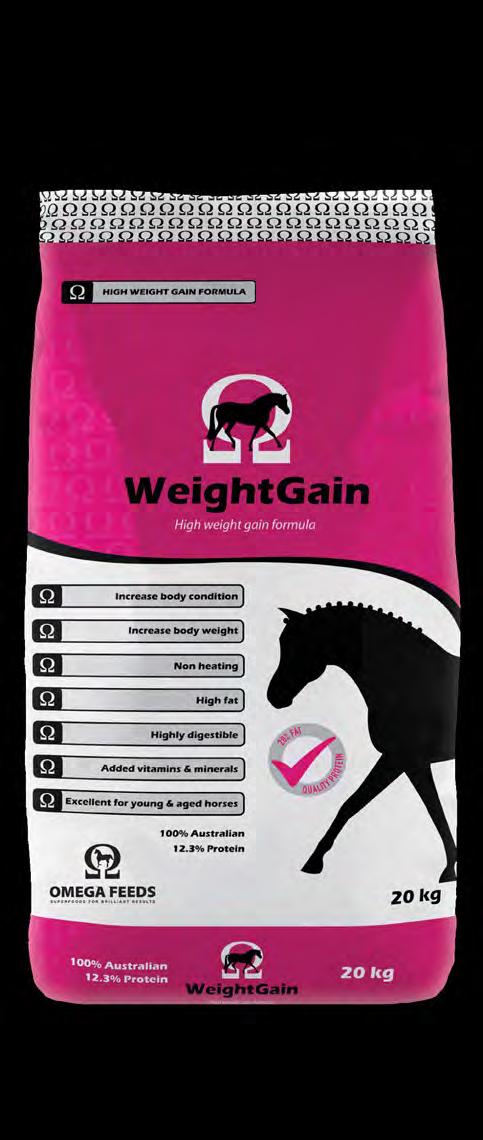
WeightGain is a SUPPLEMENT to be added to complete feeds

High in Fat (28%): To enhance body condition, coat shine and maintain stamina
Quality Protein: For muscle growth and development
Well balanced: For optimum health & vitality
Cost Effective: Feed a small amount for big results
Highly Digestible




The Off The Track Community platform is also an important resource for Thoroughbred owners to access RV’s statewide network of acknowledged retrainers, who support the retraining and rehoming of horses as they transition into second careers. Additionally, owners can use the platform to register their horse for industry supported initiatives such as the RESET Program.
As the community grows, so will the features offered. There’s an everexpanding library of educational tools and owner stories to immerse in, growing engagement functionality, and general support for those wishing to learn more about off-the-track ownership.
While the Off The Track Community will never replace the scope of a national traceability register, the online platform is making great strides towards not only increased understanding of the movement of retired racehorses in Victoria, the potential gaps, and where welfare efforts are best directed, but also to expanding and improving the skills and knowledge of the off-the-track community.
The response to the Off The Track Community platform has been so positive that it now includes members from other Australian states and territories, and even a couple of overseas owners wishing to claim their horses.
To check out the Off The Track Community and claim your Thoroughbred, visit ottcommunity.com.au. If you have any questions about the platform, contact RV’s equine welfare team at offthetrack@racingvictoria.net.au.
Life After Racing is proudly sponsored by Arrowfield Stud –visit arrowfield.com.au.
The inaugural THSA National Titles have made a significant impact on the OTT Thoroughbred competition landscape, writes TARA MADGWICK.
Creating a meaningful and rewarding program of events for off the track Thoroughbreds has been a long-term goal for the NSW based Thoroughbred Sport Horse Association (THSA) – and their inaugural 2022 National Titles on November 18, 19 and 20 represented the culmination of a dream.
The event venue, picturesque Stonewall Equestrian centre on the NSW Central Coast, was developed by the late Heath Harris and wife Krissy, a World Cup show jumper and the driving force behind TSHA. The centre was the perfect backdrop for nearly 300 Thoroughbreds and their riders to compete in show jumping, dressage
and show horse classes over three days, with the Maserati sponsored VIP marquee offering next level comfort for owners and supporters.
Krissy Harris was delighted with the end result: “It’s been a long time in the planning and there are so many people to thank for making it happen. We always hoped it would attract national interest and we had riders competing from all over the country, so we probably exceeded expectation and importantly everyone had fun. The racing industry has been very supportive and it’s been a great collaboration between racing and the sport horse world. Everyone that was involved in sponsorship this year is keen to be on board next year, so we’d be looking at expanding to a five day show to give the show and dressage horses greater focus.”
Day One produced some dazzling show jumping with the $20,000 Six Bar Contest delivering a national height record for a registered Thoroughbred
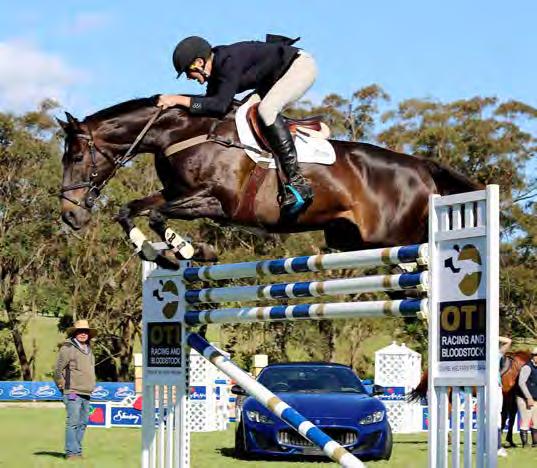
when young Hunter Valley rider Charlie Richardson cleared 1.75m in his final run on 15-year-old gelding Mavrick. Krissy believes Mavrick has thrown down a challenge to other Thoroughbred jumpers around the world: “It was an elite event and it would be good to see other countries pick it up. Our Australian Thoroughbred has just jumped 1.75m, what can the Americans and the English do? Bring it on!”
Over 30 riders contested the lucrative class sponsored by OTI Racing & Bloodstock’s Equine Welfare Program. The field featured Olympian eventer Shane Rose as well as young gun eventers Sam Woods and Shenae Lowings, who with her OTT Bold Venture competed in the recent FEI Eventing World Championships.
Saturday featured the $10,000 Maiden Teams Challenge (90cm) and was won by Peachester Lodge, the team sponsored by Linda and Graham Huddy. The Huddy’s have enjoyed great success racing and breeding Thoroughbreds with Group I winners such as Shoot Out and Volatile Mix running in their familiar brown and gold colours. They take the lifetime care of Thoroughbreds, their retraining and their eventual rehoming, very seriously. All three horses in their winning team were formerly successful Peachester Lodge racehorses.
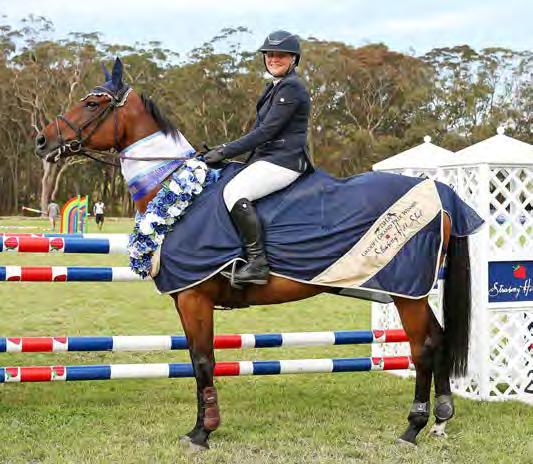
The National Group I Champion (1.2m) point score, another noteworthy event on Saturday’s program, was taken home by West Australian visitor Sophie Stott and 13-year-old Allwest. Krissy was delighted to be able to offer Sophie and Allwest accommodation: “I didn’t know her at all until she rang up and said she was coming, but she’s a lovely girl and has a been a great help to everyone while she’s been staying with us. Off the Track WA gave her $1,000 towards her travel costs and then she’s come here and won a couple of big classes, so she’s paid her way home and paid off her credit card!”
Sunday’s highlight was the thrilling $70,000 Racing Teams Challenge (1.15m) won by the Strawberry Hill Stud team featuring Australian show jumping champion Olivia Hamood. John Singleton’s Strawberry Hill Stud was also the naming rights sponsor for the entire event, literally held just up the road from his iconic Mount White farm where countless champion racehorses have been produced.
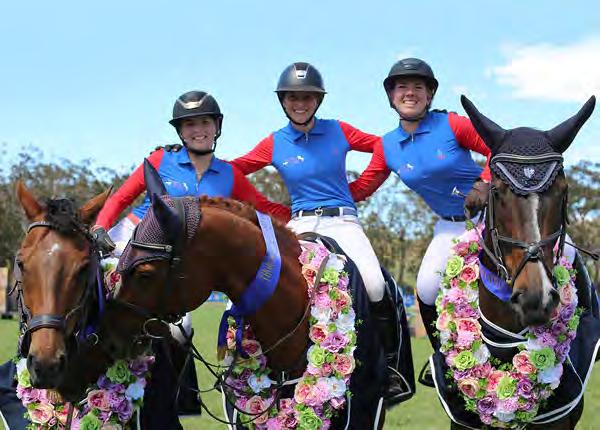
There were tears prior to the show when Strawberry Hill’s champion Tuesday Joy was laid to rest, but Stud Manager Bridie Sparkes had good reason to smile again after their team of Nikita Moore riding Moon Landing, Paton Simpson on Port Commands and Olivia Hamood aboard Showem Flash claimed victory.
Six-year-old Moon Landing was the baby of team and is showing huge potential under Nikita Moore. Bred by Strawberry Hill Stud, he was injured as a foal and never raced, but the three-quarter brother-in-blood to leading sire Better Than Ready has gone far in his first year of competition.
Another highlight of the event’s final day was the $20,000 Puissance won by Queensland rider Sarah Weiss and her wonderful 14-year-old gelding Waratone, who cleared 1.68m over the wall.
Olympian Shane Rose was the most successful rider by wins at the National Titles, claiming the $10,000 Heath Harris Horsemanship Medal. “Shane had a quality team of Thoroughbred eventers at this show that proved very effective when switched to straight show jumping,” Krissy commented. “We hoped this award would be won by the very best rider and we couldn’t have asked for a better result.”
FACING PAGE: Australian show jumping champion Olivia Hamood and the Strawberry Hill Stud team clearly delighted with their big win.
ABOVE LEFT: Charlie Richardson and Mavrick won the $20,000 Six Bar while at the same time setting a new national height record for a registered Thoroughbred.
ABOVE RIGHT: The National Group I Champion (1.2m) point score was won by West Australian visitors Sophie Stott and Allwest.
All images by Nicole Scrivener
Star turn
There are some horses with a presence that demands your undivided attention. Givenchy is one of those horses, writes JO MCKINNON.
Givenchy is one of those breathtaking show hacks. When he strides into the ring you can't take your eyes off him. His colour, his movement, his elegance, and his presence all come together to form the perfect looking Thoroughbred. Add his regular rider Greg Mickan into the equation and you have the epitome of a top show combination.
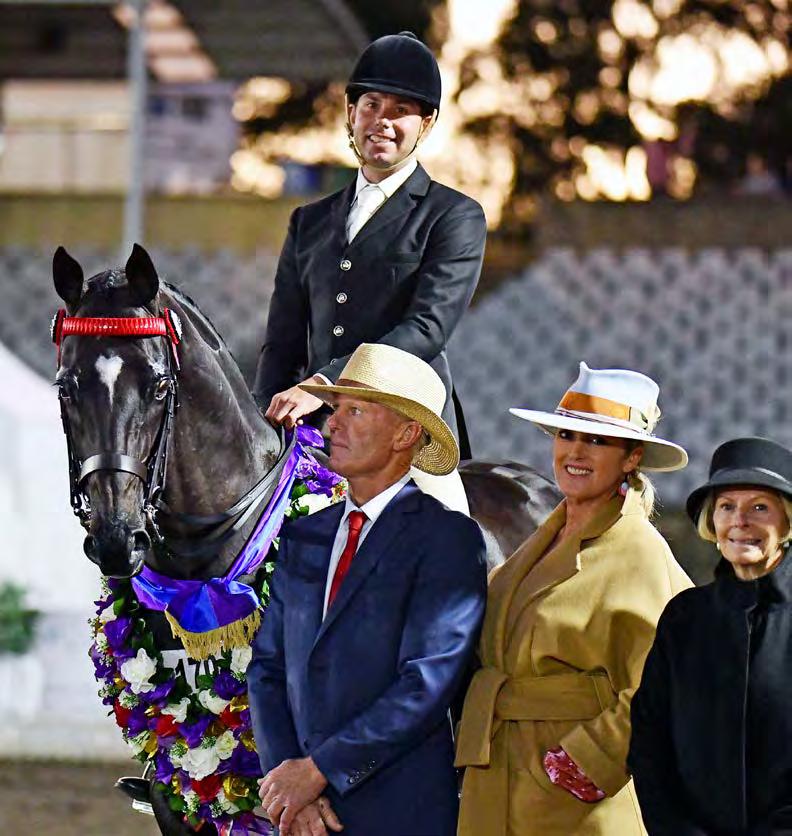
At this year's Sydney Royal Easter Show, Greg and Givenchy took out the most prestigious event for Thoroughbreds, the Pope Cup. It was the crowning glory in what has so far been an illustrious career in the ring since being retired from the racetrack in 2018.
A son of the former champion racehorse and coveted Darley sire Lonhro, Givenchy was trained by Mick Kent
and raced as Data Point. He was handy enough on the track and in 24 starts he won two races and amassed prize money earnings of $151,000.
Greg remembers catching a glimpse of him on Racing.com while he was still racing, and said he immediately noted him down as having potential as a show horse. "The Racing.com app notifies me when there's a horse I like racing, and when they’re not doing so well I contact the trainer. I saw him trotting to the barrier and liked the way he carried himself. He's a very good mover and sat in a nice frame. We have come across three or four horses by doing this. It's a good way of spotting them if you can't go to the races," Greg says.
Data Point, as he was then known, sat in Greg's little black book for a while until his trainer's vet happened to come out to Greg’s property and gave him the tip that he might soon be available. "His vet said he had a nice horse and I looked it up on my phone and there was his name. He said you better get down there and look at him, there are a few showies after him. Sue Thompson went down and ended up buying him."
Soon after the horse arrived at Romsey Park, Greg's picturesque property in Victoria, he knew Data Point had what it took to make a good competition horse. "We did a month's work to make sure he was what I wanted. From day dot he always sat in a frame and is one of the easier Thoroughbreds we have trained off the track. He's beautiful and very uncomplicated to ride and probably came up better than we thought."
Greg, a show jumping rider when he was younger, specialises in producing show horses and works with all types of breeds including Warmbloods. He says, for various reasons, that he enjoys working with Thoroughbreds the most. "They’ve been exposed to a lot before we get them. They’ve been to the races, been in stables, so when you take them to shows they are forward thinking compared to a Warmblood, which will stop and spook. With Thoroughbreds
they continue to go forward because after their training on the track, their initial instinct is to go forward.”
Greg adds that although he loves Thoroughbreds, he’s of the opinion that a good horse is a good horse, no matter what their breeding, and that they’re not easy to source.
Not all prospects turn out to be stars like Givenchy, now in his third showing season, and are simply unable to transition to life on the show circuit. "It's hard because you don't know until you get them out amongst other horses and see how they cope in the atmosphere. You can sometimes think you have a star in your own arena at home, but you never really know until you get them out,” Greg explains.
Givenchy was taken to seven agricultural shows within three weeks in his first stint, enough to make or break
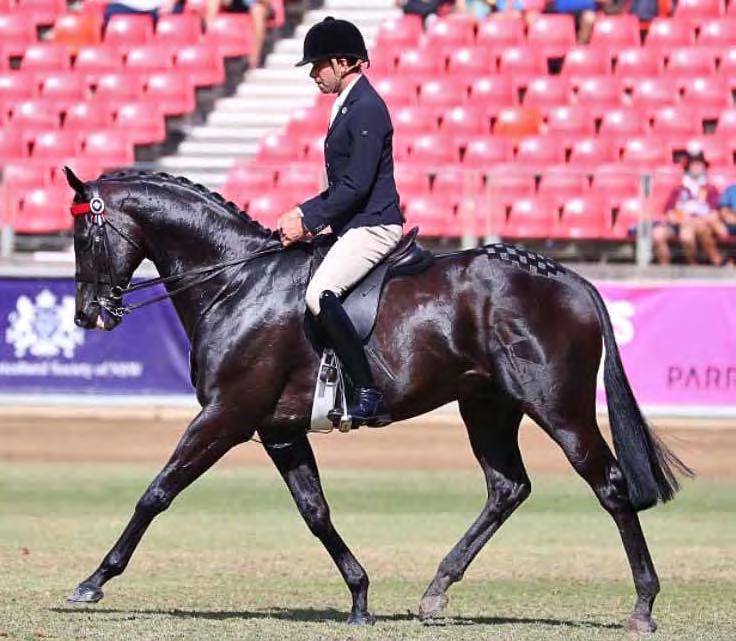
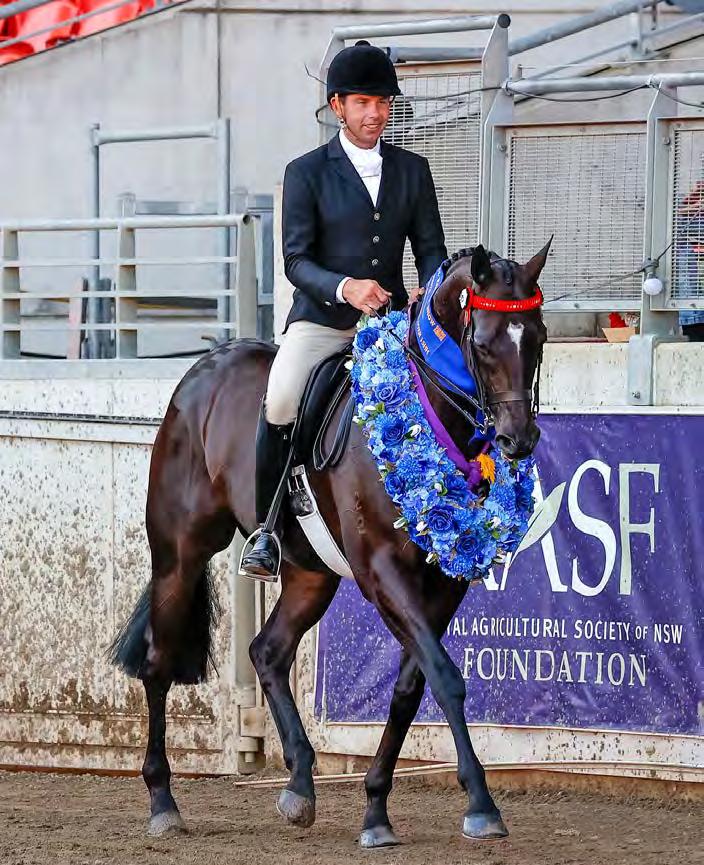
any horse. “They have to tie to the truck and work in a team environment. He was always very good even at his first few shows, he has a good temperament and accepted it very well. In temperament and trainability, he's up there with one of the easier ones we have had to produce,” Greg says. “What he is at home is just about what he is at the shows. He doesn't get there and get too bright or silly."
Greg and Givenchy’s next big targets are the 2022 Melbourne Royal followed by the Grand Nationals in Sydney at the end of the year.
And with so many off the track events offering great prize money popping up all over Australia, Greg plans to aim Givenchy at more of those shows, because, as he says, that adds up to a whole lot of incentive.
FACING PAGE: Greg and Givenchy, the 2022 OTT New Star (Image by Lisa Gordon).
ABOVE: Givenchy, a good mover with a very nice frame (Image by Lorelle Mercer).
LEFT: Winners of the 2022 Sydney Royal Pope Cup (Image by Rodney’s Photography).
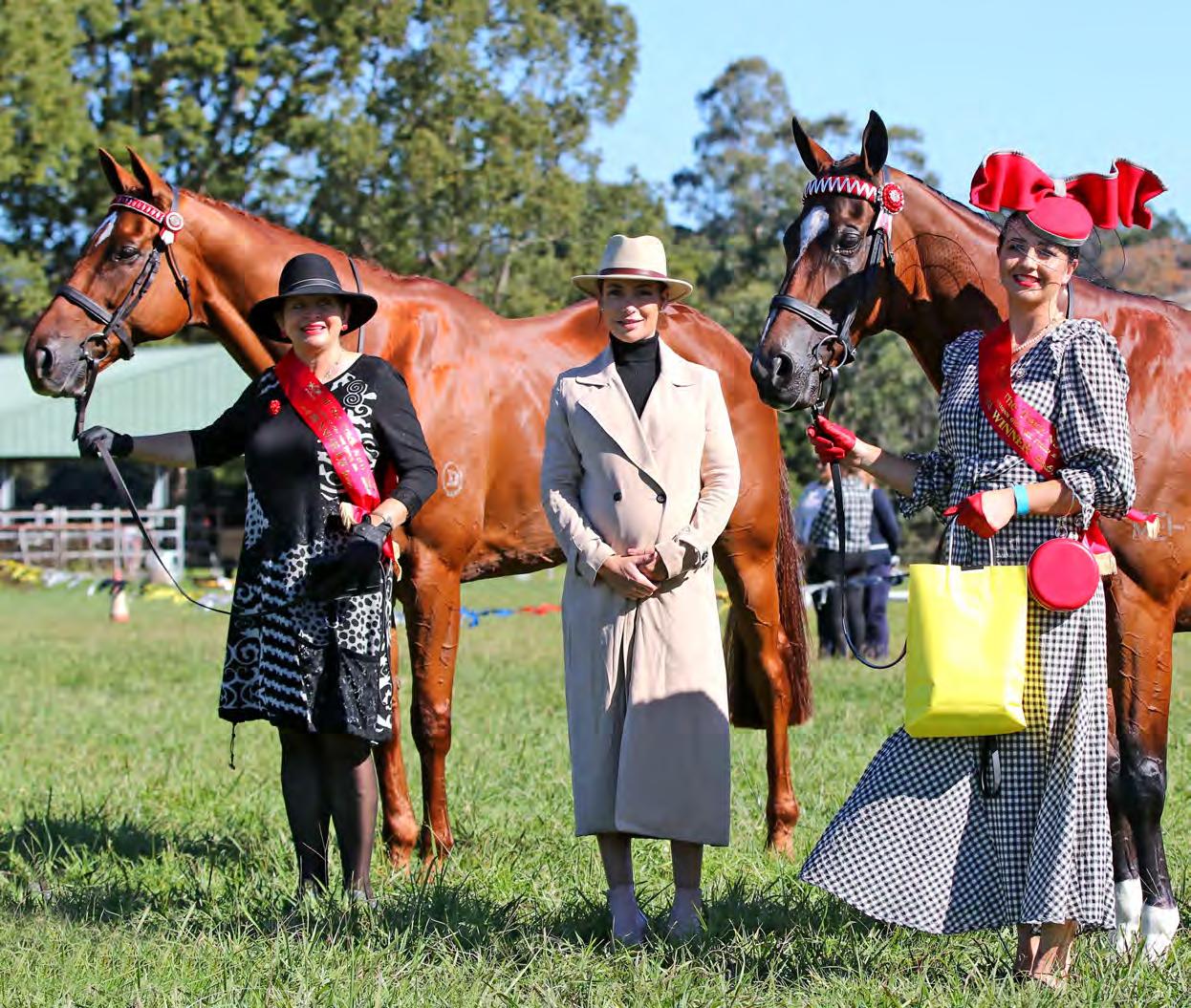
It’s probably fair to say that few horses are as misunderstood as the retired racehorse. Often labelled as difficult, anxious, and unpredictable, AMANDA MAC discovered that that’s a long way from the truth.
Over the months we’ve had some exciting glimpses into the great work being done around Australia to retrain and rehome off the track Thoroughbreds and Standardbreds –oftentimes with spectacular results.
And no less exciting are the success stories emerging from Off The Track NSW Inc (OTT NSW Inc). Located in Coffs Harbour, and generously supported by Country Racing Syndications, the organisation is run by a team of dedicated Thoroughbred enthusiasts under the guidance of committee president Cheryl Lantry. With a life-long connection to the racing industry, Cheryl retrained more OTT's than she can remember prior to obtaining her racing NSW trainers’ licence.
“Thoroughbreds are bold, intelligent, versatile, athletic horses, and our aim is to increase the number of owners prepared to take on an OTT racehorse,” she tells me. “The transition from racing to performance or pleasure horse can be extremely rewarding, and the end result can secure a life of care for the Thoroughbred post racing.”
Case in point is the story of OTT Baribo. Owned by OTT NSW Inc member Jolene Cole, Baribo’s previous career as a racehorse was, to put it mildly, less than stellar. But he hit his stride as an endurance horse when in 2019 the pair won the heavyweight division in Australia’s most prestigious endurance race, the Tom Quilty Gold Cup. So if you thought Arabians were the only poster pin-ups for endurance, better think again! Jolene says Baribo has remarkable stamina “an ability to recover and go all day … it’s an honour to own and ride him.” Looks like Baribo found his forever home.
Most horses retiring from racing are eminently suitable for a career in one of the many disciplines celebrated during OTT NSW Inc events. “Currently we stage show jumping, dressage, showing, rider and in hand classes,” Cheryl says. “We recently held our Championship show and there were numerous entries in each discipline, with competitors travelling from Canberra, Mudgee, Sydney, Tamworth and Tweed Heads.”
One of those competitors was Megan Perrin. Five years ago she began retraining Geron, an OTT retired from the track for being too slow. She saw him for sale on Facebook, and although not looking for a new horse, decided that if he hadn’t sold within 24 hours, he was meant for her. “So I bought an ex race horse sight unseen through Facebook!” she says. But fortunately, it was love at first sight. Very wisely, Megan began Geron’s education slowly, starting with a six month let down to give them time to develop a bond free of pressure.
Starting their show season in led classes only, Megan was rewarded with Supreme Led at their first show. However, although Geron proved to be very quiet in training, he was also lazy. “I could see why he never won a race,” Megan laughs.
During his first few months under saddle, Geron won the 2017 Queensland Show Horse Council Large Hack Rising Star, and has since won many champion hack classes, including Champion Ridden Thoroughbred at Toowoomba Royal, Grand Champion Off The Track NSW, and of course, Grand Champion Star of All Stars at OTT NSW Inc’s recent show.
For Megan, one of the best things about owning and retraining an OTT Thoroughbred is the family that comes with them – the stud manager, trainer, track work rider, even the person who foaled them down. “You don’t just get a horse, you get a family and a history. My journey with Geron has been the best thing that has ever happened to me. He’s my heart horse,” she says.
Another OTT NSW Inc member, Samantha Croft of Clark & Croft
Bloodstock has a similarly interesting tale to tell about her OTT Arrow, a Thoroughbred that she had sold as a yearling. Thinking he would make a lovely hack, she followed his racing career and every time he ran an ordinary race, Samantha was quick to let his owner know she was interested in buying him back. When Arrow was eventually retired from racing at the end of 2016, she more than happily brought him home.
She remembers only getting in a few weeks of part-time training with Arrow before their first outing at the 2017 Inverell Show. While that proved to be a little early in Arrow’s new career to be successful, the pair had a lot of fun and their partnership blossomed. Samantha says Arrow’s show name is now Cupid's Arrow, probably down to the fact that she’s “completely love struck” by her OTT protégé.
LEFT: Simone Bullock and Urrac (L), with Melinda Bullock and Stratums Express enjoyed Fashions Off The Field (Image by Chris Miller Photography).
BELOW: Jockey Belinda Hodder presenting Megan and Geron with their Grand Champion Star of All Stars prizes (Image by Chris Miller Photography).
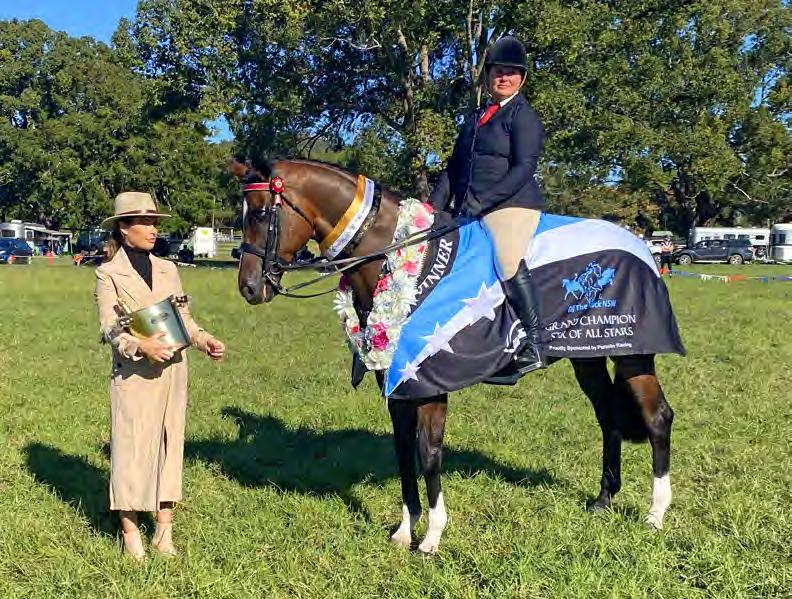
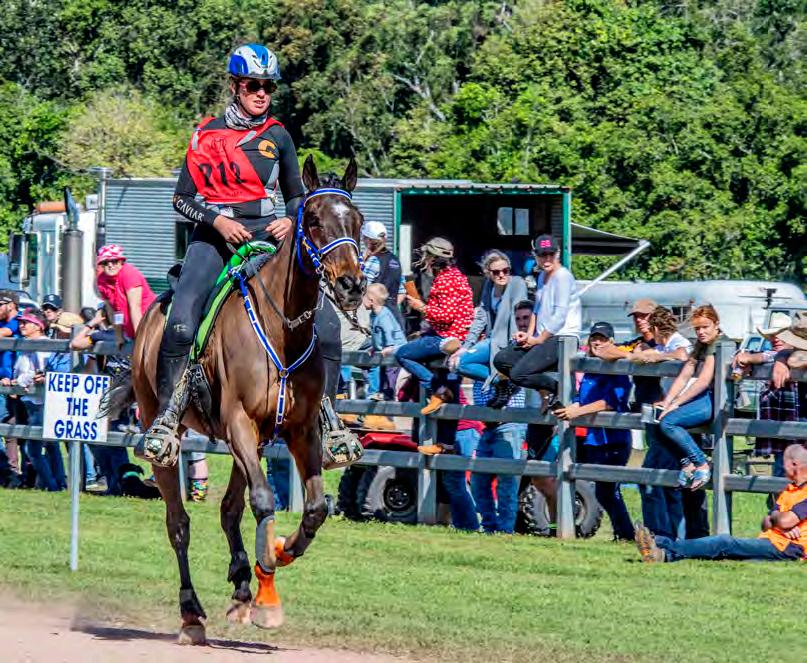
Thoroughbreds can be very versatile, one of the reasons that Samantha and Arrow were able to take out second place in the hack ring, followed by a second in show jumping at the OTT NSW Inc show. But away from the glamour of the show ring, Arrow’s home life includes mustering cattle, jumping logs, flat work and indulging in a few little quirks, one of which is shying enthusiastically at threats real and imagined. So to give him something else to think about, Samantha decided to teach him to jump. Not only did he love it, it turned out that he had a real talent. “Unfortunately he still can't be lead back to his paddock without seeing monsters. But so be it, no one's perfect!” she laughs. “He’s been a challenge at times, but I have never had intentions of selling him.”
Life on a busy property includes stock work, so from the very beginning Arrow had to learn to carry sheep, “much to his horror and mine as I'm trying to lift them up that high,” Samantha jokes. But he has some handy additional talents and can cut an escapee crossbred lamb from a mob better than the farm dogs or bike, so that’s become one of his jobs around the farm. That said, Samantha believes
in cross training all her horses so they rarely get ridden in the same place, or always do the same thing, which keeps it fresh and fun for everyone.
While these and many other re-homing success stories are heart-warming, Cheryl makes the point that re-training an OTT Thoroughbred can sometimes be more complex than starting a young horse. “Taking a Thoroughbred horse off the track and giving it a new life and purpose will take you on a journey
that’s extremely rewarding if you’re properly educated and prepared for the transition,” she explains.
In her considerable experience, starting slowly and giving the horse time to learn simple tasks and get accustomed to a variety of new situations, as well as having the patience to wait until they’re mentally and physically ready before progressing to the next level, can be a deciding factor in the horse’s future.
Trying to rush an OTT along can result in a horse that’s not properly prepared for its new life, and is instead confused and uncomfortable. “Worried horses that have been thrown in the deep end might result in them being labelled as a problem or unsuitable,” Cheryl says, “then the horse’s welfare and future can be at risk as the chance of them finding a new and secure forever home diminishes.”
But with care, patience and a pinch of love, you could very well discover your new heart horse.
You can catch up with Off The Track NSW Inc at www.offthetracknsw.org. au and if you dream of giving an OTT Thoroughbred a new life, contact Cheryl and her team for more information.