The Saddle Hub Sales Enquiries: info@equestrianhub.com.au
Cover photo: Picture by Nicole Emanuel Layout/Design: Ailebo Consulting: design@ailebo.com
Published by Equestrian Hub PO Box 13, Tintenbar NSW 2478 info@equestrianhub.com.au www.equestrianhub.com.au
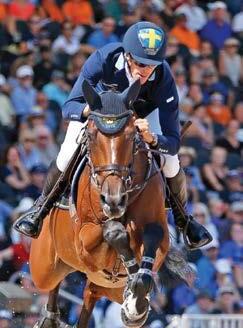
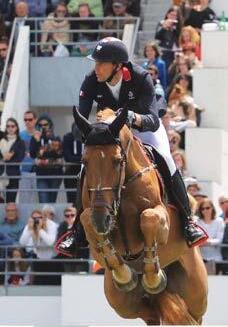
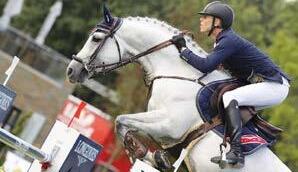
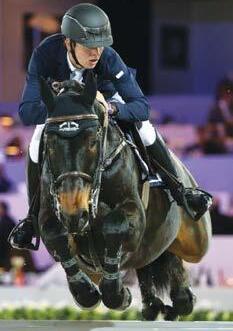
Pénélope Leprévost / Alexis Deroubaix / Maxime Livio / Henrik von Eckermann / Michael Jung / Cian O’Connor / Edward Levy / Ros alind Canter / Harrie Smolders / Martin Fuchs / Kevin Staut / Simone Blum / Marc Houtzager / Alexandra Francart / Ludger Beerbaum / Max Khuner / Beezie Madden / Kent Farrington / Olivier Robert / Olivier Philippaerts / Joseph Murphy / Simon Delestre / Denis Lynch / Félicie Bertrand / Bertram Allen ...
bones rather than on the pubic bone.
“If your horse is deemed lazy, check if you’re riding with the hand-break on. Rotate your pelvis to adjust your weight.”
bones rather than on the pubic bone. “If your horse is deemed lazy, check if you’re riding with the hand-break on. Rotate your pelvis to adjust your weight.”
MThe fifth rung is attention to what the upper thigh and groin are doing. The upper thigh shouldn’t be closed on the horse. Tanja recommends lifting each leg up and then rotating them out to loosen any grip and to increase the range of motion. “Think of John Wayne,” she says. “You can fit a horse in between his thighs when he walks.”
With Fiona Todd PUBLISHER’S
You might notice the absence of one of our popular regular columns this month.
From the Horse’s Mouth
and stability, enhancing or hindering the horse’s gait in transitions.”
FEATURE
ay is always one of my favourite months because we get to pay homage to a group of truly remarkable people - the horsey mums of the world.
The fifth rung is attention to what the upper thigh and groin are doing. The upper thigh shouldn’t be closed on the horse. Tanja recommends lifting each leg up and then rotating them out to loosen any grip and to increase the range of motion. “Think of John Wayne,” she says. “You can fit a horse in between his thighs when he walks.”
You know, those mums who get up at some stupid hour and drive their children and their beloved ponies to Woop Woop just for a lesson; the women who go without just so their offspring get to ride, have lessons and compete.
As a mum, I’ve done all that and more. I know that we all do it willingly and without question, because we love it and because we know that horsey kids are good kids! How could they not be?
Next is the importance of bent elbows and closed fists. “Soft hands come from bent elbows, not open hands,” she reminds riders. “If you squeeze your thumb and index finger when holding the reins you can’t have a clenched fist. When we learn to ride without (good) instruction, we develop habits that are not that useful to overall riding. We have to break it down into a new way of thinking.”
Next is the importance of bent elbows and closed fists. “Soft hands come from bent elbows, not open hands,” she reminds riders. “If you squeeze your thumb and index finger when holding the reins you can’t have a clenched fist. When we learn to ride without (good) instruction, we develop habits that are not that useful to overall riding. We have to break it down into a new way of thinking.”
She worries when people say things like I just want to keep my horse round in the trot, or I just want impulsion. ”These are not simple things,” she says. “First I look at the horse’s posture and ask can it physically stay in the posture. Then I look at whether the rider has the balance, meaning enough inner core strength
She worries when people say things like I just want to keep my horse round in the trot, or I just want impulsion. ”These are not simple things,” she says. “First I look at the horse’s posture and ask can it physically stay in the posture. Then I look at whether the rider has the balance, meaning enough inner core strength
This edition lands in your inbox while we are attending the fabulous Aquis Champions Tour, an event that has a mum – Michelle Lang-McMahon - at the helm. In honour of the event we’ve released our very first printed edition of HorseVibes, a tribute to Our Jumping Heroes. What a privilege it was to put this publication together! We hope you
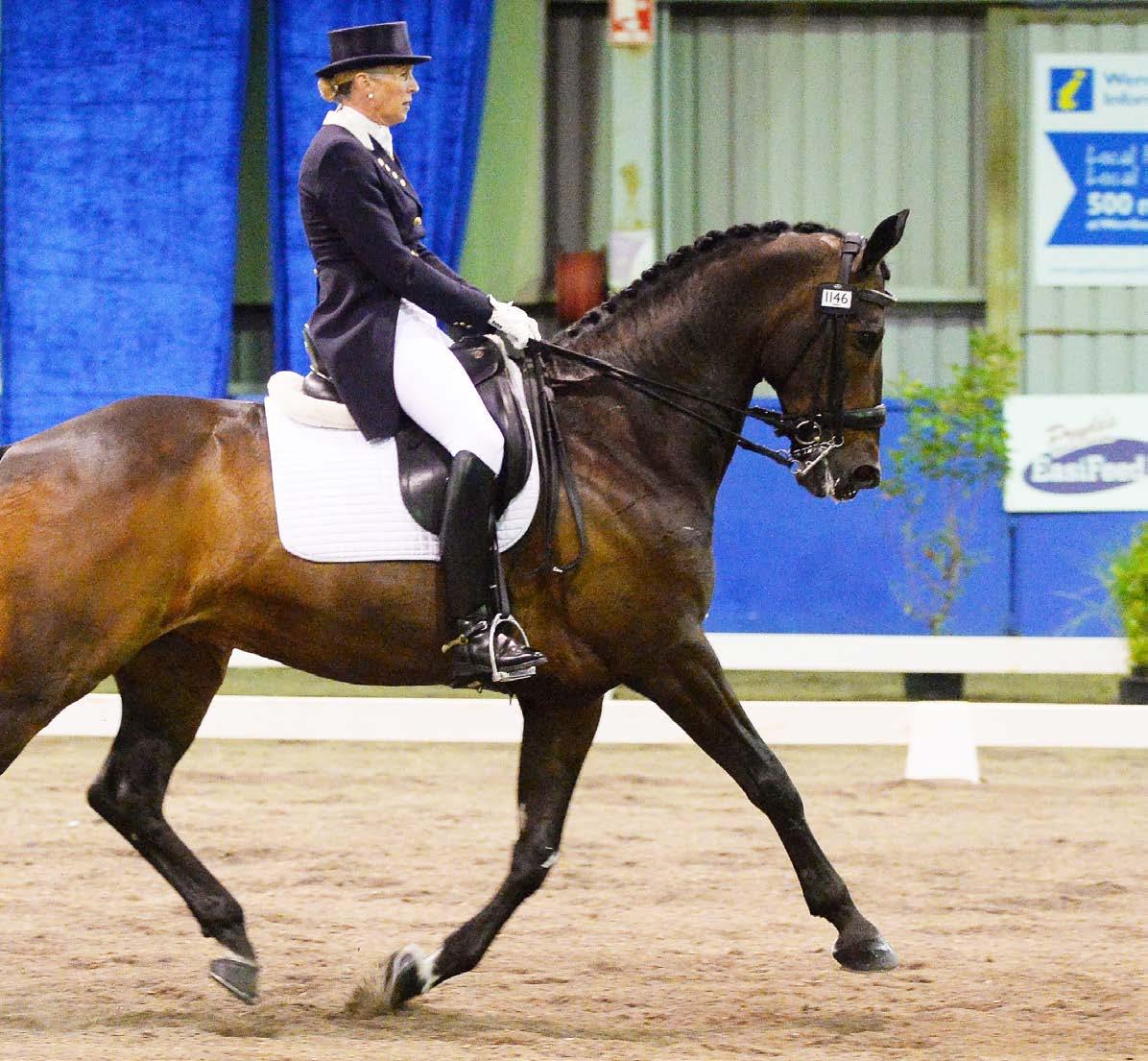
She explains that In order to ride a good soft upward transition, the horse has to engage the abdominal muscles in order to lift its back. “Then the hind legs have to come underneath the body to support the rider’s weight and step forward in balance with the neck soft and round, which we call going ‘on the bit’,” she explains. “The biggest part of my teaching is to break down such concepts as ‘on the bit’, ‘getting impulsion’ and ‘improving rhythm’. I break this down to educate riders first, so the horse is able to achieve all that.”
and stability, enhancing or hindering the horse’s gait in transitions.”
She explains that In order to ride a good soft upward transition, the horse has to engage the abdominal muscles in order to lift its back. “Then the hind legs have to come underneath the body to support the rider’s weight and step forward in balance with the neck soft and round, which we call going ‘on the bit’,” she explains. “The biggest part of my teaching is to break down such concepts as ‘on the bit’, ‘getting impulsion’ and ‘improving rhythm’. I break this down to educate riders first, so the horse is able to achieve all that.”
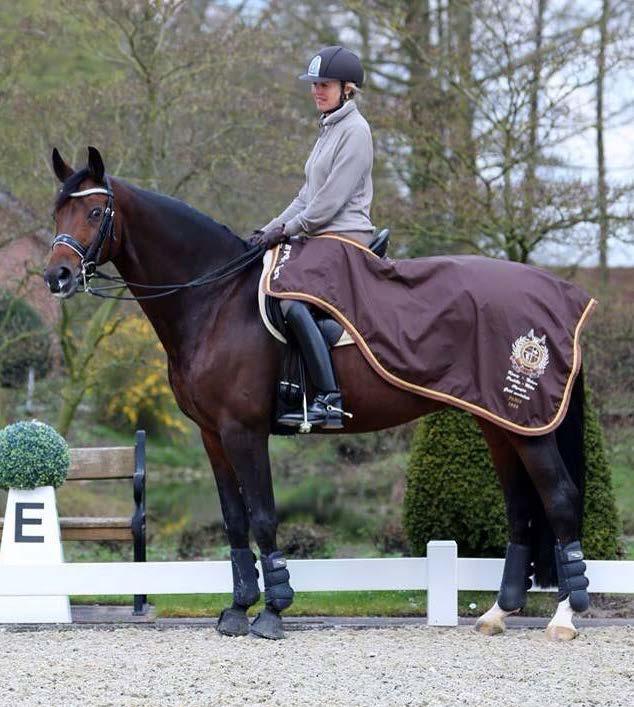
Tanja teaches riders at all levels, helping them to understand how they’ve been blocking their horse.
Tanja teaches riders at all levels, helping them to understand how they’ve been blocking their horse.
take the time to read the stories our editor Candy has gathered together during the past few years.
“The body buys into the story and controls breathing. Horses are sensitive to energy,” she says, going back to the breath. That long breath out.
“The body buys into the story and controls breathing. Horses are sensitive to energy,” she says, going back to the breath. That long breath out.
‘
‘
publisher Shona Martyn and one from Bryn Anderson, on her mother’s 30-year love affair with a beautiful Arabian she won in a raffle.
Tanja conducts some of her mindset work by phone, which she can do with people anywhere in the world. If you’d like to contact Tanja, book a clinic with her, buy her book ‘It Takes Two to Tango’ or her other on Mindset, or purchase her videos, check her website: www.tanjamitton.com
Tanja conducts some of her mindset work by phone, which she can do with people anywhere in the world. If you’d like to contact Tanja, book a clinic with her, buy her book ‘It Takes Two to Tango’ or her other on Mindset, or purchase her videos, check her website: www.tanjamitton.com
It’s a great reminder that all of the riders we feature started their journeys as beginners, not as the Grand Prix riders they are today. They were all in the back rings learning their trade. If this magazine encourages just one of you to say, “I can do that” and set a big goal for yourself, then we are on track to accomplish our ambition to be a publication that inspires you to be the best horse person you can be.
If your horse is deemed lazy, check if you’re riding with the hand-break on.
Plus of course, we have all our regular columns, put together byour staff writer Dannii Cunnane, featuring Caspian horses, endurance training tips and our young rider, Lindsey Ware.
As always, pour your favourite tipple, put up your feet and enjoy.
If your horse is deemed lazy, check if you’re riding with the hand-break on.
BRISTER’S BRIEF
Crystal ball judging is always hard
CHARLIE
BRISTER
was in
Toowoomba
recently judging the young horse eventing classes. Not an easy task.
Judging is a lot harder than it looks. And judging young horse eventing classes is even harder. Not only are you assessing horses perform on the day, you have to forecast their possible future competing at the top Australian and international events.
It’s a skill that’s partly derived from experience, research, technical knowledge and an ability to look into a crystal ball. For the past twenty years in Europe young horse eventing championships have identified world cup and Olympic talent, and the program is gathering momentum in Australia.
In mid-April Toowoomba held their Armstrong Ford one-day event and young event horse of the year competition. It was the second time I’ve judged the Young Event Horse division and this year there was perfect weather, great people and quality horses. The committee created a fantastic event and attracted terrific future talent.
Toowoomba run the class slightly differently to most other young horse competitions in Australia where there is usually set a basic dressage workout before a unique jumping phase. The jumping consists of a mix of showjumping and cross-country jumps in the showjumping arena.
In Toowoomba the young horses enter the regular competitions for 95, 1* or 2* classes and elect to be evaluated as part of the young horse division. Following the dressage and showjumping, the judge conducts a conformation and trot up assessment of each young horse. Then as the main competition commences there is a careful review of each young horse as they compete across the normal three phases of eventing: dressage, cross country and showjumping.
What really sets this competition apart is an additional ridden assessment. A shortlist of seven young horses is selected from competitors in the normal competition phases. Then the judge actually spends five to ten minutes riding each horse and seeing how they feel in the saddle over a couple of jumps.
This ensures that little visual mistakes do not detract from the overall impression and result for a horse. It also makes the judge a lot more stressed and it gives the crowd a chance to judge the riding of the judge! (No pressure there.)
One thing that was very clear is that faults or issues showing in the dressage phase quite often carried through to the other disciplines. Surprise, surprise, good dressage helps your jumping, and definitely improves the rideability of the young horse.
A good mix of breeds was represented from Off The track Thoroughbreds to purpose bred Holsteiners to paints and Connemaras. Look at
any 5* event and you will see various bloodlines represented. As a judge you definitely can’t just pick the winner on paper. It’s what’s on the inside that’s most important and how that translates to skill and attitude at a competition. At some venues it would be hard to watch the cross-country without a video feed of several fences. Luckily, Toowoomba has a great layout with the cross country running across the side of the hill at the back of the showgrounds. This allows the judge to see a large proportion of the course and watch how the horses galloped early on in the cross country and then also at the end of the course.
The ridden assessment has to be one of the toughest things for any judge. Hopping onto seven horses you’ve never ridden before in the main arena in front of a crowd in the space of about 90 minutes is not conducive to relaxation.
Not only do you have to test the horse’s ability, you want to make sure that you don’t push too hard and give the horse a bad experience. Maybe picking three mares for the final in Toowoomba this year was not the best decision, since my choices required a high level of equitation diplomacy! In saying that I found that one of the mares was the best-educated, easiest to ride and had a superb scopey jump.
A four-year-old would not usually be the
overall winner if it was picked on paper before the class. Luckily, for Mercadies Mitchell her four-year-old thoroughbred was exceptional. Calypso Charm (a bay Thoroughbred Gelding by Storm of Indya out of a Rhythm mare) has good movement, is very calm and trainable. He also has that lovely thoroughbred gallop, although too uphill to have been successful on the racetrack.
Matt Gaske was a very close second on Bellhaven Cumbria (a six-year-old bay Holsteiner mare by Bellhaven Coraldo out of a Cassini II mare). He had this mare very well trained and she will be one to watch. Jo Williams is on the committee and also managed to sneak into 3rd on Jurara Keanu (a six-yearold brown Warmblood gelding by Gymnastik Star out of the mare Pride of Kellina).
It would be excellent to see more states adopting this model of young horse competition. Assessing not only the basic gaits but how they handle the full competition environment is closer to the model seen in Le Lion which has seen the likes of La Biosthetique Sam and Fischer Rocana transition from Young horse Champion to Olympic and World Champion.
In the meantime, my advice is to make sure you can ride as many different types of horses as possible in case you get asked to Judge at Toowoomba!
You have to forecast their
Charlie Brister taking notes at Toowoomba.
Mary Hanna –Pursuing her Passion
The indefatigable Australian dressage legend has already competed at five Olympic Games. With a move to new stables, a new trainer and new horses, she has Tokyo in her sights, writes UTE RAABE.
Mary Hanna has just finished schooling her three horses for the day. It’s lunchtime in Germany, and a good time to chat at the end of a hectic week, with not just a move into new stables but also preparation for one of her horse’s competition comeback the following weekend, but Mary is happy. Her horses have settled in nicely and she and husband Rob already feel at home at Eulenhof, the base for Sweden’s top dressage rider, Patrick Kittel. “When people ask me where I live, I have to say that I actually live in Germany now. I don’t think my family quite get that,” Mary confesses.
Between them Mary and Rob have been guiding lights in the Australian dressage scene for many years. Rob has competed successfully as an eventing rider and was the Chef d’Equipe of the Australian Eventing team for the 2008 and 2012 Olympic Games. He was also the Chef
d’Equipe for Dressage from 2000 to 2005 before taking up the same role for the Eventing team. Mary has been the Australian National Grand Prix Champion on six occasions and works full time as an Equestrian coach and trainer. She gives much of her time to the sport as an NCAS Level III Dressage instructor and an ‘A’ level Judge. Together, they share a passion for horses and a vision to see Australian riders compete successfully nationally and internationally.
Mary Hanna, née Sutherland, was born in 1954, in Melbourne, growing up in the Western District of Victoria. She attended McArthur State School in Victoria before going to high school at Presbyterian Ladies College and she has a Bachelor of Arts degree from the University of Melbourne.
For Mary horses were part of her dayto-day life - her mother was keen on jumping and hunting and also trained racehorses. Not many people know that Mary came to dressage via a successful
career as an event rider. She competed up to Advanced level and was even shortlisted for the World Championships in Kentucky with a horse called Suave, but it wasn’t until her mid-twenties that Mary started to get serious about dressage. Fortunately for dressage fans, In the end it became too hard to continue both disciplines at the top level and dressage won out.
Does she miss her days of jumping? She
smiles, “Occasionally I set up a small jump, like a pole or a cross rail, and have a little pop over it. But my eventing days are well and truly over. At the time I was obsessed with eventing, as much as I am now obsessed with dressage. And if you want to be good at anything, you have to be like that — totally absorbed and passionate.”
That passion, followed with absolute dedication, last year saw her receive one of the Federationan Equestre
Internationale’s (FEI) most prestigious accolades, the Gold Badge of Honour, which recognises athletes who have been among the 15 best finishers in the Grand Prix in at least 14 CDIO competitions. She has also represented Australia at the World Equestrian Games on five occasions - 1994, 1998, 2002, 2014 and 2018 to be precise.
And then there’s the Olympics. Late last year Australia’s most decorated dressage rider made headlines when
she sold Boogie Woogie, her mount from the 2016 Rio Games and 2018 FEI World Equestrian Games, and also her 2017 World Young Horse Championship finalist, Gerion. But they were changes Mary felt were necessary in order to focus on qualifying for what could be her sixth Olympic Games in 2020. When she competed at Rio she made history, reaching the five Games milestone as the third Australian woman in Olympic history. She also became Australia’s Mary Hanna and Umbro.
oldest Olympic equestrian, eclipsing the record set by the late Bill Roycroft. Her highest individual dressage result came in Atlanta in 1996, when she finished 24th, riding Mosaic. She partnered Limbo in the 2000 Sydney and 2004 Athens Games. In London 2012, Mary and Sancette finished 9th in the team event and 44th in the individual event. When we talk about her achievements Mary admits she still has to occasionally pinch herself, crediting the sport for the opportunities it offers. “Dressage is an amazing sport, because it allows men and women to compete equally well,” she says. “It is also a sport that you can do from a very young age to a very old age. And it is wonderful to develop a partnership with a horse, with so much is depending on that partnership. It really is a sport that is worth pursuing.”
At Patrick Kittel’s stables Mary has found that she’s working harder than ever. Sweden’s top dressage rider is a firm taskmaster. “I find dressage very mentally stimulating and I love the challenge of it, both mentally and physically,” she says. “Riding three horses at Grand Prix level every day, to the standard Patrik asks for, is incredibly testing. You have to push yourself really hard. I’ve had the privilege to training with some extremely good people and I’ve learned great things from all of them. However, I guess the thing that stands out with Patrik is his positive
attitude, he really makes you believe in yourself and that you can do it.“
Mary also consults Patrik before purchasing a new horse, “We have to work together as a team, the trainer, the rider and the horse, and we all have to be happy about it. Patrik knows me well, he knows my riding and what kind of horse suits me.”
We have to work together as a team, the trainer, the rider and the horse, and we all have to be happy about it.
Which brings her to her new horsesFerrero, a nine-year-old KWPN gelding by Tuschinski with Jazz as his dam sire, and her most recent acquisition, the 13year old Westfalian mare, Syriana by Sir Donnerhall I.
When Mary found Ferrero she’d been looking for a new horse for quite some time, traveling through Holland and Germany and even to Switzerland. Finally it was through fellow Australian Bennet Conn that Mary discovered an inexperienced, but very talented gelding. “Ferrero had only had a couple of starts at Prix St Georges level before I purchased him, but he has so much potential for everything,” she says. “He’s been brought up through the levels by an amateur rider, who did a lovely job with him.”
As for Syriana, Mary admits that it was not love at first sight! Swedish rider Malin Wahlkamp Nilsson had campaigned the mare, who is particularly strong in the piaffe and passage tour, in five national events at Inter II and Grand Prix level and also at the CDI Flyinge in September 2018, where they finished third in the Grand Prix Kür.
“I tried her out some time ago and was not that impressed,” she says. “When she has a new rider on for the first time she can stiffen her back, making it difficult to sit. Apparently this is something she always does, she can be a little wary of new riders. Then I watched her again and talked to her regular rider Malin, who recommended I have another try. So I did and by the end of the second
A: Mary with Sancette
B: “The standard of riding here (at Patrik’s stable) is amazing.”
C: Mary at the Calanta CDI on Zeeland, a great start to her 2020 Tokyo campaign.
D: Zeeland and Mary warming up.
ride I was pretty sure I was going to take her. As soon as I found the way with her, she was really lovely to sit on. The more I am getting to know her, the easier she becomes. I am really enjoying her now. She reminds me of Sancette, a horse that you could really rely on at a competition. I always looked forward to competing him because I knew that once I got into the arena he would really try his heart out. You want a horse that will fight for you.”
Among the many beloved horses that shaped her career, Sancette holds a special place in her heart. The Hanoverian by Sandro Hit was imported by Mary in 2010 and purchased from US rider Steffen Peters. Mary also trained with Steffen for seven months before bringing the horse back to Australia.
Sancette competed successfully both nationally and internationally, representing Australia at the 2012 London Olympics, the 2014 WEG in Caen and the 2014 FEI World Cup Final in Lyon. It’s a tribute to the high esteem the family holds him in that Sancette is now being ridden by Mary’s daughter, Gitte Donvig.
A turnaround in her horse team is that now she has two mares on her team, whereas in the past her top horses have been mostly geldings, including Mosaic, Limbo, Tango, Umbro, Port Said, Rambo, Sancette and Boogie Woogie. Was it a conscious decision, I wonder, or did it just fall that way?
“I’m leaning more and more towards mares. Given a choice I’d always have a good mare now,” she says. “They will
fight for you until the end, they have that fire to keep going. Mares are a bit more sensitive, but they can also be quite brave. You can’t kick and squeeze them, you have to get them on your side first. But then they have that little bit of extra oomph!”
Throughout her long career Mary has enjoyed the support and knowledge of many experienced riders and trainers, among them her first husband Gert Donvig, the legendary Franz Mairinger and the famous Siegfried ‘Bimbo’ Peilicke, but also along the road Clemens Dierks, Kyra Kyrklund, Anky van Grunsven, the Bartels family and Ulla Salzgeber. “I’ve been lucky to have worked with so many great riders and trainers,” she says.
Life away from Australia can be a bit of a balancing act. Paying enough attention
to family, friends, students, horses and other animals has its challenges, but Mary and Rob are doing their best to make it work, and thanks to the perks of modern technology Mary can now also continue coaching her students from afar. A Pixio camera setup and a
E: Rob Hanna and Mary: “We already feel at home in Germany.”
fast internet connection make lessons possible whenever time allows.’
“I really enjoy teaching and it is one of the things I was missing the most,” she says. “But this video system is so good, it’s almost like I am there in the arena.
It’s going to make a big difference to staying connected with everyone and being able to help everybody.” Her students naturally benefit from the high standard of dressage Mary is experiencing in Europe.
“The standard of riding here is amazing,” she says. “I think that’s what keeps me going, just watching all these other very good riders is inspirational. We just don’t see any bad riding here. The standard of dressage just keeps improving so rapidly, you can’t close your eyes for a moment or you miss out.”
Mary also mixes up her horses’ training program to keep them motivated and happy. Sunday is a regular day off and the horses also enjoy at least one more easy day during the week, perhaps a stretching session or a light canter around the sand track. Serious work is only scheduled for four days of the week. Mary keeps herself fit as well with regular visits to the pool. She and Rob also like to play golf, which she finds a great way to switch off and put her mind on something els.
Dressage can be a tough sport, no one knows this better than an athlete that has been in the game for so long. But she is happy to share a piece of advice with young aspiring riders back home.
“There’s no doubt that if you are going to be a dressage rider, you’re going to have ups and downs and times where you are wondering why you are even doing it,” she says. “But I think the message should be that you should always persevere, if it is what you want to do. Believe in yourself and follow your dreams. Dressage is a lifetime passion, and to have a passion about a sport like that, is something very lucky.”
There is no doubt that Mary’s passion will continue for a long time. There is already a future prospect waiting in the
F:
The beautiful Sancette and Mary relaxing together after a workout.
Believe in yourself and follow your dreams. Dressage is a lifetime passion…
wings for her back at home at Statene Park, on the Bellarine Peninsular, a twoyear-old gelding out of her Grand Prix mare Calanta by the dressage super sire De Niro. He is a lovely type with three nice paces and Mary is looking forward to getting him going next year.
On a side note: Mary and Calanta’s
comeback at the CDI Zeeland Outdoor International was very successful. In her first start after a year-long break Calanta was rewarded with some great scores, including a 72% from a well respected 5* judge in the Grand Prix that saw her qualify for the Special, where she placed 4th — a great start to the Tokyo 2020 campaign.
A: Evangeline Read and her mum, Shona Martyn, at the National Showjumping Championships at Werribee in 2017.
B: Evangeline on Foxground McLain at the NSW Showjumping Championships in Canberra.
Picture: Oz Shotz.
Mother’s Day, Every Day
Shona Martyn is a publisher and editor, and not a horse person, her daughter Evangeline is a musician, and a horse person. When Evangeline showed a passion for horses, Shona swapped her heels for gumboots, and embraced a whole new lifestyle. EVANGELINE READ tells their story.
One of my earliest memories is standing in front of my Mum on a Saturday morning begging her to let me ride. We were living in an apartment in Elizabeth Bay, in the inner eastern suburbs of Sydney, and there was nowhere to keep a horse. My persuasive argument about turning the building’s communal laundry into a stable failed dismally. But I had imaginary horses; I was convinced that my first two-wheeler bike was a speedy pony. I would ride around our local harbourside park doing twenty-metre circles and go for ‘gallops’ when I felt that we were warmed up.
Ours was not a horsey family. Shona, my mum, had grown up in suburban New Zealand and lessons were a luxury that her Dad, a teacher, couldn’t afford. But when she was a cadet journalist she’d done a year of riding lessons.
Mum recalls jealously watching Sheryl, the girl across the road, (whose Dad was a builder) heading off to Pony Club on Saturday mornings with her saddle over her arm. On the other hand my Dad, Christopher, has always felt guilty at the idea of being on top of a horse. He would never have the heart to pull up a horse’s head if it was eating grass
because he harboured the firm belief that: “the horse must be hungry”. But I’m not easily dissuaded and so, for a time, pony parties were my parents’ means of satisfying my pony dreams. I rode in a horse and carriage on my fifth birthday, and for my seventh and eighth
had Saddle Club-themed sleepovers followed by a trail ride in the morning, with all of us cheerfully singing the Saddle Club songs. I had all four albums, but no pony. Every Christmas list was headed with the words, ‘a horse of my own’. I wanted to be the girl in the car towing a horse float.
For my ninth birthday, my parents relented slightly with a term’s worth of riding lessons at Malabar Riding School, on a headland shared with sporting shooters (although riding and shooting were fortunately at different times) near Sydney’s airport. I loved the riding school because, as the owner Frank Leek would say, “the horses could be horses” as they grazed on 400 acres each night. I learnt to ride every type of horse imaginable - from grumpy Shetlands to prizewinning horses Off The Track. Despite suffering horse hayfever, that term’s worth of riding didn’t end until I was 19 and had a waitressing job to pay for my own lessons. Over that decade,
every weekend my parents would drive me to the horses and watch me ride; they took me to watch high-level competitions such as three-day events out at SIEC. They understood this was something I was deeply passionate about and within their means (they were also paying for private school fees!) they helped me to pursue my riding.
In December 2008, my Mum was at a Christmas party where she started talking to her only Sydney horsey friend, Michele Neil. Mum was in a quandary. She couldn’t afford to buy me a horse but she knew I had far outgrown the riding school horses. The ever-practical Michele had a solution. Her friend, Simon Kale, a show jumping coach at Foxground on the NSW south coast was running a kids camp in a few weeks. She put in a word and my life changed. I remember that first kids camp so well, because unbeknownst to anyone –myself and my parents included - and despite childhood vaccination, I had whooping cough. But I tried my best to keep up with everyone else; my enthusiasm and experience in riding difficult horses outweighing any lack of technique (and the coughing fits).
The first time we drove the two hours plus to Foxground, Mum said firmly it was too far to drive every week. But after Michele lent me her speedy pony Holly and after numerous holiday camps, the distance seemed to lessen and within two years Mum and I were going down every Saturday after school sport.
The HSC rolled round and our six-hour round trips turned into study sessions
with Mum quizzing me on my English texts and maths formulas en route. We would sit together at horse shows editing my assignments between jumping rounds up and down the South Coast and as far away as Tamworth. I even rode the day before my first HSC exam. Riding was a distraction that kept
Mum bought me my first horse for my 18th birthday - a beautiful warmblood called Kenovia.
C: Shona in the paddock clearing fireweed with a muddy Zulu.
D: Shona and Evangeline with Kenovia, Evangeline’s beautiful 18th birthday present who tragically died at Foxground.
me calm.
Finally Mum bought me my first horse for my 18th birthday - a beautiful warmblood called Kenovia. She was the first horse I ever started under saddle, and I couldn’t have done it without my coach Simon. Mum supported me when I decided to work for Simon during my gap year and I had only been there a week when Kenovia died in a terrible paddock accident. Mum remembers when Simon called to tell her what had happened; she cried almost as much as me and took time off work to come and stay with me at the farm. There’s something so tragic about losing a horse in whom you have invested so many
dreams. I spent the next year riding horses for other people until we found my current horse – Foxground McLain.
Over the last five years, Mum has come to every competition from the Nationals in Victoria to Elysian in Queensland. We even caught up in Rome to watch the Global Champions. She’s picked fireweed in the pouring rain so I could fit in riding five or six ‘work’ horses. She’s learnt how to start generators, hold horses and these days she can provide a commentary on a show jumping round using all the appropriate lingo. Having previously worked at Vogue my Mum is my equestrian fashionista advisor; she swears by Sard Wonder Stick for stained white jodphurs. She’s bonded with the horsey mothers and adult riders, documenting our riding adventures on social media. I often bump into strangers who know all about my riding from Mum’s Facebook.
Recently Mum and Dad helped me out with feeding McLain when I moved him briefly into Centennial Park so I could keep riding while working two jobs. Even my Grandma in New Zealand, who knows nothing about horses, has got involved – once driving to the Waikato to buy me a secondhand saddle in a paddock.
So now we have a float and I also have a young horse, Kaspian, the full brother to Kenovia, and I am proud that I was able to buy him myself. I will start his education under saddle soon. Today I am the girl in the car towing the float and McLain has moved north to my current coach James Mooney which is also closer to home.
Mum has come to every competition from the Nationals in Victoria to Elysian in Queensland. We even caught up in Rome to watch the Global Champions.
What I know is that my Mum will continue to support me in my dream just as she always has, and I am extremely grateful to her.
FEATURE
The Fine Art of Horse Photography
Capturing the indefinable beauty of horses is not easy. The elite photographers featured in this story talk to Jane Camens about combining their passion for horses with their passion for a great image.
Nicole Emanuel: ‘A master of mood and light.’
On the face of it, equine photography seems like an enchanted career with those at the top of their game in demand at high-level national and international events. But the truth is that making a living out of immortalising equine grace is a hard slog.
Speaking to Ken Anderson, Nicole Emanuel, Julie Wilson, Stephen Mowbray and Lisa Gordon, it soon became obvious that ‘success’ means more than taking photos with that wow factor. It also means being financially viable. Making a career in this game involves a lot more than a good eye and great equipment - particularly in this age of smartphones and social media.
Not only do you have to do the hard yards to gain experience and contacts, you have to be canny about networking and marketing, or have a partner or associate who can do this for you. For those who travel to the big events, which often happen back-to-back, there are also major logistical issues to consider.
Making a living out of a passion for horses is never easy, but all our featured photographers have found a way to combine their passions into a unique package.
Ken Anderson
“You can destroy a horse’s future by putting up a photo of it that’s no good,” says Ken Anderson. At the same time, with a great photo you can make a horse’s career, and Ken has done that over and over again.
Based in Tamworth Ken has now been a professional equine photographer for 15 years and is particularly known for his outstanding Cutting and Reining photos. He has just been made the official photographer for the National Cutting Horse Association.
Among the many great horses he has
photographed are Just Shameless, the famous paint stallion, and the great Quarter Horse Tap Dancin Cat. “With good cutting horses, you just drop the reins and hang on. The horse does the rest,” he says. “They get down on their belly with a look of possession in their eyes. I sort of earned a reputation for ‘those’ shots.”
Ken is a horseman himself and was out mustering the day I was trying to make a
B: Hard Hat Henry at the beach with Dave Kennedy.
C: Halters as art.
time to talk. He is also a chef and proud of the meals he cooks up for celebrity diners. “But I don’t get the buzz (from cooking) I get from doing the photos,” he says. “They’re for me. It’s a very personal thing. They’re my legacy.”
He started taking photos of stallions bred by his partner Julie who, following a massive accident with one of her horses, now works as his editor. “Julie is the one with the eye,” he says. “She’s
the best judge of horses in the country. She told me where I was going wrong. ‘See that horse there,’ she’d say. ‘He’s got a giant neck. You should have taken a step back towards the hip.’ When you’re only showing a couple of photographs, you’ve got to show the best part of the horse.”
Ken is particularly aware of this when taking photos for internet sales. “Some people never see the horse in the flesh,”
A: Martin Larcombe – one of Ken’s first reining shots.
he says. Although Ken is nationally acclaimed, he considers he’s “still evolving”. He has just upgraded his camera so he can capture the world of horses at another level again. “There’s just something about them,” he says.
Nicole Emanuel
Nicole Emanuel is known as ‘a master of mood and light’. An artist in several mediums, her photos deserve the fine art canvases she now prints on.
Nicole was horse mad as a child, first picking up her mum’s camera at the age of seven to photograph a mare and foal. She won her first award at the age of 12, which was just the beginning of a lifetime of high achievement in photography. She’s now proud to be the international ambassador for Fuijfilm XT-3.
She can still remember how she felt when she first entered a dark room. “I could get lost in there for hours without food or drink, I was so obsessed with developing the images,” she says. “For me I was in my element taking horse photographs.”
Immediately after studying photography at Charles Sturt University, she was picked up by a rural newspaper as a full-time press photographer. From 1991, she spent 15 years working for News Limited and Fairfax newspapers. She was a top horseracing photographer, then a feature photographer, before starting to have her work published internationally.
“Because it’s now the digital age, every second person with a camera can call themselves a professional photographer,” Nicole says, speaking from her home in Gippsland. “They sit there and do post-processing and that’s how they give their pictures the wow factor. We didn’t have PhotoShop. We had to do it in the darkroom.”
She despairs that amateurs don’t know the value of great photography and are undercutting the pricing structure for
D
I could get lost in there for hours without food or drink, I was so obsessed with developing the images.
professional photographers. You only have to go to YouTube and watch one of the films Fuji has made of Nicole’s work to see the difference a professional photographer makes, using high resolution images, understanding the importance of lighting in the moment, and using lenses that don’t
distort. Nicole finds inspiration in the work of the world’s leading equine photographers Robert Vavra (Unicorns I Have Known, et al) and Gabriele Boiselle.
For Nicole, things upper most in her mind when she shoots film is “expression in the eyes, and being aware of the light. Light is everything.”
Nicole spent many years on the road covering the big equestrian events and perfecting her craft including photographing brumby runs in the Victorian High Country. Some of these stunning photos featured in Australian Geographic. Others appear in her bestselling book High on Horses, which was launched at Equitana in 2003.
Now 47-years-old and a single mum with two children (an artistic son and a horse mad daughter) — and 10 horses, Nicole retains a number of impressive corporate clients, among them some of the country’s most successful horse studs. She has recently opened a gallery, Studio 87 – on the Princes Highwaywhere she showcases her work. “I’m seeing this as a new phase in my career and plans to have a new book out in 2020,” she says. She’s thinking of crowd-funding it and inviting other photographers to contribute.
Misty morning, (D, P23), and water shot (E) photographs by Nicole Emanuel.
F: Australian carriage driver Boyd Exell at WEG 2014. Picture Julie Wilson.
Julie Wilson
With her award-winning journalist partner Anna Sharpley, Julie Wilson is at the forefront of Australian equestrian photojournalism. Julie has been photographing horses for 25 years and is among the fortunate few who have an ongoing contract to provide photographs to major horse magazine clients and her work published nationally and internationally.
Julie grew up in Upper Beaconsfield, outside Melbourne, where, she says, “all the kids had ponies”. When she was eleven years old her parents bought her a Shetland pony cross. “We used to ride everywhere,” she recalls. “We’d go to the shops and tie up the horses outside.”
She started taking photographs in sixth form at school where photography was part of an arts course. Her first job, with a real estate agency, saw her shooting weddings. After a detour into nursing, she decided that photography was where her future lay, establishing her business, Julie Wilson Equestrian Photography, in 1994. Since then, her work has featured in every major Australian horse magazine, as well as prestigious international publications, such as Horse International.
These days Julie is an NCAS Level 1 equestrian coach and has competed successfully in all disciplines. Her love and knowledge of horses has given her the sense of what to look for to capture a horse looking its best.
Julie tries to keep the logistical side of the business simple. Home base is Warburton, Victoria, but when she and Anna are on the circuit they live in a motor home. “At the start of the year we map out our events at the start and try to group all the ones together,” she says. The couple were about to head to Sydney to spend two weeks shooting at the Royal Easter Show before moving on around the circuit.
“We don’t shoot thousands and
G: Germany’s Daniel Deusser and Cornet D’Amour at WEG, 2014.
H: Valegro at his retirement performance, Olympia Horse Show, London 2016.
G
H
I: Leanne Caban and Gattlin in a roping competition.
J: ‘Riding Off’ – no quarter taken in a polo game. Pictures: Stephen Mowbray
thousands of photos,” she says. “We know who everyone is. We catalogue every horse we photograph and a big part of our business is people buying old photos.”
Every couple of years Julie and Anna travel to work overseas. They’ve worked at the Atlanta, Sydney, Hong Kong and London Olympic Games as well as the Equestrian World Championships in Rome, Spain, Germany, the USA and France - Julie already has her press accreditation for the Tokyo Olympics next year.
Among the highlights of her career to date has been shooting the retirement of the great dressage champion Valegro at the 2016 London Olympics, and being at the first big show jumping competition in Malaysia - the inaugural Kuala Lumpur Grand Prix – when fiftyone horses were flown in from Europe for the occasion.
“It was an amazing show,” she says. ‘They’d never had a big horse event like that before. They brought in thousands of school kids, which gave the event an incredible atmosphere of excitement. It demonstrated how someone who doesn’t know anything about horses can appreciate seeing horses live. For me, the best part of this job is seeing the best horses from around the world, seeing how amazing they are. They know their job, and they enjoy it.”
Stephen Mowbray
Stephen Mowbray’s photos are instantly recognisable. People say ‘My God look at this! Stephen must have done that’.
The New Zealand-born 57-year-young photographer spends 42 weeks a year travelling in Australia and New Zealand. He was a late starter in building a career as a professional photographer, but in just seven years there wouldn’t be too many horse disciplines he hasn’t covered. Nowadays he works only on commission, never on the off-chance that people might want to buy his work.
He attributes the way he shoots to his background. Brought up in part by a foster family who had property in New Zealand’s South Island, slide nights were a big thing on the farm. ‘The colour palette of my life is Kodachrome 64 slide nights,” he says. “Wonderful colour. Today with digital I can enhance the colour. “
Horse riding was also required on the farm, but Stephen admits he’s no great rider. “My family will tell you I can’t ride a rocking horse,” he says, “but I guess I learned something about horses along the way.”
After school he bought an Olympus camera and a handbook on photography. ‘It taught me all I needed to know in theory,’ he said. He learnt to use it travelling around the South Island shooting transparencies and building his own darkroom in his bathroom to do black and white developing, printing and enlarging.
K: Jeremy Janjic and Django of Cacheral.
L: Brooke Campbell and Copabella Visage. Pictures: Stephen Mowbray.
My family will tell you I can’t ride a rocking horse,” he says, “but I guess I learned something about horses along the way.
A natural progression saw him start to shoot weddings and also to build a solid career in retail, which eventually led to positions in the Sales, Promotions and Marketing department of Coca-Cola, NZ. He moved to Australia in 1988 and was employed by Coca-Cola Bottlers in Melbourne. “I went through their Operations courses and learnt so much about how to run a business,” he says, “it was invaluable.” He took that business know-how to run his own shop, a delicatessen that he built up and ran for over 16 years. But in 2012, his wife
Vicki inherited some money and told her husband to: “Buy that lens”. It was a $12,000 Cannon 400mm F2.8, which he bolted onto the front of his Canon ID-x. Stephen was then 49 and finally ready to become a sports photographer.
Somewhat naively he headed into the 2012 Sydney Royal Easter Show and started shooting in the arena without a photography pass. A polite tap on the shoulder by the CEO of R.M. Williams directed him to the Show’s media manager. That fortuitous moment led to an invitation to publish in the R. M.
Williams Outback magazine. “I can write as well, thanks to my time in advertising,” he says, which is handy for the ‘packagedeal’.
At his first reining event a leading trainer told him: “What you’re looking for is a horse in the shape of a prawn with tail tucked under, head and neck balanced and level and front legs continuing through.”
Reining soon became the discipline in which his photos are perhaps most sought after, although polo is another sport for which he has a strong passion, and show jumping, and…”I’m incredibly proud that people want a Stephen Mowbray on their wall,” he says.
Stephen knows he could do this for the rest of my life. “It ticks all the boxes,” he says. Even so, he’s thinking of building a secondary business to pass on his skills. “I’m trying to get together a teaching platform with a friend in New Zealand. We’re looking at putting a program together either here or there, hopefully next year.”
Lisa Gordon
M: Todd Graham and No Moore One Moore.
N: Dream sequence from Equitana New Zealand.
Pictures: Stephen Mowbray.
Lisa Gordon and her partner Peter Boyle have been on the road for the past two years travelling from one horse event to the next in a big mobile photo truck. They’re now looking to move their home and business on to a semi trailer.
“No one else does it quite like us,” Lisa says. “People are very in the moment. They want photos instantly. I can get pictures to clients within the first hour in the arena. We have three large Mac computers and load all the photos to a website.”
They need to be competitive because their equine photography business, Little More Grace (LMG), has to support the two of them. Both Lisa and Peter know horses. Lisa grew up riding and showing, and had her own equine business, ePro, before she met Peter, who had managed some of Australia’s largest thoroughbred studs.
Peter gave Lisa her first big lens and helped her reframe her life after her equine e-business went south on her. “Photography helped me heal from that bad experience,” she says. “Because I rode and showed myself and understand what people go through, I get the shots. We both understand what a good horse should look like. It’s a tough industry to be in, standing on an arena for 12-15 hours. I see why people don’t last. It wasn’t easy for us. For the
first 12 months, I was the new kid. You’ve got to prove yourself to people in the industry.”
She credits Stephen Mowbray for giving her the courage to keep going. “I was standing beside him in an arena and he gave me some great advice. I’m selftaught, I keep teaching myself and I feel I’m getting better. For instance, I’ve learned to carry a squeaky pig with me in order to get the horses ears to move forward,” she says.
O: Lisa Gordon captures a quiet moment on a trial ride, and below (P, Q & R), the beauty of horses in competition. Lisa Gordon
The couple are booked solid until midwinter. “We’re heading north for the winter and, from there, we’re travelling down to Adelaide,” she says. “We’re thinking of making it across to Perth this year with the whole premise being to work and see a bit of Australia.” Lisa and Peter also do commercial photography and have a sideline specialty of framing garlands and ribbons in display trophy cabinets. “We started that in between events and it’s taken off,” she says.
‘ ‘ You look like someone I used to know
Bryn Anderson’s mother, Michelle, with Jabwah, her Easter present.
FEATURE
A Mother, a Daughter and a Horse – of course
When Bryn Anderson’s mother won a horse in a raffle, she had all sorts of explaining to do, writes Bryn, before a lifelong love story could unfold.
This is a tale (or should that be tail) of how my family’s life got flipped-turned upside down because of winning an Egyptian Arabian horse, a veritable Prince of the Air.
Thirty years ago, even though she had never had an Arabian horse, nor knew anyone at the time that owned an Arabian horse, for some bizarre reason my mother got invited to an Arabian Horse Gala and Showcase.
As part of the evening they had a raffle to win a weanling Arabian horse by the stunning Egyptian stallion El Halimaar. My mother was so struck by his beautiful looks that she subsequently proceeded to spend several hundred dollars buying tickets, putting my name on all of them, because she thought that if a five-yearold won the horse, my dad wouldn’t be quite so upset.
Flash forward a week later to the Emergency Room, where I was crying with a split open chin due to a misadventure involving a curb and one of my older brother’s skateboards. When the phone in the room started ringing, the nurse answered it. It was my
Dad, wanting to speak with my mother. Without even asking the nurse how I was, I can clearly recall hearing my father’s voice yelling through the phone.
“MICHELE, DID YOU ENTER A RAFFLE TO WIN A HORSE?!”
Ever unflappable my Mum replied, “No, honey, Bryn won a horse.”
There I was covered in my own blood with a split open chin in the Emergency Room, but all I knew was – I’d won a horse!
Really, my dad didn’t stand a chance. Despite the fact I had a Welsh pony at the time, as a five-year-old I certainly wasn’t capable of caring for a barely handled, untouched, half wild Arabian weanling. And although my mother had grown up riding a various assortment
‘
of horses, she was also in no way capable of caring for a barely handled, untouched, half wild Arabian weanling. But you know, semantics.
Shortly after we’d won our raffle horse, my mother happened upon an amazing house. In one of those extraordinary moments of synchronicity, my mother knew this house. In the past it had been an Arabian horse farm my mother had frequently visited as a child. Although it had been subdivided, and all the rolling pastures turned into multiple homes, the original Mid-Century ranch house with a small barn and a few pastures still existed...and it was for sale.
Once more my Dad didn’t stand a chance because now we had my pony, a weanling Arabian colt, and a ranch. Yippee!
Although I ‘won’ him, no one was fooled - Saimoon was 100% my mother’s horse. Furthermore she had somehow convinced one of her best friends and her sister, to also get Arabian weanlings. I’m fairly certain the breeders just happily tossed totally unhandled baby horses they didn’t want at these women and then quietly laughed themselves silly. At one point, because my mum, my aunty and their friend couldn’t handle these lively weanlings, they used cars to create a funnel from the stalls out to the pasture. It didn’t work. I’m not sure which weanling tried to jump one of the cars - and succeeded, but my money is it would have been Saimoon.
Flash forward a bunch of trial and error, surprisingly none of which involved any horses being injured, and my
‘ There I was covered in my own blood with a split open chin in the Emergency Room, but all I knew was – I’d won a horse!
mother and Saimoon competed at Arabian horse shows all over the United States, frequently coming up against Patrick Swayze and his beautiful horse, Tammen.
At the Arabian Nationals in Scottsdale, my mother actually had a broken leg and in a full cast and on crutches, was lifted on to his back so she could still compete.
Saimoon was a larger than life horse. He and my mother were just the perfect fit, and he was her soul horse. I considered him more of a sibling, but there was a bit of sibling rivalry too - we didn’t get along. This horse who was spoiled putty in my mother’s hands would try to bite me and pin his ears at me every chance he got – but only when her back was turned. He was her baby, her beautiful majestic Arabian prince. He had the perfect pink nose she could kiss. He would hear my mother’s voice and bugle whinny for her. Not just a nicker, not just a low whinny, he would scream for her. No matter where he was, horse show, training barn - she could stand at the front of a barn and call his name and he would bellow for her so loud she could find his stall immediately. I’ve never seen a horse do this for anyone. He did this every day of his life. He screamed like this anytime he heard her voice, multiple times a day for thirty years. And that made the silence when he left us so much more heartbreaking.
This is where the story gets a bit dark. A few decades on, and in the space of a few years, my mother had a small stroke, they found a small inoperable hemangioma in her brain, and once we’d received this news, my mother then lost her father. Saimoon was getting old, he had been battling navicular problems and seromas – fluid pockets under the skin - for some years, and it was obvious a decision had to be made.
When I knew that Saimoon’s time was getting close, I decided to get my mother a puppy, whom she named
Ragnar, and it did help ease the pain when we decided it was time to let Saimoon run free. However, only a month later we lost Ragnar in a horrific accident. And this was all in the middle of my parents putting up for sale their beloved ranch, which by then had been their home for thirty years.
In their new house, which still had some land, it was obvious that my mother needed something that was going to keep her happy. I started the search for a new horse, but how could any of these horses compete with Saimoon?
I googled the stallion that sired Saimoon, El Halimaar, and found an article talking about his breeder, Rancho Bulakenyo, and lo and behold they were still breeding Arabian horses. I found their website, and in the middle of the night I sent him an email. I told him the story of my mother and Saimoon. And then I asked him...did he have a horse from the same lines? A horse that could be a fit for my mother?
Something in my story hit a note with him. El Halimaar had been his “Equine BFF”, he told me and went on to say he had the perfect horse for my mother. Her name was Jadwah, which means ‘gift’ in Arabic. Saimoon’s niece, a young mare sired by Saimoon’s brother. And best of all I saw on the photos she had the perfect pink diamond on her nose waiting for my mother to kiss.
Just this last Easter morning my mother was surprised with Jadwah or ‘Zja Zja’ (like Zsa Zsa). My heart burst as my mother walked towards her in disbelief at the vision in front of her. “You look like someone I used to know,” she said, sobbing with happiness.
Jadwah has some big horseshoes to fill but I already know she’s going to be perfect. To see the video of when we surprised my mother with Jadwah or follow them I’ve started the Facebook page, ‘Unicorn Story’ or facebook.com/ UnicornArabian for her.
Saimoon, the love of Michelle Anderson’s life, and the horse she won in a raffle.
Movement plus music equals magic
The selling point of any great freestyle dressage test is that the music should tell a story, writes FIONA PORTEOUS, who is passionate about matching the horse to the rhythm.
If you’re not a rider, watching dressage can sometimes be, dare I say it, boring. Showjumping and eventing are true spectator sports, but dressage is all about accuracy and obedience and to someone who doesn’t ride it can get a little lost in translation.
Everybody knows that when kids start riding most of them say dressage is their least favourite discipline. They would much prefer to go to Pony Club to jump, sport or even hack. It’s not until we understand that dressage is the basis of nearly all other disciplines of horsemanship that we begin to appreciate the beauty of the technique and the pure magic of dressage.
I was definitely one of these kids who avoided dressage because I didn’t really understand it. What do you mean you ride from the inside leg to the outside rein? What the? Don’t you just pull the left rein when you want to turn left? Then I started having lessons and another world opened up before me.
When I was 20 I gave away horses for a city career. I found the world of health and fitness and started my career in aerobics instructing and personal
training. 20 years ago aerobics was all freestyle and classes were packed to the rafters with sweaty aerobic junkies frothing at the bit (to use a horse metaphor) for their next big routine with pumping music and highly choreographed routines in which a sea of people all moved in unison to the pounding beat. I had found my new addiction - choreographing routines to music.
It was another 15 years before I got back into the world of horses. I did my level 1 coach education and quickly realised my career in the fitness industry was taking second position to my love of horses. I discovered Freestyle Dressage after I’d been competing in dressage for a few years but found that I was really not being challenged enough – that was when I had a lightbulb moment and started combining both my love of horses and my love of music. The beauty of freestyle dressage is you can stay within your level of competition and add a freestyle test as well. You make up your own test - as long as you execute all the compulsories outlined at your level of competition. You also get to choose your own music.
Choosing your music is definitely the
hardest and most challenging thing about freestyle. You might think that using something you truly love will work for you but the people you have to impress are the judges so thinking along those lines is a good idea. A good freestyle test should look like the horse is dancing and is in perfect time with the music. Great music choice will also showcase the horse’s strengths and enhance them even more. Some riders who aren’t as confident will choose music that resembles background music but I feel this isn’t in the spirit
of true freestyle and judges will (or should) mark accordingly. Sometimes your particular choice of music may not always be suitable for you and your horse. Big horses need big music to show off their flamboyance whereas a pony suits music that shows off a quick stride and the ‘cute’ factor. As all horses have their own personality there is always music out there to suit every horse and rider. In general music without lyrics works best but if the lyrics don’t take over the music that too can also work and is allowed.
‘
‘ Big horses need big music to show off their flamboyance whereas a pony suits music that shows off a quick stride and the ‘cute’ factor.
How the maestros do it: Edward Galand with Moorlands Totilas.
A:
AFirst you need to create your routine and make sure you’ve included all your compulsories. Once you know your workout (without the music on top) and can ride it accurately the same way at least a dozen or so times, get someone to video and make sure with EA that you’ve included every compulsory movement for your level of competition. You cannot add any advanced moves from a higher level otherwise you will be disqualified.
Remember that at the time you compete you and your horse will be full of adrenalin and will be more forward than you are at home. A tip is to video your workout out somewhere in an unfamiliar environment. If you make the mistake of riding quietly when videoing your routine at home you run the risk on competition day of coming up to your end halt with the music still running! Not a good look. Trust me. I’ve been there.
Once you’re happy with your workout and have videoed it without any hiccups this will be your base to lay over the music.
Each horse’s pace has a different tempo or beat. Your horse’s movement should be accurate to the beat and also show the expression of this pace. If your music is too hard it will make your horse look
heavy. If the music is too light it will make your horse look comical. The key is to pick the perfect music to suit your horse’s movement and tempo.
The biggest selling point to any good freestyle test is that it should tell a story. The music needs to resemble some sort of mood or emotion and it needs to have light and shade. Take a look at Moorlands Totilas ridden by Edward Gal and his world record freestyle scoring of 92.3%, or Andreas Helgstrand riding Blue Hors Matine in 2009. These are two of my all time favourites – and yet both are completely different styles of freestyle. Edward Gal’s music was not ridden to the beat but rather chosen for its mood. It painted a picture of strength and dominance whereas Andreas Helgstrand’s music was ridden beat perfect. It really seems as if Blue Hors Matine was actually dancing to the music. Matine was so beat perfect. She seemed to hear and respond effortlessly to every beat. Both freestyles captivated audiences worldwide and showed us the extraordinary joy and elevation you can see in a great freestyle test.
Once you have your video done you then have to choose your music -which to me is the hard part. Find out your horses BPM’s (beats per minute) in each pace. If you are changing tempo
within your paces - ie: collect canter to extended canter you will need to change your music to suit. To do this count your horses paces over 30 seconds and then times it by two to get your BMP’s per minute. You then have to do the same with your music. If the music is different to your horses pace it won’t work, no matter how hard you try.
A quick reference to a horse’s pace is: Walk is approximately 116bpms. Trot is approx 160bpms. Canter is approx 80-100bpms (but there are a lot of variables).
In general if you only need three working paces - walk, trot, canter, with no tempo changes, you will only need to choose three different tracks for your freestyle.
Once you’ve chosen your music tracks you then have to put the music over your video. If you’re starting in trot use a section of music from your trot music that starts to paint a picture. You can cut and paste your music as much as you like but the more cuts you make the patchier your music will sound. On the other hand though, if you use too much of the same thing it will become boring to watch. Always fade your music in and out of each pace. This also gives you a cue to listen for when you’re riding your test. Finally finishing on your strongest pace to your halt should always be a little dramatic and ridden correctly.
So when you’re thinking of entering your next dressage test why not think about trying out a freestyle test as well? It’s well worth the little extra effort and from my point of view it’s way more fun. You never know, your horse may turn out to be a great dancer!
A dancing legend: Andreas Helgstrand with Blue Hors Matine.
HORSE BREED
The Caspian –a Tiny Horse with a Big History
The Caspian is easily one of the world’s rarest horses, and is thought to be one of the oldest horse breeds in the world today, writes DANNII CUNNANE.
Please note the term ‘horse’.
Despite the Caspian’s small stature – it only grows up to 12 hands high, it’s considered a horse. This breed has been the subject of a lot of controversy and research, which has finally established that their bone structure is that of a horse rather than a pony.
The breed dates back to ancient Persia, at least as far as 3,000 B.C. Experts now believe the Caspian to be the forerunner to the Arab horse and therefore to most of the hot-blooded horses in existence today, and is thought to be one of the oldest horse breeds in the world today. Its ancestors date back from the nowextinct miniature horses of West Asia, that lived in the region from 3,000 B.C until the seventh century. The horses now inhabit an area between the Caspian Sea and the Elburz Mountains (Iran), although new groups of horses potentially related to the Caspian have been identified outside this area.
In the early 1900’s the breed was thought to be extinct, but luckily the Caspian Horse was rediscovered in the 1960s in a mountainous region of northern Iran, not far from the Caspian
Sea. It was rediscovered by Americanborn Iranian horse breeder, Louise Firouz, who was searching for small ponies to be ridden by children when she happened upon a bay stallion in the town of Amol. The horse was pulling a heavy cart and was nicely conformed with the body of a well-bred oriental horse. Louise purchased the stallion and named him Ostad.
Louise was amazed by the strength and intelligence of her stallion and found locals using horses with similar features, becoming convinced that these horses were the same ancient breed she had seen carved on the walls of ancient Persian ruins. After painstaking analysis, scholars and scientists concluded that these little horses of modern Iran were very likely to be the same breed as those depicted some 2500 years ago, on the palace walls at Persepolis. The researchers also concluded that the horses blood lines had remained mostly pure since 3000 B.C, classing them among the oldest pure breeds in existence. These were the descendants of the tiny brave chariot horses that pulled warriors and kings into battles and on lion hunts.
As Louise found out more about the horses, and discovering that they were few in number and in poor condition, she began a breeding program with Ostad at her riding school in Norouzabad, starting with seven mares and six stallions. Ostad became a successful sire of children’s ponies and it was here that the breeding program established the Caspian Royal Horse Society.
In 1965, on a visit to her family in Great Falls, Virginia, Louise approached Kathleen McCormick with the Caspian story and photos of the horses she had brought to Norouzabad. A plan was made to export a Caspian stallion
from Iran to the United States to start a breeding program there. Kathleen selected the stallion Jehan from the group of photos and in April 1966 the stallion started the four-day journey to New York. Because there was difficulty getting Jehan out of Iran, only a partbred breeding program was established in the United States at that time and plans to import mares were put on hold.
After visiting Iran in 1976 and seeing the Caspian for the first time, Prince Philip suggested that some of the horses be shipped to England to start a pure population in the UK. In the same year a Caspian stud in England was formed, saving much of the foundation stock.
During the Iran/Iraq war in 1980, the horses were again used as pack horses and for food, which depleted their numbers in their native country. A ban was also put on horse ownership which also led to their decline. Following the war in 1988, the ban on horse ownership was lifted and Louise managed to find 15 horses that could be used for breeding (after performing DNA testing to confirm they were the Caspian breed).
These horses began the Persicus stud, and in 1993, a further seven horses were exported for breeding in England, with the help of the Russian Horse Society. The combined efforts of breeders across the world have established the breed in
several European countries, as well as in Australia, New Zealand and the United States, with the first American Caspian purebred breeding program beginning in 1995. There are approximately 300 purebred Caspian horses in the United States which now maintains close to half of all Caspians in the world outside of Iran. This has put the breed on the critically endangered list.
Just as ponies, drafts and light horses each have their distinctive characters and physical qualities, so do the Caspians. In several studies, it was determined that many Caspian horses have 65 chromosomes, as opposed to the usual 64. It’s probable that the Caspian horse is actually a hybrid cross of the domesticated horse, Equus Caballus, and the Przewalski horse, Equus Ferus Przewalskii (which has 66 chromosomes). This helps to explain why the Caspian horse is quite different from other breeds.
Characteristics
Looking at photographs without any point of reference, most people think that the Caspian is a full-size horse. It’s very small by modern standards, averaging between 11-12 hands. Extra molars can be found in the top jaw where modern breeds have wolf teeth. The lack of a parietal crest in the skull, allows for a domed forehead. The shoulder blade is longer, and wider at the base than the top. The forearms are longer and slimmer in comparison to other horses, and the length from the point of the hip down to the hock is longer. The first six vertebrae of the back show a pronounced elongation. The hooves are narrow and oval-shaped, and extremely hard. The overall impression of a Caspian should be one of elegance and nobility. The head exhibits deep, prominent cheeks with good width at the throat latch. The head is broad above, usually domed, and tapers to a tiny muzzle. Their coats often have special properties that make them
appear iridescent in the summer sun. Caspians come in solid colours, and rarely have white markings; a testament to their ancient heritage. Primitive markings such as dorsal stripes, gruella bars, and ‘spider webs’ are common, and they are occasionally born with curly coats, a primitive trait seen in some Central Asian horses.
Having been used for war and lion hunting in ancient times, the Caspian retains an incredible braveness. They are highly intelligent and alert, while being kind and willing. This makes them an ideal first pony for children. With proper training and supervision, even stallions
The Caspian maybe small, but it’s a small horse for all that. If you see it without something to put it into perspective you would never believe that it’s only 12hh. It’s one of the rarest, and oldest breeds on the planet, versatile enough to use for riding, carriage driving, companionship, and breeding – check out the gorgeous tiny foal.
can be handled by experienced youths.
The Caspian moves like a large horse and its phenomenal jumping abilities can often match the performance of a full-size horse. The potential of a Caspian as a hunter/jumper is outstanding. As driving prospects, Caspians rate second to none in their height category. This is the one area where adults can enjoy the fun and excitement of the breed.
Further information
The Caspian horse is a very special breed. For further information, visit the Caspian Horse of The Americas website.
SADDLE REVIEW
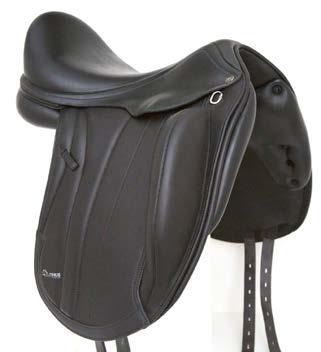
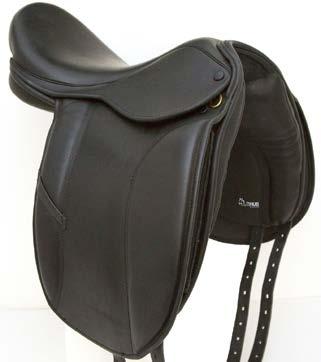
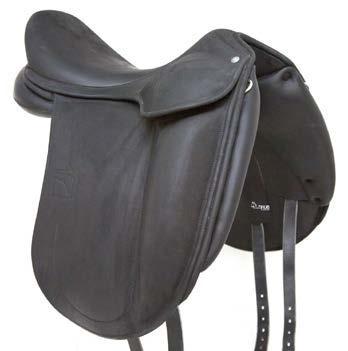
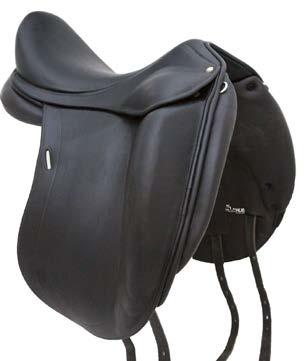
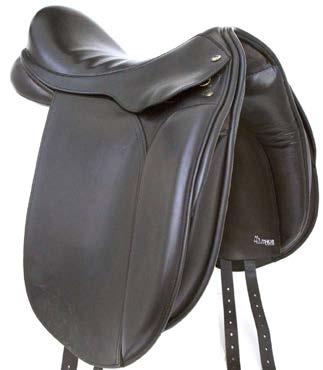
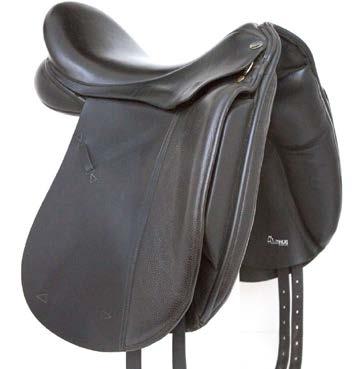
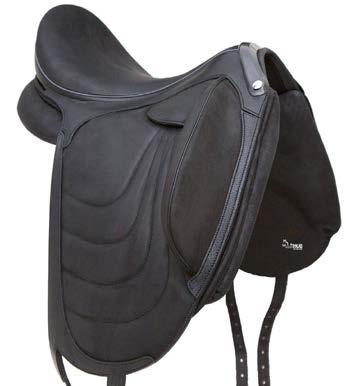
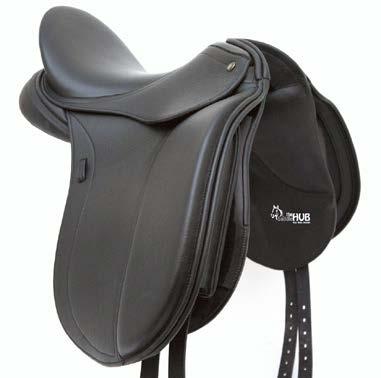
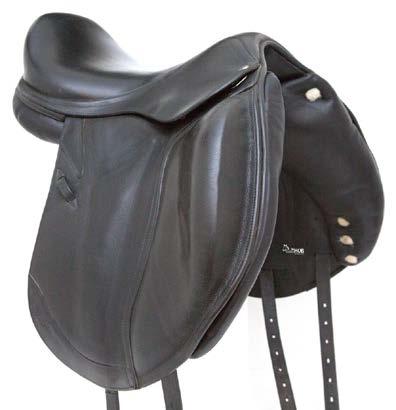
Dressage Saddle
Skye Stenning recently purchased an Equipe Viktoria for her lovely Warmblood mare, National Babe (aka Nat).
“I purchased the Viktoria as my horse is quite compact,” said Skye.
“She has big shoulders as she is still developing and being a mare, she is very sensitive. I wanted a saddle that I could feel secure in and wouldn’t disrupt my horse’s movement and block through the shoulders.
Skye found that the Viktoria was the perfect choice - the Viktoria fitted Nat best for her horse’s build and she instantly loved riding in it.
As we all know, saddle fitting isn’t all about the horse - the rider also needs to be comfortable when riding.
“I’ve found the knee rolls to be supportive and without restriction, and the Viktoria has a deep seat making every
ride enjoyable,” explains Syke.
“The quality of the leather is beautiful, it really has minimal wear and tear considering I’m the second owner. The saddle is very light weight because of the
carbon tree and the panels are small, making the Viktoria a great fit for my small Warmblood. I would recommend this saddle to anyone who is having trouble finding a saddle that fits.”
Skye needed no introduction to purchasing through The Equestrian Hub as she had previously purchased another saddle. “The girls at Equestrian Hub are lovely,” she says. “The customer service is quick, and there is a large range of saddles to choose from.”
The Equestrian Hub has a large variety of second hand saddles in our warehouse, so why not visit www.equestranhub.com.au and have a browse. Saddles come with a two-week trial, finance options and courier to your door!
SKYE STENNING finds the Equipe Viktoria perfect for horse and rider.
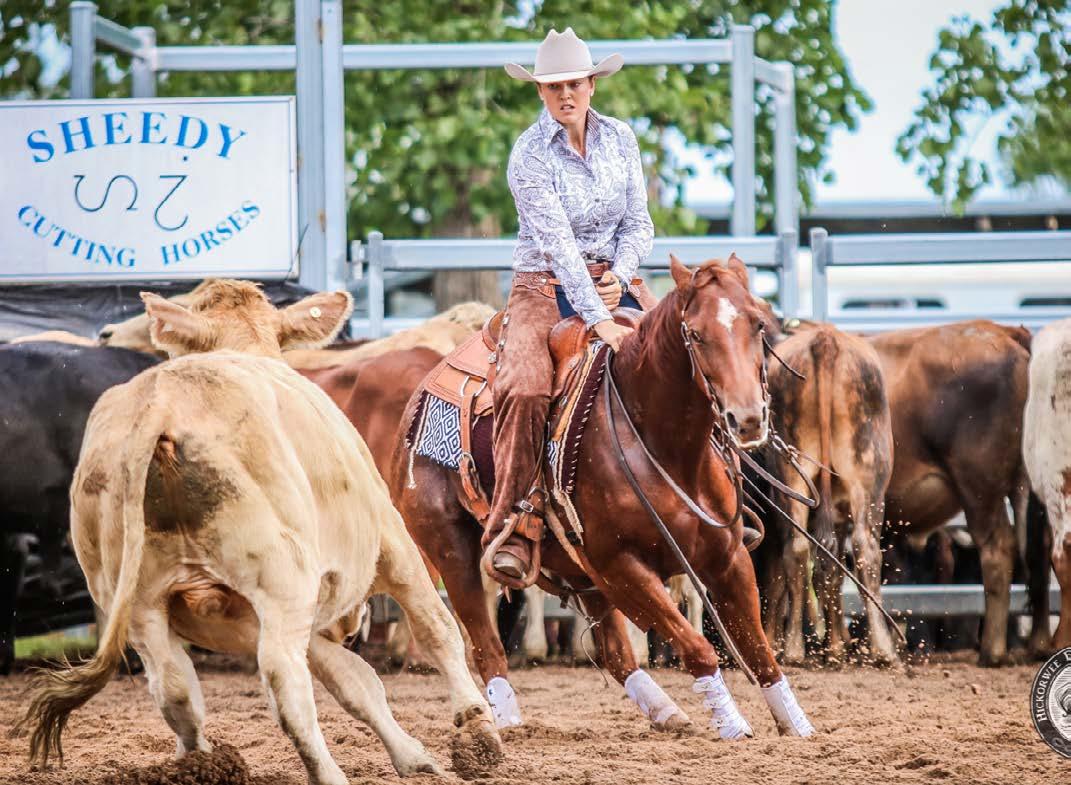
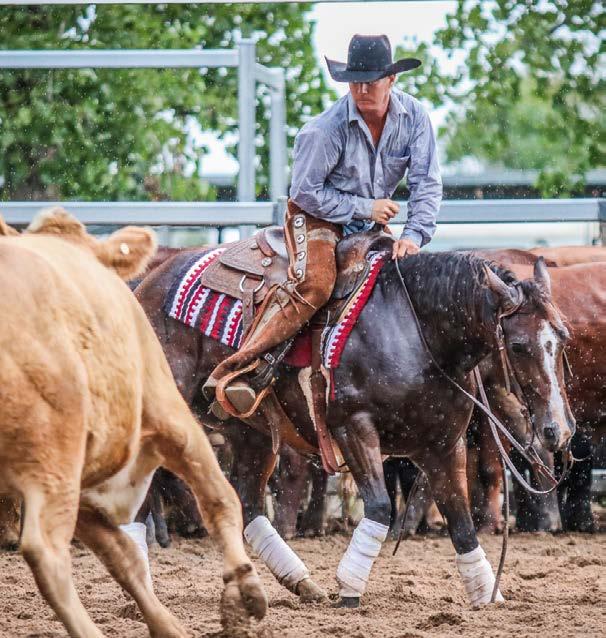
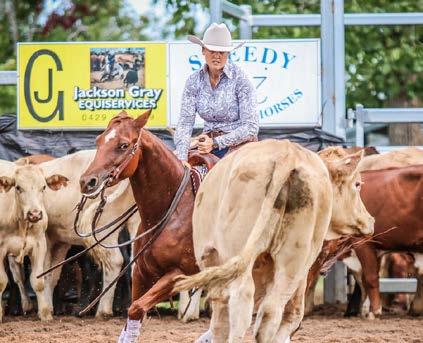
Big River Cutting Show March 2019.
A & B: Marcus and Lisa Gray’s Save our Souls, ridden by Hanah Barker.
C: Salutations, owned by Hannah Barker, ridden by Dean Rogan.
All photos: Hickorwee Photography by Tianna Barratt.
AROUND THE TRAPS
D: Powerplay ridden by Rhys Stone at Grand Nationals.
E: Astral Royal Sensation ridden by Chelsea Morelli at Grand Nationals. Image by Lisa Gordon.
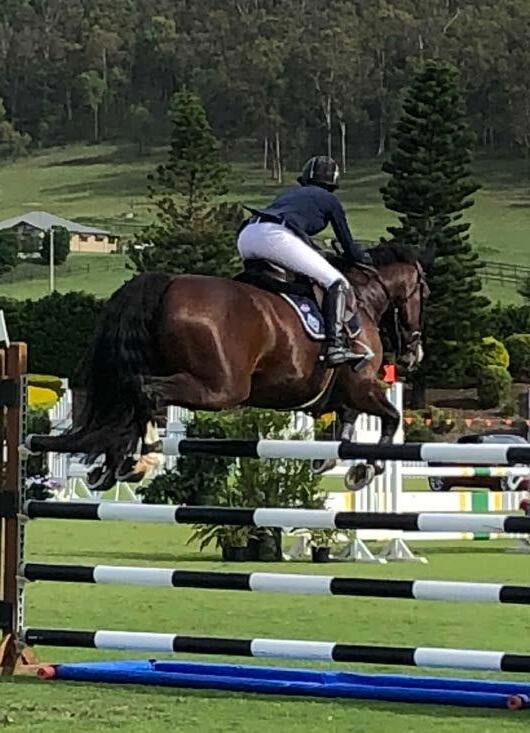
F: Olivia Hamood at Aquis Champions Tour in the 1.35m Two Phase on Day 1 of the program.
EUREKA CANVAS WINTER RUGS AND COMBOS 3’0 TO 6’9
Probably the best winter canvas rug and combo on the market today. 17.6 oz (500 gsm) superior cotton canvas with a cozy wool blended lining that keeps out those winter chills. Waxed water proofing, 3 way chest fittings, deep shoulder gussets and rump darts for a moulded fit plus more.
MINI RUGS 3’0 – 4’0 were $68.00
BY NATIONAL EQUESTRIAN WHOLESALERS
UNLINED BLUE CANVAS RUGS AND COMBOS 4’0 TO 6’9
Waterproof ripstop 16oz 100% superior cotton canvas complete with ripstop polyester grids and waxed waterproofing. Comes with all the features a quality rug should have.
$59.95
RUGS AND COMBOS 5’0 to 6’9 Our X-Calibur rugs and combos are made from 1200 Denier waterproof and breathable materials with deep shoulder gussets, double cross over surcingles, gathered rump darts for a moulded fit, 220 gsm polyfill for warmth and comfort. Best of the best.
SHOWCRAFT WINTER RIPSTOP COMBO AND RUG 4’3 - 6’9
22.5 oz (640 gsm) canvas. Excellent high grade canvas with strong polyester grids that provide extra fabric strength. Loaded with quality sort after features such as 3 way chest strap, removeable leg straps and taffeta chest lining rump darts just to name a few.
quality Winter Rugs
EUREKA SYNTHETIC WINTER COMBOS AND RUGS 4’3 to 6’9
EUREKA
X-CALIBUR PADDOCK RUGS AND COMBOS 5’0 to 6’9
Cozy and warm 300 gsm polyfill with a 600 Denier breathable waterproof outer and cotton lined body. Anti rub satin in shoulders and tail flap. Clip chest straps and double cross over surcingles and rump darts for a moulded fit.
The eureka synthetic rugs and combos are truly a great choice. 600 Denier with a twice treated waterproof outer. 220 gsm polyfill for extra warmth and a cotton lined body completed with anti rub satin, double chest straps and cross over surcingles to secure fit.
Solid colour polar fleece rugs and combos for extra warmth when needed on those cold days. Polypropylene bound with a wither protector on rugs.
YOUNG RIDER
Dressage Star on the Rise
When Lindsey Ware bought the well-known dressage star Aristede, little did she know how quickly the pair of them would bond, writes DANNII CUNNANE.
This month, we catch up with Lindsey Ware, a Young Rider from Victoria. Lindsey is 16, she’s been riding for 13 years and competes in dressage. Despite it being early days, we think that it would be safe to say that Aristede, a crowd favourite with his previous owner, Shannan Goodwin, is the love of Lindsey’s life.
“Aristede is a 14-year-old Australian Warmblood standing at 16.1 hands high,” she says. “He’s a beautiful bay gelding by Aachimedes, with a lovely temperament and incredible movement. Even though I’ve only owned him since November 2018, we started competing in January 2019. Even in a few shorts months we have come a long way together and achieved much more than I could ever imagine.”
In their first competition together, the CDN-Young Rider class at the Victorian Youth Dressage Championships 2019, the pair placed first in each test resulting in an overall first place.
Says Skye: “The following week, we competed in the Boneo Classic at the same level, placing first in each test and subsequently first overall.” They then repeated their performance at their first CDI at Willinga Park at Dressage by the
Sea in the Young Rider competition.
A leap upwards was inevitable. “Most recently, we faced competing against adult riders at this year’s Dressage and Jumping with the Stars in the Prix St George’s cup,” says Skye. “In the Prix St George we placed third, behind two of Australia’s top riders and in the Intermediate I freestyle, we placed second.”
Lindsey has worked hard to get to the top and knows that her hard work goes a long way. “You can’t expect everything to come together immediately,” she says. “As you’ll find across all disciplines, the high points certainly don’t come without the low points – and there are plenty of those!”
Skye trains three times a week due to school commitments, but over the holidays she rides between four or five times a week. “I get weekly lessons from my coach, Georgia Haythorpe. Georgia is the most amazing person and has coached me since I’ve been at Preliminary and taken me through the levels. I certainly could not have done everything I have without her. Dressage training for both horse and rider is a long process. Each new step you take poses new challenges you have to face and eventually overcome.”
Lindsey Ware riding Aristede.
The next few months will open a new chapter for Lindsey as she sets new goals for herself. “I’ll be competing at this year’s Sydney CDI in the CDI-Young Rider class,” says Lindsey. “This will be our last Young Rider class before making the step towards Grand Prix level.”
Lindsey’s goal over the next 12 months is to take the big step up to Grand Prix and compete at that level while getting consistent results and placing at the major competitions.
“My ambition is to one day compete at the World Equestrian Games and also ride at the Olympic Games. Eventually, I would also love to own a small property,
with a small team of horses that I can train through the many levels of dressage, up to Grand Prix dressage,” says Lindsey.
Getting to the level Lindsey competes at is a team effort – something that she readily acknowledges.
“I would love to also give a shout out to my mum, for going through this very big journey with me. I wouldn’t be where I am if not for her.”
HorseVibes wishes Lindsey a wonderful competition season and we look forward to seeing their fantastic achievements for 2019.
Function, form & a work of art
Saddle-maker Dan Kingsley is following in a grand tradition of Western saddle craftsmen, writes JANE CAMENS.
The secret is out,’ wrote saddle maker Dan Kingsley on his Facebook page. ‘This is the project I’ve been working on.’
The ‘project’ was an outstanding handtooled Western saddle he’d been creating for over 10 weeks — designing, drawing and redrawing, carving and stamping. When I spoke to Dan he was about to enter his beautiful and intricately carved saddle in the Sydney Royal Easter Show.
Two days later he found out the saddle had won him first place in its category as well as being selected for the ‘Standard of Excellence’ award.
“I wanted to do a one-of-a-kind work of art,” Dan says. He can imagine it sitting on display in someone’s living room, although it is designed to be used. Says Dan: “I do performance saddles and add art if the customer will allow me.” The issue, of course, is the artwork, especially original designs, cost more money. Dan was putting around $14,000 on the saddle, but that was before it won first prize.
Thirty-one-year-old Dan lives near Gunning, NSW, about an hour from Canberra. He used to shoe horses for a living but suffered an injury to his ankle and took up leatherwork while recovering.
He did a couple of saddle making courses and that’s where he met his now friend and mentor Peter Brophy. Although older than Dan and with a well-established reputation as a saddler, Peter took Dan under his wing. The pair started talking regularly and critiquing each other’s work. “It’s not about competition,” says Dan.
Dan’s craft has been inspired by master saddlers in the United States, in particular Troy West and Terry Hanson, members of the Traditional Cowboy Arts Association (TCAA). The TCCA is dedicated to ‘preserving and promoting
the skills of saddle making, bit and spur making, silver smithing and rawhide braiding and the role of these traditional crafts in the cowboy culture’. “I’ve been fortunate to go to the US and meet them. They are amazing craftsmen,” Dan says. “They take what they do very seriously.”
Dan uses Warren Wright trees because this New Zealand tree-maker is considered one of the top three tree makers in the world. After his win at Sydney Royal, Dan himself has been recognised as a top craftsman in his field.
Western saddles are a reminder of important moments in the history of the world. They are said to have originated from the Conquistador’s Spanish war saddles that originated from saddles used by Moorish invaders when they conquered the Iberian Peninsula. Later, the Spanish saddles were adapted in Mexico for working with cattle. They are designed to hold you in place, and to also be extremely comfortable.
Form, function and art all in one. Australia is lucky to have a new up-and-coming master Western saddle-maker.
DANNII CUNNANE collects some tips from The Australian Endurance Riders Association to help prepare a rider and an inexperienced horse for its first training ride.
As an introduction to Endurance, the purpose of the Intermediate ride is to introduce newcomers to the sport of endurance without the pressure of a competitive event. The Intermediate ride is non-competitive and is a friendly, low-pressure ride with the focus on a successful completion. It’s assumed however, that the horse that is being trained has had previous trail or riding experience and is not a newly educated horse.
Training
Long and slow distance work is the basis of preparing a novice horse for a training ride. You should plan on riding the horse three to five times per week and allow six weeks to get an inexperienced horse fit for its first 40 kilometre training ride. Always remember that rest is critical to the conditioning of an endurance horse as it allows recovery time from the introduced stresses of training.
The training sessions should each be about one hour in length with a longer session of two hours or more included once per week. Over the preparation time this will extend to longer sessions of three to four hours, which aligns with the time the rider should be expecting to complete the 40 kilometre intermediate ride.
Weeks 1 and 2: The horse should be
ridden at the walk and slow trot over mainly flat terrain. This is crucial to building strength in the legs and condition the horse for its future training. During this period it is a good idea to teach your horse to walk-out as strongly as possible so that the conditioning effect is maximised and it will also help you to cover more ground later at rides.
The distance of the slow trot section should be increased steadily over the two-week period while decreasing the walk section. For the average horse this will mean covering about 7 to 8 kilometres initially in a one-hour training session and 10 to 12 kilometres in a twohour training session.
The amount of rest days to be incorporated into the training program will be dependent on the level of fitness of the horse prior to commencing the training. For unfit horses two days of training can be followed by a day of rest. This can be increased to three or four days of work followed by a day of rest.
Weeks 3 and 4: You can begin to introduce more trotting intermittently with walking to a level where the walking is minimal. When you commence trotting it should initially be for only short distances but gradually increased. During this period you should work on trotting the horse on opposite
leads so that it remains even gaited and builds its muscular strength equally on both sides. It is also recommended that you work the horse at different speeds in the trot to develop the horse’s ability to travel at various speeds.
Weeks 5 and 6: A small amount of cantering can be introduced during these weeks ensuring that a change in leads is achieved to maintain muscular strength on both sides. In addition
some hill work can be introduced but be sure to increase only one element –speed or intensity (hill work) in a single session. Avoid introducing both aspects at the same time.
Some Intermediate rides will generally involve some substantial hill work and if you do not have access to hills on which to train it would be wise to float your horse to an area where this is possible. Initially you should walk the
horse up the hills and as the horse’s fitness improves begin to trot up some of the easier hills. Downhill work this early on should be done at the walk because trotting downhill is hard on a horse’s legs and you are still looking to strengthen and condition them.
Prior to competing at your first Intermediate ride it may be wise to contact the Ride Organiser to learn what the terrain of the track will be like so
that you can tailor your training towards what you will encounter at the event.
A week before the training ride the horse should be given a 30 kilometre trial run which would take approximately three hours to complete. This will allow you to check how the horse copes without the excitement of the ride. If all has gone to plan and you have had no problems or received no setbacks as a result of lameness, then
Adrian Brickley riding Moonie: Sarah Sullivan Photography.
your horse will be ready to attempt its first training ride.
Additional training
During the training period there are also a number of other things you can do with your horse that will help in preparation for the ride.
Accustom your horse to the veterinary procedures to which he or she will be subjected to in the vetting ring. This includes standing patiently when asked, picking up feet, being comfortable in having the mouth examined, having the temperature taken and trotting out easily on a loose lead. By checking your horse’s parameters at home, you will get them used to these activities and this will also help you to learn how your horse’s fitness is developing.
Try to ride in the company of other horses if possible. At a ride your horse will have to start with forty or more other horses and this can make an inexperienced horse excited. There will also be other horses trotting and cantering past, so the more experience you gain at home will be helpful when riding out at an event.
Introduce your strapping techniques to the horse so that they will be used to being sponged and scraped down.
On longer rides encourage your horse to drink at water points and allow the horse to relax and graze every now and then. This will ensure that your horse’s hydration is maintained and gut function is good.
Use a known measured training track to get a feel for the speed at which your horse travels at various gaits. This will be valuable later on at rides to enable you to control the speed at which your horse is travelling and meet the minimum and maximum time constraints of the ride.
Try not to become too regimented in your training. Both you and your horse will appreciate variety such as different terrain, long slow rides, short faster
A: Adrian Brickley riding Moonie: Sarah Sullivan Photography.
B: Sally Anne Millson with Wongamine in a 40km ride.
BArides, some flat work and other types of equestrian activities.
Feeding
Feeding will initially largely depend on the condition that the horse is in when it commences training and the effect of the training on the horse. If the horse
is in heavy condition when it starts to train it will need to lose weight slowly and trim down to athletic condition. This type of horse will not need additional feed.
If the horse is already in appropriate condition it will need additional feed in order to meet the additional work requirements. Basically, the horse needs to receive enough feed in order to maintain it in appropriate condition and provide enough energy for the work that the horse is performing.
When you are grooming your horse or saddling up you should look at and feel the horse’s withers, neck, tailhead, girth and ribs to decide whether or not the horse is gaining or losing weight and adjust the quantity of feed accordingly. One of the easiest mistakes to make is to overfeed your horse and have a horse with an excess of energy.
The amount of feed necessary will
C: Make sure your horse is familiar with all the procedures before you enter a competition.
depend on the quality and quantity of grazing you have available. Horses with access to good grazing will not need much additional feed except for perhaps a vitamin and mineral supplement. Horses with grazing of limited quality or quantity will need additional feed in the form of hay and chaff and some energy dense feed such as grain or prepared feed.
As a general guide about one to three kilogram of hard feed such as oats or prepared feed is adequate for a 500 kilogram horse. However, this needs to take into account, to a degree, the breed of the horse as different breeds require different levels of energy intake. For example, the thoroughbred horse may require considerably more feeding than the Arabian horse.
Endurance horses require good levels of vitamins and minerals in the diet so ensure that the diet is balanced correctly. Always reduce the amount of grain fed
to your horse on rest days by at least half. This is very important to prevent a condition called ‘tying-up’.
Electrolytes are important for endurance horses. Sweat contains high levels of electrolytes that must be replaced or horses become prone to fatigue, dehydration or more severe problems. Horses that are worked and sweat heavily should receive additional salt (between 25 to 50 grams) and an electrolyte supplement formulated for heavy sweating horses performing long slow work such as endurance horses. Horses being prepared for Intermediate rides may not require electrolyte supplementation as they do not work at the same levels of effort as endurance horses.
Water is critical for the endurance horse and a clean supply of cool, fresh water should be available at all times. Many seasoned endurance riders use an additive such as Stock Gain or Molasses
to sweeten the water at rides so that horses are more likely to drink.
Further information
While this is a brief introduction to the preparation of a new horse for an initial Intermediate ride there are many different views on training and feeding methods, but the basis of a steady preparation is fairly universal. Making contact with endurance riders in your area will allow you to learn from other riders and determine what exactly works best for your horse.
For more information on Endurance, visit the Australian Endurance Riders Association website which provides educational information, rules, resources and links to State Associations. AERA and each State Association has a Facebook page which are an excellent source of information and support.
The merry month of May promises to be true to form with a flirty, amusing atmosphere that has everyone talking. You’ll want to kick up your heels, whether welcoming spring or autumn. This is also a time to pay attention to practical needs, tending to health, home and business. Be ready to negotiate your priorities and know well in advance what’s a deal breaker. Eyes on the prize!
Aries
The pragmatic energy of this month highlights your second house of core values and sense of ‘wealth’. What is it, inner and outer, that makes you feel secure? Your ruler Mars knows how to handle the coin right now, so trust inspired actions, especially financial. However, us four-legged critters may feel a bit trapped so watch for signs –cribbing, pacing, ear pinning. We’re just saying, more turn-out time, please!
Taurus
For the two-legged Taureans, this is your most auspicious month of the year, the one that lights up all four corners of your life: Self-expression, home, career and partnership. It’s the perfect time to set new intentions, putting energy into YOU and what you want to experience. Dial back the ‘people-pleasing’ and make choices based on intuition. Us equines will appreciate your sense of strength and purpose. Thank you!
Gemini
This month activates your dreams, imagination and fantasies, making it perfect for starting a dream journal or exploring the Tarot. You’ll be amazed at the synchronicities and serendipitous connections coming your way. Bank on having more enthusiasm and vitality, especially if your birthday is later this month. When it comes to us equines, we will benefit from a little more time with the herd to reduce boredom and lifts spirits.
Cancer
May is the time to seek connections, friendships and links with like-minded others. In fact, if you open a fortune cookie it will likely say, a chance meeting reveals new pathways to success and friendship. It’s your turn to bask in collective love, respect and opportunity, so don’t be shy. Put yourself out there for optimum results. Four-legged Crabs need companionship more than ever this month. Make it so.
Leo
May is a month of public appearances, spotlight attention and new developments on your career path and income streams. Think increased flow, both in and out. It’s exactly what you want. Movement. Connection.
Circulation. As long as you are doing what you love, there’s no looking back. Us equines have a Houdini complex all month. You’re going to need to check locks and make sure visitors close gates.
Virgo
Ready to step out of the house, away from the computer, office, studio or desk and venture out into the world?
You are most inspired by the colours of sunrise, the sounds of success and the feel of health and contentment. Be it near or far, travel, explore, expand. Point your feet the direction that makes you smile. Us Equines are eager too. Please accommodate with longer warm-ups, work-outs and cool-offs.
Libra
Collaborations, especially where shared finances are concerned, need a revamp. You decide how you want this partnership to look. It’s best to be innovative and stop relying on outmoded maps for success. Intend the others in your life to match your desires, or at least, meet halfway. With us fourlegged Libras, it’s a month of appetites. Lock up the feed room every night and keep an eye out for overly cresting necks.
Scorpio
May is midway through your solar year marking a potent time indeed. Taurus puts the spotlight on relationships all month, especially sex and intimacy. No matter what is or is not happening in your life now, take a moment to imagine it the way you want it to be. Yes, your conscious intentions are that powerful. For us equines, we need extra encouragement. New routines are challenging, so please give us time to adjust.
Sagitarius
This month finds all the taken-forgranted things of the household, studio, barn, stable or shed in need of extra attention. Put your mind to the details and make repairs here necessary. This isn’t something you want to ignore or even delay. Spot an issue and fix it ASAP. No exceptions. Four-Legged Centaurs can develop a taste for odd things, so keep an eye out for pica, and discuss odd behaviour with your vet.
Capricorn
A childlike creative impulse washes over you, infusing all you touch with smiles and bubbly laughter. It’s out of character for the Sea-goat, but don’t let embarrassment stop the fun. Meet the vivacious energy in you by setting aside time for a carefree expenditure of vitality, ie. Play. You won’t regret it. Us equines are kicking up our heels and rearing to go too. Facilitate the reverie with time in the wide-open spaces.
Aquarius
This new moon cycle is your cue to put attention inward, into the home, family and sense of emotional grounding and stability. Ask: What is my state of being when I’m not doing? Evaluate, appreciate and refresh the Feng Shui where necessary. You’ll set the stage for fabulous results for the rests of the year. Us four-legged Water-bearers are frisky this month. Consider a little groundwork to settle us before the ride.
Pisces
May has you talking at the speed of light or beyond. Some listeners are going to follow, but others are left flustered at the gate. Consider decelerating or pressing pause now and then to give slowpokes a chance to contribute. Otherwise, you’re just a megaphone and soapbox. When it comes to us equines, there is one word for May: Hooves. Make sure they are out of the mud, trimmed and strong. Ounce of prevention, as they say.