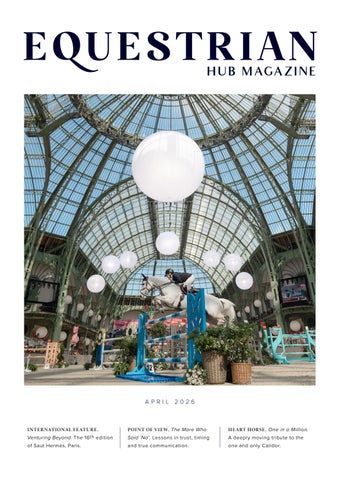
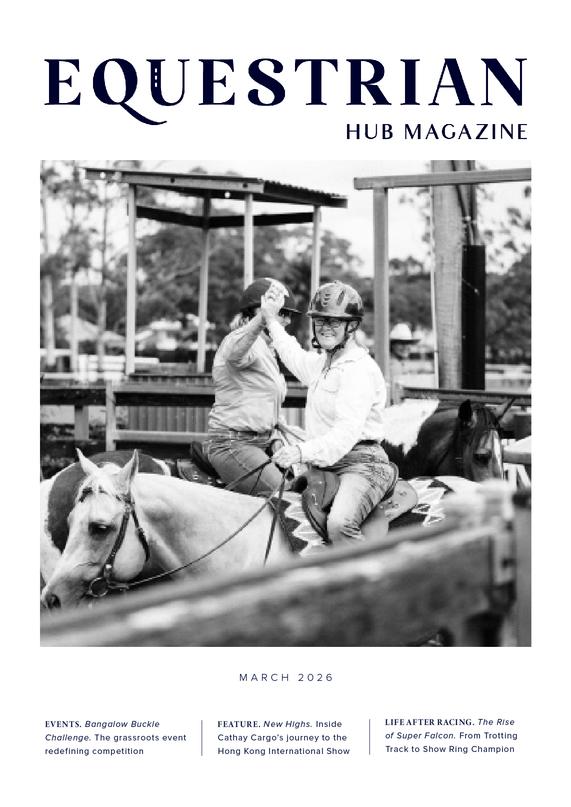
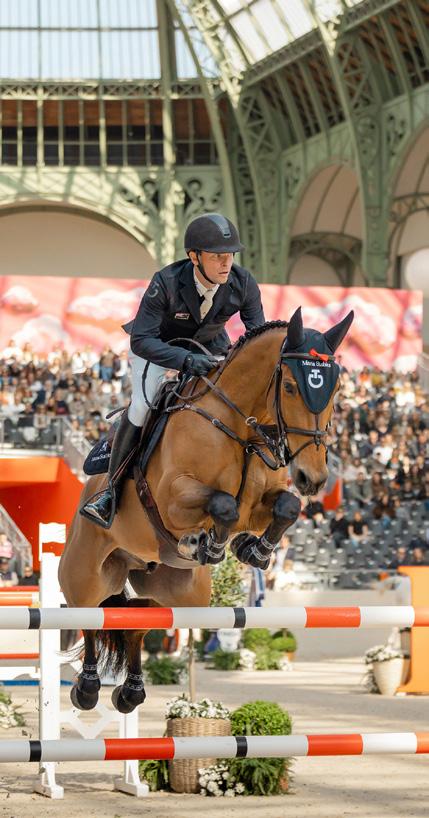
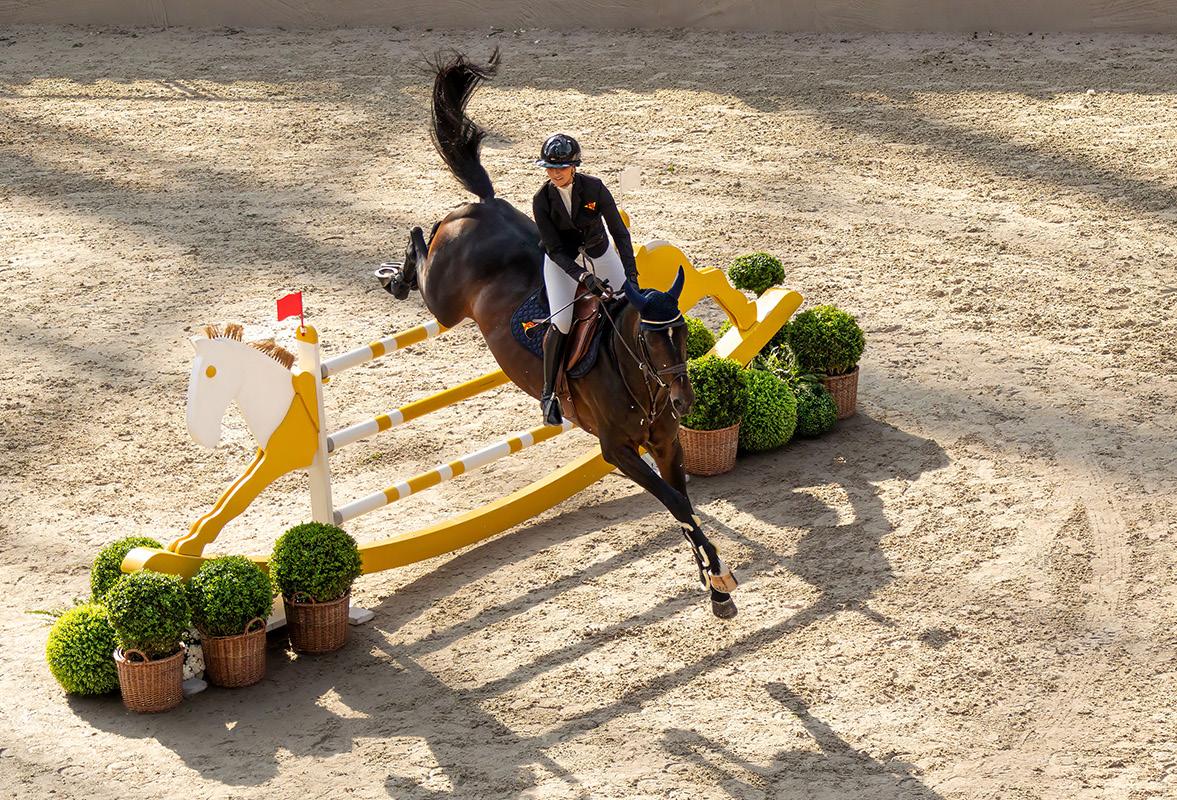
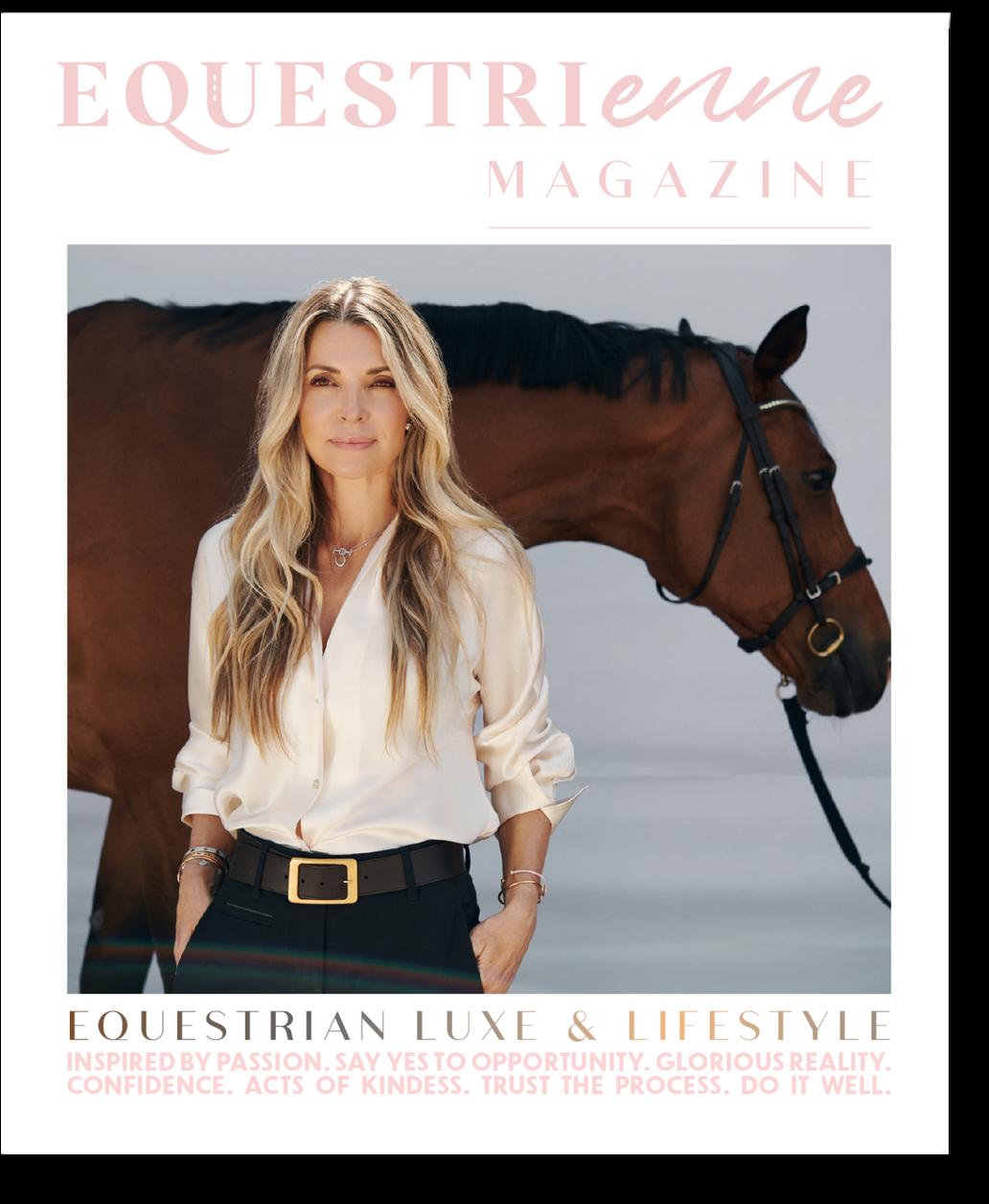
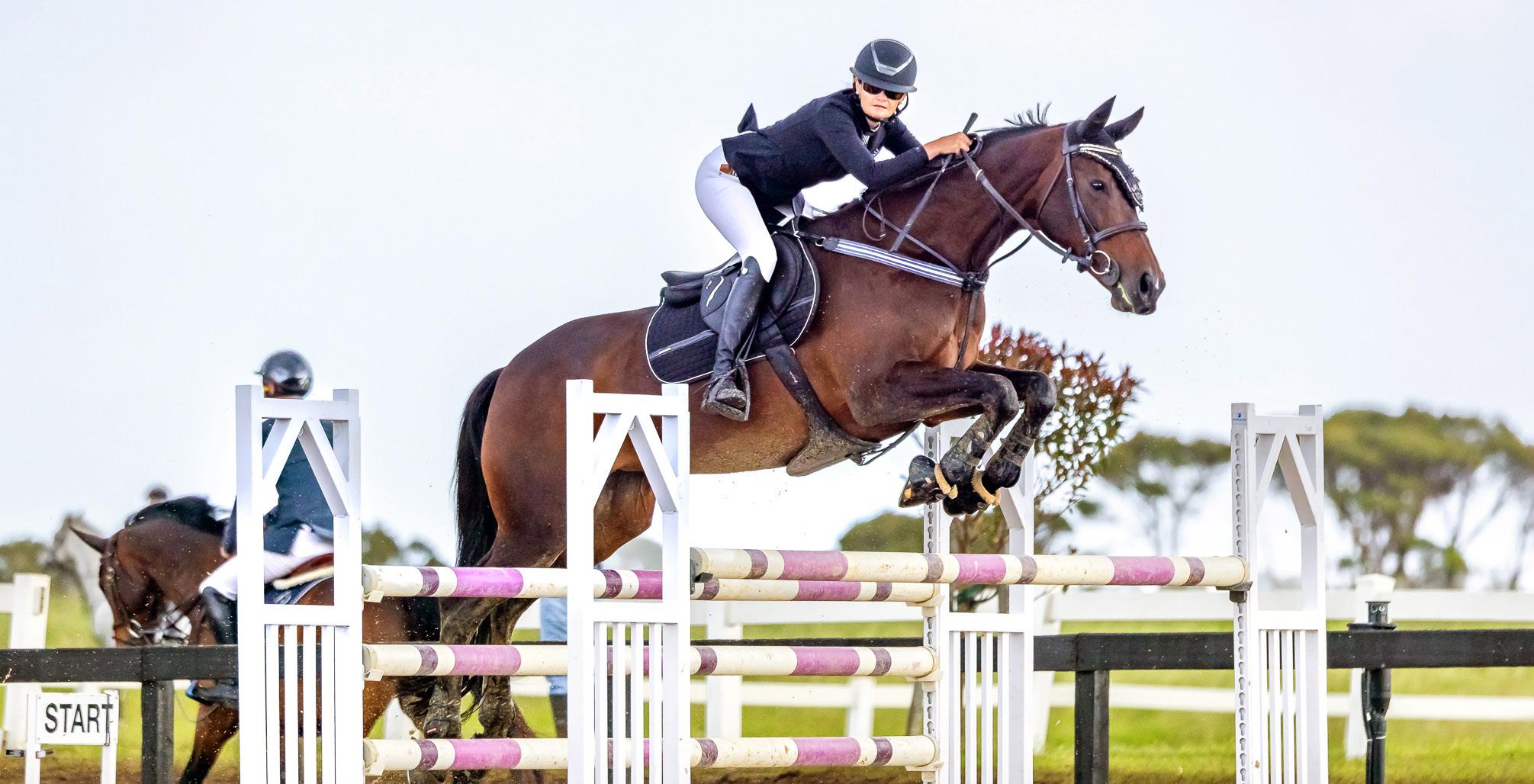
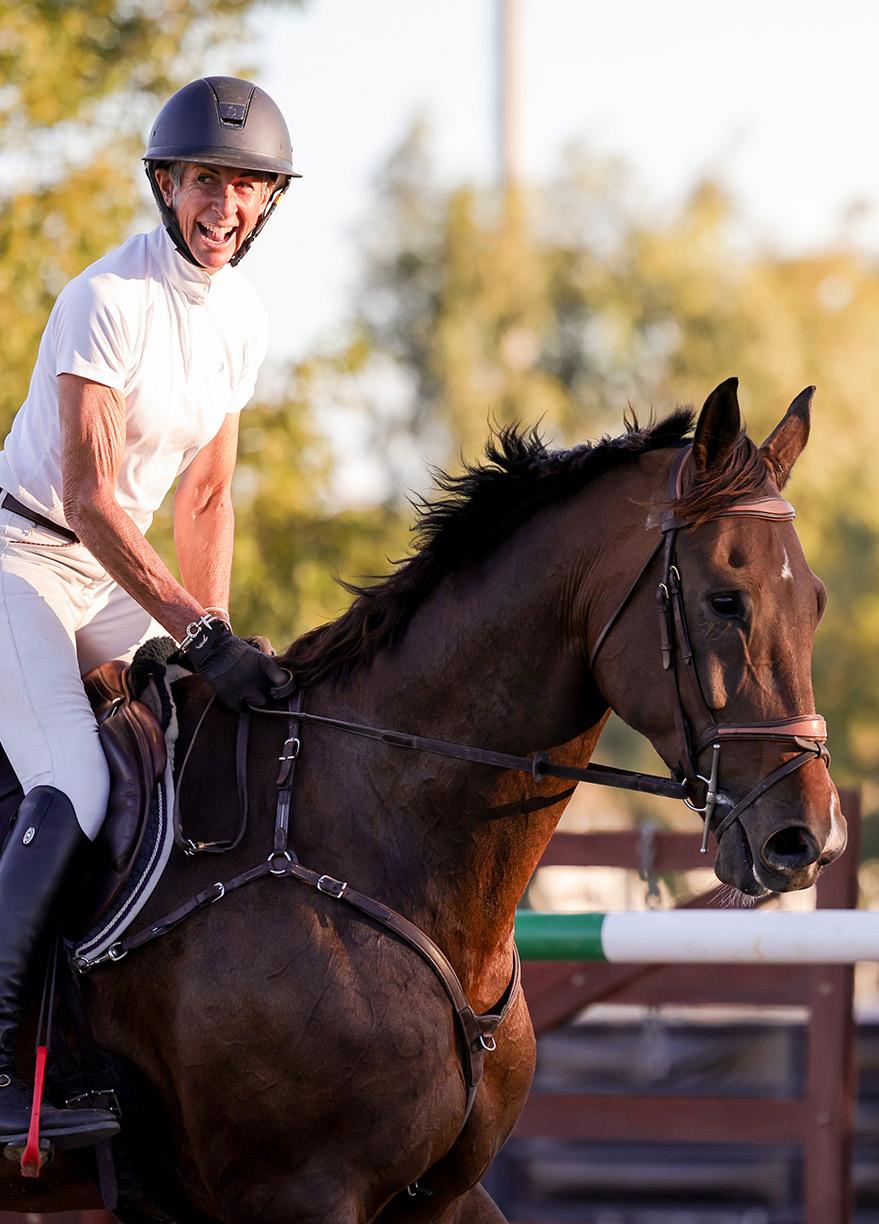
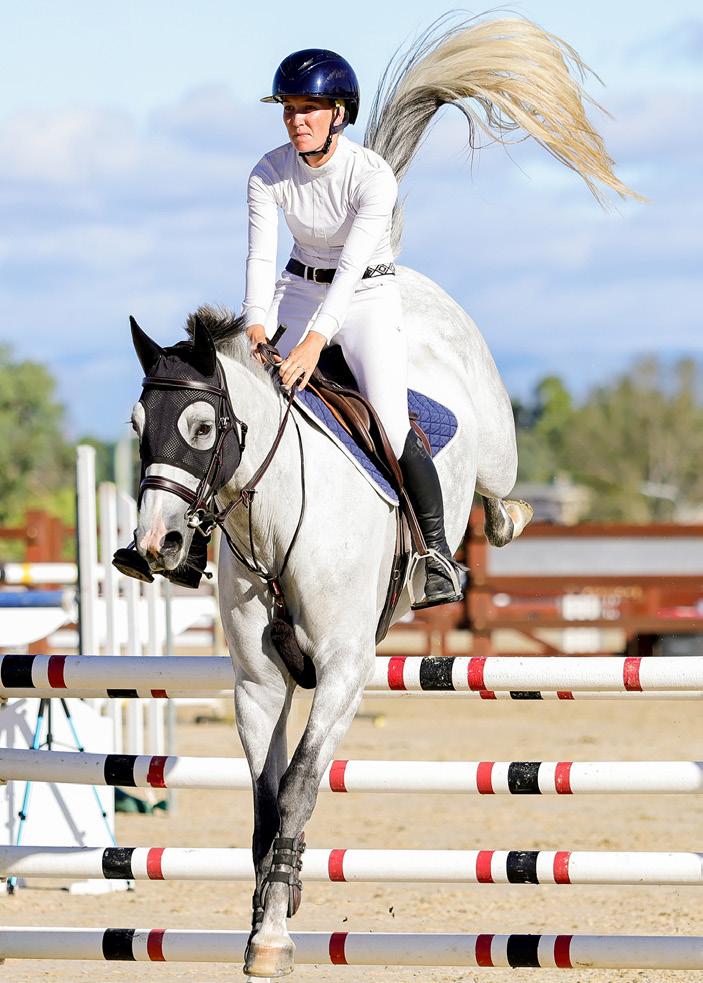
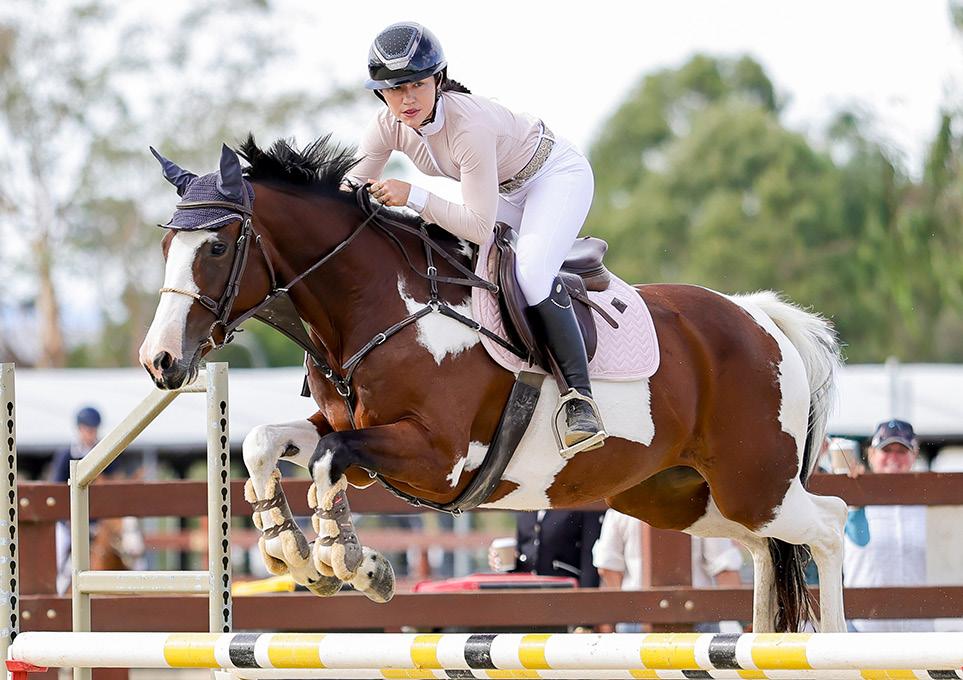
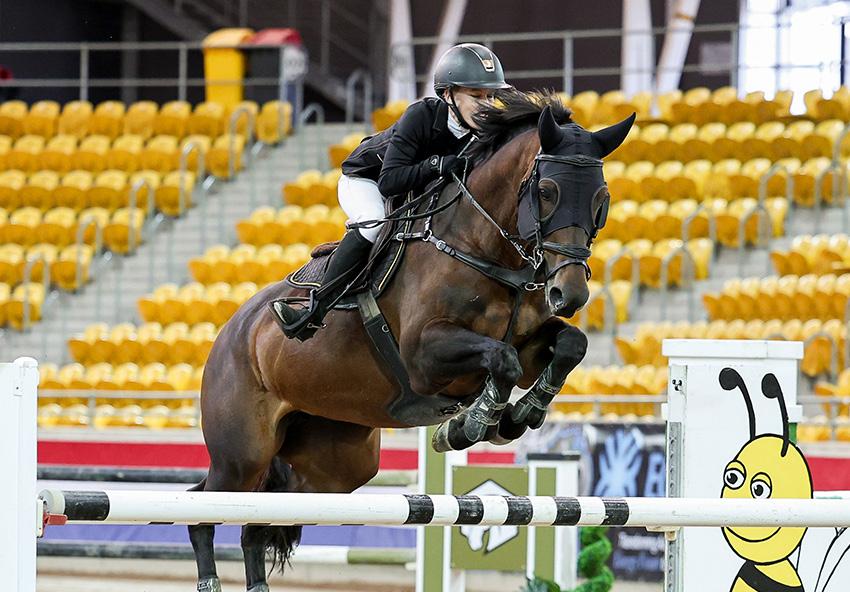
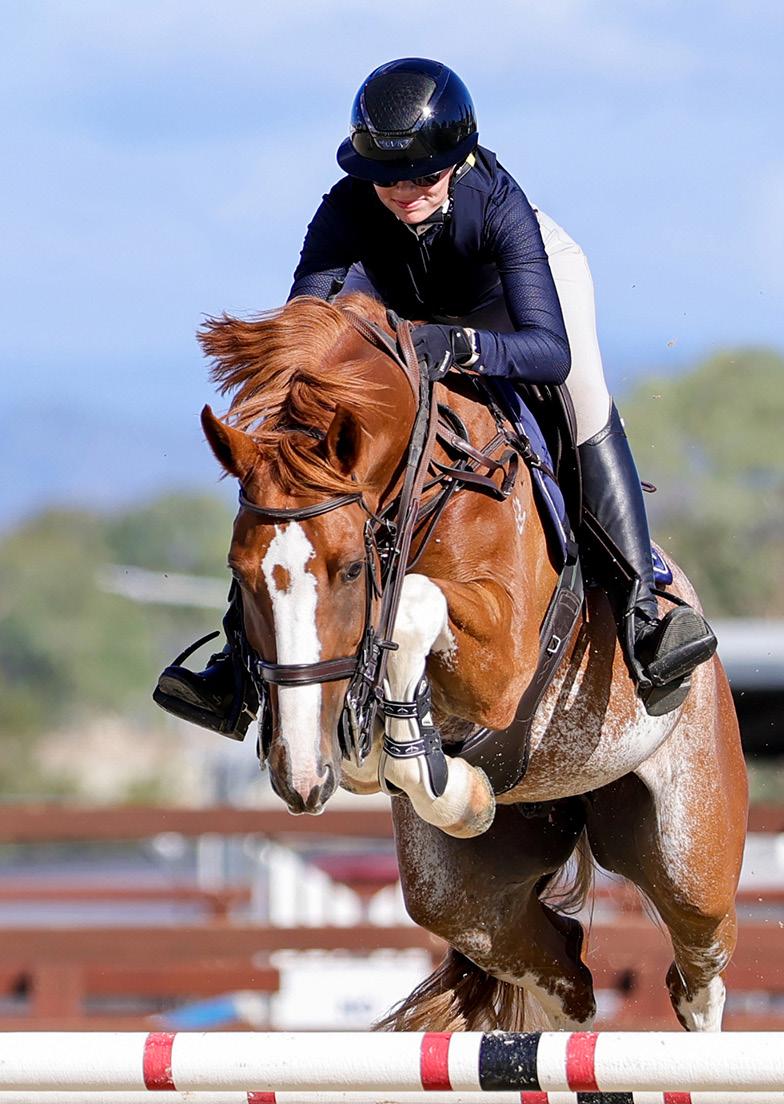
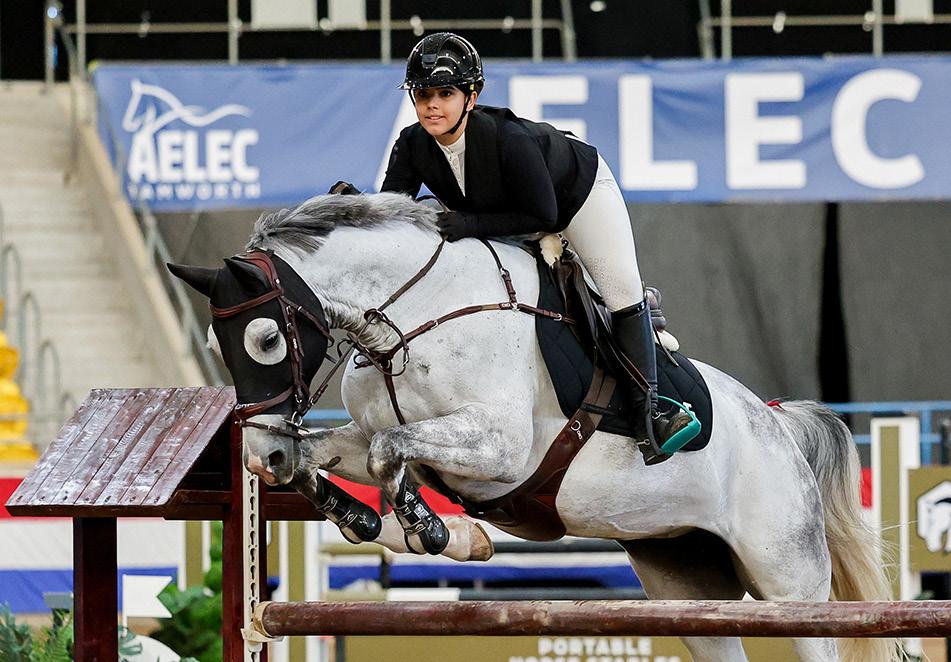
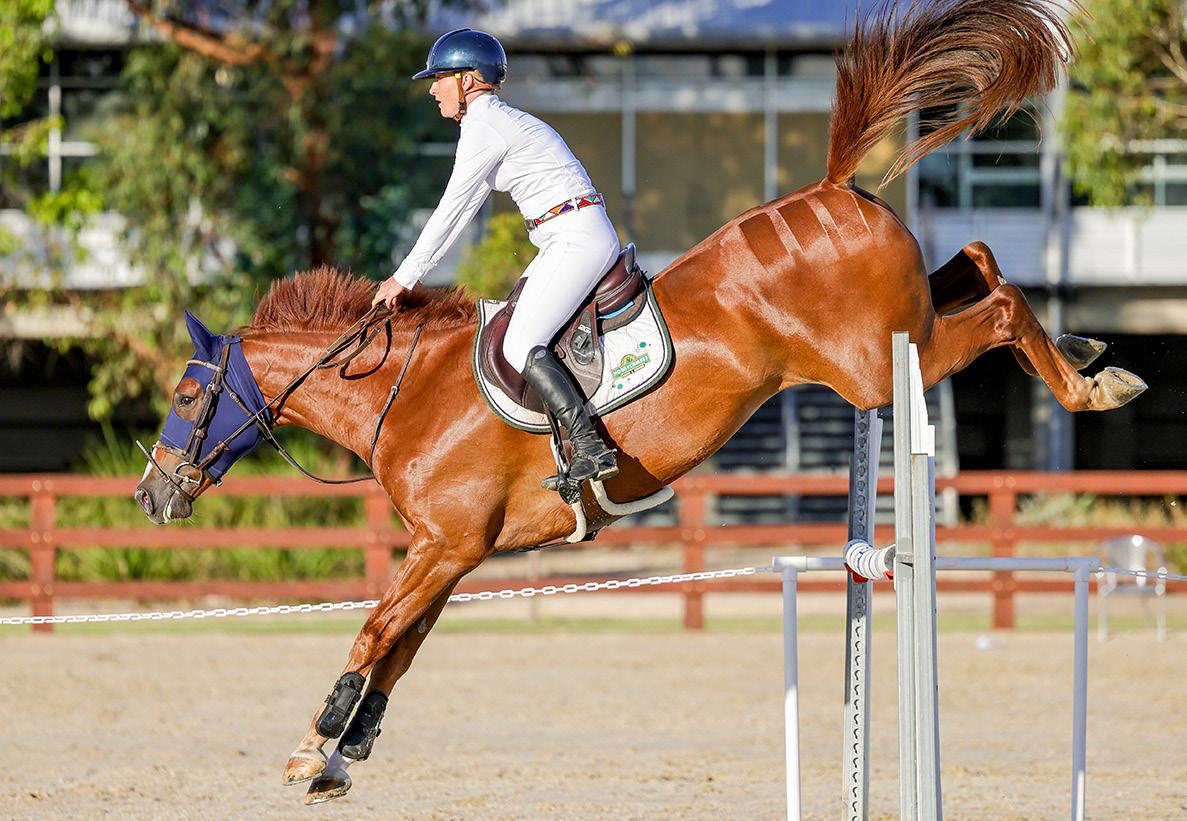
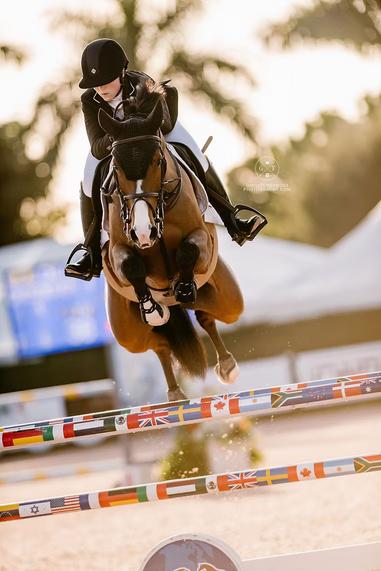
INTERNATIONAL FEATURE. Venturing Beyond. The 16 th edition of Saut Hermès, Paris.
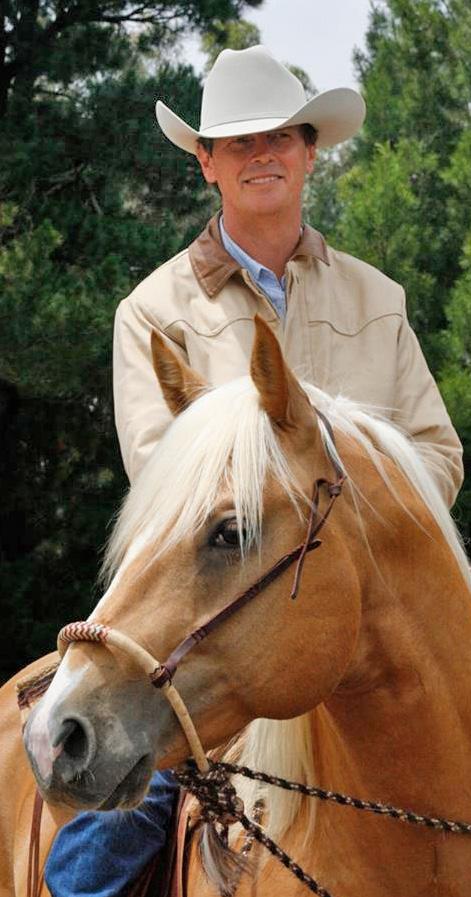
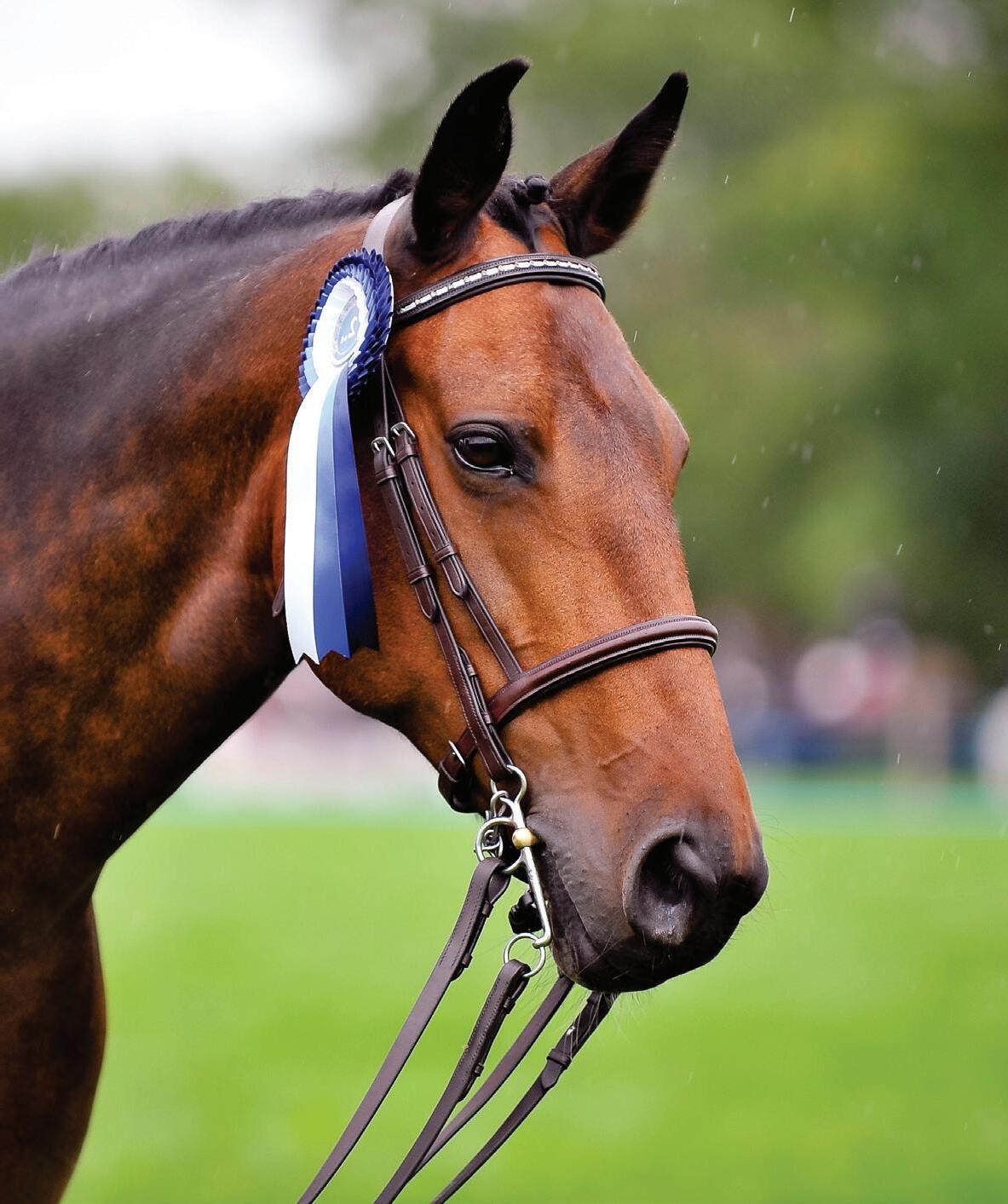
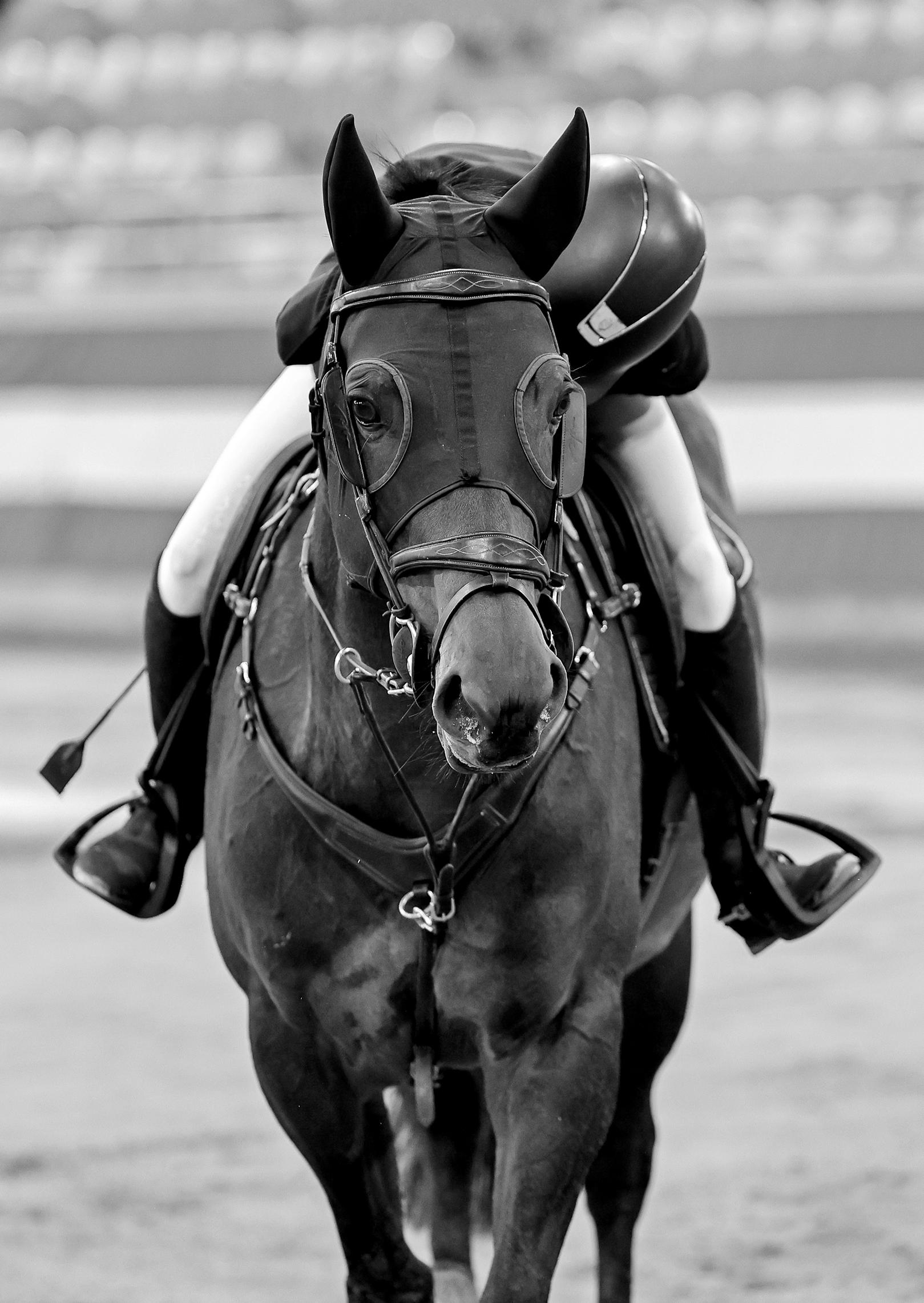
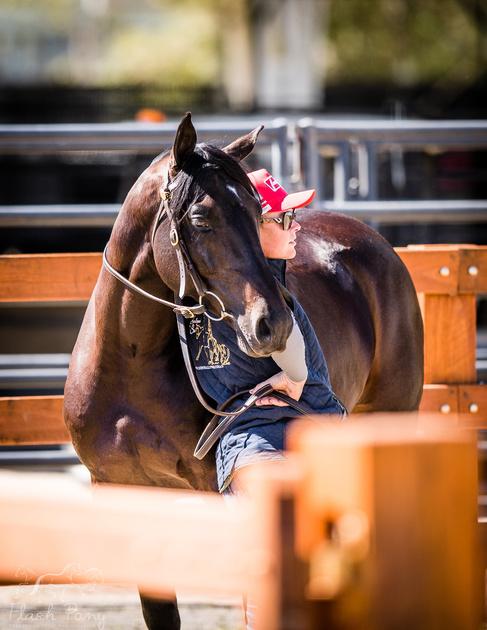
POINT OF VIEW. The Mare Who Said 'No'. Lessons in trust, timing and true communication.
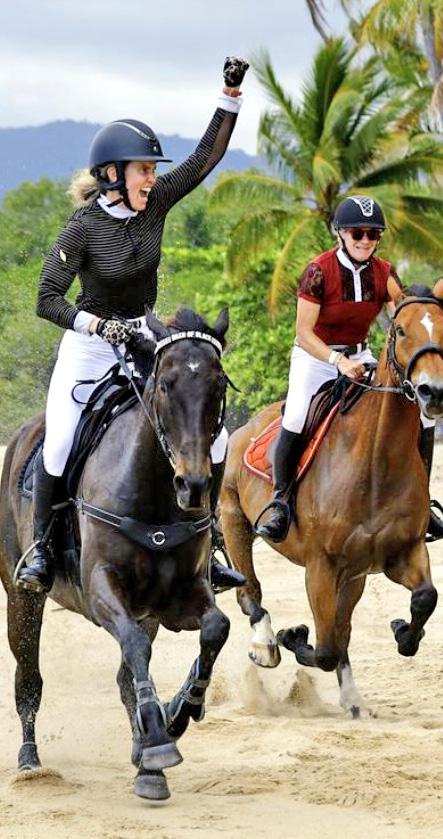
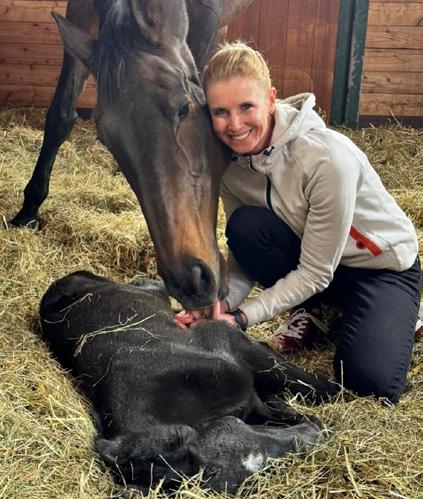
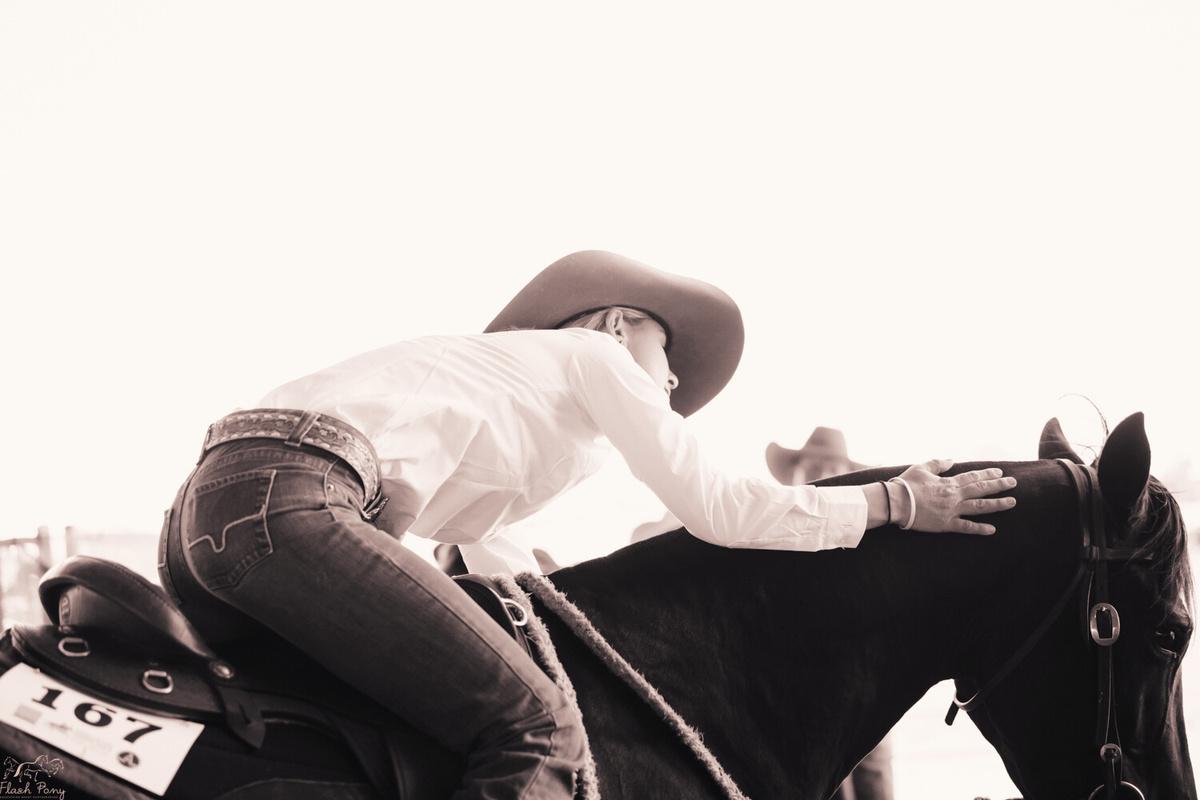
HEART HORSE . One in a Million. A deeply moving tribute to the one and only Calidor.
A grassroots equestrian magazine celebrating and connecting Australia’s horse community.
MULTI-PLATFORM EXPOSURE
DIGITAL MAGAZINE
BLOG
PODCAST
SOCIAL MEDIA
1M+ ANNUAL SOCIAL & DIGITAL IMPRESSIONS
REACH THOUSANDS OF ENGAGED RIDERS & READERS EVERY MONTH
Become a Hub Partner
CONTACT US NOW i
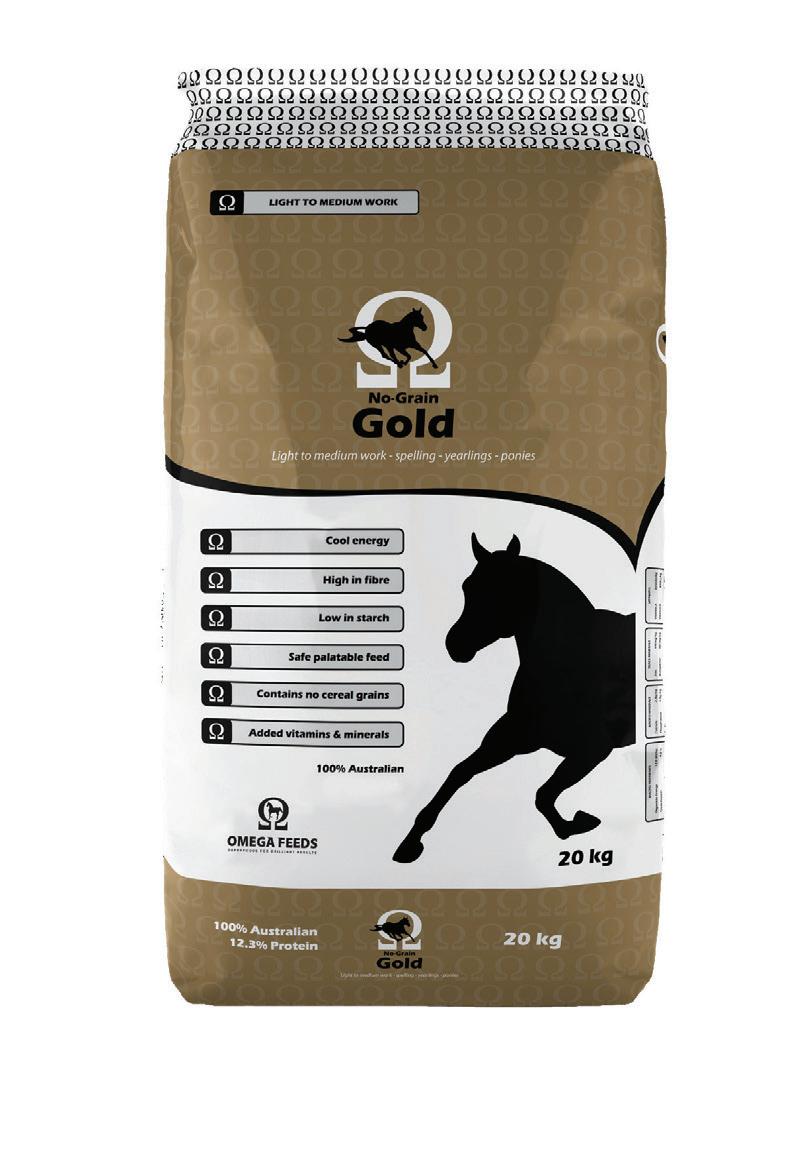
HIGH FIBRE COOL ENERGY FEED
HARNESSING THE POWER OF SUNFLOWER SEEDS, AN ALL NATURAL SUPERFOO D
Omega Feeds has formulated a palatable, high fibre, low starch feed that contains a balanced blend of vitamins and minerals to ensure optimum health and vitality. No-Grain Gold is suitable for ponies, spellers and horses in light to medium work.
High Fibre: For gut health and cool energy.
Non Pelleted: Horses spend more time chewing which stimulates saliva production and in turn buffers the stomach and protects it from ulceration.
Low Starch: Reduced risk of digestive upsets and metabolic conditions.
Balanced blend of vitamins and minerals: For optimum health and vitality.
100% Australian, proudly supporting Australian farmers
Hello,
With the Autumn equinox behind us, the days are getting noticeably shorter, and in many parts of Australia temperatures are cooling.
Life in the yard takes on a different tempo at this time of year as we check rugs, rethink feed, and - unless we’re blessed with arena lights - contemplate the best way to shift our training and riding schedules in preparation for the winter ahead. And all while show season is in full swing!
But amid the busyness, let's not forget our fabulous April issue. It’s packed with heartfelt stories, practical insights, and plenty of inspiration - plus a healthy dose of travel envy. If you’re anything like me, Kirsty Pasto’s stunning coverage of last month’s internationally renowned Saut Hermès CSI 5* event will have you reaching for your passport. Based in Europe, Aussie ex-pat Kirsty produces features for the FEI and a variety of international equestrian magazines and federations.
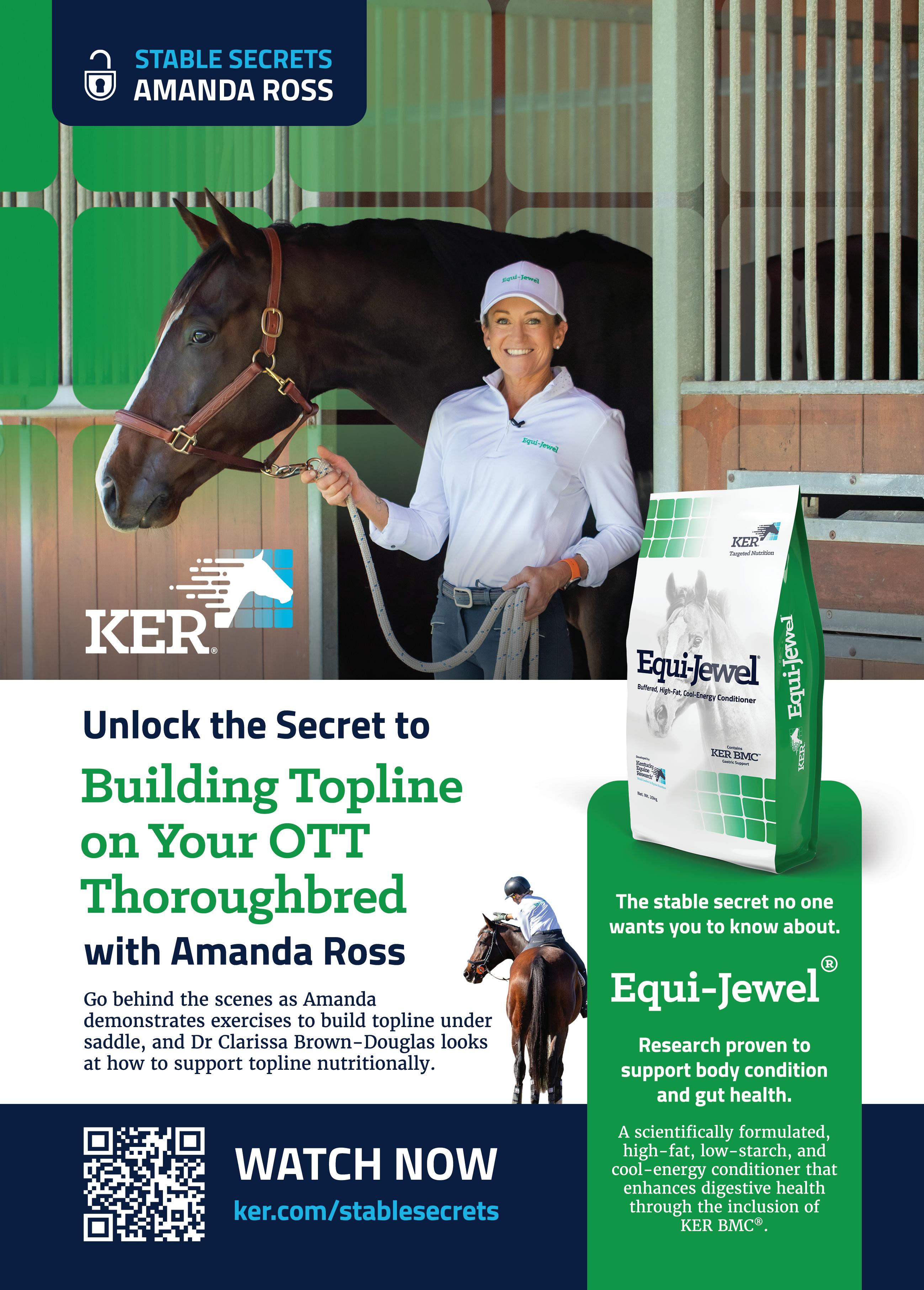
As our regular readers know, we take a keen interest in OTT horses, so it was exciting to hear that Olympian Amanda Ross has taken on the post-racing career of Godolphin’s multiple Group 1 winner Cascadian. With a wealth of experience in retraining retired
Thoroughbreds, she shares her expert advice on building and maintaining Thoroughbred topline in this issue.
Still on the topic of OTTs, this month’s Life After Racing shines a light on Queensland’s Clare Denzin whose very first horse was Dash of Black, son of the legendary 11-time Group 1 winner Lonhro. She now owns three OTTs - a pattern is emerging!
Also in this issue, Dr Jennifer Stewart explains how overtraining can cause chronic fatigue and behavioural changes, while Nicole Creed demystifies the data behind your horse’s heart rate monitor.
And let's spare a thought for the many owners who are managing the challenges of rain and humidity. Dr Caroline Spelta’s advice on diagnosing and treating the skin conditions common in that climate is a must-read guide for keeping our horses as comfortable as possible.
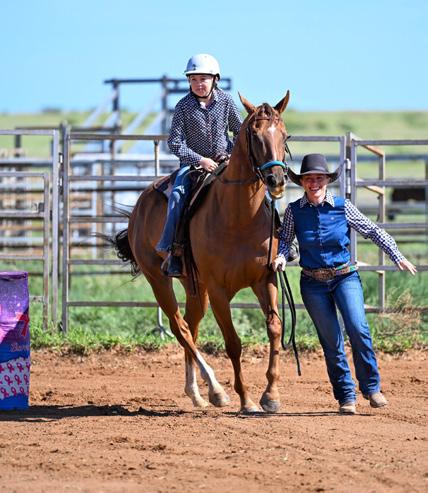
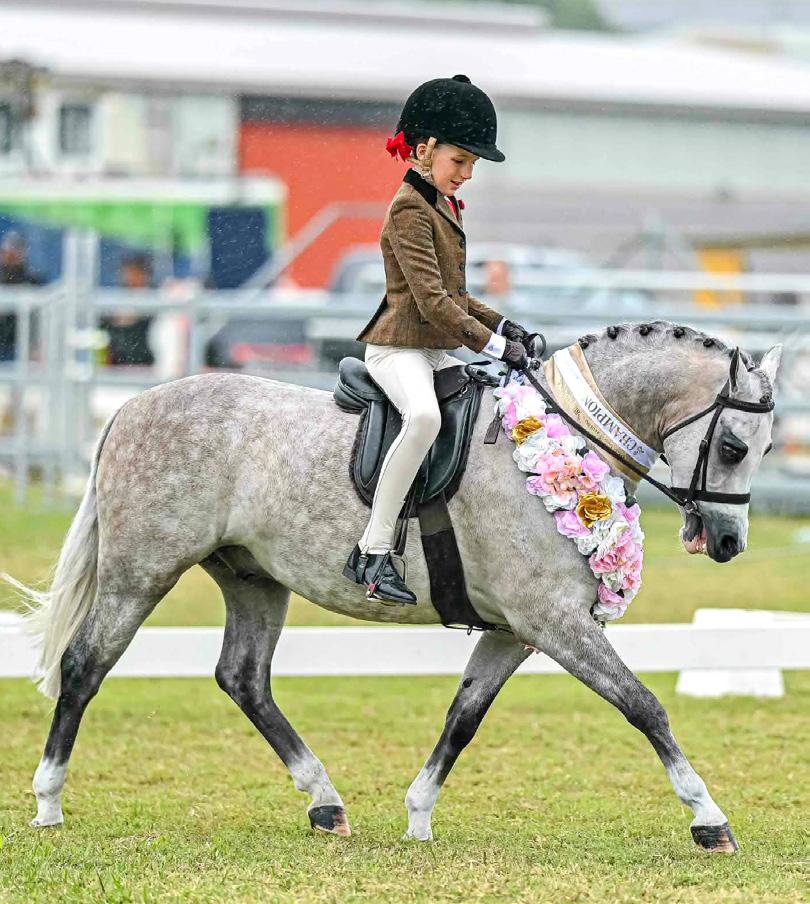
We also introduce you to our Young Rider Macy Crane, a 10-year-old with big dreams, a huge personality and a great attitudeyou'll love her.
Shannon Smith captures motion in full colour with her magical Behind the Shotand before you read Kylie Hawkins’ very
moving tribute to her beloved heart horse Calidor, make sure you have plenty of tissues nearby.
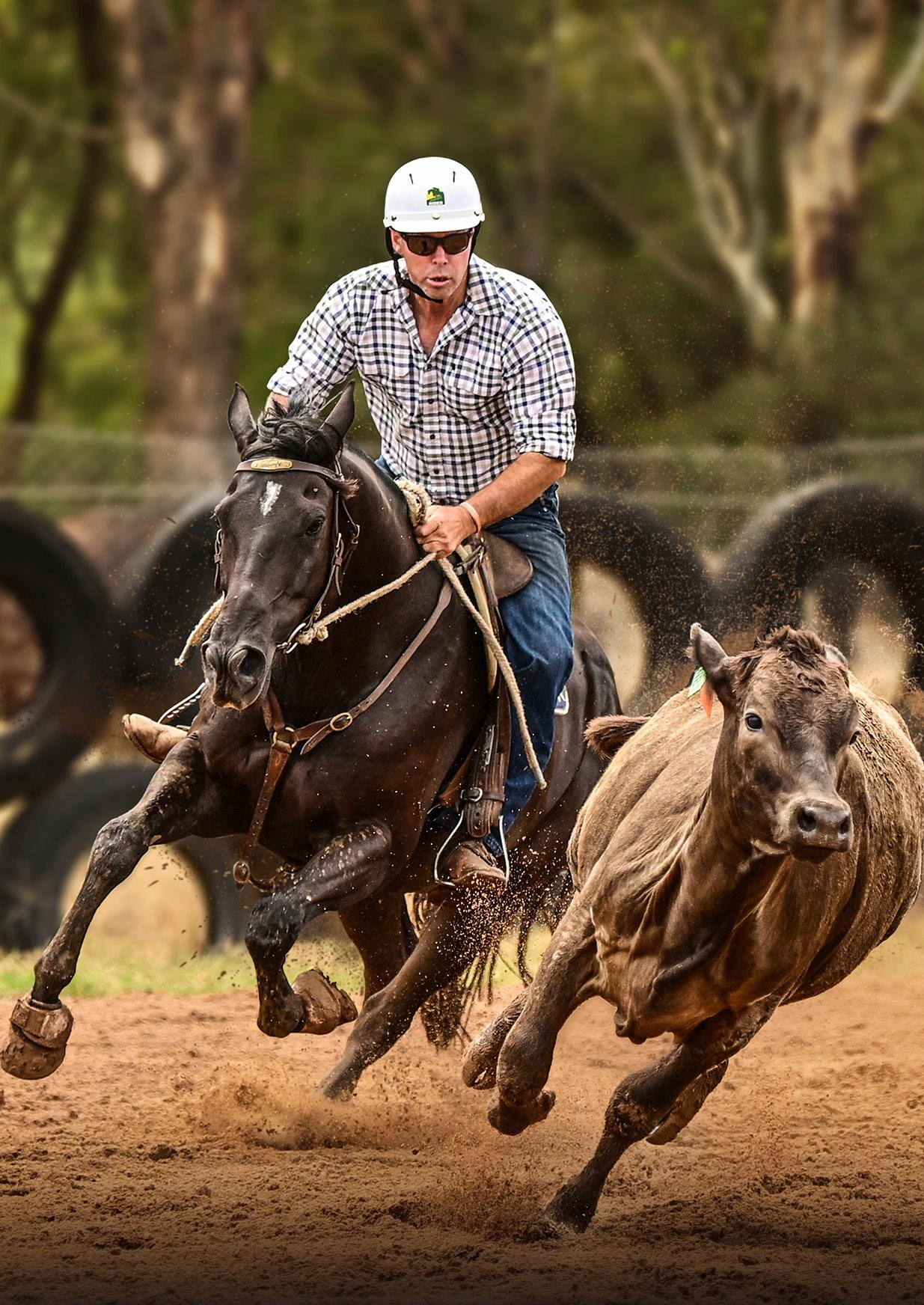
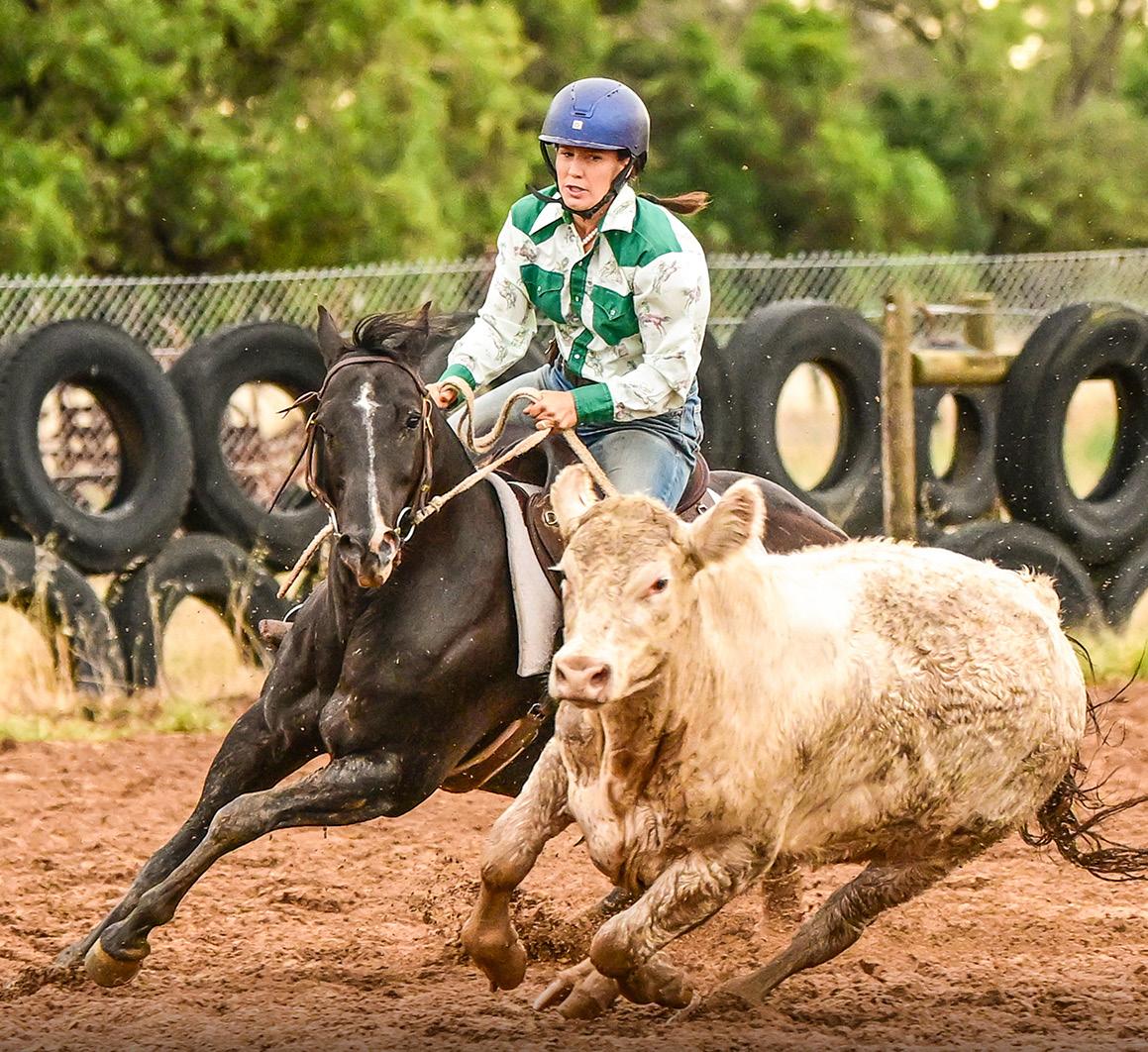
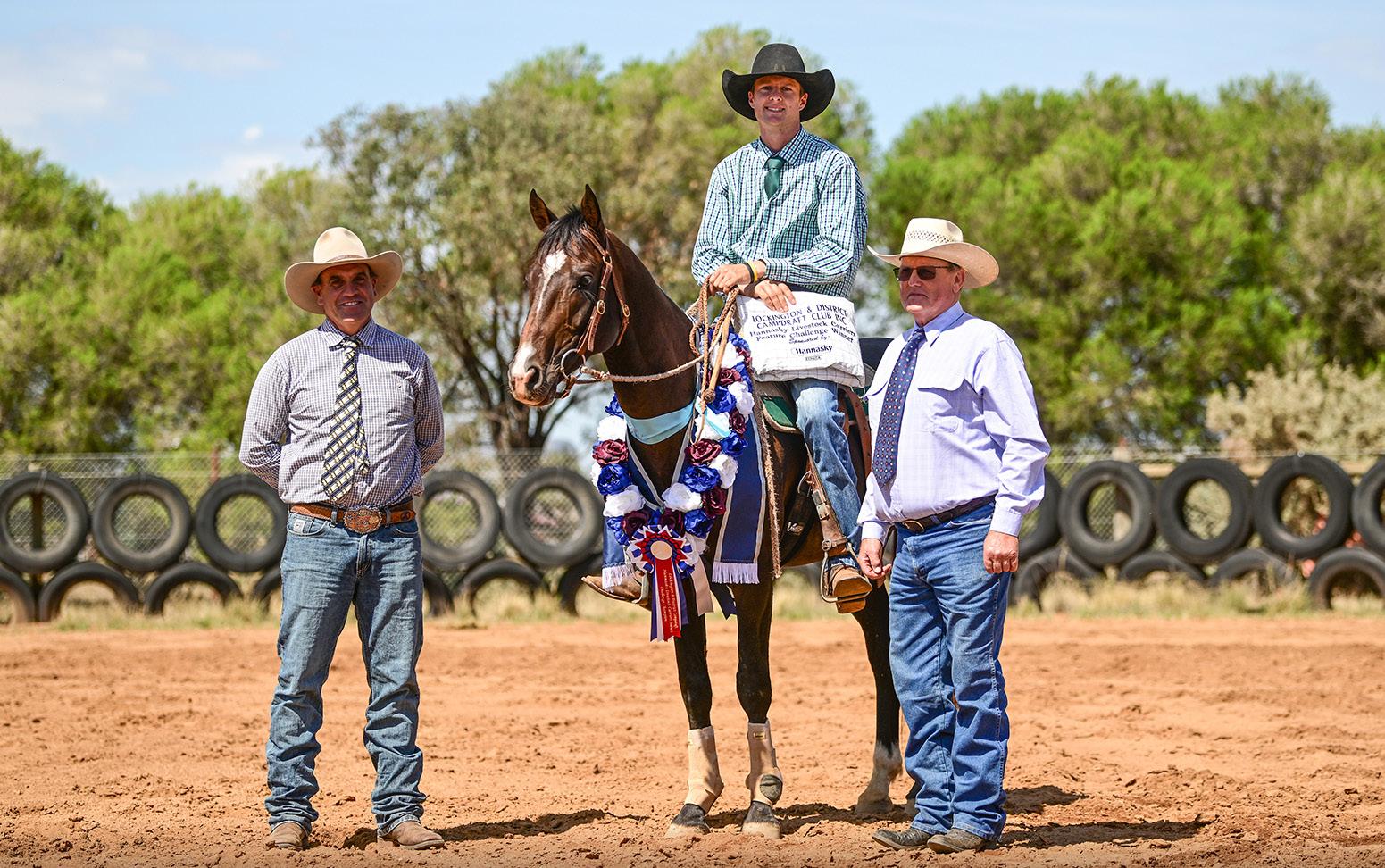
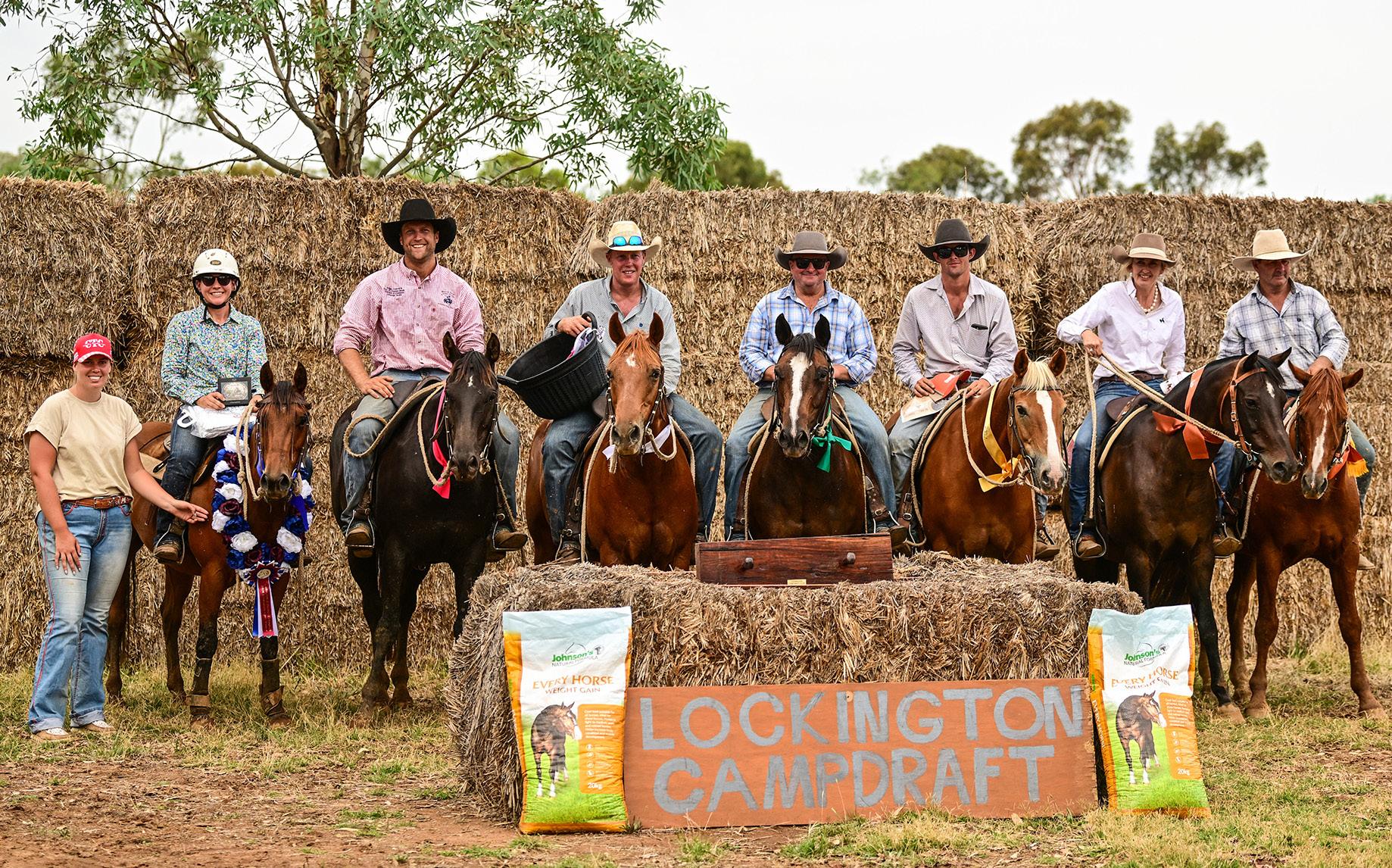
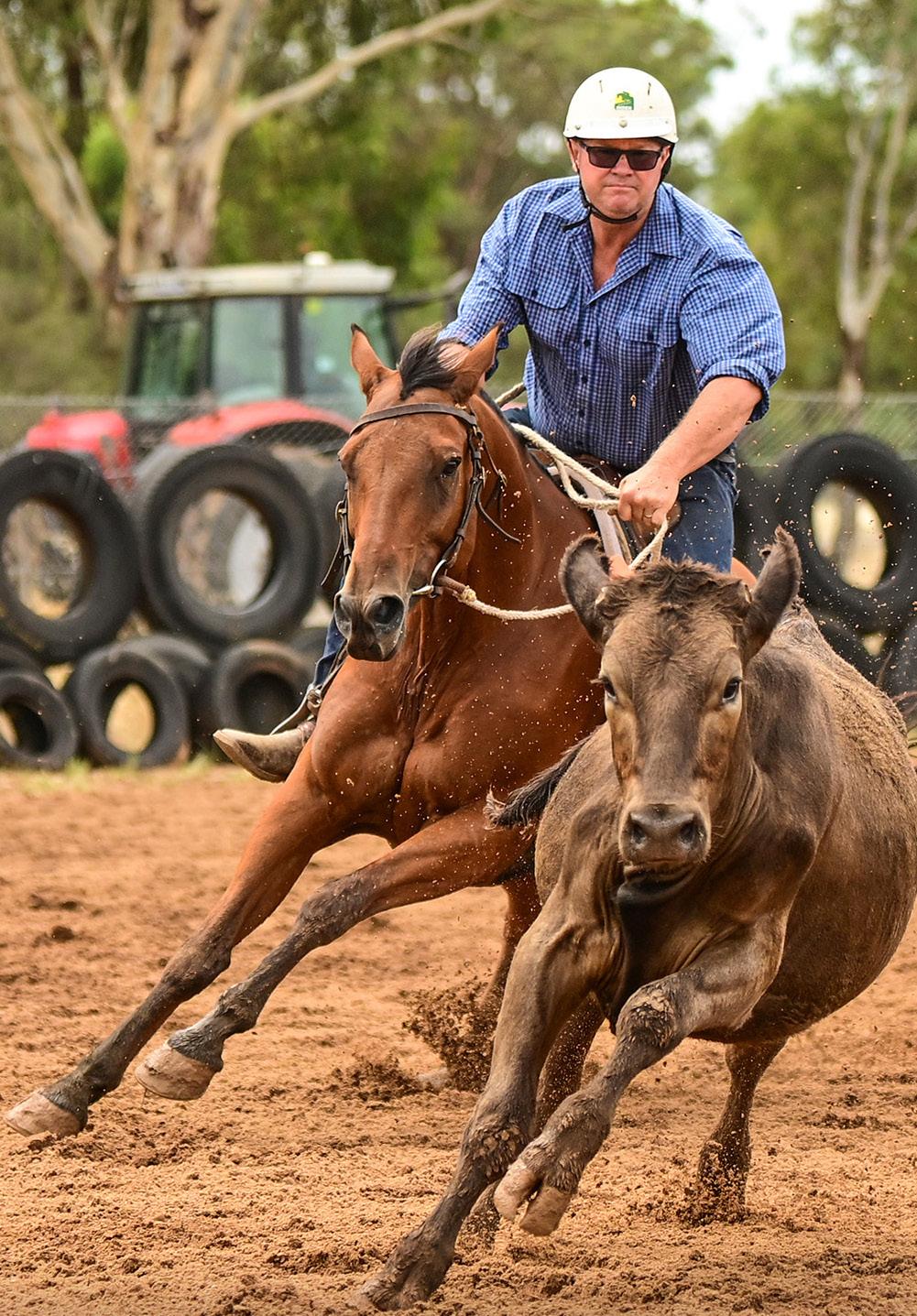
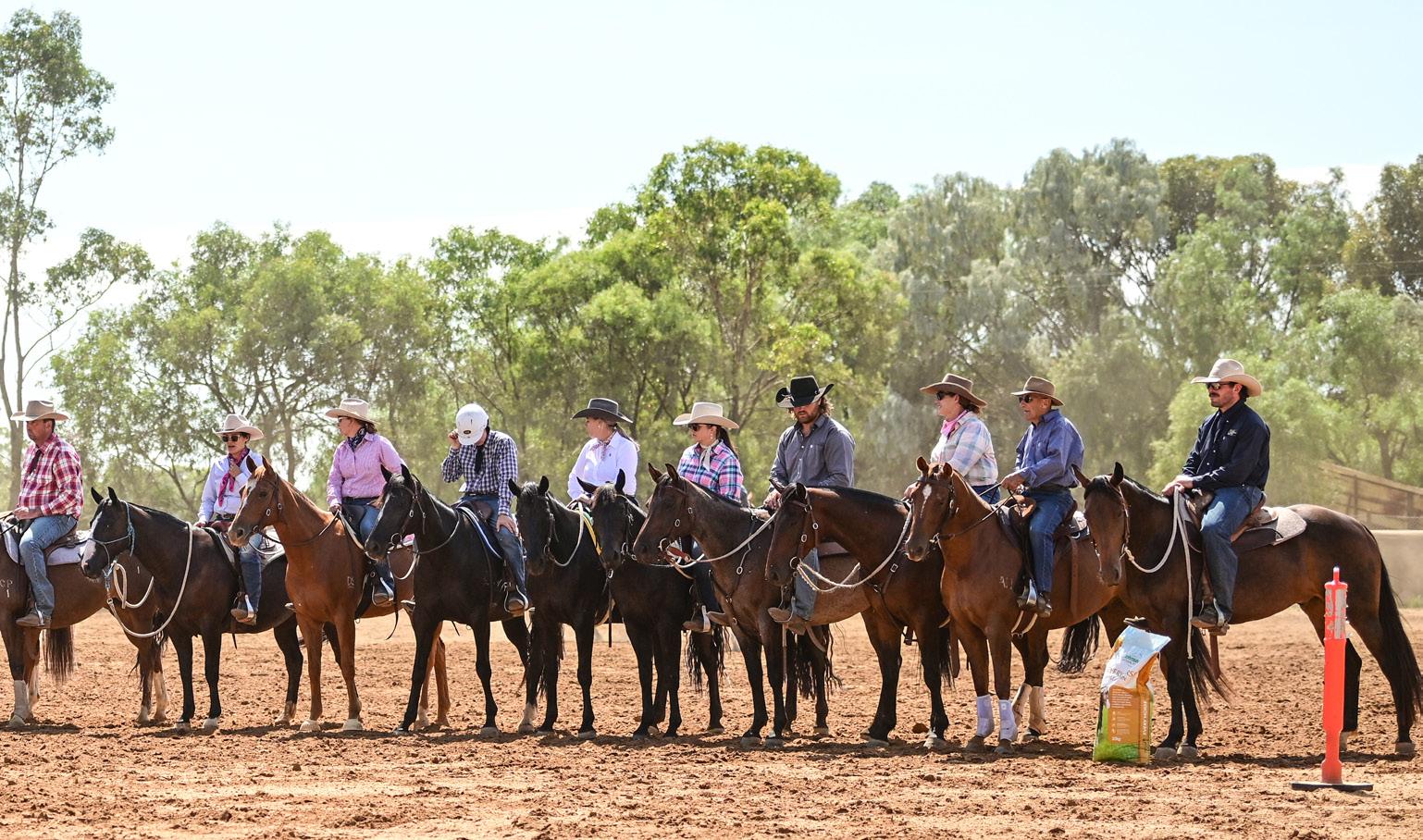
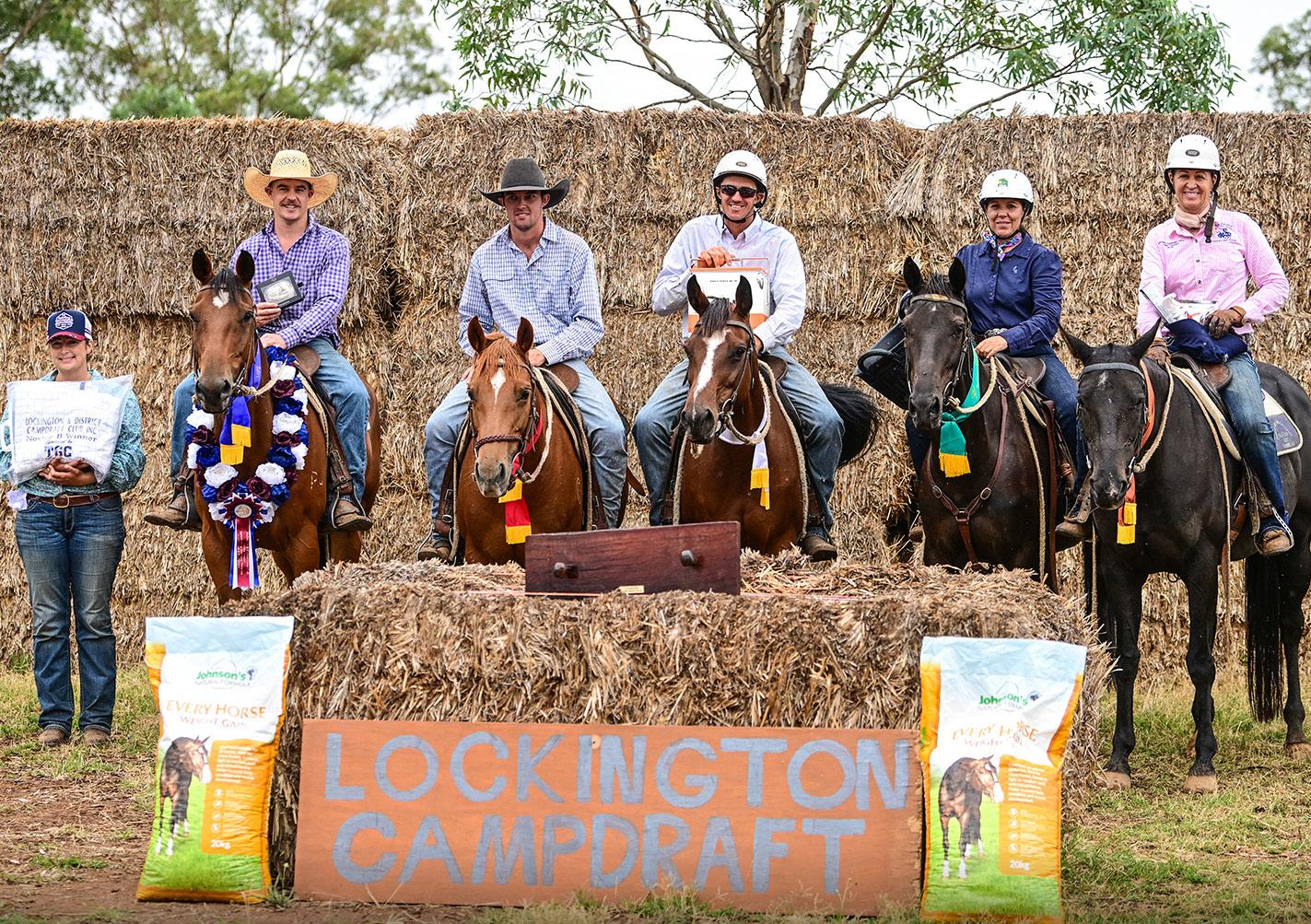
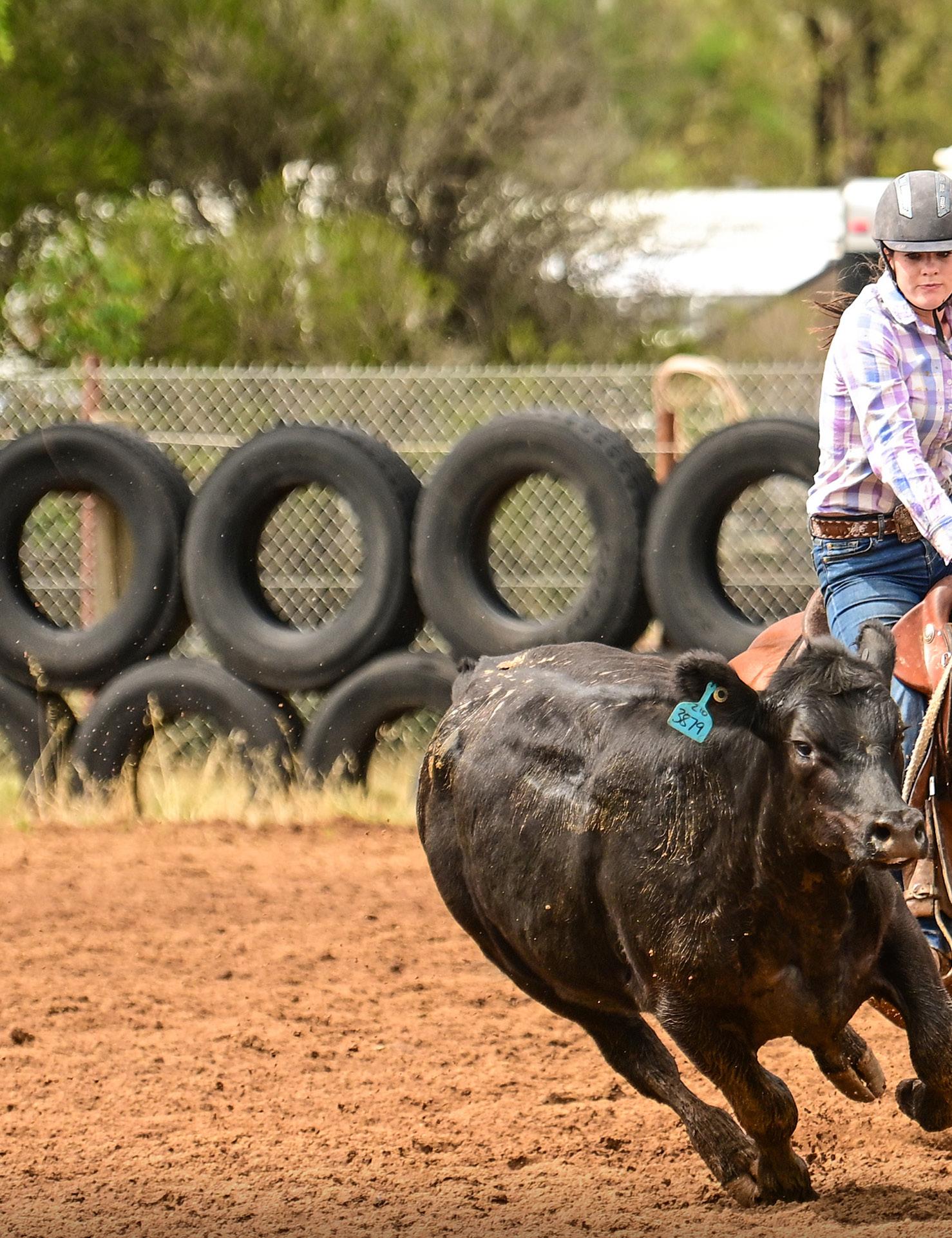
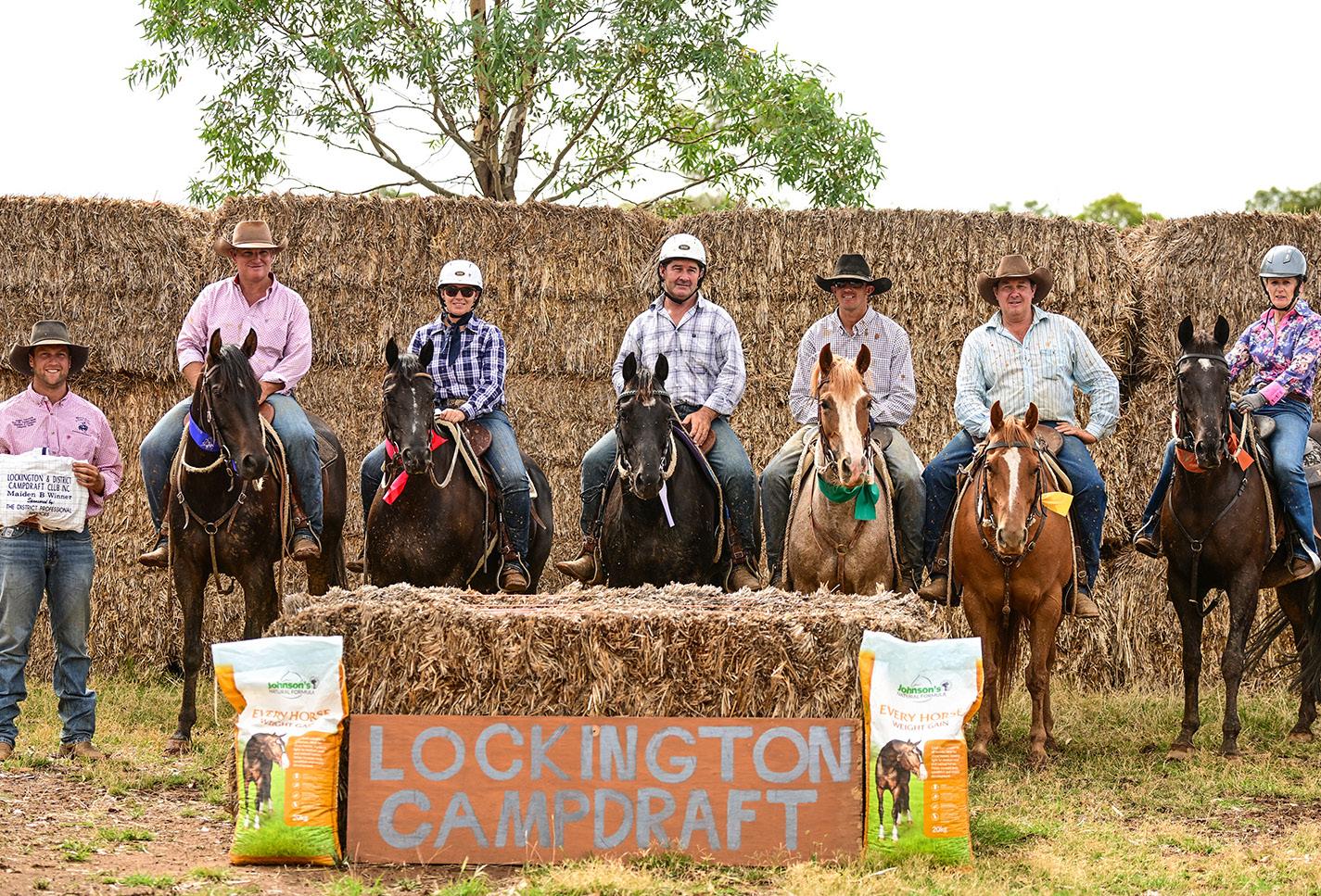
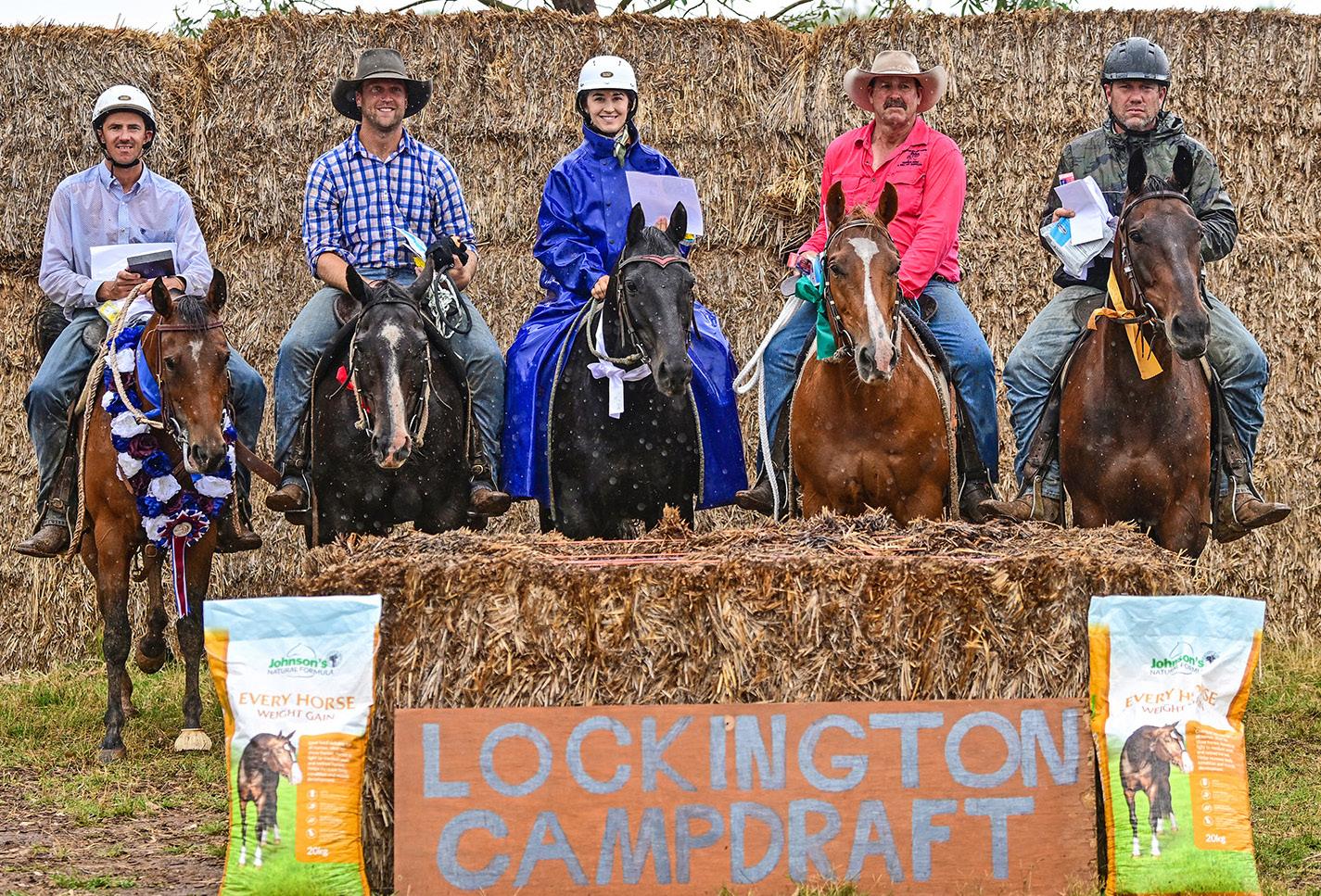
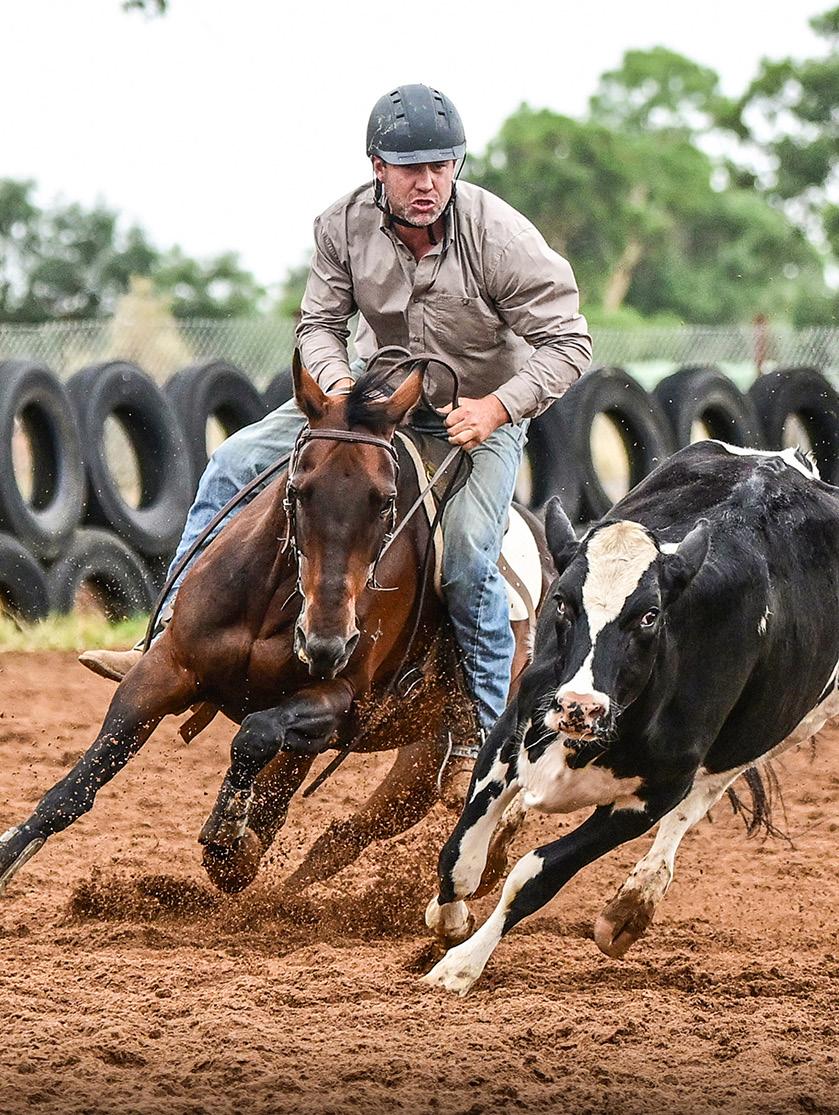
Then we head out and about with coverage of the Equis NSW Indoor State Show Jumping Titles, before bringing you all the action from the Lockington & District Campdraft Club's annual event.
As you’ve likely noticed, it’s the talented equestrian photographers who, with their skill and eye for detail, bring our event coverage to life - and the team at Click Capture ticks all of those creative boxes. In our Founders feature, you’ll meet Jacquie Johnstone, the force behind the Click Capture brand, as she shares her inspiring story.
Anne-Marie Lasserre returns to usher in the era of the strong equestrian, and professional dressage rider Jordan Evans explores the importance of symmetry in the saddle.
Plus, in this month’s Point of View, Steve Halfpenny reminds us that sometimes the most powerful lessons come from horses who simply say ‘no’.
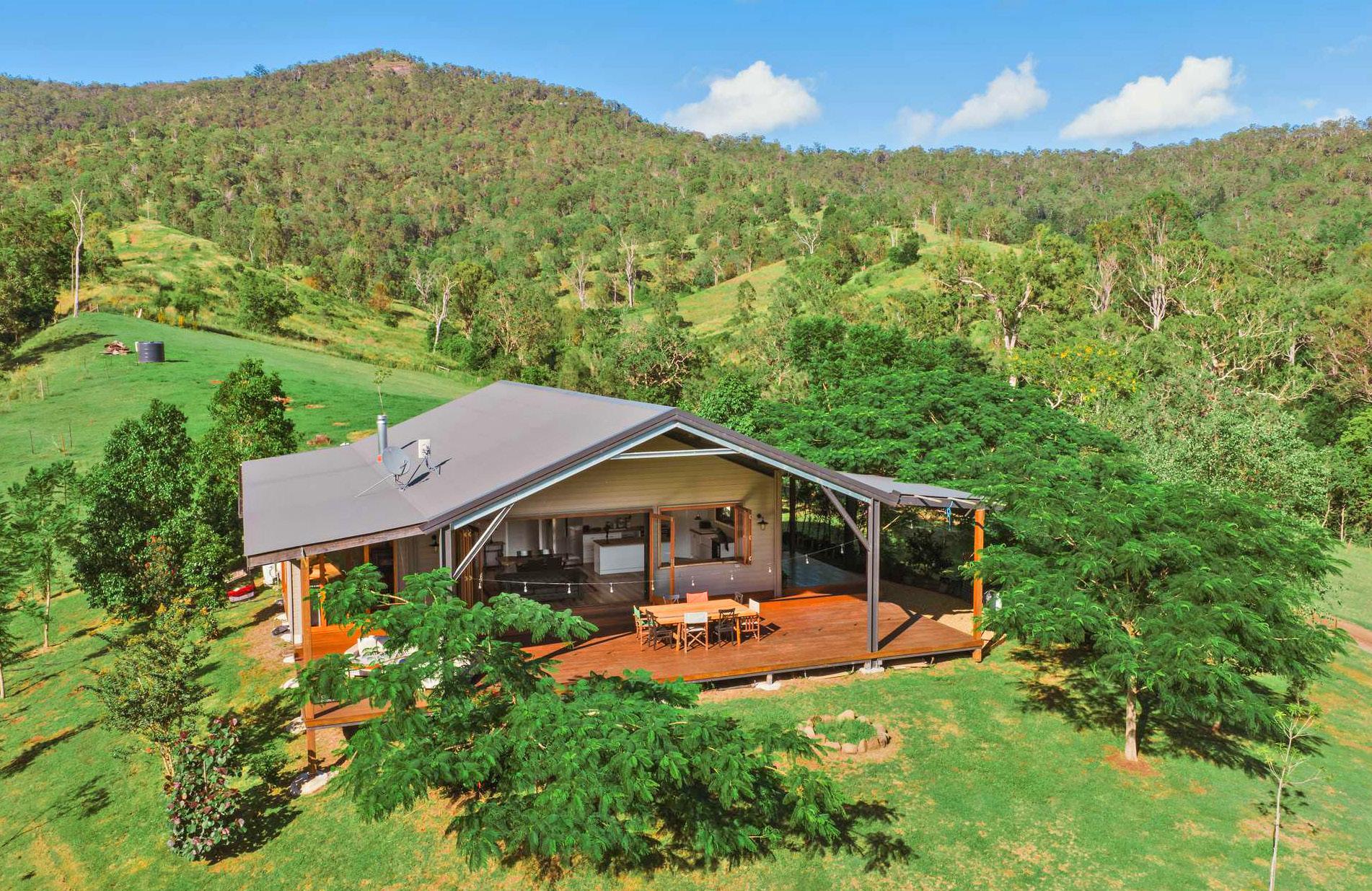
And of course, don’t miss our Mini News, equestrian properties that inspire, and this month’s What We Love, featuring some exceptionally smart show sets.
AMANDA MAC
EDITOR, EQUESTRIAN HUB
OUR CONTRIBUTORS
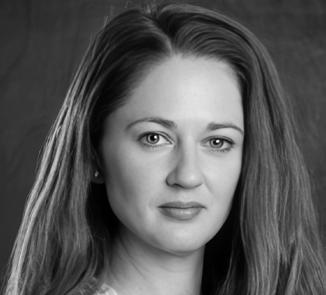
Kirsty Pasto
Based in Europe, Kirsty is an equestrian media specialist with 15 years experience in journalism and photography. She writes and photographs for the FEI, international magazines, and equestrian federations, producing features and visual content from some of the sport’s leading events. In this issue, she invites us to enjoy the elegance and spectacle of Saut Hermès in Paris.
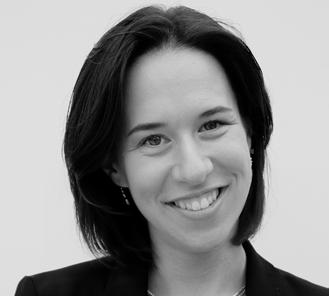
Amanda Ross
An Olympian and World Cup show jumper, Amanda Ross needs little introduction. Currently the Agistment Manager at Boneo Park, she is also an ambassador for the Victoria Racing Club and has a wealth of experience with OTT Thoroughbreds. Recently entrusted with Godolphin multiple Group 1 winner Cascadian's post-racing career, in this issue she offers her expert advice on building and maintaining topline.
Steve Halfpenny
Steve is a horseman, award-winning filmmaker, Equitana Australia presenter and bestselling author. The founder of Light Hands Equitation, he travels extensively, helping riders and horses around the world, and delivering in-person clinics and online training programs. In this issue he shares what one horse taught him about trust, timing and true communication.
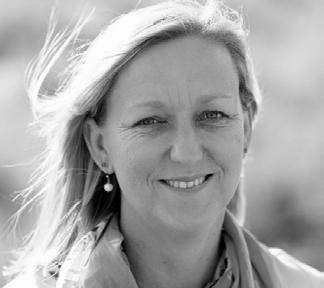
Dr Jennifer Stewart B.V.Sc., B.Sc., Ph.D.
With over 40 years’ experience as a veterinarian in mixed and equine practice, Jennifer’s special interest is equine nutrition. She was a Senior Veterinary Officer with the Australian Department of Agriculture, Water and the Environment for 10 years, and a Biosecurity Veterinarian with the ACT Government for two years. This month, she looks at the problems associated with overtraining.
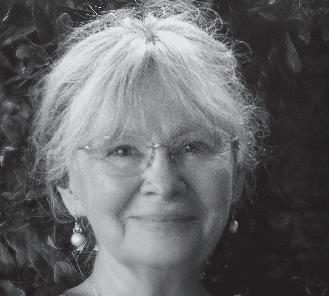
Dr Caroline Spelta B.V.Sc. (Hons), MANZCVS, DECEIM
Caroline specialises in equine medicine. Boarded with the European College of Equine Internal Medicine and a Member of the ANZCVS, she has extensive expertise in Australasian equine internal medicine and toxicology, with special interests in ophthalmology, neonatology, and intensive care. In this issue, she discusses the skin problems that often plague horses in wet, humid weather.
Anne-Marie Lasserre
Anne-Marie is a Miss World and Miss Universe Figure Champion. She’s an AOR dressage rider, and a specialist coach in aesthetics, sports performance and nutrition. She is dedicated to empowering equestrians to achieve peak fitness and personal transformatio. In this issue she explains why explains strength is replacing 'skinny' in the saddle.
Jacquie Johnstone
The co-founder of Click Capture, Jacquie has over a decade in equestrian media Often found with a camera and oat latte in hand, she is proud of how synonymous Click Capture has become with Australia's Equestrian media scene. Along with her team, she brings a person-centred, creative mindset to every project. She is featured in this month’s Founders article, and her story is one not to miss.
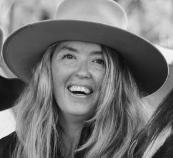
Amanda Mac As Equestrian Hub Magazine's editor, Amanda’s two long standing passions, one for horses the other for writing, come together perfectly. Originally from the UK, she was a working pupil in the yard of the legendary Cherrie Hatton-Hall while studying for her British Horse Society qualifications. Then followed a stint teaching in New Zealand, before arriving in Australia.
OUR CONTRIBUTORS
Shannon Smith
With over 20 years in the industry, Shannon is the driving force behind La Bella Vita Photography. The realisation of a dream to turn her property into a delightful location for memorable and creative client photo sessions, she specialises in whimsical, magical equine images as well as family, newborn, maternity and pet portraiture. We are delighted to feature her work in this month's Behind the Shot.
Kayla Walker
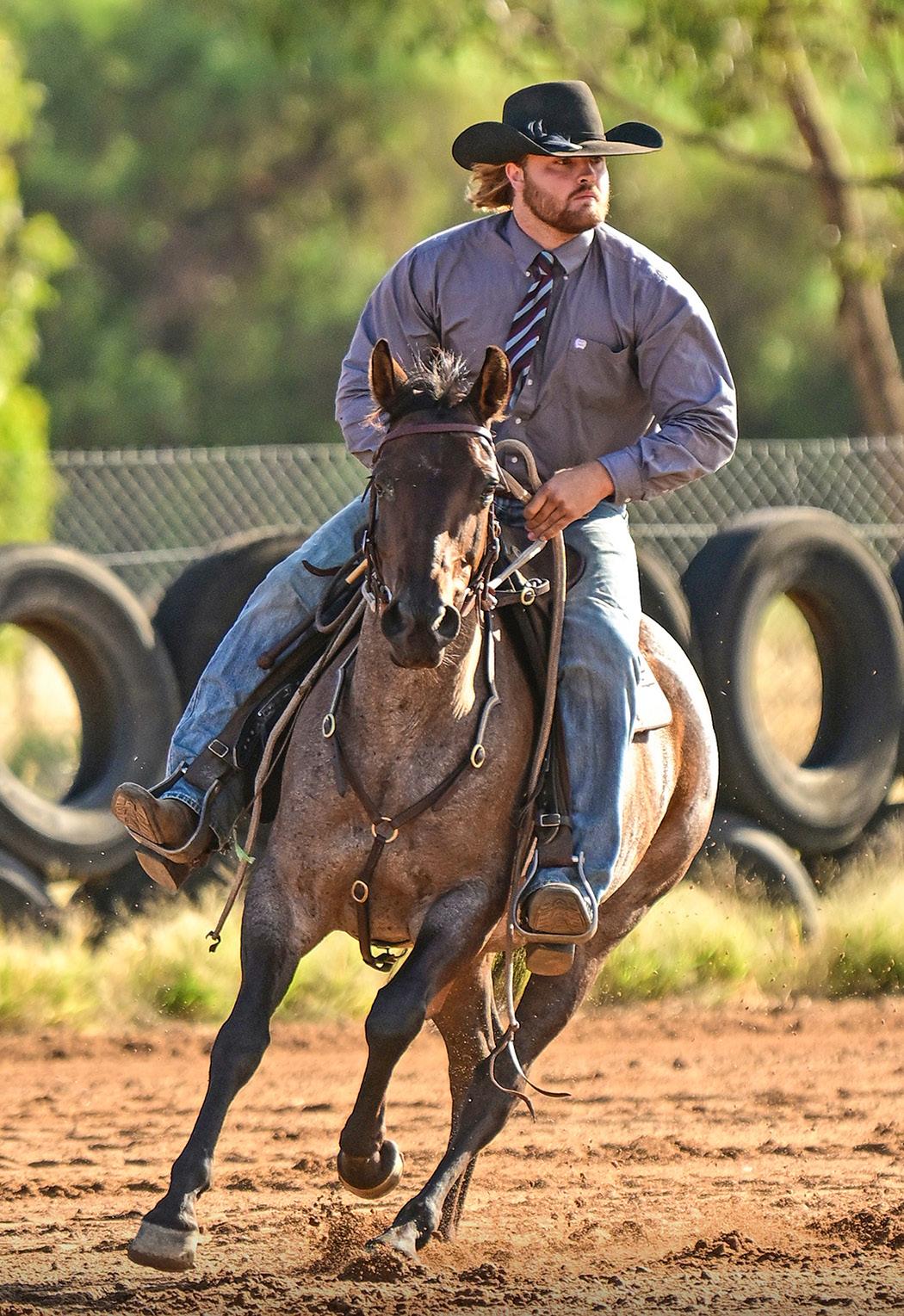
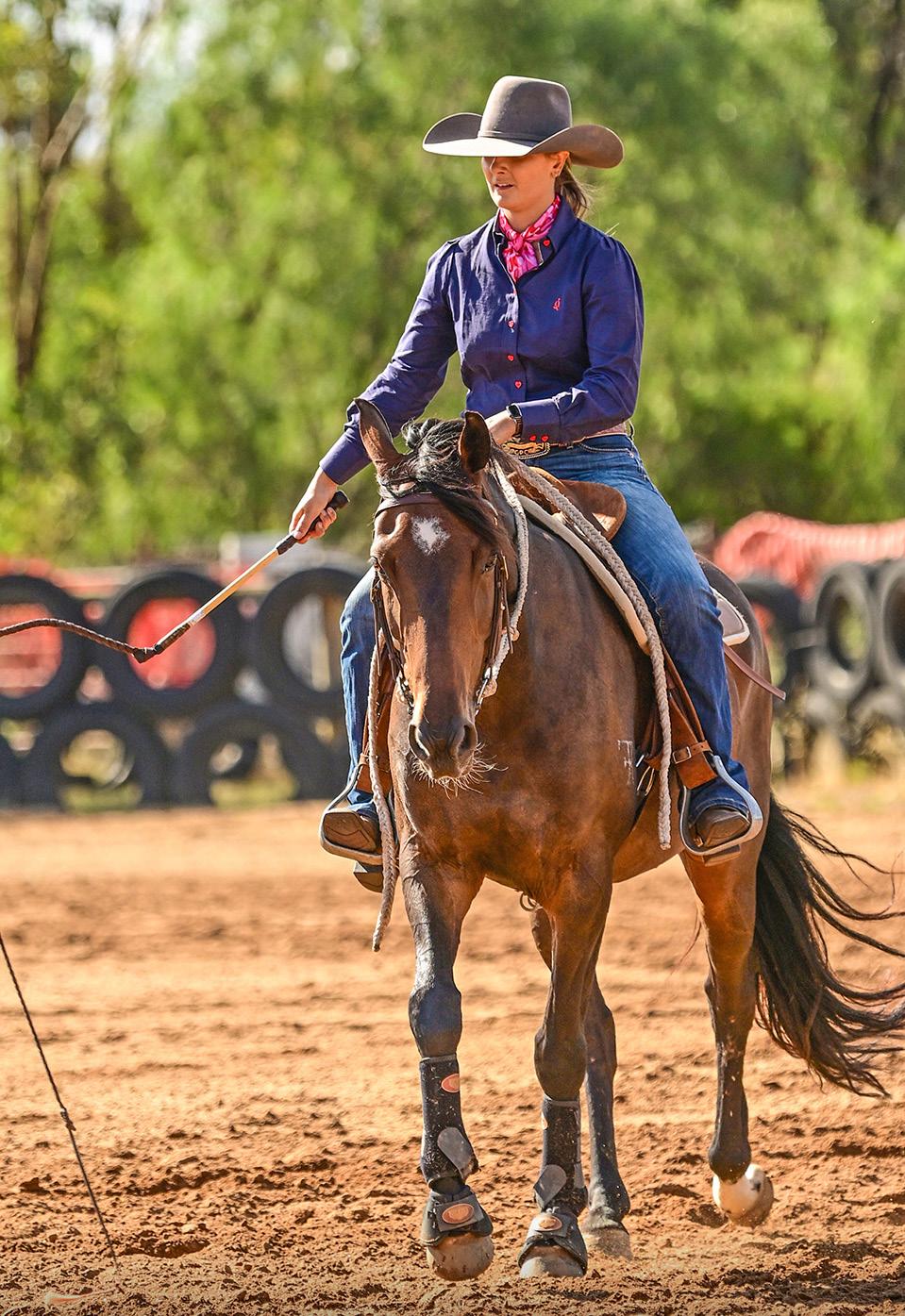
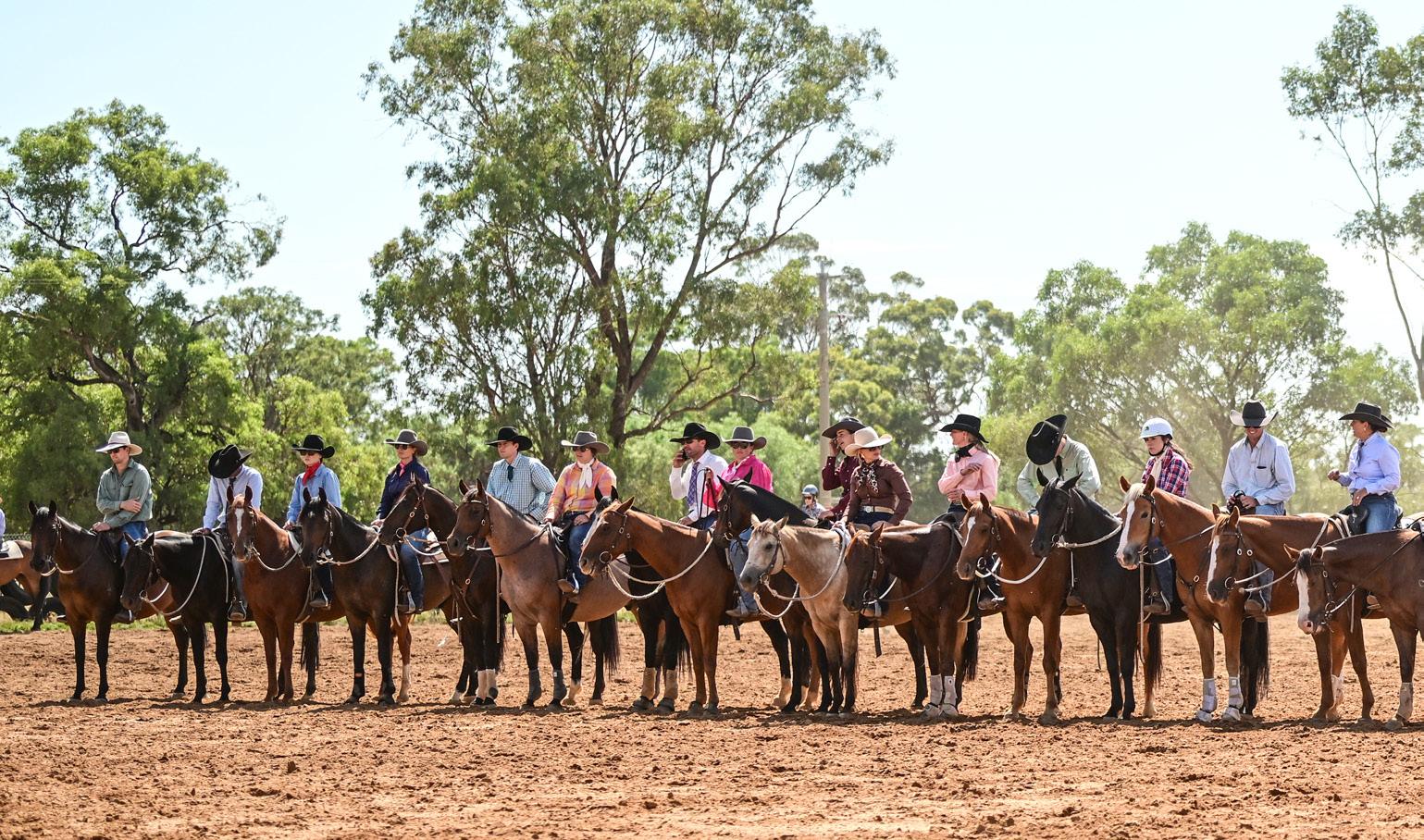
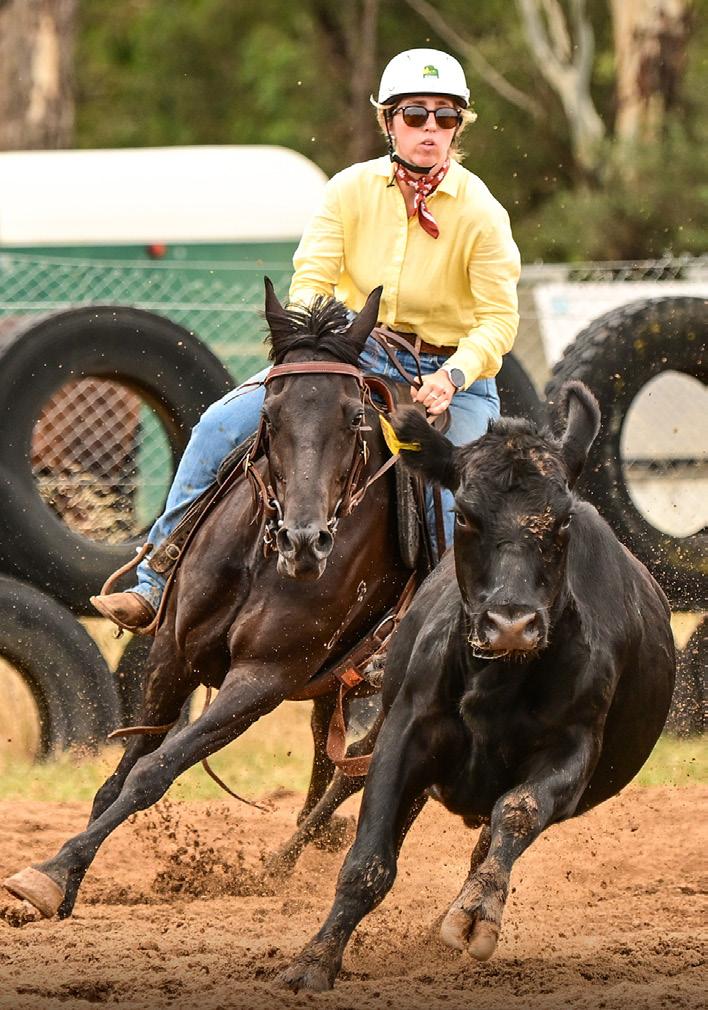
Kayla started campdrafting with the Lockington & District Campdraft Club as an 8-year-old. Coming up through the ranks, she took on organisational roles within the club and, as well as running her Stockhorse stud alongside her partner, is now the club's event and sponsorship coordinator. Don't miss Kayla's report on the club's recent annual campdraft, plus a great photo roundup.
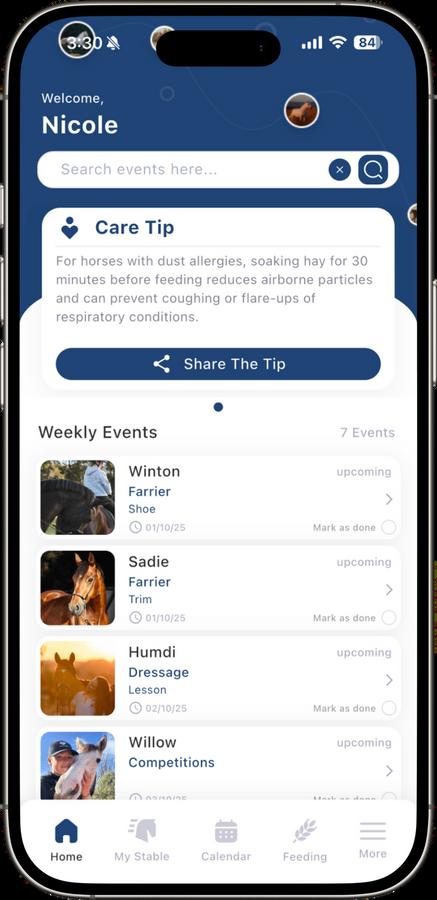
After years of competing and coaching across Australia, the USA and France, Nicole realised that the equestrian world is full of passion but mired in outdated systems. Enter EquiCare. Founded by Nicole, the app is designed to help riders stay organised. In this issue, she looks at heart rate monitors, the difference between aerobic and anaerobic activity, and why it all matters.
Sam Cavallo
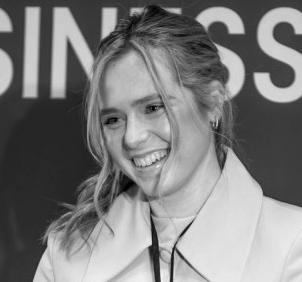
Sam is the publisher of Equestrian Hub and Equestrienne Magazine. She has a keen interest in international events and a passion for equestrian culture and lifestyle, with a focus on community, authentic storytelling, and the people behind the sport. She is committed to amplifying grassroots voices and supporting education and positive change within the equestrian community.
Nicole Creed
Apiam’s equine veterinary credentials are well-founded with a growing number of purpose-built dedicated Equine Vet Clinics and Referral Hospitals located in Victoria, New South Wales and Queensland, working alongside our network of mixed practice clinics in delivering quality equine veterinary care.
Find out more by visiting the
&
Scenic Rim Veterinary Service
Beaudesert QLD
Agnes Banks Equine Clinic
Agnes Banks NSW
Hunter Equine Centre
Scone NSW
Victorian Equine Group
Bendigo VIC
Gippsland Equine Hospital
Maffra VIC
Southwest Equine Veterinary Group
Warrnambool VIC
Animal Supplies
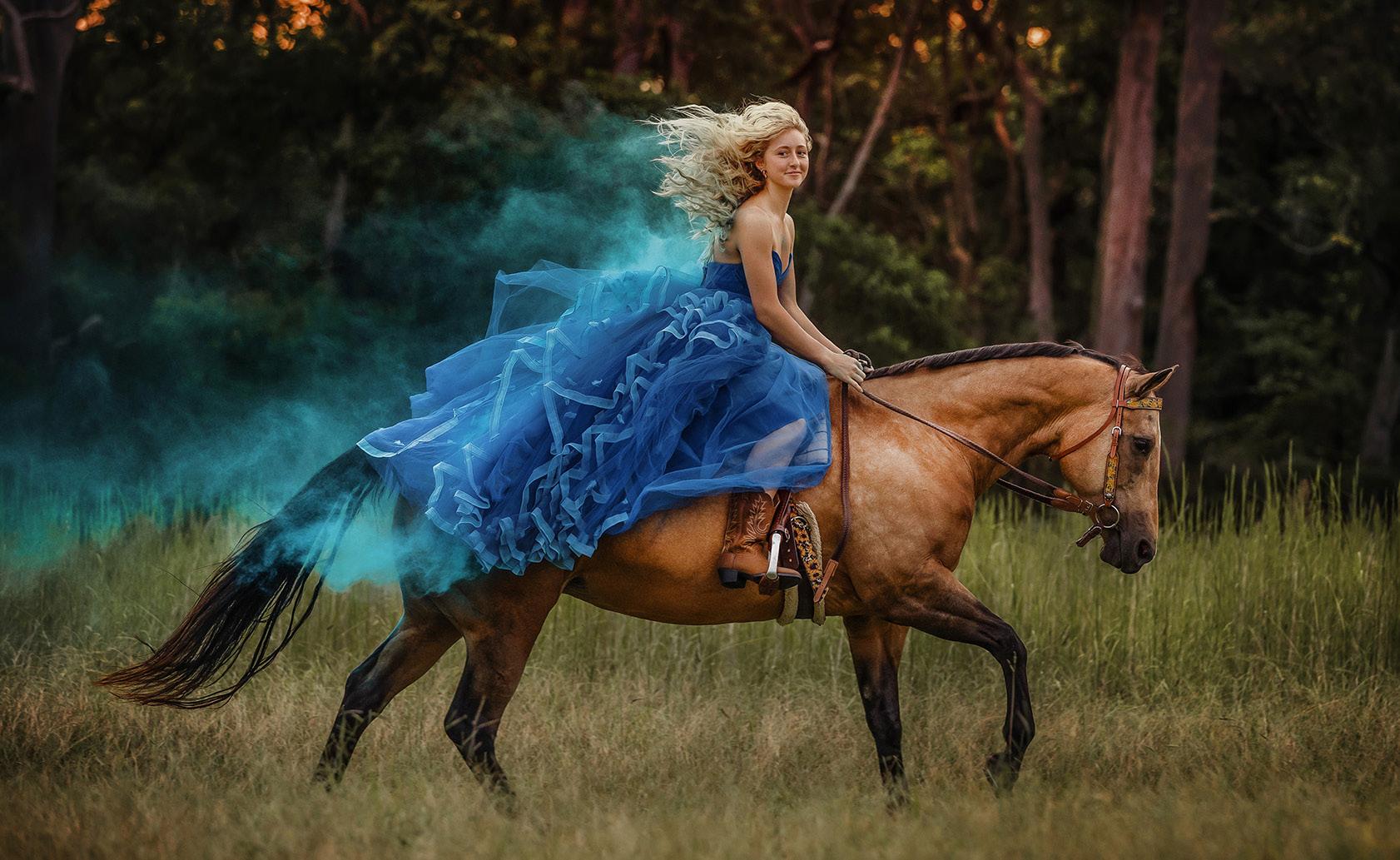
BEHIND THE SHOT
Colour in Motion
SHANNON SMITH is a creative through and through, and likes nothing better than turning her ideas into stunning reality.
Location: Lake Maquarie, NSW
Camera Settings: Canon R6 Mark II, Canon 70-200, 1/1000 sec f3.5, ISO 640
This image was born from a creative concept I had been envisioning for quite some time.
I’d seen coloured powder used in equine shoots before, but never outdoors, and never paired with a rider in an extravagant full gown.
My aim was to match the powder to the blue of the dress, creating the illusion that the colour was trailing behind as they cantered past.
I put out a model call for a horse and rider who could transition smoothly from
a standstill into a canter. Ally and Rosie applied, experienced in campdrafting, they were perfectly suited to the task. I asked Ally to trust the process without revealing too much, as I prefer to keep my creative ideas under wraps until they come to life.
There was a lot of uncertainty going into the shoot. What if it was a windy day and the powder didn’t stay put; would the powder disperse beautifully or fall in clumps; how much to use; how to apply it; how long would it remain visible in frame? Captured during a warm, late afternoon, the entire session relied solely on natural light,
Technically, I needed a fast shutter
speed to freeze both the motion and the powder in the air. Shooting at f/3.5 allowed for background compression while keeping the focus on the horse and rider, and an ISO of 640 gave me the flexibility to maintain that higher shutter speed.
With creative sessions like this, I never quite know how things will unfold, especially when bringing to life an idea that exists only in my mind. I can’t show anyone a reference picture because I am creating something I haven’t seen before.
Despite all the unknown factors, I was absolutely thrilled with the result, and with the response it received when I shared it on my socials.
I love pushing boundaries in my work, creating images that capture attention and spark imagination. These kinds of photo sessions allow me to experiment without a client's expectations, to stay inspired, and to continue evolving the style that sets my work apart.
Visit La Bella Vita Photography to see more of Shannon's stunning images, or follow her on Instagram, or on Facebook
MINI NEWS
QOTT SUPPORTS BARRELS 4 A CAUSE
QOTT proudly supported the Barrels 4 A Cause event in March through its Event Sponsorship Program, where Off-The-Track Thoroughbreds showcased their versatility. Sharni O’Toole and Window Tapper claimed first place, while Jackie Garden and Kosowski secured second. Both combinations impressed with speed, partnership and presence. The event highlighted the success of OTT retraining pathways, with each horse proving a powerful ambassador for life after racing and the adaptability of the thoroughbred beyond the track.
DALERA BB WELCOMES FIRST FOAL
Legendary dressage mare Dalera BB has welcomed her first foal, a black filly named Dolce Vita BB, born on 9 March in Germany. The dual Olympic champion, ridden by Jessica von Bredow-Werndl, retired after her Paris 2024 victory and was bred to Vitalis. Dalera dominated international dressage between 2021 and 2024, earning multiple championship titles. Her transition to broodmare marks an exciting new chapter, with the next generation of her exceptional bloodline now underway.
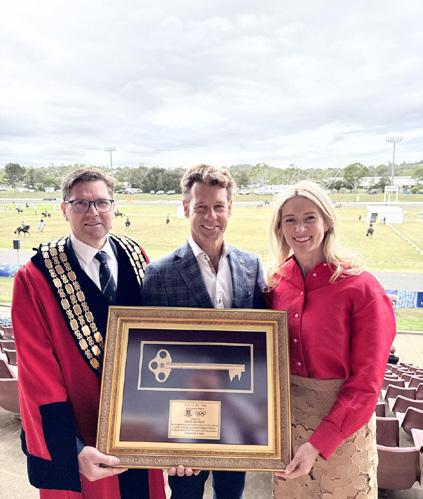
CHRIS BURTON AWARDED KEYS TO THE CITY
Olympian Chris Burton will be honoured with the Keys to the City of Toowoomba, recognising his outstanding international achievements and connection to his hometown. A dual Olympic medallist, Burton claimed individual silver at the Paris 2024 Games and team bronze in Rio 2016. Mayor Geoff McDonald described the honour as the Council’s highest recognition. Burton’s success continues to inspire regional riders, while his advocacy strengthens Toowoomba’s case to host equestrian events at the Brisbane 2032 Olympic Games.
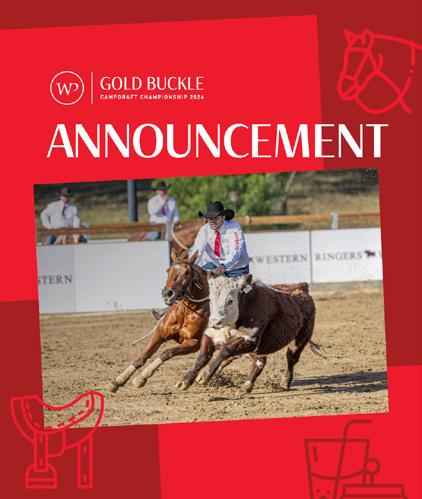
GOLD BUCKLE CAMPDRAFT
POSTPONED
Willinga Park has announced the postponement of the 2026 Gold Buckle Campdraft Championship, originally scheduled for 13–16 May. Organisers cited a desire to maximise participation, particularly amid rising fuel costs and travel challenges impacting competitors nationwide. The decision follows consultation with the campdraft community, acknowledging the commitment required to attend. The event will return at a later date, with organisers focused on delivering a stronger, more accessible championship experience for competitors, spectators and the wider community.
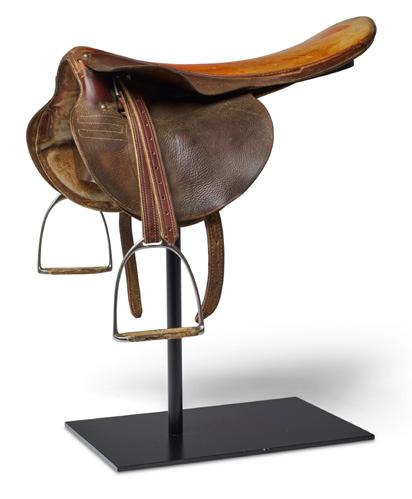
HISTORIC SADDLE BREAKS RECORD
AT AUCTION
The custom saddle used by jockey Ron Turcotte during Secretariat’s 1973 Triple Crown has sold for $1.524 million at Christie’s, setting a new record for horse racing memorabilia. Part of the Jim Irsay Collection, the saddle includes original fittings, signed photographs and letters of authenticity. Turcotte described it as a symbol of a “magical time” in his career, further elevating its significance as one of racing’s most treasured and iconic artefacts ever offered at public auction. www.christies.com
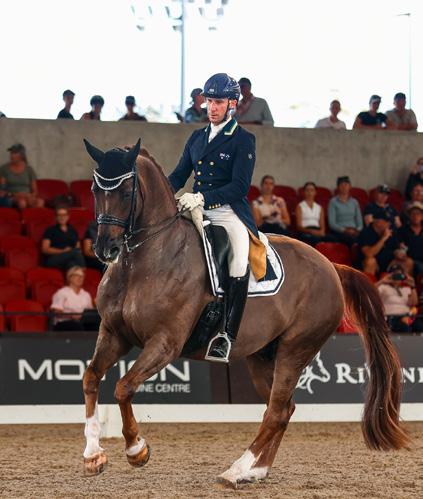
JAYDEN BROWN AND QUINCY B CLIMB RANKINGS
Australian combination Jayden Brown and Quincy B continue their rise in the FEI Dressage World Rankings, now sitting at #22 (athlete) and #20 (horse). Their climb follows a dominant performance at Dressage by the Sea at Willinga Park, where they secured three CDI3* wins. Produced entirely in Australia, the partnership is proving that worldclass results can be achieved at home, challenging the notion that international bases are essential for success. inside.fei.org
The Importance of Rider Symmetry
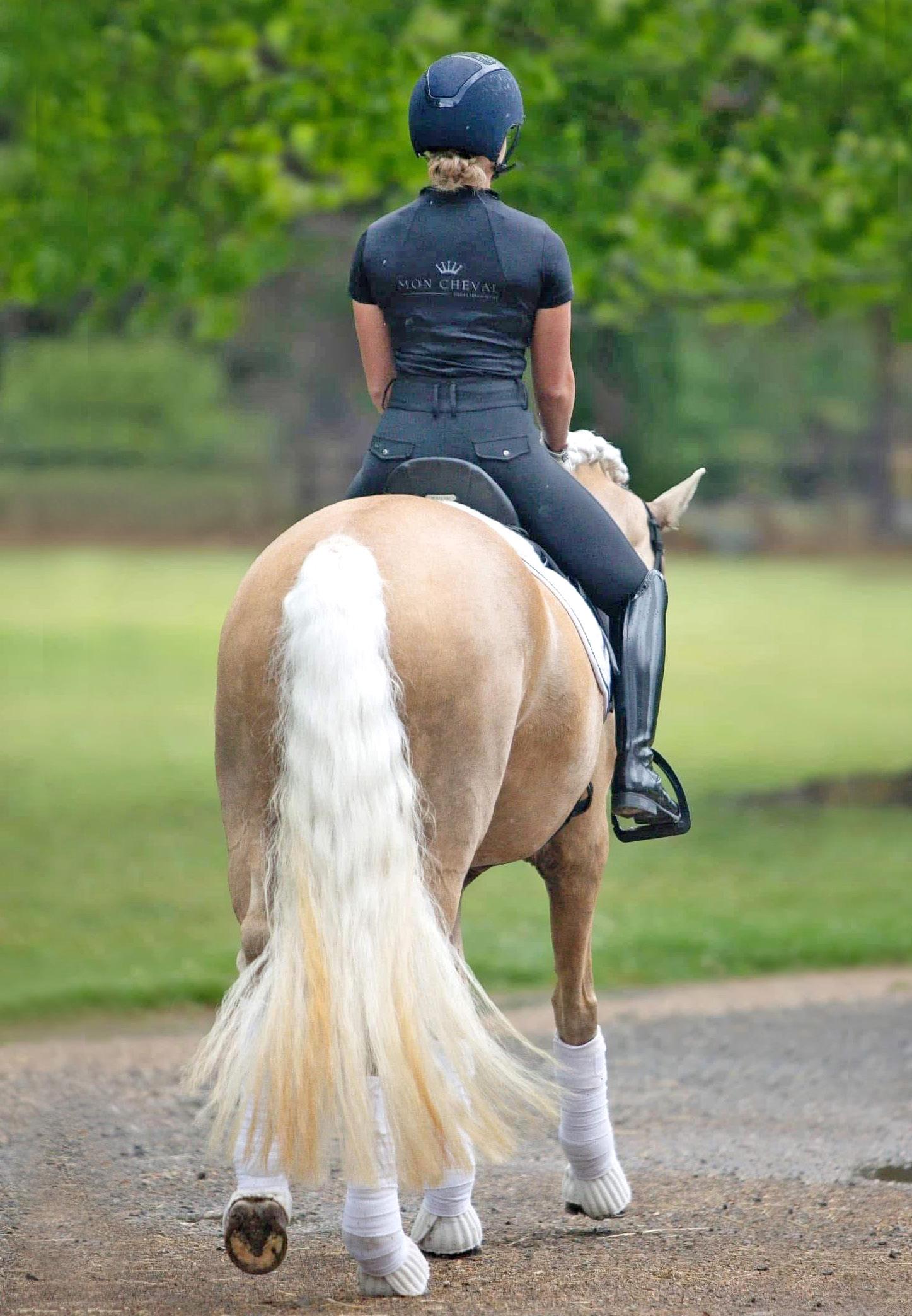
The concept of symmetry is subtle, but a lack of it can affect a rider's ability to sit independently of their horse, writes professional dressage rider JORDAN EVANS.
Sometimes the biggest factor in our riding isn’t just our timing, balance or even the clarity of our aids - it’s something that influences all of these on a much larger scale: rider symmetry.
It’s one of those concepts that can feel subtle, even invisible, but its impact is significant. When we begin to understand how our own bodies influence the horse, everything starts to make more sense - from resistance and crookedness to those moments where things suddenly feel effortless.
Horses are taught through pressure and release of our aids. But what happens when we unknowingly never release?
In many cases, a rider’s lack of symmetry affects their ability to sit independently of the horse. The result can be sitting too far on one seat bone, gripping with the legs for stability, or balancing on the reins. With compromised balance, the clarity of what you’re asking your horse to do is no longer straightforward, and this inevitably affects the way you and your horse communicate in your training.
Often, these patterns develop gradually and without awareness. What feels 'normal' to the rider may actually be a consistent imbalance that the horse is quietly compensating for. Over time, this can show up as tension, resistance, or a lack of straightnessnot because the horse is unwilling, but because the message isn’t clear.
One of my most influential coaches t old me at a young age that your horse will only go as well as your posture. For a long time, I struggled to pinpoint exactly what that meant.
Our horses are mirrors of ourselves, and in this case, the way we hold our own bodies. When we improve our own alignment, we often see immediate changes in the way our horses move, respond and carry themselves.
So what can we do?
I give my students a checklist when they are riding. Once the horse is through in the body, it allows us to shift focus to the rider’s posture and symmetry. Here are some of the key points I come back to regularly:
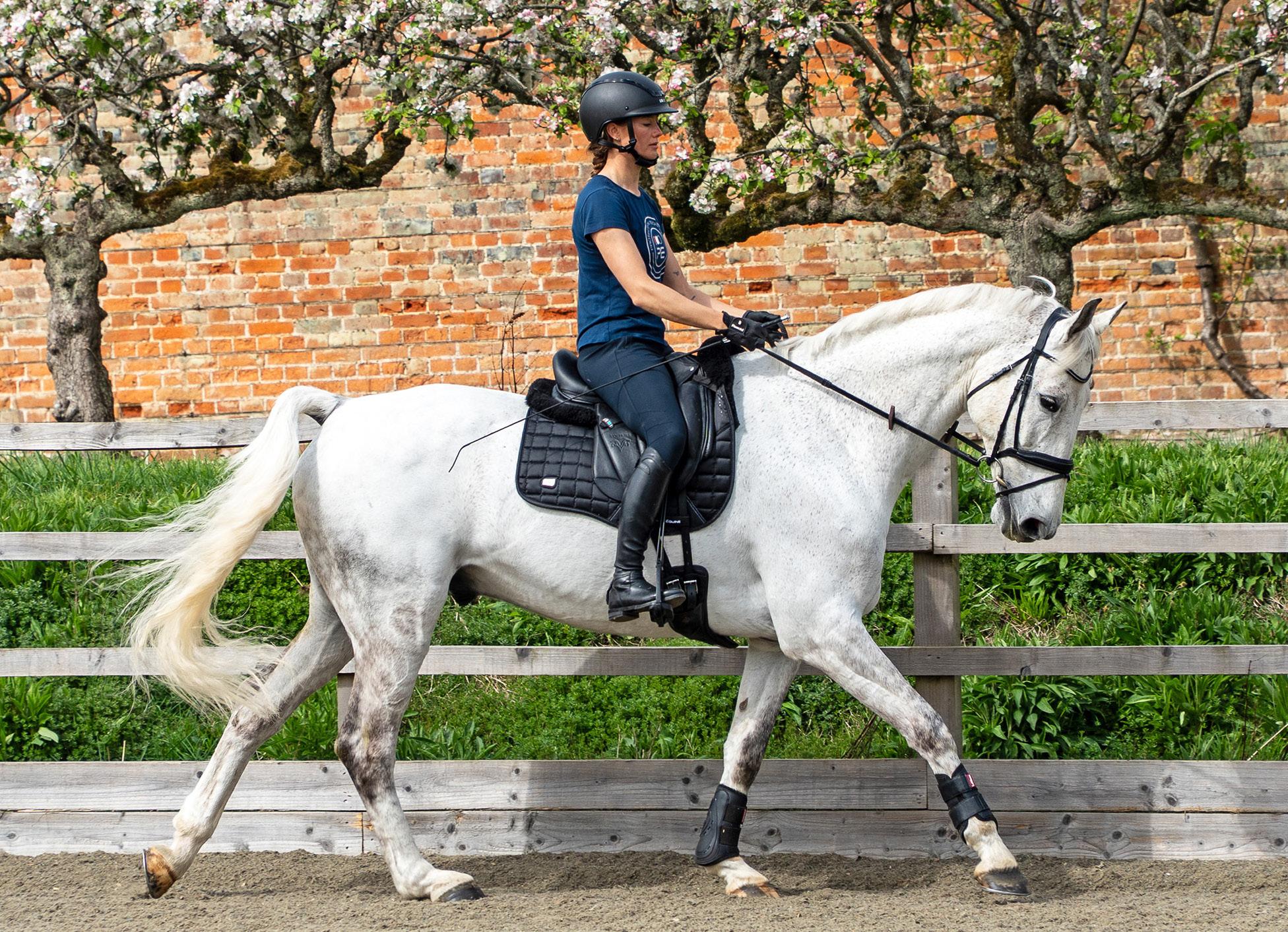
• Your heel, hip and shoulder should be in line with each other.
• Sit in the middle of the saddle with the ability to take all leg and hand aids off, maintaining your balance without gripping or bracing.
• From your elbow to the bit should form one straight line. This helps highlight any tendency to hold or grip with the hands for balance.
• If you were to ride towards a mirror, would your left side look the same as your right? This applies to your hands, shoulders, hips and legs.
Developing this awareness takes time, but even small adjustments can create noticeable improvements in your riding
and your horse’s way of going.
It’s a common practice in Europe to ride without stirrups, or to work on the lunge without reins. This encourages riders to take responsibility for their own balance. If we are unable to move with the horse without reins or stirrups, it raises the question - are we relying on the horse to hold us up?
When I’m not riding young horses, I will often take my feet out of the stirrups to continue building strength through my core. This improves my ability to apply my aids with better timing and precision.
I also recommend Pilates for body awareness. It’s a fantastic way to strengthen and stretch the muscles we use for riding, while helping us recognise and correct imbalances. It gives us another opportunity to understand our symmetry and learn how to stabilise our bodies more effectively.
The most difficult part is often being able to assess your own body and identify where change is needed. When you don’t have a suitable coach to guide you, riding with an arena mirror or asking a friend to video you can be incredibly helpful
It’s not about riding pretty - it’s about riding effectively.
Be kind, and happy riding.
You can follow Jordan Evans on Instagram.
Breaking the Glass Ceiling in Paris
From iconic venues to atmosphere-filled arenas, KIRSTY PASTO explores the equestrian events worth travelling for in this new series, starting with the elegance and spectacle of Saut Hermès in Paris.
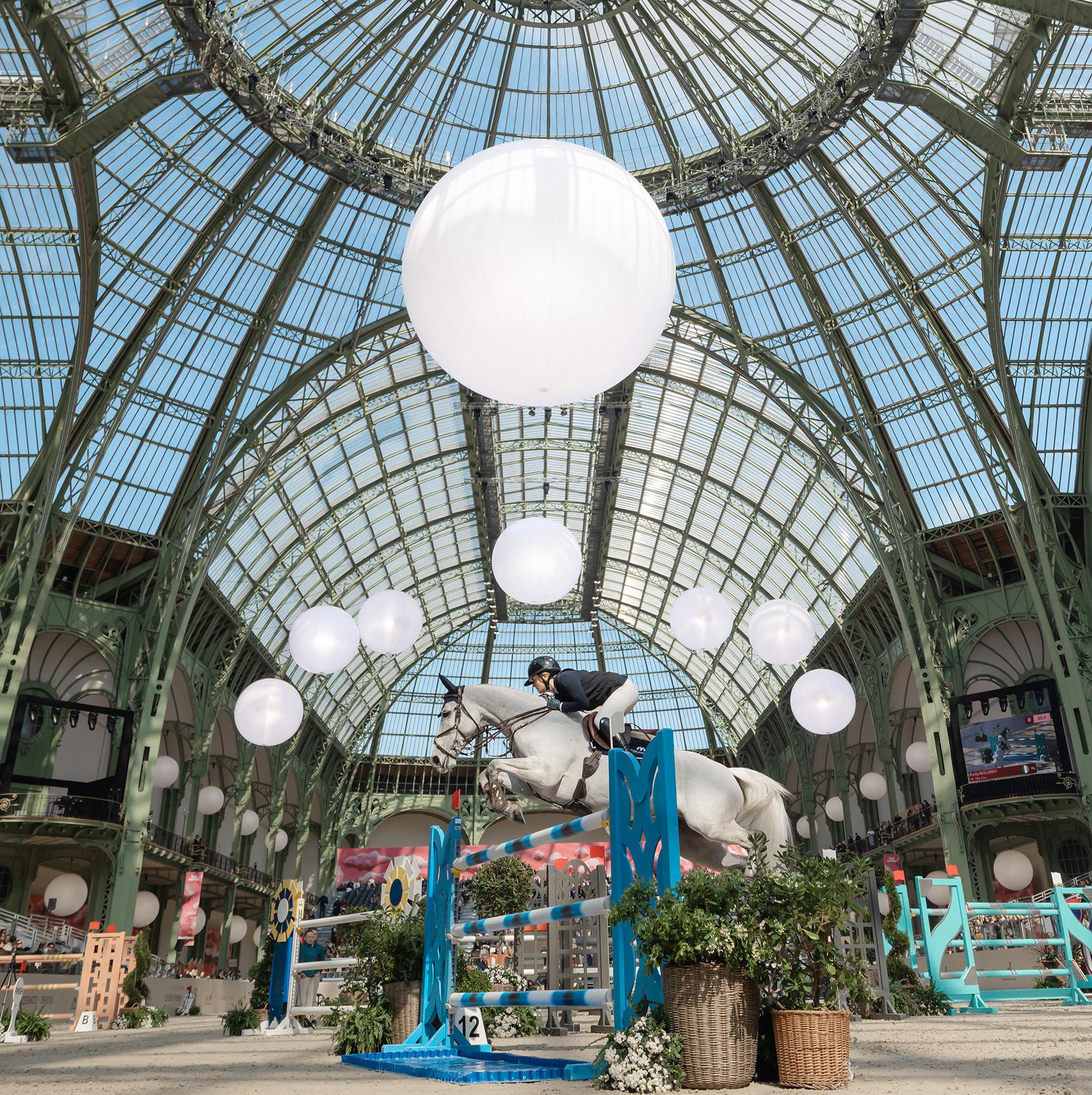
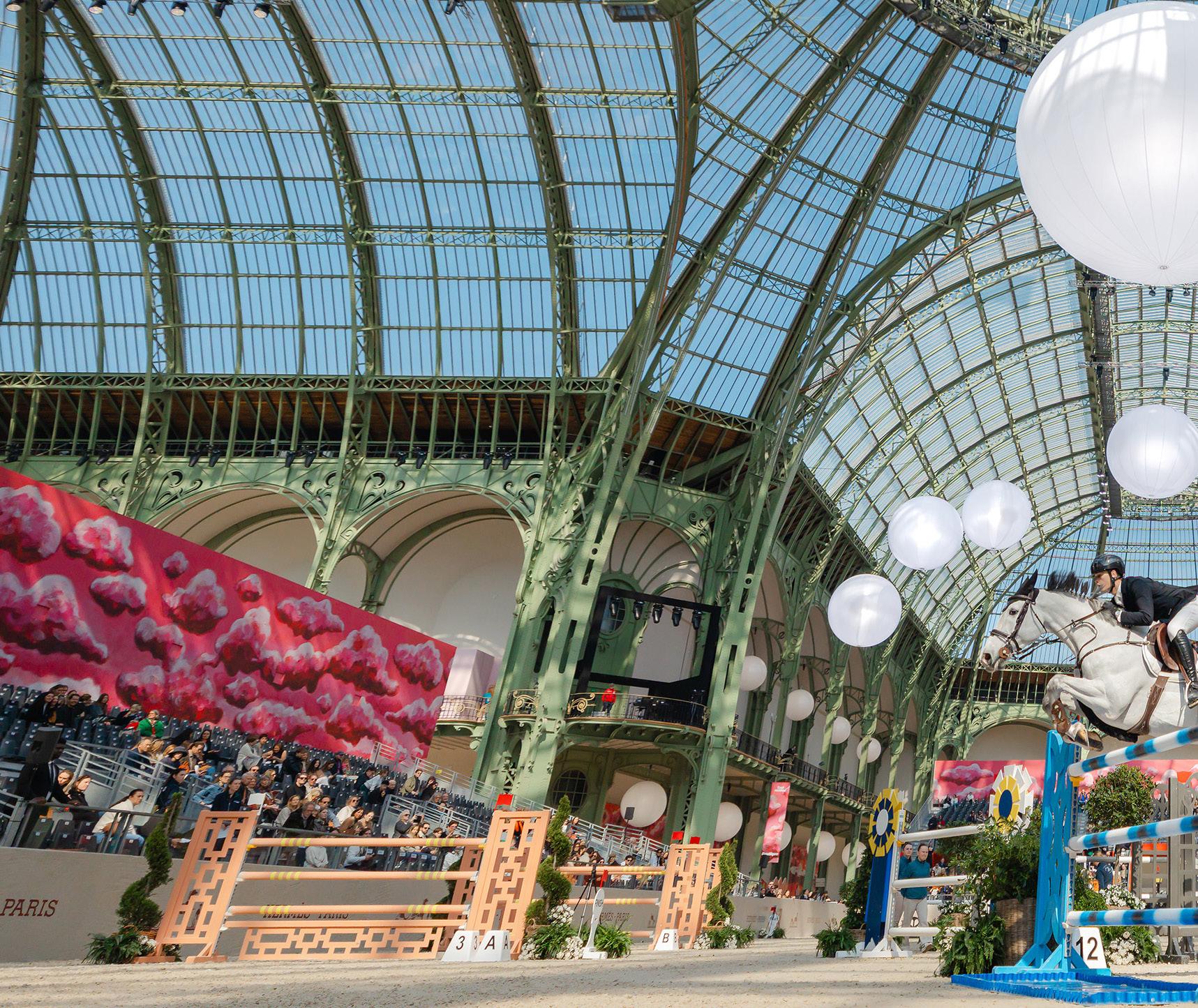
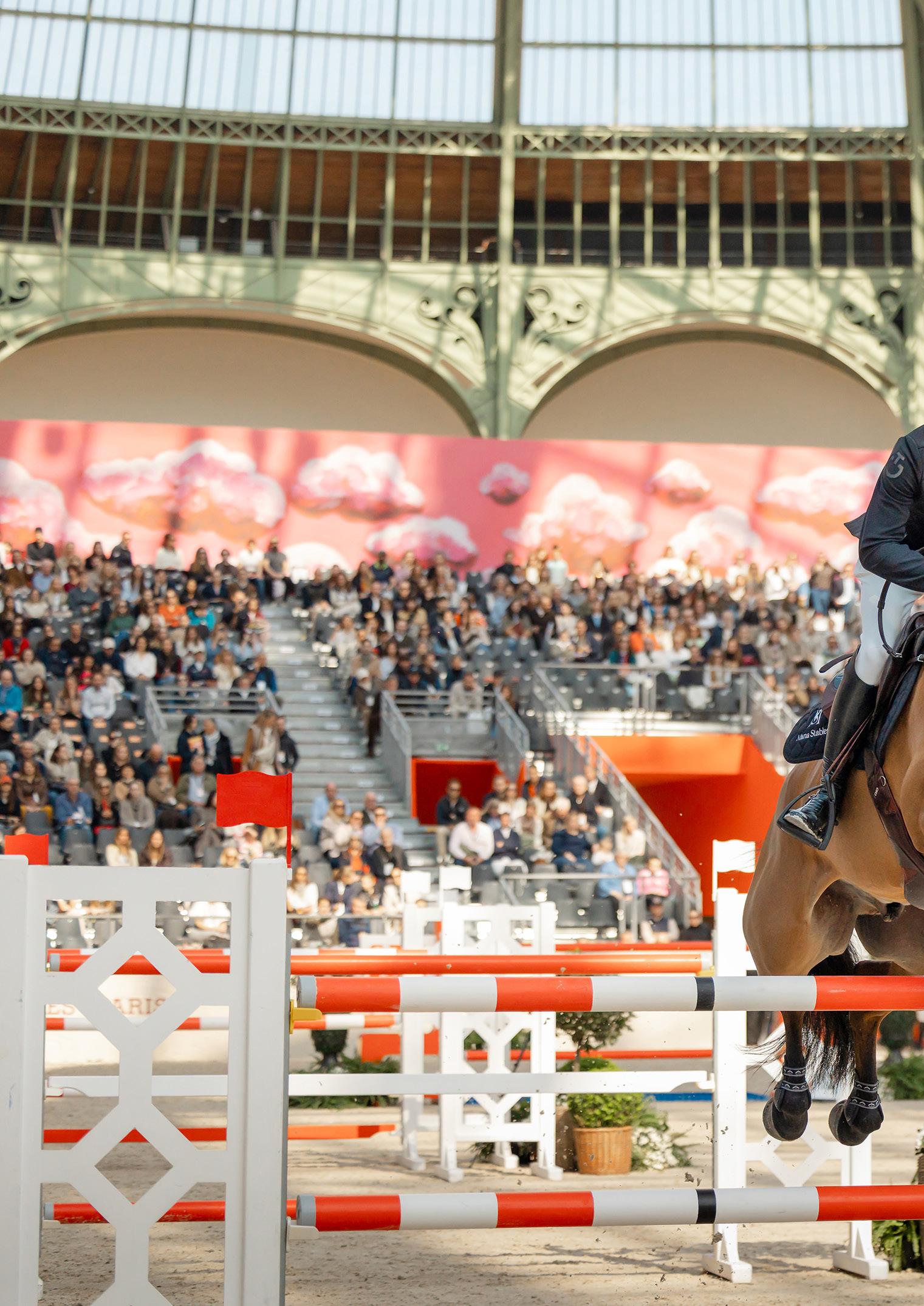
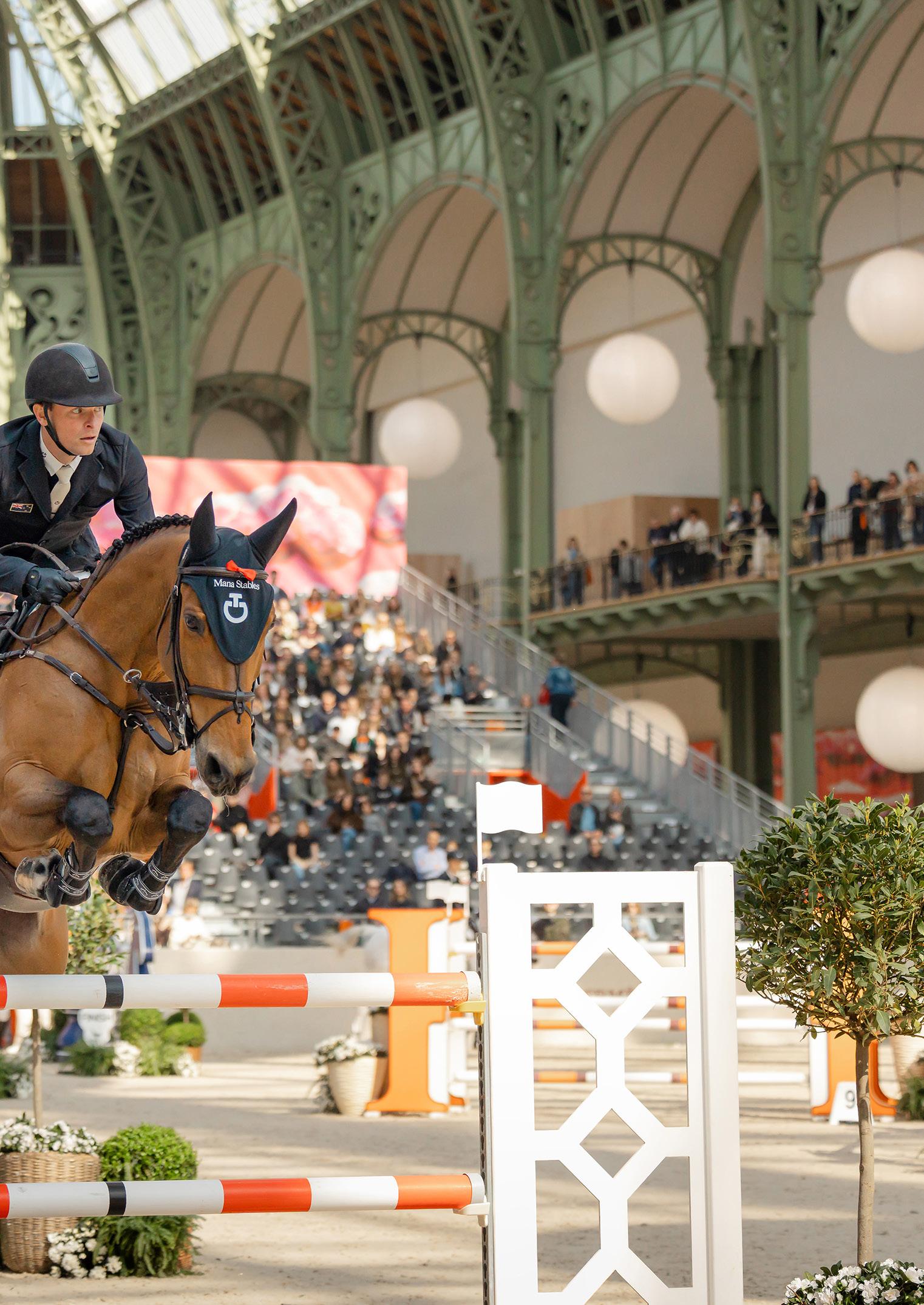
There are shows you remember for the sporting milestones, and others that stay with you for the feeling they create. Saut Hermès delivers both. Beneath the glass roof of the Grand Palais, with spring light pouring into the arena and the city
just beyond its doors, showjumping feels elevated in every sense. The world’s best horses and riders bring the precision and presence to match the setting, giving the competition an added sense of occasion, with that je ne sais quoi only Paris can provide.
Paris in the Springtime
Some shows could be staged almost anywhere and still feel much the same. Saut Hermès is not one of them. Its identity is tied to Paris, and not just Paris, but the very centre of the city, where history, architecture and culture already
provide a sense of drama before a horse even enters the arena. That matters because Saut Hermès is more than a horse show. It is a destination event.
To attend is not simply to buy a ticket and take your seat, but to fold a major sporting occasion into a weekend in Paris. You move between the intensity of the arena and the rhythm of the city outside, and the two seem to complement one another. Inside, riders are calculating distances and managing pressure with precision. Outside, Paris carries on, magnificent and indifferent, offering a backdrop no purpose-built venue could ever match.
Hoof Prints in History
The Grand Palais is one of the reasons
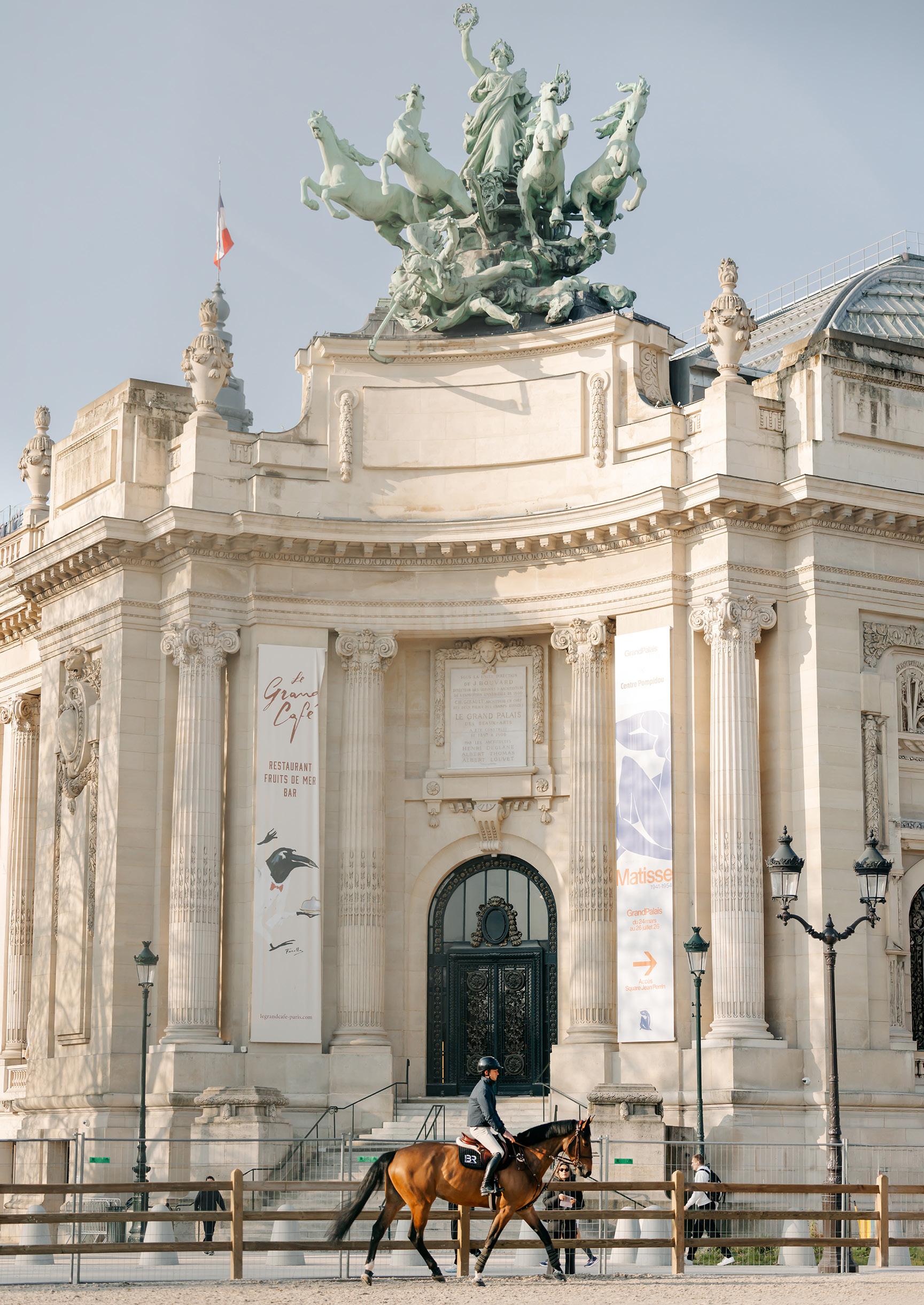
Saut Hermès feels so distinctly Parisian. Set just off the Champs-Élysées, between the Seine and some of the city’s grandest avenues, it occupies one of the most elegant corners of the capital.
Built for the 1900 Exposition Universelle, the vast Belle Époque landmark was designed to impress, and more than a century later it still does. Its soaring nave of iron, steel and glass remains one of Paris’s most recognisable interiors, flooding the space with natural light and giving everything staged beneath its roof a heightened sense of scale.
Over the decades, the Grand Palais has hosted art, spectacle and sport in equal
measure, and that variety contributes to its appeal. Horse shows have been part of its history from the beginning.
The Concours Hippique Central de Paris took place at the Grand Palais from its inauguration, with the last edition staged on 2 April 1939, less than six months before the declaration of the Second World War.
That equestrian legacy gives the building a connection that makes Saut Hermès feel less like a temporary tenant and more like a natural fit. Even the architecture reflects that history, from the horseshoe entrance ramp to the Récipon quadrigas crowning the facades.
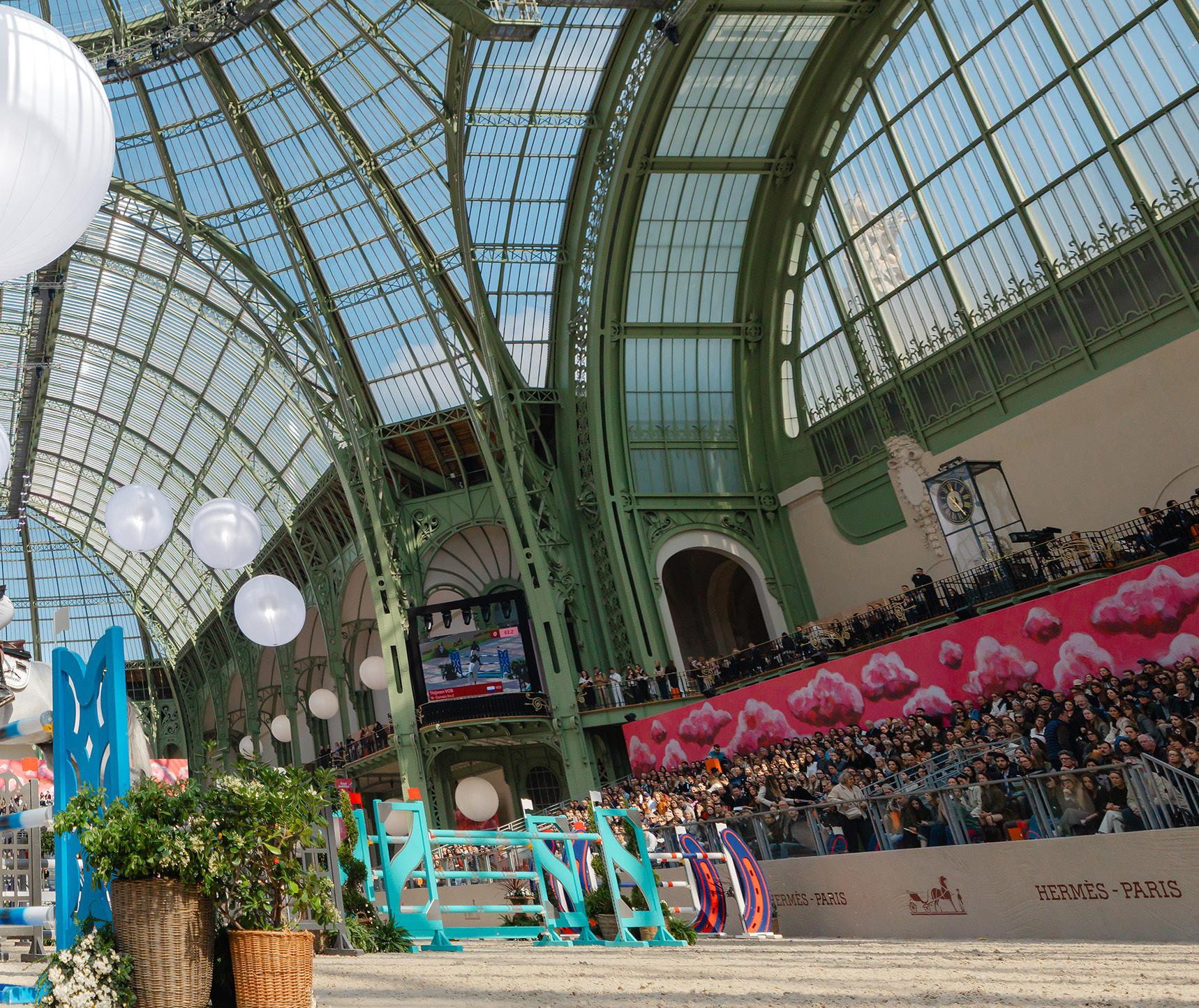
ABOVE: Thijmen Vos (NED) and Cornrlis VM Z compete in the U25 Les Talents Hermès. (All images by Kirsty Pasto).
More recently, the Grand Palais stepped back into the global spotlight during the Paris 2024 Olympic and Paralympic Games, hosting fencing, taekwondo, para taekwondo and wheelchair fencing. After closing in 2021 for major renovation works, it reopened in phases before its full return, giving the events now staged there an added sense of renewal.
Bienvenue
You enter, and you look up. It is involuntary. The glass roof draws the eye before anything else, and only once you have taken it in does the arena come into focus.
Seating frames all four sides, while open corners preserve the full sweep of the space. The decoration is minimal, tasteful and unmistakably Hermès,
allowing the scale and symmetry of the Grand Palais to create the atmosphere. Then come the grand staircases, leading spectators to the first-floor balcony, where the view unfolds in full. From that vantage point, the balance of the event becomes clear: sport, spectators and architecture in perfect proportion.
In 2026, a palette of pastel pinks and blush tones took over the venue. The theme of the sixteenth edition of Saut Hermès was ‘Venturing Beyond’, with the Grand Palais reimagined as an endless showjumping course. This year’s décor leaned into a playful seaside spirit, with sand covering the entire floor, beach-hut-style decorations and a soft palette throughout. Alongside the five-star sport itself, the event
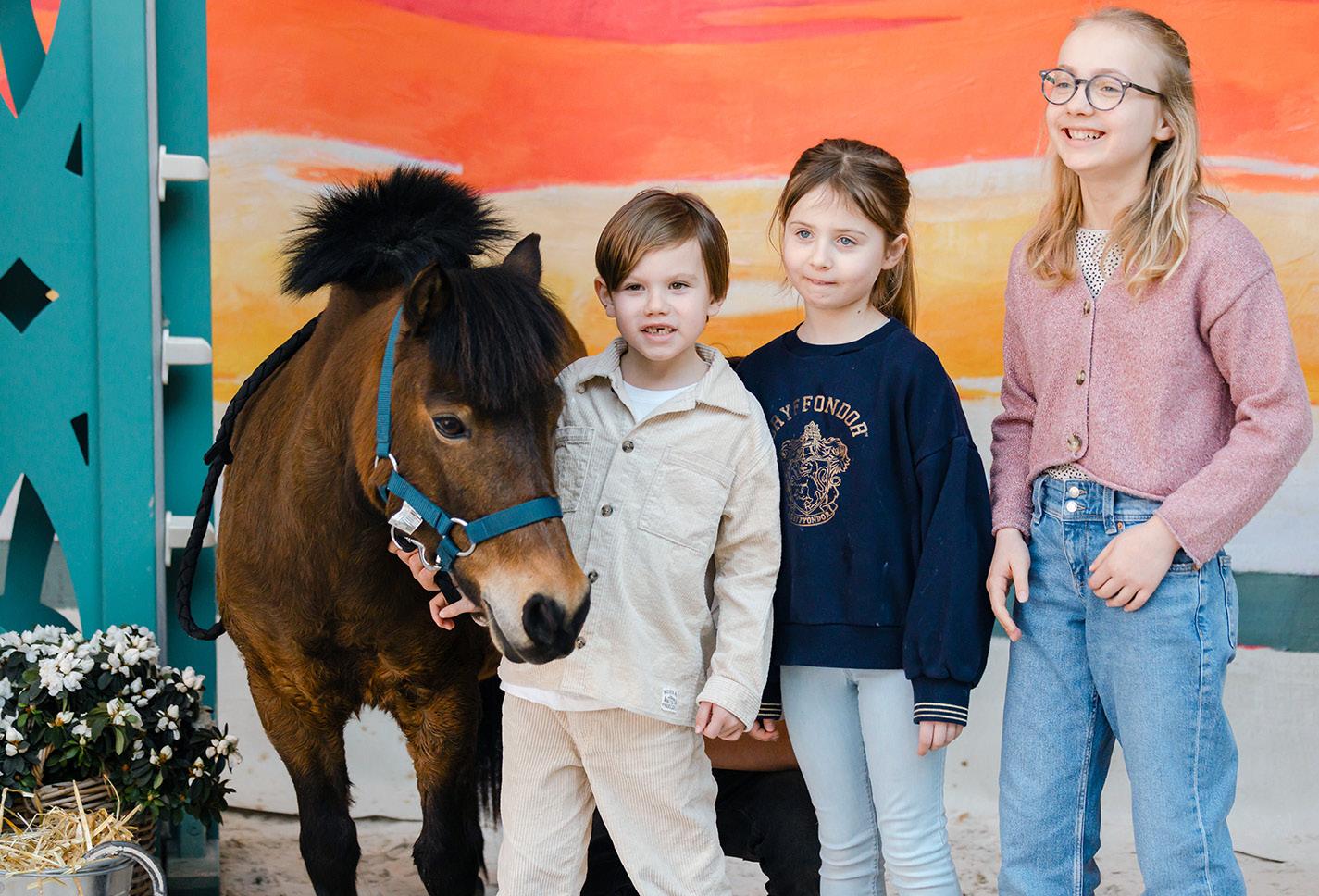
continues the Hermès’ tradition of blending competition with creation, including an original equestrian performance set to live percussion, family activities such as pony rides, animal grooming workshops and a virtual reality riding experience.
Away from the competition arena, Saut Hermès offers something rarer still: proximity. Just off the main entrance, a smaller warm-up ring, or ‘paddock’ as it is called in France, allows spectators to watch the horses up close, bringing the sport into a more intimate frame. However, at Saut Hermès, even that is not quite enough.
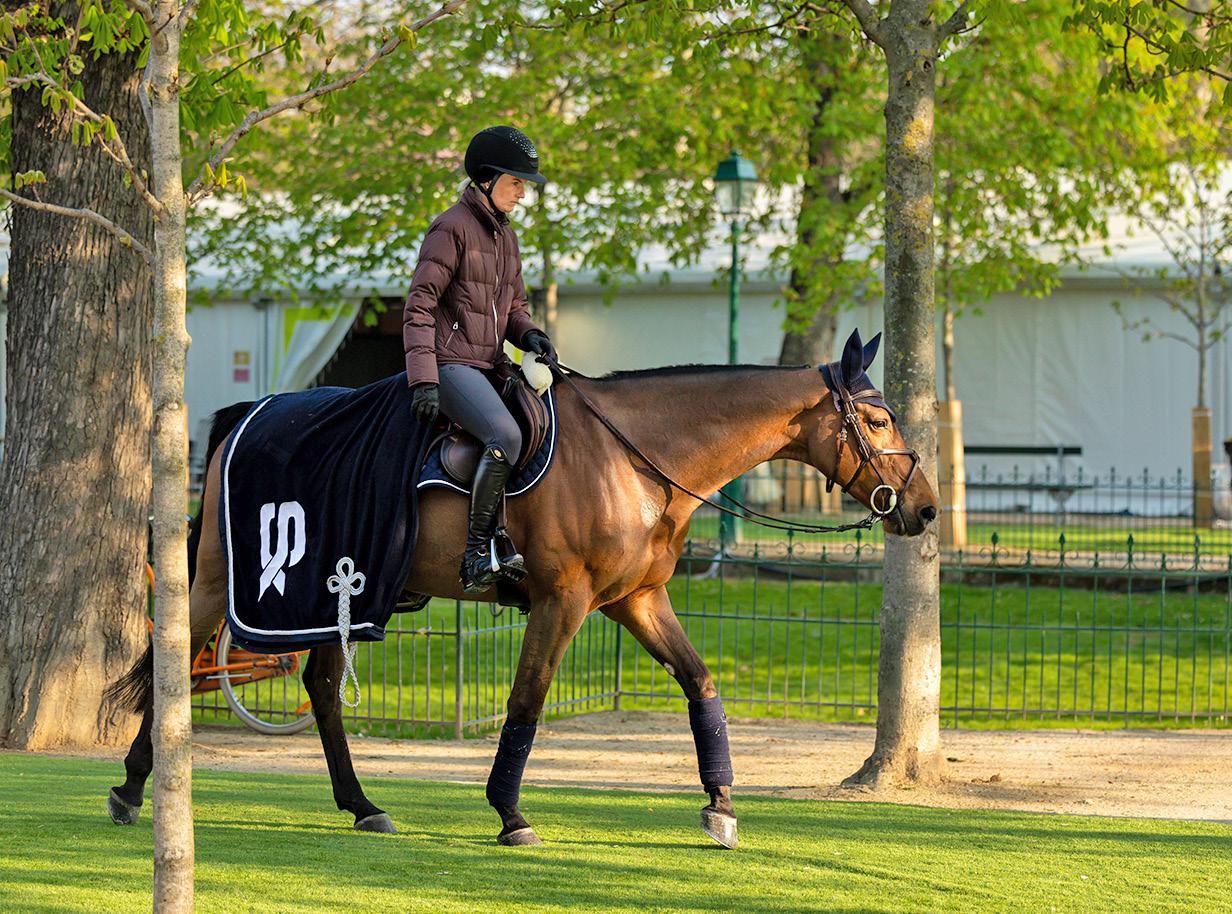
Outside the Grand Palais, the event extends into the city itself. The horses are exercised in a sand arena laid
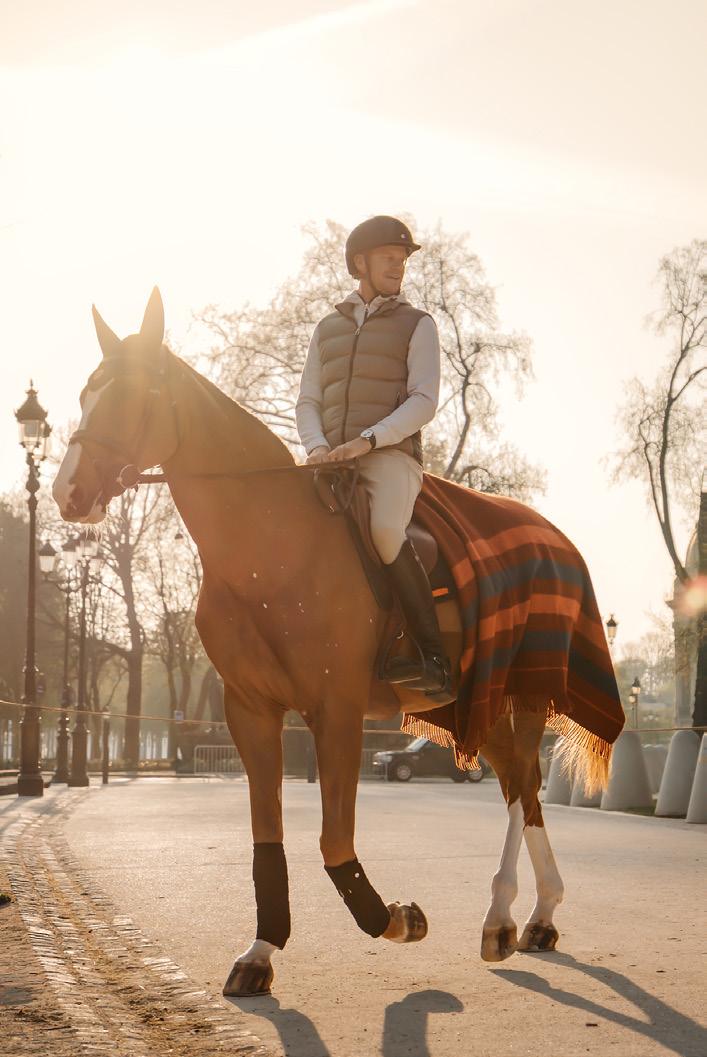
ABOVE LEFT: Jerome Guery (BEL) and Careca LS Elite walking back to the stables after a morning exercise session.
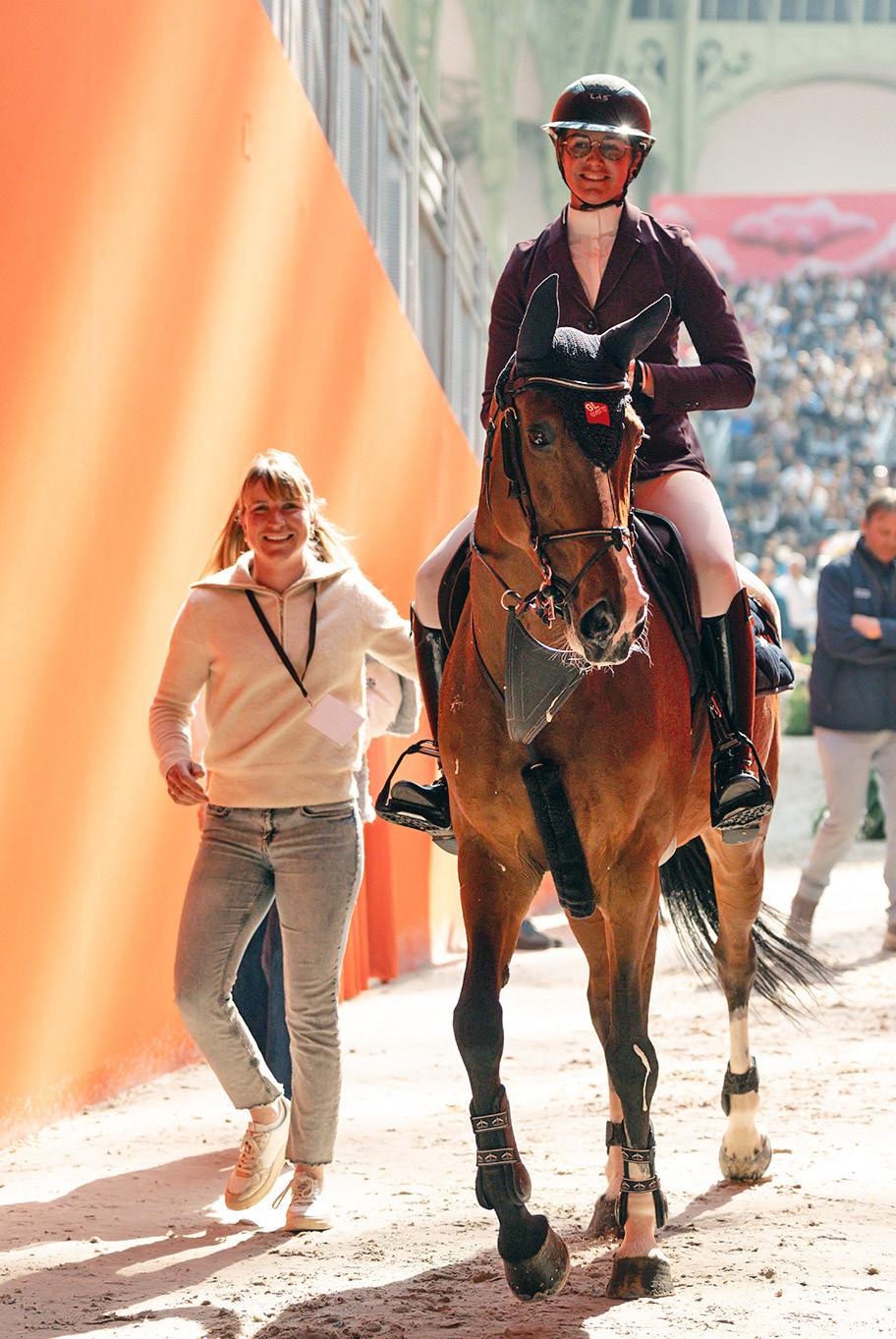
ABOVE RIGHT: Lalie Saclier (FRA) and Fenomene des Lilas making their way back through the tunnel after a clear round in the Prix GL Events. LEFT: Nicolas Layec (FRA) and Hatlantika exercising in front of the Grand Palais.
out along the Champs-Élysées which encompasses the famous statue of Charles de Gaulle. It is a striking scene, and one that allows even those without a ticket to feel part of the spectacle.
What truly sets the event apart, though, is its location. Close to the Seine, the Grand Palais places Saut Hermès in one of the most famous and recognisable parts of Paris. There is also something fitting about approaching via Avenue Winston Churchill, named after the man who once said, “Horses were the greatest of my pleasures.” Arrive by métro and, as you step back into daylight, you are immediately met by the temporary stables, the sound of hooves and the unmistakable sense of an event in full flow.
For a few remarkable days, some of
the world’s best horses are not hidden away behind the walls of a showground, but visible in the very heart of the capital, where passers-by and Parisians alike can catch glimpses of the event unfolding around them as they go about their daily routines.
The House That Horses Built
Founded in Paris in 1837 as a harness and saddlery workshop, Hermès remains one of the rare luxury houses whose equestrian roots are not an aesthetic afterthought but the very foundation of its identity. That link is still visible today in its partner riders, among them Simon Delestre, Jérôme Guéry, Rodrigo Pessoa and Ben Maher.
Even the house’s unmistakable orange has its own story, becoming a signature during the wartime shortages of the
1940s when orange packaging was the only cardboard available, a practical solution that grew into one of fashion’s most recognisable colours.
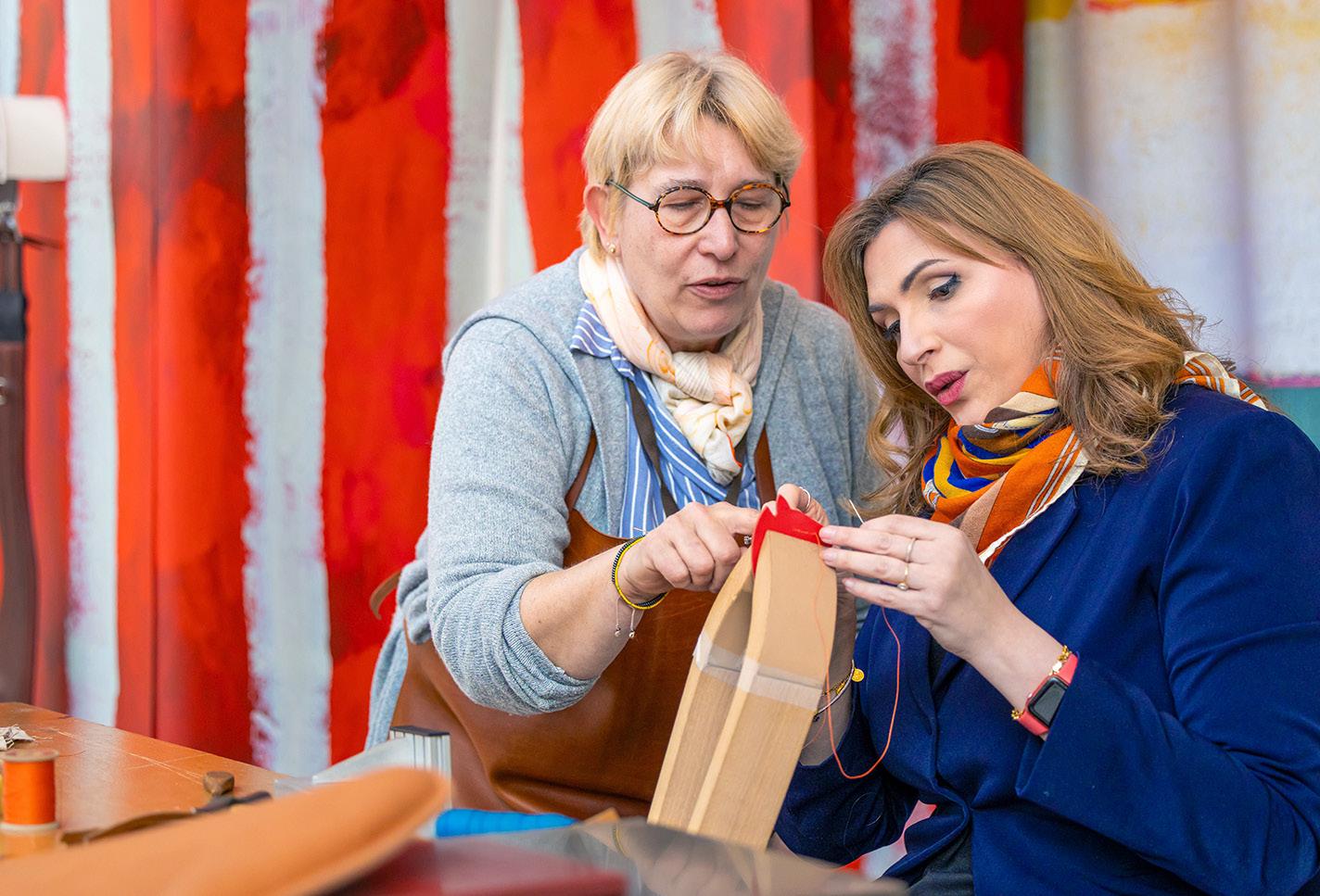
At Saut Hermès, that heritage is brought to life. Visitors can watch demonstrations given by the house’s craftspeople, seeing artisan saddlers at work on the leather pieces that remain at the heart of the brand’s equestrian line. For those brave enough, there is even the chance to create a leather keepsake under the guidance of a master saddler. For Hermès, the horse is not a motif. It is still the point of origin.
Where Paris Takes the Reins
If proof were needed that the setting is matched by the sport, the 2026 edition provided it. The start list brought together some of the biggest names
ABOVE: The private stables and rest area for horses and riders next to the Grand Palais. LEFT: Denis Lynch (IRL) and Chicago in the Grand Prix Hermès.
ABOVE: Hermès artisan saddlers demonstrate the craftsmanship behind the house’s luxury saddlery. BELOW: Young visitors can take home a keepsake photograph with the ponies at Saut Hermès.
in showjumping, among them Julian Epaillard, world number one Scott Brash, Martin Fuchs and Henrik von Eckermann.
This year, Saut Hermès welcomed 17,000 spectators, with 70 international riders from 21 nations competing for a share of €770,500 in prize money. Around 120 showjumping horses are part of the action, supported by 145 temporary boxes installed on the Champs-Élysées, two warm-up arenas inside the Grand Palais and an outdoor exercise area beyond it.
Across three days, the competition built towards Sunday’s Grand Prix Hermès, where Brash and Hello Chadora Lady rose to the occasion in style. In a six-way jump-off, the British rider was simply too quick, stopping the clock in the jump-off at 32.32 seconds and claiming the title plus €120,000 in prize money. Behind him, Martin Fuchs on
Conner Jei and Harrie Smolders on Mr. Tac could not be separated, sharing second place on 33.35 seconds in front of a sold-out crowd.
Saut Hermès also looks to the future through Les Talents Hermès, a class reserved for riders aged under 25 and contested in teams over two rounds.
Held in the same setting as the five-star competition, it gives emerging athletes the chance to test themselves on one of the sport’s most prestigious stages. This year, Great Britain secured a fourth win in the class with Claudia Moore aged 21 riding Lover Boy SVO and Olivia Sponer aged 19 on Kockie W, both team bronze medallists at the most recent European Young Rider Championships.
Worth the Journey
Saut Hermès is worth the journey not only for the sport, but for the experience around it. It is one of those rare events that more than lives up to its reputation.
For anyone tempted to go, the practical advice is simple: book as early as possible, because tickets sell fast once they are released.
What stays with you is not just the winning rounds or the grandeur of the setting, but the way the occasion lingers once you have left. The sport is world class, the setting is unforgettable, and the city only deepens the appeal. Saut Hermès does not rely on spectacle alone. It succeeds because every element feels considered, from the competition itself to the atmosphere around it, leaving you with the sense that you have seen equestrian sport presented at its very best.
For anyone still wondering whether it is worth the trip, Audrey Hepburn perhaps said it best: Paris is always a good idea. Based in Nice, France, you can enjoy more of Kirsty's work at Kirsty Pasto Media, or follow her on Instagram
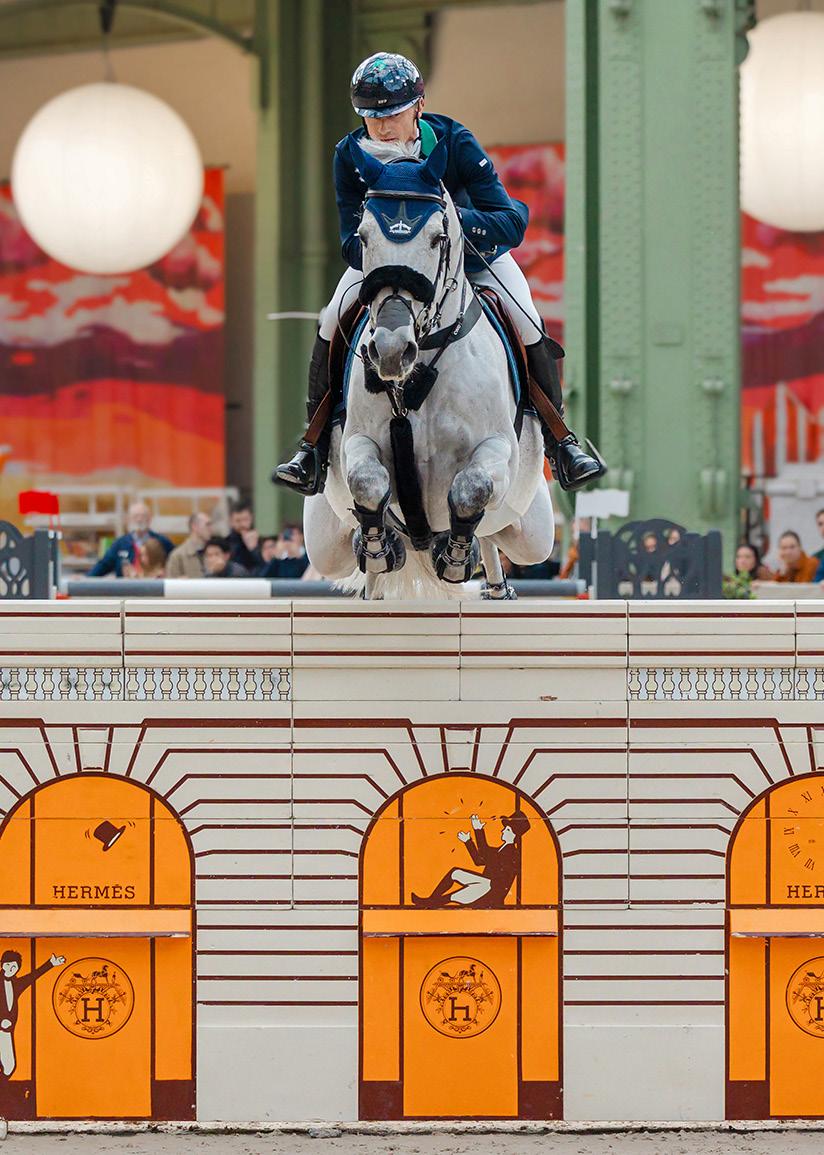
ABOVE: Wilma Hellström (SWE) and AJ Bachelor Z in the Grand Prix Hermès. PREVIOUS PAGE: Luke Dee (NZL) and Gangster WW in the Prix GL Events.
FOUNDERS
Capture and Curate
JACQUIE JOHNSTONE, the name behind the Click Capture brand, shares her inspirational story.
If you've competed at an event along Australia's eastern seaboard, chances are you'll have come across the Click Capture team. We catch up with the business' co-founder Jacquie Johnstone to find out more.
EH: Tell us a bit about you – where you are and what you do.
JJ: I’m Jac, I’m the founder of the Australian media production agency, Click Capture. You’ll find us following Australia’s show jumping circuit along the east coast and popping into the eventing scene as much as we can. I work closely with Liza Harvey, Click Capture’s co-founder, and together we work with brands, events and athletes to produce media strategies and the associated photography, filming and deployment assets.
EH: Tell us about your journey - how did horses and media first come together in your life?
JJ: From a young age, my sister was a keen rider, so I grew up in the local equestrian scene. While I didn’t pursue riding myself, I was always drawn to the community around it. I’ve always been someone who likes to be useful, and picking up a camera to support riders felt like a natural fit.
EH: From humble beginnings to becoming a recognised name in Australian equestrian media and beyond, what have been some defining moments along the way?
JJ: If I had to pick a couple, being brought onto the Melbourne
International Three Day Event media team at 18 was the first real “I can’t believe I’m here” moment.
I remember being briefed by the wonderful Sue McKay and Janet Houghton, and meeting the visionary and deeply missed Michelle Terlato. These ladies really welcomed me in and made me feel valued in that professional, high-level environment at a relatively young age.
More recently, being brought on to produce event media for the return of the Showcase of Showjumping was a big moment for us last year. To be trusted with capturing an event of that calibre, across the sport itself, the atmosphere and the broader event experience, felt like the pieces of what we had been building at a more local level were starting to come together on a national stage.
The Vision Behind Click Capture
EH: Click Capture sits at the intersection of competition, culture and storytelling - what does that mean to you in practice?
JJ: For us, it’s about working closely with riders and the community to understand and showcase Australia’s athletes, from established combinations to the next generation coming through. It means following the World Cup circuit and major eventing competitions, and being there to capture the moments when everything comes together. In practice, our focus extends far beyond the ring itself. With every reel
or photograph, we’re looking to capture what those moments actually feel like. More often than not, that’s found just outside the ring, in the celebrations with grooms, owners and family, or in the quieter moments that follow an exceptional round. There are so many amazing stories to tell in the space, and it is our mission to share them.
EH: You’ve said equestrian media should do more than document results (we agree!) What’s at the heart of what you do?
JJ: At the heart of what we do is bringing the stories and connections Australian equestrian athletes have with their horses and teams to a wider stage. It’s about showing not just what happens, but what it means.
When we’re capturing something like a World Cup Qualifier, we’re always looking beyond the result, for the moment over the last jump, or the reactions on the sidelines straight after. When you focus on those quieter, often overlooked moments, you start to capture what the results actually represent.
EH: What does it mean to you personally to create imagery that truly reflects the calibre of the sport and the people within it?
JJ: I think it’s a real privilege to document the riders and teams we work with. Australia has such depth of
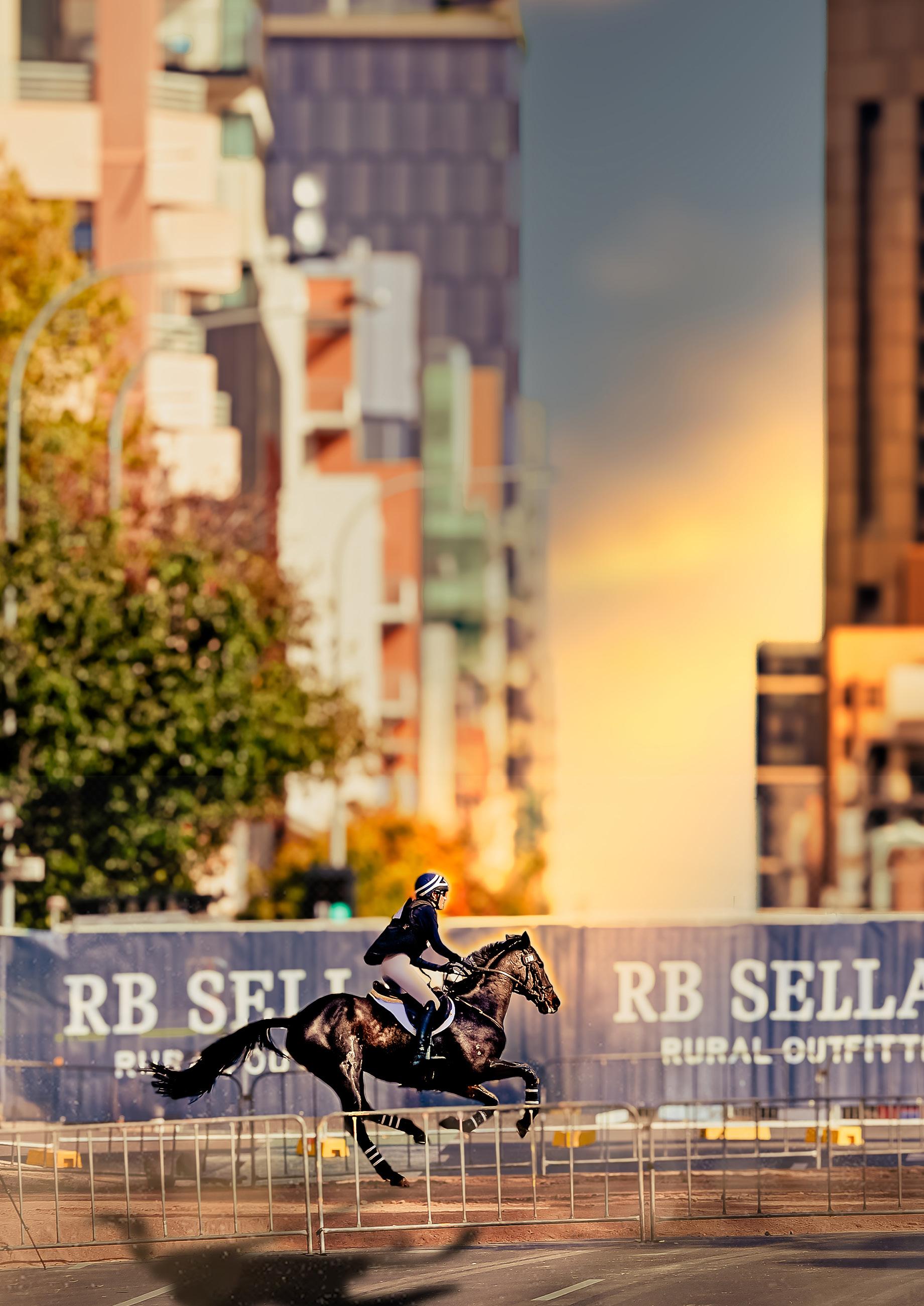
LEFT: Kaitlin Teichert and Queen B II gallop through the city centre during the Adelaide 5* (All images by Click Capture).
talent, and there are so many important athlete stories here that deserve to be seen and understood more broadly.
If I’m able to play even a small role in capturing and sharing those stories in a way that honours the sport and the people within it, that’s something I feel very fortunate to do.
Craft, Creativity and Innovation
EH: With a background in design and now completing a PhD in IT, how do creativity and technology intersect in your work?
JJ: I think my background shows up in ways that are probably not always immediately obvious, but creativity sits at the centre of everything I do. I’m constantly looking for different camera angles, ways to use light, kit to expand our capabilities, and anything that moves our work beyond the standard shot.
In terms of technology, I wouldn’t say I’m particularly talented, just very
stubborn when it comes to resolving technical issues. I'm quite good at working through them until I land on a solution, whether that’s in how we shoot or how we finish it in postproduction.
Where those two come together is what I find most exciting. When you have both the creative intent and the technical understanding to support it, you start to open up a much broader range of possibilities in the kind of media you can produce.
EH: What does a typical day at an event look like for you and the team?
JJ: A typical day starts well before the first class, dividing up the kit and mapping out roles across the team. We’ll plan who’s shooting ringside, who’s capturing candids around the grounds, and who’s on editing, then usually work right through to the last horse on course.
Transparently, our evenings at
events often involve very little sleep, particularly for Liza and I. We understand the importance of delivering professional media in real time, and making sure content is going out each day to meet the pace and expectations of audiences!
EH: With multiple rings, tight rider schedules and varying venues, event coverage can be incredibly complex. How do you and your team manage the logistics while maintaining such a high standard of work?
JJ: We’re really lucky to have a phenomenal shooting team in Jess Grant and Erica Hosking. We’re usually all connected via AirPods, constantly communicating around how classes are running and where schedules may overlap.
Jess was the original creator of our comprehensive excel sheet, which ensures every single event can be shot with precision! Having a team you trust makes all the difference. It allows us
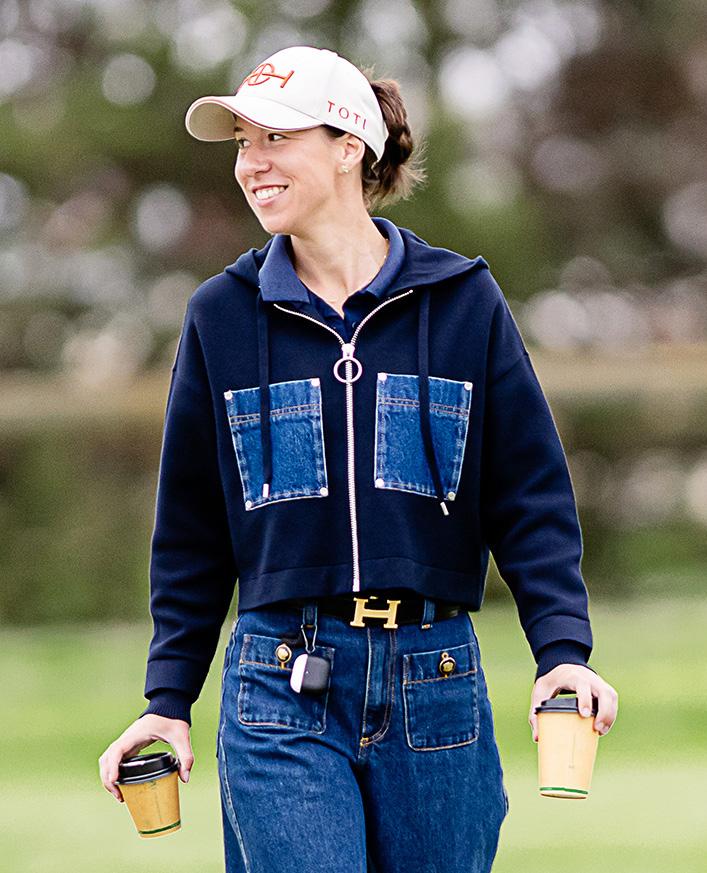
ABOVE LEFT: Young Rider Valentina Hercus with Carousel GV. ABOVE RIGHT: Jacquie has the essential ringside coffees well in hand.
to stay across the moving parts while ensuring we’re meeting, and hopefully exceeding, content deliverables for every client.
Women, Community and Industry Impact
EH: As a woman building a respected media brand in the equestrian space, what has that journey looked like for you?
JJ: I’m incredibly grateful for the way the equestrian community has supported us and the business. We’ve been fortunate to work with so many phenomenal clients who really understand what we’re trying to build and want to be part of that vision. That level of support has played a significant role in how we’ve been able to grow. At the same time, having started photography at 16, I’m still very familiar with what it feels like to not always be welcomed into media space as a young woman. It’s something that’s stayed with me, and has shaped how I
approach being at events now. I make a conscious effort to acknowledge other creatives, whether that’s a simple good morning or checking in as you pass by. Small things, but I think they matter in creating a more respectful and inclusive workplace.
EH: What does success look like for Click Capture now - and how do you see equestrian media evolving in the next few years?
JJ: Success for us is really reflected in the messages we receive after delivering content, and the impact of our work within both the community and wider audiences. We’re incredibly lucky to work with a number of clients who continue to trust us to produce their media, and that ongoing support has allowed Click Capture to build real momentum and achieve things we hadn’t initially thought possible.
Looking ahead, as professional photo and video devices become increasingly accessible, equestrian media will need
to clearly define the value it brings to riders and the wider community. I think that’s an exciting challenge to be part of and continue to work with our athletes to shape.
Quickfire Qs
Favourite event to shoot? Why?
It’d have to be Showcase of Show Jumping and Melbourne International Three Day Event!
Sunrise or golden hour?
Golden hour.
The lens you couldn’t live without? Our 300mm prime!
Coffee order?
Oat Latte (a ringside must!). What’s in your ears - Music or podcast?
As I’m in the final 6 months of my PhD, chances are an academic podcast! Three words that describes your creative process? Joyous, inspired and intentional.
Visit Click Capture's website, or follow them on Instagram and Facebook
ABOVE: For Jacquie and the team, capturing the moments outside of the ring is an important part of telling the story of our sport.
Building OTT
Thoroughbred Topline
Olympian AMANDA ROSS has some expert advice on building and maintaining OTT Thoroughbred topline.
Many OTT Thoroughbred owners can relate to the challenge of building and maintaining topline, as it is a gradual process that relies on both correct
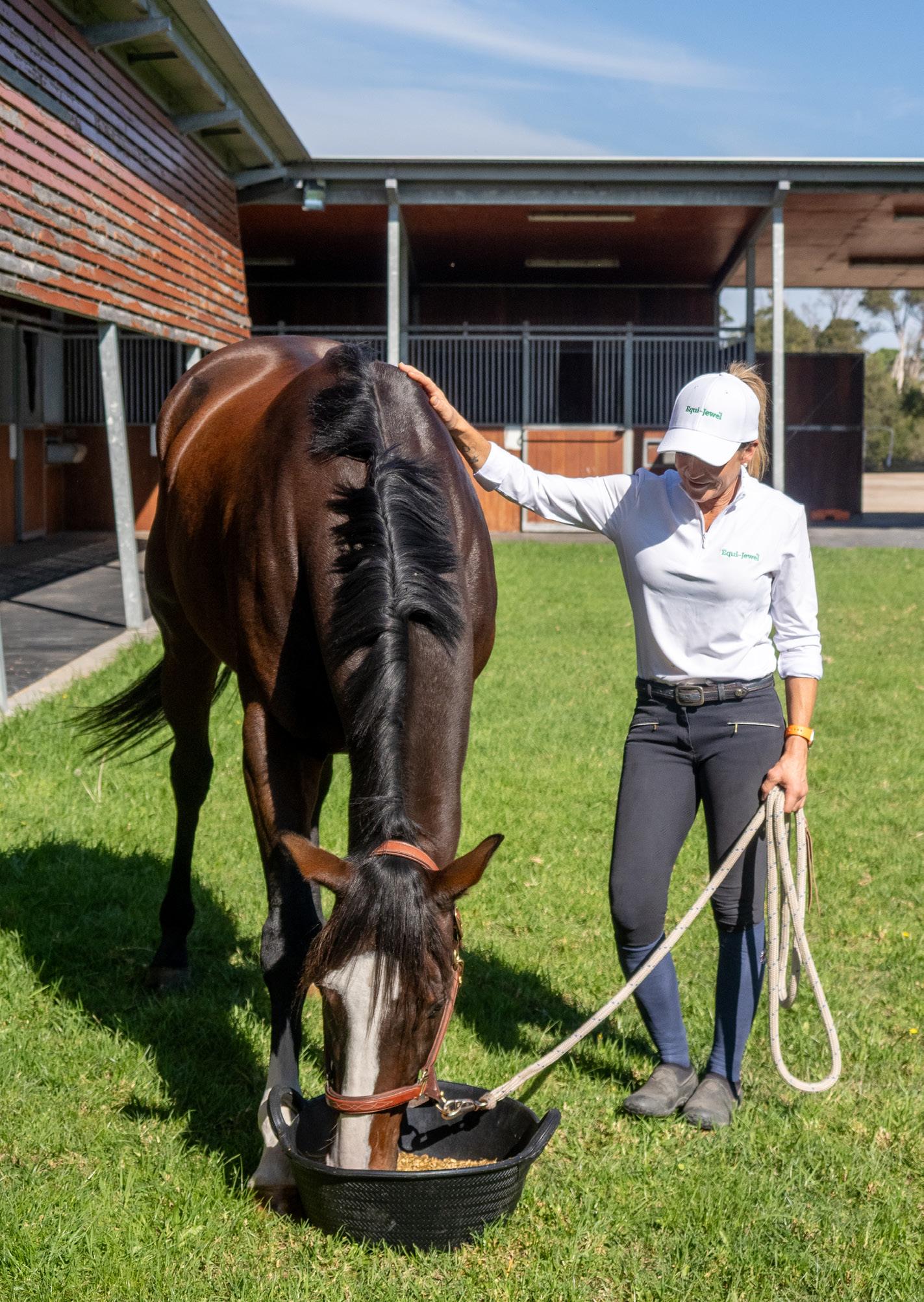
nutrition and focused training. In last December’s nutrition article, we explored what topline is, how to assess condition, and the role nutrition plays in supporting muscle development. The
next step in this multi-faceted process is training.
Having worked with many OTT Thoroughbreds, Olympic eventer and World Cup show jumping rider Amanda Ross understands just how difficult building muscle can be. “It’s important because the racing muscles they use are a completely different requirement to what they use for equestrian sport,” she says.
While diet provides the building blocks for muscle development, it is thoughtful, progressive training that teaches the horse how to use their body correctly and develop strength through the topline in a sustainable way.
Teaching Them to Stretch
Starting with the foundations, Amanda teaches the horse to stretch as an essential first step in their equestrian career. “I think it’s important for a couple of reasons,” she explains. “First, it promotes a lot of overall relaxation, and secondly, getting them to stretch encourages the horse to reach down and to relax those topline muscles - from between their ears, all the way along their back and to their tail.”
The intention is to get an idea of how far the horse can stretch, allowing you to establish a baseline from which they can then progress. However, it can sometimes take time for OTT Thoroughbreds to truly relax and offer that stretch, so you shouldn’t worry if they don’t achieve it at the beginning, it’s all part of the process.
Training Tip: When changing the rising diagonal, Amanda will sometimes opt to rise for two strides rather than sit, if she feels sitting may cause the horse to become hollow - disengaging their core and lifting their head.
Exercise One: Nose to the Wall
One of Amanda’s favourite exercises for encouraging suppleness and stretch is what she calls ‘nose to the wall’. This
ABOVE: The Nose to Wall exercise introduces the foundations of lateral work, teaching the horse to understand the inside leg and move their hindquarters sideways rather than simply forward.
exercise introduces the foundations of lateral work, teaching the horse to understand the inside leg and move their hindquarters sideways rather than simply forward.
How It’s Done:
Begin by walking on the left rein, on the outside track with the arena wall on your right. Start by halting the horse parallel with the wall. Slightly flex to the right, then slide your right leg behind the girth. Nudge or kick the hindquarters so the horse steps their hindquarters away from the wall - this is the start of a turn on the forehand. Aim for about 45 degrees from the wall.
Once your horse steps away from the wall, give them a pat and walk them forward, then halt along the wall again. Repeat pushing their hindquarters away from the wall for a few steps. Sometimes a dressage whip brushed or tapped on the horse’s right hip or hindquarters (to
reinforce your leg aid) will help the horse understand which part of their body you’d like them to move.
When your horse learns how to move their quarters from your leg aid, you can try this at the walk. It’s basically a leg yield along the wall, where the wall really helps to prevent the horse from running forward instead of crossing their hindlegs.
Once your horse is established enough to do a whole long side, you can progress to doing it at the trot. This can take some practice, as the horse is working on four tracks and must balance the movement of the hindquarters without losing control of the shoulders to the left or right.
The exercise is ridden down the long side of the arena, before straightening the horse prior to the corner. From there, ride forward and allow your horse to
stretch along the short side. This type of lateral work is a powerful tool in encouraging relaxation, suppleness and a more consistent stretch.
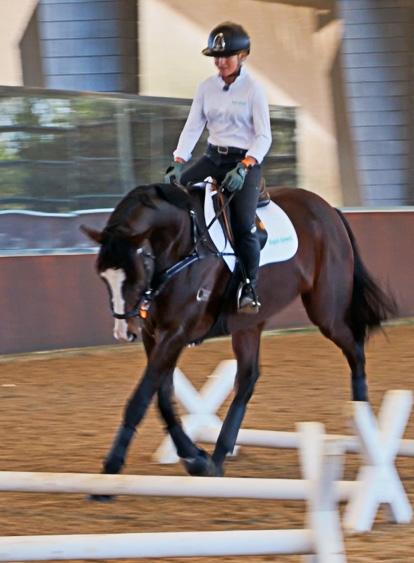
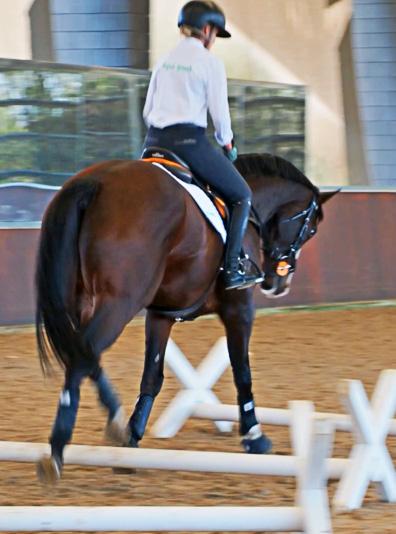
Exercise Two: Cavaletti on a Circle
Amanda uses cavaletti regularly, as the exercise can be adapted for both dressage and jumping horses. Riders can set up either three poles on the ground or three cavaletti, depending on experience and discipline.
Cavaletti distances:
• Innermost side: two yards (72 inches)
• Middle: three yards (108 inches)
• Outer Edges: four yards (144 inches)
As Amanda points out, it’s easy to remember: two, three, four yards. She also recommends placing an additional pole on the opposite side to help maintain the shape of the circle.
ABOVE: Riding the poles on a circle is key. Flexion and bend help soften the muscles and prevents the horse from using the under-neck, encouraging them to go rounder, softer, and to use their topline instead.
Riding the poles on a bend is key. “The idea of having the poles on a circle is that flexion and bend help soften the muscles,” she explains. “It stops them using the under-neck, and instead encourages the horse to go rounder, softer, and use their topline.” The exercise also helps prevent horses from rushing, something that can happen when pole work is ridden in straight lines.
How It’s Done:
Amanda begins at walk with the poles on the lowest height, which encourages the horse to stay relaxed and confident. Once established, she moves into trot. “My job is straightness and speed,” she says. “I’m in charge of the rhythm, and they’re in charge of lifting their legs.”
Rather than lifting the head to clear the poles, the horse must lift the legs and therefore use the back. If Amanda wants more forward energy
and a longer stride, she will ride a slightly wider line. If that becomes too challenging, she simply comes back to the inside to help the horse rebalance.
Amanda likens poles to speed humps. “You can drive a car on a straight road and on a circle but keeping your balance when you’re driving the car over speed humps is a bit more difficult,” she explains. “So, we’re really testing that the horse can add that little extra height in their step but stay balanced at the same time.”
Mistakes, such as an occasional misstep, are seen as part of the learning process. Another benefit of pole work is it also helps develop proprioceptive awareness, the horse’s understanding of where their body and feet are in space.
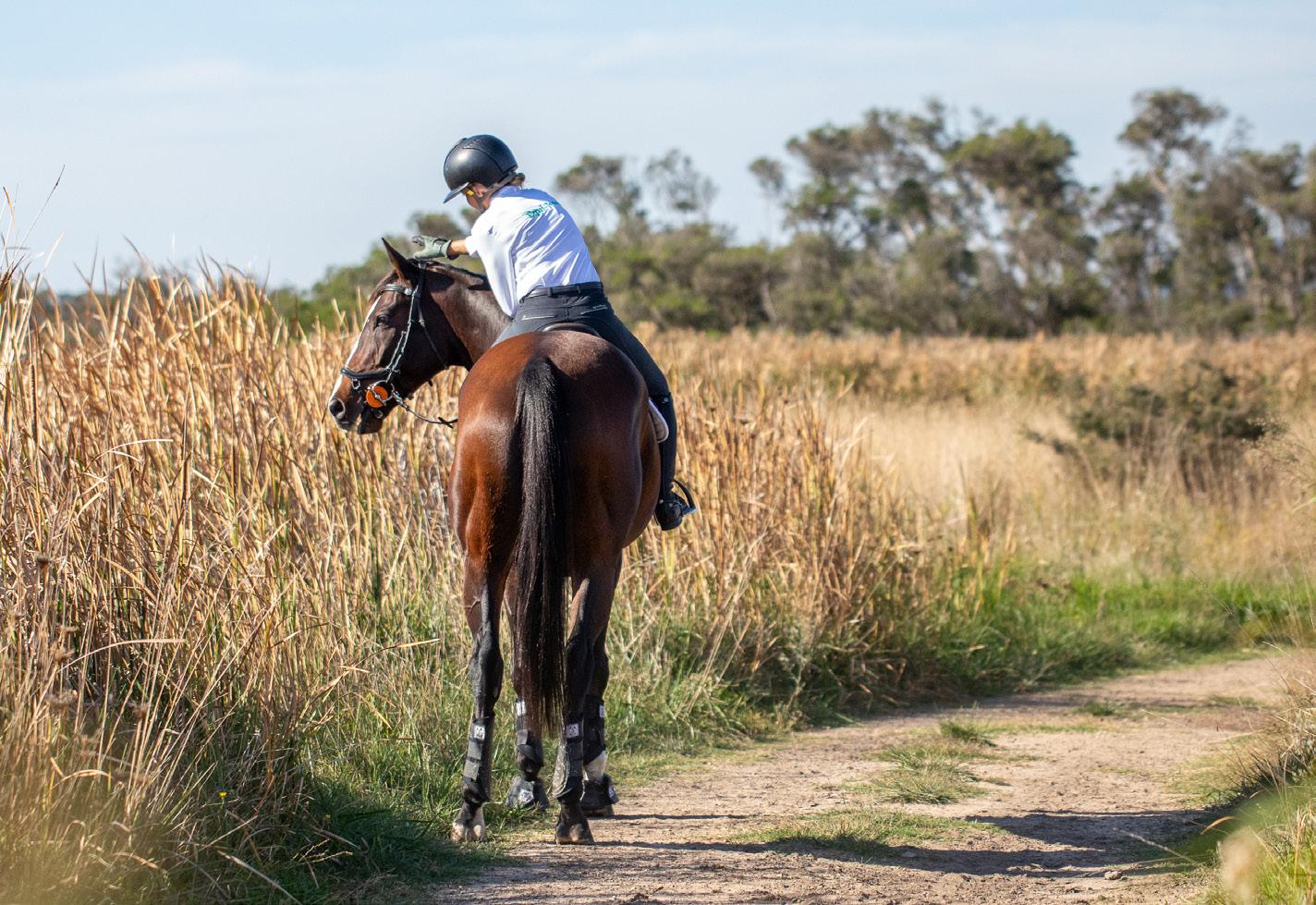
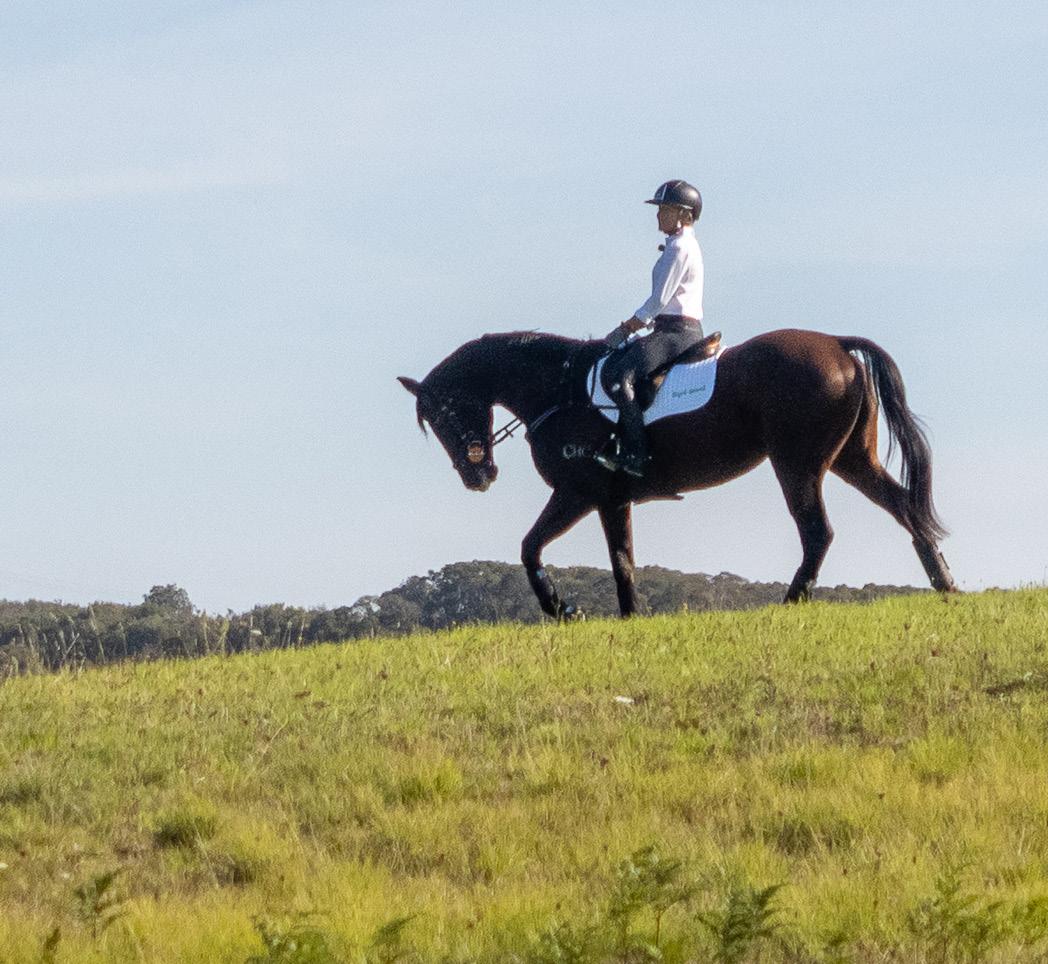
Exercise Three: Hill Work Hill work is one of Amanda’s preferred tools for building topline, and it doesn’t require perfect facilities. Even a short
hill with enough gradient can be used effectively. “I just work with whatever I have,” she explains
How It’s Done:
Amanda varies the exercises, riding serpentines up and down the hill, as well as circles. But before introducing any complexity, she first makes sure the horse understands how to travel up and down the hill correctly. “Going downhill is just as important as going up. You need to steady the walk and ensure the horse is waiting and sitting on their hindquarters,” she adds.
Once the horse is confident walking both up and down the hill, she begins to introduce trot. The pace remains steady, as some horses tend to lean downhill, making it important to start very slowly. Going back uphill, the horse is allowed to push and increase power, before being steadied again on the descent.
Building topline is a gradual process that relies on both correct nutrition and focused training.
ABOVE & BELOW: One of Amanda's preferred tools for building topline, hill work doesn’t require perfect facilities. Even a short hill with enough gradient can be used effectively. Once the horse understands how to travel up and down the hill correctly. she varies the exercises, riding serpentines up and down the hill, as well as circles.
Hill work develops the hindquarter’s pushing and sitting muscles. Amanda notes that some horses will want to break into canter rather than stay in trot and truly push, so maintaining the correct gait is key.
By combining consistent, targeted training with the right nutrition, OTT Thoroughbreds can build a strong, functional topline. With patience and the correct approach, these horses can develop the suppleness, strength and balance to become exceptional performance horses in many disciplines, whilst staying comfortable and healthy long term.
Kentucky Equine Research recommends seeking the support of an equine nutritionist to formulate a tailored diet for your horse. Contact Kentucky Equine Research at advice@ker.com or 1800 772 198.
YOUNG RIDER
Macy Crane
Ten-year-old MACY CRANE is a Young Rider with big dreams, huge personality and a great attitude.
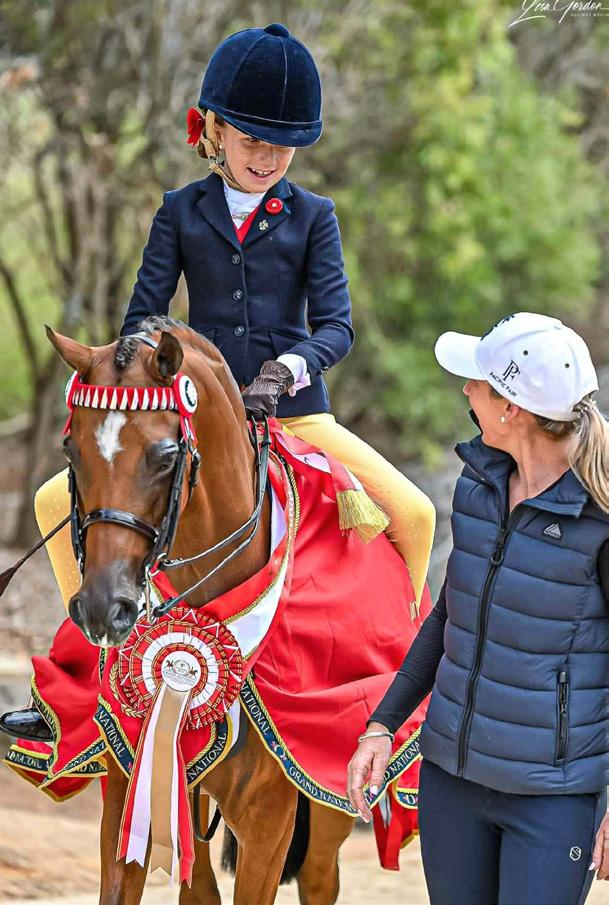
At just 10 years old, Macy Crane is already making her mark in the show and hunter pony world — bringing colour, confidence and a whole lot of personality to every class she enters. From big wins to unforgettable moments in the ring, her love for ponies is as big as her dreams.
How old are you, and how long have you been riding?
I’m 10 years old and I started riding when I was six. My nanny always wanted me to ride … Mum not so much!
What discipline do you ride, and what do you love most about it?
I do both showing and dressage, but showing is my favourite because I get to dress up and perform in front of a crowd. I also love all the fun we have in the lineup and spending time with friends after the classes are finished.
Can you introduce us to your ponies?
My first is Melody Park Kingdom of Heaven (Captain). He’s a seven-yearold riding pony who loves cuddles and always has to be touching you. He’s obsessed with toys and plays with his blow-up toys in the paddock all day.
Then there’s Rivington Sunray (Pip). He was bought for my brother, but he decided riding wasn’t for him, so I was very lucky to take over. He is the safest pony ever. Mum always finds me trying silly things like riding backwards, standing on him or riding with no handsshe has no control!
Hanley Park Coronation (Reggie) is my new Galloway that Mum and my coach Tamica keep trying to steal. He’s a five-year-old Welsh pony who just loves
attention and always calls out when he sees me. I love riding him, he feels like a mini warmblood.
Edgewood Topgun (Mavrick) is our little gremlin Shetland that we’re showing this season. He thinks he’s a dog! We race along the fence line every daysometimes I let him win.
I also get to ride a couple of ponies for Emma Ashton - Eagle Park Show Me Sass and Toorvale Vermeer (Dutch). I love Dutch and keep telling Mum we should put him on the truck.
What makes your ponies special to you?
They are my best friends and always make me smile, even on the worst days. I just love them no matter what.
What classes do you compete in?
I do both show and hunter classes. I love the hunter because we get to gallop, and the show because we get to dress up with some bling.
What do judges look for in a great pony?
I think a good forward-moving pony that sits up in the bridle and looks happy doing the workout. Mum says opens need a fancy trot and hunters need a good gallop. I just smile and hope for the best!
What’s your favourite part of a show day?
I love the crowd at the big shows and the lap of honour is my favourite. Trotting in front of a big crowd with everyone cheering is like no other feeling.
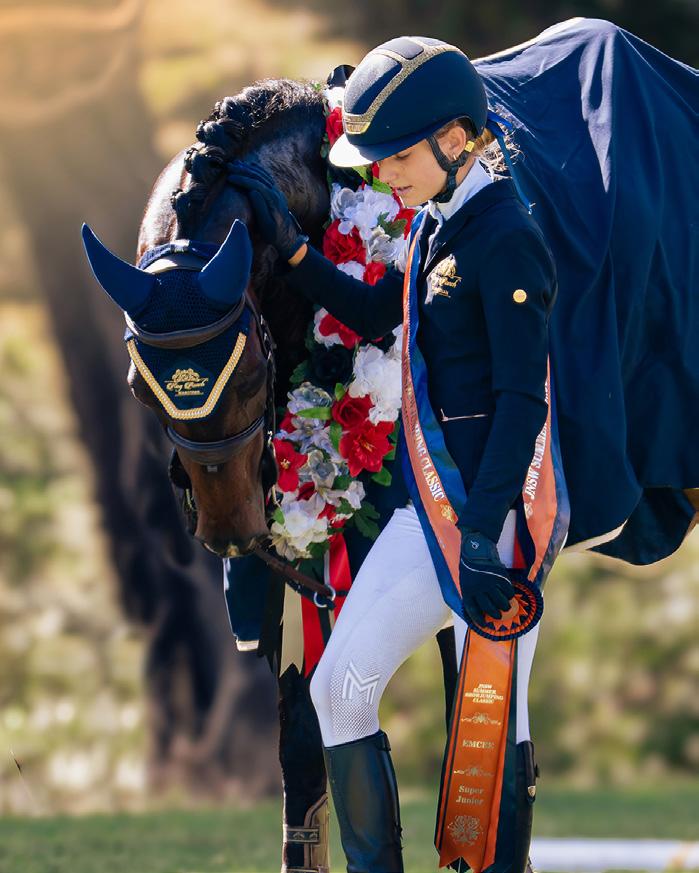
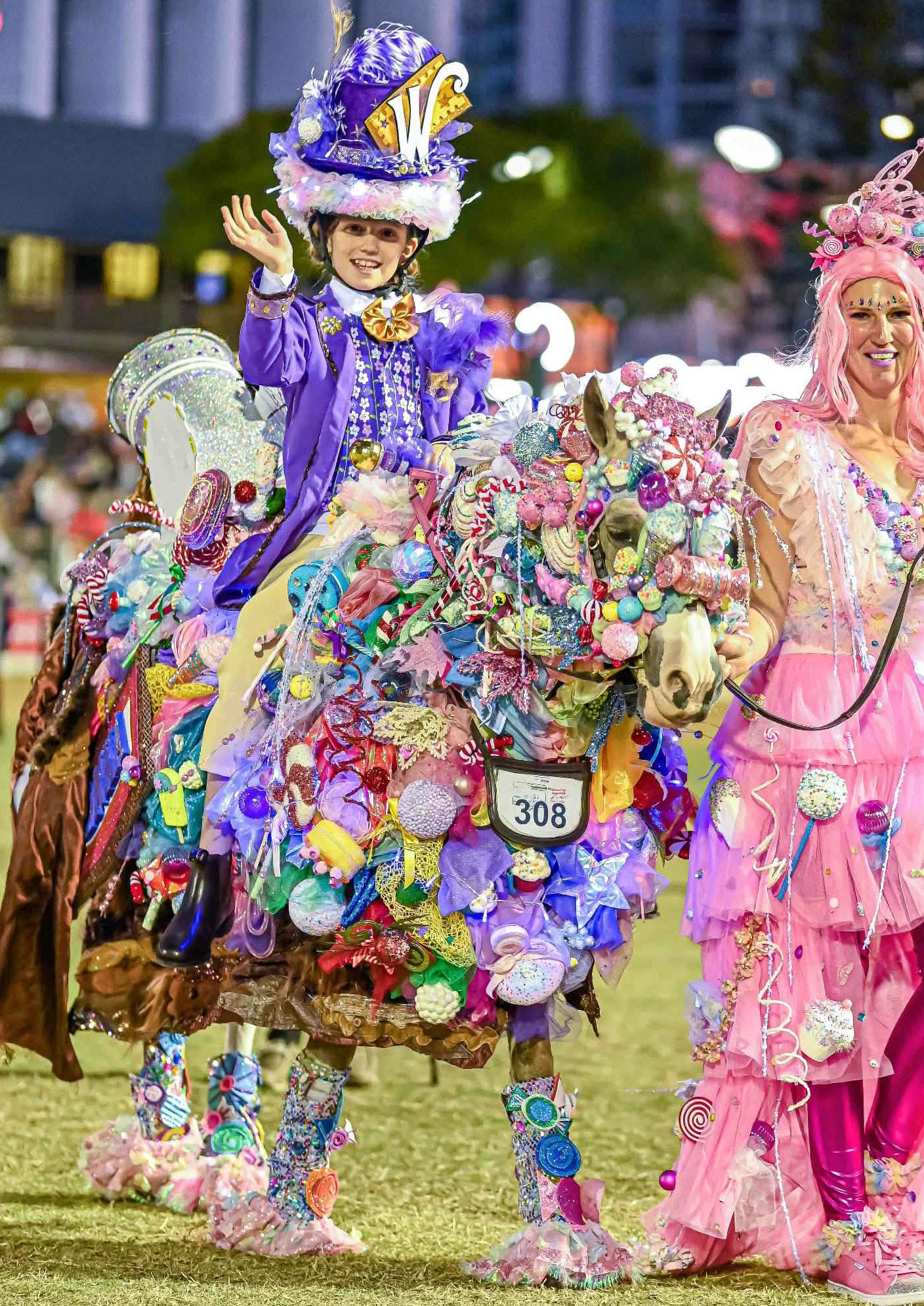
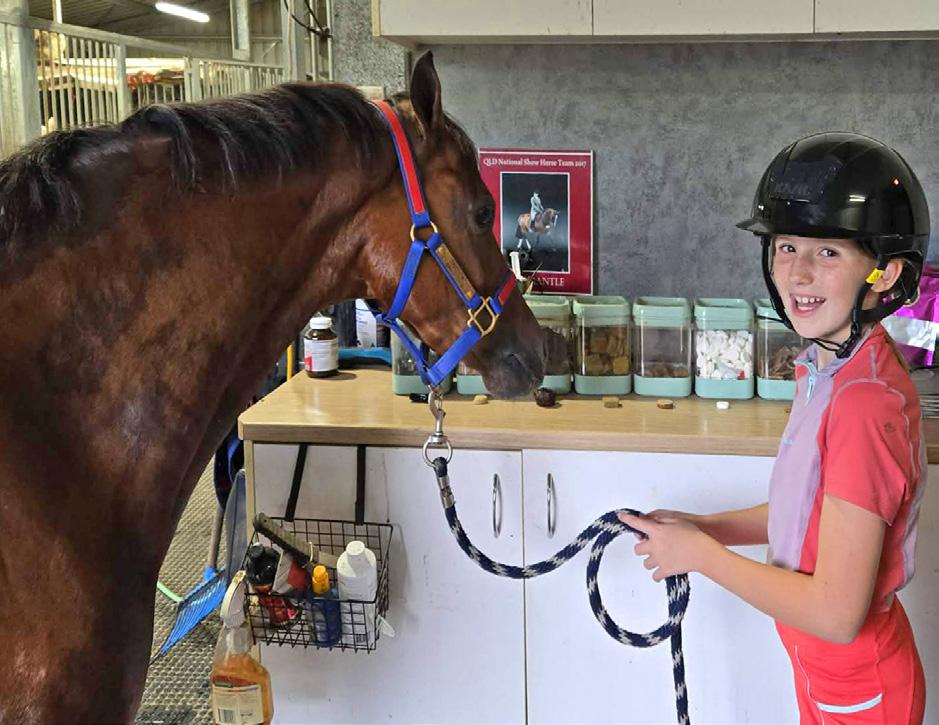
ABOVE: Macy and Captain raid the pony pantry. BELOW: In their fabulous Willy Wonker themed costume, Macy and Rivington Sunray (led by Rebecca Crane) won the 2025 Brisbane Royal Individual Open Fancy Dress (Image by Lisa Gordon).
What has been your proudest achievement so far?
Definitely coming Runner-Up at Grand Nationals and Nationals last year. Also winning the fancy dress at the Ekka (Brisbane Royal) was so amazing. But I’ve been very lucky to have a lot of big wins - they are all special in their own way.
Do you have a favourite event?
I would say Grand Nationals - the arena is just amazing and all the decorations are like nothing else. But I am so excited to compete at this year’s Sydney Royal Easter Show.
What are you working towards right now?
We are working towards Grand Nationals and Sydney Royal, but it’s just the start of the season so we have lots of shows coming up.
What do you love doing with your ponies outside of riding?
I love giving them massages with my special brush, and we have a pony
pantry so I take them there to pick what treat they want each day.
Do you have any show-day rituals?
I wake up and have waffles with Nutella and strawberries. I always put my left boot on first and sing We Wish You a Merry Christmas while spinning in a circle - apparently Charlotte Dujardin does it and it works for her!
What’s your go-to riding outfit?
At home I love bright, crazy socks and anything with colour. On show day, I always wear my nanny pin. She gave it to me and it keeps me safe - I know she’s always with me.
Do you have a coach or mentor?
I started having lessons with Harvey Besley (I think I was a little crazy for him), and now I’m so lucky to train with Tamica Clottu each week on two horses. On the other days, Mum tries to help me!
What’s the best advice you’ve been given?
Never give up. Push hard and work for
your dreams - hard work pays off.
What advice would you give other young riders?
Find a good coach, someone you can have fun with, and love your horse. The results are just a bonus.
What keeps you motivated on tough days?
I just remember that not every day is perfect - we all have bad days. Tomorrow is a new day, so just keep trying.
Who inspires you?
Definitely my dad - he works so hard so I can have my ponies and go to shows. My mum, who makes sure everything runs smoothly. And Kate Kyros - I was lucky enough to meet her and ride Chemistry. She is my idol.
Sponsors & Supporters
Macy is proudly supported by Horseland Underwood, Nolian Enterprises, Bondfield Browbands and NVS Equine Attire
ABOVE LEFT: Macy won the Ridden Hunter Pony class at the 2025 SHC Northern Queensland Hack Championships with Toorvael Veermer. ABOVE RIGHT: Coach Tamica with Macy and Melody Park Kingdom of Heaven, Reserve Champion Child's Large Open Pony at the 2025 Grand Nationals (Images by Lisa Gordon).
TECH TALK
What Your Horse's Heart is Actually Telling You
Heart rate monitors are a useful training tool - but do you understand what the figures mean? NICOLE CREED sheds some light on the subject.
Iremember the first time I rode my horse with a heart rate monitor. We’d just finished a canter set and I glanced at the number on my watch thinking I’d see something that confirmed the session had gone well. What I saw instead was a number I didn’t fully understand, there was no
context for what it meant, no baseline to compare it to, and I had absolutely no idea what to do with it.
That’s the honest reality of where most riders start with this technology. The devices we never really had before are now accessible, we have the data right at our fingertips, and yet the gap
between having the numbers and actually using them is wider apart than most people would expect. So let’s close that gap a bit.
What heart rate is measuring
A horse’s resting heart rate sits somewhere between 25 and 40 beats per minute (bpm). That’s your starting point, and it matters more than you realise. A low resting heart rate, taken without disturbance, is generally associated with good fitness and relaxation. On the flip side, a high resting heart rate can be associated with pain, illness, or fatigue from overtraining.
Before your horse has done a single step of work, their heart rate is already telling you something. So, if you've never established a true resting baseline, taken in a calm moment in the stable or paddock, you're missing the first piece of data that everything else builds from.
During exercise, heart rate increases with intensity. Walk sits low, working trot climbs, and at maximum exertion horses can reach well above 200 bpm. For most pleasure and sport horses, that upper ceiling is rarely touched, but the middle range is where your training decisions live.
The reason that this matters for everyday training is simpler than it sounds. If you ride the same session every week at the same pace, and your horse's heart rate at that pace gradually drops over a month, that's fitness. This means that their body is adapting, their cardiovascular system is becoming more efficient, and therefore the work is getting easier for them. If the number goes up instead of down, or they stop recovering as quickly, something has shifted and it's worth paying attention. The recovery number that changes everything
Of all the data points a heart rate monitor gives you, recovery rate is the one I'd tell every rider to focus on first.
After moderate work, your horse's heart rate should return to around 100 bpm within two minutes, and drop below 60 bpm around ten minutes after exercise stops. Keep in mind that a horse coming back into work after time off may take longer, and a genuinely fit horse can drop back down faster, sometimes impressively fast.
This single data point, tracked consistently across weeks, tells you more about your horse's true fitness than almost anything else. It shows you when they're ready to move to the next level of training and, just as importantly, when they're not.
I've spoken to countless riders who thought their horse was fit just because they were completing the work. But completing work and adapting to the work are two different things. A horse can finish a canter set and still be struggling to recover efficiently - their
ABOVE & LEFT: Research suggests that many performance horses are not trained at an intensity that actually matches what’s required of their competition level (All images courtesy of
heart rate doesn't lie.
Aerobic, anaerobic, and why it matters
One of the more useful things heart rate data gives you is a window into which energy system your horse is working in during a session.
Horses typically sit in aerobic work up to around 150 to 170 bpm. Above that threshold they shift into anaerobic work, producing energy quickly but generating lactic acid and placing more demand on their body.
Aerobic work is sustainable, oxygen driven, and the foundation of most training programs. It builds endurance, supports recovery, and is where the majority of your sessions should sit. Anaerobic work is the stuff above that threshold, it produces energy quickly but creates lactic acid and places significantly more demand on
the body. It's not something to avoid, but it working in this zone should be deliberate and not something to do everyday.
Research suggests that many performance horses are not trained at an intensity that actually matches what’s required of their competition level. This means that some horses are being undertrained for the job they’re being asked to do, and others are being pushed into too high intensity work without enough aerobic base underneath them.
For an eventing horse who needs to sustain a gallop across cross country, some work above the aerobic threshold is necessary. For a dressage horse whose competition heart rate rarely climbs above 140 bpm, high intensity sessions every week may be building fatigue rather than fitness.
Nicole Creed).
Knowing which zone your horse is actually working in changes how you should be planning out your sessions.
HRV: the next layer
Heart rate variability, or HRV, is a term that’s made its way from human sport science into the equine world in recent years. In scientific terms, HRV measures the variation in the interval between consecutive heartbeats, reflecting the balance between the sympathetic and parasympathetic activity of the nervous system.
The core idea is this: a horse whose nervous system is well recovered will show natural variation between heartbeats at rest. A horse under stress, pain, or fatigue will show less.
The research into equine HRV is still developing, but the direction is clear and promising, particularly for riders managing horses through competition blocks or returning from injury. What HRV can flag, when measured consistently, is the kind of low grade fatigue that doesn't show up in behaviour until it's already compounded. A horse who is bright in the stable but whose HRV has been quietly declining for three weeks is a horse heading somewhere before they arrive there. Think of it almost like a window into the future.
What the technology looks like now
A few years ago, getting equine heart rate data meant a stethoscope and a stop watch. That's changed a lot as devices like the Garmin Blaze, Enduro Equine and Polar, ship to Australia and integrate with smartphone apps to deliver real time data during exercise. I've used the Garmin Blaze personally and it's a solid entry point, straightforward to set up and reliable across a training session. These devices either wrap around the horses dock or sit in the girth area, connect wirelessly, and give you a continuous read throughout your ride without interrupting anything.
ABOVE: Heart rate monitors give you a continuous read throughout your ride without interrupting anything.
The technology isn't perfect as horses have a pronounced T-wave in their heart rhythm which some devices can misread, so data at very high intensities requires some interpretation. But for the vast majority of training purposes, the accuracy is more than enough.
The more important point is this: the device gives you data, what you do with that data is still your job.
Using it well
Start with a baseline. Measure your horse’s resting heart rate on several quiet mornings across a couple of weeks. Then ride a standard session, record what the heart rate looks like during it, and note how long recovery takes. Repeat that same session in four
weeks and compare the data.
You’re not looking for dramatic numbers, you’re just looking for a trend. A downwards trend in their working heart rate and faster recovery times will indicate fitness. An upwards trend or prolonged recovery are signals for you to slow down, investigate, or simply give your horse an easier week.
With all this in mind, better data doesn’t automatically make you better rider. But it does give your horse a voice they wouldn’t have otherwise and in a sport where they can’t tell us directly when something’s off, I think that’s worth a great deal.
Tech Talk is brought to you by Equicare
POINT
OF VIEW
The Mare Who Said 'No'
What
one horse taught STEVE HALFPENNY about trust, timing, and true communication.
There are moments in your journey with horses that quietly redefine everything you thought you knew. For me, one of those moments came in the form of a mare who said ‘no’. Not always quietly. Not always safely. But always honestly.
Like many riders and trainers, I came through a system that values results. Progress is measured in compliance, consistency and performance. If the horse resists, the assumption is usually one of three things: confusion, lack of respect, or unwillingness. And the solution? More clarity. More pressure. More insistence.
It’s a system that works - at least on the surface. Horses become obedient. Tasks get completed. Goals are achieved. But there’s a quiet cost that often goes unnoticed. Because compliance is not the same as understanding. And obedience is not the same as trust.
When No Gets Loud
This mare didn’t just hesitate - she reacted. If she didn’t understand, or if she felt threatened, she would rear. She would buck. She would do whatever she felt she needed to do to protect herself.
From the beginning, I was aware of what I was looking at. This wasn’t a horse that needed more pressure. This was a horse I could not afford to push into self-preservation. Because once a horse feels the need to protect itself, learning stops.
So the starting point was different. Instead of asking, ‘How do I get this done?’, the question became, ‘How do I keep her feeling safe enough to stay with me?’
That doesn’t mean lowering expectations. It means changing the path to get there. Every step had to be presented in a way she could understand before pressure built. Every try had to be acknowledged early. Every moment required an awareness of how close she was to feeling the need to defend herself. Because with a horse like this, timing isn’t just important - it’s everything.
The Fine Line
Working with her was about recognising the line between a horse that is thinking, and a horse that is about to react. Miss that line, and the answer becomes explosive. Stay on the right side of it, and the horse starts to search. That’s where the real conversation lives. And it required me to be better - not stronger, not firmer - but more aware, more precise, and more responsible for what I was asking.
While I understood early on that I needed to avoid triggering her selfpreservation, she sharpened just how disciplined that thinking had to be. It wasn’t enough to have the right intention. I had to break things down further than I thought necessary, release earlier than felt natural, recognise the smallest try before it grew into resistance, and stay completely present in each moment.
Because if I got it wrong, she would tell me - clearly and immediately. And in that way, she gave me incredibly honest feedback.
Traditional approaches often lean on pressure and release as the primary tool. And while that principle is valid,
it can become something we apply to the horse, rather than something we develop with them. With this mare, that approach had clear limits. If pressure came before understanding, the result wasn’t compliance - it was selfpreservation.
So, the focus shifted to clarity over force, where understanding must come before expectation. It shifted to timing over intensity, where the moment of release shapes the response. It required feel over formula, recognising that the horse in front of you matters more than any system. And above all, it reinforced trust over compliance - because a horse that feels safe doesn’t need to defend itself.
This mare didn’t allow for shortcuts. She didn’t tolerate poor timing. She didn’t accept unclear communication. She didn’t quietly absorb mistakes - she reflected them. And in doing so, she made me more accountable for every aid, every decision, every moment.
A Final Thought
When a horse reacts - when they rear, buck, or say ‘no’ in a way that’s impossible to ignore - it’s easy to focus on stopping the behaviour. But sometimes the more important question is this: what would it take for this horse to never feel the need to react like that in the first place?
That’s where trust is built. Not in overcoming resistance, but in creating a space where resistance is no longer necessary. Because when a horse no longer needs to protect itself, that’s when they can truly begin to learn.
Learn more at Light Hands Equitation
LIFE AFTER RACING
Falling Under the OTT Spell
CLAIRE DENZIN is devoted to OTT Thoroughbreds and currently owns three - but that just goes some way to making up for all those years when she had no horses at all.
When Claire Denzin went along to a horsemanship weekend in Far North Queensland, she arrived with boots she had just bought, a borrowed horse, and no real clue what she was doing. But by end of the weekend, she was absolutely hooked and knew one thing for certain: she desperately wanted a horse of her own.
Originally from South East Queensland, Claire had always loved horses. “When we went on family holidays there’d be the opportunity for trail rides. I’d always push to go on them, but I’m the youngest of four with three older brothers so I certainly didn’t always get my way,” she recalls.
That said, one of her earliest memories was from a holiday when she saw her dad on a horse cantering over a ridgeline. “In my head it was the most amazing thing ever. He led me around on that horse, and from then on, I wanted one. But life happened, so I rode other people’s horses whenever I could. I didn’t get my first horse until I was 36,” she adds.
That’s a long time to wait, but the years weren’t wasted. During her undergraduate studies at the University of Queensland (Claire has a Bachelor of Science and a Diploma of Education) she discovered she could elect to study a horse management course, and benefitted from 10 university funded lessons, plus some self-funded basic dressage on the side.
Then all things equestrian essentially came to a halt while she spent 10 years working overseas, which included running dog-sledding teams in Canada, nannying in New York, and a job as a teacher's aide on Thursday Island.
But once back home in Queensland, her dreams of horse ownership were reignited when fate stepped in with that inspiring two-day horsemanship workshop. ‘I used to foster greyhounds, and when I got back from the weekend I told the lady I worked with that I really wanted to get a horse, and she said, ‘I've got just the horse for you’. Within two weeks I had Harry, a 16-year-old Stockhorse cross Warmblood.”
Harry, a seasoned campaigner, proved to be the ultimate schoolmaster, gently testing Claire’s skills as a rider. “I think the advantage of coming to horses as an adult learner is that you didn't have a history of bad experiences. So I think my unconscious incompetence really worked for me,” she admits, “because I didn't know what I didn't know.” Sadly, their partnership ended just over a year later when Harry passed away.
Even though it was obviously not her fault, the friend who had recommended Harry as the perfect horse for Claire felt so bad that he’d died, that she decided to help Claire find a replacement. “A friend of hers put up an ad on a horse website – I think it read something like ‘Wanted: tall, dark and handsome’.” Claire laughs.
One of the candidates was Dash of Black. The son of Lonhro, an 11-time Group 1 winner and member of the Australian Racing Hall of Fame, Dash’s career was a far cry from his father’s, and had ended in retirement in late 2016.
Claire’s friend thought Dash, who had been left to potter in a paddock, might make the ideal replacement for Harry - not that other people in Claire’s life necessarily agreed: “Everyone was saying don’t get a Thoroughbred. They’re crazy, hot, stupid, born to run. I heard it all. I’d checked out a couple of horses and decided to go and see him anyway, and he just had this kind eye. That was enough for me," she explains.
What followed was two years of what Claire cheerfully describes as madness, because while Dash had had plenty of time to let down in the paddock, he had not been retrained. “I’d ride him out with just a halter, galloping around cane fields, thinking, what’s the worst that can happen? My friends were convinced he was going to kill me, but he never tried to hurt me. He was just responding to the idiot on his back. I just didn't speak his language.” It was only when she found Rebecca Henry, a QOTT Acknowledged Retrainer, that the real partnership began.
LEFT: Claire, Dash and Scout cooling off at Wangetti Beach (Image by Nicole Boreham).
When Claire and Dash arrived for their first clinic at Rebecca’s Sugarbag Station property, things didn’t go smoothly.
“Dash was losing his mind. Because I had listened to people who didn’t understand, I was riding him so badly. I still don’t know how Bec didn’t just grab me off him right then, but she saw something. She told me we could work with this, but I needed to learn to ride.”
Six months and many training sessions later, Rebecca challenged Claire to do the unthinkable: canter Dash on the buckle. “I thought, absolutely no way, but I trusted Bec and her understanding of Thoroughbreds. And wouldn't you know it, I got Dash into a canter on the buckle, and I just felt him relax because suddenly he didn't have me pulling on his face,” Claire explains.
From there, the pair built a true partnership. “The horse everyone said would kill me is now my Mr. Reliable.
Anyone can ride him. We’ve mustered cattle, show jumped, gone on trail rides,” she says, “and my partner, who’s a beginner, can walk him around. A friend’s 11-year-old daughter has jumped him around a meter track at home, and he looked after her. But don't get me wrong, if I cross him, if I mess up, he's quick to let me know that I’m on notice!”
Thoroughbreds get under your skin, it would seem, and Dash has drawn Claire deeper into the world of OTTs: “He was my gateway drug,” she laughs. “Now I’ve got three, and they couldn’t be more different.”
The other two, both from Rebecca's retraining program, are seven-yearold Ascot Road, known as Scotty, and Domingo aka Stephen. “Scotty is another step up in my ability, he's a Ferrari. I’ve had him for probably 18 months now, and he's been another extreme learning curve for me.”
And there were teething problems. After a good start to their relationship – and for Claire, a great bond with her horses is paramount - things started to go downhill to the point where they entered a “mother teenager” phase, in which Claire was stuck for answers. Very wisely, she recognised a reset was needed, and Scotty had a spell back at Rebecca’s property, “It wasn’t that anything awful had happened. I just realised that with this horse, I needed to take a pause.”
And Claire’s happy to report that her relationship with Scotty is back on track. “Recently I made an error while we were in the arena, and previously Scotty would have sent Snapchats to his friends complaining about me! But this time, he drew my attention to the problem and then said okay, cool, we can move on now. That was a big step forward.”
ABOVE LEFT: Claire and Dash pipping Naomi Hogan on I’m Not Sure to the post in the 2023 NuNu Melbourne Cup Beach Race (Image courtesy Claire Denzin). ABOVE RIGHT: The ever calm Domingo at Jump Club (Image by Barden Photographic).
Her third horse, Domingo is the opposite of Scotty in every way. The six-yearold, 17hh gelding is very laid back.
“He’s just the chillest dude ever,” Claire chuckles. When she looked up his old jockey reports, she found comments like ‘stopped listening after 500 meters’. That he wasn't interested in running was clear! However, on his first outing with Claire, he tackled cross rails with nonchalant ease. It seems he's found his calling.
Claire appreciates the opportunity she has to develop a relationship with these three very different OTT Thoroughbreds, and is keen to reach a deeper understanding of the diversity that exists within this one breed. “And for all of them,” she adds, “the basis is a good relationship. I want them to be calm, happy horses, having a good life experience. And then from there, we figure out what that looks like when it's us together out there doing things.”
ABOVE: Scotty in learner mode at Jump Club following a timely reset. BELOW: Dash and Claire competing at Mareeba Pony Club (Images by Barden Photographic).
Rain, humidity and skin health
Rain and humidity – the perfect storm when it comes to horses and skin conditions. Apiam's DR CAROLINE SPELTA looks at some common problems.
Along with the wet, hot, humid weather many parts of Australia have been experiencing in the past few months, comes the potential for problems with our horses’ skin health. Some of the ailments these environmental conditions favour are contagious, others are not, but as with
any health condition, they all need to be taken seriously and treated appropriately.
Rain scald
Dematophilosis, more commonly known as rain scald, is the skin infection caused by Dermatophilus congolensis, a bacteria that is in its element in warm,
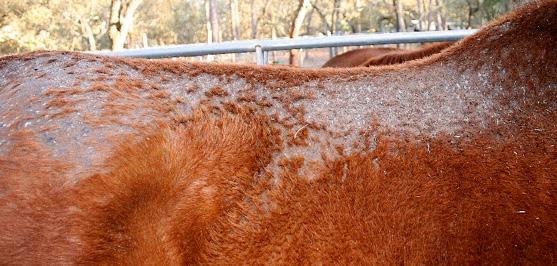
wet conditions. The infection earned the label rain scald due to its appearance, which is similar to the way horses’ coats look after they’ve been out in the rain. The infection even spreads in much the same pattern as water runoff on a horse’s coat.
The classic rain scald lesions show up as scabbing and crusting of the hair into clumps a few millimetres above the skin.
Commonly found over the back and rump (where water doesn’t drain away as easily) it can also affect the neck and extend down the legs and flanks.
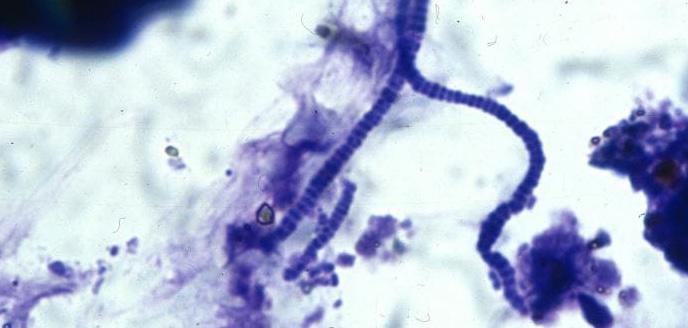
Diagnosis: A diagnosis is based on the appearance of the skin lesions, which is then confirmed with impression smears of the underside of the scabs.
The moist, dark environment under the scab is where the bacteria is living, and although the infection can appear on more than one horse at the same time, it is not considered to be truly contagious. Rather, it’s just that all the horses in that geographical area are likely to be experiencing the same environmental conditions, which are, of course, detrimental to the health of their skin.
VET VIBES
Treatment: Treatment involves the removal of the scabs followed by the application of a medicated shampoo. Sometimes this is easier said than done, because even the very gentle removal of the scabs with a soft grooming brush can be painful for the horse. Nonetheless, all the scabs need to be taken off. If some remain, the infection will continue to reoccur. If scab removal is difficult and painful for your horse, please talk to your veterinarian about pain relief options.
A medicated shampoo that contains chlorhexidine +/- miconazole works well to remove the infection. Other options are iodine-based rinses, but they can be drying on thin coated horses. Systemic antibiotics are very rarely ever needed, and usually only in immunocompromised foals.
Ringworm
Another skin condition, which is often confused with rain scald, is Dermatophytosis (ringworm). However, there is a significant point of difference in that ringworm, unlike rain scald, is contagious. It can be spread between horses through grooming tools, tack, and their handlers. Humans can also contract the infection from their horses.
The infection is usually self-limiting but can be a more serious issue in horses that are stressed, undernourished or immunocompromised.
Symptoms: The lesion presents as the classic ever-expanding ring of inflammation. The infection heals from the centre of the ring out, so large rings can have normal hair growth in the middle of them. They can appear anywhere on the skin, but most commonly in areas where the infection first occurred, for example under the girth if contaminated tack was the source.
The incubation period (the time from initial infection to showing clinical signs) is several weeks. This makes controlling an outbreak difficult, because by the time the first signs of infection have appeared, it’s very likely that other horses will have been infected.
Treatment: The infection usually resolves on its own within one to six months. However, it should be treated to prevent other horses and staff becoming infected. A twice weekly medicated anti-fungal shampoo or rinse is recommended. If you are unsure of the best products to use, ask your veterinarian for advice.
Staphylococcal Pyoderma
Staphylococcal pyoderma is the other common bacterial skin disease in horses and causes a superficial pyoderma (pyoderma refers to skin infections that can manifest as spots and bald patches).
The Staphylococcal infection can have a rosette appearance which is easily confused with ringworm, or it can appear as areas of pustules and crusting similar to rain scald.
Staphylococcal infections tend to be itchier than either rain scald or ring worm infections. Infections can be found anywhere on the horse but are commonly found on the legs, especially the pasterns. Staphylococcus spp. is
a common normal skin bacteria on horses. Infection occurs in hot humid environments when there is a break in the skin – either from fly bites; soft, macerated skin (water related skin damage) on the legs caused by standing for long periods of time in dams; or from other scratches or minor injuries. Although it is not common, the infection can become a cellulitis resulting in a systemically ill horse with a swollen, painful leg.
Diagnosis: Staphylococcal infections are not contagious. Confirmation of the infection is based on cytology of the crusts and pustules, and culture and sensitivity results.
Treatment: Treatment is with medicated shampoos combined with removal of the scabs. However, systemic antibiotics are often needed to affect a cure, so a consultation with your veterinarian will be necessary.
Visit Apiam Animal Health to learn more about their extensive range of services.
VET VIBES
ABOVE: Dermatophilus congolensis, the bacteria that causes rain scald. BELOW: Rain scald commonly occurs over the back and rump (Images courtesy APIAM).
HEART HORSE
Calidor: One in a Million
This is KYLIE HAWKINS' deeply moving tribute to her heart horse, the one and only Calidor.
On Sunday 19th January 2025, my beautiful Cali was diagnosed with septic shock/ peritonitis, secondary to intestinal rupture from an extremely large enterolith. Unfortunately there was no resolution for this and Cali joined the angels that day.
The purpose of this story is purely to document my own personal experience. And if by chance I help or educate others in the process, then that is absolutely a bonus. I won’t be talking the technicalities of it all, you can certainly do the research and read so much about it. In my case, this is in a way one part of the healing process.
I will preface this however, that yes, this is hard and heavy, all the things, but sadness can also coexist with hope and gratefulness and reflection. You can let the sadness both come and go but still find a positive way through it all and look to a new, albeit different, future. I hope this highlights it’s normal to feel both.
Cali – Callidor, Sass Queen, Cray Cray, Fire Breathing Dragon. My heart horse, my soul mate, my best friend and a once in a lifetime horse. I truly believe you were always supposed to be mine. On paper her regal yet sassy, opinionated and challenging nature should not have matched well with my own version of OCD excellence seeking, perfectionist, fully planning everything to minute detail personality. But it just did. They say mares are challenging, but when you get that good one, nothing compares to the partnership you will have, and
nothing could be more true. We had a partnership that was rock solid in all ways.
She taught me to be confident and independent. To challenge myself, think outside the box. To be strong and courageous in life and most of all, to jump some bloody massive big jumps! She was a warrior queen. I was always amazed at her absolute belief in herself. I am therefore the best version of me because of her.
I’ve always said a great coach is key. It’s not just getting a few lessons and learning to jump jumps, it’s the fact they know you sometimes better than you know yourself. And that is why this worked. Yoda knew I needed Cali and Cali needed me.
This type of partnership is something that is built over years. Years of the ups, the downs, the good, the bad and messy, and everything in between. All of it. Years of hard work and commitment and learning and just getting out there experiencing life and working it out together.
We got to where we were because of that commitment and effort but also because of the bond that we built and the trust that we had in each other. That is not something that happens overnight, and it is rewarding knowing you built something that successful and special from its foundation. Apart from so many incredible achievements and the goals we reached, you were also wildly hilarious and well, just a teeny tiny bit annoying. But that is a big part of what
made you unique. A stoic elegant queen, who made it very clear on how and when she was to be touched (mostly never, like excuse me ma’am... some personal space!)
Warm-ups were for the most part like entering the battle zone. If you made it out of Galactica alive you were sure to have a cracker round! But only God knew if you would be lucky enough that day to get to the ring relatively unscathed. Thanks to you Cali, I have an uncanny ability to pretend like that ridiculous thing you just did, didn’t really happen (#erasememoryactivated).
And how many times you escaped and simply just caused chaos because you could. So dramatic! Mostly it was just to visit The Sexiest Man Alive (King Leroy), but with all certainty it was simply to make sure we knew you were in charge here. And the adventures. I mean, the safari into the carport/backyard at Boree with five kids chasing you, was simply iconic. And the walk of shame to return even more so, sporting a whole branch of gum leaves in your tail as your souvenir. Personally so offended that you were finally ‘contained’.
Many notorious shows (SSJC) where between us all, we ran out of fingers and toes to count the number of misdemeanors. So many memories and moments that have shaped who we were as a team. And then I heard the words that no one ever, ever wants to
LEFT: Sassy and opinionated, Cali was also brave and talented (Image by Australian Jumping).
hear about their heart horse. It became a reality for me and everything changed in an instant.
The realisation that the trip you thought you were taking for surgery to help your unicorn, quickly turned into the worst nightmare imaginable. And the love we have for our horses and me in particular with Cali, it is so damn easy and normal to want to be completely selfish, to try every single possible thing no matter what ‘just in case’.
Because you never know, right? Miracles could occur. It could be this time! But the reality is, the only thing to do is the right thing by your horse. To ensure they are not in pain and not suffering. I cannot say how hard that is however, to enact in the moment. Logically you know, sure, but to actually have the mental strength to say ok, I’m going to let you go now because that’s what you need … that’s just [insert whichever swear word you like here].
I cannot describe the absolute soul destroying, agonising pain of realising that there is no option. That here, right now, are your last moments with her. That you don’t have any more jumps to jump. You don’t have any more snuggles and licorice to deliver before bed. No
more adventures to be had. Never to breathe in her comforting smell or see her waiting for you at the paddock gate. You literally jumped one of the best rounds ever only hours ago - now this??
I’ve never truly comprehended the phrase ‘time stood still’ until that day. That day I fully understood. For in that moment, when the words were spoken, the thing you never ever want to hear, “there is nothing we can do,” there was nothingness. Everything stopped. And then suddenly you realise you understand the words being spoken, what they actually mean. And there is no going back after that. Something very significant about you changes forever. It then happens just so quickly. Too quickly. Like, I need more time. It’s not right. I took her stable bandages off for the very last time. Lucy braided her tail. So pretty for her journey to come. How are you supposed to know what to do in that time. How do you fit a lifetime of ‘thank yous’ and love into the 10 minutes you know you have left?
Ten minutes to try to comprehend what’s about to happen. We did what we felt was comforting. Scratching her favourite spot. Cuddling her. Talking to her. Letting
her know just how loved she is. Thanking her for every day we spent together. Those moments were both equal measure of pure agonising heartbreak and trying desperately to give her every last piece of love I had. What goes through your head in those momentsit’s hard to describe. A mental slideshow of so many beautiful memories.
I feel like everyone has possibly thought about their own version of what they may do in this scenario and there is no right or wrong answer. For me in that moment, there was no decision. For a mare that literally gave her everything to me, I would be everything for her until the very, very end. No question. I didn’t care what the impact to me may be afterwards, I just didn’t care. But it was definitely the right and the best decision for me and for her. To know she could hear me talking to her. To know she felt incredible love and adoration to her very last breath on this earth. I was there, telling her it was ok, telling her she needed to go and I would be ok. She deserved that and so much more. I won’t lie, it is traumatic.
And there are so many logistical things you don’t think about until that moment. Why would you? However, you just need
ABOVE: Cali taught Kylie to believe anything was possible (Image by One Eyed Frog Photography).
to somehow find the strength to get to the end. There is actually no way nor words to describe the feeling of the finality of having to leave them and just walk away forever. But you somehow just do it. One foot in front of the other. Shock and numbness take over.
No one prepares you for what comes after. The feeling of driving out of there with a gooseneck that is empty, that only hours ago held your most precious cargo. The trip from hell all the way home knowing what you left behind, yet still struggling to understand how this happened. Or the arrival at the other end when you don’t even have to open the back. A simple thing, a simple task that we normally do without thinking, but with a whole lot of meaning this time.
Cali touched the hearts of many people very deeply. And how wonderful it is to know she had such a far reach. But I think without doubt the hardest part of all of this is purely the fact it happened so quickly. There was no time to prepare, there was no time to process, it was just immediate and final.
Grief certainly is a journey in itself. So many ups and downs. And there is sadly no magic pill or manual on how to deal
with all the very deep emotions. You can be travelling along doing ok and something suddenly out of nowhere just completely derails you. And the grief is consuming. But perhaps that is ok. The level of pain and hurt and sadness you feel just reflects the amount of love you had, and how undeniably special she was.
Your tribe matters! Yes, your team, your tribe, the people you surround yourself with - they matter! In moments like this, it is truly humbling to feel the support, love and care your people give you. When you have nothing left, they take over and give you theirs. Mostly they are horse people. They know. They get it. They too can see the impact and do their absolute best to give you whatever you need.
From the simple logistical things which are truly outside your mental capability at the time, like packing up your trailer to get on the road, to the big things, being there to catch you at the end and help put some pieces back together. Two people were my rocks. They know who they are and they know I can never repay them. I couldn’t have done what I did alone that day. Your survival instinct kicks in, but it drains every part of you. And those people, your people, they
keep filling it up for you so you can keep going for as long as you need to.
At the end of the day Cali was simply an amazing part of my life that will never be forgotten. Living in her spirit every single day, showing her I did listen to her, I did learn and I embody everything she was. She will live on in her beautiful, talented (but equally opinionated and sassy) babies, Surprise and Cora. Her genetics are strong and we have the baddest of all Sass Queens waiting in the wings to pick up where mum left off.
She showed me what I was made of, what I could be. To believe it was possible. She wasn’t just a horse, she was my everything. How truly lucky I was to have a Cali. I will never quite be the same, a large and special part of my heart will always be missing. But we now have a future to look forward to which will be very different but just as amazing in its own way. And that’s ok. Cali knew no other way than to keep going no matter what - so that’s what we do.
How lucky am I to have something so incredible that makes saying goodbye so hard
From ‘The Cali Chronicles’ by Kylie Hawkins.
HEART HORSE
ABOVE: Calidor touched the hearts of many (Left: Image by Australian Jumping. Right: Image by One Eyed Frog).
Welcome to Era of the Strong Rider
ANNE-MARIE LASSERRE explains why strength is replacing 'skinny' in the saddle.
For years, there’s been an unspoken image of what a ‘good rider’ should look like - light, slim, and almost invisible in the saddle. The idea was simple: the smaller you are, the less you will interfere with your horse. But that narrative is changing - and fast. Welcome to the era of the strong rider.
It’s About Being Better
Being lighter doesn’t automatically make you a better rider. What actually improves your riding is: stability, body control, balance, and endurance. And all of those come from strength - not size. A rider with a strong core can sit deeper, move more fluidly, and communicate clearly. A rider with strength in their legs doesn’t grip - they support. A rider with strong body awareness doesn’t fight the horse - they move with them.
Weak Riders Hold Horses Back
When a rider lacks strength:
• they collapse through their core
• they rely on the reins instead of their seat
• they lose balance in transitions
• their aids become inconsistent
On the flip side, a strong rider creates:
• a quieter seat
• more consistent contact
• clearer, more functional communication
• a more confident, relaxed horse Strength doesn’t make you heavy - it makes you effective.
What the ‘Rider Body’ Really Needs
A functional rider’s body isn’t built on restriction, it’s built on capacity. Not smaller, not lighter, but stronger, more aware, and more resilient. Because riding isn’t passive. It’s physical, dynamic, and far more demanding than most people realise. So what does a
rider’s body actually need?
1. Core Strength (But Not the Kind You Think): This isn’t about six-pack abs. It’s about deep, functional core strength - the kind that stabilises your pelvis, supports your spine, and allows your upper and lower body to work independently. A strong core means:
• you stay centred in the saddle
• you don’t collapse forward or hollow out
• your aids become quieter and more precise
It’s the difference between holding on and truly being in control.
2. Lower Body Stability: Your legs aren’t just along for the ride - they’re your primary point of connection. But gripping isn’t stability. True lower body strength allows you to:
• maintain a secure, consistent position without tension
• apply aids clearly without overusing them
• stay balanced through transitions, jumps, and unexpected movement
Strength here creates security - for both you and your horse.
3. Mobility and Flexibility: Strength without mobility leads to stiffness, and stiffness blocks communication. Riders need:
• open hips to follow the horse’s movement
• supple ankles for shock absorption
• thoracic (upper back) mobility for posture and rein contact
This is what allows you to move with your horse instead of bracing against them.
4. Balance and Coordination: Riding is controlled instability. You’re constantly adjusting to a moving, thinking animal beneath you. That requires not just
strength, but coordination. A well-trained rider body can:
• react quickly without overcorrecting
• stay aligned even when things go wrong
• maintain rhythm and flow
This is where true feel and timing are developed.
5. Endurance: It’s not just about one good movement, it’s about maintaining quality from start to finish. Fatigue changes everything:
• your position slips
• your reactions slow
• your aids become inconsistent
Endurance - both muscular and cardiovascular - keeps your riding reliable, not just good in short bursts.
6. Proper Fuelling: You can’t build a capable body without supporting it. Under-fuelling leads to:
• poor concentration
• reduced strength and coordination
• slower recovery
• increased injury risk
A well-fuelled rider is sharper, stronger, and far more effective in the saddle.
The Bottom Line
The ‘ideal’ rider body isn’t a look, it’s a function. It’s a body that can: stabilise, adapt, communicate, and endure. Being more capable is empowering. It comes from lifting weights, doing reformer Pilates, focusing on longevity over aesthetics, and training your core as a primary muscle group - not an afterthought.
So instead of asking, “How do I look as a rider?” Start asking: “What does my body need to perform at its best?” Because that’s where real progress begins.
Follow Anne-Marie on Instagram.
Overtraining, Overreaching and Overloading
An imbalance
between
training and
recovery,
overtraining leads to chronic fatigue and changes in health and behaviour, writes DR JENNIFER STEWART
Overtraining is a state of prolonged fatigue, characterised by falling performance that doesn’t respond to a short reduction in training or a short spell. Overtraining syndrome (OTS) is an accumulation of training and/or non-training stress with physiological and psychological symptoms that need several weeks or months to overcome.
Overreaching can occur after a short period of intensified training - recovery usually requires 2-3 weeks. An accumulation of training stress, overreaching responds well to a reduction in the intensity, duration or frequency of training or to a short spell. Overloading is the principle we apply to increase fitness (strength, power and stamina), and to achieve this, we need to continually increase the stress.
The basis of any training program is to continually provide increasing levels of stress to the muscles, bones and cardiovascular systems to stimulate adaptations that lead to fitness (Fig. 1). After a training session, the horse’s body overreacts to fatigue and muscle damage and experiences a period of overcompensation (Fig. 2).
The tissues then re-establish themselves, but at a slightly higher level than before the training. This small increase is called adaptation. If the stress is too small in intensity, frequency or duration, little or no adaptation is stimulated. If it is too large or severe, adaptation is delayed or prevented. It is important to allow enough recovery time for the processes of overcompensation and adaptation before the next session. If the next training session is applied without sufficient time for recovery/rest, adaptation cannot occur.
Different Tissue, Different Response
Different tissues require and respond to different amounts (intensity, duration and frequency) and types of training –and overtraining is different for each. Bones: Bones adapt to training by remodelling their shape and thickness to match the load distribution. Gait, speed and manoeuvres deliver significant concussion and strain to the bone and they respond by building and laying down more bone. The new bone is low density and fatigues sooner than more mature bone. When bone fatigues it deforms, so shear forces occur between the areas of new, low mineralised bone and older fully mineralised bone. The resulting inflammation causes pain and swelling. If the stress is not severe it stimulates new bone production, if severe, it causes inflammation, pain and microfractures.
Preventing Overtraining
Preventing overtraining is important. When a young horse enters training, bone is first resorbed and density is lowest at around 8 weeks, increasing at around 16 weeks. Slow work does not increase bone density and faster
speeds (greater than 12m/second for 200–400metres) are needed. However, if fast work is introduced too early and the speed, frequency, distance and duration are too severe, the bone cannot complete the necessary compensation and adaptation and bone injury is a real risk.
Because the skeleton does not usually reach full maturity until around four years of age or older, injuries to the bones can and do occur. In Thoroughbred racehorses, 90% of 2-year-olds become shin sore; higher-than-desirable wastage rates affect young halter horses, and in one study of a 150-mile endurance ride, 33% of horses failed to finish because of lameness or injury. Even in older horses, overtraining must be avoided and proper bone maintenance must occur.
Muscles: An increase in muscle size generally requires 6-8 weeks but the adaptations that improve strength, stamina and speed take up to 16 weeks. Low intensity, long duration endurance training for 6-8 months increases muscle strength and exercise capacity. Muscle size can be further increased by 60–80 minutes of higher intensity work for 12 weeks. Increased strength and exercise capacity can be evoked in dressagetype horses by 70–90 minutes of low intensity work three days a week for eight months and in show jumpers, six months of riding and jumping. Overload training, with exercises of high-intensity prolonged beyond a basic and specific training of about 16 weeks should be avoided in athletic horses to reduce the risk of overtraining.
Fit For Purpose
For some equestrian disciplines, exercise is used for purposes other than improving a horse's endurance, speed, or athletic potential. The main goal in fitting halter horses and sale horses is to maximize muscular development and improve overall body tone. Stocktype horses have a higher percentage of fast twitch muscle fibres which will increase in diameter more readily than the slow twitch fibres of a heavy hunter
or endurance horse. Halter horses respond well to aerobic work that includes extended trotting or loping plus manoeuvres that target the fast twitch fibers – such as round pen work that involves stops and rollbacks into the fence and significant backing up. These exercises increase the diameter of individual muscle fibres.
A hard training session causes the muscles to become temporarily weaker and it is actually the rest/recovery period that enables them to become stronger. If sufficient rest is not included in the training program, then muscle recovery, regeneration and development is hampered and an extended recovery period is required. This imbalance between training and recovery is an indicator of overtraining and usually occurs over a few weeks.
However, if there is a sudden increase
in the duration, intensity and frequency of work, it can occur quickly. Detectable as changes in resting heart rate and early onset of fatigue, this overreaching condition can be reversed by reducing the work and complete recovery can be achieved. If sufficient time for recovery is not provided, fatigue will occur earlier in the training session, the risk of injury increases and the horse descends into a state of overtraining.
As well as the musculoskeletal system, horses need to be conditioned to delay the onset of fatigue – which among other things leads to abnormal loading of the joints and bones. For the cutting horse, working one cow for a shorter amount of time, then returning to the herd for a second cow, helps the horse sharpen movement skills and improve ability more effectively than working one cow for an extended time period.
Figure 2: Compensation and overcompensation
Figure 1: The cycle of stress, recovery and adaption
THE PERFECT COMPLEMENTARY BALANCER FOR ALL HORSES, ALL DISCIPLINES AND ALL DIETS
A concentrated source of essential amino acids for all horses and ponies - breeding, growing, exercising, competing and ageing.
Jenquine all-4-feet provides quality protein to support growth, repair and maintenance of all body systems.
For the reining horse, rather than continually being asked to run and slide, they could be galloped and stopped, then rested by some standing and walking before the next gallop/stop repetition. This allows each repetition to be accomplished with comparable effort and precision.
For disciplines such as dressage and other sports that require quite peculiar and specific characteristics such as agility, balance, obedience, skills, and a precise interaction between the horse and rider, the interaction creates a certain synchrony in the horse/ rider heart rate and cortisol release. Monotonous repetition of specific movements, gaits and paces can cause stress with little improvements in technique. Recent studies have found that reducing movement-specific training and incorporating strengthening exercises can lead to a reduction in boredom and an improvement in core strength, translating to improved stride length, balance, agility and enthusiasm for work.
Glycogen Depletion
anxiety, become ‘stale’ or ‘sour’; have a higher heart rate after work and take longer to recover to their resting hear rate; diarrhoea or sweating; and have elevated blood levels of muscle enzymes (Table 1).
There may be a reduction in red cell volume, PCV and haemoglobin and signs of adrenal gland exhaustion. These symptoms can persist for several weeks to several months after the workload is reduced. The drop in body weight can
Table 1: Signs and symptoms associated with overtraining
• Decreased performance
• Lethargy, depression
• Poor appetite
• Weight loss
• Mental instability. irritability, anxiety
• Loss of competitive drive
• Sleep disturbances
• Increased susceptibility to illness including respiratory and allergies
• Changes in heart rate at rest, exercise and recovery
• Changes in blood pressure
• Low blood lactates during submaximal and maximal exercise
The most significant factor in muscle fatigue is depletion of muscle glycogen. It usually takes from one to five days for glycogen stores to be replenished, depending on the amount of depletion. However, glycogen depletion can be controlled to some extent by bringing the exercise and feeding program into close synchronisation. Provision of essential amino acids and antioxidants to support the mitochondria (the muscle's power plant) and prevent cell damage is essential to support the exercise program.
Overtraining Syndrome (OTS)
Early studies into overtraining syndrome focussed on changes to the size of the red blood cells. However, more recent research has found that there is no single marker that identifies the syndrome. Instead, when horses are experiencing overtraining they may drop condition; lose their appetite; develop behavioural changes - nervousness,
• Increased muscle enzymes
Table 2: Dimensions of affective state
• High Arousal/Negative Valence: Anger, anxiety, fear.
occur with no reduction in feed intake or appetite, is accompanied by a decrease in muscle fuel storage (glycogen), and due to insufficient time being allowed for adaptation and recovery, can occur if training is undertaken 6 days a week compared to 5 days.
Muscle damage and decreases in muscle strength predispose to incoordination, injury and abnormal stresses on joints, ligaments and tendons. But, there are also behavioural
signs. In an Australian study, the only consistent change in overtrained horses, other than the body weight and poor performance, was behavioural change that occurred up to 2 weeks before OTS was diagnosed. The general observations were irritability and an unwillingness to complete an exercise/ training session. Other common signs were head-tossing during exercise.
More subtle changes in behaviour are often missed. In human athletes and sportspersons, overtraining is more accurately predicted in ratings of socalled ‘affective state’ - a transient, subjective, and psycho-physiological condition encompassing emotions, moods, and feelings. The affective state (AF) acts as a continuous flow of inner sensations, shaping cognitive processing, perception, and decisionmaking. Key dimensions include valence (positive/negative) and arousal (activated/deactivated) (Table 2).
Emotional Experience
Horses' subjective emotional experiences can be characterised according to valence (positive or negative, rewarding or punishing, pleasant or unpleasant) and arousal/ intensity level (contentment versus excitement). Behavioural signs and changes are a consistent and early marker of overtraining syndrome – but not easy to recognise.
In terms of survival (in prey species in particular) there are advantages in hiding emotions that are suggestive of vulnerability to predation or social rejection. This potential lack of expression poses an additional challenge to recognising signs of emotion in the horse because survival is enhanced by masking underlying emotion. The challenge is to identify signs that the horse cannot hide. Many of us feel more comfortable assessing the physiological state of the animal, such as body condition score, hoof condition, mobility, and presence of injury, rather than assessing their mental state.
Horses in training can be exposed to intensive housing, absence of foraging, inability to exercise for most of the day and loss of their natural herd structure. Other factors such as transport stress, and subclinical or low-grade diseases including gastric ulceration, respiratory disease or lameness, create additional stresses that may precipitate overtraining syndrome.
Sleeping Patterns
Patterns of sleep relate to mental wellbeing in humans, and horses are not so different. Horses sleep because they have to and REM sleep is only achieved by lying flat out on their side with complete muscle relaxation, eyelids closed and eyes moving rapidly. Their usual sleep pattern takes 3-5 hours per 24 hours. Although sleep occurs intermittently throughout that period, most sleep happens between midnight and 5:00am and an inability to do so, contributes to OTS.
Straw bedding can facilitate nocturnal patterns that promotes more biologically significant behaviours, including greater than average recumbent behaviour in the stable. Significant interruptions to sleep can happen to horses adjusting to overnight stabling, new environments and changes to their routine. Poor performance is commonly associated with sleep deprivation and excessive sleepiness. To avoid the added stress of sleep deprivation, we must ensure they have time, conducive conditions and opportunity for full, flat-out lying on their side.
Once other causes of poor performance have been ruled out, overtraining syndrome should be suspected in horses with ongoing decreased performance in association with one or more physiological or psychological (behavioural) signs. Several physiological signs occur with overtraining syndrome, including neuroendocrine alterations, increases in muscle enzymes and GGT, loss of body weight and alterations in heart rate and lactate responses to exercise. There may be performance
loss, but no single marker is consistent enough to accurately predict the onset of overtraining syndrome before performance is adversely affected.
A Complex Task
Regardless of the discipline, owners and trainers have an complex task in preparing a horse to perform to their full potential. The horse must be kept healthy and ideally not be undertrained or overtrained.
Preparation involves a combination of conditioning and schooling. Schooling develops neuromuscular coordination and mental discipline, whereas conditioning induces physiological and structural adaptations that maximize performance and maintain soundness.
It has been said that we should listen to our horses and let their conditioning dictate whether we can continue to push forward. or need to pull back, or even take a complete break. For a horse. the recovery period can be just as important as the actual training, and they should be allowed adequate periods of recovery after bouts of strenuous exercise.
Early warning signs to back off work include soreness, stiffness, changes in behaviour toward work, intermittent lameness, and physical expressions of discomfort, such as fatigue and dullness.
Mental readiness is as vital as fitness, with rest periods helping green or anxious horses avoid burnout
during show season. To help prevent injury and burnout, avoid overdoing strenuous workouts and adding numerous competitions back-to-back, especially early in the show season. Incorporate regular rest days to give the horse’s body time to recover from intense workouts. Strategically timing competitions and factoring in your horse’s unique physical capabilities can also ensure peak physical condition when it counts.
No article or book can provide all the information needed to design the optimal conditioning program for your horse. There are many variables that direct the design of the conditioning program. Successful application of techniques requires judgment, and judgment for a large part is dependent upon experience and observation. Nonetheless, the key principles that apply to conditioning programs in general are the duration, intensity and frequency of training. These principles direct the design elements of all conditioning programs.
Dr Jennifer Stewart BVSc BSc PhD is an equine veterinarian, a member of the Australian Veterinary Association and Equine Veterinarians Australia, CEO of Jenquine and a consultant nutritionist in Equine Clinical Nutrition.
All content provided in this article is for general use and information only and does not constitute advice or a veterinary opinion. It is not intended as specific medical advice or opinion and should not be relied on in place of consultation with your equine veterinarian
ABOVE: REM sleep is only achieved when horses are lying flat out on their side.
2026 Equis NSW Indoor State Titles
The NSW INDOOR STATE TITLES wrapped up on the first day of March, and once again showcased excellence in the sport of show jumping.
Held at the Australian Equine and Livestock Events Centre, a state-of-theart facility in Tamworth NSW, the prestigious 2026 Equis NSW Indoor State Titles were an outstanding success. Hosted by the North and North West Showjumping Club, over 400 horses and 186 riders contested titles in three show jumping arenas, which operated simultaneously across each day of the four-day competition.
A significant event on the show jumping calendar, seasoned campaigners, emerging talent, and riders just starting out on their show jumping careers converged on Tamworth to compete in four major title classes: Senior Rider, Young Rider, Amateur and Junior.
Managing 441 combinations on Day 1, 476 on Day 2, 467 on Day 3, and 264 on the final day of competition brought some serious organisational and logistical skills to bear, and Event Director Martin Gostelow is delighted by how smoothly everything ran. "The committee members, volunteers, judges, marshals and the team at AELEC all worked so hard to make this event the outstanding success it was," he says.
Feedback from competitors was also extremely positive, and the welcome barbecue, kindly sponsored once again by Jack's Creek, was a huge hit.
After some heart-stopping and fiercely competitive rounds, Sam Overton and Cha Cha Blue took the Senior title; Charlie Richardson and A Foxy Lady were victorious in the Young Rider event; Paton Simpson aboard Citylights PLS won the Amateur title, and Zavanah Cochran on Finch Farm Valentina emerged as Junior champion.
Jane Kibble, President of Jumping NSW was delighted with the outcome: "Strong entry numbers across all classes, high participation levels each day, expert officials, and extensive media visibility all contributed to a professionally delivered championship. We'd like to thank the North and North West Showjumping Club for their continued support and look forward to collaborating with them again to produce more high quality events for riders across the state."
You can find the full results for this year's event at Equipe
Our photo roundup of the event is courtesy of Arcadia Images.
Lockington & District Campdraft Club Annual Campdraft
KAYLA WALKER brings us a report on this recent and always very popular campdrafting event.
Images by EQUILUXE MEDIA & DESIGN.
On the 27th of February through to the 1st of March, the Lockington & District Campdraft Club hosted their annual event - three days of outstanding Campdrafting, horsemanship, and camaraderie, all wrapped up with a touch of unpredictable weather. The weekend kicked off with the Hannasky Livestock Carriers Feature Challenge, which incorporated both dry and wet work components.
The Feature Challenge continues to be a highlight of the weekend, combining the fast paced excitement of cattle work with a dry work component that allows competitors to step outside the box and showcase their horsemanship. This provides an opportunity to elevate standards, with both workouts and presentation taken into account.
Taking out the win was Brad Daunt aboard Berragoon Beat, earning themselves a stunning trophy rug, garland and buckle. A big thank you to Jason Fry and Ian Hughes for their time and expertise in judging this Challenge.
The Lyn Barratt Memorial Encouragement event followed, with a well-deserved win going to Jess Smith and Yinbarun Adele. Delivering an impressive score of 88 points and a beautiful full course, this combination stood out among the field. It was also fantastic to see Jess back in the saddle after the very recent arrival of her
second child, making the win all the more special.
The Maiden A was brought forward to Friday afternoon in an effort to stay ahead of the less than ideal weather forecasted for later in the weekend. The final event of the day, it was taken out by Bruno Robinson riding his homebred mare How Do You Do. The pair finished on a total of 175, securing the win with a commanding six point margin.
The atmosphere on Friday night was
fantastic for competitors and spectators alike, with a delicious dinner on offer and the bar open and in full swing. The evening was topped off with live entertainment courtesy of the very talented Jack Rieter, creating an enjoyable and relaxed social setting for everyone there.
Daybreak arrived a little sooner than the committee might have preferred, but competitors were eager and ready to get underway! Saturday’s program
LEFT: Gerard Wilson in Saturday's Open. ABOVE: Elle Moro competing in Saturday's Maiden B
commenced with the Maiden B, which saw a strong field of riders take to the arena. The event was won by Dave Kennedy aboard Rodlor Hustler, with the pair delivering a competitive performance to start the day’s proceedings.
Following the Maiden B, the day moved into what are always crowd favourites - the Junior and Juvenile competitions, with the exceptional young talent in both events highlighting the sport’s bright future.
The Junior event was taken out by Max Jackson on Sugar Stone, while the Juvenile was won by Paige Kennedy riding Kerriki Clockwork. Both competitors performed to a standard well beyond their years, demonstrating excellent horsemanship, composure, and a strong ability to manage both themselves and their cattle.
The DRM Excavations Open followed, drawing an exciting lineup of competitors all vying for top spot. With a beautiful garland, trophy
buckle, and rug on offer, the event promised high quality competition and did not disappoint. Following a closely contested run-off between Jess Jackson and Zac Svetlik, it was Jess, riding her small yet determined gelding Tic Tac, who ultimately secured the win.
The final event of the day, the Novice A, delivered an exciting conclusion to Saturday’s competition. Following a thrilling run-off against Riley Shanahan, who pushed hard to the very end in a determined performance, Jason Pickering aboard Teles Hope won with an impressive total of 192.
Saturday evening offered a chance for competitors and spectators to unwind and enjoy a beautifully catered roast meal provided by the Lockington & District Campdraft Club. The atmosphere was lively with entertainment by the talented Jade Camden, whose performance carried the celebrations well into the night with many taking to the dance floor
under the lights.
Sunday morning greeted competitors with a few tired heads, but spirits remained high and the competition fierce. With challenging weather looming, proceedings moved efficiently to ensure the remaining events were completed. In the Novice B, Jayden Griffiths and his horse Rodney took top honours, delivering a winning score of 172.
The final event of the weekend, the Open 4 Open, was met with less than ideal conditions as the weather began to turn. Despite this, the competition remained strong, and it was Lachie Sim riding Destiny’s Cherry who rose to the occasion, claiming victory with a score of 177.
The Lockington & District Campdraft Club extends its sincere thanks to all competitors, volunteers, judges, sponsors, and cattle donors. Your continued support and contribution are what make this event such an outstanding success year after year.
ABOVE: Brad Daunt aboard Berragoon Beat won the Hannasky Livestock Carriers Feature Challenge, judged by Jason Fry and Ian Hughes
ABOVE: Saturday's DRM Excavations Open was taken out by Jess Jackson and her small yet determined gelding Tic Tac BELOW: Declan Price (L) and Amy Crampton (R) both competed in the Hannasky Livestock Carriers Feature Challenge.
ABOVE: The Hannasky Livestock Carriers Feature Challenge continues to be a highlight of the weekend, combining the fast paced excitement BELOW LEFT: Tahlijia Sheahan and BELOW RIGHT: Brad Caldwell both competed in Saturday's Open event.
excitement of cattle work with a dry work component that allows competitors to step outside the box and showcase their horsemanship.
and his horse
took top honours in Sunday's Novice B.
BELOW: Jayden Griffiths
Rodney
Paige Kennedy aboard Kennedys Trump.
ABOVE: Dave Kennedy aboard Rodlor Hustler took out the win in Saturday's Maiden B. BELOW: Bianca Everard (L) and Cassidy Dupuy (R) both collected an encouragement award.
ABOVE: Lachie Sim riding Destiny’s Cherry won Sunday's Open 4 Open the weekend's final event. BELOW LEFT: Ash Sheahan in the Open 4 Open. BELOW RIGHT: Jess Smith and Yinbarun Adele on their way to victory.
Located at 466 Sarabah Road, Sarabah QLD, this magnificent property has potential limited only by your imagination. PROPERTY
RScenic Lifestyle and Income Potential
arely does a property of this calibre become available in the much sought after Sarabah Valley. A landmark 1939 Queenslander on 65.05 hectares (160.75 acres) with over one kilometre of pristine creek frontage, stands as one of the valley's true generational holdings. This impressive estate captures the essence of country living.
Surrounded by the Sarabah Estate and O'Reilly's Canungra Valley vineyards, the property rests at the end of a peaceful valley, blending lifestyle, privacy, equine amenity and agritourism appeal.
Bromelton House, the original fourbedroom homestead, still retains its heritage character while benefiting from thoughtful updates, including expansive Merbau decks that frame the home -
perfect for outdoor entertaining. The home features polished floorboards, gas heating, an open fireplace and reverse cycle air conditioning.
Recently reinstated as a guest house, the property has a proven income history, opening the door to farmstays, vineyard getaways, or boutique accommodation for visitors exploring the spectacular region.
A large shed sits alongside cattle yards and a loading ramp, and offers a caretaker's quarters, with further utility for storage, a workshop, or equine infrastructure. Water is ample with over 80,000L storage supported by a main header tank pumping from the creek and gravity feeds to the property's paddocks.
The land is a blend of usable country
and gentle topography, perfectly suited to equine pursuits. Fencing, soil quality and the natural lay of the land support a range of rural uses, while the creek-side areas, which include a timber gazebo and multiple large swimming holes, create opportunities for recreational activities or agritourism ventures.
Conveniently located only 45 minutes from the Gold Coast and just over
Usable country and gentle topography are perfectly suited to equine pursuits.
an hour from Brisbane CBD, with its heritage charm, vineyard-lined surroundings and multiple income pathways, this property represents a rare combination of lifestyle, beauty and business potential in one of the Scenic Rim's most desirable rural pockets.
View the property online, or call Clint Donovan 0421 944 985.
Polished floorboards echo the homestead's heritage past.
Bromelton House, the original four-bedroom homestead, still retains its heritage character.
Lifestyle, Livestock and Location
Pendleton, a one-of-a-kind property located at 141 Rickert Road, Kings Creek Qld, represents 90 acres of unparalleled opportunity.
Positioned in the tightly held Kings Creek district, Pendleton is just two years old and presents an outstanding opportunity for lifestyle buyers, hobby farmers or those seeking a highly productive rural holding with quality infrastructure already in place.
Spanning 90 acres of rich black soil, this undulating yet 100% usable property is perfectly suited to
equine pursuits, farming, or grazing. Delivering versatility and productivity in equal measure, Pendleton’s water security is well covered with a submersible 240v bore pumping to a 110,000L tank, complemented by two 5,000 gallon rainwater tanks servicing the ho me.
For horse and livestock enthusiasts, the infrastructure is impressive, featuring
panel cattle yards complete with new crush and loading ramp, a sand horse arena, a large stable complex with three generous 4mx4m boxes and attached day yards, a feed room, tack/vet room, and loft office space with eastern views over the region.
The property is divided into eight separate paddocks, with a central laneway. A substantial 20mx9m five-
This is the kind of property that allows you to create the lifestyle you've been working towards.
bay shed (four lockable bays plus one open bay) provides ample space for machinery, vehicles and workshop needs.
The steel-frame, high-set homestead is designed for relaxed rural living. With three bedrooms (two with builtins and two large walk-in robes in the master), and the option to convert a fourth bedroom, the home features an
open plan kitchen, and a dining and lounge area that flows effortlessly onto an expansive western facing deck with a four-person sauna for ultimate relaxation.
Comfort is assured with a large split system air-conditioner, ceiling fans throughout, a Fisher & Paykel five burner electric stove and dishwasher. A substantial front verandah further
enhances the home's country charm.
This is the kind of property that allows you to create the lifestyle you've been working towards: productive land, quality infrastructure and space for the whole family (two and four-legged alike).
View the property online, or call Michael Tomlinson 0428 545 396.
Contemporary elegance is a feature of the Pendleton homestead.
The loft office space offers eastern views over the region.
P O D C A S T
F r o m t h e A r e n a t o Y o u r A i r P o d s ��
Y o u r h o s t s C h a r l i e B r i s t e r a n d H o l l y H a l l P e r r i n
b r i n g y o u g r a s s r o o t s r i d e r s t o r i e s , e x p e r t
i n s i g h t s a n d i n s p i r i n g c o n v e r s a t i o n s w i t h t o p
i n t e r n a t i o n a l c o m p e t i t o r s .
A v a i l a b l e n o w w h e r e v e r y o u l i s t e n .
B r o u g h t t o y o u b y
R E A L R I D E R S . R E A L I N S I G H T S . R E A L C O N N E C T I O N .
Ready, Set, Show
For that professional, polished look, there's nothing quite like a stylish, colour coordinated show set.
You'llalways be spoiled for choice at Gala Equine. Their show sets are available in a dazzling range of colours and designs, and every set comes complete with rug, hood, surcingle, and tail bag.
We're a little bit in love with their light grey offering. Trimmed in white and pale pink, this eye-catching set features a 20/80 270gsm polycotton blend designed for durability and style. There's a triple Velcro closure on the hood, with a single buckle fastening at the chest.
With comfort front of mind, the fleece on the wither and nose, and internal linings at the chest and along the neck, help to alleviate rubbing. Double webbed, removable leg straps are secured with trigger clips for quick and easy use.
If you're feeling creative, The Rug Rack has the perfect option: a unique design-your-own Deluxe Show Set. First pick your colour, not easy when there's 30 to choose from, including plains and fashion forward checks. Next, the main and second binding, and again, the colour palette is stunning: Aegean Blue, Metallic Antique Gold, Lavender, Mint Green, Jade, Burgundy and many more. Then there are the extras, including satin shoulders, a zipper in the hood, a leather front, a Euro front, a surcingle, and PVC or leather hood buckles. Your horse's name embroidered? No problem - the choice is all yours.
And here's a smart choice: Newmarket Saddlery's Oxford Royal 100% Cotton Show Set comes complete with matching rug, hood and tail bag. With its two-tone binding, this set features protective satin lining in the neck and shoulders and fleece at the withers.
Three metal buckles on the hood, which attaches with elastic connectors, and double front chest straps help keep this set securely in position. The tent tail flap is generously sized and the rug has Velcro already sewn into place so attaching the tail bag is a breeze.
Available in five sizes starting at 5'6 and going up to 7'0, you can purchase this set using a handy interest-free four payment option if required.
Targeted Nutrition for World-Class Performance
For over 30 years Kentucky Equine Research has continually developed innovative solutions to the health and nutritional challenges inherent in modern equine management. The results of studies conducted at its research farms, as well as advances in equine nutrition from institutions around the world, are applied and thoroughly tested in the creation of KER products.
Proprietary ingredients and science-based solutions characterise KER Targeted Nutrition. Top equestrians worldwide in a variety of disciplines know they can rely on KER to fuel world-class performance.
Discover science-based products or your closest retailer at ker.com