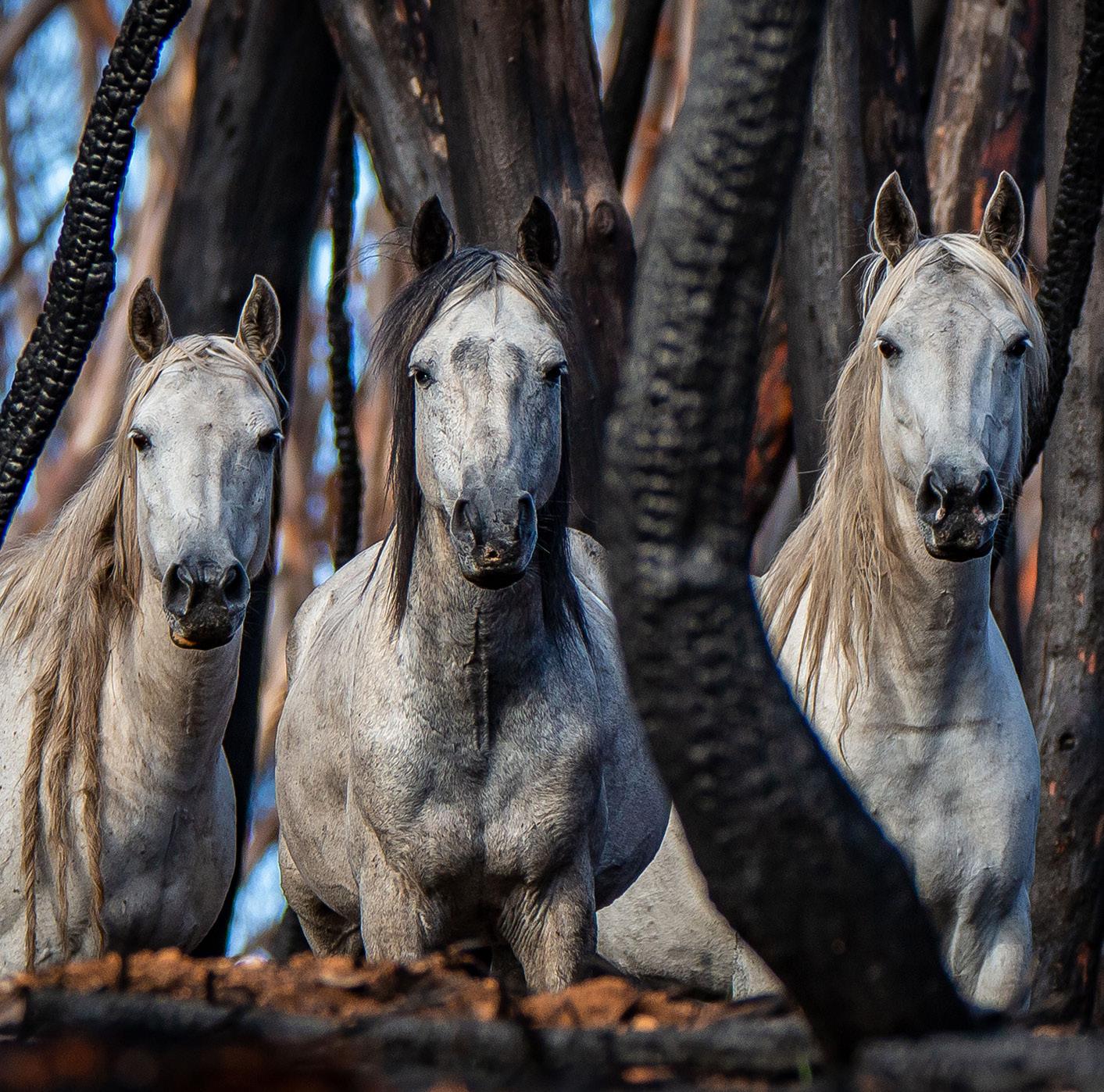
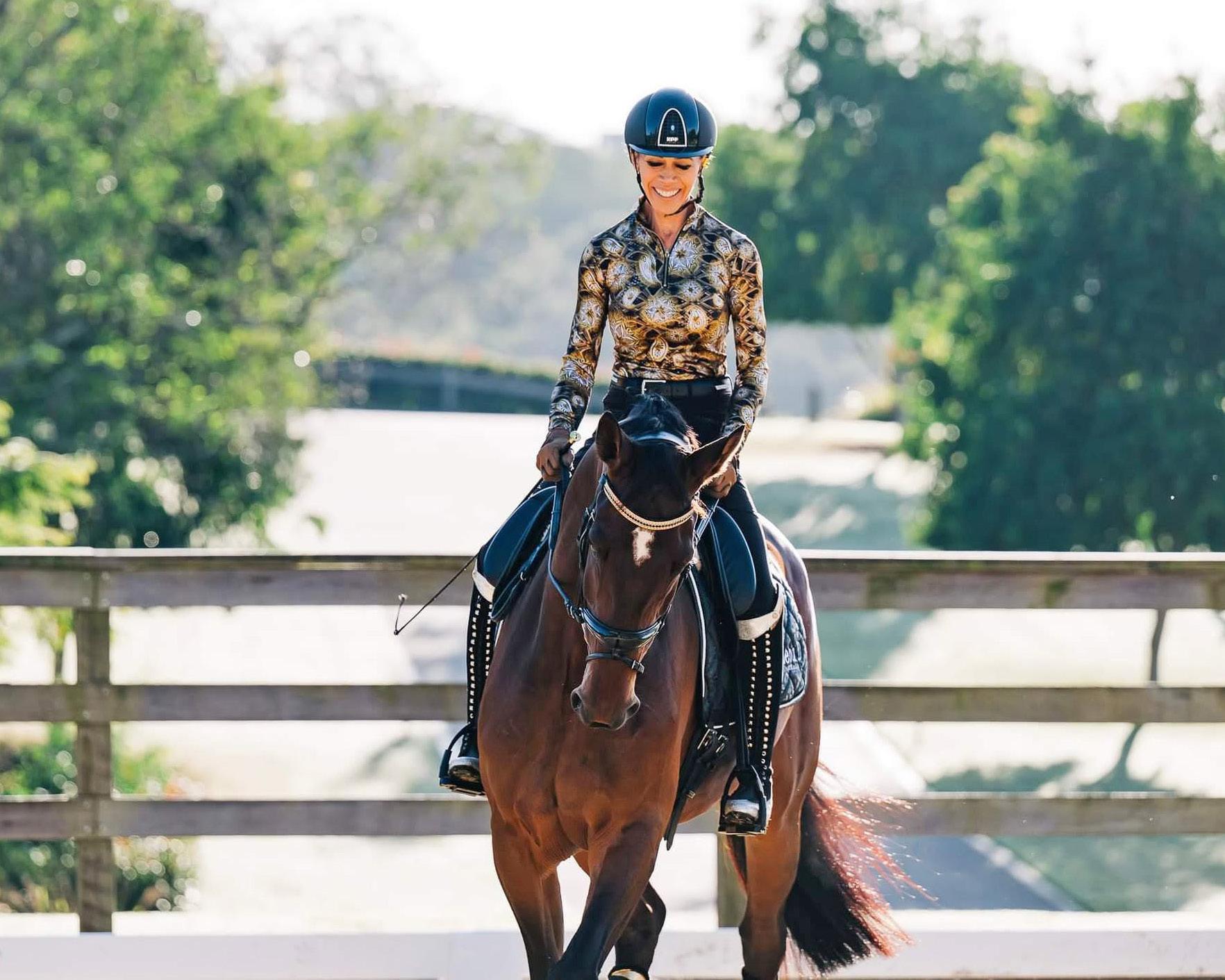
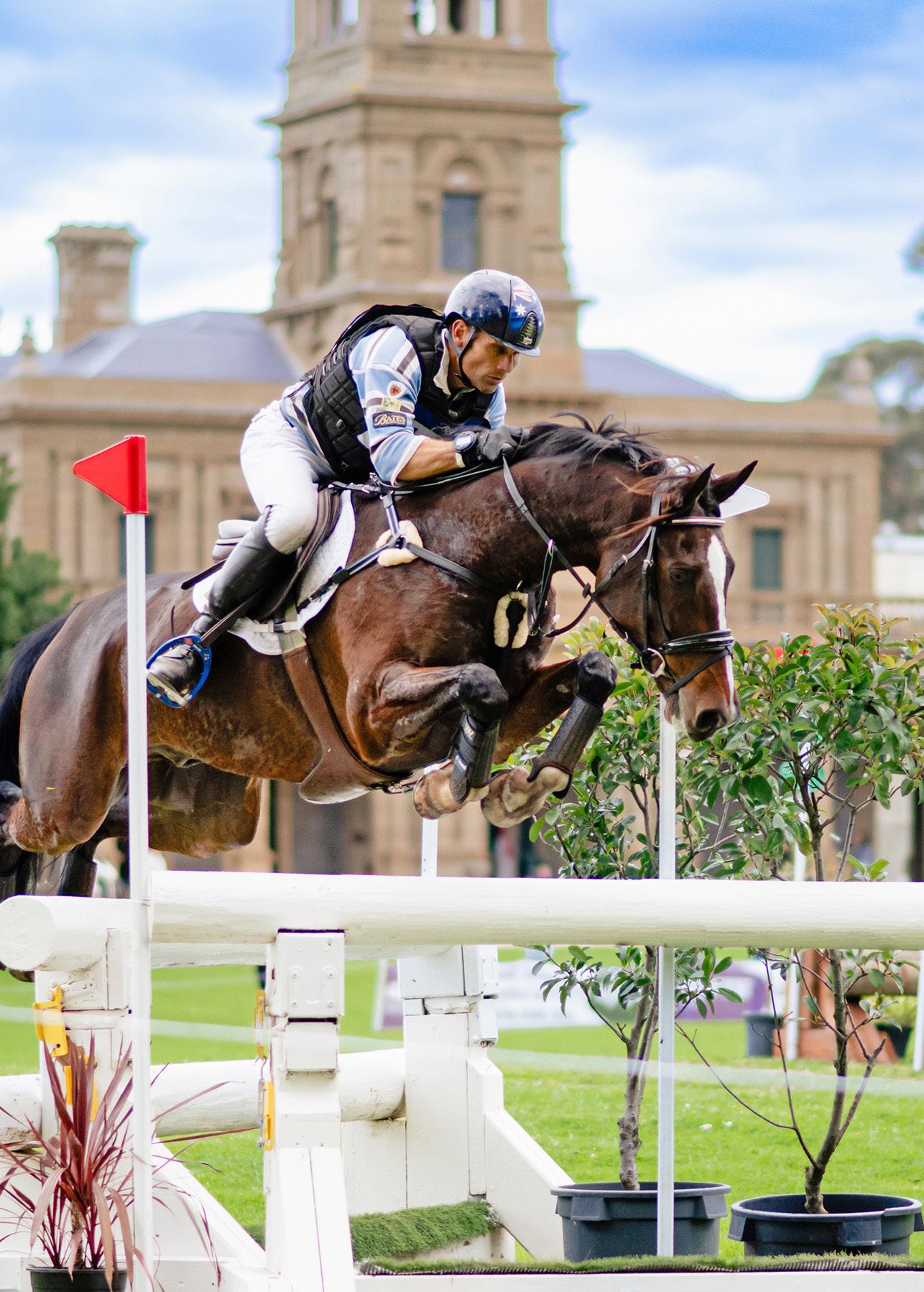
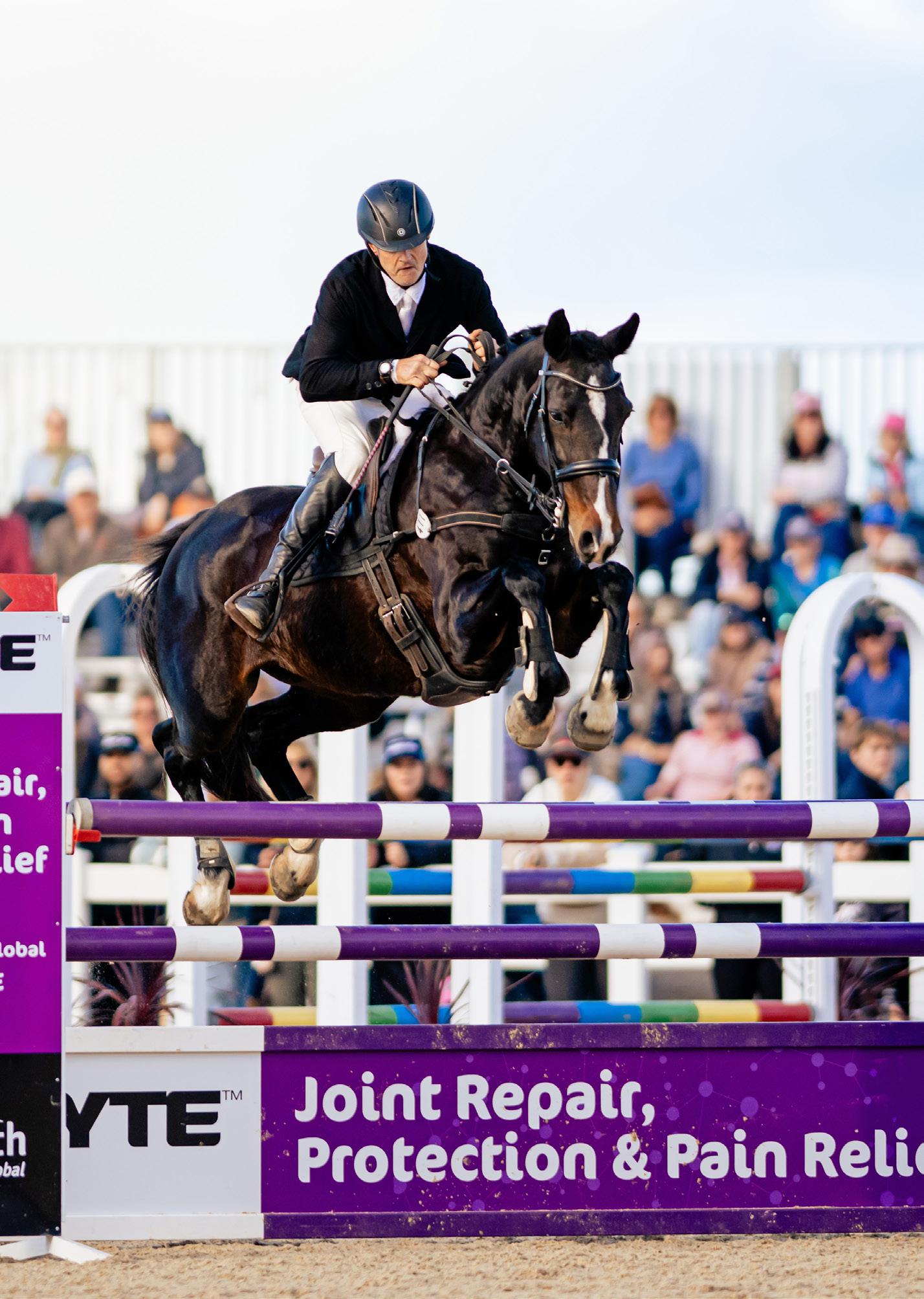
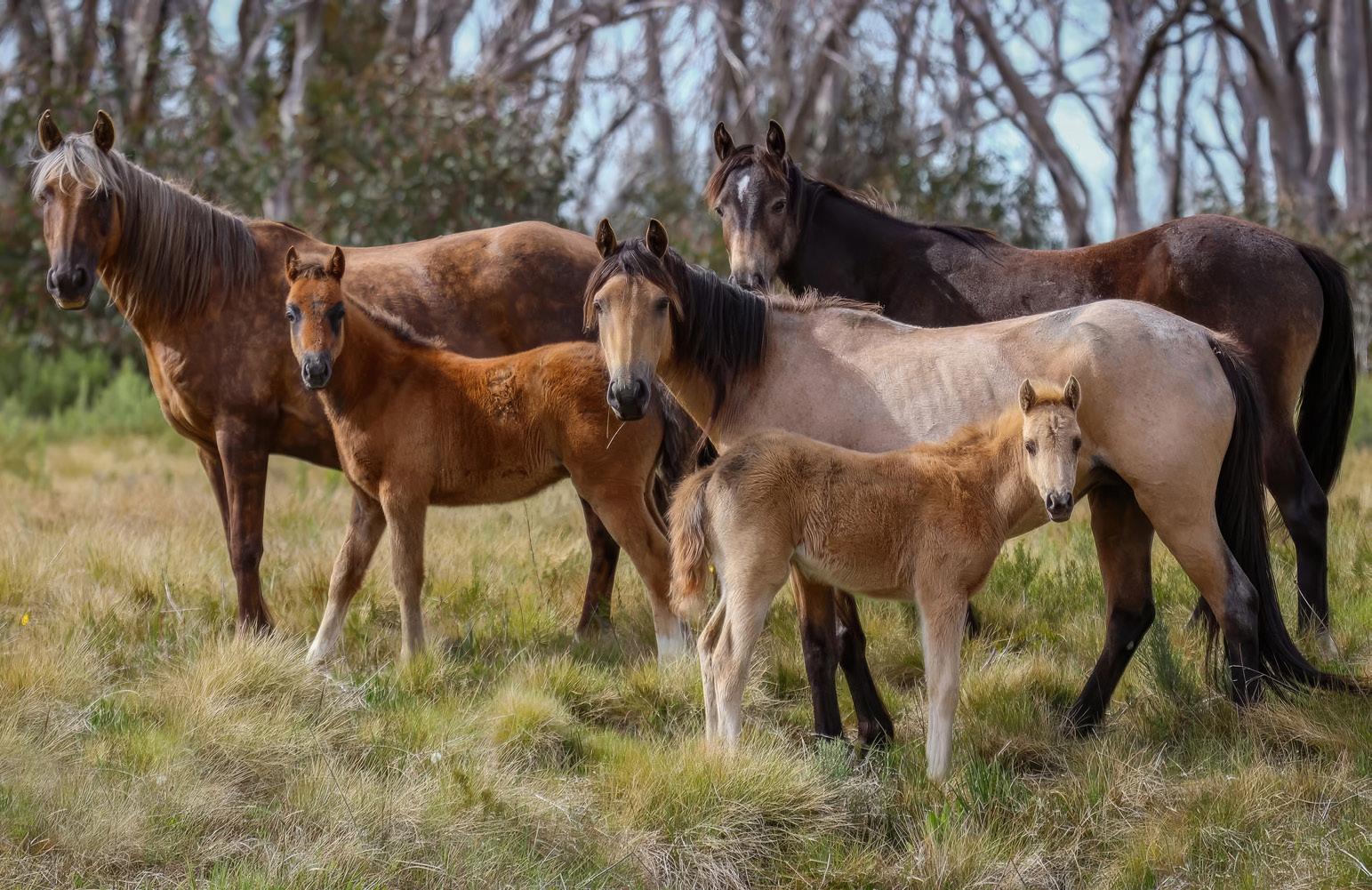
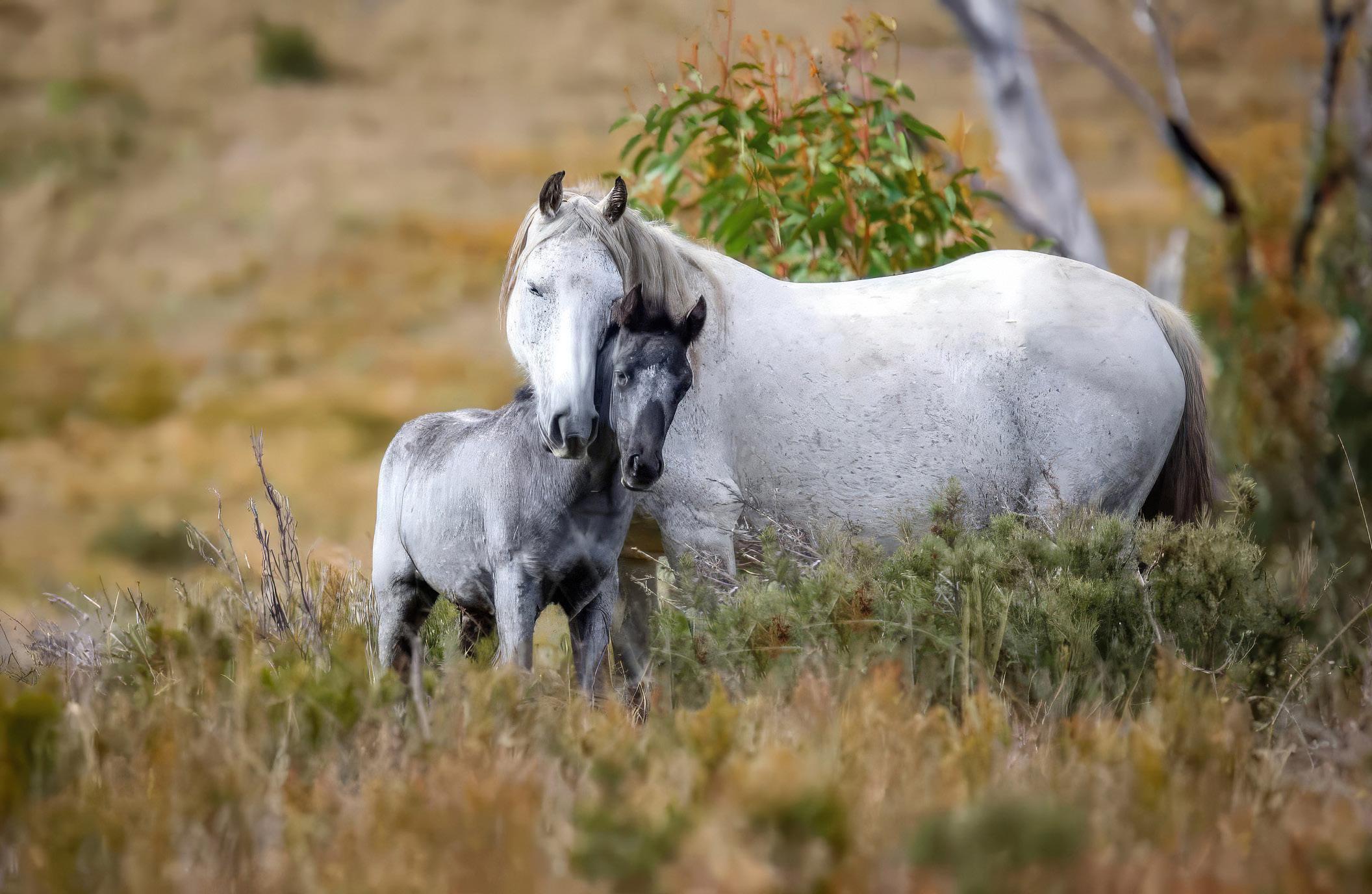
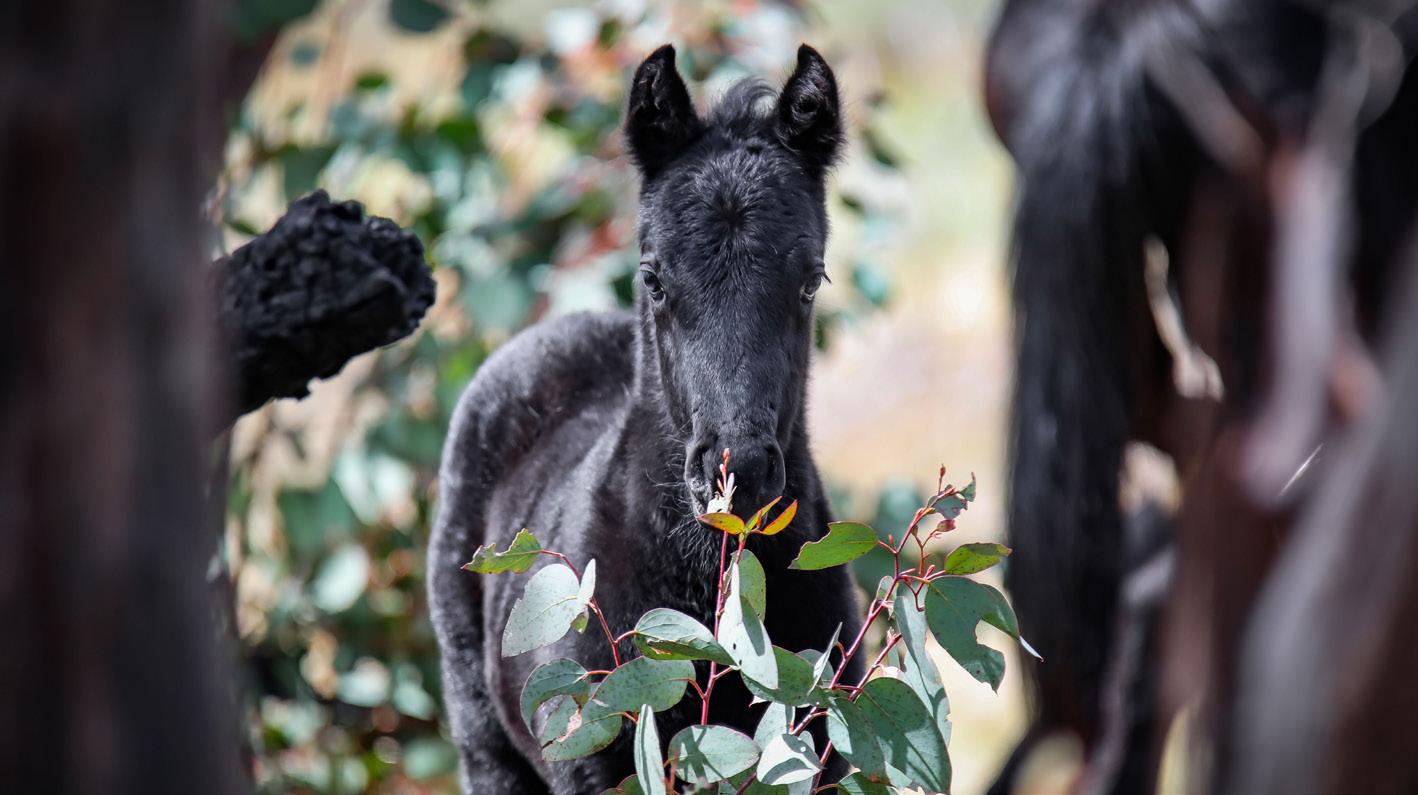
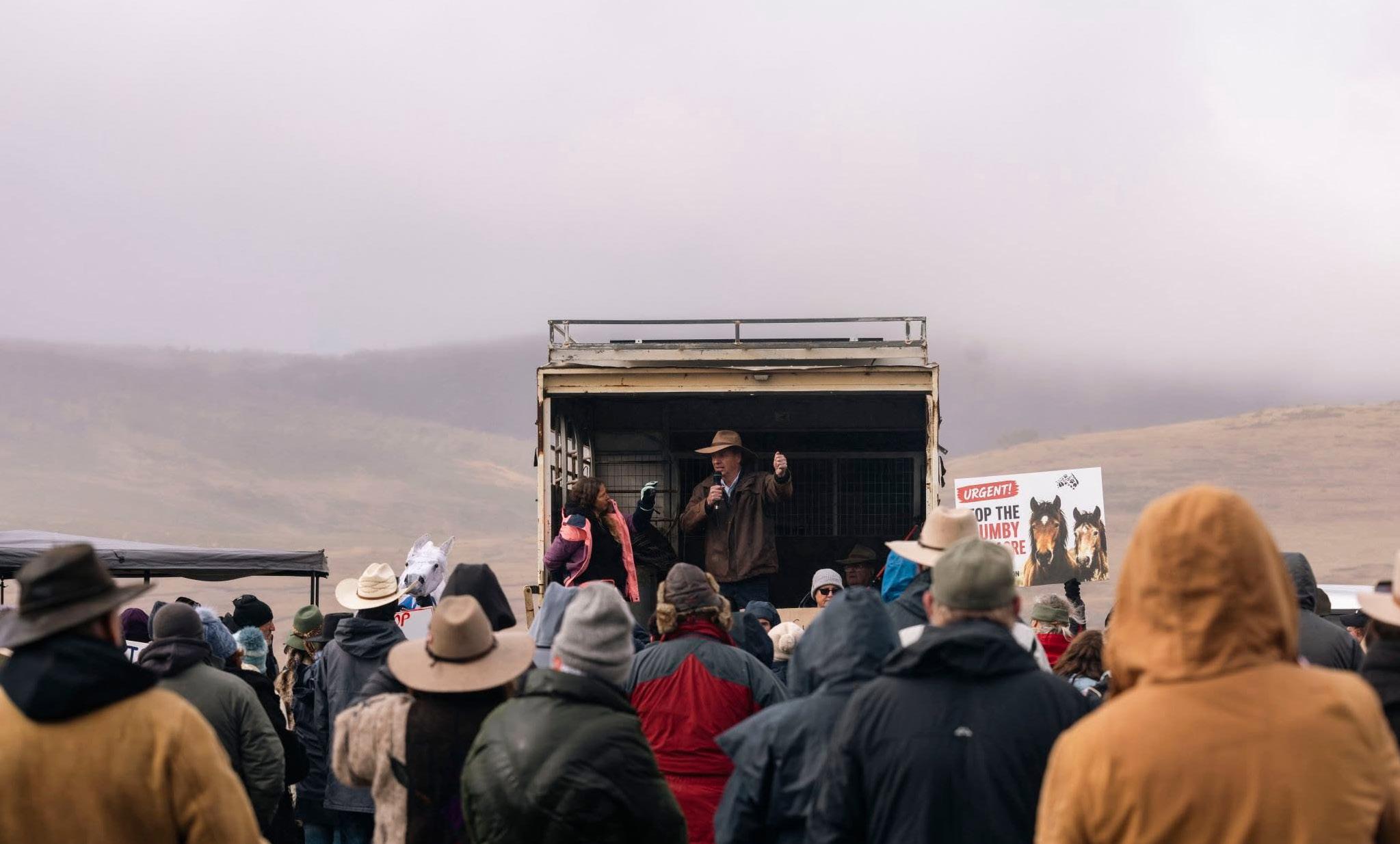
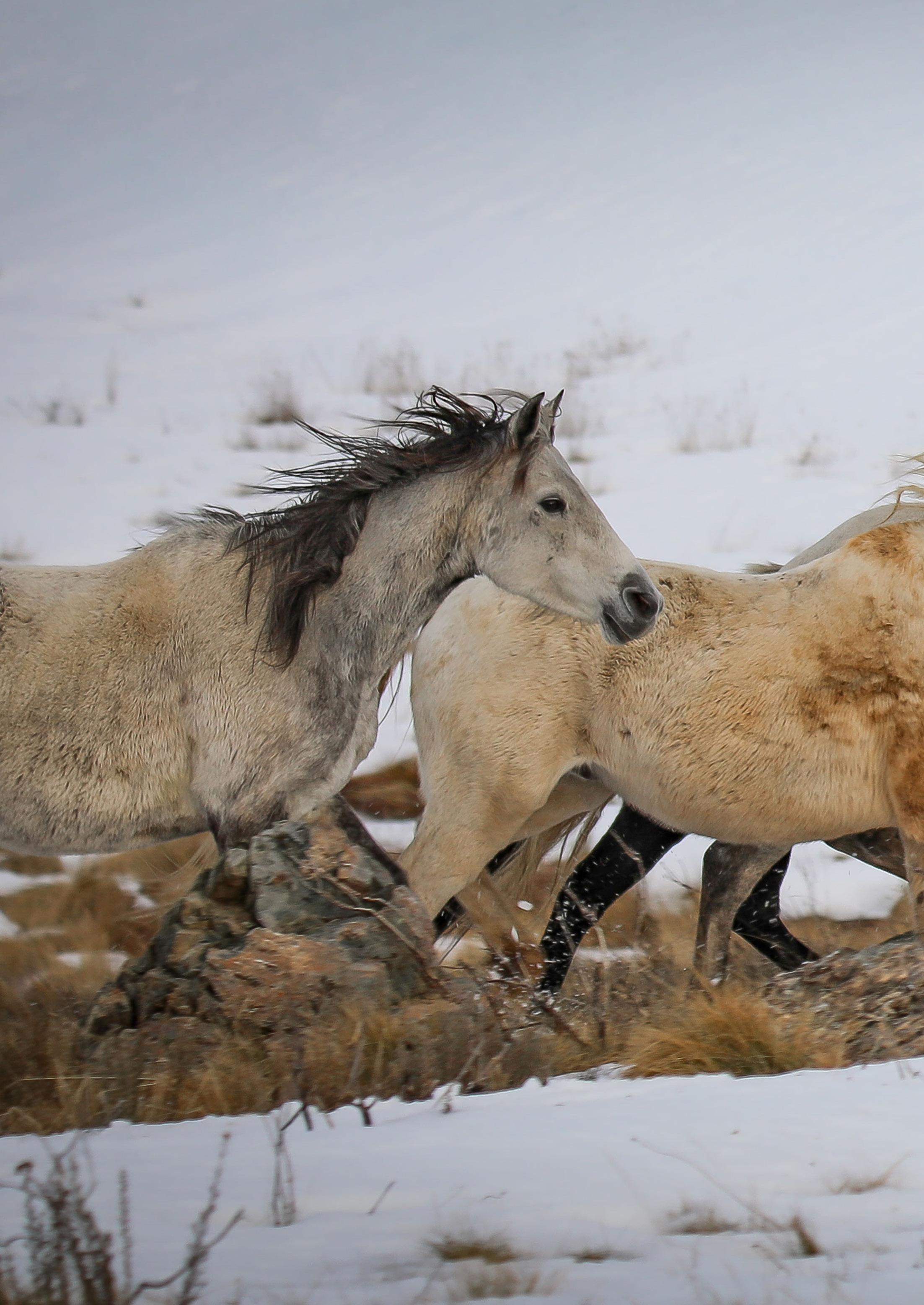
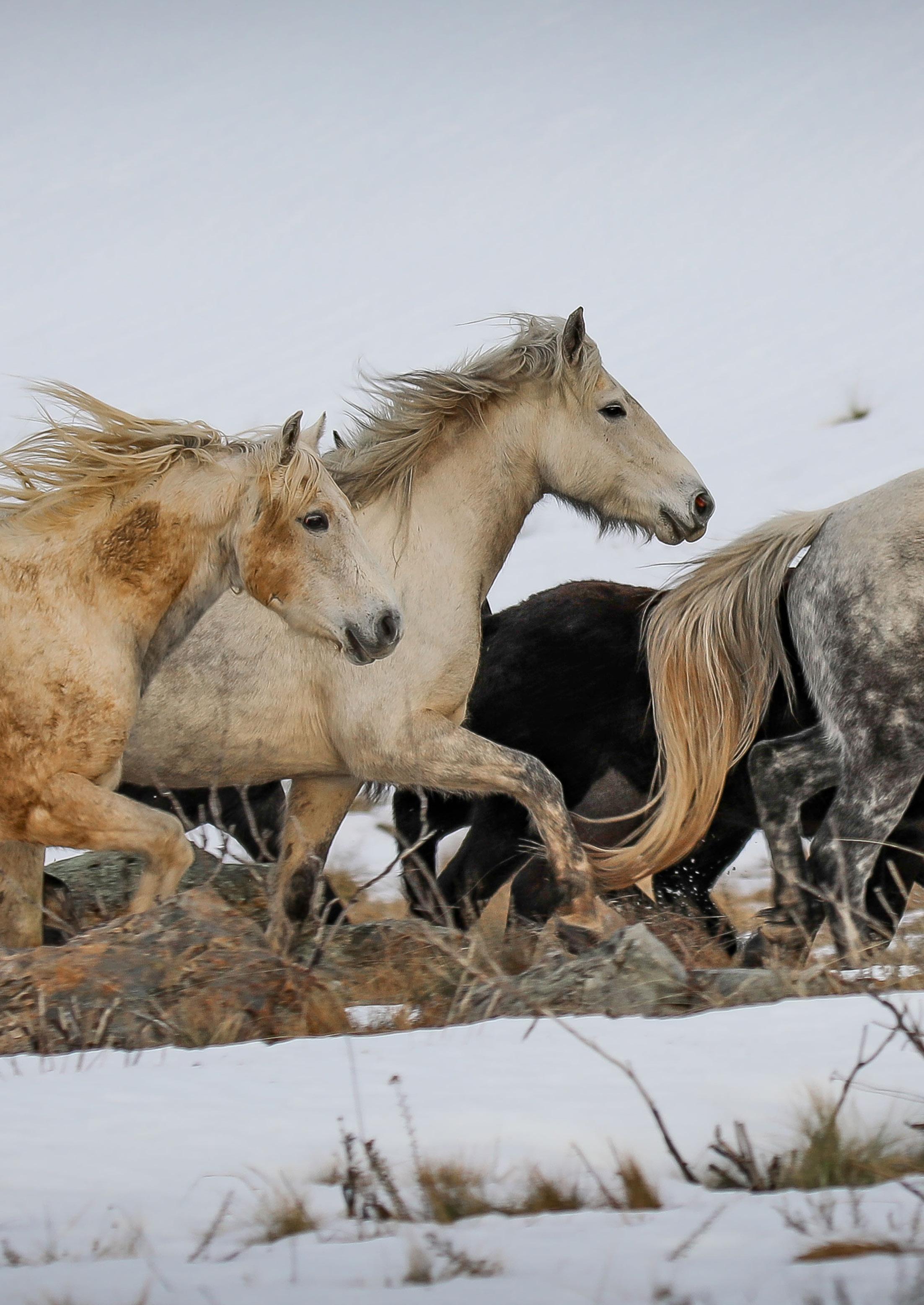
FEATURE. The Brumby Debate. Beyond the headlines. Horses, heritage and humanity.
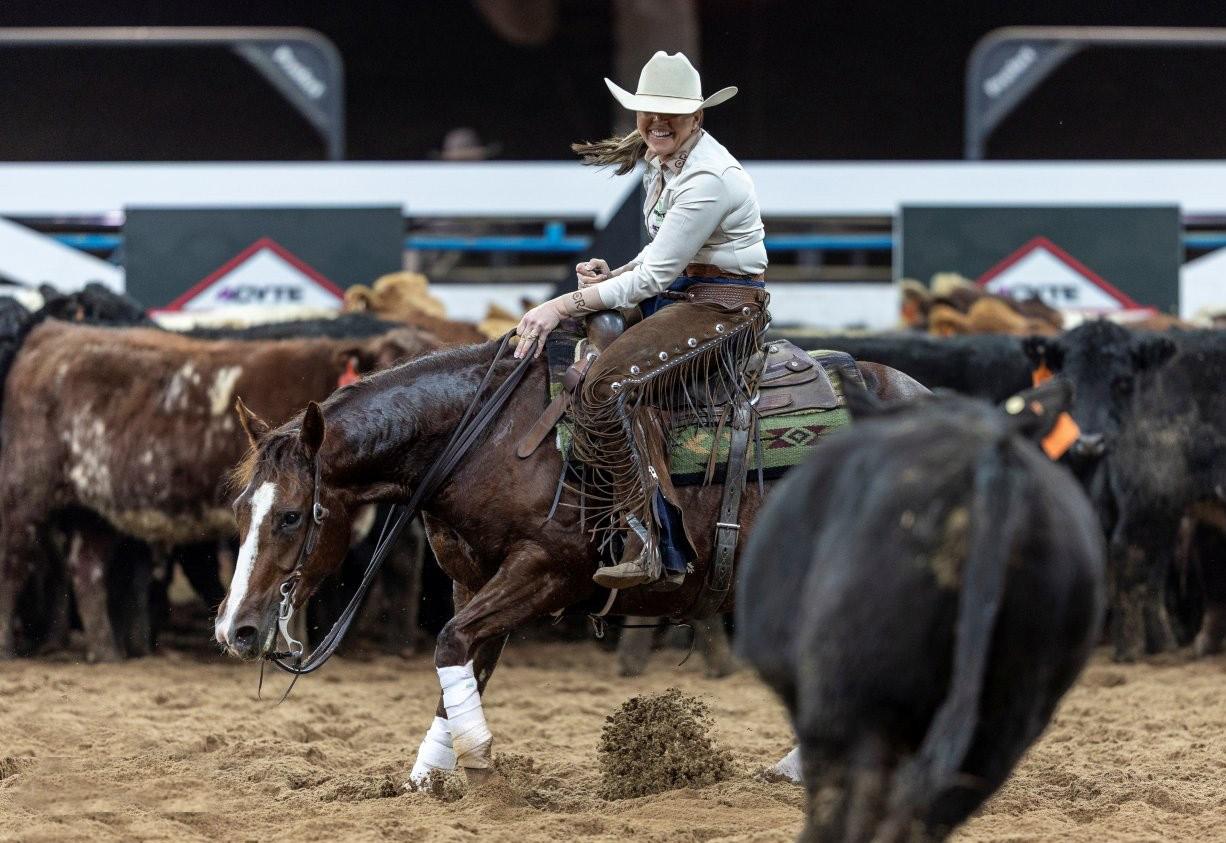
COMMUNITY . A Vision Splendid The Springlands Campdraft returns, built by community.
NOURISH . The hard yards of horse ownership. Why they're key to your wellbeing.
What's Inside
EDUCATION
CONNECTION INSPIRATION
Strengthening
EVENTS
LIFESTYLE
The People Behind the Issue
Every issue of Equestrian Hub is shaped by the generosity, knowledge and passion of the people featured here. Together, they help us educate, inspire and connect Australia's equestrian community. We're incredibly grateful to all our contributors for helping make this publication what it is today.
EQUESTRIAN HUB
SCENIC RIM, QLD
Editor
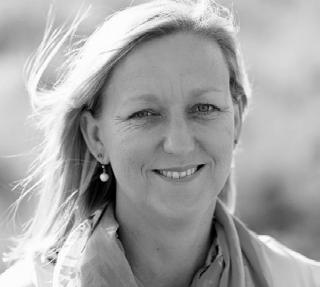
AMANDA MCWHINNIE amanda@equestrianhub.com.au
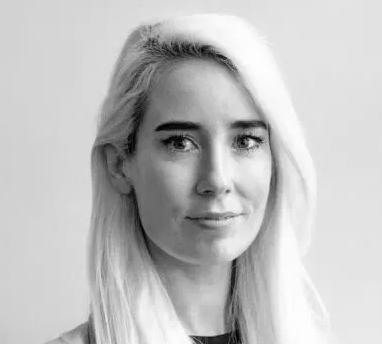
Publisher & Partnerships SAM CAVALLO hello@equestriennemagazine.com
Podcast CHARLIE BRISTER bluegumperformance@gmail.com
HOLLY HALL PERRIN kennallywood@coleychellefarm.com.au
E-mail
INFO@EQUESTRIANHUB.COM.AU
Website
EQUESTRIANHUB.COM.AU
Social Media @EQUESTHUB
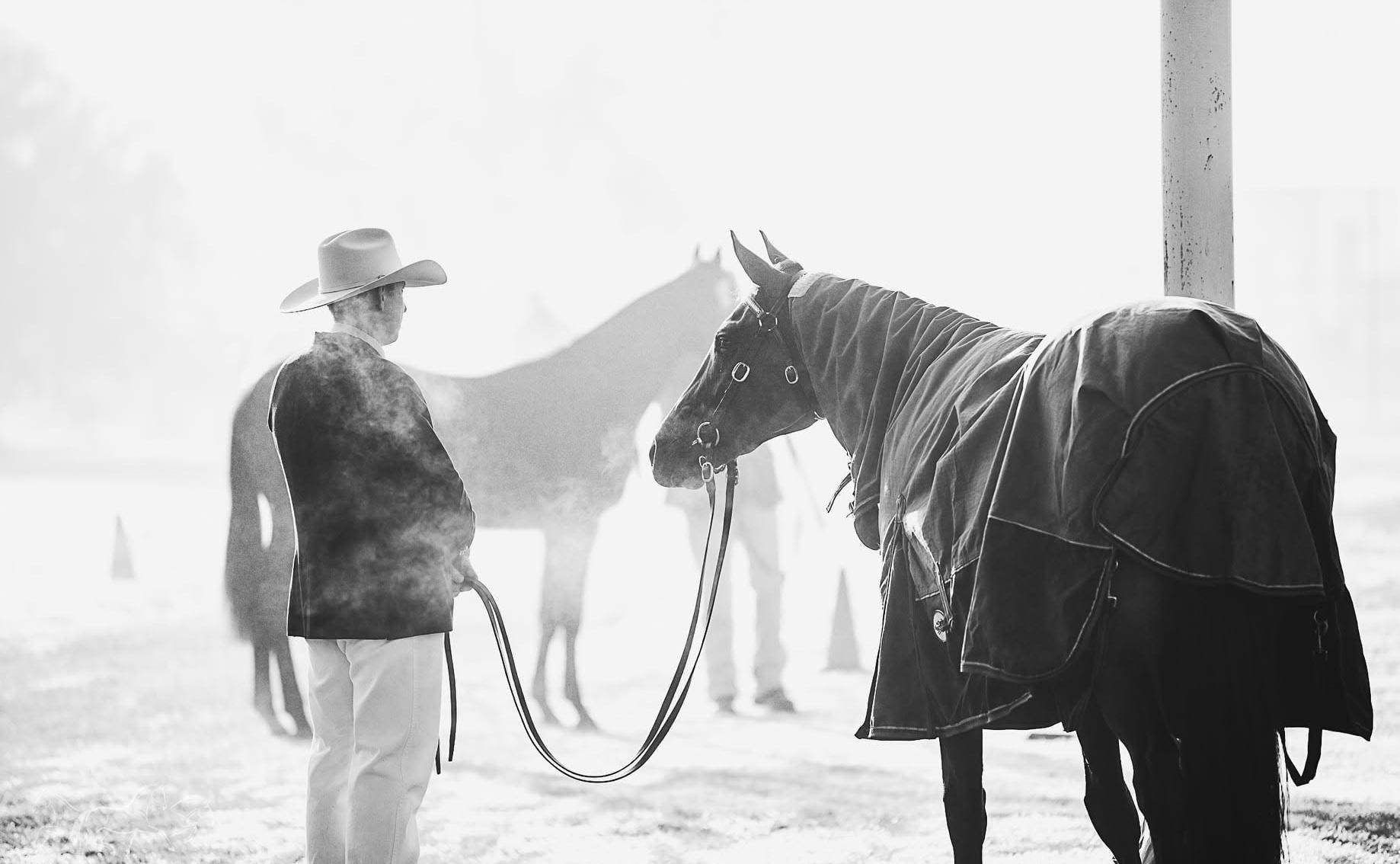
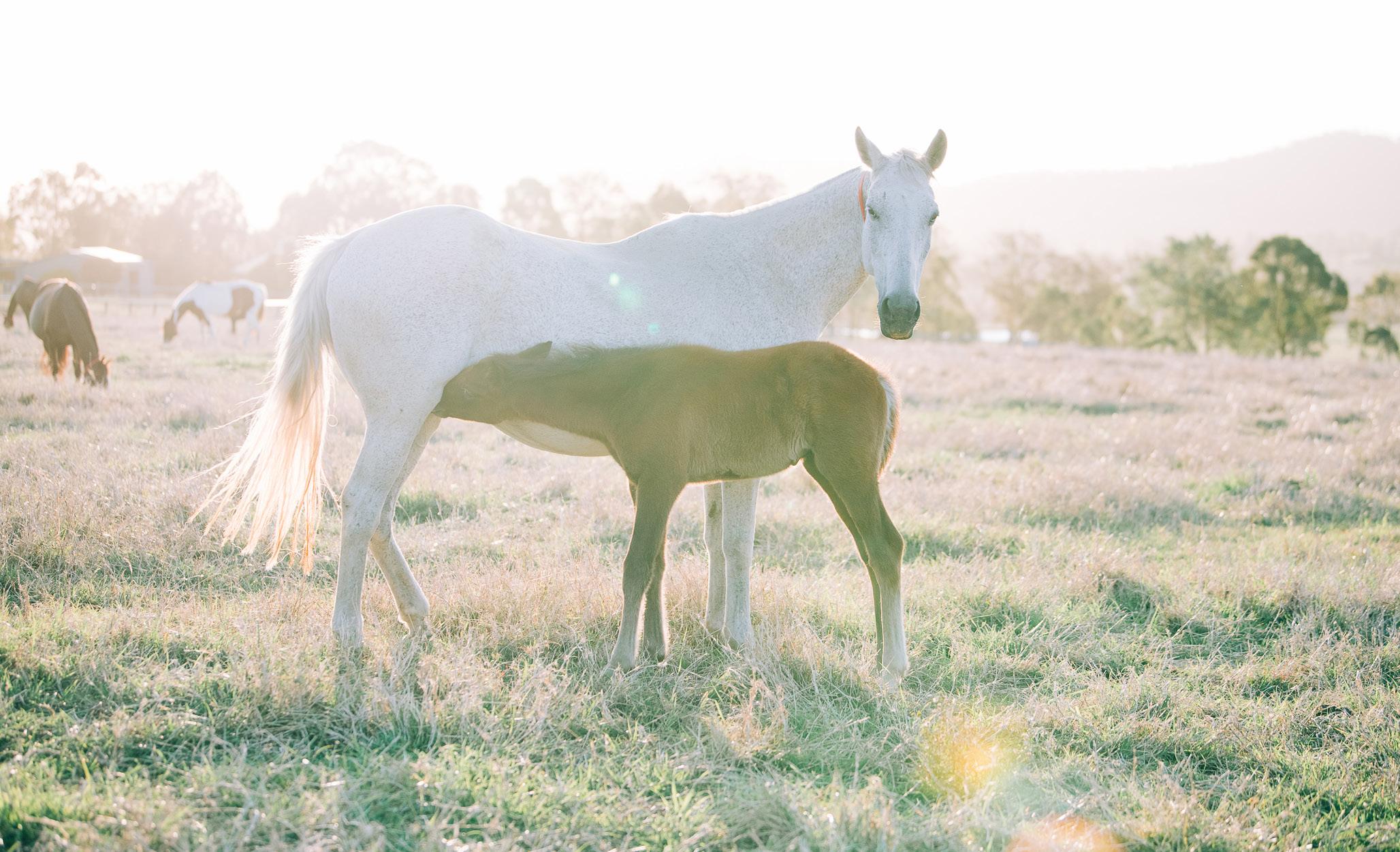
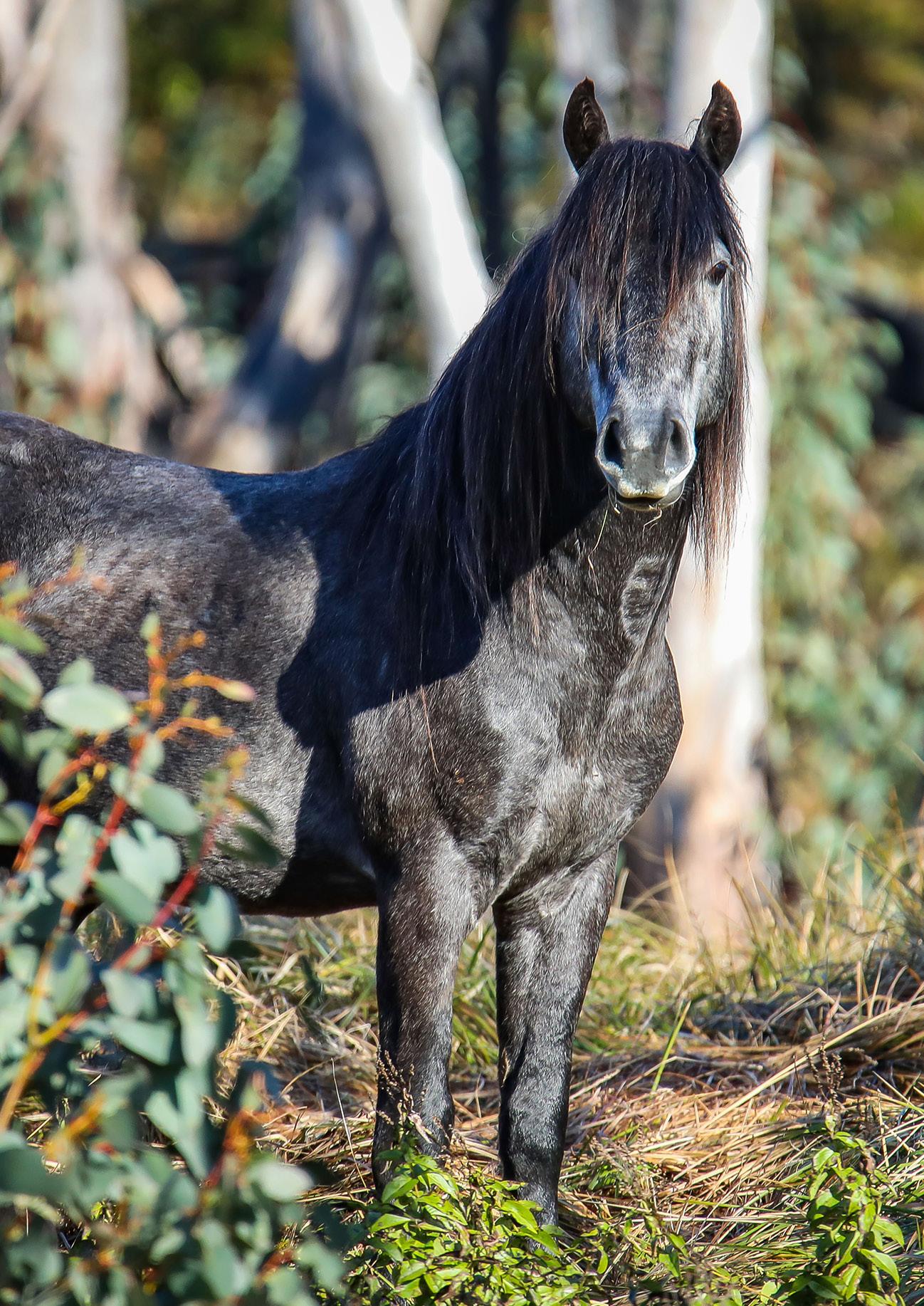
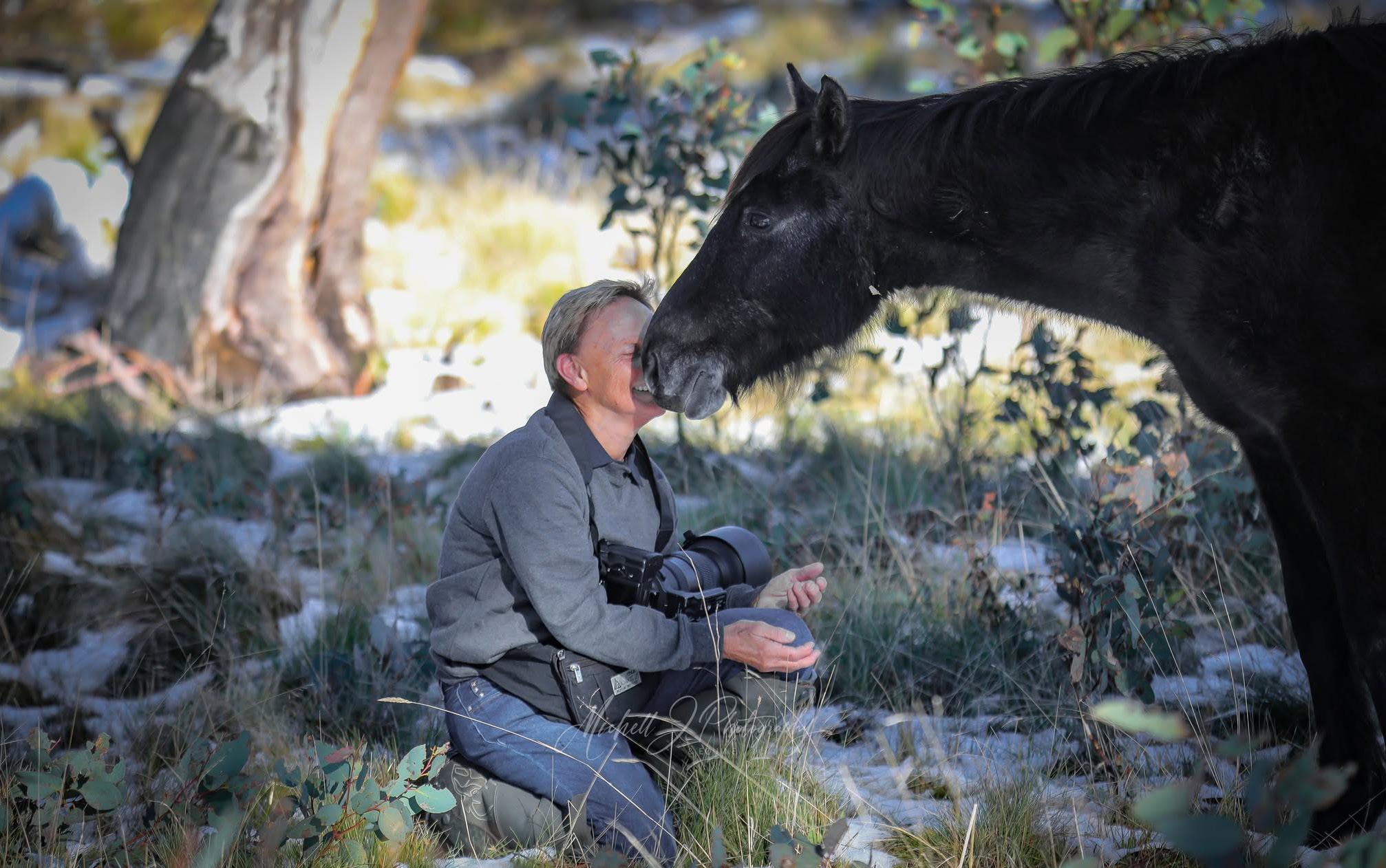
Cover MICHELLE J PHOTOGRAPHY After the bush fires - the iconic Kiandra Grey Brumbies
OUR CONTRIBUTORS
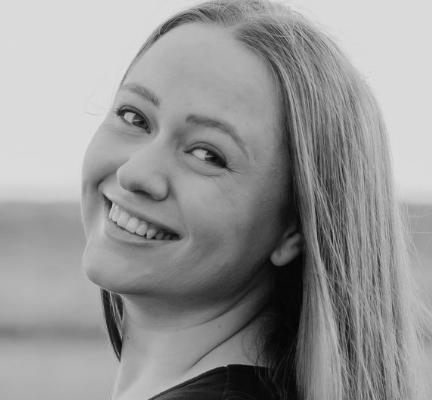
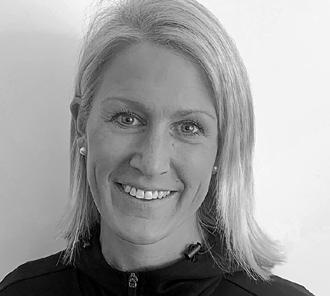
Kirsty Pasto
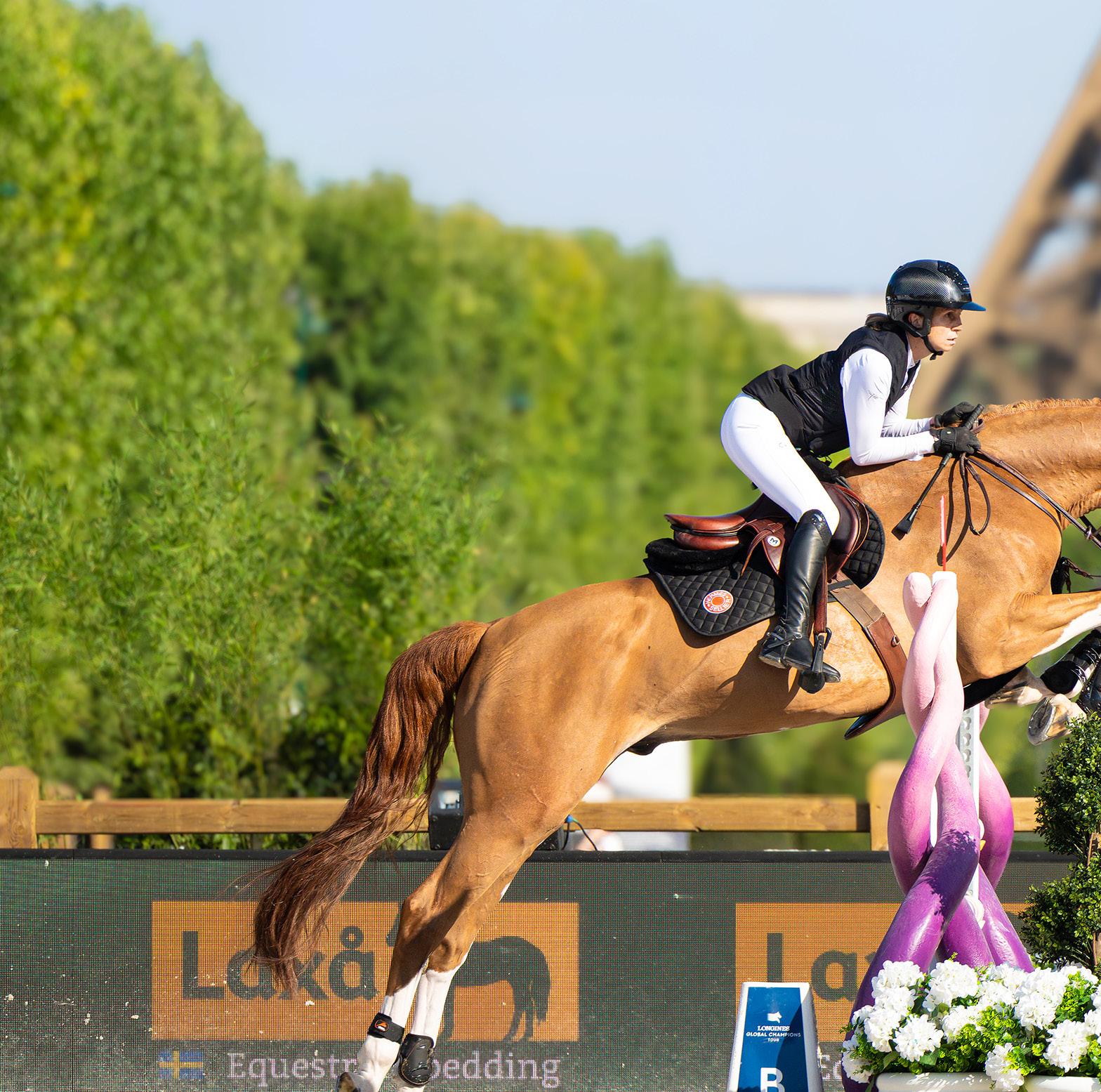
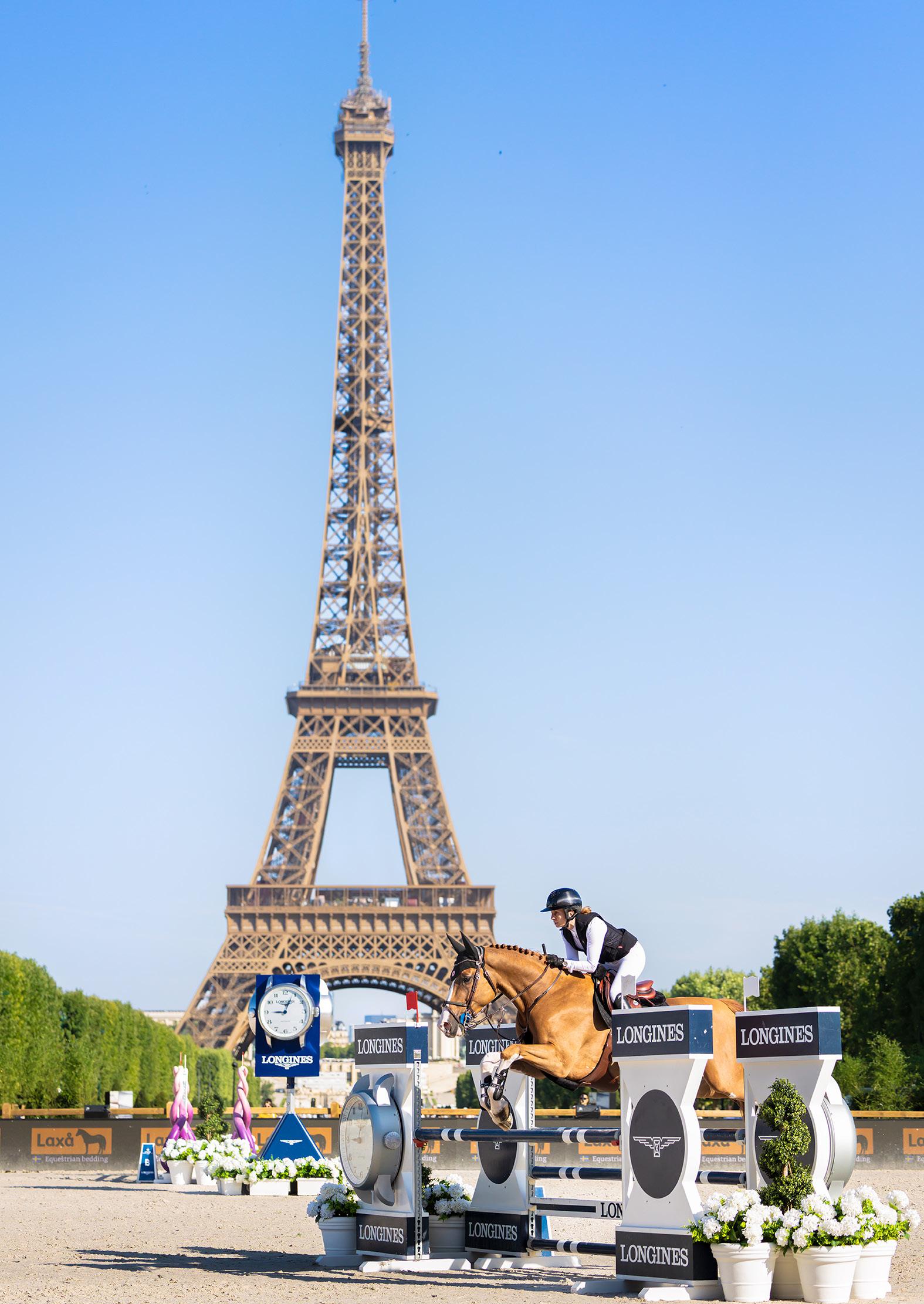
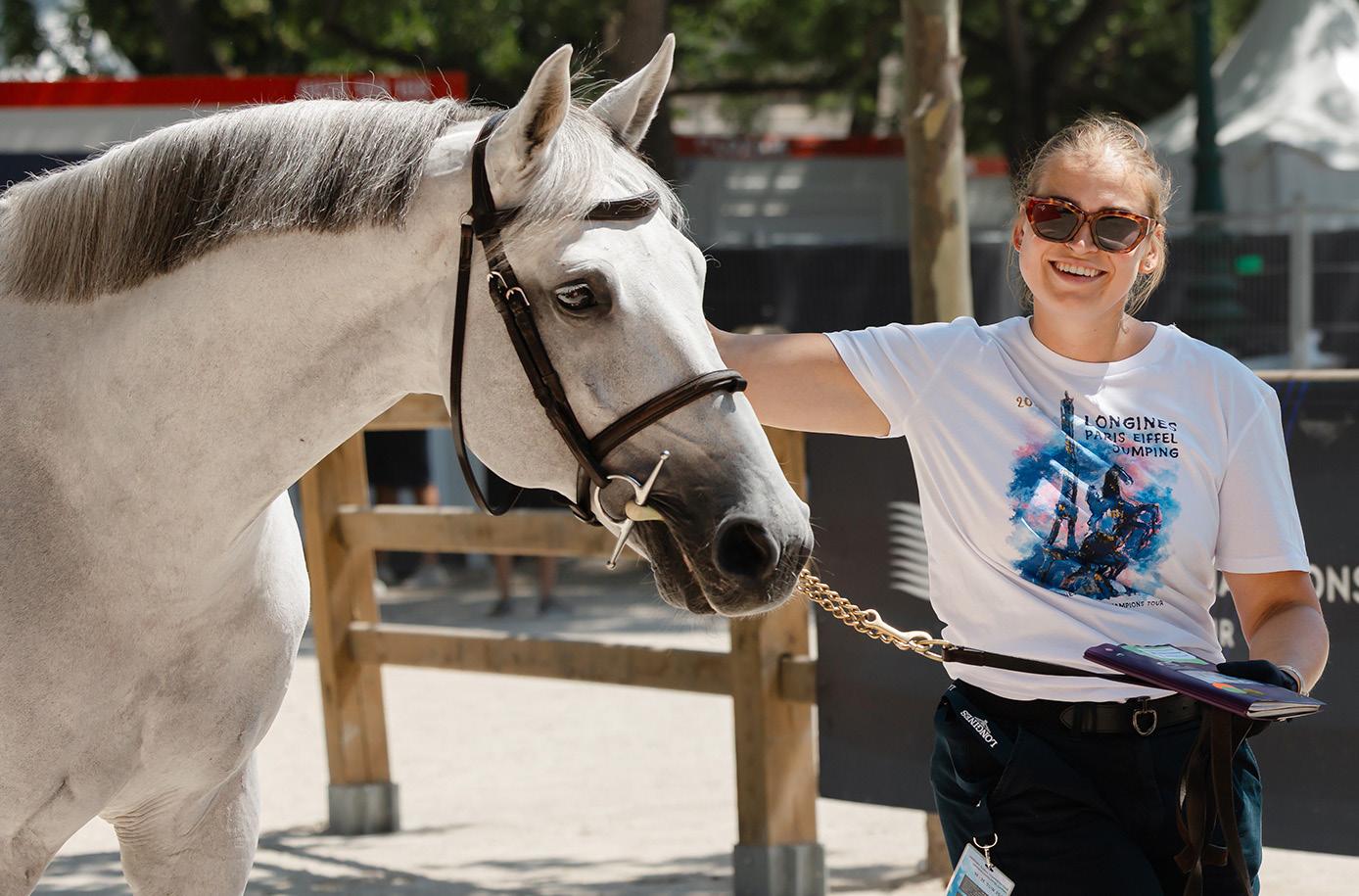
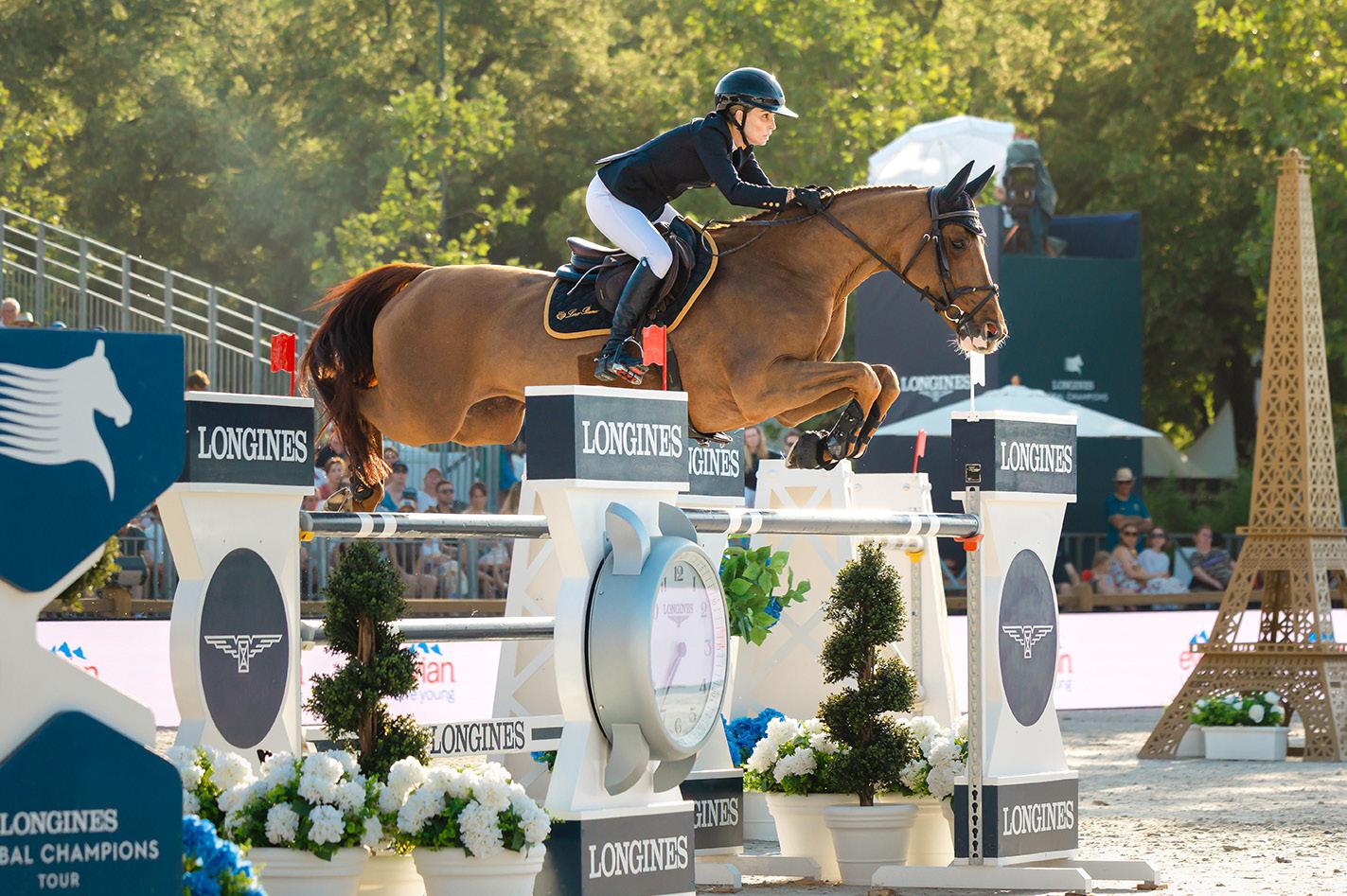
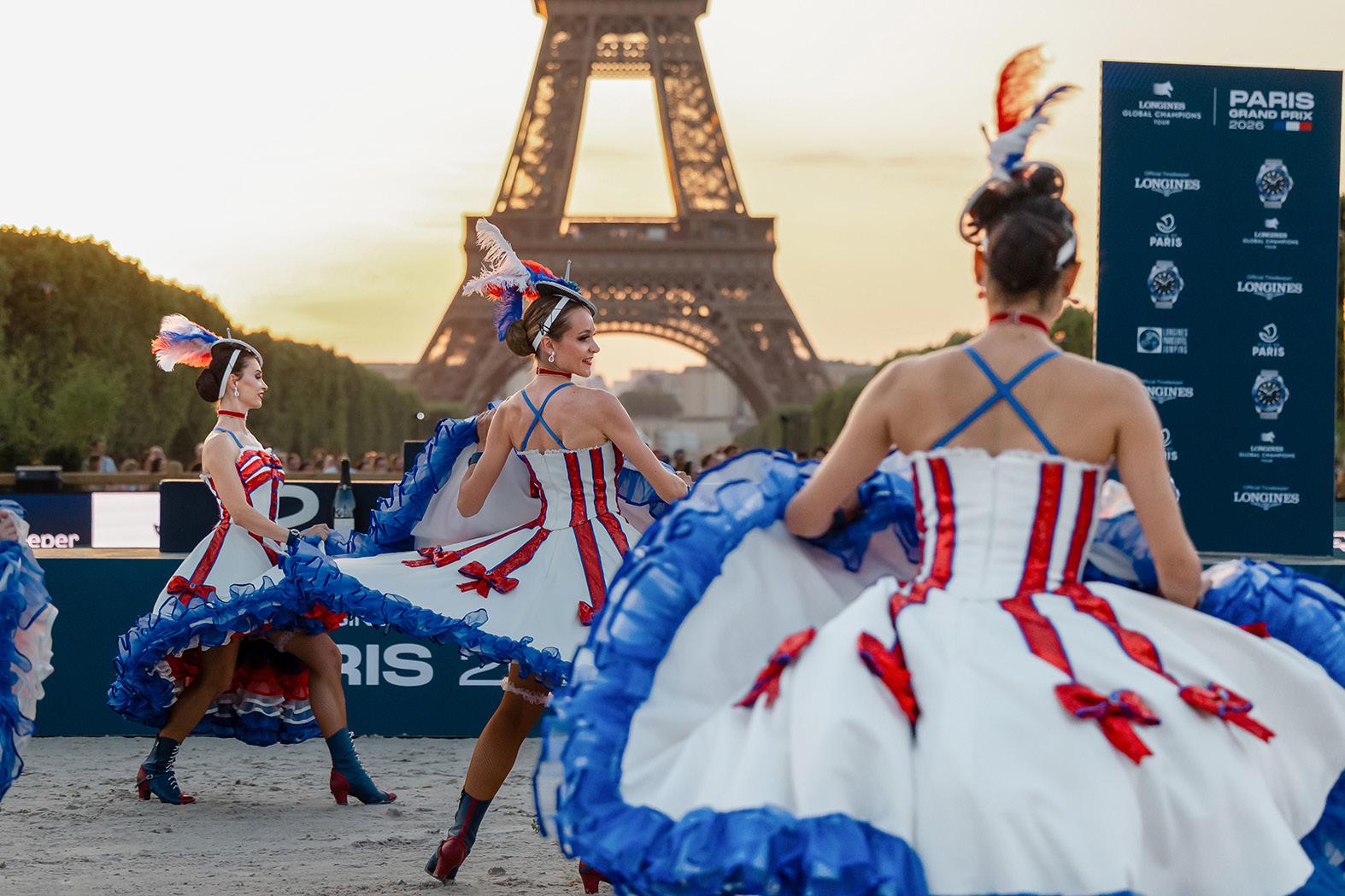
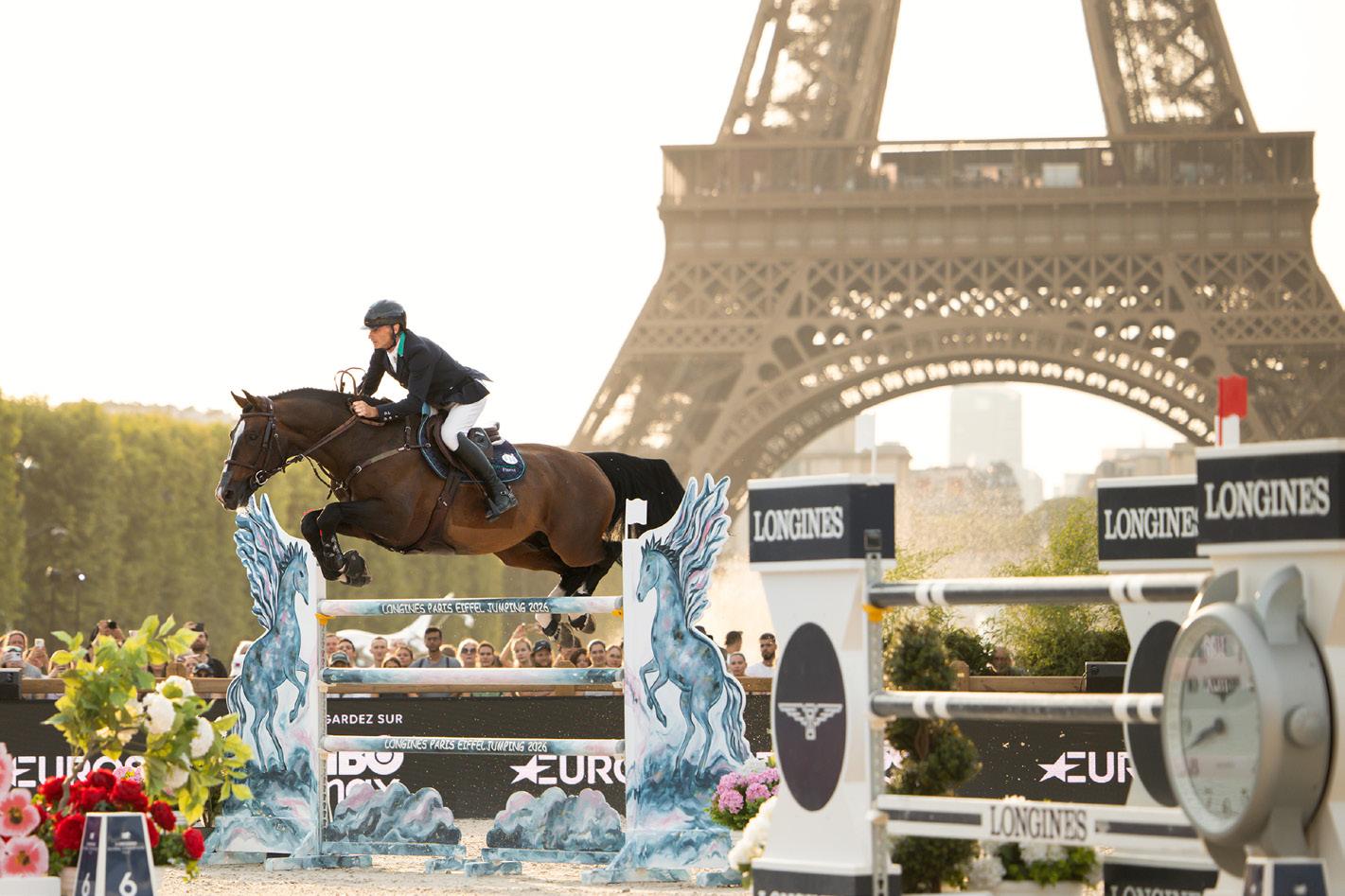
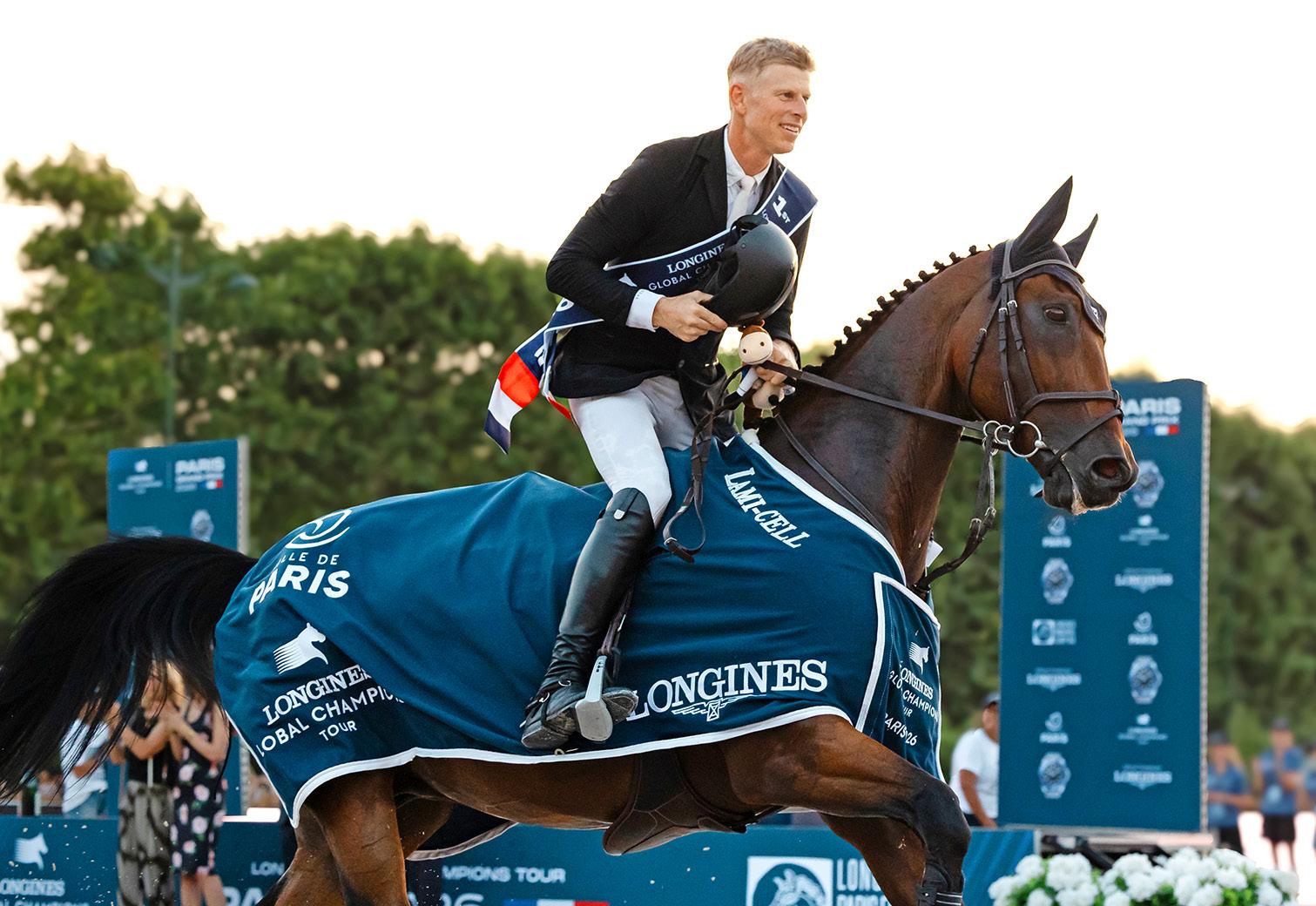
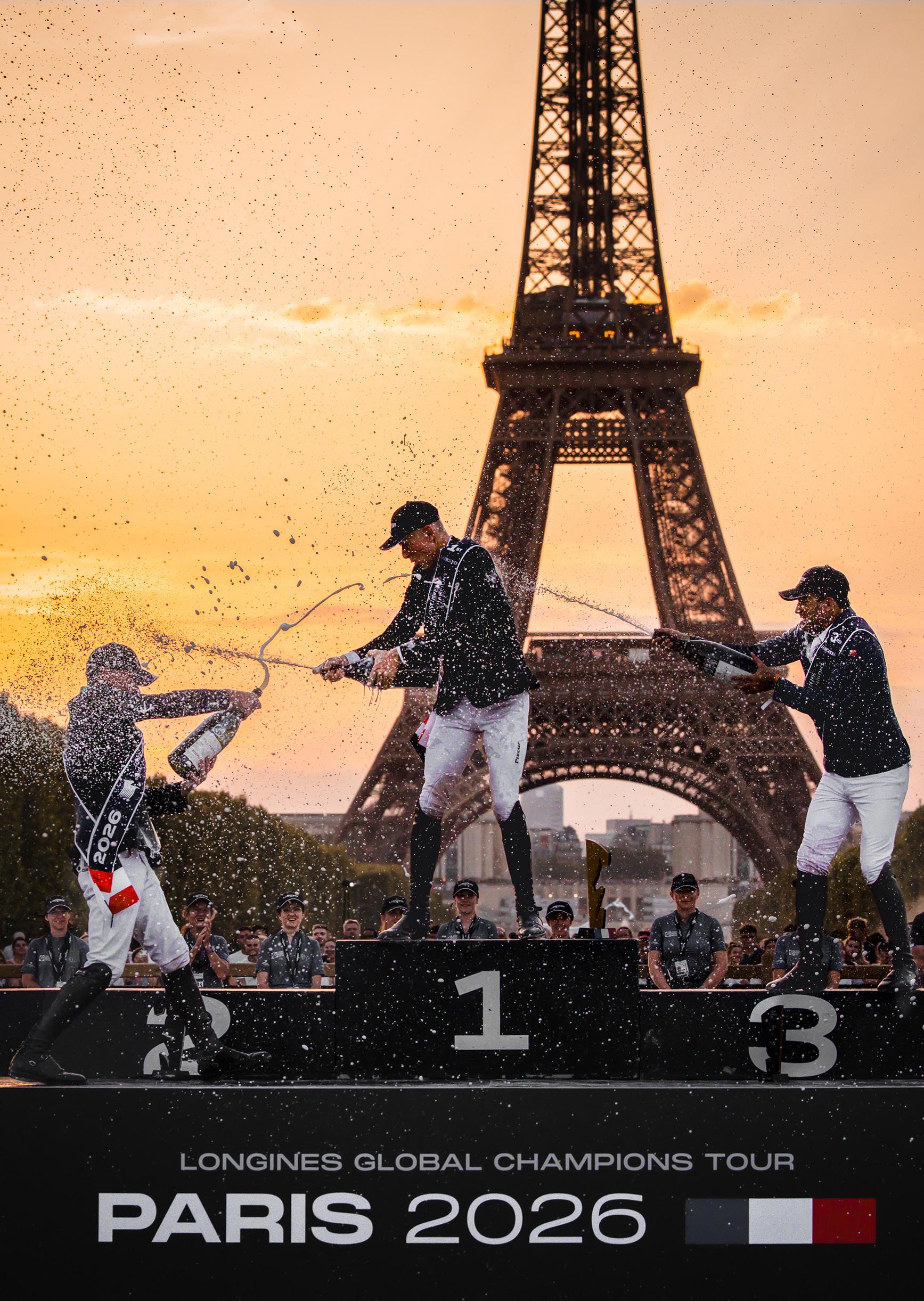
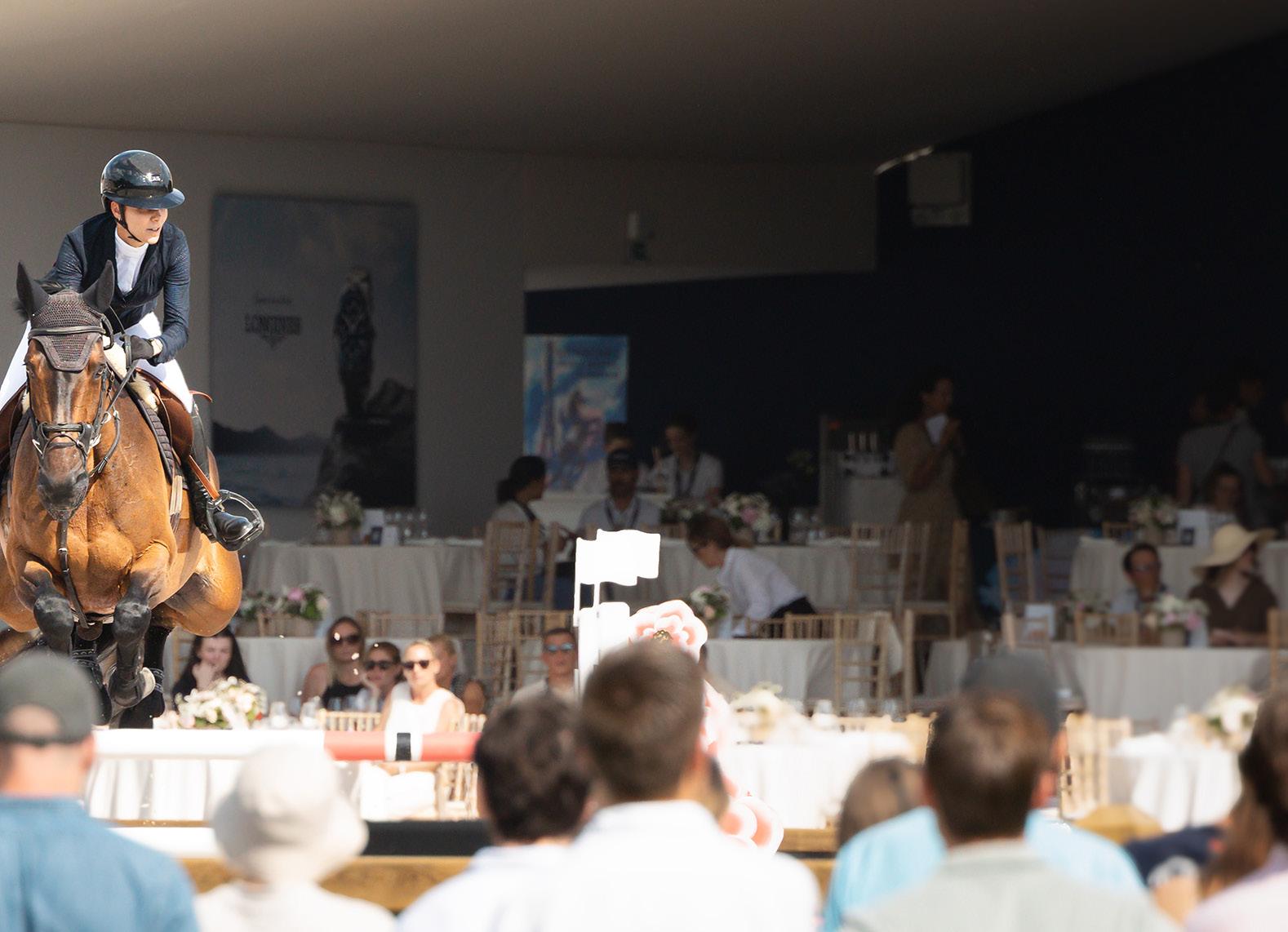
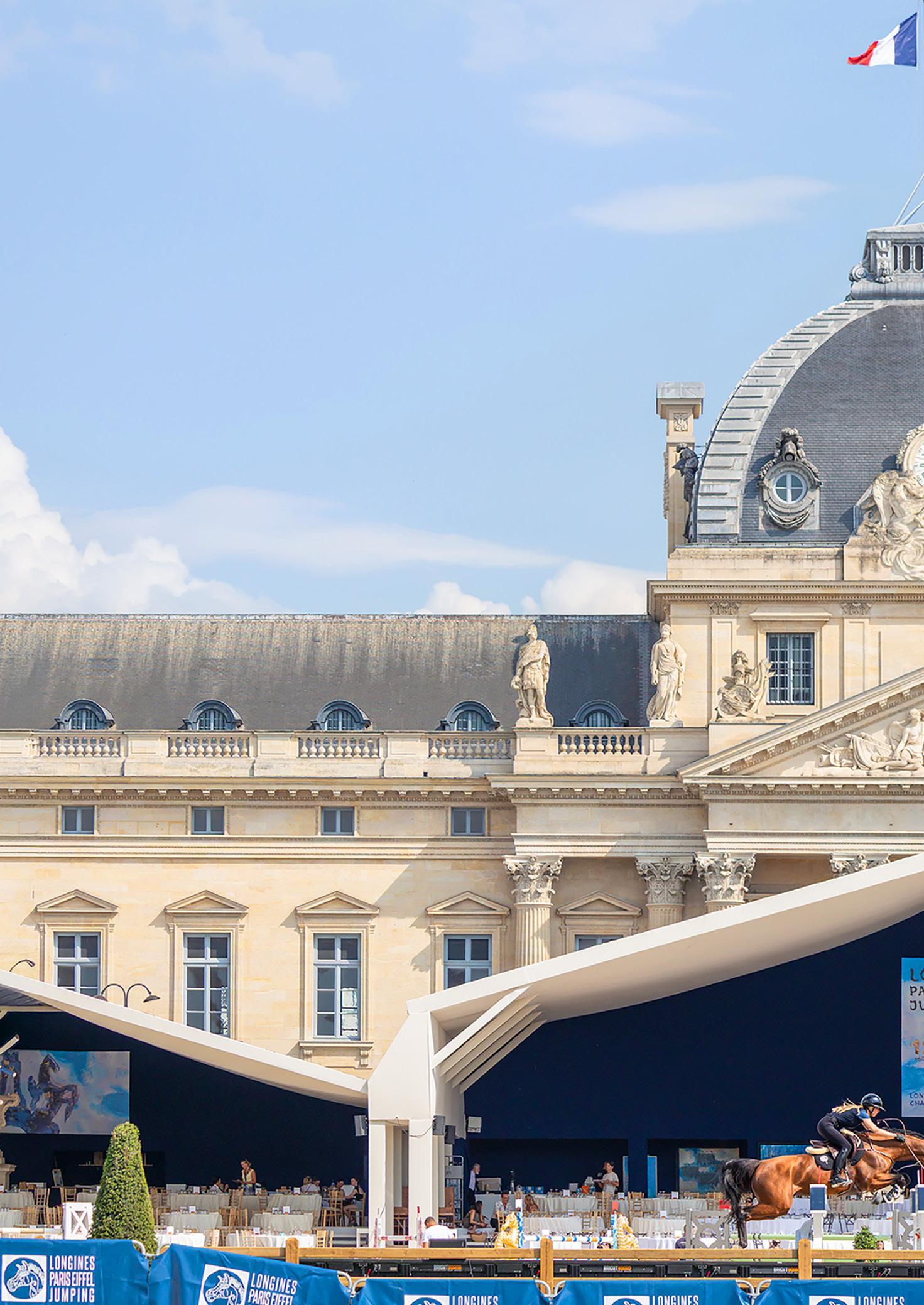
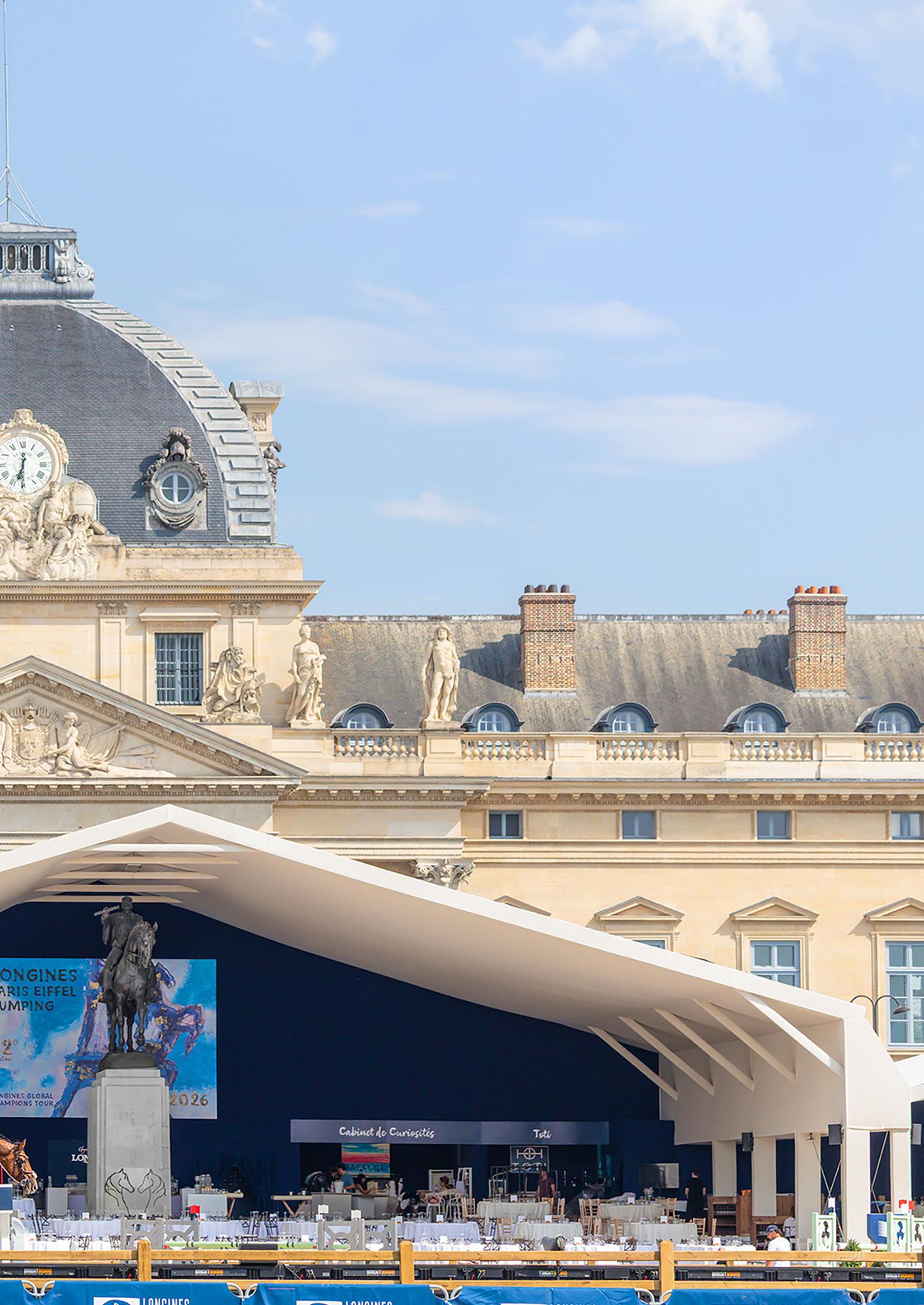
Based in Europe, Kirsty is an equestrian media specialist with 15 years experience in journalism and photography. She produces features and visual content from some of the sport’s leading events for the FEI, international magazines, and equestrian federations. In this issue, she covers the Longines Global Champion Tour, this time in the City of Lights at the 2026 Longines Paris Eiffel Jumping.
Dr Andrew McLean
Andrew is the CEO of Equitation Science International. An Honorary Fellow of the International Society for Equitation Science, he's a member of the FEI's Equine Welfare Advisory Group and Ethical Training Methods Expert Consultative Group. In the second of our two-part series, we continue our conversation with Andrew on the importance of understanding the Five Domains.
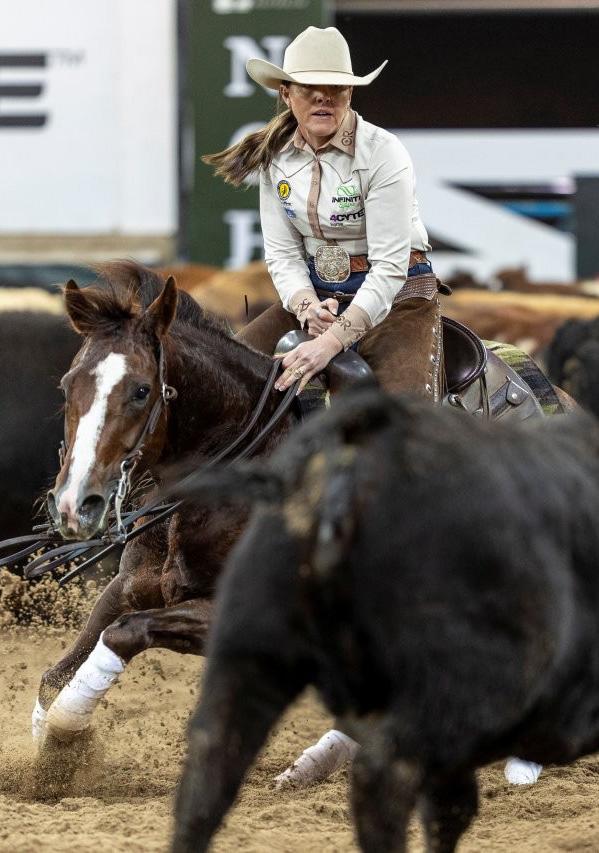
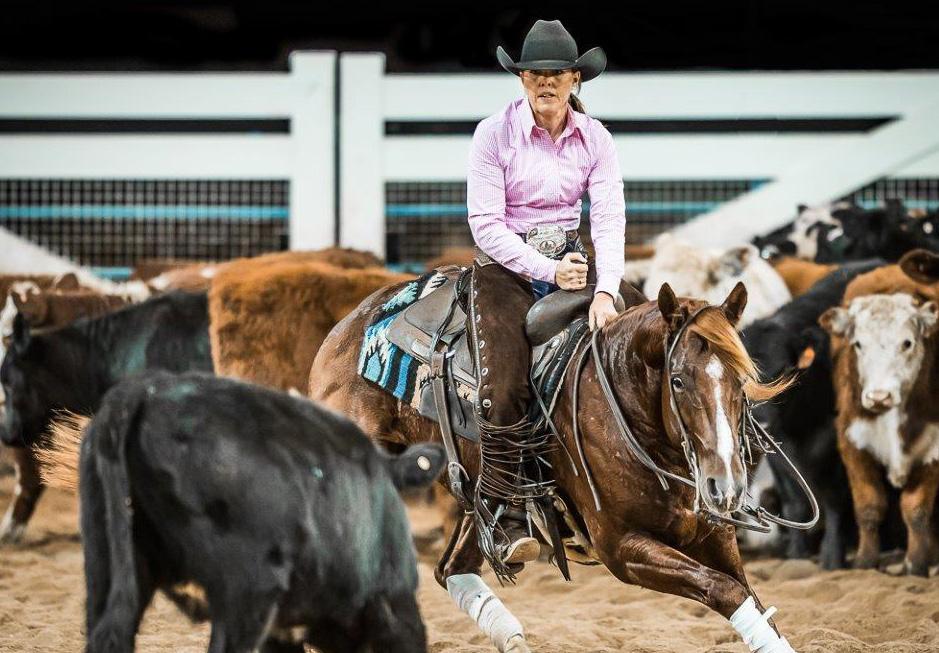
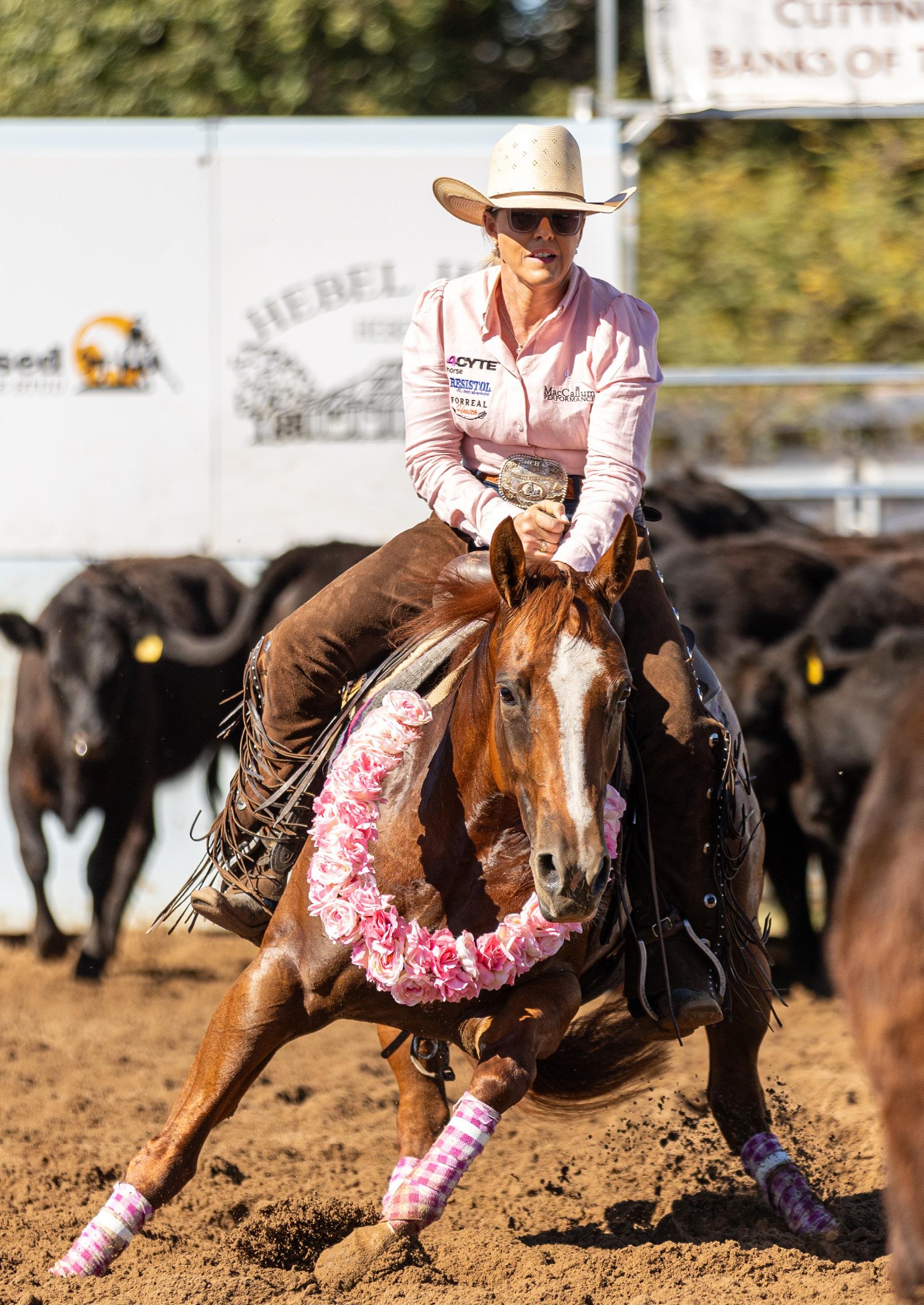
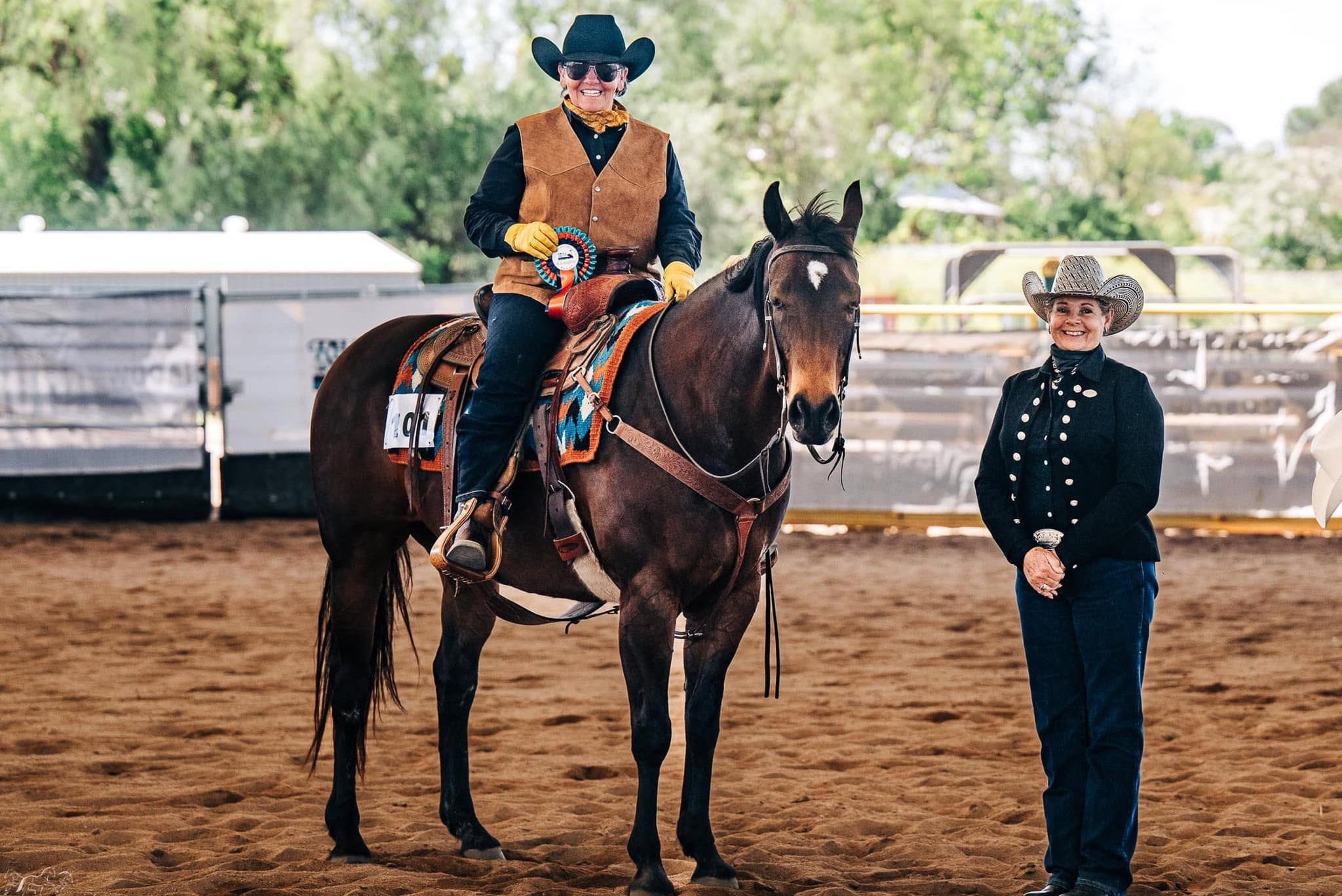
Lynda MacCallum Reserve Champion at the recent NCHA Futurity, Lynda believes in the power of positivity. Diagnosed with multiple sclerosis in 2018, she battled some tough years before handing in her Non-Pro card to train professionally - a decision resulting in MacCallum Performance. Specialising in mentorship, training, and riding lessons, you can read more about her inspirational story in this month's Chat With a Champion.
Dr Jennifer Stewart B.V.Sc., B.Sc., Ph.D.
With over 40 years’ experience as a veterinarian in mixed and equine practice, Jennifer’s special interest is equine nutrition. She was a Senior Veterinary Officer with the Australian Department of Agriculture, Water and the Environment for 10 years, and a Biosecurity Veterinarian with the ACT Government for two years. This month, she explores the topic of equine supplements
Dr Caroline Spelta B.V.Sc. (Hons), MANZCVS, DECEIM
Caroline specialises in equine medicine. Boarded with the European College of Equine Internal Medicine and a Member of the ANZCVS, she has extensive expertise in Australasian equine internal medicine and toxicology, with special interests in ophthalmology, neonatology, and intensive care. Does your horse have Equine Asthma? Turn to Vet Vibes for Caroline's expert advice.
Anne-Marie Lasserre
Anne-Marie is a Miss World and Miss Universe Figure Champion. She’s an AOR dressage rider, and a specialist coach in aesthetics, sports performance and nutrition. Dedicated to empowering equestrians to achieve peak fitness and personal transformation, in this issue she explains the benefits of investing less in hype and more in habits that build strength, resilience and long-term performance.
Krissy Harris
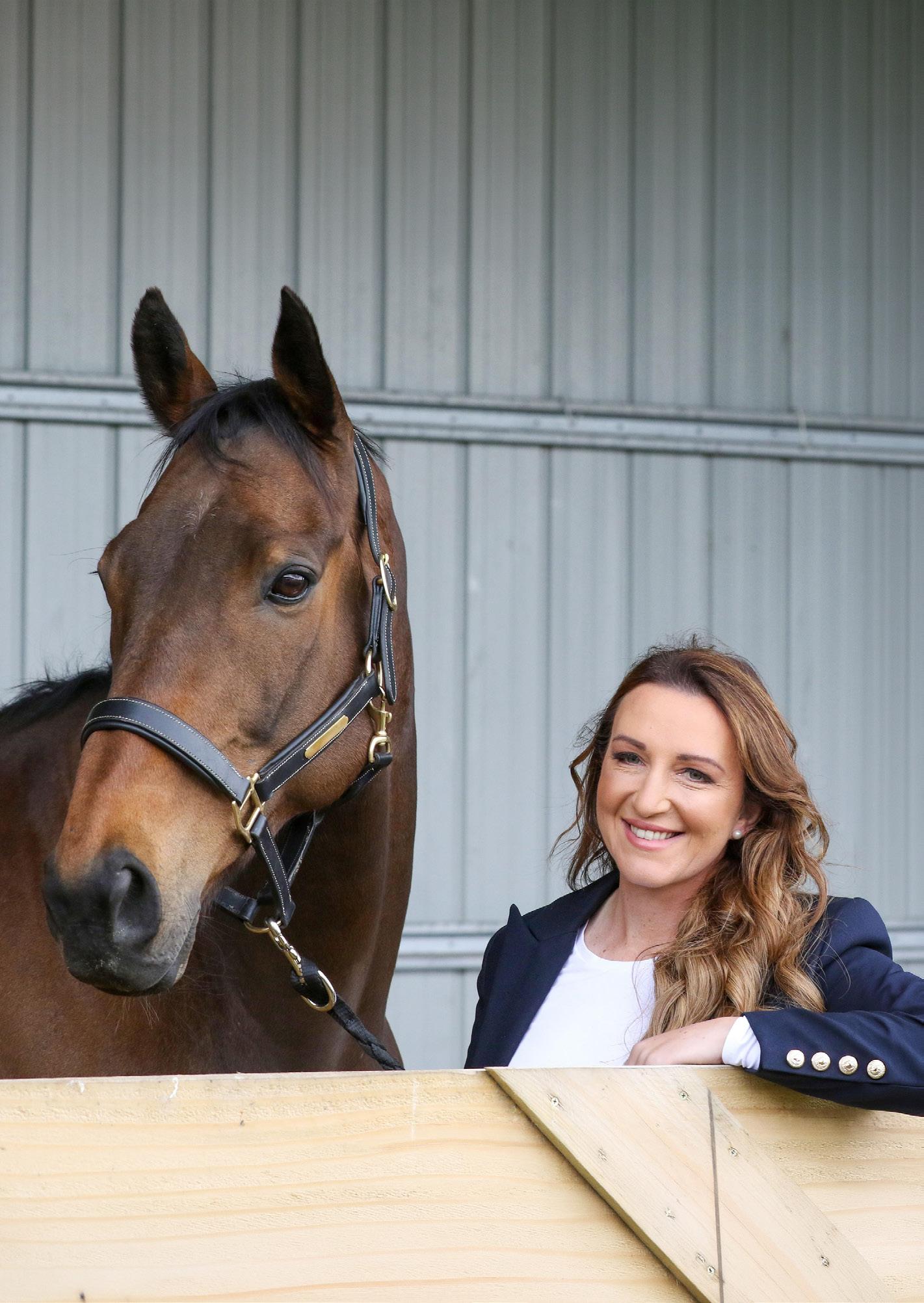
A director at Stonewall Equestrian, Krissy is a highly respected figure in Australian show jumping and has represented Australia in international competition on numerous occasions. An accredited course designer, event organiser and advocate for OTT Thoroughbreds, you can learn more about Krissy, Stonewall, and the Thoroughbred Sport Horse Association in this month’s fascinating Life After Racing.
Naomi Hill (MAPP)
Naomi is a positive psychologist and wellbeing coach who never grew out of the horse phase. Specialising in transforming positive psychology research into practical learning programs and resources that make a measurable impact, she’s passionate about helping society shed the stigma around mental health struggles. You'll love her article in this month's Nourish.
OUR CONTRIBUTORS
Dr Clarissa Brown
Douglas
Clarissa is an equine nutritionist with Kentucky Equine Research Australia. Her PhD from New Zealand’s Massey University focussed on equine growth and development. As part of KER’s equine nutrition team, Clarissa has worked with feed manufacturers, breeders, trainers, and riders around the world. In this issue, she discusses winter nutrition for broodmares.
Donal Hancock
Lisa Coffey
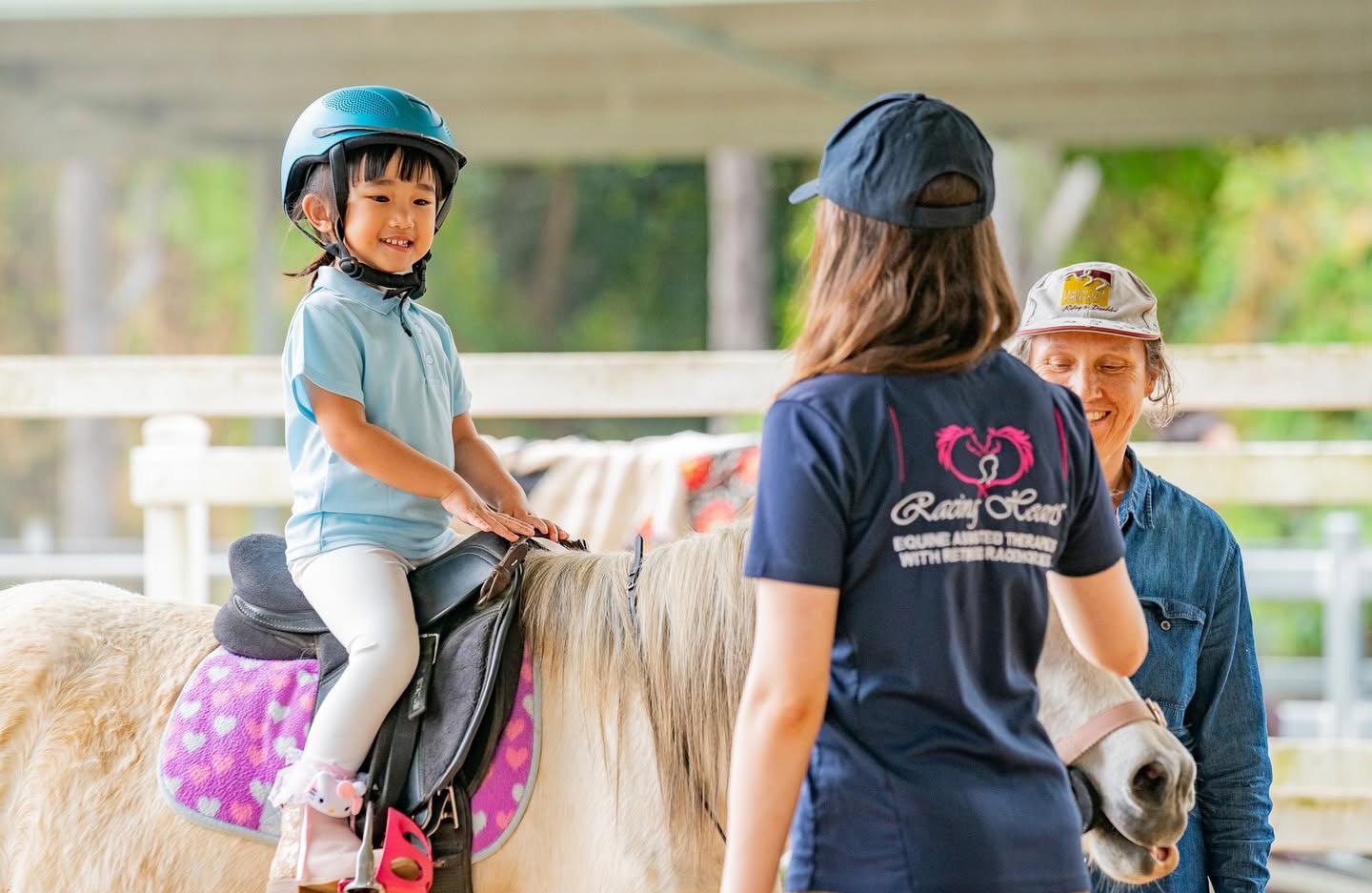
With a degree in psychology, Lisa became curious about the emerging modality of Equine Assisted Therapy. After experiencing its benefits at first-hand, she recognised a win-win: by retraining retired racehorses in the therapy space, OTTs were given new purpose and humans benefitted from the therapy. With that, Racing Hearts was born, and the full story in this month’s Founders is not to be missed.
Chloe Mackie
Jess Clark
Jess, who became one of Australia's youngest Grand Prix dressage riders, has enjoyed many successes aboard her Warmblood Remember Me, the horse she has had since he was a foal. But there have also been a number of setbacks and injuries – and yet through it all, she maintains an immense sense of gratitude for how lucky she is. A young equestrian with a great future, turn to our dressage feature for our conversation with Jess.
Chloe is a wedding photographer and the owner of Knots Photography. Passionate about helping couples tell their stories, when she's not behind the camera, you'll usually find her riding horses or attending local clinics and competitions. Her Behind the Shot in this issue is an eye=catching example of her talent for creating imaginative images.
Donal, founder of Hancock Horsemanship, believes building a relationship with your horse is foundational, not optional. Recipient of the Jack Brainard Horsemanship Award, he is a trainer, clinician and entertainer, and has competed in colt start and liberty competitions both here and overseas. In the final part of his Foundation to Finished series, he looks at body control under saddle.
Sam Baynes
Sam is an Australian entrepreneur who has secured more than $4.5 million in funding for Pegasus, a technology company on a mission to modernise horse shows and strengthen the future of equestrian sport. Now living in the US, he grew up around horses through his sister's Pony Club career but entered the industry full-time after meeting his wife, Jen. Read more in this month's Tech Talk.
Sam Cavallo
Sam is the publisher of Equestrian Hub and Equestrienne Magazine. She has a keen interest in international events and a passion for equestrian culture and lifestyle, with a focus on community, authentic storytelling, and the people behind the sport. In this issue, she goes beyond the headlines of the Brumby debate to examine the horses, the heritage and the humanity.
Racheal Spring
Racheal is an independent saddle fitter dedicated to improving horse comfort, welfare, performance and rider balance. A current competitor, she understands riders' practical needs, and combines firsthand experience with professional saddle fitting to create comfortable, balanced partnerships that enhance success in the saddle. Don't miss her informative Fit Check article in this issue.
HIGH FIBRE COOL ENERGY FEED
HARNESSING THE POWER OF SUNFLOWER SEEDS, AN ALL NATURAL SUPERFOO D
Omega Feeds has formulated a palatable, high fibre, low starch feed that contains a balanced blend of vitamins and minerals to ensure optimum health and vitality. No-Grain Gold is suitable for ponies, spellers and horses in light to medium work.
High Fibre: For gut health and cool energy.
Non Pelleted: Horses spend more time chewing which stimulates saliva production and in turn buffers the stomach and protects it from ulceration.
Low Starch: Reduced risk of digestive upsets and metabolic conditions.
Balanced blend of vitamins and minerals: For optimum health and vitality.
100% Australian, proudly supporting Australian farmers
Hello,
Isn't it true that as riders, we spend hours focussing on our horses' performance? We analyse transitions, perfect our timing and carefully plan our training. Yet one of the most powerful tools available to us requires no equipment or additional time in the saddle: it's the practice of mindfulness.
So often our thoughts stray far from where we are physically. We think about tomorrow's competition while schooling today, replay mistakes long after the ride has finished, worry about next week's work deadlines while feeding up - and sadly, become so distracted that we often miss the moments that matter most.
But horses live entirely in the present – one of the reasons why, if we'll let them, they can teach us much about mindfulness. When we approach our horses with a calm and focused mind, they often respond in kind, and we become more sensitive in our aids, more effective in our communication, more aware of subtle changes in their behaviour - and a much deeper partnership begins to unfold.
Moments of being truly present can have a profound impact on all aspects of our lives, something Naomi Hill touches on in this month's excellent Nourish article. So, let's all take a deep collective breath, relax, and settle in to enjoy the August issue.
And first, congratulations to Kirsty Pasto! Kirsty recently won the coveted Prix Jean Rochefort Photography Award at Longines Paris Eiffel Jumping. She reports on the event, and shares her wining image in our International article. Closer to home, we cover the Melbourne International 3DE, and a very successful Springlands Campdraft.
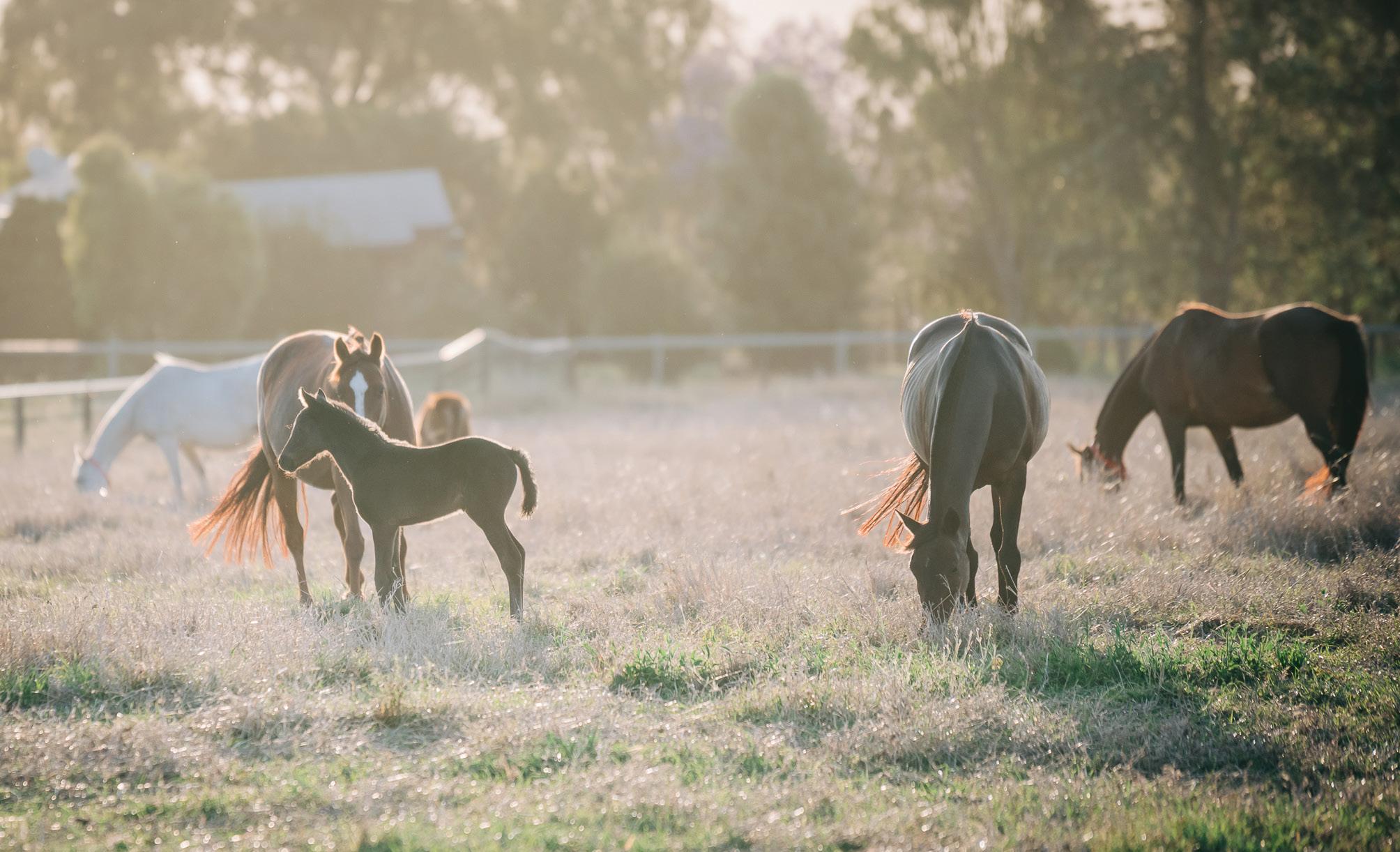
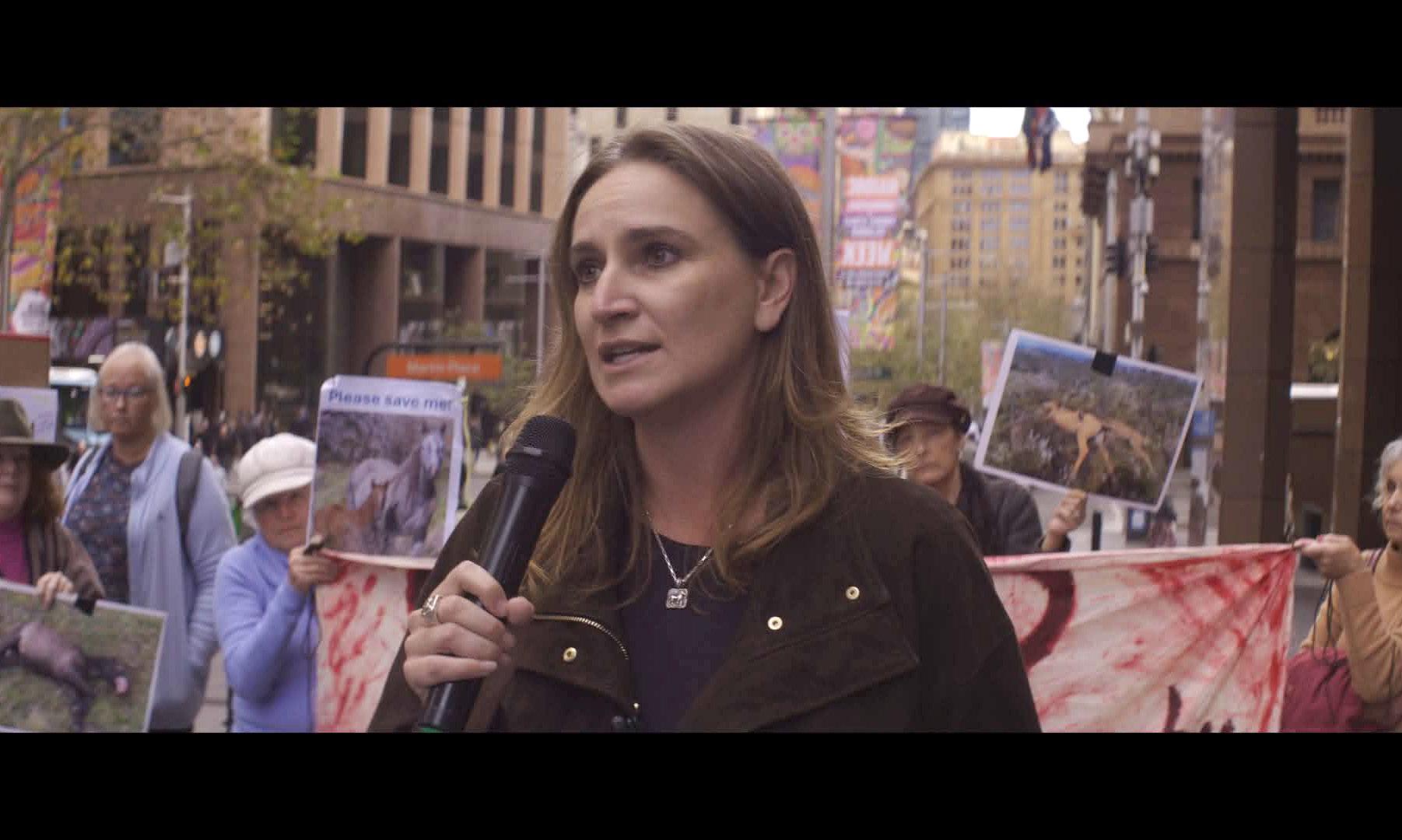
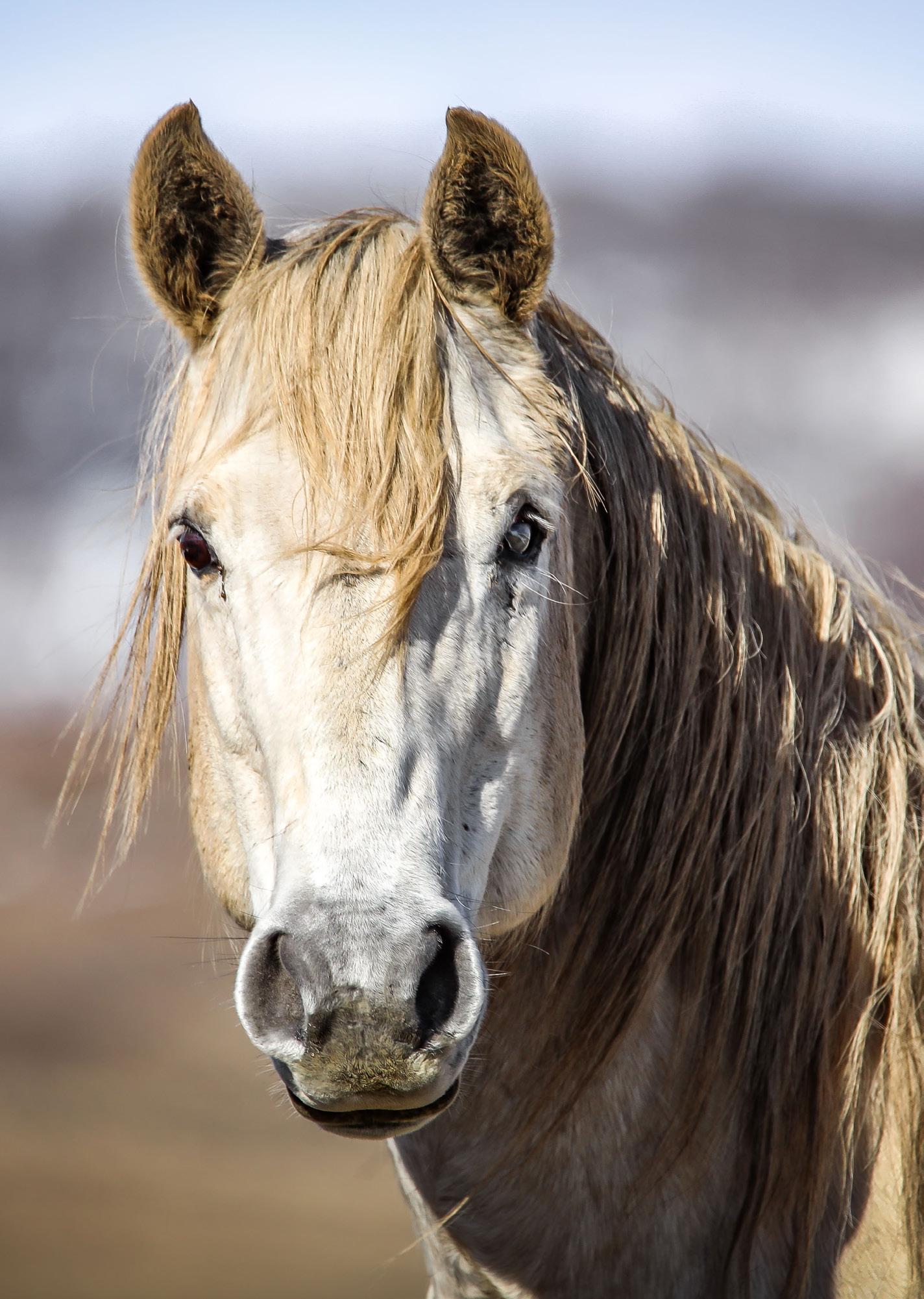
As the culling continues, the plight of the Brumby, one of our national icons, is never far from the news. In this issue, Sam Cavallo goes beyond the Brumby debate headlines to examine the horses, the heritage and the humanity - and her thoughtful article makes for truly thought provoking reading.
OTT Thoroughbreds are in the spotlight this month: Stonewall's Krissy Harris talks about the Thoroughbred Sport Horse Association; and in Founders, we go in depth with Lisa Coffey and Racing Hearts, the equine assisted therapy program powered by OTT horses.
In our ongoing conversation with Dr Andrew McLean, we explore horses' emotional and biological needs, and while in the wellbeing space, Dr Clarissa BrownDouglas discusses winter nutrition for brood mares, Dr Jennnifer Stewart ponders the pros and cons of supplements, and Dr Caroline Spelta has expert advice on the topic of equine asthma.
AMANDA MAC
EDITOR, EQUESTRIAN HUB
Chat With a Champion features cutter Lynda MacCallum - a belief in the power of the positive helped her deal with a shock multiple sclerosis diagnosis. And it seems positivity often goes hand in hand with gratitude, which is certainly true of Jess Clark, a young Grand Prix dressage rider who's experienced highs and lows and is grateful for them all.
You'll love Penny Webb's touching heart horse story, and Anne-Marie Lasserre is back with another motivational Ride Fit - be prepared to be challenged! In Tech Talk we meet Sam Baynes, the Australian entrepreneur who is on a mission to modernise horse shows and strengthen the future of equestrian sport.
Donal Hancock wraps up his excellent training series in this issue, and Racheal Spring explains why regular saddle fit assessments are essential for your horse's comfort, performance and long-term soundness.
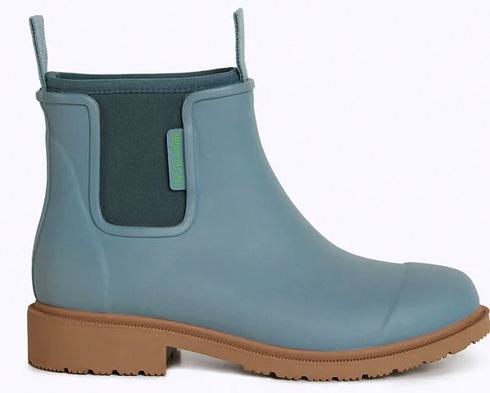
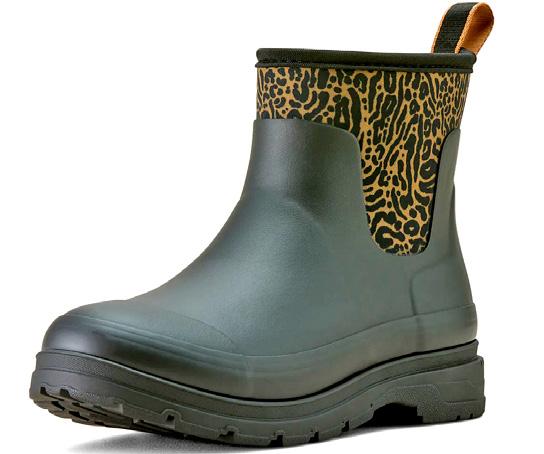
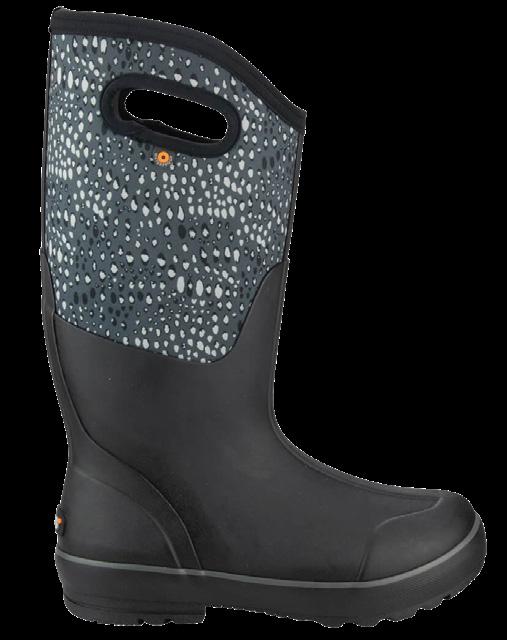
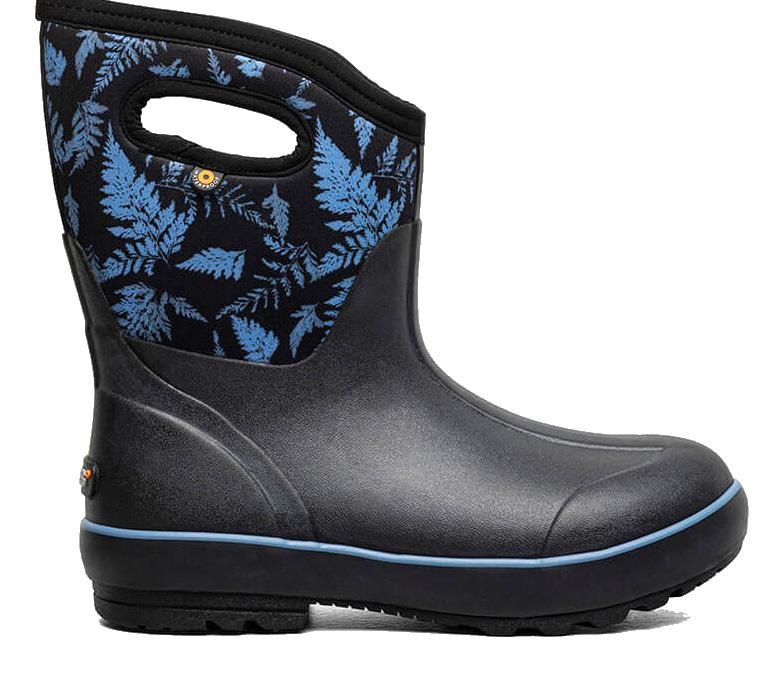
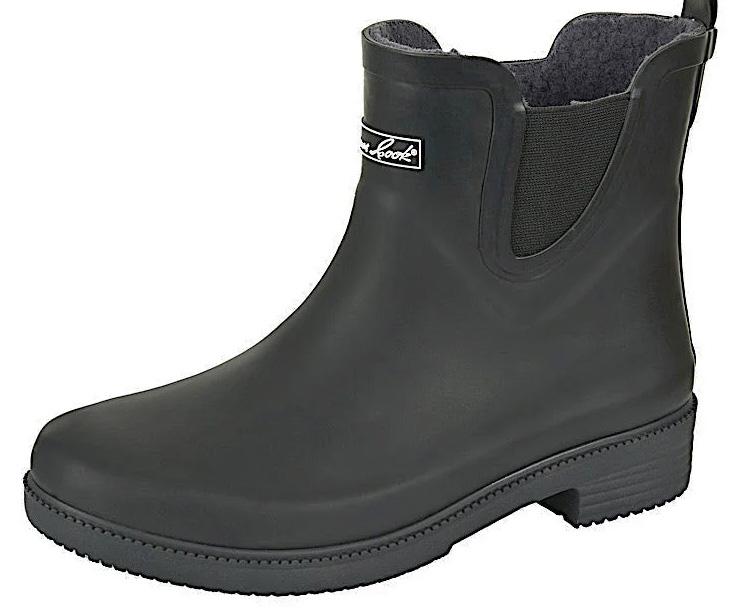
Hannah Darcy reports on a retreat where fostering genuine connection through a shared love of horses is taught alongside online content creation - and horse obsessed wedding photographer Chloe Mackie brings us a stunning Behind the Shot. Plus, if you'd like to keep your feet happy this winter, we suggest you turn to What We Love!
Where Is My Husband?
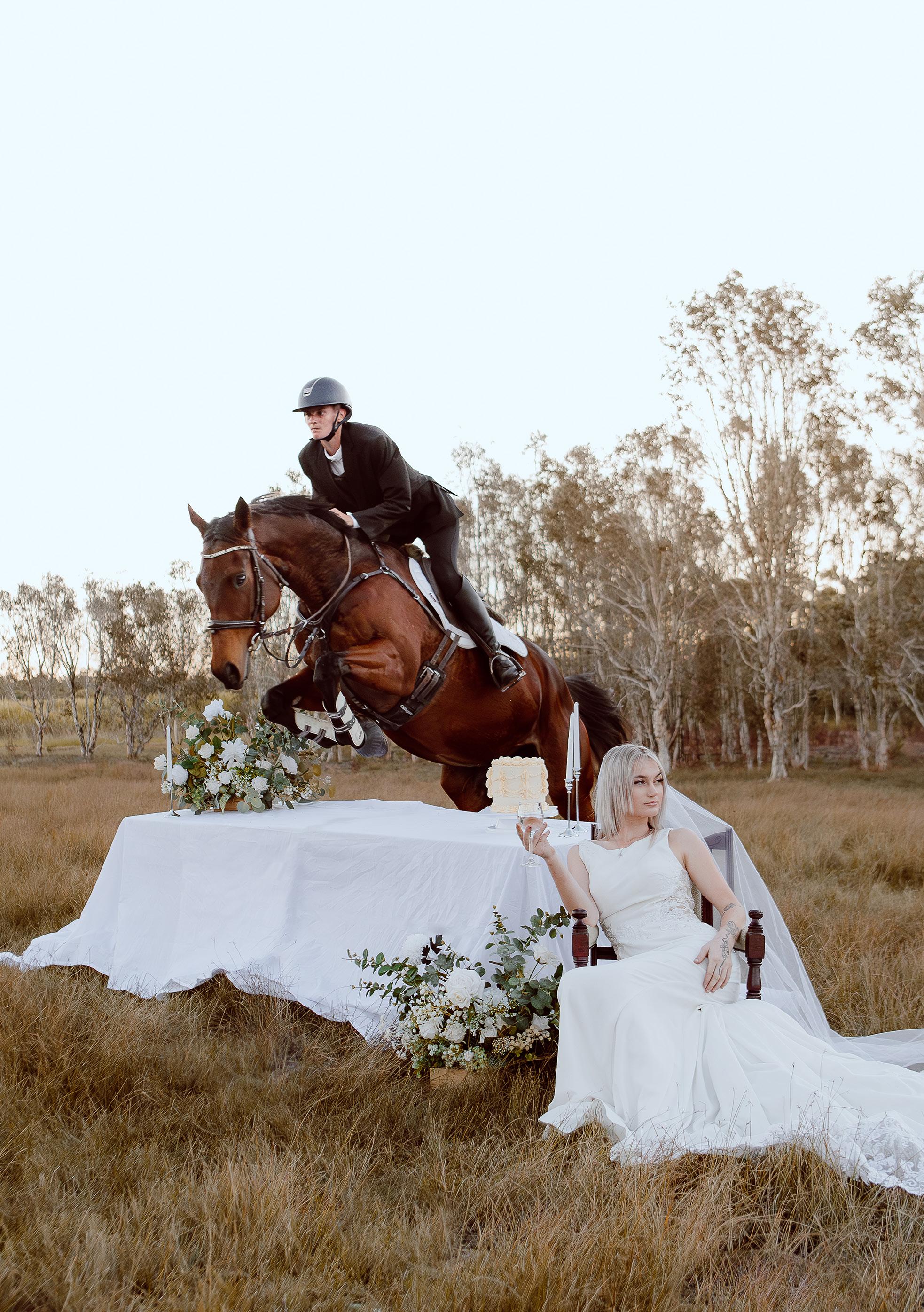
For Bundaberg wedding photographer CHLOE MACKIE, one wildly impractical idea became a creative mission years in the making - and the opportunity to bring one of her favourite images to life.
About three years ago, while on the phone with a wedding client, I found myself doodling on my notepad. My client and I were discussing the decorations for her wedding reception, so I drew little sketches of the tables.
As the call started to wrap up, I embellished the sketch with a drawing I have been recreating since I was a child: a chubby little pony with shiny eyes.
The call ended, and I was left in the silence of my office with a silly drawing of a horse on top of a wedding table. That's when the idea struck me. Of course. I should jump a horse over a fully decorated dining table. I laughed. How silly.
Late last year, in a gorgeous little café in Tasmania, my husband and I encountered a painting. It depicted an Edwardian woman jumping a horse over a picnic table while onlookers stared in shock.
It felt like a sign. Well, it was a painting. But it solidified the idea in my head: I needed to find a way to make this photo happen.
As I thought about it, the vision became clearer. It was to be a husband, a newlywed, leaping his noble steed over the bridal table to impress his beloved. I reached out to my local equestrian community in the Wide Bay, searching for a strapping young lad with the equine prowess required. Not a single reply.
When all hope seemed lost, my own
husband accidentally answered my prayers. While rambling about something to do with motion picture production (one of his special interests), he told me a story about the making of The Lord of the Rings films. "Did you know that while they were casting for the Riders of Rohan, the crew couldn't find enough men to ride the horses? So most of the extras are, in fact, women dressed as men."
Oh? That's when the incredibly talented Bethany McKay got involved. Bethany owns and operates Koolboo Performance Horses in Bundaberg, specialising in the retraining of off the track Thoroughbreds. Her mount for the shoot was Koolboo Jack of Hearts, a four-year-old OTT Thoroughbred affectionately known as Jackles, who has quickly become a wonderful ambassador for life after racing.
I asked "Are you willing to do the jump?" "Yes," she replies. "Are you willing to wear a suit?" "Yes." "Are you willing to tuck your hair away and pretend you're a man?" "Yes."
With my dashing 'groom' and steed secured, my next quest was finding 'him' a bride. I reached out to a few of my friends and quickly found someone willing to help me out.
I got to work arranging a myriad of other details, including personally baking and decorating a multi-tiered wedding cake, as well as decorating the table itself. Another friend at Bella's Infinity Blooms came through with the florals.
Just two days out from the shoot,
my 'bride' had a scheduling conflict and couldn't make the shoot. After a frantic model call and dozens of latenight conversations with potential replacements, I found my new bride.
Danielle was everything I could have hoped for: elegant, daring, eager and open-minded. "Are you willing to wear a wedding dress and sit under a jumping horse?" I asked. "Of course," she said.
I put the final touches on the wedding cake and dragged the table hundreds of metres into a field in South Kolan. Then came the moment of truth.
After literally one attempt, I captured the image I had been imagining for years. Everybody was safe, laughing, and my silly drawing of a pony on top of a wedding table suddenly existed.
I couldn't be happier with the result, and I can't thank everyone involved enough. To Bethany and her best boy, Jack, and to Danielle, thank you for helping turn a dream into reality.
Camera: Canon 5D Mark IV
Settings: ISO 800 | f/3.5 | 1/500 sec.
Chloe Mackie is a Bundaberg-based wedding photographer and owner of Knots Photography. Approaching five years in business and nearly 200 weddings photographed, Chloe is passionate about creating imaginative images and helping couples tell their stories. When she's not behind the camera, you'll usually find her riding horses or attending local clinics and competitions. You can follow her on Instagram
Arena Link connects Australian riders with the educators and clinicians who can move them forward, across every discipline, in every state.
Some riders are ready for the next level. Some educators are ready to take them there. Arena Link is where they find each other.
MATT Charles
Reining · Performance Horses · Sliding Lodge
Arena Link is live, and Matt Charles of Sliding Lodge is one of the first educators you will find there
Matt is a professional reining trainer and coach whose program is built for riders who want more than technical drills Drawing on elite competition experience, international coaching and showing across China, sports psychology, and grounded horsemanship, he helps riders find clarity, confidence, leadership, and consistency, the kind that holds up under pressure, both in and out of the show pen
What stands out is the breadth This is performance coaching for all levels and all disciplines, not just reining Whether you are chasing a class or simply want to ride with more composure, there is something to work with here
Matt's clinics and educator profile are listed on Arena Link, searchable alongside arenas and educators from every state and every discipline. If you are a rider who knows what you are looking for, Arena Link is where you find it Be first through the gate. Don’t miss our newsletter for launch news and the full list of educators joining Arena Link.
Why The Hard Yards of Horse Ownership Are Key To Your Wellbeing
Why do we do something that entails as much hard work as it does pleasure? NAOMI HILL explains why this might be so.
Why do you own a horse?
Most people would say: ‘I enjoy riding’, or ‘I grew up with them’ or ‘I just love the lifestyle’: but do you really love all of it? Between freezing mornings, soggy late nights, an ever depleting life savings, and a deprioritised social life, it’s not all sunshine and ‘rein-bows’ (sorry - had to).
Why do we do something that, on balance, entails just as much hard work as it does pleasure, joy, and ease? Surely I’m not the only one who’s asked this question on a late-night feed while my girlfriends are sipping rosé at their local.
It turns out we’re not masochists. In fact wellbeing researchers and ancient philosophers alike have identified a very
good explanation for not only why we stick it out, but the hidden wellbeing benefits of being a horse person: eudaimonic wellbeing.
Coined by Artistotle himself, and subsequently studied by positive psychologists over the past two decades, eudaimonic wellbeing refers to ‘the life well lived’, or the ‘virtuous life’.
LEFT: There are good reasons why we do things that entail just as much hard work as they do pleasure and joy.
ABOVE: Savouring the sweet moiments has been linked to a wide range of benefits (Image by Bec Sneath).
The good news? Despite its lofty origins, it’s something that is available to all of us. It lives in the moments that we choose challenge over comfort, consistency over flakiness, or consider others outside of ourselves. It’s choosing to be and do good: to live with purpose and pursue a goal and vision that matters to us beyond the discomfort it may create in that moment. It’s skipping your favourite trash TV episode to drive through the dark at 9:00pm and rug up your shivering horse. In many ways, it’s the opposite of its fairweather cousin, hedonic wellbeing (i.e. hedonism), which centres around the pursuit of immediate pleasure and abject avoidance of pain.
So is eudaimonic wellbeing reserved for horse riders? No, not at all. But in a society that is increasingly focused on fast fixes, working from home in your undies, and ordering Uber Eats instead of learning a new recipe, the opportunities for cultivating eudaimonic wellbeing
- consistently doing something hard because it matters to us - are dwindling fast.
So what do we get for choosing to live this more virtuous life? What’s the pay-off beyond, you know, feeling virtuous? As it turns out, leading a life that is rich in eudaimonic wellbeing (one of service and in alignment with our values) is conducive to a heightened sense of meaning and motivation. But what is meaning? Luckily, researchers have been hard at work studying and describing this concept that has been simmering in the back of humankind’s hive mind since the Stoics.
Their key findings? Unsurprisingly, as humans, we want to know what our lives are all about; how we fit into the grand scheme of things and the world around us. “When we talk about meaning in life, we are referring to the feeling that people have that their lives and experience make sense and matter,” meaning researcher, Professor Mike Steger, explains. “People
who feel this way, who have a sense of meaning in life, also report feeling more happy, more satisfied with their lives, less depressed and anxious, and more satisfied with their jobs.”
More than this, experiencing a sense of meaning and living in alignment with one’s values has been linked to better health outcomes over time, with studies showing that those who believe their lives have meaning as having a better immune system and buffer against stress, as well as living longer in general. Yes, keeping up that childhood love of horse riding might just be the thing that keeps you alive long enough to encourage your great grandkids to do the same.
So, how do we lean into the larger sense of meaning when we’re trudging through the mud or being whipped by our hair in the morning breeze? How can we create even more opportunities for eudaimonic wellbeing as we live this hardy, horsey life?
Know your purpose: Before you freak out - we’re not asking you to have any idea about the grand design of your life (or your horse’s life, for that matter). But research does show that we not only do better, but feel better, when we have an idea about what we’re aiming for and why it matters. In short - meaningful goals matter.
Not a competitive rider with clear success markers? No worries. The nature of our goals can vary us much as our fingerprints. Perhaps the purpose of your ‘horse life’ is to reconnect to your inner kid. Maybe it’s to feel that sense of pride and responsibility for keeping such a beautiful animal happy and healthy?
It could be that your ‘horse life’ is a chance to escape the complexities of modern living and connect to a sense of joy and peace… Whatever sense of ‘purpose’ you land on, studies show that simply by identifying it, you’re likely to increase your sense of meaning, satisfaction in life, and boost your resilience for those harder days in the arena.
Discover your strengths: Did you know that you’re actually good at a lot of things? In fact, you have a unique set of ‘character strengths’ - those things that you’re good at, energized by, and enjoy doing - that have shaped and enriched every step of your life so far.
So how do these contribute to our sense of eudaimonic wellbeing? It turns out that the more we can consciously identify and utilise our strengths to make a difference in life, the higher sense of significance (believing that we matter) we feel. The good news? You can uncover and learn to apply your unique strengths by visiting VIA Institute on Character.
Discover how to leverage your strength of humour to get you through a hard ride, or your strength of appreciation to bask in the beauty of your stable baby as she comes trotting towards you in the morning sun. It’s free and your de-
identified results contribute to a growing body of strengths research. What secret strength might you discover?
Savour the sweet moments: It turns out all those annoying people who told you to ‘stop and smell the roses’ were onto something. In fact the practice of ‘savouring’ has been linked to a wide range of benefits, including: enhanced mood and self-esteem, increased life satisfaction, as well as decreased symptoms in those experiencing depression, anxiety, and even obsessive compulsive disorder.
Researchers define savouring as noticing, appreciating, and enhancing positive experiences that occur in one’s life and there are three key ways that we can practice it:
"Did you know that you're actually good at a lot of things? In fact, you have a unique set of 'character strengths' ... that have shaped and enriched every step of your life so far."
Savouring the past, also known as reminiscence: For example, reflecting on your favourite ride, the first time you met your horse, or your funniest fall (we’ve all had them).
Savouring the present or savouring the moment: For instance, appreciating the often rushed process of grooming, drawing your attention to the feel of your horse’s sun kissed coat, or the smell of a new shampoo.
Savouring the future, also referred to as anticipation: For example, visualising the peaceful trail ride you have planned for next week, or imagining the clear round you hope to jump at your next competition.
So the next time you’re heading out for a ride, braiding your horse’s hair, or getting ready to hit the hay, consider how you might incorporate a moment of savouring into your day.
Keep learning: As humans, our brains evolved to release dopamine and other feel-good chemicals when we encounter new things. Whether you’re an artist or an accountant, if you’re a human being you are literally designed to be a lifelong learner. Unfortunately, many of us have fallen for the myth that learning stops when we finish school, our latest short course, or university.
But in doing so, we cut ourselves off from the many benefits that ongoing learning and development entails (e.g. heightened positive emotions, lowered levels of anxiety, increased life satisfaction, improved empathy and more.
The good news? Circling back to our first point, when we have meaningful goals or a more defined purpose, we’re more likely to identify and pursue growth in areas that matter to us (e.g. watching a YouTube video on running braids to get full presentation points at our next rally; enlisting a dressage instructor to perfect our new routine; or even reading up on basic equine massage to help heal our elderly horse’s old knees).
The key to any of these eudaimoniaboosters is to tailor them to you, your lifestyle, and your unique way of seeing and showing up in the world. The invitation is one of playful experimentation, not scientific intervention: If all you do is savour the sunrise as you throw the hay over the fence, or ask a few more curious questions to your jumping coach, then you’re well on your way.
Naomi Hill (MAPP) is a positive psychologist, wellbeing coach and word-weaver who never grew out of the horse phase.
Understanding the Five Domains: Socialisation, Movement and the Future of Horse Welfare
In Part Two of our special feature with DR ANDREW McLEAN, the conversation shifts from training and communication to the deeper biological and emotional needs of horses. From turnout and socialisation to stereotypic behaviours and the future of horse sport, Dr McLean explores what horses require not simply to perform - but to genuinely thrive.
If Part One of our conversation with Dr Andrew McLean explored the emotional importance of clarity, predictability and communication in horse training, Part Two moves into something even more fundamental: what happens when horses are prevented from simply being horses?
From movement and social interaction to chewing, turnout and stable design, the discussion reveals how many modern management systems still conflict with the horse’s deeply ingrained behavioural needs - often in ways riders may not fully recognise.
For Dr McLean, one of the most important shifts occurring within welfare science is the growing understanding that horses are not simply athletic animals to be managed efficiently, but highly social and emotionally responsive creatures shaped by millions of years of evolution. Many of the behaviours humans struggle with today, he believes, are not random quirks or bad habits, but the predictable outcome of environments that fail to meet those biological needs.
One of the clearest examples is foraging behaviour.
While most riders understand the nutritional importance of fibre, Andrew
explains that the behavioural need to chew is equally significant. “What we didn't realize is there are also really powerful neural pathways for the horse. They're made to keep chewing.” Horses evolved to spend enormous portions of their day grazing and processing forage, with chewing itself deeply connected to neurological regulation and emotional stability.
"Confinement does not remove that instinctive need to move freely. Instead, the pressure often builds beneath the surface until the
horse
is finally released. "
Modern management systems often interrupt that natural rhythm. Restricted forage intake, limited turnout and meal-feeding systems can leave horses unable to fulfil deeply hardwired behavioural drives, something he believes contributes to the development of stereotypic habits such as crib biting and wood chewing.
Rather than viewing these behaviours
simply as stable vices or bad habits, Dr McLean believes they should be understood within the context of welfare and behavioural frustration. Research in young horses of one to three years old with continual forage access and showing lower rates of crib biting only reinforces that perspective.
To him, these behaviours are not signs of a problematic horse, but indicators that something fundamental may be missing within the horse’s daily life.
The same principle applies to movement.
Modern horses may receive structured exercise and training, but Andrew says movement itself is about far more than fitness or workload. In natural environments, horses travel considerable distances each day, grazing, interacting, exploring and constantly moving through their surroundings. “Generally they move around about on average 17-odd kilometres a day,” he says.
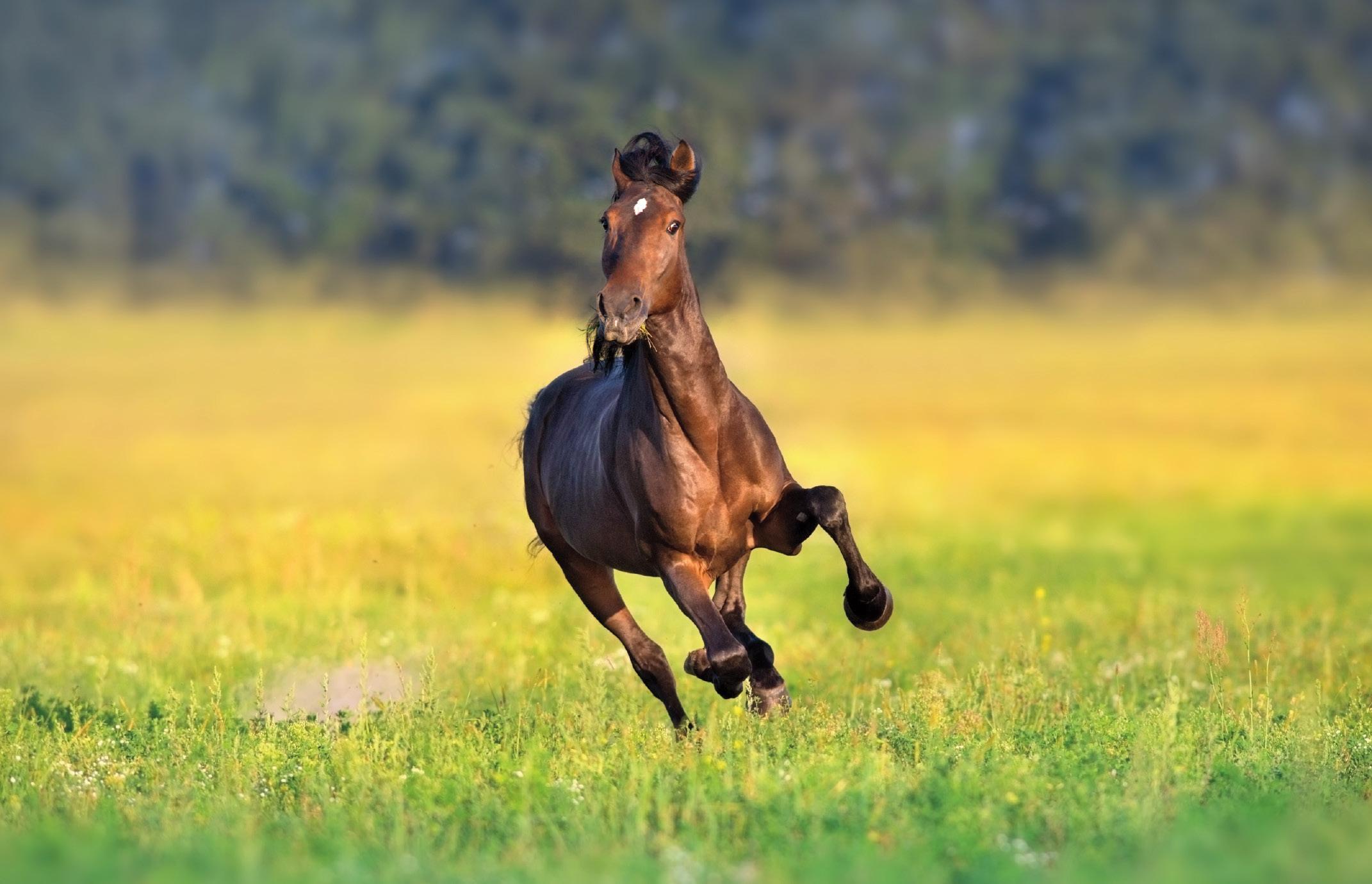
Confinement does not remove that instinctive need to move freely. Instead, the pressure often builds beneath the surface until the horse is finally released. “When you let horses go free, they'll often leap and cavort, in what is called post-
inhibitory rebound,” Andrew explains.
To many riders, those explosive moments of galloping, bucking and exuberant movement appear playful, boisterous or even dangerous - to the point that turnout is sometimes limited or denied. But Andrew sees them differently. “It's not essentially character; it's just being a horse.”
That distinction sits at the centre of the broader Five Domains discussion. Horses are frequently expected to suppress natural behaviours in order to fit within modern systems of management and competition. Yet welfare science increasingly recognises that behavioural expression itself matters deeply. “They have to be allowed to be horses.”
Perhaps nowhere is this more significant than in the discussion around socialisation - something Andrew describes as “the big-ticket item of the whole lot.”
For decades, many stable systems prioritised separation and controlled interaction, often based on the belief that physical contact between horses created behavioural issues or increased risk. But research now points strongly toward the importance of genuine social interaction and physical contact between horses. “We've got to allow horses to be able to touch each other,” Andrew says.
Simply seeing another horse is not enough. Horses are profoundly social animals whose emotional wellbeing is shaped by companionship, touch and herd interaction. That understanding is beginning to challenge even the way stables themselves are designed.
Dr McLean points to his work with the Greater Manchester Police Mounted Unit as one of the most compelling examples of the impact social contact can have on horse welfare.
Following a welfare workshop with Andrew, the unit made the decision to
remove the bars between neighbouring stables. Previously, the horses could see one another but had no opportunity for physical interaction. Once the bars were removed, they were able to touch noses, groom one another and engage in the kind of social contact that comes naturally to horses living in a herd.
The change wasn't without its challenges. Like any group of horses, some individuals formed stronger bonds than others, and there was an initial adjustment period as the horses adapted to their newfound social freedom. But once settled, the results were remarkable. "After the first week everything improved, horses became bolder," Andrew says.
"For decades, many stable systems prioritised separation and controlled interaction, often based on the belief that physical contact between horses created behavioural issues or increased risk."
Behavioural abnormalities diminished rapidly and the horses became noticeably more confident in their work. They were less frightened of unfamiliar objects and performed more confidently when out on patrol, reinforcing the growing body of evidence that social interaction plays a critical role in emotional security.
For Andrew, the lesson is simple. Seeing another horse is not enough. Horses are social animals, and meaningful social contact - including touch and mutual grooming - is a fundamental welfare need rather than a luxury.
One of the most fascinating aspects of
Dr McLean’s work is how consistently these welfare principles appear across species. His experiences working with elephants revealed many of the same patterns surrounding social deprivation, behavioural frustration and emotional wellbeing. “The outcome was exactly the same with the horses,” he says.
Again and again, the same message emerges: animals thrive when their emotional and behavioural needs are properly understood rather than simply managed.
Toward the end of the discussion, the conversation turns more directly toward modern horse sport - and the growing tension between welfare science and traditional management culture.
Andrew recalls hearing elite performance horses described in ways that deeply unsettled him, particularly suggestions that high-level sport horses required social isolation, intensive confinement or highly restricted lifestyles in order to remain manageable and competitive. "This is a dressage horse, a performance horse…" he recalls, "and the point was that the horse is really like a battery hen."
The comparison clearly stayed with him.
To him, the implication was that exceptional athletic performance somehow justified limiting the horse's opportunity to express normal behaviour. Yet welfare science increasingly suggests the opposite. Horses do not stop being horses simply because they compete at an elite level. Their need for movement, social contact, predictability and emotional security remains unchanged. "We've got to get away from that."
Importantly, Dr McLean is not anti-sport. In fact, he strongly believes horse sport has a future. But he also believes that future depends on the industry's willingness to evolve alongside modern welfare science and place greater emphasis on
ABOVE: When a horse is allowed to run free after a period of confinement, they often leap and cavort,behaviour that is known as post-inhibitory rebound.
the horse's lived experience. “There’s a way forward for horse sports, but there's no future in currently what we do.”
That evolution, he believes, will increasingly involve lighter aids, clearer communication, improved management systems and more objective welfare assessment. He even sees artificial intelligence potentially playing a future role in judging and welfare evaluation within dressage and horse sport. “It will be analysing 100 markers at one time… and it will be fair and objective.”
But despite technological advances, the foundation of welfare still returns to something remarkably simple: understanding the horse’s perspective. “The horse felt that his world was predictable and controllable,” he says. In many ways, that single idea sits at the heart of the Five Domains. Whether discussing turnout, training, social interaction or emotional wellbeing, the
underlying question remains the same: does the horse feel secure in its world? Because when a horse feels safe, understood and able to influence its environment, welfare becomes more than the absence of suffering - it becomes the foundation for a life well lived.
As our conversation drew to a close, we asked Andrew what single change he believes could most improve the lives of modern horses. He answered without hesitation. “I would say the socialisation.”
Not supplements. Not more sophisticated equipment. Simply allowing horses greater opportunity to do what they have evolved to do for millennia: form bonds, interact with one another and experience genuine companionship.
Dr McLean hopes future stable systems move toward environments that
prioritise connection rather than isolation. “Horses will form friendships with other horses, and prefer others, and it'll be a better life for horses.”
It is a deceptively simple idea, yet one that sits at the heart of the Five Domains. Throughout our conversation, the discussion repeatedly returned to the same fundamental question: what does a good life look like from the horse's perspective?
Perhaps the answer lies not in asking more of our horses, but in understanding more about what they need.
Not just managing horses. Not just training horses. But understanding what allows them to truly live well.
Dr. McLean's excellent courses are available through Equitation Science International.
From Sydney to Silicon Valley
Australian entrepreneur SAM BAYNES has secured more than $4.5 million in funding for Pegasus, a technology company on a mission to modernise horse shows and strengthen the future of equestrian sport.
Horse shows are the foundation of the equestrian industry. They are where riders take their first steps into competition, where professionals build careers, where owners invest in horses, and where communities come together around a shared passion.
Yet despite the importance of horse shows, many organisers still spend countless hours wrestling with paperwork, manual processes and administrative tasks that pull their attention away from delivering exceptional events. That challenge inspired the creation of Pegasus.
Founded by husband-and-wife team Sam and Jennifer Baynes, Pegasus is a technology company headquartered in the United States with a mission to make horse shows easier to run and more enjoyable to attend.
The idea originated with Jennifer, a Florida native and lifelong threeday eventer who had spent years experiencing the inefficiencies that exist throughout the horse show industry. Like many riders, she saw firsthand how much time organisers, competitors and volunteers spend dealing with administration rather than focusing on the horses and the event itself.
Recognising the scale of the problem, she turned to her husband, Sam, an Australian technology entrepreneur originally from Sydney, to help solve it.
Sam had spent his career building and scaling software companies
TECH TALK
outside the equestrian industry. Together, the pair saw an opportunity to bring modern technology practices into a sport that had largely been overlooked by the technology sector.
That vision recently attracted significant investor interest, culminating in a $3 million USD seed funding round - equivalent to more than $4.5 million AUD - to support the company’s continued growth.
Rather than using that capital to aggressively expand sales, Pegasus made a deliberate decision to invest almost entirely in product development and customer support. The company adopted a productfirst philosophy, focusing on building exceptional software while maintaining an unwavering commitment to customer experience. The long-term objective is simple: build software so intuitive and reliable that customers barely need support at all.
That investment culminated in the launch of Pegasus OS in May after more than three years of research and development.
"That vision recently attracted significant investor interest, culminating in a $3 million USD seed funding round ..."
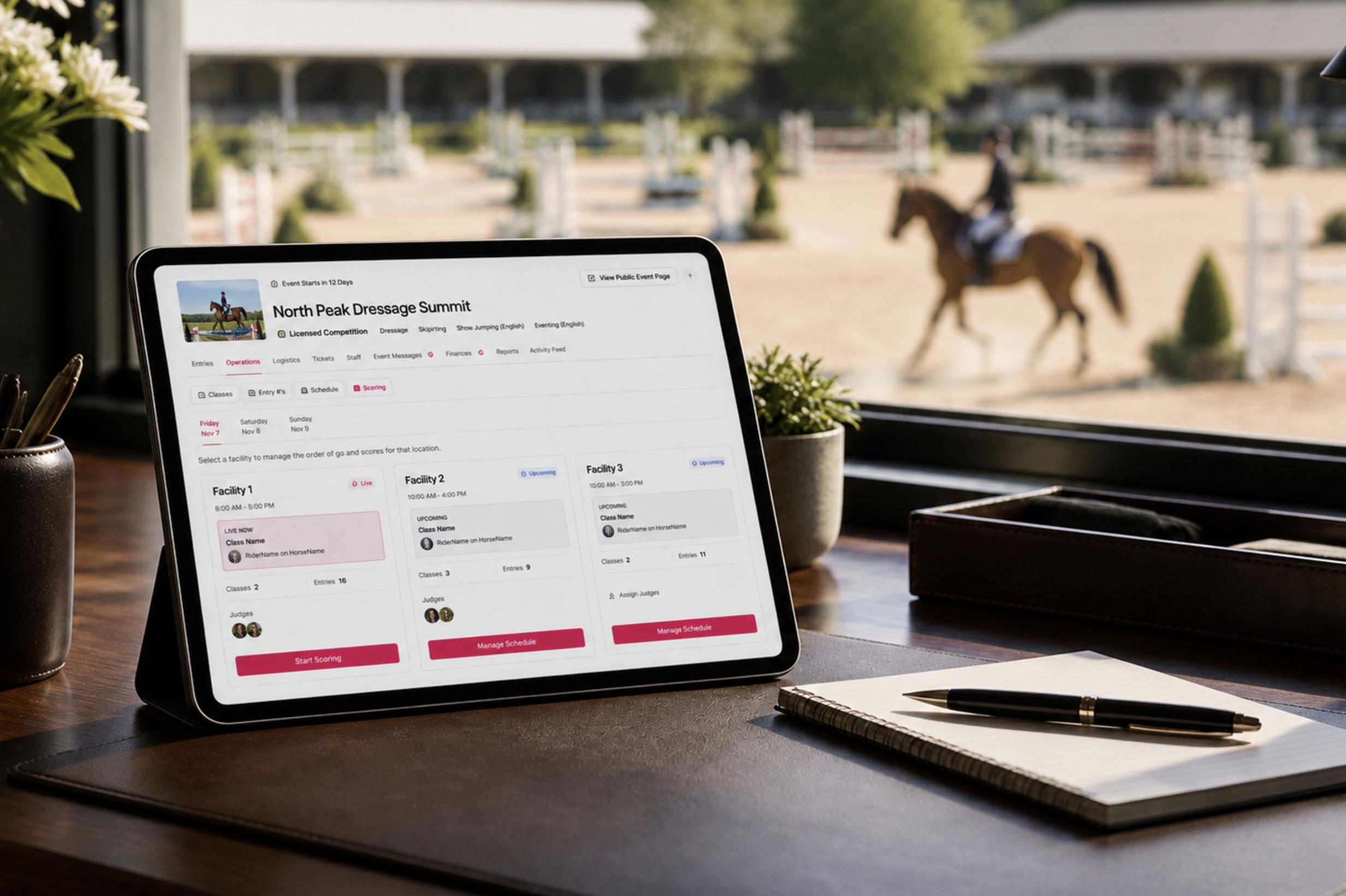
Rather than creating another point solution, Pegasus OS was designed as a complete operating system for horse shows. It brings together entries, scheduling, payments, scoring, live streaming, financial reporting, digital signatures, communications and event management into a single platform, giving organisers one place to run every aspect of an event.
For decades, technology innovation has largely bypassed the horse industry. While many other sports have embraced modern systems and digital experiences, horse shows have often relied on processes that were designed for a different era. The result is that organisers frequently spend enormous amounts of time managing administration when their focus should be on delivering great events.
Pegasus was built to change that.
For organisers, that means creating better visibility into the financial health of a horse show. Modern payment systems and real-time reporting make it easier to understand where revenue is coming from, what expenses are being incurred, and how an event is performing while it is still underway. Better information helps organisers make better decisions, reduce operating costs and build more sustainable events.
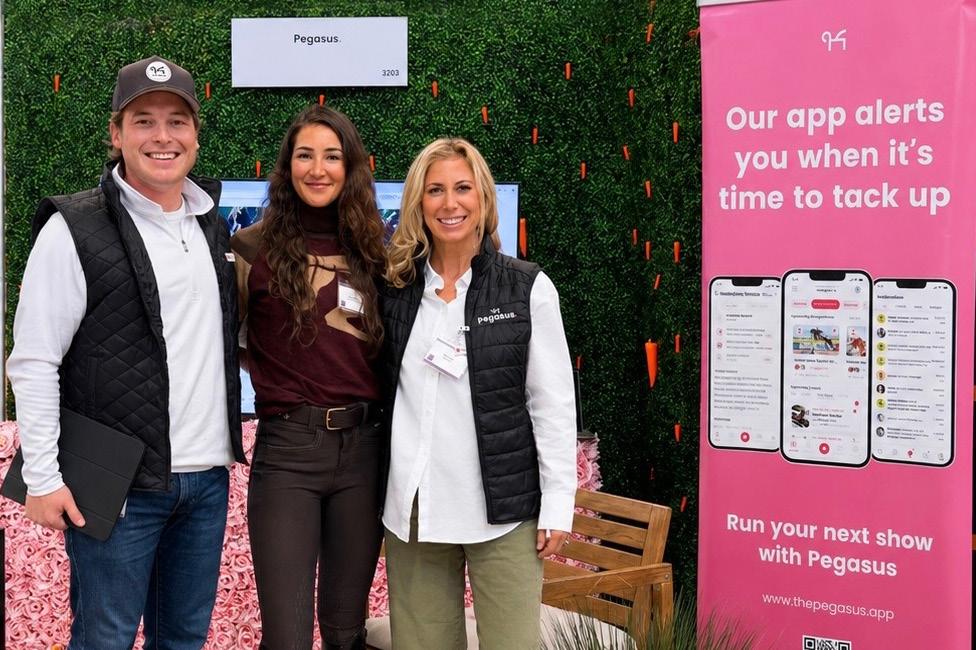
ABOVE: Sam and Jennifer have been attending trade shows to promote their innovative software. LEFT: Pegasus’ mission is to become the operating system for every horse show in the world, large or small, local or international.
It also transforms day-to-day operations. Instead of manually processing entries, collecting paper waivers, managing last-minute scratches or answering constant phone calls about ride times, organisers can manage those tasks digitally through a single platform, freeing them to focus on the event itself.
For competitors, it means reducing friction. Entering a horse show, signing forms, receiving updates and managing schedules should not be complicated. Riders can register online, receive realtime schedule updates on their phones, make changes without visiting the show office, and spend more time preparing for their rounds instead of waiting in line.
For families and supporters, it means greater connection. One of the challenges of equestrian sport is that loved ones are often unable to travel to every competition. Technologies such as integrated live streaming and individual ride videos create opportunities for competitors to share their journey with family, friends and fans regardless of where they are in the world.
The company’s progress has already demonstrated strong early momentum. Pegasus has powered hundreds of horse shows across a broad range of equestrian disciplines, with organisers from grassroots competitions through to major events adopting the platform. Horse shows from around the world have begun signing up to Pegasus OS, reinforcing the company’s belief that the need for modern infrastructure is universal rather than discipline or geography specific.
Its ambition, however, stretches much further. Pegasus’ mission is to become the operating system for every horse show in the world - large or small, local or international, across every equestrian discipline. The early
adoption of Pegasus OS suggests that vision is beginning to resonate with organisers looking for a simpler way to run their events.
The scale of that opportunity is also what attracted investors.
Pegasus’ investors believe equestrian sport represents one of the world’s most undervalued sporting asset classes. While horse sports are as widespread as many mainstream sports, they often take place away from major cities and therefore receive far less visibility than sports such as football or soccer. Their view is that modern software infrastructure can unlock the
"Pegasus has powered hundreds of horse shows across a broad range of equestrian disciplines, with organisers from grassroots competitions through to major events ..."
industry’s full potential by making horse shows more efficient, more connected and more commercially attractive.
By creating the digital infrastructure that underpins the industry, Pegasus believes horse shows can become easier for organisers to run, more engaging for competitors, and increasingly attractive to sponsors, media companies and commercial partners. As more investment flows into the sport, organisers can build stronger businesses, competitors enjoy better experiences, and the industry as a whole becomes more sustainable.
As Sam Baynes explains: “If we can help horse shows generate more revenue while reducing their operating costs, we strengthen the businesses at the heart of our sport. Profitable
horse shows attract the next generation of organisers and entrepreneursand when that happens, the future of equestrian sport becomes incredibly bright.”
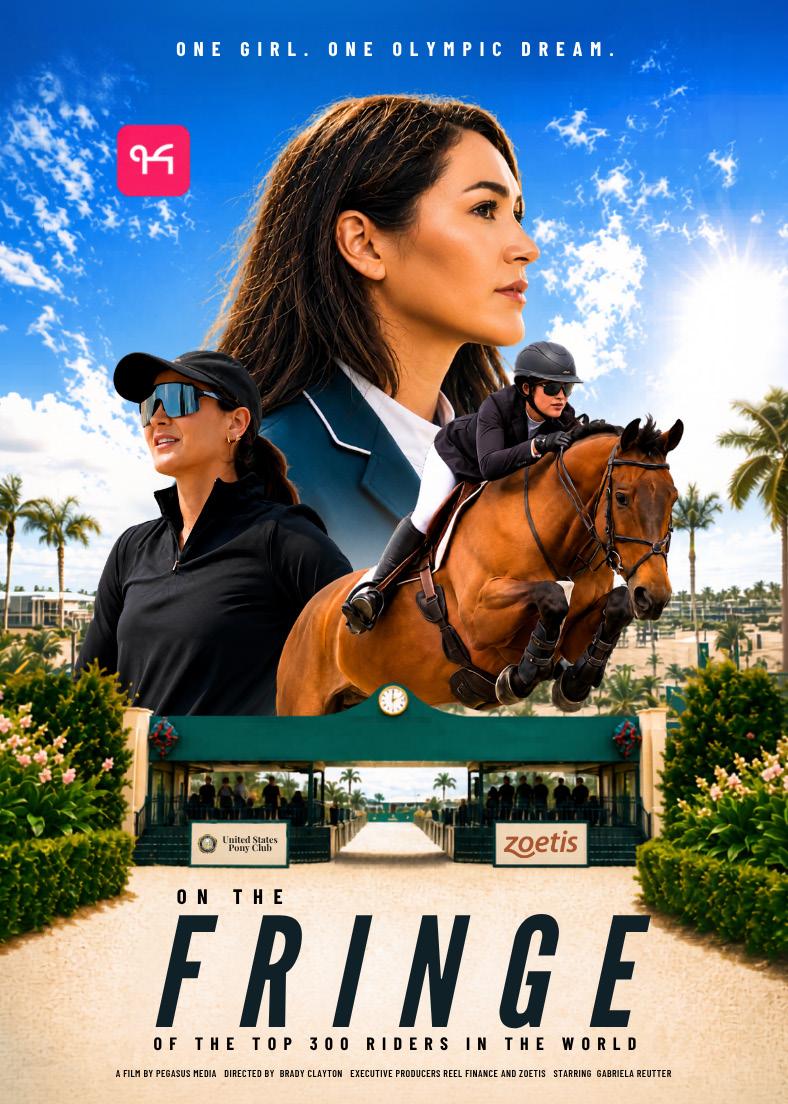
The company’s ambitions also extend beyond software. Through projects such as the upcoming documentary On The Fringe, Pegasus is investing in storytelling designed to introduce new audiences to equestrian sport and inspire more people to become involved. The goal is not only to improve how horse shows operate behind the scenes, but also to elevate the visibility of the sport itself.
Looking ahead, Pegasus plans to spend the next 12 to 24 months accelerating adoption of Pegasus OS around the world. The company will work closely with both major show managers and grassroots organisers across every country, with the goal of becoming the digital infrastructure layer that powers horse shows globally.
Ultimately, Pegasus wants to become as recognisable within the horse industry as Airbnb is within travel - a trusted platform that organisers instinctively turn to when they want to run an event.
At its core, Pegasus is not trying to change what makes horse shows special. The traditions, relationships and community spirit that define equestrian sport remain its greatest strengths.
The goal is simply to remove friction behind the scenes so organisers can run better events, competitors can have better experiences, and more people can discover and fall in love with the sport.
Because when horse shows thrive, the entire equestrian industry thrives with them.
TRAINING
Foundation to Finished: Body Control Under Saddle
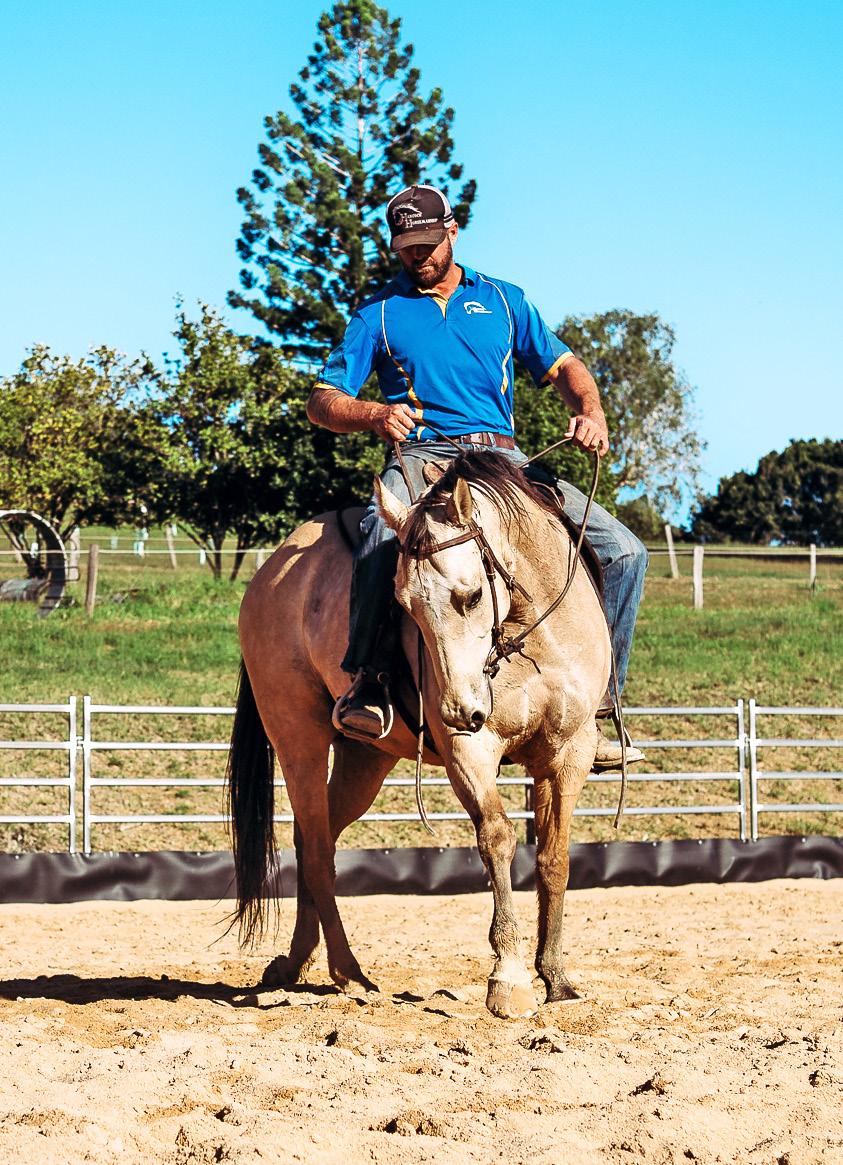
In the final instalment of Foundation to Finished, DONAL HANCOCK demonstrates how the body control established through groundwork and long reining transfers into the saddle, creating the foundation for softness, responsiveness and advanced manoeuvres.
In the first two instalments, we established control of the horse's body from the ground through halter work and long reining. Now it's time to transfer those same principles into the
saddle. Whether your goal is trail riding, campdrafting, dressage or reining, every advanced manoeuvre is built on the same foundations: control of the head and neck, shoulders and hindquarters.
Lateral Flexion
Before you do anything once you mount up, put your body in neutral (not your riding position) and take your feet
off the horse. Under saddle, your feet tell the horse's feet to move, much like the whip does on the ground. This exercise isn't asking the horse's feet to move.
Simply take pressure through whichever rein you choose towards the outside of your hip. If your horse walks, hold the pressure until the horse comes to a standstill, then release. This exercise also teaches the horse to stand quietly after mounting and, from a therapeutic perspective, helps stretch the neck muscles.
Shoulder Control
Shoulder-In
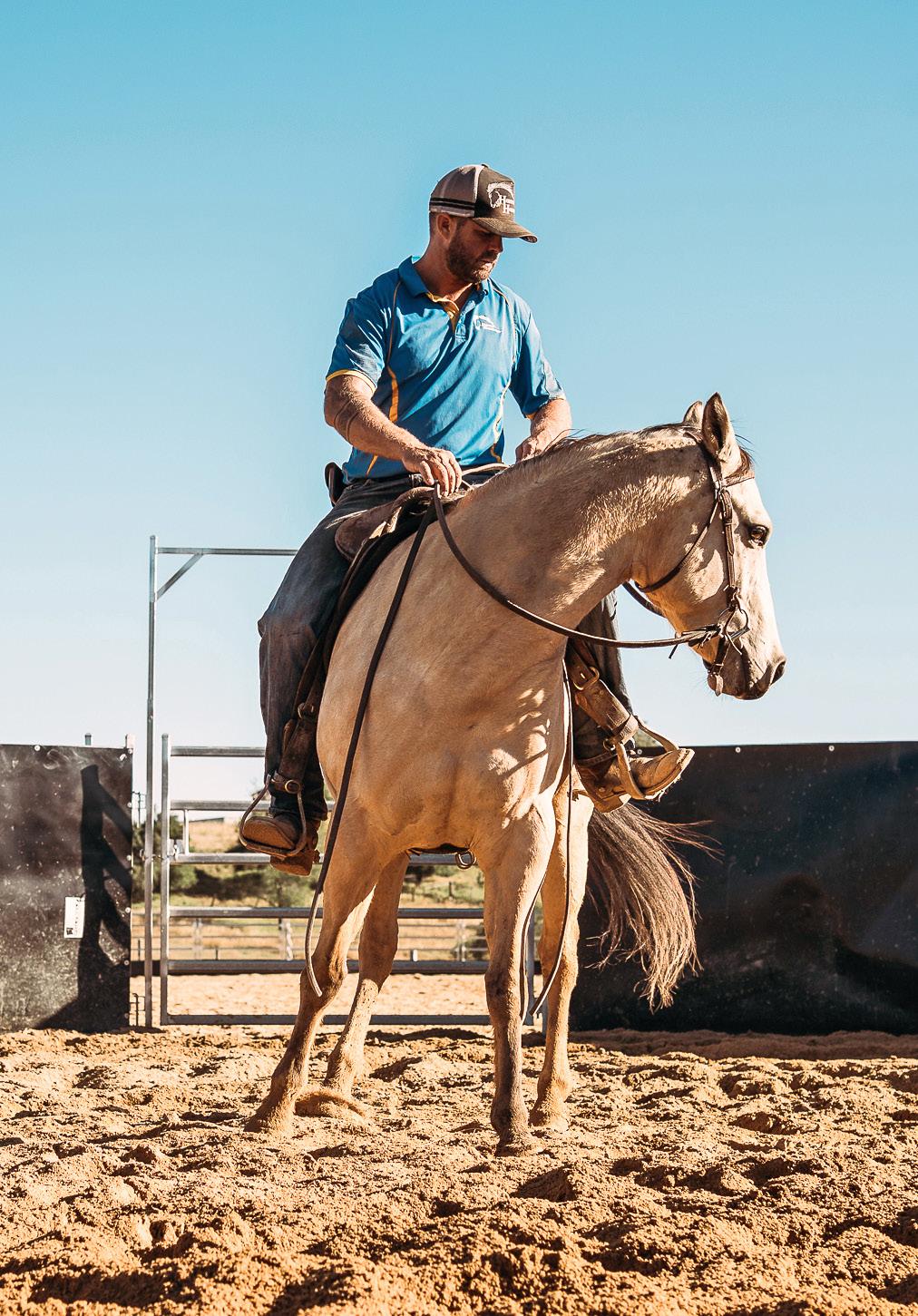
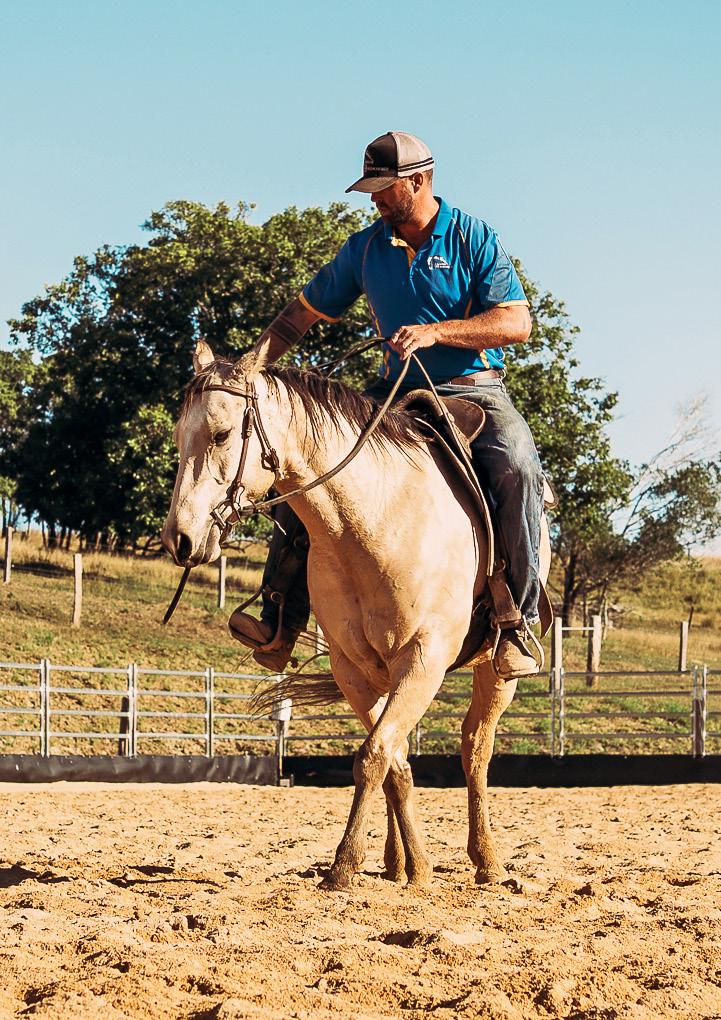
This is the easiest way, in my opinion, to help your horse understand shoulder control. Shoulder-in is about getting the shoulders to follow the direction the horse's nose is pointing — into the circle. The most technical display of this is probably the reining spin. Regardless, for general direction, you need the front
feet to follow the horse's nose.
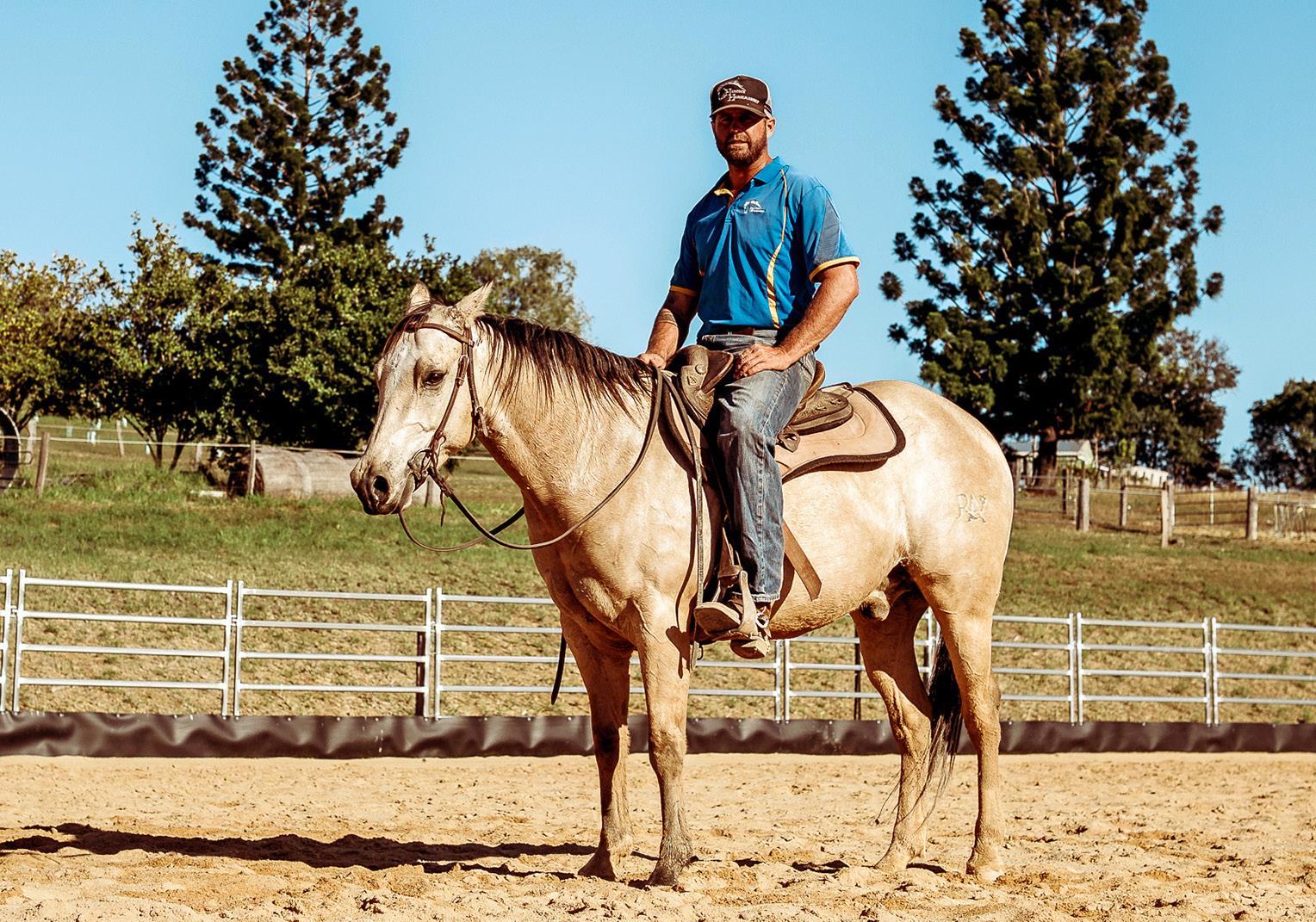
I like to use the arena fence to help with a lot of my training because it limits the horse's options for evasion. By using the fence, the horse must shift its weight back onto the hindquarters to lighten the forehand and bring the shoulders through.
I walk up close to the fence and stop my horse. Then I widen the inside rein in the direction I wish to turn, take my inside foot off the horse, close the outside rein against the horse's neck, press with my outside foot just behind the girth, and ask the inside front foot to step across and change direction.
Basically, I create pressure on the side of the horse from which I don't want a direction change and release pressure on the side where I do. Open the gate you want the horse to go through and close the gate you don't want it to go
through. That is the beginning of shoulder-in.
Shoulder-Out
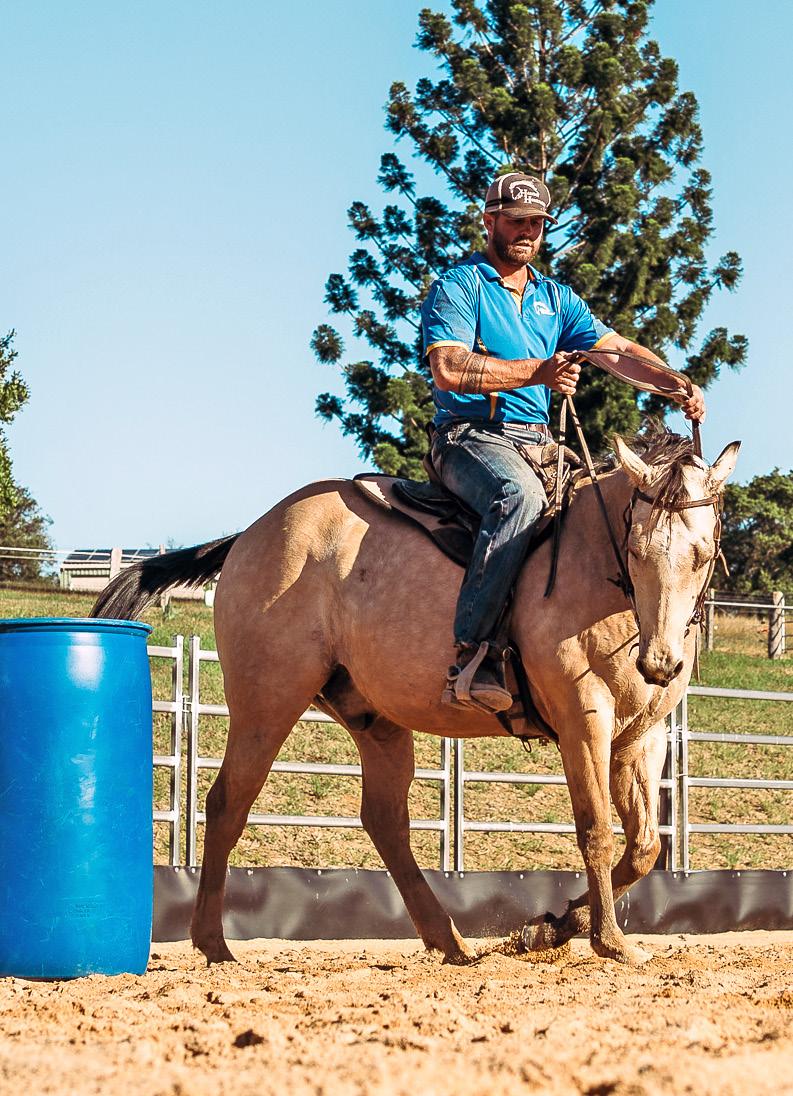
This is the beginning of counter-arcs, basically. I like to begin the exercise around a 44-gallon drum or something similar. The drum creates the inside bend through your horse's body for you.
First, establish your circle, forward movement and impulsion. When you feel your horse is ready to move its shoulders out of the circle, elevate your inside rein directly upward — don't pull it across the horse's neck. Widen the outside rein outward and squeeze with your inside foot just behind the girth.
The elevated inside rein maintains the horse's lateral bend to the inside while your inside foot yields the shoulders away from the drum. You only need a couple of steps from your horse before
ABOVE LEFT: Shoulder-out. ABOVE RIGHT: Backing up
stopping. Reward your horse for trying and for achieving the desired response.
Stopping and Backing Up
This exercise comes in three stages for me. First, the feet stop. Next, the face softens vertically to the bridle pressure. Finally, the horse backs up.
I start this exercise at the walk. Remember, speed is easy to add once everything else is correct. Walk your horse in any direction you like with your feet on — your feet tell the horse's feet to move.
When you ask for the stop, give a verbal "whoa", release your feet and relax your seat in the saddle. If your horse misses the cue, only then should you go to the bridle reins and physically ask the horse to stop. Give it a chance to work it out first, then correct if necessary.
For part two, hold rein pressure with
both hands until the horse softens vertically through the bridle. This helps eliminate bracing through the face and reduces head tossing during stops.
For part three, lean back slightly in the saddle, put your feet back on, add a little rein pressure if needed, and ask the horse to take a couple of steps backward. Then reward.
Your feet don't just mean forward; they can also mean back. The horse understands the difference because you change your seat position in the saddle.
Putting it All Together
These are the basic beginnings of body control under saddle. As your horse gains education, the exercises become more advanced. Regardless of the discipline, you need these fundamental body-control manoeuvres before you can teach advanced movements such
as rollbacks, lead changes, spins and more.
Every advanced movement begins with a horse that understands how to move each part of its body independently and willingly. Remember to take it slow and get it correct. Speed is only impressive when it's built on correctness first. And most importantly, have fun with it.
Missed a previous instalment?
Part One: Ground Control (May issue) Part Two: Long Reining and Body Control from the Ground (June issue).
Foundation to Finished is an exclusive training series for The Hub with horseman Donal Hancock, following the progression from foundational groundwork through to starting education under saddle.
For details of upcoming lesson and clinic opportunities, visit Hancock Horsemanship. You can follow Donal on Instagram.
COMMUNITY
TRENDY PONY | A RETREAT WITH HEART
More Than Content Connection, Creativity, Community
There is something special about bringing horse lovers together. Conversations flow easily, friendships form quickly and, somehow, complete strangers begin to feel like old friends.
That was the heart behind The Content Retreat: a unique all-inclusive weekend created not simply to teach content creation, but to foster genuine connection through a shared love of horses.
Hosted by Hannah Darcy, founder of Trendy Pony, alongside equestrian content creator Rachel Vercoe of My Horse Willow, the retreat welcomed women from across Australia for a relaxed weekend of learning, creativity and unforgettable horse-filled moments.
Held at the beautiful Elysium Estate in Northern New South Wales, the retreat provided the perfect setting to slow down, disconnect from everyday life and immerse participants in a supportive environment where they could learn, create and simply enjoy being surrounded by like-minded people.
Set across 105 acres in the heart of Australia’s ancient Shield Volcano and framed by the majestic Mt Warning and Nightcap Ranges, the rustic luxury farm offered breathtaking scenery, fertile countryside, flowing waterfalls and an abundance of natural beauty. It was a location that perfectly reflected the spirit of the weekend - peaceful, grounding and deeply connected to both horses and nature.
The idea behind the retreat was born from two shared passions.
Rachel Vercoe wanted to give back to the community that has supported her online journey by helping women gain confidence when it comes to creating content while spending quality time with fellow horse lovers. Through years of documenting life with her beloved horse Willow, Rachel has built an engaged audience by sharing authentic moments, practical knowledge and the everyday realities of horse ownership. The retreat gave her the opportunity to
"From the moment guests arrived, the atmosphere encouraged connection over comparison."
pass on that experience in a relaxed and encouraging environment.
For Hannah Darcy, the vision reached beyond cameras and social media. Through Trendy Pony, Hannah has always believed horses have an incredible ability to bring people together. Her goal was to create an inclusive and welcoming space where horse lovers of every experience level could feel comfortable, supported and inspired. Whether attendees had years of experience creating content or had never filmed a video before, everyone
was encouraged to learn at their own pace while enjoying the company of others who shared the same passion.
While social media and content creation formed the educational focus of the weekend, the retreat was never about chasing followers or going viral. Instead, it centred on helping women build confidence, tell their stories authentically and enjoy the creative process alongside others who genuinely understood their love of horses.
Rather than delivering a formal presentation, Rachel shared the knowledge and experience she has gained through years of creating equestrian content in an informative but casual manner. Throughout the retreat, she offered practical tips, creative ideas and real-world insights while spending time alongside attendees, answering questions and encouraging creativity.
From the moment guests arrived, the atmosphere encouraged connection over comparison. There was no pressure to create the perfect photograph or film the perfect reel. Instead, participants were free to experiment, ask questions, support one another and celebrate each other’s successes in an environment where everyone belonged.
Throughout the weekend, participants worked on photography, video creation, storytelling and social media skills while also enjoying plenty of downtime with
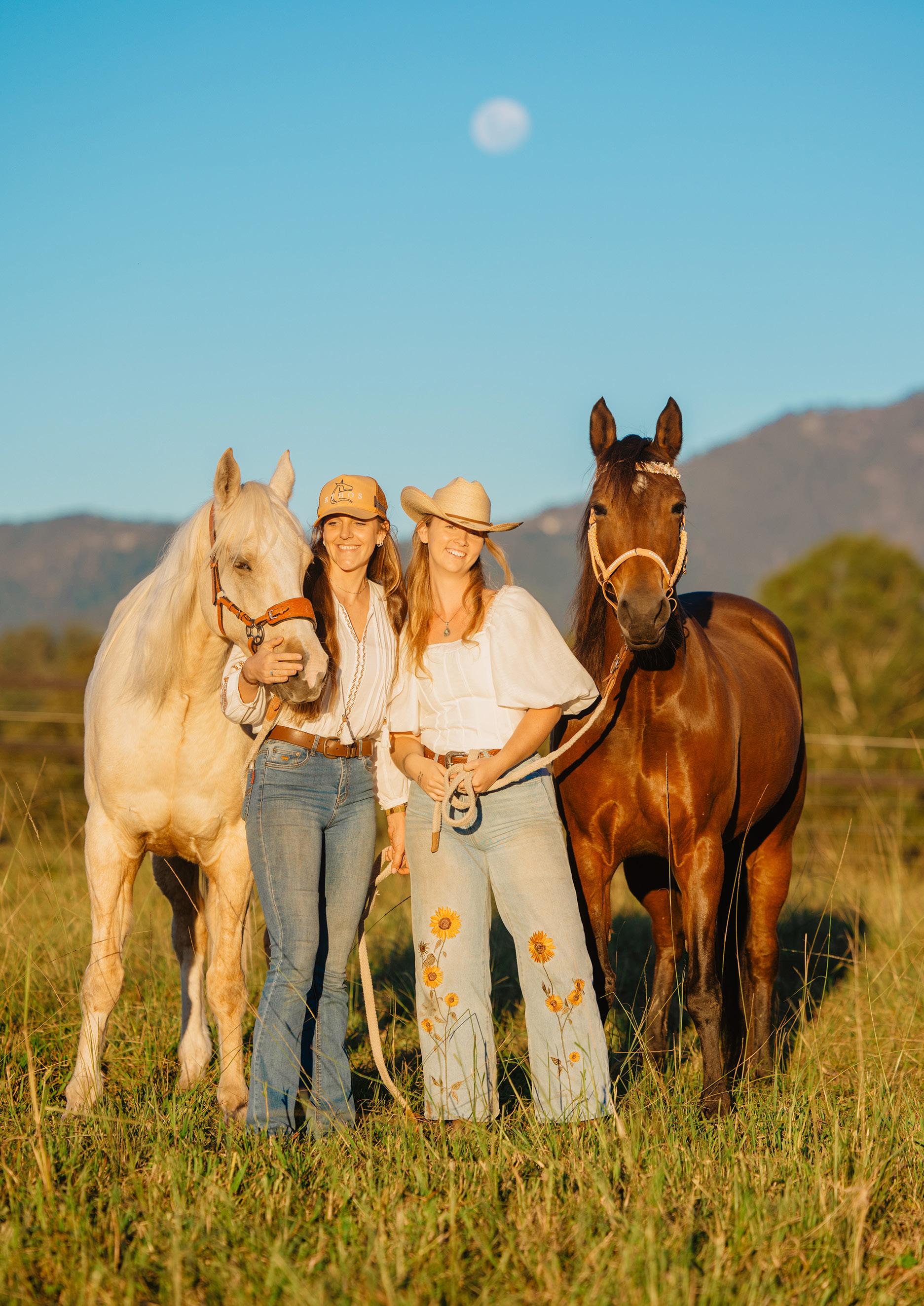
LEFT: L-R Palomino Oakley, Rachel Vercoe of My Horse Willow, a retreat guest, and Rachel's bay mare Willow.
horses and new friends.
Of course, no horse retreat would be complete without the horses themselves.
Rachel’s much-loved Willow and Oakley, along with Hannah’s horses Stormboy and Paddy, all became stars of the weekend, happily posing for photographs, appearing in video content and offering plenty of memorable moments in between. Whether participants were capturing action shots, practising storytelling or simply spending quiet time around the horses, they provided the perfect reminder of why everyone had gathered in the first place.
The retreat balanced education with relaxation, allowing guests to enjoy the beautiful accommodation, delicious meals and peaceful surroundings of Elysium Estate while taking part in practical content sessions designed specifically for equestrian creators. Every detail was carefully considered to create a weekend that felt inspiring, nurturing and effortless.
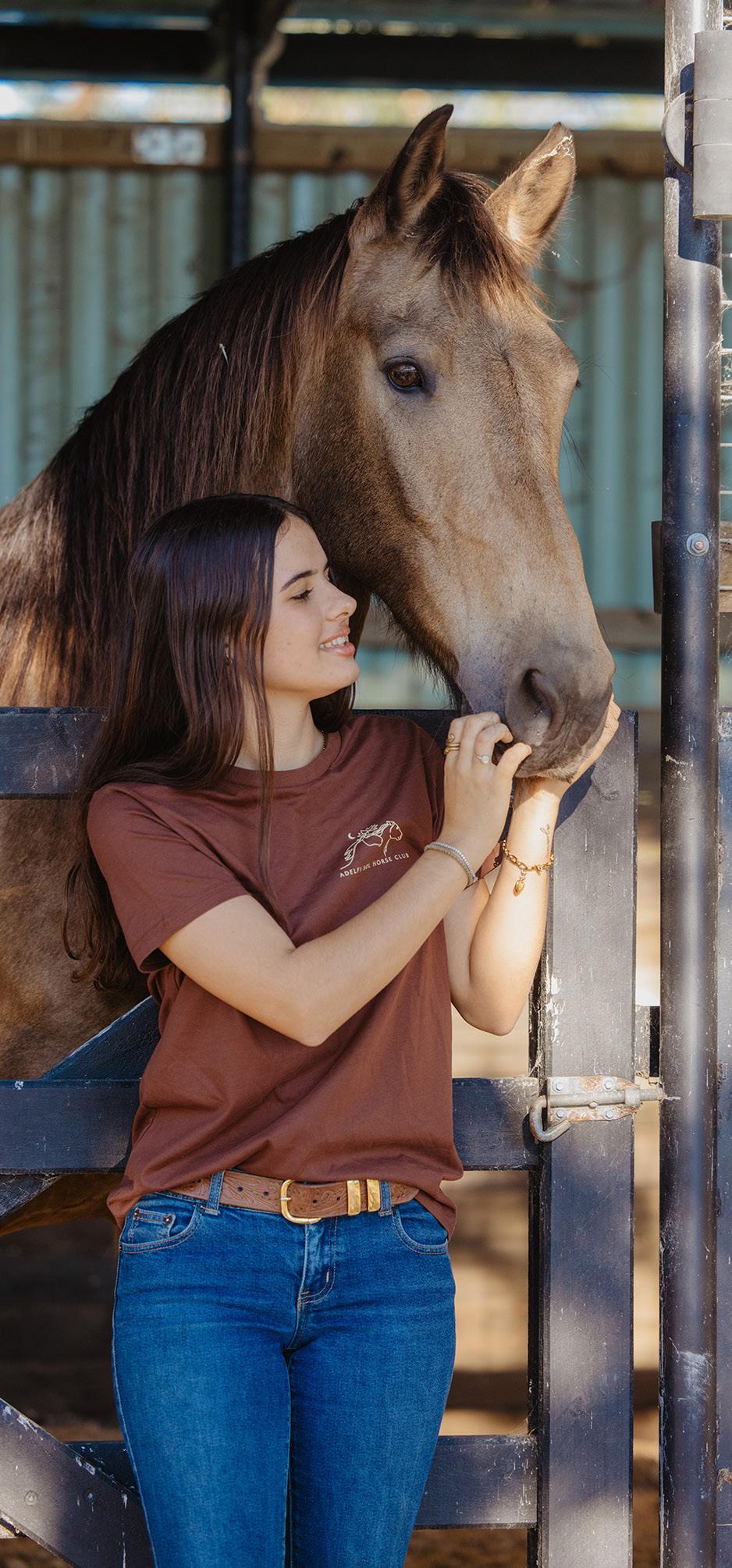
Guests were also welcomed with thoughtfully curated gift bags featuring products from Australian equestrian and lifestyle businesses including Equidae, Equico, Amber & Eden Tallow, and Adelfi Sol Horse Club. Their generous support added another layer of care to the experience while introducing attendees to brands that share a genuine passion for the equestrian community.
Throughout the weekend, what stood out most wasn’t the number of photos captured or reels created - it was the friendships that formed between women who had all arrived alone, many feeling a little nervous about the weekend ahead. By the time everyone packed their bags to head home, those same women were laughing together, sharing stories and saying goodbye like friends
LEFT: Ashleigh Reynolds of Adelfi Sol Horse Club with Hannah's horse Stormboy.
who had happily shared a bunk room for years.
When asked, “What was your favourite part of the retreat?” one guest replied: “Actually, the connection and the encouraging vibe we had going on. There was no judgement and no competition. Just a safe, nurturing space.”
Another attendee shared: “Attending this retreat was such a beautiful experience. Every detail was thoughtfully considered, from the stunning venue and incredible food to the warm and welcoming atmosphere created by Hannah and Rachel. I left feeling clearer, more confident and deeply inspired, with genuine connections and actionable ideas that I can take forward. It was the perfect balance of learning, connection,
creativity and relaxation.”
These reflections perfectly captured what both Hannah and Rachel had hoped the retreat would become.
The Content Retreat proved that learning doesn’t need to happen inside a classroom, and confidence doesn’t always come from standing alone. Sometimes it grows through encouragement, shared experiences and spending time surrounded by people who simply understand your love of horses.
More than a content workshop, the retreat became a place where horse lovers could relax, unwind, learn something new and leave feeling inspired - not only creatively, but personally. It was a reminder that while social media can connect people online,
there is something incredibly powerful about bringing a community together in person.
As the final goodbyes were exchanged and horses were loaded onto floats, guests left with full camera rolls, new skills, lasting friendships and memories that extended far beyond social media.
For Hannah Darcy and Rachel Vercoe, that was always the true measure of success.
The weekend demonstrated the remarkable way horses continue to bring people together, creating communities built on encouragement, authenticity and shared passion.
To find out when the next Trendy Pony retreat or horse lover event is happening, visit Trendy Pony, or follow them on Instagram.
ABOVE: Hannah (far left) and her guests. More than a content workshop, the retreat became a place where horse lovers could relax, unwind, learn something new.
Fit Check
Professional saddle fitter RACHEAL SPRING explains why regular saddle fit assessments are essential for your horse's comfort, performance and long-term soundness.
Saddle fitting is one of the most important aspects of horse welfare and performance, yet it is often overlooked. A well-fitted saddle allows the horse to develop correct muscle, move freely and perform comfortably, while also helping the rider maintain a balanced and effective position.
Whether a horse is used for dressage, showing, jumping, eventing, Pony Club, pleasure riding or simply enjoying time out on the trail, ensuring the saddle fits correctly should always be a priority.
Unlike a piece of equipment that can be purchased and forgotten, saddle fit
is constantly changing. Horses gain and lose weight, develop muscle through training, change shape with age and can even alter their topline seasonally.
A saddle that fitted perfectly six months ago may no longer be suitable today, which is why regular saddle fitting assessments are essential.
One of the primary reasons saddle fitting is so important is horse comfort. An ill-fitting saddle can create pressure points that cause pain and discomfort. Excessive pressure over the withers, shoulders or back muscles can lead to soreness, muscle damage and behavioural issues. Horses are unable
to verbally communicate discomfort, so they often show subtle signs that can easily be mistaken for training problems or poor behaviour.
Common signs of saddle discomfort include reluctance to move forward, tail swishing, ear pinning, resistance during saddling, hollowing through the back, bucking, rearing, difficulty maintaining contact, or unwillingness to stand still when mounting. Some horses become girthy, while others may simply lose their enthusiasm for work.
In many cases, riders spend considerable time and money investigating lameness or behavioural concerns when the
ABOVE: One of the primary reasons saddle fitting is so important is horse comfort. An ill-fitting saddle can create pressure points that cause pain and discomfort.
saddle may be a significant contributing factor.
A correctly fitted saddle allows the horse to move naturally. The horse’s shoulder must be able to rotate freely underneath the saddle without restriction. If the saddle is too narrow or positioned incorrectly, it can interfere with shoulder movement, shortening the horse’s stride and reducing overall performance. Similarly, a saddle that bridges, rocks or sits unevenly can create pressure that affects the horse’s ability to lift through the back and engage the hindquarters effectively.
For performance horses, saddle fit can directly impact results. In dressage, freedom through the back and shoulders is essential for developing collection, impulsion and self-carriage. In jumping disciplines, the horse needs unrestricted movement to jump and land comfortably. Show horses must move with expression and freedom, while pleasure horses deserve the same level of comfort regardless of their competitive ambitions. A horse cannot perform at its best if it is working in discomfort.
The rider’s position is equally important. A poorly fitted saddle can place the rider behind the movement, tip them forward or create instability. Riders often compensate without realising it, developing crookedness or tension that affects their effectiveness. Even highly skilled riders can struggle to maintain correct alignment if the saddle does not support them properly.
A saddle fitting assessment looks at much more than simply placing a saddle on the horse’s back. The fitter will evaluate the horse’s conformation, muscle development, symmetry and movement. Static assessments are important, but observing the saddle in motion is essential. A saddle may appear suitable when the horse is standing still, yet move excessively, slip, bridge or create pressure when ridden.
Modern saddle fitting also considers the horse-rider partnership. A saddle must fit both the horse and the rider. The ideal saddle supports the rider in maintaining balance without restricting movement, while simultaneously distributing pressure evenly across the horse’s back.
Regular saddle fitting can also prevent long-term problems. Chronic pressure and poor saddle fit can lead to muscle atrophy, white hairs, back pain, compensatory movement patterns and reduced performance. Addressing issues early can help avoid more significant concerns and support the horse’s longterm soundness.
Regular saddle fitting assessments should be regarded as an essential component of every horse’s management program. By ensuring the saddle continues to fit correctly as the horse’s shape, condition and workload change, owners can promote comfort, performance and long-term soundness.
Investing in routine saddle evaluations not only helps prevent avoidable problems, but also supports a more harmonious and positive partnership between horse and rider for many years to come.
You can find Racheal at Springs Equestrian on both Facebook and Instagram.
A Vision Splendid
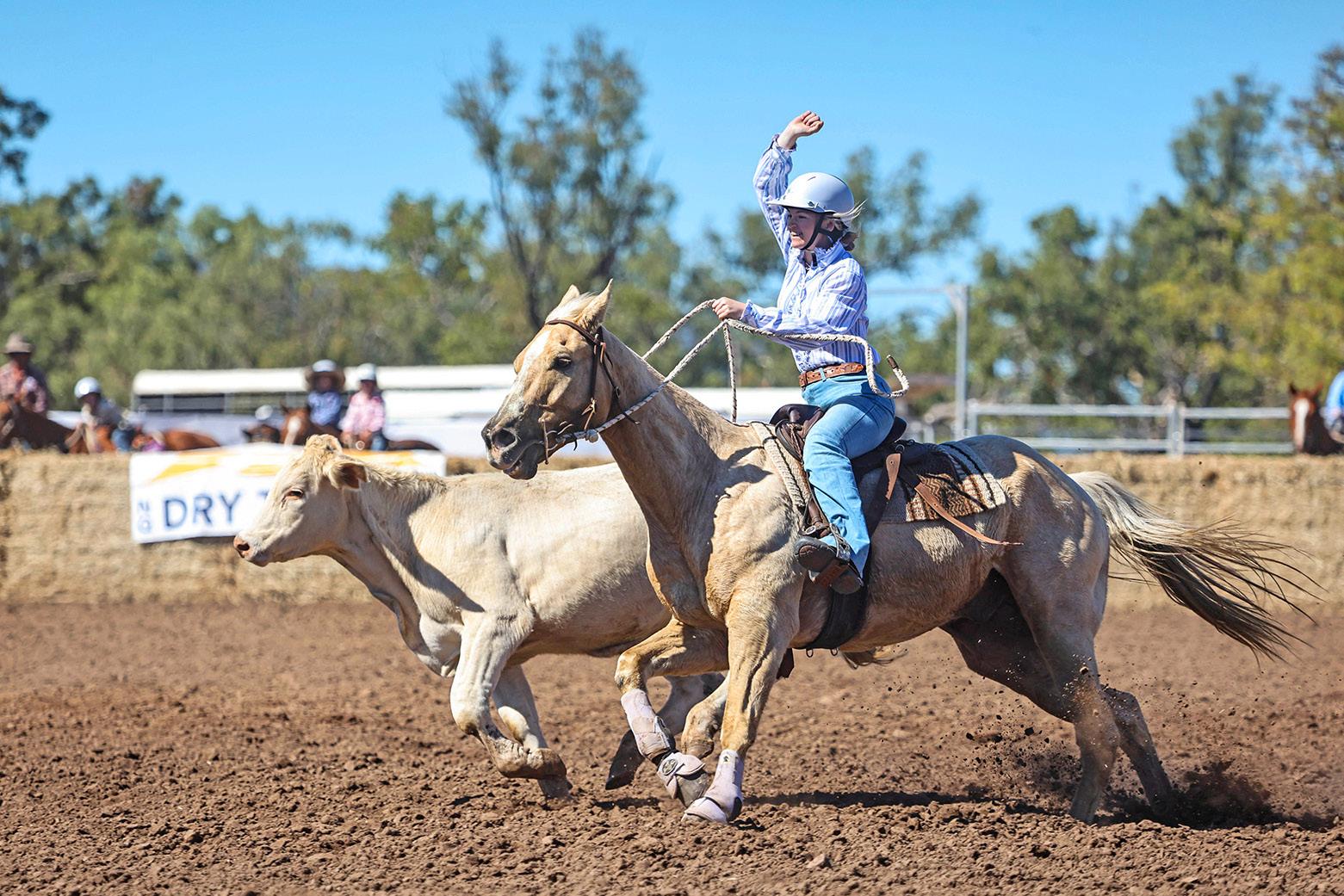
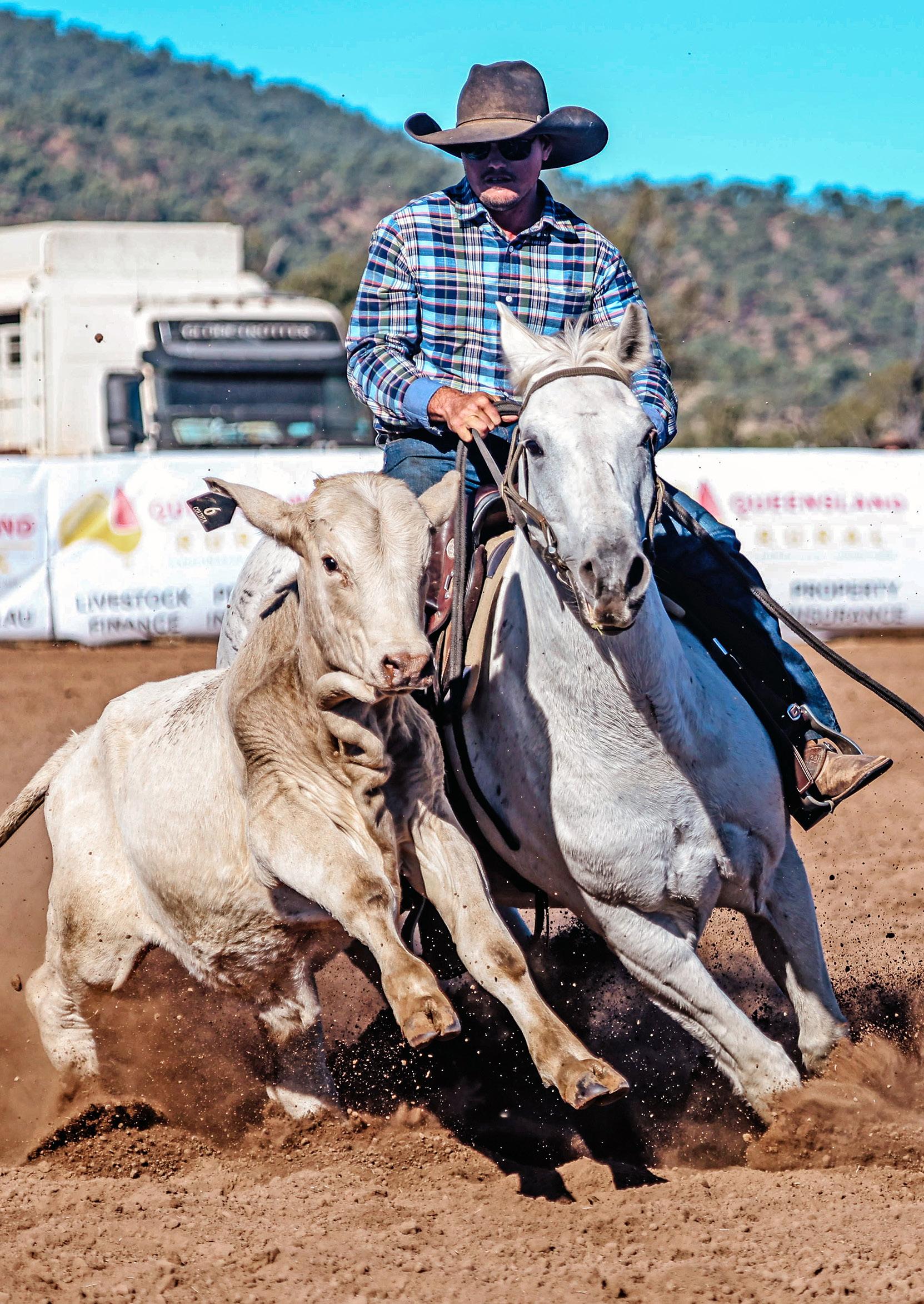
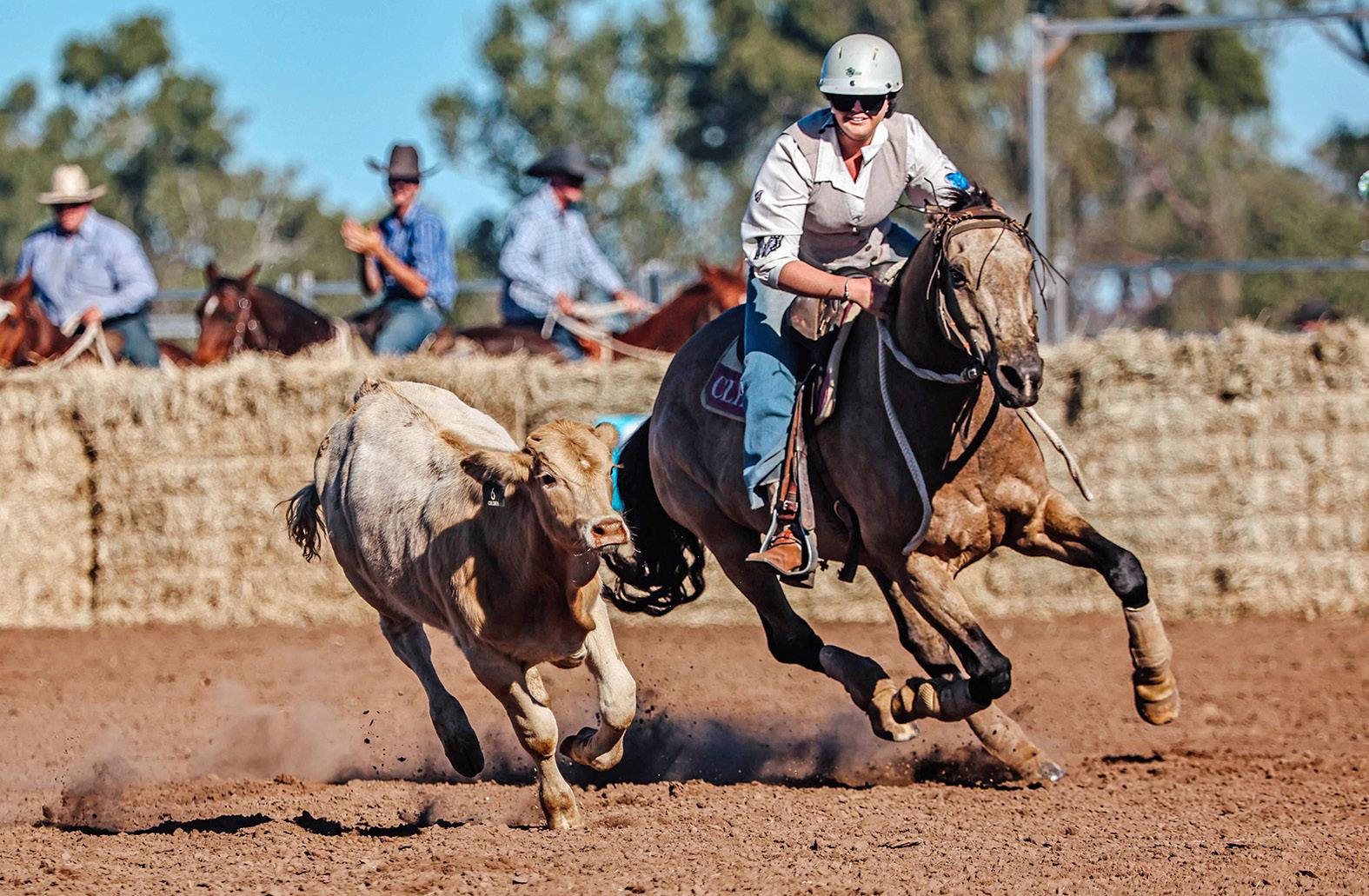
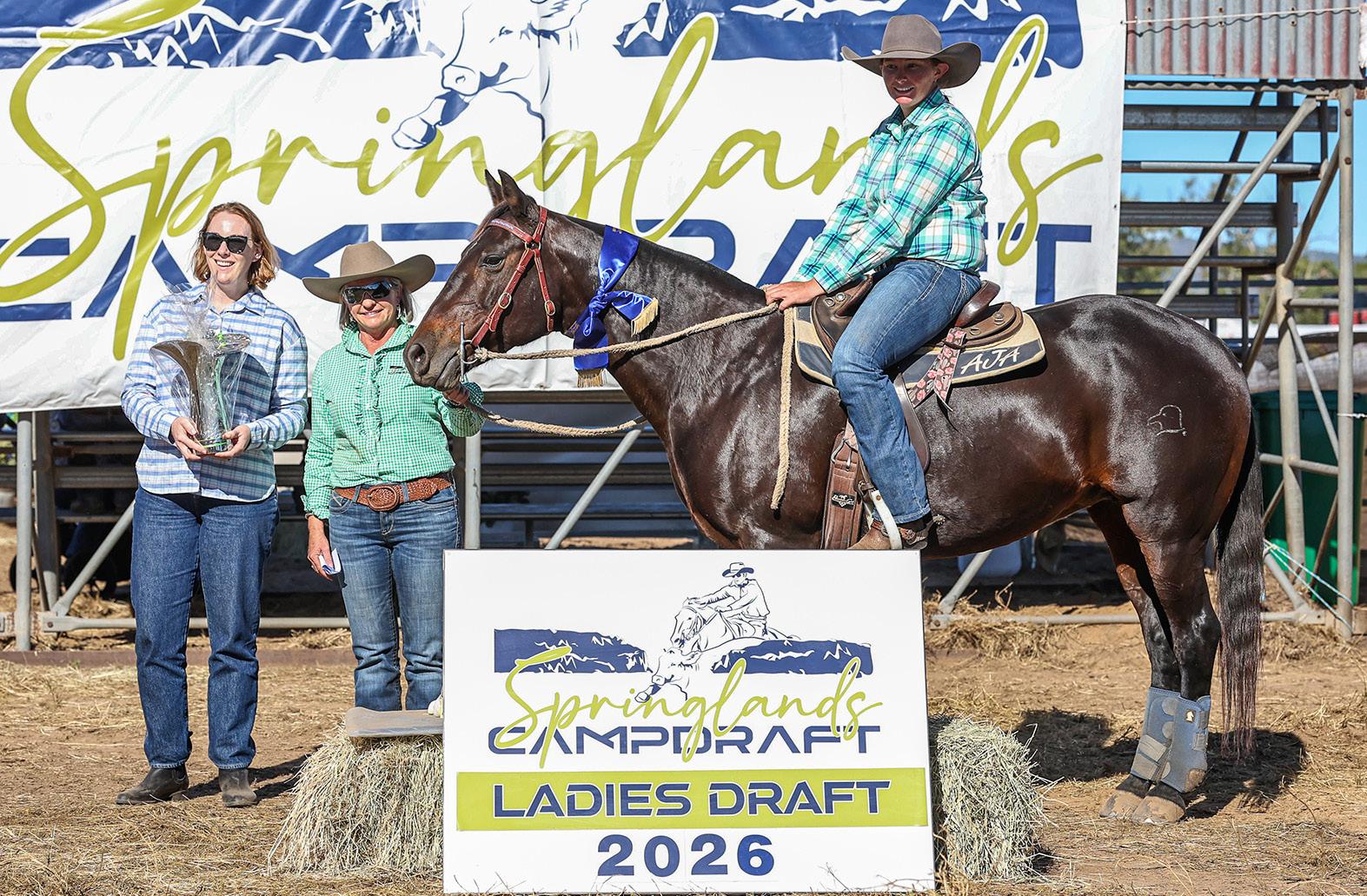
The Springlands Campdraft attracted approximately 150 competitors, an estimated 400 visitors, and around 1,300 head of cattle - it was time to get the event back on the map. Our photo coverage is by JODIE HUMBLE PHOTOGRAPHY.
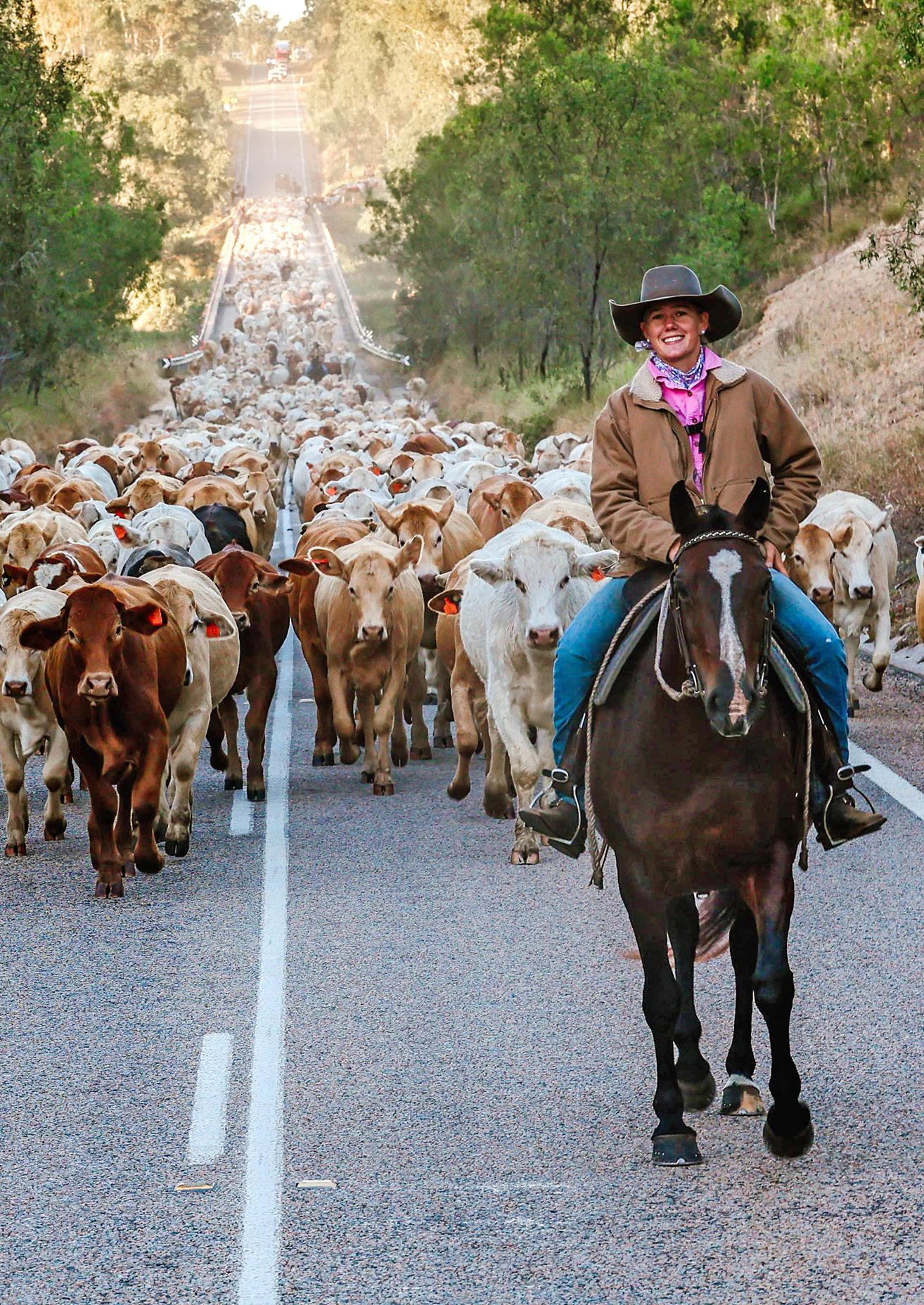
Before the first competitor entered the arena at the 2026 Springlands Campdraft, approximately 1,300 head of cattle made the 26 kilometre journey from Havilah Station to the grounds near Collinsville, a small rural town located around an hour west of Bowen in Queensland's Whitsunday region.
Walked in by the team from Colinta Holdings, accompanied by stock handlers, support vehicles and local volunteers, the remarkable procession stretched along the Bowen Developmental Road.
Held from 22–24 May, the Springlands Campdraft attracted approximately 150 competitors and an estimated 400 visitors over the weekend. Across three days of competition, 815 first-round runs were completed, marking a successful return for an event that has quickly become much more than a campdraft.
For organisers, the campdraft represented another important step towards establishing a permanent home for the event and creating something that will serve competitors, families and the wider Collinsville community for years to come.
Just eight weeks earlier, the venue was little more than a bare paddock. Volunteers, local businesses, sponsors and community members came together to build yards, prepare camping areas, install a kitchen and bar, arrange cattle, prepare the arena and complete countless jobs in the lead-up.
One of the committee's biggest achievements was the completion of a new shower and toilet block in time for the event. Supported through funding from The Gambling Community Fund, the facility represents one of the first major infrastructure projects completed at the grounds and an important investment in the long-term development of the venue.
A major contributor to the campdraft’s success was the generosity of cattle
"Across three days of competition, 815 first-round runs were completed, marking a successful return for an event that has quickly become much more than a campdraft."
donor Colinta Holdings and the Havilah team. Beyond becoming one of the defining images of the event, the decision to walk the cattle rather than truck them in is estimated to have saved tens of thousands of dollars in transport costs, demonstrating the extraordinary level of assistance and generosity from people supporting the event.
Competition commenced on Friday morning with the Open Draft before continuing over the next few days. Competitors enjoyed good cattle, quality competition and a welcoming atmosphere, while spectators embraced
the opportunity to reconnect at one of the first campdrafts of the season.
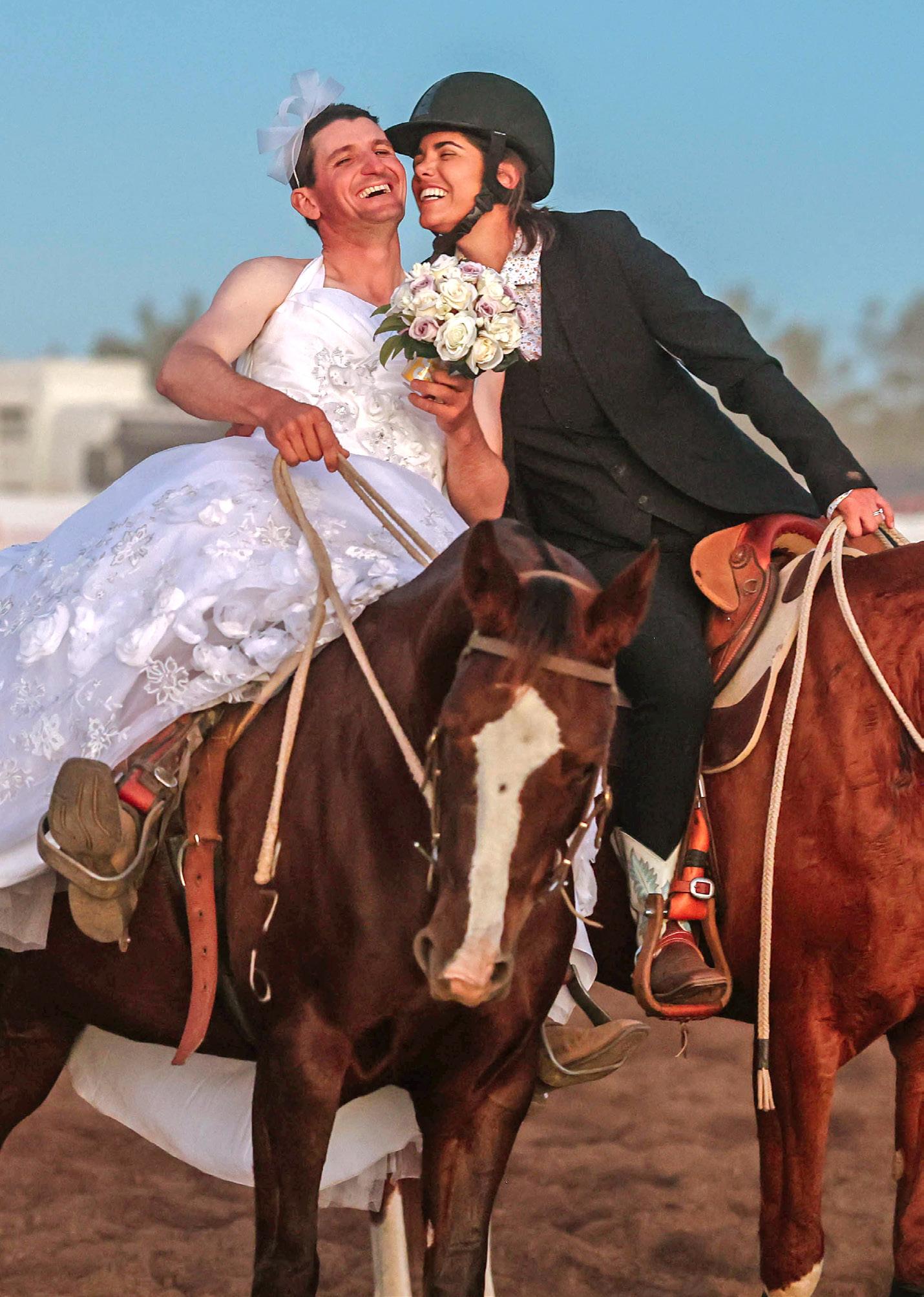
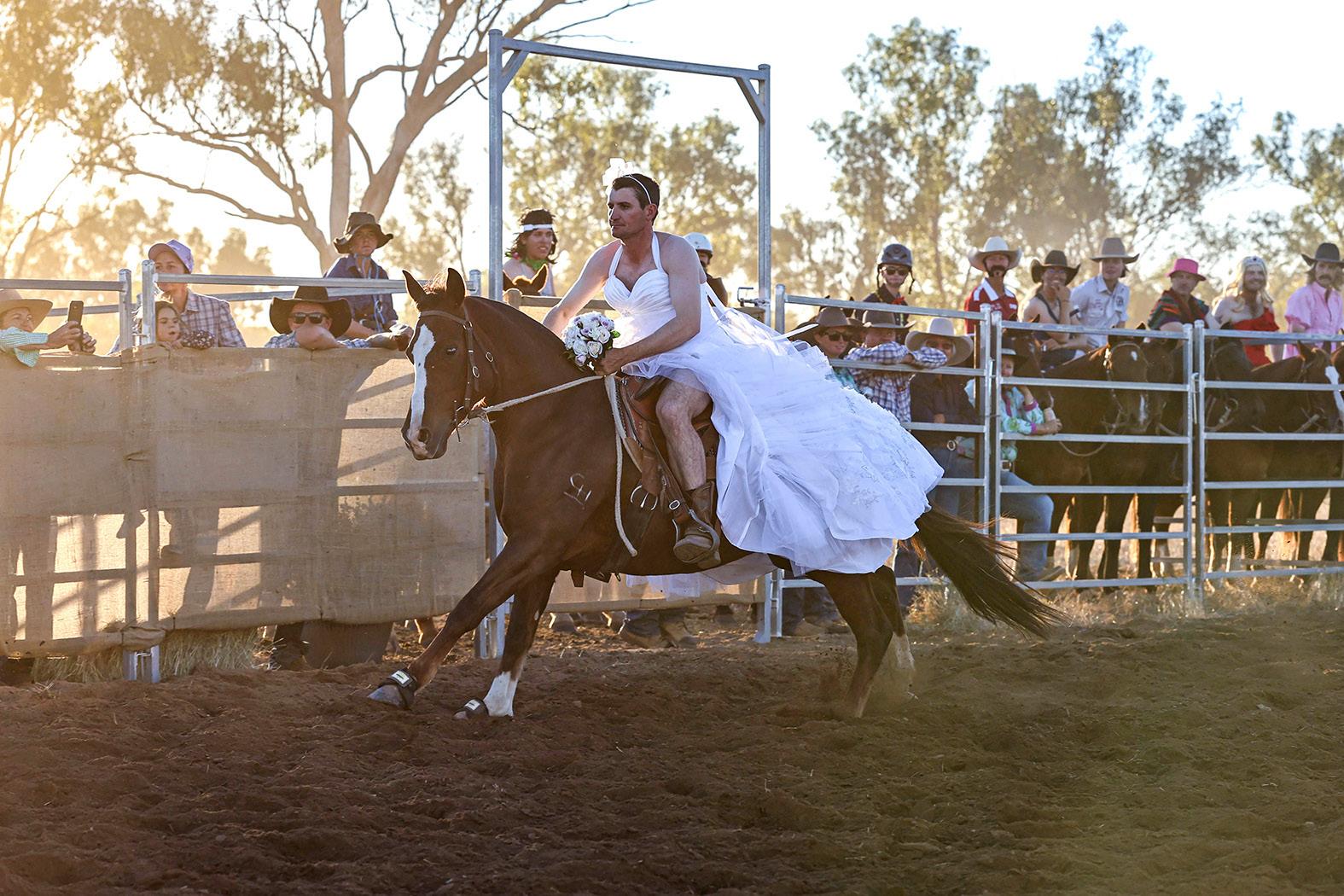
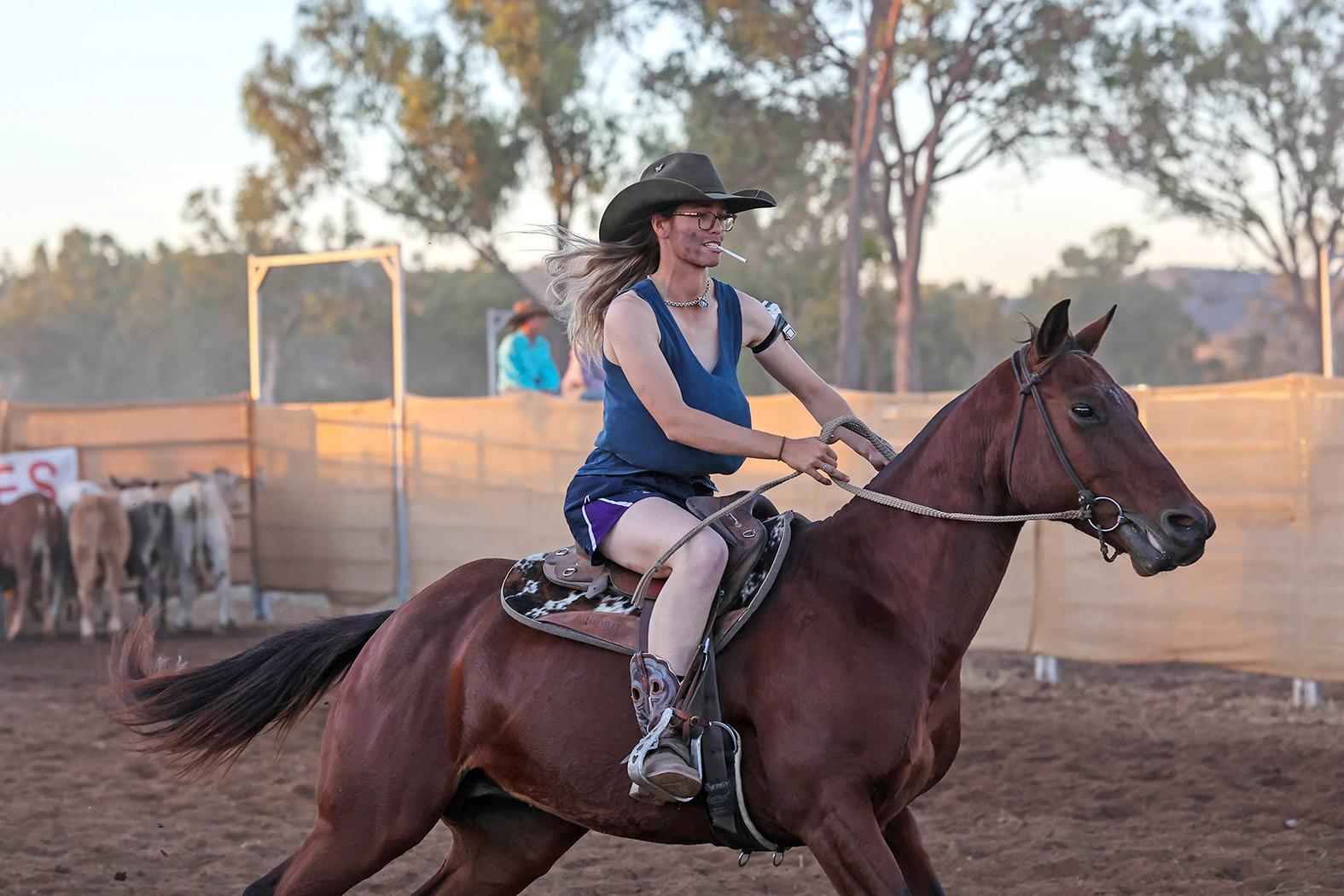
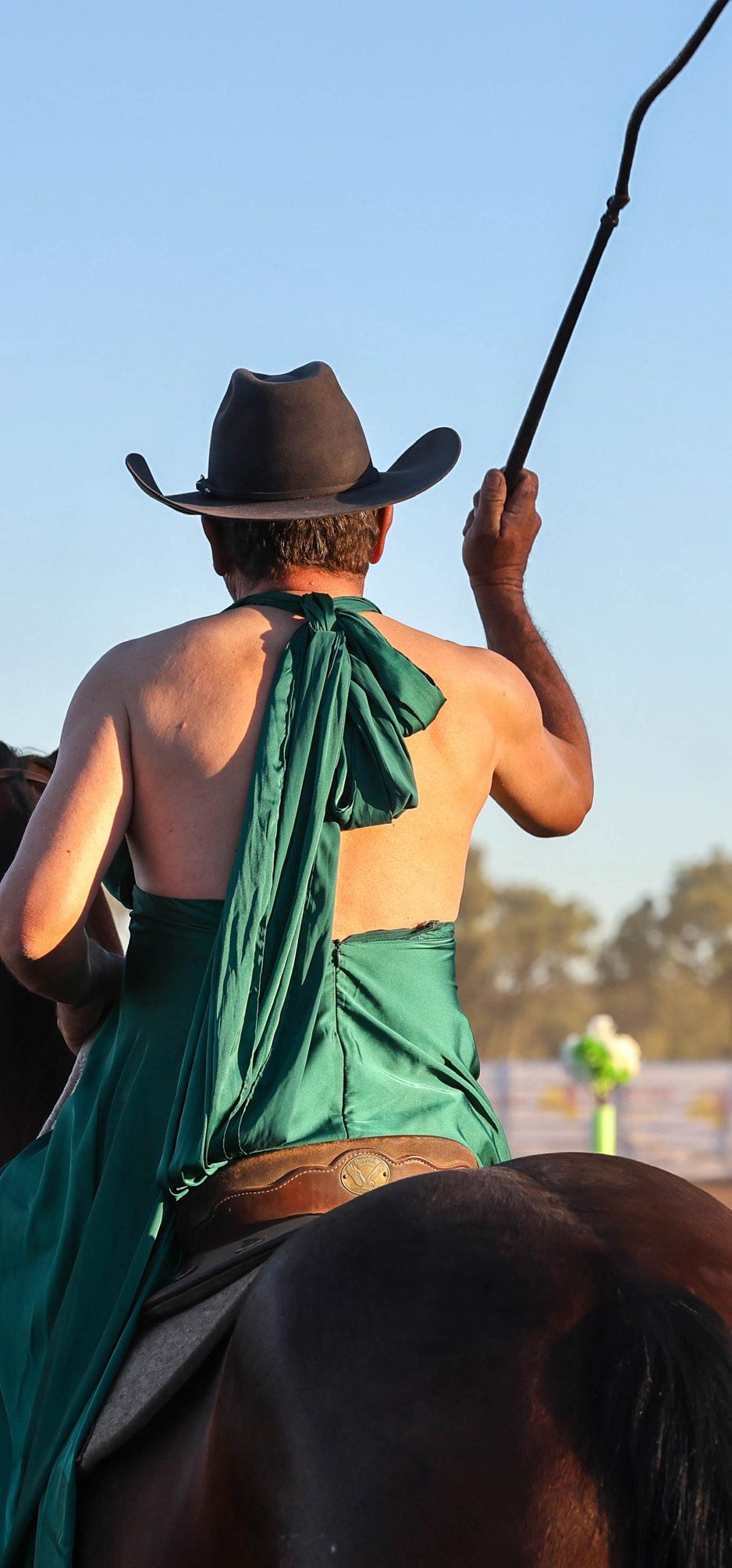
One feature on the program in particular captured the spirit of the campdraft. The Nat Lee Memorial Committee 'Gender Bender' Draft delivered plenty of laughs, colourful costumes and enthusiastic participation.
There was no shortage of outrageous and creative costumes as riders embraced the theme, donning wedding dresses, evening gowns, character costumes and a whole dress-up box of imaginative outfits while spectators packed the fence line to cheer them on.
Social media quickly filled with comments praising the fun-filled afternoon, with many noting that the laughter, friendship and community spirit on display reflected exactly what Nat would have wanted.
While organisers were thrilled with the success of the 2026 event, much of their attention is already focused on planning for next year. The committee recently secured a five-year lease over the property, with an option for a further five years, providing certainty to continue investing in the venue and improving facilities.
A key priority is creating more opportunities for younger competitors. Committee members recognised that
ABOVE: Approximately 1,300 head of Havilah cattle made the 26 kilometre journey from Havilah Station to the campdraft grounds near Collinsville.
& BELOW: Entrants
ABOVE
in the The Nat Lee Memorial Committee 'Gender Bender' Draft delivered plenty of laughs, colourful costumes and enthusiastic participation. LEFT: Best Dressed Team winners Hannah and Corbin Deboni.
many junior and juvenile riders travel significant distances to attend drafts, often for a single run.
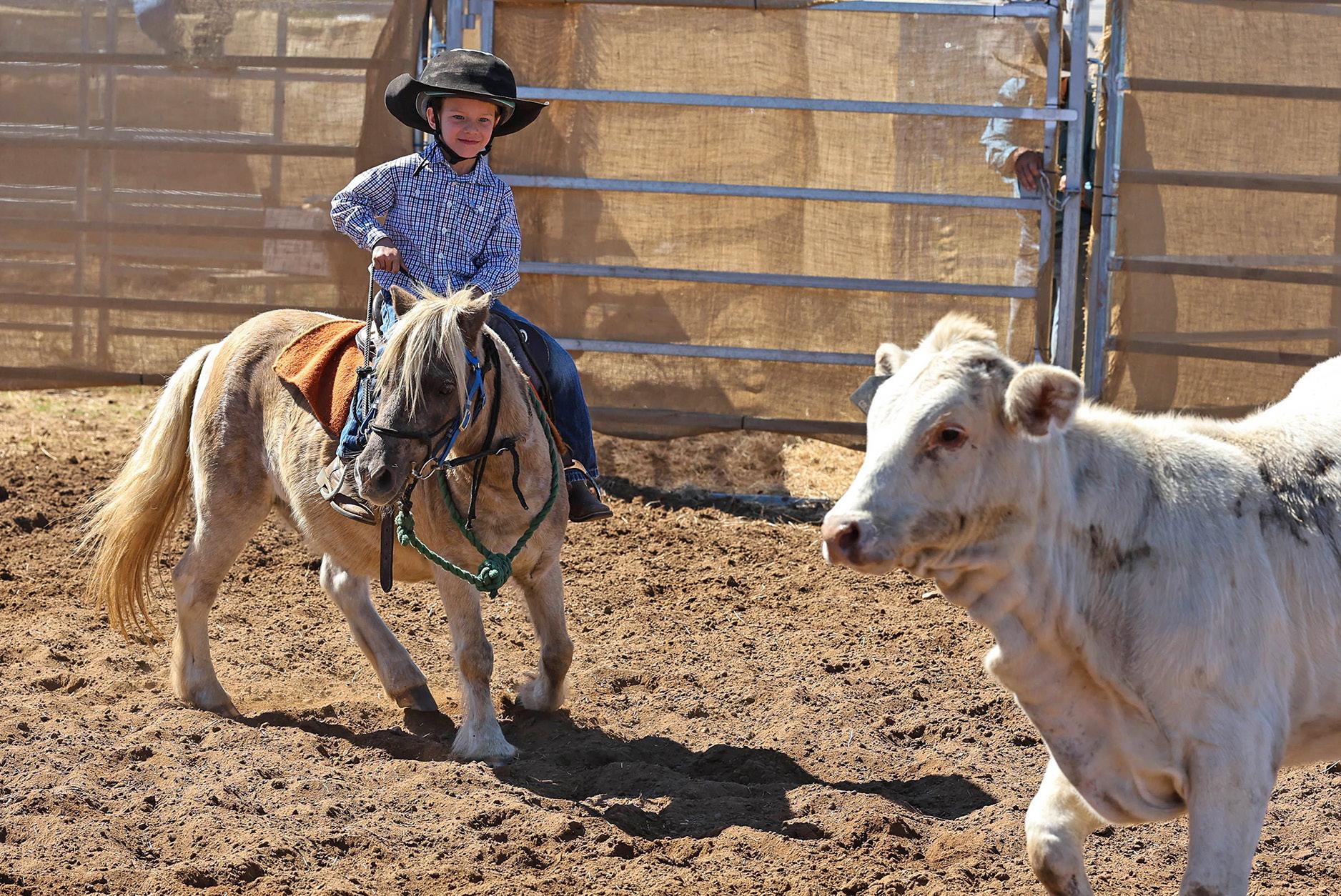
Plans are now underway to create a dedicated junior area where young riders can participate in additional activities such as barrel racing, bending races and other sporting novelties. The initiative aims to ensure younger riders get more from the event while encouraging greater participation in the sport.
It is a practical investment in the future of campdrafting, but it also reflects the broader vision behind Springlands. The goal is not simply to host a successful annual event. It is to create a facility that will continue to grow and evolve while strengthening connections within the local community. The success of the weekend was reflected not only in competitor numbers and strong community attendance, but also in the overwhelming response that followed. Social media was flooded with messages of congratulations, gratitude and encouragement from competitors, volunteers, sponsors and spectators alike.
Many praised the quality of the cattle, the welcoming atmosphere and the enormous effort of the volunteers who transformed a paddock into a fully functioning campdraft venue in just eight weeks.
By Monday morning, the cattle had begun their journey home and the temporary infrastructure was gradually being packed away. The grounds were returning to what they had been only weeks earlier - a paddock.
But the vision remains. "Springlands is back, and it will continue."
You'll find Springlands Campdraft on Facebook and Instagram
ABOVE: Mini competitor Tilly Holmes learning the ropes. BELOW: Juvenile Competitor Holly Mahar in her 1st Campdraft full course. LEFT: This backless gown was an 'Gender Bender' eye-catcher.
ABOVE: Clare Humble and Double Prime in full flight. BELOW: Leisha Allen and A Little Pearl took out the Ladies Campdraft title. LEFT: Novice Campdraft winner Tim Borg and Rooster.
Understanding Equine Asthma
If your horse coughs during exercise, gets unusually puffed, or takes longer to recover, they may have a form of equine asthma, writes DR CAROLINE SPELTA.
Does your horse cough during exercise, get puffed quickly despite being fit, or take longer than others to recover? If so, they may have a form of equine asthma.
What is Equine Asthma?
Equine asthma is the current term for airway conditions previously known as Inflammatory Airway Disease (IAD) and Recurrent Airway Obstruction. Recurrent Airway Obstruction is the more severe
form and is usually seen in older horses with a history of stabling. These horses may have permanent airway changes and can struggle with athletic work.
IAD is more common in younger horses and is usually reversible. Affected horses often appear normal at rest but may cough, show reduced exercise tolerance, have a mucoid nasal discharge, or recover slowly after exercise. IAD rarely progresses
to severe equine asthma and is not usually associated with bacterial or viral infection.
Other Causes
There are other causes of nasal discharge and poor performance, including:
Respiratory viruses
Mucoid nasal discharge can also be caused by respiratory viruses such as EHV-1, EHV-4, rhinovirus and equine adenovirus. These are commonly seen when young horses enter a new training stable and are exposed to unfamiliar allergens and infectious agents.
Like children starting daycare or school, young horses may be more prone to mild illness while their immune system adapts. Signs can include mild fever, white nasal discharge and reduced performance for a couple of weeks. Most cases are self-limiting and only require supportive care, including good nutrition, a low-dust environment, wetted feed and a reduced workload.
Lymphoid hyperplasia
Lymphoid hyperplasia is similar to
VET VIBES
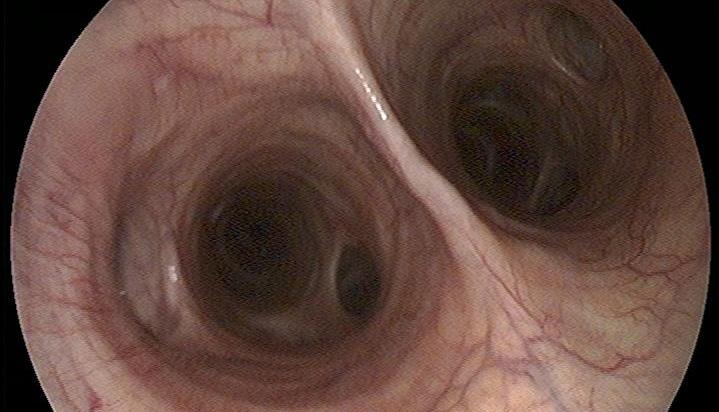
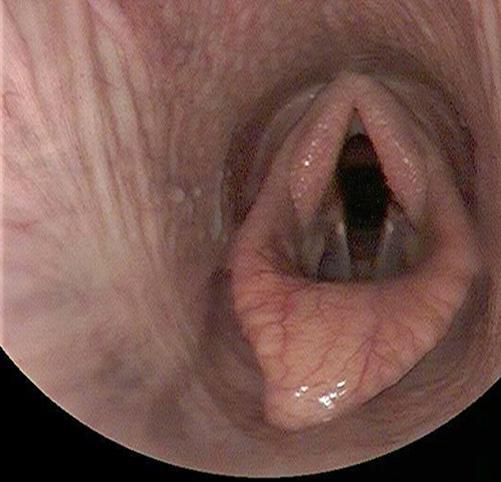
ABOVE: An endoscopy allows the veterinarian to assess the larynx, trachea and large bronchi. This image is of a normal, healthy bronchial septum.
tonsillitis in people and can occur when horses enter new stables or training routines. It is part of normal immune system development, particularly in twoand three-year-old horses, which often have more throat tissue reaction and mucus than older horses.
This reaction usually decreases with age. In horses under four years old, even higher grades are not usually linked to poor performance. In horses over four, higher grades may contribute to poor performance and may require treatment.
Diagnosis
Diagnosis of lymphoid hyperplasia and equine asthma requires a veterinarian to examine the upper and lower airways, with endoscopy and lower airway sampling for cytology. Endoscopy allows the veterinarian to assess the larynx, trachea and large bronchi for structural changes, laryngeal function, lymphoid hyperplasia, and the amount and location of mucus.
If the history and endoscopy findings suggest IAD as a cause of poor performance, a bronchoalveolar lavage
may be performed. This involves instilling 250–500 ml of fluid deep into the lungs to flush cells from the alveolar sacs for analysis. Some horses cough during the procedure, especially if they have reactive airways. Although the volume can look substantial, it samples only a small part of the lungs.
Additional testing may include sampling tracheal mucus or performing guttural pouch lavage. Fluid may be submitted for cytology, culture and sensitivity to help rule in or rule out concurrent bacterial infection.
More advanced tests, such as provocation testing, bronchial biopsies and lung biopsies, are generally reserved for horses with signs of severe equine asthma or other chronic respiratory diseases.
Treatment
Treatment can be considered once mild to moderate equine asthma, IAD or lymphoid hyperplasia has been diagnosed. Lymphoid hyperplasia usually does not require treatment in young horses. However, if a horse
is over four years old and still has significant lymphoid hyperplasia, an anti-inflammatory cough syrup or throat spray may be recommended. If the horse also has IAD, the recommended asthma treatments will generally help address the lymphoid hyperplasia as well.
Treatment for IAD depends on the cytology results and the type of inflammatory cells present. Your veterinarian may recommend a corticosteroid to reduce inflammation or a mast cell stabiliser to help control allergic airway responses, usually alongside a bronchodilator.
These medications may be given systemically as an oral liquid or powder, or delivered directly to the lungs by nebuliser or metered-dose inhaler using a dedicated equine mask and spacer. When inhaled medications are used, the bronchodilator should always be given first to open the airways and help the corticosteroid reach the lower lungs. Drug withholding times must be considered for competition horses,
VET
Apiam’s equine veterinary credentials are well-founded with a growing number of purpose-built dedicated Equine Vet Clinics and Referral Hospitals located in Victoria, New South Wales and Queensland, working alongside our network of mixed practice clinics in delivering quality equine veterinary care.
Scenic Rim Veterinary Service
Beaudesert QLD
Agnes Banks Equine Clinic
Agnes Banks NSW
Hunter Equine Centre
Scone NSW
Victorian Equine Group
Bendigo VIC
Gippsland Equine Hospital
Maffra VIC
Southwest Equine Veterinary Group
Warrnambool VIC
Find out more by visiting the Apiam Animal Health website & view the equine product range on Country Vet Animal Supplies
regardless of whether medication is given systemically or locally.
Management
Environmental management is the most important part of an equine asthma treatment plan. Bronchodilators and corticosteroids can reduce inflammation and improve airway function, but they treat the clinical signs rather than the underlying cause. The main triggers are often dust, mould and other allergens in the horse’s home or working environment.
Housing
• Provide a low-dust environment in stables and paddocks where possible.
• In stables, keep affected horses in well-ventilated areas, preferably with access to fresh air.
• Avoid areas with heavy foot traffic or proximity to the feed room.
• Feed on or close to the ground to encourage tracheal mucus clearance and reduce dust exposure around the horse’s head
For paddocked horses, aim for wellgrassed, low-dust paddocks. If signs worsen when grass goes to seed, consider slashing paddocks at that stage to reduce allergen exposure
Feeding
• Reduce feed dust by offering concentrates as a damp mash.
• Wet, soak or steam hay to lower dust content.
• Avoid hay nets or hay bags at head height, as they increase dust exposure around the horse’s nose.
• Avoid feeding from round bales, as horses can inhale high levels of respiratory allergens when they push their head into the bale.
Competition and Travel
Travelling and competing can make dust and allergen control difficult. Showgrounds, arenas, floats, goosenecks and trucks may expose horses with IAD to higher levels of respiratory irritants, making them more likely to become reactive or show performance issues.
• Work with your veterinarian to develop a therapeutic maintenance plan before travelling.
• Confirm whether any treatment is permitted under the relevant competition drug rules.
• Avoid hanging hay bags in transport for horses with IAD, as feeding at head height concentrates allergens around the head.
• If stabling at an event, wet the stable floor before adding low-dust bedding such as high-quality wood shavings or shredded cardboard.
• Maintain the horse’s usual feeding routine and continue wetting feeds.
• If using taped yards, choose an area with grass cover and access to water so the yard can be dampened during the day.
• Discuss travel management with your veterinarian and apply as many dust- and allergen-reduction strategies as possible.
In Summary
Inflammatory Airway Disease, or mild equine asthma, is a common cause of
coughing, nasal discharge and poor performance in competition horses across many disciplines in Australia. Although management and treatment can be intensive, many horses return to their previous level of performance with appropriate veterinary care and environmental control.
Young horses may show signs when adapting to new training environments, allergens or infectious agents.
Diagnosis requires veterinary examination, endoscopy and lower airway sampling. Treatment depends on the diagnosis and cytology results, and may include anti-inflammatory medication and bronchodilators
Long-term success relies heavily on reducing dust, mould and allergens in stables, paddocks, feed and transport.
Many horses show signs only while in work and may remain symptom-free during spelling or in later seasons.
Visit Apiam Animal Health to learn more about their extensive range of services.
ABOVE: This endoscopy was carried out on a horse with lymphoid hyperplasia. VET
CHAT WITH A CHAMPION
LYNDA MacCALLUM | TRUST YOUR TRAINING
Against the Odds The Power of the Positive
EH: Congratulations on your Reserve Champion result at the NCHA Futurity with Hillbilly Hippie. What did that achievement mean to you personally, and where does it sit among the highlights of your career?
LM: I always knew this mare was good. We believed in her and felt she was something special from the very beginning. Through all the pre-works leading up to the Futurity, she just kept putting her hand up.
We feel very blessed to have had the results we did. It was a special moment for our whole family and crew.
To be able to execute the way we did, finish as the highest aggregate going into the final and then come away Reserve Champion was a great feeling. We've bred and trained this mare ourselves. We always knew she was special, and honestly it was almost a relief to be able to show everyone what she can do. I'm very proud of her.
To be Reserve Champion by a single point means there was hardly anything in it. After having success with Metallic Storm years ago and then finding myself back in that arena again, it almost validated that I do belong there. You always wonder, "Can I do it again? Was it a fluke?" This result reminded me that we are on the right track with our breeding program and what we're doing.
EH: When you're in that atmosphere, can you hear the crowd or are you completely focused on the job?
LM: I try to drown everything out. I used to hear the songs and all that, but I don't really hear it anymore. What I do feel is the emotion of the crowd and the energy in the room.
During that last cow, I actually felt like I was going to burst into tears. I was thinking, "This has been fantastic." Of course, afterwards you watch the run over and over and think about what you could have done differently, but at the end of the day it was a wonderful result.
EH: For readers who may not know your story, can you tell us a little about your journey with horses and how it all began?
LM: I grew up in the Upper Hunter Valley where my father managed a sheep and cattle property in the foothills of the Great Dividing Range. Dad introduced me to horses at a young age. They weren't fancy horses at all - just station horses - but I fell in love with them. As I got older, I did Pony Club, gymkhanas, show riding and Stock Horse classes. I really did a bit of everything.
My friend Jane Munro introduced me to cutting when we were at university. The Futurity was held in the old shed back then and was a very social occasion. One day Jane and her husband Tom let me ride One Moore Playboy and, as soon as I felt that feeling, my interest in cutting just grew.
I started by training a few horses for Snafflebit Futurity while my children were young. From there I had horses with trainers before eventually evolving into training my own.
My husband Jim has always been incredibly supportive. We've been fortunate to have the facilities, the cattle and the opportunity to make it all work.
EH: Your journey hasn't been without challenges. Can you tell us about being diagnosed with multiple
sclerosis and how that changed things?
LM: I was a teacher at the time and in 2018, just before the Futurity, I was diagnosed with multiple sclerosis. Three weeks before the event, I was admitted to John Hunter Hospital and couldn't walk. At that point I was told I would never ride again.
I was devastated.
When I came home and started rebuilding my health, my husband Jim said to me, "If you think you can ride, then you need to ride. Think about Metallic Storm - he's been sent to you for a reason." So we entered everything we could. That year was incredible. We won over $80,000 with our horses, and Metallic Storm finished second in the Open Futurity and third in the Non-Pro Futurity.
After that I needed to focus on my health. We battled through some difficult years and eventually moved from Scone to Woolbrook in 2021 because the cooler climate suited my condition much better. Around that time a friend encouraged me to share my story and start coaching. I'd been a teacher for 20 years and I love helping people learn, so I made the decision to hand in my Non-Pro card and train professionally.
That's when MacCallum Performance was born. Since then we've had some wonderful success, trained horses for clients, conducted clinics around Australia and New Zealand and built a business we truly love.
LEFT: Lynda and Hillbilly Hippie competing in the 2026 Open Futurity Final (Image by Liz Speed Photography).
The last few years, my son has come back home and decided to train professionally with me. He does a lot of the breakers, and he handled Hillbilly Hippie's two-year-old year. He did a fantastic job. He was also part of this mare's training, so this year's result was very special for all of us.
EH: Today, MacCallum Performance is very much a family operation. What does a typical day at home look like?
We're usually at the barn by 5.30 or 6.00am. We train the three-year-olds first, then the older horses, and ride the two-year-olds in the afternoon. It's a big day and often we don't leave until six or seven o'clock at night.
But we genuinely enjoy it. There are times when I look around and think how lucky we are to live this life and do it alongside our family.
EH: You've competed successfully for decades. What keeps drawing you back to cutting?
LM: I love the training and I love the horses. Cutting horses are incredibly intelligent and the level of care they receive is next level. They're elite athletes. What I love most is developing both their athletic ability and their minds. It's about fostering their ability to think and perform a task with you while your hand is down.
Some horses become outstanding cutting horses. Others may not, but they'll go on and excel somewhere else. That's what I love - the training, the care and helping each horse become the best version of itself.
Another thing I love about cutting is how humbling it is. You can come home from being Reserve Champion at a Futurity and the very next week you're starting breakers again. You're right back at the beginning.
That cycle never ends, and I really enjoy that because every horse is different. You get a chance to start again and develop a new horse's abilities, but you also realise how far
you've come with the horses that are out there competing on weekends and at the Futurity each year.
EH: Was there a mentor or defining moment that helped shape your career?
LM: There have been so many people who have been generous with their knowledge and support over the years that I'd hate to single out just one. What really drives me now is our breeding program.
We didn't come from a family with generations of cutting horse genetics behind us. Everything we've built has been developed over time. My husband is very good at recognising talent, and both my son and I spend a lot of time studying genetics.
The breeding program is probably what keeps me motivated because there is always another horse coming through.
EH: You've spoken openly about the challenges you've faced. How have those experiences shaped you as both a horsewoman and a person?
ABOVE: Peter, Lynda, Jim and Olivia MacCallum (Image by Penwood Creations).
LM: The biggest lesson I've learned is the importance of finding your tribe and trusting your program. You should never stop learning, asking questions or collaborating with others. Having the right people around you is one of the most powerful tools you can have. But you also need to trust what you're doing.
I believe strongly in being ready when opportunity arrives. That preparation comes from showing up every day. You can never put the outcome before the process. Enjoy the process. Then when the opportunity comes, you're ready to capitalise on it.
EH: Mindset has become a major part of your work. What habits have had the biggest impact on your performance and wellbeing?
LM: Mindset is a huge interest of mine. The way I approach each day and the energy I bring absolutely shapes the day I'm going to have in the arena. If I'm distracted, worried or focused on something else, I can't bring my best
self to my horses - and they know it.
Horses can feel it before you even arrive at the barn. I focus on being fit, eating well, sleeping well and looking after my overall wellbeing.
For me, clarity of thought is developed long before you enter the arena. Mindset isn't something you switch on at a competition. It's something you practise every day. I believe training our minds is just as important as training our bodies and our horses.
EH: Competition environments can be intense. How do you stay focused during major events like the Futurity?
LM: I think of my wellbeing like a fuel tank and try to arrive at an event with that tank overfilled. I focus on my nutrition, my sleep and protecting my mindset in the lead-up.
Once I'm there, I stay in my own lane. I trust my program and don't get distracted by what everyone else is doing. All I did was move between the stables, the arena and the cow-
watching box. I probably looked antisocial, but I was really protecting my focus.
Having a good crew around you is also incredibly important. Our staff and the MacCallum Performance team were vital to our success this year because I always knew the horses were being cared for. That trust allows you to stay focused on your job and perform at your best.
EH: You now coach and mentor others. What are the biggest struggles you see riders facing?
LM: Self-doubt is probably the biggest one. People often feel frustrated because life doesn't allow them to dedicate as much time to their horses as they'd like.
One mindset principle that has helped me enormously is: ‘Do what you can today that your future self will be proud of’. Those small actions accumulate. Success is built through repetition. You simply keep stacking days, stacking
ABOVE: Aboard Metallic Storm at the 2018 Futurity (Image by Lauren Clark).
work and stacking small efforts over time.
The other big challenge is nerves. I was very nervous before this year's Futurity final. But nerves aren't a bad thing - they mean you care. I often teach what I call the Three Rs: Recognise the thought; Reframe it positively; Reset and return your focus to the present moment.
I also encourage people to ask whether something is controllable or uncontrollable. If it's outside your control, there's no point giving it your energy. Focus on what you can control and let the rest go.
EH: After all these years, what qualities do you value most in a great horse?
LM: I love a horse with feel. As I've progressed in my training, I've become more convinced that we are training cow horses first and foremost. Athletic ability is wonderful, but what really
matters to me is the way a horse thinks about a cow.
That thought process, that instinct and that connection to the cow are the qualities I value most.
EH: What does the next chapter look like for you?
LM: My daughter Olivia has just gone to the USA to work for Morgan Cromer. She's over there at the moment and she feels like her future is there.
I'm also sending the mare, Hillbilly Hippie, to the US. She left last week and I'm following her next week. I'm going over to compete for the next six months through to the Futurity over there. It has always been the goal, and with Olivia over there working for Morgan, I thought it was a great opportunity to follow her and have a go myself.
It's another chapter of the journey. I'm going to get myself a trailer and use it as a bit of me time too. I've always
wanted to do a few different things with my riding, so I'm really looking forward to it.
I was just going through the flight schedule with my crew and the mare goes via Hong Kong and Alaska. I thought, "How does my horse get to go to those places before I do?"
It will be an adventure.
Quick Six
Sunrise ride or sunset ride: Sunrise.
Show morning coffee order? Long black.
Favourite show to attend? The NCHA Futurity in the United States. Favourite quote or piece of advice? Trust your training and just go and play.
Favourite podcast? The 817 Podcast
Last book you read? The Let Them Theory by Mel Robbins.
You can follow Lynda’s adventures on Instagram
ABOVE: Hillbilly Hippie went into the NCHA 2026 Open Futurity on the highest aggregate score from the previous go-rounds (Image by Liz Speed Photography). RIGHT: Competing bridleless on imported mare Babes My Style in the Pink Cutting charity event for breast cancer at the 2024 St George Futurity (Image by Lauren Clark).
"Trust your training, let go and just go and play."
-Lynda MacCallum
From Paris With Love
At the foot of the Eiffel Tower, the 2026 Longines Paris Eiffel Jumping was a love letter to the City of Light, written through sport, art and the horses who captured our hearts. KIRSTY PASTO reports.
When the Eiffel Tower opened in 1889, Paris did not expect to keep it. Built for the Exposition Universelle, Gustave Eiffel’s iron tower was intended as a spectacular but temporary statement, a feat of engineering designed to astonish the world before disappearing from the Parisian skyline without a trace. Its original lifespan was just 20 years. After that, the great structure was expected to come down. Instead, Paris changed its mind.
More than a century later, another temporary structure rises beneath it. For three days in June each year, at Place Joffre on the Champ de Mars, Longines Paris Eiffel Jumping returns to the city. Its arena is built, filled, celebrated and then taken away without so much as a shadow lingering in its place. The grandstands vanish. The stables are dismantled. Yet, like so many Parisian moments, the impression left behind is far larger than its physical hoofprint.
From Parade Ground to Equestrian Playground
The Champ de Mars, one of the most recognisable open spaces in Paris, was once a military exercise ground. Its name, taken from Mars, the Roman god of war, still holds the memory of its original purpose. At one end stands the Eiffel Tower and at the other, the École Militaire, the great 18th-century military school founded under Louis XV to educate young cadets for the royal army.
ABOVE: Kirsty's award winning Prix Jean Rochefort photo (All images by Kirsty Pasto).
Among those who passed through its doors was a young Napoleon Bonaparte, who studied there from 1784 to 1785.
It is hard to imagine a more historic stretch of ground in the city. The space between the two iconic symbols has seen military drills, national ceremonies, world exhibitions, political gatherings and, in 2024, Olympic sport, when beach volleyball was staged there.
Today, the gathering place attracts tourists and locals alike, many of whom come to admire the view, enjoy a picnic, or sit with a crêpe as the tower dazzles the city when it sparkles each evening. For equestrians, the chance to ride in the centre of Paris, at the foot of the Eiffel Tower, is simply what dreams are made of.
The Eiffel Legacy Rides On Longines Paris Eiffel Jumping was founded by Virginie Coupérie-Eiffel, a former French professional show jumper and great-great-granddaughter of
Gustave Eiffel, giving the show a deeply personal link to the ‘Iron Lady’.
From its first edition in 2014, the ambition was bold: to bring five-star show jumping into the heart of the French capital and make it feel both elite and accessible. That balance remains the event’s defining quality, and it succeeds where many shows in today’s era of equestrian sport fall short.
By evening, the paid sessions have all the pomp and polish of an international sporting arena, drawing the who’s who of French society, from politicians and actors to celebrities and cultural figures. By day, however, the event opens itself to the city. Free access to the earlier classes allows spectators to enter the grandstands and watch world-class sport without the physical or financial barriers that so often separate major events from casual audiences.
Around the arena, the Village brings its
own sense of festivity and entertainment beyond the competition ring, with boutiques, food, exhibitions, activities and public access to parts of the equestrian world that are usually hidden away.
For families, the Children’s Village and pony areas offer the event a softer charm, with the feel of an old-fashioned fairground set beneath the trees. Pony rides and picnic areas provide an idyllic way for families to spend the weekend together, all topped off with a ride on a traditional French carousel. It seems only fitting since one of the most famous carousels was Louis XIV’s Grand Carrousel of 1662, staged in Paris with all the theatre of the Sun King’s court. At Longines Paris Eiffel Jumping, the painted horses offered a playful echo of that history, turning royal pageantry into childhood magic.
Longines Paris Eiffel Jumping 2026 also hosted the Kids Cup, giving the stars
ABOVE: All grooms were gifted an event t-shirt from the organising committee. LEFT: Lucia Pigeon (FRA) and Holdup Danfer in the CSI* competition presented by Joone.
ABOVE: Australia’s Edwina Tops-Alexander and Caetlin vd Heffinck Z finiehd 12th in Saturday evening's class. BELOW: Dancers from the Moulin Rouge performed the can-can during the prize-giving ceremony
ABOVE: Denis Lynch (IRL) and Cordial finished in 2nd place. BELOW: The Children’s Village included a traditional French carousel.
of the future their own moment centre stage. In a sport that can sometimes feel remote or out of reach, these details matter. A child who comes to pat a pony may stay to watch a CSI5* class and be inspired to take up riding. A spectator who wanders in through the free entry may leave knowing the name of a rider, or a horse, in a sport they had never intended to follow.
That sense of openness is part of what gives the event its character. Longines Paris Eiffel Jumping is not designed as sport alone, but as a Parisian experience, one where competition, culture and spectacle sit naturally side by side. This year, that relationship was visible throughout the site, from the official artistic branding of the show to the exhibitions, live art performances and installations that surrounded the 6.4-hectare venue.
Among the most striking additions was ZEUS, the metallic horse created for the Paris 2024 Olympic Games opening ceremony, which famously appeared to gallop along the Seine. Its presence added another connection between horses and imagination. Like the Eiffel Tower itself, ZEUS is a feat of construction that has moved beyond engineering to become an icon.
An Oasis Beneath the Iron
Behind the glamour of the arena, the practical details were just as impressive. With 260 horses, riders and grooms onsite, no element of the temporary infrastructure was left to chance. The stables were built among the abundance of trees, making use of the natural shade, while state-of-the-art cooling fans and water misting systems helped protect the horses from the Paris heat. Dedicated grazing areas were also installed to give
the horses space to stretch, relax and eat grass between classes.
That same thought and consideration carried through to the wider venue. Even the children’s pony rides and family zones were positioned within the beautiful shaded spaces available, offering comfort and respite throughout the day.
Despite the soaring temperatures in the city over the three days of competition, the careful layout, tree-lined setting and cooling facilities meant both horses and spectators could find relief from the heat. Sprinklers ran throughout the day, often drawing children and adults alike to dash through the water to cool off. It was an important element of the event, and a clear statement that even amid the prestige of the five-star sport, the wellbeing of all in attendance, both equine and human, remained the
ABOVE: Max Kühner (AUT) and EIC Up Too Jacco Blue win the Longines Global Champions Tour Grand Prix of Paris. RIGHT: Grand Prix celebrations - 1st place Max Kühner (AUT), 2nd Denis Lynch (IRL) and 3rd place Olivier Perreau (FRA).
ABOVE: Spectators were given free entry to the event to watch the competition and to enjoy the facilities. PREVIOUS PAGE: Denmark’s Zascha absolute priority of the show organisers.
Kühner Claims the City of Light
At the centre of it all there is still the elite sport. The calibre of the combinations at Longines Paris Eiffel Jumping is always impressive, and the 2026 edition was no exception, attracting athletes from 22 nations, with more than €923,000 in prize money on offer. It also hosted the eighth leg of the 2026 Longines Global Champions Tour, making Paris a pivotal stop in the race towards the season finale.
The feature competition, the Longines Global Champions Tour Grand Prix of Paris presented by Ville de Paris, brought the full weight of the international circuit into the Champ de Mars arena. Under the pressure of soldout grandstands and a setting like no other, 39 combinations came forward to
tackle a demanding 16-effort track. The course asked plenty of questions, but it was the time allowed that sharpened the challenge. With just 79 seconds to complete the course, even seasoned combinations were forced into difficult decisions, and for many, the clock proved more punishing than the rails.
By the end of the first round, only six combinations had secured that allimportant clear, earning their place in the jump-off.
The night, however, ultimately belonged to Max Kühner and EIC Up Too Jacco Blue. The pair attacked the jump-off with confidence and the Austrian was quick from the start, neat through the turns and agile across the ground, stopping the clock in 38.36 seconds. It was a time that carried them into the lead and, as
the final challengers came and went, proved impossible to beat. The result also earned Kühner the coveted golden ticket to the Longines Global Champions Tour Super Grand Prix at the GC Riyadh Playoffs.
Australia’s Edwina Tops-Alexander also produced a strong performance in the class on Saturday evening, finishing 12th with Caetlin vd Heffinck Z after an unlucky rail kept them out of the jump-off.
At the prize-giving ceremony, dancers from the famed Moulin Rouge performed the can-can for a delighted crowd. It brought a joyful burst of Parisian theatre to the arena, with feathers, high kicks and French flair turning the prize-giving ceremony into a celebration worthy of the City of Light.
Suspended in Time
Longines Paris Eiffel Jumping is deeply connected with art in all its forms, and one of the most unique ways that relationship is celebrated is through the annual Prix Jean Rochefort photography award. Named in honour of the late French actor and passionate horseman, the award recognises the connection between equestrian sport, photography and emotion.
The 2026 theme was “Le temps suspendu”, or “Time suspended”. For this writer, the award became an unforgettable personal highlight when I was named the 2026 winner. My image was awarded the coveted accolade, making me the first Australian to receive the Prix Jean Rochefort.
It was a privilege to stand in the arena
alongside the event’s founder Virginie Coupérie-Eiffel, representatives from Longines, Jean Rochefort’s daughter, Louise Rochefort, and the previous winner, Brazilian photographer Luis Ruas, who symbolically passed the torch.
Receiving the Longines Hydroconquest, the official watch of the show, made the moment even more memorable, but the real honour was standing in that extraordinary arena, in a place my younger self could only ever have dreamed of reaching.
When Temporary Becomes Eternal
Like the Eiffel Tower itself, Longines Paris Eiffel Jumping began as an act of imagination placed within a historic landscape. Unlike the tower, it stays for only three days a year. Its beauty lies partly in the fact that it vanishes. By Monday
morning, the Champ de Mars begins to return to itself. The arena comes down. The horses leave. The grandstands empty. The Village folds away. Paris absorbs the weekend and moves on.
But some temporary things never really disappear. They remain in the riders who competed there, in the children who got to ride a pony for the first time, in the spectators who came for free and left with a new appreciation of horse sport, and in the images caught in time.
The Eiffel Tower was supposed to last 20 years. Paris Eiffel Jumping lasts three days. Both prove the same point: in Paris, the temporary can become eternal.
Based in Nice, France, you can enjoy more of Kirsty's work at Kirsty Pasto Media, or follow her on Instagram
Zascha Nygaard and Charino PS in the warm up class in front of the École Militaire.
NUTRITION
Winter Nutrition for Broodmares
Good nutrition through the winter is critical to properly prepare your broodmare for foaling and rebreeding, writes
DR CLARISSA BROWN-DOUGLAS
.
Winter is often a quieter time on breeding farms, but it is also one of the most important periods for broodmare nutrition. With foaling season just around the corner, the nutritional decisions made now can influence not only the health of the mare and her foal, but also the mare's ability to return to cycling and conceive again during the upcoming breeding season.
Many mare owners focus on feeding for pregnancy, but the reality is that
late gestation, lactation and rebreeding place some of the highest nutritional demands on a mare. The challenge is to provide the nutrients required to support a rapidly growing foal, produce highquality colostrum and milk, maintain the mare's body condition, and prepare her for successful conception after foaling.
Fortunately, a few key nutritional principles can help set mares up for success.
Start With Body Condition
One of the simplest and most effective ways to improve reproductive outcomes is to ensure mares maintain appropriate body condition.
The ideal Body Condition Score (BCS) for broodmares is approximately 3 to 3.5 on the Australian 0–5 scale. Mares that are excessively thin or overweight often experience reduced reproductive performance, poorer milk production and greater difficulty maintaining pregnancy.
Winter can be a particularly challenging time for maintaining condition, especially when pasture quality and availability decline. Regularly assessing body condition allows owners to make dietary adjustments before problems develop. It is generally easier to maintain condition than it is to restore it once it has been lost.
Forage First
Like all horses, broodmares should consume a forage-based diet, with good quality pasture the ideal foundation. However, in most areas of the country pasture growth slows in winter and many farms rely heavily on conserved
& LEFT: Once the foal arrives, nutrient requirements increase dramatically (All images courtesy of KER).
forage. Providing ad lib access to quality grass hay helps support digestive health and maintain consistent energy intake. Additional fibre sources such as lucerne hay, oaten hay, and beet pulp can be valuable additions where extra calories or protein are required.
As a general rule, mares should consume at least 1.5% of their body weight in forage daily. For a 500 kg mare, this equates to a minimum of 7.5 kg of forage per day, although many mares will consume considerably more.
Adequate fibre intake not only supports gastrointestinal health but also helps reduce the risk of gastric ulcers, which can occur in broodmares just as they do in performance horses.
More Isn't Always Better
One of the most common nutritional mistakes is overfeeding mares during early pregnancy.
During the first six months of gestation, the nutritional requirements of the mare change very little. The developing foal remains relatively small throughout this period and contributes minimally to the
mare's overall nutrient requirements.
As a result, many mares can be fed similarly to non-pregnant mares during early and mid-gestation, provided they maintain appropriate body condition.
Nutritional demands increase significantly during the final trimester, when approximately 60–70% of foetal growth occurs. During this period, mares require additional calories, protein, vitamins and minerals to support rapid foetal development.
Most mares will gain around 12–15% of their pre-pregnancy body weight by the time they foal, with most of this gain occurring during the final three months of gestation. By the last month of pregnancy, calorie requirements are approximately 20–22% above maintenance levels.
The goal is to meet these increased requirements without allowing mares to become overweight. Excessive body condition can increase the risk of foaling complications, can increase the risk of laminitis, and may negatively affect subsequent fertility.
Protein and Minerals
While energy requirements increase during late gestation, protein and mineral requirements increase proportionally even more.
The growing foal requires substantial amounts of amino acids to build muscle, organs and connective tissue, while calcium and phosphorus are needed for skeletal development. Trace minerals such as copper, zinc, manganese and selenium also play critical roles in skeletal development, immune function and the accumulation of nutrient reserves that support the foal after birth.
The final trimester is particularly important because the foal accumulates stores of several key trace minerals in the liver before birth. These reserves are essential because mare's milk contains relatively low concentrations of some minerals during early life.
Unfortunately, many mares receive excess calories in an attempt to meet these increased nutrient requirements and as a result get too fat. When this occurs, switching to a more nutrientdense breeding feed or balancer can
ABOVE
ABOVE: Adequate fibre intake not only supports gastrointestinal health but also helps reduce the risk of gastric ulcers, which can occur in broodmares
help ensure adequate vitamin and mineral intake without unnecessary energy consumption.
Trace Mineral Balance Matters
Providing adequate amounts of trace minerals is important, but so too is ensuring they are supplied in the correct balance. Research has shown that deficiencies or imbalances in trace minerals during pregnancy can influence foetal development and may affect the quality of the mineral reserves the foal accumulates before birth.
Winter forage and hay are typically low in trace mineral content, and most likely are not providing sufficient levels of key minerals (zinc, copper etc) to meet the needs of broodmares and developing foals. For this reason, relying solely on forage can leave nutritional gaps. A well-formulated breeding feed, balancer pellet or broodmare supplement can help ensure mares receive the appropriate amounts and ratios of essential trace minerals without unnecessarily increasing calorie intake. When evaluating a feeding program, it is important to focus on overall nutrient balance rather than individual ingredients. The goal is not simply to
provide more minerals, but to ensure that the mare receives the right minerals, in the right amounts, at the right time.
Colostrum and Early Lactation
As foaling approaches, nutritional management becomes increasingly important for supporting colostrum quality and milk production.
The first milk produced by the mare, known as colostrum, provides the foal with antibodies that are critical for immune protection during the first weeks of life. Ensuring mares receive adequate nutrition during late gestation helps support both colostrum quality and overall foal health.
Once the foal arrives, nutrient requirements increase dramatically. Peak milk production occurs during early lactation and places enormous demands on the mare for energy, protein, water and minerals.
Many mares enter a negative energy balance during this period, particularly if feed intake does not keep pace with demand. Excessive weight loss following foaling can delay the return to normal reproductive cycles and may reduce conception rates when mares are rebred.
Maintaining body condition throughout lactation is therefore essential not only for milk production but also for future fertility.
Targeted Nutritional Support
While a balanced diet remains the foundation, research has identified several nutrients that may provide additional support for broodmares during late gestation, lactation and the breeding season.
Natural Vitamin E: Vitamin E is a powerful antioxidant that supports immune function and reproductive health.
Fresh green pasture is an excellent source of vitamin E, but concentrations decline rapidly when forage is harvested and stored (such as with hay). During winter many mares consume considerably less vitamin E than they would during the warmer seasons.
Research has shown that vitamin E supplementation can support fertility in mares with reproductive challenges and can also increase concentrations of immunoglobulins in colostrum.
When selecting a supplement, it is worth remembering that natural vitamin E (d-alpha-tocopherol) is significantly more
bioavailable than synthetic vitamin E (dlalpha-tocopherol).
Long-Chain Omega-3 Fatty Acids: Longchain omega-3 fatty acids, particularly DHA (docosahexaenoic acid) and EPA (eicosapentaenoic acid), have emerged as valuable nutritional tools for broodmares.
Research has demonstrated that supplementation with marine-derived omega-3 fatty acids may improve indicators of uterine health, reduce postbreeding inflammatory responses and support hormone profiles associated with successful pregnancy. Studies have also shown improvements in progesterone concentrations and more rapid uterine recovery following foaling.
More recently, attention has turned to the role of omega-3 fatty acids in foetal and neonatal development. DHA is a major structural component of the brain and retina, and supplementation during late gestation may increase DHA availability to the developing foal at a time of rapid neurological development.
Maternal supplementation can also alter the fatty acid profile of mare's milk, providing additional DHA and EPA to
the nursing foal during the critical first months of life. In addition to supporting reproductive performance and foal development, omega-3 fatty acids are well recognised for their ability to help modulate inflammatory responses, which may be particularly beneficial for older mares or those with a history of reproductive challenges.
Not all omega-3 sources are equal. Plantbased sources such as flaxseed provide alpha-linolenic acid (ALA), which horses convert inefficiently to DHA and EPA. Marine-derived sources provide these biologically active omega-3 fatty acids directly and are therefore considered the most effective option when targeting reproductive and developmental benefits.
Supporting Gastrointestinal Health
Digestive health should not be overlooked in broodmares. Management changes, reduced pasture access, transport, foaling and rebreeding can all contribute to gastrointestinal stress. Providing consistent access to forage, avoiding excessive starch intake and minimising unnecessary stressors can help support both gastric and hindgut health.
A healthy digestive system not only improves nutrient utilisation but also contributes to overall wellbeing and performance throughout pregnancy and lactation.
Looking Ahead to Breeding Season
The weeks leading up to foaling ovide an ideal opportunity to review broodmare nutrition and identify any gaps before demands increase further.
Maintaining appropriate body condition, providing high-quality forage, ensuring adequate vitamin and mineral intake, and incorporating targeted nutritional support where appropriate can help mares transition successfully through foaling, lactation and rebreeding.
Good nutrition cannot guarantee a healthy foal or a successful pregnancy, but it remains one of the most powerful management tools available. By investing in broodmare nutrition during winter, breeders can help support both mare and foal health while laying the foundation for a productive breeding season ahead.
Dr Clarissa Brown-Douglas is an equine nutritionist with Kentucky Equine Research Australia.
broodmares just as they do in performance horses.
Recovery Is the New Performance
Hot girls lift. Smart girls recover. Horse girls need both. ANNE-MARIE LASSERRE explains why today's smartest riders are investing less in hype and more in the habits that build strength, resilience and long-term performance.
Ihave a question. When did staying healthy become so complicated? Once upon a time, getting fit involved eating your vegetables, lifting something heavier than your tack box and getting a decent night's sleep.
Now? Apparently I need peptides, biohacking, cold plunges, red light therapy, a glucose monitor and a supplement stack that costs more than my horse's farrier bill.Don't get me wrong - I love science. I'll even
investigate a little 'gym bro' science from time to time. I love innovation, and if something is backed by solid evidence, I'm all ears. But somewhere along the way, we've started believing that expensive automatically means
effective. Meanwhile, some of the most researched performance supplements available are quietly sitting on the bottom shelf at the supermarket, looking about as exciting as a packet of oats. Here's the irony. As riders, we happily spend thousands on our horses to help them perform at their best. Magnesium? Absolutely. Electrolytes? Of course. Recovery feeds? Throw them in.
Then we'll survive an entire show day on two coffees, half a banana and whatever's lurking in the bottom of the float or glove box. Make it make sense. Because here's the truth nobody seems to be shouting over the noise of social media: You are an athlete.
You don't have to ride at Grand Prix to earn that title. If you've ever wrestled a saddle onto a 17hh horse in summer, walked a cross country course carrying a backpack, spent eight hours on your feet at a show or discovered muscles you didn't know existed after sitting a particularly expressive trot –congratulations! You're in the club.
Which is exactly why I've become increasingly fascinated by the things that quietly work rather than the things that loudly sell. Take creatine. Creatine has had the biggest image problem for years. Somewhere along the line it got labelled as the supplement for twenty-year-old blokes who grunt in gyms and spend more time looking in mirrors than lifting weights. Yet it's one of the most researched sports supplements in the world.
It helps your muscles produce energy. It supports recovery. It can improve strength training outcomes. Emerging research is even exploring its role in supporting brain health - something every rider who's forgotten their dressage test halfway through can appreciate.
And no, @AnonymousFollower from Facebook, it isn't going to make you wake up looking like a professional bodybuilder. Muscle isn't the enemy. For
women, especially as we get older, it's one of our greatest assets. Strong legs. Stable hips. Better balance. Improved posture. That's not vanity. That's riding better.
Then there's L-Tyrosine. Every rider knows that moment. You're absolutely fine … until the ground official calls your number. Suddenly you've forgotten your test, your heart is trying to exit through your throat, and your horse has chosen today to notice the flower pot that's apparently been plotting against him all morning.
L-Tyrosine supports the production of neurotransmitters involved in focus and concentration, particularly during stressful situations. It's not confidence in a capsule. Nothing replaces preparation. But if there's nutritional support that may
"Your muscles don't get stronger during training. They get stronger afterwards."
help your brain stay switched on while your adrenaline is doing cartwheels, I'm interested. Because sometimes the toughest ride isn't the horse underneath you. It's the conversation happening between your own ears.
Then we have L-Glutamine - the supplement nobody gets excited about until they realise recovery is where all the magic actually happens. We've somehow glorified exhaustion. Busy has become a personality trait. Wearing ourselves into the ground is applauded, while taking care of ourselves somehow feels indulgent.
But here's a little reality check. Your muscles don't get stronger during training. They get stronger afterwards. Your immune system doesn't thank you for living on servo coffee and protein bars all weekend. And your body definitely notices when you're trying to
ride, work full-time, run a household and survive on five hours of sleep.
Recovery isn't soft. Recovery is strategy. Maybe that's the biggest lesson here. Not every answer needs to come in a fancy box with a celebrity ambassador attached to it. The real secret to better riding lies in something far less glamorous: consistently getting the basics right. Because, more often than not, the boring basics win.
So before you find yourself adding another miracle product to your online shopping cart, ask yourself a few uncomfortable questions.
• Am I eating enough protein?
• Am I sleeping enough?
• Am I strength training for my riding?
• Am I recovering as intentionally as I train?
• Have I mastered the basics before chasing the shortcuts?
Because if I've learnt anything from horses, it's this: There are very few shortcuts that don't eventually show up somewhere else. Usually in your score sheet. Or your body.
The wellness world will continue to chase the next shiny thing. That's what it does. As for me? You'll find me walking straight past the miracle cures and picking up the boring, evidence backed staples instead: Creatine; L-Tyrosine; L-Glutamine. They're not glamorous. They won't go viral on Instagram. But then again, consistency has always looked better in the winner's circle than hype ever did.
As with any supplement, individual needs vary. It's worth discussing supplementation with a qualified health professional or sports dietitian before introducing new products into your routine.
Want to learn more about rider fitness, strength training, and building longevity in the saddle? Email Anne-Marie Lasserre for personalised coaching and rider performance support, and follow her on Instagram
2026 Melbourne International 3DE
One of the highlights on the Australian eventing calendar, the MI3DE continues to go from strength to strength.
Recognised as Australia's premier eventing competition, the Melbourne International 3 Day Event (MI3DE) once again delivered world class equestrian sport. A draw card for Australia's leading riders, the event is staged annually at iconic Werribee Park over the King's Birthday long weekend.
Victoria's only FEI 4* long-format competition, the MI3DE attracts not only many of our top equestrian athletes, but also exciting emerging talent. Younger riders were particularly well represented this year, with more than half of the Equestrian Australia CCI4*-S field aged under 25, reflecting the strength of Australia's up-and-coming eventing prospects, many of whom are targeting future Olympic and World Championship campaigns.
As always, large crowds attended Sunday's cross country as competitors tackled a course winding through some of Victoria's best known landmarks. The track passes the Werribee Park Open Range Zoo, Werribee Mansion, the State Rose Garden, the Polo Fields and the National Equestrian Centre, together creating one of the most spectacular sporting settings in Australia.
By the close of the cross country, Shane Rose and Holy Moses were leading the CCI4*-S class by more than 12 penalties. However, on Monday morning the horse's fitness was in doubt and Shane elected to withdraw him. The gauntlet was quickly picked up by 19-year-old La'Moza Velisha with Call Me Cooley. After a composed performance across all three phases the pair had moved into second following the cross country, before producing a clear show jumping round to secure victory. Emma Mason and KPH Kingfisher finished second, while Molly Barry and Impulsive Ways (OTT) completed the podium.
The CCI4*-L title was claimed by David Middleton and WEC In The Breeze. The combination had placed seventh in the dressage, before climbing into second place behind Kenya Wilson and Sandros Salute MW after Sunday's cross country, ultimately taking the win with a faultless jumping round on Monday. Zachary Thorne and Wu Gok (OTT) were in second place, with Kenya Wilson and Sandros Salute MW in third.
Notable throughout the competition were the numbers of off the track Thoroughbreds excelling in their second careers, not least of which was Former Group One racing star Zaaki who collected more than $11 million in prize money during his racing career. Olympian Shenae Lowings piloted him into third place in the Off The Track CCN1*-L, giving racing fans the opportunity to see one of Australia's most recognisable racehorses competing in a completely different arena.
You can find the full results for this year's event here, and our MI3DE photo roundup is courtesy of Click Capture Photography
Featured image: Shane Rose and Holy Moses.
ABOVE: Aleisha Lorensen and Finch Farm Chrysler took out the CCI Junior/Young Rider 2*-L Off the Track. BELOW: After placing first in the CCI3*-L, Andrew Cooper and Sandhills Cristiano were presented with the Roycroft Perpetual Trophy. LEFT: A clear show jumping round secured the 2026 Pryde's EasiFeed CCI4*-L title for David Middleton and WEC In The Breeze.
Molly Barry and OTT Impulsive Ways finished 3rd overall in the CCI4*-S.
Evie Kamevaar and Sahara Heat were awarded highest placed OTT Thoroughbred in the CCI3*-L. EVENT
ABOVE: Ridden by Olympian Shenae Lowings, former Group 1 star Zaaki took 3rd place in the Off The Track CCN1*. BELOW: At just 19 years of age, La'Moza Velisha claimed the 2026 Equestrian Australia CCI4*-S title with Call Me Cooley. LEFT: In 1st place after the CCI4*-L dressage phase, Christine Bates and Bloomfield Findon finished 4th overall.
LIFE AFTER RACING
THOROUGHBREDS | FOUNDATION OF A SPORT
The Breed That Built a Legacy
Long before other breeds dominated the Australian show jumping arena, our top riders were climbing up through the ranks aboard off the track Thoroughbreds. Tough, athletic and courageous, the Thoroughbred was once the backbone of Australian jumping - and few people understand that better than rider, event organiser and Thoroughbred advocate Krissy Harris.
Today, she is the driving force behind the Thoroughbred Sport Horse Association (TSHA), an organisation that has helped to transform perceptions around retired racehorses and create pathways for off the track Thoroughbreds across all equestrian disciplines.
But Krissy’s own story with horses began in far simpler fashion. Contrary to what many might expect of a lifelong horsewoman, she didn’t come from an equestrian family. It was a pony ride outside a wildlife park at Wyoming on the NSW’s Central Coast that set the course for her future. “Mum took me to the park to look at the reptiles,” she says. “But out the front they had pony rides. I went around five times and cried when I had to get off. I knew right then what I wanted to do.”
She was only five years old at the time, and it would take another seven years of persistent pony pleading before her parents finally relented. But horses were foreign territory, so they wisely sought guidance from the legendary
Joyce Brooke, who helped them find the perfect first pony.
While Pony Club is often considered the traditional foundation of Australian riding careers, Krissy’s trajectory differed. She developed her skills within the supportive environment of the Brooke yard. Although initially dabbling in everything - hacking, jumping, dressage - it was jumping that gradually claimed Krissy’s attention. “There was just that little bit of an adrenaline rush that really suited me,” she says. And it didn’t go
"Then the horse who was to carry Krissy to Grand Prix level arrived. An off the track Thoroughbred, Mr Popeye ..."
amiss that she also had a wonderful role model in Joyce’s show jumping daughter Colleen.
While Colleen and Joyce found the right ponies for Krissy to ride, it was her father who taught her one of the most important lessons of her riding career. “When I sold my first pony, I was devastated,” she recalls, “and Dad said to me, ‘If I buy you another pony, will you love that one too?’ I said, ‘Of course.’ And he said, ‘Well, what makes you think another little girl won’t love this pony?’ That was pretty good, I thought.”
It was a powerful lesson in horsemanship, perspective, and the value of the right horse. And with carefully selected ponies beneath her, success came quickly. She won the prestigious Helen Rose Memorial Perpetual Trophy, awarded to the most successful female rider in the Junior Jumping category at the Sydney Royal, and began rising up through the show jumping ranks.
Then the horse who was to carry Krissy to Grand Prix Level arrived. An off the track Thoroughbred, Mr Popeye had raced as Soulmate and counted the champion American racehorse Secretariat in his lineage. Barry Hurrell, his then owner, asked Krissy to ride Popeye in the Futurity at the Jumping NSW Summer Show. “He was," she says, "a very difficult little horse.” Nonetheless, the pair clicked and Krissy’s dad bought him.
Their second outing together was the Canberra World Cup, where Popeye, who bucked and reared just for fun, proved difficult. “He was leaping around so much that I had Wayne Roycroft holding him and Rod Brown trying to throw me into the saddle,” Krissy recalls. “You couldn’t ride him to and from the ring, but jumping a 1.60m fence was no problem for him at all. To give you some perspective, he won the World Cup at
LEFT: Krissy with Frida Lingren aboard Threeme Lumeah, winners of the Road To Brisbane Futurity Championships at the 2025 Stonewall International (Image courtesy Krissy Harris).
the 1997 Melbourne Royal, and then chucked me off in the lap of honour!”
But let’s not forget that at the time, Thoroughbreds were not a niche option - they were the norm on the Australian jumping circuit. And so, somewhat ironically, Krissy’s focus was never specifically on Thoroughbreds, she was simply intent on becoming the best jumping rider she could be – and her partnership with Mr Popeye was one of the most successful of her career.
Together they contested World Cups, including the 1997 World Cup Final, followed by selection for Australia’s 1998 World Equestrian Games team, although injury unfortunately ruled Popeye out. They also arrived at Number 93 in the FEI world rankings. “For a little Thoroughbred to break into the top 100 was pretty special. When I competed overseas, I was never out-horsed,” Krissy recalls. “I may have been out-ridden, but
never out-horsed.” A resounding tribute to an off the track Thoroughbred if ever there was one.
And the statistics from that era tell a compelling story. From 1994 to 2006, Australia fielded 31 representatives in show jumping at World Cups, Olympic Games and World Equestrian Games. Eighteen of those horses were Thoroughbreds. But from 2007 to 2018, things changed dramaticallyWarmbloods became the dominant force in international jumping, with not one Thoroughbred representing Australia during that period.
Around the same time, retired racehorses were struggling to find meaningful second careers, which sparked a conversation between Krissy and some friends that was the genesis of the Thoroughbred Sport Horse Association. “We started talking about how expensive Warmbloods
were becoming, while Thoroughbreds were readily available and needed homes," she explains, "and we realised we could solve two problems at once.”
The concept was simple but effective: create genuine opportunities for off the track Thoroughbreds within mainstream equestrian competition – because as Krissy points out, rehoming is wonderful, but unless riders actually have a purpose for those horses, there’s only so far it can go.
Founded in 2018, the TSHA was established to promote, encourage and coordinate the Thoroughbred sport horse industry, creating more second careers and more demand for retired racehorses. The organisation has grown rapidly, now operating across NSW, Queensland and South Australia with more than 70 affiliated shows annually. The organisation’s classes cater specifically for off the track
ABOVE: Archival image of Krissy competing with Mr Popeye in the Grand Prix class at the 1997 Hamburg Grand Prix CSIA, one of the events on her European tour after the World Cup Final in Göteborg.
Thoroughbreds, providing accessible, affordable competition opportunities for riders at all levels.
One of the key approaches behind the concept’s success is its straightforward business model. Riders pay an annual $55 licence fee; the racing industry funds rugs, ribbons and prize money; and show organisers retain entry fees, making the classes financially attractive to host. “It’s been a really collaborative effort,” Krissy comments. “The show organisers trusted us from the beginning, and the racing industry understood the importance of creating a real market for Thoroughbreds after racing.”
The impact on perceptions surrounding off the track horses has been enormous, and nowhere is that more evident than at the Thoroughbred Sport Horse National Titles, where Thoroughbreds compete across multiple disciplines.
Held at Stonewall Equestrian, home to the TSHA and the property Krissy and her late husband Heath transformed into a boutique competition venue, the most recent titles attracted over 160 entries, with some horses competing in multiple disciplines across the four days. “The stand out for me,” says Krissy, “were the statistics in the Lillyman’s Soft Drink arena where they had three days of jumping with no falls.”
Now a major venue, Stonewall Equestrian is renowned for dressage, jumping, hacking, working equitation and FEI-accredited international competitions. Last year, Krissy and her team hosted a CSI 1* World Cup qualifier alongside a CSI 1* International event - an enormous undertaking requiring comprehensive familiarity with FEI regulations. “My partner Michael Archer is an FEI Level 3 judge,” she says. “Without him I probably wouldn’t have
attempted it because the paperwork is unbelievable.”
Today, despite managing osteoporosis and riding less herself, her passion for Thoroughbreds is undiminished – and her advice to riders considering an off the track Thoroughbred is refreshingly practical. “Go for it,” she says, “you’ll have an absolute blast. And don’t be afraid if the first one doesn’t suit you. That doesn’t mean Thoroughbreds aren’t for you - it just means you haven’t found the right horse yet.”
It’s advice grounded in decades of experience, but also in a deep respect for the breed that helped shape Australian show jumping.
To contact the Thoroughbred Sport Horse Association, visit their website, or you can follow them on Instagram and Facebook You can also visit Stonewall Equestrian, and follow them on both Instagram and Facebook.
LEFT: Hot King Prawn ridden by Amanda Axiak and owned by Rebecca Brown. RIGHT: Emily Patterson, a great supporter of OTT Thoroughbreds and the TSHA (Images by Arcadia Images).
The recent TSHA competition at Stonewall Equestrian included show jumping and showing classes, with some horses competing in multiple disciplines across the four days (Images by Arcadia Images).
DRESSAGE
JESS CLARK | THE OPPORTUNITY TO RIDE
Grounded in Gratitude
When asked what she is most proud of, Jess Clark doesn't mention becoming one of Australia's youngest Grand Prix riders.
She doesn't mention competing at Sydney CDI with a broken hand. She doesn't mention the countless hours, sacrifices or achievements that have taken her to the top level of Australian dressage.
Instead, she talks about how lucky she has been. "Overall, I've lived a very privileged life. I have a great family and amazing friends, and I've been incredibly lucky to have had the opportunity to ride and compete the horses."
It is a theme that runs throughout every answer.
Based in Sydney, Jess first discovered horses when she was six years old after she and her sister asked their parents if they could go riding through Centennial Park. We all know how this goes ... two years later, along came her first pony. "My parents bought me my first (very naughty) pony when I was eight."
Like many young riders, she explored different disciplines before eventually finding her place in dressage. "I loved jumping as a kid but after a big fall my mum put a stop to that and I started showing before eventually moving to dressage."
Like many successful riders, Jess's
path to Grand Prix wasn't built around a single horse or breakthrough moment, but a collection of opportunities, lessons and people who shaped her along the way.
After riding a variety of horses through her younger years, an opportunity to ride her sister's Small Tour schoolmaster helped accelerate her progression through the levels. "It wasn't pretty but what I learned was invaluable."
"While Jess is quick to downplay her own achievements, she speaks openly about the people who helped shape her career."
While Jess is quick to downplay her own achievements, she speaks openly about the people who helped shape her career. "Heath and Rozzie Ryan helped me progress up the levels to Grand Prix and to this day I still get complimented on little test riding tips that Rozzie taught me."
One name, however, stands out in particular. "The one person who I credit for completely changing the way I ride is Elliot Patterson."
Jess first met Elliot while they were both competing in CDI-Y classes. Years
later, after returning to Sydney, she began training with him. "He made me enjoy riding again and helped me regain my confidence when I didn't have any. He was an excellent coach but an even better person."
The past 12 months have presented challenges far beyond the competition arena.
Last year, Jess's father “the fittest and healthiest person you would ever meet,” suffered a major stroke.
The stroke occurred just before his morning run. "Everything changed that day but we are very lucky that he survived and unbelievably he is back running every morning."
Like many equestrians, Jess suddenly found herself balancing family responsibilities alongside the demands of caring for horses and maintaining a riding career. Most of her horses spent far longer spelling than originally planned.
Yet the experience also changed her perspective. "Dad having a stroke really puts life into perspective, you realise some things really aren't the end of the world."
When asked what kept her motivated to continue competing during such a difficult period, the answer again came back to family. Her father feared he
LEFT: Jess and Remember Me competing at the CDI3* at the Sydney CDI in 2026 (Image by Amy-Sue Alston Photography)
may never watch Jess compete again, which only motivated Jess further.
That perspective perhaps explains why, when she broke her hand just one week before Sydney CDI, she was determined to find a way to compete. The injury happened while riding a client's horse. For many riders, the decision would have been straightforward.
For Jess, it wasn't. "I am super lucky to have a Grand Prix horse at the moment and absolutely anything can happen in life to either him or me meaning I might never get the chance to ride another Grand Prix test again."
That horse, Remember Me, has been part of her life since he was a foal. "My parents bought him as a foal because he was advertised as quiet, brave and expected to mature around 16.1hh."
The reality turned out somewhat differently. "He's scared of his own shadow, 17.3hh - he's too scared of the measuring stick to get a definite height - and if he loses sight of me, it's the end of the world!”
"Away from competition, Jess is equally passionate about helping other riders ... "
Despite his size, Jess describes him as a sensitive horse who requires a thoughtful approach. "We have been through a lot together and have similar personalities but obviously opposite ends of the spectrum size-wise! We just click."
The horse is more than a competition partner. "He is part of the family and
I honestly can't put into words how much I love him and how much he means to me."
Determined to make the competition happen, the team even sewed together an oversized glove that could fit over her cast.
Away from competition, Jess is equally passionate about helping other riders and ensuring support remains accessible. "It’s rewarding for me seeing riders gain confidence and genuinely enjoy their riding. I come from a non-horsey background, so I know how important it is to have a genuine interest in my clients and help navigate and support them through all the behind-the-scenes parts of horses and competing as well."
At the highest levels of dressage, Jess believes one of the most
ABOVE: Jess and Remember Me in action in the Grand Prix CDN at the 2023 4CYTE Dressage by the Sea CDI at Willinga Park (Image by Simon Scully Photography).
misunderstood aspects of the sport is horse management. "The horses need to be really fit but also stay sound, happy and healthy."
She speaks about carefully planning workloads, balancing training sessions and paying close attention to recovery. "I put a lot of thought into planning each session to make sure there's a good balance in their workload, and I'm pretty obsessive about things like recovery, icing and checking legs."
She also credits conversations with friends, including eventing star Hazel Shannon, for helping her manage horses as athletes. "I'm constantly talking with Hazel about workloads, recovery, competition preparation and maintaining my own sanity."
When asked what horses have taught her beyond competition, Jess's answer is characteristically thoughtful.
"Patience, perseverance and being open to trying new things."
Then she adds something that perhaps sums up her approach to both horses and people. "I think it's super important not to judge other riders. Everyone is out there doing their best. I'm a very long way from perfect, so who am I to judge anyone else."
Today, Jess continues to pursue her own riding goals while also working alongside her father on fitness initiatives for stroke survivors.
She is still learning, still improving and still looking for ways to support others.
Rather than focusing on what she has overcome, Jess prefers to focus on the opportunities she has been given. "I’m just grateful for the experiences I’ve had and the people around me who have supported me along the way. I
think my focus has always been on making the most of the opportunities I’ve been given and continuing to learn from them."
It is a perspective shaped by horses, family and experience, and perhaps reinforced by the reminder that opportunities are never guaranteed.
A horse can be injured. A season can end. Life can change in an instant.
For Jess, that understanding seems to have brought clarity rather than caution. Make the most of the opportunities. Appreciate the people around you.
And above all, make the most of every ride.
You can follow Jess's career on Instagram, or on Facebook,
ABOVE: Back at Willinga Park for the Grand Prix CDI 3* at the 2025 4CYTE Dressage by the Sea CDI (Image by Simon Scully Photography).
HEART HORSE
RADICAL JETSTAR Q-61613 | BINDI
The Greatest Gift
What began as a chance meeting at a horse show grew into a lifelong friendship, thanks to one remarkable mare. This is the story of Radical Jetstar Q-61613 - the Heart Horse who connected two women and changed both of their lives forever.
Some horses are bought. Some are bred. And some are passed from one rider to another. Some horses stay with their owners for a lifetime and are never sold, while others have so much to give that they leave hoofprints on more than one heart. Bindi is one of those horses.
For Radical Jetstar Q-61613, known as Bindi, the story began in 2012, when Sue and David Williams were collecting a mare and foal from Harry and Lynn Van Dyke's property near Wilberforce when David spotted a very pretty mare in a neighbouring yard. He couldn't stop talking about her all the way home and by the time they arrived home enquiries had been made and the beautiful three-year-old mare was to be theirs.
By Tall Dark & Radical and out of a Jetboom mare, Bindi had been successfully shown in Halter classes by Lynn Van Dyke. But from the moment she arrived at the Williams property, it became clear she possessed something far more valuable than good breeding and athletic ability. She had a heart the size of Texas. "When she first came
home, she tore around the round yard like a complete maniac," Sue laughs.
David put the first few rides on her and immediately recognised her potential. From there, Sue continued her training, starting in halter classes before progressing under saddle. Ranch Horse competition was still in its infancy in Australia, but Sue could already see that’s where Bindi belonged. She was naturally athletic, forward moving and versatile. She excelled in English events and
"And God said, I will send them without wings so no one suspects they are angels."
possessed the trainability and work ethic that would later make her a standout Ranch Horse.
She adored licorice, cuddles and attention. Although Sue and she occasionally had some robust discussions about how things should be done, their partnership was incredibly strong. A ‘once in a lifetime’ partnership with Sue’s training built on trust, consistency and mutual respect.
Like many great horses, her journey wasn't without setbacks. Midway through her show career, Bindi
sustained a serious hind leg injury that sidelined her for almost twelve months. Yet true to her nature, she recovered remarkably and returned to competition with the same enthusiasm she had always shown.
By 2018, she had been lightly shown in Ranch, competing successfully at some of Australia's leading events. What neither Sue nor Bindi knew was that their most important chapter was still to come.
In winter that year, in the warm up arena at a show in Tamworth, a woman rode up beside Sue and cheerfully announced, "I've been stalking you!" Both women burst out laughing. The woman was Penny Webb.
At the time, Penny owned a finished cutting horse. Cutting was very much his game, and it had become apparent to Penny she had much to learn. Determined to improve, she spent the next twelve months having lessons under the guidance of Gail Ritchie, who laid the foundations for her future journey into Ranch. She was eager to learn more when Sue advertised her ‘7 Step Ranch Riding program’.
Then fate intervened. Days before Penny's first session with Sue, her horse became entangled in a fence and was ruled out by the veterinarian. "No problem," Sue told her. "I've got a mare you can ride."
That mare was Bindi. For Penny, the experience was unforgettable. "From the moment I swung a leg over her, I knew I was experiencing something different," she recalls. "For the first time, I felt a horse truly working from behind, lifting through her frame and carrying herself with balance and softness."
At the end of that lesson, Penny dismounted and cried tears of joy. “I was completely in love."
Over the following weeks, Sue watched something special unfold. Penny continued riding Bindi regularly, and with every lesson the partnership deepened. Horse and rider seemed drawn to one another, Sue explained their connection as
“palpable”, strengthening with each lesson. She saw the way Penny adored Bindi and the care, respect and genuine love she had for the mare.
Meanwhile, Penny constantly asked Sue to help her find a horse just like Bindi. They searched, but nothing ever came close. Slowly, an unexpected thought began to take shape. One evening, Sue turned to David and quietly said, "I think we should sell Bindi to Penny." He thought she'd completely lost her mind. But Sue already knew what her heart was telling her.
Handing over the reins was one of the hardest things Sue had ever done. Bindi had been part of her and her
family for years. She was talented, trustworthy and deeply loved. Letting her go wasn't simply selling a horse; it was entrusting a piece of her heart to someone else.
Yet Sue never doubted she was making the right decision. She knew Penny would love Bindi with just as much devotion as she did. More importantly, she knew the mare would never truly leave the family. She was simply beginning a new chapter with someone who had become family too.
After twelve weeks of lessons, Sue pulled her aside and told her she had finally found her "Bindi". As Penny looked at her, she noticed Sue's eyes beginning to fill with tears.
The horse Sue was talking about was
ABOVE: Sue Williams and Bindi, 2019 HBSA Champion “Sires Classic Ranch Rail” AELEC (Image by Ken Anderson).
Bindi herself. For Penny, it was a wish come true.
The sale didn't mark the end of Sue's role in Bindi's story. If anything, it marked the beginning of a new chapter for all three of them. Sue continued coaching Penny, helping horse and rider navigate the next stages of their journey together. Before long, their friendship extended well beyond horses.
Bindi, meanwhile, continued doing what she did best. She was kind, honest and endlessly forgiving. She tolerated every rider mistake Penny made without frustration or resentment. She waited for Penny to learn. She trusted people completely and gave everything she had every
time she was asked. Once home, she took naturally to moving cattle and quickly became a trusted partner on the farm.
In November 2019, Penny and Bindi entered their first competition together. Penny's first class was Beginner Rider Ranch Pleasure. Nervous and inexperienced, she had little expectation of success. When the class lined up, judge Lorelei Payne handed her the blue ribbon. "I was ecstatic," Penny remembers.
When she explained it was only her third Ranch show and her first competition aboard Bindi, the judge smiled and revealed her score, a 78.5. Remarkably, it would take another three years to beat it.
Over the 2019 season, the pair competed regularly at New England Quarter Horse Association shows. Penny stepped straight into the Select Amateur classes alongside accomplished horsewomen Sandi Webb and Sara Welk. Most shows she happily collected yellow ribbons, humbled by the standard of competition around her.
Yet with every show, they improved. Or perhaps, as Penny now reflects, Bindi patiently taught her.
Their partnership strengthened through 2020 and 2021. By 2022, they were consistently placing at local and affiliate shows and enjoying increasing success.
Then life changed forever. On
ABOVE: Bindi changed Sue's life. She changed Penny life. And along the way, she created a lasting friendship.
HEART HORSE
ABOVE: Success at the 2024 RHAA Nationals. BELOW: Their results at the prestigious Tropicana Classic contributed to their AQHA All Age Versatility Ranch End of Year High Point Champions buckle.
9 August 2022, Penny lost her partner of twenty-two years to a sudden cardiac arrest. The grief was overwhelming.
During the darkest months that followed, Bindi became far more than a competition horse. Alongside Penny's little dog Coco, she became a lifeline. Looking back now, Penny understands why horse people speak of heart horses with such reverence. Sometimes they arrive in our lives knowing exactly what we need, long before we realise we need it. "She gave me a reason to get up each morning. She gave me purpose, routine and comfort when I needed it most."
By the end of that season, Penny and Bindi won the New England Quarter Horse Association “All Age” End of Year High Point Championship buckle, their first of many. It was more than a title. It represented survival.
In 2023, their partnership reached heights neither could have imagined. They travelled extensively, competing at major events including Tropicana, the Victorian State Versatility Ranch Championships and the Queensland State Championships.
One of Penny's most treasured performances came at the prestigious Tropicana Classic at QSEC in Queensland. Under the respected American judge David Avery, she and Bindi earned three first places and a second from four classes against some of the strongest competition in the country.
Those results ultimately secured one of her proudest achievements the AQHA “All Age Versatility Ranch Horse” End of Year High Point Champions. They were awarded the Ranch Horse Association of Australia same title that year.
Yet when she reflects, it isn't the ribbons, buckles or trophies she
remembers most. It's the horse. The mare who believed in her long before she believed in herself.
In January 2025, Bindi's journey faced its greatest challenge when she suffered a serious fetlock injury. Six months of rest followed and retirement became a very real possibility. Like the queen she was, Bindi spent her days grazing peacefully while Penny watched and waited. Then one morning she looked out across the paddock and saw Bindi galloping the length of ten acres, bucking, rearing and snorting with joy.
Hope returned.
After a month’s careful rehabilitation, legging up and slowly getting back into shape, they decided to enter the 2025 RHAA NSW State Show in
"People often talk about heart horses as though they belong to one person. But perhaps the most special horses are the ones who have enough heart to change many lives."
Armidale. Bindi didn’t miss a beat. Against outstanding competition, she carried Penny to Reserve Champion Senior Horse. It was the fairytale comeback every horse owner dreams about.
But only days later, while moving cattle at home, Penny felt a subtle weakness behind. Bindi wasn't lame. She simply wasn't quite right. Deep down, Penny knew. With a tear in her eye, she made the decision there and then to retire her from competition. Not because she couldn't continue, but because Bindi had already given everything Penny could have ever dreamed of. Bindi owed her nothing.
She had gently and faithfully carried her as an inexperienced rider into a discipline she grew to love. She had helped her achieve goals she never dreamed possible. She had stood beside her through the darkest chapter of her life and somehow found a way to heal parts of her that words never could.
Looking back now, it's impossible to separate Bindi's story from the friendship she helped create. Sue didn't simply give Penny a horse. She gave her a mentor, a friend and the opportunity to build a partnership that would change her life. In return, Penny became part of an extended horse family connected by trust, generosity and a remarkable mare.
People often talk about heart horses as though they belong to one person. But perhaps the most special horses are the ones who have enough heart to change many lives. For Penny, a heart horse isn't defined by ribbons, championships or accolades. "It's the horse who changes who you are."
Bindi changed Sue's life. She changed Penny's life. And along the way, she created a beautiful friendship that continues to this day.
These days, Bindi spends her days exactly as she deserves, grazing, rolling in the sunshine and simply being a horse, unaware of the championships she won, the dreams she fulfilled or the hearts she helped heal.
The buckles and ribbons are still on display. The show miles have long since been travelled. But Bindi's greatest legacy was never measured in scoresheets or silverware.
It lives in the friendship she helped create, the confidence she inspired, the grief she helped carry and the lives she quietly changed along the way. The people who love her remember. And they always will.
FOUNDERS
Led By Love
LISA COFFEY founded Racing Hearts with a simple belief: when horses, people and community come together with purpose, remarkable things can happen.
EH: Tell us a little about yourself - how did horses first become part of your life?
LC: I grew up in a small village called Prosperous in Co. Kildare, Ireland. My family had no connection to horses but we hosted Spanish students every summer. One of the teachers stayed with us one year and invited me to visit her home in Spain where she took me on a trail ride. I was instantly obsessed!
When I got home I begged my parents for riding lessons but we couldn’t afford it so they found a local lady named Breeda Corrigan whose son Ronan had kept their ponies as he grew out of them. They taught me how to ride and care for horses in return for helping with the stable work. I was there almost every evening after school and I actually moved into their house during school holidays! I owe so much to them for this incredible start with horses.
EH: What inspired you to create Racing Hearts?
LC: When working at Racing Victoria as Workforce Development Officer and riding track work for Peter Moody, I started to notice a real need for mental health support for people working in the industry, so I wanted to help. I had counselling qualifications from Ireland, so I did my psychology degree through Monash Uni, heavily supported by RV.
Around the same time, Cara Kavanagh and her team started the Off the Track program and one of the issues was finding homes for retired racehorses that were less desirable to equestrian homes,
for example horses that had sustained injuries that prevented them from performing in athletic activities, older horses, old broodmares, horses that weren’t suitable for showing etc.
Equine Assisted Therapy was an emerging modality in the US. I was curious but sceptical about how it worked, so I decided to train in it at the Equine and Animal Psychotherapy Institute in Daylesford, Victoria, to learn how to genuinely and effectively incorporate horses into counselling and psychology. I also desperately needed
"The biggest lesson I have learned is the power of love, gratitude and staying present."
to understand the science behind the biological impact this modality had on both the people and the horses.
When I experienced first-hand how powerful this kind of therapy could be, I thought, 'What a perfect pathway for these horses we are struggling to rehome.' And Racing Hearts was born!
I came up with the name Racing Hearts because we were working with retired racehorses, and a racing heart can be a symptom of stress, but also of excitement and love. It just made sense to me.
EH: For those who may not be familiar with the organisation, can you explain what Racing Hearts does and who it supports?
LC: Racing Hearts is a registered charity with DGR 1 status. Our team supports people of all ages, with or without psychological and physical disability, to connect with horses in a large variety of ways to help them improve their lives. Many of our clients have experienced profoundly life-changing transformations through working with our horses and our amazing team of staff and volunteers.
Because there is never a one-sizefits-all approach here, we offer many different programs including Counselling/ Psychology, Occupational Therapy, Breathwork, Riding for able and disabled people, Natural Horsemanship, Volunteer and School Holiday Programs and work experience opportunities.
At our Brisbane centre we also have a Disability Hub where disabled adults attend daily and engage in all kinds of activities like gardening, cooking, art, sailing, riding, day trips etc. We also host community events like our monthly markets, morning tea with the herd, breathwork with horses and educational events like our Horses Birthday Workshop coming up on August 1st. It's important to me that our services are available to everyone, not just those who like horses.
EH: What was the need or gap you saw that led you to start the program?
LC: It all started because I wanted to support people in the racing industry.
LEFT: Lisa with Gold Medals, an OTT who has found a rewarding new career thanks to Racing Hearts.
ABOVE: Because there is never a one-size-fits-all approach, Racing Hearts offers a wide variety of programs for all ages.
When RV implemented some strategy and services around mental health, I realised I wanted to take Equine Assisted Therapy further and expand beyond racing because I could see how effective it was.
EH: Can you share a moment that reinforced the impact Racing Hearts is having?
LC: There are so many stories I could share here. I always come back to a young boy who we saw in Victoria that presented with selective mutism. His parents knew he could talk because he would talk to his teddy bears at night but he hadn’t spoken to a person in years. He attended for individual sessions and then came to his first school holiday program. He was in love with a retired racehorse we have called Lagerfeld so he always partnered with him.
On the last day we played walking relay races with the group and the young boy and Lager won the race. Crossing the
finish line, the boy stood up in his stirrups punching a fist in the air and shouted at the top of his lungs ‘We won this thing! We won, Lager…YES!!!’.
Oh, my goodness, there were tears and laughing and complete disbelief from all of the adults in the arena that day.
"Working with animals and people in need, surrounded by nature, is my life's purpose."
Months later we had a note from his parents saying we’d created a monster because now he wouldn’t stop talking! They were absolutely thrilled though. On a personal note, horses have saved my life many times. Being with animals, nature and on the land is what feeds my soul. Working with animals and people in need surrounded by nature is my life’s purpose.
EH: What role do horses play in helping people heal, connect and grow?
LC: Horses act as co-facilitators in an equine assisted therapy session where they work with the therapist to co-create safety and stability, enabling the client to process what they need to. This can be achieved through a variety of activities both on the ground and in the saddle. Horses also model healthier ways of being that we can copy e.g. horses use nasal breathing to regulate their nervous system.
When we breathe slowly through our nose instead of our mouth, we access our parasympathetic nervous system which is responsible for our rest and digest (relaxation) response as opposed to mouth breathing activating the sympathetic nervous system which engages our fight-or-flight (stress) response.
Based on existing research and our own observations, people
participating in equine assisted therapy often report improvements in selfregulation, emotional awareness, and social functioning - more specifically psychosocial and emotional benefits such as reduction of depression, fatigue, symptoms of PTSD, anxiety, hyperactivity, and irritability, and increases in capacity for stress, self-esteem, empathy, and emotional, social and behavioural functioning.
The physical benefits include increased physical strength and activity, improvements in balance, gait, proprioception, gross and fine motor function, posture and core stability. Through repetition in and out of sessions, we can assist in physically rewiring people's brains through neuroplasticity, to help form new and healthier habits and behaviours.
When people feel safer in their own bodies and minds, it enables them to engage more authentically and fully in
relationships and community.
EH: What have participants taught you through this work?
LC: I could probably write a book on what participants and the horses have taught me through this work, especially about myself. But when I strip it all back the biggest lesson I have learned is the power of love, gratitude and staying present.
When I create offerings from a place of genuine love, whether for the horses or other people, they produce really life changing results. When I have been driven by fear, ego or financial pressure it never works out the way I expect or never lasts. We like to say everything happens for a reason and these perceived failures always force me to reflect on myself and be grateful for the lesson of staying present and true to my authentic self.
EH: Can you tell us about your recent retreat and any future plans for more?
LC: Our retreat at Cabarita Beach was simply incredible. We had the most amazing group of people who came with such open minds and willingness to try everything – even breathwork and cold plunges in the ocean at 6am which I’m sure is pretty unique for a horsemanship clinic!
Will Shaw, from Equine on The Move, and I designed the clinic to incorporate his incredibly intuitive way of teaching communication and working with horses and my methods of regulating the riders nervous systems to benefit their relationships with their horses.
There was so much insight and depth in the learning and especially those conversations around the campfire every night. I find those campfire conversations are where the gold comes out. That beautiful time of integration when everything comes together. We will be scheduling more Cabarita retreats in the future but in the meantime, I am about
ABOVE: Participants in equine assisted therapy often report improvements in wellbeing (Image by The Artistic Equestrian).
to release expressions of interest for very special retreats for small groups, in Bali from August 27th to September 2nd, Lorna Jane Soma in Byron Bay from December 28th to January 2nd and South Island New Zealand in March 2027. Each of these locations hold very special places in my heart because experiences I had at them created huge shifts in my personal wellness journey. I am so excited to be able to share the specific people who changed my life through these retreat experiences and the ability to include rescued horses throughout is a dream come true.
Whether it's finally learning how to fully let go and relax or realising their purpose in life…and everything in between, I know every participant is going to leave these retreats with some incredible personal gifts as I did.
EH: Running a purpose-driven organisation comes with its own challenges. What have been some of the biggest lessons you've learned along the way?
LC: The biggest lesson has been staying true to my purpose which means staying true to my ‘weird’ authentic self. And that often means going against traditional belief systems and structures which can be really challenging. I have also learned to be a better leader and in many ways still learning. I made so many mistakes in the earlier years and regretfully burned many bridges as a result.
Again, I lost my way many times because I got in my own head and was driven by fear of being judged. Having to accept that even though people say they care about animals and people in need, more often they don’t care in a way that means anything. Lip service doesn’t create change. So I’ve had to learn to pick my battles wisely.
EH: Community seems to be at the heart of everything Racing Hearts does. Why is that sense of connection so important?
LC: The sense of community and
connection is so important to me because it is something I didn’t experience as a child. It wasn’t the fault of anyone in particular, I just always felt like I was different and didn’t fit with the norm. I struggled with anxiety right up to earlier this year when I discovered breathwork and now that I don’t experience it at the intensity that I did, I realise how much fear I was living in and that I was only just surviving life.
I don’t want other people to have to live like that. I have, and continue to, create and sustain a culture of inclusivity in all of the work we do, especially at our centre and in our retreats, where people arrive and take that big outbreath and feel like we are their safe place. A place where people can be themselves and be supported in their curiosity of life and all it has to offer. A place where our differences are celebrated instead of
"My hope is that this passion and work continues long after I am gone."
being judged. The horses are a major conduit for this.
EH: What are your hopes for the future of Racing Hearts?
LC: My hope for Racing Hearts in the future is that we reach and help as many people and horses as possible. Being able to incorporate ancient healing traditions from international cultures and partner with other horse rescues in our retreats is very special because I feel like we have gone so far ahead with technology that we’re actually going backwards. We are losing touch with nature and humanity.
I am also in the middle of creating an Equine Assisted Breathwork program called Outbreath because breathwork has so profoundly changed my life! Having completed Masters in Breathwork
Facilitation with Johannes Egberts of Breathless Expeditions, I am bringing the science and practice of equine assisted therapy and breathwork together in a structured program where the two modalities complement and reinforce each other from a practical and evidence-based perspective. This will be particularly effective for people who have experienced trauma.
I would like to develop this into a program where I can teach other breathwork facilitators to incorporate horses into their work which may potentially open more doors for homes for retired racehorses. It also lends itself nicely to equine therapists learning how to be breathwork facilitators – although I will leave that to Johannes. As Australia’s leading breathwork mentor, he is a genius in his craft and one of the most beautiful humans I have ever been lucky enough to learn from. I definitely embodied some leadership skills from him too!
EH: What kind of legacy would you like the organisation to have in the years ahead?
LC: We moved from Victoria to Queensland because we were privileged to secure the McIntyre Centre. This centre was founded by Peter and June McIntyre who started the first ever Riding for Disabled programs in Australia and subsequently the national RDA movement. The purpose of Racing Hearts is the same as that of the McIntyre Family – to help as many people and horses as possible through connection and community.
My hope is that this passion and work continues long after I am gone and that when the time comes for me to step aside, that I have created something so special and valuable that the next generation will fight as hard to maintain it as I have to create it.
Learn more about Racing Heart's valuable work. Visit their website, or follow them on Instagram and Facebook
Lisa is bringing equine assisted therapy and breathwork together in a structured program (Image by The Artistic Equestrian).
To Supplement or Not?
We all want our horses to be fit and healthy, but should we supplement their diet, and if so, with what and how much?
DR JENNIFER STEWART has some expert advice.
There is an overwhelming array of equine supplements on the market, claiming to do everything from improving athletic performance to mitigating health issues.
Most feed rooms sport a collection of powders, pots, pellets and plastic scoops and a rainbow of supplements from natural, herbal botanical extracts to high-tech, high-performance formulations. The choice of supplement is nearly always based on advice from
friends and colleagues and gut feelings.
More than 80% of us include at least one supplement in our horse’s diets, with some horses receiving four or more. The most commonly used are joint supplements, calming products, trace minerals, vitamins, salts, fat/oil, nutraceuticals, digestive support, hoof health, and coat condition supplements. The most common reasons for adding supplements include: to alleviate a health issue, prevent health problems
from occurring, improve and support gut function, reduce or prevent arthritis, modify behaviour, increase hoof growth and strength, provide additional nutrients for performance and to balance the diet.
Balancing the diet
Providing shelter, food, vaccinating, worming, farriery, dentistry and all the things we do to care for our horses, help them to maintain health. But the most important of all is nutrition and while horses can survive all sorts of dietary mistakes, surviving is not the same as flourishing. Proper nutrition and a balanced diet makes the difference between surviving and thriving.
Three supplements that should be included in the diet of every horse are salt, vitamin E and omega 3 oils. Most feeds and forages are salt-deficient - especially for horses in training, horses on pasture and those with PPID (Cushings). Even with a salt lick available, additional salt (as sodium chloride) is required to replenish electrolytes.
For horses doing moderate daily exercise in cool to moderate temperatures, 25g twice a day increasing to 50g twice a day (depending on exercise and sweating) in hot weather is a good rule of thumb. You can make this at home using straight salt (NaCl) or a 3:1 ratio of NaCl:KCl (KCl is commonly known as ‘Lite’ or ‘Lo-salt’). Equine research has established the best protocols for horse salt supplements - transferring human medicine knowledge to the equine field has proven incompatible. Gatorade and other human sports drinks are unsuitable as electrolyte replacers because human sweat composition and requirements are different to horses.
Vitamin E is abundant in fresh grass, but declines rapidly after cutting and baling to make hay. Horses with little or no grass have extremely low levels of vitamin E and this and selenium are two of the most important and often deficient nutrients. For an average horse (400-
FEATURE
500kg) the basic vitamin E requirement is 1000iu/day and 2000iu for immune system support. Fresh grass is a rich source of omega 3 essential fatty acids, but these too are lost during cutting and baling. Linseed and chia seeds are excellent sources of omega 3 and the average horse will benefit from 100200g/day or 125–250ml of linseed oil.
Protein and mineral levels in hay also need balancing. Protein, vitamin E and biotin are the most expensive nutrients for manufacturers to add and even if you are using a ‘complete’ feed or a ‘balancer’, these requirements are often not met (see Tables 1 and 2).
Supplementing protein (essential amino acids) can make a difference between surviving and thriving.
For example, the aim of breeding is to produce a live, healthy foal and the NRC minimum daily protein requirement (RDI) supports this. However, there is unequivocal recent research that shows mares fed protein and amino acids above the RDI come back into season sooner, have higher early pregnancy progesterone levels and lower early pregnancy loss, and their weanlings are 25% better grown than those on the RDI. For horses in training, a 31% increase in dietary essential amino acids resulted in superior muscle development and improved gut function.
To determine the exact protein and amino acid for your horse requires a proper diet analysis. Generally adding 100g of a complementary, high essential amino acid supplement to the daily diet, or within two hours before and after work can cover the gap especially if you have concerns with muscling, stamina, speed and response to training.
Immune System Support
Many extracts of bacteria, algae, herbs, plants and probiotics can stimulate the immune system - but they depend and indeed rely upon a balanced diet to provide the nutrients and raw materials the immune system needs to respond. Many vitamins and minerals have a fundamental role in the horse’s immune
Table 1: Recommended feeding rate of common ‘balancers’
Table 2: Recommended feeding rate of common ‘complete' feeds
system, including magnesium, copper, zinc, selenium, iodine, vitamins A, B, C, D and E – all of which need to be present for the diet to be truly balanced.
There is no doubt that vitamin C is a central pillar in health and fresh grass is a rich source, but blood levels fall in winter on hay diets. Most mammals produce vitamin C from glucose however it can’t be stored in the body. There’s much we don’t know about vitamin C in horses and whether supply exceeds demand with age, injury, infection, musculoskeletal conditions or wounds.
High doses (20g/day) can cause gut irritation and diarrhoea and extra caution is needed in horses with insulin resistance or iron overload. As a rule of thumb, 4.5grams/day can support the anti-oxidant defence system, but the diet must be balanced first.
Joint Supplements
The three significant joint nutraceutical ingredients are glucosamine, chondroitin and hyaluronate, but you need to ensure you are adding a therapeutic amount. The supplements in Table 3 are all popular, but they are clearly not equal. Doing a quick comparison of the amount of each active a product contains with research in horses, ensures you are not relying on good marketing but are putting in the extra effort to ensure the
best option for your horse and your wallet.
A recent report on the safety and efficacy of joint supplements for horses recommends that ‘..before any supplement is selected for use, it is important to first ensure that the horse is being fed a balanced ration appropriate to its individual needs and that only a few nutraceuticals have shown potential to improve health above and beyond the provision of a well-balanced diet ...' (the report is available here).
Your treating veterinarian is best placed to discuss the potential benefits for your individual horse.
Herbs and Botanicals
Botanicals as medicine is not new. Throughout all human cultures and evolution we have used plants as our major resource of health-promoting substances, and even today, plants offer our most valuable reservoir of new drugs.
What is relatively new however, is the largely uninformed access to herbal products where the questions of dose, efficacy and safety remain unanswered and studies in live horses (in-vivo) are virtually non-existent. Many popular supplements have no concrete research supporting their efficacy or authenticating their use in horses.
It is helpful to compare the analysis of active ingredients with research published for horses. Some products contain ingredients that have been studied in horses, but the amount is so low that it is insignificant, while others have never been studied in horses and results from in-vitro (a laboratory dish or test-tube) studies are not directly applicable to a live animal.
Most herbs and functional foods have not been scientifically tested. This is particularly true for the horse, where many substances have never been authenticated and safety and efficacy data is just not available. So, although various herbal supplements are used in the equine industry, the safety of many is unknown and caution must be taken. There are also potential conflicts with medication and racing rules.
The Equine Biome
The intestinal microbiome is trending, but we are decades away from fully understanding the dynamic and vibrant microbial population, how it interacts with the whole horse, changes that occur with disease and how to support health and balance – other than with a balanced, healthy diet. The composition of the microbiome is as unique as a human fingerprint and there is tremendous individual variation according to sex, breed, diet, geographical location, level of exercise and things like antibiotics. Even healthy horses living and grazing side by side, on identical diets, can have very different microbiome.
What this means is that the one-sizefits-all approach is fundamentally flawed and it also complicates our efforts to manipulate it. For the vast majority of micro-organisms we’re learning how their functions affect digestion but other effects are not well described and what’s good for the gut and general health in a dog, rat, chicken, pig or human might not be in a horse. There is also limited information to be gained from manure because the microbiome of the cecum and ventral colon are similar
Table 3: Nutrients in joint supplements
Not disclosed in the analysis and therefore unknown
but very different from the dorsal colon and small colon. What does all this mean for digestive supplements? Firstly, it’s complicated and largely unknown and second diagnosing health issues from a manure/faecal microbial profile has no solid scientific ground to stand on.
Over-Supplementation
Over-supplementation is not uncommon – usually due to doubling-up of nutrients when several supplements are fed, a supplement is over-used, combinations of prepared feeds and supplements are fed, or when the ‘guaranteed’ analysis differs from the actual amount in the feed or supplement.
The most commonly reported causes of diet-related toxicity in horses are excesses of iodine, selenium and zinc where feeding beyond requirements is damaging to the horse. Seaweed products are often touted as a good source of iodine for horses, but the amount of iodine in products is wildly variable and may be anywhere between 15 and 8000mg/kg and overdoses from chronic ingestion do occur.
If iodine supplementation is required, 30g of iodised salt meets most requirements. Chronic selenium poisoning also occurs in horses and is a not uncommon cause of body weight, coat condition, coronary band and hoof concerns. Overfeeding zinc rarely causes problems in horses and has only been reported in horses grazing near smelters. However, we also need to consider the gut biome when adding heavy metals like zinc. They have recently been found to be toxic to the
beneficial gut bacteria, such that the EU has legislated the amount that can be included in horse feeds. Generally, hoof supplements have high levels of added zinc and when combined with manufactured feeds, the daily intake can exceed maximum tolerable levels.
How we decide what supplements to use and where we source information has also been the subject of much recent study and research. The results have found that many owners believe all new supplements have to be tested on horses before being marketed as well as meeting legal standards and strict quality control. But few regulations exist for human or animal nutritional supplements and the majority are not tested for safety of efficacy.
Supplements can be valuable and contribute to health, but there is no onesize-fits-all. The nutrient requirements for horses have been established and every horse should be on a diet that meets these baseline requirements and this is the best and most cost-effective way to prevent gut disturbances from occurring in the first place. Only after this baseline is met should supplements be considered, the research evaluated and discussed with your veterinarian.
Dr Jennifer Stewart BVSc BSc PhD is an equine veterinarian, a member of the Australian Veterinary Association and Equine Veterinarians Australia, CEO of Jenquine and a consultant nutritionist in Equine Clinical Nutrition
All content provided in this article is for general use and information only and does not constitute advice or a veterinary opinion. It is not intended as specific medical advice or opinion and should not be relied on in place of consultation with your equine veterinarian
The Brumby Debate
SAM CAVALLO goes beyond the Brumby headlines to examine the horses, the heritage and the humanity - and her article makes for thought provoking reading. All images by MICHELLE J. PHOTOGRAPHY.
For my birthday this year, my daughter took me to a screening of The Man from Snowy River accompanied by the Southern Cross Symphony Orchestra. As the lights dimmed, the screen came to life with the unmistakable beauty of Australia's High Country. Before a single instrument played, there was only one sound: the thunder of wild horses' hooves echoing across the mountains.
I think it took me less than five seconds to have tears in my eyes.
Like so many Australians who grew up in the 1980s, The Man from Snowy River wasn't just a film. It was part of our childhood. Alongside Elyne Mitchell's beloved Silver Brumby series, it shaped the way many of us imagined the Australian bush. We watched those movies on worn VHS tapes until we could recite every line. We raced our own mountain ponies down hills, and dreamed of a romance like that between Jim and Jessica. Of course, horses were our first love - a love that, for many of us, has outlasted a few real-life romances along the way.
As I sat listening to Bruce Rowland's unforgettable score, I found myself thinking about the story in a way I never had before. Every character is chasing something. Jim is searching for belonging. Jessica longs for freedom. Harrison pursues wealth and legacy. The mountain men fight to preserve a way of life that is slowly changing around them. Their relationships are complicated, their motivations deeply human, and no one sees the world quite the same way.
And then there are the Brumbies. Without them, there is no story. Which brings me to where we are today.
At first, I questioned whether I should write this article at all. It is one of the most emotive, divisive and deeply upsetting conversations our horse community has faced in years. But with no other equestrian publication stepping into the conversation, I found myself asking a simple question: Where does our responsibility to horses begin - and where does it end?
We devote enormous amounts of time, money and emotion to the welfare of our
"The Brumbies are not the complicated part."
own horses. Yet when horses become wild, the conversation expands beyond individual welfare to include ecosystems, biodiversity, legislation and public policy.
For every answer I uncovered, there seemed to be two bigger questions waiting behind it. What began as an attempt to understand the current aerial culling program led me into government reports, peer-reviewed science, historical legislation, ecology, animal welfare, politics and conversations with people whose lives have become deeply entwined with Australia's wild horses. Along the way, something else became clear.
The Brumbies are not the complicated part.
Like every animal, they are simply living the lives nature intended them to live. They don't know they are inside a national park. They don't understand legislation, retention zones, ecological modelling or political debate. They simply exist.
The complexity begins with us. In almost every great issue of our time, humans are both the authors of the conflict and the ones searching for its solution.
To describe this as a two-sided debate would be to oversimplify one of the most complex conservation and animal welfare issues in modern Australia. It is a story shaped by science and sentiment, history and ecology, policy and politics, ethics and identity. The Brumbies may be the heart of this story, but the people are writing it. Let me introduce you to some of them.
The Mountains
There are few places in Australia that occupy our collective imagination quite like the Snowy Mountains. Stretching across almost 690,000 hectares in New South Wales, Kosciuszko National Park is Australia's largest alpine protected area. Its landscapes are unlike anywhere else on the continent.
It is a domain of granite peaks, snow gum woodlands, subalpine forests, sweeping grasslands, bogs, fens and wetlands. It is also one of Australia's most environmentally significant places, protecting the headwaters of the Murray, Murrumbidgee and Snowy Rivers and
providing refuge for species found nowhere else on Earth. For thousands of years the mountains have held deep cultural significance for Aboriginal people whose connection to this country continues today.
European settlement brought another chapter. Like much of Australia's landscape, Kosciuszko has a long and complex history of human use. Long before it became a national park, Graziers moved cattle through the high country each summer. Timber was harvested in some areas, roads and settlements were established. Horsemen became woven into the folklore of the mountains.
The construction of the Snowy Mountains Hydroelectric Scheme transformed sections of the landscape through dams, tunnels and associated infrastructure. The park also supports populations of other introduced species, including deer and pigs, all of which are subject to
ongoing management programs. Over time, the descendants of escaped and released horses established free-ranging populations throughout parts of the park.
Today, those horses stand at the centre of one of Australia's most emotionally charged conservation debates. To some they are an invasive species threatening one of Australia's most fragile ecosystems. To others they are living heritage - descendants of the horses that helped shape the nation's identity.
Against this backdrop, the presence of the brumbies has become one of the most fiercely contested issues. The NSW Government maintains that wild horses are causing unacceptable damage to fragile alpine wetlands, waterways and threatened species habitat, citing peer-reviewed research identifying feral horses as a key threatening process under NSW biodiversity legislation. Brumby advocates, meanwhile, argue
the environmental picture is far more complex, questioning the relative impact of horses compared with historical land use, major infrastructure projects and the presence of other introduced species. It is this fundamental disagreement - over both the science and the appropriate response - that sits at the heart of the current debate.
The Government
If I wanted to understand this debate fairly, I first had to understand why the NSW Government believed aerial shooting had become necessary. I contacted the Wild Horse Team at NSW National Parks and Wildlife Service, who provided extensive background material outlining the rationale behind the current management program.
For the NSW Government, the issue is fundamentally one of environmental stewardship. According to NPWS, horse impacts extend across wetlands,
ABOVE: Everything seemed to lead back to the same questio - how many Brumbies actually live in Kosciuszko National Park?
waterways and threatened species habitat, making active population management necessary to protect biodiversity. It argues that wild horses are one of several invasive species placing pressure on fragile alpine ecosystems, alongside deer, pigs, goats, foxes and other introduced animals.
While trapping, mustering, rehoming and, in the future, fertility control all have a role to play, the Government maintains these methods alone cannot reduce horse numbers quickly enough to achieve the legislated target of retaining approximately 3,000 horses within designated retention areas by mid-2027.
Because much of Kosciuszko is remote, rugged and difficult to access, the Government concluded that trapping and ground-based control alone were insufficient at the required scale. Aerial shooting was subsequently added to
the Wild Horse Heritage Management Plan in 2023.
Animal welfare, understandably, remains one of the most contentious aspects of the program. The NSW Government maintains that all aerial shooting operations are conducted under strict Standard Operating Procedures (SOP) developed with independent veterinary advice and in consultation with RSPCA NSW. The Department said animal welfare remained its highest priority and that all operations followed nationally recognised operating procedures. It also points to independent post-operation veterinary reviews which concluded the operations complied with established welfare standards.
In a statement provided to Equestrian Hub, a spokesperson for the Department of Climate Change, Energy, the Environment and Water acknowledged the strength of feeling surrounding
the issue: "Wild horse management in Kosciuszko National Park is complex and challenging, and the NSW National Parks and Wildlife Service acknowledges the range of views held within the community."
The Australian Veterinary Association takes a similarly nuanced position. Its policy supports humane feral horse management where justified and states that, when conducted under nationally recognised operating procedures by appropriately trained personnel, aerial shooting can achieve acceptable animal welfare outcomes. The AVA also supports continued research into fertility control and acknowledges that rehoming and other non-lethal methods have a role where practical.
I was surprised to learn that the AVA policy ranked ground shooting as the most humane method of control, followed by aerial shooting, then mustering and
ABOVE: Opinions on the best way to manage the Brumbies are many and varied.
trapping. It also noted that welfare outcomes during mustering improve when family groups are kept together.
After reading the legislation, policies and veterinary reports, I realised welfare was not being ignored. Rather, it was being defined differently. The operating procedures state that multiple shots are used deliberately to achieve the fastest possible death and reduce the risk of non-fatal wounding. Independent veterinary assessments of the preliminary 2023 program reported a median time to insensibility of less than five seconds and found no evidence of non-fatal wounding in the carcasses examined.
The 2024 NSW Parliamentary Inquiry similarly concluded there was no clear evidence that animal welfare standards had been breached during the aerial culling program, relying in part on the independent veterinary assessment of the 2023 operation.
Importantly, the Government does not argue that aerial shooting is ideal. Rather, it maintains that, given the terrain, the scale of the task and the legislated population targets, it represents the most
practical and humane option available.
The more I read, it became clear that the disagreement was not about whether animal welfare mattered. It was about how welfare, practical management and environmental conservation should be balanced across one of Australia's largest and most environmentally significant national parks.
Whether that balance has been struck correctly is, of course, precisely what so many Australians continue to debate. It left me asking another question: how do we reconcile what others consider "acceptable welfare outcomes" when they differ so profoundly from our own understanding of animal welfare?
The Numbers
If there is one aspect of this debate that has become almost as contentious as the horses themselves, it is the numbers. How many Brumbies are actually living in Kosciuszko National Park? The answer depends on who you ask.
The NSW National Parks and Wildlife Service estimates horse numbers using a technique known as aerial distance sampling. During helicopter surveys,
trained observers record the horses they see along predetermined flight paths. Those observations are then analysed using statistical models to estimate the total population across the wider landscape, accounting for the reality that not every horse will be visible from the air.
The survey reports repeatedly acknowledge horses are concentrated in particular habitats - mainly the lower elevation eastern and northern parts of the park, with little or no occupation of the highest alpine areas.
The Government's most recent survey estimated an abundance of approximately 10,309 horses, with a 95 per cent confidence interval ranging from 6,476 to 16,411. Importantly, the surveys do not produce an exact head count. Instead, they generate an estimated population range, known as a confidence interval, which reflects the uncertainty inherent in surveying almost 7,000 square kilometres of rugged alpine terrain.
Government scientists argue this is an internationally recognised procedure, widely used to estimate wildlife
populations that cannot realistically be counted individually.
On paper, the methodology appears robust. Yet this is where the story became far more interesting. The peer reviews I read did not simply rubber-stamp the process. Nor did they dismiss it. Instead, they painted a far more nuanced picture.
External reviewers broadly supported the aerial survey procedure while also recommending further refinement of observer calibration, statistical modelling and validation as additional data became available. For supporters of the current management program, those reviews provide confidence that the estimates are sufficiently reliable to guide policy. However, some questions were raised about how horse behaviour may influence detectability, whether surviving horses alter their movements following management operations, and whether complementary survey methods could further improve confidence in future estimates. The reviewers recommended ongoing refinement, additional research and continued independent review.
One review by the CSIRO concluded that the survey design represented a sound approach for estimating horse abundance, while also noting there were still important questions to answer regarding some assumptions and year-toyear population changes. That sentence stayed with me. "We have a sound methodology, and there are still important questions to answer."
Perhaps no single quote better captures where the science currently sits. Despite these scientific assessments, many brumby advocates remain unconvinced that the official estimates accurately reflect the number of horses living in the park.
Not one person I interviewed dismissed science. Rather, they differed on how much certainty the available science provides. Local photographers questioned the estimates. Long-term residents questioned them. Brumby advocates questioned them. Government
scientists defended them. Perhaps the disagreement is not simply about horse numbers. Perhaps it is about how knowledge itself is gathered.
Government estimates are derived from landscape-scale statistical sampling.
Many local observers infer their understanding from years - sometimes decades - of repeatedly seeing the same locations, the same family groups and, in many cases, the same individual horses. Neither approach is inherently without value.
They are different answers to the same questions. Both are estimates. One is informed by from statistical modelling across a landscape. The other is built from years of lived observation within it.
Reconciling those two forms of knowledge remains one of the greatest
"Government estimates are derived from landscape-scale statistical sampling."
challenges in this debate. In fact, it became the most fiercely contested aspect of the entire story.
Everything seemed to lead back to the same question: How many Brumbies actually are there?
The answer matters because almost every management decision flows from it. Population estimates determine how many horses are to be retained, how many are removed and ultimately whether the current management strategy is considered necessary at all.
The more I read, the less certain I became - not about the need to protect Kosciuszko National Park, but about the confidence with which this extraordinarily complex issue is often presented to the public.
Welfare
If the numbers represent the scientific
and theoretical heart of this story, welfare is undoubtedly its emotional and ethical one. Interestingly, only one person I interviewed felt that horse populations should remain completely unmanaged. Instead, the conversation almost always returned to one question. How should they be managed?
The NSW Government maintains that aerial shooting, when conducted under strict national operating procedures by trained marksmen, provides an effective and humane method of reducing horse numbers across remote alpine terrain. Many of those opposed fundamentally reject that conclusion.
Photographers, advocates, veterinarians and local residents described to me deep concern about the welfare implications of shooting highly social animals from helicopters in heavily timbered country. The conversation often linked back to a recurring theme: Family. Photographers spoke about family groups. Advocates spoke about family groups. Local residents spoke about family groups. Even the scientific literature repeatedly refers to herds, bachelor bands and longterm social bonds.
Behavioural research has long established that horses are highly social animals. Mares raise their foals within stable family groups, which lead stallions defend. Individuals recognise one another, communicate constantly and develop strong relationships that can span the course of their natural lives.
Interestingly, the importance of these social structures is acknowledged within the very management literature surrounding the current debate.
The Australian Veterinary Association notes that retaining family groups during mustering improves welfare outcomes, while research cited within the policy documents observes that neighbouring harems are often reluctant to immediately occupy territories vacated by removed family groups. These are not sentimental observations.
These are well-established and widely
accepted aspects of equine behaviour. Understanding family structures, territoriality, movement patterns and social bonds doesn't necessarily determine which management method is best. It does, however, provide essential context for evaluating any management strategy, whether it's trapping, rehoming, ground shooting or aerial shooting.
For many people I interviewed, that knowledge fundamentally shaped how they viewed aerial shooting. The questions they had around welfare were not simply whether an individual horse died quickly. It was what happened to the family during that process and afterwards.
Others reached a different conclusion. Supporters of aerial shooting argue that prolonged environmental degradation ultimately compromises the welfare of both horses and native wildlife, and that delaying effective population management may result in greater suffering over time through starvation, drought and habitat decline.
It struck me that this is where the debate
becomes most difficult. Not because one side cares about welfare and the other does not. But because both believe they are acting in the interests of animal welfare - while arriving at profoundly different conclusions about what that means.
The Observer
Some people know the Brumbies through scientific papers. Others through government reports. Michelle knows many of them by name.
Her connection to the Snowy Mountains began in childhood, when her father introduced her to the High Country and the stories that have inspired generations of Australians. Years later she met her husband Ian, and together they have enjoyed following and photographing the Kosciuszko Brumbies for over a decade. "We've documented just about everything in Kosciuszko," she told Equestrian Hub "You get to know them all."
As we spoke, I noticed something endearing. Michelle almost never referred to them as "the Brumbies."
Instead she spoke about Matagi, Arrow Boy, Poster Boy, Paleface, Joey and Pink Snip. The Pally Mare and the Pally Mare’s daughter and countless others. She remembers where particular stallions lived, which mares belonged to which family bands, the dynamics of herds, who survived the bushfires and which horses were never sighted again after the culls.
Listening to her, I began to think of Michelle as so much more than a photographer. She had become a naturalist. A chronicler of wild horses. Someone who had quietly documented generations of family bands in the Snowy Mountains.
Like many long-term observers of the Brumbies, Michelle questions the official population estimates, believing they do not reflect what she and her husband have seen on the ground over many years. "My husband walked about 18 kilometres through the Northern End after the latest cull," she said. "He saw four horses." She also questions whether the reported rates of population growth
ABOVE: Michelle is more than a photographer, she has become a naturalist.
are biologically achievable in free-ranging horses. "A mare carries a foal for eleven to twelve months. They have one foal at a time. They're living in the wild - they go through droughts, freezing winters, not every foal survives."
For Michelle, however, the debate is about more than the remaining horses. It's about what has been lost. She recalls well-known stallions and muchloved family groups that disappeared following bushfires and successive culls, and wonders what future remains for the bloodlines she has spent years documenting. "We know these horses," she said. "There is nowhere near the amount of horses that they are stating. There’s just no way.”
Conversations like this reminded me that there are two very different ways of understanding the Brumbies. One comes through statistical modelling across an entire landscape. The other comes from years of quietly returning to the same hills and valleys, watching the same families, season after season.
The Locals
If Michelle has come to know the Brumbies through a camera lens, Hayley Hinton has come to know them from the saddle.
For more than two decades, Hayley has ridden the High Country around Tumbarumba, watching the landscape, the seasons and the horses change over time. “We've been going up there since we were kids ... and I'm not talking once a year. We're up there all the time. Normally we would go up to Kiandra to see horses, but we rarely see them there now.”
Like many locals I spoke with, she doesn't argue that Brumbies should never be managed. Quite the opposite. "I'm not saying they didn't need managing," she told Equestrian Hub. "Of course all animals need managing at some point."
Where she parts company with the current program is the method. "I just don't think aerial culling is humane at all. I think there are better ways to do it."
When I asked what she'd seen firsthand after previous culls, she paused before answering. “One thing that shocked me was the amount of horses that were shot in the timbered areas. I thought ... they'll only get a clear shot at them in the open plains. How can they get a clear shot at them in the bush?”
For Hayley, the issue is not simply one of animal welfare. It is also one of local knowledge. "I feel like it's people behind computers looking at numbers, not actually on the ground knowing the land and knowing the animals. There's never been a ridiculous amount of horses up there. I think the time I noticed the most horses was after the fires, and probably because they were in areas that that hadn’t burned and still had feed. When everything grew back, they sort of scattered around again."
She believes the experience of horsemen and women who have
"A mare carries a foal for eleven to twelve months. They have one foal at a time ... they go through droughts, freezing winters, not every foal survives."
spent years working and riding in the Snowy Mountains deserves greater consideration alongside scientific modelling.
Hayley also questions why traditional methods of Brumby management have largely disappeared from the conversation. "They banned Brumby running," she said. "You get fined if you catch them and do something with them, but they'll pay someone to shoot them." She also questioned what fewer grazing animals might mean for future fuel loads, wondering whether removing horses from parts of the landscape could have unintended consequences during future bushfire seasons.
It reflects a sentiment I heard repeatedly throughout this investigation: many locals
don't oppose management itself. They question who is making the decisions, and whether those making them truly understand the country they are managing.
Among those working to demonstrate an alternative is Brumby advocate Di Hardley.
Living on the edge of Kosciuszko National Park, Di has spent almost a decade immersed in the Brumby debate. Today, she operates a sanctuary that is home to 31 rescued Kosciuszko Brumbies - horses that once roamed the mountains and are now living proof, she believes, that another future is possible. "We've had Parliament involved, we've taken politicians into the park, we've fought against this for many years," she said.
One of those advocacy efforts took place in 2023, when Di chartered a helicopter to take several politicians over parts of Kosciuszko National Park so they could observe the landscape firsthand. The purpose of this flight was to compare their sightings with official population estimates and reported environmental impacts. "They'd done their own counts," she recalled. "Naturally, you don't see all of them, but you don't miss 95 per cent of them either."
When I asked how the rescued Brumbies had adapted to domestic life, her answer came without hesitation. "Absolutely beautifully. Within a week you'll have them eating out of your hands."
Today, many have been gentled, educated under saddle and introduced to community programs, including work supporting veterans and equine - assisted wellbeing initiatives. "There are so many programs they could have spent their money on instead of millions and millions of dollars on just carnage," she said. "Some don't adapt as quickly - maybe the lead stallions - but they all come around. There's not one horse here that you can't walk up to, or that won't walk up to you."
Those experiences have strengthened Di’s belief that rehoming should
remain a central part of future Brumby management. While she accepts that horse populations require management, she believes far greater investment should be directed towards trapping, rehoming, sanctuary programs and partnerships with experienced horse people before aerial shooting becomes the primary response.
Heritage
One word kept appearing almost as often as science. Heritage. Not simply as a legal term contained within the Kosciuszko Wild Horse Heritage Act, but as something much deeper.
For many Australians, the Snowy Mountains are more than an alpine national park. They are woven into our national identity through literature, film, stockmen and women, and generations of families who have lived and worked in the high country. For them, the Brumbies are not simply a population
to be managed, but part of the cultural landscape itself.
Federal Opposition Leader Angus Taylor has publicly opposed the aerial culling program, describing it as "inhumane" and "unnecessary." Speaking at a rally in Kiandra, he argued that brumbies are "an important part of our heritage" and called for greater involvement of local communities in future management of the Snowy Mountains. Equestrian Hub sought comment from Mr Taylor, who told us, "I am for the Brumbies, and I am for local communities being put back in control of these mountains."
Taylor, who grew up in the region, believes decisions about the future of the Snowies should be informed not only by scientific advice, but also by generations of local knowledge and experience.
"This is country with deep history, deep heritage and generations of families who
have lived, worked, ridden and cared for it."
He argues that successful environmental management depends on bringing those voices back into the conversation. "The people who know these mountains best are not the bureaucrats in city offices. They are the locals who have managed this land for generations."
Importantly, Mr Taylor does not frame the issue as a choice between horses and the environment. "Getting the balance right between the horses and the land is possible, but it must be done with locals, not imposed on them."
Speaking recently at a Brumby rally in Kiandra, he reflected on his own connection to the region. "The Snowies and the Brumbies have helped shape our national identity. They're also an important part of my life.”
Whether readers agree with his political
ABOVE: Publicly opposed to aerial culling, Federal Opposition Leader Angus Taylor recently spoke at a Brumby rally in Kiandr.
position or not, his comments reflect another recurring theme throughout this investigation. Again and again, I found people trying to answer the same question from completely different starting points. Some began with science. Some with welfare. Some with heritage. And some simply through a lifetime spent loving horses.
The Global Perspective
When award-winning American filmmaker Ashley Avis boarded a flight to Australia, it wasn't because she was looking for another story.
It was because the story unfolding in Australia's High Country felt hauntingly familiar.
Best known for writing and directing Disney's Black Beauty, Avis is a filmmaker, journalist and lifelong equestrian whose work has long been shaped by horses, storytelling and advocacy. Horses have remained the
thread running through both her life and career. Today, she and her husband run The Wild Beauty Foundation, a non-profit dedicated to protecting wild horses through conservation, advocacy and storytelling.
"I grew up with horses," she told Equestrian Hub. "Great equine literature like The Black Stallion and Black Beauty were hugely influential on my life."
She believes those stories fundamentally changed the way generations of people understood horses. "Black Beauty wasn't written as a children's book," she explained. "Anna Sewell wanted to ignite the world's imagination about horses— that they weren't just tools, that they were empathetic, intelligent, emotional beings."
Avis believes Sewell's achievement was all the more remarkable given the era in which she was writing. "She took a massive risk as a female writer in her time to tell a story from the first-
person perspective of a horse. When we undertook Black Beauty, I very much wanted to do the same thing and honour the genuine reason that piece of literature came into being."
That philosophy has shaped much of her life's work. For more than a decade, Ashley has advocated for America's wild Mustangs, documenting one of the world's most polarising wildlife management debates. When an Australian horse trainer, Cody RawsonHarris - who worked alongside her during the filming of Black Beauty - contacted her about the aerial culling taking place in Kosciuszko National Park, she and her husband boarded a flight to Australia within twenty-four hours. "I had followed the Brumby issue from afar for some time," she said. "But I had no idea the aerial culls were happening again."
What she encountered felt strikingly familiar. "To see the parallels between the
ABOVE: Award-winning American filmmaker Ashley Avis flew to Australia when news of the culling reached her.
States and what's happening here - the same misinformation, the same repetitive propaganda, the same scapegoating of wild horses for environmental damage caused by so many other factors - it was haunting."
For Ashley, however, the debate extends well beyond science or politics. She believes it begins with the way humans choose to see wild horses. "We have to stop looking at wild horses as this nebulous animal," she said. "They are individuals, they do have families and the separation of bonded equine families is heartbreaking.”
It is a philosophy that echoes throughout her filmmaking. "Trying to link storytelling with purpose, and to use cinema and emotion to get people to look at something so precious and pay attention, has become this life's work of ours."
Drawing on the work of American conservationist Eric Molvar, Avis reflected on what he describes as "human exceptionalism" - the belief that humans occupy a fundamentally different emotional world from other animals. "Horses, just like us, have families," she said. "They grieve. They feel joy. They feel emotion."
For Ashley, that changes the ethical conversation entirely. "To tear apart families, or subject them to the terror of losing their family members ... a stallion run down by a helicopter, a mare aborting her foal while fleeing ... what we're describing is a scene out of a horror movie."
Shortly after arriving in Kosciuszko National Park, Ashley was issued with a seven-day exclusion notice and directed to leave the park. She is careful, however, to distinguish between the rangers she encountered and the policy they were enforcing. "To the rangers' credit," she said, "they weren't trying to create a problem. They were simply carrying out what they believed they’d been instructed to do."
Rather than deterring her, the experience strengthened her resolve. At the time
of writing, Ashley and her husband remained in Australia, continuing to document the current situation and advocate for wild horses. “Compassion knows no borders.”
Conclusion
When I began this investigation, I thought I was writing about Brumbies. I wasn't.
Like so many stories we share in Equestrian Hub, I realised I was once again writing about the relationship between horses and humanity.
Over the past few weeks, I've read legislation, scientific papers, government reports and peer-reviewed research. I've spoken with politicians, filmmakers, photographers, advocates, local horsemen and women, and people who have spent decades walking, riding and photographing these mountains. Every one of them believed they were trying to protect something worth saving. That stayed with me.
Throughout this journey, I never found a simple divide between people who cared and people who didn't. Nor did I find a clear divide between science and compassion, or heritage and conservation. Instead, I found thoughtful people looking at the same landscape through very different lenses and arriving at profoundly different conclusions.
Perhaps that is why this debate has become so difficult. Not because people care too much. But because they care deeply about different things.
The more I read, the more I came to believe that good science welcomes questions. It evolves. It tests itself. It invites scrutiny. Likewise, local knowledge accumulated over decades in the mountains should not be dismissed simply because it is difficult to quantify. And above all, this debate deserves the humility to acknowledge that there may still be things we do not yet fully understand.
After examining the evidence available to me, I remain unconvinced that the current population estimates are as certain as
public policy sometimes suggests. I also remain unconvinced that every humane alternative has been fully exhausted before aerial shooting has become such a significant part of Brumby management.
As a little girl, I cried when Thowra, the magnificent Silver Brumby, chose to leap from the cliff rather than surrender his freedom to The Man. At the time, I thought it was simply a heartbreaking ending. No one ever knew for certain whether Thowra survived the leap. Some believed he had found safety on a ledge below. Others believed he became a ghost amongst the gums.
In many ways, the story is still unfolding. Thowra became a legend. He became part of the mountains themselves.
Perhaps that is why the Brumbies continue to stir something so deeply within us. They are more than numbers on a spreadsheet. More than a management challenge. For many Australians, they have become part of our shared cultural landscape - woven into our literature, our films, our childhoods and our understanding of the High Country. Reflecting on all of this, I find myself moved to tears once again.
The helicopters will eventually leave. The headlines will fade. But the mountains will remain. So too, I hope, will our willingness to keep asking difficult questions before making irreversible decisions.
Because once we bid the mob good day, there may be no bringing them back.
Editorial note: Equestrian Hub sought a range of perspectives for this feature, including from the NSW Government. We approached Environment Minister Penny Sharpe's office for comment but did not receive a response before publication. While reasonable people may differ on the best approach to wild horse management, Equestrian Hub does not believe aerial shooting represents an acceptable welfare outcome for horses
Michelle J Photography specialises in lanndscape and wildlife photography. You can find her on Facebook
WHAT WE LOVE
Happy Feet
You owe it to your feet to keep them warm and dry this winter, so take your pick from these pretty yet practical boots.
A. Available in multiple colours, the Merry People Bobbi Ankle Boot is crafted from high-grade natural FSC rubber for full waterproof protection. Flexible and durable, they have soft neoprene lining for all-day comfort. Produced in ethically accredited factories, every pair is made to last.
B. Ariat’s Kelmarsh Shortie Gumboot with stylish Ocelot print makes wet weather more bearable. Functional and fashionable, they’re perfect when you're taking the pups for a walk, or heading out to meet friends at the market.
C. Classic Tall Appaloosa Wide Calf boots are 100% waterproof, warm, and comfortable, with the added benefit of
DuraFresh natural biotechnology to fight odours. Their wider leg fit make them easy to slip on and off.
D. Classic Mid Ferns boots are the perfect antidote to grass and mud. Non-slip with a non-marking outsole, they have easy to pull on 'handles', while wicking moves sweat away from your feet to keep you dry and comfortable.
E. Thomas Cook Women’s Wynyard Gumboot feature faux fur lining, a centre back loop, and a steel shank. With a rubber upper, synthetic lining and a rubber outsole, they are affordably priced and made to last.
A. B.
D.
Peerless Design and Uninterrupted Horizon
Located at 170 Harbison Road, Rhyll, Victoria, Island Ranch is a one-of-a-kind property that exceeds every expectation.
Rising across 100 elevated acres of prime coastal land, Island Ranch is a monumental achievement in Australian rural living. Positioned to capture the shifting light of Westernport Bay, the estate offers an uninterrupted panorama that sweeps across the water to the Bass Hills and French Island.
The residence itself is a study in
sophisticated design, characterised by a Colorado stone exterior and interiors finished with spotted gum ceilings and French-patterned travertine. Highvolume living spaces are anchored by a sunken lounge and a grand marble island kitchen, all set beneath soaring ceilings and framed by full-height glazing. An 80-meter north-facing verandah provides a seamless transition
to the outdoors, while the primary suite occupies a dedicated eastern wing complete with a 14-meter robe and a freestanding bath positioned against the horizon.
Every secondary bedroom is a private suite in its own right, supported by modern essentials such as underfloor hydronic heating, climate automation and an integrated bar.
Among the kitchen's features is a teppanyaki grill and spectacularly seamed marble.
A world-class equestrian complex features six rubber-lined stables, a private gym, and a groom's quarters alongside the 80x40m floodlit arena. Premium quality Duncan Equine fencing, rotational pastures and professional working yards complete the picture.
The estate's commitment to selfsufficiency is evidenced by its
High-volume living spaces are set beneath soaring ceilings and anchored by a sunken lounge.
The 80x40m floodlit arena offers breathtaking views across the bay.
sophisticated off-grid energy system, including a 50kw solar array that services the expansive 15-bay machinery shed and workshop.
Island Ranch serves as a powerful financial asset. The property includes two additional dwellings, an original farmhouse and a cottage, that currently operate as thriving Airbnbs producing
an exceptional annual income. Located moments from award-winning wineries, Newhaven College, and pristine surf beaches, Island Ranch represents a rare intersection of commercial viability, breathtaking scenery, and uncompromising prestige.
View the property online or call Stephen Baster on 0417 695 644.